
Submitted:
16 September 2025
Posted:
17 September 2025
You are already at the latest version
Abstract
Sterilization of medical devices is a critical process to ensure patient safety. However, traditional steam autoclaves may be unsuitable for heat-sensitive materials. In this study, we evaluated an innovative cold sterilization system based on the controlled generation of free radicals with reducing properties. The system has already been val-idated and marketed following the completion of numerous microbiological tests in compliance with UNI EN standards (13727, 13624, 17126, 14476, 14348). A quantitative suspension test was conducted under controlled conditions, comparing the microbial reduction achieved with the cold system to that obtained with a standard autoclave cycle. The system demonstrated bactericidal efficacy exceeding 6 log10, comparable to that of the autoclave cycle. The results suggest that the free radical system represents a safe, rapid, and effective alternative for the sterilization of heat-sensitive materials, with potential applications in both healthcare and industrial settings.
Keywords:
cold sterilization
; free radicals
; autoclave
; microbial reduction
; UNI EN standards
; biofilm
; medical devices
1. Introduction
Sterilization of medical devices is an essential step to ensure patient safety and prevent healthcare-associated infections (HAIs) [1]. In recent decades, the reference method has been saturated steam sterilization in an autoclave, characterized by high microbicidal efficacy but with significant limitations in the treatment of heat-sensitive materials or complex devices, where heat can compromise integrity and functionality [2].
Over the years, research has focused on alternative low-temperature methods, including systems based on plasma [3], ethylene oxide [4], peracetic acid [5,6,7] and free radicals [8,9]. Several studies have confirmed the effectiveness of cold plasma in the decontamination of thermosensitive surfaces and surgical instruments, highlighting rapid cycle times and the absence of toxic residues [10,11]. At the same time, free radical systems — obtained, for example, from the dissociation of peroxides or the ionization of aqueous solutions — have shown high efficacy against bacteria, spores, viruses and mycobacteria, even in the presence of biofilms [12,13,14].
In the regulatory context, the performance of these systems is evaluated through European and international standards, including UNI EN 13727:2015 for bactericidal activity [15], UNI EN 17126:2019 for sporicidal activity [16], UNI EN 14476:2019 for virucidal activity [17], UNI EN 13624:2022 for fungicidal and yeasticidal activity [18], and UNI EN 14348:2005 for mycobactericidal activity [19], which guarantee an approach comparable to that of traditional methods.
The EC STER system, the subject of this study, exploits the controlled generation of highly reactive free radicals with reducing properties to achieve sterilization. It is already marketed and produced according to a Quality Assurance System compliant with the UNI EN ISO 9001:2015 [20] and UNI EN ISO 13485:2021 [21] standards, as well as the requirements of Regulation (EU) 2017/745 [22]. It has passed microbiological tests compliant with the main UNI EN standards cited above, demonstrating efficacy against various clinically relevant microorganisms.
It should be noted that laser handpieces for erbium devices and fibers for diode lasers are generally sterilized by autoclave. However, exposure to high temperature and steam may compromise the efficiency and longevity of these instruments. Therefore, the availability of a cold sterilization system capable of achieving effects comparable to an autoclave, but without such side effects, could help preserve laser fibers for longer periods while maintaining their performance. To address this issue, the aim of the present study was to compare, through quantitative suspension testing, the microbicidal efficacy of the EC STER reducing free radical system with that of a standard autoclave cycle, including experimental conditions that simulate complex clinical scenarios, such as the presence of multi-strain biofilms.
2. Materials and Methods
2.1. Selection and Preparation of Microorganisms
Three microorganisms of clinical and industrial interest were selected: Clostridioides difficile (strain R027 NCTC 13366, an opportunistic pathogen known for its ability to form resistant and persistent biofilms), Bacillus spizizenii (ATCC 6633), an indicator microorganism for sporicidal tests in numerous international standards, thanks to the robustness of its spores) and Bacillus cereus (ATCC 9634, a ubiquitous microorganism of clinical and industrial interest, with high adhesive and biofilm-forming capacity). The strains were grown to the stationary phase and standardized by serial dilutions according to the requirements of UNI EN 13727 [15]. Purified spores and mature biofilms were produced in 96-well microtiter plates, following rigorous anaerobic protocols, with heat shock and culture in BHIS broth enriched with 0.1 M glucose to promote biofilm formation.
After neutralization, the cultures were poured onto Tryptic Soy Agar (TSA) medium and incubated for 24 hours for CFU counting and logarithmic reduction calculation.
For C. difficile, spores were produced and purified following rigorous anaerobic protocols, including heat shock and seeding onto BHIS media in an anaerobic environment (37°C).
After growth, a single colony was transferred to BHIS broth and incubated for 14–18 hours. The suspension was adjusted to 1×10⁷ cells/mL with 0.1M glucose supplementation to promote biofilm formation.
100 µL of inoculum per portion was added to a 96-well microtiter plate and incubated anaerobically for 24 hours at 37°C for adherent maturation.
This step allowed for the removal of free cells by gentle washing with pre-reduced PBS, ensuring only the biofilm biomass before treatment.
The strain used was subcultured from the mother culture according to the manufacturer's protocol (see attached diagram), so as not to allow the reducing free radical generator to come into contact with nutrient residues or other substances.
2.2. Medical Instruments Used
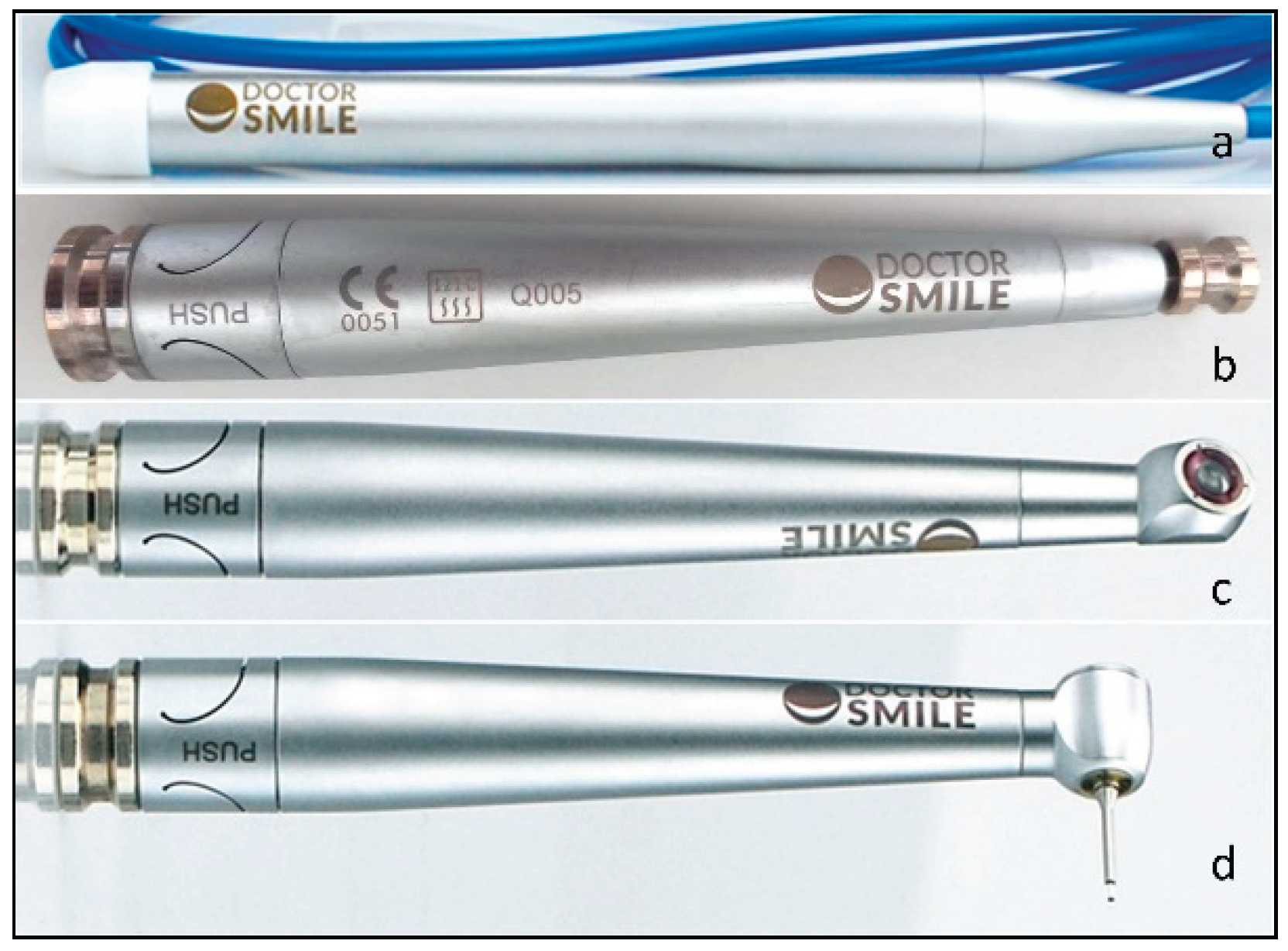
The laser handpieces and tips used in the study, with various angles and fiber diameters, were selected to cover a wide range of clinical applications, from direct treatment on accessible surfaces to irradiation of internal or hard-to-reach areas. The variants with different emission angles allowed us to evaluate the sterilization system's effectiveness on complex geometries, while the autoclavable parts were treated separately according to the standard procedures set forth in the relevant UNI EN standards.
Figure 1.
Diode laser tips White/Blue Fiber LAACS018.6. A, schematic drawing; B, set of standard tips used with the diode laser; the white and blue fibers are employed under different operating conditions and allow for a uniform distribution of energy.
Figure 1.
Diode laser tips White/Blue Fiber LAACS018.6. A, schematic drawing; B, set of standard tips used with the diode laser; the white and blue fibers are employed under different operating conditions and allow for a uniform distribution of energy.
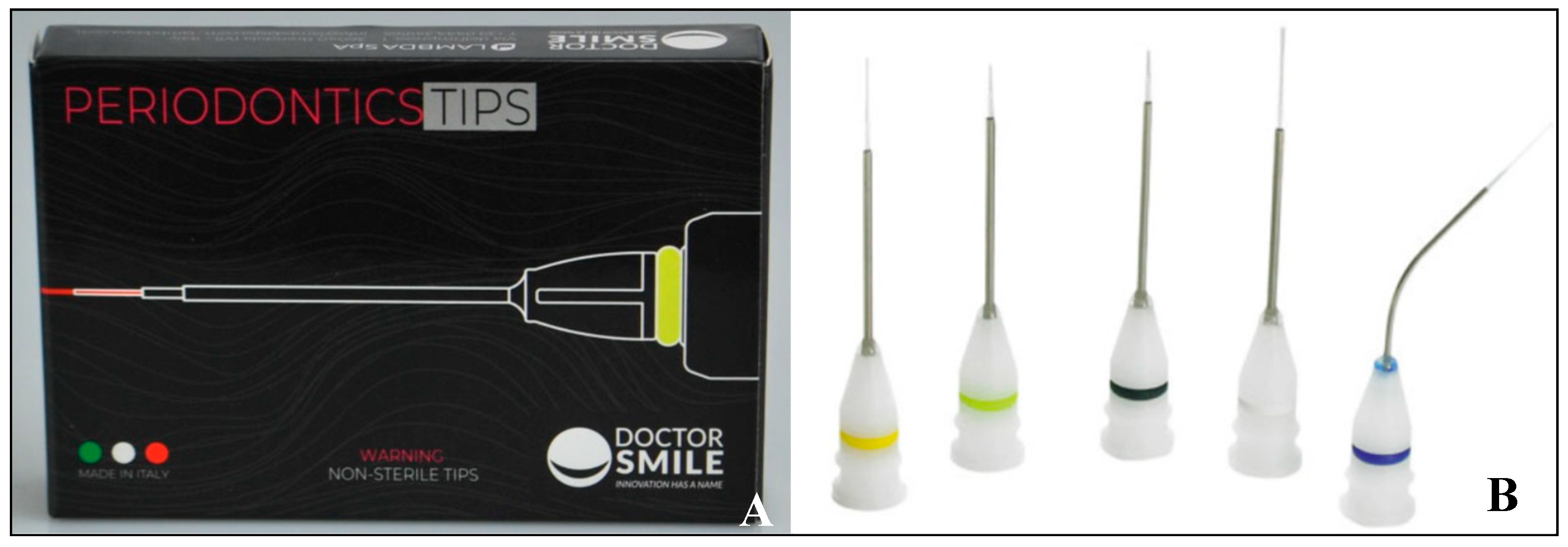
Figure 2.
Erbium laser tips with various diameters.
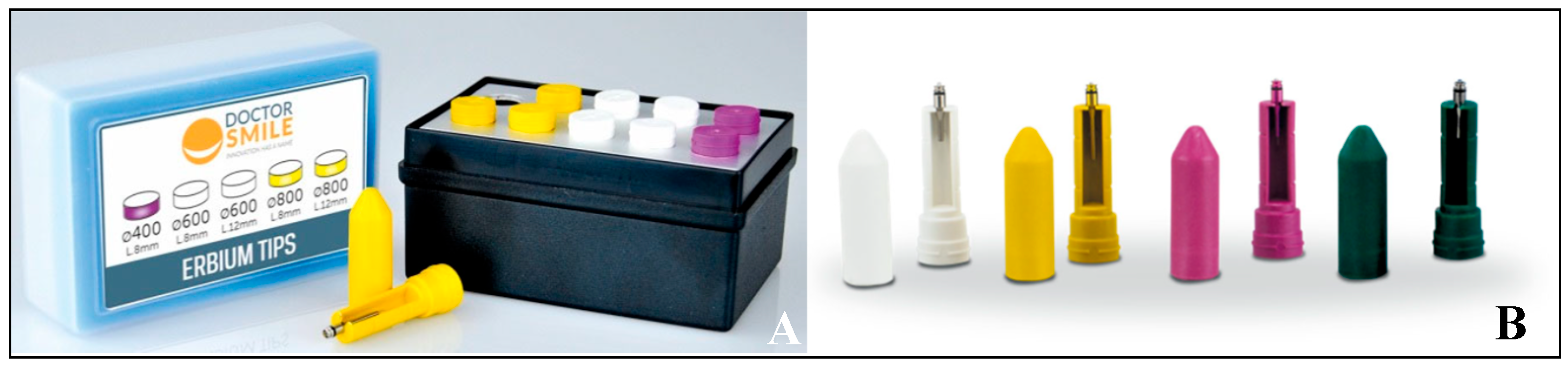
Figure 3.
(a) Complete WISER 3 BLUE handpiece (no interlock) with removable autoclavable cylindrical part LATPA 402.4, used as the main instrument; (b) Erbium handpiece 0° II version LOMAN 018.3, employed for direct applications with perpendicular emission to the treated surface; (c) 110° free radius handpiece II version LOMAN 018.9, allowing angled laser application in less accessible areas; (d) 90° Erbium handpiece II version LOMAN 018.2, suitable for treatments on lateral or internal surfaces that are difficult to reach.
Figure 3.
(a) Complete WISER 3 BLUE handpiece (no interlock) with removable autoclavable cylindrical part LATPA 402.4, used as the main instrument; (b) Erbium handpiece 0° II version LOMAN 018.3, employed for direct applications with perpendicular emission to the treated surface; (c) 110° free radius handpiece II version LOMAN 018.9, allowing angled laser application in less accessible areas; (d) 90° Erbium handpiece II version LOMAN 018.2, suitable for treatments on lateral or internal surfaces that are difficult to reach.
2.3. Preparation of Solutions
EC STER sterilizing solution was prepared at a concentration of 0.45% (4.5 g/L; batch 03/2025; internal code ICM/01/25) using municipal tap water as a diluent. The solution was stored at room temperature and used 30 minutes after preparation. The pH was checked before use.
2.4. Culture Media and Neutralizer
Tryptone Soya Agar (TSA) was used as the growth medium (pancreatic digest of casein 15 g, soy peptone 5 g, NaCl 5 g, agar 15 g, water to 1000 mL). The neutralizer used contained Tween 80 (30 g), soy lecithin (1 g), L-histidine (1 g), and sodium thiosulfate (5 g) in 1000 mL of water.
2.5. Equipment and Glassware
Apparatus for moist heat sterilization: An autoclave capable of being maintained at 135 °C for 5 min.
Water baths: Capable of being controlled at 20 °C ± 1 °C and at 45 °C ± 1 °C.
Incubator: Capable of being controlled at 36 °C ± 1 °C or 37 °C ± 1 °C, and at 30 °C ± 1 °C. The same temperature shall be used for all incubations performed during a test, as well as for its control and validation.
pH meter: Calibration accuracy of ± 0.1 pH units at 25 °C.
Other required equipment:
- ▪
- Stopwatch
- ▪
- Electromechanical shaker, e.g., Vortex mixer
- ▪
- Containers: test tubes, culture bottles, or bottles of suitable capacity
- ▪
- Graduated pipettes with nominal capacities of 10 mL, 1 mL, and 0.1 mL; calibrated automatic pipettes may be used
- ▪
- Petri dishes, 90 mm to 100 mm in diameter
- ▪
- Orbital mechanical shaker
- ▪
- Centrifuge, capable of 3000 rpm
- ▪
- Microscope, preferably phase-contrast type, with at least × 400 magnification
2.6. Contamination Procedure
A 1000 mL bacterial suspension was prepared and homogenized, then divided into two 500 mL aliquots. The devices were immersed in the microbial suspensions for 30 minutes at 22–25°C to simulate direct contamination with a defined contact time. After removal from the suspension, the devices were dried at 37°C to promote microbial adhesion and the initiation of biofilm formation. The treatment groups were:
- Group A: treatment with EC STER (1 min) followed by immersion in neutralizing solution for 5 min
- Group B: autoclave sterilization (135°C, 5 min) in pouches compliant with UNI EN 868-1, 868-3, 868-5
After exposure to the bacterial suspension, the devices were removed and transferred to sterile trays, then incubated at 37°C until completely dry to promote engraftment and possible initial biofilm formation.
The group of devices intended for autoclave sterilization was prepackaged in specific bags made of a paper-polymer film laminate, compliant with the requirements of UNI EN 868-1, UNI EN 868-3, and UNI EN 868-5 standards, suitable for steam sterilization.
Sterilization was performed in an autoclave at 135°C for 5 minutes, according to the standard methodology defined by the European Pharmacopoeia and the relevant technical standards (UNI EN 285, UNI EN 554) for saturated steam sterilization.
The devices assigned to treatment with the ECSTER system (reducing free radical generator) were immersed in 500 ml of active solution, the volume necessary to ensure complete immersion of the surfaces to be treated. At the end of the 1-minute contact time, as indicated by the manufacturer, the devices were transferred to a specific neutralizing solution and kept immersed for 5 minutes, a time sufficient to ensure the complete inactivation of the active ingredient.
2.7. Preparation of Microorganisms
To assess the effectiveness of the cold sterilization system, different bacterial strains were selected as representative models of resistance to disinfectants. These included Clostridioides difficile, a clinically relevant anaerobic spore-forming pathogen; Bacillus spizizenii (formerly Bacillus subtilis), the standardized reference strain for sporicidal activity; and Bacillus cereus, an additional spore-forming species of both environmental and clinical significance. Table 1 summarizes the growth conditions and inoculum levels employed in the experimental assays.
2.8. Recovery and Counting
After treatment, residual microorganisms were recovered by elution with 500 mL of sterile water, combined with mechanical scraping of the surfaces with sterile spatulas to detach biofilms and adherent cells. The elution liquid was subjected to serial dilutions and plated on TSA. The plates were incubated at 37°C for 24–48 h and the colonies were counted to determine the logarithmic reduction in microbial load. Each test was performed in duplicate.
3. Results
The initial concentrations of the bacterial suspension and the validations of the method and neutralizer confirmed the suitability of the experimental conditions (Table 2, Table 3 and Table 4).
The comparison between the two treatment groups (Table 5 and Table 6) shows that, in the presence of an initial load of 6.81 log₁₀ CFU/mL and structured biofilm, both the autoclave cycle and the EC STER treatment resulted in a total reduction in the detectable microbial load, reaching the method's sensitivity limit. No significant differences in log reductions were observed between the two methods, which are both deemed "effective" according to the criteria established by UNI EN 13727:2015 [15].
These results indicate that the EC STER system is able to match the performance of the autoclave even under complex contamination conditions, confirming its suitability for temperature-sensitive instruments. The test solutions remained stable throughout the procedure. The initial concentrations of the microbial suspension used are shown in the following table:
The effectiveness of the neutralizing solution was verified through suspension assays performed with the selected bacterial strains. This validation step confirmed that the neutralizer did not exert residual antimicrobial activity and that the recovery of viable microorganisms remained within the required limits. Table 3 presents the suspension concentrations obtained for each strain, along with the acceptance criteria and compliance status.
To ensure the reliability of the experimental procedure, validation of both the method and the neutralizing solution was performed using three representative microorganisms (Clostridioides difficile, Bacillus spizizenii, and Bacillus cereus). The results, summarized in Table 4, confirmed that the minimum inoculum requirements were fulfilled, the neutralizer was non-toxic, and its neutralizing capacity was adequate.
These findings demonstrate that neither the method nor the neutralizer interfered with the test outcome, thereby ensuring the validity of the reduction data obtained in subsequent sterilization assays.
The results obtained demonstrate that the method and the neutralizer did not interfere with the test and that the neutralizer effectively blocked the action of the product. The test suspension concentration was 6.81 log. Following method validation, the performance of the reference autoclave sterilization cycle (135 °C, 5 min, controlled pressure) was evaluated. The results, summarized in Table 5, show that autoclave treatment achieved complete elimination of detectable microorganisms, reducing microbial counts to the detection limit of the method.
The performance of the cold sterilization system based on reducing free radicals (ECSTER) was evaluated under the same experimental conditions as the autoclave cycle, using a product concentration of 4.5 g/L and a contact time of 1 minute. As shown in Table 6, the treatment achieved a microbial reduction comparable to that obtained with autoclaving, lowering the bacterial load to the detection limit of the method. These findings demonstrate that the ECSTER system can ensure effective sterilization even in the presence of a high initial microbial load and biofilm structures, thereby confirming its potential as a valid alternative to heat-based sterilization for thermosensitive medical devices.
4. Discussion
The data obtained confirm that reducing free radical technology can represent a valid alternative to steam sterilization, especially for heat-sensitive materials and devices [8,9,12]. The fact that the results were obtained on an experimental model with multi-strain biofilm lends further robustness to the conclusions, as it simulates real-world hospital contamination scenarios [14].
Comparing these results with previous studies, it emerges that low-temperature systems based on oxidizing agents or plasma have achieved reductions of ≥6 log₁₀ on bacterial spores and viruses, but sometimes require longer contact times or more complex operating conditions [10,11,23]. The EC STER system stands out for its very short treatment time (1 min), making it particularly suitable for clinical settings with high instrument turnover.
Regarding clinical application, pilot studies on the use of similar systems in dentistry and outpatient surgery are reported in the literature, in which reducing free radical sterilization was associated with an absence of post-treatment contamination and better maintenance of the physical characteristics of the instruments compared to steam [13,24,25]. However, the availability of large-scale controlled clinical studies is still limited, suggesting the need for further research to confirm its effectiveness in routine use.
The results obtained confirm that the reducing free radical-based cold sterilization system is capable of achieving microbial reduction levels equivalent to those of an autoclave cycle. This makes it particularly attractive for use on temperature-sensitive devices, where the use of heat would be harmful or impractical.
The use of mixed cultures and C. difficile in biofilm conditions increases the significance of the study and extends its clinical applicability, providing a model more closely aligned with the operational reality of highly critical healthcare environments.
Our findings indicate that reducing radical–based technology represents a promising alternative to conventional steam sterilization, particularly for heat-sensitive materials and instruments [8,9,12]. The complete microbial reduction achieved, even in the presence of complex multi-strain biofilms, suggests that the EC STER system may provide an efficacy comparable to that of a standard autoclave cycle, while offering the advantage of substantially shorter treatment times.
The active principle of the product consists of reducing free radicals generated in an aqueous solution at basic pH. Its mechanism of action relies on electron transfer, which targets microbial protein structures, inducing irreversible chemical damage and leading to their immediate inactivation. This mode of action differs from that of conventional oxidizing agents and, owing to the reducing nature of the radicals and the basic pH of the solution, does not induce oxidative phenomena on treated surfaces, thereby preserving the integrity and functionality of medical instruments.
The sporicidal activity test of the EC STER spray formulation, performed on contaminated medical instruments, demonstrated a spore reduction exceeding 8 log within only 15 seconds of contact. This result, which is exponentially higher than the 6-log reduction threshold required to validate a system as a “sterilant,” highlights not only the high efficacy of the product but also the remarkable speed of the process. Such rapid sterilization substantially decreases the risk of operator infection, as microorganisms are inactivated before they can migrate or spread into the surrounding environment.
Comparison with the literature indicates that other cold sterilization systems, such as plasma or oxidizing agents, can also achieve microbial reductions of ≥6 log, but often require longer exposure times or more complex operating conditions [10,11,23]. The ability of EC STER to achieve equivalent efficacy within an exceptionally short timeframe makes it particularly suitable for clinical settings with high instrument turnover, where rapid turnaround is crucial.
From a mechanistic perspective, reducing radicals act effectively on complex microbial structures, including mature biofilms and spores. This accounts for the efficacy observed even against notoriously resistant microorganisms such as Clostridioides difficile. In addition, the absence of thermal stress represents a further advantage over autoclaving, allowing delicate devices such as laser handpieces and optical fibers to be safely treated without compromising their functionality, an aspect of particular relevance in routine clinical practice, where maintaining both sterility and instrument performance is essential.
Cold sterilization based on reducing radicals represents an innovative, rapid, and safe approach. The ability to inactivate >8 log of spores within seconds, while preserving treated surfaces and avoiding thermal stress, positions EC STER as a potentially revolutionary solution for the management of heat-sensitive instruments, with significant implications for infection prevention and the optimization of clinical workflows.
This study nevertheless presents some limitations: the tests were conducted in vitro and on a limited number of microbial strains. It will therefore be necessary to validate these findings under real clinical conditions, across a broader range of instruments and microorganisms, and to assess the long-term compatibility of materials after repeated treatment cycles. Looking ahead, controlled clinical studies and large-scale testing could provide further insights into the safety, economic sustainability, and environmental impact of this technology. In particular, comparative evaluations of costs, maintenance requirements, and cycle times versus conventional methods will be crucial to supporting its adoption in both healthcare and industrial settings.
In summary, reducing radical–based cold sterilization emerges as a promising approach that combines rapid antimicrobial action with preservation of delicate instruments. While these findings are encouraging, further validation under real-world clinical conditions will be essential before widespread implementation can be recommended.
5. Conclusions
The tested system represents a valid, effective, and safe alternative to traditional autoclave sterilization. Its performance under complex experimental conditions, including the presence of biofilms and mixed cultures, confirms its potential for large-scale use in healthcare and industrial settings. An additional advantage is the potential to safeguard the efficiency and longevity of delicate instruments such as laser handpieces and fibers, which are often compromised by high-temperature sterilization. The study will need to be completed with further material compatibility testing and validation under real-world operating conditions.
Author Contributions
Conceptualization, C.C. and S.B.; methodology, C.C.; validation, C.C.; formal analysis, C.C.; investigation, C.C.; resources, C.C. and S.B.; data curation, C.C. and D.B.; writing—original draft preparation, C.C. and D.B.; writing—review and editing, C.C., S.B. and D.B.; supervision, C.C.; project administration, C.C. and S.B.; funding acquisition, C.C. and S.B. All authors have read and agreed to the published version of the manuscript.
Funding
ICM SRL C/DA TORRE, SNC Portigliola (RC) Italia.
Institutional Review Board Statement
Not applicable.
Informed Consent Statement
Not applicable.
Data Availability Statement
The data presented in this study are available from the corresponding author upon reasonable request.
Acknowledgments
The authors gratefully acknowledge Dr. Felice Alberto Martelli, inventor of the EC STER system, for his technical support and valuable insights regarding the device. The authors also thank Lambda S.p.A., Brendola (VI), Italy, for providing the materials and instruments used in this research. The sporicidal efficacy test of the Spray variant on medical devices was performed by Eurolab. The study on biofilm grown on dental implants was conducted by the University of Perugia (UNIPG).
Conflicts of Interest
The authors declare no conflicts of interest.
Abbreviations
The following abbreviations are used in this manuscript:
| NCTC | National Collection of Type Cultures |
| ATCC | American Type Culture Collection |
| TSA | Tryptic Soy Agar |
| CFU | Colony-Forming Unit |
| BHIS | Brain Heart Infusion with Supplements |
| ICM | Initial Contamination Microbial load |
References
- Rutala, W\.A.; Weber, D.J. Disinfection and Sterilization in Health Care Facilities: An Overview. Am. J. Infect. Control 2016, 44, e1–e6.
- McDonnell, G.; Russell, A.D. Antiseptics and Disinfectants: Activity, Action, and Resistance. Clin. Microbiol. Rev. 1999, 12, 147–179.
- Lerouge, S.; Wertheimer, M.R.; Yahia, L.H. Plasma Sterilization: A Review of Parameters, Mechanisms, and Limitations. Plasma Process. Polym. 2001, 8, 175–188.
- Rogers, J.V.; Sabourin, C.L.; Choi, Y.W.; Richter, W\.R. Evaluation of Ethylene Oxide Sterilization for Medical Devices. J. Appl. Microbiol. 2008, 105, 1643–1651.
- Peracetic acid sterilization of heat-sensitive medical instruments. Infect. Control Hosp. Epidemiol. 1995, 16, 348–353. [CrossRef]
- Block, C.; Robson, D.; Barrett, S.P. Use of peracetic acid in endoscope disinfection: Evaluation of efficacy and safety. J. Hosp. Infect.1998, 301–307. [CrossRef]
- Baldry, M.G.C.; Fraser, J.A.L. Disinfection with peracetic acid. \J.
- Dukan, S.; Touati, D. Hypochlorous Acid Stress in Escherichia coli: Resistance, DNA Damage, and Comparison with Hydrogen Peroxide Stress. J. Bacteriol. 1996, 178, 6145–6150.
- Block, S.S. Disinfection, Sterilization, and Preservation, 5th ed.; Lippincott Williams & Wilkins: Philadelphia, PA, USA, 2001.
- Rossi, F.; et al. Cold Plasma for Medical Device Decontamination: A Systematic Review. J. Hosp. Infect. 2020, 105, 123–134.
- Fridman, G.; et al. Applied Plasma Medicine. Plasma Process. Polym. 2008, 5, 503–533.
- Maillard, J.Y. Bacterial Target Sites for Biocide Action. J. Appl. Microbiol. 2002, 92, 16S–27S.
- Leprat, R.; Michel, M.; Bayon-Auboyer, M.H. Evaluation of a Cold Sterilization System for Dental Instruments. J. Dent. Res. 2018, 97, 1356–1362.
- Bridier, A.; et al. Resistance of Bacterial Biofilms to Disinfectants: A Review. Biofouling 2011, 27, 1017–1032.
- UNI EN 13727:2015. Disinfettanti chimici ed antisettici—Prova quantitativa in sospensione per la valutazione dell’attività battericida in area medica—Metodo di prova e requisiti (fase 2, stadio 1). Ente Italiano di Normazione: Milano, Italia.
- UNI EN 17126:2019. Valutazione dell’attività sporicida dei disinfettanti chimici in ambito medico. Ente Italiano di Normazione: Milano, Italia.
- UNI EN 14476:2019. Prova quantitativa in sospensione per attività virucida in area medica. Ente Italiano di Normazione: Milano, Italia.
- UNI EN 13624:2022. Prova quantitativa in sospensione per attività fungicida e levuricida in campo medico. Ente Italiano di Normazione: Milano, Italia.
- UNI EN 14348:2005. Valutazione dell’attività micobattericida dei disinfettanti chimici. Ente Italiano di Normazione: Milano, Italia.
- UNI EN ISO 9001:2015. Sistemi di gestione per la qualità—Requisiti. Ente Italiano di Normazione: Milano, Italia.
- UNI EN ISO 13485:2021. Dispositivi medici—Sistemi di gestione per la qualità—Requisiti per scopi regolamentari. Ente Italiano di Normazione: Milano, Italia.
- Regolamento (UE) 2017/745 del Parlamento Europeo e del Consiglio, del 5 aprile 2017, relativo ai dispositivi medici.
- Herrmann, H.W.; Henins, I.; Park, J.; Selwyn, G.S. Decontamination of Chemical and Biological Warfare (CBW) Agents Using an Atmospheric Pressure Plasma Jet. Phys. Plasmas 1999, 6, 2284–2289.
- Jeng, D.K.; Woodworth, A.G. Evaluation of a Peracetic Acid-Based Cold Sterilization System for Endoscopes. Am. J. Infect. Control 1990, 18, 244–250.
- Tuttlebee, C.M.; et al. Effect of Disinfectant Exposure on the Physical Properties of Dental Instruments. J. Hosp. Infect. 2002, 52, 244–250.

Table 1.
Bacterial strain used and inoculum.
| Strain | Growth Conditions | Required Inoculum (CFU/mL) |
Inoculum (CFU/mL) |
|---|---|---|---|
| Clostridioides difficile (formerly Clostridium difficile) R027 NCTC 13366 | Anaerobic, Tryptic Soy Agar (TSA) | 1.5 – 5.0 x 10⁶ | 1.2 x 10² |
| Bacillus spizizenii (formerly Bacillus subtilis) ATCC 6633 | TSA (1-2 days – 36°C) | 3.1 x 10² | |
| Bacillus cereus ATCC 9634 | 2.2 x 10² |
Table 2.
Concentration of the suspension used for the test.
| Strain | (CFU/ml) | Requirement (CFU/ml) | Compliant |
|---|---|---|---|
| Clostridioides difficile | 1.2 x 10² | 1.0 x 10⁶ CFU/mL | Yes |
| Bacillus spizizenii | 3.1 x 10² | Yes | |
| Bacillus cereus | 2.2 x 10² | Yes | |
| Total | 6.5 x 10² | Yes |
Table 3.
Suspension concentration for validating the action of the neutralizer.
| Strain | (CFU/ml) | Requirement | Compliant |
|---|---|---|---|
| Clostridioides difficile | 2.7 x 10⁴ | 3.0 x 10⁴ – 1.6 x 10⁵ CFU/mL |
Yes |
| Bacillus spizizenii | 3.1 x 10⁴ | Yes | |
| Bacillus cereus | 3.2 x 10⁴ | Yes |
Table 4.
Test validation results.
| Strain | Description | Requirement (CFU/mL) |
Results (CFU/mL) |
Compliant |
|---|---|---|---|---|
| Clostridioides difficile | Method Validation | ≥ 1.2 x 10² | 1.2 x10² | Yes |
| Assessment of neutralizer non-toxicity | Yes | |||
| Neutralizer validation (product neutralization capacity) | Yes | |||
| Bacillus spizizenii | Method Validation | ≥ 3.1 x 10² | 3.1 x10² | Yes |
| Assessment of neutralizer non-toxicity | Yes | |||
| Neutralizer validation (product neutralization capacity) | Yes | |||
| Bacillus cereus | Method Validation | ≥ 2.2 x 10² | 2.2 x10² | Yes |
| Assessment of neutralizer non-toxicity | Yes | |||
| Neutralizer validation (product neutralization capacity) | Yes |
Table 5.
Test Group B – standard autoclave cycle sterilization (135 °C, 5 min, controlled pressure).
Table 5.
Test Group B – standard autoclave cycle sterilization (135 °C, 5 min, controlled pressure).
| Initial bacterial suspension (log₁₀ CFU/mL) | Reduction after sterilization (log₁₀ CFU/mL) | Microbial count reduction (log₁₀ CFU/mL): R = log₁ – log₂ |
Evaluation |
|---|---|---|---|
| 6.81 | 6.81 | 6.81 – 6.81 = 0 | Effective |
Table 6.
Test Group A: cold sterilization with reducing free radicals – ECSTER test (product concentration 4.5 g/L, contact time 1 min).
Table 6.
Test Group A: cold sterilization with reducing free radicals – ECSTER test (product concentration 4.5 g/L, contact time 1 min).
| Initial bacterial suspension (log₁₀ CFU/mL) | Reduction after sterilization (log₁₀ CFU/mL) | Microbial count reduction (log₁₀ CFU/mL): R = log₁ – log₂ | Evaluation |
|---|---|---|---|
| 6.81 | 6.81 | 6.81 – 6.81 = 0 | Effective |
Disclaimer/Publisher’s Note: The statements, opinions and data contained in all publications are solely those of the individual author(s) and contributor(s) and not of MDPI and/or the editor(s). MDPI and/or the editor(s) disclaim responsibility for any injury to people or property resulting from any ideas, methods, instructions or products referred to in the content. |
© 2025 by the authors. Licensee MDPI, Basel, Switzerland. This article is an open access article distributed under the terms and conditions of the Creative Commons Attribution (CC BY) license (http://creativecommons.org/licenses/by/4.0/).
Copyright: This open access article is published under a Creative Commons CC BY 4.0 license, which permit the free download, distribution, and reuse, provided that the author and preprint are cited in any reuse.


