

Submitted:
03 October 2025
Posted:
04 October 2025
You are already at the latest version
Abstract
The purpose of this paper is to determine the local dimension of the critical locus of a generic singularity. We use combinatorial methods to calculate this dimension in terms of a convex object associated with the singularity, called the Newton polyhedron. In the article we prove that the local dimension of the critical locus of a generic singularity \( f:(\mathbb{C}^n,0)\longrightarrow (\mathbb{C},0), n\leq 4, \) is equal to the combinatorial dimension of the Newton polyhedron of the gradient mapping \( \nabla f. \) Therefore there is some symmetry between combinatorial properties of the Newton polyhedron of a generic singularity and geometric properties of its critical locus.
Keywords:
combinatorial dimension
; generic dimension
; critical locus
; nondegeneracy
; Newton polyhedron
; complex singularity
MSC: Primary: 32SO5. Secondary: 13C15
1. Introduction
In our research, we study discrete invariants of complex analytic singularities. More precisely, we try to read these invariants from a certain combinatorial convex object in real space, associated with a singularity, called the Newton polyhedron. A singularity is represented by a holomorphic function defined in some neighborhood of a critical point. In the sixties and seventies of the last century Vladmir I. Arnold posed the following problems related to the Newton polyhedron of a singularity (see [1]) :
- 1968-2
- What topological characteristics of a real (complex) polynomial are computable from the Newton polyhedron (and the signs of the coefficients)?
- 1975-1
- Every interesting discrete invariant of a generic singularity with a Newton polyhedron is an interesting function of the polyhedron. Study: the signature, the number of moduli, the singularity index, the integral monodromy, the variation, the Bernstein polynomial, and (for generic section).
- 1975-21
- Express the main numerical invariants of a typical singularity with a given Newton polyhedron (e.g., the signature, the genus of the 1-dimensional Milnor fiber) in terms of the polyhedron.
So far, many of invariants have been read off from the Newton polyhedron of a generic singularity (i.e. singularity with generic coefficients). The most important of them is the Milnor number [11]. Also bifurcation set of a polynomial function [23], zeta-function of monodromy [20], Lojasiewicz exponent [2,3,9,13,14], Lê numbers [7], local Euler obstruction of isolated determinantal singularities [8,21] are determined by the Newton polyhedron. So we see many geometric and topological properties of a generic singularity are reflected in corresponding combinatorial properties of its Newton polyhedron. Thus, we can say that there is some kind of symmetry between a generic singularity and its Newton polyhedron.
In this paper we study the dimension of the critical locus of a generic singularity and we want to show that it is determined by the Newton polyhedron. It is known, that if singularities have the same Newton polyhedron and their Lê numbers exist then their critical loci have the same dimension [7]. It seems that the assumption about the existence of the Le numbers is unnecessary. This is how the hypothesis was born that critical loci of generic singularities with the same Newton polyhedron have the same dimension. Firstly, we studied the case of an isolated singularity i.e. its critical locus has zero dimension, in [4] we gave combinatorial conditions in terms of the Newton polyhedron to check when a generic singularity is an isolated singularity. In [18] we generalized this result to the case of non-isolated singularity and we gave a formula for the dimension of the critical locus of a generic singularity in terms of the Newton polyhedron of The main result of our article is to extend this result to the case More precisely, we prove that the dimension of the critical locus of a generic singularity is equal to the combinatorial dimension of the Newton polyhedron of the gradient mapping (see Theorem 3, Corollary 1). Our result confirms Arnold’s Conjecture in this case. It is possible to compute a dimension of an analytic set by Gröbner basis ([5]). However the complexity of the Gröbner basis computations may by exponential and our combinatorial methods could be more effective in many cases. To get singularities with generic coefficients we use the Kushnirenko nondegeneracy (see Preliminaries). Also C.T.C Wall gave some similar nondegeneracy conditions, but his conditions are too strong and imply that the singularity nondegenerate in his sense has to be an isolated singularity (see [22]). The concept of the nondegeneracy of singularity is studied in detail in books by Oka [17] and Mondal [16]. Another aspect of our paper is finite determinacy. Recall an analytic function f is finitely determined if its topology is determined by its Taylor polynomial of some degree. It is known that f is finitely determined if and only if it has an isolated singularity [15,19]. We show that dimension of the critical locus of Kushnirenko nondegenerate singularity is finitely determined (see Corollary 2, 3). Hence calculation of a dimension of the critical locus is more easy in this case (see Example 4).
2. Preliminaries
Put Let be a singularity i.e. a germ of a holomorphic function having critical point at Denote by the germ of the critical locus of If , then we say f is an isolated singularity. The germ f is represented by a convergent power series:
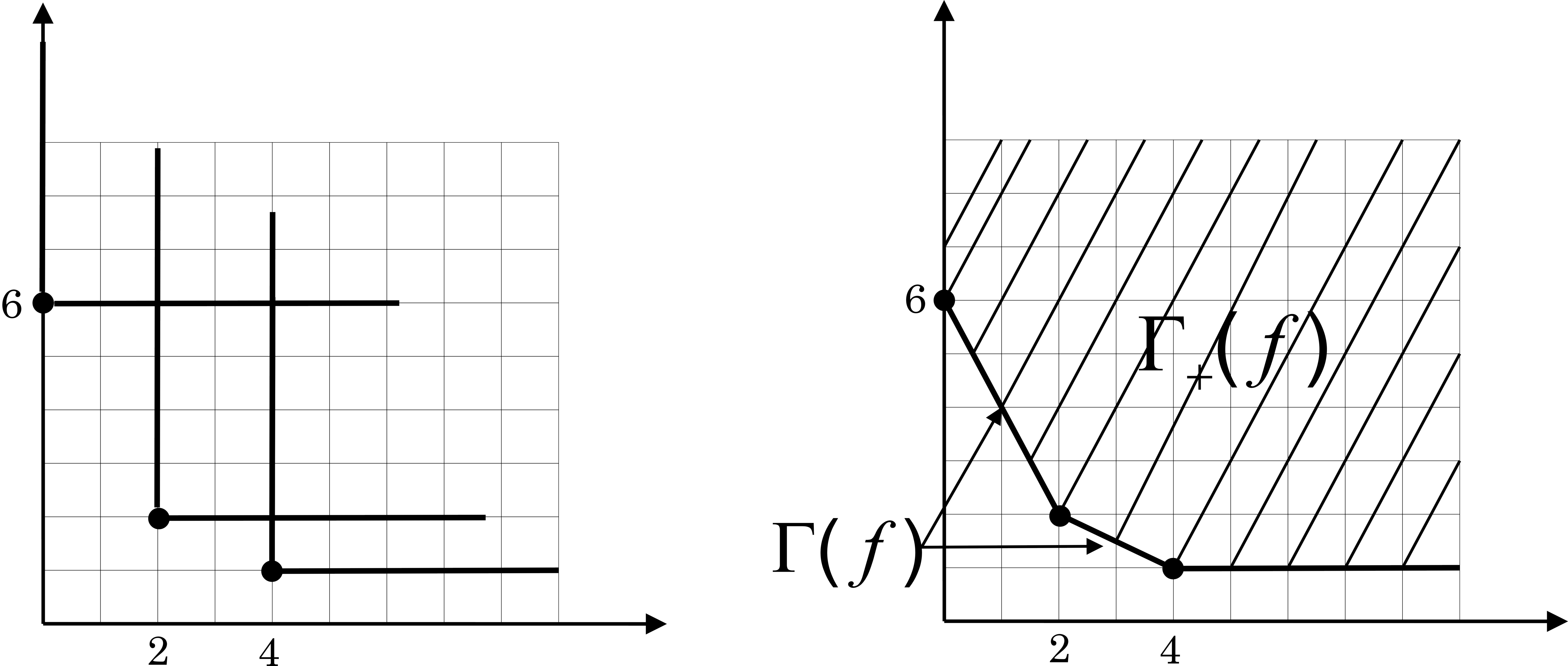
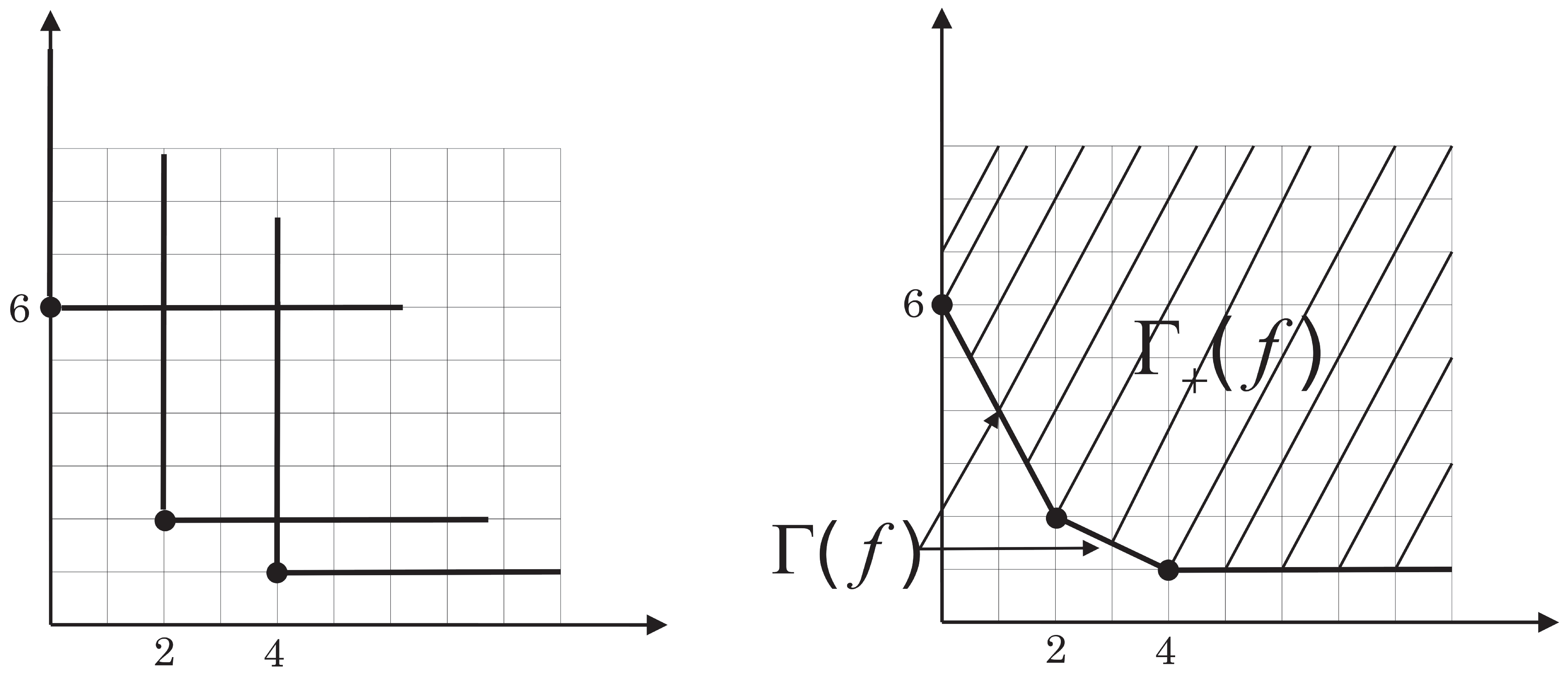
Figure 1.
Newton polyhedron of
We will now give some definitions following famous Kushnirenko paper [11]
- - support off
- - convex hull of - Newton polyhedron of f
- - family of compact faces of - Newton boundary of f
- f - Kushnirenko nondegenerate on if the system of equationshas no solution in .
- f - Kushnirenko nondegenerate, if f nondegenerate on each face
If we start with a given subset we can also define an abstract Newton polyhedron as a convex hull of sets Then we say that is generated by
Now, we pass to the case of the mapping. Let be a germ of a holomorphic mapping and be a tuple of subsets of
Now, we will introduce the following definitions.
Definition 1.
We define a tuple
and call it the support of f.
Definition 2.
We define a tuple
and call it the Newton polyhedron of f.
We define a tuple
and call it an abstract Newton polyhedron generated by .
Let we put
so is the coordinate subspace spanned by axes
Definition 3.
We say satisfies -Kushnirenko condition (simply (k)-condition) if for each there are at least nonempty sets among the following sets:
Definition 4.
We say f satisfies -Kushnirenko condition (simply (k)-condition) if satisfies -Kushnirenko condition.
Remark 1.
For we will shortly write the Kushnirenko condition instead of -Kushnirenko condition. It seems that Kushnirenko was the first, who gave such condition [12]. If f is a function (not a mapping) then Definition 4 is different from [18, Definition 2.2]. In this case the old definition of the Kushnirenko condition [18, Definition 2.2] corresponds to the condition satisfy -Kushnirenko condition in the sense of our new Definition 4. Hertling and Kurbel collected conditions equivalent to the Kushnirenko condition in the case of quasihomogeneous polynomial [10], but this lemma is also true without the assumption of quasihomogeneity.
Definition 5.
We define a combinatorial dimension of
Example 1.
Let It easy to see that for each there is exactly nonempty subsets among Hence ”a density” of on each coordinate subspace I is maximal and equal to Therefore the combinatorial dimension is minimal,
Example 2.
Let Observe that all are empty sets and ”a density” on axis is minimal. Hence It easy to check that for each there is at least nonempty subsets among Summing up
Remark 2.
Since if and only if for each we get that
Remark 3.
It is also easy to observe the following conditions are equivalent:
- satisfies k-condition and it does not satisfy - condition.
3. Main Results
In the paper [18] we prove the following theorem:
Theorem 1.
Let be a singularity. If f is Kushnirenko nondegenerate then the following conditions are equivalent:
- (i)
- (ii)
- satisfies d-condition and it does not satisfy - condition,
for each
By Remarks 1, 2, 3 we can reformulate the above theorem as following.
Theorem 2.
Let be a singularity. If f is Kushnirenko nondegenerate, then
Roughly speaking, is a measure of the density of supports on the coordinate subsystems. If this density increases in all coordinate subsystems, the dimension of the critical locus decreases. If this density is maximal, then the singularity has an isolated critical point at
Therefore we may put forward the following conjecture.
Hypothesis 1.
Let be a singularity. If f is Kushnirenko nondegenerate, then
Now, we give the main result of the paper, which confirms our conjecture for
Theorem 3.
Let be a singularity. If f is Kushnirenko nondegenerate, then
Example 3.
Let
We easily check that f is Kushnirenko nondegenerate. Put We get all supports in are disjoint with Therefore f does not satisfy 0 - Kushnirenko condition. On the other hand it is easy to see f satisfies 1-Kushnirenko condition. Hence
As a direct corollaries of the main result we get the following:
Corollary 1.
Let be a singularity. If f is Kushnirenko nondegenerate, then
Corollary 2.
Let be Kushnirenko nondegenerate singularities. If then
Since the Newton polyhedron is determined by a finite number of vertices, then as a direct consequence of Corollary 2 we have the following.
Corollary 3.
The dimension of the critical locus is finitely determined in the class of Kushnirenko nondegenerate singularities of n-variables,
Remark 4.
Finite determinacy means that this dimension is uniquely determined by a finite numbers of terms in the Taylor series of singularity.
Example 4.
Consider the polynomial function
The Newton diagram of f is nothing but the triangle in (with coordinates ) defined by the vertices , and . We easily check that f is Kushnirenko nondegenerate singularity. Now, put
It is easy to check that g is Kushnirenko nondegenerate, and has the same Newton polyhedron. We easily calculate Hence by Corollary 2 we also get
4. The Proof of the Main Results
We will imitate the proof of [Theorem 3.2] [18]. However the proof in the case requires more effort, which is shown in the following lemma.
Lemma 1.
Let be a nondegenerate singularity. If then does not satisfy - Kushnirenko condition.
Proof.
Therefore without loss of a generality we can assume that Now, let’s expand f with respect to
Hence Consider cases:
- Then Put Then are empty sets. Hence does not satisfy (1) - Kushnirenko condition.
-
Since f is nondegenerate, then is also nondegenerate andTherefore without loss of a generality we can assume thatNow, let’s expand and with respect toHence Therefore function are identically equal to 0 and f has a form:or Put Then are empty sets. Hence does not satisfy (1) - Kushnirenko condition.
It finishes the proof. □
Proof of Theorem 3.
Let By Remark 3 it is enough to prove the equivalence of conditions i) and ii). Since the conditions ii) are disjoint for different it is enough to prove only implication from i) to ii). By [18] satisfies - Kushnirenko condition. It is enough to show that does not satisfy - Kushnirenko condition. Let’s consider the cases:
It finishes the proof. □
Funding
This research was funded by Rector of Poznan University of Technology; grant number 0213/SBAD/0119.
Conflicts of Interest
The author declare no conflicts of interest.
References
- Arnold, V. I. Arnold’s problems. Springer-Verlag: Berlin; Moscow, 2004.
- Brzostowski, Sz. 2019. A note on the Łojasiewicz exponent of non-degenerate isolated hypersurface singularities. In Analytic and algebraic geometry, Edited by Krasiński, T. and Spodzieja, S. Lodz: Lodz University Press, vol. 3, pp. 27–40.
- Brzostowski, Sz.; Krasiński, T.; Oleksik, G. The Łojasiewicz exponent of nondegenerate surface singularities. Canad. Math. Bull. 2023, 64, 1391–1410.
- Brzostowski, Sz.; Oleksik, G. On combinatorial criteria for non-degenerate singularities. Kodai Math. J. 2008, 39, 455–468.
- Cox, D. A.; Little J.; O’Shea D. Ideals, Varieties, and Algorithms. An Introduction to Computational Algebraic Geometry and Commutative Algebra. Springer 2015.
- Damon, J.; Gaffney, T. Topological triviality of deformations of functions and Newton filtrations. Invent. Math. 1983, 72, 335–358.
- Eyral, C.; Oleksik, G.; Różycki, A. Lê numbers and Newton diagram. Advances in Mathematics 2021, 376, 107441.
- Esterov, A. I. Determinantal Singularities and Newton Polyhedra. Trudy Mat. Inst. Steklova 2007, 259, 20–38.
- Fukui, T. Łojasiewicz type inequalities and Newton diagrams. Proc. Am. Math. Soc. 1991, 112, 1169–1183.
- Hertling, C. A.; Kurbel, R. On the classification of quasihomogeneous singularities. J. Singul. 2012, 4, 131–153.
- Kushnirenko, A. G. Polyèdres de Newton et nombres de Milnor. Invent. Math. 1976, 32, 1–31.
- Kushnirenko, A. G. Criteria for the existence of a non-degenerate quasihomogeneous function with given weights. Usp. Mat Nauk 1977, 32, 169–170 (in Russian).
- Lenarcik, A. On the Łojasiewicz exponent of the gradient of a holomorphic function. Banach Center Publications 1998, 112, 149–166.
- Lichtin, B. Estimation of Lojasiewicz exponents and Newton polygons. Invent. Math. 1981, 64, 417–429.
- Mather, J. Stability of C∞ mappings III Publ. Math. I.H.É.S. 1969, 35, 127–156.
- Mondal, P. How many zeroes? Springer CMS/CAIM, 2021.
- Oka, M. Non-degenerate complete intersection singularity. Hermann, Paris 1997.
- Oleksik, G. On a generic dimension of the critical locus. Results Math. 2020, 75, 1–9.
- Tougeron, J. -C. Idéaux de fonctions différentiables I Ann. Inst. Fourier 1968, 8, 177–240.
- Varchenko, A.N. Zeta-function of monodromy and Newton’s diagram. Invent. Math. 1976, 37, 253–262.
- Varella Costa, M. D. 2024. Newton Polyhedra and Invariants of Determinantal Singularities. Phd, Universidade Federal de São Carlos, Brasil.
- Wall, C. T. C. Newton polytopes and non-degeneracy. J. Reine Angew. Math. 1999, 509, 1–19.
- Zaharia, J. On the bifurcation set of a polynomial function and Newton boundary II. Kodai Math. J. 1996, 19, 218–233.
Disclaimer/Publisher’s Note: The statements, opinions and data contained in all publications are solely those of the individual author(s) and contributor(s) and not of MDPI and/or the editor(s). MDPI and/or the editor(s) disclaim responsibility for any injury to people or property resulting from any ideas, methods, instructions or products referred to in the content. |
© 2025 by the authors. Licensee MDPI, Basel, Switzerland. This article is an open access article distributed under the terms and conditions of the Creative Commons Attribution (CC BY) license (http://creativecommons.org/licenses/by/4.0/).
Copyright: This open access article is published under a Creative Commons CC BY 4.0 license, which permit the free download, distribution, and reuse, provided that the author and preprint are cited in any reuse.


