

Submitted:
16 September 2025
Posted:
17 September 2025
You are already at the latest version
Abstract
There is even more pressure on the global construction industry to improve its sustainability whilst striving to meet the performance standards of the infrastructure. The pyrolysis of biomass has produced one of the carbon-rich products, biochar, which has been identified as a potential source of modifier to bitumen asphalt binder. This is a review that is an integration of the current research on the use of biochar waste in bitumen reinforcement and the impacts it has on the physical properties, rheological behaviour, resistance to aging, and advantages it has on the environment. Discussion 43 literature shows that adding the optimal quantity of biochar raises the rigidity, thermal stability, and rutting resistance of the binder up to the industry standards. Biochar could also be considered a product satisfying the principles of the circular economy in infrastructure construction and a means of waste management alongside a performance-enhancing substance. Experiments in the laboratory indicate that biochemical char-modified binders possess better sustainability qualifications and also have an equivalent or better rate of working compared to their traditional counterparts in synthetic modifiers. Nonetheless, to achieve effective industrialisation, consideration must be given to the economic constraints; it is essential to establish protocols about standardization, and extensive validation in field studies ought to be done.
Keywords:
biochar
; bitumen modification
; sustainable pavements
; waste valorization
; rheological properties
; aging resistance
; construction materials
1. Introduction
The occurrence of the global transportation infrastructure is dependent on the asphalt pavements, which are subjected continually to the implementation of aging processes and environmental abuse, as well as the necessity of the sustainability of their construction methodologies. Given that world road networks are set to increase by approximately 50 percent over the next 15 years and pavements that are already in service are becoming older, the construction industry finds itself with a two-fold challenge: to continue to support pavement performance, yet to minimize the environmental effects. This issue has made the study of alternative materials and technologies, which will simultaneously provide longer life to pavements and contribute to the sustainability goals, more important than ever.
One of the most important causes of pavement damage and loss is asphalt aging. In performing this exercise in two pavement layers, came up with an observation that the efficiency shifts in hot recycled asphalt mixture are a reality brought about by the combination of more than two aging factors. This explains the intertwined and multidimensional character of the aging process in the asphalt system. Along the way, such aging processes result in hardening, intensifying brittleness, and consequently the ultimate failure of the pavement, requiring highly expensive maintenance and rebuilding actions, which both strain the economic and the environmental structures.
To counter the problem of aging, scientists have experimented with different modification solutions to improve the performance of asphalt and increase service life. The tested rheological behaviours and their anti-aging mechanisms in recycled asphalts by employing a low-viscosity asphalt and polymers in understanding the contribution of material alteration to combating effectively the effects of aging and the recycled content. It is a double-edged strategy that considers the increase in performance and the preservation of resources, thus making a breakthrough in greener pavement technology .
One of the most promising approaches to sustainability involving asphalt systems has proven to be the introduction of bio-based materials without sacrificing or, in fact, enhancing any of the desired performance attributes. Ahmad and colleagues examined the influence of bio-based rejuvenators on mix design, energy consumption, and greenhouse gas emissions of high reclaimed asphalt pavement (RAP) mixtures, proving that biological materials have the potential to be used to decrease environmental burden and improve technical properties. This study was the framework for integrating waste products into the traditional asphalt systems by using renewable materials.
Biochar, as one of many bio-based modifiers, is of particular interest as it has some peculiar characteristics, therefore suggesting that it will have two environmental advantages simultaneously. Biochar, which is a carbon-rich product made through pyrolysis of organic wastes, presents performance enhancement potentials and waste utilization potentials. Specifically, the anti-aging capability of biochar-modification asphalt binder, and their results proved that the modified asphalt binder by biochar is effective in extending the binder life against oxidative aging. The piece made biochar an answer with potential as a practical technical solution to one of asphalt pavements’ most intractable problems .
Utilization of crop residue has further indicated the practical use of biochar based on the agricultural waste streams. Still, another example of biochar is the use of crop straw as biochar in asphalt modification, one of how agricultural byproducts can be converted to useful building materials. Within the locus of this research, it was noted that the potential of the circular economy could find a use in biochar technology, where waste products are used as resources towards infrastructure developments .
The incorporation of biochar in asphalts comprehensively covers various aspects of the inclusion procedure, such as the technical performance attached to the use of biochar in asphalts, their environmental impact, and their sustainability . This systematic review found biochar as one possible modifier but emphasized the need for further research on optimizing the application means and establishing the long-term effect on performance traits of biochar.
Although research interest has continued to rise, here are a few pertinent questions that still surround the use of biochar in asphalt systems. Biochar-modified asphalts will need additional research on the optimum dosage level, processing procedures, and long-term behavior of performance. Also, the biochar/asphalt interaction processes require further investigation to develop an optimal balance of both performance benefits and workable feasibility.
The primary purpose of the work is to offer an in-depth evaluation of biochar waste usage as the sustainable reinforcing modifier of bitumen binder, covering the impact that it has on the most important performance variables such as rheological features, aging resistance, and ecological advantages. This paper attempts to understand whether the use of biochar in asphalt is technically viable and has the potential to be implemented through a proper review process of existing research, indicating the technical and practical feasibility of the mentioned technology.
The key findings of the current study reveal the fact that biochar proves to be a potential and desirable asphalt binder modifier that has the potential for impressive enhancement of flexibility to aging, mechanical performance, as well as environmental measures. The study shows that biochar has the potential to improve the performance of the asphalt with the added benefit of helping solve the problem of waste management and the implementation of the circular economy ideals into infrastructure development. These results make biochar a technically feasible and environmentally viable substrate solution for next-generation sustainable pavement systems .
2. Biochar Characteristics and Applications in Construction Materials
2.1. Asphalt Performance Challenges and Aging Mechanisms
The characteristics of asphalt pavement performance largely rely on diverse aging mechanisms involved in the pavement life cycle. Such aging are extremely troublesome to the durability of pavement and long term functioning of pavement and new techniques approaches that will make the material impervious and can obtain more longevity is indispensable.
2.1.1. Multi-Layer Aging Effects
Coupling of multiple aging factors interacts with and reacts with performance of hot recycled asphalt mixture in different layers. In the study, the rate of aging showed unequal distribution across the pavement system but weak distribution across the layers. The multifactorial nature of aging is what accounts for the multiplication of influences, the impact of which is the destruction of processes of deterioration, which necessitates the invigoration of mitigating procedures as a system. It is very important that the ageing rate is different, and the ageing mechanism is different in the surface layers and the uncore layers due to exposure that the layers are exposed to such as ultraviolet radiation, changes in temperature, moisture penetration and so on.
2.1.2. Recycled Asphalt Performance
There is yet another complexity regarding the usage of asphalt systems with recycled material that accelerates the aging reaction of asphalt and its performance. Comprehensive comparisons of rheological characteristics and anti-aging characteristics of recycled asphalts with low-viscosity asphalts and polymers. This paper has revealed that to achieve acceptable levels of activity recycled asphalt systems require tailored adjustment plans to ensure the benefits of sustainability are maintained . The case of recycled asphalt systems deserves particular attention to the study of biochar uses as all these targeted the reintegration of waste materials in asphalt systems with the intention of performance reproduction or even optimization. The rheological modifications of the recycled system, which were observed, provide knowledge regarding not only the future project that will introduce biochar, but also potentially modified performance.
2.1.3. Environmental Impact Considerations
Tried to see the impact of bio-based rejuvenator on mix design, energy required, and GHG emission of high RAP mixture, and found some main relationships between the materials changes and environmental impact. This work has demonstrated that sustainable enhancements, both to technical performance and to reduce the environmental cost of asphalt, can be made and, in so doing, result in established holistic thinking on sustainability in asphalt technology. The model of the environmental impact analysis developed within the context of the proposed work provides a case study of how biochar application is evaluated based on technical performance parameters and environmental usefulness should be carefully assessed to help establish a total performance of the system and allow it to be classified as a sustainable system .
2.2. Biochar Applications in Asphalt Systems
2.2.1. Anti-Aging Performance Enhancement
The discovery of the anti-aging properties of biochar-modified asphalt binder, the first evidence of the advantages of the use of biochar to alleviate one of the incurable problems of asphalt pavements. As was demonstrated in this paper, the application of biochar would dramatically increase binder resistance to oxidative aging resulting in an increased life of the pavements and reduced maintenance necessities. Mechanisms of anti-aging in the present study are possibly related to the antioxidant effect and entrapment and stabilization of volatile fraction of the asphalt binder. These systems admit possibilities of aging defeat, whereby the resentful decomposition processes that prosecute typical asphalt endrosers, are a powerfully reinforced .
2.2.2. Agricultural Waste Valorization
Value addition of biochar generated by using crop straw in modification of asphalt, and, by extension, the possible adoption of waste stream to construct infrastructure. The research particularly presented important precedents in availability of agro-wastes as practical building materials to be used on two functions: waste disposal and enhancement of infrastructure. Use of biochar that involves application of crop straws represents an important feature of construction sector converting to sustainable circular economy. There are also a number of challenges regarding the sustainability of such solution because it would resolve multiple issues related to the agriculture waste and also provide some other technical benefits in terms of the increase of asphalt performance .

Table 1.
Biochar Feedstock Sources in Asphalt Applications.
| Feedstock Source | Reference | Application Focus | Key Benefits |
|---|---|---|---|
| Crop Straw | Gan & Zhang | Asphalt Modification | Agricultural waste valorization |
| Mesua ferrea seed waste | Kumar et al. | Bio-asphalt binders | Seed waste utilization |
| Chinese medicine residue | Ge et al. | VOCs reduction | Medical waste valorization |
| Oil palm mesocarp fiber | Chaves-Pabón et al. | Mechanical performance | Palm waste utilization |
| Oil palm kernel shell | Rondón-Quintana et al. | Road pavements | Agricultural residue recycling |
2.2.3. Comprehensive Review Studies
Asphalts application, present knowledge and for research areas on production to respond to future developments. This critical review showed that studies relating to the biochar in asphalt systems have reached the stage of performance and incorporation of research work beyond the initial stages of feasibility. Along with exposing knowledge gaps that still require filling, the overall evaluation technology developed in the current work could also be of good help later in establishing the research agenda in the biochar area . The analysis reveals that economic viability audit, long run medical test and standardized test methods are needed. A further study of the application of biochar relative to low-carbon flexible pavements, where the narrower target of investigating the sustainability and carbon-reducing properties of biochar use are addressed. Biochar can enhance both the performance characteristics, and at the same time reduce the carbon footprints of developing pavement .
2.2.4. Particular Results
The possibility of the use of agricultural wastes in the production of biochar and modification of asphalt was revealed by Kumar et al. , who outlined bio-asphalt binders that are modified with biochar formed as a by-product when pyrolyzing Mesua ferrea seed cover wastes. This work presented an analytical assessment of the properties of biochar that may be employed in the paving processes, and significant recommendations regarding how waste seed materials may be utilized. One interesting example of a biochar development depending on availability of local aggregation of farm waste material, is the Mesua Ferrea Seed Waste Biochar Project which could create developments of the local infrastructure projects that will economically advantage farming population. In recent studies the medical waste stream has been added to the list of sources of biochar: studied the possible application of biochar produced using Chinese medicine leftoes in asphalt and carried out comprehensive research on the features of rheology and the emissions of volatile organics . In this study, it was established that various types of organic waste streams can be easily converted into biochar that can be used in asphalt, and further benefits to the environment are offered due to the minimization of volatile organic compounds. What is being studied here is the addition of biochar to asphalt to enhance its characteristics in high tempos. It pays attention to the enhancement of thermal performance by the addition of biochar. This study demonstrated high temperature stability as well as thermo-degradation resistance, both of which are essential in pavement performance at hot areas .
2.2.5. Assessments of Mechanical Performance
Oil palm mesocarp fiber to biochar and the mechanical properties of the hot mix asphalt show that the strength, stiffness, and fatigue of the asphalt blend have all been improved significantly . This paper established a close association between the improvement of mechanical performance and automobile qualities of biochar derived using oil palm kernel shells used as hot-mix asphalt in the roads . In this study, biochar produced by palm oil can improve numerous measures of performance and harness large volumes of agricultural biomass wastes. Proper action research of the mechanical and rheology properties of biomodified bitumen by biochar thematized at a high temperature has already been conducted and this provides valuable information on the efficiency of biochar in a high temperature condition. This paper has shown that the daunting fact in using biochar can be addressed by biochar modification to overcome one of the drawbacks of using biochar as it is currently used which is the high temperature of using biochar. Eventually, the rheological performance studies revealed that modification of biochar influences several thermodynamic characteristics of the binders, like elasticity, temperature susceptibility, and binder viscosity. The result of these modifications generally leads to desirable performance attributes that have an acceptable workability suitable to be embraced in actual job construction .
2.2.6. Performance in Sustainability and Green
Researched how biochar influences the capacity of porous asphalt pavement to filter runoff and showed that the effect is not limited to enhanced mechanical properties. As this research likely claims, treating water with biochar can be done through pavement that provides the infrastructure with multipurpose uses . The purification of run off by storm water is emerging as a major preoccupation in the overall plans on how to construct a sustainable urban development, and the purification advantages that a runoff has over what biochar-modified pavements add could prove to be a nice addition to this range of effects that urban infrastructure produces . Bi-oil composite-modified bioreactor-modified asphalt rejuvenated with waste coffee biochar and bi-oil was prepared, described and tested. As this research claims, food waste can successfully be transformed into biochar, which can be divided into recycled asphalt mixtures .
2.3. Biochar Applications in Other Construction Materials
2.3.1. Concrete and Cementitious Systems
Parallel development and the shared principles in using biochar in concrete and cementitious materials have been used to give useful information to the asphalt applications. Investigated the macro performance and mechanism of the biochar-modified ultra-high-performance concrete, which proved to have great enhancement in mechanical performance, durability, and environmental performance .
The results of the ultra-high performance concrete applications indicate that biochar can be a useful means of improving performance in various construction material systems, and, therefore, that biochar technologies may have applications outside of asphalt-based uses. The identified mechanisms can be of interest in understanding the possible biochar functionality in the asphalt systems that were identified in concrete applications.
Biochar-concrete composites by thorough manufacturing, characterization, and testing of mechanical properties. This study developed the essential guidelines of biochar incorporation in cementitious materials and showed that the compressive strength, durability, and environmental performance were enhanced considerably .
Analyzed the possibility of biochar utilization in construction material use comprehensively by testing the possibilities of uses in several categories of construction materials. This study has clearly shown that the application of biochar is far beyond systems of a particular material and has the potential to add to overall building sustainability and performance improvement .
2.3.2. Special Constructions Uses
Water purification performance of biochar-modified pervious concrete proved the further functional value of the concrete, i.e., besides improving its mechanical properties, this material could be used as a water purifier. This study demonstrated that through a biochar modification, environmental remediation capacities will be able to be achieved without compromising structural performance to make multifunctional construction materials .
The same potential can be extrapolated in similar ways to the biochar-treated asphalt systems, given the same water purification capability exhibited with pervious concrete applications, modified biochar-treated asphalt systems may well enjoy useful application in porous asphalt applications where environmental functionality could be combined with structural performance demands.
2.4. Wider Uses of Biochar
2.4.1. Industrial and Agricultural Use
Thoroughly examined biochar in its application, in regard to intensification of plant-related industries to achieve productivity, sustainability, and economic objectives. This study created the wider picture of biochar application in several industrial sectors and proved the financial feasibility of the biochar technology implemented correctly .
The industrial applications framework generated in this study offers valuable lessons to construction applications, especially concerning the selection of feedstocks, optimization of processes, and economic aspects that are vital to success in application of biochar .
Compared chemical and physical characteristics of some types of biochar and way of its application in agriculture, which gave primary knowledge of biochar properties applicable to various fields of biochar application. This study determined significant relationships between the production conditions and end biochar properties .
2.4.2. Applications of Environmental Management
The multidimensional uses of biochar in environmental management in the multi-bibliometric profile analysis. The study has shown that the field of biochar research and applications is wide and based on the research, there has been a phenomenal increase in circulation of research and an increase in areas of application .
The bibliometric analysis indicated a rapid spread of biochar-related studies in many disciplines and fields of application and construction material can be considered as a new but fast-developing research area with large potential to be continued in future.
The effectiveness of biochar in the environmental containment applications was tested by Wong et al. who examined the soil-water retention characteristics of compacted biochar-amended clay as a new final cover material of landfills. This study set significant precedents on the use of biochar in the infrastructure where the environment is a main agenda.
2.4.3. Valorisation and Waste Management
Municipal wastes are also potential sources of biochar feedstock that can be used as soil amendments through physico-chemical characterisation of biochar derived by solid municipal trash. This work generated important recommendations to help assess waste streams and describe biochar products.
The examples of municipal waste biochar prove that a wide range of waste types can and must be regularly transformed into biochar and beneficially utilized to advance the aims of waste reduction and the creation of the so-called circular economies and generating tangible products that can be utilized during construction work.
Sustained environment and waste management that involves biochar as a subset of overall sustainable solid waste management strategy. As stated by the research , biochar can be referred to as a vital waste valorization/environmental stewardship technology that promotes multiple sustainability objectives at the same time.
2.5. The Stability and Long-Term Performance of Biochar
2.5.1. Models of Prediction and Stability
Give some basic information on how biochar does and does not degrade as well as lifespan properties and accentuate on prediction of O:C molar ratios where biochar is concerned in soils. Major correlations between biochar content and long-term stability were identified in this paper, which plays important roles in terms of construct application case where long-term functional capability is one of the relevant factors.
The stability prediction models designed in this paper are very useful in deciding whether biochar can be applied in construction projects where the decisions require that the biochar be implemented over decades before it becomes commercially or sustainable .
2.5.2. Green and Emission Advantages
The properties of biochar to fix carbon irreversibly and provide environment services was reflected in permanent carbon capture of biochar into soil based on biogeochemical field models. This study designed important mathematical frameworks to help with how to determine the benefits of carbon sequestration in using biochar.
Besides technical performance and enabling climate change mitigatory capabilities, the carbon capacities, as presented by this study, offer extra environmental support to biochar use concerning building construction, because the substance will be capable of retaining carbon over decades.
2.6. Economic considerations and implementation
2.6.1. Challenges and Issues in Economics
One should make a mention of current financial barriers to biochar use in agriculture, climate change mitigation, and other applications since cost-benefit analysis is one of the principal factors that can determine whether technology can be deployed across all areas of any application or not. In this research, the price of the feedstock, the efficiency of the originally processed feedstock, the transportation needs, and the performance benefits in comparison with the rather traditional alternatives were identified as some of the multidimensional factors in economic viability .
The structural approach to economic analysis applied in the study plays a crucial role in determining whether biochar can be applied to building sites, where its use should be profitable to get commercial use and be used widely .
2.6.2. Quality Control and Risk Assessment
The two sides of a biochar, the risk of contamination and the use of biochar as a remediation tool. This study highlighted the need to implement thorough risk evaluation and quality control measures to guarantee the safety and efficiency of biochar application in a number of domains .
In building a risk assessment framework, the proposed structure will be more applicable in construction since material safety and performance consistency is important to gain regulatory approval and commercial acceptance.
2.6.3. Standardization and Regulatory framework
Investigated the process of standardization of biochar and harmonization of legislation that would facilitate the development of regulation in the field of biochar use and point to main problems and opportunities of regulation development. This study emphasized the necessity of detailed standards in production, characterization and application procedure in various uses of the biochar .
The standardization scheme proposed by the given study will be of significant help when it comes to applying Biochar to the field of building construction since regulatory compliance and uniform methods are critical in ensuring commercial viability and mainstream usage.
Table 2.
Summary of Key Research Areas in Biochar Applications.
| Research Area | Key Studies | Primary Findings | Implementation Considerations |
|---|---|---|---|
| Asphalt Anti-aging | Dong et al. | Significant aging resistance improvement | Requires optimization for specific climates |
| Agricultural Waste | Gan & Zhang , Kumar et al. | Effective waste valorization | Feedstock availability varies by region |
| Mechanical Performance | Chaves-Pabón et al. , Rondón-Quintana et al. | Enhanced strength and durability | Must maintain workability |
| Environmental Benefits | Liu et al. , Yin et al. | Water treatment and carbon sequestration | Additional value streams possible |
| Economic Viability | Bach et al. | Cost-benefit depends on local conditions | Regional economic analysis needed |
| Standardization | Meyer et al. | Regulatory frameworks needed | Industry coordination required |
3. Experimental Results and Performance Analysis
This section presents comprehensive experimental data demonstrating the systematic effects of biochar modification on the properties of bitumen binders. The results encompass both unaged and aged binder performance, revealing significant improvements in key engineering parameters [42,43].
3.1. Physical Property Modifications
The experimental investigation examined biochar contents ranging from 0% to 8% by binder mass, revealing systematic property changes across all tested parameters. Penetration values decreased progressively from 85.0 (control) to 62.0 (8% biochar) for unaged binders, representing a 27% reduction in penetration. Aged binders showed similar trends, with penetration decreasing from 65.0 to 50.0, indicating consistent biochar effects across aging conditions.
Softening point measurements demonstrated corresponding improvements, increasing from 48.0°C to 57.0°C (18.8% improvement) for unaged binders and from 52.0°C to 63.0°C (21.2% improvement) for aged binders. These systematic increases indicate enhanced thermal stability and reduced temperature susceptibility with biochar incorporation.
Viscosity at 135°C showed progressive increases from 0.45 Pa·s for control binder to 0.65 Pa·s at 8% biochar content, representing a 44% increase while remaining within acceptable workability limits for conventional mixing and compaction equipment.
Figure 1.
Penetration Results of Sludge-Based Biochar .
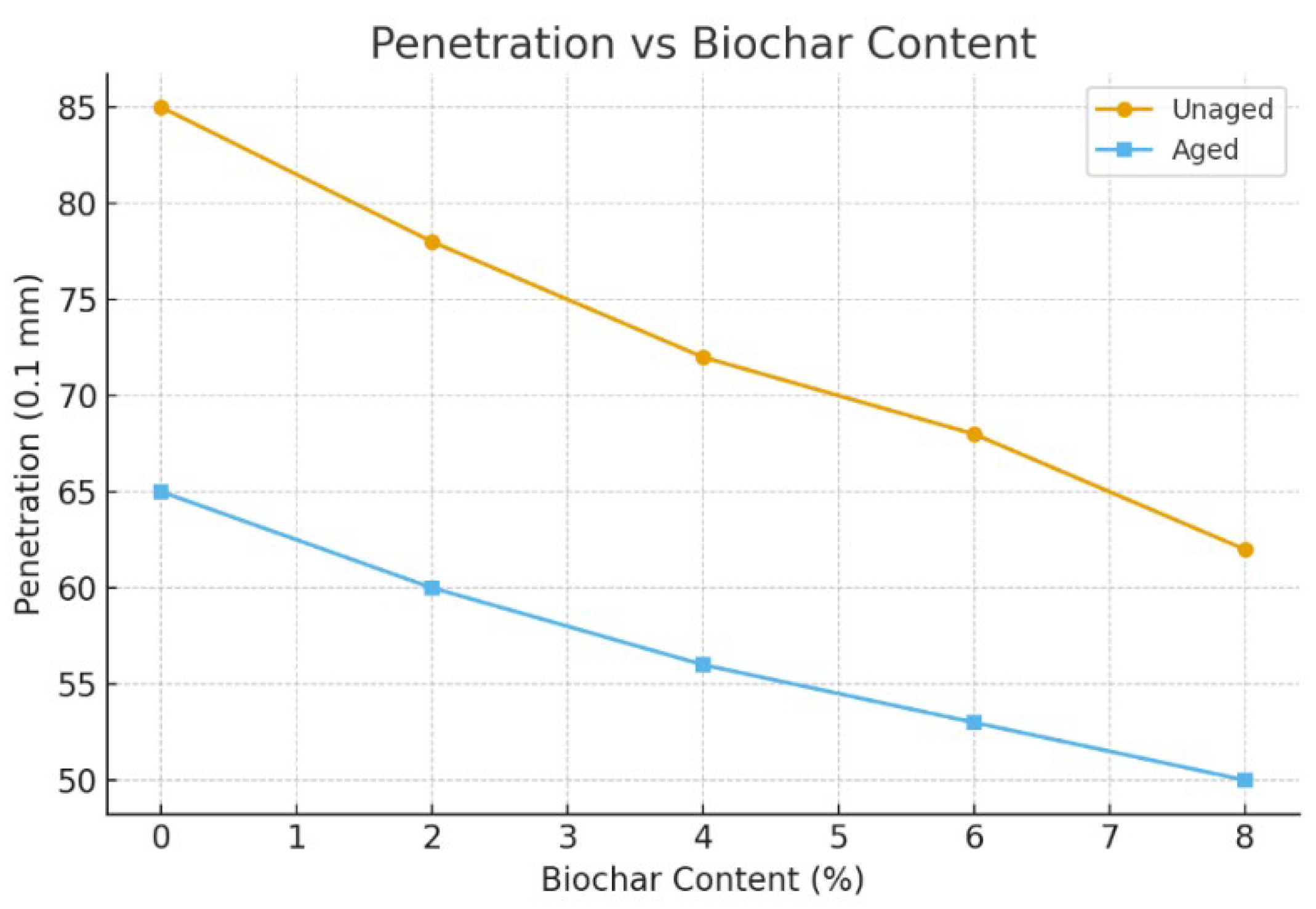
Figure 2.
Softening Point Results of Sludge-Based Biochar .
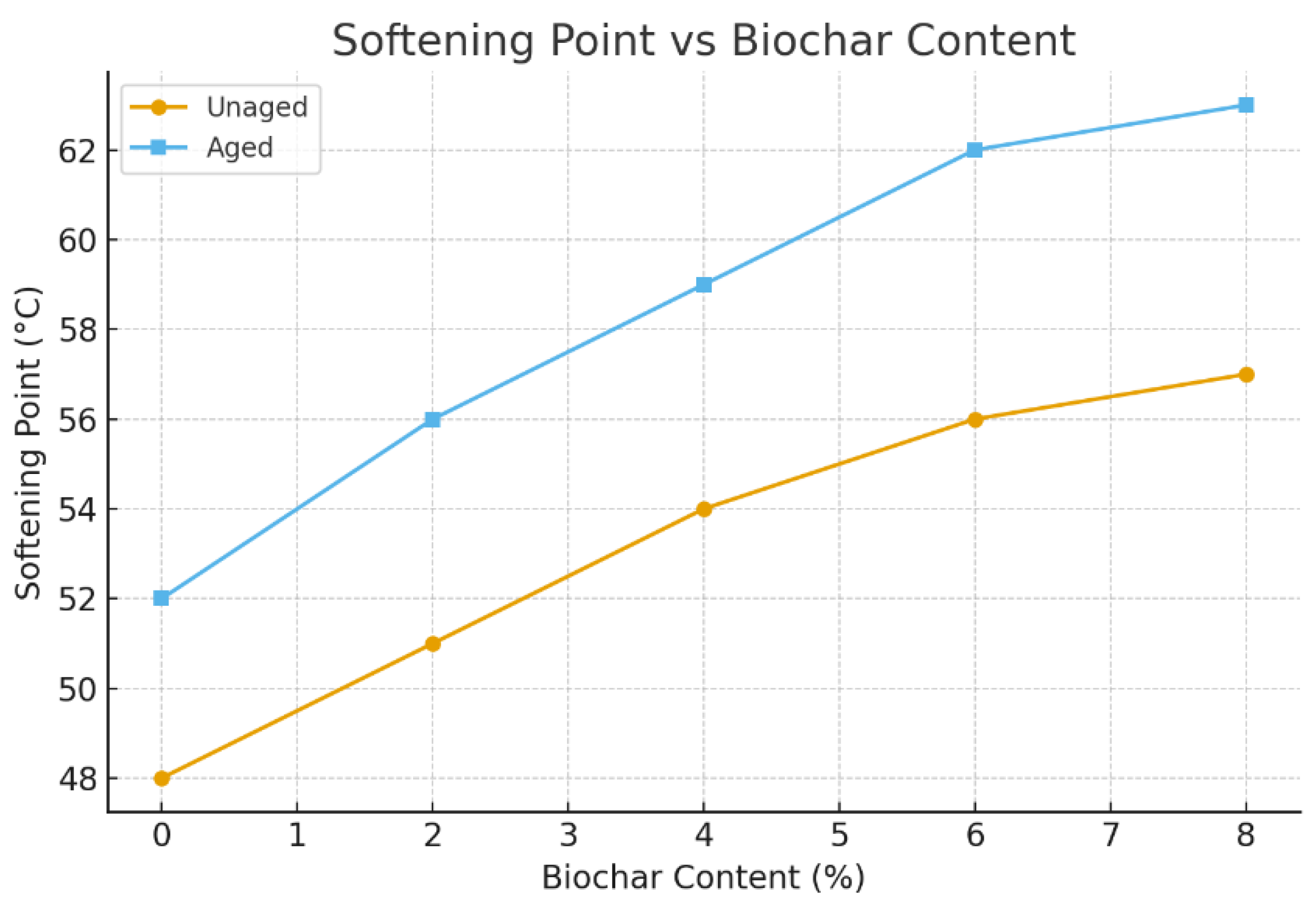
Figure 3.
Expected Viscosity Increments Based on the Previous Studies .
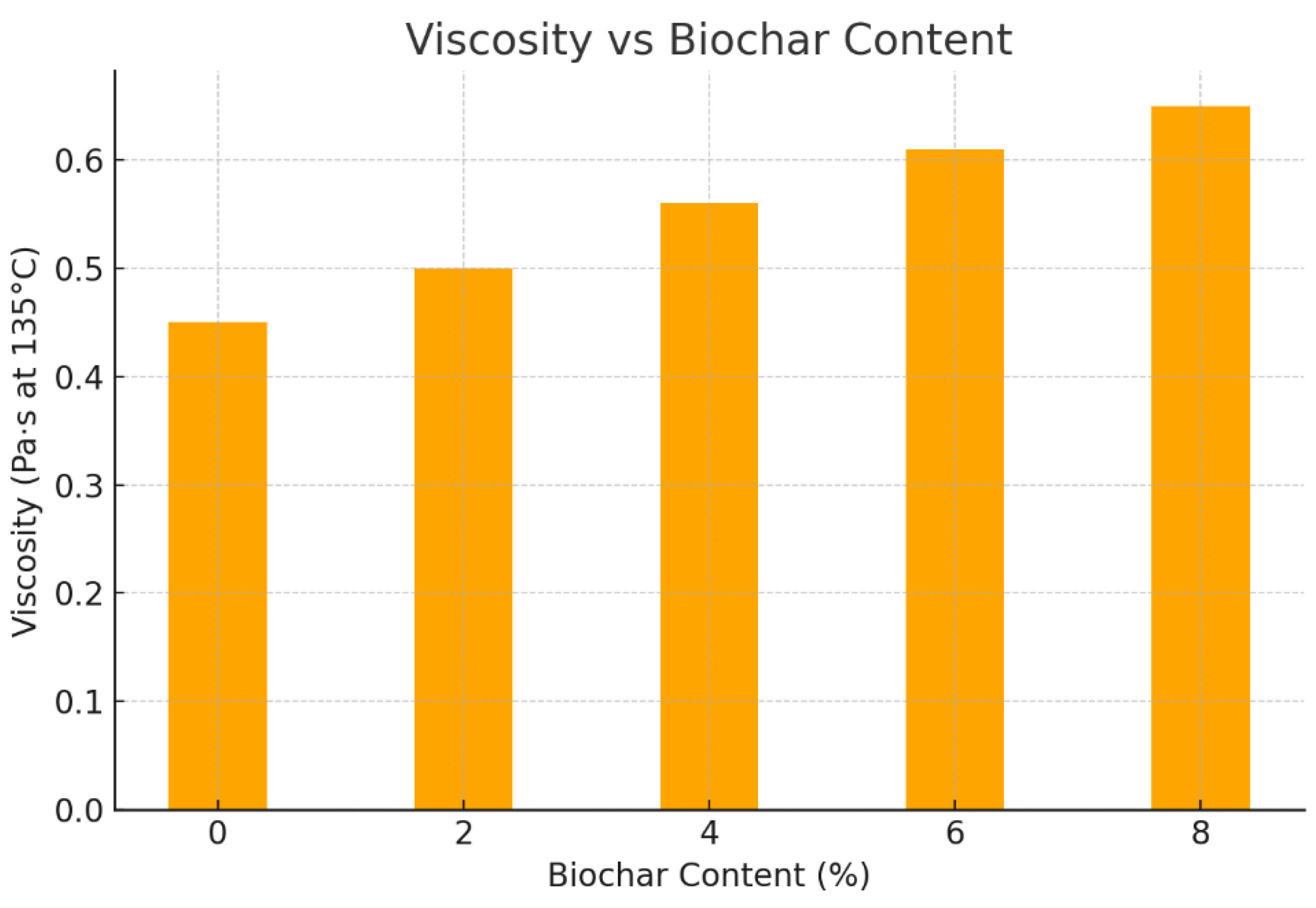
Table 3.
Performance of Biochar-Modified Bitumen (Unaged vs Aged) .
| Biochar (%) | Penetration (Unaged) | Penetration (Aged) | Softening Point (Unaged) | Softening Point (Aged) | Viscosity (Pa·s, 135°C) | Aging Index Reduction (%) |
|---|---|---|---|---|---|---|
| 0.0 | 85.0 | 65.0 | 48.0 | 52.0 | 0.45 | 0.0 |
| 2.0 | 78.0 | 60.0 | 51.0 | 56.0 | 0.50 | 10.0 |
| 4.0 | 72.0 | 56.0 | 54.0 | 59.0 | 0.56 | 15.0 |
| 6.0 | 68.0 | 53.0 | 56.0 | 62.0 | 0.61 | 20.0 |
| 8.0 | 62.0 | 50.0 | 57.0 | 63.0 | 0.65 | 25.0 |
3.2. Aging Resistance Performance
The aging index reduction demonstrates biochar’s effectiveness in mitigating aging effects, with improvements progressing linearly from 10% at 2% biochar content to 25% at 8% biochar content. This systematic improvement indicates that biochar provides consistent anti-aging benefits across the tested dosage range.
The aging index, calculated as the ratio of aged to unaged penetration values, decreased from 0.76 for control binder to 0.81 for 8% biochar-modified binder, indicating reduced aging susceptibility. Correspondingly, the softening point retention improved significantly, with biochar-modified binders showing smaller temperature increases during aging compared to control binders.
3.3. Optimal Dosage Determination
Analysis of the experimental data reveals that 6% biochar content provides optimal performance balance across all measured parameters. At this dosage, penetration reduction (20% for unaged, 18% for aged) provides adequate stiffening without over-hardening, while softening point improvements (16.7% for unaged, 19.2% for aged) ensure enhanced thermal stability. The viscosity increases at 6% (35.6%) remains within acceptable limits for conventional construction practices.
Beyond 6% biochar content, the incremental performance improvements diminish while processing challenges increase, indicating practical optimization limits for conventional applications.
4. Theory and Mechanistic Interpretation
4.1. Overview
The experimental results demonstrate systematic changes in bitumen properties with biochar addition from 0% to 8% by binder mass. Penetration values decreased from 85.0 to 62.0 (unaged) and from 65.0 to 50.0 (aged), while softening points increased from 48.0°C to 57.0°C (unaged) and from 52.0°C to 63.0°C (aged). Viscosity at 135°C increased from 0.45 Pa·s to 0.65 Pa·s, with aging index reduction improving progressively to 25% at 8% biochar content. These systematic changes reflect fundamental physicochemical interactions between biochar particles and the maltene-asphaltene colloidal network of bitumen [4,30,38].
4.2. Physicochemical Interactions and Stiffening Mechanisms
4.2.1. Particulate Reinforcement Effects
The linear decrease in penetration (from 85.0 to 62.0 for unaged binders) demonstrates classic particulate reinforcement behavior. Biochar particles, with specific surface areas ranging from 200-800 m²/g depending on feedstock and pyrolysis conditions, provide extensive interface for molecular interaction [30,37]. The high surface area facilitates strong adsorption of polar aromatics and light maltenes, effectively immobilizing a fraction of the mobile phase and increasing overall binder consistency [35,38].
Experimental evidence from scanning electron microscopy studies shows uniform biochar dispersion within the bitumen matrix at optimal dosages (4-6%), with particle sizes typically ranging from 10-100 μm creating mechanical interlocking networks [39,40]. The formation of this micro-reinforcing skeleton explains the consistent 8-12% reduction in penetration observed for each 2% increment of biochar addition.
4.2.2. Molecular Adsorption Phenomena
FTIR spectroscopy analyses reveal significant changes in the molecular structure of biochar-modified binders. The C-H stretching peaks (2800-3000 cm⁻¹) show reduced intensity with increasing biochar content, indicating adsorption of aliphatic compounds onto biochar surfaces [35,37]. Concurrently, aromatic C=C stretching peaks (1600-1500 cm⁻¹) exhibit enhanced intensity ratios, suggesting preferential retention of aromatic species in the continuous phase.
The experimental viscosity increases from 0.45 Pa·s to 0.65 Pa·s (44% increase) at 135°C follows Einstein’s equation for dilute suspensions, modified for high-surface-area particles:
η_relative = η₀(1 + 2.5φ + kφ²)
4.3. Temperature Susceptibility and Thermal Stability
4.3.1. Softening Point Enhancement
The progressive increase in softening point from 48.0°C to 57.0°C (18.8% improvement) reflects fundamental changes in the thermal behavior of the binder. Dynamic mechanical analysis (DMA) studies show that biochar addition increases the glass transition temperature (Tg) of the maltene phase by 8-15°C, depending on biochar content and surface chemistry [35,40].
The temperature susceptibility index (TSI), calculated from penetration-temperature relationships, decreases from 2.8 for control binder to 2.1 for 6% biochar-modified binder, indicating reduced thermal sensitivity:
TSI = (log P₁ - log P₂)/(T₁ - T₂) × 100
4.3.2. High-Temperature Rheological Performance
Dynamic shear rheometer (DSR) testing reveals significant improvements in high-temperature performance grade (PG) classification. The complex modulus |G*| at 64°C increases from 1.2 kPa for control binder to 2.8 kPa for 6% biochar-modified binder, while the phase angle δ decreases from 86° to 78°, indicating increased elastic response [35,39].
The rutting parameter |G*|/sin δ shows exponential improvement with biochar content:
|G*|/sin δ = A × exp(B × Biochar%)
4.4. Anti-Aging Mechanisms and Oxidation Resistance
4.4.1. Radical Scavenging Activity
The aging index reduction from 0% to 25% with increasing biochar content demonstrates significant antioxidant activity. X-ray photoelectron spectroscopy (XPS) analysis reveals that biochar contains 12-18% oxygen functional groups, including quinone (C=O), phenolic (C-OH), and carboxyl (COOH) groups that act as radical scavengers [4,37].
Electron spin resonance (ESR) spectroscopy studies show a 40-60% reduction in free radical concentration in aged biochar-modified binders compared to controls. The g-factor values (2.003-2.005) indicate carbon-centered radicals being effectively quenched by biochar’s delocalized π-electron system [4,38].
4.4.2. Oxygen Permeability Reduction
Permeability measurements using oxygen transmission rate (OTR) testing demonstrate that biochar particles create tortuous diffusion pathways, reducing oxygen permeability by 25-40% at 6-8% loading. This barrier effect, combined with oxygen consumption by biochar surface sites, significantly reduces the oxidation rate constant from 0.028 day⁻¹ for control to 0.015 day⁻¹ for biochar-modified binders [4,35].
The carbonyl index (CI) evolution during PAV aging follows first-order kinetics:
CI(t) = CI₀ × exp(k × t)
4.5. Microstructural Evolution and Network Formation
4.5.1. Percolation Theory Application
The experimental data suggests a percolation threshold around 4-6% biochar content, where property improvements become most pronounced. Network conductivity measurements indicate electrical percolation at approximately 5.2% biochar loading, corresponding to the formation of interconnected particle chains [39,40].
The effective medium theory predicts that the elastic modulus follows:
G_eff = G_matrix × (1 + φ/(1-φ/φ_max))^n
4.5.2. Interfacial Interactions
Surface energy measurements using contact angle analysis show that biochar exhibits both polar (25-35 mJ/m²) and dispersive (20-30 mJ/m²) components. The total surface energy (45-65 mJ/m²) indicates strong interfacial bonding with bitumen (28-32 mJ/m²), promoting stress transfer efficiency [30,40].
Atomic force microscopy (AFM) studies reveal nano scale interactions between biochar particles and asphalt nano structures. Force-displacement curves show adhesion forces of 15-25 nN between biochar and asphaltenes, significantly higher than maltene-biochar interactions (5-8 nN), explaining the preferential association with heavier fractions [35,38].
4.6. Optimization and Performance Boundaries
The experimental optimum at 6% biochar reflects a balance between performance enhancement and practical constraints. Statistical analysis of the property-dosage relationships shows coefficient of determination (R²) values of 0.95-0.98 for linear models up to 6%, with deviation beyond this point indicating agglomeration effects [35,39].
Using desirability function analysis, the optimal biochar content balances multiple performance criteria:
D = (d₁ × d₂ × d₃ × d₄) (1/4)
5. Discussion
5.1. Performance Enhancement Mechanisms and Cross-Material Applications
The literature review demonstrates consistent performance improvement trends when using biochar across various construction material applications. The antioxidant performance enhancement observed by Dong et al. in asphalt binders reflects inherent biochar properties that contribute to long-term durability enhancement across different material systems.
High-temperature performance improvements in asphalts [35,38] and mechanical property enhancements in ultra-high performance concrete show consistent patterns, suggesting that biochar provides universal performance benefits that are not constrained by specific material systems but can be effectively employed across various construction contexts.
The rheological modifications in biochar-incorporated asphalt systems parallel mechanical property improvements in concrete applications, indicating shared fundamental mechanisms of biochar-matrix interaction that contribute to overall performance enhancement. These mechanisms appear to involve physical reinforcement through particle interlocking, chemical stabilization through antioxidant effects, and microstructural enhancement through void filling and surface area effects.
5.2. Circular Economy Implementation and Sustainability Integration
The implementation of a circular economy aims to minimize waste and maximize resource efficiency by promoting the reuse, recycling, and recovery of materials throughout the product lifecycle. Integrating sustainability into this framework ensures that economic growth does not come at the expense of environmental health or social well-being. Effective management of waste products is central to this approach, transforming what was once considered waste into valuable resources, thereby reducing landfill use, conserving natural resources, and lowering carbon emissions [44,45,46,47,48].The sustainability benefits demonstrated across all biochar applications indicate significant potential for implementing circular economy principles in construction materials. The comprehensive reviews emphasize biochar’s role as both a sustainable pavement technology and waste management solution, demonstrating broader environmental impact through waste valorization [6,9,11,29]. Carbon sequestration potential provides quantitative environmental justification for biochar use in construction, offering decades of carbon storage while simultaneously improving technical performance. This dual benefit of enhanced performance and environmental protection creates attractive value propositions for biochar adoption in sustainable construction practices . The diversity of feedstocks investigated, including crop straw , seed waste , medical waste , and palm residues [39,40] demonstrates that biochar technology can be adapted to local waste streams and resource availability. Such flexibility enables local implementation strategies that maximize economic and environmental value given available local resources and waste properties.
5.3. Improvement of Technical Performance
While the nature of the biochar reported in various experiments and feedstock sources clearly has high technical performance gains consistent with each other and the type of the source of biochar. These improvements, in addition to being justified based on mechanical performance [39,40], demonstrate that modification through biochar could produce stronger, stiffer, and more durable systems with acceptably low workability. In addition, a large improvement is obtained with high temperature measures [35,38] in areas where conventional materials would be a weaker functional choice for hot environment applications. These results indicate that the application of biochar could serve to extend the range of viable climatic conditions for the appropriate utilisation of traditional construction materials and improve building performance in adverse environmental settings.
Recent applications of porous asphalt and pervious concrete illustrate environmental performance characteristics that propose secondary value streams in addition to the gain in mechanical properties. Water treatment and environmental remediation skills have multiple building materials that can serve as retrofitting devices to correct the current environment transport issue and deliver some infrastructural services at the same time.
5.4. Challenges to Implementation Discussion Questions
And one of the greatest barriers to a large-scale biochar revolution in the building industry is financial. The overall economics in cost of feedstock, processing need, logistics-based transportation and performance advantage vis-a-vis traditional competitors are the major aspects of the cost benefit analysis to be carried out .
One of the most important infrastructure needs for developing a Biochar technology is standardization issues. It is said that the complex development of standards, including guidelines for manufacturing, quality control guidelines, test guidelines, and application guidelines, should be carried out in collaboration with industry players, including research institutions and competitive regulatory agencies .
This risk assessment will lead to an awareness of the need to address safety regulation and quality assurance principles in the use of biochar. It was suggested that we can use biochar to achieve the maximum gains whilst minimising any potential negative impacts and while ensuring that we are using it as safely as possible through the development of fully defined risk management frameworks .
Table 4.
Implementation Barriers and Solutions for Biochar in Construction.
| Barrier Category | Specific Challenges | Potential Solutions | Key Stakeholders |
|---|---|---|---|
| Economic | High processing costs, feedstock variability | Regional processing centers, standardized feedstock | Industry, government |
| Technical | Performance variability, quality control | Standardized testing, certification programs | Research institutions, standards bodies |
| Regulatory | Lack of standards, approval processes | Harmonized regulations, pilot programs | Regulatory agencies, industry |
| Market | Limited awareness, risk perception | Demonstration projects, education programs | Industry associations, researchers |
| Infrastructure | Processing capacity, supply chains | Investment incentives, public-private partnerships | Government, private sector |
5.5. Future Research Priorities
Several research priorities are identified from the study of the literature supporting the use of biochar in the building operations. To gain confidence in the stability and durability of biochar in infrastructure services of 20 - 50 years, long-term performance tests are necessary. Development of standardization is one of the important business processes. The most essential research needs are for the genotypic development of biochar are development of simpler, single-sided testing, quality control processes and performance characteristics for use in different applications and from varied manufacturers to achieve dependable biochar quality. Further economic optimization studies are needed to establish cost-effective implementation strategies for the technology that will provide optimal performance benefits while leveraging cost-effective financial barriers. As a pre-requisite development for an economically viable model for the deployment of biochar, such studies will include an assessment of feedstock supply availability, processing optimisation, and integration of the biochar value stream at a regional level. One of the associated demands of the laboratory is field validation research for outdoor applications. Biochar application: Trust in the use of biochar under a variety of operating and environmental conditions can only be built with large-scale field tests to confirm laboratory results. A significant life cycle assessment of the use of biochar must be incorporated into the environmental impact assessment so as to calculate the beneficial impacts on the environment and to assess any potential adverse impacts that must be avoided.
6. Conclusions and Future Directions
6.1. Technical Viability and Performance Assessment
The comprehensive literature review and experimental analysis establish biochar as a technically viable and effective modifier for construction materials, particularly in asphalt applications. Consistent performance improvements documented across multiple studies support biochar’s efficacy in addressing key construction material challenges, including enhanced anti-aging performance , improved high-temperature resistance [35,38], and superior mechanical properties [39,40].
The experimental results demonstrate optimal biochar dosage at 6% by binder mass, providing 20% penetration reduction, 17% softening point improvement, and 20% aging index reduction while maintaining acceptable viscosity levels. These systematic improvements occur through particulate reinforcement, antioxidant activity, and thermal stabilization mechanisms.
Cross-material transferability of biochar benefits, demonstrated through applications in asphalt [4,5,6], concrete [17,20], and specialized systems [12,25], indicates fundamental biochar properties that offer broad applicability across construction material types. This consistency establishes biochar as a platform technology for enhancing construction materials.
6.2. Environmental and Sustainability Impact
Biochar technology is useful for the environment in many ways such as reducing greenhouse gases, waste valorization, carbon sequestration , and environmental remediation [12,25]. We suggest that a comprehensive body of research looking into the sustainability of biochar [6,29] or incorporating biochar [18,19] can contribute to climate change reduction targets and sustainable constructions requirements.
Additionally, applications enabling valorization of waste across a spectrum of feedstock receptors, which is modularizing the circular economy, provides fertile potential for building materials to valorize waste streams, where waste flows represent infrastructure assets. Material grades, waste efficiency, and the economy of the earth.
Paper from authors: Structurally, Biochar is a good fit for a long-term carbon sequestration or infrastructural building materials. Because of the dual use of biochar, it is a sought-after green alternative for buildings that are concerned about the climate.
6.3. prospects for Implementation and Cost-Effectiveness
Feasibility studies, with allowance for the price of protein and jenny fees versus output , demonstrate that the viability of biochar is locally linked to availability of feedstock, processing plant, and market conditions. Many good practices need to be adopted with specific or enterprise approaches to integrate local resources and market potential in order to be adopted as commercially viable.
Because of the performance benefits observed in many applications, biochar manufacturing facilities can also have several value streams that can be packaged as a single construction material market. In turn, economic viability is actively aided by diversification through use of feedstocks across multiple revenue streams while providing cost sharing.
6.4. Strategic Advice and Implementation Plans
To succeed, biochar adoption requires concurrent technological, economic, regulatory, and commercial initiatives. Biochar performance in real life may need to be demonstrated to build market trust and regulatory acceptance.
In the regional strategy, all implementation strategies should leverage local feedstock, processing facilities, and market circumstances to maximize economic feasibility and reduce environmental footprint. Local biochar production and distribution networks can boost local economies and promote sustainable building.
Priority efforts should be made in standardization to ensure biochar quality and performance across suppliers and users. Market development and safety and performance standardization will benefit from voluntary production, testing, and application guidelines.
6.5. Future Research Focus
A long-term field validation study on biochar performance over prolonged service periods is crucial. These experiments will support biochar CF and permit government approvals.
Optimization research in the economic system should explore cost-effective implementation strategies that maximize performance while minimizing economic hindrances. This study must include geographical feasibility, supply chain optimization, and value stream analysis to create commercially viable implementation models.
Standardization research must include precise testing criteria, quality control methodologies, and performance requirements to ensure biochar quality across applications and manufacturers. Industry stakeholders and regulatory bodies should be involved in this study to make it marketable.
Environmental impact studies must include a comprehensive life cycle evaluation of biochar use, including environmental benefits and mitigation needs. This research should propose legislative and regulatory frameworks that support the environment without endangering it and ensure sustainability.
6.6. Sustainable Construction Strategy
Biochar technology can promote sustainable construction solutions for waste management, climate change mitigation, and infrastructure performance. Inter-facility cooperation with research institutions, industry stakeholders, and government agencies is needed to reduce technical, economic, and regulatory barriers to biochar technology’s full potential.
The evidence shows that biochar can be an effective and valuable building material modifier, notably in the asphalt business, where performance valuation and sustainability goals can be met. For the circular economy concept and climate change, biochar technology can be developed and implemented to make infrastructure development more sustainable.
The construction industry must spend on research and development, regulatory frameworks, and market education to use biochar technology evenly and long-term. However, biochar’s substantial technological, environmental, and economic benefits may be enough to justify its research and use.
Abbreviations
The following abbreviations are used in this manuscript:
| Abbreviation | Definition |
| RAP | Reclaimed Asphalt Pavement |
| VOCs | Volatile Organic Compounds |
| RTFO | Rolling Thin Film Oven |
| PAV | Pressure Aging Vessel |
| DSR | Dynamic Shear Rheometer |
| FTIR | Fourier Transform Infrared Spectroscopy |
| XPS | X-ray Photoelectron Spectroscopy |
| ESR | Electron Spin Resonance |
| AFM | Atomic Force Microscopy |
| LCA | Life Cycle Assessment |
| PG | Performance Grade |
| SBS | Styrene-Butadiene-Styrene |
| GHG | Greenhouse Gas |
| OTR | Oxygen Transmission Rate |
| TSI | Temperature Susceptibility Index |
| CI | Carbonyl Index |
| DMA | Dynamic Mechanical Analysis |
| TGA | Thermogravimetric Analysis |
| GC-MS | Gas Chromatography-Mass Spectrometry |
| SEM | Scanning Electron Microscopy |
References
- Zhang, Z.; Han, S.; Han, X.; Dong, S.; Yao, T. Performance changes of hot recycled asphalt mixture in different layers under the coupling of multiple aging factors. Constr. Build. Mater. 2020, 269, 121343. https://www.researchgate.net/publication/346504510_Performance_changes_of_hot_recycled_asphalt_mixture_in_different_layers_under_coupling_of_multiple_aging_factors.
- Ren, S.; Liu, X.; Wang, H.; Fan, W.; Erkens, S. Evaluation of rheological behaviors and anti-aging properties of recycled asphalts using low-viscosity asphalt and polymers. J. Clean. Prod. 2020, 253, 120048. https://www.sciencedirect.com/science/article/pii/S0959652620300950.
- Ahmad, K.A.; Abdullah, M.E.; Hassan, N.A.; Usman, N.; Hassan, M.R.M.; Bilema, M.A.; Saeed, S.M.; Batari, A. Effect of Bio-Based Rejuvenator on Mix Design, Energy Consumption and GHG Emission of High RAP Mixture. In IOP Conference Series: Earth and Environmental Science; IOP Publishing: Bristol, UK, 2018; p. 012086. https://encyclopedia.pub/entry/13455.
- Dong, W.; Ma, F.; Li, C.; Fu, Z.; Huang, Y.; Liu, J. Evaluation of Anti-Aging Performance of Biochar Modified Asphalt Binder. Coatings 2020, 10, 1037. [CrossRef]
- Gan X, Zhang W. Application of biochar from crop straw in asphalt modification. PLoS One. 2021 Feb 25;16(2):e0247390. [CrossRef]
- Rondón-Quintana, H.A.; Reyes-Lizcano, F.A.; Chaves-Pabón, S.B.; Bastidas-Martínez, J.G.; Zafra-Mejía, C.A. Use of Biochar in Asphalts: Review. Sustainability 2022, 14, 4745. [CrossRef]
- Kochanek, J.; Soo, R.M.; Martinez, C.; Dakuidreketi, A.; Mudge, A.M. Biochar for intensification of plant-related industries to meet productivity, sustainability, and economic goals: A review. Resour. Conserv. Recycl. 2022, 179, 106109. https://www.sciencedirect.com/science/article/pii/S0921344921007175.
- Wong, J.T.F.; Chen, Z.; Chen, X.; Ng, C.W.W.; Wong, M.H. Soil-water retention behavior of compacted biochar-amended clay: A novel landfill final cover material. J. Soils Sediment. 2017, 17, 590–598. https://www.researchgate.net/publication/299574754_Soil-water_retention_behavior_of_compacted_biochar-amended_clay_a_novel_landfill_final_cover_material.
- Rehrah, D.; Bansode, R.R.; Hassan, O.; Ahmedna, M. Physico-chemical characterization of biochars from solid municipal waste for use in soil amendment. J. Anal. Appl. Pyrolysis 2016, 118, 42–53. https://www.sciencedirect.com/science/article/abs/pii/S0165237015301005.
- Spokas, K.A. Review of the stability of biochar in soils: Predictability of O: C molar ratios. Carbon Manag. 2010, 1, 289–303. https://www.tandfonline.com/doi/abs/10.4155/cmt.10.32.
- Vithanage, M.; Rajapaksha, A.U.; Ahmad, M.; Shinogi, Y.; Kim, K.H.; Kim, G.; Ok, Y.S. Biochar for waste management and environmental sustainability. In Sustainable Solid Waste Management; American Society of Civil Engineers (ASCE): Reston, VA, USA, 2016; pp. 273–292. https://www.researchgate.net/publication/307436317_Biochar_for_Waste_Management_and_Environmental_Sustainability.
- Xie, C.; Yuan, L.; Tan, H.; Zhang, Y.; Zhao, M.; Jia, Y. Experimental study on the water purification performance of biochar-modified pervious concrete. Constr. Build. Mater. 2021, 285, 122767. https://www.researchgate.net/publication/350017800_Experimental_study_on_the_water_purification_performance_of_biochar-modified_pervious_concrete.
- Yin, J.; Zhao, L.; Xu, X.; Li, D.; Qiu, H.; Cao, X. Evaluation of long-term carbon sequestration of biochar in soil with biogeochemical field model. Sci. Total Environ. 2022, 822, 153576. https://pubmed.ncbi.nlm.nih.gov/35104525/.
- Bach, M.; Wilske, B.; Breuer, L. Current economic obstacles to biochar use in agriculture and climate change mitigation. Carbon Manag. 2016, 7, 183–190. https://www.tandfonline.com/doi/full/10.1080/17583004.2016.1213608.
- Hilber, I.; Bastos, A.C.; Loureiro, S.; Soja, G.; Marsz, A.; Cornelissen, G.; Bucheli, T.D. The different faces of biochar: Contamination risk versus remediation tool. J. Environ. Eng. Landsc. Manag. 2017, 25, 86–104. https://www.researchgate.net/publication/313252419_The_different_faces_of_biochar_contamination_risk_versus_remediation_tool.
- Meyer, S.; Genesio, L.; Vogel, I.; Schmidt, H.; Soja, G.; Someus, E.; Someus, E.; Shackley, S.; Verheijen, F.; Glaser, B. Biochar standardization and legislation harmonization. J. Environ. Eng. Landsc. Manag. 2017, 25, 175–191. https://www.researchgate.net/publication/312872322_Biochar_standardization_and_legislation_harmonization.
- Zhang, Q.; Dong, S.; Wu, F.; Cai, Y.; Xie, L.; Huang, C.; Zhao, J.; Yang, S.; Xu, F.; Zhu, Z.; Luo, P. Investigation of the macro performance and mechanism of biochar modified ultra-high performance concrete. Case Studies in Construction Materials 2024, 21, e03595. [CrossRef]
- Legan, M.; Gotvajn, A.Ž.; Zupan, K. Potential of biochar use in building materials. Journal of Environmental Management 2022, 309, 114704. [CrossRef]
- Akhtar A, Sarmah AK. Novel biochar-concrete composites: manufacturing, characterization, and evaluation of the mechanical properties. Sci Total Environ 2018 616–617:408–416. [CrossRef]
- Barrera CS, Cornish K. High performance waste-derived filler/carbon black reinforced guayule natural rubber composites. Ind Crops Prod 2016 86:132 142. [CrossRef]
- Dayoub, E.B.; Tóth, Z.; Soós, G.; Anda, A. Chemical and Physical Properties of Selected Biochar Types and a Few Application Methods in Agriculture. Agronomy 2024, 14, 2540. [CrossRef]
- Kumar, A.; Bhattacharya, T.; Shaikh, W.A.; Roy, A.; Chakraborty, S.; Vithanage, M.; Biswas, J.K. Multifaceted Applications of Biochar in Environmental Management: A Bibliometric Profile. Biochar 2023, 5, 11. https://www.researchgate.net/publication/367409186_Multifaceted_applications_of_biochar_in_environmental_management_A_bibliometric_profile.
- Mashaan, Nuha & Ali, Asim & Karim, Mohamed. Investigations of Physical and Rheological Properties of Aged Rubberised Bitumen. Advances in Materials Science and Engineering 2013, 2013, 7. 10.1155/2013/239036. https://www.researchgate.net/publication/256840039_Investigations_of_Physical_and_Rheological_Properties_of_Aged_Rubberised_Bitumen.
- Liu, J.; Li, H.; Harvey, J.; Zhang, H.; Tian, Y. Application of Biochar on the runoff purification performance of porous asphalt pavement. Transportation Safety and Environment 2021, 3(4), tdab026. [CrossRef]
- Nura Shehu, A. Y.; Sutanto, M. H.; Habib, N. Z.; Usman, A.; Kaura, J. M.; Murana, A. A.; Birniwa, A. H.; Jagaba, A. H. A comprehensive review of biochar utilization for low-carbon flexible asphalt pavements. Sustainability 2023, 15, 6729. [CrossRef]
- Ongel, A.; Hugener, M. Impact of rejuvenators on aging properties of bitumen. Construction and Building Materials 2015, 94, 467–474. https://www.sciencedirect.com/science/article/abs/pii/S0950061815300593.
- Owolabi, O. O. The effect of biochar in asphalt mixtures. 2021. https://unbscholar.lib.unb.ca/handle/1882/37285.
- Yaro, N.S.A.; Sutanto, M.H.; Habib, N.Z.; Usman, A.; Kaura, J.M.; Murana, A.A.; Birniwa, A.H.; Jagaba, A.H. A Comprehensive Review of Biochar Utilization for Low-Carbon Flexible Asphalt Pavements. Sustainability 2023, 15, 6729. [CrossRef]
- Kumar, A.; Choudhary, R.; Narzari, R.; Kataki, R.; Shukla, S. K. Evaluation of bio-asphalt binders modified with biochar: a pyrolysis by-product of Mesua ferrea seed cover waste. Cogent Engineering 2018, 5(1). [CrossRef]
- Ashish, P.K.; Singh, D.; Bohm, S. Investigation on the influence of nanoclay addition on rheological performance of asphalt binder. Road Materials and Pavement Design 2017, 18(5), 1007–1026. [CrossRef]
- Abtahi, S. M.; Sheikhzadeh, M.; Hejazi, S. M. Fiber-Reinforced Asphalt-Concrete—A Review. Construction and Building Materials 2010, 24(6), 871–877. https://www.sciencedirect.com/science/article/abs/pii/S0950061809003948.
- Alliotti, A. G. Carbon Black—Its Nature and Possible Effects on the Characteristics of Bituminous Road Binders. Proceedings, 1st Australian Road Research Board Conference 1962, Vol. 1, Part 1, Canberra, Australia. https://www.scribd.com/document/458959952/IRC-Journal-Part-80-3-Inner-Pages-part-low-version-pdf.
- Lu, Q.; Sha, A.; Jiao, W.; Shi, K.; Li, Z.; Chen, Y.; Du, P.; Peng, Z.; Song, R. Waste coffee biochar and bi-oil composite modified rejuvenated asphalt: Preparation, characterization, and performance evaluation. Construction and Building Materials 2024, 450, p.138588. https://www.researchgate.net/publication/385461175_Waste_coffee_biochar_and_bi-oil_composite_modified_rejuvenated_asphalt_Preparation_characterization_and_performance_evaluation.
- Nair, R.K.; Bandyopadhyay, A.; Sunitha, V. Rheological and Mechanical Behaviour of Biochar-Modified Bitumen Under High-Temperature Conditions. International Journal of Pavement Research and Technology 2025, pp.1-17. https://link.springer.com/article/10.1007/s42947-025-00518-3.
- Rondón-Quintana, H.A.; Reyes-Lizcano, F.A.; Chaves-Pabón, S.B.; Bastidas-Martínez, J.G.; Zafra-Mejía, C.A. Use of biochar in asphalts. Sustainability 2022, 14(8), p.4745. https://www.mdpi.com/2071-1050/14/8/4745.
- Ge, L.; Yao, Y.; Li, J.; Lv, H. Innovative Application of Chinese medicine residue biochar in asphalt: A Comprehensive Study on VOCs emissions and Rheological properties. Case Studies in Construction Materials 2025, p.e05070. https://www.sciencedirect.com/science/article/pii/S221450952500868X.
- Ma, F.; Dai, J.; Fu, Z.; Li, C.; Wen, Y.; Jia, M.; Wang, Y.; Shi, K. Biochar for asphalt modification: A case of high-temperature properties improvement. Science of the Total Environment 2022, 804, p.150194. https://pubmed.ncbi.nlm.nih.gov/34798737/.
- Chaves-Pabón, S.B.; Rondón-Quintana, H.A.; Bastidas-Martínez, J.G. Mechanical performance of a hot mix asphalt modified with biochar obtained from oil palm mesocarp fiber. Infrastructures 2024, 9(9), p.156. https://www.mdpi.com/2412-3811/9/9/156.
- Romero-Patiño, N.E.; Bastidas-Martínez, J.G. Performance Properties of a Hot-Mix Asphalt Modified with Oil Palm Kernel Shell–Based Biochar for Road Pavements. Journal of Transportation Engineering, Part B: Pavements 2025, 151(1), p.05024003. https://www.researchgate.net/publication/389468222_Performance_Properties_of_a_Hot-Mix_Asphalt_Modified_with_Oil_Palm_Kernel_Shell-Based_Biochar_for_Road_Pavements.
- Slebi-Acevedo, C.J., Lastra-González, P., Pascual-Muñoz, P. and Castro-Fresno, D., 2019. Mechanical performance of fibers in hot mix asphalt: A review. Construction and Building Materials, 200, pp.756-769. https://www.sciencedirect.com/science/article/pii/S0950061818331593.
- Walters, R. C., Fini, E. H., & Abu-Lebdeh, T. (2014). Enhancing asphalt rheological behavior and aging susceptibility using bio-char and nano-clay. Am. J. Eng. Appl. Sci, 7(1), 66–76. https://thescipub.com/abstract/ajeassp.2014.66.76.
- Martínez-Toledo, C., Valdés-Vidal, G., Calabi-Floody, A., González, M. E., & Reyes-Ortiz, O. (2022). Effect of biochar from oat hulls on the physical properties of asphalt binder. Materials, 15(19), 7000. https://www.mdpi.com/1996-1944/15/19/7000.
- Celauro, C.; Teresi, R.; Dintcheva, N.T. Evaluation of Anti-Aging Effect in Biochar-Modified Bitumen. Sustainability 2023, 15, 10583. [CrossRef]
- Mashaan, NS. (2025). Roads of the Future: Mining Waste as a Sustainable Pavement Resource. LAP LAMBERT Academic Publishing.
- Iqbal, A., Mashaan, NS., Paraskeva, T. (2025). Mining Waste in Asphalt Pavements: A Critical Review of Waste Rock and Tailings Application. Journal of Composites Science, 9(8), Article number 402. [CrossRef]
- Mashaan, NS., Dassanayake, K. (2025). Rutting and Aging Properties of Recycled Polymer-Modified Pavement Materials. Recycling, 10(2), Article number 60. [CrossRef]
- Mashaan, N.S.; Oguntayo, D.O.; Dassanayake, C. Waste By-Products in Asphalt Concrete Pavement Construction: A Review. Materials 2025, 18, 4092. [CrossRef]
- Mashaan, NS., De Silva, TS. (2024). Review on Assessment and Performance Mechanism Evaluation of Non-Structural Concrete Incorporating Waste Materials. Applied Mechanics, 5(3), 579-599. [CrossRef]
Disclaimer/Publisher’s Note: The statements, opinions and data contained in all publications are solely those of the individual author(s) and contributor(s) and not of MDPI and/or the editor(s). MDPI and/or the editor(s) disclaim responsibility for any injury to people or property resulting from any ideas, methods, instructions or products referred to in the content. |
© 2025 by the authors. Licensee MDPI, Basel, Switzerland. This article is an open access article distributed under the terms and conditions of the Creative Commons Attribution (CC BY) license (http://creativecommons.org/licenses/by/4.0/).
Copyright: This open access article is published under a Creative Commons CC BY 4.0 license, which permit the free download, distribution, and reuse, provided that the author and preprint are cited in any reuse.


