

Submitted:
15 September 2025
Posted:
16 September 2025
You are already at the latest version
Abstract
The increasing frequency and severity of wildfires, exacerbated by climate variability and human activities, demand innovative solutions for early detection and risk assessment. This systematic review critically examines the convergence of advanced wildfire prediction technologies, including machine learning, satellite remote sensing, and IoT sensor networks, with bees’ behavioural and physiological responses to environmental stressors. Special emphasis is placed on the emerging potential of bee acoustic monitoring as a non-invasive, nature-inspired method for detecting subtle environmental changes that may precede wildfire events. By synthesizing findings from over 200 peer-reviewed articles published in recent years, this review identifies key environmental parameters, like temperature, humidity, smoke, and CO2 that influence both wildfire dynamics and bee colony behaviour. The analysis highlights both the promise and challenges of integrating AI-driven systems with bioindicator species like bees, including issues of data quality, model generalisation, and multi-modal data fusion. Ultimately, this review underscores the value of a multidisciplinary, bio-inspired approach to wildfire early warning systems and outlines future research directions to enhance the accuracy and robustness of wildfire detection frameworks.
Keywords:
wildfire prediction
; bee bioacoustics
; environmental stressors
; machine learning
; remote sensing
; IoT sensor networks
; early fire detection
; pollinator behaviour
; bioindicators
; nature-inspired detection systems
1. Introduction
Wildfires have emerged as one of the most destructive natural disasters worldwide, causing significant economic losses and long-term ecological damage. It is estimated that only a small percentage of wildfires, typically between 3% and 5%, exceed 100 hectares in size. Yet, these larger fires are responsible for 80% to 96% of the total area burned [1]. The term “megafire” reflects the unprecedented size, impact, and severity of recent wildfires, a trend driven by changing climate patterns and aggressive fire suppression strategies. Climate change has led to more frequent and severe weather events, prolonged droughts, changes in vegetation patterns, and increased fuel loads, making fire behaviour more unpredictable and variable [2]. The impacts of wildfires extend beyond the destruction of lives, homes, businesses, and infrastructure, also affecting wildlife, forests, crops, soil stability, and air quality [3].
Human actions like building homes near forests, leaving campfires unattended, or starting fires on purpose can cause wildfires, while natural causes include lightning strikes during hot, dry weather, with fire risk shaped by terrain, available plants, and weather conditions [4]. Certain regions are particularly susceptible to wildfires due to their arid conditions and high temperatures, while others experience strong winds that can rapidly spread flames.
Figure 1 summarises the primary factors influencing wildfire spread, dividing them into meteorological factors (temperature, precipitation, wind, fuel arrangement, channelling) and environmental terrain factors (slope, vegetation type, channelling). These interconnected elements determine the likelihood, speed, and direction of wildfire propagation.
As wildfire behaviour becomes increasingly complex due to climate change and change environmental conditions [5,6] there is a growing need for advanced predictive models that can accommodate these dynamic factors [7]. Early detection, prediction, and forecasting of fires are critical, as traditional systems often fail to detect fires quickly and accurately, resulting in delayed responses and substantial damage [8,9].
Recent advances leverage machine learning, which uses sophisticated algorithms and large datasets to improve detection speed and accuracy [10,11]. Vision-based techniques further enhance these systems by enabling the interpretation of visual cues, such as smoke or flames, similar to human observation [12,13].
The exacerbation of wildfire behaviour is closely linked to climate change, which brings more frequent and severe weather events, prolonged droughts, changes in vegetation patterns, and increased fuel loads [2]. Understanding and predicting wildfire spread is critical due to its potentially devastating effects on the environment, human life, and property [3,14].
1.1. Current Trends and Challenges
Recent advances in wildfire detection and prediction have focused on integrating remote sensing and satellite imagery with machine learning algorithms. Multispectral and hyperspectral data enable large-scale, minute-level fire monitoring and burned area mapping, especially when combined with advanced deep learning models such as recursive Transformers and optical flow techniques [14,15,16,17,18,19]. Deep learning architectures, including U-Net and decision-level super-resolution models, outperform traditional methods, especially when fusing multispectral and SAR data [20,21]. Benchmark datasets such as EO4WildFires and Sen2Fire further support model evaluation and generalisation across diverse regions by addressing the challenge of limited annotated data [22,23].
Despite these technological advances, challenges persist. Data quality, availability, and the need for advanced processing capabilities to manage large datasets remain significant issues. Satellite-based methods face difficulties in detecting small fires, dealing with cloud and smoke occlusion, and ensuring model transferability across different regions [5,18,24]. However, integrating contextual and structural features into machine learning models has improved generalisation across varied environmental conditions and fire intensities [25].
The deployment of IoT devices and sensor networks is another major trend, enhancing real-time detection and early warning capabilities. IoT-based wireless sensor networks (WSNs) and energy-optimized frameworks have improved network stability and energy efficiency [26]. Integrating physical and virtual sensors in WSNs enhances prediction accuracy and scalability, supporting early warning and fire scenario classification [27]. However, these systems are often limited by power constraints, limited connectivity in remote areas, and data processing capabilities [8,28,29,30,31]. Advances in energy-harvesting, efficient algorithms, and edge or fog computing are being developed to extend device lifespan and reliability [32,33,34].
Environmental variability, driven by climate change, complicates fire risk prediction. Shifts in weather patterns, diverse vegetation types, and complex terrains challenge model accuracy, especially when models rely on historical climate data [5,6,22,35,36,37]. Poor air quality and reduced visibility due to smoke or fog can also impede the effectiveness of optical sensors and satellite imagery, leading to detection failures [38]. The use of additional data sources, such as Sentinel-5P aerosol products, and the fusion of meteorological, topographic, and vegetation data are helping to mitigate some of these environmental challenges [22,23].
From a methodological perspective, model complexity and interpretability are key concerns. Deep learning models can be difficult to interpret, making it challenging to understand the prediction rationale [20,39,40]. Data privacy and security are also critical, particularly with federated learning approaches that enable decentralised model training but introduce challenges related to heterogeneous data and communication overhead [41,42].
Lastly, models may not adapt well to new conditions, such as novel fire types or unusual weather patterns, leading to decreased performance over time [43,44]. The scarcity of annotated datasets, especially for early-stage fires and diverse geographies, remains a persistent obstacle. Techniques such as transfer learning, data augmentation, and the development of benchmark datasets are being explored to address these gaps [20,40,45].
To address these challenges, researchers are exploring innovative, nature-inspired approaches. One promising direction involves leveraging bees’ sensitivity to environmental changes. Our prior work introduced how bees are sensitive and can show different behaviours in response to environmental changes. As naturally sensitive creatures, bees respond to subtle environmental shifts, and their behavioral patterns, particularly acoustic signals may correspond to changes in factors such as temperature, humidity, and vegetation. Exploring these relationships offers valuable insights into potential early indicators of environmental conditions linked to wildfire risk.
This paper aims to conduct a systematic literature review examining the relationship between environmental factors contributing to wildfires and the behavioural responses of bees, focusing on acoustic behaviour. By exploring this novel approach, we aim to contribute to developing innovative, nature-inspired methods for early wildfire detection and prediction, leveraging the sensitivity of bees to environmental changes as a potential indicator of impending wildfires.
1.2. Structure of the Paper
This paper’s organisation is summarised in Figure 2. Section 1 introduces the study by outlining its purpose, reviewing existing trends and challenges, highlighting the impact of this survey, and presenting the overall structure of the work. Section 2 details the research methodology, including the application of PRISMA guidelines, the sources of references, formulation of the research question, and the systematic search approach employed. Section 3 presents the literature review, covering fire prediction and detection technologies, bee behaviour under environmental stressors, the correlation between bee behaviour and environmental conditions, and the applications of bees’ acoustic data. Finally, Section 4 offers a discussion and conclusion, addressing the main findings and suggesting potential directions for future research.
2. Research Methodology – Wildfire Prediction Techniques
This systematic literature review follows the Preferred Reporting Items for Systematic Review and Meta-Analyses (PRISMA) guidelines, as recommended by Page et al. [46]. The process begins with formulating well-defined research questions to guide the review. These questions are crucial for focusing the search and ensuring that the review addresses specific gaps in the literature.
Research Questions
An SLR is conducted to review existing research on integrating environmental factors and bee behaviour for wildfire prediction, as well as the application of federated learning in combining bioacoustics data with traditional sensor data for enhanced wildfire detection. This SLR seeks to answer the following research questions:
- RQ1: What are the main categories of data and technological approaches being researched for wildfire prediction and early fire detection, and what are the key trends and challenges associated with their use?
- RQ2: What environmental and climate factors are most frequently studied in wildfire prediction research, and how do these factors contribute to both the benefits and limitations of current predictive models?
This review addresses these questions to provide insights into innovative methods for early wildfire detection and prediction, leveraging environmental factors and non-traditional data sources like bee bioacoustics.
2.1. Database Selection
The next step involves developing a systematic search strategy. This includes selecting appropriate databases and crafting search phrases to ensure comprehensive coverage of relevant literature. Two primary electronic databases were chosen for this review: Scopus and IEEE Xplore. Scopus, managed by Elsevier, contains over 80 million records and was used extensively due to its broad coverage of scholarly literature across various disciplines. IEEE Xplore, with over 5 million records, is a leading database in engineering and computer science, providing access to articles, proceedings papers, and related research.
2.1.0.1. Database Search String
The search strategy involved querying these databases with tailored search strings to maximize the relevance of the results. For Scopus, the initial search string included terms like “wildfire AND prediction OR detection AND machine AND learning OR IoT AND sensors” with specific filters for publication year, document type, language, and exact keywords related to machine learning and wildfires. For IEEE, the search string focused on “Wildfire Prediction” or “Wildfire Detection” combined with “Machine Learning” and “IoT Sensors.” Based on these strategies, 532 papers from Scopus and 332 papers from IEEE were initially identified.
Inclusion and Exclusion Criteria
As presented in Table 1, the inclusion criteria for this review comprised publication in English, relevance to wildfire detection or prediction using machine learning or IoT sensors, relevance to bee behaviour and acoustic data for the secondary search, and publication between 2019 and 2025. Exclusion criteria included studies on post-fire management and mitigation, non-English publications, and works not addressing wildfire detection/prediction. This approach ensured the review provides a comprehensive synthesis of current research trends in wildfire/bushfire detection and prediction.
The PRISMA flow diagram Figure 3 summarizes the systematic process used for literature screening and selection. A total of 688 records were initially retrieved from Scopus (n = 395) and IEEE Xplore (n = 293). After removing duplicates, records marked as ineligible by automation tools, and entries excluded due to reasons such as publication year, document type, or language, 439 records proceeded to screening. After screening, 284 reports were sought for retrieval, and 243 were assessed for eligibility. Following the application of inclusion and exclusion criteria—such as title and abstract screening, full-text review, keyword-based exclusions, and topic/domain relevance. A final total of 114 studies were included in this review. Rayyan.ai was used exclusively to accelerate and document the process of excluding non-relevant papers during the early phases; all subsequent screening and eligibility decisions were conducted manually based on the defined criteria.
3. Literature Review—Wildfire Prediction Techniques
Traditional wildfire spread prediction models can be categorized into three major groups: empirical, semiempirical, and physics-based. Empirical models are built from statistical relationships using historical fire data, while physics-based models simulate how fires spread using equations that represent heat transfer, fuel combustion, and wind interaction [34]. These models have played a critical role in fire science and operations for decades, but they also come with a set of limitations. Many of these models require manual calibration and fine-tuning for specific locations, which can be time-consuming and difficult to scale. Because they are deterministic, these models also don’t handle uncertainty well — something that’s especially problematic when decisions must be made under pressure [5,18,22]. And when run over large areas or at high resolutions, some physics-based models become computationally expensive.
3.1. Machine Learning and Deep Learning Techniques
Machine learning and deep learning have become pivotal tools in enhancing wildfire detection and prediction. Harkat et al. [47], Jonnalagadda et al. [48] explored federated learning and transfer learning to improve model performance and detection accuracy. Choi et al. [49] introduced a wildfire detection model using the Swin Transformer, which enhances early fire detection capabilities and reduces false positives. Similarly, Fahim-Ul-Islam et al. [50] proposed a system powered by an involutional neural network and multi-task learning, highlighting the potential of advanced neural architectures in improving detection accuracy.
Ji et al. [51] coupled physical models with deep learning for near real-time wildfire detection, demonstrating the effectiveness of integrating physical insights with machine learning. Di Giuseppe et al. [5] developed a data-driven model for global fire activity prediction, emphasizing the importance of high-quality data in improving predictive accuracy. These studies underscore the importance of deep learning in enhancing wildfire detection systems and the need for tailored machine learning approaches to improve predictive accuracy in diverse environmental conditions.
Recent systematic reviews and empirical studies further highlight that deep learning architectures such as CNNs, U-Nets, Swin Transformers, and hierarchical multi-headed CNNs achieve high accuracy in wildfire detection from satellite, drone, and ground-based imagery, often surpassing 90% accuracy [40,52,53]. Lightweight models like FCDNet facilitate deployment on drones and edge devices, enabling real-time detection with reduced computational requirements [54]. Specialized approaches, including dual deep learning frameworks for smoke and flame detection [55], classification of one class for early detection with limited data [45], and deep reinforcement learning for UAV trajectory optimization [56], are expanding the capabilities of ML/DL in wildfire management. The integration of contextual and structural features into machine learning models, as well as the use of advanced datasets like EO4WildFires, further improves generalization and predictive performance across diverse environmental conditions [22,25].
This network visualization in Figure 4 illustrates the centrality of "machine learning" and "deep learning" in wildfire prediction literature. The prominent connections between terms such as "fire detection," "wildfires," "UAVs," and "sensor networks" highlight the interdisciplinary and interconnected nature of current research themes. The clustering of keywords further demonstrates the integration of AI with remote sensing, IoT, and advanced sensor technologies in wildfire management.
3.2. Satellite Imagery and Remote Sensing
Satellite imagery plays a significant role in wildfire detection and monitoring due to its ability to cover large areas. Singh et al. [14], Ali and Kurnaz [57] utilized satellite imagery for detecting wildfires, highlighting the effectiveness of remote sensing in monitoring vast regions. Brito et al. [15] conducted a comparative analysis of classification algorithms using Sentinel-2 data, demonstrating the importance of satellite imagery in identifying fire risk areas.
Mazzeo et al. [58] enhanced wildfire detection and mapping using satellite data from Sentinel-2 and Landsat 8/9, while Maeda and Tonooka [59] used Himawari-8 AHI images combined with machine learning for early-stage forest fire detection. These studies emphasise the role of satellite imagery in providing timely and accurate information for wildfire management.
Expanding on this, multi-source satellite data fusion—including geostationary and polar-orbiting satellites such as Himawari-8/9, MODIS, Sentinel-1/2/3, and VIIRS—enables improved accuracy and timeliness in wildfire monitoring and burned area mapping [17,18,60]. Advanced models like recursive Transformers and deep learning-based optical flow allow for minute granularity detection and temporal up-sampling, critical for early-stage wildfire identification [17,19]. Machine learning algorithms, including Random Forests, SVM, and LGBM, have demonstrated high precision and recall when analyzing satellite imagery, especially when incorporating contextual and structural features [16,25]. Deep learning models, such as U-Net and decision-level super-resolution architectures, outperform traditional methods in burned area mapping, particularly when fusing multispectral and SAR data [20,21].
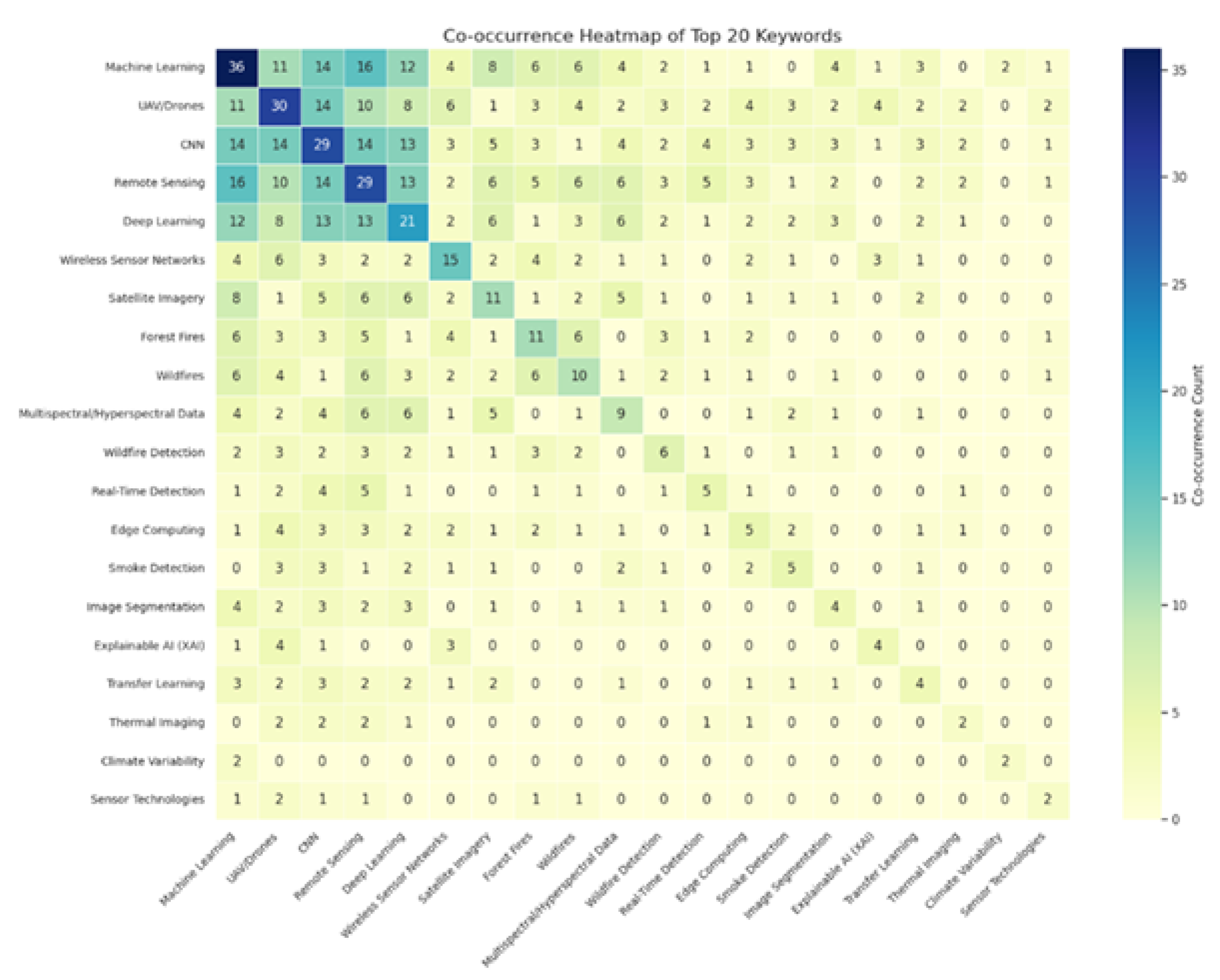
This Figure 5, presents the most frequently occurring keywords in the reviewed literature. "Machine Learning," "UAV/Drones," "CNN," and "Remote Sensing" are the leading terms, reflecting the dominance of AI-based approaches and the integration of aerial and satellite technologies. The frequency distribution underscores the research community’s focus on combining advanced computational methods with remote sensing for enhanced wildfire detection and monitoring.
3.3. Real-Time Detection and IoT Integration
Real-time detection is critical for effective wildfire management, and IoT technologies have been instrumental in achieving this goal. Mohammad Imdadul Alam et al. [39] developed a system using FireNet with CNN and explainable AI techniques for real-time forest fire detection, while Arun Prasad [61], Harkat et al. [62] examined the use of advanced machine learning techniques in IoT-integrated systems. Dampage et al. [63] proposed a forest fire detection system using wireless sensor networks and machine learning, highlighting the potential of IoT in enhancing response times.
Kaur and Sood [64] proposed an energy-efficient IoT-fog-cloud architecture for real-time wildfire prediction and forecasting, emphasizing the role of IoT in reducing the impact of wildfires. Peruzzi et al. [65] discussed the use of embedded machine learning models on low-power IoT devices for detecting forest fires, further highlighting the importance of integrating IoT with machine learning to improve detection accuracy and response times.
Recent research demonstrates that IoT-based wireless sensor networks (WSNs) and energy-efficient frameworks, such as those using the Tunicate Swarm Algorithm for cluster head selection and sleep scheduling, significantly improve network stability and energy efficiency in wildfire detection [26]. The integration of physical and virtual sensors in WSNs enhances prediction accuracy and scalability, supporting early warning and fire scenario classification [27]. Edge and fog computing solutions, where ML models are deployed at the network edge, reduce latency and enable rapid sensor data processing. Ensemble learning models achieve R2 values above 99% for fire radiant power prediction [33]. Multi-sensor integration, including UAVs and smart notification systems, further minimizes false alarms and improves response times [66,67].
3.4. Environmental Factors and Climate Considerations
Environmental factors such as climate change, weather patterns, and land use are increasingly being considered in wildfire prediction models. Ahajjam et al. [68] used spatio-temporal clustering and ensemble machine learning to predict the occurrence and behaviour of wildfire, considering factors like temperature and precipitation. da Rocha Miranda et al. [36] examined the climate-vegetation intersection in determining the burn rate in the Brazilian Cerrado, highlighting the importance of understanding environmental interactions for effective wildfire management.
Li [69] conducted a comprehensive survey of fire weather index systems and IoT applications in peatland fire management, emphasising the need for tailored approaches to improve fire risk assessment in diverse environments. Di Giuseppe et al. [5] also emphasized the role of integrating environmental factors into machine learning models to enhance predictive accuracy.
This aligns with findings that integrating meteorological, topographic, and vegetation data from multi-sensor sources, such as those provided by EO4WildFires, can significantly improve severity forecasting and fire risk assessment [22,37]. The use of advanced contextual features and structural similarity in machine learning models also helps address challenges related to environmental heterogeneity and intensity variations in wildfire detection [25].
3.5. Emerging Technologies and Future Directions
Emerging technologies such as drones and advanced neural networks are being explored for their potential in wildfire management. Khosravi et al. [70] proposed a search and detection autonomous drone system for wildfire detection, while Niu et al. [71] developed a novel deep learning method using visible and infrared sensors on UAVs for early forest fire detection. These studies highlight the potential of drone-based systems in improving detection accuracy and real-time monitoring capabilities.
Retna Raj et al. [72] discussed sustainable AI systems for monitoring and predicting wildfires, emphasising the importance of integrating AI with environmental data to enhance predictive accuracy and response strategies. Hu et al. [73] proposed an edge computing-based wildfire detection and optimization algorithm, demonstrating the potential of edge computing in reducing latency and improving real-time detection capabilities.
Drones equipped with RGB, thermal, and infrared sensors provide high-resolution, real-time data for fire detection and risk assessment, especially in inaccessible areas [74,75]. Swarm UAVs managed by optimization algorithms, such as Particle Swarm Optimisation, enable efficient, autonomous data collection over large areas, reducing costs and risks to personnel [76]. Deep reinforcement learning further enhances multi-UAV trajectory planning for optimal coverage [56]. The trend is toward hybrid, real-time, and scalable systems that leverage multi-source data and advanced algorithms for early detection and accurate prediction.
Figure 6.
Co-occurrence heatmap of top 20 keywords in wildfire detection literature, indicating strong intersections between “remote sensing,” “CNN,” and “deep learning.”
Figure 6.
Co-occurrence heatmap of top 20 keywords in wildfire detection literature, indicating strong intersections between “remote sensing,” “CNN,” and “deep learning.”
3.6. Advanced Sensor Technologies
Recent research has focused on advanced sensor technologies for wildfire detection. De Rango et al. [77] developed a wildfire early warning system based on an innovative CO2 sensor network, while Comesaña-Cebral et al. [78] explored the use of multispectral LiDAR data for wildfire response analysis. These studies highlight the importance of integrating sensor data with machine learning models to improve detection accuracy and response strategies.
Paidipati et al. [79] utilized imaging sensors in WSNs to collect data and used deep learning models for forest fire detection, demonstrating the potential of advanced sensor technologies to improve detection accuracy. Mazzeo et al. [58] enhanced wildfire detection using satellite-based Normalised Hotspot Indicators, further emphasising the role of sensor technologies in wildfire management.
Additionally, the integration of advanced sensor networks with IoT and machine learning, such as smart sensor-based systems combining temperature, gas, and smoke detectors, has been shown to enhance real-time detection and classification capabilities [31,80]. The use of virtual sensors in WSNs can extend coverage and improve scalability without increasing deployment costs [27].
3.7. Multimodal Data Integration
Multimodal data integration is increasingly recognized as a key strategy for improving wildfire prediction and detection. Xu et al. [81] proposed a spatiotemporal wildfire prediction model using multi-modal data, highlighting the effectiveness of integrating diverse data sources to enhance predictive accuracy. Zhang et al. [82] demonstrated the potential of fusing multi-type and multi-source information for early wildfire detection, underscoring the importance of multimodal data integration in enhancing wildfire prevention and mitigation decision making processes.
Recent literature emphasizes the fusion of satellite, UAV, IoT, and ground-based sensor data, combined with ML/DL models, to improve generalization and robustness of wildfire prediction systems [18,21,22]. Hybrid and federated learning approaches, as well as knowledge-driven and service-oriented architectures, support scalable, privacy-preserving, and adaptive wildfire alerting and prediction [42,83].
In Figure 7, this mind map provides a comprehensive overview of the technological landscape in wildfire prediction and early fire detection. It visually organizes the main research domains, including satellite imaging, IoT and sensor networks, advanced AI (e.g., federated and reinforcement learning), data fusion, quantum and edge AI, UAVs, climate and weather data, simulation, and innovative approaches such as sound-based detection. The diagram highlights the diversity and interconnectivity of current research directions, underscoring the importance of integrating multiple technologies for effective wildfire management.
4. Synthesis of Challenges, Emerging Directions, and Nature-Inspired Innovations in Wildfire Prediction
Recent advancements in wildfire detection and prediction have focused on integrating remote sensing and satellite imagery with machine learning algorithms. Multispectral and hyperspectral data are being used for fire detection and monitoring, enabling large-scale surveillance [14,15,16]. The use of multisource satellite data, such as Himawari-8/9, MODIS, Sentinel-1/2/3 / 2/3, and VIIRS - combined with advanced deep learning models such as recursive Transformers and optical flow - has greatly improved the speed and accuracy of wildfire monitoring and burned area mapping, allowing for minute-level detection and better temporal up-sampling [17,18,19]. Deep learning architectures, including U-Net and decision-level super-resolution models, outperform traditional methods, especially when fusing multispectral and SAR data [20,21]. Benchmark data sets such as EO4WildFires and Sen2Fire further support the evaluation and generalization of the model in diverse regions by addressing the challenge of limited annotated data [22,23].
However, as illustrated in Figure 8, the field faces a spectrum of technological and methodological challenges. The pie chart visually summarizes the prevalence of key challenges discussed in the literature. The most dominant concern, reflected in 80% of the reviewed studies, is data quality, resolution, and availability. This includes issues such as satellite image resolution, cloud cover, and the scarcity of annotated datasets, all of which hinder early detection capabilities. Model generalization, interpretability, and adaptability are the next most cited challenges (62.86%), with many studies noting that deep learning models, while powerful, are often complex and lack transparency, which can impede trust and practical deployment. False alarms, latency, and real-time constraints are also significant, discussed in 54.29% of the literature, as high false positive rates and detection delays can strain emergency resources and reduce the effectiveness of rapid response.
Energy, connectivity, and scalability issues within IoT and wireless sensor networks are highlighted in 51.43% of the studies, emphasising the difficulties of maintaining reliable, energy-efficient networks in remote or rugged environments. Environmental and climatic variability, including the impacts of changing weather patterns, diverse vegetation, and complex terrain, is addressed in 42.86% of the references, underscoring the need for models that can adapt to dynamic and heterogeneous conditions. Other challenges, such as false negatives, environmental interference (e.g., smoke, fog), and algorithmic complexity, are noted in 40% of the studies. Cost, deployment, and maintenance issues are discussed in 22.86% of the literature, particularly regarding the high expenses associated with deploying and maintaining extensive sensor or satellite networks. Privacy, security, and data sharing concerns—especially in the context of federated learning and cross-agency collaboration—are raised in 20% of the references, while standardization and interoperability issues, which hinder the integration and comparison of different systems and datasets, are discussed in 17.14% of the studies.
The diversity of data sources and environmental variables is a defining feature of contemporary wildfire research, as illustrated in Figure 9. The main categories identified include: Machine Learning & Deep Learning (26%), which covers image-based detection approaches like CNNs and YOLO, as well as transfer and reinforcement learning applied to satellite, drone, or sensor data [40,41,53]; Remote Sensing & Satellite Imagery (18%), utilizing multispectral/hyperspectral analysis and data fusion from platforms such as MODIS and Sentinel satellites for fire detection and mapping [17,21,58]; IoT & Sensor Networks (15%), which employ wireless sensor networks to monitor environmental parameters like temperature, humidity, and CO2 [26,79]; Emerging Technologies (17%), including digital twins, explainable AI, and quantum computing [72,84]; UAVs/Drones & Multi-Modal Learning (12%), integrating drone-mounted sensors and multi-modal data for real-time monitoring [52,71,74]; and Environmental & Climate Factors (12%), focusing on climate modeling, vegetation, fuel loads, and drought indices [22,36,85]. This multi-faceted approach reflects the field’s emphasis on leveraging a wide range of data and analytical techniques to enhance the accuracy and robustness of wildfire prediction and detection systems.
A closer look at the environmental and climate factors reveals a sophisticated integration of weather variables (temperature, precipitation, wind, humidity, drought), climate variability, vegetation patterns, fuel loads, vapour pressure deficit, soil moisture, large-scale circulation patterns, and more. Table 2 summarizes the environmental and climate variables studied in the literature, along with their research focus and representative references.
As per the literature, CO2 fertilization, vegetation growth, and climate-fuel interactions are increasingly studied in the context of climate change. Recent studies show that elevated CO2 levels can enhance plant growth, leading to increased fuel loads and, consequently, more severe and frequent wildfires [36,85,100]. These interactions highlight the need for predictive models that account for both direct climate effects (e.g., temperature, drought) and indirect effects (e.g., fuel accumulation, vegetation productivity) on fire regimes. This is reflected in the growing share of studies focusing on environmental and climate factors, as shown in Figure 9.
Future research should prioritise several key areas to advance the field of wildfire prediction and early detection. First, multimodal data integration is essential; combining data from satellites, ground-based sensors, meteorological sources, and innovative bio-indicators such as bee acoustics can significantly enhance the accuracy and timeliness of early warning systems. This integrative approach enables a more comprehensive assessment of wildfire risk by capturing complex environmental interactions that single-source data may overlook.
Second, the development of advanced machine learning models and explainable artificial intelligence (AI) should be emphasised. Highly accurate and interpretable models will facilitate actionable insights for fire managers and policymakers, increasing trust and enabling more effective decision making in operational settings.
Third, there is substantial promise in nature-inspired sensing, particularly through bio-indicators like bees. Investigating bees’ behavioural and acoustic responses to environmental changes offers a novel avenue for detecting precursors to wildfire events. Such approaches may provide earlier and more sensitive risk indicators, especially in ecosystems where traditional technological monitoring faces limitations.
By addressing these directions, future research can contribute to the development of more holistic, adaptive, and robust wildfire prediction frameworks, ultimately mitigating wildfires’ ecological and societal impacts.
Despite considerable progress in wildfire prediction—driven by advances in machine learning, remote sensing, and IoT sensor networks—persistent challenges remain, as illustrated in Figure 8 and Figure 9. Key limitations include data quality and availability, model generalization, latency, environmental variability, and the scalability of sensor networks. These hurdles highlight the need for innovative and complementary approaches that can provide early and sensitive indicators of wildfire risk.
One promising direction is the use of nature-inspired bioindicators. Bees, for example, are highly sensitive to subtle environmental changes and may exhibit behavioural and acoustic responses to stressors associated with wildfire precursors, such as temperature fluctuations, humidity shifts, and vegetation alterations. By leveraging bee acoustic monitoring alongside traditional environmental data streams, it may be possible to detect early warning signals of wildfire risk that are otherwise missed by remote sensing or meteorological models.
Building on this premise, our current research systematically reviews the literature on the relationship between environmental drivers of wildfires and bee behavioural responses, with a particular focus on acoustic signals. This approach aims to address some of the technological and methodological challenges identified in the wildfire prediction literature by exploring the integration of bee bioacoustics as a supplementary indicator within early warning frameworks. The following section outlines the systematic methodology used to examine these interdisciplinary connections.
5. Research Methodology—Bees’ Behaviour
Building on the identified limitations in current wildfire prediction technologies, this systematic literature review follows the PRISMA guidelines Page et al. [46] to investigate the potential of bee behavioural responses as complementary indicators for early wildfire detection. The process begins with the formulation of defined research questions to guide the review. These questions are crucial for focusing the search and ensuring that the review addresses specific gaps in the literature.
5.1. Research Questions
A systematic literature review (SLR) is conducted to review existing research on integrating environmental factors and bee behaviour for wildfire prediction, as well as the application of federated learning in combining bioacoustics data with traditional sensor data for enhanced wildfire detection. This SLR seeks to answer the following research questions:
- RQ3: How do environmental stressors such as heat stress, air pollution, and humidity changes influence bee behaviour, particularly acoustic signals, and what insights can these changes provide for wildfire prediction models?
- RQ4: What is the relationship between environmental factors affecting bee behaviour and wildfire prediction factors, and how can understanding these interactions improve the accuracy and efficiency of wildfire detection systems?
This review addresses these questions to provide insights into innovative methods for early wildfire detection and prediction, leveraging environmental factors and non-traditional data sources like bee bioacoustics.
5.2. Database Selection
The next step involves developing a systematic search strategy. This includes selecting appropriate databases and crafting search phrases to ensure comprehensive coverage of relevant literature. Three primary electronic databases were chosen for this review: Scopus, PubMed/PubMed Central, and IEEE Xplore. Scopus, managed by Elsevier, contains millions of records and was used extensively due to its broad coverage of scholarly literature across various disciplines. IEEE Xplore, with a vast collection of engineering and technology research, was included for its relevance to studies involving sensors, IoT, and machine learning in environmental monitoring. PubMed/PubMed Central, maintained by the National Library of Medicine, is a key resource for biomedical literature and provides robust access to articles focused on health, biology, and life sciences. These three databases were selected based on their comprehensive coverage within their respective fields and their alignment with the objectives outlined in the PRISMA flow diagram for this review.
5.2.0.2. Database Search Strategy
To explore the relationship between environmental factors and bee behaviour, particularly acoustic data, focused search strings were designed for each selected database. In Scopus, terms such as “bee behaviour,” “environmental factors,” “acoustic data,” “climate change,” “artificial intelligence,” and “machine learning” were combined to identify studies on environmental impacts and computational methods in bee research. PubMed/PubMed Central queries used “Bee Behaviour” with “Environmental Impact,” “Acoustic Monitoring,” “machine learning,” and “IoT sensors” in titles and abstracts. For IEEE Xplore, searches included “bee behaviour,” “acoustic signals,” “environmental monitoring,” “AI,” and “machine learning,” emphasizing studies using technological and computational approaches. These strategies aimed to capture research on how environmental changes, especially those linked to wildfires, affect bee acoustic signals and behaviour, including applications of AI and machine learning for detection and prediction.
5.2.0.3. Inclusion and Exclusion Criteria
The inclusion criteria as presented in Table 3, for this review were publication in English, relevance to wildfire detection or prediction using machine learning or IoT sensors, relevance to bee behaviour and acoustic data for the secondary search, and publication between 2019 and 2025. Exclusion criteria included studies focusing on post-fire management and mitigation, non-English publications, and studies not related to wildfire detection/prediction or bee behaviour and acoustic data. By applying these criteria, the review aims to provide a comprehensive overview of current research on the potential for using bee acoustic behaviour as an indicator of environmental changes related to wildfires.
The PRISMA flow diagram Figure 10 outlines the process of literature screening and selection. Initially, 291 records were retrieved from Scopus (n = 146), PubMed/PubMed Central (n = 78), IEEE Xplore (n = 67), and other databases (n = 32). After removing duplicates (n = 53), ineligible records by automation tools (n = 15), and records excluded for publication year, document type, or language (n = 37), 186 records proceeded to screening. Screening reduced the pool to 123 reports for retrieval, with 7 reports not obtained. In the eligibility assessment, 116 reports were reviewed, with exclusions based on title and abstract (n = 15), full text (n = 9), and topic relevance (n = 3). Ultimately, 89 studies were included in the review. Rayyan.ai was used exclusively to accelerate and document the process of excluding irrelevant papers during the early phases; all subsequent screening and eligibility decisions were conducted manually based on the defined criteria.
6. Literature Review—Bee Behavioural Responses to Environmental Stressors
6.1. Introduction
Bees are indispensable pollinators within both natural and agricultural ecosystems; however, their populations are becoming increasingly susceptible to various environmental stressors, including elevated temperatures, smoke inhalation, and ecological alterations after wildfires. These stressors, frequently intensified by climate change and wildfire occurrences, adversely affect bee physiology, behaviour, and the dynamics of their colonies. A comprehensive understanding of how bees react to these challenges is paramount for developing effective conservation strategies aimed at alleviating the impacts of environmental disturbances.
This review combines findings from contemporary studies concerning bee responses to thermal stress, smoke exposure, and post-fire conditions; it particularly emphasises how modifications in bee behaviour and acoustic signals can act as preliminary indicators for the presence of smoke or the initiation of wildfire events.
Environmental parameters such as fluctuations in temperature, the presence of smoke, and variations in humidity exert a significant influence on bee behaviour, particularly during fire-related incidents. The ability to discern these influences through alterations in bee acoustics and behaviour is vital for the prediction and monitoring of disturbances associated with fire events. This review offers a thorough examination of how these environmental parameters affect bee behaviour and acoustic emissions before a fire, with the aim of enhancing early detection and monitoring methodologies [103,104].
Figure 11 presents a keyword co-occurrence network generated using VOSviewer, based on the literature included in this review. The map visually summarizes the main research themes and their interconnections, highlighting key topics such as temperature, humidity, pollination, and bee physiology. This visualization helps to illustrate the breadth and structure of current research on environmental stressors affecting bees and supports the thematic organization of the present review.
6.2. Environmental Stressors Affecting Bees
Honeybee colonies face numerous environmental stressors that negatively impact their health and survival, including temperature and humidity fluctuations, pesticide and pollutant exposure, and habitat degradation. Climate change alters temperature and humidity patterns, leading to changes in acoustic emissions, impaired brood development, and increased susceptibility to diseases and parasites [105,106]. Applying pesticides and the presence of pollutants can disrupt bee behaviour and physiology, leading to changes in acoustic emissions and overall health [105]. Habitat degradation reduces food resources and alters hive conditions, increasing stress and harming colony vitality [105,106].
Fluctuations in temperature and humidity significantly influence honeybee behaviour, physiology, and communication by modifying colony acoustic signals. Understanding these effects is essential for monitoring colony health, predicting environmental risks, and developing mitigation strategies as climate change intensifies these challenges.
6.2.1. Heat Stress
Thermal stress is a critical abiotic factor affecting bee colonies. Research has indicated that elevated temperatures during developmental stages can hinder survival and physiological functionality. For example, hyperthermia has been shown to reduce eclosion rates by 30-50% in Apis mellifera larvae subjected to a temperature of 40°C for prolonged periods [106,107]. Drone honeybees display an increased sensitivity to heat, with sperm viability diminishing by 19% for each degree above 34°C [108]. Additionally, queens exhibit a decline in fertility under thermal stress, with oviposition rates decreasing by 33% following exposure to 38°C for four hours [109].
Bees exhibit behavioural adaptations to heat, including increased fanning, water collection, and reduced foraging during peak temperatures, aimed at maintaining brood health and colony function [105,110]. Optimal foraging occurs between 21°C and 33.5°C, with activity declining above this range due to physiological and behavioural stress [103,111]. Diurnal patterns show peak foraging in cooler early mornings to mitigate heat stress [112]. Prolonged heat can overwhelm these adaptations, reducing productivity and increasing vulnerability to other stressors [113].
6.2.2. Smoke Exposure
Wildfire smoke and urban pollutants impair bees’ olfactory and gustatory systems, disrupting their ability to locate floral resources and navigate effectively. Acute exposure to smoke or diesel exhaust can reduce olfactory learning by up to 68% and increase homing failure rates by 22%, while also suppressing defensive behaviours [114,115]. Additionally, defensive responses are notably inhibited, with venom release during stinging reduced by 52% in smoky conditions [116].
Though research on smoke’s effects on bee behaviour is limited, evidence suggests smoke alters foraging patterns by changing air and floral chemical composition, deterring foraging, and disrupting olfactory cues necessary for flower location [117,118,119,120]. Bees may reduce or reschedule foraging to avoid smoke exposure [121].
6.2.3. Humidity and Temperature Fluctuations
Humidity affects bee foraging behaviour, with relative humidity between 55% and 88% optimal for pollen and nectar collection [122]. Both excessively high and low humidity levels reduce foraging efficiency [111]. High humidity preserves pollen viability by preventing desiccation, increasing pollen mass, whereas low humidity reduces pollen quality and quantity, potentially impacting colony nutrition and productivity [103,123].
Table 4 offers a clear summary of how key environmental and climate factors affect bee behaviour, comparing normal and stress-induced responses in areas like foraging, thermoregulation, brood care, and communication. It highlights behavioural changes with empirical data, making it easier to spot sensitive indicators for environmental monitoring and early detection of threats such as climate change and wildfires.
6.2.4. Post-Fire Ecological Shifts and Foraging Modifications
Wildfires drastically alter ecosystems, reducing floral resources and pollinator diversity by 62% in burned forests compared to unburned areas, with cavity-nesting species especially affected [140]. The scarcity of floral resources in post-fire scenarios compels honeybees to extend their foraging range by as much as an additional 1.8 km, which consequently leads to an escalation in energy expenditure for the colonies [141]. Some solitary bees adapt reproductive strategies in high-severity burn areas by producing female-biased offspring ratios [141]. Cape honeybees (Apis mellifera capensis) use propolis “firewalls” to insulate nests from residual heat post-fire [142]. These findings highlight bees’ vulnerabilities and adaptive responses to post-fire environmental changes.
6.2.5. Acoustic Responses to Environmental Stressors
Environmental stressors such as temperature and humidity fluctuations, pollutants, and habitat degradation influence bee behaviour, physiology, and the acoustic signals colonies produce. Variations in acoustic emissions reflect colony health and communication efficacy. Understanding these acoustic changes is crucial for assessing colony status and developing mitigation strategies. Table 5 summarises how specific environmental factors affect bee acoustics.
6.3. AI Applications in Bee Acoustic Monitoring
The integration of artificial intelligence (AI), particularly machine learning (ML) and deep learning (DL), has revolutionized bee behavioural research and environmental monitoring, offering unprecedented capabilities for understanding bee responses to environmental stressors. This comprehensive analysis examines how AI technologies are being applied to bee acoustic monitoring, with particular emphasis on environmental factors that influence bee behaviour and colony health.
6.3.1. Applications of AI Techniques in Bee Behavioural Research
Recent advances in AI have significantly enhanced our ability to monitor and understand bee behaviour, particularly in response to environmental stressors such as temperature fluctuations, habitat loss, and climate change. Machine learning approaches have been employed across diverse applications, from habitat suitability modelling to real-time colony health assessment. Ma’moun et al. [145] demonstrated the use of machine learning and cloud computing for habitat suitability modelling of the Red Dwarf Honeybee (Apis florea), showcasing how AI can predict species distribution patterns under changing environmental conditions. Similarly, Ramirez-Diaz et al. [146] combined environmental variables with machine learning methods to determine the most significant factors influencing honey production, highlighting the critical role of environmental parameters in bee productivity.
The application of AI in bee research extends beyond traditional monitoring approaches, incorporating sophisticated sensor networks and edge computing frameworks. Chen et al. [147] developed a machine learning-based multiclass classification model for bee colony anomaly identification using an IoT-based audio monitoring system with edge computing, demonstrating the potential for real-time environmental stress detection. This approach is particularly valuable for monitoring bee responses to environmental stressors, as it enables continuous assessment of colony health without human intervention.
Environmental factors play a crucial role in driving the need for advanced AI monitoring systems. Gharakhanlou et al. [148] evaluated environmental, weather, and management influences for sustainable beekeeping in California and Quebec, emphasizing how climate variability and environmental conditions directly impact beehive survival predictions. Their work demonstrates that AI systems must account for multiple environmental variables to provide accurate assessments of bee colony health and resilience.
The integration of environmental data with AI monitoring systems has proven essential for understanding bee behaviour patterns. Kulyukin et al. [149] employed discrete time series forecasting techniques to analyze the weight of the hive, the temperature of the hive and the traffic at the entrance of the hive, showing how environmental parameters can be used to predict colony behaviour and health status. This multimodal approach to environmental monitoring represents a significant advancement in precision beekeeping, where environmental stressors can be detected and mitigated before they cause significant colony damage.
6.3.2. AI Applications in Bee Acoustic Monitoring
The application of AI, especially the use of Machine Learning and Deep Learning Approaches to bee acoustic monitoring, has emerged as a particularly powerful approach for understanding bee behaviour and environmental responses. Garçao et al. [150] explored deep learning techniques for beehive audio classification in their work "BEE-YOND BUZZ", demonstrating how convolutional neural networks (CNNs) can effectively analyze bee acoustic patterns to identify various behavioural states and environmental responses. Their research shows that deep learning models can distinguish between different acoustic signatures associated with environmental stressors, colony health conditions, and seasonal variations.
Ballesteros et al. [151] conducted groundbreaking research on acoustic monitoring of bees, demonstrating that wingbeat sounds are directly related to species and individual traits, with significant implications for environmental monitoring. Their work reveals how acoustic analysis can provide insights into bee responses to environmental changes, including temperature fluctuations, humidity variations, and habitat modifications. This research is particularly relevant for understanding how environmental stressors affect individual bee behaviour and colony-level acoustic patterns.
The development of sophisticated machine learning models for acoustic analysis has enabled real-time monitoring of bee responses to environmental conditions. Sakova et al. [152] implemented beehive acoustic monitoring using convolutional neural networks and machine learning, showing how automated systems can continuously assess colony health and detect environmental stress responses. Their approach demonstrates the potential for early detection of environmental threats through acoustic pattern recognition, enabling proactive management strategies.
Iqbal et al. [153] conducted an empirical analysis of honeybee acoustics as biosensor signals for swarm prediction in beehives, highlighting how acoustic monitoring can serve as an early warning system for environmental stress-induced swarming behaviour. Their research shows that AI algorithms can detect subtle changes in acoustic patterns that precede swarming events, often triggered by environmental stressors such as temperature extremes, resource scarcity, or habitat disturbance.
6.3.3. Environmental Factors in Acoustic Monitoring Systems
Environmental variables play a critical role in shaping bee acoustic patterns, making their integration essential for effective AI monitoring systems. Chwalek et al. [154] developed high-resolution acoustic and environmental data systems to monitor Bombus dahlbomii amid invasive species and habitat loss, demonstrating how environmental stressors directly influence bee acoustic behavior. Their research shows that habitat degradation, temperature changes, and invasive species presence create distinct acoustic signatures that can be detected and analyzed using machine learning algorithms.
The relationship between environmental conditions and bee acoustics has been further explored through advanced sensor integration. Ulyshen et al. [140] measured factors affecting honey bee attraction to soybeans using bioacoustic monitoring, revealing how environmental variables such as temperature, humidity, and floral resource availability influence bee foraging behavior and associated acoustic patterns. This research demonstrates the importance of considering multiple environmental factors when developing AI systems for bee monitoring.
Weather and climate conditions significantly impact bee acoustic behaviour, requiring sophisticated AI models to account for these variations. Gharakhanlou and Perez [155] leveraged ensemble machine learning for enhanced crop yield predictions across Canada amidst climate change, providing insights into how environmental variability affects bee-pollinator relationships and associated acoustic patterns. Their work emphasizes the need for AI systems that can adapt to changing environmental conditions and predict bee responses to climate-driven stressors.
Table 6 presents an organized overview of recent studies at the intersection of bee ecology, environmental factors, and advanced computational methods. Key literature is grouped into thematic areas—including IoT and machine learning, image processing, audio analytics, and multi-modal data fusion—highlighting major factors investigated (such as temperature, humidity, hive health, infestation, and habitat) and the methodologies applied, from sensor networks and acoustic monitoring to deep learning. For each study, main results—including metrics like detection accuracy and predictive performance—are summarized. Overall, the table illustrates how the integration of AI, sensor technology, and data analytics is transforming bee health monitoring, environmental impact prediction, and modern beekeeping practices, providing a comparative reference for approaches and findings across the field.
6.3.4. Real-Time Monitoring and IoT Integration
The integration of IoT technologies with AI acoustic monitoring has enabled comprehensive environmental assessment capabilities. Barbisan et al. [165] developed a machine learning approach for queen bee detection through remote audio sensing to safeguard honeybee colonies, demonstrating how AI can provide continuous monitoring of colony health in response to environmental threats. Their system can detect changes in queen bee acoustic patterns that may indicate environmental stress, disease pressure, or other threats to colony survival.
Advanced monitoring systems have incorporated multiple environmental sensors alongside acoustic monitoring capabilities. Astuti et al. [168] explored current issues in apiculture and the role of artificial intelligence in addressing environmental challenges, emphasizing how AI systems can integrate acoustic data with environmental measurements to provide comprehensive colony health assessments. This integrated approach is essential for understanding the complex relationships between environmental stressors and bee behaviour.
The development of multi-sensor monitoring systems has enhanced the ability to detect environmental stress responses. Underwood and Tashakkori [170] demonstrated techniques for detecting anomalies in honey bee hives using audio recordings, showing how AI algorithms can identify environmental stress-induced behavioural changes through acoustic pattern analysis. Their research highlights the potential for early detection of environmental threats through automated acoustic monitoring systems.
Nolasco et al. [171] demonstrated an audio-based framework for detecting beehive states such as queen loss, swarming, and foraging using sound classification models integrated with machine learning. These classifications reflect underlying changes in hive behavior that may result from environmental stressors. Complementing this, Terenzi et al. [172] highlighted the significance of interpreting audio signals from beehives to detect physiological and behavioural changes, showcasing how sound emissions can serve as early indicators of environmental disturbances. This line of research demonstrates that acoustic monitoring systems can function as non-invasive, real-time diagnostic tools, valuable for both ecological research and precision apiculture.
The future of AI applications in bee acoustic monitoring lies in the continued integration of environmental sensing capabilities with advanced machine learning algorithms. Cejrowski and Szymański [167] developed buzz-based honeybee colony fingerprinting techniques, demonstrating how AI can create unique acoustic signatures for colonies that reflect their environmental conditions and health status. This approach enables long-term monitoring of bee responses to environmental changes and provides valuable data for conservation and management strategies.
6.4. Mechanisms of Bee Response
Bee responses to wildfire smoke, heat, and associated pollutants are multifaceted and involve behavioural, sensory, communication, and physiological adaptations. Understanding these mechanisms is essential for predicting and detecting environmental stressors, such as smoke or fire, through changes in bee behaviour and acoustic signals.
6.4.1. Behavioural Adaptations
6.4.1.1. Influence of Wildfire Smoke on Olfactory Cues and Foraging Patterns
Wildfire smoke introduces pollutants like particulate matter, carbon monoxide, ozone, and VOCs, which disrupt plant-pollinator interactions. Bees rely heavily on floral VOCs for foraging, but smoke degrades these cues, making flowers less recognizable and attractive [173,174]. Ozone alters floral scent chemistry, reducing beesábility to detect and interpret these signals [128]. Additionally, particulate matter may obstruct olfactory receptors or diminish signal intensity, further complicating scent detection [124,175]. Acute pollution exposure further impairs beesólfactory learning and memory, key for associating scents with food [176].
These sensory disruptions lead to longer and less efficient foraging trips, decreased pollination efficiency, and reduced colony fitness [124,127,176]. Some bees avoid smoky areas, limiting food access, while others adapt by adjusting antennal sensitivity or relying more on visual cues [115,177,178].
At the behavioural level, smoke exposure quickly reduces the number of guards and foragers at hive entrances for at least 10 minutes, while also triggering engorgement behavior—a survival response that peaks two minutes after exposure but takes resources away from foraging [116]. Prolonged poor air quality extends foraging trips and reduces efficiency due to navigation issues [124,126]. Diesel exhaust and particulate matter delay foraging, degrade floral odours, and reduce brood and honey stores [175,179].
Colony-level impacts include disrupted recruitment, alarm pheromone interference, and impaired brood development [175]. Occasionally, wildfires can increase bee abundance and diversity in recently burned areas due to richer plant resources, but pollutants like volcanic ash can disrupt resource use [123,131].

Table 7.
Effects of Wildfire Smoke on Bee Olfactory Cues, Foraging Behaviour, and Colony Health.
| Effect of Smoke/Exposure | Observed Impact on Bees | Citation |
|---|---|---|
| Degradation of Floral VOCs | Alters VOC composition, reduces flower attractiveness, impairs recognition and localization of food sources | [173,174] |
| Impaired Olfactory & Gustatory Function | Reduced antennal responses, impaired olfactory memory and learning, diminished taste responsiveness | [127,128,176,180] |
| Increased Foraging Duration & Reduced Success | Longer, less efficient foraging trips; delays in homing and flight activity; navigation disruptions | [124,126] |
| Avoidance of Smoke-Affected Areas | Bees avoid high-smoke zones, limiting food access | [115] |
| Flexible Olfactory & Sensory Responses | Adjustments in antennal sensitivity, increased reliance on visual cues | [177,178] |
| Colony-Level Disruption | Fewer guards/foragers at hive entrances, disrupted recruitment/communication, alarm pheromone interference | [116,136,175] |
| Engorgement Behaviour | Increased food intake as a survival response, peaking shortly after exposure | [116,129] |
| Brood and Resource Impacts | Smaller broods, reduced honey stores due to particulate exposure | [175] |
| Fire’s Role in Ecosystems | Sometimes increases bee abundance/diversity in recently burned areas, but can disrupt resource use | [123,131] |
6.5. Communication and Bioacoustics
6.5.1. Effects of Heat and Smoke on Bioacoustics Communication
Thermal stress induces critical physiological and behavioural adaptations in bees, particularly through modulation of wingbeat frequency to balance metabolic heat production and acoustic communication. For instance, honeybees (Apis mellifera) reduce wingbeat frequency from 234 Hz at 25°C to 211 Hz at 40°C, lowering metabolic heat generation while maintaining flight efficiency through increased stroke amplitude [181].As temperatures rise, bees across different species tend to beat their wings more slowly, which is a pattern seen in many types of bees. The kinematic adjustment shifts acoustic signatures to higher frequencies (due to altered stroke mechanics), which may reduce signal transmission range and impair intraspecific communication [151]. Ballesteros et al. [151] further demonstrates that stress conditions amplify these frequency modifications at the individual level, creating compound effects on colony-scale acoustic coordination. These trade-offs between thermal regulation and signal fidelity underscore the vulnerability of acoustic communication systems in pollinators under climate-driven temperature extremes.
Heat stress also impairs the sensory systems bees rely on to detect these signals. Research shows that bumblebees and honeybees exposed to heatwaves experience a significant reduction in antennal responsiveness to floral scents, diminishing their ability to perceive and communicate vital foraging information [126]. This sensory impairment complicates the location and communication of food sources.
Honeybees depend on a sophisticated system of vibrations and auditory signals, including the waggle dance and various vibrational cues, to coordinate foraging efforts and brood care activities effectively. Thermal stress has the potential to diminish the precision of these communicative exchanges; for example, the dance language employed to indicate food locations exhibits decreased accuracy under elevated temperature conditions [182,183]. The decline in foraging activity due to heat stress further exacerbates intra-colony communication challenges, as a diminished number of bees are available to disseminate information [105,106]. Moreover, heat stress can precipitate more extensive behavioural and physiological alterations, including heightened activity levels, spatial reorganisation within the hive, and modified feeding behaviours, all of which may affect the timing and frequency of activities related to communication.
Temperature also influences floral signals. Flowers display thermal patterns that guide bees to nectar-rich areas, but rising temperatures can alter these patterns, disrupting both chemical and thermal communication between plants and pollinators and ultimately reducing foraging efficiency and colony fitness [121].
Thermal communication is also critical for brood care. Adult bees adjust their thermoregulatory behaviours to meet the needs of larvae and pupae, but heat stress can disrupt this process, leading to inadequate brood care and reduced survival rates [175]. Prolonged exposure to high temperatures may alter brood comb organisation, increase energy demands, and deplete carbohydrate reserves, adding further stress to the colony.
Sensitivity to heat stress varies among bee species and subspecies. Solitary bees, lacking social buffering mechanisms, are generally more vulnerable to communication disruptions caused by heat than social species like honeybees, which can partially mitigate these effects through collective behaviour [105,106,121]. Table 8 below summarises the main impacts of heat stress on bee communication systems, highlighting how sound production, perception, and social and thermal communication are affected.
Importantly, these disruptions in communication may function as early biomarkers for environmental stressors. For instance, worker piping at frequencies ranging from 250 to 280 Hz has been recognized as an early indicator of colony distress, occurring up to two days before swarm absconding [184]. Additionally, vibrational signals such as “stop signals” exhibit a fourfold increase during smoke exposure, which inhibits the recruitment of foragers via the waggle dance and modifies foraging behaviours [129]. Furthermore, accelerometer data assessing colony mobility have demonstrated a predictive accuracy of up to 92% in identifying heat stress events [110].
6.5.2. Effects of Temperature and Humidity on Acoustic Emissions
Honeybees are highly social insects whose communication and colony health are significantly influenced by environmental factors such as temperature and humidity. Acoustic emissions, or the sounds produced by honeybees, are a critical component of their communication and serve as indicators of colony health and stress.
Temperature and Acoustic Emissions
Temperature constitutes a fundamental environmental variable that substantially affects the behaviour, physiology, and communicative processes of honeybees. Elevated temperatures, particularly above 30°C, increase worker activity and hive movement, which in turn alter the frequency and intensity of acoustic signals produced by the colony [113]. High temperatures can change the sounds bees make, and when combined with severe weather like strong winds or hail, these effects become even stronger. This leads bees to produce louder or different sounds, which are signs that they are feeling stressed by the environment [143]. High temperatures can induce heat stress, activating physiological stress mechanisms such as accumulating sugars, polyols, and free amino acids to protect cell structure stability [144]. These metabolic changes influence energy expenditure and worker movement, potentially altering the frequency and intensity of acoustic emissions within the hive.
Humidity and Acoustic Emissions
Humidity represents a significant environmental variable affecting honeybee populations’ acoustic emissions. Honeybees employ active and passive mechanisms to regulate humidity levels within their hives, including fanning behaviours and hygroscopic materials [132]. Variations in humidity can disrupt this regulatory process, consequently inducing modifications in acoustic signals as worker bees modify their behaviours to sustain optimal hive conditions. Elevated humidity levels can potentially augment the water content in nectar, thereby influencing the energy expenditure of foragers and the overall activity within the hive [185]. Additionally, high humidity can exacerbate the effects of heat stress, resulting in heightened metabolic activity and alterations in acoustic signals [144].
Combined Effects of Temperature and Humidity
The interplay between temperature and humidity for honeybee acoustic emissions is inherently complex. Both environmental factors influence honeybee behaviour, physiological processes, and communication dynamics, and their combined effects can precipitate substantial alterations in acoustic signals. Honeybees’ responses to temperature and humidity are contingent upon contextual factors, demonstrating variability according to specific environmental conditions and the colony’s adaptability. For example, honeybee populations adapting to extreme conditions display a higher tolerance to elevated temperatures and reduced humidity levels [144]. The accompanying Table 9 elucidates these impacts, illustrating how temperature and humidity, both independently and synergistically, modify acoustic signals. Thus, this provides a non-invasive approach to monitoring honeybee colonies’ health and stress levels.
6.6. Molecular and Physiological Markers
Molecular biomarkers, such as the expression of HSP70, are correlated with thresholds of thermal tolerance, thus offering valuable insights into the resilience of colonies under extreme environmental conditions [186]. These findings indicate that integrating acoustic and molecular monitoring methodologies could enhance early detection systems for environmental stressors adversely affecting bee colonies. The expression of heat shock proteins (e.g., HSP70, HSP90, HSC70) is associated with thermal tolerance and resilience to stress [187]. Chronic exposure to stressors elevates hemolymph octopamine levels by 140%, which serves as a physiological marker indicative of systemic stress [188]. Furthermore, nutritional stress exacerbates these effects; for instance, pollen-deprived bees subjected to high temperatures demonstrate a 40% decrease in antennal sensitivity to sucrose stimuli [189].
6.7. Compounding Stressors: Pesticides and Pathogens
Environmental stressors frequently synergise with additional factors, including pesticides and pathogens. Acute exposure to low (non-lethal) levels of neonicotinoid pesticides can make honeybees more tolaerant to heat up to 22%, so bees may survive heat better after being exposed to these pesticides. However, this effect could hide the fact that pesticides are still harmful, because bees might seem to cope with heat but still experience other negative pesticide effects. [131]. In contrast, infestations by Varroa mites, when combined with heat stress, accelerate the rates of viral replication, further endangering the health of honeybee colonies [107]. Moreover, nutritional stress amplifies these effects; pollen-deprived bees exposed to elevated temperatures show a 40% reduction in antennal sensitivity to sucrose stimuli [189]. These interactions underscore the intricate interplay between abiotic and biotic factors significantly influencing bee populations.
Correlation Between Bees Behaviour and Environmental Factors
Figure 12 illustrates a conceptual map that comprehensively encapsulates the principal environmental variables exerting influence on apian populations, particularly within the framework of wildfire occurrences. The schematic delineates the interrelationships among fire intensity, escalations in temperature, atmospheric pollution, habitat disruption, exposure to smoke, and fluctuations in humidity, all of which collectively affect bee physiology and behavioural patterns. For instance, fire and thermal stress diminish pollinator diversity, hinder sensory and reproductive capabilities, and challenge bee populations’ resilience. Concurrently, atmospheric pollution and smoke hinder navigational abilities, olfactory learning processes, and immune system functionality. Post-wildfire habitat disturbances further compromise pollinator diversity and reproductive success. Variations in humidity and interactions involving heat or fire may exacerbate stress levels within bee colonies. The cumulative impacts of these factors are frequently synergistic, with climatic alterations exacerbating fire dynamics and developmental heat stress intensifying repercussions on bee health and survival.
The conceptual map further underscores the compounded effects, illustrating how climate change amplifies fire dynamics and how developmental heat stress can detrimentally affect bees. These interactions are not independent; instead, they reinforce one another, culminating in intricate and frequently unpredictable consequences for bee colonies [105,110,113,117].
Understanding these interrelated factors is crucial for elucidating alterations in bee behaviour and acoustic signals, which are sensitive bio-indicators of environmental stressors. As previously articulated, the integration of bioacoustics monitoring, molecular profiling, and ecological modelling presents promising avenues for the preemptive identification of wildfire threats and for enhancing pollinator resilience within fire-affected ecosystems. Consequently, the conceptual map depicted in Figure 12 is a theoretical framework for associating environmental stressors with observable modifications in bee populations, thereby fostering innovative methodologies for ecosystem monitoring and conservation initiatives.
The Table 10 provides a succinct overview of contemporary research concerning the effects of environmental and climatic variables, such as thermal stress, humidity, climate change, wildfires, smoke, and atmospheric pollution, on bee health, behaviour, and colony resilience. Describes areas of investigation, experimental methodologies, and relevant references, encompassing laboratory and field studies. This comprehensive overview, in conjunction with the conceptual map in Figure 12, emphasises these stressors’ intricate and interlinked impacts on bees, ranging from molecular alterations to modifications in foraging behaviour and communication strategies.
Incorporating methodologies such as bioacoustics monitoring, proteomic profiling, and ecological modelling can enhance the early detection and forecasting of environmental threats. Nevertheless, significant gaps remain in understanding the interactions among multiple stressors and the mechanisms by which bees adapt over extended periods. Addressing these challenges necessitates a multidisciplinary research approach to safeguard pollinators within fire-prone, better, and dynamically changing ecosystems.
7. Challenges, Discussion and Future Direction
The impact of wildfire smoke on bee populations is multifaceted, involving changes in behaviour, foraging patterns, and community dynamics. Although direct studies on bee avoidance behaviours specifically due to smoke are limited, related research provides valuable information on how bees respond to environmental stressors. For instance, honeybees alter their foraging behaviour in response to poor air quality, such as that caused by wildfire smoke, leading to increased foraging trip durations due to disrupted navigation and altered skylight polarization [124]. This can be interpreted as an avoidance behaviour or difficulty in navigating smoke-affected environments.
Wildfires can lead to changes in bee community composition and abundance, with some species benefiting from new floral resources and nesting sites in burned areas, while others decline [200,201]. Specific responses based on different species are evident, as certain bees in the Halictidae family increase in abundance after fire, while others decrease [202]. Insects, including bees, are sensitive to smoke, which can alter behaviour and physiology. Some species are repelled by smoke, using it as a cue for fire avoidance, while others exhibit altered stress responses like fight-or-flight behaviours [115,203].
Smoke exposure disrupts bee foraging by impairing olfactory cues and navigation, leading to increased foraging times and reduced pollination efficiency [115,124]. This disruption can cascade through ecosystems, as bees are crucial pollinators. The ecological impacts of wildfires, including habitat changes and resource availability shifts, further influence bee behaviour and community dynamics [141,201]. The presence of smoke and pollutants can lead to adverse health effects, contributing to changes in bee movement patterns and avoidance behaviours [203].
Bees exhibit adaptability to environmental stressors, such as flexible foraging strategies in urban environments, suggesting potential resilience to specific stressors [196]. However, the cumulative effects of smoke exposure, pollution, and habitat changes necessitate comprehensive mitigation strategies. Habitat diversity and management can mitigate these impacts, highlighting the importance of conservation efforts [164].
Future research should focus on long-term studies of bee behaviour and community dynamics in fire-prone areas to better understand bee responses to wildfire smoke. Integrating bioacoustics monitoring, proteomic profiling, and ecological modelling can enhance predictive frameworks for detecting environmental stressors [110,113,117]. Investigating specific responses against each species and adaptive mechanisms, along with assessing cumulative effects of multiple stressors, is crucial for predicting how bee communities will adapt to increasing wildfire activity under climate change. By advancing these areas, we can better support pollinator resilience in dynamic ecosystems.
8. Conclusion and Future Directions
The escalating severity and unpredictability of wildfires necessitate early detection systems that are not only technologically advanced but also deeply attuned to environmental signals. This systematic literature review has provided a comprehensive evaluation of recent progress in wildfire prediction methodologies, including machine learning, remote sensing, and IoT technologies, while simultaneously highlighting the emerging ecological perspective of using bee behaviour, especially acoustic signals, as sensitive bioindicators of environmental stressors that often precede wildfire events.
A principal contribution of this review is the identification and synthesis of environmental and climatic factors that simultaneously influence both wildfire risk models and bee behavioural responses. This intersection is visually captured in Figure 13, a Venn diagram that illustrates the shared and unique factors across the technological and ecological domains. On one side, wildfire prediction systems rely on variables such as temperature anomalies, relative humidity, drought indices, wind, fuel load, and advanced sensor data. On the other hand, bee behavioural studies focus on temperature and humidity fluctuations, air pollution, CO2 concentration, floral resource availability, light levels, and post-fire ecological shifts. The overlapping region of the Venn diagram highlights correlating factors, such as temperature, humidity, smoke/air quality, vegetation/fuel loads, CO2 concentration, air pollutants, and drought, that are critical to both domains. These shared factors not only drive wildfire risk but also induce measurable changes in bee behaviour and colony acoustics, underscoring the feasibility of integrating bioacoustics bee data into current early warning frameworks for wildfires.
While advanced machine learning and sensor technologies offer high-resolution, scalable solutions for fire prediction, they are often challenged by data scarcity, high false alarm rates, and environmental noise. Conversely, bees evolved to be acutely sensitive to microclimatic changes and provide complementary, biologically grounded indicators of environmental transformation. Acoustic monitoring of bee colonies has shown promise in detecting stress responses before overt environmental degradation is observable, offering a novel, nature-inspired pathway for early wildfire detection.
However, the integration of these domains is still in its infancy. Future research should prioritise:
- Multimodal data fusion: Integrating bee acoustic signals with satellite, meteorological, and IoT sensor data to enhance the robustness and sensitivity of early warning systems.
- Development of lightweight machine learning models: Creating models capable of processing real-time bee acoustic data in resource-constrained or remote environments.
- Field-based validation: Conducting long-term monitoring of bee colonies in fire-prone areas to inform and train predictive models.
- Federated learning frameworks: Establishing privacy-preserving, decentralized learning from distributed bee and environmental sensors to ensure data security and scalability.
Beyond advancing academic understanding, our review highlights important practical and societal prospects associated with this emerging area of research. By synthesizing existing studies on AI-based wildfire detection and bee bioacoustics, we aim to lay the conceptual groundwork for future early warning systems that are both technologically advanced and ecologically informed. Although the integration of bee acoustic monitoring is still in the exploratory phase, it presents an innovative, nature-inspired approach to environmental detection that could enable faster and more reliable wildfire alerts, especially in environments where traditional sensor networks can be impractical or prohibitively costly.
For society, this could lead to greater resilience against wildfires by supporting more timely evacuations and better resource use, reducing risks to people, property, and ecosystems. In research, our work encourages collaboration between ecologists, engineers, and data scientists, promoting the development of more adaptive and effective detection tools. By discussing both the opportunities and the challenges of current approaches, this review encourages further innovation that links technical progress with ecological insight, offering real advantages for wildfire-affected communities and contributing to broader environmental protection and pollinator conservation.
In summary, this review underscores the untapped synergy between AI-driven technologies and bioindicator species like bees for proactive wildfire risk assessment. The convergence of these domains promises more comprehensive, adaptive, and resilient early warning systems grounded in both data science and ecological sensitivity. By recognizing bees not only as pollinators but also as sensitive environmental sentinels, we open the door to innovative, sustainable approaches to the prediction of wildfires, approaches urgently needed in the face of accelerating climate change and environmental volatility.
Author Contributions
Conceptualization, M.M. and S.M.; methodology, S.M. and M.M.; validation, I.A. and M.M.; formal analysis, S.M.; investigation, S.M.; resources, M.M. and A.S.; data curation, S.M.; writing-original draft preparation, S.M.; writing-review and editing, M.M., I.A., and A.S.; visualization, S.M.; supervision, M.M., I.A. and A.S.; project administration, A.S.; funding acquisition, I.A., A.S. All authors have read and agreed to the published version of the manuscript.
Funding
This research received no external funding.
Data Availability Statement
Not applicable.
Acknowledgments
The authors used AI-assisted tools (e.g., ChatGPT) to improve grammar and language clarity during manuscript preparation. The authors also acknowledge the use of AI-based tools (e.g., generative image software) to create illustrative Figure 1 in this article. The figure was generated solely for visualization purposes; no real individuals or identifiable subjects are depicted. The authors confirm that all intellectual content, analysis, and conclusions are their own.
Conflicts of Interest
The authors declare no conflict of interest.
Abbreviations List
| AI | Artificial Intelligence |
| IoT | Internet of Things |
| WSN(s) | Wireless Sensor Network(s) |
| SAR | Synthetic Aperture Radar |
| UAV(s) | Unmanned Aerial Vehicle(s) |
| CNN(s) | Convolutional Neural Network(s) |
| ML/DL | Machine Learning / Deep Learning |
| SHAP | Shapley Additive Explanations |
| PRISMA | Preferred Reporting Items for Systematic Reviews and Meta-Analyses |
| RH | Relative Humidity |
| NDVI | Normalized Difference Vegetation Index |
| SSP | Shared Socioeconomic Pathways |
| MODIS | Moderate Resolution Imaging Spectroradiometer |
| EO4WildFires | Multi-sensor benchmark dataset for wildfire prediction |
| Sen2Fire | Benchmark dataset for wildfire detection using Sentinel data |
| PM2.5 | Particulate Matter |
| SVM | Support Vector Machine |
| LGBM | Light Gradient Boosting Machine |
| Coefficient of Determination | |
| ERC | Energy Release Component |
| CTmax | Critical Thermal Maximum |
| ANN | Artificial Neural Network |
| AUC | Area Under the ROC Curve |
| RT-qPCR | Real-Time Quantitative Polymerase Chain Reaction |
| DIY | Do It Yourself |
| Temp | Temperature |
| Hz | Hertz |
| km | Kilometer |
| SST | Sea Surface Temperature |
| API | Application Programming Interface |
| ML | Machine Learning |
| DL | Deep Learning |
| CO2 | Carbon Dioxide |
| VOCs | Volatile Organic Compounds |
| qRT-PCR | Quantitative Reverse Transcription Polymerase Chain Reaction |
| MALDI | Matrix-Assisted Laser Desorption/Ionization |
Appendix A. Search Strategy and Databases Used
Appendix A.1. Search Databases for Wildfire Studies
Table A1.
Search Databases for Wildfire Studies.
| Database | Search String | Total |
|---|---|---|
| Scopus | (TITLE-ABS-KEY ("wildfire*" OR "forest fire*" OR "bushfire*") AND TITLE-ABS-KEY ("predict*" OR "detect*" OR "forecast*") AND TITLE-ABS-KEY ("machine learning" OR "deep learning" OR "artificial intelligence" OR "AI") AND TITLE-ABS-KEY ("IoT" OR "internet of things" OR "sensor*" OR "wireless sensor network*")) AND PUBYEAR > 2018 AND PUBYEAR < 2026 | 68 |
| IEEE Xplore Digital Library | ((("wildfire" OR "forest fire" OR "bushfire") AND ("predict*" OR "detect*" OR "forecast*") AND ("machine learning" OR "deep learning" OR "artificial intelligence" OR "AI") AND ("IoT" OR "internet of things" OR "sensor*" OR "wireless sensor network")) NOT ("risk assessment" OR "disaster prevention" OR "disaster management")) | 46 |
Appendix A.2. Search Databases for Bee Behaviour and Environmental Factors
Table A2.
Search Databases for Bee Behaviour and Environmental Factors.
| Database | Search String | Total |
|---|---|---|
| Scopus | ( ALL ("bee behaviour" OR "bee behavior" OR "bee acoustic" OR "bee bioacoustics" OR "bee bio-acoustics") AND ALL ("acoustic data" OR "sound signals" OR "vibroacoustic signals" OR "sound recording" OR "vibration") AND ALL ("environmental factors" OR "climate change" OR "temperature" OR "heat" OR "smoke" OR "vegetation" OR "fire" OR "drought") ) AND (ALL("machine learning" OR "deep learning" OR "artificial intelligence" OR "AI" OR "IoT" OR "sensors")) | 58 |
| PubMed/PubMed Central | ("bee behaviour"[All Fields] OR "bee behavior"[All Fields] OR "bee acoustic"[All Fields]) AND ("environmental factors"[All Fields] OR "climate change"[All Fields] OR "temperature"[All Fields] OR "heat"[All Fields] OR "smoke"[All Fields] OR "vegetation patterns"[All Fields] OR "fuel loads"[All Fields] OR "drought conditions"[All Fields]) AND ("acoustic data"[All Fields] OR "sound signals"[All Fields] OR "vibroacoustic signals"[All Fields] OR "bioacoustics"[All Fields] OR "sound recording"[All Fields]) AND ("machine learning"[All Fields] OR "deep learning"[All Fields] OR "artificial intelligence"[All Fields] OR "AI"[All Fields] OR "IoT"[All Fields] OR "sensors"[All Fields]) | 23 |
| IEEE Xplore Digital Library | ("bee behavior" OR "bee acoustic" OR "bee bio-acoustics") AND ("environmental factors" OR "climate change" OR "temperature" OR "heat" OR "smoke" OR "vegetation patterns" OR "fuel loads" OR "drought conditions") AND ("acoustic data" OR "sound signals" OR "vibroacoustic signals") AND ("machine learning" OR "deep learning" OR "artificial intelligence" OR "AI" OR "IoT" OR "sensors") | 8 |
Appendix B
Table A3.
Applications of AI in bee acoustic and environmental monitoring.
| Area of Study / Observation | Factors Discussed | Method Used | Results & Findings |
|---|---|---|---|
| IoT + ML | |||
| Bee colony anomaly detection [147] | Temperature, humidity, hive health | IoT audio sensors, ML multiclass classification, edge computing | Achieved accuracy in detecting anomalies in real-time using hive audio and environmental data |
| Varroa infestation detection [156] | Hive environment, pest infestation | IoT sensor aggregation, ML classification | System detected Varroa presence with high sensitivity, reducing false negatives by 15% |
| Stingless bee honey production monitoring [157] | Temperature, humidity, floral cues | IoT sensors, image detection framework | Enabled continuous honey production monitoring; improved yield estimation by 12% |
| Beehive state and events recognition [158] | Hive sound patterns, swarming, queen loss, foraging | TinyML audio signal analysis, embedded ML on edge devices | Audio-based event recognition models achieved accuracy detecting states/events (e.g., swarming, queen loss) |
| Precision beekeeping [159] | Temperature, humidity, CO2, hive weight, activity | Review and synthesis of IoT+ML methods, multi-sensor system examples | Studies report 90–98% classification accuracy for activity states; ML-based monitoring reduces manual inspections, enables early anomaly detection |
| Bee colony health prediction [160] | In-hive temp/humidity, weight, weather, inspections | Data fusion (hive sensors + weather), ML-based status forecasting | ML models predicted colony health changes up to 2 weeks in advance; achieved 85–92% forecast accuracy |
| Image Processing & ML | |||
| Pollinator conservation, bee monitoring [161] | Habitat, floral resources, activity | Object recognition algorithms (CNN), Computer Vision | Improved pollinator detection rates by 18%; enabled large-scale monitoring of bee activity |
| Automated insect monitoring [162] | Habitat, insect diversity | DIY camera trap, image processing | Enabled cost-effective, scalable insect monitoring; detection accuracy for bee presence |
| Bee detection from acoustic data [163] | Hive acoustics and bee activity | Image-based spectrogram + selective acoustic features + ML classifiers (e.g., SVM, CNN) | High-accuracy classification of bee activity from spectrogram images; selective features enhanced robustness |
| Audio Processing & ML | |||
| Acoustic monitoring of Bombus dahlbomii [164] | Temperature, habitat loss, invasives | Acoustic sensors, ML pattern recognition | High-res data showed acoustic shifts correlate with habitat loss and invasive species; detected presence with 92% accuracy |
| Acoustic monitoring, bee traits [151] | Temperature, species ID | Wingbeat analysis, ML, acoustic feature extraction | Wingbeat frequency negatively correlated with temperature; species classified with accuracy |
| Beehive audio classification [150] | Hive state, environmental stress | Deep learning (CNN), spectrogram analysis | CNN classified hive states with 94% accuracy; robust to environmental noise |
| Swarm prediction via acoustics [153] | Temperature, hive congestion | Acoustic biosensor, ML, time-series analysis, SVM, and ANN | Detected pre-swarm signals up to 2 days in advance; prediction accuracy 87% |
| Queen detection via audio [165] | Queen presence, hive health | Remote audio sensing, ML classification | Queen status detected with 91% accuracy; early warning of queen loss |
| Sound pattern analysis [166] | Hive behavior, colony stress patterns | Audio spectral analysis, signal visualization, frequency modelling | Demonstrated how hive state (e.g., swarming vs. calm) affects sound spectra; use as a diagnostic signal source |
| Buzz fingerprinting [167] | Colony identity, environmental conditions, health status | Acoustic signal processing, spectral entropy, ML classification | Developed unique acoustic “buzz” fingerprints; reflected colony health status; achieved classification accuracy |
| Multi-Model Data Processing | |||
| Hive monitoring: weight, temp, traffic [149] | Temperature, hive activity | Time series forecasting, ML, sensor fusion | Combined metrics improved colony health prediction by 15% over single-sensor approaches |
| Bee health & environment review [168] | Multiple: temp, humidity, stress | Literature review, ML/DL synthesis | Highlighted need for integrating acoustic, environmental, and visual data for robust monitoring |
| Bee health blood test [169] | Land use, environmental stress | Mass spectrometry, ML, multi-site data | Detected health biomarkers across 20+ sites; ML classified health status with 89% accuracy |
| Habitat suitability modelling [145] | Temperature, climate, and land use | ML(Random Forest, SVM), cloud computing, spatial modelling | Predicted Apis florea distribution shifts under climate change; model AUC 0.93 |
| Honey production factors [146] | Temperature, humidity, environment | ML regression, variable importance ranking | Identified temp/humidity as top predictors; model explained 78% of honey yield variance |
| Beehive survival prediction [148] | Weather, management, climate | ML, survival analysis | Integrated weather/management data improved survival predictions by 22% over baseline |
| Crop yield prediction [155] | Temperature, climate change, yield | Ensemble ML, environmental data fusion | Yield predicted with ; bee activity highlighted as key ecological factor |
References
- Tedim, F.; Leone, V.; Amraoui, M.; Bouillon, C.; Coughlan, M.R.; Delogu, G.M.; Fernandes, P.M.; Ferreira, C.; McCaffrey, S.; McGee, T.K. Defining extreme wildfire events: Difficulties, challenges, and impacts. Fire 2018, 1, 9. [Google Scholar] [CrossRef]
- Jones, M. W.; Abatzoglou, J. T..; Veraverbeke, S..; Andela, N..; Lasslop, G..; Forkel, M..; Smith, A. J..; Burton, C..; Betts, R. A..; van der Werf, G. R. Global trends in wildfire and its impacts: Perceptions versus realities in a changing world. Proceedings of the National Academy of Sciences 2022, 119, e2119915119. [Google Scholar] [CrossRef]
- Eliott, M.G.; Venn, T.J.; Lewis, T.; Farrar, M.; Srivastava, S.K. A prescribed fire cost model for public lands in south-east Queensland. Forest Policy and Economics 2021, 132, 102579. [Google Scholar] [CrossRef]
- Boroujeni, S.P.H.; Razi, A.; Khoshdel, S.; Afghah, F.; Coen, J.L.; O’Neill, L.; Fule, P.; Watts, A.; Kokolakis, N.M.T.; Vamvoudakis, K.G. A comprehensive survey of research towards AI-enabled unmanned aerial systems in pre-, active-, and post-wildfire management. Information Fusion 2024, 108. [Google Scholar] [CrossRef]
- Di Giuseppe, F.; McNorton, J.; Lombardi, A.; Wetterhall, F. Global data-driven prediction of fire activity. Nature Communications 2025, 16, 2918. [Google Scholar] [CrossRef] [PubMed]
- Ivchenko, O.; Tiutin, A.; Kozachenko, M.; Pankin, K. A Relationship Between Weather Conditions and a Number of Forest Fires. In Proceedings of the IOP Conference Series: Earth and Environmental Science, 2022.
- Zhai, C.; Zhang, S.; Cao, Z.; Wang, X. Learning-based prediction of wildfire spread with real-time rate of spread measurement. Combustion and Flame 2020, 215, 333–341. [Google Scholar] [CrossRef]
- Chan, C.C.; Alvi, S.A.; Zhou, X.; Durrani, S.; Wilson, N.; Yebra, M. A Survey on IoT Ground Sensing Systems for Early Wildfire Detection: Technologies, Challenges, and Opportunities. IEEE Access 2024, 12, 172785–172819. [Google Scholar] [CrossRef]
- Subramaniam, A.; Rao, A.S.; Vajrapu, A.; V, A.D.R.; H.R, V. Real Time Monitoring of Forest Fires and Wildfire Spread Prediction. In Proceedings of the 2023 2nd International Conference on Applied Artificial Intelligence and Computing (ICAAIC), 2023.
- Almeida, J.S.; Huang, C.; Nogueira, F.G.; Bhatia, S.; de Albuquerque, V.H.C. EdgeFireSmoke: A Novel Lightweight CNN Model for Real-Time Video Fire–Smoke Detection. IEEE Transactions on Industrial Informatics 2022, 18, 7889–7898. [Google Scholar] [CrossRef]
- Wang, M.; Yue, P.; Jiang, L.; Yu, D.; Tuo, T.; Li, J. An open flame and smoke detection dataset for deep learning in remote sensing based fire detection. Geo-spatial Information Science 2024, pp. 1–16. [CrossRef]
- Casas, E.; Ramos, L.; Bendek, E.; Rivas-Echeverría, F. Assessing the Effectiveness of YOLO Architectures for Smoke and Wildfire Detection. IEEE Access 2023, 11, 96554–96583. [Google Scholar] [CrossRef]
- Ramos, L.; Casas, E.; Bendek, E.; Romero, C.; Rivas-Echeverría, F. Computer vision for wildfire detection: a critical brief review. Multimedia Tools and Applications 2024, 83, 83427–83470. [Google Scholar] [CrossRef]
- Singh, A.; Madan, P.; Arya, P.K.; Sheikh, V.; Gupta, M.; Kumar, R. Detecting Wildfires Using Satellite Imagery. In Proceedings of the 2024 International Conference on Cybernation and Computation (CYBERCOM). IEEE, November 2024, pp. 57–62.
- Brito, T.; Pereira, A.I.; Costa, P.; Lima, J. Enhancing Forest Fire Detection and Monitoring Through Satellite Image Recognition: A Comparative Analysis of Classification Algorithms Using Sentinel-2 Data. In Optimization, Learning Algorithms and Applications; 2024; pp. 78–92. [CrossRef]
- Singh, H.; Ang, L.M.; Paudyal, D.; Acuna, M.; Srivastava, P.K.; Srivastava, S.K. A Comprehensive Review of Empirical and Dynamic Wildfire Simulators and Machine Learning Techniques used for the Prediction of Wildfire in Australia. Technology, Knowledge and Learning 2025. [CrossRef]
- Zhu, J.; Zhang, Q.; Zheng, Y. Forest Early Wildfire Detection via Multi-Source and Multi-Type Information Fusion. In Proceedings of the IGARSS 2024-2024 IEEE International Geoscience and Remote Sensing Symposium. IEEE, July 2024, pp. 3444–3447.
- Dong, Z.; Zheng, C.; Zhao, F.; Wang, G.; Tian, Y.; Li, H. A Deep Learning Framework: Predicting Fire Radiative Power from the Combination of Polar-Orbiting and Geostationary Satellite Data During Wildfire Spread. IEEE Journal of Selected Topics in Applied Earth Observations and Remote Sensing 2024, 17, 10827–10841. [Google Scholar] [CrossRef]
- Vandal, T.J.; Nemani, R.R. Temporal Interpolation of Geostationary Satellite Imagery With Optical Flow. IEEE Transactions on Neural Networks and Learning Systems 2023, 34, 3245–3254. [Google Scholar] [CrossRef] [PubMed]
- Seydi, S.T.; Sadegh, M. DLSR-FireCNet: A deep learning framework for burned area mapping based on decision level super-resolution. Remote Sensing Applications: Society and Environment 2025, 37. [Google Scholar] [CrossRef]
- Rashkovetsky, D.; Mauracher, F.; Langer, M.; Schmitt, M. Wildfire Detection From Multisensor Satellite Imagery Using Deep Semantic Segmentation. IEEE Journal of Selected Topics in Applied Earth Observations and Remote Sensing 2021, 14, 7001–7016. [Google Scholar] [CrossRef]
- Sykas, D.; Zografakis, D.; Demestichas, K.; Costopoulou, C.; Kosmidis, P. EO4WildFires: An Earth observation multi-sensor, time-series machine-learning-ready benchmark dataset for wildfire impact prediction. In Proceedings of the Ninth International Conference on Remote Sensing and Geoinformation of the Environment (RSCy2023). SPIE, September 2023, Vol. 12786, pp. 11–20.
- Xu, Y.; Berg, A.; Haglund, L. Sen2fire: A challenging benchmark dataset for wildfire detection using sentinel data. In Proceedings of the IGARSS 2024-2024 IEEE International Geoscience and Remote Sensing Symposium. IEEE, July 2024, pp. 239–243.
- Xu, S.G.; Kong, S.; Asgharzadeh, Z. Wildfire detection using streaming satellite imagery. In Proceedings of the 2021 IEEE International Geoscience and Remote Sensing Symposium IGARSS. IEEE, July 2021, pp. 2899–2902.
- Sung, T.; Kang, Y.; Im, J. Enhancing Satellite-Based Wildfire Monitoring: Advanced Contextual Model Using Environmental and Structural Information. IEEE Transactions on Geoscience and Remote Sensing 2024, 62, 1–16. [Google Scholar] [CrossRef]
- Verma, S.; Kaur, S.; Rawat, D.B.; Xi, C.; Alex, L.T.; Zaman Jhanjhi, N. Intelligent Framework Using IoT-Based WSNs for Wildfire Detection. IEEE Access 2021, 9, 48185–48196. [Google Scholar] [CrossRef]
- Haque, A.; Soliman, H. Smart Wireless Sensor Networks with Virtual Sensors for Forest Fire Evolution Prediction Using Machine Learning. Electronics 2025, 14. [Google Scholar] [CrossRef]
- Blalack, T.; Ellis, D.; Long, M.; Brown, C.; Kemp, R.; Khan, M. Low-Power Distributed Sensor Network for Wildfire Detection. In Proceedings of the 2019 SoutheastCon, 2019.
- Mahajan, R.; Priyadarshini, R. Integrated Wireless Sensor Network and Machine Learning Algorithm Based Forest Fire Detection System. In Proceedings of the Proceedings of the 2023 12th International Conference on System Modeling and Advancement in Research Trends (SMART), India, 2023; pp. 275–279.
- Memon, Q.A.; Wodajo, B.; Alshamsi, A.; Alshamsi, S.; Alshebli, A.; Alderei, N. Experimental Analysis of Robust Forest Fire Detection for Sustainability. In Proceedings of the Proceedings of the 2023 9th International Conference on Computer Technology Applications, May 2023, pp. 91–96.
- Jayakody, L.; Edirisinghe, C.; Senasinghe, T.; Dissanayake, S.; Gamage, N.; Pandithage, D.; Wijayaraja, J.L. Forest Fire Prevention and Detection System. In Proceedings of the 2025 IEEE 5th International Conference on Power, Electronics and Computer Applications (ICPECA), 2025.
- Nawkhare, R.; Singh, D. Optimizing Ad-Hoc Routing Protocols in WSN to Enhance QoS Parameters Using Evolutionary Computation Algorithms. International Journal of Computer Networks and Applications 2024, 11. [Google Scholar] [CrossRef]
- Grari, M.; Idrissi, I.; Boukabous, M.; Moussaoui, O.; Azizi, M.; Moussaoui, M. Early wildfire detection using machine learning model deployed in the fog/edge layers of IoT. Indonesian Journal of Electrical Engineering and Computer Science 2022, 27. [Google Scholar] [CrossRef]
- Honary, R.; Shelton, J.; Kavehpour, P. A Review of Technologies for the Early Detection of Wildfires. ASME Open Journal of Engineering 2025, 4. [Google Scholar] [CrossRef]
- Labenski, P.; Ewald, M.; Schmidtlein, S.; Fassnacht, F.E. Classifying Surface Fuel Types Based on Forest Stand Photographs and Satellite Time Series Using Deep Learning. International Journal of Applied Earth Observation and Geoinformation 2022, 109. [Google Scholar] [CrossRef]
- da Rocha Miranda, J.; Juvanhol, R.S.; da Silva, R.G.; do Nascimento, M.S.; da Silva, J.F. Climate-vegetation intersection in determining the burn rate in an area of the Brazilian Cerrado. Earth Science Informatics 2024, 18. [Google Scholar] [CrossRef]
- Jadouli, A.; Amrani, C.E. Advanced Wildfire Prediction in Morocco: Developing a Deep Learning Dataset from Multisource Observations. IEEE Access 2024.
- Muthukumar, P.; Nagrecha, K.; Comer, D.; Calvert, C.F.; Amini, N.; Holm, J.; Pourhomayoun, M. PM2.5 Air Pollution Prediction through Deep Learning Using Multisource Meteorological, Wildfire, and Heat Data. Atmosphere 2022, 13. [Google Scholar] [CrossRef]
- Mohammad Imdadul Alam, G.; Tasnia, N.; Biswas, T.; Hossen, M.J.; Arfin Tanim, S.; Saef Ullah Miah, M. Real-Time Detection of Forest Fires Using FireNet-CNN and Explainable AI Techniques. IEEE Access 2025, 13, 51150–51181. [Google Scholar] [CrossRef]
- Saleh, A.; Zulkifley, M.A.; Harun, H.H.; Gaudreault, F.; Davison, I.; Spraggon, M. Forest fire surveillance systems: A review of deep learning methods. Heliyon 2024, 10, e23127. [Google Scholar] [CrossRef] [PubMed]
- Supriya, Y.; Gadekallu, T.R. Particle Swarm-Based Federated Learning Approach for Early Detection of Forest Fires. Sustainability 2023, 15. [Google Scholar] [CrossRef]
- Venkateswaran, S.; Keng, V.; Vaidya, H.; Kondar, D.; Sawant, S.; Joshi, A. Wildfire Area prediction using Federated Learning. In Proceedings of the 2024 Asian Conference on Intelligent Technologies (ACOIT). IEEE, September 2024, pp. 1–7.
- Girtsou, S.; Apostolakis, A.; Giannopoulos, G.; Kontoes, C. A Machine Learning Methodology for Next Day Wildfire Prediction. In Proceedings of the 2021 IEEE International Geoscience and Remote Sensing Symposium (IGARSS), 2021.
- Shmuel, A.; Heifetz, E. A machine-learning approach to predicting daily wildfire expansion rate. Fire 2023, 6, 319. [Google Scholar] [CrossRef]
- Hong, W.L.; Zhao, X. Early Wildfire Detection Using One Class Learning. In Proceedings of the 2024 IEEE International Conference on Big Data (BigData). IEEE, 2024, pp. 4315–4319.
- Page, M.J.; McKenzie, J.E.; Bossuyt, P.M.; Boutron, I.; Hoffmann, T.C.; Mulrow, C.D.; Shamseer, L.; Tetzlaff, J.M.; Akl, E.A.; Brennan, S.E. The PRISMA 2020 statement: an updated guideline for reporting systematic reviews. BMJ 2021, 372. [Google Scholar] [CrossRef]
- Harkat, H.; Ahmed, H.F.T.; Nascimento, J.M.P.; Bernardino, A. Early Fire Detection Using Wavelet-Based Features. Measurement 2025, 242. [Google Scholar] [CrossRef]
- Jonnalagadda, A.V.; Hashim, H.A.; Harris, A. Comprehensive and Comparative Analysis between Transfer Learning and Custom Built VGG and CNN-SVM Models for Wildfire Detection. In Proceedings of the 2024 Sixth International Conference on Intelligent Computing in Data Sciences (ICDS). IEEE, October 2024, pp. 1–7.
- Choi, S.; Song, Y.; Jung, H. Study on Improving Detection Performance of Wildfire and Non-Fire Events Early Using Swin Transformer. IEEE Access 2025, 13, 46824–46837. [Google Scholar] [CrossRef]
- Fahim-Ul-Islam, M.; Tabassum, N.; Chakrabarty, A.; Aziz, S.M.; Shirmohammadi, M.; Khonsari, N.; Kwon, H.H.; Piran, M.J. Wildfire Detection Powered by Involutional Neural Network and Multitask Learning With Dark Channel Prior Technique. IEEE Journal of Selected Topics in Applied Earth Observations and Remote Sensing 2024, 17, 19095–19114. [Google Scholar] [CrossRef]
- Ji, F.; Zhao, W.; Wang, Q.; Chen, J.; Li, K.; Peng, R.; Wu, J. Coupling Physical Model and Deep Learning for Near Real-Time Wildfire Detection. IEEE Geoscience and Remote Sensing Letters 2023, 20, 1–5. [Google Scholar] [CrossRef]
- Yuan, W.; Qiao, L.; Tang, L. Forest Wildfire Detection from Images Captured by Drones Using Window Transformer without Shift. Forests 2024, 15. [Google Scholar] [CrossRef]
- Mowla, M.N.; Asadi, D.; Masum, S.; Rabie, K. Adaptive Hierarchical Multi-Headed Convolutional Neural Network With Modified Convolutional Block Attention for Aerial Forest Fire Detection. IEEE Access 2025, 13, 3412–3433. [Google Scholar] [CrossRef]
- Wang, L.; Doukhi, O.; Lee, D.J. FCDNet: A Lightweight Network for Real-Time Wildfire Core Detection in Drone Thermal Imaging. IEEE Access 2025, 13, 14516–14530. [Google Scholar] [CrossRef]
- Pundir, A.S.; Raman, B. Dual Deep Learning Model for Image Based Smoke Detection. Fire Technology 2019, 55, 2419–2442. [Google Scholar] [CrossRef]
- Demir, K.; Tumen, V.; Kosunalp, S.; Iliev, T. A Deep Reinforcement Learning Algorithm for Trajectory Planning of Swarm UAV Fulfilling Wildfire Reconnaissance. Electronics 2024, 13. [Google Scholar] [CrossRef]
- Ali, A.W.; Kurnaz, S. Optimizing Deep Learning Models for Fire Detection, Classification, and Segmentation Using Satellite Images. Fire 2025, 8. [Google Scholar] [CrossRef]
- Mazzeo, G.; Falconieri, A.; Filizzola, C.; Genzano, N.; Pergola, N.; Marchese, F. Wildfire Detection and Mapping by Satellite With an Enhanced Configuration of the Normalized Hotspot Indices: Results From Sentinel-2 and Landsat 8/9 Data Integration. IEEE Transactions on Geoscience and Remote Sensing 2025, 63, 1–21. [Google Scholar] [CrossRef]
- Maeda, N.; Tonooka, H. Early Stage Forest Fire Detection from Himawari-8 AHI Images Using a Modified MOD14 Algorithm Combined with Machine Learning. Sensors (Basel) 2022, 23. [Google Scholar] [CrossRef]
- Hu, X.; Ban, Y.; Nascetti, A. Uni-Temporal Multispectral Imagery for Burned Area Mapping with Deep Learning. Remote Sensing 2021, 13. [Google Scholar] [CrossRef]
- Arun Prasad, M. Pioneering Real-Time Forest Fire Detection: A Comprehensive Examination of Advanced Machine Learning Techniques in IoT-Integrated Systems for Enhanced Environmental Adaptability. In Intelligent Computing for Sustainable Development; 2024; pp. 350–363. [CrossRef]
- Harkat, H.; Nascimento, J.M.P.; Bernardino, A.; Ahmed, H.T. Assessing the Impact of the Loss Function and Encoder Architecture for Fire Aerial Images Segmentation Using DeepLabv3+. Remote Sensing 2022, 14. [Google Scholar] [CrossRef]
- Dampage, U.; Bandaranayake, L.; Wanasinghe, R.; Kottahachchi, K.; Jayasanka, B. Forest fire detection system using wireless sensor networks and machine learning. Scientific Reports 2022, 12, 46. [Google Scholar] [CrossRef] [PubMed]
- Kaur, H.; Sood, S.K. Energy-Efficient IoT-Fog-Cloud Architectural Paradigm for Real-Time Wildfire Prediction and Forecasting. IEEE Systems Journal 2020, 14, 2003–2011. [Google Scholar] [CrossRef]
- Peruzzi, G.; Pozzebon, A.; Van Der Meer, M. Fight Fire with Fire: Detecting Forest Fires with Embedded Machine Learning Models Dealing with Audio and Images on Low Power IoT Devices. Sensors (Basel) 2023, 23. [Google Scholar] [CrossRef]
- Bhoir, A.; Ghone, G.; Chavhan, P.; Khedkar, V. Enhancing Forest Safety: Sensor-Assisted Detection and Prevention of Wildfires. In Proceedings of the 2024 8th International Conference on Computing, Communication, Control and Automation (ICCUBEA), 2024.
- Masram, B.; Mendhe, A.; Mishra, A.; Pathade, A.; Shindekar, N.; Kangale, Y. A smart forest fire detection and notification system using IoT and machine learning. In Proceedings of the 2024 International Conference on Electrical Electronics and Computing Technologies (ICEECT). IEEE, August 2024, Vol. 1, pp. 1–6.
- Ahajjam, A.; Allgaier, M.; Chance, R.; Chukwuemeka, E.; Putkonen, J.; Pasch, T. Enhancing prediction of wildfire occurrence and behavior in Alaska using spatio-temporal clustering and ensemble machine learning. Ecological Informatics 2025, 85. [Google Scholar] [CrossRef]
- Li, L. A Comprehensive Survey of Fire Weather Index (FWI) Systems and IoT Applications in Peatland Fire Management. IEEE Access 2025, 13, 33579–33599. [Google Scholar] [CrossRef]
- Khosravi, M.; Arora, R.; Enayati, S.; Pishro-Nik, H. A Search and Detection Autonomous Drone System: From Design to Implementation. IEEE Transactions on Automation Science and Engineering 2025, 22, 3485–3501. [Google Scholar] [CrossRef]
- Niu, K.; Wang, C.; Xu, J.; Liang, J.; Zhou, X.; Wen, K.; Lu, M.; Yang, C. Early Forest Fire Detection With UAV Image Fusion: A Novel Deep Learning Method Using Visible and Infrared Sensors. IEEE Journal of Selected Topics in Applied Earth Observations and Remote Sensing 2025, 18, 6617–6629. [Google Scholar] [CrossRef]
- Retna Raj, T.S.; Francis Raj, J.R.; Krishnan, R.S.; Balamuralikrishnan, G.; Vikkiramapandian, D.; Jothi, J.N. Sustainable AI Systems for Monitoring and Predicting Wildfires in Vulnerable Forest Regions. In Proceedings of the 2025 International Conference on Multi-Agent Systems for Collaborative Intelligence (ICMSCI), 2025.
- Hu, Z.; Shi, S.; Ye, Y.; He, W.; Yang, Z.; Li, X.; Feng, S. Edge Computing-Based Wildfire Detection and Optimization Algorithm. In Proceedings of the Proceedings of the 2024 7th International Conference on Advanced Algorithms and Control Engineering (ICAACE), 2024.
- Qiao, L.; Li, S.; Zhang, Y.; Yan, J. Early Wildfire Detection and Distance Estimation Using Aerial Visible-Infrared Images. IEEE Transactions on Industrial Electronics 2024, 71, 16695–16705. [Google Scholar] [CrossRef]
- Lelis, C.A.S.; Roncal, J.J.; Silveira, L.; Aquino, R.D.G.D.; Marcondes, C.A.C.; Marques, J.; Loubach, D.S.; Verri, F.A.N.; Curtis, V.V.; Souza, D.G.D. Drone-Based AI System for Wildfire Monitoring and Risk Prediction. IEEE Access 2024, 12, 139865–139882. [Google Scholar] [CrossRef]
- Mo, X.; Peters, D.; Lei, C. Low cost autonomous UAV swarm application in wildfire surveillance and suppression. In Proceedings of the Proceedings of the 2021 6th International Conference on Machine Learning Technologies, April 2021, pp. 164–169.
- De Rango, A.; Furnari, L.; Cortale, F.; Senatore, A.; Mendicino, G. Wildfire Early Warning System Based on a Smart CO(2) Sensors Network. Sensors (Basel) 2025, 25. [Google Scholar] [CrossRef] [PubMed]
- Comesaña-Cebral, L.; Martínez-Sánchez, J.; Suárez-Fernández, G.; Arias, P. Wildfire response of forest species from multispectral LiDAR data. A deep learning approach with synthetic data. Ecological Informatics 2024, 81. [Google Scholar] [CrossRef]
- Paidipati, K.K.; Kurangi, C.; J, U.; Reddy, A.S.K.; Kadiravan, G.; Shah, N.H. Wireless sensor network assisted automated forest fire detection using deep learning and computer vision model. Multimedia Tools and Applications 2023, 83, 26733–26750. [Google Scholar] [CrossRef]
- Nagolu, C.; Cheekula, C.; Thota, D.S.K.; Padmanaban, K.; Bhattacharyya, D. Real-time forest fire detection using IoT and smart sensors. In Proceedings of the 2023 International Conference on Inventive Computation Technologies (ICICT). IEEE, April 2023, pp. 1441–1447.
- Xu, C.; Xie, Y.; Vazquez, D.A.Z.; Yao, R.; Qiu, F. Spatio-Temporal Wildfire Prediction Using Multi-Modal Data. IEEE Journal on Selected Areas in Information Theory 2023, 4, 302–313. [Google Scholar] [CrossRef]
- Zhang, Q.; Zhu, J.; Dong, Y.; Zhao, E.; Song, M.; Yuan, Q. 10-minute forest early wildfire detection: Fusing multi-type and multi-source information via recursive transformer. Neurocomputing 2025, 616. [Google Scholar] [CrossRef]
- Taktak, H.; Boukadi, K.; Guégan, C.G.; Mrissa, M.; Gargouri, F. Towards Knowledge-Driven Automatic Service Composition for Wildfire Prediction. In Service-Oriented Computing – ICSOC 2020 Workshops; 2021; pp. 408–420. [CrossRef]
- Wang, Z.; Hou, J.; Yi, X. Combing Wildfire Danger Index and Geo-Kompsat-2A Geostationary Meteorological Satellite Data for Wildfire Detection. In Proceedings of the IGARSS 2024 - 2024 IEEE International Geoscience and Remote Sensing Symposium. IEEE, 2024, pp. 3428–3431.
- Lee, J.H. Prediction of Large-Scale Wildfires with the Canopy Stress Index Derived from Soil Moisture Active Passive. IEEE Journal of Selected Topics in Applied Earth Observations and Remote Sensing 2021, 14, 2096–2102. [Google Scholar] [CrossRef]
- Akila, T.; M, M.; Vasanth, P.; Jancee, B.V. Forecasting Naturally Occurring Forest Fires using AI and Machine Learning in Wireless Sensor Networks. In Proceedings of the 2023 5th International Conference on Inventive Research in Computing Applications (ICIRCA), 2023.
- Amici, S.; Piscini, A. Exploring PRISMA Scene for Fire Detection: Case Study of 2019 Bushfires in Ben Halls Gap National Park, NSW, Australia. Remote Sensing 2021, 13. [Google Scholar] [CrossRef]
- Babu, N.J.; Praveena, M.; Nagaraju, B.; Begum, D.R.; Surekha, P.; Vivek, K. Advancements in Forest Fire Prediction: Techniques and Technologies. In Proceedings of the 2024 4th International Conference on Ubiquitous Computing and Intelligent Information Systems (ICUIS), 2024.
- Cheng, S.; Chassagnon, H.; Kasoar, M.; Guo, Y.; Arcucci, R. Deep Learning Surrogate Models of JULES-INFERNO for Wildfire Prediction on a Global Scale. IEEE Transactions on Emerging Topics in Computational Intelligence 2025, 9, 444–454. [Google Scholar] [CrossRef]
- Zope, V.; Dadlani, T.; Matai, A.; Tembhurnikar, P.; Kalani, R. IoT sensor and deep neural network based wildfire prediction system. In Proceedings of the 2020 4th International Conference on Intelligent Computing and Control Systems (ICICCS). IEEE, May 2020, pp. 205–208.
- Singh, S.S.; Jeganathan, C. Using ensemble machine learning algorithm to predict forest fire occurrence probability in Madhya Pradesh and Chhattisgarh, India. Advances in Space Research 2024, 73, 2969–2987. [Google Scholar] [CrossRef]
- Zhang, J.; Zhu, H.; Wang, P.; Ling, X. ATT Squeeze U-Net: A Lightweight Network for Forest Fire Detection and Recognition. IEEE Access 2021, 9, 10858–10870. [Google Scholar] [CrossRef]
- Zheng, Z.; Hu, H.; Huang, W.; Zhou, F.; Ma, Y.; Liu, Q.; Jiang, L.; Wang, S. Wildfire Detection Based on the Spatiotemporal and Spectral Features of Himawari-8 Data. IEEE Transactions on Geoscience and Remote Sensing 2024, 62, 1–13. [Google Scholar] [CrossRef]
- Sykas, D.; Zografakis, D.; Demestichas, K. Deep Learning Approaches for Wildfire Severity Prediction: A Comparative Study of Image Segmentation Networks and Visual Transformers on the EO4WildFires Dataset. Fire 2024, 7. [Google Scholar] [CrossRef]
- Bhowmik, R.T.; Jung, Y.S.; Aguilera, J.A.; Prunicki, M.; Nadeau, K. A multi-modal wildfire prediction and early-warning system based on a novel machine learning framework. Journal of Environmental Management 2023, 341, 117908. [Google Scholar] [CrossRef]
- Deng, J.; Hong, B.; Wang, W.; Gu, G. Daily Wildfire Risk Prediction by Mining Global and local spatio-temporal dependency. Earth Science Informatics 2025, 18. [Google Scholar] [CrossRef]
- Lever, J.; Cheng, S.; Arcucci, R. Human-Sensors & Physics Aware Machine Learning for Wildfire Detection and Nowcasting. In Proceedings of the Computational Science – ICCS 2023, 2023, pp. [Google Scholar] [CrossRef]
- Nagaiah, K.; Kalaivani, K.; Palamalai, R.; Suresh, K.; Sethuraman, V.; Karuppiah, V. A Logical Remote Sensing Based Disaster Management and Alert System Using AI-Assisted Internet of Things Technology. Remote Sensing in Earth Systems Sciences 2024, 7, 457–471. [Google Scholar] [CrossRef]
- Allen, R.J.; Gomez, J.; Horowitz, L.W.; Shevliakova, E. Enhanced future vegetation growth with elevated carbon dioxide concentrations could increase fire activity. Communications Earth & Environment 2024, 5, 54. [Google Scholar] [CrossRef]
- Altakhaineh, A.T.; Alrawashdeh, R.; Zhou, J. Machine Learning-Aided Dual-Function Microfluidic SIW Sensor Antenna for Frost and Wildfire Detection Applications. Energies 2024, 17. [Google Scholar] [CrossRef]
- McColl-Gausden, S.C.; Bennett, L.T.; Clarke, H.G.; Ababei, D.A.; Penman, T.D. The fuel–climate–fire conundrum: How will fire regimes change in temperate eucalypt forests under climate change? Global Change Biology 2022, 28, 5211–5226. [Google Scholar] [CrossRef]
- Li, Z.; Angerer, J.P.; Wu, X.B. The Impacts of Wildfires of Different Burn Severities on Vegetation Structure Across the Western United States Rangelands. Science of the Total Environment 2022, 845, 157214. [Google Scholar] [CrossRef]
- Usha, V.; Devi, M. Effect of environmental factors on the foraging activities of major bee pollinators. Journal of Entomology and Zoology Studies 2020, 8, 450–454. [Google Scholar]
- Alves, L.H.S.; Cassino, P.C.R.; Prezoto, F. Effects of abiotic factors on the foraging activity of Apis mellifera Linnaeus, 1758 in inflorescences of Vernonia polyanthes Less (Asteraceae). Acta Scientiarum. Animal Sciences 2015, 37. [Google Scholar] [CrossRef]
- Kamboj, P.; Kaur, G.; Gupta, G. Understanding the Impact of Heat Stress on Honeybee Populations: Insights into Thermoregulation, Colony Dynamics, and Environmental Interactions. Uttar Pradesh Journal of Zoology 2024, 45, 1–13. [Google Scholar] [CrossRef]
- Zhao, H.; Li, G.; Guo, D.; Li, H.; Liu, Q.; Xu, B.; Guo, X. Response mechanisms to heat stress in bees. Apidologie 2021, 52, 388–399. [Google Scholar] [CrossRef]
- Xu, X.; Zhou, S.; Huang, J.; Geng, F.; Zhu, X.; Abou-Shaara, H.F. Influence of Hyperthermia Treatment on Varroa Infestation, Viral Infections, and Honey Bee Health in Beehives. Insects 2025, 16. [Google Scholar] [CrossRef] [PubMed]
- McAfee, A.; Metz, B.N.; Connor, P.; Du, K.; Allen, C.W.; Frausto, L.A.; Swenson, M.P.; Phillips, K.S.; Julien, M.; Rempel, Z.; et al. Factors affecting heat resilience of drone honey bees (Apis mellifera) and their sperm. PLoS One 2025, 20, e0317672. [Google Scholar] [CrossRef]
- McAfee, A.; Chapman, A.; Higo, H.; Underwood, R.; Milone, J.; Foster, L.J.; Guarna, M.M.; Tarpy, D.R.; Pettis, J.S. Vulnerability of honey bee queens to heat-induced loss of fertility. Nature Sustainability 2020, 3, 367–376. [Google Scholar] [CrossRef]
- Jhawar, J.; Davidson, J.D.; Weidenmuller, A.; Wild, B.; Dormagen, D.M.; Landgraf, T.; Couzin, I.D.; Smith, M.L. How Honeybees Respond to Heat Stress from the Individual to Colony Level. Journal of the Royal Society Interface 2023, 20, 20230290. [Google Scholar] [CrossRef]
- Kamaraj, N.; Rasappan, K. Temporal and Spatial Foraging Activity of Indian Honey Bee (Apis cerana indica F.) at Different Migratory Sites. Sociobiology 2024, 71. [Google Scholar] [CrossRef]
- Bar-Shai, N.; Motro, U.; Shmida, A.; Bloch, G. Earlier Morning Arrival to Pollen-Rewarding Flowers May Enable Feral Bumble Bees to Successfully Compete with Local Bee Species and Expand Their Distribution Range in a Mediterranean Habitat. Insects 2022, 13. [Google Scholar] [CrossRef]
- O’Connell, D.P.; Baker, B.M.; Atauri, D.; Jones, J.C. Increasing temperature and time in glasshouses increases honey bee activity and affects internal brood conditions. Journal of Insect Physiology 2024, 155, 104635. [Google Scholar] [CrossRef]
- Reitmayer, C.M.; Ryalls, J.M.W.; Farthing, E.; Jackson, C.W.; Girling, R.D.; Newman, T.A. Acute exposure to diesel exhaust induces central nervous system stress and altered learning and memory in honey bees. Scientific Reports 2019, 9, 5793. [Google Scholar] [CrossRef]
- Liu, Y.; Francis, R.A.; Wooster, M.J.; Grosvenor, M.J.; Yan, S.; Roberts, G. Systematic Mapping and Review of Landscape Fire Smoke (LFS) Exposure Impacts on Insects. Environmental Entomology 2022, 51, 871–884. [Google Scholar] [CrossRef] [PubMed]
- Gage, S.L.; Ahumada, F.; Rivera, A.; Graham, H.; DeGrandi-Hoffman, G. Smoke Conditions Affect the Release of the Venom Droplet Accompanying Sting Extension in Honey Bees (Hymenoptera: Apidae). Journal of Insect Science 2018, 18. [Google Scholar] [CrossRef] [PubMed]
- Ferreira, L.M.N.; Hrncir, M.; de Almeida, D.V.; Bernardes, R.C.; Lima, M.A.P. Climatic fluctuations alter the preference of stingless bees (Apidae, Meliponini) towards food contaminated with acephate and glyphosate. Science of the Total Environment 2024, 952, 175892. [Google Scholar] [CrossRef] [PubMed]
- Descamps, C.; Quinet, M.; Jacquemart, A.L. Climate Change-Induced Stress Reduce Quantity and Alter Composition of Nectar and Pollen From a Bee-Pollinated Species (Borago officinalis, Boraginaceae). Frontiers in Plant Science 2021, 12, 755843. [Google Scholar] [CrossRef]
- Czekońska, K.; Łopuch, S.; Miścicki, S. The effect of meteorological and environmental variables on food collection by honey bees (Apis mellifera). Ecological Indicators 2023, 156. [Google Scholar] [CrossRef]
- Vincze, C.; Leelossy, A.; Zajacz, E.; Meszaros, R. A review of short-term weather impacts on honey production. International Journal of Biometeorology 2025, 69, 303–317. [Google Scholar] [CrossRef]
- Vilchez-Russell, K.A.; Rafferty, N.E. Effects of heat shocks, heat waves, and sustained warming on solitary bees. Frontiers in Bee Science 2024, 2. [Google Scholar] [CrossRef]
- Salatnaya, H.; Widodo, W.D.; Winarno.; Fuah, A.M. The Influence of Environmental Factors on the Activity and Propolis Production of Tetragonula laeviceps. Jurnal Ilmu Produksi dan Teknologi Hasil Peternakan 2020, 8, 67–71. https://doi.org/10.29244/jipthp.8.2.67-71. [CrossRef]
- Baez-Gonzalez, A.D.; Royo-Marquez, M.H.; Perez-Quintana, C.A.; Hernandez-Bernal, A.I.; Melgoza-Castillo, A.; Titulaer, M.; Vega-Mares, J.H. Influence of Distance, Environmental Factors, and Native Vegetation on Honeybee (Apis mellifera) Foraging in Arid Shrublands and Grasslands. Insects 2024, 15. [Google Scholar] [CrossRef] [PubMed]
- Cho, Y.; Jeong, S.; Lee, D.; Kim, S.W.; Park, R.J.; Gibson, L.; Zheng, C.; Park, C.R. Foraging trip duration of honeybee increases during a poor air quality episode and the increase persists thereafter. Ecology and Evolution 2021, 11, 1492–1500. [Google Scholar] [CrossRef] [PubMed]
- Abou-Shaara, H.F.; Al-Ghamdi, A.A.; Mohamed, A.A. Tolerance of two honey bee races to various temperature and relative humidity gradients. Environmental and Experimental Biology 2012, 10, 133–138. [Google Scholar]
- Nooten, S.S.; Korten, H.; Schmitt, T.; Karpati, Z. The heat is on: reduced detection of floral scents after heatwaves in bumblebees. Proceedings of the Royal Society B: Biological Sciences 2024, 291, 20240352. [Google Scholar] [CrossRef]
- Demares, F.; Gibert, L.; Lapeyre, B.; Creusot, P.; Renault, D.; Proffit, M. Ozone exposure induces metabolic stress and olfactory memory disturbance in honey bees. Chemosphere 2024, 346, 140647. [Google Scholar] [CrossRef]
- Dotterl, S.; Vater, M.; Rupp, T.; Held, A. Ozone Differentially Affects Perception of Plant Volatiles in Western Honey Bees. Journal of Chemical Ecology 2016, 42, 486–489. [Google Scholar] [CrossRef]
- Bencsik, M.; McVeigh, A.; Claeys Bouuaert, D.; Capela, N.; Penny, F.; Newton, M.I.; Sousa, J.P.; de Graaf, D.C. Quantitative assessments of honeybee colony’s response to an artificial vibrational pulse resulting in non-invasive measurements of colony’s overall mobility and restfulness. Scientific Reports 2024, 14, 3827. [Google Scholar] [CrossRef]
- Bordier, C.; Dechatre, H.; Suchail, S.; Peruzzi, M.; Soubeyrand, S.; Pioz, M.; Pelissier, M.; Crauser, D.; Conte, Y.L.; Alaux, C. Colony adaptive response to simulated heat waves and consequences at the individual level in honeybees (Apis mellifera). Scientific Reports 2017, 7, 3760. [Google Scholar] [CrossRef]
- Gonzalez, V.H.; Hranitz, J.M.; McGonigle, M.B.; Manweiler, R.E.; Smith, D.R.; Barthell, J.F. Acute exposure to sublethal doses of neonicotinoid insecticides increases heat tolerance in honey bees. PLoS One 2022, 17, e0240950. [Google Scholar] [CrossRef]
- Eouzan, I.; Garnery, L.; Pinto, M.A.; Delalande, D.; Neves, C.J.; Fabre, F.; Lesobre, J.; Houte, S.; Estonba, A.; Montes, I.; et al. Hygroregulation, a key ability for eusocial insects: Native Western European honeybees as a case study. PLoS One 2019, 14, e0200048. [Google Scholar] [CrossRef]
- Li, X.; Ma, W.; Shen, J.; Long, D.; Feng, Y.; Su, W.; Xu, K.; Du, Y.; Jiang, Y. Tolerance and Response of Two Honeybee Species Apis cerana and Apis mellifera to High Temperature and Relative Humidity. PLoS One 2019, 14, e0217921. [Google Scholar] [CrossRef]
- Gounari, S.; Proutsos, N.; Goras, G. How does weather impact on beehive productivity in a Mediterranean island? Italian Journal of Agrometeorology 2022, pp. 65–81.
- Bakri, N.E.; Bouchoucha, K.; Nagara, W.; Djemali, M. Enhancing honeybee breeding for sustainable agriculture through temperature and relative humidity monitoring. World Journal Of Advanced Research and Reviews 2024, 21. [Google Scholar] [CrossRef]
- Bencsik, M.; McVeigh, A.; Tsakonas, C.; Kumar, T.; Chamberlain, L.; Newton, M.I. A Monitoring System for Carbon Dioxide in Honeybee Hives: An Indicator of Colony Health. Sensors (Basel) 2023, 23. [Google Scholar] [CrossRef] [PubMed]
- Newton, M.I.; Chamberlain, L.; McVeigh, A.; Bencsik, M. Winter Carbon Dioxide Measurement in Honeybee Hives. Applied Sciences 2024, 14. [Google Scholar] [CrossRef]
- Barie, K.; Levin, E.; Amsalem, E. CO2 narcosis induces a metabolic shift mediated via juvenile hormone in Bombus impatiens gynes. Insect Biochemistry and Molecular Biology 2022, 149, 103831. [Google Scholar] [CrossRef] [PubMed]
- Cressman, A.; Amsalem, E. Impacts and mechanisms of CO2 narcosis in bumble bees: narcosis depends on dose, caste and mating status and is not induced by anoxia. Journal of Experimental Biology 2023, 226, jeb244746. [Google Scholar] [CrossRef]
- Ulyshen, M.D.; Horn, S.; Fair, C.; Forrester, E.J.; Reynolds, S.K.; Young, A.; Schmidt, C. Forest pollinator richness declines with distance into burned areas. Forest Ecology and Management 2024, 565. [Google Scholar] [CrossRef]
- Galbraith, S.M.; Cane, J.H.; Rivers, J.W. Wildfire severity influences offspring sex ratio in a native solitary bee. Oecologia 2021, 195, 65–75. [Google Scholar] [CrossRef]
- Tribe, G.; Tautz, J.; Sternberg, K.; Cullinan, J. Firewalls in bee nests-survival value of propolis walls of wild Cape honeybee (Apis mellifera capensis). Naturwissenschaften 2017, 104, 29. [Google Scholar] [CrossRef]
- Tlačbaba, J.; Černý, M.; Dostál, P.; Přidal, A. The Acoustic Emission in the Nest of the Honey Bee Depending on the Extreme Weather Conditions. Acta Universitatis Agriculturae et Silviculturae Mendelianae Brunensis 2014, 62, 245–254. [Google Scholar] [CrossRef]
- Li, X.; Ma, W.; Jiang, Y. Honeybees (Hymenoptera: Apidae) Adapt to the Shock of High Temperature and High Humidity Through Changes in Sugars and Polyols and Free Amino Acids. Journal of Insect Science 2023, 23. [Google Scholar] [CrossRef] [PubMed]
- Ma’moun, S.; Farag, R.; Abutaleb, K.; Metwally, A.; Ali, A.; Yones, M. Habitat Suitability Modelling for the Red Dwarf Honeybee (Apis florea (Linnaeus)) and Its Distribution Prediction Using Machine Learning and Cloud Computing. Neotropical Entomology 2024, 54, 18. [Google Scholar] [CrossRef] [PubMed]
- Ramirez-Diaz, J.; Manunza, A.; de Oliveira, T.A.; Bobbo, T.; Nutini, F.; Boschetti, M.; Minozzi, G. Combining Environmental Variables and Machine Learning Methods to Determine the Most Significant Factors Influencing Honey Production. Insects 2025, 16, 278. [Google Scholar] [CrossRef] [PubMed]
- Chen, S.H.; Wang, J.C.; Lin, H.J.; Lee, M.H.; Liu, A.C.; Wu, Y.L.; Jiang, J.A. A machine learning-based multiclass classification model for bee colony anomaly identification using an IoT-based audio monitoring system with an edge computing framework. Expert Systems with Applications 2024, 255, 124898. [Google Scholar] [CrossRef]
- Gharakhanlou, N.M.; Perez, L.; Henry, E. Evaluating environmental, weather, and management influences for sustainable beekeeping in California and Quebec: Enhancing beehive survival predictions. Journal of Environmental Management 2025, 373, 123783. [Google Scholar] [CrossRef]
- Kulyukin, V.A.; Coster, D.; Kulyukin, A.V.; Meikle, W.; Weiss, M. Discrete time series forecasting of hive weight, In-Hive temperature, and hive entrance traffic in Non-Invasive monitoring of managed honey bee colonies: part I. Sensors 2024, 24, 6433. [Google Scholar] [CrossRef]
- Garção, T.; Sousa, J.; André, L.; Ferreira, J. BEE-YOND BUZZ: Exploring Deep Learning Techniques for Beehive Audio Classification. In Proceedings of the 2024 4th International Conference on Electrical, Computer, Communications and Mechatronics Engineering (ICECCME). IEEE, November 2024, pp. 1–5.
- Ballesteros, A.R.; Desjonquères, C.; Hevia, V.; Llorente, M.G.; Ulloa, J.S.; Llusia, D. Towards Acoustic Monitoring of Bees: Wingbeat Sounds Are Related to Species and Individual Traits. Philosophical Transactions of the Royal Society B 2024, 379, 20230111. [Google Scholar] [CrossRef]
- Sakova, M.; Jurik, P.; Galajda, P.; Sokol, M. Bee Hive Acoustic Monitoring and Processing Using Convolutional Neural Network and Machine Learning. In Proceedings of the 2024 34th International Conference Radioelektronika (RADIOELEKTRONIKA). IEEE, April 2024, pp. 1–5.
- Iqbal, K.; Alabdullah, B.; Al Mudawi, N.; Algarni, A.; Jalal, A.; Park, J. Empirical analysis of honeybees acoustics as biosensors signals for swarm prediction in beehives. IEEE Access 2024. [Google Scholar] [CrossRef]
- Chwalek, P.; Kuronaga, M.; Zhu, I.; Montague, S.; Campopiano Robinson, V.; Lohrmann, J.; Arbetman, M. High-Res Acoustic and Environmental Data to Monitor Bombus dahlbomii Amid Invasive Species, Habitat Loss. Scientific Data 2025, 12, 548. [Google Scholar] [CrossRef]
- Gharakhanlou, N.M.; Perez, L. From data to harvest: Leveraging ensemble machine learning for enhanced crop yield predictions across Canada amidst climate change. Science of The Total Environment 2024, 951, 175764. [Google Scholar] [CrossRef]
- Camayo, A.I.C.; Muñoz, M.A.C.; Corrales, J.C. ApIsoT: An IoT Function Aggregation Mechanism for Detecting Varroa Infestation in Apis mellifera Species. Agriculture 2024, 14, 846. [Google Scholar] [CrossRef]
- Rohafauzi, S.; Kassim, M.; Ja’afar, H.; Rustam, I.; Miskon, M.T. A review on internet of things-based stingless bee’s honey production with image detection framework. International Journal of Electrical and Computer Engineering (IJECE) 2024, 14, 2282–2292. [Google Scholar] [CrossRef]
- Al Zein, H.; Yaacoub, A.; Haidar, S. Beehive state and events recognition through sound analysis using TinyML. In Proceedings of the Seventeenth International Conference on Machine Vision (ICMV 2024). SPIE, February 2025, Vol. 13517, SPIE Proceedings, pp. 441–448.
- Turyagyenda, A.; Katumba, A.; Akol, R.; Nsabagwa, M.; Mkiramweni, M.E. IoT and Machine Learning Techniques for Precision Beekeeping: A Review. AI 2025, 6, 26. [Google Scholar] [CrossRef]
- Braga, A.R.; Gomes, D.G.; Rogers, R.; Hassler, E.E.; Freitas, B.M.; Cazier, J.A. A method for mining combined data from in-hive sensors, weather and apiary inspections to forecast the health status of honey bee colonies. Computers and Electronics in Agriculture 2020, 169, 105161. [Google Scholar] [CrossRef]
- Alex, A.J.; Barnes, C.M.; Machado, P.; Ihianle, I.; Markó, G.; Bencsik, M.; Bird, J.J. Enhancing pollinator conservation: Monitoring of bees through object recognition. Computers and Electronics in Agriculture 2025, 228, 109665. [Google Scholar] [CrossRef]
- Sittinger, M.; Uhler, J.; Pink, M.; Herz, A. Insect detect: An open-source DIY camera trap for automated insect monitoring. PLOS ONE 2024, 19, e0295474. [Google Scholar] [CrossRef]
- Rustam, F.; Sharif, M.Z.; Aljedaani, W.; Lee, E.; Ashraf, I. Bee detection in bee hives using selective features from acoustic data. Multimedia Tools and Applications 2024, 83, 23269–23296. [Google Scholar] [CrossRef]
- Chwalek, P.; Kuronaga, M.; Zhu, I.; Montague, S.; Campopiano Robinson, V.; Lohrmann, J.; Gil, C.A.V.; Susic, D.; Gradisek, A.; Schul, J.; et al. High-Res Acoustic and Environmental Data to Monitor Bombus dahlbomii Amid Invasive Species, Habitat Loss. Scientific Data 2025, 12, 548. [Google Scholar] [CrossRef] [PubMed]
- Barbisan, L.; Turvani, G.; Riente, F. A machine learning approach for queen bee detection through remote audio sensing to safeguard honeybee colonies. IEEE Transactions on AgriFood Electronics 2024, 2, 236–243. [Google Scholar] [CrossRef]
- Cecchi, S.; Terenzi, A.; Orcioni, S.; Piazza, F. Analysis of the sound emitted by honey bees in a beehive. In Proceedings of the Audio Engineering Society Convention 147. Audio Engineering Society, October 2019.
- Cejrowski, T.; Szymański, J. Buzz-based honeybee colony fingerprint. Computers and Electronics in Agriculture 2021, 191, 106489. [Google Scholar] [CrossRef]
- Astuti, P.K.; Hegedus, B.; Oleksa, A.; Bagi, Z.; Kusza, S. Buzzing with intelligence: Current issues in apiculture and the role of artificial intelligence (AI) to tackle it. Insects 2024, 15, 418. [Google Scholar] [CrossRef]
- Askri, D.; Pottier, M.; Arafah, K.; Voisin, S.N.; Hodge, S.; Stout, J.C.; Bulet, P. A blood test to monitor bee health across a European network of agricultural sites of different land-use by MALDI BeeTyping mass spectrometry. Science of the Total Environment 2024, 929, 172239. [Google Scholar] [CrossRef] [PubMed]
- Underwood, B.; Tashakkori, R. Detecting anomalies in honey bee hives using their audio recordings. In Proceedings of the SoutheastCon 2022. IEEE, March 2022; pp. 173–177. [Google Scholar]
- Nolasco, I.; Terenzi, A.; Cecchi, S.; Orcioni, S.; Bear, H.L.; Benetos, E. Audio-based identification of beehive states. In Proceedings of the ICASSP 2019–2019 IEEE International Conference on Acoustics, Speech and Signal Processing (ICASSP). IEEE, May 2019, pp. 8256–8260.
- Terenzi, A.; Cecchi, S.; Spinsante, S. On the importance of the sound emitted by honey bee hives. Veterinary Sciences 2020, 7, 168. [Google Scholar] [CrossRef] [PubMed]
- Lusebrink, I.; Girling, R.D.; Farthing, E.; Newman, T.A.; Jackson, C.W.; Poppy, G.M. The Effects of Diesel Exhaust Pollution on Floral Volatiles and the Consequences for Honey Bee Olfaction. Journal of Chemical Ecology 2015, 41, 904–912. [Google Scholar] [CrossRef] [PubMed]
- Langford, B.; Ryalls, J.M.W.; Mullinger, N.J.; Hayden, P.; Nemitz, E.; Pfrang, C.; Robins, A.; Touhami, D.; Bromfield, L.M.; Girling, R.D. Mapping the Effects of Ozone Pollution and Mixing on Floral Odour Plumes and Their Impact on Plant-Pollinator Interactions. Environmental Pollution 2023, 336, 122336. [Google Scholar] [CrossRef]
- Khan, A.A.; Khan, A.R.; Taha, H.; Iqbal, J.; Khan, A.M. Behavioural impairments, foraging behaviour and brood development of Apis mellifera L. (Hymenoptera: Apidae) driven by air pollutants particulate matter in agro-industrial ecosystem. Journal of Apicultural Research 2023, 63, 189–198. [Google Scholar] [CrossRef]
- Leonard, R.J.; Pettit, T.J.; Irga, P.; McArthur, C.; Hochuli, D.F. Acute Exposure to Urban Air Pollution Impairs Olfactory Learning and Memory in Honeybees. Ecotoxicology 2019, 28, 1056–1062. [Google Scholar] [CrossRef]
- Rodríguez-Vásquez, S.; Gardea-Bejar, A.A.; Romo-Chacón, A.; García-Hernández, J.; González-Ríos, H.; Orozco-Avitia, J.A. Hive Temperature Regulation by Honeybees in Response to Extreme Conditions. Agrociencia 2024. [Google Scholar] [CrossRef]
- Yousry, N.; Henderson, P.; Sprayberry, J. Fungicide Scent Pollution Disrupts Floral Search-and-Selection in the Bumblebee Bombus impatiens. Agrochemicals 2023, 2, 181–192. [Google Scholar] [CrossRef]
- Girling, R.D.; Lusebrink, I.; Farthing, E.; Newman, T.A.; Poppy, G.M. Diesel exhaust rapidly degrades floral odours used by honeybees. Scientific Reports 2013, 3, 2779. [Google Scholar] [CrossRef]
- Kim, S.; Kim, K.; Lee, J.H.; Han, S.H.; Lee, S.H. Differential Expression of Acetylcholinesterase 1 in Response to Various Stress Factors in Honey Bee Workers. Scientific Reports 2019, 9, 10342. [Google Scholar] [CrossRef] [PubMed]
- Glass, J.R.; Burnett, N.P.; Combes, S.A.; Weisman, E.; Helbling, A.; Harrison, J.F. Flying, nectar-loaded honey bees conserve water and improve heat tolerance by reducing wingbeat frequency and metabolic heat production. Proceedings of the National Academy of Sciences 2024, 121, e2311025121. [Google Scholar] [CrossRef] [PubMed]
- Terenzi, A.; Cecchi, S.; Spinsante, S. On the Importance of the Sound Emitted by Honey Bee Hives. Veterinary Sciences 2020, 7. [Google Scholar] [CrossRef] [PubMed]
- Kanelis, D.; Liolios, V.; Papadopoulou, F.; Rodopoulou, M.A.; Kampelopoulos, D.; Siozios, K.; Tananaki, C. Decoding the Behavior of a Queenless Colony Using Sound Signals. Biology (Basel) 2023, 12. [Google Scholar] [CrossRef]
- Uthoff, C.; Homsi, M.N.; Von Bergen, M. Acoustic and vibration monitoring of honeybee colonies for beekeeping-relevant aspects of presence of queen bee and swarming. Computers and Electronics in Agriculture 2023, 205, 107589. [Google Scholar] [CrossRef]
- Abou-Shaara, H.F.; Owayss, A.A.; Ibrahim, Y.Y.; Basuny, N.K. A review of impacts of temperature and relative humidity on various activities of honey bees. Insectes Sociaux 2017, 64, 455–463. [Google Scholar] [CrossRef]
- Rasouli-Nadergoli, K.; Sadeghi, A.A.; Shawrang, P.; Chamani, M. The effects of zinc-methionine and Sel-Plex on the hypopharyngeal gland size, royal jelly yield and composition and the relative expression of hsp90 and trx gene in honey bees under heat stress. Apidologie 2025, 56. [Google Scholar] [CrossRef]
- Derafsh, A.; Salehi, A.; Amiri, E.; Bakhtiarizadeh, M.R. Effect of honeybee queen size and HSP90 and HSC70 gene expression on thermal stress resistance. Frontiers in Bee Science 2025, 3. [Google Scholar] [CrossRef]
- Even, N.; Devaud, J.M.; Barron, A.B. General Stress Responses in the Honey Bee. Insects 2012, 3, 1271–1298. [Google Scholar] [CrossRef]
- Perl, C.D.; Johansen, Z.B.; Moradinour, Z.; Guiraud, M.; Restrepo, C.E.; Wen Jie, V.; Miettinen, A.; Baird, E. Heatwave-Like Events During Development Are Sufficient to Impair Bumblebee Worker Responses to Sensory Stimuli. Frontiers in Ecology and Evolution 2022, 9. [Google Scholar] [CrossRef]
- Nacko, S.; Hall, M.A.; Gloag, R.; Lynch, K.E.; Spooner-Hart, R.N.; Cook, J.M.; Riegler, M. Heat stress survival and thermal tolerance of Australian stingless bees. Journal of Thermal Biology 2023, 117, 103671. [Google Scholar] [CrossRef] [PubMed]
- McAfee, A.; Metz, B.N.; Milone, J.P.; Foster, L.J.; Tarpy, D.R. Drone honey bees are disproportionately sensitive to abiotic stressors despite expressing high levels of stress response proteins. Communications Biology 2022, 5, 141. [Google Scholar] [CrossRef] [PubMed]
- McMenamin, A.J.; Daughenbaugh, K.F.; Flenniken, M.L. The Heat Shock Response in the Western Honey Bee (Apis mellifera) is Antiviral. Viruses 2020, 12. [Google Scholar] [CrossRef] [PubMed]
- Medina, R.G.; Paxton, R.J.; Hernandez-Sotomayor, S.M.T.; Pech-Jimenez, C.; Medina-Medina, L.A.; Quezada-Euan, J.J.G. Heat stress during development affects immunocompetence in workers, queens and drones of Africanized honey bees (Apis mellifera L.) (Hymenoptera: Apidae). Journal of Thermal Biology 2020, 89, 102541. [Google Scholar] [CrossRef]
- Oluwaseyi, F.; Mustapha, M.; Oluwaseyi, I. Effects of temperature and relative humidity on colonization of bees hives within Futa community. Journal of Research in Forestry, Wildlife and Environment 2022, 14, 18–25. [Google Scholar]
- Sibaja Leyton, M.; Lattorff, H.M.G.; Kiatoko, N.; Requier, F. Climate effects on honey bees can be mitigated by beekeeping management in Kenya. Journal of Environmental Management 2025, 374, 123879. [Google Scholar] [CrossRef]
- Gatty, D.C.R.; Veiga, J.C.; Pereira, D.S.; Contrera, F.A.L. Unfavorable urban climatic conditions affects colony performance of an amazonian stingless bee (Apidae: Meliponini). Insectes Sociaux 2025. [Google Scholar] [CrossRef]
- Rondeau, N.C.; Raup-Collado, J.; Kogan, H.V.; Cho, R.; Lovinger, N.; Wague, F.; Lopatkin, A.J.; Texeira, N.G.; Flores, M.E.; Rovnyak, D.; et al. Remodeling of Cellular Respiration and Insulin Signaling Are Part of a Shared Stress Response in Divergent Bee Species. Insects 2025, 16. [Google Scholar] [CrossRef]
- Mathis, C.L.; McNeil, D.J.; Kammerer, M.; Larkin, J.L.; Skvarla, M.J. Distance models reveal biases associated with passive trapping methods for measuring wild bee abundance. Frontiers in Ecology and Evolution 2024, 12. [Google Scholar] [CrossRef]
- Mayack, C.; Cook, S.E.; Nino, B.D.; Rivera, L.; Nino, E.L.; Seshadri, A. Poor Air Quality Is Linked to Stress in Honeybees and Can Be Compounded by the Presence of Disease. Insects 2023, 14. [Google Scholar] [CrossRef]
- Burkle, L.A.; Simanonok, M.P.; Durney, J.S.; Myers, J.A.; Belote, R.T. Wildfires Influence Abundance, Diversity, and Intraspecific and Interspecific Trait Variation of Native Bees and Flowering Plants Across Burned and Unburned Landscapes. Frontiers in Ecology and Evolution 2019, 7. [Google Scholar] [CrossRef]
- Galbraith, S.M.; Cane, J.H.; Moldenke, A.R.; Rivers, J.W. Wild bee diversity increases with local fire severity in a fire-prone landscape. Ecosphere 2019, 10, e02668. [Google Scholar] [CrossRef]
- Nakas, G.; Lazarina, M.; Chtenelli, T.T.; Sgardelis, S.; Dimitrakopoulos, P.G.; Devalez, J.; Petanidou, T. The response to fire by two eusocial bee species. Ecological Entomology 2023, 49, 41–53. [Google Scholar] [CrossRef]
- Sanderfoot, O.V.; Bassing, S.B.; Brusa, J.L.; Emmet, R.L.; Gillman, S.J.; Swift, K.; Gardner, B. A review of the effects of wildfire smoke on the health and behavior of wildlife. Environmental Research Letters 2022, 16. [Google Scholar] [CrossRef]
Figure 1.
AI-generated conceptual diagram illustrating the primary factors that contribute to wildfire spread, categorized into meteorological factors and environmental terrain factors.
Figure 1.
AI-generated conceptual diagram illustrating the primary factors that contribute to wildfire spread, categorized into meteorological factors and environmental terrain factors.
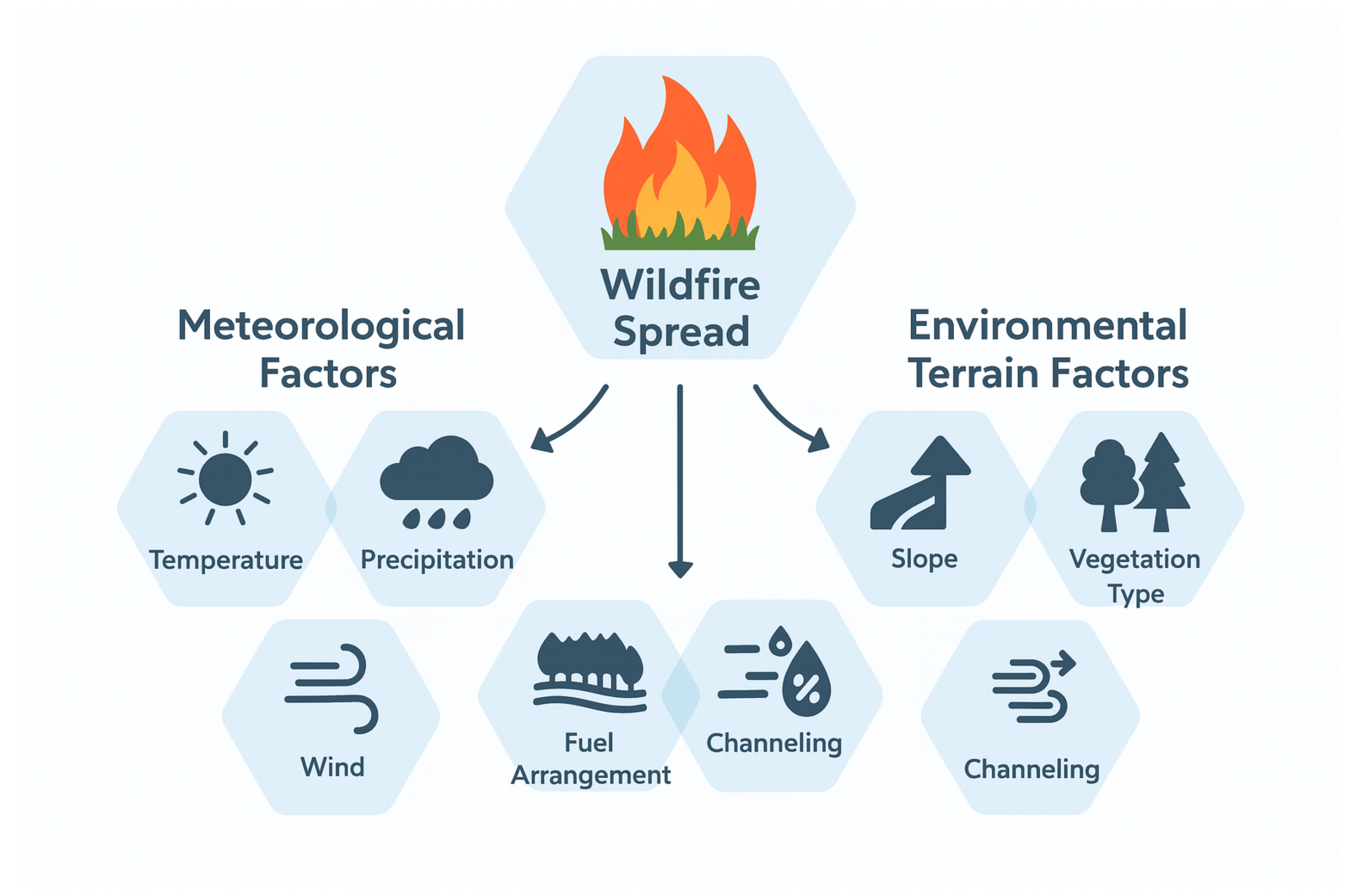
Figure 2.
The organization of this paper.
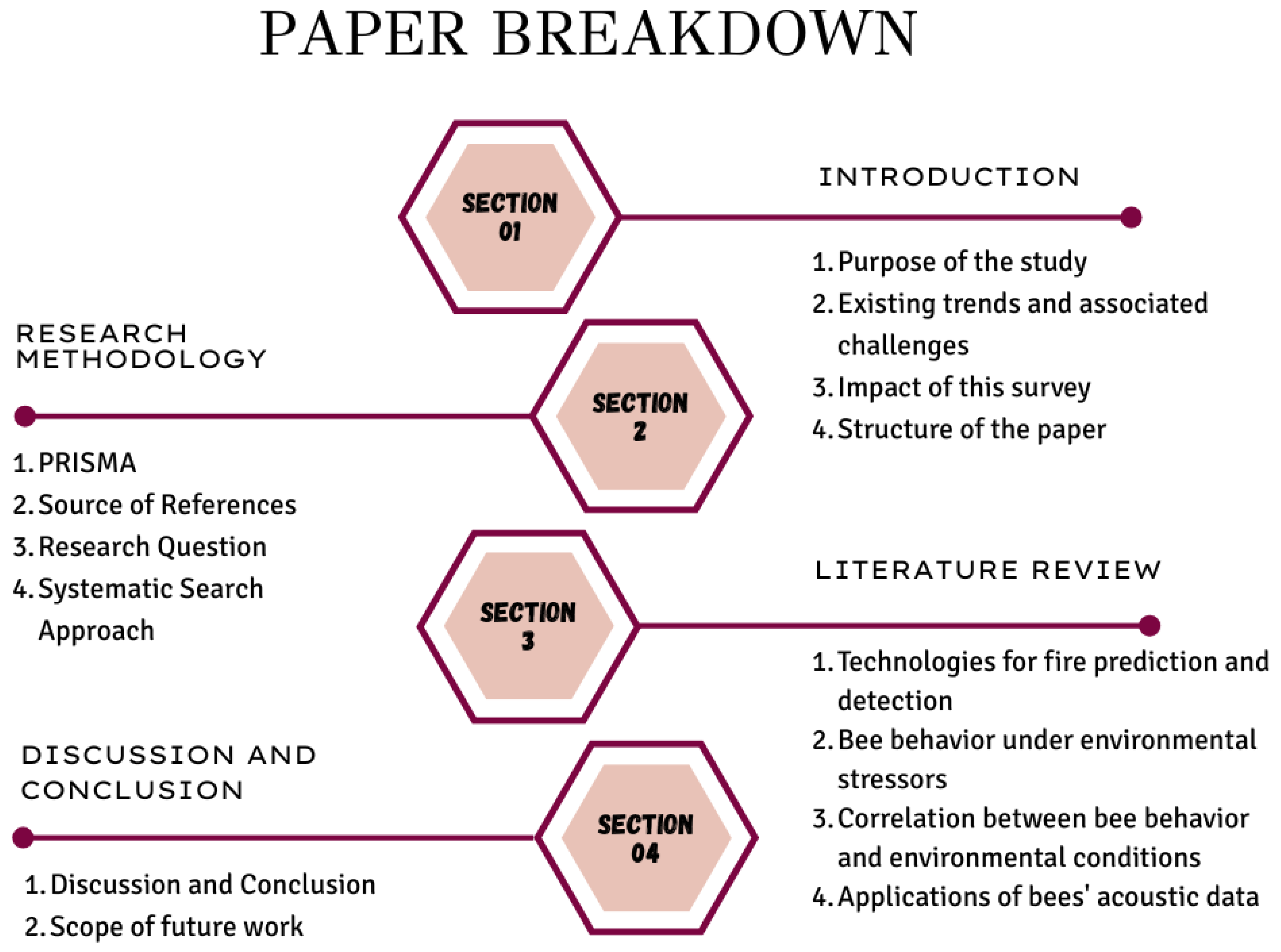
Figure 3.
PRISMA Flowchart Illustrating the Study Selection Process for Systematic Literature Review.
Figure 3.
PRISMA Flowchart Illustrating the Study Selection Process for Systematic Literature Review.
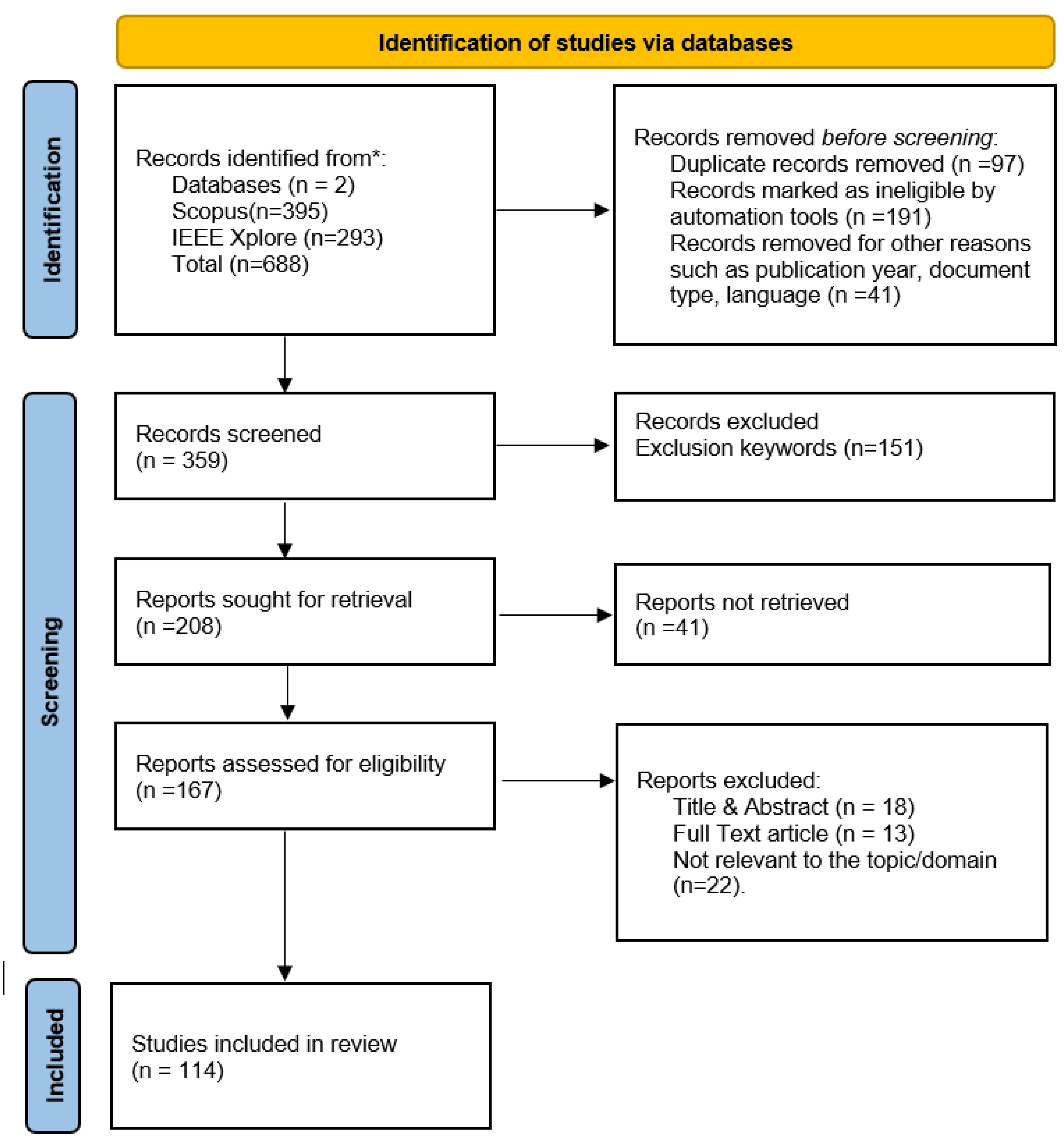
Figure 4.
Keyword co-occurrence network map illustrating dominant research trends in wildfire prediction, with “machine learning” and “deep learning” forming central thematic clusters.
Figure 4.
Keyword co-occurrence network map illustrating dominant research trends in wildfire prediction, with “machine learning” and “deep learning” forming central thematic clusters.
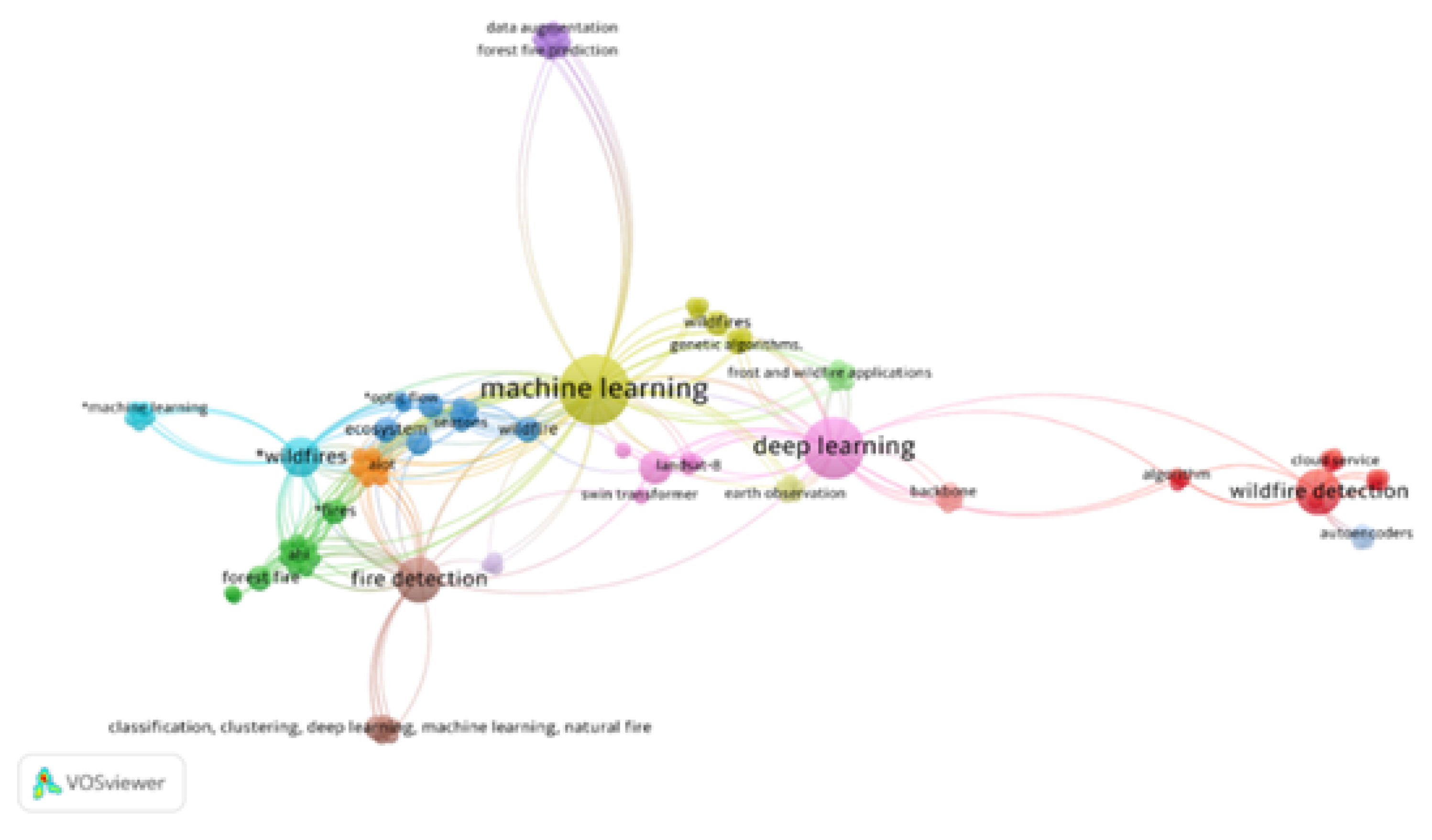
Figure 5.
Top 20 most frequent keywords in wildfire prediction literature, with “machine learning,” “UAVs,” and “CNN” as dominant themes.
Figure 5.
Top 20 most frequent keywords in wildfire prediction literature, with “machine learning,” “UAVs,” and “CNN” as dominant themes.
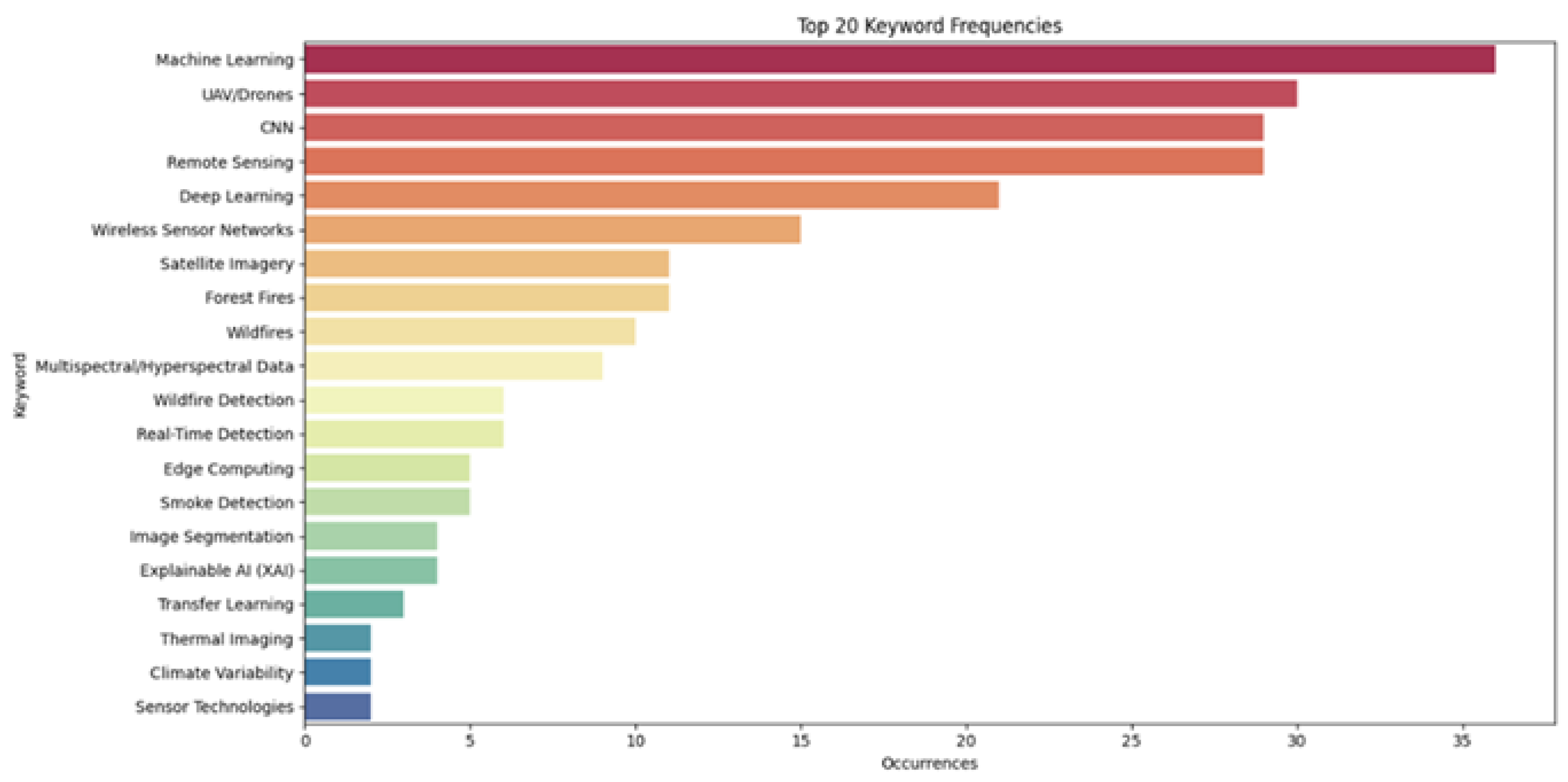
Figure 7.
Thematic mind map of key technologies and domains in wildfire prediction and early fire detection.
Figure 7.
Thematic mind map of key technologies and domains in wildfire prediction and early fire detection.
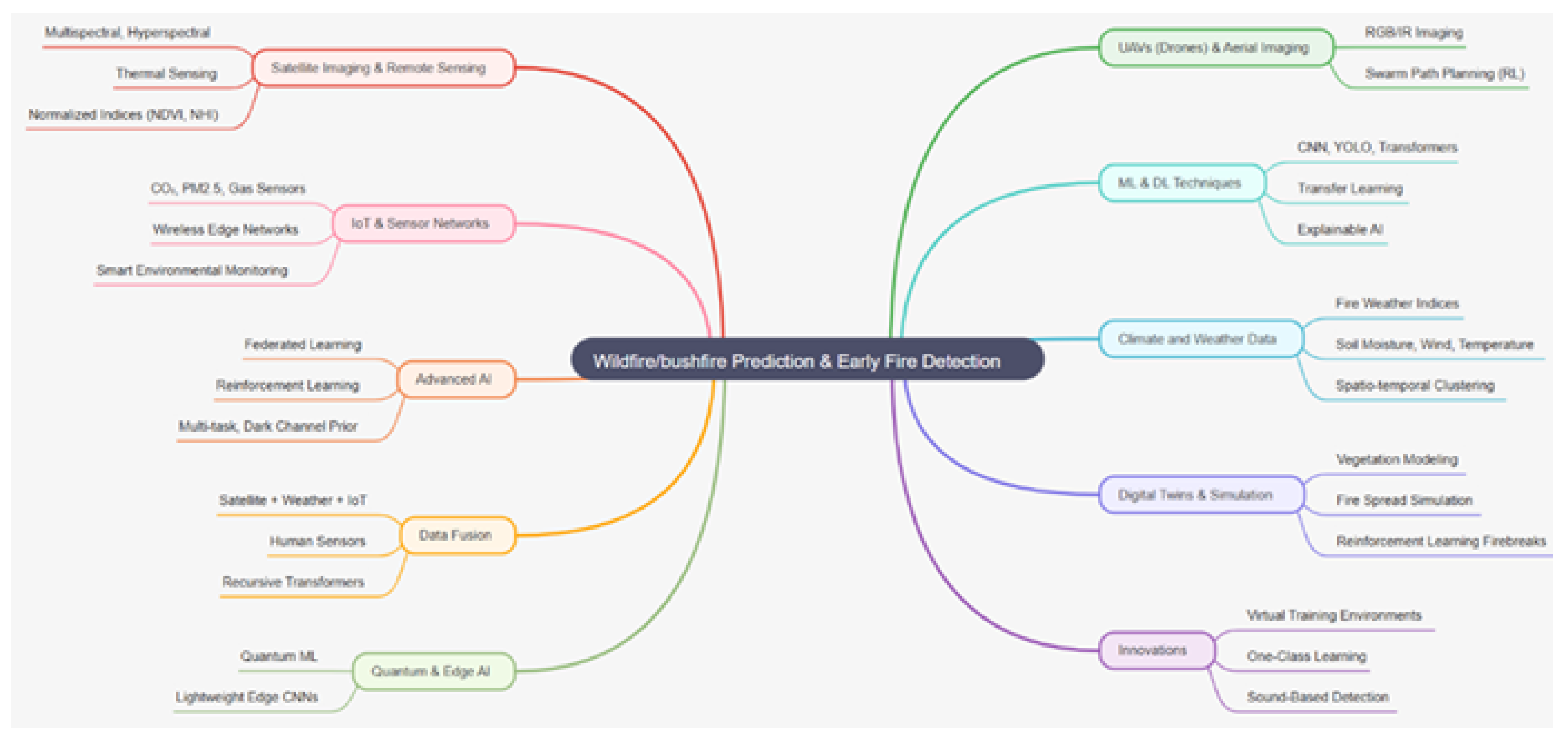
Figure 8.
Distribution of key challenge areas identified in wildfire research, based on the percentage of papers addressing each issue.
Figure 8.
Distribution of key challenge areas identified in wildfire research, based on the percentage of papers addressing each issue.
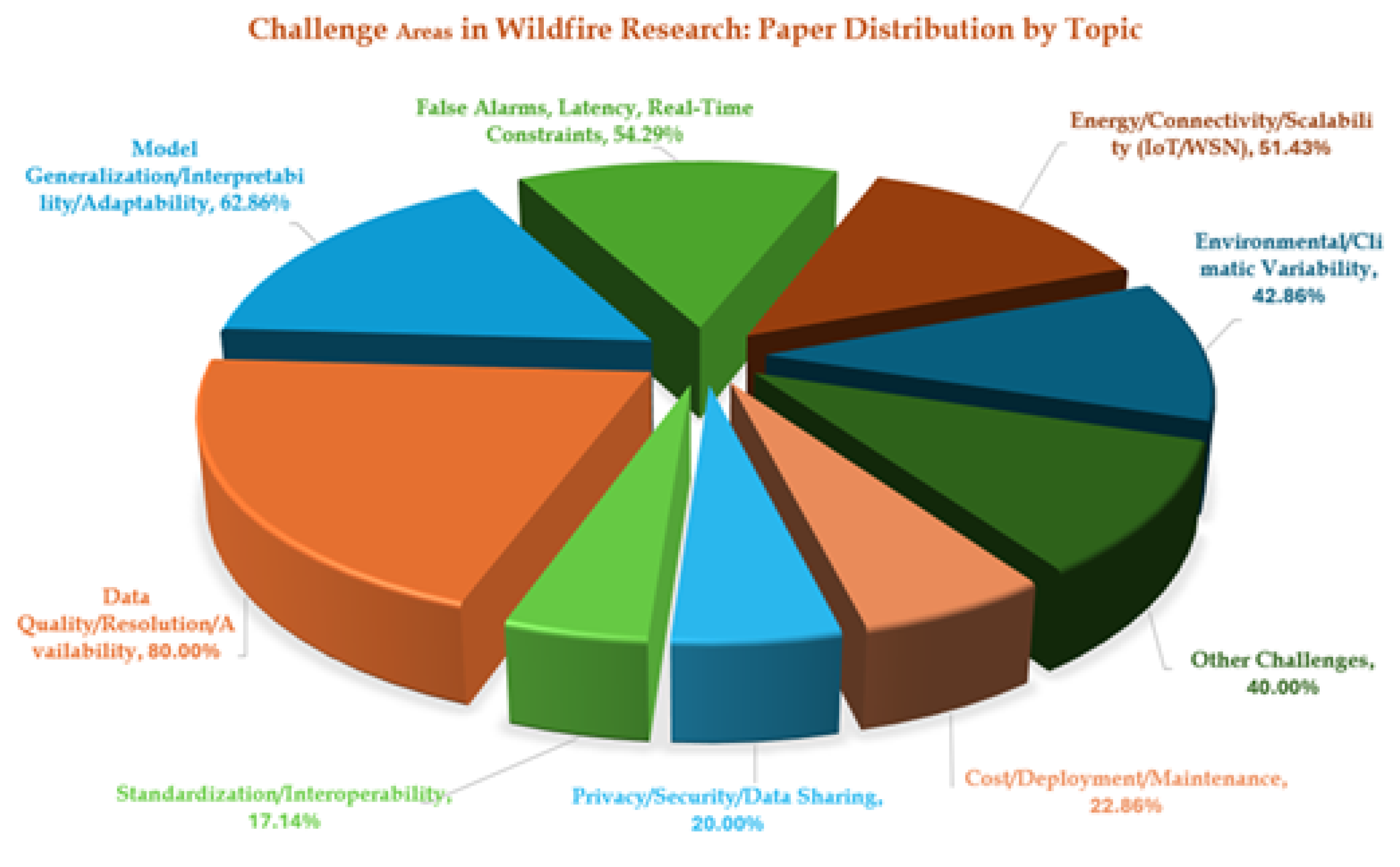
Figure 9.
Categorical distribution of wildfire prediction techniques, with detailed annotations on associated technologies and methodologies.
Figure 9.
Categorical distribution of wildfire prediction techniques, with detailed annotations on associated technologies and methodologies.

Figure 10.
PRISMA flow diagram illustrating the research paper selection process.
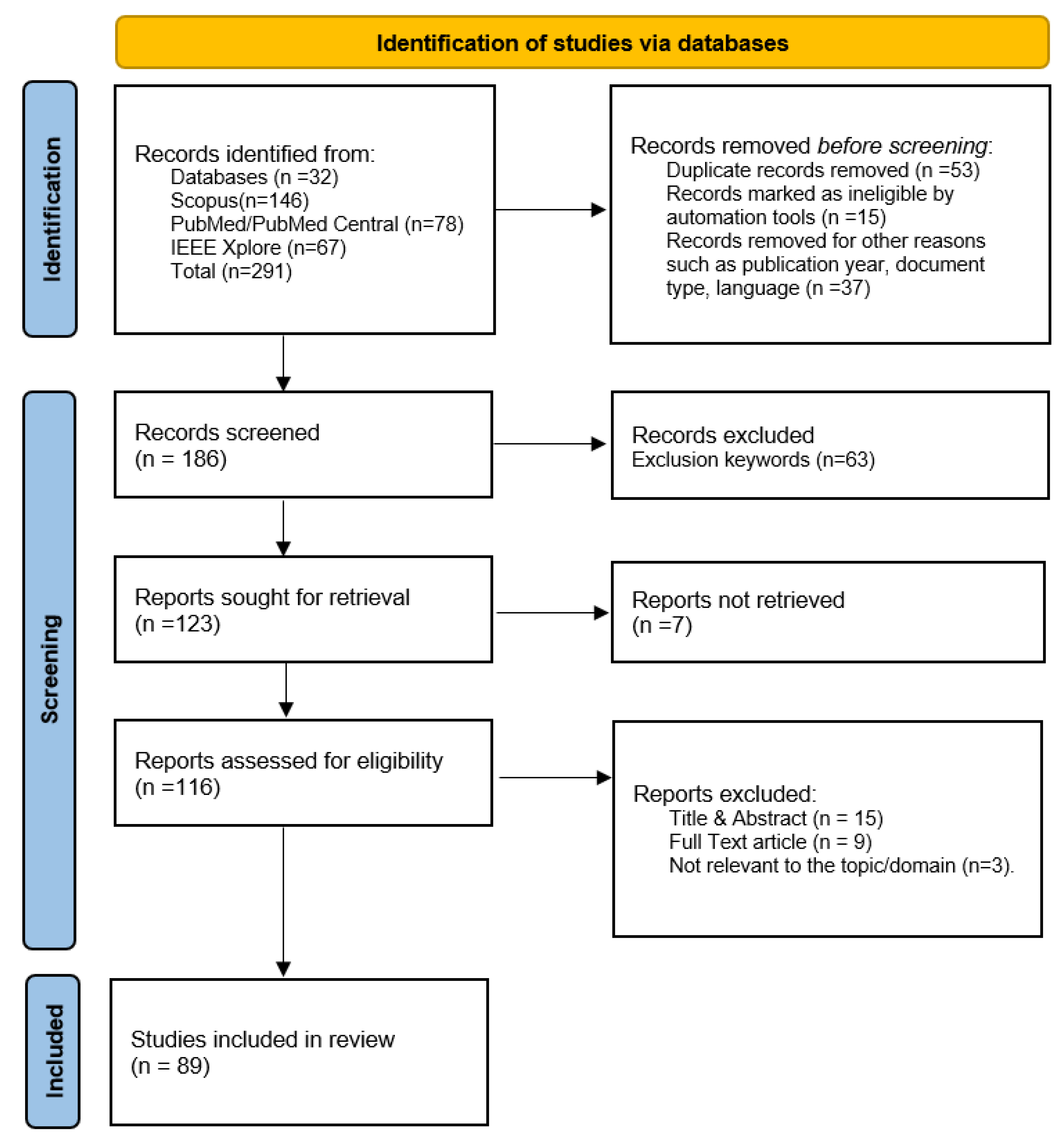
Figure 11.
Keyword Co-Occurrence Network of Environmental and Physiological Factors Affecting Bees.
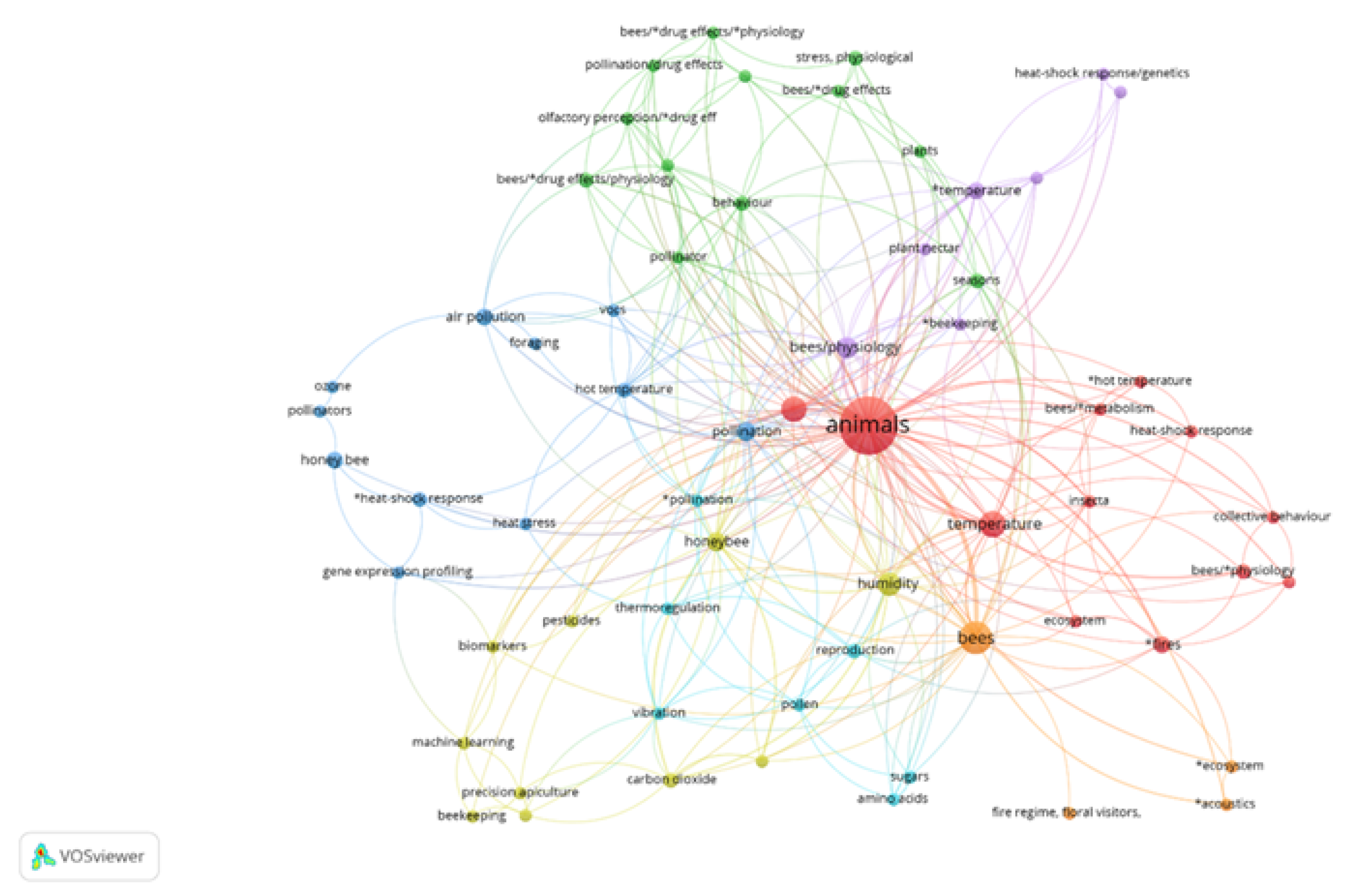
Figure 12.
Mind map illustrating the major environmental factors impacting bee populations during wildfire events.
Figure 12.
Mind map illustrating the major environmental factors impacting bee populations during wildfire events.
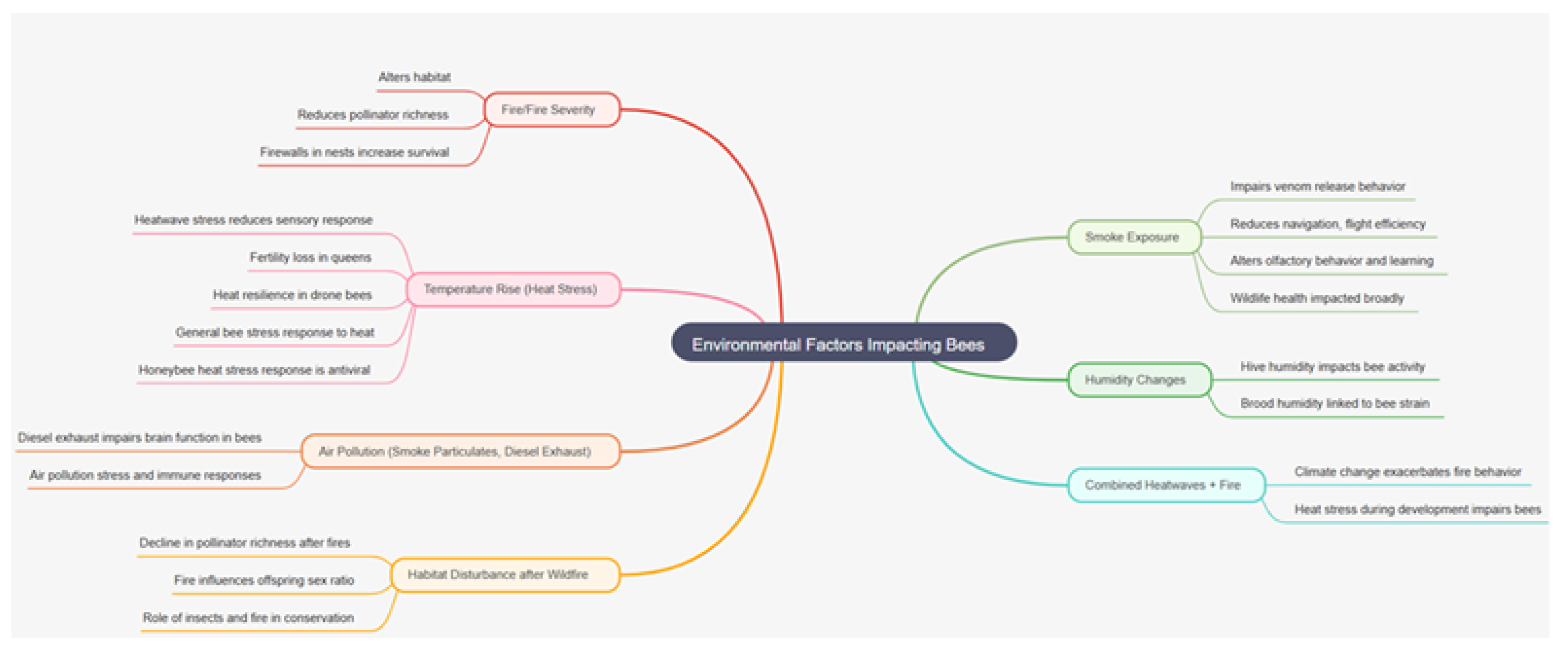
Figure 13.
Cross-domain Venn diagram illustrating the key environmental and climatic factors shared between wildfire risk modelling (technological domain) and bee behavioural responses (ecological domain).
Figure 13.
Cross-domain Venn diagram illustrating the key environmental and climatic factors shared between wildfire risk modelling (technological domain) and bee behavioural responses (ecological domain).
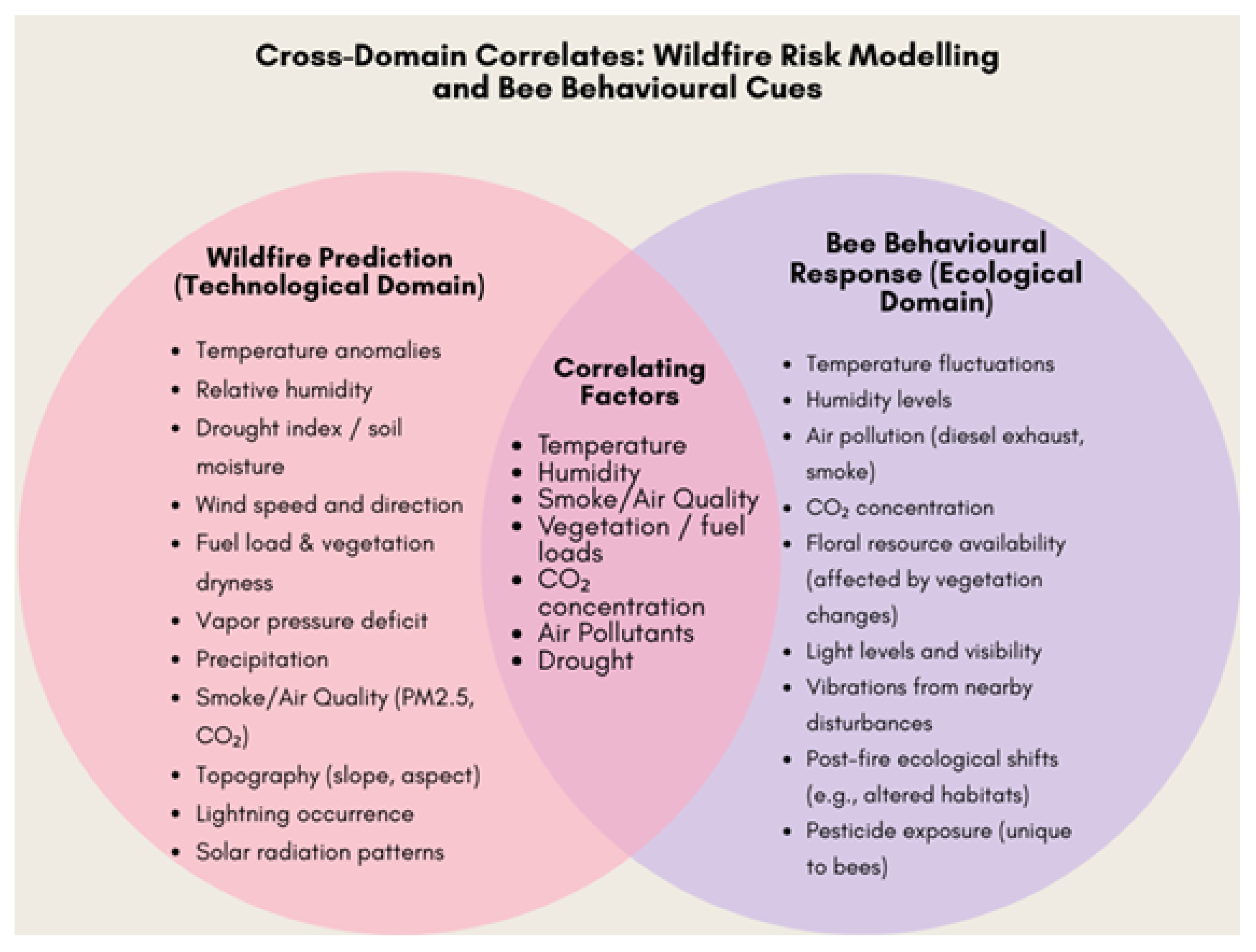
Table 1.
Research paper selection criteria.
| Criteria | Eligibility | Exclusion |
|---|---|---|
| Literature type | Journal, conference papers | Review paper, book series, book, chapter in book, conference proceeding |
| Language | English | Non-English |
| Timeline | Between 2019 and 2025 | 2018 and earlier |
Table 2.
Environmental and climate factors are studied in wildfire prediction research, with key references.
Table 2.
Environmental and climate factors are studied in wildfire prediction research, with key references.
| Environmental/Climate Factors | Key Focus | Reference |
|---|---|---|
| Weather variables (precipitation, temperature, wind, humidity, drought), climate variability, vegetation patterns, fuel loads | Quantifies the effects of environmental factors on wildfire burned area using ML | [5,14,15,35,44,68,84,85,86,87,88,89,90] |
| Vapor pressure deficit, relative humidity, energy release component (ERC), large-scale circulation patterns | Identifies drivers of burned area using ML and SHAP interpretation | [6,44,58,69,84,91,92] |
| Drought, soil moisture, Atlantic/Pacific SST gradient, external radiative forcings | Predicts multi-year drought and wildfire probabilities using Earth system models | [5,6,44,85,87,89,91] |
| Fuel moisture, meteorological drivers (temperature, humidity, precipitation) | Contrasts the environmental conditions of human- vs. lightning-ignited wildfires | [5,6,38,44,65,85,89,91,93,94] |
| Meteorological conditions (RH, precipitation), vegetation, lightning ignition | Predicts global lightning-ignited wildfires under climate change | [5,6,8,43,69,95] |
| Vegetation indices (NDVI), land surface temperature, drought indices | Reviews remote sensing methods for early fire detection | [35,44,58,84,85,92,93,94] |
| Topographic heterogeneity, temperature seasonality, climatic water deficit, anthropogenic factors | Analyses geographical variation in fire regimes under climate change | [5,35,36,43,58,68,87,88,89,96,97,98] |
| Fuel dryness, vegetation growth, and CO2 fertilization | Examines how climate change aggravates wildfire behaviour through increased fuel loads | [36,85,99,100] |
| Antecedent weather-driven vegetation growth, fine fuel accumulation | Demonstrates value of dynamic vegetation in Great Basin fire prediction | [2,4,85,101,102] |
Table 3.
Research paper selection criteria.
| Criteria | Eligibility | Exclusion |
|---|---|---|
| Literature type | Journal, Conference papers | Review paper, book series, book, chapter in book, conference proceeding |
| Language | English | Non-English |
| Timeline | Between 2019–2025 | 2018 and earlier |
Table 4.
Normal and deviated bee behaviours under environmental and climate conditions.
| Behaviour Aspect | Normal Behaviour (Typical Conditions) | Deviated Behaviour (Stressful Conditions) | Numerical Facts / Evidence | References |
|---|---|---|---|---|
| Foraging Activity | Optimal foraging at 21-33.5°C; peak activity in morning/early afternoon; efficient pollen/nectar collection | Reduced foraging above 33.5°C; foraging nearly ceases above 43°C; trip duration increases in poor air quality | Foraging trip duration ↑ by 32 min during pollution; optimal range: 21–33.5°C | [103,104,110,124,125] |
| Colony Temperature Regulation | Brood nest temperature stable at 33-35°C; fanning and water collection for thermoregulation | Brood temp fluctuates; heat stress increases fanning up to 300%; metabolic changes, dehydration | Brood nest temp: 33-35°C; fanning ↑ 300% at 40°C | [110,125] |
| Brood Rearing | Stimulated by longer days and resources; continuous in mild climates | Reduced during heat stress/poor resources; increased disease/Varroa susceptibility | Brood rearing ↓ during heatwaves; Varroa ↑ with longer brood periods | [106,107,109] |
| Flight Activity Timing | Peaks 9 AM-2 PM; diurnal variability linked to floral availability | Reduced/shifted activity during extreme heat or smoke exposure | Flight activity peaks 9 AM-2 PM; varies by plant species | [103,112] |
| Olfactory Sensitivity | High antennal sensitivity to floral VOCs; effective olfactory learning/memory | Reduced antennal response to scents; impaired learning due to ozone/pollutants | Olfactory response ↓ up to 80% after heatwaves; ozone impairs learning | [126,127,128] |
| Communication (Acoustic Signals) | Clear waggle dance, piping, and other signals; stable frequency/intensity | Disrupted signals; stop signals ↑ 4x during smoke; altered dance accuracy; distress piping | Stop signals ↑ 4x during smoke; piping at 250–280 Hz precedes distress | [129,130] |
| Temperature | Brood comb maintained at 33-36°C; RH ∼70%; foraging peaks ∼20°C; bees regulate hive temp by fanning, water collection, clustering, shivering | Foraging decreases above 35°C; ceases above 43°C; heat stress causes dehydration, impaired immunity, reduced brood; bees move faster, more dispersed; CTmax: honeybees ∼49.1°C, bumblebees ∼53.1°C, sweat bees ∼50.3°C | CTmax increases only 0.09°C per 1°C rise | [105,106,110,113,125,131] |
| Humidity | Bees maintain hive RH via fanning/hygroscopic materials; in-hive RH: 50–75%; brood RH optimal: 90-95% | Extreme low RH (<30%) or high RH (>75%) disrupts regulation, increases metabolic stress; high RH reduces longevity, exacerbates heat stress | Best worker survival at 75% RH at 35°C; productivity ↑ 0.237% per 10% RH (up to optimal); survival correlated with RH (, ) | [132,133,134,135] |
| CO2 | Typical in-hive CO2: 0.55% (large colony), 0.92% (small); bees tolerate high CO2 without visible distress; fanning increases with CO2 | High/acute CO2 can induce ovary activation in queens, metabolic shifts; chronic CO2 reduces pollen protein content | Ovary activation ↑, fat body lipids ↓; protein in ovaries ↑; pollen protein ↓ 30%; CO2 range: 0.33-1.77% | [136,137,138,139] |
Table 5.
Summary of Environmental Stressors and Their Impact on Bee Acoustics.
| Environmental Factor | Effect on Acoustic Emissions | Citation |
|---|---|---|
| Temperature Fluctuations | Increased intensity of acoustic emissions during extreme weather conditions | [113,143] |
| Humidity Changes | Disruption of hygroregulation mechanisms, leading to altered acoustic signals | [132] |
| Heat Stress | Activation of physiological stress mechanisms, altering worker activity and acoustic emissions | [144] |
| Synergistic Effects of Temperature and Humidity | Amplified impact on acoustic emissions due to combined stress | [144] |
| Environmental Stressors (General) | Increased stress levels, leading to altered acoustic emissions and negative impacts on colony health | [105,106] |
Table 6.
Applications of AI in bee acoustic and environmental monitoring.
| Area of Study / Observation | Factors Discussed | Method Used | Results & Findings |
|---|---|---|---|
| IoT + ML | |||
| Bee colony anomaly detection [147] | Temperature, humidity, hive health | IoT audio sensors, ML multiclass classification, edge computing | anomaly detection in real time. |
| Varroa infestation detection [156] | Hive environment, pest infestation | IoT sensor aggregation, ML classification | Detected Varroa presence with high sensitivity, false negatives ↓ 15% |
| Stingless bee honey production monitoring [157] | Temperature, humidity, floral cues | IoT sensors, image detection framework | Yield prediction ↑ 12% |
| Beehive state and events recognition [158] | Hive sound patterns, swarming, queen loss, foraging | TinyML audio signal analysis, embedded ML on edge devices | Audio-based event recognition models achieved event detection (e.g., swarming, queen loss) |
| Precision beekeeping [159] | Temperature, humidity, CO2, hive weight, activity | Review and synthesis of IoT+ML methods, multi-sensor system examples | 90-98% classification accuracy for activity states; early anomaly alerts |
| Bee colony health prediction [160] | In-hive temp/humidity, weight, weather, inspections | Data fusion (hive sensors + weather), ML-based status forecasting | Predicted colony health 2 weeks ahead; achieved 85-92% forecast accuracy |
| Image Processing & ML | |||
| Pollinator conservation, bee monitoring [161] | Habitat, floral resources, activity | Object recognition algorithms (CNN), Computer Vision | Detection ↑ 18%; large-scale monitoring of bee activity |
| Automated insect monitoring [162] | Habitat, insect diversity | DIY camera trap, image processing | bee presence accuracy |
| Bee detection from acoustic data [163] | Hive acoustics and bee activity | Image-based spectrogram + selective acoustic features + ML classifiers (e.g., SVM, CNN) | Accurate bee activity classification from spectrograms; robust with selected features |
| Audio Processing & ML | |||
| Acoustic monitoring of Bombus dahlbomii [164] | Temperature, habitat loss, invasives | Acoustic sensors, ML pattern recognition | Habitat shifts tracked; 92% accuracy |
| Acoustic monitoring, bee traits [151] | Temperature, species ID | Wingbeat analysis, ML, acoustic feature extraction | Wingbeat frequency negatively correlated with temperature; species classification |
| Beehive audio classification [150] | Hive state, environmental stress | Deep learning (CNN), spectrogram analysis | 94% hive state accuracy with CNN; noise robust |
| Swarm prediction via acoustics [153] | Temperature, hive congestion | Acoustic biosensor, ML, time-series analysis, SVM, and ANN | Detected pre-swarm signals 2 days in advance; prediction accuracy 87% |
| Queen detection via audio [165] | Queen presence, hive health | Remote audio sensing, ML classification | 91% queen status detection; early warning of queen loss |
| Sound pattern analysis [166] | Hive behavior, colony stress patterns | Audio spectral analysis, signal visualization, frequency modelling | Hive states alter sound spectra; useful diagnostic signal |
| Buzz fingerprinting [167] | Colony identity, environmental conditions, health status | Acoustic signal processing, spectral entropy, ML classification | Unique buzz prints; classification accuracy |
| Multi-Model Data Processing | |||
| Hive monitoring: weight, temp, traffic [149] | Temperature, hive activity | Time series forecasting, ML, sensor fusion | Health prediction ↑ 15% |
| Bee health & environment review [168] | Multiple: temp, humidity, stress | Literature review, ML/DL synthesis | Integration of multi-source data needed for monitoring |
| Bee health blood test [169] | Land use, environmental stress | Mass spectrometry, ML, multi-site data | Detected biomarkers at 20+ sites; 89% health classification |
| Habitat suitability modelling [145] | Temperature, climate, and land use | ML(Random Forest, SVM), cloud computing, spatial modelling | Predicted Apis florea distribution shifts under climate change; model AUC 0.93 |
| Honey production factors [146] | Temperature, humidity, environment | ML regression, variable importance ranking | Temp/humidity top predictors; model explained 78% yield variance |
| Beehive survival prediction [148] | Weather, management, climate | ML, survival analysis | Weather+management data; Predictions ↑ 22% |
| Crop yield prediction [155] | Temperature, climate change, yield | Ensemble ML, environmental data fusion | Yield ; bee activity critical |
Table 8.
The Impact of Heat Stress on Bee Communication.
| Effect of Heat on Communication | Description of Impact | Citation |
|---|---|---|
| Disruption of Sound Production | Heat stress alters metabolic rate, affecting buzzing sounds in bumblebees. | [181] |
| Impaired Floral Communication | Heatwaves reduce antennal responses to floral scents in bumblebees. | [126] |
| Changes in Social Communication | Heat stress reduces accuracy of dance communication in honeybees. | [182] |
| Thermal Communication in Brood | Heat stress disrupts thermal responses used for brood care. | [175] |
| Species-Specific Vulnerability | Solitary bees are more vulnerable to heat stress than social bees. | [121] |
Table 9.
Environmental Stressors and Their Impact on Bee Acoustics.
| Environmental Factor | Effect on Acoustic Emissions | Citation |
|---|---|---|
| Temperature Fluctuations | Increased intensity of acoustic emissions during extremes | [143] |
| Humidity Changes | Disruption of hygroregulation, altered acoustic signals | [132] |
| Heat Stress | Alter work emissions and acoustic emissions. | [133,144] |
| Synergistic Effects | Amplified impact on acoustic emissions | [144] |
| Environmental Stressors | Increased stress levels, leading to altered acoustic emissions and negative impacts on colony health. | [105,106] |
Table 10.
Summary of studies on bee stressors and environmental factors.
| Year of Study | Key Focus Area | Method Used | References |
|---|---|---|---|
| Heat Stress | |||
| 2025 | Effects of zinc-methionine and Sel-Plex; Hyperthermia influence on varroa/viruses; Drone resilience factors; Queen size and HSP90/HSC70 role. | Lab RT-qPCR, heat chambers, gene expression, statistical resilience models. | [107,108,186,187] |
| 2023 | Honeybee heat stress response; Thermal tolerance in stingless bees. | Thermocouples, video tracking, survival analysis (Kaplan–Meier). | [110,190] |
| 2022 | Drone bee abiotic stress sensitivity; Heatwave effects on bumblebee workers. | Heat shock assays, temp. chambers, maze behaviour tests. | [189,191] |
| 2021 | Mechanisms of heat stress response. | Thermocouples, spectrophotometric physiology assays. | [106] |
| 2020 | Heat-induced queen fertility loss; Heat shock response; Immunocompetence effects. | Histology, qRT-PCR, phenoloxidase enzyme assays in heat chambers. | [109,192,193] |
| 2019 | Acetylcholinesterase 1 expression under heat stress. | RT-PCR, Western blotting, stress analysis. | [180] |
| Temperature and Humidity | |||
| 2022 | Hive colonisation affected by temp. and RH. | Field loggers + regression analysis. | [194] |
| Climate Change | |||
| 2025 | Climate impacts and mitigation by management. | Field surveys, interviews, ANOVA. | [195] |
| 2025 | Urban climate impacts on Amazonian stingless bees. | Field sensors + regression modelling. | [196] |
| General Stressors | |||
| 2025 | Stress responses in divergent bee species. | Biochemical assays (Western blotting, t-tests). | [197] |
| Wildfire & Smoke Impacts | |||
| 2024 | Decline in pollinator richness with fire distance. | Transect surveys, linear regression. | [140] |
| 2022 | Review of smoke impacts on insects. | Meta-analysis, random effects modelling. | [115] |
| 2021 | Wildfire severity effects on bee offspring sex ratio. | Transect fieldwork, logistic regression. | [141] |
| Environmental Stressors | |||
| 2024 | Vibrational pulse response in colonies; Passive trapping bias. | Electromagnetic shaker (340 Hz), accelerometers, randomized pulses; Pitfall traps + GLM analysis. | [129,198] |
| Air and Smoke Pollution | |||
| 2023 | Poor air quality linked to bee stress. | Air sensors + correlation analysis. | [199] |
| 2020 | Smoke effects on butterfly flight. | Flight mill + PM2.5 variation, paired t-tests. | [115] |
| Diesel Exhaust | |||
| 2019 | Diesel exhaust impact on bee memory/learning. | Diesel exposure, behaviour assays, HSP70 analysis. | [114] |
Disclaimer/Publisher’s Note: The statements, opinions and data contained in all publications are solely those of the individual author(s) and contributor(s) and not of MDPI and/or the editor(s). MDPI and/or the editor(s) disclaim responsibility for any injury to people or property resulting from any ideas, methods, instructions or products referred to in the content. |
© 2025 by the authors. Licensee MDPI, Basel, Switzerland. This article is an open access article distributed under the terms and conditions of the Creative Commons Attribution (CC BY) license (http://creativecommons.org/licenses/by/4.0/).
Copyright: This open access article is published under a Creative Commons CC BY 4.0 license, which permit the free download, distribution, and reuse, provided that the author and preprint are cited in any reuse.


