

Submitted:
07 November 2025
Posted:
10 November 2025
Read the latest preprint version here
Abstract
The advances related to Modular Elliptic Curves and the Fermat – Wiles’ theorem in recent years has opened the door to entirely new approaches to numerous problems and techniques. This paper studies the linking between a family of exponential function and the Fermat – Wiles’ theorem. In this family, the convergence of the coordinates of the abscissas of the maxima and the equation determined by the fulfilment of the maximum condition leads to a singular connection with the Fermat – Wiles’ theorem.
Keywords:
connection
; Fermat-Wiles' theorem
; family of exponential functions
; sequence
; maxima
1. Introduction
In 1637 Pierre Fermat formulated the conjecture known as his Last Theorem. In 1995, Andrew Wiles presented the first successful proof of Fermat’s conjecture [1]. In this work, the semistable case of the Taniyama-Shimura theorem - previously a conjecture - which links modular forms and elliptic curves, was demonstrated. From this progress, combined with ideas from Frey and Ribet’s theorem, the proof of the conjecture was obtained. This result was hailed as an astonishing breakthrough that opened the door to entirely new approaches to numerous problems and techniques [2]. The number of publications in recent years and the new links with other fields have confirmed this statement [3,4,5].
In parallel, research into exponential functions has evolved from the study of their basic properties towards deep problems connecting number theory, complex analysis, dynamical systems, and applied mathematics, keeping it at the frontier of mathematical knowledge: Schanuel’s Conjecture, Dynamics of the Exponential Function, Transcendence of Hybrid Expressions and others [6,7]. Moreover, the exponential function is the natural language for describing a vast range of natural and human processes involving proportional change, making it a cornerstone of modern scientific modelling: Nuclear and Atomic Physics, Biology and Demography, Geology and Palaeoclimatology, Economics and Finance, Psychology and Neuroscience and many others [8]. It is therefore interesting to explore the possible links between Fermat - Wiles’ theorem and exponential functions.
In this work, a singular connection between a family of exponential function and the Fermat – Wiles’ theorem (FWT) is revealed. This family depends on the variable x ∈° / x ≥ 0 and a parameter n ∈ Z+. The bases were chosen as integers, and an additional restriction was imposed on them. The functions have a unique maximum for each value of n, which is determined by an equation relating the bases. On the other hand, the sequence xn, whose terms are the abscissas of the maxima for different values of n, has a sup xn. By analysing the limit of the sequence and the additional linking equation between the bases, a singular connection with the Fermat – Wiles’ theorem is found.
Below, we proceed to carry out the analysis that reveals the aforementioned connection.
2. Analysis of the Connection
2.1. Family of Exponential Functions
Let the set of exponential functions (1) be described by the equations
where a, b, c ∈ Z+
and the sets A, B and C, whose elements are the prime numbers present in the factorial decompositions of a, b and c respectively, satisfy the condition that they only have one as a common prime factor
n = 1, 2, 3,…,n,…
The integers a, b and c are used as bases to define (1) in the interval x ∈ [0, +∞). Additionally, the restriction (4) will be imposed on (1), where p ∈ Z+/ p ≥ 3
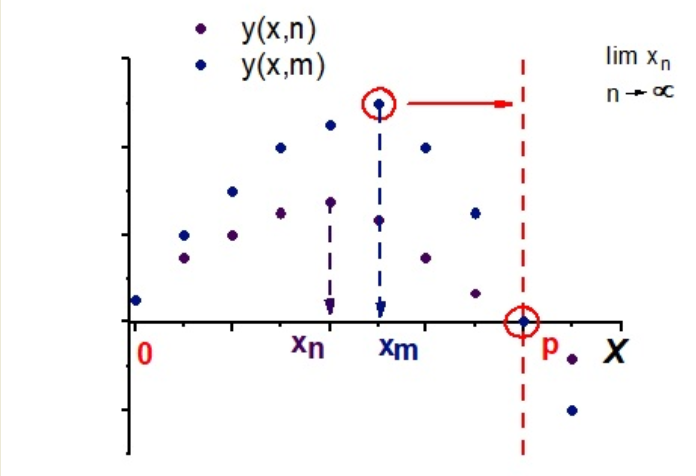
Next, we proceed to study the consequences of imposing restriction (4) on variation of functions (1). As a first step in the analysis, it will be shown that the functions (1) have a maximum in the interval (0, p).
From (4) it can be simply shown that
Considering (2) and (5) it follows that ∃ d ∈ Z+ /
and it will be shown that d ≡ 0 (mod p). Taking into account (4) and (6), Fermat’s little theorem ( will be applied to equality
from which it is concluded that d is a multiple of p, consequently, d = q⋅ p where q ∈ Z+(q ≥1). Therefore, d ≥ p, from here it is inferred that
Therefore
Bearing in mind (4) and (9) as well the theorem of Intermediate Values for continuous functions, then ∃ ∈ [1, p] ⁄ . Hence, at the endpoints of the interval [0, ], it holds that . Consequently, by Rolle’s theorem for continuous and differentiable functions, there exists at least one point such that , and has an extremum at that value .
From (1) it follows that
lf yn’(x) is evaluated at and is considered that it is obtained that:
Relation (10) determines that yn(x) has only one extremum. And if (2), (10) and (11) are taken into account, it follows that yn”(xn) < 0, so the extremum at x = xn is a maximum.
From (12), it results that
Note that the abscissas xn of the maxima of the functions y1(x), y2(x),… and yn(x)… are not equal.
In the next stage, the sequence xn and the variation of the equality (13) as a function of n will be investigated.
2.2. Sequence of the Abscissas xn of the Maxima
It will then be shown that the coordinates of the abscissas of maxima of the family functions , form a monotonically increasing sequence that has a limit.
From (4) it results that
The derivative of is equal to
Given , at the coordinate of the maximum of it is true that and as that implies that
If is evaluated at , it results in
The next step is to replace in (17) by its expression (16) obtaining
Since , and , this means that . Therefore, is growing at . Considering (14) and , then the function must reach a maximum at some point . Therefore, the sequence formed by the coordinates of the maxima of turns out to be monotonically increasing. Furthermore, considering that , this is bounded by
This sequence is monotonically increasing and being bounded it converges to a supremum according to the Monotonic Convergence theorem [9]
So
2.3. The Connection with the Fermat – Wiles’ Theorem (FWT)
2.3.1. The Connection Between the Existence Condition of the Maximum of yn(x) and the FWT.
In some cases, the use of the concept of limit allows to transcend the discrete and individual nature of integers to discern connections in the case of numerical functions [10]. This tool will now be used to determine the behaviour of (13) when n → ∞.
From the previous analysis to demonstrate the existence of the maximum of at it follows that , and
Besides
Therefore, for large values of n, , it can be assumed considering (22) and (23) that
From (13) and taking into account (24) the relationship (25) is obtained for large value of n
If the limit of both sides of the equality (25) is calculated as n → ∞ is obtained
From (26) and (27), the equality (28) is derived
However, the resulting equation (28) contradicts the conditions assumed in (2) and (3).
Another way to show this contradiction is to use the expression (29) derived from (13)
Expression (21) leads to the fact that for very large n and consequently
If n is increased further, then the same relation (28) is obtained which leads to the contradiction shown above.
2.3.2. The connection between the continuity condition of
and the FWT.
From (13), the following relationship is obtained
Equation (33) allows the value of the maximum of the function to be expressed in terms of the value of the first derivative of at the abscissa of said maximum. Upon evaluating the value of the maximum of the function at using (33), one obtains
that is undefined at the abscissa . Furthermore, from (1), it’s concluded that the entire family of functions (1) is undefined at . This result contradicts the fact that all functions are continuous on the interval [0, +∞).
The relations (28) and (34) obtained by evaluating the variation of the functions contradict assumptions adopted in (2), (3) and (4). The analysis performed by its essence represents a demonstration by reductio ad absurdum, that shows that if the family has a, b, c ∈ bases, then it cannot have roots .
3. Conclusions
The previous analysis demonstrates a singular connection between a family of exponential functions and the Fermat – Wiles’ theorem. If it is assumed that the bases of the family of exponential functions are integers and the existence of an entire root is imposed, then the convergence of the abscissas of the maxima and the equation determined by the fulfilment of the maximum condition leads to contradictions. This analysis indicates that if the family has integer bases, then it cannot have roots .
Acknowledgments
This work was subjected to analysis and criticism by numerous colleagues. My deepest thanks to all of them.
Conflicts of Interest
The author declares that he has no conflicts of interest.
References
- Wiles A. (1995). Annals of Mathematics, Second Series, 141, 3, pp./c67107 443-551.
- https://abelprize.no/abel-prize-laureates/2016 (accessed July 18, 2025).
- Queme R. (2002). arXiv:math/0211467v1. [CrossRef]
- Moser J. (2025). arXiv:2501.03646v1. [CrossRef]
- Wheeler W.H. (2 arXiv:2309.07151v1. [CrossRef]
- Terzo, G. (2008). Communications in Algebra, 36, 3, 1171–1189. [CrossRef]
- Shkop, A. C. (2011). Communications in Algebra, 39(10), 3813–3823. [CrossRef]
- G. J. Fu, Hui Jiang, Y. M. Zhao, S. Pittel, A. Arima. (2010). Phys. Rev. C 82, 034304. [CrossRef]
- Bloch E.D. The Real Numbers and Real Analysis. Springer Science+Business Media, LLC 2011. [CrossRef]
- Hardy, G. H., Wright, E. M. (2008). An introduction to the theory of numbers (6th ed.). Oxford University Press.
Disclaimer/Publisher’s Note: The statements, opinions and data contained in all publications are solely those of the individual author(s) and contributor(s) and not of MDPI and/or the editor(s). MDPI and/or the editor(s) disclaim responsibility for any injury to people or property resulting from any ideas, methods, instructions or products referred to in the content. |
© 2025 by the authors. Licensee MDPI, Basel, Switzerland. This article is an open access article distributed under the terms and conditions of the Creative Commons Attribution (CC BY) license (http://creativecommons.org/licenses/by/4.0/).
Copyright: This open access article is published under a Creative Commons CC BY 4.0 license, which permit the free download, distribution, and reuse, provided that the author and preprint are cited in any reuse.


