Preprint
Review

This version is not peer-reviewed.

Lentiviral Vectors for CAR-T and Other Cell Therapy Products: A Microbiological and Biosafety Perspective

Submitted:

10 June 2026

Posted:

11 June 2026

You are already at the latest version

Abstract

Chimeric antigen receptor T-cell (CAR-T) therapy represents a transformative yet high-cost immunotherapeutic strategy that has benefited many patients with hematological malignancies and autoimmune diseases. As of January 2025, only a limited number of CAR-T products have received approval by the FDA, EMA, and the NMPA, primarily targeting CD19 or B-cell maturation antigen (BCMA) expressed on cancer cells. The manufacturing of currently approved CAR-T products predominantly relies on lentiviral vectors (LVVs), largely derived from human immunodeficiency virus type 1 (HIV-1). LVVs are favored due to their high transduction efficiency and their ability to stably integrate transgenes into the genomes of both dividing and non-dividing cells, including post-mitotic mammalian cells, an advantage over gamma retroviral vectors, which exhibit limited capacity to transduce non-dividing cells. This review outlines the fundamental biological principles of HIV-derived LVVs, their structure, functional components, and biotechnological applications. It provides a comparative analysis of different viral vectors, an overview of the CAR construct, and a summary of ex vivo CAR-T manufacturing processes. Additionally, emerging in vivo CAR-T approaches are discussed, with reference to clinically approved LVV-based CAR-T products. Emphasis is placed on microbiological perspectives and environmental biosafety. Finally, recent advances in LVV technology are described, providing insight into the production of next-generation CAR-T therapies employing in vivo gene delivery approaches.

Keywords: 
;  ;  ;  ;  ;  ;  ;  

1. Introduction

Viral vectors have become fundamental biotechnological tools in modern medicine, serving as highly efficient vehicles for delivering genetic material into human cells. Their ability to enable stable, targeted genomic modification has been a pillar of gene and cell therapy, opening new therapeutic strategies for monogenic diseases, malignancies, and immunological disorders previously considered incurable. Among these transformative applications, chimeric antigen receptor T-cell (CAR-T) therapy, first described in the late 20th century, represents one of the most significant advances in oncological immunotherapy, reshaping the therapeutic paradigm for advanced hematological malignancies. [1,2,3]CAR-T cells are autologous or allogeneic T lymphocytes genetically engineered to express a CAR that redirects T-cell specificity toward tumor-associated antigens. Structurally, the CAR, defined as the main functional element of CAR-T cells, comprises four distinct domains: a ligand-binding domain, a spacer, a transmembrane domain, and a cytoplasmic domain.[4] Unlike natural T lymphocytes, CAR-T cells can recognize tumor antigens independently of the human major histocompatibility complex (MHC), enabling them to distinguish a broader spectrum of targets.[5]Upon binding tumor antigens, CAR-T cells undergo activation, expansion, cytokine secretion, metabolic reprogramming, and cytotoxic degranulation, releasing perforin and granzymes that mediate tumor cell lysis.[6]
The fundamental principle of gene therapy is the ability to administer a transgene that confers a therapeutic benefit. Although several gene delivery platforms have been developed, viral vectors remain the most widely adopted vehicles due to their high transduction efficiency and reproducibility.[7] Viral vectors are engineered to retain essential components required for cellular entry and transgene delivery while eliminating genes necessary for replication, thereby producing replication-defective viruses optimized for therapeutic use.[7]
Lentiviral vectors (LVV), γ-retroviruses, and adeno-associated viruses (AAV) are among the most used viral vectors in various applications.[1,2,3] Due to their superior transduction efficiency. γ-retroviral vectors were the first viral vectors used to produce CAR-T cells targeting CD19 and accounted for approximately one-fifth of gene therapy clinical trials. [2]However, their limited ability to transduce non-dividing cells constrains their broader application. AAVs offer a lower risk of toxicity and immunogenicity but are limited by their small packaging capacity (~50 kb), which makes them unsuitable for larger or more complex gene transgene constructs.[3]LVVs are the leading platform for CAR-T production.[1] In addition to their high gene transfer efficiency, they can transduce both non-proliferating and proliferating cells. Importantly, since the viral genome is transmitted to daughter cells, it can induce long-term, stable transgene expression and a sustained therapeutic effect.[1] Advanced vector designs have substantially enhanced biosafety by minimizing the risk of replication-competent lentivirus formation and reducing insertional activation of oncogenes. As a result, LVVs are currently the predominant vector system used in clinically approved and investigational CAR-T products worldwide.[4]
The ex vivo manufacturing process of CAR-T cells typically involves leukapheresis, T-cell enrichment and activation, viral transduction, expansion, formulation, and reinfusion into the patient. Automation and closed-system processing have become central to ensuring reproducibility, sterility, and regulatory compliance under Good Manufacturing Practice (GMP) standards. In Abu Dhabi, United Arab Emirates, our Good Manufacturing Practice (GMP) laboratory at the Abu Dhabi Stem Cells Center (ADSCC) has produced and applied clinical-grade autologous CAR-T cells for the treatment of hematological malignancies since 2024, using the CliniMacs Prodigy® platform (Miltenyi Biotec). The cells are stimulated and transduced with an LVV (Lentigen Technology, Miltenyi Biotec) encoding a CAR targeting CD19. [8] CliniMACS Prodigy® is among the most advanced automated platforms for CAR-T cell manufacturing and other applications, including stem cell enrichment and the preparation of virus-reactive T cells.[9] It integrates cell washing, magnetic cell separation, activation, transduction, and a cell culture device within a fully closed, sterile system. Its programmable interface enables standardized, GMP-compliant, multi-step processing with reduced contamination risk and operator variability.[10]
This review provides a comprehensive analysis of the evolution of viral vector technology, with particular emphasis on the biology, structural organization, and engineering of LVVs. It traces their development from foundational molecular insights into human immunodeficiency virus (HIV-1) genome organization to the design of next-generation vectors optimized for safety and efficiency. Furthermore, it examines transduction methodologies that enhance gene transfer to meet increasing clinical demand. Particular emphasis is placed on microbiological risk assessment, environmental containment, and biosafety governance in vector production and cell processing facilities. Additionally, the review explores the transition from conventional ex vivo manufacturing to emerging in vivo gene delivery, highlighting technological innovations and regulatory implications. This analysis will provide a comprehensive view of a technology that, despite its challenges, continues to evolve and redefine the limits of personalized medicine. The review may be of interest to laboratory scientists, engineers, and others responsible for biopharmaceutical processes and biosafety and quality; clinicians; facility designers; and regulatory and legislative bodies.

2. From the Biology of a Lentivirus to that of the Lentiviral Therapeutic Vector

2.1. What Are Lentiviruses?

Lentiviruses are of the genus Lentiviridae, of the family Retroviridae, characterized by their prolonged incubation period ("lenti-" from Latin, meaning "slow") and their ability to infect both dividing and resting (non-dividing) cells.[11] Unlike other retroviruses, lentiviruses can cross the intact nuclear membrane of the host cell thanks to specific pre-integration complexes, allowing them to integrate their genetic material into the host cell genome.[11]Lentiviruses possess a positive-sense single-stranded RNA genome (+ssRNA); Following entry into the host cell, reverse transcriptase converts the viral RNA into double-stranded DNA, which is subsequently integrated into the host genome by the viral integrase enzyme, forming a provirus. This stable integration allows viral genetic material to replicate alongside host DNA.[12] The lentivirus can transfer up to 10 kb of genes to the host cell, leading to the expression of encoded proteins.[13] The best-known example is HIV-1, which causes AIDS, but there are other examples, including Simian Immunodeficiency Virus (SIV) and Caprine Arthritis-Encephalitis Virus (CAEV).[14]
A breakthrough in retrovirology occurred in 1970 with the discovery of reverse transcriptase by Howard Temin and Satoshi Mizutani,[15] and independently by David Baltimore.[16] This discovery established the molecular basis of retroviral replication and stable genomic integration, ultimately enabling the conceptual development of retroviruses as gene delivery tools.[17] Subsequent natural dissection of this natural "genetic engineering" mechanism revealed the potential for retroviruses to be stripped of their pathogenic genes and adapted to transport therapeutic genes. These insights laid the foundations for gene therapy concepts that began to emerge in the early 80s. Although the field faced significant technical and regulatory challenges over the following forty years, HIV-based lentiviral vector technologies only fully matured in the late 90s. [18]
As illustrated in Figure 1, the genomic organization of wild-type HIV-1 (Figure 1A) and the virion structure (Figure 1B) provide the biological framework from which lentiviral therapeutic vectors were subsequently engineered.

2.2. Production of HIV-Derived LVVs

Modern lentiviral vectors (LVVs) are primarily derived from HIV- 1 but are extensively engineered to abolish pathogenicity and replication competence while preserving efficient gene transfer capacity. The third-generation LVV platform, currently the clinical standard for gene and cell therapy applications, employs a four-plasmid system designed to maximize biosafety. This system includes a transfer plasmid containing the "genetic cargo" of interest, flanked by self-inactivating (SIN) long terminal repeats (LTR). In SIN vectors, the U3 promoter/enhancer region of the native viral LTR is removed, thereby preventing activation of adjacent host genes after integration and reducing the risk of insertional mutagenesis. The transfer construct further includes the "therapeutic" or "reporter" transgene, an internal promoter that regulates transgene expression, and the packaging signal Ψ (psi), which ensures the selective encapsidation of vector RNA into assembling viral particles. The remaining viral components are supplied by separate plasmids encoding gag/pol, rev, and the envelope glycoprotein (Env). The gag/pol plasmid provides the structural and enzymatic proteins required for particle assembly and maturation. In contrast, the rev plasmid enables nuclear export of full-length vector RNA via interaction with the recv response element (RRe). An envelope plasmid encodes a heterologous glycoprotein that determines cellular tropism; most commonly, the vesicular stomatitis virus glycoprotein (VSV-G) is used because it confers broad tropism and enhances particle stability. These plasmids are co-transfected into producer cells, typically HEK 293T cells, where viral components are expressed and self-assemble. Importantly, only the transfer vector RNA containing the Ψ sequence is packaged, resulting in replication-incompetent lentiviral particles capable of a single round of infection without generating new virions.[18,19]
Consistent with earlier observations in murine leukemia virus (MLV) and Rous sarcoma virus (RSV), sequences within the 5′ untranslated region of HIV-1 were shown to be essential for selective RNA packaging into virions. [19,20,21] Initial studies demonstrated that heterologous transcripts containing these motifs could be efficiently encapsidated, establishing the first lentivirus-derived vectors. [22,23,24,25,26] Helper-free systems were subsequently developed by expressing gag/pol and env from separate plasmids, allowing gene transfer to CD4+ target cells while minimizing replication risk. [27] Contemporary HIV-1–based LVVs retain only the minimal cis-regulatory elements required for vector function, including the 5′ R/U5 region through the packaging signal (Ψ), the RRE, the central polypurine tract (cPPT), and a modified 3′ SIN LTR. Additional regulatory elements—such as heterologous internal promoters, the woodchuck hepatitis virus post-transcriptional regulatory element (WPRE), internal ribosome entry sites (IRES), or chromatin insulators—may be incorporated to optimize transgene expression and further enhance biosafety. [7]

2.3. Evolution of LVV Packaging Systems

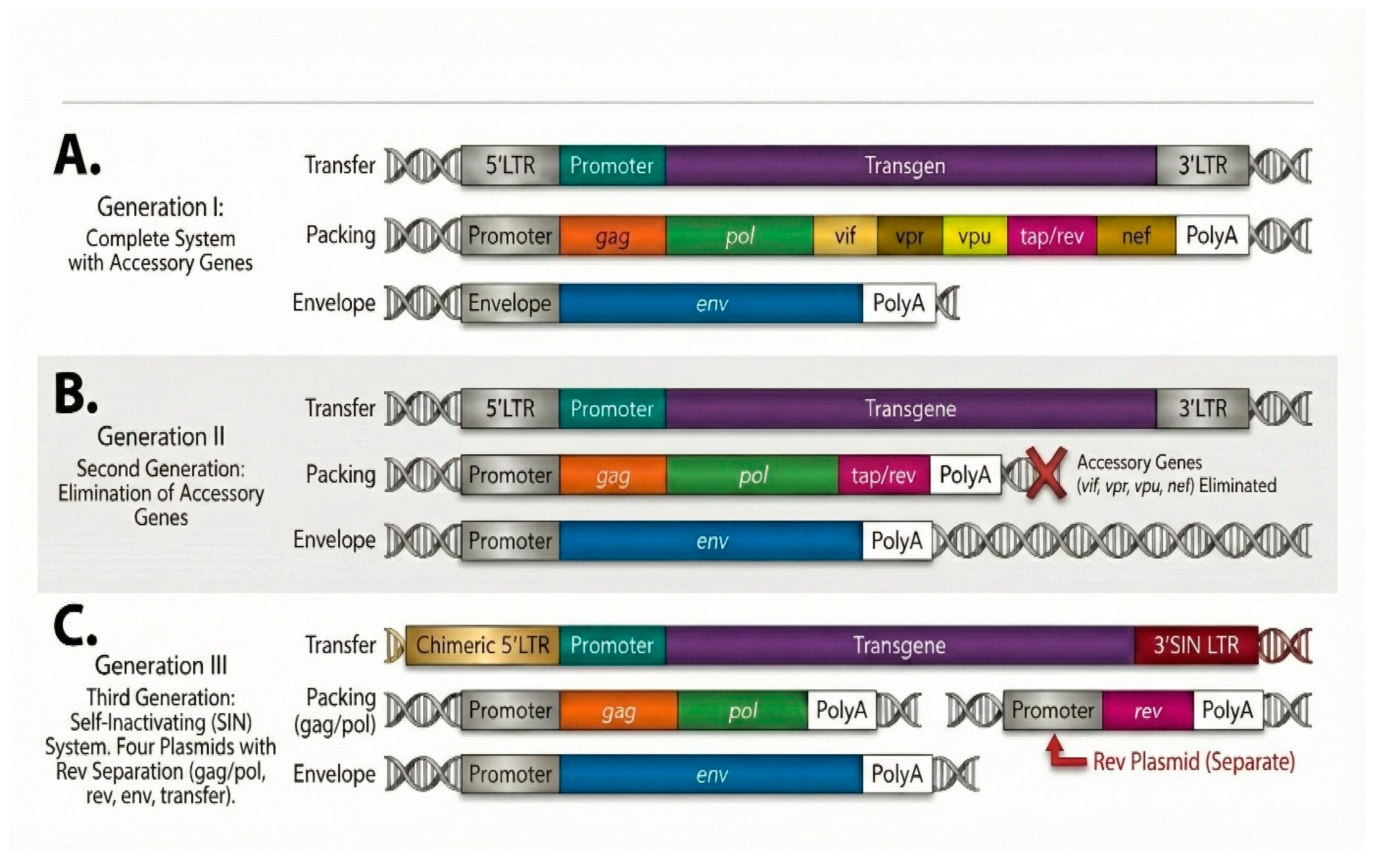
To date, four generations of the lentivirus-derived LVV system have been developed; the first three are summarized in Figure 2. Generational classification is based on the progressive elimination of accessory genes and the distribution of the remaining essential genes across multiple plasmids, minimizing sequence overlap and reducing the probability of recombination that could form a replication-competent lentivirus (RCL). [27]

2.3.1. First-Generation LVV

Utilized a single packaging plasmid containing all HIV-1 genes (gag, pol, vif, vpr, vpu, tat, rev, nef), posing a considerable recombination risk. In 1996, Naldini and colleagues developed a three-plasmid system (Figure 2A) comprising a packaging construct with expression of gag/pol, and accessory proteins, driven by a heterologous human cytomegalovirus (CMV) promoter, an envelope plasmid encoding the VSV-G, and a transfer vector with the internal transgene cassette, flanked by the HIV-1 LTR and all necessary cis elements. [23,24,27] This vector system achieved in vivo gene transfer to rat neurons and stable transduction of non-proliferating cells, demonstrating the unique capabilities of HIV-1-based systems compared to MLV-based vectors.[23] Eliminating non-essential accessory genes from the packaging plasmid improved biosafety and created space for larger transgene inserts, while maintaining the viral life cycle.[21,24,28]

2.3.2. Second-Generation LVV

To enhance biosafety, the non-essential accessory genes (vif, vpr, vpu, and nef) were deleted from second-generation LVVs, retaining only the regulatory genes tat and rev. In addition, gag/pol and env were placed on separate plasmids to reduce further the risk of homologous recombination (Figure 2B). These modifications significantly improved the safety profile for potential in vivo applications without compromising transduction efficiency.[26,29,30]

2.3.3. Third-Generation LVV

This system is the current safety standard for LVV production and is based on a four-plasmid system: a SIN transfer vector, gag/pol, rev, and envelope. The tat gene was eliminated, and transcription of the transfer vector became Rev-dependent. At the same time, the 3′ ΔU3 LTR deletion conferred self-inactivation, reducing the likelihood of RCL formation[26,31,32,33]. Additional regulatory elements, including heterologous internal promoters, the woodchuck hepatitis virus post-transcriptional regulatory element (WPRE), and the central polypurine tract (cPPT), enhance RNA stability, transcription efficiency, and viral titer.[31] These systems provide high biosafety and long-term transgene expression in dividing and non-dividing cells, including terminally differentiated populations such as neurons and hepatocytes. [34,35,36] The tat gene was eliminated, and the transcriptional activity of the transfer plasmid was made dependent on the Rev protein (supplied in a fourth plasmid) via a chimeric promoter. This extreme segmentation makes the reconstitution of a wild-type virus statistically unlikely.[31] This advance in 1998 included self-inactivating LTRs (SIN): since the 3′ ΔU3 LTR, copied to the 5′ LTR upon reverse transcription, provided a transcriptionally inactive LTR in the provirus; these vector systems added a constitutively active heterologous promoter upstream of the vector transcript in the 5' LTR and reduced the packaging constructs to separate plasmids for the expression of gag/pol and rev [26] Initially characterized using the pRRL and pCCL vectors included in this analysis, these advanced vectors carried the RSV enhancer and the CMV promoter to regulate the expression of the transfer vector.[26] Since the tat function, which activates transcription of genomic RNA from the LTR, was replaced, eliminating tat from the system increased safety. Furthermore, the inclusion of rev as a separate rev plasmid reduced the probability of obtaining RCL. By combining these modifications with deletions in the 3' LTR to confer self-inactivation, [31,32,33] these third-generation LVVs brought unprecedented biosafety considerations to the platform. They became a highly safe delivery system for gene therapy.[31] Thus, with this complete system comprising four plasmids (SIN transfer + gag/pol + rev + env), the risk of chronic lymphocytic leukemia (CLL) is substantially reduced (Figure 2C).[24]

2.3.3. Fourth-Generation LVV

On the other hand, the variants considered fourth-generation have already been tested. With these LVV variants, greater viral safety has been achieved, as the fourth-generation packaging plasmid separates the gag/pol and rev sequences into two cassettes. The fourth-generation packaging systems are the safest to date, but they remain in the experimental phase.[24] Within it, various experimental transfer plasmids have been created, which account for the differences between numerous commercial vectors and those under clinical investigation. As simple retroviruses, HIV-1-derived LVVs can hijack the host cell machinery to maintain efficient nuclear import through the intact nuclear membrane. [34]
This feature has allowed them to transduce non-proliferating and terminally differentiated cells (e.g., post-mitotic neurons, hepatocytes, or macrophages) with high efficiency. [35] The prolonged effect of viral transduction enables long-term expression of the therapeutic gene of interest (providing constant, sustained dosing after a single viral administration), which is essential for gene therapy applications.[35] In Figure 2, a schematic representation of the plasmid structure of the first three generations of HIV-derived lentiviral systems is shown.[36]
On the other hand, as already mentioned, the creation of heterologous envelopes for pseudotyping these viral particles is considered a significant advance in the field, as it enabled a substantial diversification and expansion of transduction tropism. As a result, the host range of retroviral vectors, including LVVs, could be expanded or modified. Pseudotyped LVVs consist of vector particles carrying glycoproteins (GPs) derived from other enveloped viruses. Such particles possess the tropism of the virus from which the GP was derived. For example, to exploit the natural neuronal tropism of the rabies virus, vectors designed to target the central nervous system have been pseudotyped with GPs derived from rabies virus and other viruses, such as Mokola virus (MV) and Ross River virus (RRV).[36]Among the first GPs and still the most widely used for LVV pseudotyping is the VSV-G GP, due to its broad tropism and the stability of the resulting pseudotypes. Pseudotypes using VSV-G have become the standard for evaluating the efficacy of other viral vectors. Furthermore, the incorporation of heterologous envelopes into viral particles has improved vector safety for clinical use.[36,37] Still, the most widely used envelope for viral particle pseudotyping exhibits extremely broad tropism and can therefore be used for transduction in most cells and tissues.[35] Unlike wild-type HIV-1, which encodes a complete genome capable of autonomous replication and pathogenic propagation, LVVs used for CAR-T therapy manufacturing are highly modified, replication-deficient viral particles. They retain only the minimal cis sequences necessary for gene transfer, lack accessory and pathogenic genes, are pseudotyped with heterologous envelopes, and exclusively deliver the therapeutic CAR transgene without producing viral proteins in the transduced T cells.[37,38] Table 1. Presents a comparative summary between wild-type HIV-1 types and LVVs used for the manufacture of CAR-T therapies regarding genomic content, packaging and protein expression, replication capacity, biosafety classification, and clinical function. [38,39]
With the rapid development and refinement of new gene therapy techniques, such as CRISPR-Cas9 and chimeric antigen receptors (CAR), the safe and efficient administration of these technologies is fundamental. Advances in both LVVs and other retrovirus have been corroborated, and one of the most comprehensive safety studies to date analyzed the results of 17 lots of clinical vectors, 375 manufactured T-cell products, and 308 patients treated with infusions to develop RCL or retroviral (RCL/R) and integration-directed expansion.[40] This study supported the safety profile of these vectors in this application and their continued use in oncology, infectious diseases, autoimmunity, and inherited genetic disorders. It encouraged their adoption in other therapeutic fields. This analysis does not represent all vectors that have been developed or advanced to clinical trials. Critical follow-up studies will include direct comparisons of different regulatory elements in lentiviral vectors, such as the promoter or wPRE, in patients who have developed RCL or RCL/R.[29,40]
If optimizations yield a series of vectors with significantly better characteristics, the field could move towards standardized vectors providing a "plug-and-play" system. This level of standardization could streamline processing, evaluation, and approval by regulatory bodies and would also affect the financial viability of Good Manufacturing Practice (GMP)- compliant manufacturing. This advance would enable the development of multiple standardized vectors tailored to the target population's cell type, each with distinct safety requirements and therapeutic rationales.
While many approaches, including WAS and SCID-X1 trials, use gene transfer into stem cell populations, others, such as most CAR approaches, transduce differentiated lymphocytes. [27] On the other hand, it has been shown that the degree of cell lineage differentiation affects the penetrance of leukemia following insertional oncogenesis.[27] Stem cells, by necessity, possess active signaling pathways for growth and self-renewal; therefore, they are more susceptible to oncogenic transformation. In contrast, mature cells have this self-renewal pathways reduced, which must be reactivated to facilitate uncontrolled growth. These differences have implications for the choice of vector, internal promoter, or other regulatory elements. It is necessary to investigate the minimal transgene expression required to achieve therapeutic benefit and whether a specific cell type is suitable for safely harbouring such an enhancer/promoter, to guide the choice of vector and target cell population. [27]Table 2 presents a comparison between wild-type HIV-1 and the HIV-derived LVV used for CAR-T therapy manufacturing, including key elements genomic content, long terminal repeats (LTR), packaging system, envelope glycoproteins, protein expression in target cells, replication capacity, accessory/regulatory genes, biosafety level recommendations, and clinical effects.
It should be noted that the rev gene is present in all packaging systems, as its product, REV, plays a fundamental role in the export of full-length and partially spliced viral RNA (vRNA) from the nucleus to the cytoplasm.[29]
Advanced generations of packaging plasmids also contain a strong heterologous polyadenylation (poly-A) signal, derived from the SV40 virus or bovine/human growth hormone (bGH/hGH). These strong poly-A allow for high vRNA stability and, therefore, their inclusion is advantageous for packaging and viral titers. [24,29]Furthermore, it has been shown that the inclusion, in the third generation, of the woodchuck hepatitis virus post-transcriptional regulatory element (WPRE) and the central polypurine tract (cPPT) in the viral transfer cassette further improves viral RNA stability, transcription efficiency, and overall viral titer. [30] Table 3 summarizes the four generations of LVV, including their key genomic features, plasmid systems, safety profiles, and primary uses.

2.4. Other Applications of LVVs

LVV packaging can also be crucial for the development of gene and cell therapies. [41] Depending on the characteristics of the LVV system, it can be used in the following applications:

2.4.1. Basic Research

In molecular and cell biology, LVs are used in overexpression, knockdown, and gene insertion experiments. Gene knockdown involves replacing a gene with an artificial DNA fragment. In contrast, gene insertion experiments involve inserting a gene into a specific genomic location. These techniques facilitate the study of gene functions and disease mechanisms. Large-scale collaborations are underway to use LVVs to block the expression of specific genes using RNA interference technology in high-throughput formats. On the other hand, LVs are also employed to overexpress specific genes stably, allowing researchers to examine the effects of increased gene expression in a model system. For example, LVV-mediated gene editing technologies, such as CRISPR/Cas9, can repair or replace mutated genes.[42]

2.4.2. Construction of Stable Cell Lines

LVVs can be used to generate stable cell lines in the same way as standard retroviruses. [1] The process involves infecting host cells with recombinant or pseudotyped LVVs carrying selectable markers, such as the puromycin resistance gene. This gene confers antibiotic resistance to infected host cells. By adding these antibiotics to the host cell culture medium, cells that have not incorporated the LVV genome are eliminated. [1] These surviving cells can be expanded to create stable cell lines that include the lentiviral genome and harbor the genetic information it encodes.[1] For example, in vaccine development, LVVs can act as vectors to express pathogen antigens, inducing an immune response. [43] They are used in the development of vaccines against HIV and other infectious diseases. [17,38,44]

2.5. Comparison with Other Vector Platforms

LVs possess the unique ability to stably integrate into the genomes of dividing, non-dividing, and post-mitotic mammalian cells, a capability that γ retroviruses do not have to the same extent. While AAV can also transduce non-dividing cells, it cannot stably integrate into the host genome and requires much more time to design and prepare. Furthermore, LVs are much less immunogenic than γ retroviruses and AAVs, making them more suitable for a broader range of cell types and animal models.
In Table 4, the comparison highlights differences among LVVs, γ-retroviruses, and adeno-associated viruses, the most widely used in CAR-T cells, including genomic integration capacity, target cell types, immunogenicity, design and preparation time, application range, vector capacity, stability, regulatory aspects, and available products. [1]

3. Biology and Design of CAR-T Cells

3.1. What is the Structure of the CAR-T Cell?

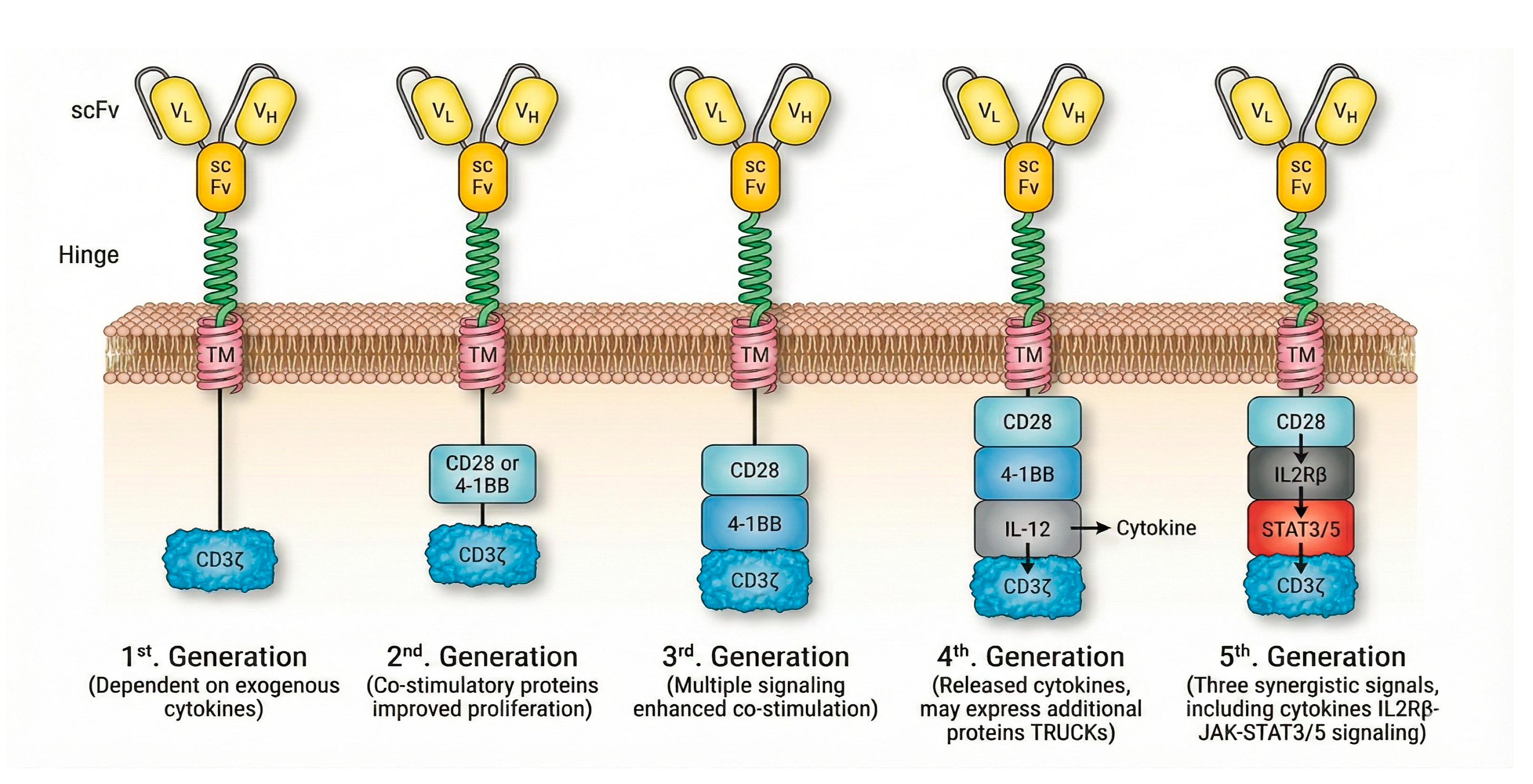
CARs are structurally designed with a combination of three domains: an endodomain, an anchoring transmembrane domain, and an ectodomain. [49]The latter is a ligand-specific extracellular domain, composed of a single-chain variable fragment (scFv) region and a hinge region.[50] The scFv is a fusion protein formed by the variable regions of the heavy and light chains of immunoglobulins, joined by a short and flexible linker peptide.[51] The hinge region, also known as the spacer, separates the binding units from the transmembrane domain.[52] Most CAR-T cells are engineered with hinge regions similar to those of immunoglobulins, allowing them to access the target antigen. [53]The endodomain may consist of the intracellular activation domain of CD3ζ T cells, as a single entity, or of one or more intracellular co-stimulatory (or activation) domains. [54]While the scFv provides antigenic specificity, co-stimulatory domains are key for activating effector T cells. [55] Currently, CAR-T cells are classified into five generations according to the endodomain, as shown in Figure 3. [56]
First-generation CAR-T cells contained a single fragment of the CD3ζ chain.[57] These cells depended on exogenous cytokine production, showed insufficient persistence and T cell activation, and consequently did not achieve the desired results in most studies. [58,59]
Consequently, first-generation CARs have been replaced by second-generation CARs, which incorporate an intracellular signaling domain composed of various co-stimulatory receptors located in the cytoplasmic tail of the CARs, such as CD28 or CD137 (4-1BB). [4] These co-stimulatory proteins can enhance proliferation and cytotoxicity, as well as prolong persistence.[60,61]
Third-generation CARs integrate multiple signaling domains, including CD28, 4-1BB, ICOS, and/or OX40.[62,63,64]CAR-T cells, also known as TRUCK cells (T cells redirected for universal cytokine-mediated killing),[65] are designed to release cytokines within the tumor microenvironment (TME). Additionally, they can express additional proteins, such as chemokine receptors, isotype-switching receptors, bispecific T-cell engagers (BiTEs), and blockers/inducers of specific signaling pathways. [66]In this context, next-generation CAR-T cells are being developed. The fifth generation differs from the previous ones by the integration of an additional membrane receptor.
Various approaches are being explored; among the most promising is the incorporation of IL-2 receptor signaling to activate the antigen-dependent JAK/STAT pathway. [67,68]This signaling not only maintains CAR-T cell activity and promotes memory T cell formation but also reactivates and stimulates the immune system as a whole. Modification of T cells to express CAR generally involves transducing the cells with viral vectors carrying the transgene, resulting in semi-random DNA integration into the T cell genome. However, some fifth-generation strategies use specific receptors.
Site-specific integrations providing additional features can be achieved through CRISPR-mediated editing. An example is the insertion of the CAR into the TRAC locus (the T-cell receptor alpha constant region). The TRAC locus is a constant region of the T-cell receptor (TCR) alpha chain gene. This gene editing suppresses endogenous TCR expression to ensure specific antigen recognition and avoid potential interference from endogenous TCRs. By integrating TRAC, fifth-generation CAR-T cells maintain greater stability and identity over time, improving their ability to recognize and eliminate cancer cells. This genetic modification reduces the risk of T cell exhaustion and graft-versus-host effect. It improves the overall efficacy of CAR-T therapies, offering a more durable and potent treatment option.[69] Consistent with this, another innovative strategy has integrated the CAR cassette into the PDCD1 gene locus, demonstrating superior ability to eradicate cancer cells both in vitro and in xenograft models. [70]
Currently, six second-generation CAR-T cell constructs have been approved. Axicabtagene ciloleucel (Yescarta®) and brexucabtagene autoleucel (Tecartus®) are based on CD28, [71]While the other approved constructs are based on 4-1BB, most approved products employ a murine scFv, except ciltacabtagene autoleucel (Carvykti®), which uses a camelid-binding domain. [72] As explained in this section, to further improve the efficacy of CAR-T cell therapy, distinct CAR components have been designed, resulting in constructs with enhanced properties. [55,67,73]Therefore, in CAR-T terminology, the binding domain is not a "tumor antigen receptor". Still, it is the antigen recognition domain (ARD), typically a scFv or single-domain antibody (VHH), that is part of a larger synthetic receptor (the CAR). "Receptor" = signaling complex; the scFv/VHH alone cannot signal. By immunological convention, a receptor is the complete transmembrane signaling unit. In CARs, this unit includes the ectodomain (scFv/VHH + hinge/spacer), the transmembrane segment, and intracellular signaling (CD3ζ ± co-stimulatory molecules such as CD28 or 4-1BB). The isolated binding domain lacks the transmembrane/signaling architecture; therefore, it is not a receptor in itself. We refer to it as the CAR antigen recognition domain (scFv/VHH).[74] It is important to clarify terminology when referring to modified TCR therapies, as "tumor antigen receptor" is often interpreted (incorrectly) as a TCR specific to a tumor peptide-MHC complex. In the case of CARs, conversely, they use antibody-mediated binding and do not require MHC; confusing the ARD with a "tumor antigen receptor" risks conflating CAR approaches with TCR-T in texts and figures.[75] On the other hand, while the biology of many CAR targets is associated with tumors, it is not specific to them (CD19, BCMA, GD2, etc.). It is often found on some healthy cells, denominating the ARD as "tumor antigen receptor" erroneously implies exclusive tumor recognition. Clinically, this imprecision is necessary because on-target, off-tumor effects are expected (e.g., B-cell aplasia with CD19 CAR-T).[76]
While scFvs (human/mouse) and camelid VHHs (nanobodies) are common, CARs can also employ natural receptor or ligand domains (e.g., NKG2D ectodomain, based on cytokines/ligands) or adapter/switch platforms (anti-FITC/biotin "universal" CARs).[77] Affinity/format and signaling thresholds are decoupled, as the properties of the binding domain (affinity/epitope; scFv vs. VHH) influence synapse geometry and antigen density thresholds, but signal intensity also depends on the hinge/TM/costim region design, emphasizing again that the "receptor" is the complete construct, not just the ligand.[78] Figure 3 presents a schematic representation of the four generations of CAR-T structures.

3.2. Manufacturing of CAR-T Cells: Ex Vivo vs. In Vivo Methods, in a Brief Description

The ex vivo CAR-T cell manufacturing procedure remains constant despite various T-cell genetic modifications and requires patient participation. Patients eligible for CAR-T cell therapy typically undergo the following treatment process, as summarized below.(83)[81]
Lentiviral transduction of T cells to generate CAR T cells is an ex vivo gene-delivery process in which a CAR transgene is introduced into patient or donor T cells using integrating lentiviral vectors, enabling the cells to express a synthetic receptor that redirects their antigen specificity stably.
In this process, T cells are collected and placed in an ex vivo culture environment where they are rendered receptive to genetic modification, and a lentiviral vector carrying a chimeric antigen receptor (CAR) transgene is used to deliver the genetic information; because lentiviral vectors are integration-competent, the CAR sequence becomes stably incorporated into the T cell genome, enabling durable transcription and translation of the engineered receptor. The CAR construct typically encodes an extracellular antigen-binding domain fused to transmembrane and intracellular signaling modules, so that once expressed on the T cell surface, the receptor couples antigen recognition to activation and effector functions. After gene delivery, modified cells are maintained under conditions that support survival and selective outgrowth of transduced cells, and the resulting population is characterized by CAR expression, phenotype, and functional attributes to ensure potency and safety before clinical use.[82,83] Key conceptual advantages of lentiviral delivery include efficient gene transfer into nondividing lymphocytes and long-term transgene expression due to genomic integration, while considerations for clinical translation emphasize vector design, transgene expression control, and rigorous quality-control testing to minimize risks such as insertional mutagenesis or off-target activity. The final product is an autologous or allogeneic CAR-expressing T cell population that can be administered to the patient to mediate antigen-specific cytotoxicity against target cells expressing the cognate tumor antigen.[84]
With the rapid development and refinement of new gene therapy techniques, such as CRISPR-Cas9 and CARs, the safe and effective administration of these technologies is fundamental. With corroboration of improvements in both LVVs and other retroviral vectors, the most comprehensive safety study to date analyzed results from 17 lots of clinical vectors, 375 manufactured T-cell products, and 308 patients treated by infusion to evaluate RCL and RCL/R, as well as integration-directed expansion. [85]This analysis supports the safety profile of these vectors in this application and their continued use in oncology, infectious diseases, autoimmunity, and inherited genetic disorders, and encourages their adoption in other therapeutic fields. Vectors used in ex vivo CAR-T cell manufacturing also differ from those employed in vivo gene transfer. Workflows separate vector processing from cell processing, with validated cleaning. Additional controls apply to myeloid products derived from HSC, TCR T, Tregs, NK, and HSPC, as described..[86]
Table 5 below shows a comparison of vectors performance in aspects like transgene delivery, cells that can be transformed, transduction & most common editing enhancer, integration pattern, and others aspects for the most used vectors in the ex vivo process of CAR-T cells manufacturing: LVV, ɣ-retrovirus, and adeno-associated viral vectors, and Table 6 shows the advantages, disadvantages and examples for each class of vectors used for the CAR T manufacturing.
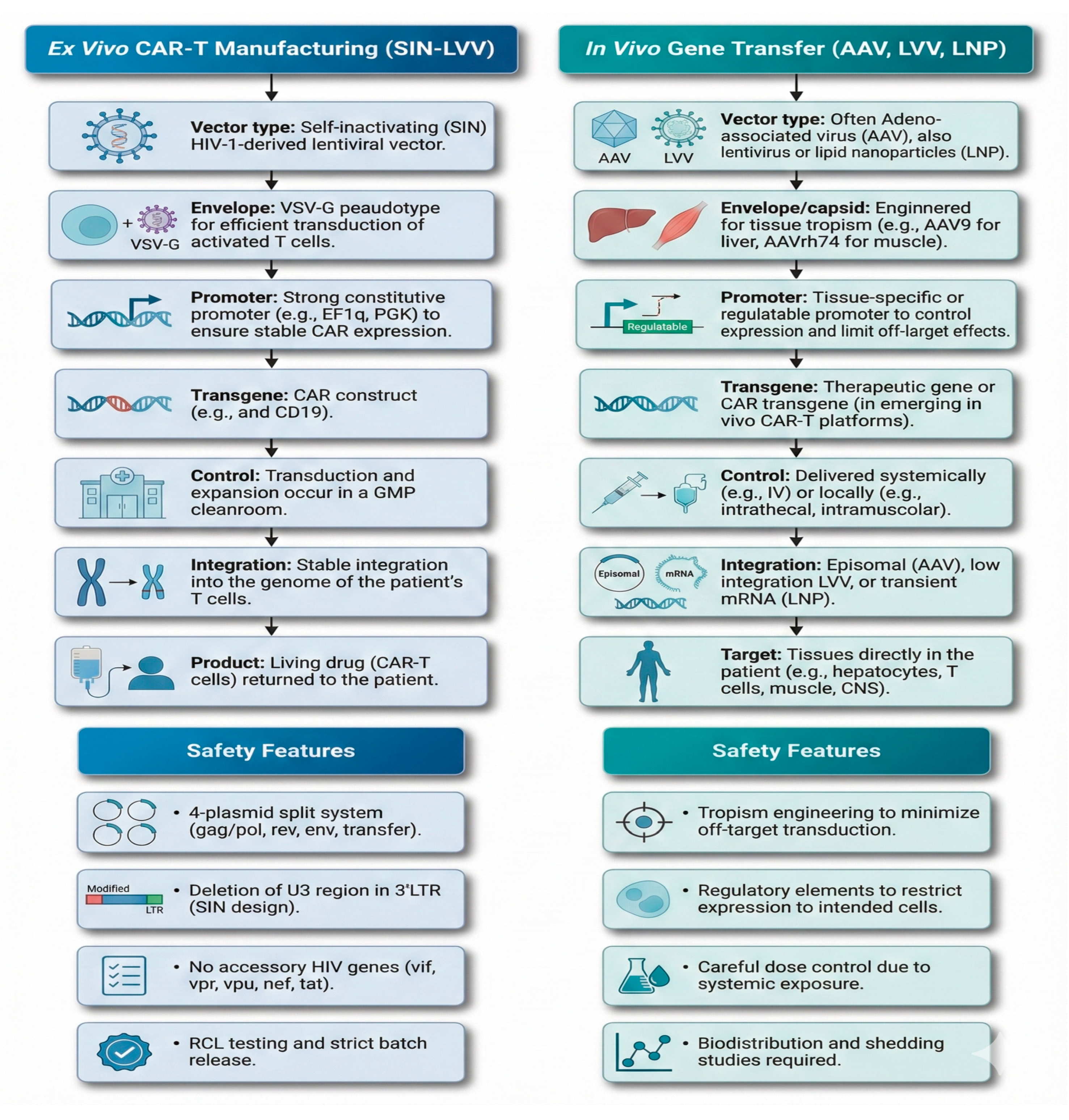
It is because ex vivo LVVs are optimized for controlled stable T cell engineering, minimal immunogenicity, and GMP compliance. In contrast, in vivo gene transfer vectors are being optimized for tissue-targeted delivery, immune evasion, and regulated expression, but they pose greater challenges for biodistribution and safety. New in vivo CAR-T technologies aim to combine the advantages of both approaches but remain in early clinical phases. If comparing LVVs for ex vivo and in vivo CAR-T manufacturing strategies, two strategies must be considered: ex vivo CAR-T manufacturing (e.g., patient T cells transduced outside the body) versus in vivo gene transfer (e.g., vector administered directly to patient tissues or immune cells).[87]
Figure 4 compares ex vivo gene transfer to generate CAR-T cells with in vivo gene therapy approaches. [88]
Although autologous CAR-T cells have demonstrated remarkable clinical results, significantly transforming the treatment of leukemias, problems persist in ensuring patients receive CAR-T cell therapy. In addition to the efficacy and safety issues of CAR-T therapy mentioned in previous sections, the high cost, complex process, and long waiting time of approximately three weeks required for personalized T-cell manufacturing hinder patient access to the development of universal allogeneic CAR-T cells (also known as "off-the-shelf" CAR-T cells) and other CARs employing alternative effector cells.[89]
Recently, various engineering approaches and alternative sourcing strategies have been developed to generate CAR-modified cells. Given the success of CAR-T therapy in oncology, the development of additional strategies based on new technologies and greater ease of use is justified to reduce costs and increase accessibility. Continuous advances in expanding cell sources and engineering techniques have revealed new ways to improve CAR immune cell supply and simplify CAR product manufacturing.[89]
Diverse sourcing strategies, encompassing autologous, donor-derived, third-party, and off-the-shelf cell products, have highlighted a broad spectrum of cell reserves with distinct attributes and potential. However, any basal transcription of the provirus could express this heterologous protein, which is potentially immunogenic. The function of the ISRE sequence in some LVVs is unclear. Understanding whether ISRE-mediated expression can occur during cell activation could be relevant in contexts requiring strict regulation. Understanding how these differences in the 5' UTR region affect packaging would be essential to determine the optimal packaging signal.[89]
These strategies have expanded the repertoire of therapeutic candidates and addressed limitations associated with cell availability and functionality. Furthermore, ingenious engineering techniques have driven the optimization of CAR-based immunotherapies. Techniques such as genomic editing, synthetic biology, and multigenic integration have enabled the customization of immune cells with greater persistence, specificity, and improved safety profiles. In parallel, advances in modular CAR designs, the incorporation of co-stimulatory domains, and switchable CAR systems have optimized the therapeutic response and mitigated adverse effects, underscoring remarkable progress in refining CAR-modified immune cells.[90] Therefore, the ability of LVVs to generate CAR-T cells in vivo has attracted significant interest, as it could eliminate the need to isolate and activate T cells ex vivo, thereby reducing both costs and in vitro production time.[71,91,92]

4. Landscape of Applications Where LVVs and Other Plasmids have Been Used

4.1. Late-Stage Approved Ex Vivo CAR-T Products

As of July 2025, 11 CAR-T structure products had been registered as approved by the three major regulatory bodies. Following the initial approval by the United States Food and Drug Administration (FDA) of the first two CAR-T therapies, Kymriah™ (Tisagenlecleucel) for B-cell Acute Lymphoblastic Leukemia (B-ALL), and diffuse large B-cell lymphoma (DLBCL) on August 30, 2017[93,94,95,96,97,98] and Yescarta™ (Axicabtagene ciloleucel) for the treatment of acute lymphoblastic leukemia (ALL) on October 18, 2017,[69,99,100,101,102,103,104,105] the approval of Terakus™ (Brexucabtagene autoleucel) for the treatment of adult patients with relapsed or refractory mantle cell lymphoma (R/R MCL) occurred on July 24, 2020,[106,107,108,109,110,111,112]These three products were also approved by the European Medicines Agency (EMA) on August 27, 2017, August 23 of the same year, and December 14, 2020, respectively. Next, the FDA approved Breyanzi® (Lisocabtagene maraleucel) for the treatment of adult patients with large B-cell lymphoma (LBCL) on February 5, 2021.[113,114,115,116,117]and Abecma® (Idecabtagene vicleucel) on March 26, 2021, for the treatment of adult patients with relapsed or refractory multiple myeloma (R/R MM) after four or more prior lines of treatment [5,118,119,120,121]and more recently, on February 28, 2022, gave the green light to CarvyktiTM (Ciltacabtagene autoleucel) for relapsed and R/R multiple myeloma in February 2022,[44,72,122,123,124,125,126,127]The latest initial FDA approval of a CAR-T product was obtained by Aucatzyl (Obecabtagene autoleucel) for patients with refractory and recurrent B-precursor acute lymphoblastic leukemia (R/R B-ALL).[128,129]
On the other hand, the National Medical Products Administration of China (NMPA) began by approving Yikaida® (Axicabtagene ciloleucel) on June 22, 2021, for CD19+ lymphoma, followed by the registration of Beinuoda® (Relmacabtagene autoleucel), also known internationally as Carteyva®, on September 6, 2021, with a CAR structure identical to the FDA's liso-cel, which has demonstrated high response rates and lower toxicity associated with CAR-T therapy in relapsed/refractory large B-cell lymphoma in the United States. Furthermore, the pivotal RELIANCE study confirmed the long-term efficacy of this product in relapsed/refractory large B-cell lymphoma. Thanks to its high target-elimination efficacy, long-term persistence, and low toxicity, Carteyva® became the second CAR-T product approved in China for three indications: relapsed/refractory large B-cell lymphoma (LBCL), relapsed/refractory follicular lymphoma (r/r), and relapsed/refractory mantle cell lymphoma (r/r). [129,130,131,132,133]
The NMPA also approved Fucaso® (Equacabtagene autoleucel) on June 30, 2023, as a third-line treatment for (R/R MM). [134,135,136,137]and Yuanruida or Yorwida® (Inaticabtagene autoleucel) on November 8, 2023, as therapy for adult R/R B-cell acute lymphoblastic leukemia (ALL),[138]and then on November 28, 2025, for adult patients with relapsed or refractory large B-cell lymphoma (r/r LBCL) after two or more prior systemic therapies, and the registration of Saikaize® or Zevor-cel (Zevorcabtagene autoleucel) was also published on February 23, 2024[139,140]also as 3rd line therapy for R/R MM. It should not be forgotten that the Chinese regulatory authority also approved YescartaTM since June 23, 2021, and CarvyktiTM since August 28, 2024.
As shown in Table 7, most CAR-T therapies approved in the US (FDA), the European Medicines Agency (EMA), and China (National Medical Products Administration [NMPA]) use LVV as a gene delivery strategy, indicating its widespread use. [140,141]
This table demonstrates that clinical use of CAR technology has progressed more rapidly in recent years. CAR-T immunotherapy has demonstrated impressive clinical efficacy in relapsed and refractory (r/r) hematological malignancies, including CD19+ leukemia and lymphoma, and BCMA+ multiple myeloma. Motivated by these achievements, researchers have expanded CAR technology, including applications such as CAR-NK, CAR-CIK, and CAR-MΦ, and have employed cell therapy with modified CAR cells to treat a broader spectrum of aggressive diseases. [3,141,145]

4.2. Other Cell Therapy Products Obtained by Using HIV-Derived LVVs

The field of personalized medicine, particularly gene therapy, is undergoing an exciting and auspicious period. New therapeutic strategies under development offer a glimpse of the horizon of treatments for genetic diseases, far more tangible than what was visible just a few years ago. However, the path to developing gene therapy strategies has not been simple or free of complications and failures. Nevertheless, recent advances, particularly the emergence and development of CRISPR-Cas9, place gene therapy in an auspicious position. Gene therapy has ceased to be a discipline associated with science fiction, and, with some products on the market and many others in various phases of clinical trials, it is realistic to expect new therapies to become available.
Among the cell therapies obtained with the use of LVV for the genetic manipulation of other cells without the CAR structure are the following examples:

4.2.1. Approved Therapies with LVV-Modified Hematopoietic Stem Cells (HSC)

Several FDA-approved products meet this condition, such as Zynteglo (betibeglogene autotemcel), whose regulatory action was approved in 2022.[146] It was also published on December 8, 2023, about the product Lyfgenia (lovotibeglogene marcelpivlecel) from Bluebird Bio. [147]and the product Skysona (elivaldogene autotemcel), which received successive approvals between 2022 and 2025[148] and, finally, about Lenmeldy (atidarsagene autotemcel) on March 18, 2024.[149]

4.2.2. T lymphocytes Whose TCR has Been Modified by LVV Transduction

A phase 1 clinical trial reported on patients treated with T cells whose TCR was modified to recognize the NY-ESO_1 antigen (TAEST16001), consisting of autologous T cells transduced with LVV. [150,151]On the other hand, Sangano Biosciences reported that it obtained a product, TX200-TR101, which used a third-generation LVV-SIN in a first-in-human clinical trial. [152]

4.2.3. CAR-NK Platforms Obtained via NK Cells Transduced with LVV

A report about the efficient and robust transduction of NK cells with LVV pseudotyped with BaEV was done in 2019, [153]In 2024, another group reported production protocols for high-titer BaEV-R-free LVVs as an advanced manufacturing approach.[154]

4.2.4. HSC-Derived Cellular Drug Factories

Refers to a clinical trial reported in ClinicalTrials.gov with the bioproduct TemferonTM (NCT03866109): based on autologous HSPCs transduced with an LVV encoding IFN-α2 and echoed by the publication of Mazzoleni S. et al. [155] Which describes the Temferon platform of the company Genenta.com. This same Temferon-modified HSPC product (LVV) gives rise to myeloid cells with tumor tropism that release IFN-2alpha, according to a study summarized at ASH. [156,157] Table 8 below summarizes the mentioned products.

5. Limitations and Risks Associated with the Use of LVVs

5.1. Risk is Associated with Randomly Inserting into the Cell Genome and Insertional Oncogenesis

While LVVs are primarily used as research tools to introduce gene products into in vitro systems or animal models, their applications in gene therapy development are significant, particularly for adoptive cell transfer therapies. These include CAR-T, CAR-NK, TCR-T, and TIL therapies, which constitute the primary use of LVVs in this field.[155] Appreciating how these LVVs have been developed and how they generate new opportunities in regenerative medicine and tissue engineering, one must not overlook that limitations persist in their use for CAR-T therapies.[158] Among other challenges is that, during CAR gene integration into T cells, LVVs often integrate randomly into the cell genome, which can cause adverse effects on the host genome. It can lead to unwanted gene silencing, overexpression, or genetic mutations, increasing safety risks.[159] Furthermore, the limited transcriptional capacity of LVVs restricts the size and complexity of CAR gene payloads, as well as the incorporation of associated regulatory elements. Finally, large-scale production of LVVs for clinical applications requires GMP-certified laboratory and manufacturing reagents and a biosafety level 2+ or 3 (BSL2+ or BSL3), entailing practically prohibitive manufacturing costs and regulatory hurdles. [92,160,161]
On the other hand, these vectors can also alter regular cell gene expression programs and increase cancer risk by stably integrating into the genome. Serious adverse events have been reported with the use of both gamma and safer self-inactivating LVV (SIN-LVs).[162,163,164] Intensive research, combined with field experience, revealed that the main determinants of insertional oncogenesis are the vector class (γ-retroviral, LVV, or α-retroviral) and the chosen internal promoter in SIN-LV configurations. [165,166,167]It has also been shown that synergistic interactions between these aspects and the specific transgene contribute to mutagenicity.[167] These insights have led to significant improvements in vector design, which have been crucial to the field's progress. Yet, there is still an unmet need for sensitive and reliable preclinical genotoxicity assays.[88,168]
But it should not be forgotten that, by the end of 2023, the FDA had received 22 reports of T-cell malignancies linked to CAR-T treatments.(87) [88]Among them, three cases in which sequencing was performed detected the CAR gene in the malignant clone,(87) [88]suggesting a possible connection between malignancies and the integration properties of retroviral vectors. In 2024, several reports described rare secondary T-cell lymphomas following CAR-T therapy, which can be attributed to multiple factors, including lentiviral insertions within T-cell homeostasis genes, occasional progression of CAR-T cells themselves to T-cell lymphoma, and genetic mutations associated with clonal hematopoiesis.[169,170,171,172,173]
Therefore, other methods for in vitro T cell genetic modification, considered non-viral as they do not depend on this type of vector, have already been tested. But these methods, including electroporation via the transposon system, prove ineffective in achieving stable CAR gene expression, although the produced CAR-T cells exhibit faster cytotoxicity in vitro. This inefficiency highlights the need for safer and cheaper virus-free gene transfer vectors, typically represented by transposon systems, CRISPR/Cas9 systems, and mRNA electroporation platforms.[32,36,43] Further research is required to thoroughly elucidate the long-term safety and efficacy of these advanced therapies.
The integration of CRISPR/Cas-based editing techniques into these approaches provides unmatched precision in genetic engineering, enabling genes to be inserted or disrupted. Furthermore, various processing techniques facilitate the automated manufacturing of non-viral CAR-T cells, and the importance of implementing measures to ensure the safety and genetic stability of these therapies was emphasized. These measures include the use of sequencing technologies to identify unwanted cut sites and computational methods to deconvolve translocations. Given the growing importance of non-viral transgene administration and CRISPR/Cas-based editing in gene therapy, these technologies must continue to evolve and undergo rigorous testing to ensure their safe and practical application in clinical practice.[89]

5.2. Biological Risk Assessment When Working with LVV

Viral vectors have generally proven to be efficient tools for gene delivery to target cells/tissue, a critical aspect of achieving therapeutic efficacy.[174]As already mentioned, viral vector expression cassettes can be engineered with elements to enhance target specificity and increase transgene expression, [175] These features have been explored and exploited to develop efficient methods for delivering genes of interest into mammalian cells. However, a vast repertoire of viral vectors exists with profoundly different properties. To date, five main classes of viral vectors have been tested for clinical applications, [176] including, apart from LVV, other retroviruses (RV), adenoviruses (AV), AAV, and herpes simplex viruses (HSV). Although many viral vectors are safe and effective delivery vehicles for clinical gene therapy, some are considered risky due to potential oncogenicity. [3,29] These features have been explored and exploited to develop efficient methods for delivering genes of interest into mammalian cells. However, a vast repertoire of viral vectors exists with profoundly different properties. To date, five main classes of viral vectors have been tested for clinical applications,[177] They may pose risks, such as replication-competent retroviruses (RCR) and insertional mutagenesis, which can activate oncogenes or cause secondary malignancies, especially with 1st- and 2nd-generation LVVs.[178]
Despite these safety improvements, working with LVVs requires strict compliance with biosafety protocols to prevent laboratory-acquired infections and ensure patient safety in clinical applications. Risks associated with HIV-1-derived LVVs include the potential to generate RCVs that could make them pathogens and the potential for oncogenesis. These risks can be mitigated according to the nature of the vector system (and its safety characteristics) or those exacerbated by the nature of the transgene insert encoded by the vector.[160] General criteria for LVV risk assessment must take into account a series of parameters/considerations, including: the nature of the vector system and the potential for regeneration of RCV from vector components; the nature of the transgene insert (e.g., known oncogenes or genes with high oncogenic potential may require special precautions); the vector titer and the total amount of the vector, the inherent biological containment of the animal host, if relevant; a negative RCL testing. Modern clinical CAR-T LVVs are designed so that the probability of generating an RCL is extremely low, although not mathematically zero. Therefore, design, process controls, and batch release testing collectively reduce residual risk to the level "as low as reasonably achievable (ALARA)". [179]Since the risk is not literally zero, regulatory bodies require RCL control strategies and testing.[160,179,180]
In particular, in those LVVs where that of VSV-G has replaced the wild-type HIV-1 envelope, this modification increases the number of potential cells and tissues the particle can penetrate, and its mode of transmission could include direct exposure to infected body fluids, sexual contact, splashes, or percutaneous injection.[24] Signs and symptoms associated with this type of infection, often accidental, are fever, nasal discharge, sore throat, diarrhea, cough, vomiting, nausea, lethargy, myalgia, anorexia, and dyspnea, but this depends on infectious dose, which in turn would be determined by the source of infection, and taking into account the incubation period which can be 1 to 6 months, surveillance and reporting of accidental exposure must be recorded and followed, as biosafety practice.[181] This step is necessary, as prophylaxis exists and must be performed after documented exposure to any HIV-1-derived LVV, including the use of antiretroviral drugs, as no vaccines are available for these LVVs. [182]Surveillance of affected individuals should be conducted by monitoring for influenza-like symptoms and confirming diagnoses with RT-PCR testing and initial rapid tests.[182]These concerns have motivated more than one regulatory organization, including the Department of Health of Abu Dhabi (DOH), to mandate rigorous containment measures, thorough risk assessment, and comprehensive personnel training to ensure safe handling practices in both laboratory and clinical settings.[182,183,184]
Biosafety practices for HIV-derived LVVs have evolved as viral vector generation technology and understanding of potential risks have improved. Current standards emphasize evidence-based approaches that focus on actual risks rather than predetermined prescriptions, thereby enabling more flexible and effective safety protocols. International harmonization of biosafety guidelines facilitates global collaboration in the research and development of LVV therapies. As these technologies are increasingly incorporated into clinical applications, integrating GMP standards with traditional biosafety practices creates a comprehensive framework to ensure safety from the laboratory to the patient's bedside.[185]
Among the new challenges in LVV biosafety is the growing use of CRISPR/Cas9 systems delivered via LVV, which demand greater containment due to their genotoxic potential. The increase in production for clinical applications also raises new biosafety considerations distinct from those for research-scale work. It is essential to ensure that future developments incorporate increasingly effective vector systems with even higher safety profiles, such as targeted integration systems that minimize the risk of insertional mutagenesis.[181]

5.3. Laboratory Containment Level

Given that risk group 2 classification applies to LVVs, containment level 2 facilities, equipment, and operational practices must be used when working with these vectors; it is recommended that work not be performed on open benchtops with this type of viral particle. [181,185]All work must be performed inside a biosafety cabinet. The use of sharps with needle safety features is also recommended. Centrifuge rotors must have lids; samples must be loaded and unloaded inside the biosafety cabinet, and the centrifuge must be disinfected with a suitable disinfectant after use. If the vector is not replication-competent, animals infected with the vector will remain in BSL-2 for 72 hours, after which they will be moved to BSL-1. [181,185]If the vector is replication-competent, animals will be kept in BSL-2 for the entire duration of the experiment.[185] Other authors recommend using Biosafety Level 2+ (BSL-2+) containment. [186,187] The BSL-2+ level is the term commonly used for laboratories working with microorganisms that employ biosafety practices and procedures proper to BSL-3 laboratories. Most research institutions still struggle to determine when to use this approach and what BSL-3 practices to utilize, as BSL-2+ is not a recognized containment level. There is no standardized list of microorganisms, viral vectors, or research projects that must be conducted in BSL-2+ environments; however, it is assumed that, when generating new vectors whose potential is still under experimental evaluation, this would be appropriate practice.[187] Each decision to use specific BSL-3 practices in a BSL-2 laboratory must be based on a risk assessment. [181,185]Some examples of when BSL-2+ use may be appropriate include viral vectors with gene inserts containing oncogenes or genes of unknown function, or 1st- and 2nd-generation LVVs that present a higher risk of recombination, which can lead to RCL. [160]
Risk assessment includes several steps before work can be approved and started: the laboratory supervisor or Principal Investigator (PI) must complete and submit the project registration document to the Biosafety Officer (BSO). It is a document that must clearly describe the project's purpose and detail the steps for handling biohazardous materials. It is reviewed and discussed with the laboratory supervisor or PI, the BSO, and, in some cases, selected members of the Institutional Biosafety Committee (IBC) with experience in BSL-2+ research. [185]For example, a virologist may be asked to review a project involving viral vectors. Suitable BSL-2 laboratory space must be proposed, and BSL-3 practices described. IBC review and consensus must occur before project initiation. At the IBC meeting, the BSO describes the proposed project and the BSL-3 practices to be used in the BSL-2 laboratory space. IBC members must agree on appropriate Biosafety Level 3 (BSL-3) practices for the proposed work and determine a suitable Biosafety Level 2 (BSL-2) laboratory space. Risk communication and training must occur after IBC approval and before any laboratory work is performed. The Biomedical Safety Officer (BSO) must review required BSL-3 procedures with the laboratory supervisor or principal investigator (PI) and their staff. Ideally, these procedures should be documented in a Standard Operating Procedure (SOP). Additionally, it is essential to review the laboratory space to ensure required BSL-2 elements are present, including, among others, biological waste containers, a sink with soap and paper towels, and certified biosafety cabinets (BSCs).[182]
The laboratory supervisor or principal investigator must designate a laboratory meeting facility that meets the requirements outlined in U.S. CDC/NIH publications on biosafety in microbiological and biomedical laboratories.[182]It must be an inner laboratory with two doors separating it from the biosafety cabinet (BSC) and the corridor. Airflow must be from the corridor into this laboratory (i.e., in a negative direction). All air must be exhausted to the outside of the building; it must not be recirculated. An Environmental Health and Safety (EHS) officer can assess the laboratory's negative-pressure status.[187]

5.4. Considerations on Personal Protective Measures

The following safety equipment must be used when working with LVVs: at a minimum, personnel must wear gloves, closed-toe shoes, a lab coat, and appropriate eye and face protection before working with lentiviruses or their derived vectors.
Additional protective equipment may be required according to laboratory-specific standard operating procedures (SOPs). And utmost care must be taken to avoid spills and/or splashes of infected materials. It must be presumed that LVV is present on all equipment and devices coming into direct contact with infected materials. While decontamination within the laboratory is preferable, removing materials from the decontamination facility is also an option. All materials coming into contact with LVV must be disinfected with a 1:10 bleach solution before disposal. Additionally, all work surfaces must be disinfected with a 1:10 bleach solution at the end of work and at the end of the workday. (Note: A contact time of at least 15 minutes is required for decontamination. [188]
When working with LVV, the following personal protective equipment must be worn: gloves (consider double gloving depending on procedures being performed), lab coat, safety glasses, and face shield. Waste management is also highly regulated. Examples: Non-sharp waste: All cultures, stocks, and cell culture materials must be disinfected and autoclaved before disposal using double-walled biohazard waste containers. Sharp waste, including needles, syringes, razor blades, scalpels, Pasteur pipettes, and tips, must be disposed of in an approved puncture-resistant sharps container. Sharps containers must not be filled to more than 2/3 of their capacity.[188]

5.5. Response and Decontamination Procedures for Spills, and in Cases of Accidental Exposure

In the event of a minor spill containing LVV (<1 liter) within a BSC, the panel must be closed and the cabinet allowed to operate for 15 minutes before proceeding with spill cleanup. Lentiviruses, such as HIV-1, are not commonly transmitted through aerosols, but extra precautions must be taken during a spill outside a BSC to reduce exposure risk. Leave the room immediately and allow aerosols to dissipate for 15 minutes. Notify other people working in the laboratory. Put on appropriate personal protective equipment.
Cover the spill area with paper towels or another absorbent material, and apply an EPA-registered disinfectant effective against the viruses involved (bleach, glutaraldehyde, hypochlorite, iodine, and phenols), working from the perimeter toward the center. Decontamination protocols for LVV require the use of a suitable disinfectant.[188]
An immediate response to potential LVV exposures is crucial to minimize risk. In case of exposure, personnel must immediately: (1) Rinse mucous membranes (eyes, nose, and mouth) with plenty of water for 15 minutes at an eyewash station; (2) Wash exposed skin with soap and water for at least 15 minutes (5 minutes if skin is intact); And (3) In case of puncture wounds or cuts, encourage bleeding by gently pressing the area while washing with soap and water. After providing first aid, the affected person must seek medical attention immediately, even if the exposure seems mild. Healthcare professionals must be informed of the specific nature of the LVV, including the generation method, the expressed transgene, and any other relevant details. [187]
In case of significant exposures to HIV-based LVVs, post-exposure prophylaxis (PEP) with antiretroviral drugs may be considered. Some guidelines recommend that physicians consider initiating a 7-day course of a nucleoside reverse transcriptase inhibitor (NRTI), as soon as possible after exposure (within 72 hours). The need for PEP must be determined by a medical assessment based on the type and magnitude of exposure. All exposure incidents must be reported immediately to the supervisor and the institution's biosafety office, and appropriate incident report forms must be completed, with follow-up required by institutional policies. [187,189]

5.6. Other Facility Infrastructure Requirements

Optimizing workflows, improving process robustness, and adopting closed, automated systems are recommended to facilitate scalability and reduce product costs while maintaining the efficiency of CAR-T cells or other products. To achieve commercial-scale production of CAR-T cell therapies, comprehensive automation is desirable, including fully automated and partially automated closed systems. [190]Fully automated closed systems can be used in less strict cleanrooms. However, the final product stage must be performed in an ISO 7 cleanroom (Class 10,000, Clean C). Cleanroom classification systems are based on the maximum number of suspended particles per cubic meter of air, with defined particle size ranges (≥0.5 μm and ≥5 μm). It applies according to ISO classification, defined by ISO 14644-1 and ISO 14644-2 standards, and/or according to Good Manufacturing Practice (GMP) classification, characterized by Annex 1 of the European Union (EU) GMP and corresponding FDA regulations, with grades A, B, C, and D. [158,190,191]
To maintain classification, cleanrooms must have: HEPA filtration (typically H14 or higher for Grade A), unidirectional (laminar) airflow in critical Grade A zones, positive pressure differentials (≥10–15 Pa between cleanroom classes), continuous particle count monitoring in Grade A, periodic particle count monitoring in lower grades, microbiological monitoring: settle plates, contact plates, air samplers, glove prints. [158]
For cell isolation involving open manipulation, steps must be performed in an ISO 5 (Class 100) BSC. The environment surrounding BSCs must remain sterile during cell therapy handling and manufacturing processes, in compliance with Good Manufacturing Practices (GMP). The environment of ISO 5 BSCs (formerly Class 100) must be controlled and classified as an ISO 7 cleanroom (Class 10,000, Clean C). ISO 5 BSCs (formerly Class 100) must comply with ISO 5, which includes, at a minimum, HEPA-filtered laminar airflow over the work area and a UV sterilization lamp.[189]
Table 9 serves as a guide for classifications according to ISO standards, EU GMP grades, and FDA cleanroom classes. [176,177,178,179]

5.7. Design of Outpatient Rooms for CAR-T Therapy Application in Human Subjects

There must be a designated area for outpatient care that protects patients from exposure to infectious agents, allows for isolation, and supports confidential examination and assessment, as well as the administration of intravenous fluids, medications, and blood products. For procedures performed in an outpatient setting, a designated area with appropriate space and design to minimize the risk of microbial contamination must be available. Immediate assessment and treatment mechanisms must be in place, staffed by an on-call physician available 24 hours a day, 7 days a week. [192]

6. Conclusions

As described in this review, several CAR-T cell therapies have received FDA, EMA, and NMPA approvals as second- and third-line treatments, and ongoing clinical trials are evaluating their efficacy as first-line therapies. Immune cell therapies have transformed the landscape of cancer and other disease treatment, offering unprecedented clinical results. The global T-cell therapy market is projected to grow rapidly, increasing from USD 10.30 billion in 2025 to USD 161.21 billion by 2034, with a compound annual growth rate of 35.74%. [193]
Current engineering approaches focus on developing the next generation of CAR-T cells to improve potency and safety. [194,195,196]including strategies aimed at enhancing CAR-T cell fitness (e.g., signaling, killing capacity), overcoming antigen loss (e.g., via dual-targeting CARs), and modifying the tumor microenvironment (e.g., interleukin-18 secreting CARs) [194,195,196]including strategies aimed at enhancing CAR-T cell fitness (e.g., signaling, killing capacity), overcoming antigen loss (e.g., via dual-targeting CARs), and modifying the tumor microenvironment (e.g., interleukin-18 secreting CARs) [194,196,197,198]particularly as progress is made in evaluating the efficacy of CAR-T cell therapy in solid tumors.[198]
The development of standardized protocols for obtaining, engineering, and characterizing CAR-modified immune cells will be fundamental to ensuring reproducibility and facilitating regulatory approval. [91]The field of non-viral transgene delivery to T cells has experienced significant advances in recent years, with several platforms already used in clinical trials or showing promise for future clinical application. These platforms offer a substantial advantage over viral vectors, as they are more cost-effective, thereby accelerating the development of innovative gene therapies.
Continuous personnel training remains an essential component of an effective biosafety program, as human factors remain the most crucial variable in preventing laboratory accidents and exposures. By rigorously applying current guidelines and adapting to new challenges, the scientific community can continue to harness the potential of LVV technology while maintaining the highest safety standards for both laboratory personnel and patients. Intensifying collaborative efforts between medical centers, the biotechnology industry, pharmaceutical companies, and nanotechnology institutes is poised to accelerate the translation of these cutting-edge approaches into transformative clinical interventions, such as in vivo generation of CAR-T cells, which could reshape the landscape of cancer and other immune-related diseases. As we explore these frontiers, a promising era of precision immunotherapy emerges, offering personalized, potent, and durable treatments for patients in need. This potential motivates us to continue to expand the boundaries of scientific research.

Author Contributions

Conceptualization, writing—original draft, editing, figures preparation, RARJ; Writing—Review and Editing, LAH; Search the medical literature, writing, editing, GRN and DA; Resources, supervision, review of the manuscript, FMAK; Resources, supervision, review-editing draft, YVC; Conceptualization, supervision, project management, and final review of the manuscript, AABH. All authors have read and agreed to the published version of the manuscript.

Funding

This research received no external funding.

Institutional Review Board Statement

Not applicable, as it is a literature review.

Data Availability Statement

This review article did not include original data; all material cited has been referenced in the text and the bibliography.

Acknowledgments

We acknowledge the support received from the ADSCC for the publication of this article. During the preparation of this manuscript, the author(s) used the EndNote 2025 software for bibliography citation. All authors have reviewed and edited the output and take full responsibility for the content of this publication.

Conflicts of Interest

All authors are employees of the ADSCC and declare no conflict of interest. No financial support or relationships with affiliated organizations were received that could have influenced the submitted work.

Open Access

This article is licensed under a Creative Commons Attribution 4.0 International License, which permits use, sharing, adaptation, distribution, and reproduction in any medium or format, if you give appropriate credit to the original author(s) and the source, provide a link to the Creative Commons license, and indicate if changes were made. The figures were drawn using Google AI Gemini Pro and NanoBanana for the visualization. [199]The images or other third-party material in this article are included in the article's Creative Commons license, unless stated otherwise in a credit line to the material.

Abbreviations

The following abbreviations are used in this manuscript:
4-1BB/CD137 A surface glycoprotein that belongs to the tumor necrosis factor receptor family
AAVs Adeno-associated virus
ALL Acute lymphoblastic leukemia
BaEV
BSCs
Baboom envelope
Biological Safety Cabinets
BSL-2+ Biological Safety Level 2+
BSL-3 Biological Safety Level 3
BSO Biosafety Office
BCMA Anti-B-cell maturation antigen
CA Capsid
CAR-CIK CAR-cytokine-induced killer cell
CAR-MΦ CAR-macrophage
CAR-NK CAR-natural killer cell
CAR-T Cell chimeric antigen receptor T cell
CD19 Cluster of differentiation 19.
CD28 Cluster of differentiation 28.
CD3ζ Accessory signaling molecule
CRISPR Clustered regularly interspaced palindromic repeats
DLBCL Diffuse large B-cell lymphoma.
Env Envelop
EHS Environmental Health and Safety
EIAV Equine infectious anemia virus
FDA Food and Drug Administration (USA)
FIV Feline immunodeficiency virus
FL Follicular lymphoma
Gag Group-specific antigen
GMP Good manufacturing practice
HIV Human immunodeficiency virus
HSCT Hematopoietic stem cell transplantation
IN Integrase
IBC Institutional Biosafety Committee
kb Kilo bytes
KI Knocking-In
KO Knocking Out
LTR Long terminal repeat
LV Lentivirus
LVVs Lentivirus vectors
MA Matrix
MCL Mantle cell lymphoma
MM Multiple myeloma
NC Nucleocapsid
NMPA National Medical Products and Drug Administration (PR China)
PPE Personal Protective Equipment
PA Phosphatidic Acid
PI Principal Investigator
Pol Polymerase
Poly A Poly-Adenine tail
PR Protease
R Repeat region
RCL Replication-competent lentivirus
Rev Regulator of the expression of viral protein
RNA Ribonucleic acid
RRE Rev response element
RT Reverse transcriptase
sgRNA Single guide RNA
shRNA Short hairpin RNA
SOP Standard Operating Procedure
SIV Simian immunodeficiency virus
TAA Tumor-associated antigens
Tat Trans-activator of transcription
U3 Unique 3’ region
U5 Unique 5’ region
Vif Viral infectivity factor
Vpr Viral protein R
Vpu Viral protein U
VSV-G Vesicular stomatitis virus G
Ѱ Retroviral psi packaging element

References

  1. Yang, G. "Lentiviral vectors in CAR-T cell manufacturing: Biological principles, manufacturing process, and frontier development." Highlights in Science, Engineering and Technology 74 (2023): 172-80.
  2. Sadelain, M., I. Rivière, and R. Brentjens. "Targeting tumors with genetically enhanced T lymphocytes." Nature Reviews Cancer 3 (2003): 35-45.
  3. Zhao, Z., Y. Chen and N. M. Francisco. "The application of CAR-T cell therapy in hematological malignancies: Advantages and challenges." Acta Pharmaceutica Sinica B 8 (2018): 539-51.
  4. Han, D., Z. Xu and Y. Zhuang. "Current progress in CAR-T cell therapy for hematological malignancies." Journal of Cancer 12 (2021): 326-34.
  5. Chen, Y. J., B. Abila, and Y. Mostafa Kamel. "CAR-T: What is next?" Cancers 15 (2023): 663.
  6. Eshhar, Z., T. Waks, and G. Gross. "Specific activation and targeting of cytotoxic lymphocytes through chimeric single chains consisting of antibody-binding domains and the gamma or zeta subunits of the immunoglobulin and T-cell receptors." Proceedings of the National Academy of Sciences of the United States of America 90 (1993): 720-24.
  7. Johnson, N. M., A. F. Alvarado, and T. N. Moffatt. "HIV-based lentiviral vectors: Origin and sequence differences." Molecular Therapy: Methods & Clinical Development 21 (2021): 451-65.
  8. Abu Haleeqa, M. I., I. El-Najjar, Y. K. Afifi and S. A. Ali. "Establishment of CD19-CAR-T cell production and treatment of non-Hodgkin lymphoma in the United Arab Emirates." Blood 144 (2024): 7268-68.
  9. Stroncek, D. F., M. Tran, and S. E. Frodigh. "Preliminary evaluation of a highly automated instrument for the selection of CD34+ cells from mobilized peripheral blood stem cell concentrates." Transfusion 56 (2016): 511-17.
  10. Nickolay, L. E., G. W. C. Cheung, and M. Pule. "Automated lentiviral transduction of T cells with CARs using the CliniMacs Prodigy." Presented at 2015.
  11. International Committee on Taxonomy of, V. "Species list: Retroviridae." (2025): https://ictv.global/report/chapter/retroviridae/taxonomy/retroviridae.
  12. Goff, S. P. "Retroviridae." In Fields virology. D. M. Knipe and P. M. Howley. Philadelphia: Lippincott Williams & Wilkins, 2013, 1424-72.
  13. van Heuvel, Y., S. Schatz and J. F. Rosengarten. "Infectious RNA: Human immunodeficiency virus (HIV) biology, therapeutic intervention, and the quest for a vaccine." Toxins 14 (2022): 138.
  14. Dufait, I., T. Liechtenstein, and A. Lanna. "Retroviral and lentiviral vectors for the induction of immunological tolerance." Scientifica 2012 (2012): 1-14.
  15. Temin, H. M. and S. Mizutani. "RNA-dependent DNA polymerase in virions of Rous sarcoma virus." Nature 226 (1970): 1211-13. 10.1038/2261211a0.
  16. Baltimore, D., A. S. Huang, and M. Stampfer. "Ribonucleic acid synthesis of vesicular stomatitis virus, II. An RNA polymerase in the virion." Proceedings of the National Academy of Sciences of the United States of America 66 (1970): 572-76. 10.1073/pnas.66.2.572.
  17. Coffin, J. M. "50th anniversary of the discovery of reverse transcriptase." Molecular Biology of the Cell 32 (2021): 91-97. 10.1091/MBC.E20-09-0612.
  18. Wang, X. and I. P. Rivière. "Clinical manufacturing of CAR T cells: Foundation of a promising therapy.".
  19. Lana, M. G. and B. E. Strauss. "Production of lentivirus for the establishment of CAR-T cells." In Chimeric antigen receptor t cells (methods in molecular biology). K. Swiech, K. Malmegrim, and V. Picanço-Castro. 2086. New York, NY: Humana, 2020,.
  20. Hu, W. S. and S. H. Hughes. "HIV-1 reverse transcription." Cold Spring Harbor Perspectives in Medicine 2 (2012): a006882.
  21. Lewis, P. F. and M. Emerman. "Passage through mitosis is required for oncoretroviruses but not for the human immunodeficiency virus." Journal of Virology 68 (1994): 510-16.
  22. Kantor, B., R. M. Bailey, and K. Wimberly. "Methods for gene transfer to the central nervous system." Advances in Genetics 87 (2014): 125-97.
  23. Cronin, J., X. Y. Zhang, and J. Reiser. "Altering the tropism of lentiviral vectors through pseudotyping." Current Gene Therapy 5 (2005): 387-98.
  24. Coffin, J. M., S. H. Hughes, and H. E. Varmus. The interactions of retroviruses and their hosts. Retroviruses. Cold Spring Harbor (NY): Cold Spring Harbor Laboratory Press, 1997,.
  25. Naldini, L., U. Blomer and F. H. Gage. "Efficient transfer, integration, and sustained long-term expression of the transgene in adult rat brains injected with a lentiviral vector." Proceedings of the National Academy of Sciences of the United States of America 93 (1996): 11382-88.
  26. Blömer, U., L. Naldini and T. Kafri. "Highly efficient and sustained gene transfer in adult neurons with a lentivirus vector." Journal of Virology 71 (1997): 6641-49.
  27. Dull, T., R. Zufferey, and M. Kelly. "A third-generation lentivirus vector with a conditional packaging system." Journal of Virology 72 (1998): 8463-71.
  28. Kafri, T., U. Blömer and D. A. Peterson. "Sustained expression of genes delivered directly into liver and muscle by lentiviral vectors." Nature Genetics 17 (1997): 314-17.
  29. Zufferey, R., D. Nagy, and R. J. Mandel. "Multiply attenuated lentiviral vector achieves efficient gene delivery in vivo." Nature Biotechnology 15 (1997): 871-75.
  30. Naldini, L., U. Blömer and P. Gallay. "In vivo gene delivery and stable transduction of nondividing cells by a lentiviral vector." Science 272 (1996): 263-67.
  31. Cockrell, A. S., H. Ma, and K. Fu. "A trans-lentiviral packaging cell line for high-titer conditional self-inactivating HIV-1 vectors." Molecular Therapy 14 (2006): 276-84.
  32. Zufferey, R., J. E. Donello and D. Trono. "The woodchuck hepatitis virus post-transcriptional regulatory element enhances the expression of transgenes delivered by retroviral vectors." Journal of Virology 73 (1999): 2886-92.
  33. Zufferey, R., T. Dull and R. J. Mandel. "Self-inactivating lentiviral vector for safe and efficient in vivo gene delivery." Journal of Virology 72 (1998): 9873-80.
  34. Iwakuma, T., Y. Cui, and L. J. Chang. "Self-inactivating lentiviral vectors with U3 and U5 modifications." Virology 261 (1999): 120-32.
  35. Hanawa, H., D. A. Persons and A. W. Nienhuis. "Mobilization and mechanism of transcription of integrated self-inactivating lentiviral vectors." Journal of Virology 79 (2005): 8410-21.
  36. Zennou, V., C. Petit, and D. Guetard. "HIV-1 genome nuclear import is mediated by a central DNA flap." Cell 101 (2000): 173-85.
  37. NCBI. "Human immunodeficiency virus 1 (id: 10319), genome." https://www.ncbi.nlm.nih.gov/genome/?term=Human+immunodeficiency+virus+1.
  38. Ferreira, M. V., E. T. Cabral and A. S. Coroadinha. "Progress and perspectives in the development of lentiviral vector producer cells." Biotechnology Journal 16 (2021): 2000017.
  39. Vannucci, L., M. Lai, F. Chiuppesi, L. Ceccherini-Nelli and M. Pistello. "Viral vectors: A look back and ahead on gene transfer technology." New Microbiologica 36 (2013): 1-22.
  40. Beignon, A., K. Mollier and C. Liard. "Lentiviral vector-based prime/boost vaccination against aids: Pilot study shows protection against simian immunodeficiency virus SIVmac251 challenge in macaques." Journal of Virology 83 (2009): 10963-74.
  41. Rezalotfi, A., L. Fritz, and R. Förster. "Challenges of CRISPR-based gene editing in primary T cells." International Journal of Molecular Sciences 23 (2022): 1689.
  42. Meng, B. and A. M. Lever. "Wrapping up the bad news – HIV assembly and release." Retrovirology 10 (2013): 5.
  43. Di Nunzio, F., T. Felix and N. J. Arhel. "HIV-derived vectors for therapy and vaccination against hiv." Vaccine 30 (2012): 2499-509.
  44. Labbé, R. P., S. Vessillier, and Q. A. Rafiq. "Lentiviral vectors for T cell engineering: Clinical applications, bioprocessing and future perspectives." Viruses 13 (2021): 1528.
  45. Maetzig, T., M. Galla and C. Baum. "Gammaretroviral vectors: Biology, technology and application." Viruses 3 (2011): 677-713.
  46. Kalidasan, V., J. Yee, J. Law, N. S. Abdul Rahman, J. H. Tan, and H. Chan. "Lentiviral vector systems for gene therapy: A comprehensive review." Biotechnology Advances 49 (2021): 107737. 10.1016/j.biotechadv.2021.107737.
  47. Sweeney, N. P., C. A. Vink, and M. Themis. "Manufacturing of clinical-grade lentiviral vectors." Molecular Therapy - Methods & Clinical Development 23 (2021): 78-88. 10.1016/j.omtm.2021.08.004.
  48. Gregory, S. M., S. A. Nazir, and J. P. Metcalf. "Implications of the innate immune response to adenovirus and adenoviral vectors." Current Gene Therapy 11 (2011): 362-71. 10.2174/156652311797415845.
  49. June, C. H. and M. Sadelain. "Chimeric antigen receptor therapy." New England Journal of Medicine 379 (2018): 64-73.
  50. Sadelain, M., I. Rivière, and S. Riddell. "Therapeutic T cell engineering." Nature 545 (2017): 423-31.
  51. Uslu, U., S. Castelli and C. H. June. "CAR T cell combination therapies to treat cancer." Cancer Cell 42 (2024): 1319-25.
  52. Hudecek, M., D. Sommermeyer, and P. L. Kosasih. "The nonsignaling extracellular spacer domain of chimeric antigen receptors is decisive for in vivo antitumor activity." Cancer Immunology Research 3 (2015): 125-35.
  53. Maus, M. V., S. A. Grupp and D. L. Porter. "Antibody derivatives as new therapeutics for hematologic antibody-modified T cells: Cars take the front seat for hematologic malignancies." Blood 123 (2014): 2625-35.
  54. June, C. H., R. S. O’Connor and O. U. Kawalekar. "CAR T cell immunotherapy for human cancer." Science 359 (2018): 1361-65.
  55. Guedan, S., H. Calderon and A. D. Posey, Jr. "Engineering and design of chimeric antigen receptors." Molecular Therapy - Methods & Clinical Development 12 (2018): 145-56.
  56. Marvin-Peek, J., B. N. Savani and O. O. Olalekan. "Challenges and advances in chimeric antigen receptor therapy for acute myeloid leukemia." Cancers 14 (2022): 497.
  57. Irving, B. A. and A. Weiss. "The cytoplasmic domain of the T cell receptor chain is sufficient to couple to receptor-associated signal transduction pathways." Cell 64 (1991): 891-901.
  58. Lamers, C. H. J., S. Sleijfer, and A. G. Vulto. "Treatment of metastatic renal cell carcinoma with autologous t-lymphocytes genetically retargeted against carbonic anhydrase ix: First clinical experience." Journal of Clinical Oncology 24 (2006): e20-e22.
  59. Kershaw, M. H., J. A. Westwood, and L. L. Parker. "A phase I study on adoptive immunotherapy using gene-modified T cells for ovarian cancer." Clinical Cancer Research 12 (2006): 6106-15.
  60. Sadelain, M., R. Brentjens and I. Rivière. "The basic principles of chimeric antigen receptor design." Cancer Discovery 3 (2013): 388-98.
  61. Chen, L. and D. B. Flies. "Molecular mechanisms of T cell co-stimulation and coinhibition." Nature Reviews Immunology 13 (2013): 227-42.
  62. Guedan, S., A. Madar and V. Casado-Medrano. "Enhancing car T cell persistence through icos and 4-1bb costimulation." JCI Insight 3 (2018): e96976.
  63. Hombach, A. A., J. Heiders, and M. Foppe. "Ox40 costimulation by a chimeric antigen receptor abrogates CD28 and IL-2 induced IL-10 secretion by redirected CD4+ T cells." Oncoimmunology 1 (2012): 458-66.
  64. Collinson-Pautz, M. R., W. C. Chang, and A. Lu. "Constitutively active myd88/cd40 costimulation enhances expansion and efficacy of chimeric antigen receptor t cells targeting hematological malignancies." Leukemia 33 (2019): 2195-207.
  65. Hong, M., J. D. Clubb, and Y. Y. Chen. "Engineering car-t cells for next-generation cancer therapy." Cancer Cell 38 (2020): 473-88.
  66. Asmamaw Dejenie, T., G. A. Tiruneh and G. Dessie. "Current updates on generations, approvals, and clinical trials of CAR T-cell therapy." Human Vaccines & Immunotherapeutics 18 (2022): 2036528.
  67. Li, D., X. Li, and W. L. Zhou. "Genetically engineered T cells for cancer immunotherapy." Signal Transduction and Targeted Therapy 4 (2019): 35.
  68. Zhang, J., Y. Hu and J. Yang. "Non-viral, specifically targeted CAR-T cells achieve high safety and efficacy in B-NHL." Nature 609 (2022): 369-74.
  69. Jacobson, C. A., J. C. Chavez, and A. R. Sehgal. "Axicabtagene ciloleucel in relapsed or refractory indolent non-hodgkin lymphoma (zuma-5): A single-arm, multicentre, phase 2 trial." The Lancet Oncology 23 (2022): 91-103.
  70. San-Miguel, J., B. Dhakal, and K. Yong. "Cilta-cel or standard care in lenalidomide-refractory multiple myeloma." New England Journal of Medicine 389 (2023): 335-47.
  71. Rafiq, S., C. S. Hackett, and R. J. Brentjens. "Engineering strategies to overcome the current roadblocks in car T cell therapy." Nature Reviews Clinical Oncology 17 (2020): 147-67.
  72. Marcucci, K. T., J. K. Jadlowsky, and W. T. Hwang. "Retroviral and lentiviral safety analysis of gene-modified T cell products and infused HIV and oncology patients." Molecular Therapy 26 (2018): 269-79.
  73. Harris, D. T., M. V. Hager, and S. N. Smith. "Comparison of T cell activities mediated by human TCRs and CARs that use the same recognition domains." Journal of Immunology 200 (2018): 1088-100.
  74. Flugel, C. L., R. G. Majzner and G. Krenciute. "Overcoming on-target, off-tumor toxicity of car t cell therapy for solid tumors." Nature Reviews Clinical Oncology 20 (2023): 49-62.
  75. Safarzadeh Kozani, P., A. Naseri and S. M. J. Mirarefin. "Nanobody-based CAR-T cells for cancer immunotherapy." Biomarker Research 10 (2022): 24.
  76. Fujiwara, K., A. Tsunei, and H. Kusabuka. "Hinge and transmembrane domains of chimeric antigen receptor regulate receptor expression and signaling threshold." Cells 9 (2020): 1182.
  77. Milone, M. C. and U. O’Doherty. "Clinical use of lentiviral vectors." Leukemia 24 (2010): 1667-73.
  78. Bulcha, J. T., Y. Wang, and H. Ma. "Viral vector platforms within the gene therapy landscape." Signal Transduction and Targeted Therapy 6 (2021): 53.
  79. Pfeifer, A. and I. M. Verma. "Gene therapy: Promises and problems." Annual Review of Genomics and Human Genetics 2 (2001): 177-211.
  80. Naldini, L. "Gene therapy returns to center stage." Nature 526 (2015): 351-60.
  81. Park, J. H., H. K. Lee, and G. Rosen. "In vivo generated human CAR T cells eradicate tumor cells." Science Translational Medicine 15 (2023): EABO4044.
  82. Okuma, A. Generation of CAR-T cells by lentiviral transduction. 2021, 3-14.
  83. platform, Q. "Lentivirus-mediated transduction for CAR-T cells." https://qvirus.creative-biogene.com/applications/lentivirus-mediated-transduction-for-car-t-cells.html: 2026. 24/01/2026 2026.
  84. Prommersberger, S., M. Hudecek and T. Nerreter. "Antibody-based CAR T cells produced by lentiviral transduction." Current Protocols in Immunology 128 (2020): 10.1002/cpim. 93.
  85. Dunbar, C. E., K. A. High and J. K. Joung. "Gene therapy comes of age." Science 359 (2018): eaan4672.
  86. Sandig, V., R. Youil, A. J. Bett, L. L. Franlin, M. Oshima, D. Maione, F. Wang, M. L. Metzker, R. Savino, and C. T. Caskey. "Optimization of the helper-dependent adenovirus system for production and potency in vivo." Proceedings of the National Academy of Sciences of the United States of America 97 (2000): 1002-07. 10.1073/pnas.97.3.1002.
  87. Howe, S. J., M. R. Mansour, and K. Schwarzwaelder. "Insertional mutagenesis combined with acquired somatic mutations causes leukemogenesis following gene therapy of scid-x1 patients." Journal of Clinical Investigation 118 (2008): 3143-50.
  88. Hacein-Bey-Abina, S., A. Garrigue and G. P. Wang. "Insertional oncogenesis in 4 patients after retrovirus-mediated gene therapy of scid-x1." Journal of Clinical Investigation 118 (2008): 3132-42.
  89. Balke-Want, H., V. Keerthi, and A. Cadinanos-Garai. "Non-viral chimeric antigen receptor (CAR) T cells going viral." Immuno-Oncology Technology 18 (2023): 100375.
  90. Moretti, A., M. Ponzo, and C. A. Nicolette. "The past, present, and future of non-viral CAR T cells." Frontiers in Immunology 13 (2022): 867013.
  91. Michels, A., N. Ho and C. J. Buchholz. "Precision medicine: In vivo car therapy as a showcase for receptor-targeted vector platforms." Molecular Therapy 30 (2022): 2401-15.
  92. Chen, Z., Y. Hu, and H. Mei. "Advances in car-engineered immune cell generation: Engineering approaches and sourcing strategies." Advanced Science 10 (2023): e2303215.
  93. FDA. FDA package insert - Kymriah (tisagenlecleucel). 2022,.
  94. Prasad, V. "Tisagenlecleucel—the first approved CAR-T-cell therapy: Implications for payers and policy makers." Nature Reviews Clinical Oncology 15 (2018): 11-12.
  95. Maude, S. L., T. W. Laetsch, and J. Buechner. "Tisagenlecleucel in children and young adults with B-cell lymphoblastic leukemia." New England Journal of Medicine 378 (2018): 439-48.
  96. Bishop, M. R., R. T. Maziarz, and E. K. Waller. "Tisagenlecleucel in relapse-refractory diffuse large B-cell lymphoma patients without measurable disease at infusion." Blood Advances 3 (2019): 2230-36.
  97. Schuster, S. J., M. R. Bishop and C. S. Tam. "Tisagenlecleucel in adult relapsed or refractory diffuse large B-cell lymphoma." New England Journal of Medicine 380 (2019): 45-56.
  98. Pasquini, M. C., Z. H. Hu, and K. Curran. "Real-world evidence of tisagenlecleucel for pediatric acute lymphoblastic leukemia and non-Hodgkin lymphoma." Blood Advances 4 (2020): 5414-24.
  99. FDA. FDA package insert - Yescarta (axicabtagene ciloleucel). 2022,.
  100. Neelapu, S. S., F. L. Locke, and N. L. Bartlett. "Axicabtagene ciloleucel car t-cell therapy in refractory large B-cell lymphoma." New England Journal of Medicine 377 (2017): 2531-44.
  101. Roberts, Z. J., M. Better, and A. Bot. "Axicabtagene ciloleucel, a first-in-class cart cell therapy for aggressive NHL." Leukemia & Lymphoma 59 (2018): 1785-96.
  102. Locke, F. L., A. Ghobadi, and C. A. Jacobson. "Long-term safety and activity of axicabtagene ciloleucel in refractory large B-cell lymphoma (Zuma-1): A single-arm, multicentre, phase 1–2 trial." The Lancet Oncology 20 (2019): 31-42.
  103. Wang, M., J. Munoz, and A. Goy. "Kte-x19 car t-cell therapy in relapsed or refractory mantle-cell lymphoma." New England Journal of Medicine 382 (2020): 1331-42.
  104. Fosun, P. Fosun Kite’s first CAR-T product, Yescarta® (axicabtagene ciloleucel), approved for marketing. 2021,.
  105. Locke, F. L., D. B. Miklos, and C. A. Jacobson. "Axicabtagene ciloleucel as second-line therapy for large b-cell lymphoma." New England Journal of Medicine 386 (2022): 640-54.
  106. Bretscher, P. A. "A two-step, two-signal model for the primary activation of precursor helper t cells." Proceedings of the National Academy of Sciences of the United States of America 96 (1999): 185-90.
  107. FDA. FDA package insert - Tecartus (brexucabtagene autoleucel). 2022,.
  108. Wang, Y., P. Jain, and F. L. Locke. "Brexucabtagene autoleucel for relapsed/refractory mantle cell lymphoma: Real-world experience from the US Lymphoma CAR T Consortium." Blood 138 (2021): 744-44.
  109. Bouchkouj, N., X. Lin, and X. Wang. "FDA approval summary: Brexucabtagene autoleucel for treatment of adults with relapsed or refractory B-cell precursor acute lymphoblastic leukemia." The Oncologist 27 (2022): 892-99.
  110. Ball, G., C. Lemieux, D. Cameron, and M. D. Seftel. "Cost-effectiveness of brexucabtagene autoleucel versus best supportive care for the treatment of relapsed/refractory mantle cell lymphoma following treatment with a Bruton’s tyrosine kinase inhibitor in Canada." Current Oncology 29 (2022): 2021-45.
  111. Andrea, A. E., A. Chiron, and S. Mallah. "Advances in CAR-T cell genetic engineering strategies to overcome hurdles in solid tumors treatment." Frontiers in Immunology 13 (2022): 830292.
  112. Frey, N. V. "Approval of brexucabtagene autoleucel for adults with relapsed and refractory acute lymphocytic leukemia." Blood 140 (2022): 11-15.
  113. FDA. FDA package insert - breyanzi (lisocabtagene maraleucel). 2022,.
  114. Iragavarapu, C. and G. Hildebrandt. "Lisocabtagene maraleucel for the treatment of B-cell lymphoma." Expert Opinion on Biological Therapy 21 (2021): 1151-56.
  115. Teoh, J. and L. F. Brown. "Developing lisocabtagene maraleucel chimeric antigen receptor T-cell manufacturing for improved process, product quality, and consistency across CD19+ hematologic indications." Cytotherapy 24 (2022): 962-73.
  116. Abramson, J. S., M. L. Palomba, L. I. Gordon, M. A. Lunning, M. Wang, and J. Arnason. "Lisocabtagene maraleucel for patients with relapsed or refractory large B-cell lymphomas (transcend NHL 001): A multicentre seamless design study." The Lancet 396 (2020): 839-52.
  117. Kamdar, M., S. R. Solomon, and J. Arnason. "Lisocabtagene maraleucel versus standard of care with salvage chemotherapy followed by autologous stem cell transplantation as second-line treatment in patients with relapsed or refractory large B-cell lymphoma (transform): Results from an interim analysis of an open-label, randomized, phase 3 trial." The Lancet 399 (2022): 2294-308.
  118. FDA. FDA package insert - ABECMA (idecabtagene vicleucel). 2021,.
  119. Friedman, K. M., T. E. Garrett, and J. W. Evans. "Effective targeting of multiple B-cell maturation antigen–expressing hematological malignancies by anti-B-cell maturation antigen chimeric antigen receptor T cells." Human Gene Therapy 29 (2018): 585-601.
  120. Munshi, N. C., L. D. Anderson, and N. Shah. "Idecabtagene vicleucel in relapsed and refractory multiple myeloma." New England Journal of Medicine 384 (2021): 705-16.
  121. Anderson Jr, L. D. "Idecabtagene vicleucel (ide-cel) CAR T-cell therapy for relapsed and refractory multiple myeloma." Future Oncology 18 (2022): 277-89.
  122. FDA. Fda package insert - CARVYKTI (ciltacabtagene autoleucel). 2022,.
  123. Berdeja, J. G., D. Madduri, and S. Z. Usmani. "Ciltacabtagene autoleucel, a B-cell maturation antigen-directed chimeric antigen receptor T-cell therapy in patients with relapsed or refractory multiple myeloma (cartitude-1): A phase 1b/2 open-label study." The Lancet 398 (2021): 314-24.
  124. Chekol Abebe, E., M. Yibeltal Shiferaw, and F. Tadele Admasu. "Ciltacabtagene autoleucel: The second anti-BCMA CAR T-cell therapeutic armamentarium of relapsed or refractory multiple myeloma." Frontiers in Immunology 13 (2022): 991092.
  125. Martin, T., S. Z. Usmani, and J. G. Berdeja. "Ciltacabtagene autoleucel, an anti–B-cell maturation antigen chimeric antigen receptor T-cell therapy, for relapsed/refractory multiple myeloma: Cartitude-1 2-year follow-up." Journal of Clinical Oncology 41 (2023): 1265-74.
  126. Legend, B. Carvykti® (ciltacabtagene autoleucel) granted conditional approval by the European Commission for the treatment of patients with relapsed and refractory multiple myeloma. 2022,.
  127. National Medical Products, A. Ciltacabtagene autoleucel injection approved for marketing by China NMPA. 2025,.
  128. Roddie, C., K. S. Sandhu, E. Tholouli, P. Shaughnessy, P. Barba, M. Guerreiro, D. Yallop, M. Abedi, S. Chaganti, and A. Ghobadi. "Obecabtagene autoleucel (obe-cel, auto1) for relapsed/refractory adult B-cell acute lymphoblastic leukemia (r/r B-all): Pooled analysis of the ongoing felix phase Ib/II study." Blood 142 (2023): 221. 10.1182/blood-2023-179093.
  129. Roddie, C., J. H. Park, P. Shaughnessy, A. C. Logan, K. S. Sandhu, M. Abedi, B. D. Shah, M. R. Bishop, D. J. DeAngelo, W. Brugger, et al. "Risk factors associated with sub-optimal outcomes following obecabtagene autoleucel (obe-cel) for relapsed/refractory B-cell acute lymphoblastic leukemia (r/r b-all): What we have learned from the felix trial." Blood 144 (2024): 4845. 10.1182/blood-2024-199672.
  130. Ying, Z., H. Yang and Y. Guo. "Relmacabtagene autoleucel (relma-cel) CD19 CAR-T therapy for adults with heavily pretreated relapsed/refractory large B-cell lymphoma in China." Cancer Medicine 10 (2021): 999-1011.
  131. Lu, J., L. Xu and W. Wei. "Advanced therapy medicinal products in China: Regulation and development." MedComm 4 (2023): e251.
  132. 132. Therapeutics, J. W. Jw Therapeutics announces NMPA approval of the supplemental biological license application for Carteyva® in adult patients with relapsed or refractory mantle cell lymphoma. Shanghai: 2024,.
  133. Ying, Z., Y. Song and H. Yang. "Two-year follow-up result of reliance study, a multicenter phase 2 trial of relmacabtagene autoleucel in Chinese patients with relapsed/refractory large B-cell lymphoma." Journal of Clinical Oncology 40 (2022): 7529-29.
  134. National Medical Products, A. Equecabtagene autoleucel injection approved with conditions by China NMPA. 2023,.
  135. Wang, D., J. Wang, and G. Hu. "A phase 1 study of a novel fully human BCMA-targeting CAR (CT103a) in patients with relapsed/refractory multiple myeloma." Blood 137 (2021): 2890-901.
  136. Mu, W., X. Long and H. Cai. "A model perspective explanation of the long-term sustainability of a fully human BCMA-targeting CAR (CT103a) T-cell immunotherapy." Frontiers in Pharmacology 13 (2022): 803693.
  137. Qin, C., D. S. Tian, and L. Q. Zhou. "Anti-BCMA CAR T-cell therapy CT103a in relapsed or refractory aqp4-igg seropositive neuromyelitis optica spectrum disorders: Phase 1 trial interim results." Signal Transduction and Targeted Therapy 8 (2023): 5.
  138. Gu, R., F. Liu and D. Zou. "Efficacy and safety of CD19 CAR T constructed with a new anti-CD19 chimeric antigen receptor in relapsed or refractory acute lymphoblastic leukemia." Journal of Hematology & Oncology 13 (2020): 122.
  139. Chen, W., C. Fu, and B. Fang. "Phase II study of fully human BCMA-targeting CAR-T cells (zevorcabtagene autoleucel) in patients with relapsed/refractory multiple myeloma." Blood 140 (2022): 4564-65.
  140. Fu, C., W. Chen and Z. Cai. "Three-year follow-up on efficacy and safety results from phase 1 lummicar study 1 of zevorcabtagene autoleucel in Chinese patients with relapsed or refractory multiple myeloma." Blood 142 (2023): 4845-45.
  141. Addgene. "Lentiviral guide." (2025): https://www.addgene.org/guides/lentivirus/.
  142. Neelapu, S. S., M. Dickinson, and J. Munoz. "Axicabtagene ciloleucel as first-line therapy in high-risk large B-cell lymphoma: The phase 2 zuma-12 trial." Nature Medicine 28 (2022): 735-42.
  143. Kamdar, M., S. R. Solomon and J. E. Arnason. "Lisocabtagene maraleucel (liso-cel)... Versus standard of care... (transform study)." Blood 138 (2021): 91-91.
  144. Roddie, C., K. S. Sandhu and E. Tholouli. "Safety and efficacy of obecabtagene autoleucel (obe-cel, auto1), a fast-off rate CD19 CAR, in relapsed/refractory adult B-cell acute lymphoblastic leukemia (r/r B-ALL): Top line results of the pivotal Felix study." Journal of Clinical Oncology 41 (2023): 7000.
  145. Gale, R. P. "Chimeric antigen receptor-t-cell therapy: China leading the way." Blood Science 4 (2022): 176-76.
  146. Bluebird Bio, I., and FDA. Zynteglo (betibeglogene autotemcel) approved by the FDA. 2022,.
  147. Bluebird Bio, I., and FDA. Lyfgenia (lovotibeglogene autotemcel) approved by the FDA. 2023,.
  148. Bluebird Bio, I., and FDA. Skysona (elivaldogene autotemcel) approved by the FDA. 2022,.
  149. Orchard, T. and FDA. Lenmeldy (atidarsagene autotemcel) approved by the FDA. 2024,.
  150. Pan, Q., D. Weng, and J. Liu. "Phase 1 clinical trial to assess safety and efficacy of ny-eso-1-specific TCR T cells in HLA-A*02:01 patients with advanced soft tissue sarcoma." Cell Reports Medicine 4 (2023): 101133.
  151. Xing, Z., D. Weng and Q. Pan. "Phase I clinical trial to assess safety, pharmacokinetics (pk), pharmacodynamics (pd), and efficacy of NY–eso–1–specific TCR T–cells (taest16001) in HLA-A*02:01 patients with advanced soft tissue sarcoma." Journal of Clinical Oncology 40 (2022): 11502.
  152. Schreeb, K., E. Culme-Seymour, E. Ridha, C. Dumont, G. Atkinson, B. Hsu, and P. Reinke. "Study design: Human leukocyte antigen class I molecule a*02-Chimeric Antigen Receptor Regulatory T cells in renal transplantation." Kidney International Reports 7 (2022): 1258-67. 10.1016/j.ekir.2022.03.030.
  153. Colamartino, A. B. L., W. Lemieux, P. Bifsha, S. Nicoletti, N. Chakravarti, and J. Sanz. "Efficient and robust NK-cell transduction with baboon envelope pseudotyped lentivector." Frontiers in Immunology 10 (2019): 2873. 10.3389/fimmu.2019.02873.
  154. Klatt, D., L. Sereni, B. Liu, P. Genovese, A. Schambach, E. Verhoeyen, D. A. Williams and C. Brendel. "Engineered packaging cell line for the enhanced production of baboon-enveloped retroviral vectors." Molecular Therapy - Nucleic Acids 35 (2024): 102389. 10.1016/j.omtn.2024.102389.
  155. Mazzoleni, S., B. Gentner, V. Brambilla, T. Magnani, F. Ciceri, G. Finocchiaro, L. Naldini and C. Russo. "Temferon™, an ex vivo genetically modified cell therapy aiming to fill the gaps for solid tumor immunotherapy." Cell & Gene Therapy Insights 6 (2020): 1445-53. 10.18609/cgti.2020.157.
  156. Russo, C. and S. Mazzoleni. "A phase I/IIA dose escalation study evaluating the safety and efficacy of autologous CD34+-enriched HSPCs genetically modified with human interferon-α2 in patients with glioblastoma multiforme and unmethylated mgmt gene promoter (tem-gbm)." (2019): https://clinicaltrials.gov/study/NCT03866109.
  157. Farina, F., B. Gentner, G. Finocchiaro, M. Eoli, A. Capotondo, E. Anghileri and F. Ciceri. "Genetic engineering of hematopoietic progenitor stem cells for targeted IFN-α immunotherapy reprogramming the solid tumor microenvironment: A first-in-man study in glioblastoma multiforme (nct03866109)." Blood 142 (2023): 4850. 10.1182/blood-2023-178212.
  158. European, C. The rules governing medicinal products in the European Union: Annex 1 - manufacture of sterile products. 2022,.
  159. Heuser, C., A. Hombach, and C. Losch. "T-cell activation by recombinant immunoreceptors: Impact of the intracellular signaling domain on the stability of receptor expression and antigen-specific activation of grafted T cells." Gene Therapy 10 (2003): 1408-19.
  160. National, I. Biosafety considerations for research with lentiviral vectors (RAC guidance document).
  161. Barrett, D. M., Y. Zhao and X. Liu. "Treatment of advanced leukemia in mice with mRNA-engineered T cells." Human Gene Therapy 22 (2011): 1575-86.
  162. FDA. Cellular, tissue, and gene therapies advisory committee June 9-10, 2022 meeting announcement. U.S. Department of Health and Human Services, 2022.
  163. Levine, B. L., M. C. Pasquini, and J. E. Connolly. "Unanswered questions following reports of secondary malignancies after CAR-T cell therapy." Nature Medicine 30 (2024): 338-41.
  164. Duncan, C. N., J. R. Bledsoe, and B. Grzywacz. "Hematologic cancer after gene therapy for cerebral adrenoleukodystrophy." New England Journal of Medicine 391 (2024): 1287-301.
  165. Cesana, D., M. P. Cicalese and A. Calabria. "A case of T-cell acute lymphoblastic leukemia in retroviral gene therapy for ADA-SCID." Nature Communications 15 (2024): 3662.
  166. Modlich, U., S. Navarro and D. Zychlinski. "Insertional transformation of hematopoietic cells by self-inactivating lentiviral and gammaretroviral vectors." Molecular Therapy 17 (2009): 1919-28.
  167. Zychlinski, D., A. Schambach and U. Modlich. "Physiological promoters reduce the genotoxic risk of integrating gene vectors." Molecular Therapy 16 (2008): 718-25.
  168. Schambach, A., D. Zychlinski, and B. Ehrnstroem. "Biosafety features of lentiviral vectors." Human Gene Therapy 24 (2013): 132-42.
  169. Verdun, N. and P. Marks. "Secondary cancers after chimeric antigen receptor T-cell therapy." New England Journal of Medicine 390 (2024): 2044-46.
  170. Ozdemirli, M., T. M. Loughney and E. Deniz. "Indolent CD4+ CAR-T-cell lymphoma after cilta-cel car t-cell therapy." New England Journal of Medicine 390 (2024): 2074-82.
  171. Hamilton, M. P., T. Sugio, and T. Noordenbos. "Risk of second tumors and t-cell lymphoma after car t-cell therapy." New England Journal of Medicine 390 (2024): 2047-60.
  172. Mitchell, E. and G. S. Vassiliou. "T-cell cancer after CAR T-cell therapy." New England Journal of Medicine 390 (2024): 2120-21.
  173. McCormack, M. P., A. Forster, and L. Drynan. "The LMO2 T-cell oncogene is activated via chromosomal translocations or retroviral insertion during gene therapy but has no mandatory role in normal T-cell development." Molecular and Cellular Biology 23 (2003): 9003-13.
  174. Powell, S. K., R. Rivera-Soto, and S. J. Gray. "Viral expression cassette elements to enhance transgene target specificity and expression in gene therapy." Discov Med 19 (2015): 49-57.
  175. Schepelmann, S. and C. J. Springer. "Viral vectors for gene-directed enzyme prodrug therapy." Curr Gene Ther 6 (2006): 647-70. 10.2174/156652306779010679.
  176. Srivastava, A. "Gene therapy with viral vectors: The hope, the problems, and the solution.".
  177. Anson, D. S. "The use of retroviral vectors for gene therapy: what are the risks? A review of retroviral pathogenesis and its relevance to retroviral vector-mediated gene delivery." Genetic Vaccines and Therapy 2 (2004): 9.
  178. Baum, C., J. Dullmann and Z. Li. "Side effects of retroviral gene transfer into hematopoietic stem cells." Blood 101 (2003): 2099-113.
  179. Yi, Y., S. H. Hahm and K. H. Lee. "Retroviral gene therapy: Safety issues and possible solutions." Current Gene Therapy 5 (2005): 25-35.
  180. FDA. Testing of retroviral vector-based human gene therapy products for replication-competent retrovirus during product manufacture and patient follow-up (guidance for industry). U.S. Department of Health and Human Services, 2020,.
  181. Schlimgen, R., J. Howard and D. Wooley. "Risks associated with lentiviral vector exposures and prevention strategies." Journal of Occupational and Environmental Medicine 58 (2016): 1159-66.
  182. National Institutes of Health. NIH guidelines for research involving recombinant or synthetic nucleic acid molecules. 2024,.
  183. Abu Dhabi Department of Health. Standard for laboratory accreditation for genomic-related services and products (doh/ric/st/lagrsp/v1/2023). 2023,.
  184. Abu Dhabi Department of Health. Guidelines for Clinical & Translational Research in Genomics (doh/gdl/rct/v1/2024). 2024,.
  185. Centers for Disease Control, Prevention, and Health. National Institutes of Health. Biosafety in Microbiological and Biomedical Laboratories. U.S. Department of Health and Human Services, 2020,.
  186. Environmental, H. and Engineering. "Guide: BSL-2+: A guide to safe implementation in the research environment." https://eheinc.com/wp-content/uploads/2023/11/BSL2-Research-Env-Guide_3rd-Edition.pdf.
  187. Occupational, S. and A. Health. Model plans and programs for the OSHA bloodborne pathogens and hazard communications standards. 2003.
  188. Duane, E. G. "A practical guide to implementing a BSL-2+ biosafety program in a research laboratory." Applied Biosafety 18 (2013): 30-36.
  189. World Health Organization. Guidelines for HIV post-exposure prophylaxis. Geneva: 2024,.
  190. International Organization for S. Iso 14644-1:2015 Cleanrooms and associated controlled environments — Part 1: Classification of air cleanliness by particle concentration. ISO, 2015,.
  191. FDA. Guidance for industry: Sterile drug products produced by aseptic processing — current good manufacturing practice. U.S. Department of Health and Human Services, 2004,.
  192. Ahmed, S. O., R. El Fakih, and M. A. Kharfan-Dabaja. "Setting up a chimeric antigen receptor T cell therapy program: A framework for delivery from the worldwide network for blood & marrow transplantation." Transplantation and Cellular Therapy 29 (2023): 674-84.
  193. Precedence, R. T-cell therapy market size, share, and trends 2024 to 2034. 2024,.
  194. Majzner, R. G., S. P. Rietberg and E. Sotillo. "Tuning the antigen density requirement for car T-cell activity." Cancer Discovery 10 (2020): 702-23.
  195. Baird, J. H., M. J. Frank, and J. Craig. "CD22-directed CAR T-cell therapy induces complete remissions in CD19-directed CAR-refractory large B-cell lymphoma." Blood 137 (2021): 2321-25.
  196. Shah, N. N., B. D. Johnson, and D. Schneider. "Bispecific anti-CD20, anti-CD19 CAR T cells for relapsed B cell malignancies: A phase 1 dose escalation and expansion trial." Nature Medicine 26 (2020): 1569-75.
  197. Lynn, R. C., E. W. Weber, and E. Sotillo. "C-jun overexpression in car t cells induces exhaustion resistance." Nature 576 (2019): 293-300.
  198. Avanzi, M. P., O. Yeku, and X. Li. "Engineered tumor-targeted T cells mediate enhanced anti-tumor efficacy both directly and through activation of the endogenous immune system." Cell Reports 23 (2018): 2130-41.
  199. Google. Nano banana pro (AI image generation model). Mountain View, CA, USA: Google LLC, 2025,.
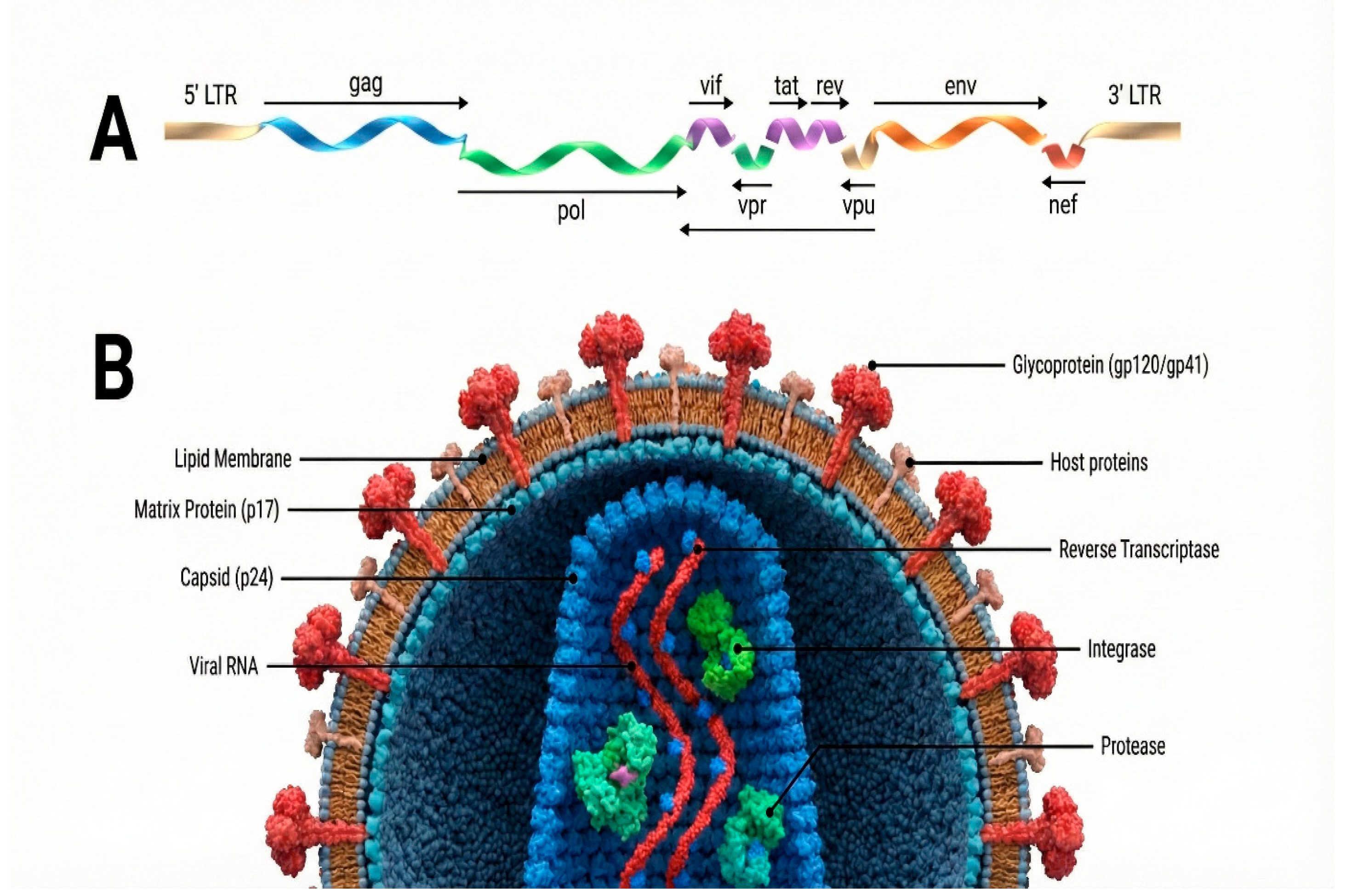
Figure 1. The HIV-1 genome and mature virion structure are complex. (A) Simplified schematic of the wild-type HIV-1 genome, and (B ) morphology of the virion. [1,7,17,18] (Image generated using Gemini Pro and Nano Banana software (Google), accessed on December 10, 2025.).
Preprints 217934 g001
Figure 2. (A) The first generation is composed of three plasmids: transfer, packaging, and envelope. The complete HIV-1 genome, excluding the env gene, is packaged; it encodes accessory genes (vif, vpr, vpu, nef) and the Tat-dependent LTR; it exhibits high homology to the wild type. (B) The second generation comprises three plasmids: transfer, packaging (gag/pol + tat + rev), and envelope. Unlike the first, accessory genes are eliminated (Δvif, Δvpr, Δvpu, Δnef); often, it remains without a synthetic inactive system (SIN), but tat + rev are retained in the packaging. (C) The third generation comprises four plasmids: self-inactivating transfer (SIN), + packaging [(gag/pol) + (rev)] + envelope. Unlike previous generations, the gene rev is found on a separate plasmid. Standard SIN LTR (ΔU3); heterologous 5′ promoter; cPPT/CTS and WPRE are commonly used. [35,36](Image generated using Gemini Pro and Nano Banana software (Google), accessed on December 9, 2025.).
Preprints 217934 g002
Figure 3. The different generations of CAR-T structures. Legend: The figure above illustrates the modular structure of a chimeric antigen receptor (CAR), including the antigen recognition domain (scFv/VHH), the hinge/spacer region, the transmembrane domain, and the intracellular signaling domains (CD3ζ and co-stimulatory motifs like CD28 or 4-1BB). [79,80](Image generated using Gemini Pro and Nano Banana software (Google), accessed on December 5, 2025.).
Preprints 217934 g003
Figure 4. shows the differences in steps between ex vivo gene transfer and the new in vivo CAR-T generation. Legend: CAR-T: chimeric antigen receptor T; SIN-LVV: self-inactivating lentiviral vector; AAV: adeno-associated virus; LNP: viral nanoparticle; CNS: central nervous system; VSV-G: Vesicular stomatitis virus G glycoprotein.[88](Image generated using Gemini Pro and Nano Banana software (Google), accessed on December 5, 2025.).
Preprints 217934 g004
Table 1. HIV genome and HIV-derived lentiviral vectors components: gene of origin, proteins encoded, functions, and abbreviations.
Component Gene Proteins Encoded Functions in Wild Type HIV Role in Recombinant Vector System Abbreviation
Structural gene gag MA (matrix), CA (capsid), NC (nucleocapsid), p6 Structural core proteins: form the viral capsid and are essential for particle assembly and packaging. Provided “in trans” by the “packaging plasmid”. Forms the viral core that encapsulates the vector RNA gag
Enzymatic gene pol RT (reverse transcriptase), IN (integrase), PR (protease) Reverse transcription, integration, polyprotein cleavage Provided “in trans” by the “packaging plasmid”. Essential for creating an infectious vector particle pol
Envelope gene env gp120, gp41 (envelope glycoproteins) Mediates viral entry by binding to CD4 and CCR5/CXCR4 co-receptors on target cells Deleted from the vector system. Replaced “in trans” by a heterologous envelope plasmid, most commonly “VSV-G”, which confers broad tropism env
Vesicular Stomatitis Virus protein G To support an extensive range of tropisms VSV-G
Regulatory element RRE (in env RNA) – (RNA motif, not protein) Binding site for the Rev protein. Allows unspliced and partially spliced viral RNAs to be exported from the nucleus to the cytoplasm Retained in the vector to enable nuclear export of the full-length vector RNA (especially important for genomes >4kb) RRE
Regulatory gene
rev Rev protein RNA-binding protein that binds to RRE to shuttle unspliced RNAs from the nucleus to the cytoplasm Provided “in trans” on a “separate plasmid” (in 3rd/4th gen systems) or with packaging genes. Essential for high-titer production of vectors with RRE. rev
tat Tat protein A key transcriptional activator that binds the TAR element to enhance transcription from the LTR dramatically. Deleted. LTRs in packaging plasmids are often replaced with a strong constitutive promoter (e.g., CMV). tat
Accessory gene
nef Nef protein Immune evasion downmodulates CD4 and MHC-I expression, thereby enhancing infectivity. Deleted nef
vif Vif protein Blocks APOBEC3G (antiviral restriction factor) Deleted vif
vpr Vpr protein Cell cycle arrest, nuclear import of pre-integration complex Deleted vpr
vpu Vpu protein CD4 degradation, virus release enhancement Deleted vpu
LTR (5′ and 3′)
U3 – (cis-DNA/RNA element) Promoter/enhancer region (drives transcription) In “SIN vectors”, the U3 region is often deleted and replaced with a specific promoter. U3
R Repeat: transcription initiation and polyadenylation site. It drives transcription of the vector RNA. R
U5 Needed for reverse transcription and integration U5
LTR (3′) PolyA (in 3′ LTR) Signals proper 3′ end processing and mRNA stability In “SIN vectors”, the U3 region is “deleted”. This deletion is copied to the 5' LTR during reverse transcription, “inactivating the viral promoter” in the provirus PolyA
Legend: For LVV: Only cis-acting sequences are retained (LTRs, RRE, packaging signal Ψ, PolyA). Protein-coding regions (gag, pol, env, tat, rev, etc.) are supplied in trans from helper plasmids during vector production. The U3 region is modified in self-inactivating (SIN) vectors to eliminate unwanted promoter activity.[39].
Table 2. Comparison of Wild-Type HIV-1 with Lentiviral Vectors Used for CAR-T Manufacturing.
Feature Wild-Type (WT) HIV-1 CAR-T Lentiviral Vector (LVV)
Genome content Whole ~9.7 kb genome encoding gag, pol, env, tat, rev, nef, vif, vpr, vpu. Minimal cis-acting elements only (ψ packaging signal, RRE, cPPT, WPRE, LTRs) plus therapeutic CAR transgene.
Long Terminal Repeats (LTRs) Full LTRs with intact promoter/enhancer elements (U3, R, U5) → drive viral transcription. Self-inactivating (SIN) LTRs with U3 deletion → no promoter activity post-integration.
Packaging All proteins are encoded in cis by the viral genome. Split packaging: gag/pol, rev, and envelope supplied on separate plasmids during vector production.
Envelope glycoprotein Native HIV-1 env (gp120/gp41): specific tropism for CD4+ cells. Pseudotyped (commonly VSV-G): broad tropism and stability; not HIV-specific.
Protein expression in target cells Viral proteins are expressed after integration (Gag, Pol, Env, accessory proteins). Only the CAR transgene was expressed; no viral proteins were produced in CAR-Ts.
Replication competence Fully replication-competent; generates infectious progeny. Replication-incompetent; no complete viral genome present in any construct.
Accessory/regulatory genes Present (tat, rev, nef, vif, vpr, vpu): key for replication and immune evasion. Deleted; absent from the vector genome.
Biosafety level BSL-3 pathogen (Risk Group 3). Typically, BSL-2 (Risk Group 2) with RCL testing is required.
Clinical function Pathogenic virus causes HIV/AIDS. Safe gene delivery vehicle to introduce CAR constructs into T cells.
Table 3. Comparison of the four generations of HIV-derived LVV system .[21] .
Generation Key Genomic Feature Plasmid System Safety Profile Primary Use
First Full HIV-1 genome minus env in packaging; accessory genes present (vif, vpr, vpu, nef). Tat-dependent LTR; non-SIN; high homology to wild-type 3-Plasmid: Transfer + Packaging + Envelope. Low Basic research; historical.
Second Accessory genes deleted (Δvif, Δvpr, Δvpu, Δnef); often still non-SIN; tat + rev retained in packaging. 3-Plasmid: Transfer + gag/pol + tat + rev (packaging) + Envelope. Medium In-vitro cell modification; preclinical.
Third rev moved to a separate plasmid; SIN LTRs (ΔU3) standard; heterologous 5′ promoter; cPPT/CTS and WPRE commonly used. 4-Plasmid: Transfer (SIN) + gag/pol + rev + Envelope. High Gold standard for clinical applications (CAR-T, HSC).
Fourth Further HIV sequence minimization; tat-independent with heterologous promoters; possible insulators/extra safety modules; may split gag from pol. ≥4-Plasmid (extends 3rd-gen split; optional extra splits). Very High Cutting-edge trials/platforms where maximal safety is required.
Table 4. Comparison between Lentiviral Vectors, Gamma-Retroviruses, and Adeno-Associated Viruses.[1].
Feature/Parameter Lentivirus Vector γ-Retrovirus Vector Adeno-associated virus Vector (AVV)
Genome Integration Ability Stable integration into the host genome (dividing & non-dividing cells). Semi-random preference for active sites. Stable integration requires nuclear entry via cell division. Preference for transcription start sites. Non-integrating (episomal), transient expression.
Target Cell Type Dividing and non-dividing cells (T cells, HSCs, neurons). Dividing cells only (T cells, hematopoietic progenitors). Dividing and non-dividing cells, broad tropism (depends on serotype).
Immunogenicity Low to moderate; envelope dependent. Low to moderate. High, strong innate and adaptive immune response.
Design & Preparation Time 4–8 weeks (moderate complexity). 4–6 weeks (simpler design). 8–12+ weeks (complex production).
Application Range Ex vivo CAR-T, HSC, in vivo gene therapy. Mainly ex vivo (CAR-T). In vivo gene delivery, vaccines, and oncolytic therapy.
Vector Capacity 8–10 kb. 7–8 kb. Up to 36 kb (gutless), 7.5 kb (standard).
Vector Stability High stability of transgene expression; moderate physical stability. Stable integration; similar physical stability. Very high physical stability; transient expression.
Regulatory Experience Extensive (CAR-T, HSC gene therapy). Historical (first CAR-T). Extensive (vaccines, oncolytic vectors).
Biosafety Level BSL-2+ (RCL-free LVVs). BSL-2. BSL-2 or BSL-2+ (depending on modifications).
Example Products/Uses Yescarta®, Kymriah®, Carteyva® (CAR-T). First-generation CAR-T products. Ad5-nCoV (COVID-19 vaccine), oncolytic adenoviruses.
Legend: LVVs and γ-retrovirals integrate into the host genome, allowing stable expression but requiring safety testing (RCL/RCR); adenoviral vectors remain episomal, preventing insertional mutagenesis but limiting long-term expression; γ-retroviral vectors require dividing cells, while lentiviral and adenoviral vectors can transduce non-dividing cells; AAVs have higher immunogenicity, which may restrict repeated administration; All vectors require appropriate biosafety measures and regulatory testing. [45,46,47,48].
Table 5. Process steps & technical knobs.
Step/Parameter Lentiviral vector
(SIN-LVV)
γ-retroviral vector
(γ-RV)
AAV6-HDR
(CRISPR knock-in)
Transgene delivery principle Random genomic integration by HIV-1–derived SIN-LVV; internal promoter drives CAR expression. Random genomic integration by MLV-derived (often SIN) vector; internal promoter or SIN-LTR-driven CAR. Targeted integration at a defined locus (e.g., TRAC) via Cas9 RNP electroporation + AAV6 donor.
Need for cell division. Transduces dividing and non-dividing T cells. Most efficient in dividing cells; pair with early/strong activation. HDR-active in activated T cells; not an integrating retrovirus process.
Common entry pseudotypes VSV-G, RD114-TR, BaEV, GALV (choose based on serum stability and T/NK tropism). RD114 or GALV; Retronectin is commonly used to bridge the virus-to-cell. Not applicable; AAV6 is the donor; Cas9 RNP delivered by electroporation.
Transduction/editing enhancers Retronectin, spinoculation; Vectofusin-1 at some sites. Retronectin (standard), spinoculation. Optimize AAV6 dose/time; serum-free exposure window; electroporation parameters are critical.
Typical sequence capacity ~8–10 kb usable cassette. ~8–9 kb. ~4.7 kb AAV payload including homology arms → strict cassette size discipline.
Integration pattern Bias to intragenic, transcriptionally active regions (LEDGF/p75 tethering). Bias toward promoters/TSS/enhancers. Defined locus (e.g., TRAC); mix of on-target HDR and rare by-products that must be QC’d.
QC readouts (vector-specific) VCN per cell; integration-site analysis (as needed); RCL testing of vector lots. VCN; integration sites (as needed); RCR testing of vector lots. Knock-in allele frequency (on-target HDR); off-target analysis; AAV donor integrity; no RCL/RCR.
Regulatory/clinical precedent Broadest T-cell precedent (e.g., Kymriah). Deep precedent in approved CAR-Ts (e.g., Yescarta, Tecartus). Rapidly growing preclinical and early-clinical use for TRAC knock-in.
Legend: SIN-LVV:.
Table 6. Advantages, Disadvantages & Examples for Each Class of Vectors.
Vector class Advantages Disadvantages/Risks Clinical/
landmark examples
Lentiviral (SIN-LVV) Robust on activated T cells; broad activation window; high functional titers; mature GMP playbook; integration is less promoter-centric than γ-RV. Integrating vector → insertional risk (managed by SIN design and VCN control); multi-plasmid transient production; RCL testing required. Kymriah (tisagenlecleucel);
extensive academic programs.
γ-retroviral (γ-RV) Very mature CAR-T workflows (Retronectin + RD114/GALV); options for stable producer cell lines. Requires cell division; integration bias near TSS/enhancers; RCR testing; historical tonic signaling with non-SIN LTRs. Yescarta (axi-cel),
Tecartus (brexu-cel).
AAV6-HDR
(CRISPR knock-in)
Targeted insertion (e.g., TRAC) enabling uniform expression and potentially improved performance; no integrating retrovirus. Two-part process (electroporation + AAV6 donor); HDR efficiency and cell stress are critical; AAV size limit; specialized QC for edits. TRAC knock-in CD19 CAR-T (Eyquem et al., Nature 2017) and subsequent AAV6 optimization studies.
Table 7. Summary of FDA, EMA, and NMPA-approved CAR T cell therapies globally.
Item Trademark (Generic Name/Development Code/Common Abbreviations) Targeted gene Vector Delivery Strategy Indications Manufacturer/marketing authorization issued Data source
1 KymriahTM
Tisagenlecleucel/CTL019/tisa-cel/
CD19 HIV-11-derived
replication-incompetent (RI),
third-generation
SIN lentiviral vector (LVV)
pseudotyped
with VSV-G2/transient transfection of HEK293T cells/EF-1α promoter
R/R3 B-ALL4
(2017)
DLBCL5 after ≥2
lines of therapy
(2018)
FL6 after ≥2 lines
of therapy (2022)
Novartis
Pharmaceuticals
Corporation.
FDA7 (August 2017)
EMA8 (August 2018)
NMPA9 (not approved)
[93,98]
2 YescartaTM
Axicabtagene ciloleucel
Yikaida®
Axicabtagene ciloleucel/azi-cel
CD19 MSCV10-based vector pseudotyped with the GaLV11 envelope, non-self-inactivating ɣ retroviral vector/Stable transfection of packaging cell clone PG13-CD19-H3 Relapsed
DLBCL after ≥2
lines of
therapy (2017)
Relapsed FL
after ≥2 lines
of therapy
(2021)
DLBCL
refractory to
first-line
therapy (2022) R/R DLBCL
(2021)
DLBCL (2023)
Kite Pharma, Inc.
FDA (October
2017)
Kite Pharma EU
B.V. EMA (August 2018)
Fosun Kite Biotechnology Co., Ltd. NMPA (June 2021)
[69,99,100,101,102,103,104,105,142]
3 TecartusTM
Brexucabtagene autoleucel/KTE-X19/Brexu-cel/Tec-cel
CD19 R/R MCL12 (2020)
R/R B-ALL
(2021)
Kite
Pharmaceuticals
Inc.
FDA (July 2020)
EMA (December 2020)
[106,107,108,109,110,111,112]
4 Breyanzi®
Lisocabtagene
maraleucel/JCAR017/liso-cel
CD19 HIV-1-derived replication-incompetent (RIC) third-generation SIN LVV pseudotyped
with VSV-G
Relapsed DLBCL
after ≥2 lines of
therapy (2021)
DLBCL refractory
to first-line or
relapsing at <12
months of the first
line therapy or
relapsing on
first-line
therapy and not
eligible for
HSCT13 (2022)
Adult patients
with R/R CLL14
or SLL15 who
have received at
At least two prior
lines of therapy
(2024)
Juno
Therapeutics,
Inc., a Bristol-
Myers Squibb
FDA (February 2021)
EMA (2022)
[113,114,115,116,143]
5 Abecma®
Idecabtagene vicleucel/bb2121/ide-cel
BCMA14 Fifth line
R/R MM16 (2021)
Celgene
Corporation, a
Bristol-Myers
Squibb Company. FDA (March 2021)
EMA (August 2021)
[5,118,119,120,121]
6 Carvykti®
Ciltacabtagene autoleucel/JNJ-68284528, LCAR-B38M, cila-cel
BCMA Fifth line
R/R MM (2022)
Patients with
R/R MM who
have received at
at least one prior
line of therapy
(2024)
Janssen Biotech,
Inc.
FDA (February
2022)
EMA (May 2022)
Janssen (Xi'an) Pharmaceutical Ltd. NMPA (2022)
[44,72,122,123,124,125,126,127]
7 Aucatzyl®
Obecabtagene autoleucel
CD19 HIV-derived RIC LVV expressing an anti-CD19 CAR composed of a murine anti-CD19 scFv linked to 4-1BB and CD3ζ signaling domains. Adult r/r B-LLA. Autolus Therapeutics
FDA (2024)
[128,129,144]
8 Beinuoda® or Carteyva®
Relmacabtagene autoleucel/Relma-cel/JWCAR029
CD19 HIV-derived RIC third-generation SIN LVV pseudotyped with VSV-G R/R DLBCL (2021) R/R FL (2022) R/R B-ALL
(2023)
JW Therapeutics Co., Ltd., based on technology from a Bristol Myers Squibb company (Juno Therapeutics) and WuXi AppTec)
NMPA. (September 3, 2021)
(September 30, 2021)
[130,131,132,133]
9 Fucaso®
Equacabtagene autoleucel/CT103A
BCMA HIV-1-derived RIC, third-generation SIN LVV pseudotyped with VSV-G (speculated) Lentiviral Third line
R/R MM (2023). This treatment is an autologous cellular immunotherapy that includes a CAR
Lentigen Technology (a subsidiary of Miltenyi Biotec and Nanjing Legend Biotec)
NMPA (June 2023, November 2023)
[134,135,136,137]
10 Yorwida® or
Yuanruida®
Inaticabtagene autoleucel/CNCT19
BCMA Third line
R/R MM (2023)
IASO Biotherapeutics, in collaboration with Innovent Biologics. NMPA (June 23, 2023, [138]
11 Saikaize®
Zevorcabtagene
Autoleucel/Zevor-cel
BCMA Third line
R/R MM (2024)
Carsgen Therapeutics. NMPA. (March, 5 2024) [139,140]
Legend: 1HIV-1: Human Immunodeficiency Virus Type-1; 2VSV-G: Vesicular Stomatitis Virus G-protein; 3R/R: Relapse/Refractory; 4B-ALL: B-Acute Lymphoblastic Leukemia; 5DLBCL: Diffuse Large B-cell Lymphoma; 6FL: Follicular Lymphoma; 7FDA: US Food and Drug Administration; 8EMA: European Medicine Agency; 9NMPA: China National Medical Products Administration; 10MSCV: Murine Stem Cells Virus; 11GaLV: Gibon Ape Leukemia Virus; 12MCL: Mantel Cell Lymphoma; 13HSCT: Hemapopoietic Stem Cells Transplantation; 14CLL: Chronic Lymphocytic Leukenia; 15SLL: Small Lymphocytic Lymphoma; 16MM: Multiple Myeloma.
Table 8. Other LVV-derived cell therapy products, distinct from CAR-T cells, are in development.
Product class Example product/program Cell source LVV payload/target Stage Notes
HSC gene therapy
Zynteglo® (betibeglogene autotemcel) Autologous CD34+ HSCs HBB^T87Q β-globin (BB305 LVV) Approved (US, 2022) Transfusion-dependent β-thalassemia
Lyfgenia™ (lovotibeglogene marcelpivlecel) Autologous CD34+ HSCs Modified β-globin (HBB^T87Q) Approved (US, 2023) Sickle cell disease with VOEs
Skysona® (elivaldogene autotemcel) Autologous CD34+ HSCs ABCD1 Approved (US, 2022) Early, active CALD (REMS & malignancy warnings apply)
Lenmeldy™/Libmeldy® (atidarsagene autotemcel) Autologous CD34+ HSCs ARSA Approved (EU 2020; US 2024) Metachromatic leukodystrophy
TCR-engineered T cells (TCR-T) TAEST16001 (NY-ESO-1 TCR-T) Autologous T cells Affinity-enhanced NY-ESO-1 TCR Clinical (Phase 1/2) LVV-transduced TCR-T; activity in soft-tissue sarcoma
CAR-Tregs TX200-TR101 (HLA-A2 CAR-Tregs) Autologous Tregs HLA-A2–specific CAR Clinical (Phase 1/2) Third-gen SIN-LVV used for transduction
CAR-NK/NK cell therapy BaEV-LVV–transduced CAR-NK platforms Primary NK cells CAR (e.g., anti-CD19 or dual CD19/CD22) Clinical/Preclinical BaEV pseudotyping greatly improves NK transduction
HSC-derived “cellular drug factory.” Temferon™ (IFN-α2 HSPC platform) Autologous HSPCs → myeloid progeny IFN-α2 under myeloid/TEM control Clinical (Phase 1/2a) Engineered myeloid cells deliver IFN-α within tumors
Table 9. GMP Grades vs ISO Cleanroom Classes.
Cleanroom Standard Cleanroom Classification Guidelines
ISO 14644-1 Class 3 Class 4 Class 5 Class 6 Class 7 Class 8
EU GMP (at rest)* - - A/B - C D
US Federal Standard 209F (replaced by ISO 14,644 in 2011) 1 10 100 1,000 10,000 100,000

Parameter
Class 5
(EU Grade A)

(EU Grade B)
Class 7
(EU Grade C)
Class 8
(EU Grade D)
Max particles ≥0.5 µm (max/m3)* 3,520 3,520 (at rest)/352,000 (in operation) 352,000 3,520,000
Particles ≥ 5 µm (max/m3)* 20 20 (at rest)/2,900 (in operation) 2,900 29,000
Typical airflow Laminar, unidirectional Turbulent dilution Turbulent dilution
Pressure differential +15 Pa min to lower grade +10–15 Pa +5–10 Pa
Typical use High-risk operations: aseptic filling, open product exposure, critical zones Less critical steps: solution preparation, filtration. Handling of components after washing, preparation of solutions to be sterilized
Typical ISO Class ISO 4.8/ISO 5 ISO 5 (at rest), ISO 7 (in operation) ISO 7 ISO 8
Legend: *Values correspond to the at-rest state, unless otherwise indicated. At rest: The cleanroom is fully equipped and operational, but currently lacks personnel. In operation: The cleanroom is operational, with equipment and personnel engaged in activities. Grade A and B GMP standards are critical for aseptic operations; particle counts during operations are especially important. ISO classes do not define at-rest versus in-operation state; this distinction is exclusive to GMP.
Disclaimer/Publisher’s Note: The statements, opinions and data contained in all publications are solely those of the individual author(s) and contributor(s) and not of MDPI and/or the editor(s). MDPI and/or the editor(s) disclaim responsibility for any injury to people or property resulting from any ideas, methods, instructions or products referred to in the content.
Copyright: This open access article is published under a Creative Commons CC BY 4.0 license, which permit the free download, distribution, and reuse, provided that the author and preprint are cited in any reuse.
Prerpints.org logo

Preprints.org is a free preprint server supported by MDPI in Basel, Switzerland.

Subscribe

Accessibility

Disclaimer

Terms of Use

Privacy Policy

Privacy Settings

© 2026 MDPI (Basel, Switzerland) unless otherwise stated