

Submitted:
09 November 2026
Posted:
10 November 2026
You are already at the latest version
Abstract
Irritable bowel syndrome (IBS) is a gastrointestinal disorder that is highly prevalent, often accompanied by considerable comorbidities and that places a substantial burden both on individuals and healthcare systems. Treatments are usually aimed at addressing symptoms but often fall short of long-term relief. Current dietary strategies primarily focus on what patients should avoid eating, while the potential physiological importance of when food is consumed has received little attention in IBS research. We hypothesize that gastrointestinal symptoms may, at least partially, be affected by a cumulative burden of epithelial injury as well as insufficient time for mucosal maintenance and repair. This paper explores the hypothesis that intermittent fasting regimens could represent underexplored therapeutic strategies for reducing IBS symptoms by promoting gut renewal and restoring homeostasis. We review the multifactorial pathophysiology of IBS and explore how fasting may impact relevant biological mechanisms. Several lines of evidence, from both preclinical and clinical studies, indicate that intermittent fasting may reduce inflammation, regulate gut motility and reshape the microbiota, thereby strengthening the gut barrier and dampening immune responses. Fasting also induces autophagy, a key cellular recycling process essential for intestinal barrier maintenance and microbial defense, which may be impaired in IBS. Hence, intermittent fasting may reduce cumulative epithelial injury and allow time for repair to alleviate symptoms in IBS. Although no randomized controlled trials on fasting regimens and IBS are available, evidence from related populations and mechanistic research supports further exploration of this accessible, low-cost approach.
Keywords:
irritable bowel syndrome
; intermittent fasting
; gut renewal
; inflammation
; autophagy
Introduction
Irritable bowel syndrome (IBS) is a functional gastrointestinal disorder characterized by abdominal pain and changes in stool form and frequency (diarrhea, constipation, or both), as defined by the Rome IV criteria (1), in the absence of detectable pathology on standard medical testing (2). Reliable biomarkers for IBS are lacking (3). The global prevalence of IBS has previously been estimated at 3.8% using the Rome IV criteria and 9.2% using the Rome III criteria, though this varies widely between countries, even when standardized diagnostic criteria and methods are applied (4). Prevalence estimates also vary between publications: a more recent meta-analysis reported considerably higher pooled prevalence rates (17.1% with Rome IV and 13.2% with Rome III), a reversal of the pattern found in (4), and identified a trend toward increasing prevalence in more recent studies (5). Prevalence is consistently higher among women than men (4,5).
In addition to gastrointestinal symptoms, IBS is frequently accompanied by comorbidities such as anxiety, depression, fibromyalgia, chronic fatigue syndrome, and sleep disturbances (6). It is often unclear whether IBS leads to these conditions or arises as a consequence of them. However, in the case of mood disorders, some evidence suggests that gastrointestinal symptoms may precede psychological symptoms (7). Both the GI symptoms and comorbidities contribute to significantly reduced quality of life (8), and patients have reported a willingness to sacrifice years of life expectancy for effective relief (9). The disorder also imposes a substantial economic burden, both through direct healthcare costs and through indirect costs such as reduced work productivity and disability benefits (9).
There is currently no known cure for IBS and treatment strategies typically focus on symptom relief through medications, dietary interventions, or supplements. However, since most approaches do not address the underlying pathophysiology, they usually do not lead to long-term improvement (7). Surveys indicate that many IBS patients experience unmet needs and are dissatisfied with the care they receive from the healthcare system (8,10). Given the significant burden IBS places on both individuals and society, any effective addition to the therapeutic toolbox available to patients and clinicians would be valuable. In this paper, we explore the hypothesis that structured intermittent fasting (IF) could support gut repair and reduce symptom burden in IBS.
The multifaceted pathophysiology of IBS
The pathophysiology of IBS remains incompletely understood, but current evidence points to a complex, bidirectional interplay between the gut and the nervous system. Disruptions in this gut–brain axis contribute to key features of the disorder, including altered gastrointestinal motility, visceral hypersensitivity, and changes in central pain processing (11).
In a comprehensive review, Holtmann et al. summarize the diverse pathological features associated with IBS, emphasizing its heterogeneous and multifactorial nature (7). Their analysis highlights that a substantial subset of IBS patients exhibits a range of inflammation-related abnormalities, such as gut microbiota dysbiosis, low-grade mucosal inflammation, increased intestinal permeability, and both cellular and humoral immune activation. These findings challenge the traditional notion of IBS as a purely functional disorder (7).
The role of diet in IBS
Although food reactions are not included in the most common diagnostic criteria for IBS, a majority of patients report that meals exacerbate their symptoms (12). In recent years, the role of diet has gained increasing attention both in research and in clinical management of IBS (13). However, identifying true individual dietary triggers remains challenging, and many patients continue to experience symptoms despite significant dietary modifications, even in trials reporting a benefit (14,15).
Several studies have shown that IBS patients often report intolerances to specific foods, food groups, or food components (12,16). Yet, when self-reported food intolerances in the general population are tested under double-blind, placebo-controlled conditions, only a small proportion can be reliably reproduced (17). This discrepancy may be due to the dose-dependent or delayed nature of food-related symptoms, making it difficult to pinpoint true dietary triggers. When the time lag between dietary triggers and symptom onset remains unclear, it adds to the confusion both for patients trying to self-manage, and for professionals trying to help. As a result, patients may unnecessarily eliminate benign foods while continuing to consume unrecognized triggers. In the worst case, such unnecessary dietary restriction is itself a risk factor for disordered eating behavior, including avoidant/restrictive food intake disorder (18).
Despite the well-known limitations of self-reported dietary data in observational studies, both in accurately capturing actual intake and in reliably identifying true symptom triggers, there is robust evidence from controlled human trials for specific dietary triggers of IBS symptoms. For example, fermentable carbohydrates such as fructose and sorbitol (19), as well as lactulose, a synthetic carbohydrate used medically (20), have been shown to reliably provoke gastrointestinal symptoms in individuals with IBS under controlled conditions.
While most treatment strategies target the colon, evidence suggests that also the small intestine may play a role. Using confocal laser endomicroscopy, immediate structural and functional changes, along with infiltration of inflammatory cells, have been observed in the duodenal tissue of IBS patients after exposure to common dietary components such as cow’s milk, wheat, yeast, and soy (21). These findings indicate that also small intestinal responses are relevant when evaluating dietary influences in IBS.
Limitations to dietary symptom management
First-line dietary advice for IBS, as recommended by the National Institute for Health and Care Excellence (NICE) and the British Society of Gastroenterology, includes eating regular meals and avoiding long gaps between meals (22,23). Although such advice is strongly recommended, the quality of evidence is graded as weak, and it is based primarily on clinical experience rather than on randomized controlled trials (22). When this first-line advice is not sufficient, elimination diets, such as the low FODMAP diet, very low-carbohydrate diets or a starch- and sucrose-reduced diet have demonstrated efficacy in alleviating IBS symptoms (24–29). Notably, the CARIBS trial showed that dietary interventions resulted in greater symptom improvement than pharmacological treatment (27). However, such dietary approaches can be highly restrictive, lead to a limited variety of food options and require substantial patient involvement. They may also pose social and practical challenges, making long-term adherence difficult. While adherence can be significantly improved through the support of a dietitian (30), such professional guidance is not always available or systematically offered to patients (31).
In addition, dietary recommendations for IBS management may conflict with general dietary guidelines, which can create confusion for patients attempting to self-manage their symptoms. For example, some of the fermentable carbohydrates associated with IBS symptoms are also classified as fibers; non-digestible carbohydrates that are fermented by the gut microbiota. While a high intake of fiber is widely promoted as beneficial for intestinal health (32), this general advice may be counterproductive for IBS patients in the absence of individualized dietary guidance. Accordingly, in a survey on IBS patients who had tried bran intake, the majority experienced worsening of symptoms, and only a minority reported relief (33).
The “chicken or egg dilemma” is also often present: Do dietary factors contribute to IBS pathology, thereby leading to symptoms, or does an underlying IBS pathology increase sensitivity to dietary triggers? Coffee is a useful example of this. It is frequently self-reported as a symptom trigger and is linked to symptom recurrence upon reintroduction (13,34). Two cohort studies have reached inconsistent conclusions regarding coffee and IBS risk (35,36). As no randomized controlled trial (RCT) has examined the effect of coffee on IBS symptoms, the question of causal direction remains unresolved.
The role of the microbiome in IBS
There is increasing recognition that disturbances in the intestinal microbiome may be both a contributor to and consequence of intestinal inflammation in IBS. While advances in sequencing technologies have generated vast amounts of microbiome data from IBS patients, no universally accepted microbial signature has been identified that can reliably distinguish IBS patients from healthy individuals or serve as a diagnostic biomarker (37).
Nonetheless, comparative studies have identified recurring microbial features in IBS. These include an increased abundance of Firmicutes, a higher Firmicutes-to-Bacteroidetes ratio (37), and elevated levels of Proteobacteria, including potentially pathogenic strains such as Escherichia coli, as well as increased archaeal methanogens (38). IBS patients often show a reduction in microbes important for maintaining gut barrier integrity and modulating inflammation, particularly Bifidobacterium species and butyrate-producing bacteria such as Faecalibacterium prausnitzii (37–39).
The complexity of diet-microbiome-host interactions is still being unraveled, and our understanding is still incomplete. Most microbiome studies rely on fecal sampling, which primarily reflects the microbial composition of the distal colon. These samples may not reflect structural and functional alterations in the small intestine or upper gastrointestinal tract. This is a limitation, as the small intestine houses the majority of the gut’s lymphoid tissue and represents the primary site of direct contact between luminal microbes and the immune system (40). Direct sampling studies demonstrate that the distal ileal microbiota is distinct from both colonic and fecal communities, being dominated by facultative, oral-type taxa (41). Furthermore, much of the existing research has been focused on bacterial taxa, often overlooking the possible roles of the mycobiome, phageome, and the broader interplay between microbial kingdoms and the host in gut function.
This limited understanding has implications for treatment development. Research into alternative therapies, such as fecal microbiota transplantation, has yielded mixed results and the long-term efficacy remains uncertain. While some clinical trials have reported symptom improvement, a recent systematic review and meta-analysis found no significant difference in clinical response or symptom scores compared with control (42). More recently, the large phase 3 REFIT2 trial (n = 450) found no clinical benefit of fecal microbiota transplantation compared with placebo (43). These findings underscore the need for a perspective that includes host factors and microbial functionality, not just composition, in efforts to restore gut homeostasis.
In a 2024 conceptual paper, Lee et al. argue for moving beyond compositional analysis toward an ecological framework that views the gut as a homeostatic ecosystem (44). The authors emphasize that under normal conditions, the host maintains a hypoxic environment in the colon that favors obligate anaerobic fermenters. However, if the environment is disrupted by inflammation, antibiotics or dietary insults, luminal oxygen can increase. This change in oxygen availability can allow facultative anaerobes that are associated with disease to increase. Hence, shifts in microbial composition may be signs of a disrupted environment, rather than causes of symptoms per se (44).
This reframing also affects the therapeutic approach: rather than targeting specific microbes, interventions that aim to restore ecological balance and host-microbial homeostasis might offer new possibilities for managing IBS.
The critical role of the gut barrier
The change in perspective from microbial composition to gut ecology can be exemplified by the intestinal barrier, including the host-controlled mucus layer, which shapes the microbial environment and serves as the first line of defense by shielding the epithelium from pathogens, mechanical stress, and dietary antigens (45).
Disruption of the mucus barrier has been implicated in a range of gastrointestinal disorders, including IBS, inflammatory bowel disease (IBD), and metabolic conditions (46). For example, mice deficient in the primary colonic mucin MUC2 exhibit a thinner, more penetrable mucus layer that allows commensal microbes to approach the epithelial surface. These mice are highly vulnerable to intestinal infections, develop spontaneous colitis even in the absence of pathogens, and show increased risk of tumor formation driven by low-grade inflammation and epithelial proliferation (46).
Dietary factors such as emulsifiers and texturizing agents widely used in ultra-processed foods can significantly influence mucus barrier function, as demonstrated in preclinical studies. Maltodextrin, a highly processed polysaccharide, has been shown to impair antimicrobial defense, promote adherence of pathobionts, deplete the mucus layer and increase intestinal inflammation (47–51). Similarly, carboxymethylcellulose, a synthetic emulsifier, has been found to alter the composition of the microbiota, thin the mucus barrier, increase inflammatory responses, and promote microbial encroachment in animal models (52).
Emerging evidence also highlights the importance of the mucus barrier in preventing food allergies and sensitivities (46). Recently, two other commonly used food emulsifiers, soy lecithin and diacetyl tartaric acid esters of mono- and diglycerides, were shown to impair epithelial barrier integrity, induce inflammatory signaling and promote IgE production in human gut models and mice, at concentrations corresponding to reported use levels in foods (53).
Bile acids contribute to gut barrier integrity, both directly through their antimicrobial effects, which limit bacterial density in the upper gastrointestinal tract (54), and indirectly via activation of the bile acid receptors TGR5 and FXR, which enhance epithelial barrier function (55–57). Notably, in fat-reduced products natural dietary fat is often replaced with emulsifiers and texturizing agents such as those discussed above (58,59). We propose that this could lead to a double-hit effect: reduced fat intake diminishes bile-mediated antimicrobial defense, while the emulsifier itself directly damages the mucus and tight-junction barrier. Hence, seeking to avoid dietary factors that have the potential to compromise host-microbial homeostasis could be just as useful as dietary interventions aimed at reducing symptoms that occur as a result.
Is the need for cellular repair and renewal underappreciated in IBS?
Meals expose the intestinal epithelium to repeated mechanical, chemical, and microbial stress, necessitating rapid and continuous epithelial renewal, occurring approximately every 3-5 days in the small intestine (60) and every 5-7 days in the colon (61). Direct visualization of damage to the epithelial lining during food exposure indicates that IBS patients might be more prone to such stress (21).
In both the small intestine and colon, stem cells located at the base of the crypts divide and produce transient cells which proliferate, differentiate, and migrate along defined axes. In the small intestine, differentiated cells (including absorptive enterocytes, mucus-secreting goblet cells and enteroendocrine cells) migrate upward along the crypt-villus axis, while in the colon, where villi are absent, they migrate toward the luminal surface. In both regions, fully matured cells are ultimately shed into the intestinal lumen via apoptosis (60,61). This highly dynamic turnover is tightly regulated by both endogenous signals and exogenous stimuli from the gut microbiota. Notably, microbial metabolites like short-chain fatty acids enhance proliferation and differentiation of epithelial cells, thereby contributing to epithelial homeostasis (60). Thus, the integrity of the intestinal epithelium depends on the orchestrated interaction between stem cells, niche signals, and the gut microbiota.
Can insights from IBD be helpful for understanding IBS?
IBS and IBD are, in most respects, clearly distinct conditions which differ markedly both in presentation and pathogenesis. However, when biological measures are compared directly, several features are shared between the two conditions. Accordingly, IBS has been proposed to represent a low-grade inflammatory condition with mechanistic overlap with IBD (7,62). Many patients with IBD experience IBS-like symptoms during remission, suggesting a continuum in symptom expression between the two conditions (63). Moreover, both IBS and ulcerative colitis patients display mucosal biofilms and disruptions in bile acid metabolism to a far greater extent than healthy controls (64).
Some microbial features are also shared between IBS and IBD. Both conditions are associated with reduced gut microbial diversity, loss of beneficial bacterial species (such as Faecalibacterium prausnitzii and Bifidobacterium spp.), and increased abundance of potentially pathogenic bacteria, particularly within the phylum Proteobacteria (39,65). Such similarities could reflect common pro-inflammatory components in the microbial ecosystem of both disorders.
Furthermore, evidence from nutritional interventions points to shared responses. For instance, FODMAP restriction can improve symptom burden in IBD patients during remission and in IBS patients (25,66,67). However, in IBD, this symptom improvement does not correspond to changes in inflammatory biomarkers such as C-reactive protein (CRP) or fecal calprotectin (67). This finding highlights a broader concern: that symptom-targeted treatments may not adequately address underlying pathology (7).
Given the overlapping features between IBS and IBD, it is worth exploring whether dietary strategies studied in IBD could also be beneficial for IBS patients. A variety of other dietary strategies, including ketogenic diets and anti-inflammatory diets, are being investigated in IBD management, based on their ability to reduce symptoms (68). Among such approaches, we suggest that IF regimens stand out due to their universal accessibility, low cost, and minimal need for clinical supervision. Thus far, this discussion, like most IBS dietary research, has centered on what is eaten. We now turn to when.
The therapeutic potential of fasting
Homeostatic processes induced by fasting have received little attention in the field of IBS, but the evidence presented in the following sections suggests that insufficient periods of fasting to allow for maintenance, repair and renewal could be a missing link in understanding disease pathology.
A first hint that meal timing itself may matter for IBS symptoms comes from a randomized dietary intervention in which many of the participants consumed small, frequent amounts of food every hour or two hours at baseline, instead of complete meals. Although the intervention aimed to reduce starch and sucrose intake, and not meal frequency directly, many of the participants spontaneously adopted more regular eating patterns during the study, which also demonstrated clinically meaningful symptom improvement in a majority of participants (29).
Over the past two decades, the body of literature on fasting strategies has grown rapidly. However, this field continues to face challenges due to the lack of standardized protocols and consistent terminology. To address this issue, we adopt the definitions proposed in a recent expert consensus publication on fasting terminology (69). IF is used here as an umbrella term for repetitive fasting regimens that can last up to 48 hours, including time-restricted eating (TRE), while the fasting-mimicking diet (FMD) is discussed separately where mechanistically relevant. Table 1 presents fasting-related terms used in this work, as defined in the consensus publication (69). Tables are provided at the end of the manuscript.
Interventions involving fasting have demonstrated broad health benefits across conditions with distinct etiologies. In humans, various forms of fasting have been shown to improve markers of insulin resistance, dyslipidemia and systemic inflammation, and have led to meaningful improvements in conditions in which inflammation is part of the clinical picture (70–72).
Despite growing interest, fasting interventions have still been minimally explored in the context of IBS. The earliest study we identified showed that a 10-day fasting intervention led to improvements in IBS symptoms compared to a control group (73); however, this protocol involved complete fasting under medical supervision, limiting its practicality as a self-managed therapeutic strategy. More recently, our research group conducted an 8-week TRE pilot study, in an uncontrolled setting, and found a mean reduction in IBS Severity Scoring System of 100.2 points (74). This change exceeds the threshold for clinically meaningful improvement, according to the scoring system’s original validation study (75). Most recently, a two-week, partially randomized trial compared a low-FODMAP diet, NICE dietary advice and NICE dietary advice combined with TRE (76). Symptom severity improved in all groups, and adding TRE did not significantly reduce the symptom score beyond NICE advice alone. However, as the authors note, the two-week intervention may have been too short for the full effect to emerge. This is consistent with participant reports from our qualitative follow-up study, in which symptom relief typically emerged after an adaptation period of three to six weeks (77). Still, taken together the results so far support further investigation of structured fasting approaches in IBS treatment, while underscoring the need for controlled trials that can also identify which patients are most likely to benefit.
Although research on fasting in IBD also remains limited, early results are encouraging. FMDs have been associated with reduced inflammation and disease severity in animal models of IBD (78). More recently, in an RCT of adults with Crohn’s disease, three monthly cycles of FMD resulted in significantly higher rates of clinical response and clinical remission compared with a baseline diet (79). Additionally, a 12-week RCT of TRE in adults with Crohn’s disease in remission found reductions in clinical disease activity, abdominal pain and systemic inflammation (80). Together, these trials provide evidence that fasting-based dietary interventions can improve symptoms in patients with Crohn’s disease. Given that IBS and IBD share some features, as discussed previously, findings from fasting studies in IBD populations may inform hypotheses relevant to IBS management.
While RCTs on IF in IBS are still lacking, mechanistic studies suggest that fasting can attenuate gut inflammation, supporting the rationale for exploring structured fasting as a feasible, low-cost, and accessible adjunctive therapy for IBS. Based on current evidence and shared disease mechanisms, we hypothesize that increasing time spent in a fasting state could support epithelial repair and alleviate IBS symptoms by targeting underlying inflammatory and microbial dysregulation.
Proposed mechanisms by which intermittent fasting may promote gut homeostasis in IBS
Table 2 summarizes pathways through which IF may influence IBS, integrating clinical, translational, and mechanistic evidence across biological levels, and subsequent sections discuss proposed mechanisms.
Migrating motor complex activity
The migrating motor complex (MMC) is a cyclical pattern of electromechanical activity that occurs in the stomach and small intestine during fasting periods and is suppressed by food intake (81). Commonly referred to as the “housekeeper” of the gut, the MMC clears residual food particles, mucus, and bacteria from the small intestine. It has been proposed that the MMC is one of several host mechanisms that normally maintain the small intestine as only transiently colonized, and that persistent microbial colonization should instead be understood as a pathological state, reflecting impaired homeostatic mechanisms that otherwise preserve gut health (82). Moreover, the burst phase of MMC is preceded by a motilin-stimulated flow of bile into the duodenum (83). Hence, MMC activity is combined with the previously mentioned antibacterial properties of bile, potentially enhancing the microbial control of the small intestine.
Disruptions in MMC activity have been linked to various gastrointestinal disorders, including IBS. Patients with IBS tend to exhibit a shorter duration of postprandial motor activity than healthy individuals, and those with diarrhea-predominant IBS (IBS-D) often show shorter intervals between MMCs compared to those with constipation-predominant IBS (IBS-C) (84,85). Moreover, impaired MMC function is associated with small intestinal bacterial overgrowth (SIBO) (86), a condition more often seen in IBS patients than in healthy controls (87). While these findings suggest a pattern of dysregulated interdigestive motility in IBS, it remains uncertain whether the disturbances in MMC activity are a cause or consequence of the condition.
Given that fasting is the physiological trigger for MMC activity, prolonging fasting periods could support MMC regulation and bacterial clearance. However, despite this biological rationale, direct clinical evidence that IBS symptoms can be alleviated through this mechanism is lacking and the link remains speculative.
Enhancement of autophagy
Autophagy is a highly conserved, cell-intrinsic recycling mechanism essential for maintaining cellular homeostasis, especially in tissues exposed to environmental stressors like the gut (88). Autophagy plays a critical role in sustaining barrier integrity and immune balance in intestinal epithelial cells. It is activated in response to stressors such as nutrient deprivation, infection and organelle damage and facilitates the degradation of dysfunctional components and invasive pathogens (89). In the gut, autophagy safeguards epithelial function through several key mechanisms. It alleviates endoplasmic reticulum stress and supports mucus secretion in goblet cells, while also enabling Paneth cells to release antimicrobial peptides (90,91). These functions are essential to maintain the mucosal barrier and to prevent microbial translocation. Autophagy also facilitates xenophagy, the selective clearance of invading microbes, thereby limiting inflammation and preserving gut immune tolerance (91).
Disruption of autophagic pathways has been linked to gut inflammatory conditions by impaired secretion, barrier dysfunction, and heightened inflammatory responses in both animal models and human patients (88,91). Importantly, fasting is one of the most potent physiological inducers of autophagy. Evidence indicates that food deprivation robustly activates autophagy in various tissues, including the gut, enhancing the cell’s ability to clear damaged components and preserve homeostasis (89). Current research on the relationship between autophagy and IBS is limited; however, a mechanistic link between IBS pathology and impaired autophagy was recently suggested, as exosomes derived from IBS patients can suppress autophagy in human colon epithelial cells (92). Thus, therapeutic strategies aiming to restore autophagy may improve IBS-related epithelial dysfunction.
Modulation of gut microbiota
Evidence from both human and animal studies indicate that long term fasting induces a state of remodeling and renewal of both the microbial ecosystem and intestinal tissues, with subsequent reduction in pro-inflammatory events and immune responses (93). Longer-term fasting also leads to a reduction in microbial density, and a relative increase in microbes capable of utilizing host-derived nutrient sources such as Akkermansia muciniphila (93). Consequently, it has been hypothesized that fasting is a mechanism that enables the host to reset the microbial ecosystem in the gut and to regain control of the microbial activity (93). IF, including TRE, has been associated with changes in the gut microbiota composition, richness, and diversity. In human studies, IF has shown potential to increase microbial richness and α-diversity, although results vary between individuals and fasting regimens and are heterogeneous and difficult to interpret (94). Of interest, beneficial genera such as Akkermansia and Faecalibacterium have been reported to increase during IF (94,95).
Reduction in pro-inflammatory signaling
Mechanistically, fasting inhibits NF-κB signaling, a central mediator of inflammation, thereby downregulating pro-inflammatory cytokines (96). Accordingly, IF regimens have reduced levels of pro-inflammatory cytokines such as TNF-α, IL-1β, and IL-6 in both animal and human trials (96). However, despite an established mechanistic link between fasting and reduced inflammation, the inclusion of studies on healthy individuals in systematic reviews and meta-analyses, as well as the lack of studies on IBS patients, makes results difficult to interpret in the context of IBS pathology.
A conceptual overview of the proposed mechanisms is presented in Figure 1.
Discussion
Considerations for the application of intermittent fasting regimens in IBS treatment
Further research is needed to fully understand the long-term effects and mechanisms of IF in IBS. However, early findings suggest promising potential for this approach as an accessible and non-pharmacological strategy to support symptom management. Importantly, data from a recent pilot study conducted by our research group indicate that TRE may confer symptom benefit for individuals with IBS (74). A qualitative exploration of the same patient group identified both motivating factors and practical barriers that can inform how such interventions are introduced and supported in clinical practice (77).
Fasting regimens in this context are not intended to induce weight loss. Patients should therefore be instructed to consume nutrient-dense foods and to eat to satiety during eating windows, in order to prevent nutritional deficiencies and support metabolic and overall physiological function. Moreover, as individuals with IBS are at increased risk of disordered eating (18), any dietary intervention, including IF, should be implemented with caution and tailored to the patient’s psychological relationship with food.
Considerations for future research
Although direct clinical evidence in IBS is limited, the convergence of mechanistic data, translational findings and early clinical observations provides a biologically plausible hypothesis that warrants testing of IF regimens in controlled trials. The novelty of this approach lies in the targeting of mechanisms that may be underappreciated in current IBS management. While awaiting corroborating evidence, IF could be viewed as a potential complementary strategy to established treatments.
The hypothesis that IF can improve symptom burden in IBS can be tested in controlled trials that compare such strategies with conventional dietary management and with outcomes that include symptom severity, markers of intestinal permeability, mucus barrier integrity, inflammatory markers and microbiome ecology. Such trials should be of sufficient duration, as patient experiences indicate that an adaptation period of several weeks may precede symptom relief (77), and should include an arm in which fasting is not combined with other dietary changes, so that its specific contribution can be isolated. If supported by future controlled trials, IF may represent a simple, low-cost, and physiologically grounded addition to the therapeutic toolbox for IBS.
Author Contributions
MK: Writing - original draft, Conceptualization, Methodology. AB, HFD, MM and JV: Writing - review & editing. All authors approved the final version of the manuscript.
Funding
This work has not been funded.
Use of artificial intelligence
No content, including hypotheses, interpretations or scientific claims, was generated by AI. Claude Opus 5.5 (Anthropic, accessed September through October 2026) was used to improve the structure and clarity of selected author-written paragraphs. The authors reviewed and edited all AI-assisted text and take full responsibility for the final manuscript.
Acknowledgments
An earlier version of this manuscript was made available as a preprint (97).
Conflicts of Interest
MK is the author of a popular science book addressing time-restricted eating and receives royalties from book sales. All other authors declare no conflicts of interest.
References
- Drossman, D.A. Functional gastrointestinal disorders: history, pathophysiology, clinical features and Rome IV. Gastroenterology 2016, 150, 1262–1279.e2. [Google Scholar] [CrossRef]
- Fikree, A.; Byrne, P. Management of functional gastrointestinal disorders. Clin. Med. 2021, 21, 44–52. [Google Scholar] [CrossRef]
- Kim, J.H.; Lin, E.; Pimentel, M. Biomarkers of Irritable Bowel Syndrome. J. Neurogastroenterol. Motil. 2017, 23, 20–26. [Google Scholar] [CrossRef]
- Oka, P.; Parr, H.; Barberio, B.; Black, C.J.; Savarino, E.V.; Ford, A.C. Global prevalence of irritable bowel syndrome according to Rome III or IV criteria: a systematic review and meta-analysis. Lancet Gastroenterol. Hepatol. 2020, 5, 908–917. [Google Scholar] [CrossRef]
- Ballena-Caicedo, J.; Valladolid-Sandoval, L.A.M.; Zuzunaga-Montoya, F.E.; Vera-Ponce, V.J. Global Prevalence of Irritable Bowel Syndrome: An Updated Systematic Review and Meta-Analysis. Gastroenterol. Res. 2025, 18, 308–321. [Google Scholar] [CrossRef]
- Shiha, M.G.; Aziz, I. Review article: Physical and psychological comorbidities associated with irritable bowel syndrome. Aliment Pharmacol. Ther. 2021, 54 Suppl 1, S12–S23. [Google Scholar] [CrossRef]
- Holtmann, G.J.; Ford, A.C.; Talley, N.J. Pathophysiology of irritable bowel syndrome. Lancet Gastroenterol. Hepatol. 2016, 1, 133–146. [Google Scholar] [CrossRef]
- El-Salhy, M.; Johansson, M.; Klevstul, M.; Hatlebakk, J.G. Quality of life, functional impairment and healthcare experiences of patients with irritable bowel syndrome in Norway: an online survey. BMC Gastroenterol. 2025, 25, 143. [Google Scholar] [CrossRef]
- Canavan, C.; West, J.; Card, T. Review article: the economic impact of the irritable bowel syndrome. Aliment Pharmacol. Ther. 2014, 40, 1023–1034. [Google Scholar] [CrossRef]
- International Foundation for Gastrointestinal Disorders (IFFGD). IBS patients’ illness experience and unmet needs survey (2020). Available online: https://iffgd.org/news/press-release/2020-iffgd-s-ibs-patients-illness-experience-and-unmet-needs-survey/ (accessed on 28 October 2026).
- Ford, A.C.; Sperber, A.D.; Corsetti, M.; Camilleri, M. Irritable bowel syndrome. The Lancet 2020, 396, 1675–1688. [Google Scholar] [CrossRef]
- Simrén, M.; Månsson, A.; Langkilde, A.M.; Svedlund, J.; Abrahamsson, H.; Bengtsson, U.; Björnsson, E.S. Food-related gastrointestinal symptoms in the irritable bowel syndrome. Digestion 2001, 63, 108–115. [Google Scholar] [CrossRef]
- Capili, B.; Anastasi, J.K.; Chang, M. Addressing the Role of Food in Irritable Bowel Syndrome Symptom Management. J. Nurse Pract. 2016, 12, 324–329. [Google Scholar] [CrossRef]
- Atkinson, W.; Sheldon, T.A.; Shaath, N.; Whorwell, P.J. Food elimination based on IgG antibodies in irritable bowel syndrome: a randomised controlled trial. Gut 2004, 53, 1459–1464. [Google Scholar] [CrossRef]
- Rej, A.; Sanders, D.S.; Shaw, C.C.; Buckle, R.; Trott, N.; Agrawal, A.; Aziz, I. Efficacy and Acceptability of Dietary Therapies in Non-Constipated Irritable Bowel Syndrome: A Randomized Trial of Traditional Dietary Advice, the Low FODMAP Diet, and the Gluten-Free Diet. Clin. Gastroenterol. Hepatol. 2022, 20, 2876–2887.e15. [Google Scholar] [CrossRef]
- Böhn, L.; Störsrud, S.; Törnblom, H.; Bengtsson, U.; Simrén, M. Self-Reported Food-Related Gastrointestinal Symptoms in IBS Are Common and Associated With More Severe Symptoms and Reduced Quality of Life. Off. J. Am. Coll. Gastroenterol. ACG 2013, 108, 634. [Google Scholar] [CrossRef]
- Young, E.; Stoneham, M.D.; Petruckevitch, A.; Barton, J.; Rona, R. A population study of food intolerance. Lancet 1994, 343, 1127–1130. [Google Scholar] [CrossRef]
- Murray, H.B.; Doerfler, B.; Harer, K.N.; Keefer, L. Psychological Considerations in the Dietary Management of Patients With DGBI. Am. J. Gastroenterol. 2022, 117, 985–994. [Google Scholar] [CrossRef]
- Valeur, J.; Øines, E.; Helvik Morken, M.; Juul Holst, J.; Berstad, A. Plasma glucagon-like peptide 1 and peptide YY levels are not altered in symptomatic fructose-sorbitol malabsorption. Scand. J. Gastroenterol. 2008, 43, 1212–1218. [Google Scholar] [CrossRef]
- Valeur, J.; Morken, M.H.; Norin, E.; Midtvedt, T.; Berstad, A. Carbohydrate intolerance in patients with self-reported food hypersensitivity: Comparison of lactulose and glucose. Scand. J. Gastroenterol. 2009, 44, 1416–1423. [Google Scholar] [CrossRef]
- Fritscher-Ravens, A.; Schuppan, D.; Ellrichmann, M.; Schoch, S.; Röcken, C.; Brasch, J.; Bethge, J.; Böttner, M.; Klose, J.; Milla, P.J. Confocal endomicroscopy shows food-associated changes in the intestinal mucosa of patients with irritable bowel syndrome. Gastroenterology 2014, 147, 1012–1020.e4. [Google Scholar] [CrossRef]
- Vasant, D.H.; Paine, P.A.; Black, C.J.; Houghton, L.A.; Everitt, H.A.; Corsetti, M.; Agrawal, A.; Aziz, I.; Farmer, A.D.; Eugenicos, M.P.; et al. British Society of Gastroenterology guidelines on the management of irritable bowel syndrome. Gut 2021, 70, 1214–1240. [Google Scholar] [CrossRef]
- National Institute for Health and Care Excellence (NICE). Irritable bowel syndrome in adults. Quality standard QS114, quality statement 3: dietary management (2016). Available online: https://www.nice.org.uk/guidance/QS114/chapter/quality-statement-3-dietary-management (accessed on 28 October 2026).
- Halmos, E.P.; Power, V.A.; Shepherd, S.J.; Gibson, P.R.; Muir, J.G. A diet low in FODMAPs reduces symptoms of irritable bowel syndrome. Gastroenterology 2014, 146, 67–75.e5. [Google Scholar] [CrossRef]
- Algera, J.P.; Demir, D.; Törnblom, H.; Nybacka, S.; Simrén, M.; Störsrud, S. Low FODMAP diet reduces gastrointestinal symptoms in irritable bowel syndrome and clinical response could be predicted by symptom severity: A randomized crossover trial. Clin. Nutr. Edinb. Scotl. 2022, 41, 2792–2800. [Google Scholar] [CrossRef]
- Austin, G.L.; Dalton, C.B.; Hu, Y.; Morris, C.B.; Hankins, J.; Weinland, S.R.; Westman, E.C.; Yancy, W.S.; Drossman, D.A. A Very Low-carbohydrate Diet Improves Symptoms and Quality of Life in Diarrhea-Predominant Irritable Bowel Syndrome. Clin. Gastroenterol. Hepatol. Off. Clin. Pract. J. Am. Gastroenterol. Assoc. 2009, 7, 706–708.e1. [Google Scholar] [CrossRef]
- Nybacka, S.; Törnblom, H.; Josefsson, A.; Hreinsson, J.P.; Böhn, L.; Frändemark, Å.; et al. A low FODMAP diet plus traditional dietary advice versus a low-carbohydrate diet versus pharmacological treatment in irritable bowel syndrome (CARIBS): a single-centre, single-blind, randomised controlled trial. Lancet Gastroenterol. Hepatol. 2024, 9, 507–520. [Google Scholar] [CrossRef]
- Cuffe, M.S.; Staudacher, H.M.; Aziz, I.; Adame, E.C.; Krieger-Grubel, C.; Madrid, A.M.; Ohlsson, B.; Black, C.J.; Ford, A.C. Efficacy of dietary interventions in irritable bowel syndrome: a systematic review and network meta-analysis. Lancet Gastroenterol. Hepatol. 2025, 10, 520–536. [Google Scholar] [CrossRef]
- Nilholm, C.; Larsson, E.; Roth, B.; Gustafsson, R.; Ohlsson, B. Irregular Dietary Habits with a High Intake of Cereals and Sweets Are Associated with More Severe Gastrointestinal Symptoms in IBS Patients. Nutrients 2019, 11, 1279. [Google Scholar] [CrossRef]
- Tuck, C.J.; Reed, D.E.; Muir, J.G.; Vanner, S.J. Implementation of the low FODMAP diet in functional gastrointestinal symptoms: A real-world experience. Neurogastroenterol. Motil. 2020, 32, e13730. [Google Scholar] [CrossRef]
- Scarlata, K.; Eswaran, S.; Baker, J.R.; Chey, W.D. Utilization of Dietitians in the Management of Irritable Bowel Syndrome by Members of the American College of Gastroenterology. Off. J. Am. Coll. Gastroenterol. ACG 2022, 117, 923. [Google Scholar] [CrossRef]
- Ioniță-Mîndrican, C.-B.; Ziani, K.; Mititelu, M.; Oprea, E.; Neacșu, S.M.; Moroșan, E.; Dumitrescu, D.-E.; Roșca, A.C.; Drăgănescu, D.; Negrei, C. Therapeutic Benefits and Dietary Restrictions of Fiber Intake: A State of the Art Review. Nutrients 2022, 14, 2641. [Google Scholar] [CrossRef]
- Francis, C.Y.; Whorwell, P.J. Bran and irritable bowel syndrome: time for reappraisal. Lancet Lond. Engl. 1994, 344, 39–40. [Google Scholar] [CrossRef]
- Heizer, W.D.; Southern, S.; McGovern, S. The Role of Diet in Symptoms of Irritable Bowel Syndrome in Adults: A Narrative Review. J. Am. Diet. Assoc. 2009, 109, 1204–1214. [Google Scholar] [CrossRef]
- Zhou, S.; Hu, F.; Long, Z.; Huang, H.; Li, D.; Chu, M.; Zhang, L. Coffee Consumption and Risk of Incident Gastrointestinal Disease: A Large Prospective Cohort Study. Food Sci. Nutr. 2025, 13, e71271. [Google Scholar] [CrossRef]
- Wu, S.; Yang, Z.; Yuan, C.; Liu, S.; Zhang, Q.; Zhang, S.; Zhu, S. Coffee and tea intake with long-term risk of irritable bowel syndrome: a large-scale prospective cohort study. Int. J. Epidemiol. 2023, 52, 1459–1472. [Google Scholar] [CrossRef]
- Shaikh, S.D.; Sun, N.; Canakis, A.; Park, W.Y.; Weber, H.C. Irritable Bowel Syndrome and the Gut Microbiome: A Comprehensive Review. J. Clin. Med. 2023, 12, 2558. [Google Scholar] [CrossRef]
- Chong, P.P.; Chin, V.K.; Looi, C.Y.; Wong, W.F.; Madhavan, P.; Yong, V.C. The Microbiome and Irritable Bowel Syndrome - A Review on the Pathophysiology, Current Research and Future Therapy. Front Microbiol. 2019, 10, 1136. [Google Scholar] [CrossRef]
- Vich Vila, A.; Imhann, F.; Collij, V.; Jankipersadsing, S.A.; Gurry, T.; Mujagic, Z.; Kurilshikov, A.; Bonder, M.J.; Jiang, X.; Tigchelaar, E.F.; et al. Gut microbiota composition and functional changes in inflammatory bowel disease and irritable bowel syndrome. Sci. Transl. Med. 2018, 10, eaap8914. [Google Scholar] [CrossRef]
- Mowat, A.M.; Agace, W.W. Regional specialization within the intestinal immune system. Nat. Rev. Immunol. 2014, 14, 667–685. [Google Scholar] [CrossRef]
- Villmones, H.C.; Haug, E.S.; Ulvestad, E.; Grude, N.; Stenstad, T.; Halland, A.; Kommedal, Ø. Species Level Description of the Human Ileal Bacterial Microbiota. Sci. Rep. 2018, 8, 4736. [Google Scholar] [CrossRef]
- Lo, S.-W.; Hung, T.-H.; Lin, Y.-T.; Lee, C.-S.; Chen, C.-Y.; Fang, C.-J.; Lai, P.-C. Clinical efficacy and safety of faecal microbiota transplantation in the treatment of irritable bowel syndrome: a systematic review, meta-analysis and trial sequential analysis. Eur. J. Med. Res. 2024, 29, 464. [Google Scholar] [CrossRef]
- Johnsen, P.H.; Juul, F.E.; Hoff, D.A.L.; Hillestad, E.R.; Holme, Ø.; Skjevling, L.K.; et al. Faecal microbiota transplantation in irritable bowel syndrome (REFIT2): a randomised, double-blind, placebo-controlled, phase 3 trial. Lancet 2026. [Google Scholar] [CrossRef]
- Lee, J.-Y.; Bays, D.J.; Savage, H.P.; Bäumler, A.J. The human gut microbiome in health and disease: time for a new chapter? Infect. Immun. 2024, 92, e0030224. [Google Scholar] [CrossRef]
- Akdis, C.A. Does the epithelial barrier hypothesis explain the increase in allergy, autoimmunity and other chronic conditions? Nat. Rev. Immunol. 2021, 21, 739–751. [Google Scholar] [CrossRef]
- Parrish, A.; Boudaud, M.; Kuehn, A.; Ollert, M.; Desai, M.S. Intestinal mucus barrier: a missing piece of the puzzle in food allergy. Trends Mol. Med. 2022, 28, 36–50. [Google Scholar] [CrossRef]
- Laudisi, F.; Di Fusco, D.; Dinallo, V.; Stolfi, C.; Di Grazia, A.; Marafini, I.; Colantoni, A.; Ortenzi, A.; Alteri, C.; Guerrieri, F.; et al. The Food Additive Maltodextrin Promotes Endoplasmic Reticulum Stress-Driven Mucus Depletion and Exacerbates Intestinal Inflammation. Cell Mol. Gastroenterol. Hepatol. 2019, 7, 457–473. [Google Scholar] [CrossRef]
- Nickerson, K.P.; Chanin, R.; McDonald, C. Deregulation of intestinal anti-microbial defense by the dietary additive, maltodextrin. Gut Microbes 2015, 6, 78–83. [Google Scholar] [CrossRef]
- Nickerson, K.P.; Homer, C.R.; Kessler, S.P.; Dixon, L.J.; Kabi, A.; Gordon, I.O.; Johnson, E.E.; de la Motte, C.A.; McDonald, C. The dietary polysaccharide maltodextrin promotes Salmonella survival and mucosal colonization in mice. PLoS ONE 2014, 9, e101789. [Google Scholar] [CrossRef]
- Zangara, M.T.; Ponti, A.K.; Miller, N.D.; Engelhart, M.J.; Ahern, P.P.; Sangwan, N.; et al. Maltodextrin consumption impairs the intestinal mucus barrier and accelerates colitis through direct actions on the epithelium. Front Immunol. 2022, 13, 841188. [Google Scholar] [CrossRef]
- Nickerson, K.P.; McDonald, C. Crohn’s disease-associated adherent-invasive Escherichia coli adhesion is enhanced by exposure to the ubiquitous dietary polysaccharide maltodextrin. PLoS ONE 2012, 7, e52132. [Google Scholar] [CrossRef]
- Chassaing, B.; Koren, O.; Goodrich, J.K.; Poole, A.C.; Srinivasan, S.; Ley, R.E.; Gewirtz, A.T. Dietary emulsifiers impact the mouse gut microbiota promoting colitis and metabolic syndrome. Nature 2015, 519, 92–96. [Google Scholar] [CrossRef]
- Yazici, D.; Hayashi, Y.; Pat, Y.; Hotie, J.; Balci, M.A.; Ardicli, S.; Lopez, J.F.; Ardicli, O.; Zhao, B.; Maldonado, A.; et al. Common Food Emulsifiers Impair Epithelial Barrier Integrity and Trigger Pro-Inflammatory Responses and IgE Production. Allergy 2026. [Google Scholar] [CrossRef]
- Hofmann, A.F.; Eckmann, L. How bile acids confer gut mucosal protection against bacteria. Proc. Natl. Acad. Sci. U S A 2006, 103, 4333–4334. [Google Scholar] [CrossRef]
- Zangerolamo, L.; Carvalho, M.; Barbosa, H.C.L. The Critical Role of the Bile Acid Receptor TGR5 in Energy Homeostasis: Insights into Physiology and Therapeutic Potential. Int. J. Mol. Sci. 2025, 26, 6547. [Google Scholar] [CrossRef]
- Inagaki, T.; Moschetta, A.; Lee, Y.-K.; Peng, L.; Zhao, G.; Downes, M.; Yu, R.T.; Shelton, J.M.; Richardson, J.A.; Repa, J.J.; et al. Regulation of antibacterial defense in the small intestine by the nuclear bile acid receptor. Proc. Natl. Acad. Sci. 2006, 103, 3920–3925. [Google Scholar] [CrossRef]
- Cipriani, S.; Mencarelli, A.; Chini, M.G.; Distrutti, E.; Renga, B.; Bifulco, G.; Baldelli, F.; Donini, A.; Fiorucci, S. The Bile Acid Receptor GPBAR-1 (TGR5) Modulates Integrity of Intestinal Barrier and Immune Response to Experimental Colitis. PLoS ONE 2011, 6, e25637. [Google Scholar] [CrossRef]
- Golding, M.; Pelan, E. Application of emulsifiers to reduce fat and enhance nutritional quality. In Food Emulsifiers and Their Applications, 2nd ed.; Hasenhuettl, G.L., Hartel, R.W., Eds.; Springer: New York, 2008; pp. 327–348. [Google Scholar] [CrossRef]
- Chen, Y.; She, Y.; Zhang, R.; Wang, J.; Zhang, X.; Gou, X. Use of starch-based fat replacers in foods as a strategy to reduce dietary intake of fat and risk of metabolic diseases. Food Sci. Nutr. 2020, 8, 16–22. [Google Scholar] [CrossRef]
- Park, J.; Kotani, T.; Konno, T.; Setiawan, J.; Kitamura, Y.; Imada, S.; Usui, Y.; Hatano, N.; Shinohara, M.; Saito, Y.; et al. Promotion of Intestinal Epithelial Cell Turnover by Commensal Bacteria: Role of Short-Chain Fatty Acids. PLoS ONE 2016, 11, e0156334. [Google Scholar] [CrossRef]
- Barker, N. Adult intestinal stem cells: critical drivers of epithelial homeostasis and regeneration. Nat. Rev. Mol. Cell Biol. 2014, 15, 19–33. [Google Scholar] [CrossRef]
- Szałwińska, P.; Włodarczyk, J.; Spinelli, A.; Fichna, J.; Włodarczyk, M. IBS-Symptoms in IBD Patients—Manifestation of Concomitant or Different Entities. J. Clin. Med. 2021, 10, 31. [Google Scholar] [CrossRef]
- Fairbrass, K.M.; Costantino, S.J.; Gracie, D.J.; Ford, A.C. Prevalence of irritable bowel syndrome-type symptoms in patients with inflammatory bowel disease in remission: a systematic review and meta-analysis. Lancet Gastroenterol. Hepatol. 2020, 5, 1053–1062. [Google Scholar] [CrossRef]
- Baumgartner, M.; Lang, M.; Holley, H.; Crepaz, D.; Hausmann, B.; Pjevac, P.; Moser, D.; Haller, F.; Hof, F.; Beer, A.; et al. Mucosal Biofilms Are an Endoscopic Feature of Irritable Bowel Syndrome and Ulcerative Colitis. Gastroenterology 2021, 161, 1245–1256.e20. [Google Scholar] [CrossRef]
- Casén, C.; Vebø, H.C.; Sekelja, M.; Hegge, F.T.; Karlsson, M.K.; Ciemniejewska, E.; Dzankovic, S.; Frøyland, C.; Nestestog, R.; Engstrand, L.; et al. Deviations in human gut microbiota: a novel diagnostic test for determining dysbiosis in patients with IBS or IBD. Aliment Pharmacol. Ther. 2015, 42, 71–83. [Google Scholar] [CrossRef]
- Pedersen, N.; Ankersen, D.V.; Felding, M.; Wachmann, H.; Végh, Z.; Molzen, L.; Burisch, J.; Andersen, J.R.; Munkholm, P. Low-FODMAP diet reduces irritable bowel symptoms in patients with inflammatory bowel disease. World J. Gastroenterol. 2017, 23, 3356–3366. [Google Scholar] [CrossRef]
- Cox, S.R.; Lindsay, J.O.; Fromentin, S.; Stagg, A.J.; McCarthy, N.E.; Galleron, N.; Ibraim, S.B.; Roume, H.; Levenez, F.; Pons, N.; et al. Effects of Low FODMAP Diet on Symptoms, Fecal Microbiome, and Markers of Inflammation in Patients With Quiescent Inflammatory Bowel Disease in a Randomized Trial. Gastroenterology 2020, 158, 176–188.e7. [Google Scholar] [CrossRef]
- Gubatan, J.; Kulkarni, C.V.; Talamantes, S.M.; Temby, M.; Fardeen, T.; Sinha, S.R. Dietary Exposures and Interventions in Inflammatory Bowel Disease: Current Evidence and Emerging Concepts. Nutrients 2023, 15, 579. [Google Scholar] [CrossRef]
- Koppold, D.A.; Breinlinger, C.; Hanslian, E.; Kessler, C.; Cramer, H.; Khokhar, A.R.; Peterson, C.M.; Tinsley, G.; Vernieri, C.; Bloomer, R.J.; et al. International consensus on fasting terminology. Cell Metab. 2024, 36, 1779–1794.e4. [Google Scholar] [CrossRef]
- Longo, V.D.; Mattson, M.P. Fasting: Molecular Mechanisms and Clinical Applications. Cell Metab. 2014, 19, 181–192. [Google Scholar] [CrossRef]
- de Cabo, R.; Mattson, M.P. Effects of Intermittent Fasting on Health, Aging, and Disease. N Engl. J. Med. 2019, 381, 2541–2551. [Google Scholar] [CrossRef]
- Samkari, J. Intermittent fasting: a comprehensive review of cellular mechanisms, metabolic processes, and organ health. J. Umm Al-Qura Univ. Med. Sci. 2025, 11, 7. [Google Scholar] [CrossRef]
- Kanazawa, M.; Fukudo, S. Effects of fasting therapy on irritable bowel syndrome. Int. J. Behav. Med. 2006, 13, 214–220. [Google Scholar] [CrossRef]
- Clausen, M.T.; Sverdrup, H.; Brevik, A.; Molin, M.; Kolby, M. Time-Restricted Eating and Symptom Severity in Irritable Bowel Syndrome: Results from a Pilot Study. Nutrients 2026, 18, 765. [Google Scholar] [CrossRef]
- Francis, C.Y.; Morris, J.; Whorwell, P.J. The irritable bowel severity scoring system: a simple method of monitoring irritable bowel syndrome and its progress. Aliment Pharmacol. Ther. 1997, 11, 395–402. [Google Scholar] [CrossRef]
- Ozman, N.E.B.; Gönen, C.; Gençalp, C.; Kahrıman Aydemir, M.; Baş, M. Short-Term Effects of a Low-FODMAP Diet, Adapted NICE Dietary Advice, and Adapted NICE Dietary Advice Combined with Intermittent Fasting on Symptoms and Quality of Life in Irritable Bowel Syndrome: A Three-Arm, Non-Randomized Controlled Dietary Intervention Study. Nutrients 2026, 18, 3526. [Google Scholar] [CrossRef]
- Sverdrup, H.; Brevik, A.; Clausen, M.T.; Kolby, M.; Molin, M. From Desperation to Sustainability: A Qualitative Exploration of Drivers and Barriers to Time-Restricted Eating in IBS Treatment. Nutrients 2026, 18, 940. [Google Scholar] [CrossRef]
- Wang, R.; Lv, X.; Xu, W.; Li, X.; Tang, X.; Huang, H.; Yang, M.; Ma, S.; Wang, N.; Niu, Y. Effects of the periodic fasting-mimicking diet on health, lifespan, and multiple diseases: a narrative review and clinical implications. Nutr. Rev. 2024, nuae003. [Google Scholar] [CrossRef]
- Kulkarni, C.; Fardeen, T.; Gubatan, J.; Ye, J.; Jarr, K.; Dickson, E.; Jang, H.; Temby, M.; Patel, A.; Jiang, Y.; et al. A fasting-mimicking diet in patients with mild-to-moderate Crohn’s disease: a randomized controlled trial. Nat. Med. 2026, 32, 1023–1033. [Google Scholar] [CrossRef]
- Haskey, N.; Ye, J.; Lewis, A.; Yousuf, M.; Reimer, R.A.; Raman, M. Time-Restricted Feeding Reduces Body Mass Index, Visceral Adiposity, Systemic Inflammation, and Clinical Disease Activity in Adults With Crohn’s Disease: A Randomized Controlled Study. Gastroenterology 2026, 170, 1051–1054. [Google Scholar] [CrossRef]
- Deloose, E.; Janssen, P.; Depoortere, I.; Tack, J. The migrating motor complex: control mechanisms and its role in health and disease. Nat. Rev. Gastroenterol. Hepatol. 2012, 9, 271–285. [Google Scholar] [CrossRef]
- Villmones, H.C.; Valeur, J. Persistent small intestinal microbial colonisation: a potentially pathological rather than physiological state. Med. Hypotheses 2026, 214, 112079. [Google Scholar] [CrossRef]
- Shaffer, E.A. Review article: control of gall-bladder motor function. Aliment Pharmacol. Ther. 2000, 14 Suppl 2, 2–8. [Google Scholar] [CrossRef]
- Kellow, J.E.; Phillips, S.F. Altered small bowel motility in irritable bowel syndrome is correlated with symptoms. Gastroenterology 1987, 92, 1885–1893. [Google Scholar] [CrossRef]
- Kellow, J.E.; Gill, R.C.; Wingate, D.L. Prolonged ambulant recordings of small bowel motility demonstrate abnormalities in the irritable bowel syndrome. Gastroenterology 1990, 98, 1208–1218. [Google Scholar] [CrossRef]
- Vantrappen, G.; Janssens, J.; Hellemans, J.; Ghoos, Y. The interdigestive motor complex of normal subjects and patients with bacterial overgrowth of the small intestine. J. Clin. Invest 1977, 59, 1158–1166. [Google Scholar] [CrossRef]
- Shah, A.; Talley, N.J.; Jones, M.; Kendall, B.J.; Koloski, N.; Walker, M.M.; Morrison, M.; Holtmann, G.J. Small Intestinal Bacterial Overgrowth in Irritable Bowel Syndrome: A Systematic Review and Meta-Analysis of Case-Control Studies. Am. J. Gastroenterol. 2020, 115, 190–201. [Google Scholar] [CrossRef]
- Haq, S.; Grondin, J.; Banskota, S.; Khan, W.I. Autophagy: roles in intestinal mucosal homeostasis and inflammation. J. BioMed Sci. 2019, 26, 19. [Google Scholar] [CrossRef]
- Bagherniya, M.; Butler, A.E.; Barreto, G.E.; Sahebkar, A. The effect of fasting or calorie restriction on autophagy induction: A review of the literature. Ageing Res. Rev. 2018, 47, 183–197. [Google Scholar] [CrossRef]
- Larabi, A.; Barnich, N.; Nguyen, H.T.T. New insights into the interplay between autophagy, gut microbiota and inflammatory responses in IBD. Autophagy 2019, 16, 38–51. [Google Scholar] [CrossRef]
- Telpaz, S.; Bel, S. Autophagy in intestinal epithelial cells prevents gut inflammation. Trends Cell Biol. 2023, 33, 817–819. [Google Scholar] [CrossRef]
- Fu, R.; Liu, S.; Zhu, M.; Zhu, J.; Chen, M. Apigenin reduces the suppressive effect of exosomes derived from irritable bowel syndrome patients on the autophagy of human colon epithelial cells by promoting ATG14. World J. Surg. Oncol. 2023, 21, 95. [Google Scholar] [CrossRef]
- Ducarmon, Q.R.; Grundler, F.; Le Maho, Y.; Wilhelmi de Toledo, F.; Zeller, G.; Habold, C.; et al. Remodelling of the intestinal ecosystem during caloric restriction and fasting. Trends Microbiol. 2023, 31, 832–844. [Google Scholar] [CrossRef]
- Paukkonen, I.; Törrönen, E.-N.; Lok, J.; Schwab, U.; El-Nezami, H. The impact of intermittent fasting on gut microbiota: a systematic review of human studies. Front Nutr. 2024, 11, 1342787. [Google Scholar] [CrossRef]
- Pérez-Gerdel, T.; Camargo, M.; Alvarado, M.; Ramírez, J.D. Impact of intermittent fasting on the gut microbiota: a systematic review. Adv. Biol. 2023, 7, 2200337. [Google Scholar] [CrossRef]
- Haasis, E.; Bettenburg, A.; Lorentz, A. Effect of Intermittent Fasting on Immune Parameters and Intestinal Inflammation. Nutrients 2024, 16, 3956. [Google Scholar] [CrossRef]
- Kolby, M.; Brevik, A.; Dale, H.F.; Molin, M.; Valeur, J. Intermittent fasting as a potential therapeutic approach for irritable bowel syndrome: a mechanistic perspective [Preprint]. Preprints.org 2025. [Google Scholar] [CrossRef]
Figure 1.
Conceptual overview of how fasting can influence interconnected domains, such as gut motility, autophagy, microbiome composition and mucosal inflammation, which may lead to reduced symptom burden in combination.
Figure 1.
Conceptual overview of how fasting can influence interconnected domains, such as gut motility, autophagy, microbiome composition and mucosal inflammation, which may lead to reduced symptom burden in combination.
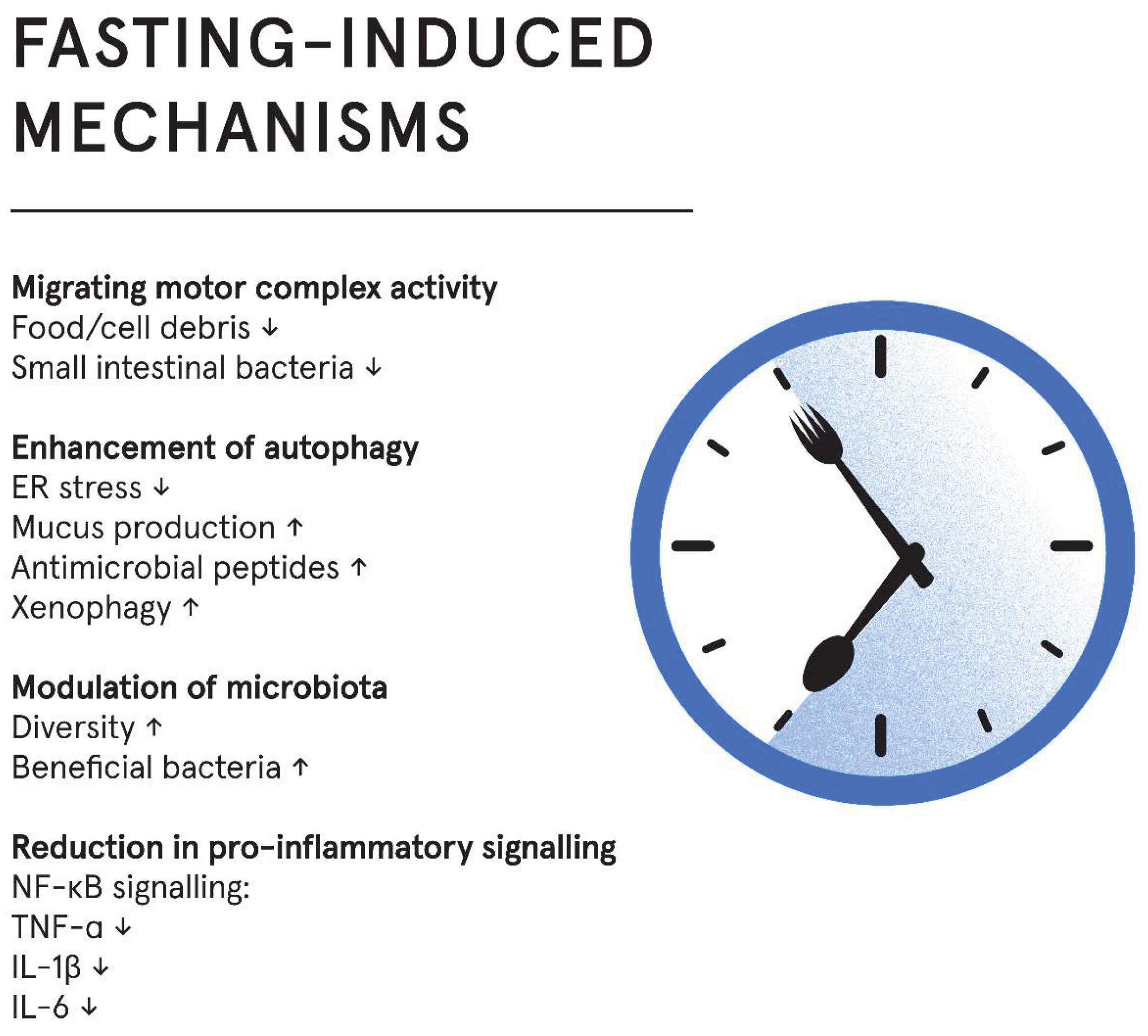

Table 1.
Fasting-related terms used in this publication.
| Term | Definition |
|---|---|
| Fasting | Any voluntary abstinence from some or all foods or foods and beverages. |
| Intermittent fasting (IF) | Repetitive fasting periods lasting up to 48 hours each (including time restricted eating). |
| Time restricted eating (TRE) | A dietary regimen with a fasting window of at least 14 h per day in humans, and no limit on energy intake during eating hours |
| Fasting mimicking diet (FMD) | Any diet specifically composed to induce the metabolic effects of fasting while allowing for a potentially higher caloric intake, including solid foods. |
Definitions adapted from the international consensus on fasting terminology (69).
Table 2.
Proposed pathways through which IF may influence IBS, integrating clinical, translational and mechanistic evidence. A indicates evidence from studies in patients with IBS or related gastrointestinal disorders; B indicates physiological or mechanistic evidence relevant to IBS from human, animal or in vitro studies, but not examined in patients with IBS or related disorders. Table 2 is not intended to be exhaustive, but rather to provide an overview of proposed pathways and the biological levels at which they have been investigated.
| Pathophysiological domain | Biological level(s) involved | Proposed effect or pathway | Proximity to IBS outcomes |
Ref. |
|---|---|---|---|---|
| Migrating motor complex activity | Humans; animal models; gastrointestinal organ-level physiology; neural and hormonal signaling pathways | Fasting is required for MMC activity. | B | (81) |
| Impaired interdigestive motility is associated with IBS and SIBO. | A | (84–86) | ||
| Enhancement of autophagy | Humans, animal models; intestinal mucosal tissue; epithelial and immune cells; molecular autophagy pathways | Fasting is a potent inducer of autophagy across multiple tissues. | B | (89) |
| Autophagy supports antimicrobial defense via Paneth cell secretion, mucus production by goblet cells, and immune regulation in the intestinal epithelium. | B | (88,90,91) | ||
| Modulation of gut microbiota | Humans; animal models | Fasting leads to remodeling of gut microbial ecology; influencing community structure, diversity, and functional capacity. | B | (93) |
| Reduction in pro-inflammatory signaling | Humans; animal models; intestinal tissue and immune endpoints; molecular and cellular pathways | Fasting attenuates NF-κB activation and pro-inflammatory signaling. | B | (96) |
| FMD and TRE improve clinical disease activity in Crohn’s disease; the fasting-mimicking diet was accompanied by a significant decline in fecal calprotectin. | A | (79,80) |
Evidence levels indicate proximity to clinical IBS outcomes: A = evidence from studies in patients with IBS or related gastrointestinal disorders; B = physiological or mechanistic evidence relevant to IBS from human, animal or in vitro studies, but not examined in patients with IBS or related disorders. Abbreviations: IBS – irritable bowel syndrome, MMC – migrating motor complex, NF-κB – nuclear factor kappa B, SIBO – small intestinal bacterial overgrowth.
Disclaimer/Publisher’s Note: The statements, opinions and data contained in all publications are solely those of the individual author(s) and contributor(s) and not of MDPI and/or the editor(s). MDPI and/or the editor(s) disclaim responsibility for any injury to people or property resulting from any ideas, methods, instructions or products referred to in the content. |
© 2026 by the authors. Licensee MDPI, Basel, Switzerland. This article is an open access article distributed under the terms and conditions of the Creative Commons Attribution (CC BY) license (http://creativecommons.org/licenses/by/4.0/).
Copyright: This open access article is published under a Creative Commons CC BY 4.0 license, which permit the free download, distribution, and reuse, provided that the author and preprint are cited in any reuse.