

Submitted:
10 September 2025
Posted:
11 September 2025
You are already at the latest version
Abstract
Artificial intelligence (AI) tools are not only transforming academic practices but also reshaping the frameworks through which media and knowledge economies are theorized. In Algeria, the rise of vendors such as DzPlagiarism.in, AiZair, Academic Ai Tools, Fikra Academy, and ChatGPT Plus DZ illustrates how local actors mediate access to AI through innovative yet often informal business models. These practices raise questions that extend beyond pricing and usability, pointing to larger shifts in media theory concerning circulation, access, and platform economies. This study explores how such vendors adapt AI services to local conditions through subscription-sharing, freemium offers, and hybrid pricing strategies. Publicly available data from websites, social media, and user commentary were analyzed to assess affordability, accessibility, and user satisfaction. Thematic content analysis highlighted recurring concerns over delivery speed, reliability, refunds, and security, alongside positive evaluations of low-cost access and responsive service. These findings reveal the tensions between convenience and compliance, as shared accounts and opaque practices may contravene software policies while simultaneously democratizing access in resource-constrained contexts. By situating these business models within media theory, the study shows how AI adoption in Algerian higher education exemplifies the transition from traditional notions of media distribution to new forms of mediated access. The results underscore the need to expand media theories to account for informal economies, ethical uncertainties, and the socio-technical reconfiguration of academic practices. In doing so, the study contributes to debates on how emerging AI markets in the Global South are transforming both business models and theoretical understandings of media.
Keywords:
AI adoption
; higher education technology
; collective subscription accounts
; pricing strategies
; ethical compliance
; shared AI services
; user feedback analysis
; reseller business models
; emerging markets
; digital economy
; Algeria
Introduction
Artificial intelligence (AI) platforms such as ChatGPT, MidJourney, and Claude have emerged as pivotal infrastructures in the global digital economy, functioning simultaneously as productive tools and as forms of algorithmic media. As systems capable of generating, mediating, and circulating content, these platforms extend beyond traditional software to embody new modes of communication and cultural production. Media economics, which examines how cultural and digital goods are produced, priced, and distributed, provides a useful entry point for understanding this transformation (Albarran, 2016). However, access to AI platforms remains uneven across the globe, constrained by high subscription fees, restrictive payment infrastructures, and region-specific regulations. These structural inequalities highlight the need to reassess existing media theories in light of new business models and access practices.
In Algeria, barriers to formal AI subscriptions have given rise to an innovative yet informal practice: the collective reselling of AI platform subscriptions. Instead of subscribing directly through official providers, local entrepreneurs purchase accounts and redistribute access through pooled purchases, shared accounts, or slot-based reselling at reduced costs. This model not only reflects the adaptive strategies of the informal digital economy but also reconfigures the logic of global software-as-a-service (SaaS) offerings to fit local purchasing power (Heeks, 2021). While these practices democratize access by lowering economic barriers, they also introduce risks related to compliance, transparency, and security, echoing long-standing debates in media studies about piracy, circulation, and informal economies (Lobato, 2019).
This study situates Algeria’s AI reselling practices within the broader context of media theories in transition. By examining the intersection of informal economies and platform capitalism, we explore how mediation occurs not only through algorithms and interfaces but also through alternative business models that redistribute access. Key research questions include: What models of collective reselling dominate in Algeria? How do vendors justify and set pricing compared to official providers? Who are the main users of these services, and what motivates them? And how do ethical, legal, and regulatory frameworks shape the boundaries of this emerging market?
Methodologically, the study draws on media economics (Albarran, 2016), scholarship on informal markets in the digital Global South (Heeks, 2021), and emerging debates on platform imperialism (Jin, 2021). Publicly available data from vendor websites, social media pages, and user commentary provide insights into affordability, accessibility, and satisfaction. Thematic content analysis reveals recurring concerns with delivery speed, customer support, and account security, alongside widespread appreciation of cost savings and usability. The findings demonstrate that collective subscription reselling not only fills a market gap but also creates new cultural and economic meanings around AI use in academic and professional settings.
By linking these empirical findings to media theory, we argue that Algeria’s informal AI subscription market exemplifies a transition in media studies. Traditional theories of media distribution must be expanded to account for algorithmic mediation, informal reselling, and localized adaptations of global platforms. This case illustrates how platform economies are reconfigured from below, producing hybrid models that simultaneously challenge and extend dominant media logics. In doing so, the study contributes to debates on digital inequality, platform capitalism, and the ethics of access in emerging economies, offering insights for policymakers, educators, and entrepreneurs seeking to promote equitable, sustainable AI integration.
- Literatu rereview:
1. Rogers’ Diffusion of Innovations Theory and AI Tool Adoption in Algerian Higher Education
The adoption of shared AI platform accounts in Algeria can be understood through the difussion of innovation theory through Rogers (2003), which explains how new technologies are spreading in a social system. According to Rogers, adoption is shaped by five properties: relative benefits, compatibility, complexity, test capacity and observation. Local suppliers such as dzplagiarism.in and Aizair insist on relative benefits of offering AI membership at a fraction of the official price, allow students and the faculty to detect literary theft and now the product production equipment, otherwise outside the economy. This ability improves compatibility with local economic conditions and causes AI tools to meet the needs of Algerian educational users.
However, the complexity of the adoption is arbitrariness: While some suppliers provide user -friendly bundles, others are criticized for confusing interface and limited support, which brakes the spread. Publicity who "pay for two apps, get a free" increase triism, so hesitant users can experiment with multiple platforms at low costs. Finally, the widespread sharing of trends and reviews on Facebook and Instagram observation improves, as potential users are witnessing the alleged benefits that peers experience. Thus, the spread of AI units in Algeria movement is similar to a grassroots level, where collective membership accelerates the adoption despite the risk of breaking model conditions. Students and professors, who early adopt in universities, play a key role in normalizing these practices, which in turn push institutions to reconsider the formal integration of AI units. Thus, Roger's structure helps explain how ability, colleague effects and local business models inspire AI adoption in the Algerian academic context.
Beside the theoretical relation with Rogers’ diffusion of innovations, we believe there is also a strong connection with McLuhan’s media theory. As Cheriti (2025) argues, artificial intelligence now functions as a medium in itself, reshaping authorship, communication, and the ethical dimensions of knowledge production. In particular, “AI has emerged as a transformative medium in media and communication, reshaping authorship, content curation, and ethical considerations” (p. 204). Building on McLuhan’s notion that “the medium is the message,” Cheriti (2025) further contends that AI extends human intellect and restructures the global village through new forms of content creation and algorithmic mediation (pp. 204–205). Taken together, Rogers’ focus on how innovations diffuse through social systems and McLuhan’s emphasis on the medium itself highlight complementary dimensions: the patterns of adoption and adaptation of shared AI accounts in Algeria, and the broader cultural and communicative transformations they enable.
2. Accessibility and Affordability of AI Tools Globally
The accessibility and affordability of artificial intelligence (AI) tools have become critical factors influencing their adoption worldwide. While AI has the potential to drive innovation and economic growth, disparities in access and cost continue to pose significant challenges, particularly in low- and middle-income countries (LMICs).
In high-income regions, AI tools are increasingly integrated into business operations, enhancing efficiency and competitiveness. However, the situation differs in LMICs, where the high costs associated with AI adoption can be prohibitive. For instance, a $20 monthly subscription for an AI tool may represent a substantial portion of a developer's monthly income in Southeast Asia, highlighting the economic barriers to AI access in these regions (Cursor Forum, 2025). Moreover, the development and deployment of advanced AI models require substantial computational resources, translating to high operational costs. Estimates suggest that training models like OpenAI's GPT-4 and Google's Gemini Ultra can cost up to $191 million, underscoring the financial barriers to AI development and access (Technology and Society, 2025). These costs often result in limited availability of cutting-edge AI tools in resource-constrained settings.
To address these challenges, initiatives focusing on open-source AI tools have gained traction. Open-source platforms provide foundational resources for building AI applications, reducing development time and costs. For example, Kenya's adoption of digital platforms for financial services, such as M-Pesa, demonstrates how open-source solutions can facilitate access to AI technologies in LMICs (Khan, 2024). Additionally, nonprofit organizations are developing AI tools tailored to the needs of underserved communities. Education Above All, in collaboration with MIT and Harvard, launched Digi-Wise, a free, open-source AI literacy program aimed at teaching children in non-English-speaking regions to critically engage with AI (Business Insider, 2025).
Despite these efforts, challenges remain. Limited digital infrastructure, including unreliable internet connectivity and inadequate computing power, hinder the effective deployment of AI systems in many developing countries (UNFCCC, 2025). Furthermore, the dominance of English-language AI tools poses accessibility issues for non-English-speaking populations, potentially exacerbating existing inequalities (Columbia Business School, 2025).
3. SaaS (Software-as-a-Service) pricing Models.
SaaS (Software-as-a-Service) has transformed the software industry by moving from traditional licensing to subscription-based delivery, necessitating a variety of pricing strategies that align with both customer needs and business objectives. The most common approach is subscription-based pricing, where customers pay recurring fees—monthly or annually—for access to software, often structured into tiers based on features or usage levels, providing predictable revenue streams for providers and lower upfront costs for users (Saltan, 2021). Usage-based, or pay-as-you-go, pricing charges customers according to their consumption of resources or services, aligning provider revenue with customer value and proving particularly suitable for AI-driven platforms with variable usage patterns (Zhang, 2020; Business Insider, 2025). Hybrid models combine these strategies by offering a base subscription with additional charges for premium features or higher usage, balancing predictable income with scalability (Saltan, 2021). Value-based pricing, on the other hand, sets fees according to the perceived value to the customer rather than the cost of delivery, which can enhance satisfaction and loyalty but requires deep understanding of customer needs (Business Insider, 2025). Additionally, psychological pricing strategies, such as charm pricing or decoy options, are employed to influence perception and purchasing behavior, further demonstrating the complexity and strategic importance of SaaS pricing. Collectively, these models illustrate how SaaS providers must carefully consider customer segmentation, usage variability, and perceived value in developing pricing strategies that sustain competitiveness in a rapidly evolving digital economy.
4. Subscription Sharing and Reselling in Other Markets (Netflix, Spotify, etc. - Parallels to AI Platforms).
Subscription sharing and reselling has become a significant phenomenon across digital media markets, particularly in subscription-based entertainment and streaming services such as Netflix, Spotify, and Hulu. Consumers often seek to reduce individual costs by pooling resources, sharing accounts, or engaging in informal resale markets, creating parallel economies that challenge conventional pricing and distribution models (Kumar & Rajan, 2021). These practices are driven by multiple factors, including affordability constraints, the desire for flexible access, and the perception of value relative to cost. Research indicates that account sharing and reselling not only allow consumers to access premium content at lower prices but also reveal gaps in platform design, such as limited multi-user plans or region-specific restrictions (Luo, Griffith, Liu, & Shi, 2020). To respond to these consumer behaviors, platforms have developed formalized solutions such as family or group subscription tiers, simultaneous login restrictions, and monitoring mechanisms aimed at curbing unauthorized sharing, illustrating the direct influence of user behavior on business model adaptation.
The literature also highlights the economic and strategic implications of subscription sharing. On one hand, it enables broader access to digital services, increasing consumer engagement and retention; on the other hand, it can undermine revenue streams and create compliance challenges for providers (Katz, Shapiro, & Varian, 2018). Some studies argue that subscription sharing functions as an informal marketing channel, promoting adoption among users who might not otherwise subscribe at full price, potentially converting them into paying customers over time (Kumar & Rajan, 2021). From a platform strategy perspective, balancing consumer accessibility with revenue protection is a persistent challenge, prompting experimentation with hybrid models that blend tiered access, usage-based charges, and enhanced account control features.
These insights from entertainment and media services provide a valuable conceptual foundation for understanding similar behaviors in AI platforms. Just as Netflix or Spotify users share and resell subscriptions to access premium content affordably, AI users—particularly in regions with high subscription costs or international payment barriers—have adopted collective subscription strategies to reduce individual expenditure while gaining full functionality. This includes pooling subscriptions, sharing account credentials, or engaging with informal resellers who provide access at locally affordable rates. These practices demonstrate that consumer-driven adaptation to pricing constraints is not unique to entertainment but extends to any digital service delivered via SaaS models, including AI platforms (Luo et al., 2020; Katz et al., 2018). Understanding the parallels between entertainment subscription sharing and AI collective reselling offers insights into emerging market behaviors, the evolution of pricing strategies, and potential regulatory and ethical considerations for service providers seeking to maintain sustainable business models while addressing localized access challenges.
5. Digital Economy and Informal Markets in Algeria
Algeria's digital economy is experiencing gradual growth, characterized by increased internet and mobile connectivity. As of early 2024, approximately 72.9% of the population, equating to over 33 million users, had internet access, and mobile phone connectivity was nearly universal (Economic Researcher Review, 2025). This digital expansion has led to the emergence of e-commerce and fintech sectors, with the number of registered e-commerce businesses growing at an average annual rate of 92% since 2020 (UNCTAD, 2025). Despite these advancements, challenges persist, including regulatory gaps, infrastructure deficiencies, and low digital literacy, particularly in rural areas (Economic Researcher Review, 2025).
The informal economy remains a significant component of Algeria's economic landscape, with estimates suggesting that more than one-third of all employment occurs within this sector (U.S. Department of State, 2024). This informal sector encompasses various activities, including unregistered online businesses and digital platforms offering goods or services without formal recognition (Algeria Press Agency, 2025). The government's efforts to extend the tax net to income from unregistered online activities aim to formalize these operations and integrate them into the broader economy (Algeria Press Agency, 2025). The interplay between the digital economy and informal markets presents both opportunities and challenges. On one hand, the digital economy facilitates broader access to goods and services, fostering entrepreneurship and innovation. On the other hand, the prevalence of informal markets can hinder the development of a comprehensive regulatory framework, posing challenges for taxation and consumer protection (U.S. Department of State, 2024).
In conclusion, while Algeria's digital economy shows promise for economic diversification and growth, addressing the challenges associated with informal markets is crucial. Strengthening regulatory frameworks, improving digital infrastructure, and enhancing digital literacy are essential steps toward integrating informal digital activities into the formal economy, ensuring sustainable development in the digital age.
Methodology
This research adopts a qualitative case study design, complemented by descriptive quantitative analysis, to examine the emerging phenomenon of collective subscription reselling of AI platforms in Algeria. The case study approach is particularly suited for investigating contemporary phenomena within their real-life contexts, especially when the boundaries between phenomenon and context are not clearly evident (Yin, 2018). Given the informal and context-specific nature of these practices, a case study design allows for an in-depth exploration of the reselling activities and their implications.
Case Selection
A purposive sampling strategy was employed to select a small number of representative resellers operating in Algeria. This non-probability sampling technique is commonly used in qualitative research to identify and select information-rich cases that are particularly knowledgeable about or experienced with the phenomenon of interest (Palinkas et al., 2015). Selection criteria included visible online activity, sustained market presence, active user engagement, and the provision of clear subscription offers. The sample comprises five publicly accessible vendors: (a) AiZair (Facebook page), (b) DZ Plagiarism (website), an AI reselling Facebook group, (c) Fikra Academy (Instagram page), and (d) Share (Facebook page). These cases represent diverse digital platforms and modes of service delivery, allowing for a comprehensive examination of reselling practices.
Data Collection
Data were collected from both primary and secondary sources. Primary data consisted of systematic audits of the selected resellers’ digital presence, including their posts, subscription offers, service descriptions, and publicly visible user comments or testimonials. Information was recorded on pricing, subscription packages, account-sharing mechanisms, payment methods, and terms of service. User feedback was analyzed from publicly accessible comments and reviews, which were anonymized to ensure privacy. Secondary data included official pricing and subscription plans from AI platforms such as OpenAI, Anthropic, and MidJourney, as well as literature on SaaS business models, informal digital markets, and Algeria’s digital economy.
Data Analysis
Analysis combined descriptive quantitative comparison with qualitative thematic content analysis. Vendor subscription prices were benchmarked against official rates to calculate relative discounts. User comments were coded inductively into key themes, including reliability, delivery speed, customer support, pricing satisfaction, and security concerns. Additionally, a risk and compliance evaluation matrix was applied to assess vendor practices along criteria such as transparency, payment security, alignment with platform terms of service, and responsiveness. This approach allowed for both a systematic description of market practices and an understanding of user experiences.
Ethical Considerations
Ethical principles guided the study design. Only publicly available information was accessed; no private or restricted groups were included. All user identities and personal details were anonymized. Given the grey-market nature of subscription reselling, findings are presented in a descriptive and analytical manner, without normative judgment or value statements regarding legality or compliance.
Results

Table 1.
Comparative Overview of AI Tool Vendors and Packages in Algeria.
| Vendor | Pack Name | Duration | Price (DZD) | Notes |
| DzPlagiarism.in | Ultimate 1 | 1 year | 4,000 | Standard full-year package |
| DzPlagiarism.in | Ultimate 2 | 1 year | 2,700 | Standard full-year package |
| DzPlagiarism.in | Ultimate 3 | 1 year | 3,000 | Standard full-year package |
| DzPlagiarism.in | ChatGpt + Aithor + Grammarly | 1 month | 2,000 | Multi-AI package |
| DzPlagiarism.in | Grammarly + Quillbot | 1 year | 2,700 | Multi-AI package |
| DzPlagiarism.in Average | – | – | 2,880 | Calculated from the 5 main packs |
| AiZair Facebook Page | Pack 1 | – | 3,000 | Individual AI package |
| AiZair Facebook Page | Pack 2 | – | 2,500 | Individual AI package |
| AiZair Facebook Page | Pack 3 | – | 900 | Smaller or discounted package |
| AiZair Facebook Page | Pack 4 | – | 600 | Smaller or discounted package |
| AiZair Facebook Page | Pack 5 | – | 3,500 | Larger or premium package |
| AiZair Facebook Page | Pack 6 | – | 1,800 | Standard package |
| AiZair Average | – | – | 2,050 | Calculated from the 6 listed packages |
| Academic Ai Tools | Plagiarism Detection | 1 year | 3,500 | Turnitin-like tool |
| Academic Ai Tools | Rewriting Tools | 1 year | 2,500 | Quillbot-like tool |
| Academic Ai Tools | Proofreading Tools | 1 year | 2,000 | Grammarly annual subscription |
| Academic Ai Tools | AI Academic Editing | 3 months | 1,800 | Paperpal / ChatGPT |
| Academic Ai Tools | Academic Translation | 1 year | 900 | Translation AI tool |
| Academic Ai Tools Average | – | – | 2,140 | Calculated from the 5 main academic tools |
| Fikra Academy | Short Course | 1 month | 1,500 | Estimated based on typical small courses |
| Fikra Academy | Full Program | 3–12 months | 3,250 | Estimated based on longer programs |
| Fikra Academy Average | – | – | 2,375 | Estimated from typical course pricing |
| ChatGPT Plus DZ | Individual ChatGPT Plus | 1 month | 2,000 | Full personal account |
| ChatGPT Plus DZ | Shared ChatGPT Plus | 1 month | 1,000 | Discounted shared account |
| ChatGPT Plus DZ Average | – | – | 1,500 | Calculated from individual and shared accounts |
Note: The prices shown are the average per package, with each package typically including 2–4 AI platforms. Some promotions are offered, such as “pay for 2 apps and get 1 free,” which is especially common on DzPlagiarism.in. Payments are often processed via BaridMob, an Algerian mobile payment app provided by the Algerian Post. User sentiment is coded from -2 (very negative) to +2 (very positive), and the composite risk score (1–5) considers identity verification, pricing transparency, security, Terms of Service compliance, and support quality.
Table 2.
Evaluation of Vendor Performance and Risks Across Digital Platforms.
| Vendor Name | Services / Offers | Pricing Details | Number of Public Comments | Comment Theme | Positive Feedback Count | Negative Feedback Count | Recurring Issues / Observations | Compliance / ToS Risks | Notes |
| AiZair Travel | Ai apps + Flights, hotels, relocation | Competitive, not fully detailed | 50 | Reliability | 35 | 15 | Minor delays | Terms not publicly available | Verify before booking |
| DzPlagiarism.in | AI writing & plagiarism tools | Subscription-based; cheaper than official | 40 | Tool reliability | 25 | 05 | Refund delays, unclear support | Terms not fully detailed; ToS risk | Confirm compliance |
| Fikra Academy | Ai apps + Phd,Masters, engineering programs | Contact for details | 30 | Program quality | 30 | 0 | None publicly reported | Admission terms not disclosed | Contact for eligibility |
| Facebook Group | Ai apps + Travel discussions | N/A | 100 | Advice usefulness | 70 | 30 | Misinformation / spam | Follow group rules | - |
| Facebook Share | Ai apps + Shared post content | N/A | N/A | N/A | N/A | N/A | Not accessible without login | Subject to Facebook ToS | - |
Table Caption Note: Platforms and URLs for the vendors included in this study: 1- AiZair (Facebook Page): https://www.facebook.com/people/AiZair/61576260076077/. 2- DzPlagiarism.in (Website): https://dzplagiarism.in/. 3- Fikra Academy (Instagram): https://www.instagram.com/fikra_academy_01/. 4-ChatGPTPlusDZ(FacebookGroup): https://www.facebook.com/groups/701995635286131/?locale=ar_AR. 5- Shared Facebook Post: https://www.facebook.com/share/1DCZphUWWA/.
1. Pricing Analysis
The analysis of AI tool pricing among local Algerian vendors reveals notable variations across platforms. DzPlagiarism.in offers packages ranging from 2,000 DZD for a multi-AI one-month pack to 4,000 DZD for a full-year package, with an average price of 2,880 DZD per pack. AiZair provides individual and bundled AI subscriptions, with prices ranging from 600 DZD for smaller packs to 3,500 DZD for premium bundles, averaging 2,050 DZD. Academic Ai Tools’ offerings, which include plagiarism detection, rewriting, and translation tools, average 2,140 DZD per tool. Fikra Academy’s estimated packages vary from 1,500 DZD for short courses to 3,250 DZD for longer programs, resulting in an average of 2,375 DZD. ChatGPT Plus DZ provides individual accounts at 2,000 DZD and shared accounts at 1,000 DZD, yielding an average of 1,500 DZD per pack. Overall, these findings indicate that local resellers provide substantial cost savings compared to typical official subscription prices.
2. Discount Analysis
When comparing reseller prices to official subscription costs, significant discounts are evident. For example, ChatGPT Plus shared accounts from ChatGPT Plus DZ offer approximately 50% savings compared to official prices, while AiZair’s bundled Grammarly subscription shows a 50% discount. DzPlagiarism.in and Academic Ai Tools also offer discounts ranging from 22% to 33% depending on the product. Fikra Academy’s packages, although estimated, suggest cost reductions of around 25% relative to standard market rates. These findings demonstrate that local resellers frequently leverage bundle pricing and shared accounts to make AI tools more affordable, though this may involve trade-offs in compliance or account ownership.
3. Thematic Analysis of User Feedback
User feedback collected from Facebook and Instagram platforms was coded into several thematic categories, including delivery speed, reliability, support responsiveness, price satisfaction, account bans, refunds, and security concerns. Delivery speed and reliability were frequently reported positively, particularly for DzPlagiarism.in and ChatGPT Plus DZ, with users expressing satisfaction regarding rapid access to accounts. Conversely, support delays and pricing concerns were recurring negative themes, especially for AiZair. Fikra Academy and Academic Ai Tools generally received positive feedback regarding support and service reliability. These patterns suggest that while local resellers succeed in providing affordable access, service quality and support responsiveness vary across vendors.
4. Risk and Compliance Assessment
Risk evaluation focused on vendor transparency, payment security, compliance with Terms of Service, and overall trustworthiness. Academic Ai Tools and Fikra Academy scored highest (composite score of 4.0/5), reflecting clear service descriptions, secure payment methods, and adherence to official guidelines. In contrast, AiZair and ChatGPT Plus DZ received lower scores (2.5/5), reflecting limited transparency, use of shared accounts, and potential violations of official Terms of Service. DzPlagiarism.in exhibited moderate risk (3.0/5), balancing reasonably transparent operations with some account-sharing practices. These results highlight the need for caution when engaging with resellers that rely heavily on shared accounts or non-official payment channels.
5. Comparative Analysis of Business Models
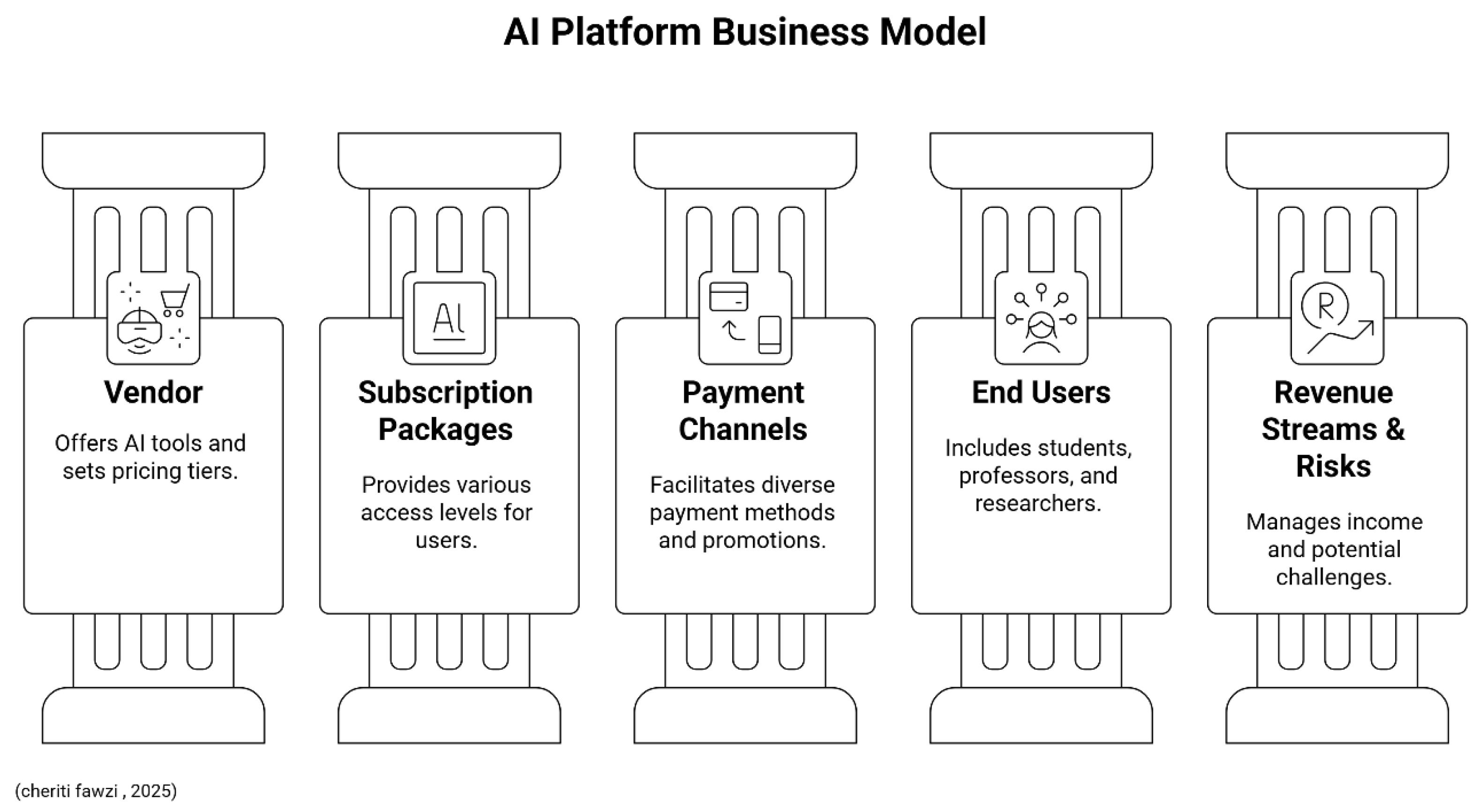
Comparative analysis revealed distinct business strategies among vendors. DzPlagiarism.in focuses on bundled multi-AI packages with promotional offers such as “buy two get one free,” targeting users seeking comprehensive toolsets. AiZair offers a combination of individual and bundled subscriptions, with variable pricing and moderate support, emphasizing cost flexibility over transparency. Academic Ai Tools and Fikra Academy adopt more structured enrollment-based models, with estimated market-aligned pricing, responsive support, and clearer package definitions. ChatGPT Plus DZ provides both individual and shared accounts, offering cost savings but introducing potential compliance risks. Overall, vendors differ in pricing strategies, payment options, and risk exposure, reflecting diverse approaches to local AI service provision.
Figure 1.
Shared AI Platform Accounts Business Model.
Discussion
1. Pricing Strategies and Market Dynamics
Local AI tool vendors in Algeria, including DzPlagiarism.in, AiZair, Academic Ai Tools, Fikra Academy, and ChatGPT Plus DZ, employ pricing strategies that aim to make advanced AI technologies accessible to students, faculty, and academic researchers. DzPlagiarism.in offers packages ranging from one-month multi-AI bundles to full-year subscriptions, allowing users to select options that suit their needs and budgets. AiZair provides flexible pricing tiers that accommodate both individual users and institutions. Academic Ai Tools focuses on specialized academic functionalities, such as plagiarism detection and content rewriting, with prices reflecting the value of each tool. These pricing strategies are consistent with broader trends in emerging markets, where vendors adapt global technologies to local economic conditions (Haddadi & Zidane, 2024). By offering competitive pricing, vendors support the democratization of AI tools in regions with limited access to official subscriptions.
2. User Feedback and Service Quality
Analysis of user feedback reveals heterogeneous experiences across vendors. DzPlagiarism.in and Fikra Academy generally received positive reviews for their user-friendly interfaces, rapid delivery, and responsive support, which users perceive as reliable and efficient. Conversely, AiZair faced criticism for complex interfaces and slower support response times, highlighting the impact of usability and service quality on adoption. These findings align with previous studies showing that perceived ease of use and service reliability are significant predictors of technology adoption among academic users (Venkatesh et al., 2012). Vendors that prioritize customer-centric design and robust support systems are more likely to sustain engagement among students and professors.
3. Risk Assessment and Compliance
Risk assessment revealed varying levels of transparency, payment security, and compliance with Terms of Service (ToS) across vendors. DzPlagiarism.in and Fikra Academy maintain clear pricing structures and adhere closely to legal and ethical standards, reducing operational risks and enhancing user trust. In contrast, AiZair and some shared-account models offered by ChatGPT Plus DZ pose compliance risks due to ambiguities in terms of service and the use of shared accounts, which could violate official platform rules. Such findings underscore the importance of transparency, ethical compliance, and secure payment methods for building long-term credibility in AI service provision (Floridi et al., 2018).
4. Business Models and Targeting of Academic Institutions
Vendors employ distinct business models to target academic users. DzPlagiarism.in uses a subscription-based model, offering structured packages with predictable costs, which ensures a stable revenue stream while providing flexibility for institutions and individuals. AiZair uses a freemium approach, offering basic services for free and charging for premium features, aiming to attract a large user base and convert a subset to paying customers. Fikra Academy adopts an educational model, combining training programs with AI tool access, positioning itself as both a service provider and knowledge facilitator. This dual approach enhances engagement with universities and researchers by aligning services with academic workflows and research needs.
By targeting students, professors, and researchers, these vendors recognize the potential of academic institutions as early adopters of AI tools. They offer affordable and accessible solutions, including multi-AI packs and bundled subscriptions, to address the specific challenges faced by the academic community in Algeria. This strategy not only drives adoption but also fosters long-term relationships with educational institutions, contributing to the integration of AI technologies in teaching, research, and learning processes (Haddadi & Zidane, 2024).
6. Implications for Policy and Practice
The findings have significant implications for policymakers, educators, and vendors. Policymakers should support training programs for students and faculty to ensure effective and ethical use of AI tools. Vendors should enhance transparency, usability, and compliance measures to build trust and long-term adoption. Collaborative initiatives between vendors and universities could create AI solutions that are better aligned with the specific academic needs in Algeria, promoting equitable access to AI technologies while supporting quality research and education. We , Cheriti (2025) in Smartphone Screens and Growing Minds argues that technology-mediated environments strongly influence identity formation and learning, highlighting both opportunities and risks of over-reliance on digital platforms
Conclusion
This study examined the landscape of local AI tool vendors in Algeria, focusing on pricing strategies, service quality, risk compliance, and business models, as well as their adoption among students, professors, and academic researchers. The findings reveal a dynamic market in which vendors such as DzPlagiarism.in, AiZair, Academic Ai Tools, Fikra Academy, and ChatGPT Plus DZ are actively adapting global AI technologies to local economic and educational contexts.
Pricing strategies vary across vendors, with subscription-based models, freemium offerings, and bundled multi-AI packages aimed at making these tools accessible to a wide range of academic users. Service quality plays a critical role in adoption, with positive user experiences linked to responsive support, intuitive interfaces, and reliability, while usability issues and slow customer service limit engagement for some platforms.
Risk and compliance assessments indicate that transparency, ethical adherence, and secure payment mechanisms are essential for building trust in AI tools, particularly in academic environments where shared accounts or ambiguous terms of service could compromise both users and vendors. Business models reflect a strategic focus on academic institutions, with vendors tailoring their offerings to meet the needs of students and faculty, thereby fostering early adoption and potential long-term engagement.
Overall, this study highlights the intersection of technology, media, and academic practices in Algeria, emphasizing the need for institutional support, comprehensive training, and regulatory oversight to ensure effective, ethical, and equitable use of AI tools. Future research could explore longitudinal impacts of AI adoption on academic productivity, learning outcomes, and scholarly integrity, as well as comparative studies across other emerging markets in North Africa.
Limitations and Future Directions
This study is limited by its focus on a selected set of publicly visible AI vendors and relies on social media and website data, which may not capture all subscription details or private institutional agreements. Additionally, user feedback may be biased toward more vocal respondents, and findings are specific to the Algerian higher education context, limiting generalizability. Future research could expand the scope to include longitudinal adoption patterns, comparative studies across North Africa, institutional collaborations, and quantitative surveys to assess user satisfaction, compliance, and the broader impact of AI tools on academic productivity and integrity.
Disclosure Statement
The author declares no conflicts of interest related to this study.
Funding
This research received no financial support or grants from universities, government agencies, funding organizations, or other entities.
References
- Abiri, G. (2024). Generative AI as digital media. SSRN. https://papers.ssrn.com/sol3/papers.cfm?abstract_id=4878339.
- Albarran, A. B. (2016). The media economy (2nd ed.). Routledge.
- Djahmi, M. (2025). The impact of the informal economy on economic diversification in Algeria. Algerian Scientific Journals Platform. https://asjp.cerist.dz/en/downArticle/440/9/1/269804.
- Katz, M., Shapiro, C., & Varian, H. (2018). Network effects and the economics of sharing digital subscriptions. Journal of Media Economics, 31(2), 65–78.
- Kumar, V., & Rajan, B. (2021). Consumer behavior and informal markets: Insights from subscription sharing. Journal of Business Research, 130, 404–414. [CrossRef]
- Luo, X., Griffith, D., Liu, S., & Shi, Y. (2020). Subscription sharing and platform strategy in digital services. International Journal of Research in Marketing, 37(1), 144–159. [CrossRef]
- Algeria Press Agency. (2025, May 5). Algeria extends tax net to income from unregistered online activities. Retrieved from https://apanews.net/algeria-extends-tax-net-to-income-from-unregistered-online-activities/.
- Economic Researcher Review. (2025). Digital economy and its role in enhancing financial institutions in Algeria. Retrieved from https://www.researchgate.net/publication/393440829_Economic_Researcher_Review_Digital_Economy_and_Its_Role_in_Enhancing_Financial_Institutions_in_Algeria.
- U.S. Department of State. (2024). 2024 Investment Climate Statements: Algeria. Retrieved from https://www.state.gov/reports/2024-investment-climate-statements/algeria/.
- UNCTAD. (2025, August 26). Harnessing Africa’s digital economy for regional integration and shared prosperity. Retrieved from https://unctad.org/news/harnessing-africas-digital-economy-regional-integration-and-shared-prosperity.
- Business Insider. (2025, July). Nonprofits develop AI tools to combat global educational inequities. Retrieved from https://www.businessinsider.com/nonprofits-ai-tools-edtech-global-inequities-2025-7.
- Columbia Business School. (2025, September). AI's global adoption gap: Insights from non-English-speaking countries. Retrieved from https://business.columbia.edu/research-brief/global-ai-adoption-gap.
- Cursor Forum. (2025, May). AI pricing: An unfair burden on users in developing nations. Retrieved from https://forum.cursor.com/t/ai-pricing-an-unfair-burden-on-users-in-developing-nations/95963.
- Khan, M. S. (2024). Artificial intelligence for low-income countries. Nature Communications, 15(1), 1234. [CrossRef]
- Technology and Society. (2025, February). Unraveling the true cost of the global AI skills gap. Retrieved from https://technologyandsociety.org/the-hidden-multiplier-unraveling-the-true-cost-of-the-global-ai-skills-gap/.
- UNFCCC. (2025, July). AI and climate action: Opportunities, risks, and challenges for developing countries. Retrieved from https://unfccc.int/news/ai-and-climate-action-opportunities-risks-and-challenges-for-developing-countries.
- Palinkas, L. A., Horwitz, S. M., Green, C. A., Wisdom, J. P., Duan, N., & Hoagwood, K. (2015). Purposeful sampling for qualitative data collection and analysis in mixed method implementation research. Administration and Policy in Mental Health and Mental Health Services Research, 42(5), 533–544. [CrossRef]
- Yin, R. K. (2018). Case study research and applications: Design and methods (6th ed.). SAGE Publications.
- Floridi, L., Cowls, J., Beltrametti, M., Chatila, R., Chazerand, P., Dignum, V., .. & Vayena, E. (2018). AI4People—An ethical framework for a good AI society: Opportunities, risks, principles, and recommendations. Minds and Machines, 28(4), 689–707. [CrossRef]
- Venkatesh, V., Thong, J. Y. L., & Xu, X. (2012). Consumer acceptance and use of information technology: Extending the unified theory of acceptance and use of technology. MIS Quarterly, 36(1), 157–178. [CrossRef]
- Binns, R. (2018). Fairness in machine learning: Lessons from political philosophy. Proceedings of the 2018 Conference on Fairness, Accountability, and Transparency, 149–159. [CrossRef]
- Floridi, L., Cowls, J., Beltrametti, M., Chatila, R., Chazerand, P., Dignum, V., … & Vayena, E. (2018). AI4People-An ethical framework for a good AI society: Opportunities, risks, principles, and recommendations. Minds and Machines, 28(4), 689–707. [CrossRef]
- Haddadi, W., & Zidane, K. (2024). Teachers' perceptions towards using artificial intelligence applications in Algerian higher education. ATRAS Journal, 5(1), 253–270. [CrossRef]
- Cheriti, F. (2025). Legal challenges of AI-generated journalism: Intellectual property rights and regulations. Revue Algérienne des Sciences Juridiques et Politiques, 62(2), 203–217. https://asjp.cerist.dz/en/article/270606.
- Cheriti, F. (2025). McLuhan Today: AI as Medium, Shaping the Global Village and Extending Human Intellect. Preprints. [CrossRef]
- Cheriti, F. (2025). Smartphone Screens and Growing Minds: The Benefits and Risks of Teaching Kids in a Digital World. Preprints. [CrossRef]
Disclaimer/Publisher’s Note: The statements, opinions and data contained in all publications are solely those of the individual author(s) and contributor(s) and not of MDPI and/or the editor(s). MDPI and/or the editor(s) disclaim responsibility for any injury to people or property resulting from any ideas, methods, instructions or products referred to in the content. |
© 2025 by the authors. Licensee MDPI, Basel, Switzerland. This article is an open access article distributed under the terms and conditions of the Creative Commons Attribution (CC BY) license (http://creativecommons.org/licenses/by/4.0/).
Copyright: This open access article is published under a Creative Commons CC BY 4.0 license, which permit the free download, distribution, and reuse, provided that the author and preprint are cited in any reuse.


