

Submitted:
08 September 2025
Posted:
10 September 2025
You are already at the latest version
Abstract
The research presented in this article aimed to analyze the impact of circular economy initiatives on the European Union environmental goods and services sector. Data from the Eurostat databases were used to conduct the research. Validation of the five re-search hypotheses involved the formulation of two regression equations: the first one focused on innovation and recycling performance indicators, the second equation fo-cused on circular-economy indicators. Both models were estimated using country fixed-effects regression with Driscoll–Kraay standard errors to ensure robust inference. The regression model was selected based on the Hausman and F-test, but tests for au-tocorrelation, heteroscedasticity and multicollinearity were performed. The main findings, as the results suggest, refer to the central role of private investment in circu-lar sectors and of resource productivity, both exerting positive and significant effects on the EGSS. The material footprint also shows a positive effect but in contrast, the circular material use rate does not display a significant impact, indicating that in-creases in the share of recycled materials do not automatically translate into greater economic value.
Keywords:
circular economy
; environment
; goods
; services
; European Union
1. Introduction
Over the past decades, the circular economy (CE) has emerged as a central framework in sustainability debates, offering a systematic response to global challenges of resource scarcity, waste generation, and climate change. Unlike the traditional linear model of production and consumption, CE advocates a regenerative system based on reduction, reuse, recycling, and product life extension. It proposes a paradigm shift where economic prosperity and ecological stewardship are no longer in conflict but mutually reinforcing [1]. This transition requires profound transformations in business models, consumption patterns, and governance frameworks, making CE one of the most ambitious sustainability strategies in contemporary policy and academic discourse.
At the European Union (EU) level, CE is deeply embedded in the policy agenda. The European Green Deal and the CE Action Plans of 2015 and 2020 outline a comprehensive vision for decoupling growth from resource depletion, enhancing competitiveness, and ensuring long-term resilience of industries. These frameworks highlight sectors with high resource intensity—such as agri-food, construction, electronics, and packaging—as priorities for intervention [2]. The implementation of CE in the EU has already shown uneven progress: while some industries, such as agri-food and construction, have pioneered circular practices, others remain constrained by financial, regulatory, and cultural barriers. This variability underscores the need for sector-specific analysis, especially concerning the environmental goods and services sector (EGSS), which plays a pivotal role in enabling circular practices across the economy.
The relationship between CE and sustainable economic development has been increasingly validated in empirical studies. Evidence indicates that higher recycling rates, improved waste management, and reduced environmental tax burdens contribute to GDP per capita growth across EU member states [3]. Similarly, CE initiatives are linked to job creation, resource security, and industrial competitiveness, making them not only environmental imperatives but also engines of economic transformation. The EGSS, in particular, represents a sector where these dynamics converge: it encompasses industries that supply goods and services aimed at environmental protection and resource management, making it a direct beneficiary and driver of circular policies.
Beyond material efficiency, the financial dimension of sustainability has gained prominence. Green finance and transition finance are recognized as critical mechanisms for supporting firms in their transition towards low-carbon and circular models. Studies demonstrate that access to sustainable financing alleviates capital constraints, promotes environmental investments, and stimulates green technological innovation [4]. Transition finance, in particular, plays a key role in enabling high-emission industries to gradually decarbonize while maintaining competitiveness [5]. These insights highlight how the effectiveness of CE initiatives depends not only on regulation and technology but also on financial ecosystems that incentivize long-term sustainability.
Technological innovation constitutes another pillar of CE implementation. The integration of green technologies into business models has been shown to enhance innovation, competitiveness, and resilience [6]. This shift represents a broader transformation of corporate strategies, where sustainability is no longer peripheral but central to value creation. The combination of technological, financial, and regulatory frameworks thus forms the foundation for scaling CE across the EU economy.
Despite growing academic interest, significant gaps remain in measuring and quantifying the direct influence of CE initiatives on specific economic sectors. Most research has focused on conceptual models, policy reviews, or isolated case studies, while empirical evidence using robust econometric methods remains limited. The environmental goods and services sector (EGSS) offers a unique testing ground for such analysis. Positioned at the intersection of environmental policy and industrial activity, the EGSS not only supplies products and services that directly address sustainability challenges but also reflects broader macroeconomic and policy-driven shifts.
Against this background, this study aims to investigate the influence of CE initiatives on the EU EGSS through panel data regression analysis. By employing CE indicators as explanatory variables and examining their impact on EGSS performance, the research addresses a critical gap in both academic literature and policy evaluation. The study’s contribution lies in providing empirical evidence on the economic significance of CE initiatives, thereby informing policymakers, businesses, and scholars about the tangible outcomes of Europe’s circular transition.
2. Theoretical background and hypotheses development
2.1. Theoretical background
The circular economy (CE) has become one of the most important strategic directions of the European Union (EU), aiming at the transition from the linear economic model, based on extraction-production-consumption-disposal, to a sustainable model that favors the efficient use of resources, waste reduction and maximization of added value through recycling, reuse and innovation [7]. In this context, the Environmental Goods and Services Sector (EGSS) plays a crucial role in supporting this transition, contributing to the development of green technologies, waste management solutions and energy efficiency services [8].
The EU has promoted the transition to a circular economy through a robust legislative and policy framework, including the Circular Economy Action Plan (CEAP), the European Green Deal and the Sustainable Development Strategy. Studies show that these initiatives have aimed to stimulate innovation, support businesses and strengthen sustainable value chains [9,10]. However, research highlights a gap between policy rhetoric and practical application, especially in terms of implementation at national level [11].
Circular economy initiatives have significantly influenced the EGSS sector, generating opportunities for innovation, eco-innovation and the development of new business models [12,13]. The literature shows that European firms have benefited from the increased demand for green technologies and ecological services, which has contributed to strengthening economic competitiveness and creating new jobs in areas such as recycling, energy efficiency and the digital economy applied to sustainability [14,15]. Recent research also highlights that the circular economy favors the decoupling of economic growth from resource consumption, which is essential for achieving the sustainable development goals [16,17].
Circular economy initiatives have transformed EGSS into a key driver of innovation in the European Union. Studies show that companies that adopt circular models develop eco-innovations faster, such as advanced recycling technologies, digital solutions for monitoring material flows and services to extend the life of products [12,13]. This orientation boosts the competitiveness of European companies, as they diversify their product and service portfolios and access new growth markets linked to the green transition. At the same time, integrating circular principles into business strategies is associated with reduced operational costs and increased resilience to resource fluctuations [14].
In addition to innovation, the circular economy has a direct impact on employment. Evidence shows that the circular transition generates new jobs in emerging industries, such as recycling, repair and remanufacturing, but also in related areas, such as sustainability consulting or life cycle analysis [15]. According to the World Bank [18], in Member States where circular policies are better implemented, EGSS see an increase in the number of employees, especially in SMEs. However, the distribution of these jobs is not uniform: Western European countries are advantaged by advanced infrastructure and substantial investments in research and development, while Central and Eastern European countries face structural and institutional barriers [19,20].
In terms of environmental performance, the literature highlights the positive effects of circularity on reducing carbon emissions, raw material consumption and waste volume [16,21]. By encouraging the decoupling of economic growth from resource use, circular initiatives strengthen the role of EGSS in achieving climate and sustainable development goals. For example, Baldassarre’s [22] study shows that the large-scale implementation of circular practices contributes to resource security in the EU, reducing dependence on critical imports. However, the effects vary by sector: material-intensive industries (e.g. construction and electronics manufacturing) show the greatest benefits, while service-based areas experience a more moderate impact.
Another important aspect is attracting investment and strengthening global competitiveness. EU policies, such as the Green Deal and related funding, create a favorable environment for the development of circular businesses. This positions the European EGSS as a leader in international markets for green technologies and services, giving the EU a competitive advantage over other regions such as the USA or China [23,24]. However, the literature highlights that maintaining this advantage depends on the constant alignment of environmental standards and the adoption of clear indicators to measure circular progress [11].
The impact of circular economy initiatives on the EGSS is multiple: they stimulate innovation and eco-innovation, create jobs, improve environmental performance and strengthen European competitiveness. However, persistent regional disparities and implementation difficulties suggest that the benefits are not evenly distributed and that policies need to be adapted to maximize the potential of circularity across the Union.
Although the benefits are clear, the implementation of the circular economy faces a number of barriers. These include the lack of adequate infrastructure, difficulties in standardizing performance indicators, as well as cultural and organizational resistance to change [23,25]. Furthermore, differences between Member States in terms of financial resources and institutional capacity create disparities in the effective implementation of policies [19,20]. Thus, the literature indicates that in order to achieve the full potential of the circular economy, greater coherence between European and national policy levels is needed, as well as continued investment in research and development [24].
The literature review shows that circular economy initiatives have a significant impact on the EGSS sector, strengthening its role in the transition to a sustainable and competitive economy in the EU. Although there is remarkable progress in innovation and job creation, challenges remain in terms of implementation and convergence between Member States. Future research directions should investigate more deeply how European policies can be adapted to regional specificities and how public-private partnerships can accelerate the transformation of EGSS into a central pillar of the circular economy [3,22].
2.2. Hypotheses development
Technological innovation in the field of recycling and secondary raw materials is a key factor for the development of the circular economy and for increasing the gross value added in the environmental goods and services sector. Patents are a recognized indicator of innovation capacity, and “green patents” are correlated with the competitiveness of firms and the economic performance of green sectors [26]. According to the Porter hypothesis, environmental regulations and pressures stimulate innovation, which leads to competitive advantages and economic growth [27]. Patents in the field of recycling and secondary raw materials reflect technological solutions that are directly applicable in activities such as collection, sorting and recovery of materials, all of which fall under the environmental goods and services sector. Recent research has shown that firms holding green patents achieve superior financial performance and contribute to GDP growth through related industries [28]. In this context, it is plausible that increased patenting in the field of recycling and secondary raw materials will stimulate production and added value in EGSS. Therefore, we propose the following hypothesis:
H1. Patents related to recycling and secondary raw materials have a positive influence on gross value added in the environmental goods and services sector
The recycling rate of packaging waste is a key indicator of waste management performance and reflects the level of development of the collection and processing infrastructure. Increasing this rate generates demand for economic activities associated with environmental goods and services sector , including collection, sorting, recycling and material recovery. According to the European Environment Agency [29], implementing more ambitious packaging recycling targets triggers additional investments, creates jobs and stimulates circular value chains. Empirical studies show that achieving high recycling rates has positive effects on employment and value added in specialized sectors [30]. Furthermore, Eurostat reports confirm that packaging is the waste stream with the highest recycling rate in the EU, making the impact on gross value added in the environmental goods and services sector significant [31]. Consequently, the positive relationship between packaging waste recycling rate and gross value added in environmental goods and services sector is supported both theoretically and empirically. For these reasons, we propose the following hypothesis:
H2. Recycling rate of packaging waste has a positive influence on gross value added in the environmental goods and services sector (EGSS)
Waste electrical and electronic equipment (WEEE/WEEE) is one of the priority waste streams in the European Union, both due to its growing volume and the valuable content of secondary raw materials, such as rare and precious metals. The recycling rate of this stream indicates the degree of development of the specialized collection and treatment infrastructure, an area that is directly included in the EGSS. According to the Global E-waste Monitor [32], the efficient recycling of WEEE generates substantial economic benefits, including the recovery of critical resources and job creation. Furthermore, a recent systematic review showed that policies to stimulate WEEE recycling lead to increased investment and the development of circular economy sectors [33]. From this perspective, the increase in the WEEE recycling rate is directly correlated with the expansion of EGSS activities and, implicitly, with the increase in gross value added. Therefore, we propose the following hypothesis:
H3. Recycling rate of waste electrical and electronic equipment (WEEE) has a positive influence on gross value added in the environmental goods and services sector (EGSS).
Private investment is a driver of circular economy development, as it supports the expansion of recycling, repair and reuse capacities, all integrated into the EGSS. According to Eurostat [31], the indicator “Private investment, jobs and gross value added related to circular economy sectors” directly tracks the contribution of these investments to economic performance. Empirical studies confirm that investments oriented towards circular technologies produce significant increases in productivity and value added in related sectors [34]. Also, the EEA analysis [35] shows that private investment in circular economy infrastructure has increased steadily in recent years and contributed to a positive dynamics of gross value added in the EGSS. In this context, the hypothesis regarding the positive relationship between private investment and gross value added in the EGSS is solidly grounded theoretically and empirically.
H4. Private investment and gross added value related to circular economy sectors have a positive influence on gross value added in the environmental goods and services sector (EGSS).
Indicators related to resource use provide a complex picture of the interaction between the economy and the environment and are directly correlated with the development of EGSS. The material footprint (MF) reflects the total materials used in the economy; large volumes of resources imply larger waste flows, which stimulates EGSS activities [36]. Resource productivity, calculated as GDP relative to domestic material consumption, is a key indicator of economic efficiency; the increase in resource productivity is based on the adoption of technologies and services provided by EGSS [37]. The circular material use rate (CMU) measures the share of secondary materials reintroduced into the economy, and a higher rate signals the development of the recycling market and materials recovery, activities central to EGSS [38]. Thus, each of these indicators describes a mechanism through which economic activity in EGSS is intensified and value added is strengthened.
H5. Material footprint, resource productivity and circular material use rate have a positive influence on gross value added in the environmental goods and services sector (EGSS).
H5.a. Material footprint has a positive influence on gross value added in the environmental goods and services sector (EGSS).
H5.b. Resource productivity has a positive influence on gross value added in the environmental goods and services sector (EGSS).
H5.c. Circular material use rate has a positive influence on gross value added in the environmental goods and services sector (EGSS).
3. Research methodology
The methodology combines panel fixed-effects models, rigorous selection, comprehensive econometric diagnostics and the use of robust standard errors, ensuring the consistency and relevance of the results. The tests confirm country fixed effects, as well as autocorrelation and heteroskedasticity, inference relying on Driscoll–Kraay robust standard errors [39]. The variables used in the regression model are presented in Table 1.
As can be seen from the data presented in the previous table, the validation of the research hypotheses involved the formulation of two regression equations. The data for each of the variables used in the regression equations are sourced from Eurostat databases. The dependent variable used in both equations is gross value added in the environmental goods and services sector (EGSS). The choice of this indicator is justified by the fact that gross value added reflects the actual economic value created by the sector, being a standard indicator used by Eurostat to assess the contribution of economic sectors to GDP. Unlike other measures, such as turnover or employment rate, gross value added directly captures productivity and economic performance, allowing for robust comparisons across countries and over time. Furthermore, the use of gross value added is aligned with the objectives of European policies on the circular economy, which aim not only to reduce the environmental impact but also to stimulate sustainable economic growth. Thus, gross value added constitutes an appropriate measure of the economic results of the transition to a green and circular economy.
The first regression equation focuses on innovation and recycling performance indicators, while the second regression equation focuses on circular-economy indicators. Both models were estimated using country fixed-effects regression with Driscoll–Kraay standard errors to ensure robust inference. The regression model selection was based on the Hausman and F-test. For error autocorrelation, the Wooldridge and Breusch–Godfrey tests were used, for heteroskedasticity, the Breusch–Pagan and White tests, and for multicollinearity, the VIF tests. The results were obtained using R software and Eviews, but those presented in the article are based on those obtained in R since this software ensured the performance of all relevant tests for the selected regression models.
4. Research results
In this section, it is examined the relationship between the circular economy indicators and the performance of the environmental goods and services sector (EGSS) using a country-level panel dataset of the European Union. We specify two models: Equation 1, capturing patents related to recycling, recycling rate of packaging waste, recycling rate of WEEE and Equation 2, reflecting circular initiatives and efficiency such as private investment in circular sectors, material footprint, resource productivity and the circular material use rate.
All models are estimated through country fixed-effects regression with Driscoll–Kraay standard errors to ensure robust inference [40]. Model selection relies on the F-test and the Hausman test, while model adequacy is assessed through tests for serial correlation, heteroskedasticity, cross-sectional dependence and multicollinearity. The coefficients (β), robust standard errors and p-values, accompanied by descriptive statistics are reported for each equation. Descriptive analysis for the equation 1 is presented in Figure 1.
- Equation 1
The table above presents descriptive statistics for the variables used in Equation 1. EGSS value added and the number of recycling-related patents exhibit high dispersion (CV ≈ 1.45 and 1.58), with skewed distributions, which indicates robustness checks. By contrast, recycling rates display relatively low variation (CV ≈ 0.16 for packaging and 0.08 for WEEE), with high mean values. Model selection for the first equation is presented in Table 2.
The Hausman test shows that the RE estimates differ significantly from the FE estimates, indicating correlation between unobserved country-level effects and the regressors. Continuing, here are employed the fixed-effects model, together with robust standard errors for inference. The Wooldridge test for autocorrelation in fixed-effects models [41] indicates the presence of first-order serial correlation. The Breusch–Godfrey test for serial correlation in panel data indicates higher order temporal dependence in the errors and the studentized Breusch–Pagan test indicates heteroskedasticity in the errors. The coefficients together with robust standard errors are reported in order to ensure validity. Therefore Driscoll–Kraay standard errors test was used, which is robust to all issues (Table 3).
The VIF results confirm the absence of multicollinearity among the independent variables included in the model. The variance inflation factors range from 1.01 to 1.08.
Table 4 presents the coefficients for the FE model (Driscoll–Kraay standard errors) for the first regression equation.
The country fixed-effects model estimated with Driscoll–Kraay standard errors reveals negative and statistically significant associations between all three independent variables and EGSS value added. Respectively, an intensification of innovation in recycling is associated with a reduction in value added. Likewise, an increase of in the packaging recycling rate is negatively correlated with EGSS value added , while the recycling rate of WEEE exhibits a smaller, but still significant negative effect.
These results suggest that recycling rates and innovative patents do not immediately translate into increases in EGSS value added. Possible explanations could include temporal lags between investments in innovation and the realization of economic effects, maturity level of waste-management systems and reverse causality probability, where economies with smaller EGSS invest more in innovation and in the acceleration of recycling.
- Equation 2
Descriptive analysis for the equation 2 is presented in Figure 2.
The table above reports descriptive statistics for the variables used in the analysis. Data shows high variability for EGSS value added and investments in circular sectors, indicating highly skewed distributions and indicating robustness checks. The material footprint variable displays moderate variation (CV ≈ 0.42), while resource productivity and the circular material use rate show moderate to high variation (CV ≈ 0.75 and 0.70).
Model selection for the first equation is presented in Table 5.
The Hausman test confirms the presence of correlation between country specific effects and the explanatory variables (p < 0.001), invalidating the random-effects estimator. The estimates reported for Equation 2 are based on the country fixed-effects model. The Wooldridge test for serial correlation in fixed-effects panel models indicates the presence of first-order autocorrelation in the errors. The Breusch–Godfrey test for serial autocorrelation in panel models indicates the presence of higher-order autocorrelation in the errors. The studentized Breusch–Pagan test indicates the presence of heteroskedasticity in the model errors. The White test for heteroskedasticity [42] indicates a violation of the constant error variance assumption in the model. The F-test for individual effects indicates the presence of significant country fixed effects.
The model selection were based on the following tests: F test FE vs. pooled with p < 0.001 indicated that a country fixed-effects model is appropriate , F test time FE with p = 0.311 indicates that there is no need for year fixed effects and Hausman test with p < 0.001 confirms the fixed-effects choice. Autocorrelation Wooldridge and Breusch–Godfrey test with p < 0.001 confirms that autocorrelation is present. Heteroskedasticity Breusch–Pagan and White test with p < 0.001 confirms non-constant variance. Therefore Driscoll–Kraay standard errors test was used, which is robust to all issues.
The assessment of multicollinearity using VIF statistics reveals no problematic correlation among the explanatory variables (Table 6) . The values range from 1.04 to 1.90. This result indicates relative independence among the regressors and the absence of artificial inflation of coefficient variances due to collinearity.
Table 7 presents the coefficients for the FE model (Driscoll–Kraay standard errors) for the first regression equation. The country fixed-effects model with Driscoll–Kraay standard errors shows that circular initiatives generally exert a positive effect on value added in the environmental goods and services sector (EGSS).
Investment in circular sectors variable with β = 1.137 and p < 0.001 confirms that increases in investment in circular sectors have a positive and significant effect on value added in the EGSS. Material footprint variable with β = 215.019 and p = 0.037 confirms that a higher material footprint is associated with a positive effect on value added. This may reflect that countries with higher resource consumption also generate more economic activity within the EGSS. Resource productivity variable with β = 2231.450 and p = 0.047 shows that resource productivity has a positive and significant impact, therefore countries that use resources more efficiently create greater value added in the EGSS. Circular material use rate variable with β = 1.533 and p = 0.980 shows that there is no evidence that the circular material use rate directly influences value added in the EGSS in this model, therefore is not statistically significant. Therefore, the significant determinants of EGSS are private investment in circular sectors, material footprint and resource productivity, while circular material use rate has no significant effect.
5. Discussions
Tests reveal autocorrelation and heteroskedasticity, which were appropriately addressed using Driscoll–Kraay robust standard errors [39], consequently, the results are robust and reliable. For the analysis both R and EViews software were used, but the final interpretation relies on R because it enables a complete suite of tests, addresses autocorrelation and heteroskedasticity, providing more robust estimators [43].
Equation 1 captures the technological dimension, whereas Equation 2 captures the economic dimension of sustainability. Equation 1 emphasis on innovation and recycling performance with innovation as the decisive factor. Equation 2 emphasis on investment and productivity within the circular economy with private investment and resource efficiency as decisive factors. The results obtained in the regression models seem to confirm some previous research on the influence of green patents on the economic performance of green sectors [26] and of recycling rates on value added in specialized sectors [30].
The models suggest that economic factors carry greater weight than recycling indicators. The selection tests such as Hausman and F tests clearly indicate that country fixed-effects models are the most appropriate. Results of first equation demonstrate that technological innovation matters more than recycling performance. Results of the second equations demonstrate that private investment in circular sectors and resource productivity exert a positive and significant effect on the EGSS. Circular material use rate is not significant, because a higher share of circular material use does not automatically translate into economic value.
The results of the analysis suggest that public policies and economic strategies dedicated to the transition to a circular economy should pay increased attention to stimulating innovation and investment, more than the simple objective of increasing recycling rates. The significant impact of patents in the field of recycling and secondary raw materials confirms that technological progress is a determining factor for the development of the environmental goods and services sector. It is therefore recommended to strengthen funding programmes for research and development, as well as to facilitate the transfer of knowledge between the Member States of the European Union.
Policies that support private investment and technological innovation in recycling and the circular economy are essential for expanding the EGSS. Recycling indicators or circular material use rate are insufficient to bring added value, because increased investment and productivity are required.
Overall, EGSS development in the EU is driven primarily by innovation and investment, rather than recycling rates, suggesting that the transition to a circular economy must be accompanied by supportive policies for research, investment, and resource productivity gains. Overall, sustainability policies should be oriented towards structural factors such as innovation, investment and resource productivity, as they generate tangible economic effects and support the sustainable development of the EGSS sector.
6. Conclusions
The panel analysis conducted for European Union countries showed that country fixed-effects models yield the most robust results. The results obtained from the estimations performed in R software can be viewed as reliable and relevant [43] for interpretation due to performing the autocorrelation and heteroskedasticity using Driscoll–Kraay robust standard errors. Two regression models were specified, the model selection was grounded in the Hausman and F-test. Robustness diagnostics were conducted using tests for error autocorrelation such as Wooldridge and Breusch–Godfrey, tests for heteroskedasticity such as Breusch–Pagan and White and multicollinearity (VIF) tests. To ensure validity, the coefficients were estimated with Driscoll–Kraay standard errors.
The first equation, centered on innovation and recycling performance indicators, indicates that innovation patents related to recycling and secondary raw materials are negatively associated with EGSS value added in the short run. The second equation, focused on circular-economy indicators, confirms the central role of private investment in circular sectors and of resource productivity, both exerting positive and significant effects on the EGSS. The material footprint also shows a positive effect, reflecting economic intensity and the level of resource consumption. In contrast, the circular material use rate does not display a significant impact, indicating that increases in the share of recycled materials do not automatically translate into greater economic value. The results suggest that measures oriented toward capacity and efficiency directly support value added in the EGSS, while the final performance indicators of recycling do not generate immediate economic gains in the EGSS sector, reflecting temporal lags between effort and monetization.
Prioritizing investments in circular sectors and interventions to raise resource productivity appears to yield the clearest economic returns within the EGSS. Recycling rates remain essential for environmental objectives [44], but their direct economic effect on the EGSS is delayed. In the short run, circular investments and resource productivity are the principal economic drivers of the EGSS, whereas recycling indicators primarily reflect environmental objectives [45] and may exert lagged economic effects.
Limitations and future examination. The identified relationships reflect short-term correlations. The effects of certain policies or investments may materialize in the long run. Indicators of recycling and circular material use may capture environmental performance, but their connection to economic value added is indirect and contingent on each country’s political and institutional context. The analysis is conducted at the level of EU member states and the results cannot be automatically generalized to other regions, where economic and environmental policies may differ. Also the conclusions should be interpreted within the specific analyzed timeframe and context. Future directions to extend this research could include: extension of the analysis with sector specific indicators, comparison of the results with those for other regions to assess the relevance of institutional and policy contexts, investigation of differences across groups of countries to capture structural heterogeneities, integration of qualitative analyses to complement the quantitative results, as well as evaluation of the long-term impact of circular investments and policies.
Author Contributions
Conceptualization, C-P.S., M.V._and M.M.; Methodology, C-P.S. and M.M.; validation, M.M., . and L.-G.B.; formal analysis, M.M.; investigation, C-P.S. and M.M.; resources, C-P.S. and M.V..; data curation, C-P.S., M.V._and M.M.; writing—original draft preparation, C-P.S., M.V._and M.M.; writing—review and editing, C-P.S. and M.M.; visualization, L.-G.B.; supervision, C-P.S.. All authors have read and agreed to the published version of the manuscript.
Institutional Review Board Statement
Not applicable
Informed Consent Statement
Not applicable
Conflicts of Interest
The authors declare no conflicts of interest.
References
- Lahti, T.; Wincent, J.; Parida, V. (2018). A definition and theoretical review of the circular economy, value creation, and sustainable business models. Sustainability. 2018, 10(8), 2799. [CrossRef]
- De Pascale, A.; Di Vita, G.; Giannetto, C.; Ioppolo, G.; Lanfranchi, M.; Limosani, M.; Szopik-Depczynska, K. The circular economy implementation at the European Union level: Past, present and future. Journal of Cleaner Production. 2023, 423, 138658. [CrossRef]
- Sabău-Popa, C. D.; Bele, A. M.; Dodescu, A. O.; Bolos, M. I. How does the circular economy applied in the European Union support sustainable economic development?. Sustainability. 2022, 14(16), 9932. [CrossRef]
- Fan, M.; Liu, W.; Yao, D. The impact of green finance reform and innovation pilot zones on corporate pollution and carbon reduction. Journal of Environmental Management. 2025, 389, 126110. [CrossRef]
- Khan, S.; Pinglu, C.; Ullah, A.; Qian, N. Facilitating sustainable corporate growth in China: Examining the role of transition finance, green technology innovation, and ESG strategies. Journal of Environmental Management. 2025, 389, 126085. [CrossRef]
- Pavesi, R.; Orsi, L.; Zanderighi, L. Green light for business sustainability: A bibliometric analysis on the integration of green technologies within business strategy. Sustainable Futures. 2025, 10, 100922. [CrossRef]
- Kirchherr, J.; Reike, D.; Hekkert, M. Conceptualizing the circular economy: An analysis of 114 definitions. Resources, Conservation and Recycling. 2017, 127, 221-232, ISSN 0921-3449. [CrossRef]
- Mhatre, P.; Panchal, R.; Singh, A.; Bibyan, S. A systematic literature review on the circular economy initiatives in the European Union. Sustainable Production and Consumption. 2021, 26, 187-202, ISSN 2352-5509. [CrossRef]
- Domenech, T.; Bahn-Walkowiak, B. Transition Towards a Resource Efficient Circular Economy in Europe: Policy Lessons From the EU and the Member States. Ecological Economics. 2019, 155, 7-19, ISSN0921-8009. [CrossRef]
- Hartley, K.; Van Santen, R;. Kirchherr, J. Policies for transitioning towards a circular economy: Expectations from the European Union (EU). Resources, Conservation and Recycling. 2020, 155, ISSN 0921-3449. [CrossRef]
- Calisto Friant, M.; Vermeulen, W.J.V.; Salomone, R. Analysing European Union circular economy policies: words versus actions. Sustainable Production and Consumption. 2021, 27, 337-353, ISSN 2352-5509. [CrossRef]
- Cainelli, G.; D’Amato, A.; Mazzanti, M. Resource efficient eco-innovations for a circular economy: Evidence from EU firms. Research Policy. 2020, 49(1), ISSN 0048-7333. [CrossRef]
- Manninen, K.; Koskela, S.; Antikainen, R.; Bocken, N.; Dahlbo, H; Aminoff, A. Do circular economy business models capture intended environmental value propositions?. Journal of Cleaner Production. 2018, 171, 413-422, ISSN 0959-6526. [CrossRef]
- Suchek, N.; Fernandes, C.I.; Kraus, S.; Filser, M.; Sjögrén, H. Innovation and the circular economy: A systematic literature review. Business Strategy and the Environment. 2021, 30(8), 3686-3702. [CrossRef]
- Camilleri, M.A. European environment policy for the circular economy: Implications for business and industry stakeholders. Sustainable Development. 2020, 28(6), 1804-1812. [CrossRef]
- Huttmanová, E.; Chovancová, J.; Petruška, I.; Sallaku, K. Circular Economy in Action: Examining the Decoupling of Economic Growth and Material Use across EU Countries. European Journal of Sustainable Development. 2024, 13(4), 13. [CrossRef]
- Radivojević, V.; Rađenović, T.; Dimovski, J. The Role of Circular Economy in Driving Economic Growth: Evidence from EU Countries. SAGE Open, 2024, 14(4). https://0411582s7-y-https-doi-org.z.e-nformation.ro/10.1177/215824402412406.
- World Bank. Squaring the Circle: Policies from Europe’s Circular Economy Transition. https://www.worldbank.org/en/region/eca/publication/squaring-circle-europe-circular-economy-transition,https://documents1.worldbank.org/curated/en/099425006222229520/pdf/P174596025fa8105a091c50fb22f0596fd1.pdf.
- Simionescu, M. The circular economy and sustainable development in the European Union’s new member states. Economics, Management and Sustainability. 2023, 8(1), 6–15. [CrossRef]
- Nowak-Marchewka, K.; Osmólska, E.; Stoma, M. Progress and Challenges of Circular Economy in Selected EU Countries. Sustainability, 2025, 17(1), 320. [CrossRef]
- Alnafrah, I., Alqararah, K., AlJaradin, M. From linear to circular: Evaluating the effects of circular economy on sustainable development progress in the EU economies. Journal of Environmental Management. 2025, 382, ISSN 0301-4797. [CrossRef]
- Baldassarre, B. Circular economy for resource security in the European Union (EU): Case study, research framework, and future directions. Ecological Economics. 2025, 227, ISSN 0921-8009. [CrossRef]
- Ranta, V.; Aarikka-Stenroos, L.; Ritala, P.; Mäkinen, S.J. Exploring institutional drivers and barriers of the circular economy: A cross-regional comparison of China, the US, and Europe. Resources, Conservation and Recycling. 2018,135, 70-82, ISSN 0921-3449. [CrossRef]
- Georgescu, L.P.; Fortea, C.; Antohi, V.M; Balsalobre-Lorente, D.; Zlati M.L., Barbuta-Misu, N. Economic, technological and environmental drivers of the circular economy in the European Union: a panel data analysis. Environ Sci Eur. 2025, 37, 76. [CrossRef]
- Tura, N.; Hanski, J.; Ahola, T.; Ståhle, M.; Piiparinen, S.; Valkokari, P. Unlocking circular business: A framework of barriers and drivers. Journal of Cleaner Production. 2019, 212, 90-98, ISSN 0959-6526. [CrossRef]
- Costantini, V.; Crespi, F.; Marin, G.; Paglialunga, E. Eco-innovation, sustainable supply chains and environmental performance in European industries. Journal of Cleaner Production, 2017, 155, 141–154. [CrossRef]
- Porter, M. E.; van der Linde, C. Toward a new conception of the environment-competitiveness relationship. Journal of Economic Perspectives. 1995, 9(4), 97–118. [CrossRef]
- Dechezleprêtre, A.; Glachant, M. Does foreign environmental policy influence domestic innovation? Evidence from the wind industry. Environmental and Resource Economics, 2014, 58(3), 391–413. [CrossRef]
- European Environment Agency (EEA). Packaging waste and recycling rates in Europe. 2021.Retrieved from https://www.eea.europa.eu/.
- García-Sánchez, I. M., Rodríguez-Ariza, L., & Frías-Aceituno, J. V. The cultural system and integrated reporting. International Business Review. 2018, 22(5), 828–838. [CrossRef]
- Eurostat. Packaging waste statistics. 2023.Retrieved from https://ec.europa.eu/eurostat/statistics-explained/index.php?title=Packaging_waste_statistics.
- Baldé, C. P., Forti, V., Gray, V., Kuehr, R., & Stegmann, P. The Global E-waste Monitor 2024. United Nations Institute for Training and Research. Retrieved from https://ewastemonitor.info.
- Forti, V., Baldé, C. P., Kuehr, R., & Bel, G. The Global E-waste Monitor 2020: Quantities, flows and the circular economy potential. United Nations University. https://ewastemonitor.info/wp-content/uploads/2020/11/GEM_2020_def_july1_low.pdf.
- Kirchherr, J., Reike, D., & Hekkert, M. Conceptualizing the circular economy: An analysis of 114 definitions. Resources, Conservation and Recycling, 2018, 127, 221–232. [CrossRef]
- European Environment Agency (EEA). Private investments and circular economy performance in Europe. 2020.Retrieved from https://www.eea.europa.eu/.
- Eurostat. Material footprint and resource productivity statistics.2023. Retrieved from https://ec.europa.eu/eurostat/statistics-explained/index.php?title=Resource_productivity_statistics.
- OECD. Inventory of Circular Economy Indicators. 2021. OECD Publishing. Retrieved from https://www.oecd.org/content/dam/oecd/en/topics/policy-sub-issues/circular-economy-in-cities-and-regions/Inventory-Circular-Economy-Indicators.pdf.
- European Environment Agency (EEA).Circular material use rate in Europe. 2022. Retrieved from https://www.eea.europa.eu/en/circularity/thematic-metrics/materialsandwaste/circular-material-use-rate.
- Hoechle, D. Robust standard errors for panel regressions with cross-sectional dependence. Stata Journal. 2007, 7(3), 281–312. [CrossRef]
- Croissant, Y.; Millo, G. Panel data econometrics in R: The plm package. Journal of Statistical Software. 2008, 27(2), 1–43.
- Wooldridge, J. M. . Econometric Analysis of Cross Section and Panel Data (3rd ed.). 2020. MIT Press., 126.
- White, H. A heteroskedasticity-consistent covariance matrix estimator and a direct test for heteroskedasticity. Econometrica. 1980. 48(4), 817–838.. [CrossRef]
- Lillis, D. Use R for data analysis and research. Zealand Science Review. 2023. 68(2), 73–79. [CrossRef]
- Klein, N., Deutz, P. & Ramos, T.B. A survey of Circular Economy initiatives in Portuguese central public sector organisations: National outlook for implementation. Journal of Environmental Management. 2022, 314, ISSN 0301-4797. [CrossRef]
- Simamindra, R.S. & Rajaonarivo, L. (2024) A global analysis of circular economy initiatives: weak or strong sustainability?. Journal of Cleaner Production. 2024, 467, ISSN 0959-6526. [CrossRef]
Figure 1.
Descriptive analysis – Equation 1.Source: own calculations using R software version 4.5.1
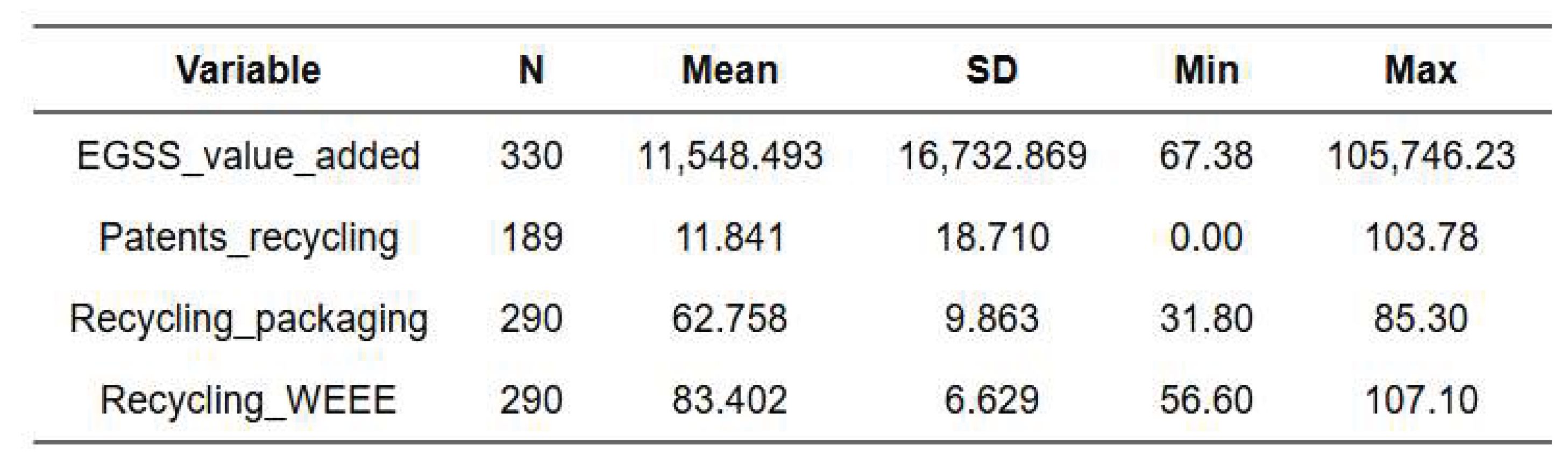
Figure 2.
Descriptive analysis – Equation 2. Source: own calculations using R software version 4.5.1.
Figure 2.
Descriptive analysis – Equation 2. Source: own calculations using R software version 4.5.1.
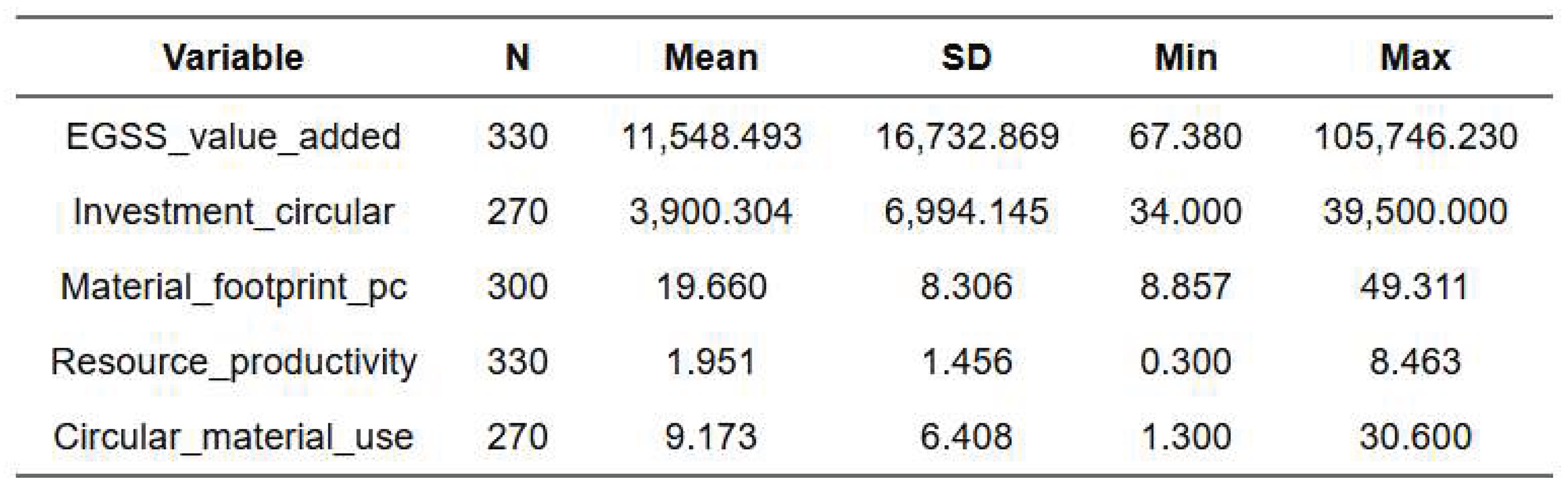

Table 1.
Variables used in regression models.
| Equation | Dependent variable | Independent variables |
| Equation 1 | gross value added in the environmental goods and services sector (EGSS) | patents related to recycling and secondary raw materials, recycling rate of packaging waste, recycling rate of waste electrical and electronic equipment (WEEE) |
| Equation 2 | gross value added in the environmental goods and services sector (EGSS) | private investment and gross added value related to circular economy sectors material footprint resource productivity circular material use rate |
Source: own creation.
Table 2.
Model selection – Equation 1.
| Test | Statistic | Parameters | P-value | Decision |
| Hausman – FE vs RE | 31.86 | df=4 | 2.04e-06 | p<0.05 |
| Wooldridge for serial correlation in FE panels | 13.062 | df1=1, df2=241 | 3.67e-04 | p<0.05 |
| Breusch–Godfrey for serial correlation in panel models | 57.36 | df=10 | 1.14e-08 | p<0.05 |
| Breusch–Pagan heteroskedasticity | 31.425 | df=4 | 2.51e-06 | p<0.05 |
| White heteroskedasticity | 26.179 | df=2 | 2.07e-06 | p<0.05 |
| F test for individual effects | 32.66 | df1=26, df2=239 | 3.76e-64 | p<0.05 |
| F test for time effects | 1.176 | df1=9, df2=256 | 3.11e-01 | p>0.05 |
Source: own calculations using R software version 4.5.1.
Table 3.
Assessment of multicollinearity – Equation 1.
| Variable | VIF |
| Patents related to recycling and secondary raw materials Recycling rate of packaging waste Recycling rate of waste electrical and electronic equipment (WEEE) |
1.080717 1.069375 1.012706 |
Source: own calculations using R software version 4.5.1.
Table 4.
Coefficients (FE, Driscoll–Kraay standard errors) – Equation 1.
| Variables | β | SE | P-value |
| Patents related to recycling and secondary raw materials |
-124.639* | 50.719 |
p = 0.015 |
| Recycling rate of packaging waste |
-58.524*** |
16.723 |
p = <0.001 |
|
Recycling rate of waste electrical and electronic equipment (WEEE) |
-22.641* | 9.971 |
p = 0.025 |
Source: own calculations using R software version 4.5.1.
Table 5.
Model selection - Equation 2.
| Test | Statistic | Parameters | P-value | Decision |
| Hausman – FE vs RE | 31.86 | df=4 | 2.04e-06 | p<0.05 |
| Wooldridge for serial correlation in FE panels | 13.062 | df1=1, df2=241 | 3.67e-04 | p<0.05 |
| Breusch–Godfrey for serial correlation in panel models | 57.36 | df=10 | 1.14e-08 | p<0.05 |
| Breusch–Pagan heteroskedasticity | 31.425 | df=4 | 2.51e-06 | p<0.05 |
| White heteroskedasticity | 26.179 | df=2 | 2.07e-06 | p<0.05 |
| F test for individual effects | 32.66 | df1=26, df2=239 | 3.76e-64 | p<0.05 |
| F test for time effects | 1.176 | df1=9, df2=256 | 3.11e-01 | p>0.05 |
Source: own calculations using R software version 4.5.1.
Table 6.
Assessment of multicollinearity - Equation 2.
| Variable | VIF |
| Investment (circular sectors) |
1.401737 |
| Material footprint |
1.037294 |
| Resource productivity |
1.852628 |
| Circular material use rate | 1.896135 |
Source: own calculations using R software version 4.5.1.
Table 7.
Coefficients (FE, Driscoll–Kraay standard errors) – Equation 2.
| Variables | β | SE | P-value |
| Investment (circular sectors) | 1.137*** | 0.327 |
p = < 0.001 |
| Material footprint | 215.019* |
102.707 |
p = 0.037 |
| Resource productivity |
2231.450* | 1116.630 |
p = 0.047 |
| Circular material use rate | 1.533 | 60.363 |
p = 0.980 |
Source: own calculations using R software version 4.5.1.
Disclaimer/Publisher’s Note: The statements, opinions and data contained in all publications are solely those of the individual author(s) and contributor(s) and not of MDPI and/or the editor(s). MDPI and/or the editor(s) disclaim responsibility for any injury to people or property resulting from any ideas, methods, instructions or products referred to in the content. |
© 2025 by the authors. Licensee MDPI, Basel, Switzerland. This article is an open access article distributed under the terms and conditions of the Creative Commons Attribution (CC BY) license (http://creativecommons.org/licenses/by/4.0/).
Copyright: This open access article is published under a Creative Commons CC BY 4.0 license, which permit the free download, distribution, and reuse, provided that the author and preprint are cited in any reuse.


