

Submitted:
08 September 2025
Posted:
10 September 2025
You are already at the latest version
Abstract
Galaxy is a widely used open-source platform for accessible, reproducible, transparent, and scalable data analysis in the life sciences and beyond. Despite its growing adoption across domains, several misconceptions persist about its scope, usability, scalability, and relevance to academia and industry. In this manuscript, we identify and address ten common misconceptions about Galaxy, ranging from the belief that it is limited to genomics, lacks scalability, or is only useful for teaching, to doubts about its ability to support secure data analysis or maintain high software quality as a free and open-source project. We refute each misconception with present evidence based on Galaxy’s technical features, real-world use cases, user communities, and governance structures. We show that Galaxy is a mature and versatile platform capable of supporting cutting-edge scientific research, education, and even clinical workflows across a wide variety of disciplines. By clarifying existing misconceptions, we aim to help researchers, educators, developers, and decision-makers better appreciate Galaxy’s capabilities and potential within their fields.
Keywords:
galaxy
; data analysis
; FAIR
Author Summary
Galaxy is a free, community-built web interface that helps scientists analyse data in a way that’s easy to use, transparent, and reproducible. While it is widely used in biology and other fields, many people still do not understand what it can do. Some think it’s only for analysing DNA, or that it’s too slow, too technical, or only useful in classrooms. In this article, we take on ten common misconceptions about the Galaxy interface, and show how it’s actually a powerful, flexible tool used by researchers, educators, and even clinicians around the world. With real examples and current evidence, we explain how Galaxy supports health data analysis, scales to massive datasets, and maintains high software quality - all while staying free and open to everyone. Our goal is to help more people understand Galaxy’s true potential and feel confident using it in their own work.
Introduction
Open science computing is a complex, interconnected field. The computational tools and methods are ever-changing, and the scale of the data to be analysed increases at a pace never seen before[1]. Workflow managers such as Galaxy (https://galaxyproject.org), NextFlow (https://www.nextflow.io/), Snakemake (https://snakemake.github.io/) and many more have come and gone over the years, each serving different communities. They help scientists rapidly build complex, automated and reproducible pipelines that can scale to the challenge without fully understanding the inner workings. It allows them to avoid reinventing the wheel so that they can focus on high-value data analysis.
One of the longest serving platforms is Galaxy, established in 2005[2] and consistently maintained and expanded in scope to support analysis in many fields and to provide integrated training material through the GTN[3]. It has an active global contributor base and user communities (https://galaxyproject.org/community/). It has public and private servers across the globe, where the proliferation of region-specific servers (such as usegalaxy.org (USA), usegalaxy.edu (Europe), usegalaxy.org.au (Australia), and usegalaxy.fr (France)) have collectively led to the term UseGalaxy.* for large-scale, public servers (https://galaxyproject.org/usegalaxy/).
However, in parallel to this success, myths and misconceptions have arisen, some based on long-outdated experience, others on comparisons with alternative workflow managers designed for highly technically skilled users.
We conducted a small survey among Galaxy users, developers, and admins, asking them about the most common misconceptions they regularly hear from other scientists and decision-makers in science. Below, we offer evidence to debunk each of the ten most common.
Misconceptions
We address common misconceptions and present the reality — highlighting relevant Galaxy features and proven results that directly refute these misunderstandings.
1: “It is only useful for genome scientists” - Protein scientist
“Galaxy supports -omics and beyond” - Galaxy Community Board
While Galaxy originated for genome analysis[4] and has a long-established track record in that field[5], its approach to visual programming and big data analysis extends beyond genomics or life sciences. Galaxy’s data-type agnostic architecture enables this broad applicability, flexibility in tool development, and curated interfaces.
Galaxy tool and workflow execution mechanisms are highly adaptable, relying on technologies such as Conda, Docker, Apptainer, and HPC schedulers like Slurm. These choices ensure compatibility with the computing environments used outside genomics. Galaxy also offers integration with interactive tools like Jupyter or RStudio, or any tool providing a user web interface (e.g., RShiny applications). Generalisable AI and machine learning resources[6] further extend Galaxy’s capabilities.
For developers, new Galaxy tools can be created from any command-line software package. This flexibility allows Galaxy to accommodate diverse data types and analysis methods. By contributing tools to the Galaxy ToolShed (https://toolshed.g2.bx.psu.edu/), tool developers benefit from increased visibility and discoverability of their tools within a global user community. Tools wrapped in Galaxy are not only accessible to users in the original domain but can also be reused in cross-disciplinary contexts, enabling new scientific applications and collaborations.
Due to the proliferation of domain-specific tools, Galaxy enables curation of domain-specific ‘flavours’, known as GalaxyLabs[7] (sometimes referred to as subdomains and instances), with curated tool, workflow and resources lists for a given research field.
These features have resulted in Galaxy’s extensive datatype system, which already supports over 700 formats (https://github.com/galaxyproject/galaxy/blob/dev/lib/galaxy/config/sample/datatypes_conf.xml.sample) and over 10,000 tools across various scientific domains. Disciplines such as proteomics[8], single-cell[9] and metabolomics[10] are well established in Galaxy, while non-biological domains are rapidly growing, such as imaging, machine learning, natural language processing, ecology, climate, astronomy and physics - often supported by self-organised Special Interest Groups (https://galaxyproject.org/community/sig/) and extensive training materials (https://training.galaxyproject.org/). To support these communities, a large collection of GalaxyLabs (https://galaxyproject.org/eu/subdomains/) have emerged, covering domains such as proteomics (https://proteomics.usegalaxy.eu/), climate science (https://climate.usegalaxy.eu/), imaging (https://imaging.usegalaxy.eu/) and machine learning (https://ml.usegalaxy.eu/). The European Galaxy project now maintains a list of use cases (https://galaxyproject.eu/news?tag=UseCase) that ultimately illustrate the breadth of usage of this platform, with recent examples of astronomy (https://galaxyproject.org/news/2025-06-11-voronoi-astronomy/), geospatial (https://galaxyproject.org/news/2025-05-20-jupytergis/) and imaging (https://galaxyproject.org/news/12-05-2025-galaxy-imaging-hackathon2025/) data analysis.
2: “It offers nothing to coders.” - Bioinformaticians
“You can write your own tools - and make your analysis reproducible - with Galaxy.” - Bioinformaticians
Software developers commonly prefer generating their own code rather than learning or depending on a system created by someone else, sometimes referred to as the ‘not invented here’ syndrome[11]. As a result, research groups accumulate a plethora of often undocumented code, termed ‘in-house scripts’, which are usable to one person, who is usually on a fixed-term contract. Conversely, Galaxy brings the accumulated expertise of hundreds of different developers to drive versioned, documented, and reproducible analysis.
Galaxy analyses are easily shared with others via links. The powerful workflow manager allows metadata annotation to encourage FAIR workflows, which can be deposited (or retrieved) from WorkflowHub (https://workflowhub.eu/). Execution is possible both through the web interface and the Galaxy API.
When an analysis has to be repeated (e.g., at a reviewer’s request), Galaxy allows for the exact environment to be reproduced, making this a straightforward task. Tools are installable with a single click. Dependency resolution is based on conda packages or containers to make deployment easier. Galaxy is cluster and cloud-agnostic, so it can utilise commonly used infrastructures that may be available, saving a scientist the need to learn all the quirks of cluster or Cloud APIs.
Finally, informaticians can write their own Galaxy tools (see Misconception #8), which then benefit from the embedded FAIR and reproducibility features.
The result is that complex pipelines can often be built much faster and with a markedly more reproducible output than a bespoke analysis could achieve - thanks to the decades of input from informaticians into the engineering of the Galaxy platform. There is a reason that data-heavy industries rely on workflow management systems[12] - reproducibility matters.
3: “It does not scale to large and complex problems” - Scientist
“Galaxy scales to global analyses!” - Galaxy User
Galaxy computing power is commonly under-estimated - Galaxy has developed significantly over the past few years to allow for the massive scaling of datasets, analysis, and complexity.
The UseGalaxy.* instances offer ample computing power to perform data analysis, as evidenced by the availability of 9000+ CPU cores, 60+ TiB RAM, 35 GPUs, and 5+ PiB of storage on the European server alone. In addition, thanks to Pulsar (https://pulsar.readthedocs.io/en/latest/), jobs can be sent to other places where the appropriate resources are available. On the usegalaxy.eu, .org, .org.au, and .fr instances, the platform can process more than 65,000 jobs per day.
Managing a long-term analysis with a complex experimental design can be challenging inside or outside Galaxy: naming outputs, provenance, and tracking metadata on the generated data. By design, following the FAIR principles, Galaxy traces the origin of output files back to the source data. Users can also set tags (conditions, strains, etc.) to propagate to the generated data[13] (Figure 1). Some tools can use tags to create contrast matrices for statistical analysis, for example[14].
The Galaxy project supports automated data processing through its various tools and APIs. For example, the Bioblend API (bioblend.readthedocs.io/en/latest/), written in Python, enables programmatic interaction with a Galaxy instance. This capability is particularly useful for instance administration, but above all for automating processing: uploading data, launching tools and workflows, and retrieving results. This approach makes it possible to integrate Galaxy into Python scripts or offer layers on top of Galaxy, such as websites. It is also possible to run Galaxy jobs from the command line (CLI) using the planemo run tool (bioblend.readthedocs.io/en/latest/). Creating a workflow via the Galaxy user interface (tying boxes together with noodles) or importing one enables the job to be run locally or on a remote instance such as UseGalaxy.*. This means that data management, interaction with hardware, the computing environment, etc., is transparent to the user and can all be delegated to the Galaxy instance.
Galaxy’s ability to handle large datasets can be seen in its processing of COVID-19 data during the pandemic, where it has been able to analyse over 500,000 samples in near real time as the raw sequencing data was made publicly available (infectious-diseases-toolkit.org/showcase/covid19-galaxy). Another example is the IRIDA project, built on top of Galaxy (https://irida.ca/), or in the same principle, the ABRomics project, which aims to study and monitor antibiotic resistance in France (abromics.fr/home/abromics-platform/). Even students are able to capitalise on the Galaxy scalability, as seen in a recent project analysing RNA in one million heart cells[15].
4: “It’s hard to use.” - Educators
“Galaxy is easier to use than the alternatives!” - Bench scientist & educator
This misconception is relative. In comparing the complex analysis achieved with Galaxy to using simple interfaces such as the Google search engine, certainly Galaxy will be hard to use. However, when comparing Galaxy to the open-ended landscape of command line-based bioinformatics analysis, the Graphical User Interface of Galaxy assuredly lands on ‘easier to learn’. The Galaxy community achieves this usability via three mechanisms: standardised environments; a simple User Interface, and extensive training material.
First, a common barrier to any informatics analysis is inevitably the start-up: given any tutorial, workflow, or analysis framework, the challenges in re-creating an identical environment - including tool versions, packages, and even OS - prevent further analysis long before any particular non-intuitive feature of an interface can create frustration. By standardising these environments through web-browser-based access, Galaxy significantly reduces this initial barrier for users to get started.
Second, the Galaxy Community has a working group to improve the user interface and user experience (https://galaxyproject.org/community/wg/). Community members as well as users can report errors via the Galaxy interface, post questions on the actively monitored help forums, or post issues via GitHub. All feedback is transformed into quick fixes or added to the Galaxy Roadmap. The change of the look and feel of the Galaxy webpage over the last 20 years highlights these efforts (Figure 2).
Thirdly, Galaxy is extensively documented with a scalable training platform offering FAIR training material (see Misconception #8 for additional details).
This coordinated approach from site to support makes Galaxy relatively easy to use. Course trainers have reported that trainees learning the interface and analysis during the course successfully applied the analysis to their own datasets in the evening, demonstrating rapid up-skilling[16]. Indeed, in one mixed-methods study evaluating the usability of Galaxy in clinical diagnostics, participants reported high satisfaction rates with the interface, in addition to its efficiency and accuracy[17].
5: “It is only useful for teaching, not research.” - Principal Investigator
“Galaxy is used widely for high-impact studies and industry applications.” - Researcher
While it is true that many researchers’ first introduction to Galaxy is in a training environment, its capabilities extend far beyond teaching.
Galaxy scales to handle large-scale data analyses (see Misconception #3), making it a powerful tool for complex scientific research. Its emphasis on provenance and reproducibility ensures that workflows can be shared and re-run with the same input parameters, which is crucial for scientific rigour and collaboration.
The extensive toolset available in Galaxy supports various types of data analyses (see Misconception #1). These tools are continuously updated and expanded by a large and active community of users and developers, providing researchers with cutting-edge analytical capabilities (see Misconception #10).
Workflow managers and pipelines have become so complex that the ability for one research group or organisation to develop and maintain a system for the long term is long gone. By joining forces as an open source community, Galaxy has built a strong, resilient technical base, allowing data analysis to be undertaken easily at scale and reproduced (see Misconception #2).
Galaxy’s utility in real-world scientific research is evident from its citation in numerous high-impact studies. Since 2016, the Galaxy Project has published biennial papers that are recommended as primary references. These publications, along with previous core works, have been cited 10,414 times (Figure 3A), highlighting the platform’s significant impact on the scientific community. The user statistics, like the increase in the number of users and submitted jobs on the European Galaxy server alone (Figure 3B), proves the popularity and usage of Galaxy.
Galaxy has been used in large-scale analyses, including significant projects such as COVID-19 research[18,19], the Vertebrate Genomes Project[20] (VGP, https://vertebrategenomesproject.org/), European Reference Genome Atlas (ERGA, https://www.erga-biodiversity.eu/), the Earth Biogenome Project (https://www.earthbiogenome.org/), BRC analytics (https://brc-analytics.org/), the Human Cell Atlas[21], ABRomics for antimicrobial resistance surveillance (https://www.abromics.fr/), the Integrated Rapid Infectious Disease Analysis (IRIDA) for tracking infectious diseases in multiple countries (https://irida.ca/), the EuroScienceGateway (ESG, https://eosc.eu/eu-project/eurosciencegateway/) and many more. In particular, ESG nicely highlights Galaxy’s broad applicability across different scientific domains. It is also widely used by data-intensive organisations, such as the U.S. Food and Drug Administration for genomic epidemiology of foodborne pathogens with GalaxyTrackr[22] and the Belgian national public health institute (Galaxy @Sciensano[23]). In these cases, Galaxy servers are set up with configured solutions and toolsets for specific scientific fields. Galaxy is also the recommended platform for sharing reproducible analyses supporting scientific publications endorsed by the GigaScience journal, originating from developments within China Gene Bank (CGB) and Beijing Genome Informatics (BGI).
Galaxy’s impact extends beyond academia into the industry. Many companies recognise the value of Galaxy and actively seek professionals with Galaxy skills. Job listings that require Galaxy expertise can be found on the Galaxy Project’s careers page (https://galaxyproject.org/careers/), demonstrating the platform’s relevance in the job market. Additionally, industry sponsors, such as Limagrain, support the annual Galaxy Community Conference, further highlighting the industry’s investment in and recognition of Galaxy’s capabilities.
6: “It cannot be used on secure data” - Clinician
“Galaxy is actively used in secure settings” - Health scientist
The increasing volume of sensitive biomedical and genomic data has necessitated secure computing environments that enable compliant, reproducible, and federated data analysis. Trusted Research Environments (TREs) and Secure Computing Environments (SCEs) ensure researchers can analyse sensitive datasets without compromising security or regulatory compliance. Galaxy has evolved into a robust framework for secure data analysis, integrating best practices in data governance, authentication, encryption, and federated computing.
Galaxy provides a flexible and scalable environment for analysing sensitive datasets, leveraging security-enhanced deployment models and access controls. Features such as Bring Your Own Compute (BYOC), Bring Your Own Storage (BYOS), Bring Your Own Data (BYOD), and deferred data enable secure data processing in Galaxy, incorporating integrations with storage services like Nextcloud, OwnCloud, Dropbox, Google Drive, and several others.
Galaxy supports federated data analysis by enabling users to integrate their compute resources, including HPC clusters, cloud environments, or on-premises servers. Storage solutions like S3 can be integrated, ensuring data remains within institutionally governed environments and reducing risks associated with external data transfers while maintaining compliance with local regulations. Security within Galaxy is enforced through role-based access control (RBAC), single sign-on (SSO), and identity federation protocols, including OpenID Connect and SAML. Additionally, Galaxy integrates with Life Science Login (LS Login), an authentication service from EOSC-Life, enabling secure authentication with institutional credentials while maintaining fine-grained control over access permissions.
Galaxy supports APIs such as the Data Repository Service (DRS), Beacon, Task Execution Service (TES), and Tool Registry Service (TRS) developed by the Global Alliance for Genomics and Health (GA4GH, https://galaxyproject.org/ga4gh/), which promote interoperability and standardised genomic data exchange. This alignment advances medical research by enabling secure, federated analysis workflows.
These security features have led to a number of Galaxy use cases in secure settings.
The NHGRI Analysis, Visualisation, and Informatics Lab-space (AnVIL, https://anvilproject.org/overview, https://galaxyproject.org/use/anvil/)[24] integrates Galaxy to provide secure access to large-scale genomic datasets under controlled data access policies, ensuring compliance while enabling analysis. Galaxy has been deployed in hospital and clinical research settings where sensitive patient genomic data is analyzed[23,25,26]. By leveraging Galaxy’s authentication, encryption, and containerised execution features, these institutions can maintain full control over their datasets while enabling secure bioinformatics analysis.
Sciensano (Belgium’s national public health institute)[23] operates a dedicated Galaxy instance for analysing whole genome sequencing (WGS) from Illumina and Oxford Nanopore data. The platform supports pathogen characterisation, outbreak detection, and diagnostics while maintaining traceability, reproducibility, and security.
The Computational Genomics (BOSCO) team at IRCCS AOUBO uses Galaxy (https://galaxyproject.org/news/2024-07-26-irccs-aoubo-hospital-bologna/) for rare disease diagnostics. The local instance enables standardised workflows and secure data sharing in clinical settings, demonstrating Galaxy’s suitability for clinical genomics.
For over five years, Assistance Publique–Hôpitaux de Paris (AP-HP) has used Galaxy in clinical diagnostics for more than 7,000 patient cases[25]. Deployed on a secure server compliant with EN ISO15189:2012, the instance ensures reproducibility, traceability, secure data management, and integration of in-house tools for hereditary disease and cancer diagnostics.
Galaxy Europe is an open, domain-agnostic, publicly accessible science gateway and a federated environment supporting BYOC, BYOS, and BYOD features. It operates on an ISO 27001-certified infrastructure with encryption at rest and in transit, hosted at the University of Freiburg, Germany. The platform enables SSO and strict access control, integrating with multiple Authentication and Authorization Infrastructures (AAIs), including the German National Research Data Infrastructure (NFDI) and EGI. Galaxy Europe demonstrates Galaxy’s viability as a TRE, supporting secure, compliant, and scalable workflows across domains. Thousands of researchers actively use it to analyse datasets, from the humanities to human genomics to epidemiological surveillance, while ensuring privacy, data protection, and regulatory alignment. These examples demonstrate Galaxy’s handling of secure data.
7: “It’s free, so it must be low-quality without any professional staff supporting it.” - Researchers
“The Galaxy community are professionals, from software engineers to life scientists, who review and test all code.” - Support Staff
While it is true that much research software is untested, thrown online to support a publication, with poor - if any - documentation and no plans for support or sustainability[27,28], this is not the case with Galaxy. Through a combination of automation & testing support, community structure, and user engagement, the Galaxy community ensures that its product is stable and trustworthy.
Galaxy has a strong testing culture to ensure quality; the community’s dedication to testing is evident from thousands of automated tests, multiple testing frameworks and libraries, elaborate testing infrastructure, as well as formal testing policies and procedures applied to all stages of application development and system deployment. Galaxy uses numerous types of tests: unit-tests, tool-tests, framework-tests, selenium-tests, api tests, integration tests, performance tests, frontend and backend, and more. Each major Galaxy release goes through formal release testing. The testing process takes several weeks. Once any discovered bugs or issues have been addressed, the new release is deployed to usegalaxy.org, followed by extensive testing by the broader Galaxy team. Only after any issues have been resolved is the new release formally announced.
Galaxy resources, from the interface to training materials, are built by a combination of professional staff members in research, core services for institutes, or core services for national informatics infrastructures; researchers contributing significant amounts of time into Galaxy as part of their more applied research; and scientists contributing short-term support, such as for specific use cases or to deliver training. These individuals collectively are part of the Galaxy community, which is roughly divided into Working Groups and Special Interest Groups. Working Groups (https://galaxyproject.org/community/wg/) include: Systems, Backend, User Interface/User Experience, Testing & Hardening, Workflows, and Outreach. Special Interest Groups range from scientific communities of practice (Single-cell, Microbiology, Digital Humanities, Ecology, Climate) to regional communities (India, Czech) to Service (Small Scale Admins, Support) (https://galaxyproject.org/community/sig/). These groups work together to develop the Galaxy interface in line with user needs. While the use of Galaxy is unrestricted, it results from a distributed funding model (See Misconception #9) to support both part-time- and full-time staff, in addition to voluntary community contributions.
A particular effort is made within Galaxy to onboard and train new contributors, thereby ensuring quality in future developments and responsiveness to user needs (https://galaxyproject.org/community/contributing/, training-material). The Testing & Hardening Working Group even helps new contributors create tests for any contributions made.
Together, this structure allows both short-term and part-time community members to contribute alongside the full-time, professional staff. The Galaxy Community has held an annual conference since 2010, averaging over 200 participants (https://galaxyproject.org/gcc/#conferences), while its training materials alone have been contributed by over 400 scientists (https://training.galaxyproject.org/training-material/stats/).
8: “It’s open-source, so the documentation and support must be poor.” - Principal Investigators
“The Galaxy project is extensively documented, with live support and training.” - Software developers
Research software indeed is, in general, rarely well documented outside of IT fields[29]. Such fields are full of ‘dead’ software, which is published once and unsupported[27,29]. In contrast, within the Galaxy community, there are real, conscientious people on the other end of bug reports, forums, Github repositories, and chat spaces who are committed to supporting Galaxy users. The Galaxy community achieves excellence in documentation and user support through a combination of: documentation standards; documentation automation; an active support team; and extensive synchronous and asynchronous training materials and delivery.
First, the Galaxy community shares a culture of promoting good documentation (https://github.com/galaxyproject/galaxy/blob/dev/CONTRIBUTING.md#documentation), which is further reinforced during the code review process. Additionally, several aspects of Galaxy’s documentation are automatically generated from the code where feasible, and validation or linting checks are routinely performed to maintain consistency and technical correctness.
Second, Galaxy’s API is implemented using FastAPI with in-code documentation and OpenAPI specifications, enabling the automatic generation of detailed, interactive API documentation. This ensures that developers can reliably integrate and automate Galaxy through a fully documented programmatic interface. Tool developers benefit from Galaxy Tools and Language Server extensions for VSCode, providing auto-completion, validation, snippets, test generation, and embedded syntax highlighting.
Third, the Galaxy help forum has been monitored by both community members and a full-time support staff member since 2010 (https://help.galaxyproject.org/about). This help forum is linked directly to every tool used in Galaxy (https://galaxyproject.org/news/2024-06-05-help-forum-integration/).
Finally, to help propel researchers analysing data, developers wrapping tools, and systems administrators spinning up Galaxy servers, the Galaxy Training Network (https://training.galaxyproject.org/) was established. Regular free, hands-on training sessions attract and support thousands of global participants, while annual global courses initiate annual updates to the milieu of tutorials and training resources documented across the Galaxy Training Network.
These practices result in excellent documentation of the Galaxy project across use levels, from administration to platform development to tool wrapping (docs.galaxyproject.org). The Galaxy ecosystem offers Planemo, an SDK designed to streamline the wrapping of tools and integrating them with Galaxy. It is also comprehensively documented and encourages test-driven development best practices. BioBlend, the Python library for interacting with Galaxy’s API, offers both standard and object-oriented interfaces, and is well documented and structured to match Galaxy services. Frequent, detailed release notes (https://docs.galaxyproject.org/en/master/releases/index.htm) document rapid development, while thousands of GitHub issues and pull requests provide in-depth design discussions.
The evolution of Galaxy’s code base, as well as Galaxy’s numerous satellite projects (such as Planemo[30], Pulsar[31], Bioblend[32], etc.) that comprise the Galaxy ecosystem, is thoroughly documented in thousands of in-depth discussions in issues and pull requests by hundreds of contributors in public repositories on GitHub. The Galaxy help forum receives an average of 3,000-5,000 page views per month from individuals with an account, and an additional 1k per day of anonymous page views.
Finally, the Galaxy Training Network[33] (https://training.galaxyproject.org/) provides high-quality training material to empower scientists to analyse data[33]. It contains over 400 tutorials, 200 videos, 450 contributors, 29 scientific topics, 2.4 million visitors since 2021 (https://training.galaxyproject.org/training-material/stats/), a 100% FAIRness score, an excellent Accessibility compliance (https://training.galaxyproject.org/training-material/about.html), and over 20,000 scientists trained since 2018 on the free Training Infrastructure as a Service (https://usegalaxy.eu/tiaas/stats/). The Galaxy Training Network additionally provides extensive training on administrating Galaxy servers, contributing features, wrapping tools, and creating training materials, thereby ensuring a full circle of Galaxy documentation from user to contributor.
9: “It cannot be sustainable without a commercial organisation managing it.” - Principal Investigators
“Galaxy was externally rated as ‘low-risk, high-reward’ for its community-driven sustainability.” - Original Galaxy creators
Sustainability does not require corporate ownership: many successful open-source projects thrive through community-driven governance, diverse funding, and widespread adoption. For example, Apache (https://www.apache.org/foundation/governance/) and Jupyter (https://jupyter.org/governance/overview.html) are governed by non-profit organisations. NumPy, SciPy, and Pandas are maintained by a diverse group of contributors under the umbrella of the NumFOCUS non-profit, which supports community governance and fundraising. These examples demonstrate that open, transparent, and inclusive governance can foster both longevity and innovation. In fact, commercial software can be riskier, as companies may discontinue products if they are no longer profitable, leaving users without support or access.
Galaxy ensures sustainability through its forward-thinking and adaptive governance and administrative structures (https://galaxyproject.org/community/governance/). This governance framework includes dedicated working groups (https://galaxyproject.org/community/wg/) focused on technical development, training, and outreach, as well as a community board (https://galaxyproject.org/community/governance/gcb/) representing diverse scientific domains. Additionally, Galaxy maintains published technical development and strategic roadmaps (https://galaxyproject.org/roadmap/), ensuring transparency and a clear vision for the future. Financially, Galaxy benefits from a diverse and distributed funding model across continents, including research grants, institutional support, and industry collaborations. Unlike commercial software, which can be abruptly discontinued if unprofitable, Galaxy’s open-source nature guarantees continuous development, long-term accessibility, and community-driven support.
This collaborative community model has made Galaxy one of the most active open-source projects, placing it in the top 2% on Open Hub (https://openhub.net/p/galaxybx/factoids#FactoidTeamSizeVeryLarge). What started as an academic tool has evolved into a mature, global collaboration with a solid engineering foundation, robust governance, and mechanisms to manage personnel and technological evolution. Committed to sustainability, the Galaxy community requested an external evaluation by the EGI, where Galaxy was ultimately described as “low-risk, high-reward investment in the future of data-driven research”[34].
10: “Its tools and supported analyses are outdated” - Bioinformaticians
“Galaxy constantly adds new tools, updates existing ones, and keeps all versions for reproducibility. “ - Software developers
Bioinformatics tool quality is notoriously poor - with scientists often creating bespoke code on short-term contracts, then abandoning it for other roles[27,28]. Indeed, scientific tools and workflows are often difficult to keep up to date, as they are typically maintained by researchers rather than professional developers and may not follow standard software development practices. This issue is further compounded by the slow release cycles of repositories like Bioconductor. Galaxy ensures tool maintenance by open-source structure, semi-automation, integrations, and community responsibility.
Galaxy tools are developed and maintained by the global Galaxy community and groups such as the Intergalactic Utilities Commission (IUC) (https://galaxyproject.org/iuc/), with their source code hosted in open-source, publicly available GitHub repositories.
Galaxy’s semi-automatic update infrastructure helps keep tools as current as possible while balancing stability and reproducibility. Rather than relying solely on automated updates, which can introduce breaking changes, Galaxy combines automation with manual oversight to ensure controlled and reliable updates. This process is powered by GitHub Continuous Integration (CI) pipelines and Planemo[30], the Galaxy Software Development Kit.
A critical component of this system is its integration with Bioconda and BioContainers, which manage dependencies and allow tools to be installed in isolated environments. The benefits of this community engagement extend beyond Galaxy, as workflow management systems like Nextflow and Snakemake also rely on Bioconda and BioContainers for tool packaging.
When these dependencies are updated, tools maintained by IUC or other community tool GitHub repositories undergo a semi-automated updating process. Once approved by a community member, the updated tool becomes publicly available on ToolShed and is automatically updated on the major Galaxy servers where they are installed. This process ensures that users have access to the latest versions of tools while retaining legacy versions to support reproducibility and maintain standardised workflows, enabling users to repeat analyses even as tools evolve. However, some tools cannot be updated automatically when new features alter their logic or outputs. In these cases, Galaxy tool updates depend on community contributions and require expert reviews to ensure quality and correctness.
Similar to tools, workflows offered by the Intergalactic Workflow Commission (IWC) (https://github.com/galaxyproject/iwc) are stored in the IWC GitHub repository and supported by a semi-automated updating system. When a Galaxy tool used in the workflow is updated, a continuous integration pipeline tests the workflow with the updated tool version. Once a community member approves, the updated workflow becomes publicly available on WorkflowHub, Dockstore, and the major Galaxy instances.
The collective efforts of these community-driven initiatives—with 277 contributors for tools and 50 for workflows—are instrumental in maintaining the functionality of tools (Figure 4) and workflows within the Galaxy ecosystem. However, these efforts are not without their limitations, as they are constrained by the availability of human resources. Outdated tools are a ubiquitous issue in computational pipelines, regardless of whether they are built with a workflow editor or custom command-line solutions. Therefore, sustaining an active and engaged community that continually adapts to advancements in the field is essential for addressing this ongoing challenge.
Conclusion
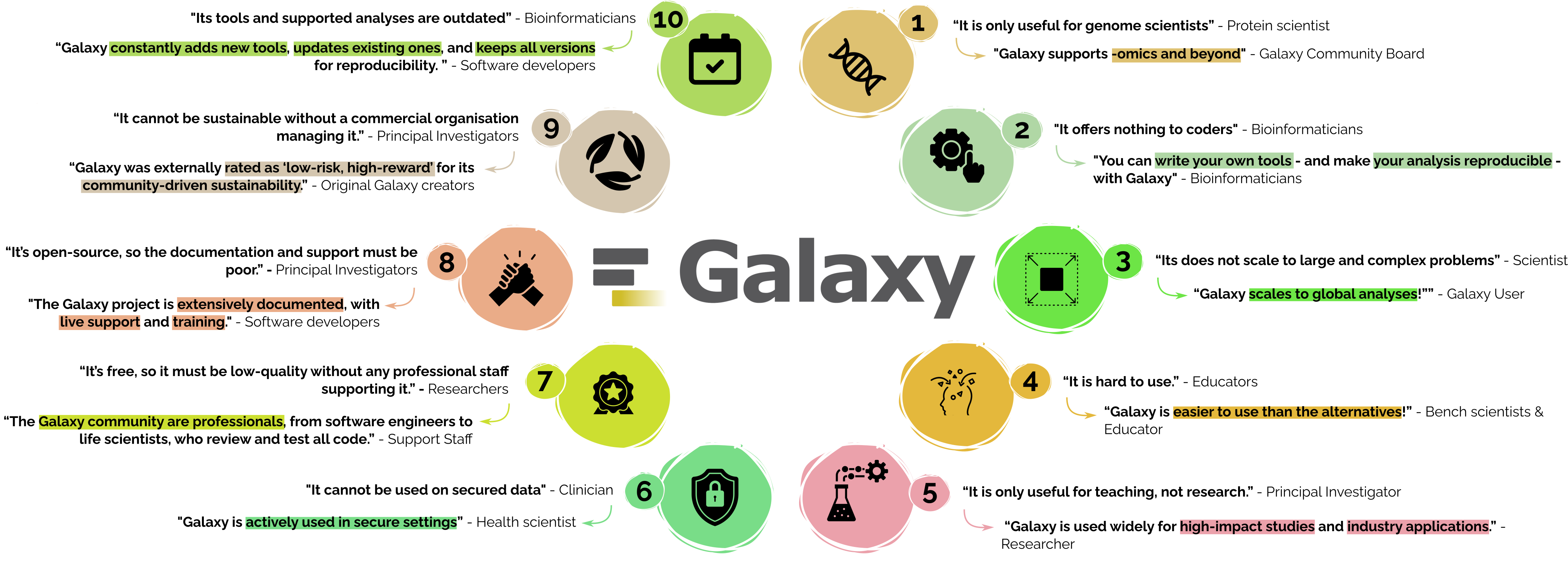
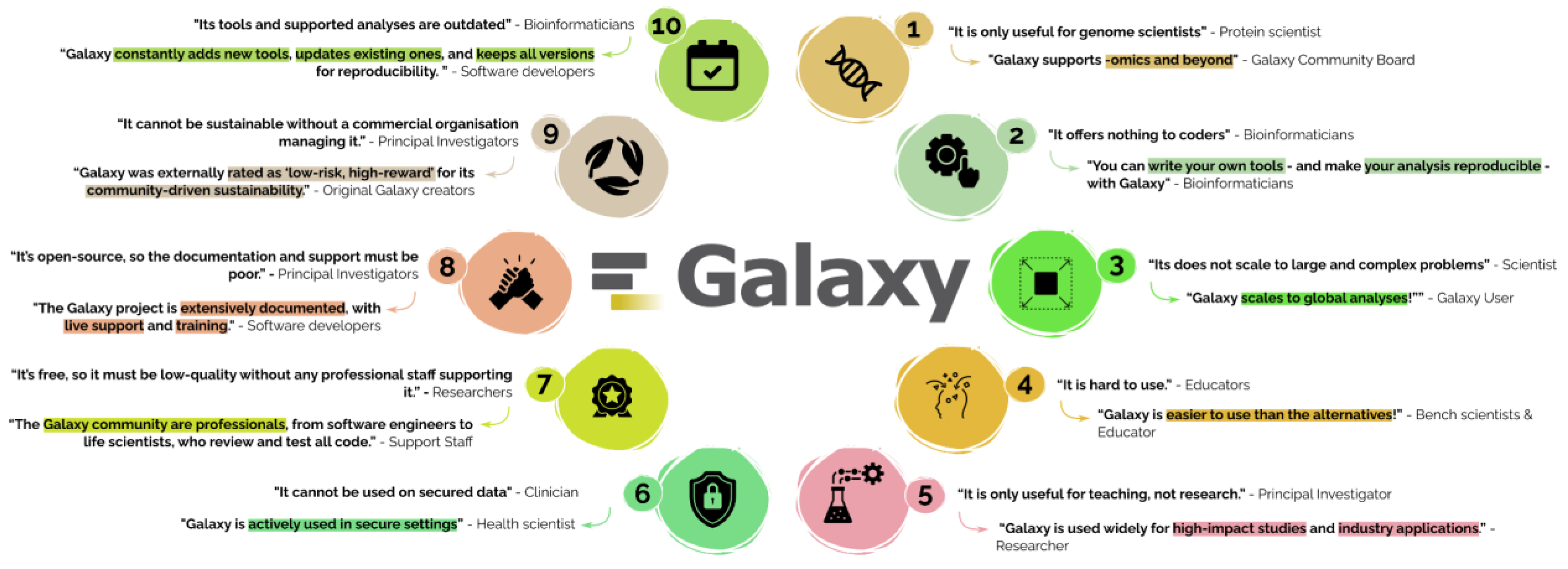
Despite a wealth of evidence, Galaxy is often underestimated due to common perceptions about open-source and academic user interfaces (Figure 5). Initially developed for genomics, Galaxy is now widely used across scientific domains. It enables reproducible, reusable analyses, with support for custom tools and a user-friendly interface that lowers the barrier to entry compared to coding or other workflow systems. Galaxy combines ease of use with serious power: it is backed by free computational resources, integrated into national and international infrastructure, and trusted in regulated, secure environments. It supports secure data analysis via authentication, encryption, and federated storage. Its passionate, structured community ensures quality through rigorous testing, review, and documentation. Galaxy’s semi-automated update mechanisms connect to open-source repositories, preventing software decay while preserving old analyses for reproducibility. Backed by a resilient funding model and distributed governance, Galaxy has been rated “low-risk, high-reward” and remains a sustainable, scalable platform for both education and advanced research.
What is remarkable about these misconceptions is an underlying theme of distrust or uncertainty around community-driven initiatives and open-source software. Whilst it is true that there are examples of poor quality software in academia, profit drivers and commercial enterprises are not guarantees of software quality or security. Uniquely, Galaxy demonstrates not the pitfalls of community management, but the idealism of them - what is possible where communities create, adjust, and develop structures for self-review, self-organisation, and self-management over time. In Galaxy, global community contribution ensures robustness and eliminates single points of failure; cross-disciplinary collaboration drives development; and user engagement is realised from clicking to conferences. Ultimately, the Galaxy community understands that the most critical factor for any software community aiming for long-term impact is how it treats its people[35]. The Galaxy project is a collective pursuit where thoughtful interface design and rigorous scientific practice meet — a community building up resources, and each other.
Financial Disclosures
BB acknowledges funding from the Programme d’Investissements d’Avenir (PIA) through the Agence Nationale de la Recherche (grant number ANR-11-INBS-0013). PZ acknowledges funding from the German Federal Ministry of Education and Research (BMBF) [031 A538A de.NBI-RBC]; and the Ministry of Science, Research and the Arts Baden-Württemberg (MWK) within the framework of LIBIS/de.NBI Freiburg. Additional support was provided by the European Union’s Horizon Europe programme under grant agreements HORIZON-INFRA-2021-EOSC-01-04 (101057388) and REA.B.3, Biodiversity, Circular Economy and Environment (BGE 101059492). JYD received funding from the U.S. National Institutes of Health (NIH) under awards U24HG006620, U24HG010263, U24AI183870, U24CA284167, and OT2OD037936, as well as from the National Science Foundation (NSF) under award 2419522. BSS acknowledges support from the OSCARS project, funded by the European Commission’s Horizon Europe Research and Innovation programme (grant agreement No. 101129751).
Software Availability
All scripts used to generate this manuscript can be found at: https://github.com/usegalaxy-eu/misconception-paper-2025 Galaxy servers can be found at: https://galaxyproject.org/use/ Galaxy training can be found at: https://training.galaxyproject.org/ Galaxy community documentation is located at: https://galaxyproject.org/.
Acknowledgements
The authors gratefully acknowledge: Andrew J. Page and Ross Lazarus for initial discussions; Anne Fouilloux, Simon Gladman, Sveinung Gundersen, Yvan Le Bras, Gareth Price, Jennifer Hillman-Jackson, Florian Heyl, Pavankumar Videm, Dave Clements, Jeremy Goecks, Bradley W. Langhorst, and Daniel Blankenberg for participating in the initial thought process; and Guerler Aysam for historical Galaxy interface images. We also thank the following individuals for conversations and contributions throughout the development of this manuscript: Pratik Jagtap, Anton Nekrutenko and Nikos Pechlivanis.
Competing Interests
The authors do not have any competing interests.
References
- Fan, J.; Han, F.; Liu, H. Challenges of Big Data analysis. Natl Sci Rev. 2014, 1, 293–314. [Google Scholar] [CrossRef] [PubMed]
- Giardine, B.; Riemer, C.; Hardison, R.C.; Burhans, R.; Elnitski, L.; Shah, P.; et al. Galaxy: A platform for interactive large-scale genome analysis. Genome Res. 2005, 15, 1451–1455. [Google Scholar] [CrossRef]
- Community-Driven Data Analysis Training for Biology. Cell Systems. 2018, 6, 752–758.e1. [CrossRef]
- Blankenberg, D.; Von Kuster, G.; Coraor, N.; Ananda, G.; Lazarus, R.; Mangan, M.; et al. Galaxy: A Web-Based Genome Analysis Tool for Experimentalists. Current Protocols in Molecular Biology. 2010, 89, 19.10.1–19.10.21. [Google Scholar] [CrossRef]
- The Galaxy Community; Abueg, L.A.L.; Afgan, E.; Allart, O.; Awan, A.H.; Bacon, W.A.; et al. The Galaxy platform for accessible, reproducible, and collaborative data analyses: 2024 update. Nucleic Acids Res. 2024, 52, W83–W94. [Google Scholar] [CrossRef] [PubMed]
- Gu, Q.; Kumar, A.; Bray, S.; Creason, A.; Khanteymoori, A.; Jalili, V.; et al. Galaxy-ML: An accessible, reproducible, and scalable machine learning toolkit for biomedicine. PLOS Computational Biology. 2021, 17, e1009014. [Google Scholar] [CrossRef]
- Hyde, C.J.; Syme, A.; Batut, B.; Zierep, P.F.; Mok, W.; Bacon, W.A.; et al. Community-Curated Galaxy Interfaces with the Galaxy Labs Engine. 2025 Aug 5 [cited 2025 Aug 7]; Available from: https://www.preprints.org/manuscript/202508.0199/v1.
- Mehta, S.; Bernt, M.; Chambers, M.; Fahrner, M.; Föll, M.C.; Gruening, B.; et al. A Galaxy of informatics resources for MS-based proteomics. Expert review of proteomics [Internet]. 2023 Jul [cited 2025 Aug 7];20(11). Available from: https://pubmed.ncbi.nlm.nih.gov/37787106/.
- Goclowski, C.L.; Jakiela, J.; Collins, T.; Hiltemann, S.; Howells, M.; Loach, M.; et al. Galaxy as a gateway to bioinformatics: Multi-Interface Galaxy Hands-on Training Suite (MIGHTS) for scRNA-seq. Gigascience 2025, 14. [Google Scholar] [CrossRef]
- Giacomoni, F.; Le Corguillé, G.; Monsoor, M.; Landi, M.; Pericard, P.; Pétéra, M.; et al. Workflow4Metabolomics: A collaborative research infrastructure for computational metabolomics. Bioinformatics. 2014, 31, 1493–1495. [Google Scholar] [CrossRef]
- Antons, D.; Declerck, M.; Diener, K.; Koch, I.; Piller, F.T. Assessing the not-invented-here syndrome: Development and validation of implicit and explicit measurements. Journal of Organizational Behavior. 2017, 38, 1227–1245. [Google Scholar] [CrossRef]
- Wratten, L.; Wilm, A.; Göke, J. Reproducible, scalable, and shareable analysis pipelines with bioinformatics workflow managers. Nature Methods. 2021, 18, 1161–1168. [Google Scholar] [CrossRef] [PubMed]
- van den Beek, M. Group tags for complex experimental designs. 2023 Nov 9 [cited 2025 Aug 7]; Available from: https://github.com/galaxyproject/training-material.
- Rasche, H. Name tags for following complex histories. 2023 Nov 9 [cited 2025 Aug 7]; Available from: https://github.com/galaxyproject/training-material.
- Loach, M.; Johnson, D.M.; Bacon, W. One million heart cells: Integrating public data on Galaxy to explore how cardiomyocytes change in atrial fibrillation. F1000Research 2025, 14. [Google Scholar] [CrossRef]
- Bacon, W.; Holinski, A.; Pujol, M.; Wilmott, M.; Morgan, S.L. Ten simple rules for leveraging virtual interaction to build higher-level learning into bioinformatics short courses. PLOS Computational Biology. 2022, 18, e1010220. [Google Scholar] [CrossRef]
- Almohab, H.; Al-Othmany, R. Evaluation of Galaxy as a User-friendly Bioinformatics Tool for Enhancing Clinical Diagnostics in Genetics Laboratories. 2024 Sep 25 [cited 2025 Aug 7]. [CrossRef]
- Maier, W.; Bray, S.; van den Beek, M.; Bouvier, D.; Coraor, N.; Miladi, M.; et al. Ready-to-use public infrastructure for global SARS-CoV-2 monitoring. Nat Biotechnol. 2021, 39, 1178–1179. [Google Scholar] [CrossRef]
- Martin, D.P.; Weaver, S.; Tegally, H.; San, J.E.; Shank, S.D.; Wilkinson, E.; et al. The emergence and ongoing convergent evolution of the SARS-CoV-2 N501Y lineages. Cell 2021, 184. Available from: https://pubmed.ncbi.nlm.nih.gov/34537136/. [CrossRef] [PubMed]
- Larivière, D.; Abueg, L.; Brajuka, N.; Gallardo-Alba, C.; Grüning, B.; Ko, B.J.; et al. Scalable, accessible and reproducible reference genome assembly and evaluation in Galaxy. Nat Biotechnol. 2024, 42, 367–370. [Google Scholar] [CrossRef] [PubMed]
- Moreno, P.; Huang, N.; Manning, J.R.; Mohammed, S.; Solovyev, A.; Polanski, K.; et al. User-friendly, scalable tools and workflows for single-cell RNA-seq analysis. Nat Methods. 2021, 18, 327–328. [Google Scholar] [CrossRef]
- Gangiredla, J.; Rand, H.; Benisatto, D.; Payne, J.; Strittmatter, C.; Sanders, J.; et al. GalaxyTrakr: A distributed analysis tool for public health whole genome sequence data accessible to non-bioinformaticians. BMC Genomics. 2021, 22, 114. [Google Scholar] [CrossRef] [PubMed]
- Bogaerts, B.; Van Braekel, J.; Van Uffelen, A.; D’aes, J.; Godfroid, M.; Delcourt, T.; et al. Galaxy @Sciensano: A comprehensive bioinformatics portal for genomics-based microbial typing, characterization, and outbreak detection. BMC Genomics. 2025, 26, 20. [Google Scholar] [CrossRef]
- Schatz, M.C.; Philippakis, A.A.; Afgan, E.; Banks, E.; Carey, V.J.; Carroll, R.J.; et al. Inverting the model of genomics data sharing with the NHGRI Genomic Data Science Analysis, Visualization, and Informatics Lab-space. Cell Genom 2022, 2. [Google Scholar] [CrossRef]
- Chappell, K.; Francou, B.; Habib, C.; Huby, T.; Leoni, M.; Cottin, A.; et al. Galaxy Is a Suitable Bioinformatics Platform for the Molecular Diagnosis of Human Genetic Disorders Using High-Throughput Sequencing Data Analysis: Five Years of Experience in a Clinical Laboratory. Clin Chem. 2021, 68, 313–321. [Google Scholar] [CrossRef]
- Digan, W.; Countouris, H.; Barritault, M.; Baudoin, D.; Laurent-Puig, P.; Blons, H.; et al. An architecture for genomics analysis in a clinical setting using Galaxy and Docker. Gigascience. 2017, 6, gix099. [Google Scholar] [CrossRef]
- Coelho, L.P. For long-term sustainable software in bioinformatics. PLOS Computational Biology. 2024, 20, e1011920. [Google Scholar] [CrossRef]
- Kern, F.; Fehlmann, T.; Keller, A. On the lifetime of bioinformatics web services. Nucleic Acids Res. 2020, 48, 12523–12533. [Google Scholar] [CrossRef] [PubMed]
- Hermann, S.; Fehr, J. Documenting research software in engineering science. Scientific Reports. 2022, 12, 1–11. [Google Scholar] [CrossRef]
- Bray, S.; Chilton, J.; Bernt, M.; Soranzo, N.; van den Beek, M.; Batut, B.; et al. The Planemo toolkit for developing, deploying, and executing scientific data analyses in Galaxy and beyond. Genome Res. 2023, 33, 261–268. [Google Scholar] [CrossRef]
- Afgan, E.; Baker, D.; Batut, B.; van den Beek, M.; Bouvier, D.; Čech, M.; et al. The Galaxy platform for accessible, reproducible and collaborative biomedical analyses: 2018 update. Nucleic Acids Res. 2018, 46, W537–W544. [Google Scholar] [PubMed]
- Sloggett, C.; Goonasekera, N.; Afgan, E. BioBlend: Automating pipeline analyses within Galaxy and CloudMan. Bioinformatics. 2013, 29, 1685–1686. [Google Scholar] [CrossRef] [PubMed]
- Hiltemann, S.; Rasche, H.; Gladman, S.; Hotz, H.R.; Larivière, D.; Blankenberg, D.; et al. Galaxy Training: A powerful framework for teaching! PLOS Computational Biology. 2023, 19, e1010752. [Google Scholar] [CrossRef]
- Jain, S. Galaxy Sustainability Report. [cited 2025 Aug 7]; Available from: https://zenodo.org/records/16030329.
- Sustaining Maintenance Labor for Healthy Open Source Software Projects through Human Infrastructure: A Maintainer Perspective [Internet]. [cited 2025 Aug 7]. Available from: https://dl.acm.org/doi/10.1145/3674805.3686667.
Figure 1.
Name tags for complex histories. Galaxy has enabled dataset tagging, such that users can manually label datasets in their histories (left) that propagate through an analysis, or automate dataset labelling (right) via a workflow, which then propagates through an analysis. This helps users organise datasets in the vertical history (left).
Figure 1.
Name tags for complex histories. Galaxy has enabled dataset tagging, such that users can manually label datasets in their histories (left) that propagate through an analysis, or automate dataset labelling (right) via a workflow, which then propagates through an analysis. This helps users organise datasets in the vertical history (left).
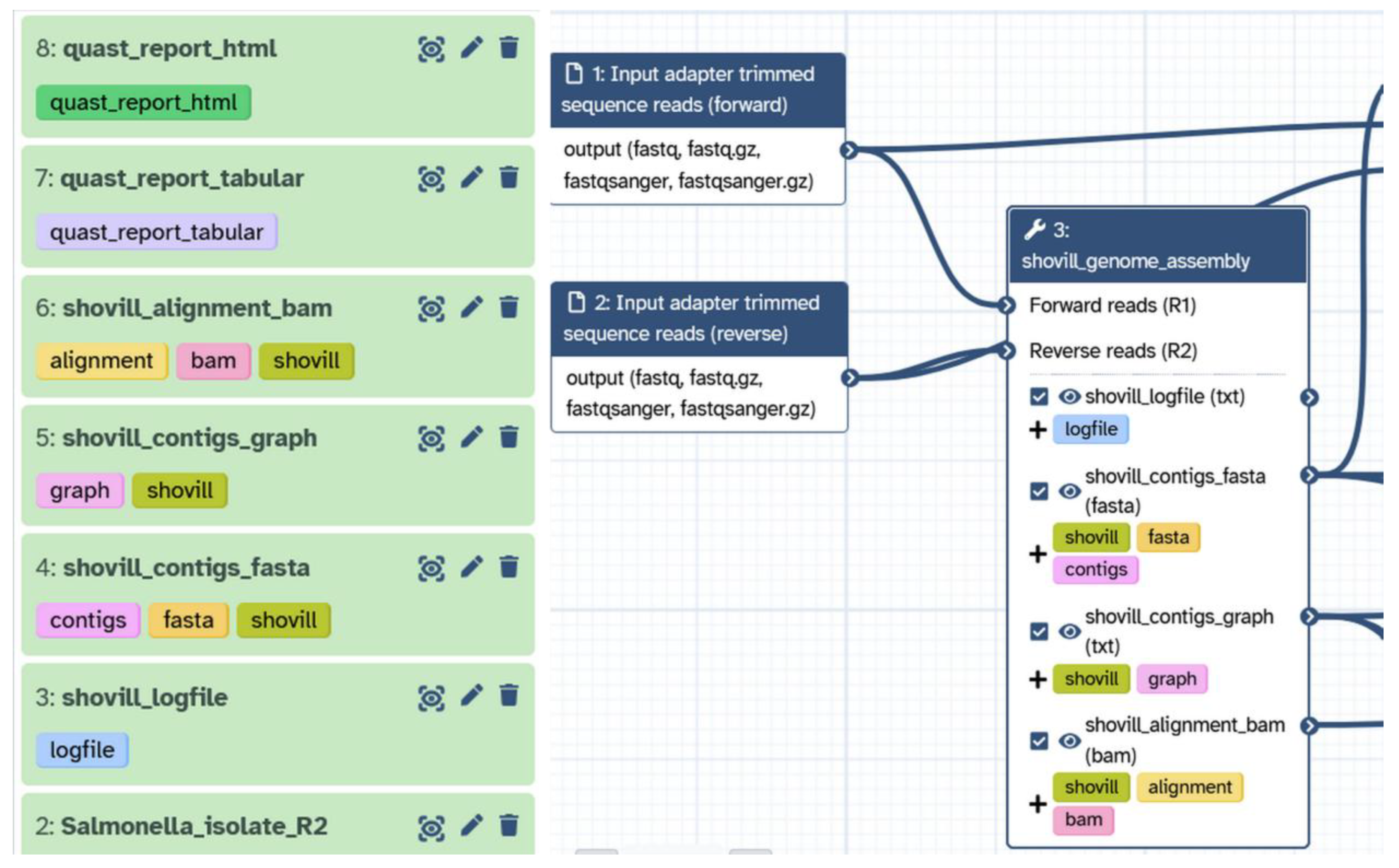
Figure 2.
Galaxy interface over the years. Running a tool looked different in (top row) 2010 and 2017, and (bottom row) 2019 and 2024.
Figure 2.
Galaxy interface over the years. Running a tool looked different in (top row) 2010 and 2017, and (bottom row) 2019 and 2024.
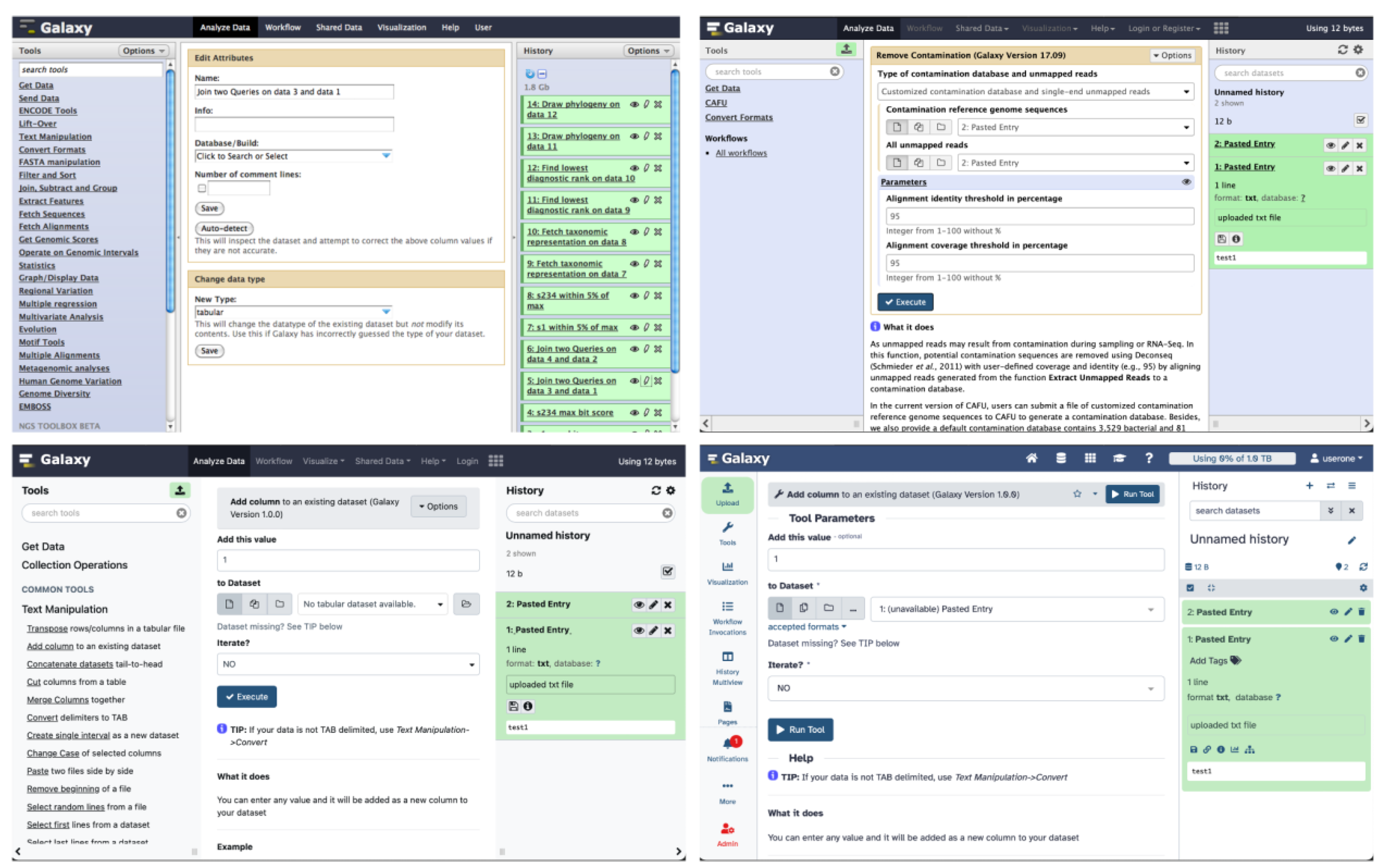
Figure 3.
Galaxy impact over time. A) Cumulative number of papers citing the 8 major publications of the Galaxy project. The 8 major publications of the Galaxy Project were extracted from the Galaxy Project’s Google Scholar profile (https://scholar.google.com/citations?hl=en&user=3tSiRGoAAAAJ) using the scholarly package (v 1.7.11). These publications and their citations were then retrieved on Semantic Scholar via its Application Programming Interface (API) using requests (v2.32.3). The collected data included the publication years, titles, and abstracts. B) The number of distinct users and jobs per month on the usegalaxy.eu instance. A user is counted if they ran at least one job that month.
Figure 3.
Galaxy impact over time. A) Cumulative number of papers citing the 8 major publications of the Galaxy project. The 8 major publications of the Galaxy Project were extracted from the Galaxy Project’s Google Scholar profile (https://scholar.google.com/citations?hl=en&user=3tSiRGoAAAAJ) using the scholarly package (v 1.7.11). These publications and their citations were then retrieved on Semantic Scholar via its Application Programming Interface (API) using requests (v2.32.3). The collected data included the publication years, titles, and abstracts. B) The number of distinct users and jobs per month on the usegalaxy.eu instance. A user is counted if they ran at least one job that month.
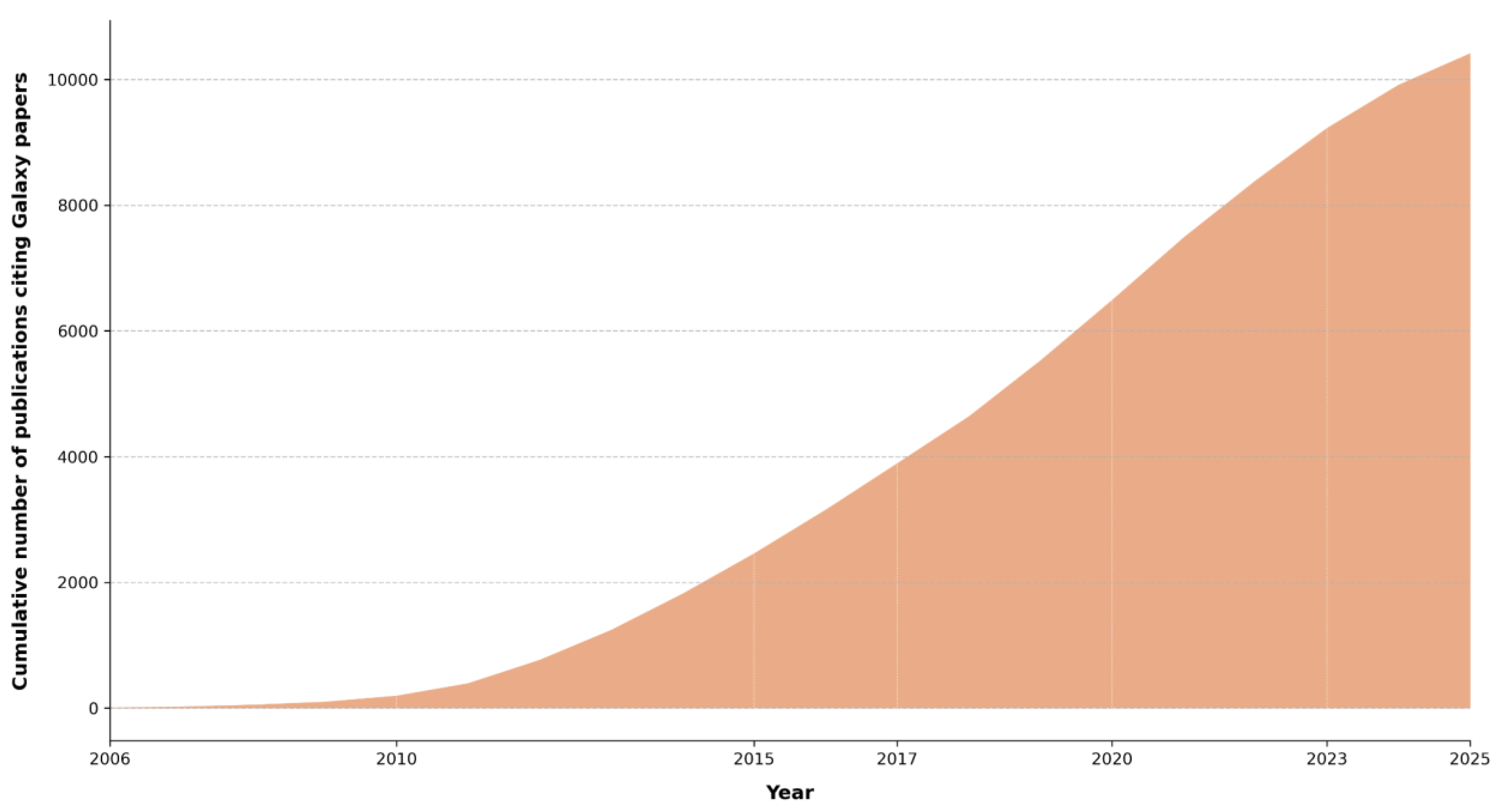
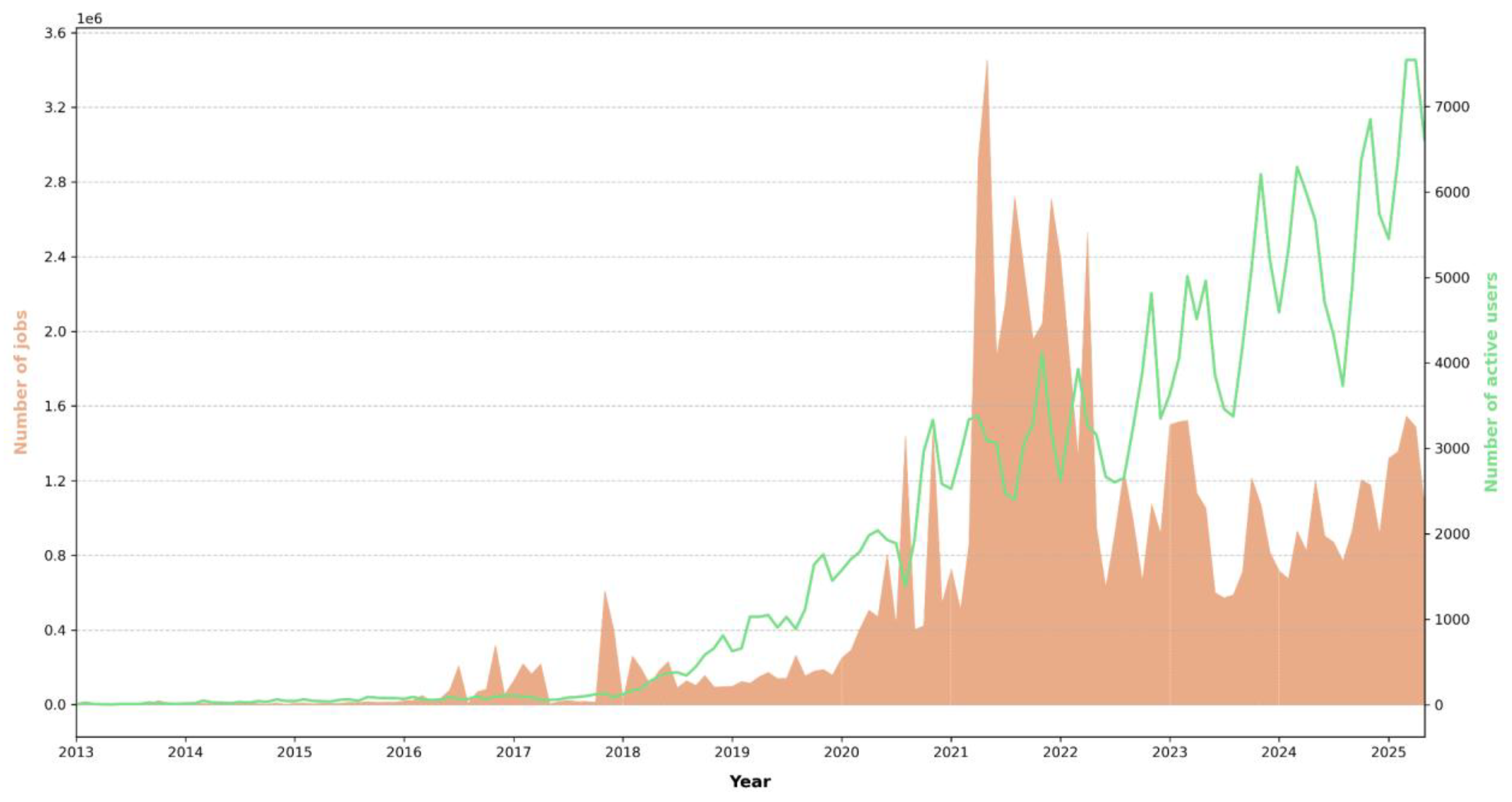
Figure 4.
Tool updates on Galaxy over time. A) The number of tool updates per day on usegalaxy.eu. B) The same data, plotted cumulatively, demonstrating consistent updates over time, with no decline in maintenance.
Figure 4.
Tool updates on Galaxy over time. A) The number of tool updates per day on usegalaxy.eu. B) The same data, plotted cumulatively, demonstrating consistent updates over time, with no decline in maintenance.
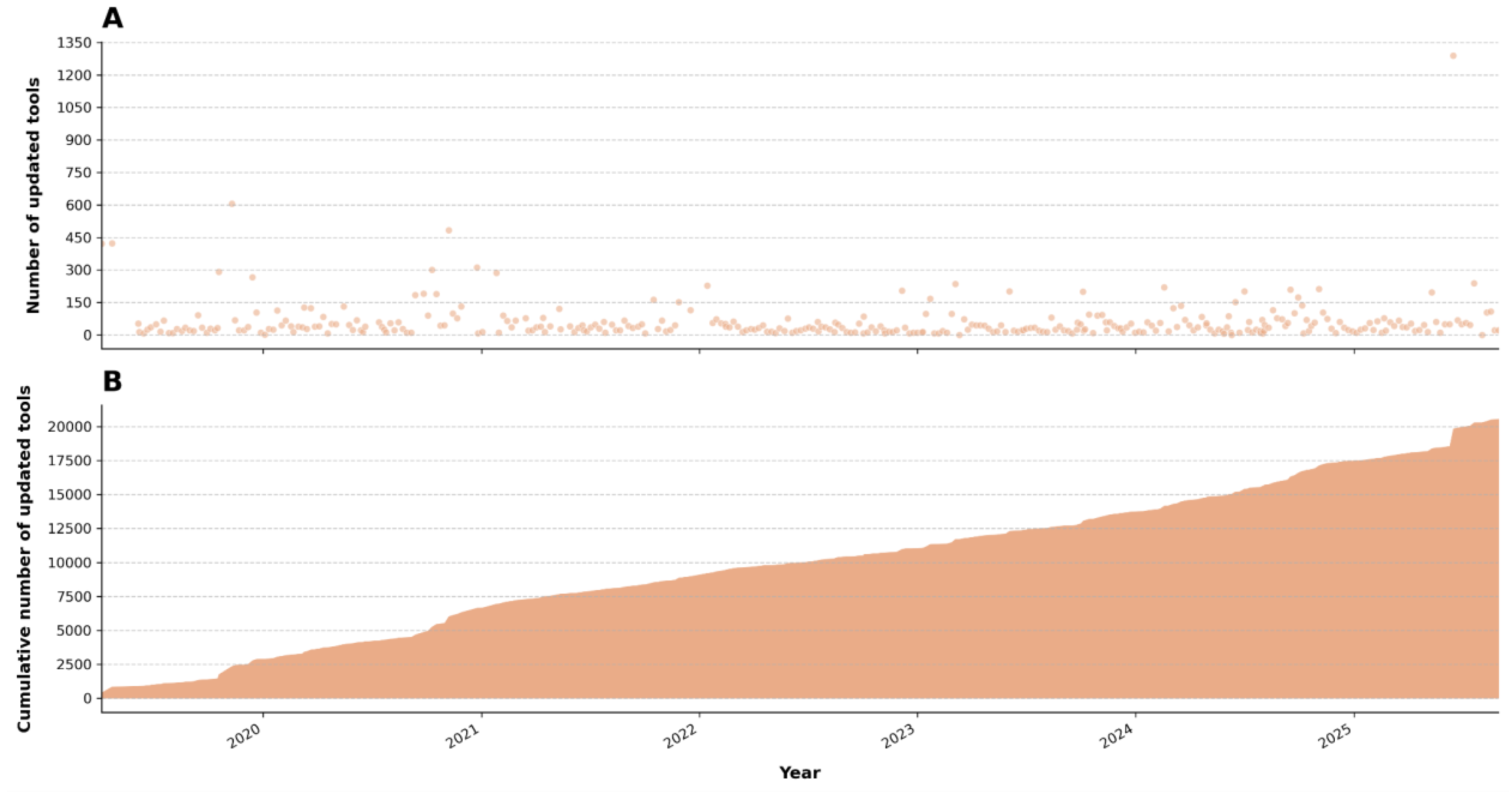
Figure 5.
Overview of Galaxy misconceptions and reality. Here we summarise ten common misconceptions of Galaxy, and from whom these misconceptions are often heard. We provide summary responses from diverse members of our community, ranging from researchers to health scientists to software developers.
Figure 5.
Overview of Galaxy misconceptions and reality. Here we summarise ten common misconceptions of Galaxy, and from whom these misconceptions are often heard. We provide summary responses from diverse members of our community, ranging from researchers to health scientists to software developers.
Disclaimer/Publisher’s Note: The statements, opinions and data contained in all publications are solely those of the individual author(s) and contributor(s) and not of MDPI and/or the editor(s). MDPI and/or the editor(s) disclaim responsibility for any injury to people or property resulting from any ideas, methods, instructions or products referred to in the content. |
© 2025 by the authors. Licensee MDPI, Basel, Switzerland. This article is an open access article distributed under the terms and conditions of the Creative Commons Attribution (CC BY) license (http://creativecommons.org/licenses/by/4.0/).
Copyright: This open access article is published under a Creative Commons CC BY 4.0 license, which permit the free download, distribution, and reuse, provided that the author and preprint are cited in any reuse.