

Submitted:
08 September 2025
Posted:
09 September 2025
You are already at the latest version
Abstract
Water and energy are essential resources for human livelihoods and institutional functionality. In Mbeere South Sub-County, rising demand and unreliable supply threaten the sustainability of secondary schools. This study examines the factors influencing water and energy source choices in these institutions, guided by Resource Dependence Theory. A descriptive survey design was employed, targeting all 33 secondary school principals and two education officers. Data were collected using validated questionnaires and observation checklists, with a reliability coefficient of 0.82. Analysis using SPSS (v21) revealed a significant association (Fisher’s exact test, p = 0.003) between resource choices and influencing factors such as cost, technical feasibility, location, and policy incentives. The study recommends prioritizing reliability and cost-effectiveness in infrastructure investments and promoting awareness on sustainable practices. Findings contribute to policy formulation and resource planning in semi-arid educational environments.
Keywords:
water and energy access in schools
; semi-arid Kenya
; sustainable infrastructure planning
1. Introduction
Access to energy and water is indispensable to human well-being, economic advancement, and environmental sustainability. Educational institutions, as both service providers and resource consumers, are uniquely positioned to influence and benefit from sustainable development initiatives. In particular, they play a critical role in advancing Sustainable Development Goals (SDGs) 6 (clean water and sanitation) and 7 (affordable and clean energy). Yet, stark disparities in resource access between developed and developing regions continue to undermine the equity, functionality, and resilience of learning environments(Kingori Gakai, Waweru et al. 2025).
Globally, rapid urbanization and population growth have intensified pressure on energy and water systems. In low-income countries, approximately 70% of schools lack access to electricity and safe drinking water, impairing essential educational activities such as lighting, sanitation, cooking, and scientific experimentation. In contrast, schools in high-income nations benefit from modern infrastructure and renewable technologies, underscoring the need for localized research that accounts for socio-economic and ecological contexts(Kipkemoi, Sitati et al. 2025).
Sub-Saharan Africa faces acute energy poverty, affecting over 600 million people. Schools in these regions often rely on unsustainable energy sources such as firewood and charcoal, which contribute to deforestation, poor indoor air quality, and adverse health outcomes. Water scarcity further compounds these challenges, with more than one-third of schools lacking basic WASH (Water, Sanitation, and Hygiene) services. Common coping mechanisms—such as boreholes, rainwater harvesting, and water trucking—are frequently unreliable due to financial and technical constraints. While integrated solutions like solar-powered systems for electricity and water pumping offer promising alternatives, their adoption is shaped by policy support, economic investment, and resource availability(Gakai, Kirigo Waweru et al. 2025)
In Kenya, national frameworks such as Vision 2030 and the National Water Master Plan 2030 have promoted renewable energy and sustainable water management. Despite these efforts, rural and arid/semi-arid lands (ASALs), including Mbeere South Sub-County, remain underserved. Schools in these regions continue to face resource deficits, relying on traditional fuels and experiencing frequent water shortages. These conditions not only compromise educational quality but also exacerbate environmental degradation and operational inefficiencies(Kibiiy and Kosgei 2017).
This study investigates the environmental and economic determinants influencing energy and water source choices in secondary schools within Mbeere South Sub-County. It aims to assess the extent and effectiveness of conservation practices and provide evidence-based recommendations to inform policy interventions tailored to semi-arid educational environments. Guided by Resource Dependence Theory (RDT), the research explores how schools navigate external constraints, diversify resource options, and adopt strategic behaviors to enhance institutional resilience.
2. Justification of the Study
The urgency of this study is underscored by the growing mismatch between resource demand and supply in rural educational institutions, particularly in semi-arid regions like Mbeere South Sub-County. Despite national efforts to promote renewable energy and sustainable water management, many secondary schools continue to rely on outdated, inefficient, and environmentally harmful resource systems. This reliance not only undermines the quality of education through inadequate lighting, sanitation, and cooking facilities but also exacerbates environmental degradation and operational costs.
While national policies such as Kenya’s Vision 2030 and the National Water Master Plan 2030 advocate for broad-based improvements in resource access,(Kibiiy and Kosgei 2017) they often fail to account for the nuanced socio-economic and ecological realities of rural schools. Current interventions tend to be generalized, overlooking the unique constraints faced by institutions in ASAL regions. These include limited financial capacity, technical barriers to infrastructure development, and inconsistent policy enforcement. Without localized data and analysis, schools risk perpetuating inefficient practices that compromise both educational outcomes and environmental stewardship.
This study is justified by the need to bridge this gap. By investigating the environmental and economic determinants of energy and water source choices, the research provides a granular understanding of the decision-making processes within secondary schools in Mbeere South. It also evaluates the extent and effectiveness of conservation practices, offering insights into how schools manage resource scarcity and external dependence.
The application of Resource Dependence Theory (RDT) further strengthens the study’s relevance. RDT provides a robust framework for analyzing how institutions navigate external constraints and adopt strategic behaviors to mitigate risk. In the context of Mbeere South, where schools face unreliable water and energy supplies, RDT helps explain the rationale behind source diversification, conservation efforts, and the selective adoption of renewable technologies.(Hillman, Withers et al. 2009)
3. Methodology
3.1. Research Design
The study used a descriptive survey design to explore factors influencing energy and water source choices in secondary schools. It targeted all 33 schools in Mbeere South Sub-County, involving principals and education officers. Data were collected through structured questionnaires and observation checklists, capturing both infrastructure and conservation practices. Reliability was confirmed via test-retest and Cronbach’s alpha, while validity was ensured through expert review and theoretical alignment. Instruments were piloted in two schools to refine clarity and effectiveness. Ethical approvals and permits were obtained, and data collection followed strict ethical standards including informed consent and confidentiality.
4. Results and Discussions
4.1. Determinants of Energy Sources Adopted by Secondary Schools

Table 1.
Ranked Energy Sources in Terms of Their Importance in Schools.
| Energy Source | Most Important | Very Important | Important | Somewhat Important | Slightly Important | Not Important | Mean | SD |
| Firewood | 83.3% | 16.7% | – | – | – | – | 1.17 | 0.38 |
| Charcoal | – | – | 16.7% | 46.7% | 6.7% | 30.0% | 4.5 | 1.11 |
| Solar Energy | – | – | 10.0% | 56.7% | 6.7% | 26.7% | 4.5 | 1.01 |
| Grid Electricity | 16.7% | 80.0% | – | – | – | 3.3% | 1.97 | 0.85 |
| Generator | – | – | 13.3% | 33.3% | 20.0% | 33.3% | 4.73 | 1.08 |
| Biogas | – | – | – | 43.3% | – | 56.7% | 5.13 | 1.01 |
The study(Figure 1) revealed a strong reliance on traditional energy sources among secondary schools in Mbeere South Sub-County, with firewood and grid electricity emerging as the most important. Firewood was rated “Most Important” by 83.3% of schools, with a mean score of 1.17 and minimal variation (SD = 0.38), indicating widespread dependence for cooking and heating. Grid electricity followed with a mean of 1.97, valued for lighting and equipment use, though its reliability is challenged by outages and cost.
Sustainable alternatives like solar energy and biogas were rated significantly lower. Solar energy had a mean score of 4.5, with only 13.3% of schools using it primarily hindered by high installation costs and technical limitations. Biogas was the least important (mean = 5.13), with 56.7% of schools rating it “Not Important,” reflecting installation challenges and limited organic waste availability.
Charcoal and diesel generators also ranked low, with mean scores of 4.5 and 4.73 respectively. Their use is constrained by cost, environmental concerns, and limited utility, though some schools retain them as backup options.
The findings underscore a critical tension: while firewood and grid electricity meet immediate needs, they pose long-term sustainability risks. Conversely, renewable options remain underutilized due to financial and technical barriers. The study recommends targeted investments in solar and biogas infrastructure, supported by localized policy incentives and community-driven pilot programs.
Economic and technical factors (Figure 2) are the most influential determinants in energy source decisions among secondary schools in Mbeere South Sub-County. Cost effectiveness and school budget constraints topped the list, with 90% and 80% of respondents rating them as “Very Important,” respectively. These findings underscore the financial limitations faced by schools in arid and semi-arid lands (ASALs), which often lead to the adoption of low-cost but environmentally harmful sources such as firewood. Technical considerations—specifically availability and reliability—also ranked highly, reflecting the need for consistent and accessible energy in regions where infrastructure is weak and grid electricity is prone to outages.
In contrast, school location and government policies were less influential. While location had a moderate impact (Mean = 3.07), its importance varied widely, suggesting that proximity to energy infrastructure is not as critical as affordability and reliability. Government policies and incentives received the lowest rating (Mean = 2.77), indicating limited awareness or ineffective implementation of energy-related support mechanisms. This points to a significant policy gap, where schools may not be fully informed or equipped to take advantage of renewable energy initiatives. Strengthening policy outreach and tailoring interventions to local contexts could enhance the adoption of sustainable energy solutions in these underserved educational environments ,the study revealed that economic and technical factors are the most influential determinants in energy source decisions among secondary schools in Mbeere South Sub-County. Cost-effectiveness and school budget constraints emerged as the top priorities, with 90% and 80% of respondents rating them as “very important,” respectively. These findings highlight the financial limitations faced by schools in arid and semi-arid lands (ASALs), which often compel them to adopt low-cost but environmentally detrimental sources such as firewood. Technical considerationsparticularly availability and reliability also ranked highly, underscoring the need for consistent and accessible energy in regions where infrastructure is weak and grid electricity is frequently unreliable.
4.2. Determinants of Water Source Choices in Secondary Schools
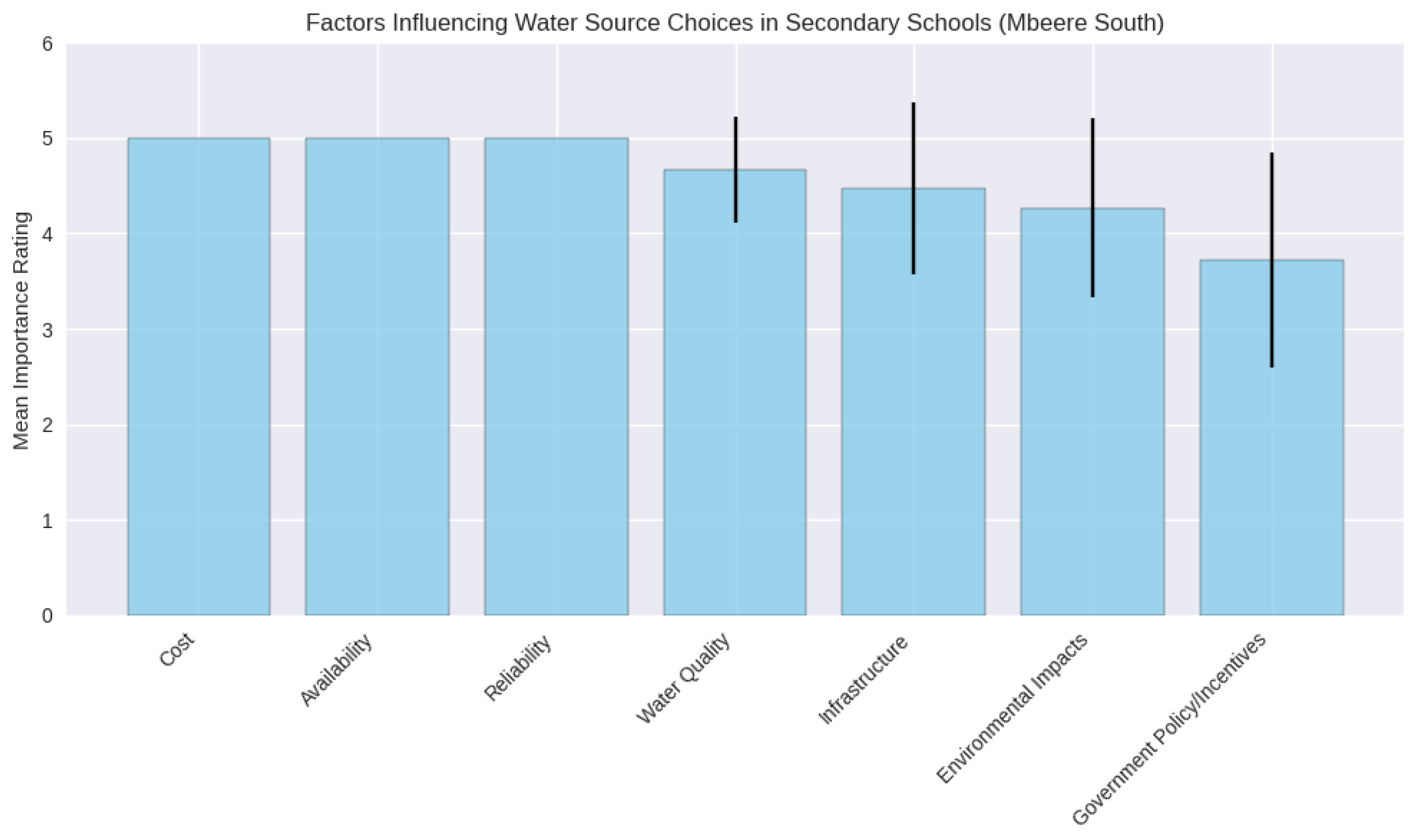
This study explored the key determinants influencing water source selection among secondary schools in Mbeere South Sub-County, a semi-arid region grappling with chronic water scarcity. Respondents ranked seven factors based on their perceived importance, and the results revealed unanimous agreement on the primacy of cost, availability, and reliability—each receiving a mean score of 5.00 with no variation (SD = 0.00). This consensus underscores the urgent need for affordable, accessible, and dependable water supply systems in resource-constrained educational settings. Water quality was also highly valued, with 70% of schools rating it as “very important” and a mean score of 4.67 (SD = 0.55), reflecting health and sanitation concerns. Infrastructure availability followed closely (mean = 4.47), though with slightly more variation, suggesting disparities in school-level capacity. Environmental impacts (mean = 4.27) were moderately influential, while government policy and incentives received the lowest rating (mean = 3.72), indicating limited awareness or perceived effectiveness of policy support mechanisms.
To assess the statistical relationship between these factors and water source choices, a Fisher’s Exact Test was conducted, yielding a value of 16.45 and a p-value of 0.003. This confirms a significant association, affirming that school decisions are shaped by a blend of economic, technical, and environmental considerations. These findings are consistent with regional and global trends. In Embu and Makueni counties, rainwater harvesting is widely adopted due to its affordability, while in Kisumu, wealthier schools prefer bottled water over public supply due to quality concerns. Similar patterns are evident in Nigeria and South Africa, where contamination risks drive demand for purchased water. Internationally, cost remains a dominant factor, as seen in India’s rural schools, which favor rainwater systems for their low operational costs. These parallels highlight the universal importance of affordability and reliability in water management decisions, particularly in underserved educational environments(Kimutai, Siagi et al. 2022, Organization 2022, Nwanevu, Oladipo et al. 2024)
Table 2.
Importance of Factors Influencing School’s Energy Sources.
| Factor | Mean Score | Standard Deviation |
| Cost | 5.00 | 0.00 |
| Availability | 5.00 | 0.00 |
| Reliability | 5.00 | 0.00 |
| Water Quality | 4.67 | 0.55 |
| Infrastructure | 4.47 | 0.90 |
| Environmental Impacts | 4.27 | 0.94 |
| Government Policy/Incentives | 3.72 | 1.13 |
Note: Higher mean scores indicate greater perceived importance.
Figure 3 presents the mean importance ratings of seven key factors influencing water source decisions among secondary schools in Mbeere South Sub-County, with error bars indicating standard deviations. The chart reveals that Cost, Availability, and Reliability were unanimously rated as “Very Important” (Mean = 5.00, SD = 0.00), underscoring the critical need for affordable and dependable water access in this semi-arid region. Water Quality (Mean = 4.67) and Infrastructure (Mean = 4.47) also received high ratings, though with some variability across institutions, reflecting their significance in ensuring safe and sustainable supply. Environmental Impacts (Mean = 4.27) were moderately prioritized, suggesting increasing awareness of ecological considerations. In contrast, Government Policy and Incentives (Mean = 3.72) ranked lowest, indicating limited influence or engagement with policy frameworks at the school level. Overall, the chart highlights the dominance of practical and economic concerns in shaping water source decisions within resource-constrained educational environments.
Conclusion
This study underscores the predominance of practical and economic considerations in shaping water source decisions within secondary schools in Mbeere South Sub-County. The unanimous prioritization of cost, availability, and reliability reflects the acute challenges faced in securing consistent and affordable water access in semi-arid educational environments. While water quality and infrastructure also emerged as significant factors, their variability suggests uneven resource distribution and technical capacity across institutions. The moderate emphasis on environmental impacts indicates a growing, yet secondary, awareness of sustainability, whereas the relatively low influence of government policy and incentives highlights a gap in institutional support and policy integration. These insights call for targeted interventions that not only address immediate operational needs but also strengthen policy frameworks, infrastructure investment, and environmental stewardship. Enhancing stakeholder engagement and aligning government incentives with school-level realities will be critical in fostering resilient and equitable water management strategies.
Author Contributions
All authors contributed equally to the conception, design, data collection, analysis, and writing of this manuscript. Each author reviewed and approved the final version for publication, ensuring shared responsibility for the integrity and accuracy of the work.
References
- Embu County Education Office (2024). Annual Report on Secondary Schools in Mbeere South Sub-County. Embu County Government Press.
- Gakai, P. K.; Kirigo Waweru, R.; Mutisya, A.; K, N. M.; Kimathi, V. K. Inclusive Recovery in Aweil East and South: A Social Baseline for Equity and Resilience. Preprints 2025, 2025081922. [CrossRef]
- Gakai, P. K., R. Kirigo Waweru, A. Mutisya, N. M. K and V. K. Kimathi (2025). Inclusive Recovery in Aweil East and South: A Social Baseline for Equity and Resilience. Preprints, Preprints.
- Hillman, A. J., M. C. Withers and B. J. Collins (2009). "Resource dependence theory: A review." Journal of management 35(6): 1404-1427. [CrossRef]
- Kibiiy, J. and J. Kosgei (2017). "Long-term water planning: a review of Kenya National Water Master Plan 2030." Water Resources Management: Select Proceedings of ICWEES-2016: 193-208. [CrossRef]
- Kimutai, S. K., Z. O. Siagi and P. M. Wambua (2022). "Determinants of household energy utilization and changing behaviour in Kenya: Structural equation modelling approach." European Journal of Energy Research 2(4): 1-9. [CrossRef]
- Kingori Gakai, P., R. K. Waweru, A. Mutisya, N. Mukami K and V. K. kimathi (2025). Flood Impacts on Vulnerable Communities in Aweil East and South: A Qualitative Assessment. Preprints, Preprints.
- Kipkemoi, I., G. K. Sitati and P. K. Gakai (2025). "Exploring the impact of sister city partnerships on emerging African cities." Discover Cities 2(1): 68. [CrossRef]
- Nwanevu, C., S. S. Oladipo and A. O. Ajayi (2024). "Designing effective policy frameworks for the implementation of microgrids in developing countries: Opportunities, challenges and pathways to sustainable energy access." World Journal of Advanced Research and Reviews 24(1): 1279-1294. [CrossRef]
- Organization, W. H. (2022). Progress on drinking water, sanitation and hygiene in schools: 2000-2021 data update, World Health Organization.
Figure 1.
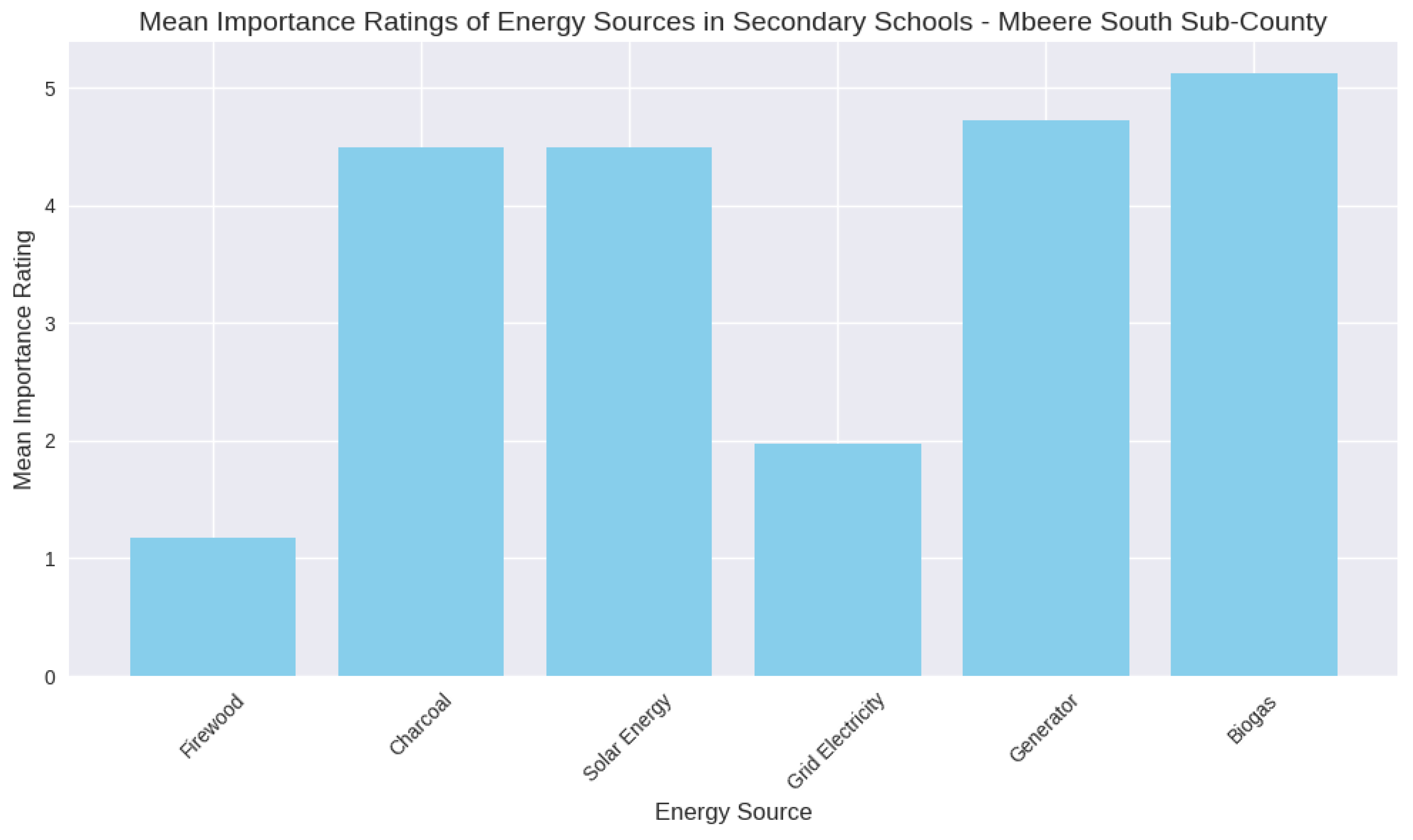
Figure 2.
factors influencing energy source choices.
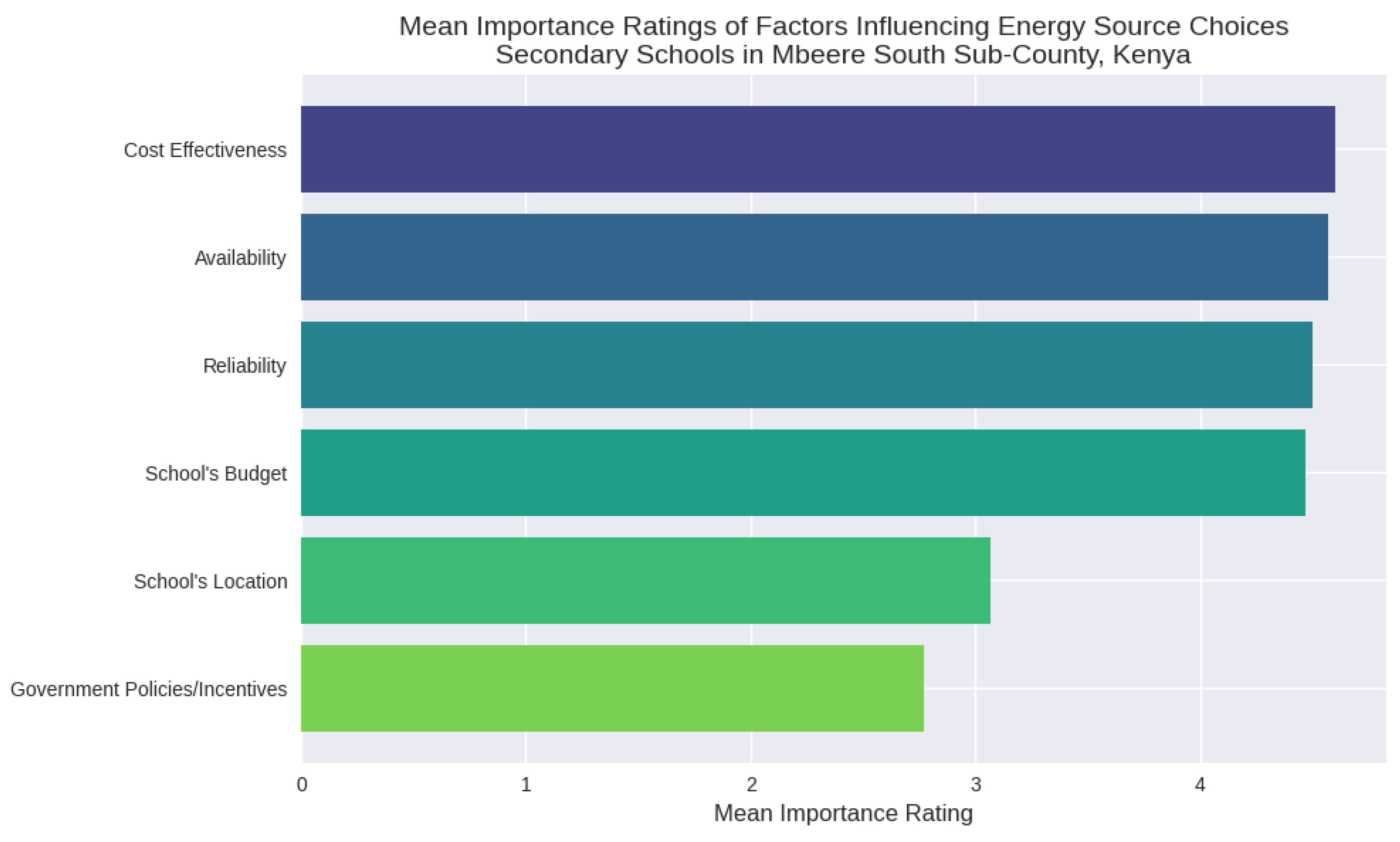
Figure 3.
Mean Importance Ratings of Water Source Decision Factors.
Disclaimer/Publisher’s Note: The statements, opinions and data contained in all publications are solely those of the individual author(s) and contributor(s) and not of MDPI and/or the editor(s). MDPI and/or the editor(s) disclaim responsibility for any injury to people or property resulting from any ideas, methods, instructions or products referred to in the content. |
© 2025 by the authors. Licensee MDPI, Basel, Switzerland. This article is an open access article distributed under the terms and conditions of the Creative Commons Attribution (CC BY) license (http://creativecommons.org/licenses/by/4.0/).
Copyright: This open access article is published under a Creative Commons CC BY 4.0 license, which permit the free download, distribution, and reuse, provided that the author and preprint are cited in any reuse.


