

Submitted:
08 September 2025
Posted:
11 September 2025
You are already at the latest version
Abstract
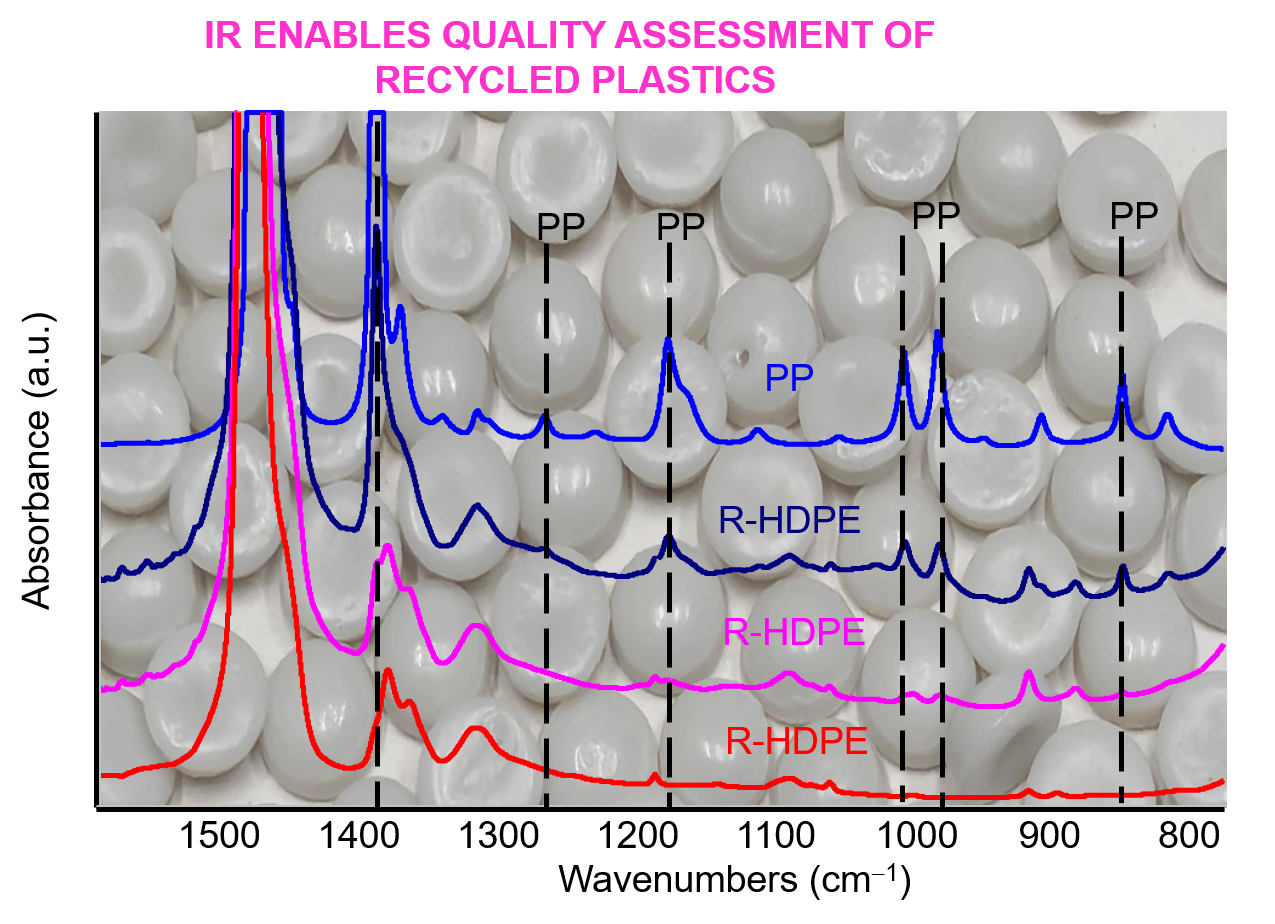
Driven by environmental concerns and aligned with the principles of a circular economy, urban plastic waste, such as packaging materials, disposable items, non-functional objects, and industrial plastic scrap is increasingly being collected, recycled, and marketed as a potential substitute for virgin polymeric materials. However, the use of recycled polymers introduces uncertainties that can significantly affect both the durability and the further recyclability of the resulting products. This paper demonstrates how spectroscopic analysis in the mid-infrared (MIR) and near-infrared (NIR) regions can be employed well beyond the basic identification of the main polymeric component—typically performed during the sorting stage of recycling processes. A detailed interpretation of spectral data, based on well-established correlations between spectroscopic response and material structure, enables the classification of recycled polymers according to specific physicochemical properties, such as chemical composition, molecular architecture, and morphology. In this context, infrared spectroscopy not only allows for a reliable comparison with the corresponding virgin polymer reference but also proves particularly effective in evaluating the homogeneity of recycled materials and the reproducibility of their properties—factors not inherently ensured due to the variability of input sources.
Keywords:
plastic waste
; polymers sorting
; structural characterization
; chemical recognition
; polymer morphology
; secondary raw materials
1. Introduction
The environmental sustainability of plastic object production can be significantly improved by developing recycling strategies that ensure reliable assessment of the quality and reproducibility of the recycled polymeric material [1,2,3].
Chemical recycling, which involves depolymerizing the polymeric component to obtain small molecules (monomers) that can be reused as raw materials in subsequent polymer synthesis processes, is potentially the most reliable route [4,5]. In principle, it can yield a final product (the polymer) that is identical to the one obtained from conventional sources. However, the complexity and cost of chemical processes have so far made mechanical/thermal recycling the most widely adopted strategy for polymer materials [3,4,5].
Ideally, a thermoplastic polymer can be melted and reformed an infinite number of times at relatively low temperatures, thus with limited energy consumption, without losing its physicochemical properties.
This unique property makes recycling feasible: plastic waste—once sorted by polymer type—is shredded into fragments, which are then melted and extruded to produce pellets ready for market use as secondary raw materials for manufacturing new plastic products. Although this process may appear simple when described schematically, each of its steps has critical aspects that strongly impact the quality of the final product. We can identify: (i) Issues related to the intrinsic characteristics of the plastic waste, and, (ii) issues related to the recycling process itself.
Waste material-related issues concern the accuracy of polymer sorting, and the presence of contaminants or foreign fragments that were not removed. These problems are especially common in post-consumer plastic waste, while post-industrial waste sources typically allow for predefined selection of the input polymer type.
It is also essential to recognize that polymers in finished products are always used in formulations. Part of the formulation depends on the raw material itself (virgin polymer pellets), while another part is adjusted during processing to meet the functional requirements of the final product. Common additives include: inorganic fillers (e.g., glass fibers, calcium carbonate, talc, carbon black), stabilizers, antioxidants, flame retardants, and color pigments. The same polymer may be compounded with different additives and filler concentrations, depending on the needs of the converter [6]
Another critical aspect is that plastic waste is aged material, and the polymer may be partially degraded due to wear and environmental exposure. Typically, this leads to oxidation phenomena, resulting in lower molecular weights and a decrease or loss of mechanical properties.
Process-related issues mostly stem from the inevitable partial thermal degradation during processing, which makes it necessary to add additional stabilizers (typically antioxidants) during the recycling process. The inherent limitations of mechanical/thermal recycling affect the properties of the recycled polymer in the following ways:
- The recycled material is different from virgin polymer: while it may be similar in chemical characteristics and performance, it is effectively a new material.
- Recycled polymers can vary from batch to batch, due to inconsistent and hard-to-control input materials. In some cases, inhomogeneities may be present even from pellet to pellet, or within a single pellet (especially if foreign inclusions are present, such as metal flakes).
To ensure proper use of secondary raw materials obtained from plastic waste recycling, it is essential to have a comprehensive understanding of their physicochemical properties [3]. This enables comparisons with the reference virgin polymer and with other recycled polymers available on the market.
In this article, we will discuss the potential of IR spectroscopy in this context, explicitly addressing the specific contributions in light of the aforementioned challenges. In particular, we will focus on methodological aspects and, through selected examples, propose guidelines for critical interpretation and the use of spectroscopic markers that are not typically considered in this field. The discussion includes examples from the spectroscopic analysis of commercially sourced recycled polymer pellets, as well as reference spectra from virgin polymers. A case study on the quantitative determination of polypropylene content —which is frequently present in recycled polyethylene samples—will also be presented.
2. Materials and Methods
Several commercial polymer samples were analyzed, including high-density polyethylene (HDPE), low-density polyethylene (LDPE), isotactic polypropylene (PP), polyamide (PA), polystyrene (PS), polyvinyl chloride (PVC), polyethylene terephthalate (PET), Carilon®, and recycled HDPE pellets (R-HDPE) from various manufacturers. For the construction of the PP/PE calibration curve, isotactic polypropylene and HDPE purchased from Aldrich were used as reference materials.
Transmission-mode infrared (IR) spectra were acquired on thin-film samples using a Nicolet 6700 Fourier-transform infrared (FTIR) spectrometer over the range of 400–6500 cm⁻¹, with 128 scans and a spectral resolution of 4 cm⁻¹. Attenuated Total Reflectance (ATR) spectra were recorded using a Thermo-Electron Continuµm IR microscope coupled to the same Nicolet 6700 FTIR instrument, equipped with a slide-on single-bounce ATR accessory featuring a silicon crystal (128 scans, 4 cm⁻¹ resolution). ATR spectra were intensity-corrected using the ATR correction function implemented in the OMNIC 8.2.0.387 software (Thermo Fisher Scientific Inc.), and the corrected spectra are shown in the corresponding figures for comparison with transmission-mode spectra.
To investigate the PP concentration in R-HDPE samples, a series of reference mixtures with known HDPE/PP ratios were prepared. Pure HDPE and isotactic PP (Aldrich) pellets were mechanically ground using a blender with steel blades under liquid nitrogen to prevent thermal degradation. The resulting powder was sieved using a mesh with pore size ~100 µm to isolate the finest fraction. Six mixtures with varying HDPE/PP compositions were then prepared by weighing appropriate amounts of each component. Approximately 150 mg of each mixture was placed into a pellet press and compressed at 10 tons/cm² for 2 minutes. Thin films (~100 µm thick) were subsequently obtained by compression molding at 200 °C. Three replicate films were produced for each composition to ensure reproducibility. R-HDPE samples were prepared with the same procedure by compression molding the recycled polymer pellets at 200 °C.
The experimental conditions for natural sunlight exposure of Carilon® and PP specimens, used to study degradation and oxidation processes, are described in detail in the cited literature.
3. Results and Discussion
3.1. General Characteristics of Polymeric Materials and Their IR Spectra
The discussion of polymer spectra must take into account the peculiar characteristics of these materials [7,8] and their spectroscopic features [9,10,11,12,13,14,15,16] that are independent of whether the material is a virgin polymer or a second-raw material obtained through recycling processes.
- A polymeric material is often a formulation: in addition to the polymer itself, it contains additives that meet processing requirements and ensure the durability of the final product. Additives may provide chemical stability, while fillers can modify mechanical properties (e.g., reinforcing glass fibers) or electrical properties (e.g., graphene particles). Many polymeric materials intended for specific technological applications consist of blends of two or more polymers or copolymers with variable composition. The resulting IR spectrum is therefore a superposition of the spectral responses of all components and cannot perfectly match that of a pure homopolymer or even samples of the same polymer/copolymer that differ in additive type and/or concentration.
- Automated identification (typically using spectral libraries) is an effective and valuable method for determining the polymer family, especially when combined with supervised analysis. This is commonly employed for plastic sorting in recycling processes. However, especially for semi-crystalline polymers, sample preparation can influence morphology [7,8], resulting in spectral differences compared to literature references or database entries. Furthermore, the measurement technique—such as transmission, attenuated total reflectance (ATR ), or reflection—can significantly alter the spectral pattern (band shape and intensity), even when spectra are mathematically converted to a common absorbance (or transmittance) scale. Note that absorbance conversion—except in transmission mode—is based on theoretical models and assumptions that are never perfectly met in practice.
- Effective use of spectral libraries often requires data post-processing: baseline correction and subtraction of solvent, substrate, or contamination bands may be necessary. Spectral comparison also requires proper normalization procedures, typically based on normalizing absorbance intensity to a reference band. These processes are not automatic and require expertise, as they may introduce artifacts.
Nevertheless, IR spectroscopy offers capabilities far beyond basic chemical identification via spectral databases or correlative analysis. Spectra analysis has greatly enhanced our understanding of polymer physics, particularly due to advances in first-principles modeling (e.g., DFT) and molecular dynamics simulations [17,18,19,20,21,22]. A substantial body of theoretical and experimental work is now available [10,11,12,13,14,15,20,21,22] enabling critical interpretation of polymer spectroscopic responses and offering valuable tools even for the analysis of complex materials such as recycled polymers.
Below is a brief list of chemical and structural information that can be obtained through IR spectroscopy, some of which will be discussed in the following sections:
- Chemical identification, including additives: this is especially useful when studying/identifying unknown formulations and can reach quantitative diagnosis through calibration curves based on suitably developed reference samples of known composition.
- Diagnosis of chemical modifications: particularly important for monitoring degradation phenomena during production (e.g., extrusion, molding, spinning) or aging under various environmental conditions.
- Structural diagnosis: identifying molecular conformation, degree of crystallinity, and structural defects in semi-crystalline polymers.
- Morphology analysis: identifying the presence of different phases (e.g., crystalline vs. amorphous), distinguishing between crystalline polymorphs, and even quantifying them. Also includes recognition of polymer chain orientation, as in fibrous materials.
- Thermal transformation analysis: the material’s thermal history can be traced by recording spectra at different temperatures during controlled heating/cooling cycles. This allows the monitoring of phase transitions (e.g., melting) or the effects of post-treatment processes (annealing, thermal cross-linking).
The above information is obtained by analyzing the frequencies and intensities of the IR absorption bands associated with vibrational transitions of the material. It is important to remember that Raman spectroscopy is complementary to IR spectroscopy for studying molecular and material vibrational transitions. In some cases, Raman can even replace IR, especially when sampling issues arise with IR measurements or when IR sensitivity/selectivity is low.
3.2. Techniques and Measurement Setups
Polymeric materials are generally solid samples, and when analyzing their structure and morphology, it is essential to use an appropriate experimental setup and/or properly prepare the sample. Several measurement techniques are well documented in the specialized literature [13,15,16]. In this section, we briefly list the most commonly used methods, highlighting which types of polymeric samples they are best suited for. In addition to transmission experiments, which directly yield the absorption spectrum, alternative setups exploit different physical phenomena—primarily reflection and scattering—associated with IR photons absorption. These methods can reconstruct an absorbance spectrum through appropriate mathematical processing. However, as such procedures often introduce some distortion in the spectral profile, it is considered best practice—particularly for quantitative analysis—to compare spectra obtained using the same technique and experimental setup. For solid polymer samples, the following methods are available:
Transmission measurements. Suitable samples include: fine polymer powders dispersed in KBr pellets; thin films deposited on a transparent substrate (e.g., KBr or ZnSe windows); thin films deposited on a reflective substrate (e.g., aluminum, gold, silicon wafer). In the last case, the setup is called double transmission, as the IR beam passes through the sample twice (incident and reflected beam) before reaching the detector. By compression in a diamond anvil cell (DAC) accessory, very small polymer particles can be prepared as a thin film suitable for transmission-mode analysis. It should be noted, however, that the application of high pressure may induce morphological changes in the material.
Reflection measurements comprise:
- ATR: One of the most convenient techniques for polymeric materials. It detects absorption of the evanescent wave generated at the surface of a high-refractive-index crystal in contact with the sample. Since surface layers often contain additives (e.g., slip agents, release agents), for bulk analysis, it may be necessary to remove the surface layer or section the sample. With special ATR accessories, direct measurements on finished products are also possible.
- Specular reflection: Suitable for polymeric materials with good reflectivity (also depending on surface finish). The sample must be thick enough to prevent the collection of transmitted photons (as in double transmission setups).
- Diffuse Reflectance (DRIFT): Captures diffusely scattered IR radiation over a large solid angle, from which the IR spectrum is obtained. Applicable to samples with high IR scattering (e.g., powders or granular solids), where transmitted IR is negligible and specular reflection is weak.
3.3. Spectral Analysis
There are well-established procedures used by companies and manufacturers for quality control of various polymeric materials via IR analysis. Due to their applied nature and confidentiality, these methods and algorithms are rarely detailed in the scientific literature, and general accessible guidelines are lacking. This section aims to provide practical methodological guidance for addressing the challenges in studying recycled or recyclable polymers, supported by selected examples. IR spectroscopy can assist in: (i) Separation of polymeric materials for recycling; (ii) Analysis/evaluation of recycled material (second-raw material)
3.3.1. Sorting
IR analysis, particularly in the near-infrared (NIR) region, is a well-established method for rapid sorting of polymers to be recycled. These applications often focus on identifying the specific polymer class (e.g., polyethylene, polypropylene, polyamide, polyethylene terephthalate, polyvynil chloride, etc.). Identification is enabled by the spectroscopic “fingerprints”—intense absorption bands corresponding to the fundamental vibrational modes of the polymer. In this context, in addition to supervised sorting by operators, automated techniques such as NIR/MIR hyperspectral imaging can be employed on industrial lines [6]. Effective sorting should not only selectively identify a specific polymer but also minimize contamination with other polymeric species that may or may not be miscible with the primary polymer, as such contamination can degrade material properties [23,26].
The sorting challenge is particularly relevant for post-consumer recycled material, which additionally requires preliminary removal of non-polymeric components (metal fragments, paper, etc.). In the case of post-industrial waste, the polymer and its formulation should, in principle, already be known—especially when the scraps are returned directly to the recycling company.
Figure 1 shows a comparison of NIR - IR spectra of common polymers, some of which are currently subject to recycling. The spectra clearly demonstrate that identification is possible by detecting intense and selective absorption peaks specific to each polymer. Spectra were recorded on manufactured samples (thick films) using both transmission mode (Figure 1.a) and ATR mode (Figure 1.b). The intense absorption bands in the mid-IR region — corresponding to fundamental transitions (3500–400 cm⁻¹) — enable highly effective polymer identification, which can be performed either automatically using spectral libraries or through empirical correlations based on characteristic group frequencies [9].
It is important to note that spectra acquired in transmission mode (Figure 1.a) show saturation effects in the intense fundamental bands, which hinder reliable identification. In contrast, spectra recorded in ATR mode overcome this limitation and can be used to identify the main polymeric component in the material by focusing on the most intense bands. Unlike ATR spectra, where NIR transitions are extremely weak and mostly indistinguishable from experimental noise, transmission spectra of films exhibit a good signal in the NIR region. In this case, overtone and combination bands can be used for both material sorting and quantitative diagnostics (see Section 3.3.3).
Polyethylene is one of the most abundant polymers found in post-consumer plastic waste. It is widely used in packaging — primarily as low-density polyethylene (LDPE) — and, in the form of high-density polyethylene (HDPE), in a variety of manufactured products (containers, furniture components, toys, pipes, sheets) where enhanced mechanical properties are required. During the recycling process, it is important to separate HDPE from LDPE, and IR spectroscopy is a powerful tool for this purpose, provided that one focuses on specific spectral features that support accurate classification. Figure 2 shows a comparison between the ATR spectra of two samples of virgin HDPE and LDPE polyethylene.
The differences between HDPE and LDPE relate to the relative abundance of amorphous and crystalline phases. These differences are reflected in a more pronounced crystal splitting in the rocking and bending bands of HDPE, as well as in the intensification of signals associated with polymer chains in distorted conformations in the CH₂ wagging region. An additional marker of LDPE is the appearance of a very characteristic band at 1372 cm⁻¹, attributed to the symmetric bending of the methyl group – often referred as “umbrella mode”. This band gains significant intensity in the presence of the branching of the polymer’s main chain, which ends in CH₃ groups. These branches are typical of LDPE but are less frequent in HDPE due to the tighter control of the molecular structure in catalyzed synthesis.
Any analysis based solely on the observation of the fundamental transitions of the main polymer cannot exclude the presence of contaminants, additives, or other polymers in small percentages. We will explore these aspects in greater detail in Section 3.3.2 and 3.3.3, by analyzing recycled polymer pellets, where mixtures of similar polymers—such as PE and PP, or HDPE and LDPE—represent one of the most common issues.
In the context of analyzing material intended for recycling, IR analysis based on the identification of oxidation markers—typically the C=O stretching band around 1700 cm⁻¹—can be useful [27,28,29]. More importantly, the analysis of band shapes can provide insights into the aging and degradation levels of the materials. This information could be used as a criterion to discard low-quality materials before undergoing mechanical recycling.
3.3.2. Comparative Analysis of Recycled Polymers: R-HDPE.
The IR analysis of recycled polymeric materials—usually supplied in pellet form to manufacturers—requires appropriate experimental strategies, and several example of application of IR spectroscopy to specifica cases are reported in the literature [28,29,30,31].
Depending on the type of information needed, it may be preferable to perform ATR measurements or transmission measurements on films obtained by melting and compressing the pellets. Quantitative determinations require the development of calibration methods using model formulations prepared ad hoc, as will be illustrated in a case study illustrated in Section 2.3.3. In this section, we present some comparisons between IR spectra of recycled HDPE pellets (R-HDPE), showing how a supervised analysis of ATR spectra can already highlight significant differences in chemical composition and structure.
Figure 3 shows the IR (ATR) spectra of various R-HDPE samples obtained from different manufacturers. Comparison with the spectrum of a virgin HDPE pellet reveals that each R-HDPE sample is distinct, and all differ noticeably from the virgin material. The inset (zoomed region) highlights the shape of the two strong rocking and bending bands, which exhibit characteristic crystal splitting—a marker of the crystalline phase [10,12,14]. This splitting is clearly visible in virgin HDPE, where crystallinity is high (usually around 60%), but is less pronounced in the recycled pellets, indicating a lower degree of crystallinity in R-HDPE. In some spectra, features attributable to additives—such as antioxidants—are also clearly observed.
In Figure 4, a zoomed-in view of the IR spectra highlights the marker band of the methyl group, which appears particularly intense in sample 4 (red line). This could be attributed to a significant presence of LDPE within the R-HDPE sample. However, since PP also exhibits a strong CH₃ bending band at nearly the same wavenumber, it is also plausible that sample 4 contains a certain amount of PP. Notably, the varying intensity of the band at 1650 cm⁻¹ (Figure 3) attributed to a common antioxidant, indicates different additive concentrations across the three samples.
The first conclusion drawn from the analysis of the R-HDPE samples in Figure 4 is that the label “R-HDPE” does not guarantee a crystallinity level comparable to that of virgin HDPE. This is likely because the polymeric fraction in R-HDPE consists of a blend of HDPE and some amount of LDPE and/or it contains a fraction of PP. It is well known that the degree of crystallinity strongly influences the mechanical performance of polymer materials [7,8].
Another important observation arises from comparing ATR spectra of different granules within the same R-HDPE batch (Figure 5). Some granules, when examined under an optical microscope, reveal fragments of extraneous materials. IR analysis confirms that different pellets exhibit varying chemical compositions. Spectral subtraction (not shown here) and comparison with reference spectra from a database reveal that sample A contains common anti-tack additives on the pellet surface.
3.3.3. Detection and quantification of Polypropylene in R-HDPE samples.
Figure 6 shows a comparison that highlights the presence of polypropylene within R-HDPE samples. The spectra of the recycled polymer, recorded in transmission mode on a film obtained by compression moulding from the pellet, exhibits the typical saturation of polyethylene’s fundamental absorption bands. However, it also clearly reveals weak absorption features attributable to the presence of a polypropylene fraction, likely introduced as contamination during the separation stage of the recycling process.
The presence of isotactic polypropylene (PP) in R-HDPE samples is quite common due to the intrinsic challenges during the sorting process. While small amounts of PP may have beneficial effects on the mechanical and rheological properties of the material, it is crucial to reliably control the PP content to ensure consistent material properties when using different commercial R-HDPE products or different batches from the same manufacturer. To address this, we developed methods based on intensity ratios of selected marker bands for HDPE and PP, enabling quantification of the PP weight percentage in the range of 0–15%. Interestingly, there is no single optimal strategy for selecting marker bands for this analysis. For example, absorption features from certain additives can mask useful PP and HDPE marker bands in the mid-IR region. In such cases, the near-infrared (NIR) region provides more informative spectral data. Reference calibration curves were obtained using lab-prepared samples consisting of known weight ratios of virgin PP and HDPE.
In order to use IR spectroscopy for the quantitative determination of polypropylene (PP) content in commercial recycled HDPE (R-HDPE), transmission IR measurements were performed on thin films of HDPE/PP blends prepared according to the method described in the Materials and Methods Section. Three films were prepared and analyzed for each sample. Table 1 reports the composition of the different reference samples, labeled with alphabetical letters.
Several commercial recycled PE samples (samples 2-8) and a commercial virgin HDPE (sample 1) were also prepared as thin films obtained directly from the pellets.
IR spectra of the reference samples and R-HDPE samples were recorded in the 350–7000 cm⁻¹ range to capture absorptions corresponding to first overtones and combination bands of fundamental transitions in the NIR region (Figure 7). As usual, the strong fundamental absorption bands of polyethylene exhibit saturation effects in the spectra recorded in transmission mode; however, PP features are clearly detectable, even in reference samples with low PP content (Figure 7c). In particular, PP features are also observed as weak but distinct peaks in the spectra of R-HDPE samples (Figure 7d).
For R-HDPE samples, the simultaneous presence of absorption bands from polymers, fillers, and additives makes the spectral region very crowded and masks several weak HDPE bands (see Figures 7c, 7d) that could otherwise be used to quantify the relative PP/HDPE content. Therefore, we focused our analysis on the NIR region (4000–7000 cm⁻¹), where overtone and combination bands are observed (Figure 8). The NIR analysis offers several additional advantages:
- Absorption intensities of overtone and combination bands are much weaker than fundamental transitions, reducing bands saturation effects even in relatively thick films. In fact, thicker samples can enhance the visibility of these weak bands.
- Additives and fillers exhibit very weak absorptions in the NIR, making their contribution negligible compared to the main polymer component. Hence, the obtained information primarily reflects the bulk polymer.
- Transmission mode ensures analysis of the bulk material, preventing overestimation of surface chemical species possibly present on pellets.
For the construction of the calibration curve, the HDPE marker band at 5664 cm⁻¹ (1797 nm) was selected, corresponding to the first overtone of symmetric C–H stretching vibration of the methylene (CH₂) group [32]. As for PP, the marker band at 5907 cm⁻¹ (1694 nm) was chosen, corresponding to the first overtone of asymmetric C–H stretching vibration of the methyl (CH₃) group. These two bands were selected due to their rather good separation and easy identification in both reference blend samples and commercial recycled HDPE samples (Figures 8a and 8b).
The peak height of the bands at 5664 cm⁻¹ and 5907 cm⁻¹ was measured after baseline correction by drawing a straight line between 6000 and 5000 cm⁻¹ (Figure 8c). For each concentration, three spectra from three different films were recorded, and the average peak intensity ratio of the marker bands was calculated and associated with the relative concentration. Numerical values are reported in Table 1, and the trend is shown in the plot in Figure 9. A linear correlation of the intensity ratio as a function of PP concentration was observed. From these data, linear regression allowed deriving a calibration function describing PP relative concentration C_(PP/PE) (w/w%)as a function of the band intensity ratio R=I5907/I5564.
This calibration curve was used to determine the PP content in commercial recycled HDPE samples. Spectra were recorded on three films per R-HDPE sample (spectra are reported in Figure 8). Values of R=I5907/I5564 and the estimated PP weight percentages from the calibration curve are summarized in Table 2.
In conclusion, the careful preparation of reference samples with known PP concentrations in HDPE enabled the establishment of a reliable calibration curve useful for detecting small percentages of PP. The method can discriminate samples with vanishing PP levels: sample 1, a commercial sample marketed as virgin HDPE, showed a negligible estimated PP content (~0.3%), confirmed by supervised spectral analysis in the fingerprint region (950–1000 cm⁻¹), where no PP-related absorptions were observed. All other samples (R-HDPE) showed clear PP signals in the fingerprint region, and result to contain estimated PP relative percentages higher than 1.5%.
3.3.3. IR Detection of Polymer Degradation.
As a final example, we illustrate how IR analysis can assist in diagnosing plastic degradation. This case study [27] focuses on a specialized polymer — an alternating ethylene–carbon monoxide copolymer, commercialized under the trade name Carilon® — used in the automotive industry, with particular attention to the effects of outdoor weathering. Infrared spectra show that all IR bands become sharper with increased exposure time, indicating that sunlight induces a loss of the amorphous phase, which is typically characterized by broad absorption features (Figure 10). What remains — especially when analyzing the upper surface of the sample, which was directly exposed to sunlight — are small polymer crystals no longer embedded in the amorphous matrix. This structural change results in a material that is significantly more brittle. Furthermore, a detailed examination of the IR spectra reveals the appearance and progressive increase of new bands over time, enabling the identification of specific degradation products.
Another example of polymer degradation detection using IR spectroscopy is illustrated in Figure 11, which shows the IR spectra of polypropylene (PP) plates exposed to outdoor conditions for a prolonged period (up to approximately 200 days) [33]. The main evidence in this case is the appearance of a new broad band around 1700 cm⁻¹—corresponding to the C=O stretching mode—arising from polymer oxidation.
The two examples discussed above refer to virgin polymers, but the same type of analysis could be applied to recycled materials to assess their stability over time through accelerated ageing tests in a controlled environment.
4. Conclusions
We have presented numerous comparisons and analyses of infrared spectra of recycled polyethylene, one of the most abundant polymeric materials found in plastic waste. Detailed analysis of these spectra, together with comparison to infrared spectra of reference samples, has demonstrated that, by carefully optimizing the experimental setup and focusing on the most suitable spectral region, it is possible to obtain accurate information about the chemical composition and molecular structure of the material. Expert use of IR spectroscopy, which can be partially automated, provides valuable solutions both in the sorting and classification phase of recyclable materials and for assessing the quality and reproducibility of the material obtained from recycling processes. Below, we summarize some key insights that have emerged from this study:R-materials are different from virgin ones.
- The use of IR for materials characterization provides a detailed description of chemical composition, molecular structure, and morphology. Different materials or issues may require choosing different experimental setups. Standardization of protocols remains a challenge.
- Available IR techniques allow the identification of several differences between R-polymer materials and virgin polymers.
- Characterization of R-polymers can suggest strategies to bridge the gap and/or develop new structure-property correlations with application perspectives in mind.
- The durability of R-polymers should be evaluated through appropriate accelerated weathering or ageing tests, followed by structural analysis, e.g., using IR.
Author Contributions
Conceptualization, C.C. and L.B.; methodology, K.H. and C.C.; validation, K.H. and L.B.; investigation, K.H. and L.B.; resources, C.C.; data curation, L.B.; writing—original draft preparation, L. B and C.C.; writing—review and editing, C.C., K.H. and L.B.; supervision, C. C.; funding acquisition, C.C. .All authors have read and agreed to the published version of the manuscript.
Funding
This study was carried out within the MICS (Made in Italy – Circular and Sustainable) 751Extended Partnership and received funding from Next-Generation EU (Italian PNRR – M4 C2, Invest 1.3 – D.D. 1551.11-10-2022, PE00000004)
Institutional Review Board Statement
Not applicable.
Informed Consent Statement
Not applicable.
Data Availability Statement
The data presented in this study are available upon request from the corresponding author.
Acknowledgments
We thank Riccardo Micciché (Politecnico di Milano) for the experiments on HDPE-PP blends. K. H. acknowledges financial support from the China Scholarship Council (CSC, No. 202006560017).
Conflicts of Interest
The authors declare no conflicts of interest.
Abbreviations
The following abbreviations are used in this manuscript:
| HDPE | High Density Polyethylene |
| R-HDPE | Recycled High Density Polyethylene |
| LDPE | Low Density Polyethylene |
| PP | Polypropylene (isotactic) |
| ATR | Attenuated Total Reflectance (spectroscopy) |
| NIR | Near Infrared (spectroscopy) |
References
- Pierri, E.; Egle, L.; Milios, L.; Saveyn, H. EU-Wide End-of-Waste Criteria for Plastic Waste; Luxembourg, 2024; 775.
- Johansson, O. The End-of-Waste for the Transition to Circular Economy: A Legal Review of the European Union Waste 776 Framework Directive. Environ. Policy Law 2023, 53, 167–179. [Google Scholar] [CrossRef]
- Dzoh Fonkou, J.P.; Beggio, G.; Salviulo, G.; Lavagnolo, M.C. Analytical Methods for In-Depth Assessment of Recycled Plastics: A Review. Environments 2025, 12, 154. [Google Scholar] [CrossRef]
- Valerio,O. ; Muthuraj, R.; Codou, A. Strategies for polymer to polymer recycling from waste: Current trends and opportunities for improving the circular economy of polymers in South America. Curr. Opin. Green Sustain. Chem., 2020, 25, 100381. [Google Scholar] [CrossRef]
- da Silva, D.J.; Wiebeck, H. Current options for characterizing, sorting, and recycling polymeric waste. Prog. Rubber Plast. Re. 2020, 36, 284–303. [Google Scholar]
- Lange, J-P. Managing Plastic Waste - Sorting, Recycling, Disposal, and Product Redesign. ACS Sustainable Chem. Eng. 2021, 9, 15722–15738. [Google Scholar] [CrossRef]
- Gedde, U.W. Polymer Physics; Springer Science + Business Media, B.V. : Dordrecht, NL, 2001.
- Cowie, J.M.G.; Arrighi, V. 2007.
- Socrates, G. Infrared and Raman Characteristic Group Frequencies: Tables and Charts; John Wiley & Sons Inc.: Hoboken (NJ), USA, 2004. [Google Scholar]
- Painter, P.C.; Coleman, M.M.; Koening, J.L. The Theory of Vibrational Spectroscopy and its Application to Polymeric Materials; Wiley, Chichester, UK, 1982.
- Zbinden, R. Infrared Spectroscopy of High Polymers; Academic Press: New York, USA, 1964. [Google Scholar]
- Zerbi, G. Modern polymer spectroscopy; Wiley: Chichester, UK, 1999. [Google Scholar]
- Everall, N.J.; Chalmers, J.M.; Griffiths, P.R. Vibrational Spectroscopy of Polymers: Principles and Practices; Wiley: New York, USA, 2007. [Google Scholar]
- Castiglioni, C. Theory of Vibrational Spectroscopy of Polymers, In Vibrational Spectroscopy of Polymers: Principles and Practices; Everall, N.J., Chalmers, J.M., Griffiths, P.R., Eds.; Wiley: New York, USA, 2007; pp. 455–483. [Google Scholar]
- Tasumi, M. Introduction to Experimental Infrared Spectroscopy: Fundamentals and Practical Methods; Wiley: Chichester, 2015. [Google Scholar]
- Günzler, H. , Gremlin, H.-U. (2002) IR Spectroscopy. An Introduction. W: Wenheim.
- Barone, V. The virtual multifrequency spectrometer: a new paradigm for spectroscopy. WIREs Comput. Mo.l Sci. [CrossRef]
- Barone, V.; Puzzarini, C. Gas-Phase Computational Spectroscopy: The Challenge of the Molecular Bricks of Life. Annu. Rev. Phys. Chem. [CrossRef]
- Dovesi, R.; Orlando, R.; Erba, A.; Zicovich-Wilson, C.; M. , Civalleri, B.; Casassa, S.; et al. CRYSTAL14: a program for the ab initio investigation of crystalline solids, Int. J. Quantum Chem. 2014, 114, 1287–1317. [Google Scholar] [CrossRef]
- Galimberti, D.; Milani, A.; Maschio, L.; Castiglioni, C. Intermolecular modulation of IR intensities in the solid state. The role of weak interactions in polyethylene crystal: A computational DFT study, J. Chem. Phys. 2016, 145, 144901. [Google Scholar] [CrossRef] [PubMed]
- Dovesi, R.; Erba, A.; Orlando, R.; Zicovich-Wilson, C.M.; Civalleri, B.; Maschio, L.; Rérat, M.; Casassa, S.; Baima, J.; Salustro, S.; et al. Quantum-mechanical condensed matter simulations with CRYSTAL, Wiley Interdiscip. Rev. Comput. Mol. Sci. 2018, 8, e1360. [Google Scholar] [CrossRef]
- Milani, A.; Castiglioni, C.; Radice, S. Joint Experimental and Computational Investigation of the Structural and Spectroscopic Properties of Poly(vinylidene fluoride) Polymorphs. J. Phys. Chem. B 2015, 119, 4888–4897. [Google Scholar] [CrossRef] [PubMed]
- Karaagac, E.; Jones, M.P.; Koch, T.; Archodoulaki, V.-M. Polypropylene Contamination in Post-Consumer Polyolefin Waste: Characterisation, Consequences and Compatibilisation. Polymers 2021, 13, 2618. [Google Scholar] [CrossRef] [PubMed]
- Karaagac, E.; Jones, M.P.; Koch, T.; Archodoulaki, V.-M. The effect of PP contamination in recycled high-density polyethylene (rPE-HD) from post-consumer bottle waste and their compatibilization with olefin block copolymer (OBC). Waste Management 2021, 119, 285–294. [Google Scholar] [CrossRef] [PubMed]
- Hashemnejad, M.; Doshi, A. Quantifying the content of various types of polypropylene in high density polyethylene blends. Polymer Testing 2024, 139, 108577. [Google Scholar] [CrossRef]
- Larsen, Å.G.; Olafsen, K.; Alcock, B. Determining the PE fraction in recycled PP. Polymer Testing 2021, 96, 107058. [Google Scholar] [CrossRef]
- Gallo, R.; Brambilla, L.; Castiglioni, C.; Severini, F. ; Characterization of naturally weathered polypropylene plates. J. Macromol. Sci. A. 2006, 43, 535–554. [Google Scholar] [CrossRef]
- Maria, C. Application of FTIR Spectroscopy in Environmental Studies. In Advanced Aspects of Spectroscopy; InTech: Singapore, 2012. [Google Scholar]
- Nguyen, T.; Shamsabadi, A.A.; Bavarian, M. Coupling ATR-FTIR Spectroscopy with Multivariate Analysis for Polymers Manufacturing and Control of Polymers’ Molecular Weight. Digit. Chem. Eng. 2023, 7, 100089. [Google Scholar] [CrossRef]
- Mwanzia, M.N.; Mugo, W.; Soitah, T.N. Correlation of Mechanical and Optical Properties of Polypropylene Plastic Waste for Application in Composite Panels. J. Agric. Sci. Technol. 2023, 23, 125–130. [Google Scholar] [CrossRef]
- Audy, R.; Enfrin, M.; Boom, Y.J.; Giustozzi, F. Selection of Recycled Waste Plastic for Incorporation in Sustainable Asphalt Pavements: A Novel Multi-Criteria Screening Tool Based on 31 Sources of Plastic. Sci. Total Environ. 2022, 829, 154604. [Google Scholar] [CrossRef] [PubMed]
- Mizushima, M.; Kawamura, T.; Takahashi, K.; Nitta, K. In Situ Near-Infrared Spectroscopic Studies of the Structural Studies of the Structural Changes of Polyethylene During Melting. Polym. J. 2012, 44, 162–166. [Google Scholar] [CrossRef]
- Severini, F.; Gallo, R.; Di Landro, L.; Pegoraro, M.; Brambilla, L.; Tommasini, M. ; Castiglioni; C. , Zerbi, G. Chemical and physical modifications of alternating ethylene-carbon monoxide copolymer by outdoor exposure, Polymer 2001, 42, 3609–3625. [Google Scholar]
Figure 1.
IR spectra of samples (thick films) of commercial polymeric materials (polyamide, PA; polystyrene, PS; polyvinyl chloride, PVC; polyethylene terephthalate, PET; polypropylene, PP; high density polyethylene, HDPE). (a) Overview of IR-NIR spectra recorded in transmission mode, showing saturation of intense absorption bands (in the 3500–800 cm⁻¹ region) corresponding to fundamental transitions. (b) Overview of IR-NIR spectra recorded in ATR mode. ATR spectra allow observation of absorption bands corresponding to fundamental transitions without saturation effects; (c) Transmission spectra, zoomed into the NIR region (3500–6500 cm⁻¹), where overtone and combination bands are observed. Due to the weak intensity of these bands, even in thick samples, the absorbance values are suitable for quantitative diagnostics.
Figure 1.
IR spectra of samples (thick films) of commercial polymeric materials (polyamide, PA; polystyrene, PS; polyvinyl chloride, PVC; polyethylene terephthalate, PET; polypropylene, PP; high density polyethylene, HDPE). (a) Overview of IR-NIR spectra recorded in transmission mode, showing saturation of intense absorption bands (in the 3500–800 cm⁻¹ region) corresponding to fundamental transitions. (b) Overview of IR-NIR spectra recorded in ATR mode. ATR spectra allow observation of absorption bands corresponding to fundamental transitions without saturation effects; (c) Transmission spectra, zoomed into the NIR region (3500–6500 cm⁻¹), where overtone and combination bands are observed. Due to the weak intensity of these bands, even in thick samples, the absorbance values are suitable for quantitative diagnostics.
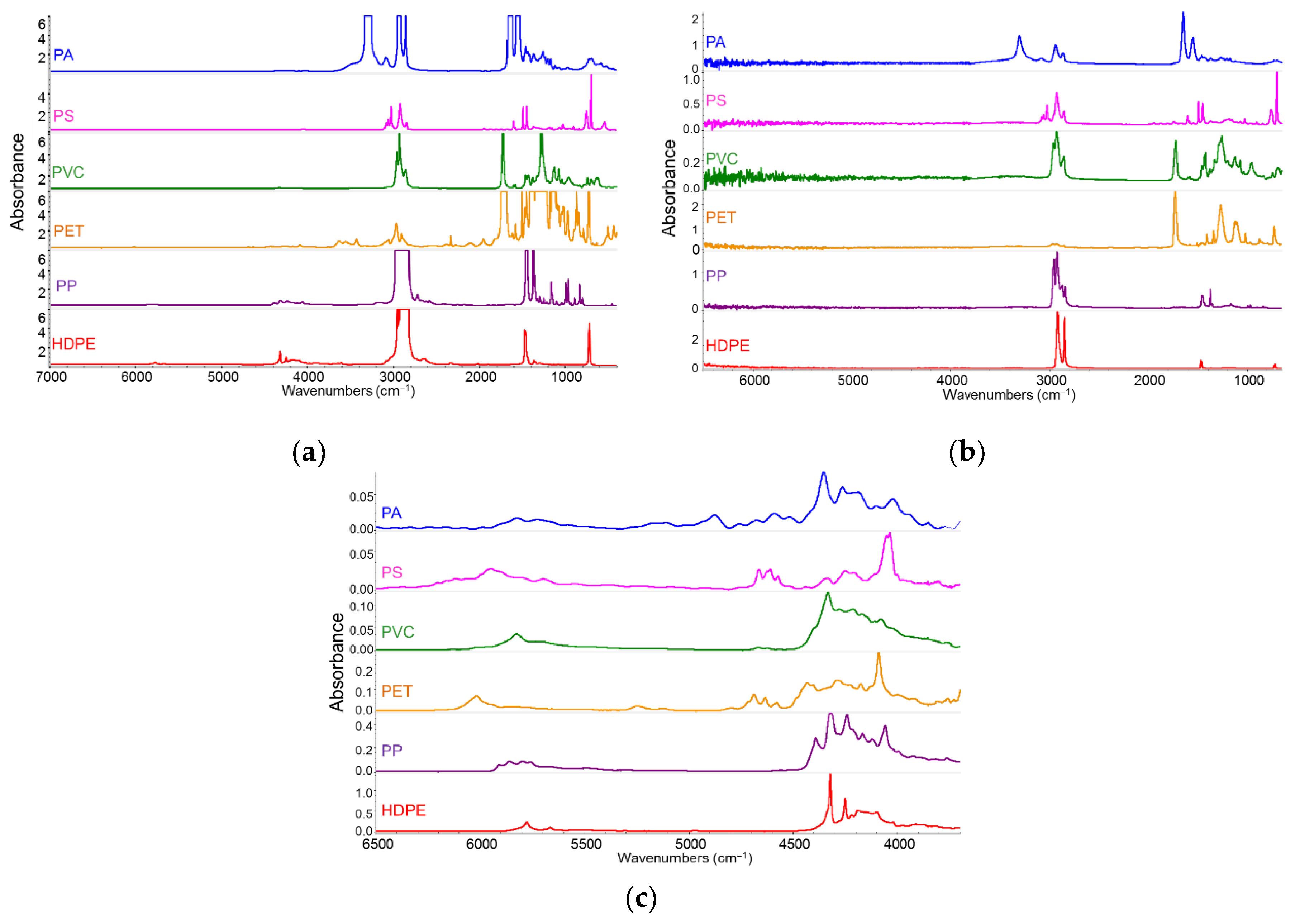
Figure 2.
Comparison of IR-ATR spectra of HDPE (red line) and LDPE (blue line) in the fingerprint region. Rocking and bending bands of CH₂ groups, which exhibit more pronounced crystal-splitting in the case of HDPE, are highlighted. The dashed line indicates the bending “umbrella”band associated with the presence of methyl groups, which is particularly prominent in LDPE.
Figure 2.
Comparison of IR-ATR spectra of HDPE (red line) and LDPE (blue line) in the fingerprint region. Rocking and bending bands of CH₂ groups, which exhibit more pronounced crystal-splitting in the case of HDPE, are highlighted. The dashed line indicates the bending “umbrella”band associated with the presence of methyl groups, which is particularly prominent in LDPE.
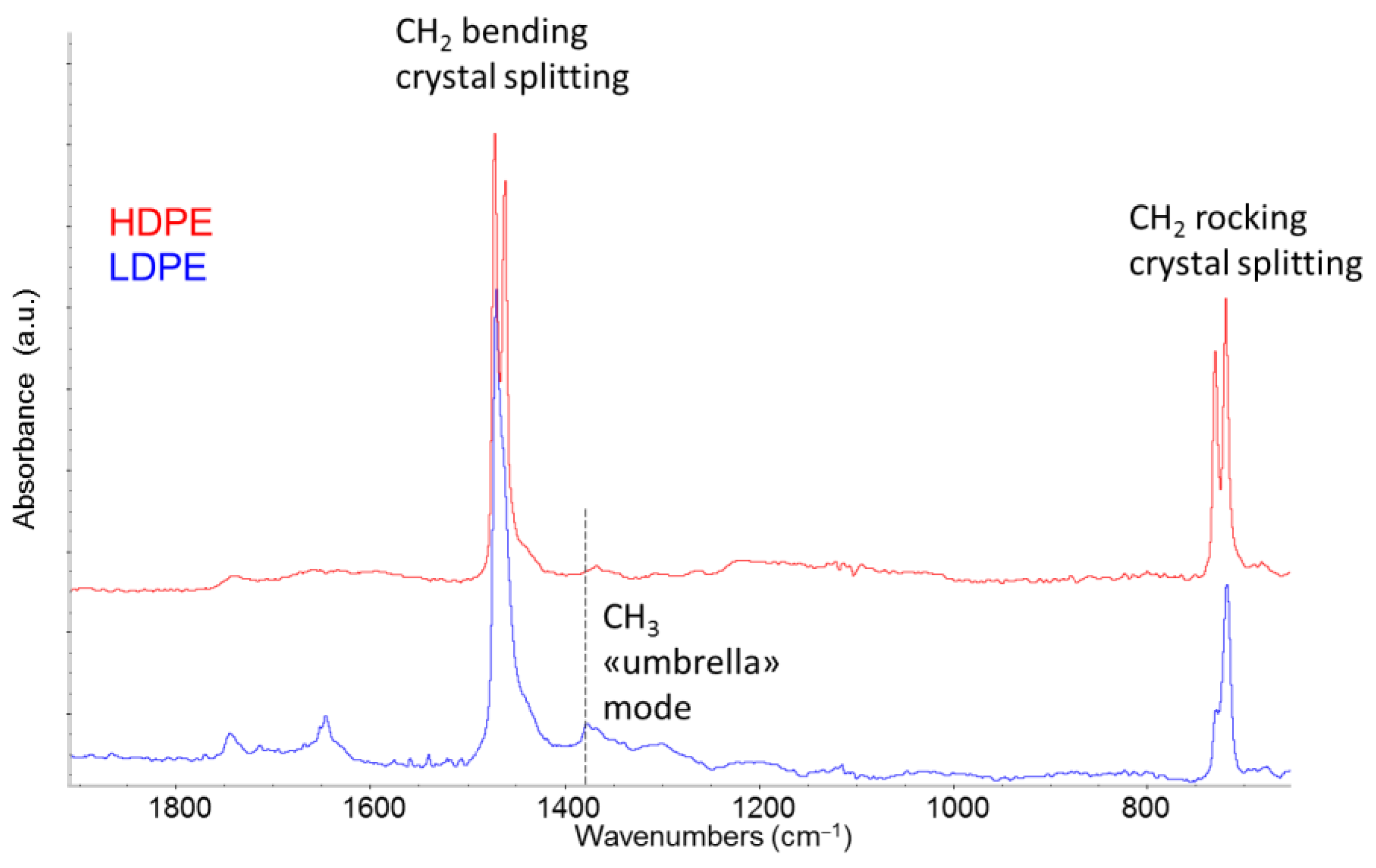
Figure 3.
Comparison of ATR infrared spectra of two commercial recycled HDPE (R-HDPE) pellets from different sources (purple and red lines) and a virgin HDPE sample (blue line). The inset shows a zoomed view of the spectra in the fingerprint region.
Figure 3.
Comparison of ATR infrared spectra of two commercial recycled HDPE (R-HDPE) pellets from different sources (purple and red lines) and a virgin HDPE sample (blue line). The inset shows a zoomed view of the spectra in the fingerprint region.
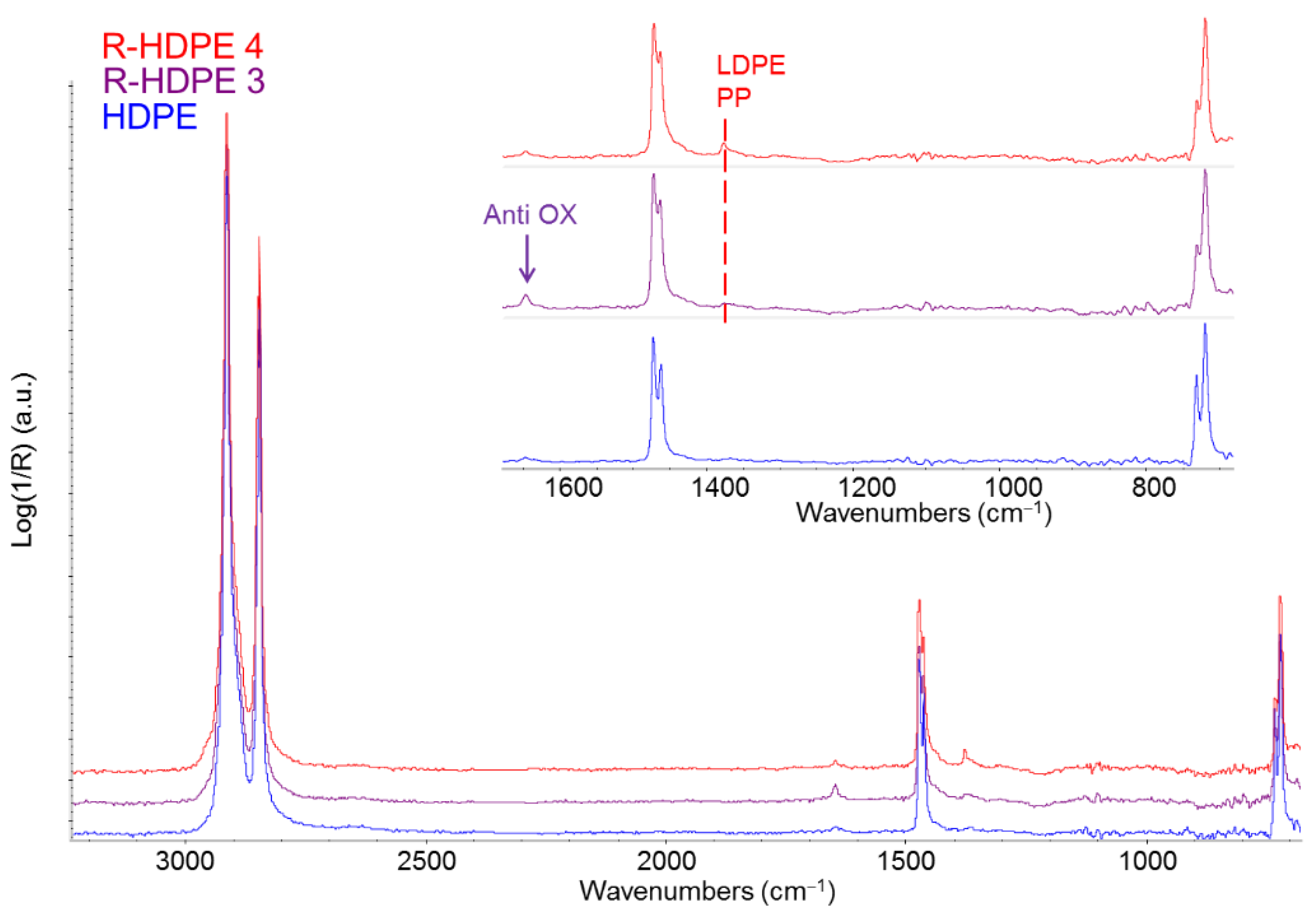
Figure 4.
Comparison of ATR infrared spectra of two commercial recycled HDPE (R-HDPE) pellets from different sources and a virgin HDPE sample (red line) in the 1600 – 1250 cm-1 region.
Figure 4.
Comparison of ATR infrared spectra of two commercial recycled HDPE (R-HDPE) pellets from different sources and a virgin HDPE sample (red line) in the 1600 – 1250 cm-1 region.
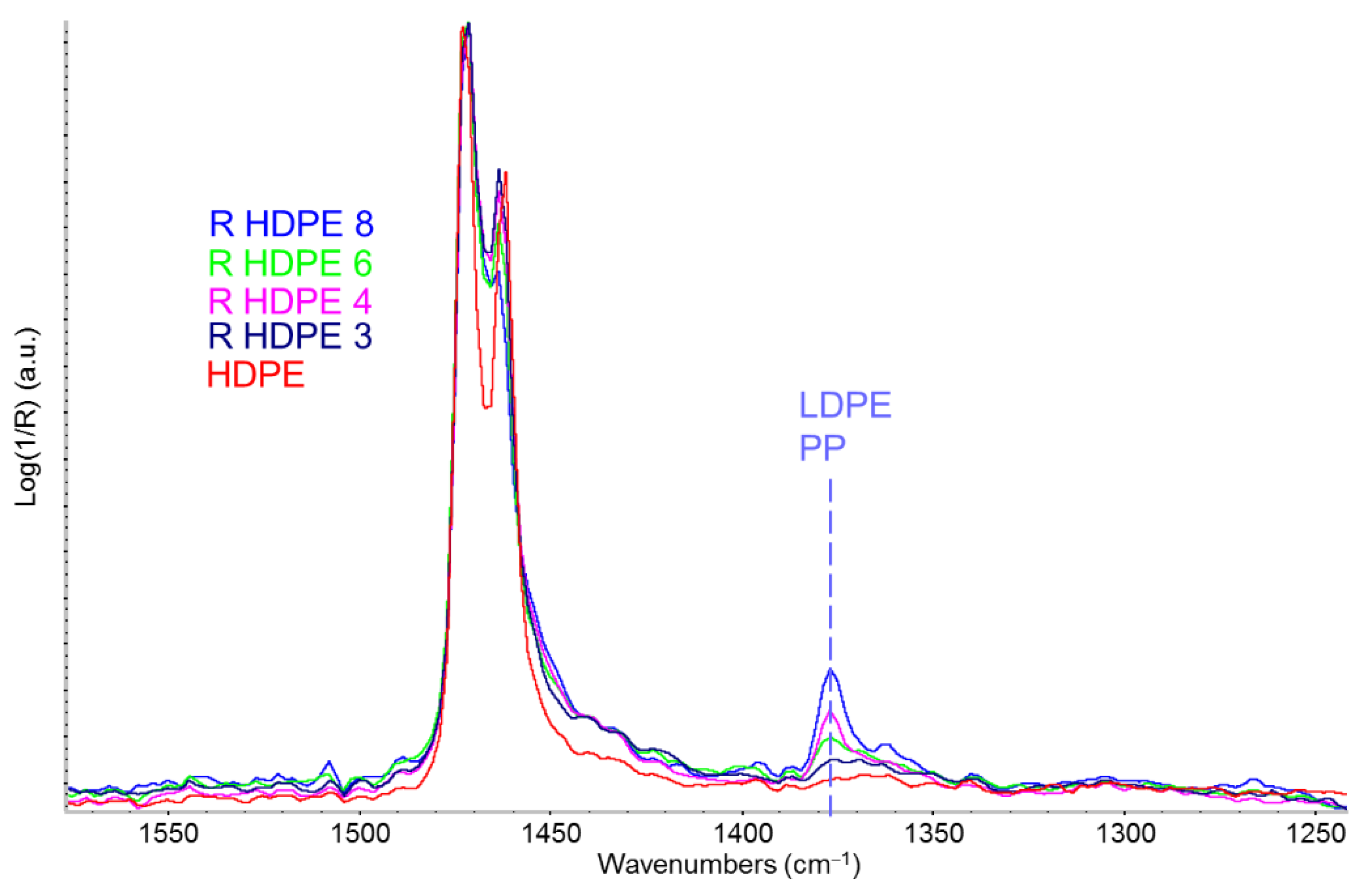
Figure 5.
IR-ATR spectra (fingerprint region) of various pellets from the same R-HDPE batch. Absorptions related to additives or contamination are highlighted by dashed circles.I 3.2. Figures, Tables and Schemes.
Figure 5.
IR-ATR spectra (fingerprint region) of various pellets from the same R-HDPE batch. Absorptions related to additives or contamination are highlighted by dashed circles.I 3.2. Figures, Tables and Schemes.
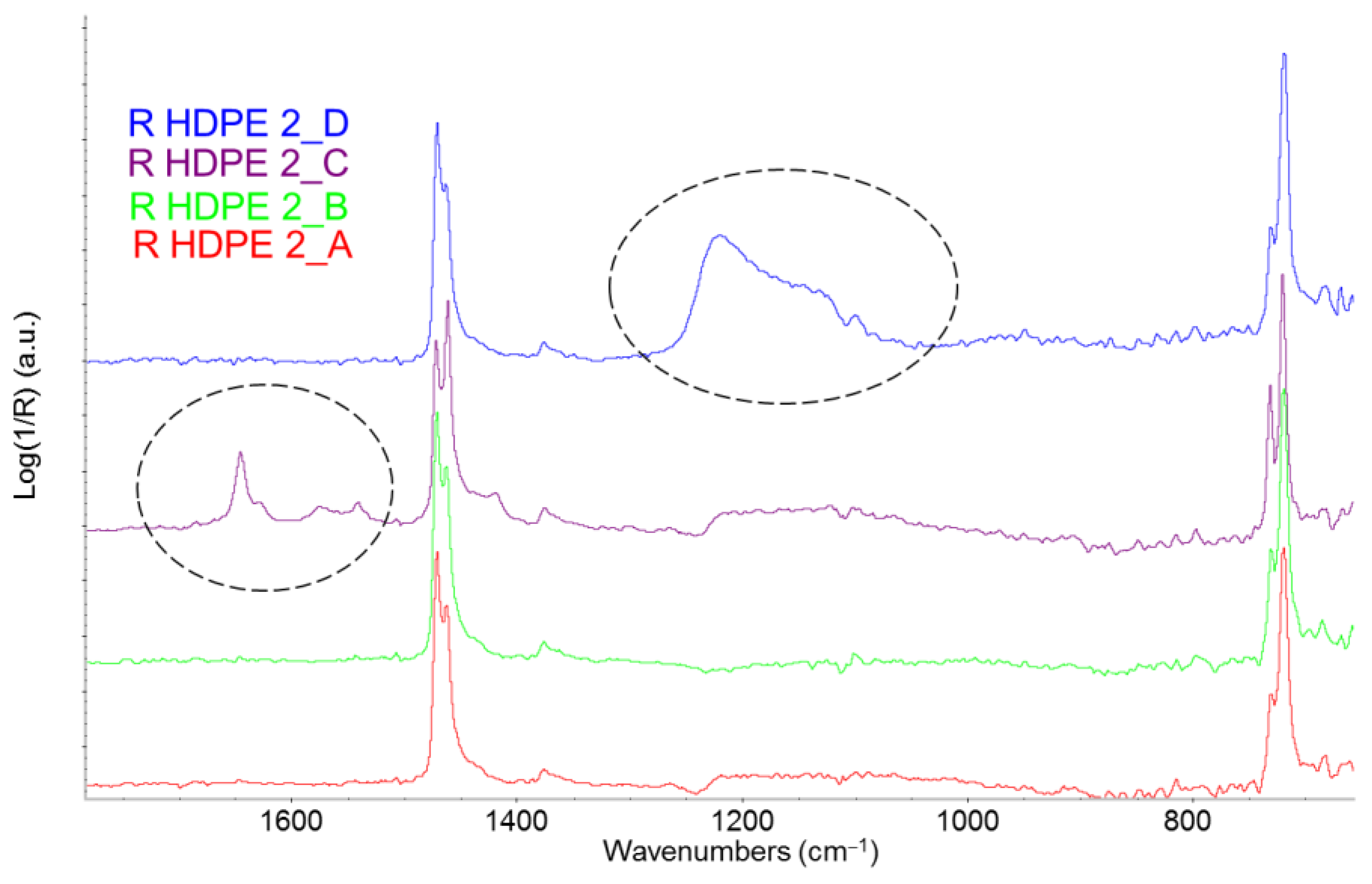
Figure 6.
Comparison of IR spectra of R-HDPE samples with those of virgin HDPE (red line) and virgin polypropylene (PP, blue line). Spectra were recorded in transmission mode on films obtained by compression moulding from the pellets. The dashed lines highlight characteristic absorption peaks of PP.
Figure 6.
Comparison of IR spectra of R-HDPE samples with those of virgin HDPE (red line) and virgin polypropylene (PP, blue line). Spectra were recorded in transmission mode on films obtained by compression moulding from the pellets. The dashed lines highlight characteristic absorption peaks of PP.
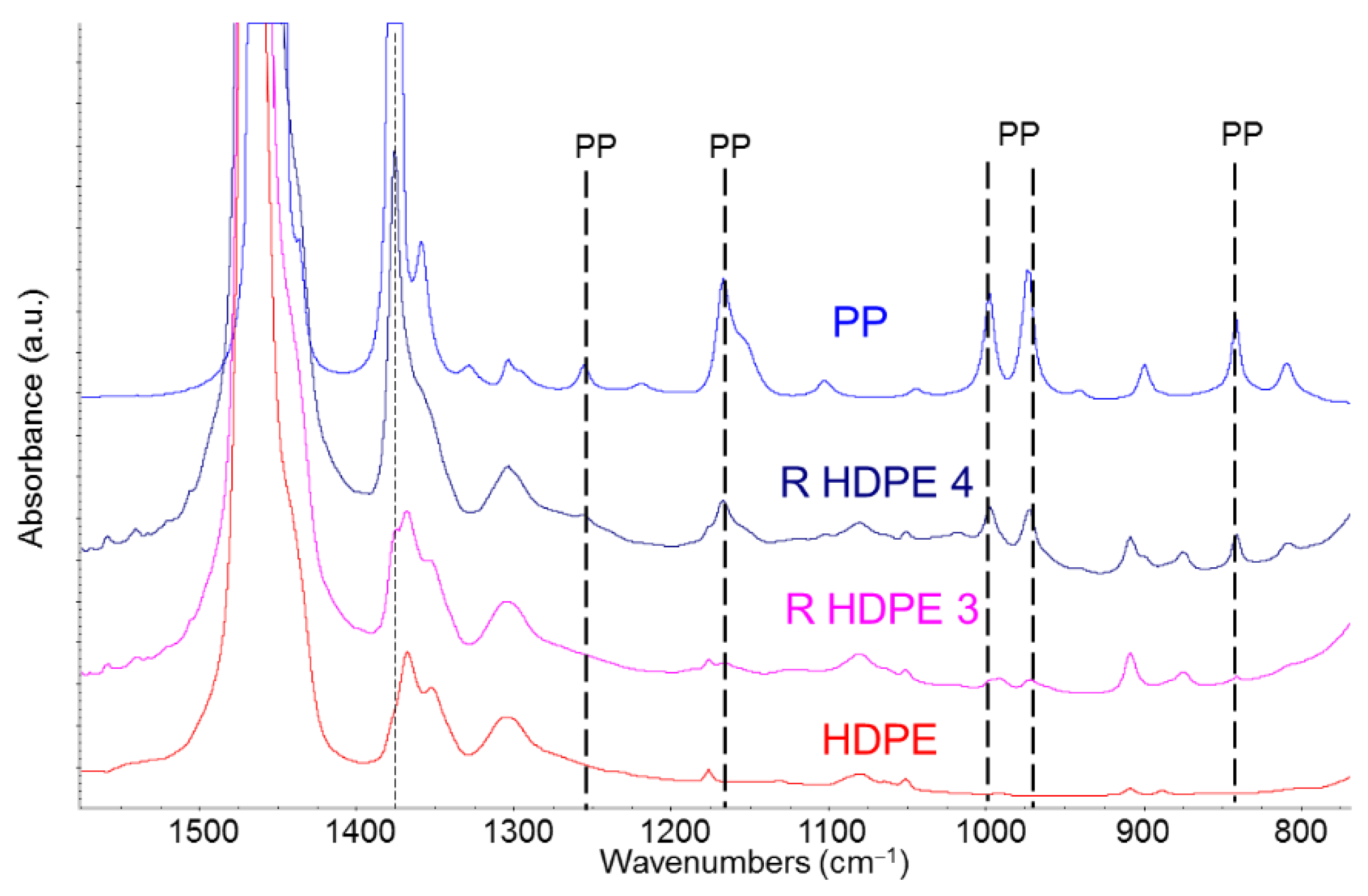
Figure 7.
IR-NIR spectra (transmission mode) of: (a) reference samples (HDPE/PP mixtures) and (b) R-HDPE samples. Zoom of the IR spectra in the fingerprint region: (c) reference samples (d) R-HDPE samples.
Figure 7.
IR-NIR spectra (transmission mode) of: (a) reference samples (HDPE/PP mixtures) and (b) R-HDPE samples. Zoom of the IR spectra in the fingerprint region: (c) reference samples (d) R-HDPE samples.
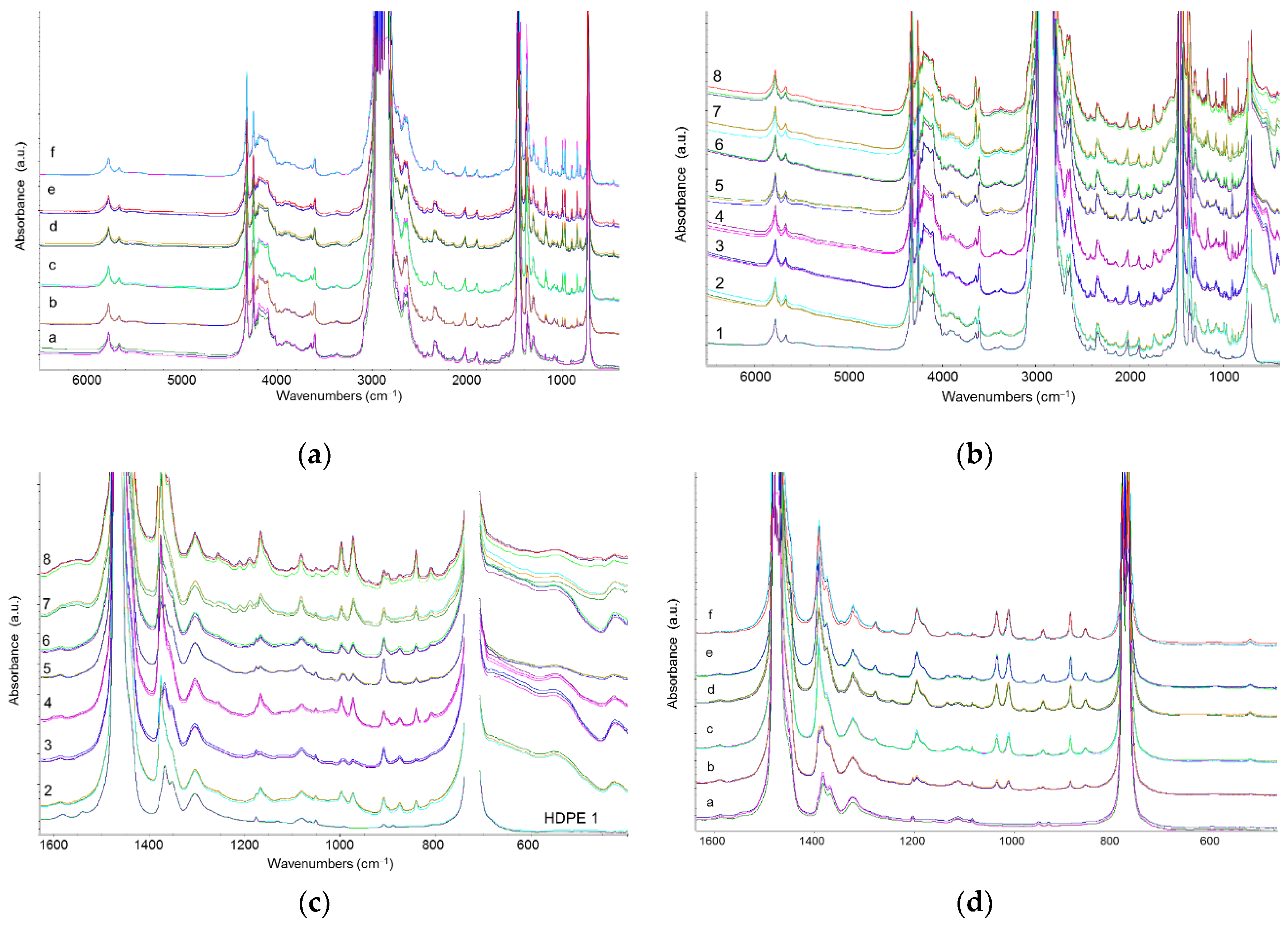
Figure 8.
NIR spectra (6200–4800 cm⁻¹ region, recorded in transmission mode) of: (a) reference samples (HDPE–PP mixtures) and (b) R-HDPE samples. Panel (c) illustrates the procedure used to measure the height of representative peaks.
Figure 8.
NIR spectra (6200–4800 cm⁻¹ region, recorded in transmission mode) of: (a) reference samples (HDPE–PP mixtures) and (b) R-HDPE samples. Panel (c) illustrates the procedure used to measure the height of representative peaks.
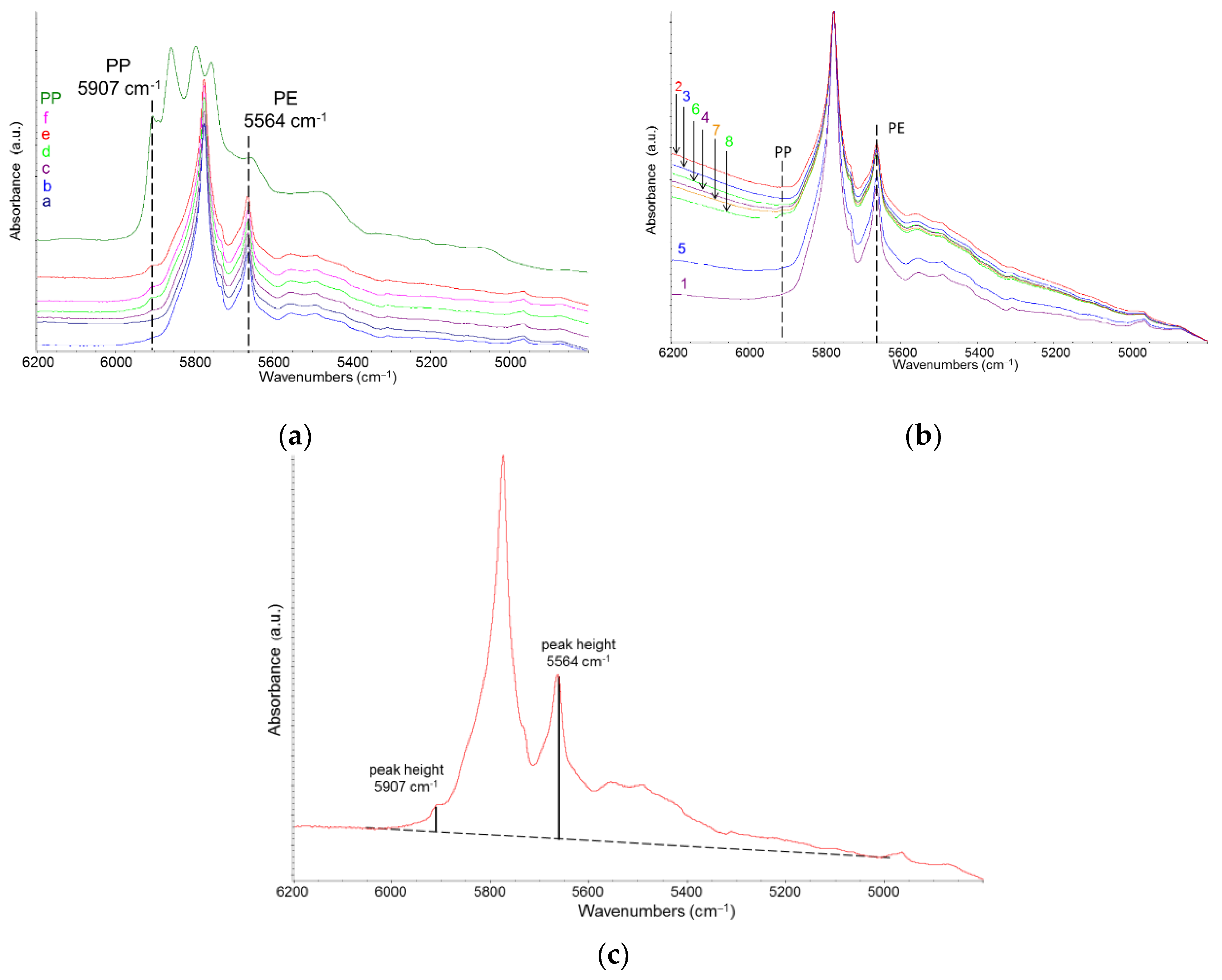
Figure 9.
Calibration curve based on the ratio measured from the reference samples.
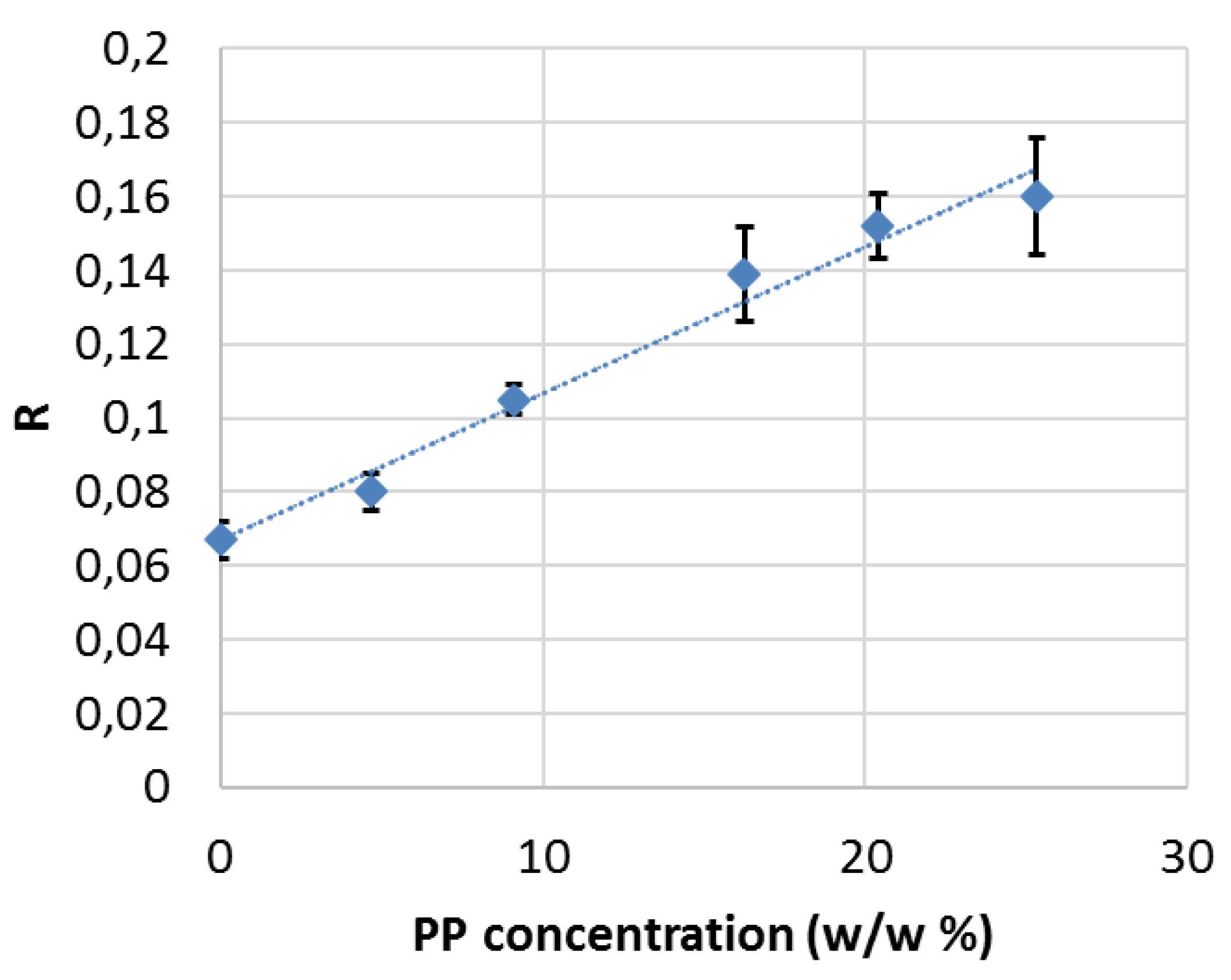
Figure 10.
IR spectra of a Carilon® plate. Green line: spectrum of the unaged sample; blue line: spectrum of the top surface, directly exposed to sunlight, after 7944 hours of outdoor weathering; red line: spectrum of the bottom surface, not directly exposed to sunlight, after 7944 hours of outdoor weathering; magenta line: spectrum of the melted sample, showing spectral features associated with the amorphous phase.
Figure 10.
IR spectra of a Carilon® plate. Green line: spectrum of the unaged sample; blue line: spectrum of the top surface, directly exposed to sunlight, after 7944 hours of outdoor weathering; red line: spectrum of the bottom surface, not directly exposed to sunlight, after 7944 hours of outdoor weathering; magenta line: spectrum of the melted sample, showing spectral features associated with the amorphous phase.
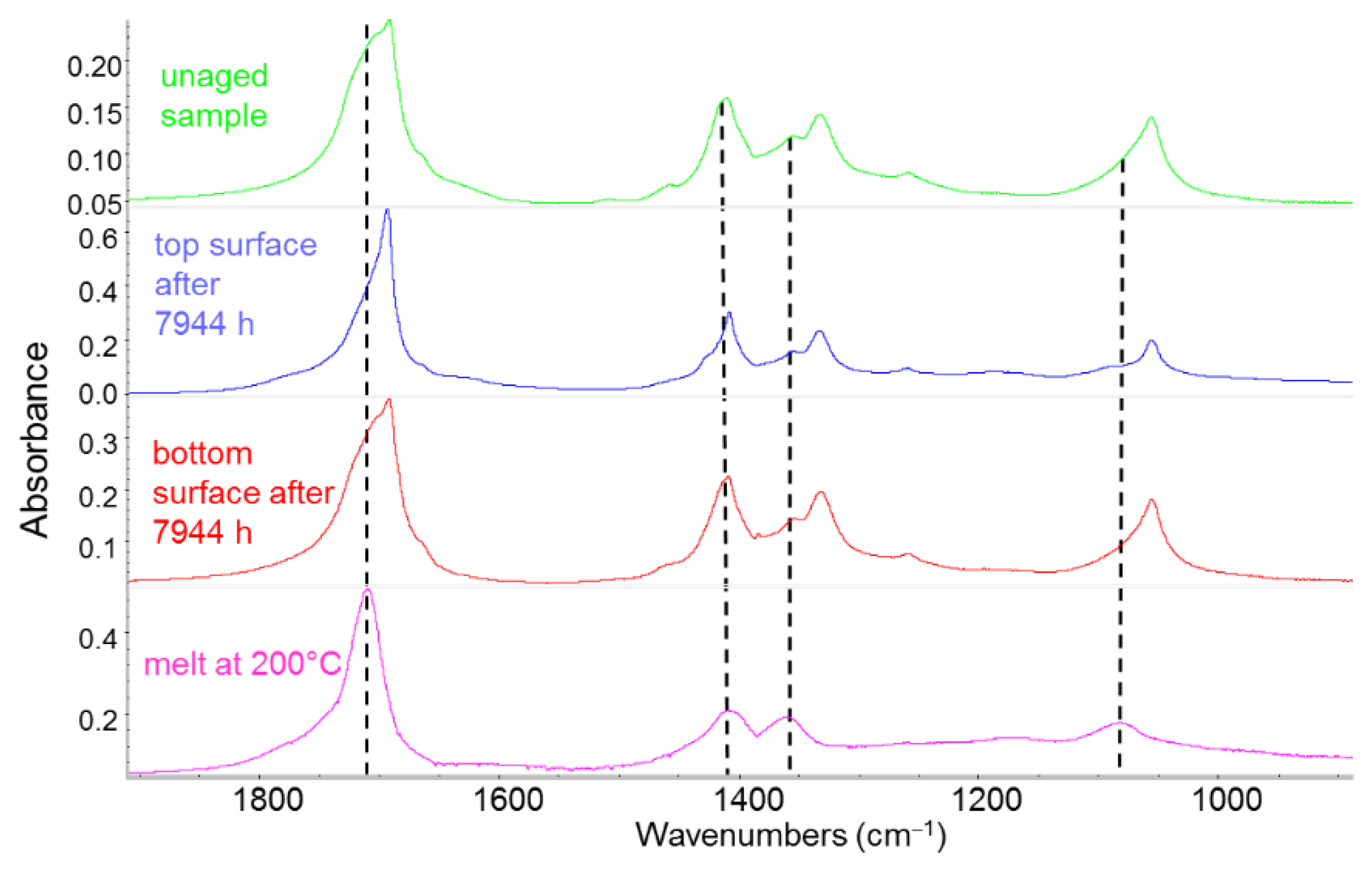
Figure 11.
IR spectra of an isotactic polypropylene plate. Red line: spectrum of the unaged sample; green line: spectrum of the bottom surface, not directly exposed to sunlight, after 5016 hours of outdoor weathering; yellow line: spectrum of the top surface, directly exposed to sunlight, after 5016 hours of outdoor weathering. The samples exposed outdoors show the characteristic C=O stretching band around 1700 cm⁻¹, whose intensity indicates greater polymer oxidation on the surface directly exposed to sunlight.
Figure 11.
IR spectra of an isotactic polypropylene plate. Red line: spectrum of the unaged sample; green line: spectrum of the bottom surface, not directly exposed to sunlight, after 5016 hours of outdoor weathering; yellow line: spectrum of the top surface, directly exposed to sunlight, after 5016 hours of outdoor weathering. The samples exposed outdoors show the characteristic C=O stretching band around 1700 cm⁻¹, whose intensity indicates greater polymer oxidation on the surface directly exposed to sunlight.
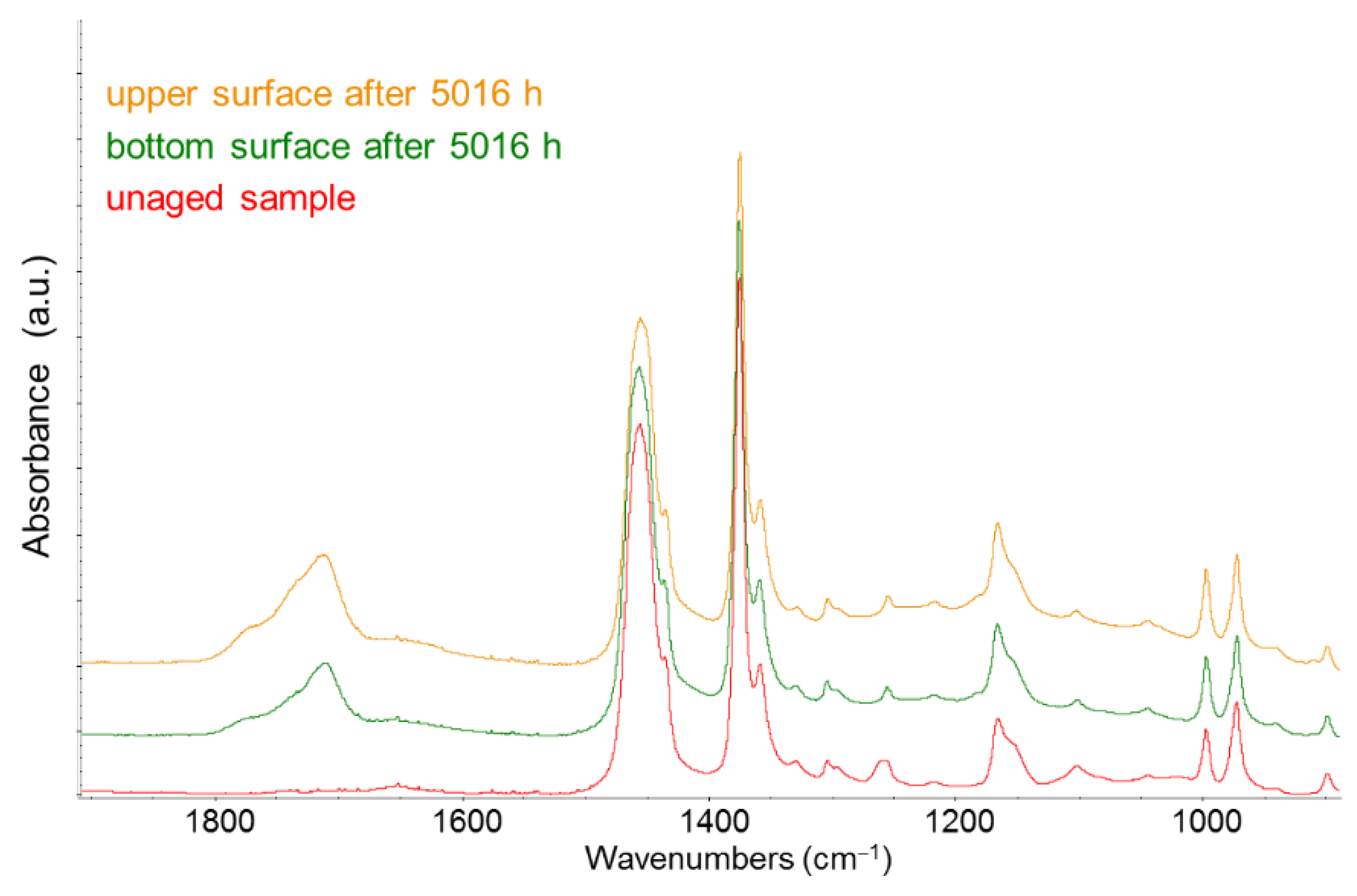

Table 1.
Composition of reference samples prepared by mixing virgin HDPE and PP powders and data (intensity atios) used to build the calibration curve for estimating the PP fraction in R-HDPE samples.
Table 1.
Composition of reference samples prepared by mixing virgin HDPE and PP powders and data (intensity atios) used to build the calibration curve for estimating the PP fraction in R-HDPE samples.
| Sample | PP [mg] | HDPE [mg] | ||
| a | 0.0 | 160.5 | 0.00 | 0.067 |
| b | 7.0 | 149.4 | 4.69 | 0.080 |
| c | 13.8 | 151.5 | 9.11 | 0.105 |
| d | 19.6 | 120.5 | 16.27 | 0.139 |
| e | 27.8 | 136.2 | 20.41 | 0.152 |
| f | 26.9 | 106.2 | 25.33 | 0.160 |
Table 2.
Intensity ratios of the representative NIR bands of R-HDPE samples and PP fraction deduced by means of the calibration curve.
Table 2.
Intensity ratios of the representative NIR bands of R-HDPE samples and PP fraction deduced by means of the calibration curve.
| sample # | ||
| 8 | 0.124 | 14.25 |
| 4 | 0.107 | 10.00 |
| 7 | 0.089 | 5.50 |
| 3 | 0.08 | 3.25 |
| 6 | 0.078 | 2.75 |
| 2 | 0.077 | 2.50 |
| 5 | 0.073 | 1.50 |
| 1 | 0.068 | 0.25 |
Disclaimer/Publisher’s Note: The statements, opinions and data contained in all publications are solely those of the individual author(s) and contributor(s) and not of MDPI and/or the editor(s). MDPI and/or the editor(s) disclaim responsibility for any injury to people or property resulting from any ideas, methods, instructions or products referred to in the content. |
© 2025 by the authors. Licensee MDPI, Basel, Switzerland. This article is an open access article distributed under the terms and conditions of the Creative Commons Attribution (CC BY) license (https://creativecommons.org/licenses/by/4.0/).
Copyright: This open access article is published under a Creative Commons CC BY 4.0 license, which permit the free download, distribution, and reuse, provided that the author and preprint are cited in any reuse.


