1. Introduction
Umbilical cord blood (UCB) donation represents a critical resource in modern medicine due to its richness in hematopoietic stem cells, which serve as progenitors for all blood cell lineages [
1,
2]. These cells provide established, life-saving treatments for various severe congenital and acquired hematological disorders, such as leukemia, as well as immune deficiencies [
1,
2]. Beyond hematology recent research has expanded the therapeutic potential of UCB to include regenerative treatments for treating high-prevalence and high-mortality conditions including cardiovascular diseases [
3], neurodegenerative disorders [
4], and diabetes [
5].
Despite these advances, public UCB donation rates remain critically low in many countries, including Italy, where fewer than 3% of eligible births result in donation, and only approximately 5% of collected units meet transplantation criteria [
5,
6]. This underutilization is not solely attributable to clinical or biological factors but is influenced by complex informational, cultural, and organizational barriers that limit the engagement of expectant mothers [
7].
In Italy, the Italian Cord Blood Network (ITCBN), established in 2009, coordinates 18 public banks across 13 regions, connected to 269 collection centers [
8]. Although these centers account for 64% of national births, voluntary donation rates remain low, averaging below 3%, with only a small proportion of collected units banked for transplantation [
8,
9] Barriers include informational gaps, concerns for newborn safety, social factors, and logistical difficulties, often exacerbated by the organizational model where external midwives recruit donors sporadically, limiting effective patient engagement.
In Italy, UCB recruitment is frequently managed by external midwives funded through temporary research grants, who operate outside regular obstetric care workflows. This structural limitation reduces opportunities for trust-building and patient interaction, thus hindering effective donor recruitment [
18]. Within this context, two complementary approaches have gained attention for addressing the human and operational challenges in healthcare delivery: Narrative Medicine (NM) and Lean Management (LM). NM fosters empathetic listening and the co-construction of care pathways through patient storytelling, thereby improving communication and trust between patients and healthcare providers [
8,
11]. LM, originally developed for industrial efficiency, is increasingly applied in healthcare to identify and reduce inefficiencies, optimize organizational processes, may enhance donation rates by improving both patient engagement and operational efficiency [
12,
13].
This study investigates the combined application of NM and LM within the Obstetrics and Gynecology Department of the University Hospital of Alessandria, assessing its impact on UCB donation rates, patient satisfaction, and organizational performance. Our findings suggest that integrating these approaches creates a potentially replicable model to enhance both patient-centered care and operational efficiency in maternal health services.
2. Materials and Methods
Study Design and Setting
This prospective, single-center observational study was conducted at the Department of Obstetrics and Gynecology of the University Hospital of Alessandria, Italy. This research was approved by the Institutional Review Board of the University Hospital of Alessandria (n° 0021513). The study spanned from 1 July 2022 to 31 December 2024. The primary objective was to assess whether the integration of Narrative Medicine (NM) and Lean Management (LM) approaches would improve umbilical cord blood (UCB) donation and collection rates, as well as increase patient satisfaction and the perceived quality of care.
The secondary objective was to evaluate the quality of collected UCB units, defined as the proportion of donated units eligible for hematopoietic transplantation, according to standards established by the national cord blood banking guidelines.
Participants (StudyPopulation)
A total of 2,636 women who gave birth during the study period were included. Eligibility criteria for UCB donation followed national protocols and excluded individuals with medical or obstetric contraindications (e.g., infections, autoimmune conditions, fever during labor, or preterm birth).
Intervention
The intervention involved two key components:
1. Narrative Medicine Integration
Healthcare professionals—including physicians, midwives, and nurses—underwent NM training in collaboration with the Italian Society of Narrative Medicine (SIMeN). The training aimed to enhance empathetic listening, trust-building, and patient engagement through structured narrative workshops. These included close reading and reflection exercises using literature, visual arts, and cinema.
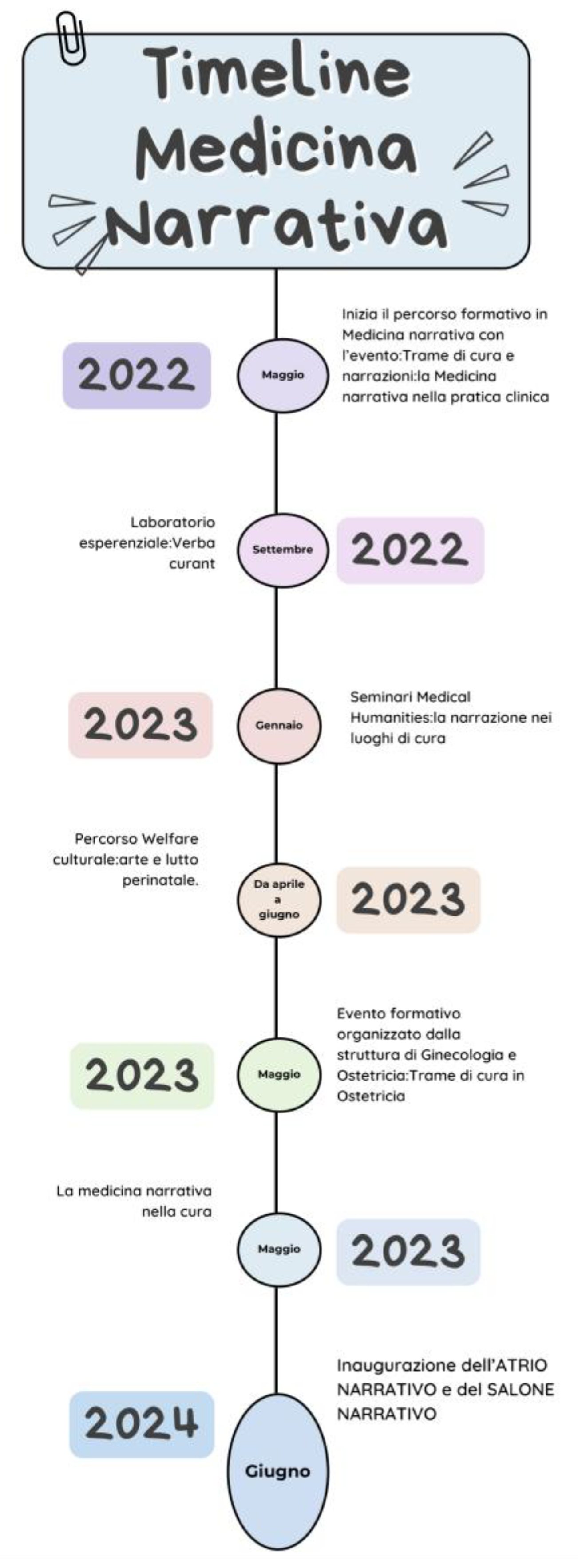
Figure 1.
Training pathway in Narrative Medicine.
Figure 1.
Training pathway in Narrative Medicine.
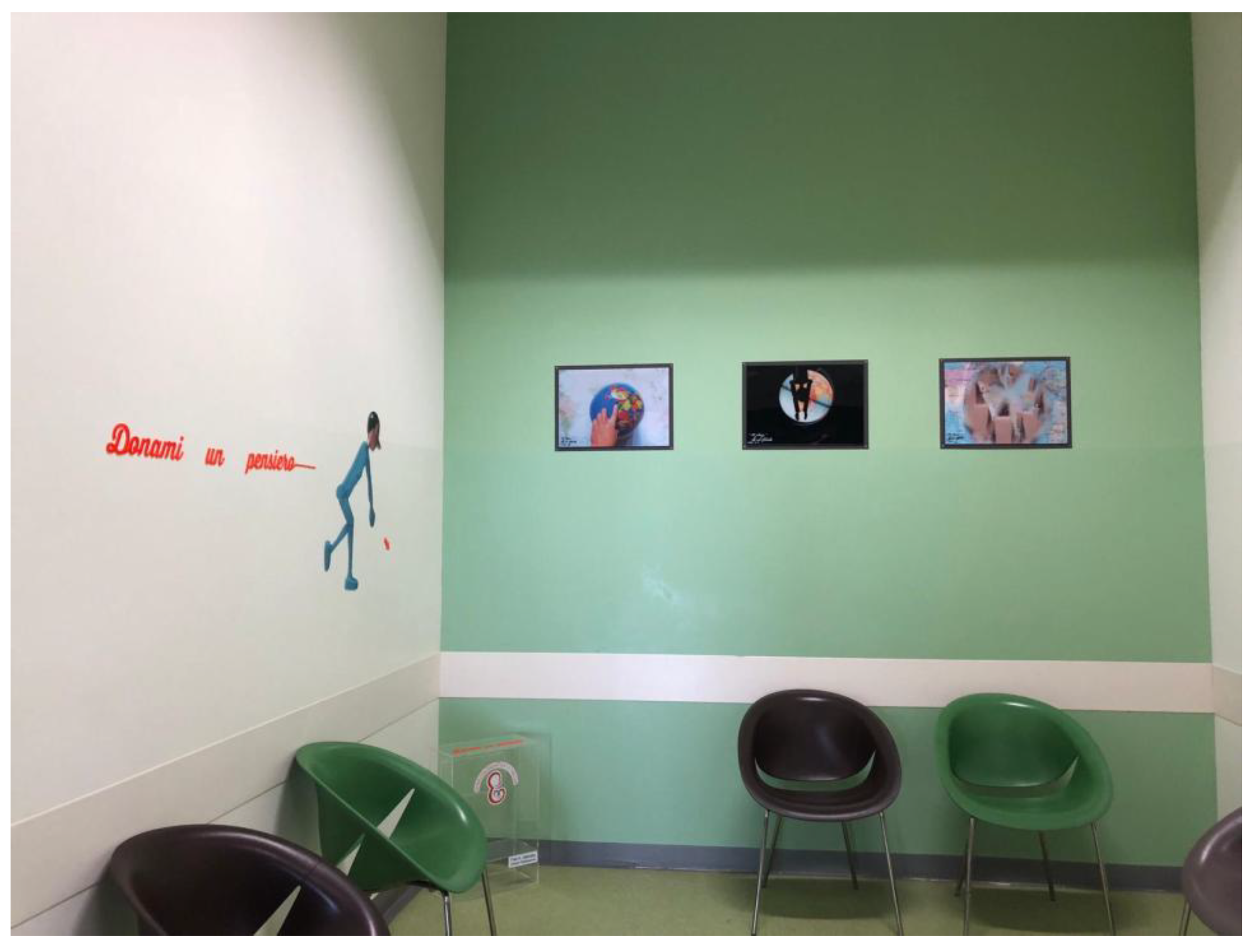
The hospital established two dedicated physical spaces to foster narrative practice:
Figure 2.
Narrative Atrium.
Figure 2.
Narrative Atrium.
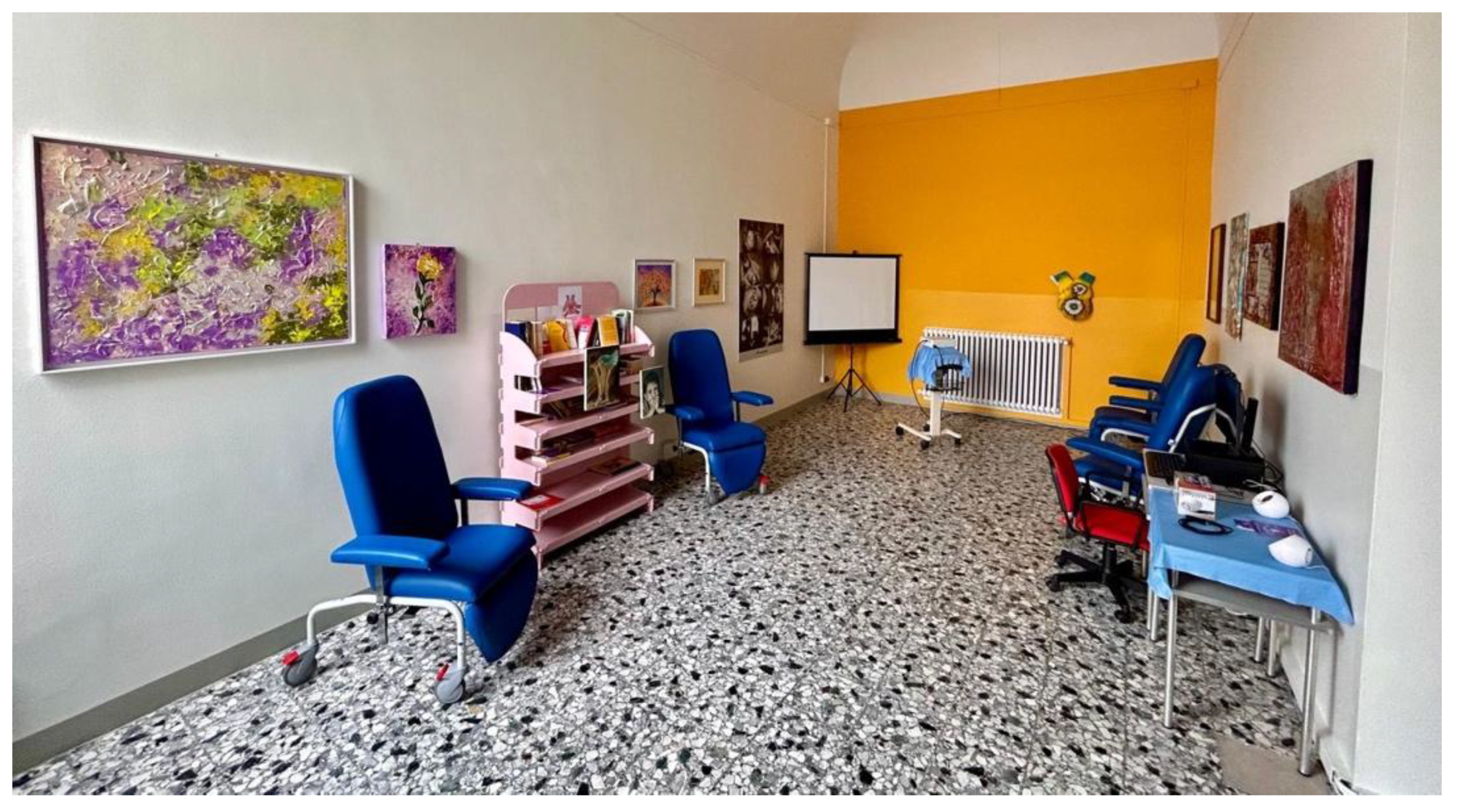
Narrative Hall: A therapeutic space for emotional expression through books, films, artwork, and narrative journals.
These initiatives built upon earlier NM experiences during the COVID-19 pandemic, which had revealed the importance of narrative-based care in supporting isolated mothers [
14].
Figure 3.
Narrative Hall.
Figure 3.
Narrative Hall.
2. Lean Management Implementation
In 2019, the department obtained “Advanced Level” certification in Lean Healthcare Management. Lean principles were applied to reorganize UCB donation workflows, emphasizing process mapping, waste reduction, and value creation for patients [
15,
16]. This included transitioning from reliance on an externally funded midwife via ADISCO ((Italian Association of Female Cord Blood Donors) to a multidisciplinary, in-house care team.
Key Lean components included:
Staff training and engagement
Process flow mapping and optimization
Standardization of procedures
Continuous quality improvement
Enhanced communication strategies
Informational and consent materials were incorporated into the hospital’s Birth Pathway and disseminated at multiple prenatal care points, including the first visit, the high-risk pregnancy clinic, the 34-week Health Check-Up Clinic, and during birth preparation classes.
Data Collection
Data were collected from institutional clinical records, donation registries, and patient-reported feedback. The following indicators were monitored:
Donation Rate: Number of successful donations relative to total births.
Collection Adherence Rate: Number of women who consented to donate UCB out of total deliveries.
Patient Satisfaction and Perceived Quality of Care: Measured via corporate satisfaction questionnaires and “PERLA – Person-Centered Care” surveys in collaboration with SIMeN (Italian Society of Narrative Medicine).
Transplant Eligibility: Proportion of collected UCB units banked for clinical use.
Table 1.
Umbilical Cord Blood Donation Collection Rates – University Hospital of Alessandria, 2007 to June 2022.
Table 1.
Umbilical Cord Blood Donation Collection Rates – University Hospital of Alessandria, 2007 to June 2022.
| YEAR |
NUMBER OF BIRTHS |
NUMBER OF DONATIONS |
COLLECTION RATE |
| 2007 |
1222 |
123 |
10.06% |
| 2008 |
1356 |
102 |
7.50% |
| 2009 |
1349 |
41 |
3.03% |
| 2010 |
1298 |
113 |
8.70% |
| 2011 |
1301 |
112 |
8.21% |
| 2012 |
1364 |
65 |
4.76% |
| 2013 |
1332 |
46 |
3.45% |
| 2014 |
1423 |
18 |
1.26% |
| 2015 |
1395 |
16 |
1.14% |
| 2016 |
1307 |
9 |
0.68% |
| 2017 |
1311 |
15 |
1.14% |
| 2018 |
1180 |
20 |
1.69% |
| 2019 |
1213 |
54 |
4.38% |
| 2020 |
1085 |
26 |
2.39% |
| 2021 |
1031 |
0 |
0% |
| 01/01-30/06/2022 |
516 |
0 |
0% |
Ethical Considerations
The study followed the principles of the Declaration of Helsinki. All participants provided informed consent for donation and participation in satisfaction assessments. Ethical approval was obtained from the institutional ethics committee of the University Hospital of Alessandria.
Data Analysis
Descriptive statistical analysis was performed to compare pre- and post-intervention outcomes. Donation and adherence rates, satisfaction scores, and transplant eligibility percentages were examined to evaluate the intervention's effectiveness in enhancing patient-centered care and operational performance.
3. Results
Participant Characteristics
Between 1 July 2022 and 31 December 2024, a total of 2,636 women gave birth at the University Hospital of Alessandria. All participants received information regarding umbilical cord blood (UCB) donation as part of their care pathway. No significant changes in the overall number of deliveries or patient demographic profile were observed compared to previous years.
Improvement in Donation Rates
Following the implementation of the Narrative Medicine and Lean Management interventions, there was a notable increase in UCB donation rates.
Pre-intervention donation rate (2021): 2.81%
Post-intervention donation rate (2023): 2.98%
Donation rate during study period (2022–2024): 4.5%, with 118 donations out of 2,636 births
This represents a 60% relative increase in the donation rate compared to the 2021 baseline, suggesting improved patient engagement and organizational efficiency.
Collection Adherence and Transplant Eligibility
Of the 118 UCB donations collected post-intervention:
Collection adherence rate (women who consented and followed through with donation): 100% among enrolled participants
Units eligible for transplant: 19 units (16.1% of donations) met the national quality criteria for transplantation, as assessed by the Regional Cord Blood Bank in Turin
This eligibility rate represents a
threefold improvement compared to the 2022 and 2023 national average (5–5.3%) [
8,
9].
Table 3.
Percentage of Cord Blood Units Eligible for Transplantation.
Table 3.
Percentage of Cord Blood Units Eligible for Transplantation.
| YEAR |
NUMBER OF UNITS DONATED |
ELIGIBLE UNITS |
ELIGIBLE UNIT RATE |
| 01/07/2022-31/12/2022 |
180 |
5 |
2.77% |
| 2023 |
270 |
15 |
5.55% |
| 2024 |
308 |
9 |
2.92% |
Patient Satisfaction and Perceived Quality of Care
Post-intervention evaluation using both institutional satisfaction surveys and the "PERLA – Person-Centered Care" questionnaires indicated:
90.3% of patients reported feeling well-informed about UCB donation
88.7% indicated they felt “actively listened to” by the midwifery team
92.5% rated their overall care experience as “excellent” or “very good”
Qualitative feedback highlighted the importance of the Narrative Atrium and Hall in promoting emotional safety and enhancing trust during the birth experience. Corporate customer satisfaction surveys revealed progressive improvement in patient-reported outcomes over the two-year intervention period. In particular, ratings related to the quality of the operator-patient relationship, clarity of communication, and emotional support showed statistically significant gains.
The department also participated in the national PERLA–SIMeN (Personalized and Person-Centered Care) initiative. Patient feedback collected through PERLA-specific tools led to the official PERLA Certification being awarded to the Department of Obstetrics and Gynecology on February 28, 2025, recognizing its excellence in patient-centered care practices.
Operational and Organizational Improvements
The integration of Lean Management principles led to several measurable improvements in workflow and care delivery:
Reduction in missed donation opportunities due to more consistent patient engagement throughout the prenatal pathway
Increased internal staff autonomy: trained in-house midwives replaced reliance on an external figure, ensuring continuity and sustainability of care and elimination of annual external grant costs (€5,000) for a dedicated midwife
Shortened collection procedure times, due to smoother and standardized processes
Increased process reliability and safety, as reported in internal observations. Staff reported greater motivation and ownership of the donation process, while delays caused by prior inefficiencies were notably reduced.
Standardized communication protocols and training improved interdepartmental coordination and reduced delays in consent and collection logistics
These organizational changes contributed to a more robust and patient-centered UCB donation process.
4. Discussion
This study demonstrates the effectiveness of an integrated approach combining Narrative Medicine (NM) and Lean Management (LM) in improving outcomes related to umbilical cord blood (UCB) donation within a hospital-based obstetric setting. Following the implementation at the University Hospital of Alessandria, we observed a significant increase in donation rates, improved patient satisfaction, enhanced quality of collected units, and greater organizational efficiency.
Integration of Humanistic and Operational Models
The use of
Narrative Medicine contributed to a more empathetic and trust-based clinician–patient relationship, which literature suggests is a key factor in increasing voluntary health behaviors [
12,
13,
17]. Training programs and the establishment of narrative spaces (e.g., the Narrative Atrium and Hall) created environments where patients felt heard, supported, and better informed, thus reducing emotional barriers to participation.
Simultaneously, the application of
Lean Management principles helped optimize workflow efficiency and staff engagement, aligning with previous research showing that LM can reduce waste and enhance care quality in obstetric and gynecological services [
15,
16]. By eliminating the dependency on externally funded personnel and integrating recruitment into routine care, the model became more sustainable and replicable.
Comparison with National and International Data
The post-intervention
donation rate of 4.5% and
16.1% of units eligible for transplantation compare favorably with national Italian averages (2.98% and 5%, respectively) [
8,
9]. These outcomes support the hypothesis that informational and organizational barriers, rather than clinical limitations, are the primary factors inhibiting public UCB donation—an argument also supported by earlier findings in Italy and other countries [
6,
7,
11].
Implications for Healthcare Delivery
This model highlights the potential of interdisciplinary strategies to improve both clinical outcomes and patient experience. The convergence of NM and LM addresses two traditionally separate domains—empathy and efficiency—proving that they can be mutually reinforcing when implemented cohesively. Moreover, the approach aligns with the person-centered care framework endorsed by PERLA–SIMeN, suggesting broader applicability across maternal health services.
Limitations
This study was conducted in a single center and may reflect context-specific strengths such as strong leadership, existing NM culture, and prior Lean certification. Additionally, the absence of a randomized control group limits causal inference. Nonetheless, the observational design allowed for real-time implementation and adjustment, enhancing ecological validity.
Future Directions
Further multi-center studies are warranted to validate the generalizability of these findings and assess long-term sustainability. Future research should also investigate the cost-effectiveness of this integrated model and its applicability in other areas of maternal–child healthcare, such as breastfeeding support or perinatal mental health.
5. Conclusions
The integration of Narrative Medicine and Lean Management within the Department of Obstetrics and Gynecology at the University Hospital of Alessandria led to measurable improvements in umbilical cord blood donation rates, patient satisfaction, and organizational efficiency. By combining empathetic patient engagement with streamlined operational workflows, the project successfully addressed both human and systemic barriers to UCB collection.
These findings offer a promising and replicable model for enhancing patient-centered care and clinical outcomes in maternal health settings. The success of this intervention suggests that multidimensional approaches—rooted in both communication and process management—can significantly improve participation in public health initiatives like UCB donation. Broader adoption of similar models, supported by institutional commitment and interprofessional collaboration, could help bridge the gap between scientific opportunity and real-world implementation in obstetrics.
Author Contributions
Conceptualization, D.D. and C.P; methodology, V.G.; software, J.P.; validation, D.D., G.S. and V.G.; formal analysis, B.F; investigation, E.R.; resources D.D.; data curation, M.T.; writing—original draft preparation, D.B.; writing—review and editing, D.D.; visualization, C.P.; supervision, M.D.; project administration, G.S.; All authors have read and agreed to the published version of the manuscript.”
Funding
This research received no external funding
Institutional Review Board Statement
The study was conducted according to the guidelines of the Declaration of Helsinki and approved on 26/06/2022 by the Institutional Review Board of the University Hospital of Alessandria (ASO. Gine.22.01)
Informed Consent Statement
Informed consent was obtained from all subjects involved in the study.
Data Availability Statement
The authors confirm that the data supporting the findings of this study are available within the article.
Acknowledgments
We thank Paola Barbero, Nadia Biancato, Laura Mazzucco, Antonella Dragonetti and Federico Genzano Besso for their technical support. We also thank Stefania Polvani for her kind contribution.
Conflicts of Interest
The authors declare no conflict of interest. The funders had no role in the design of the study; in the collection, analyses, or interpretation of data; in the writing of the manuscript, or in the decision to publish the results.
Abbreviations
The following abbreviations are used in this manuscript:
UCB
NM
LM |
Umbilical cord blood
Narrative Medicine
Lean Management |
| SIMeN |
Italian Society of Narrative Medicine |
| ADISCO |
Italian Association of Female Cord Blood Donors |
References
-
Zhu, X.; Tang, B.; Sun, Z. Umbilical cord blood transplantation: Still growing and improving. Stem Cells Transl Med. 2021 Nov;10 Suppl 2(Suppl 2):S62-S74. [CrossRef]
-
Tong, J.; Zhang, L.; Liu, H.; Xu, X.; Zheng, C.; Yao, W.; Zhu, X.; Tang, B.; Wan, X.; Song, K.; Zhang, X.; Sun, G.; Sun, Z. Umbilical cord blood transplantation can overcome the poor prognosis of KMT2A-MLLT3 acute myeloid leukemia and can lead to good GVHD-free/relapse-free survival. Ann Hematol. 2021 May;100(5):1303-1309. [CrossRef]
-
Copeland, N.; Harris, D., Gaballa, M.A. Human umbilical cord blood stem cells, myocardial infarction and stroke. Clin Med (Lond). 2009 Aug;9(4):342-345. [CrossRef]
-
Sanberg, P.R.; Eve, D.J.; Willing, A.E.; Garbuzova-Davis, S.; Tan, J.; Sanberg, C.D.; Allickson, J.G.; Cruz, L.E.; Borlongan, C.V. The treatment of neurodegenerative disorders using umbilical cord blood and menstrual blood-derived stem cells. Cell Transplant. 2011;20(1):85-94. [CrossRef]
-
Bi, Y.; Kong, R.; Peng, Y.; Yu, H.; Zhou, Z. Umbilical cord blood and peripheral blood-derived regulatory T cells therapy: Progress in type 1 diabetes. Clin Immunol. 2023 Oct;255:109716. [CrossRef]
-
Ballen, K.K.; Verter, F.; Kurtzberg, J. Umbilical cord blood donation: public or private? Bone Marrow Transplant. 2015 Oct;50(10):1271-1278. [CrossRef]
-
Committee on Obstetric Practice; Committee on Genetics. ACOG committee opinion number 399, February 2008: Umbilical cord blood banking. Obstet Gynecol. 2008;111 Pt 1:475–477.
-
Banche del Sangue di Cordone Ombelicale Report 2023, Centro Nazionale Sangue, Ministero della Salute. Available from Centro Nazionale Sangue report database: https://www.centronazionalesangue.it/rapporti-di-attivita-delle-banche-sco/#flipbook-df_18255/1/.
-
Banche del Sangue di Cordone Ombelicale Report 2022, Centro Nazionale Sangue, Ministero della Salute. Available from Centro Nazionale Sangue report database: https://www.centronazionalesangue.it/wp-content/uploads/2023/04/Banche-sco-Report-2022.pdf.
-
Benvenuti, M.; Cavallini, E.; Battello, G.; Zullo, F.; Driul, L.; Cromi, A.; Mannella, P.; Nappi, R.E.; Scambia, G.; De Franciscis, P.; Riemma, G.; A.G.U.I. (Associazione Ginecologi Universitari Italiani) Knowledge, Attitudes, and Practices of Pregnant Women and Hospital Staff Regarding Umbilical Cord Blood Banking: Systematic Review and Meta-Analysis. Healthcare (Basel). 2024 Oct 25;12(21):2131. [CrossRef]
-
Herlihy, M.M.; Delpapa, E.H. Obstetricians and their role in cord blood banking: promoting a public model. Obstet Gynecol. 2013 Apr;121(4):851-855. doi:10.1097/AOG.0b013e31828882aabanking: promoting a public model. Obstet Gynecol. 2013 Apr;121(4):851-85. [CrossRef]
-
Charon, R. Narrative Medicine: Honoring the Stories of Illness. Oxford University Press; 2006.
-
Greenhalgh, T. What is this thing called ‘lean’? J Health Serv Res Policy. 2013 Apr;18(2):128–131. [CrossRef]
-
Bolgeo, T.; Gambalunga, F.; Di Matteo, R.; Gatti, D.; Roberti, E.; Dealberti, D.; Fadda, B.; Grassi, E.; Gambarini, L.; Iacorossi, L.; Maconi, A. Becoming a mother during the COVID-19 pandemic: The lived experience as told by birthing mothers: A qualitative study. J Nurs Manag. 2022 Nov;30(8):4138-4144. [CrossRef]
-
Bacci, A. Lean Healthcare Management: meno sprechi, più competitività. Wolters Kluwer; 2017.
-
Boggetti, M. Pattern comportamentali: percorsi di eccellenza per guidare l’innovazione organizzativa. Edra; 2016.
-
Trenta, P. La postura narrativa: i modi di essere della cura. Castelvecchi; 2024.
-
Womack, J.P.; Jones, D.T.Lean Thinking: Banish Waste and Create Wealth in Your Corporation. New York: Simon & Schuster; 1996. [CrossRef]
Table 2.
Umbilical Cord Blood Donation – Adherence and Collection Rates at the University Hospital of Alessandria, July 1, 2022–2024.
Table 2.
Umbilical Cord Blood Donation – Adherence and Collection Rates at the University Hospital of Alessandria, July 1, 2022–2024.
| YEAR |
NUMBER OF BIRTHS |
NUMBER OF DONATIONS |
COLLECTION RATE |
ADHERENCE RATE |
| 01/07-31/12/2022 |
584 |
180 |
30.8% |
40.4% |
| 2023 |
1046 |
270 |
25.8% |
39.8% |
| 2024 |
1006 |
308 |
30.6% |
41.6% |
|
Disclaimer/Publisher’s Note: The statements, opinions and data contained in all publications are solely those of the individual author(s) and contributor(s) and not of MDPI and/or the editor(s). MDPI and/or the editor(s) disclaim responsibility for any injury to people or property resulting from any ideas, methods, instructions or products referred to in the content. |
© 2025 by the authors. Licensee MDPI, Basel, Switzerland. This article is an open access article distributed under the terms and conditions of the Creative Commons Attribution (CC BY) license (http://creativecommons.org/licenses/by/4.0/).