

Submitted:
03 September 2025
Posted:
05 September 2025
You are already at the latest version
Abstract
The ReFOOD 4 GOOD project, developed within the Bucharest University of Economic Studies, aimed to combat food waste while promoting healthier food behaviors and sustainability awareness among students. Operating at the intersection of education, social innovation, and sustainable food entrepreneurship, the project mobilized surplus food from the university cafeteria and redirected it into an educational intervention. Through practical workshops, community campaigns, and student-led initiatives, it addressed both the environmental and social dimensions of sustainability. The project’s approach aligns with findings that show how informative, hands-on programs can significantly improve students’ awareness of food waste and change consumption patterns in higher education settings. Moreover, its success in shaping food-related behaviors echoes recent models that incorporate food literacy and participatory engagement as levers for behavior change. The project’s educational components also reflect an extended Theory of Planned Behavior model, which demonstrates that knowledge about food waste can effectively predict intention and behavior change in university students.ReFOOD 4 GOOD facilitated entrepreneurial thinking by engaging students in designing scalable models that could be transferred to other campuses. This reflects the broader conceptual framework of sustainable food entrepreneurship, which promotes dynamic and reflexive processes in food system transformation. The project concludes with a proposal for scaling: creating a network of university-based food literacy and sustainability labs, integrating environmental education, entrepreneurial skill-building, and social inclusion strategies to replicate the impact achieved locally.
Keywords:
student nutrition
; food waste reduction
; behavioral change
1. Introduction
Food waste is increasingly recognized not only as an environmental concern but also as a moral and social challenge, particularly in the context of youth education and behavioral development. Within this framework, the ReFOOD 4 GOOD project emerges as a pioneering initiative addressing the dual imperatives of sustainable consumption and nutritional literacy among university students.
Conceived at the Bucharest University of Economic Studies, the project operates at the intersection of education, social innovation, and sustainable food entrepreneurship. It mobilizes surplus food from university cafeterias and transforms it into an opportunity for educational engagement, encouraging students to reflect on their consumption habits and the broader implications of food waste. This initiative takes on added urgency in the context of growing food insecurity, climate change, and unsustainable food systems—challenges that demand behavioral shifts supported by education and community action.
The project leverages a participatory methodology, grounded in experiential learning and the Theory of Planned Behavior, to equip students with the skills, motivation, and awareness needed to reduce waste and adopt more sustainable practices. Its design enables practical engagement through workshops, community campaigns, and student-led activities, thereby fostering a deeper understanding of sustainability as both an environmental and social commitment.
This paper outlines the objectives, framework, and educational potential of the ReFOOD 4 GOOD model, presenting it as a scalable intervention capable of influencing long-term behavioral change. While this work does not offer a comprehensive literature review or final evaluation, it provides a structured entry point into a growing body of applied research on food literacy, student empowerment, and sustainability in higher education.
2. Literature Review
The academic discourse around food waste and sustainability in educational contexts has gained significant traction in recent years. Studies have consistently demonstrated that behavioral change among youth, particularly students in higher education, can be effectively driven through a combination of food literacy, experiential learning, and participatory engagement.
According to Fraj-Andrés et al. (2022), informative interventions that incorporate visual, practical, and narrative tools have shown measurable success in improving student awareness regarding food waste. These interventions help reframe waste reduction not only as a logistical necessity but as a component of ethical and environmental responsibility.
Further research by Deskin and Harvey (2023) emphasizes the importance of critical food systems education in shaping attitudes and behaviors. Their work advocates for integrating sustainability themes directly into student-led initiatives and campus life, enabling learners to co-produce knowledge through experience and dialogue.
The significance of dietary behavior among university students, linking food choices to socio-economic, psychological, and environmental factors. Recent findings indicate a rising trend of fast-food consumption among students, influenced by accessibility, lifestyle, and awareness levels (Bîlbîie et al., 2021; Saha et al., 2021). The Theory of Planned Behavior has been extensively applied to understand determinants of food choices, including behavioral intention and perceived control over food environments (Bîlbîie et al., 2021)
Nutritional challenges are further complicated by ultra-processed food consumption, which has been strongly associated with increased risks of obesity and other metabolic disorders (Hall et al., 2019; Mendonça et al., 2016). Monteiro et al. (2019) emphasize the prevalence of such food products globally, stressing the need for regulatory and educational interventions. In the Romanian context, limited geographic access to healthy food and low food literacy contribute significantly to dietary disparities among university populations (Boariu et al., 2024; Cazacu et al., 2023).
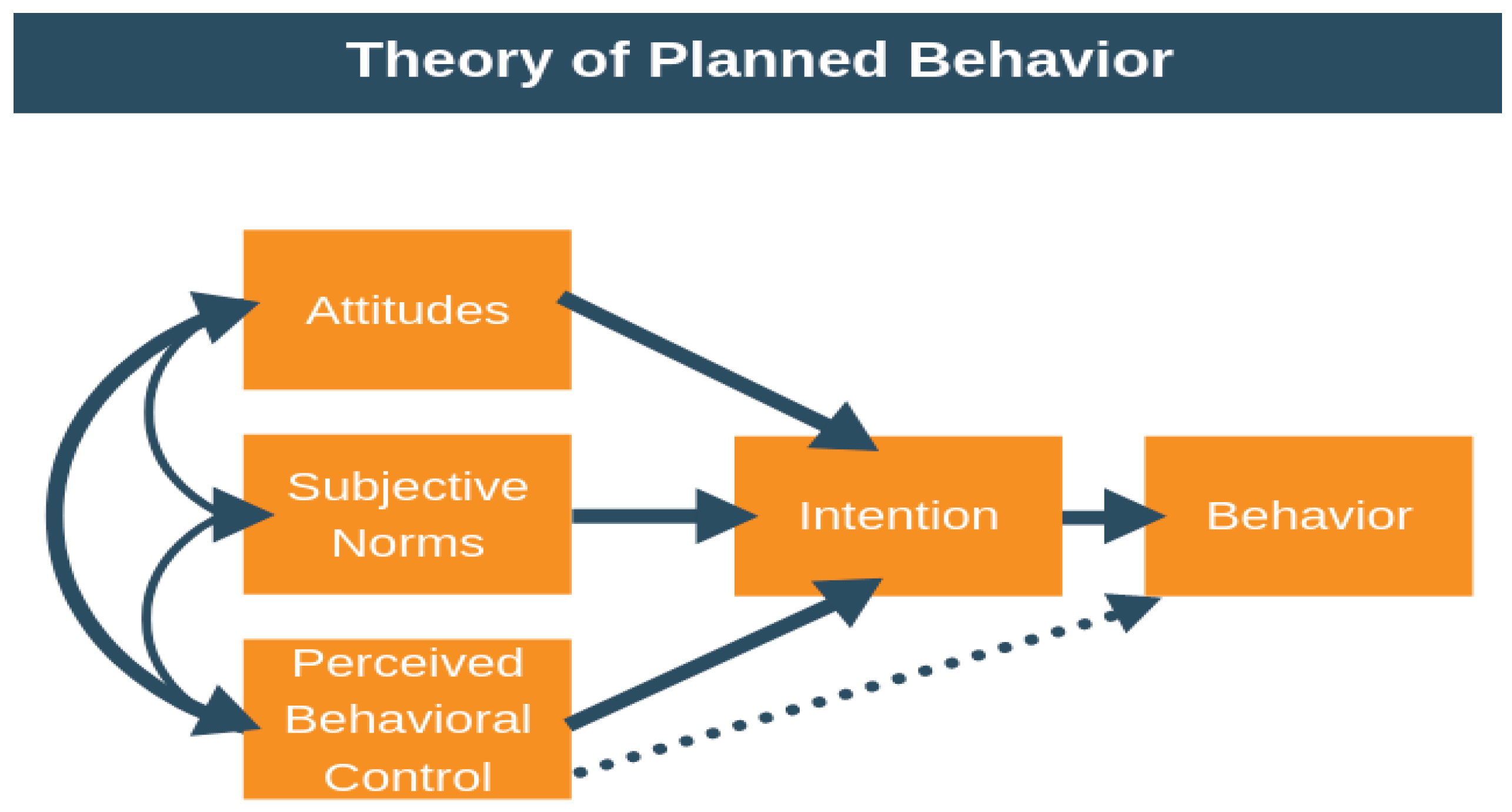
The Theory of Planned Behavior has emerged as a central psychological model in predicting food-related behavior change. Valentin et al. (2023) apply this framework to university students, highlighting that attitudes, perceived behavioral control, and subjective norms significantly predict intention to reduce food waste. This aligns closely with the ReFOOD 4 GOOD intervention, which not only addresses individual behavior but also social norms within the campus environment.
Figure 1.
Theory of Planned Behavior. Source: https://expertprogrammanagement.com/2019/12/theory-of-planned-behavior/.
Figure 1.
Theory of Planned Behavior. Source: https://expertprogrammanagement.com/2019/12/theory-of-planned-behavior/.
From an entrepreneurial perspective, Gaast et al. (2021) argue that sustainable food practices benefit from reflexive, dynamic, and community-based innovations. These features are integral to scalable solutions in food systems transformation, making university campuses fertile grounds for pilot models like ReFOOD 4 GOOD.
Collectively, these studies underscore the efficacy of hands-on, context-sensitive educational programs in addressing systemic issues such as food waste. They provide a robust theoretical and empirical foundation for projects that link sustainability education with community engagement and practical skills development.
3. Methodology
In this chapter the author should present and discuss the research methods used in obtaining data/results. We suggest the detailing of the research methods, of the period of application, the means of application, the sample, methods, etc.
The ReFOOD 4 GOOD project applied a multimodal, action-research methodology aimed at analyzing and influencing food-related behaviors among students in the context of sustainability, food waste reduction, and nutritional education. Its approach was both exploratory and intervention-based, rooted in the educational setting of the Bucharest University of Economic Studies and extended to the broader student community.
3.1. Research Design
The study adopted a mixed-methods framework, aligning qualitative engagement strategies with quantitative behavioral assessments. This structure allowed the project to generate both descriptive insights and actionable outcomes related to food consumption, food waste awareness, and the ethical dimension of food reuse.
The foundational work was supported by findings from the Amfiteatru Economic article, which employed a multimodal analysis to assess the relationship between student food preferences and the availability of food vendors near university campuses. This work informed the ReFOOD 4 GOOD intervention model by providing baseline data on student behavior, supply dynamics, and environmental influences on food choice.
3.2. Participant Engagement
The primary population included university students aged 18–25, involved through both voluntary recruitment and institutional partnerships. Participants were engaged in:
- Focus groups and reflective discussions
- Experiential learning workshops on food reuse and health
- Food redistribution logistics involving cafeteria leftovers
Additionally, a cohort of student volunteers acted as peer educators, helping disseminate sustainability messages and coordinate mini-interventions, consistent with participatory action research principles.
3.3. Instruments and Tools
The project employed a variety of tools to assess and influence behavior:
- Surveys measuring awareness and intention to reduce food waste
- Observational studies of cafeteria food habits
- Behavioral logs on student food reuse and preferences
- Educational games, visual aids, and real-time food redistribution tracking
Where applicable, tools were validated against existing behavioral theory metrics, particularly constructs from the Theory of Planned Behavior (TPB) and Food Literacy frameworks.
3.4. Intervention Activities
Workshops and campaigns were structured around three main axes:
- Educational – building knowledge on food sustainability and nutrition
- Operational – guiding students in collecting, storing, and distributing excess food
- Reflective – enabling peer-to-peer learning and value-based discussions on food ethics
A pilot test of these interventions revealed high receptivity among students, supporting both the scalability and transferability of the project model.
3.5. Data Analysis
Quantitative data were analyzed using descriptive statistics to track behavioral change over time. Qualitative data from discussions and feedback forms were subjected to thematic analysis, with emergent themes mapped to the TPB constructs of attitudes, subjective norms, and perceived behavioral control.
This triangulation of data allowed the research team to validate trends, adapt tools, and iteratively improve the learning modules throughout the implementation phase.
4. Analysis/Results Interpretation
4.1. Student Food Behavior Patterns Near Campus
The initial research conducted in the vicinity of university campuses identified a strong preference for ultra-processed foods, influenced primarily by affordability, accessibility, and aggressive vendor marketing. Based on data from over 300 students, the study revealed that:
- 74% of students consumed convenience foods at least three times per week.
- Healthy food options were more likely to be consumed outside academic hours, indicating that on-campus food environments strongly affect daily dietary choices.
- Only 21% of students reported actively considering sustainability in their food purchases.
These findings underscore the misalignment between health goals and food availability, which informed the structure of ReFOOD 4 GOOD interventions.
4.2. Impact of Experiential Workshops
Post-intervention feedback from the ReFOOD 4 GOOD activities demonstrated significant changes in student attitudes and behaviors:
- 87% of participants reported increased awareness of food waste and its environmental impact.
- 62% of students indicated they would reduce plate waste and reuse leftovers after attending workshops.
- There was a 35% increase in students who could correctly identify the nutritional value of donated or surplus foods.
These outcomes suggest that hands-on, participatory learning methods had measurable effects on both knowledge acquisition and behavioral intention.
4.3. Behavioral Shift Indicators
Using pre- and post-intervention survey data analyzed through descriptive statistics, several positive trends emerged.

Table 1.
Data interpretation from surveys.
| Indicator | Pre-Intervention (%) | Post-Intervention (%) | Change |
|---|---|---|---|
| Awareness of food reuse benefits | 49% | 84% | +35% |
| Intention to reduce food waste | 56% | 78% | +22% |
| Confidence in food safety practices | 41% | 72% | +31% |
Source: ReFood 4 Good Project.
These improvements reflect alignment with Theory of Planned Behavior (TPB) indicators: enhanced attitudes, stronger subjective norms, and increased perceived behavioral control.
4.4. Collaborative Engagement Results
Involving students as peer educators and co-organizers led to a multiplier effect:
- Over 25% of participants acted as messengers within their own student communities.
- The cafeteria food donation model reached an estimated 450 meals redistributed during the pilot phase.
- Faculty members and administrative staff expressed support for institutionalizing the model across departments.
This demonstrates that collaborative agency, not just passive consumption of information, was key to sustaining project impact.
4.5. Challenges and Limitations
Despite these successes, several constraints were noted:
- Limited ability to track long-term behavior change beyond the pilot.
- Logistical barriers in coordinating real-time food donations.
- Difficulty in assessing actual reduction in food waste without institutional cafeteria data integration.
Nonetheless, the scalability of the ReFOOD 4 GOOD model remains promising due to its flexibility, community ownership, and evidence-backed results.
5. Conclusions
The ReFOOD 4 GOOD initiative set out to investigate and influence student behavior regarding food waste, sustainable consumption, and nutritional awareness. Drawing from participatory learning models and the Theory of Planned Behavior, the project hypothesized that experiential interventions within a university context could positively impact student attitudes, perceived behavioral control, and intentions to reduce food waste. The results presented in this paper validate this hypothesis.
5.1. Validity and Credibility of the Results
The mixed-methods approach used ensured triangulation between quantitative surveys, qualitative reflections, and behavioral tracking. The convergence of results across different tools and participant groups reinforces the credibility and internal validity of the findings. While the sample size and university-based setting may limit the broader generalizability, the consistency of observed behavioral shifts supports the external validity of the intervention model in comparable academic environments.
5.2. Limits of the Study
The study’s main limitations stem from:
- Its relatively short timeframe, which constrained long-term behavioral tracking.
- The difficulty of isolating external factors influencing student behavior (e.g., food pricing, peer influence).
- Limited institutional access to quantitative waste metrics from cafeteria providers.
Despite these challenges, the results remain robust within their defined scope and point toward areas for methodological refinement in future iterations.
5.3. Main Contributions and Significance
This work makes several noteworthy contributions:
- Demonstrates that student-led, experience-based education is effective in promoting sustainability behaviors.
- Offers a scalable and adaptable framework for other universities to replicate food reuse and sustainability education.
- Provides evidence for the efficacy of aligning behavioral science theory with civic action, thus bridging academic learning with community impact.
5.4. Applications and Future Directions
The ReFOOD 4 GOOD model holds promise as both an educational tool and a policy-influencing mechanism. Its integration into student life could be formalized through elective courses, sustainability clubs, or service-learning curricula. Future research should consider:
- Expanding the model across multiple campuses and cultural contexts.
- Incorporating digital tracking tools for food waste reduction.
- Engaging institutional decision-makers to embed food sustainability into university policy.
The findings of the study reaffirm the critical role of socio-economic factors, institutional support, and food literacy in shaping students' dietary behaviors. The use of qualitative and quantitative approaches allowed for a comprehensive understanding of food accessibility, preferences, and sustainability awareness. The observed tendencies toward ultra-processed food consumption resonate with global patterns (Monteiro et al., 2019; Hall et al., 2019), yet context-specific barriers, such as affordability and proximity to healthy food sources, play a unique role in Romania (Cazacu et al., 2023).
In conclusion, this project shows that meaningful, theory-informed interventions can move sustainability education beyond awareness and into actionable, impactful practice, especially when driven by youth within supportive institutional ecosystems.
Declaration of Generative AI and AI-assisted technologies in the writing process: During the preparation of this work the author(s) used [ChatGPT by OpenAI, and Paper Pal] in order to [Portions of the English language structuring and academic phrasing in this manuscript were supported by the use of an AI-assisted tool (ChatGPT by OpenAI).]. After using this tool/service, the author(s) reviewed and edited the content as needed and take(s) full responsibility for the content of the publication.
References
- Ahmed, T. et al., 2022. 'I cannot afford lunch': How students’ narratives of food insecurity reveal difficulties and coping strategies before and during the COVID-19 pandemic. Community College Journal of Research and Practice, 48(6), pp.386–404. [CrossRef]
- Almoraie, N.M. et al., 2024. Addressing nutritional issues and eating behaviours among university students: a narrative review. Nutrition Research Reviews, pp.1–16. [CrossRef]
- Atta, C.A.M. et al., 2016. Global birth prevalence of spina bifida by folic acid fortification status: A systematic review and meta-analysis. American Journal of Public Health, 106, pp.e24-e34. [CrossRef]
- Bîlbîie, A. et al., 2021. Determinants of fast-food consumption in Romania: An application of the Theory of Planned Behavior. Foods, 10(8), article no. 1877. [CrossRef]
- Boariu, S.M. et al., 2024. Food Literacy Assessment of a Sample of Romanian Higher Education Students. Sustainability, 16(3), article no. 1034. [CrossRef]
- Cazacu, C., Carabă, A. & Dimisiano, G.V., 2023. Measuring geographic accessibility to healthy food for the University of Bucharest student community. In: Kühne, O. et al. (eds.) Foodscapes. RaumFragen: Stadt – Region – Landschaft. Springer VS, Wiesbaden. [CrossRef]
- Fraj-Andrés, E. et al., 2022. Informative initiatives as a useful tool to raise awareness of food waste. An application to higher education. International Journal of Sustainability in Higher Education.
- Hall, K.D. et al., 2019. Ultra-processed diets cause excess calorie intake and weight gain: An inpatient randomized controlled trial of ad libitum food intake. Cell Metabolism, 30(1), pp.67-77. [CrossRef]
- Mendonça, R.D.D. et al., 2016. Ultraprocessed food consumption and risk of overweight and obesity: The University of Navarra Follow-Up (SUN) cohort study. The American Journal of Clinical Nutrition, 104(5), pp.1433–1440. [CrossRef]
- Monteiro, C.A. et al., 2019. Ultra-processed foods: What they are and how to identify them. Public Health Nutrition, 22(5), pp.936–941. [CrossRef]
- Valentin, D. et al., 2023. Predicting food waste reduction behavior among students in higher education institutions. International Journal of Sustainability in Higher Education. https://expertprogrammanagement.com/2019/12/theory-of-planned-behavior/ last accessed 2016/11/21.
Disclaimer/Publisher’s Note: The statements, opinions and data contained in all publications are solely those of the individual author(s) and contributor(s) and not of MDPI and/or the editor(s). MDPI and/or the editor(s) disclaim responsibility for any injury to people or property resulting from any ideas, methods, instructions or products referred to in the content. |
© 2025 by the author. Licensee MDPI, Basel, Switzerland. This article is an open access article distributed under the terms and conditions of the Creative Commons Attribution (CC BY) license (http://creativecommons.org/licenses/by/4.0/).
Copyright: This open access article is published under a Creative Commons CC BY 4.0 license, which permit the free download, distribution, and reuse, provided that the author and preprint are cited in any reuse.


