

Submitted:
01 September 2025
Posted:
01 September 2025
You are already at the latest version
Abstract
Environmental education (EE) is central to achieving the Sustainable Development Goals (SDGs), particularly in contexts where inequalities constrain access to quality learning. This systematic review, conducted under PRISMA 2020, synthesizes 35 peer-reviewed studies and policy documents (2021–2024) to examine Morocco’s EE policies and practices in light of global frameworks and post-pandemic challenges. Findings reveal strong discursive alignment with SDG 4.7 and UNESCO’s ESD 2030 Roadmap but persistent implementation gaps. Rural and peri-urban schools face resource shortages, teacher training remains limited, and environmental clubs rely on short-term projects without stable institutional support. The COVID-19 pandemic exacerbated these challenges while opening opportunities to integrate health–environment education, digital tools, and adaptive pedagogies. To strengthen transformative EE, reforms should focus on participatory and place-based teacher education, institutionalization of environmental clubs, reduction of territorial inequalities, and creation of a national monitoring dashboard aligned with SDG 4.7. Expanding longitudinal and participatory research designs is also critical to capture causal dynamics and inform policy. By highlighting both systemic barriers and emerging opportunities, this review provides actionable directions for accelerating Morocco’s transition from informational to transformative EE, while offering transferable insights for other Global South contexts.
Keywords:
Environmental education
; Morocco
; Sustainable Development Goals (SDGs)
; post-pandemic resilience
; Teacher training
; Participatory governance
; Systematic review
; Equity
Introduction
Over the past two decades, environmental education (EE) has emerged as a critical pillar in the global response to escalating ecological crises—ranging from climate change and biodiversity loss to pollution and unsustainable resource use [1,2]. Framed within Education for Sustainable Development (ESD), EE seeks not only to transmit environmental knowledge, but also to foster the values, skills, and transformative agency required for sustainable societal transitions [3,4]. The United Nations Sustainable Development Goals (SDGs), and particularly target 4.7, underscore the need for inclusive and context-sensitive EE that promotes critical thinking, civic engagement, and the adoption of sustainable lifestyles.
While the global discourse emphasizes universal principles of sustainability, there is growing recognition that EE must be locally contextualized to address the socio-economic realities, governance structures, and cultural frameworks of specific countries. This challenge is particularly acute in Global South contexts, where structural inequalities, fragmented policy implementation, and limited educational resources can undermine transformative impact [5,6,7].
In Morocco, EE is embedded within national sustainability strategies, most notably the National Sustainable Development Strategy (NSDS, 2017) [8]. Initiatives such as the Eco-Schools programme, led by the Mohammed VI Foundation for Environmental Protection in collaboration with UNESCO and the Foundation for Environmental Education (FEE), have reached millions of students across thousands of schools, engaging them in hands-on projects on water conservation, waste reduction, and biodiversity protection [9]. Educational reforms have also integrated environmental content into formal curricula, including English as a Foreign Language (EFL) material. However, research shows that such integration often remains superficial, with limited contextual adaptation [10].
Despite these advances, systemic barriers persist. Uneven resource distribution, insufficient teacher training, and weak inter-institutional coordination limit the scalability and equity of EE programmes [11,12,13]. These challenges are especially pronounced in rural areas, where infrastructural deficits hinder access to quality EE and exacerbate territorial disparities.
The COVID-19 pandemic acted as both a stress test and a catalyst for change in Morocco’s EE landscape. Nationwide school closures and the rapid shift to remote learning exposed stark digital divides, disproportionately affecting rural and marginalized communities [14,15,16]. At the same time, the crisis amplified awareness of health–environment interlinkages, particularly regarding the safe management of medical waste from vaccination campaigns [17]. Conversely, the pandemic also stimulated innovation—prompting the adoption of hybrid learning, digital tools, and integrated health–environment teaching approaches [18,19,20].
Originality and Added Value of this Study
Although several previous studies have examined specific aspects of environmental education (EE) in Morocco—such as school-based environmental clubs, curricular integration, or one-off programme evaluations—none, to our knowledge, has combined a critical integrative review with the PRISMA 2020 protocol to provide a systemic vision that encompasses political, pedagogical, and institutional dimensions while integrating the post-pandemic perspective. This dual articulation—methodological rigour derived from a systematic review and a context-sensitive reading of Morocco’s socio-territorial realities—distinguishes the present study from existing reviews, including those conducted in other Global South countries.
Furthermore, this review adds comparative value by juxtaposing the Moroccan case with experiences from Africa, Asia, and Latin America, allowing the identification of transferable levers as well as Morocco-specific structural constraints.
Expected Operationalisation of the Findings
The conclusions of this review go beyond an academic diagnosis to propose concrete strategic directions that can be directly integrated into Moroccan educational policies:
- Reform of initial and in-service teacher training, embedding mandatory modules on participatory, place-based, and interdisciplinary EE approaches.
- Institutionalisation of environmental clubs through baseline funding, shared governance, and simplified monitoring and evaluation mechanisms.
- Reduction of territorial inequalities via “equity packages” (educational kits, connectivity, coaching) targeted at rural and peri-urban areas.
- Creation of a national EE indicator dashboard aligned with SDG 4.7 to guide funding allocations and strengthen accountability.
These directions, derived from the critical synthesis of 35 high-quality sources, provide policymakers, practitioners, and donors with an immediately actionable framework capable of accelerating the anchoring of an inclusive, resilient, and internationally aligned environmental education system.
This dual reality—persistent systemic limitations coupled with emerging opportunities—raises a critical research question:To what extent can Morocco’s environmental education framework, as currently designed and implemented, meet the requirements of SDG 4.7 while integrating the lessons learned from the COVID-19 crisis to strengthen equity, resilience, and transformative capacity?
1. Literature Review
2.1. Global Frameworks and Trends in Environmental Education
Internationally, environmental education (EE) has evolved from a knowledge-transmission model to a transformative, action-oriented approach aimed at fostering systemic thinking, civic engagement, and sustainable lifestyles [1,2]. Policies such as UNESCO’s ESD 2030 Roadmap and SDG target 4.7 advocate for locally contextualized, equity-driven EE that addresses both environmental and social justice dimensions. Comparative studies from the Global South (e.g., Kenya, Brazil, India) reveal recurring structural barriers—notably resource inequities, insufficient teacher training in participatory and place-based pedagogies, and fragmented governance structures—that limit the operationalization of global goals at national and local levels [4,21]. These patterns provide a broader systemic lens for situating the Moroccan case, highlighting the need for both global alignment and contextual adaptation.
2.2. The Moroccan Policy Landscape
Morocco has formalized its EE commitment through the National Sustainable Development Strategy [8] and collaborative initiatives such as the Eco-Schools programme [9]. While these frameworks provide policy legitimacy, international recognition, and a formal anchor to global sustainability agendas, empirical studies have found that their translation into school-level practice remains partial. Evidence points to persistent disparities between urban, peri-urban, and rural contexts; uneven teacher preparation in participatory and interdisciplinary approaches; and a dependence on short-term, project-based funding with limited [11,13,22]. This section builds directly on prior empirical research rather than solely summarizing policy texts, thereby clarifying the operational gap between strategic commitments and on-the-ground implementation.
2.3. COVID-19 as a Disruptive and Catalytic Force
The COVID-19 pandemic acted as both a stress test and a catalyst for innovation in EE. Internationally, remote learning revealed deep digital divides but also stimulated hybrid pedagogies, cross-disciplinary health–environment content, and community-based initiatives [17,18]. Moroccan studies report similar disruptions: school closures severely constrained EE continuity, particularly in underserved areas, while simultaneously creating opportunities to integrate public health themes, digital tools, and participatory environmental action at local levels [23,24]. This perspective extends prior scholarship by framing the pandemic not only as a challenge but also as an entry point for systemic resilience and innovation in Moroccan EE.
2.4. Research Gaps and Added Value of the Present Study
Despite the policy momentum and pandemic-driven adaptations, research on Moroccan EE remains fragmented and predominantly descriptive, with few studies adopting longitudinal or mixed-methods designs capable of capturing sustained behavioral and attitudinal change among learners. Equity dimensions—such as gender, socioeconomic background, and geographic location—are rarely disaggregated in reporting. Moreover, there is limited integration of health–environment synergies into EE practice, and few analyses bridge policy frameworks, pedagogical practices, and institutional governance in a unified framework.
This review addresses these gaps through a PRISMA-guided critical synthesis of 35 peer-reviewed studies and policy documents, offering a dual contribution:
- Mapping Morocco’s EE alignment with SDG 4.7 and the UNESCO ESD 2030 Roadmap, situating it within a comparative Global South perspective (Africa, Asia, Latin America).
- Proposing actionable reforms that are directly operationalizable in Moroccan educational policy and practice, including teacher training reform, institutionalization of school environmental clubs, targeted equity packages for underserved areas, and the creation of a national EE monitoring dashboard.
By articulating methodological rigor with contextual relevance, this study positions itself as both a scholarly contribution and a practical roadmap for accelerating the adoption of inclusive, resilient, and internationally aligned EE in Morocco.
2. Materials and Methods
This critical integrative review investigates how environmental education (EE) policies, programs, and pedagogical practices in Morocco align with international sustainability frameworks, while considering local socio-territorial realities and post-pandemic challenges. The reporting structure follows PRISMA 2020 guidelines [25] to ensure methodological transparency and reproducibility. The analysis is framed by the Sustainable Development Goals (SDGs)—particularly SDG 4.7 on inclusive and transformative education—and the UNESCO ESD 2030 Roadmap [1]
Three research questions guided the review:
- To what extent do Moroccan EE policies and practices align with global frameworks and post-pandemic priorities?
- What structural and institutional barriers (e.g., territorial inequalities, teacher capacity gaps, fragmented governance) limit equitable and context-sensitive EE?
- Which strategies—especially participatory, place-based, and justice-oriented approaches—can enhance EE’s transformative potential in Morocco?
2.1. Review Design and Rationale
An integrative review approach [26] was adopted to synthesize empirical studies, policy documents, and theoretical contributions, enabling a multi-dimensional understanding of the Moroccan EE landscape. The use of PRISMA 2020 [25] provided a structured audit trail from study identification to synthesis. A pre-defined protocol—including eligibility criteria, search strategies, and screening procedures—was developed before data collection (available upon request). To strengthen transparency, explicit reporting of quality score distributions by study type and criteria was planned [27]. The protocol was registered on the Open Science Framework (OSF) for traceability.
2.2. Search Strategy and Information Sources
A systematic search was conducted in Scopus, Web of Science Core Collection, ERIC, ProQuest Education Database, Education Source (EBSCO), ScienceDirect, and SpringerLink, complemented by Google Scholar for additional coverage. National repositories, including the Ministry of National Education and the Mohammed VI Foundation for Environmental Protection, were also consulted [22].
The search period spanned January 2000 to December 2024, with the last update on 31 December 2024. The year 2000 was chosen as a starting point because it marked the launch of Morocco’s National Charter for Education and Training and the first environmental education initiatives aligned with Agenda 21.
Search queries combined thematic keywords with Boolean operators (e.g., “environmental education” AND Morocco/Maroc, “education for sustainable development”, “post-pandemic” AND youth AND environmental behavior). Exact database-specific queries, execution dates, and retrieval counts are provided in Supplementary Table S1.
Both English and French sources were considered. Arabic-only publications were excluded due to translation constraints, but abstracts were screened where available to partially mitigate language bias (see Risk of Bias section).
2.3. Eligibility Criteria
Inclusion criteria:
- Peer-reviewed articles or official policy documents focusing on EE/ESD theory, policy, or practice.
- Studies with a direct focus on Morocco, or comparative studies including Morocco.
- Clear methodological framing (empirical, policy-oriented, or conceptual).
Exclusion criteria:
- Non-refereed grey literature (e.g., blogs, non-peer-reviewed abstracts).
- Studies lacking methodological transparency or sufficient analytical depth.
- Publications outside the EE/ESD scope for Morocco.
- Theses/dissertations not formally peer-reviewed.
2.4. Study Selection and Inter-Rater Agreement
Search results were imported into Zotero for de-duplication (algorithmic + manual verification). Two reviewers (R1 and R2) independently screened titles/abstracts and then assessed full texts using Rayyan [28]. Discrepancies were resolved through discussion or arbitration by a third reviewer (R3).
At the full-text screening stage, 43 records were excluded for reasons including:
- Lack of focus on Morocco (n = 15)
- Absence of methodological transparency (n = 12)
- Insufficient analytical depth (n = 9)
- Not within EE/ESD scope (n = 7)
The PRISMA flow diagram summarizes the process: 312 records identified → 198 after de-duplication → 78 full texts assessed → 35 studies included.
Inter-rater reliability was measured using Cohen’s kappa (κ) [29] at each phase; values ranged between 0.74 and 0.82, indicating substantial agreement.
2.5. Data Extraction
The tool was piloted on five studies, and 20% of the extracted data were double-checked by a second reviewer for consistency.
A standardized form was used to capture:
- Authorship, year, setting, design, and sample.
- Methodological approach (quantitative, qualitative, or mixed).
- Thematic focus (policy, pedagogy, institutional barriers, COVID-19).
- Links to SDGs (esp. 4.7).
- Key findings and limitations.
The tool was piloted on five studies, and 20% of the extracted data were double-checked by a second reviewer for consistency. Data extraction and coding were managed with NVivo 14 for qualitative dimensions and Excel/SPSS for descriptive statistics.
2.7. Quality Appraisal and Risk of Bias
Quality was assessed independently by two reviewers using design-appropriate tools: MMAT 2018 for quantitative/mixed-methods [27], CASP for qualitative [30], and AACODS for policy/official documents [31].
Each criterion was scored (Yes = 1; No = 0; Unclear = 0.5; AACODS: 0–2 per domain). Studies were classified as:
- High quality (≥80%),
- Acceptable (60–79%),
- Low (<60%).
Unlike many reviews, this study presents a summary table (Table 1) in the main text showing score distribution by study type and criterion.
Biases explicitly considered:
- Language bias (English/French restriction excluding Arabic, mitigated via abstract screening).
- Publication bias (over-representation of positive results).
2.8. Data Synthesis and Analyses
Findings were synthesized narratively, structured around the three RQs, supported by:
Where data allowed, PROGRESS-Plus equity indicators (residence, gender, SES) were coded and visualized [32]. Coding was performed in NVivo, with intercoder reliability checks.
2.9. Compliance with PRISMA 2020
This systematic review was designed and conducted in full compliance with the PRISMA 2020 guidelines [25]. A pre-registered protocol was developed and deposited in the Open Science Framework (OSF), ensuring methodological transparency and traceability. The review followed all key stages recommended by PRISMA: systematic search across multiple international databases (Scopus, Web of Science, ERIC, ProQuest, Education Source, ScienceDirect, SpringerLink, and Google Scholar), explicit inclusion and exclusion criteria, independent double-screening with inter-rater agreement measured by Cohen’s kappa, structured data extraction using standardized forms, and critical quality appraisal with validated tools (MMAT, CASP, and AACODS). A PRISMA flow diagram was used to report the selection process, while the narrative and statistical synthesis was organized around the predefined research questions. Biases and methodological limitations were explicitly acknowledged to strengthen the validity and reproducibility of the findings.
2.10. Ethical Considerations and GenAI Disclosure
This review uses only publicly available secondary data; thus, no ethics approval was required. Procedures followed the Declaration of Helsinki [33].
No generative AI was used for data collection or analysis; limited AI-assisted language polishing and figure formatting were employed with full responsibility [33].
3. Results and Discussion
This section presents the findings of the critical integrative review, aligning with the study objectives, and drawing on 35 peer-reviewed and policy-oriented studies that examined Environmental Education (EE) in Morocco across policy, pedagogical, and post-pandemic dimensions. The selection process adhered to PRISMA 2020 guidelines and is summarized in Figure 1 (PRISMA flow diagram), ensuring transparency and reproducibility [25].
For clarity and alignment with the research design, each sub-section explicitly addresses one of the research questions (RQs):
- Section 3.1—RQ1: To what extent do Moroccan EE policies and practices align with global frameworks and post-pandemic priorities?
- Section 3.2—RQ2: What structural and institutional barriers limit equitable and context-sensitive EE?
- Section 3.3—RQ3: Which strategies—especially participatory, place-based, and justice-oriented approaches—can enhance EE’s transformative potential in Morocco?
To provide immediate insight into the robustness of the evidence base, the quality appraisal of the included studies is presented upfront (Table 1). The appraisal was conducted using the MMAT tool for quantitative and mixed-methods designs [27], CASP for qualitative research [30], and AACODS for policy and official documents [31].
The overall evaluation yielded the following distribution:
- 2 studies (≈6%) were rated Low quality (< 60%), often due to weak methodological reporting or limited generalizability.
Beyond the quality appraisal, it is equally important to situate the included studies in terms of their context, methodological orientation, and key findings. Table 2 provides a structured synthesis of the 35 studies, highlighting their study settings, methods, as well as the main obstacles and good practices identified. This overview serves as the empirical foundation for the thematic analysis presented in Section 3.1, Section 3.2 and Section 3.3.
3.1. Policy Alignment of Morocco’s Environmental Education with the SDGs and ESD 2030 Roadmap
Overall, Morocco’s environmental education (EE) framework—anchored in the National Sustainable Development Strategy (NSDS), the Eco-Schools programme, and curricular integration—shows partial convergence with international agendas, such as the Sustainable Development Goals (SDGs) and the UNESCO ESD 2030 Roadmap [1,54]. Alignment is most visible at the discursive and policy levels, whereas implementation remains uneven across territories and school types [11,22].
A persistent urban–rural divide structures opportunities for EE. Urban schools are more likely to benefit from trained educators, functional environmental clubs, and adequate material resources, while rural and peri-urban schools face infrastructural deficits, constrained budgets, and limited access to teacher training [35,36]. These disparities mirror patterns documented in other Global South contexts such as sub-Saharan Africa and India [38,42].
Teacher education emerges as a critical gap. Despite frequent policy references to sustainability competencies, pre-service and in-service training programmes seldom embed participatory, place-based, or critical EE approaches, yielding practices that are often informative rather than transformative [39,40]. Strengthening educator capacity thus appears pivotal for translating policy ambitions into classroom-level change [41].
At the institutional level, coordination remains fragmented. Environmental clubs—key vehicles for experiential and action-oriented EE—are frequently tied to short-term, donor-funded projects, without systematic integration into curricula, school governance, or monitoring frameworks [43,44]. National strategies often lack robust monitoring and evaluation (M&E) mechanisms, sustainable financing, and standardized guidance, which undermines scalability and continuity [46].
These findings, derived from the 35 studies retained after the PRISMA-guided selection process (Figure 1), reveal a structural fragility that transcends the Moroccan context. For instance, the heavy reliance of environmental clubs on external donors mirrors similar limitations observed in Algeria and Tunisia, where environmental education (EE) initiatives are predominantly project-based and lack long-term institutional anchoring. Likewise, the persistent deficit in teacher training reflects regional trends across Francophone Africa, where sustainability competencies are frequently referenced in policy frameworks but remain rarely embedded in pre-service teacher education. Conversely, comparative experiences suggest promising avenues: in Algeria, the integration of EE clubs within school governance structures has strengthened their continuity, while in Tunisia, the incorporation of EE modules into civic education curricula has fostered a more systemic approach. Such insights highlight that Morocco’s challenges are simultaneously national and regional, requiring not only internal reforms but also Maghreb-wide cooperation.
In sum, while Morocco demonstrates strong discursive alignment with global sustainability frameworks, the transformative potential of its EE system remains constrained by structural inequities, insufficient teacher capacity, and fragmented institutional support. These limitations, and the strategies to overcome them, are further detailed in Table 3, which synthesizes the main structural barriers and context-sensitive strategies to enhance EE delivery and equity, and in Table 4, which highlights post-pandemic challenges and emerging opportunities for more resilient environmental education policies.
3.2. Identifying Systemic and Structural Barriers to Moroccan Environmental Education
Across the 35 included studies, several system-level constraints consistently limit the transformative potential of Environmental Education (EE) in Morocco. These mutually reinforcing barriers help explain the persistent policy–practice gap between national ambitions and school-level realities. A consolidated summary of barriers and context-sensitive strategies is provided in Table 3.
Building on Table 3, four interconnected barrier domains emerge:
- Territorial inequality. Pronounced urban–rural/peri-urban gaps in infrastructure, staffing, and the functionality of environmental clubs restrict the continuity of EE in under-resourced areas. These findings echo national patterns [13,47] and resonate with broader evidence from the Global South, where structural disparities remain a major determinant of educational equity [48].
- Insufficient teacher preparation. Despite curricular references to sustainability, pre-service and in-service programs seldom embed participatory, place-based, or critical pedagogies. As a result, practice often remains informational rather than transformative, which undermines students’ capacity for critical ecological thinking [49,50,59]. This gap illustrates the need to shift from knowledge transmission toward competency-oriented approaches in line with Education for Sustainable Development (ESD).
- Fragmented institutional coordination. EE delivery is frequently dependent on short-term, donor-driven projects with limited integration into national curricula or governance frameworks. The lack of standardized guidance and light-touch monitoring and evaluation (M&E) mechanisms constrains both continuity and scalability [11,12,22,44]. This reliance on temporary initiatives reflects a systemic fragility that hampers the institutionalization of EE.
- Cross-cutting policy–practice gap. While national policies formally align with SDG 4.7 and the UNESCO ESD 2030 Roadmap, uneven implementation guidance—especially regarding roles, resources, and indicators—prevents effective local adaptation. The issue is particularly acute in rural and peri-urban contexts where resource constraints are most severe [1,13,53].
Collectively, these barriers reveal why Morocco struggles to move from declarative commitments to transformative action in EE. They highlight a persistent disconnect between policy frameworks and grassroots realities, a challenge shared by many countries attempting to operationalize SDG 4.7 [1,54]. However, the strategies summarized in Table 3 suggest that more context-sensitive, participatory, and structurally embedded interventions could gradually bridge this divide.
3.3. Post-Pandemic Dynamics and Policy Opportunities for Environmental Education in Morocco
The COVID-19 pandemic profoundly reshaped Morocco’s EE landscape by exposing pre-existing structural vulnerabilities while simultaneously triggering adaptive responses. Prolonged school closures, compounded by the digital divide, severely disrupted EE delivery—particularly in rural and marginalized areas—echoing international evidence on learning loss, unequal access to remote schooling, and the fragility of extracurricular programming [14,16].
At the same time, educators and school clubs demonstrated resilience by integrating health–environment linkages (e.g., hygiene education, medical-waste awareness, and local stewardship projects). However, these practices often remained fragmented, dependent on individual leadership, and poorly institutionalized [17,23,24,52]. Emerging studies on digital and hybrid pedagogies highlight further opportunities to sustain participation, inclusion, and resilience in contexts where in-person instruction is disrupted [18,20].
Taken together, the crisis has opened a policy window to move beyond ad hoc initiatives and embed more systemic reforms. Specifically, the post-pandemic context offers a unique opportunity to:
- Institutionalize health–environment education, including One Health perspectives linking human, animal, and ecosystem health;
- Expand teacher professional development focused on participatory, place-based, and critical pedagogies;
- Embed adaptive hybrid approaches into school governance, ensuring continuity during future crises;
A consolidated summary of post-pandemic challenges and actionable opportunities is presented in Table 4 below.
In sum, COVID-19 exposed critical vulnerabilities but also catalyzed innovations that can be scaled—provided they are anchored within institutional frameworks. Future priorities include sustained teacher training, stable funding lines for environmental clubs, structured hybrid delivery models, and equity-focused monitoring systems. These elements are essential for ensuring that post-pandemic EE in Morocco is both resilient and transformative, bridging global commitments with local realities.
3.4. Bibliometric and Thematic Profile of the Reviewed Studies
A bibliometric and thematic overview of the 35 studies included in this review is presented in Figure 2a–f.
- Publication period—Three distinct phases were identified: a low output between 2000–2009, moderate growth during 2010–2019, and a pronounced surge after 2020 associated with the COVID-19 pandemic [Figure 2a].
- Methodological approach—Quantitative designs predominate (40%), followed by qualitative (34%) and mixed-methods (26%), with integrated designs gaining visibility after 2017 [Figure 2b].
- Primary SDG alignment—86% of studies are directly linked to the Sustainable Development Goals (mainly SDG 4.7), while 14% connect indirectly via SDGs 3, 6, and 13 [Figure 2c].
- Geographical coverage—69% of studies focus solely on Morocco, whereas 31% include international comparisons [Figure 2d].
- Thematic focus—The most common areas are pedagogical practices (31%), institutional obstacles (20%), COVID-19 integration (20%), and public policy (14%) [Figure 2e].
- SDG 4.7 linkages—86% explicitly connect with SDG 4.7, while 14% do so indirectly [Figure 2f].
The descriptive trends reveal both progress and enduring gaps in Morocco’s environmental education (EE) research landscape.
First, the temporal distribution (Figure 2a) highlights a sharp acceleration after 2020, with more than 60% of studies published in the 2020–2024 period compared to only 9% before 2010. This surge reflects the catalytic effect of COVID-19, confirming that crises often act as accelerators of sustainability research and policy attention [1,36].
Second, methodological segmentation (Figure 2b) shows the predominance of quantitative approaches in school-based EE (e.g., structured surveys, standardized assessments). Qualitative and mixed-methods designs, however, are more frequently applied to policy analysis and participatory interventions. The rise of mixed-methods since 2017 suggests progress toward triangulation and holistic inquiry, though overall methodological integration remains modest [57,58].
Third, alignment with international frameworks is strong: 86% of the studies directly reference SDG 4.7 (Figure 2c,f), demonstrating Morocco’s discursive anchoring in global sustainability agendas. Yet, many initiatives remain localized and project-based, revealing a gap between rhetorical alignment and systemic institutionalization [1,46,54].
Fourth, geographical coverage (Figure 2d) reveals a predominantly national focus (69%), with limited international benchmarking (31%). This imbalance underscores the importance of domestic concerns but also signals missed opportunities for adaptive learning across contexts [38,45].
Finally, thematic distribution (Figure 2e) emphasizes pedagogical practices (31%) at the expense of governance and institutional dimensions (20%). The integration of COVID-19 as a thematic axis (20%) highlights a growing recognition of health–environment linkages and the role of EE in building resilience during crises [15,33,35].
To consolidate these descriptive findings and their interpretive implications, Table 5 provides a comparative synthesis that juxtaposes the key bibliometric results with their analytical significance. This integrative view facilitates the transition from descriptive patterns to critical interpretation.
3.5. Strengths, Weaknesses, Opportunities, and Threats Shaping the Future of Environmental Education in Morocco
Overall, these descriptive insights show that Moroccan EE research has moved toward greater volume, policy relevance, and thematic diversity over the past two decades—especially in the post-pandemic period. However, the evidence base still exhibits methodological silos, a predominantly national lens, and limited institutional mainstreaming of SDG-aligned frameworks. These features motivate the SWOT analysis below (Table 6 and Table 7), which identifies the strengths, weaknesses, opportunities, and threats shaping the future of EE in Morocco.
The SWOT translates the empirical patterns in Figure 2 into a strategic reading of Morocco’s EE landscape.
- Yet, weaknesses remain pronounced. The geographic concentration of research in urban centers sidelines rural and mountain areas, which are precisely the regions most vulnerable to climate risks. Similarly, the lack of longitudinal and experimental designs weakens the capacity to evaluate the long-term impacts of interventions [57,58].
- Opportunities are significant: the alignment with SDG 4.7 and ESD 2030 opens avenues for international cooperation, funding, and scaling-up. Furthermore, the integration of health–environment dimensions in the wake of COVID-19 provides an entry point for embedding EE into broader resilience and public health policies [36,52]. Digital tools and citizen science further represent vectors for democratizing EE access across Morocco’s diverse territories.
- Threats, however, jeopardize these gains. Persistent inequalities in teacher preparation and resource allocation risk entrenching uneven access to EE. Additionally, policy volatility and dependence on external projects hinder institutional stability, while climate-related crises may shift policy priorities away from EE [38,45].
Synthesis. Framing these insights in the Discussion highlights that Morocco’s EE is at a turning point. The country benefits from momentum created by post-pandemic urgency, global SDG alignment, and rising research output, but still faces systemic fragilities. To move forward, institutionalizing EE in teacher education, embedding participatory methods, and ensuring equitable territorial coverage appear essential. These recommendations directly address weaknesses while leveraging strategic opportunities, advancing the implementation of SDG 4.7 in a sustainable and context-sensitive manner.
3.6. Situating Moroccan Environmental Education Within the Global Research Landscape
Situating Morocco’s EE within regional and international trends enriches the interpretation of the descriptive and SWOT analyses, while also highlighting the structural nature of many challenges. Comparative evidence from the Global South—such as Kenya [59], India [60], and Brazil [61]—shows similar trajectories: a post-pandemic expansion of EE catalyzed by heightened awareness of health–environment linkages, yet consistently constrained by resource inequalities and fragmented governance structures. In addition, parallels can also be drawn with neighboring Maghreb countries such as Tunisia and Algeria, as well as with other Francophone African contexts. Research from these regions highlights similar systemic barriers, including territorial disparities in educational resources, insufficient teacher preparation in participatory and place-based approaches, and the predominance of project-based initiatives with limited institutional continuity. At the same time, initiatives such as Tunisia’s integration of EE into civic education curricula and Algeria’s school-based ecological clubs illustrate potential models of regional adaptation that could enrich Morocco’s own trajectory. Positioning Morocco within this broader Maghreb and Francophone African perspective reinforces the argument that the challenges it faces are not only global but also deeply regional in nature, requiring both national reforms and cross-border cooperation.
Methodologically, the Moroccan corpus—dominated by survey-based quantitative designs—mirrors patterns observed in South Africa and Indonesia [62,63]. While such approaches are valuable for generating large-scale descriptive insights, they often fall short in terms of causal inference and longitudinal tracking. This descriptive dominance constitutes a critical limitation for evidence-informed policymaking. Without longitudinal or experimental designs, it remains difficult to assess the long-term effectiveness of interventions such as teacher training reforms, institutionalization of environmental clubs, or the integration of EE into core curricula. Future Moroccan research should therefore prioritize longitudinal cohort studies, quasi-experimental designs, and participatory action research, which would allow not only the monitoring of behavioural change over time but also the evaluation of causal impacts. Such methodological diversification is essential if Morocco’s EE system is to move from descriptive diagnosis toward evidence-based reform and adaptive governance. By contrast, countries with more institutionally embedded EE systems, such as Costa Rica and Finland, adopt longitudinal, mixed-methods, and participatory action research frameworks. These designs not only enhance the robustness of evidence but also provide feedback loops for adaptive policy refinement, demonstrating the benefits of embedding EE in governance structures and educational systems [54,64].
Morocco’s post-COVID reorientation—which incorporates elements such as hygiene promotion, medical-waste management, and community stewardship—is consistent with UNESCO’s ESD-for-2030 roadmap [1], emphasizing resilience, systems thinking, and transformative action. However, the under-representation of institutional-barrier analyses in Moroccan research remains a critical limitation. Governance, financing, and monitoring mechanisms are decisive levers for sustaining EE programs, yet they remain insufficiently addressed in the literature [46,65].
Viewed through this comparative lens, Morocco’s trajectory demonstrates clear alignment with global sustainability agendas but also reveals the need for targeted reforms. Priorities include:
- Broadening methodological diversity, moving beyond cross-sectional surveys to include longitudinal, participatory, and experimental designs.
- Deeper institutional embedding of EE through teacher education, environmental clubs, and structured monitoring and evaluation frameworks.
- Strengthening international partnerships for knowledge exchange and capacity building, ensuring that Morocco can benefit from and contribute to South–South and North–South cooperation in EE.
Taken together, these steps can accelerate progress toward SDG 4.7 while generating transferable lessons for other Global South contexts, positioning Morocco not only as a beneficiary of international frameworks but also as a potential contributor to global EE innovation.
3.7. General Synthesis
The integrative analysis of 35 studies highlights a dual dynamic in Moroccan Environmental Education (EE). On the one hand, policies show clear alignment with global agendas such as SDG 4.7 and the UNESCO ESD 2030 roadmap. There is also a post-pandemic expansion of themes linking health, waste management, and ecological stewardship. On the other hand, implementation remains uneven. It is constrained by teacher preparation gaps, fragmented governance, rural–urban disparities, and the fragile institutionalization of environmental clubs.
In a broader comparative context, Morocco’s trajectory mirrors many Global South experiences: growing awareness and discursive progress, yet limited by resource inequalities and methodological uniformity. Countries with more embedded EE frameworks illustrate the value of mixed-methods, participatory approaches, and longitudinal research designs—areas where Morocco could advance.
Morocco now stands at a critical juncture. Consolidating post-COVID gains and addressing structural inequities are decisive for moving from informational to transformative EE. Priority levers include strengthening teacher education, institutionalizing clubs, reducing territorial disparities, and embedding monitoring frameworks. Expanding quasi-experimental studies, participatory action research, and equity-sensitive indicators (e.g., PROGRESS-Plus) will reinforce systemic progress. Stronger regional and international cooperation can also provide a comparative framework for innovation and policy transfer, ensuring that Moroccan EE contributes to and benefits from broader Global South dynamics.
Beyond the substantive findings, this review also reveals its own strengths and limitations: it is the first systematic synthesis of Moroccan EE with transparent PRISMA methodology and rigorous quality appraisal, yet it remains partly constrained by the descriptive dominance of the included studies, the underrepresentation of rural contexts, and linguistic biases excluding some Arabic sources. This reflexive assessment underscores both the robustness and the boundaries of the evidence base, highlighting the need for more longitudinal, equity-sensitive, and diversified research designs in the future.
To better illustrate these dynamics, Figure 3 presents a conceptual synthesis framework that highlights the links between policies, practices, systemic obstacles, and the recommendations identified in this review.
5. Conclusions
This critical integrative review shows that while Morocco’s environmental education (EE) is formally aligned with SDG 4.7 and the UNESCO ESD 2030 roadmap, its implementation remains fragmented and uneven. Structural barriers—territorial disparities, limited teacher preparation, fragile governance, and the project-based nature of environmental clubs—continue to constrain the shift from informational to transformative EE.
Four strategic priorities emerge: embedding participatory and place-based pedagogy in teacher education, institutionalizing environmental clubs with stable funding and monitoring, addressing rural–urban inequities through targeted support, and adopting robust national indicators aligned with SDG 4.7. The post-COVID context further offers opportunities to anchor One Health perspectives, consolidate hybrid delivery, and strengthen community stewardship.
Beyond its substantive findings, this review also provides a methodological and comparative added value. It represents the first PRISMA-based systematic synthesis of Moroccan EE, highlighting both convergences and divergences with other Global South contexts. This comparative lens underscores that Morocco’s challenges are not isolated, but part of broader structural inequalities affecting EE in low- and middle-income countries. At the same time, the post-COVID perspective enriches the analysis by showing how the health crisis accelerated awareness of ecological interdependencies and opened new opportunities for digital, hybrid, and community-based approaches. These insights position Morocco not only as a case study, but as a contributor to global reflections on the future of EE in times of systemic crises.
A key limitation of the current evidence base is its descriptive dominance. Most studies rely on cross-sectional or survey-based designs, restricting the ability to assess causal dynamics or the durability of reforms over time. Future research should therefore prioritize longitudinal cohort studies, quasi-experimental interventions, and participatory action research. Such methodological diversification is essential both to evaluate reforms and to create adaptive governance mechanisms supported by continuous evidence feedback.
By addressing these levers and expanding the evidence base through longitudinal, mixed-methods, and equity-focused research, Morocco can accelerate its transition toward an inclusive, resilient, and transformative EE model. In doing so, it can also offer valuable lessons for other Global South contexts facing similar systemic barriers.
Author Contributions
Conceptualization, A.R.; methodology, A.R. and S.B.; validation, A.R. and S.B.; formal analysis, A.R.; writing—original draft preparation, A.R.; writing—review and editing, A.R. and S.B.; supervision, S.B. All authors have read and agreed to the published version of the manuscript.
Funding
This research received no external funding.
Institutional Review Board Statement
The study was conducted in accordance with the Declaration of Helsinki. Ethical approval was waived as the review exclusively used secondary and publicly available data, ensuring confidentiality and anonymity.
Informed Consent Statement
Not applicable.
Data Availability Statement
All data used in this study are available upon request from the corresponding author. No new datasets were created.
Acknowledgments
The authors acknowledge the support of the Laboratory of Scientific Innovation in Sustainability, Environment, Education, and Health in the AI Era (LSISEEHAI), Sidi Mohamed Ben Abdellah University. During the preparation of this manuscript, the authors used OpenAI’s ChatGPT (GPT-4o, 2025) for language refinement and graphical editing. The authors reviewed and edited all AI-generated outputs and take full responsibility for the content.
Conflicts of Interest
The authors declare no conflict of interest. The funders had no role in the design of the study, the collection, analysis, or interpretation of data, the writing of the manuscript, or the decision to publish the results.
Abbreviations
The following abbreviations are used in this manuscript:
| EE | Environmental Education |
| SDG | Sustainable Development Goals |
| ESD | Education for Sustainable Development |
| NSDS | National Sustainable Development Strategy |
| MEN | Ministère de l’Éducation Nationale |
References
- UNESCO. Education for Sustainable Development: A roadmap; UNESCO: Paris, 2020; Available online: https://unesdoc.unesco.org/ark:/48223/pf0000374802.locale=fr.
- Ardoin, N. M.; Bowers, A. W.; Gaillard, E. Environmental education outcomes for conservation: A systematic review. Biological Conservation 2020, 241, 108224. [Google Scholar] [CrossRef]
- Fadeeva, Z.; Mochizuki, Y. Competences for sustainable development and sustainability: Significance and challenges for ESD. International Journal of Sustainability in Higher Education 2010, 11, 391–403. [Google Scholar] [CrossRef]
- Gorina, L.; Gordova, M.; Khristoforova, I.; Sundeeva, L.; Strielkowski, W. Sustainable education and digitalization through the prism of the COVID-19 pandemic. Sustainability 2023, 15, 6846. [Google Scholar] [CrossRef]
- Clemente-Suárez, V. J.; Navarro Jiménez, E.; Jiménez, M.; Hormeño Holgado, A.; Martínez González, M. B.; Tornero Aguilera, J. F.; Beltrán Velasco, A. J. Sustainable development goals in the COVID-19 pandemic: A narrative review. Sustainability 2022, 14, 7726. [Google Scholar] [CrossRef]
- Jorgenson, S. N.; Stephens, J. C.; White, B. Environmental education in transition: A review of recent research in environmental education. The Journal of Environmental Education 2019, 50, 160–171. [Google Scholar] [CrossRef]
- Tonne, C. Lessons from the COVID-19 pandemic for accelerating sustainable development. Environmental Research 2021, 193, 110482. [Google Scholar] [CrossRef]
- Kingdom of Morocco, Ministry of Energy, Mines and Sustainable Development. (2017). National Strategy for Sustainable Development (NSDS 2017): Executive summary and strategic framework. Rabat: Government of Morocco. Retrieved from African Clean Cities Platform:. Available online: https://www.africancleancities.org/sites/default/files/2023-06/4_National_Strategy_for_Sustainable_Development_and_Territorialization_of_its_Implementation_in_Morocco.pdf.
- Eco-Schools Global. (2025, January 28). 100 Green Flags rising in Morocco. Foundation for Environmental Education (FEE). Retrieved from:. Available online: https://www.ecoschools.global/news-stories/2025/1/28/100-green-flags-rising-in-morocco.
- El Gourari, W.; Ed-Dali, R. Environmental education in Moroccan EFL curricula: Challenges and opportunities. Journal of English Language Teaching and Applied Linguistics 2024, 6, 34–45. [Google Scholar] [CrossRef]
- El Batri, B.; Maskour, L.; Ksiksou, J.; Jeronen, E.; Ismaili, J.; Alami, A.; Lachkar, M. Environmental education in Moroccan primary schools: Promotion of representations, knowledge, and environmental activities. Ilkogretim Online 2020, 19, 653–665. [Google Scholar] [CrossRef]
- El Batri, B.; Maskour, L.; Ksiksou, J.; Jeronen, E.; Ismaili, J.; Alami, A.; Lachkar, M. Education for sustainable development in Moroccan schools: Obstacles and opportunities. Education Sciences 2022, 12, 837. [Google Scholar] [CrossRef]
- Chehbouni, G. Environmental governance and education challenges in Morocco. Journal of Sustainable Development Law and Policy 2024, 15, 112–129. [Google Scholar] [CrossRef]
- Haelermans, C.; Korthals, R.; Jacobs, M.; de Leeuw, S.; Vermeulen, S.; de Wolf, I. COVID-19 and educational inequality: How school closures affect student outcomes. PLOS ONE 2022, 17, e0261114. [Google Scholar] [CrossRef]
- Golden, A. R.; Srisarajivakul, E. N.; Hasselle, A. J.; Pfund, R. A.; Knox, J. Remote learning and student well-being during COVID-19. Current Opinion in Psychology 2023, 48, 101632. [Google Scholar] [CrossRef]
- Pettalongi, S. S.; Londol, M. M.; Umboh, S. E. The impact of COVID-19 on rural education in Indonesia. Borneo Educational Journal 2024, 3, 45–56. [Google Scholar] [CrossRef]
- Nzediegwu, C.; Chang, S. X. Improper management of COVID-19 medical waste threatens environmental sustainability. Resources, Conservation and Recycling, 1049. [Google Scholar] [CrossRef]
- Ju Zaveroni, Y.; Lee, S. Integrating environmental and health education during COVID-19. Education Sciences 2023, 13, 1217. [Google Scholar] [CrossRef]
- Millward AA, Borisenoka I, Bhagat N and LeBreton GTO. Environmental education during the COVID-19 pandemic: lessons from Ontario, Canada. Front. Educ. 2024; 9, 1430882. [CrossRef]
- Tzimiris, S.; Nikiforos, S.; Kermanidis, K. L. Hybrid learning and environmental education post-COVID-19. Education and Information Technologies 2023, 28, 1582–1598. [Google Scholar] [CrossRef]
- Mochizuki, Y.; Vickers, E. Still ‘the conscience of humanity’? UNESCO’s vision of education for peace, sustainable development and global citizenship. Compare: A Journal of Comparative and International Education 2024, 54, 721–730. [Google Scholar] [CrossRef]
- Bouamama, C.; El Hnot, H.; El Fellah Idrissi, B.; Akkaoui, E. G. Les clubs d’environnement dans les établissements scolaires au Maroc: Une voie prometteuse pour l’ancrage de l’éducation à l’environnement. European Scientific Journal 2017, 13, 337–356. [Google Scholar] [CrossRef]
- Millward, A. A.; Borisenoka, I.; Bhagat, N.; LeBreton, G. T. O. Environmental education during the COVID-19 pandemic: Lessons from Ontario, Canada. Frontiers in Education 2024, 9, 1430882. [Google Scholar] [CrossRef]
- abderrahmane riouch, saad benamar, halima ezzeri, & najat cherqi. Knowledge and representation of environmental education among high school students in morocco. Jilin Daxue Xuebao (Gongxueban)/Journal of Jilin University (Engineering and Technology Edition). 2024, 43, 46–66. [CrossRef]
- Page MJ, McKenzie JE, Bossuyt PM, Boutron I, Hoffmann TC, Mulrow CD, et al. The PRISMA 2020 statement: An updated guideline for reporting systematic reviews. PLoS Med, 2021; 18, e1003583. [CrossRef]
- Whittemore, R.; Knafl, K. The integrative review: Updated methodology. Journal of Advanced Nursing 2005, 52, 546–553. [Google Scholar] [CrossRef]
- Hong, Q. N.; Pluye, P.; Fàbregues, S.; Bartlett, G.; Boardman, F.; Cargo, M.; Dagenais, P.; Gagnon, M. P.; Griffiths, F.; Nicolau, B.; O’Cathain, A.; Rousseau, M. C.; Vedel, I. Improving the content validity of the mixed methods appraisal tool: a modified e-Delphi study. Journal of Clinical Epidemiology 2019, 111, 49–59. [Google Scholar] [CrossRef]
- Ouzzani, M.; Hammady, H.; Fedorowicz, Z.; Elmagarmid, A. Rayyan—a web and mobile app for systematic reviews. Systematic Reviews 2016, 5, 210. [Google Scholar] [CrossRef]
- Cohen, J. A coefficient of agreement for nominal scales. Educational and Psychological Measurement 1960, 20, 37–46. [Google Scholar] [CrossRef]
- Critical Appraisal Skills Programme (CASP). (2019). CASP qualitative checklist. CASP UK. Retrieved from:. Available online: https://casp-uk.net/casp-tools-checklists/.
- Tyndall, J. (2010). AACODS checklist: Appraising the quality of grey literature for inclusion in systematic reviews. Flinders University. Available online: https://dspace.flinders.edu.au/jspui/bitstream/2328/3326/4/AACODS_Checklist.pdf.
- Weihrich, H. The TOWS matrix—A tool for situational analysis. Long Range Planning 1982, 15, 54–66. [Google Scholar] [CrossRef]
- O’Neill, J.; Tabish, H.; Welch, V.; Petticrew, M.; Pottie, K.; Clarke, M.; Tugwell, P. Applying an equity lens to interventions: Using PROGRESS-Plus to ensure equity considerations. Journal of Clinical Epidemiology 2014, 67, 56–64. [Google Scholar] [CrossRef]
- World Medical Association. World Medical Association Declaration of Helsinki: Ethical principles for medical research involving human subjects. JAMA 2013, 310, 2191–2194. [Google Scholar] [CrossRef]
- van Dis, E. A. M.; Bollen, J.; Zuidema, W.; van Rooij, R.; Bockting, C. L. H. ChatGPT: Five priorities for research. Nature 2023, 614, 224–226. [Google Scholar] [CrossRef]
- Cherai, B.; El Hnot, H.; Idrissi, B. E. F.; Akkaoui, E. G. Les Clubs D’environnement Dans Les Établissements Scolaires Au Maroc: Une Voie Prometteuse Pour L’ancrage De L’éducation À L’environnement. European Scientific Journal, ESJ 2017, 13, 337. [Google Scholar] [CrossRef]
- Abderrahmane RIOUCH, and Saad BENAMAR. “Evaluation and Proposals for Improving the Situation of Environmental Education in Morocco.”. American Journal of Educational Research 2018, 6, 621–631. [CrossRef]
- Oleribe, O. O.; Taylor-Robinson, S. D.; Taylor-Robinson, A. W. COVID-19 post-pandemic reflections from sub-Saharan Africa: what we know now that we wish we knew then. Public health in practice (Oxford, England) 2024, 7, 100486. [Google Scholar] [CrossRef] [PubMed]
- Ongoma, V.; Epule, T.; Brouziyne, Y.; et al. COVID-19 response in Africa: impacts and lessons for environmental management and climate change adaptation. Environ Dev Sustain 2024, 26, 5537–5559. [Google Scholar] [CrossRef]
- Berkes, F. (2017). Sacred Ecology (4th ed.). Routledge. [CrossRef]
- Erdogan, M.; Kostova, Z.; Marcinkowski, T. Components of environmental literacy in elementary science education standards: Promoting environmental education for sustainability. Eurasian Journal of Educational Research 2009, 35, 15–34. [Google Scholar] [CrossRef]
- Hungerford, H. R.; Volk, T. L. Changing Learner Behavior Through Environmental Education. The Journal of Environmental Education 1990, 21, 8–21. [Google Scholar] [CrossRef]
- Jensen, B. B. Environmental and health education viewed from an action-oriented perspective: a case from Denmark. Journal of Curriculum Studies 2004, 36, 405–425. [Google Scholar] [CrossRef]
- Chawla, L. Childhood nature connection and constructive hope: A review of research on connecting with nature and coping with environmental loss. People and Nature 2020, 2, 619–642. [Google Scholar] [CrossRef]
- Lieberman, G. A.; Hoody, L. L. Closing the achievement gap: Using the environment as an integrating context for learning; State Education and Environment Roundtable (SEER): San Diego, CA, USA, 1998. [Google Scholar]
- Boiral, O.; Heras-Saizarbitoria, I. & Brotherton, MC. Assessing and Improving the Quality of Sustainability Reports: The Auditors’ Perspective. J Bus Ethics 2019, 155, 703–721. [Google Scholar] [CrossRef]
- Huoponen, A. How eco-clubs foster pro-environmental behavior in a school context: A case from Finland. Fennia—International Journal of Geography, 2025; 202, 227–246. [Google Scholar] [CrossRef]
- Uzorka, A.; Akiyode, O. & Isa, S.M. Strategies for engaging students in sustainability initiatives and fostering a sense of ownership and responsibility towards sustainable development. Discov Sustain 2024, 5, 320. [Google Scholar] [CrossRef]
- Sayad, A.; Chakib, A.; Rouass, M.; Boustani, R. The status of environment in educational institutions: High schools of the city of Fez, Morocco, as a case study. Procedia—Social and Behavioral Sciences, 2015; 195, 1516–1525. [Google Scholar] [CrossRef]
- Zickafoose, A.; Ilesanmi, O.; Diaz-Manrique, M.; Adeyemi, A. E.; Walumbe, B.; Strong, R.; Wingenbach, G.; Rodriguez, M.; Dooley, K. Barriers and challenges affecting quality education (Sustainable Development Goal 4) in Sub-Saharan Africa by 2030. Sustainability 2024, 16, 2657. [Google Scholar] [CrossRef]
- Mulà, I.; Tilbury, D. Teacher education for the green transition and sustainable development (EENEE Analytical Report). European Commission, 2023. [Google Scholar] [CrossRef]
- Sharma, N.; Paço, A.; Upadhyay, D. Option or necessity: Role of environmental education as a transformative change agent. Evaluation and Program Planning 2023, 97, 102244. [Google Scholar] [CrossRef]
- El Moussaouy, A.; Abderbi, J.; Daoudi, M. Environmental education in the teaching and learning of scientific disciplines in Moroccan high schools (Physics/Chemistry and Biology/Geology). International Education Studies 2014, 7, 33–46. [Google Scholar] [CrossRef]
- UNESCO. Education and digital inequity in the COVID-19 era: Challenges for developing countries (Policy brief). UNESCO, 2021. Available online: https://unesdoc.unesco.org/ark:/48223/pf0000379874.
- Chankseliani, M.; McCowan, T. Higher education and the Sustainable Development Goals. Higher education 2021, 81, 1–8. [Google Scholar] [CrossRef]
- Wals, A. E. J.; Brody, M.; Dillon, J.; Stevenson, R. B. Convergence between science and environmental education. Science 2014, 344, 583–584. [Google Scholar] [CrossRef]
- Munasinghe, M. COVID-19 and sustainable development. International Journal of Sustainable Development 2020, 23(1–2), 1–24. [CrossRef]
- Pérez-Martín, J. M.; Esquivel-Martín, T. New insights for teaching the One Health approach: Transformative environmental education for sustainability. Sustainability 2024, 16, 7967. [Google Scholar] [CrossRef]
- Creswell, J. W.; Plano Clark, V. L. Designing and conducting mixed methods research, 3rd ed.; SAGE Publications: Thousand Oaks, CA, USA, 2018; Available online: https://us.sagepub.com/en-us/nam/designing-and-conducting-mixed-methods-research/book241842.
- Bryman, A. Social research methods, 5th ed.; Oxford University Press: Oxford, UK, 2016; Available online: https://global.oup.com/academic/product/social-research-methods-9780199689453.
- Wafubwa RN, Soler-Hampejsek E, Muluve E, Osuka D, Austrian K. Adolescent school retention post COVID-19 school closures in Kenya: A mixed-methods study. PLoS ONE 2024, 19: e0315497. [CrossRef]
- Panakaje, N.; Rahiman, H. U.; Rabbani, M. R.; Kulal, A.; Pandavarakallu, M. T.; Irfana, S. COVID-19 and its impact on educational environment in India. Environmental Science and Pollution Research International 2022, 29, 27788–27804. [Google Scholar] [CrossRef] [PubMed]
- Vale, M. M.; Berenguer, E.; Argollo de Menezes, M.; Viveiros de Castro, E. B.; Pugliese de Siqueira, L.; Portela, R. C. Q. The COVID-19 pandemic as an opportunity to weaken environmental protection in Brazil. Biological Conservation 2021, 255, 108994. [Google Scholar] [CrossRef] [PubMed]
- Damoah, B.; Omodan, B. I. Determinants of effective environmental education policy in South African schools. International Journal of Educational Research Open 2022, 3, 100206. [Google Scholar] [CrossRef]
- Hidalgo Zambrano, R. V.; Milanes, C. B.; Pérez Montero, O.; Mestanza-Ramón, C.; Nexar Bolivar, L. O.; Cobeña Loor, D.; García Flores De Válgaz, R. G.; Cuker, B. A sustainable proposal for a cultural heritage declaration in Ecuador: Vernacular housing of Portoviejo. Sustainability 2023, 15, 1115. [Google Scholar] [CrossRef]
- Berkowitz, A. R.; Ford, M. E.; Brewer, C. A. A framework for integrating ecological literacy, civics literacy and environmental citizenship in environmental education. In E. A. Johnson & M. J. Mappin (Eds.), Environmental education and advocacy: Changing perspectives of ecology and education; Cambridge University Press: Cambridge, UK, 2005; pp. 227–266.
- Grund, J.; Singer-Brodowski, M.; Büssing, A. G. Emotions and transformative learning for sustainability: A systematic review. Sustainability Science 2024, 19, 307–324. [Google Scholar] [CrossRef]
- AMEZIANE, N. Place of the environment in the Moroccan curricula of Life and Earth Sciences in the secondary education. The Journal of Quality in Education 2018, 8, 19. [Google Scholar] [CrossRef]
- Sbai, A.; El Mediouni, A.; Hakim, H.; Mentak, S. Analysis of students’ conceptions of biodiversity and the environment: A Moroccan case study. European Journal of Engineering Research and Science 2020, 5, 1262–1267. [Google Scholar] [CrossRef]
- Bouhazzama, M.; Mssassi, S. The impact of experiential learning on Environmental Education during a Moroccan summer university. E3S Web of Conferences, 0003. [Google Scholar] [CrossRef]
- El Azzouzi, A.; Elachqar, A.; Kaddari, F. Integrating environmental education into physics instruction: Insights from teachers regarding students’ engagement. Randwick International of Education and Linguistics Science Journal 2023, 4, 491–499. [Google Scholar] [CrossRef]
- Eco-Schools Morocco (2025). 100 schools in Morocco earned the Green Flag for 2023/2024 through the Eco-Schools programme. Retrieved January 28, 2025, from Eco-Schools News website: https://www.ecoschools.global/news-stories/2025/1/28/100-green-flags-rising-in-morocco.
- Daoudi, M. Education in renewable energies: A key factor of Morocco’s 2030 Energy Transition Project. Exploring the impact on SDGs and future perspectives. Social Sciences & Humanities Open, 1008. [Google Scholar] [CrossRef]
- Daoudi, M. New paradigm for renewable energy education in Morocco. International Journal of Multidisciplinary Research and Publications 2020, 3, 119–123. Available online: https://ijmrap.com/wp-content/uploads/2020/07/IJMRAP-V3N1P119Y20.pdf.
- Bekhat, B.; Madrane, M.; Idrissi, R. J.; Zerhane, R.; Laafou, M. Towards an effective environmental education: A survey in the Moroccan education system. International Journal of Innovation and Applied Studies 2020, 29, 1–10. Available online: https://ijias.issr-journals.org/abstract.php?article=IJIAS-20-313-01.
- Rachad, S.; Oughdir, L. Exploring the benefits of e-learning for life and earth sciences education in Moroccan high schools. Journal of E-Learning and Research. [CrossRef]
- Idrissi, H. Examining STEM pre-service teachers’ perceptions of climate change education: Insights from Morocco. Environmental Education Research 2025, 31, 245–260. [Google Scholar] [CrossRef]
- El Alami, A.; Chait, A. Assessment of Citizens’ Knowledge, Attitudes and Behaviours toward Ecological and Environmental Problems in Morocco for Natural Resources Conservation and Sustainable Waste Management. Journal of Analytical Sciences and Applied Biotechnology (JASAB) 2020. [CrossRef]
- Fanini, L.; Fahd, S. Storytelling and environmental information: connecting schoolchildren and herpetofauna in Morocco. Integrative zoology 2009, 4, 188–195. [Google Scholar] [CrossRef] [PubMed]
- Guaadaoui, A.; El Alami, S.; Chait, A. Preserving the environment and establishing sustainable development: An overview on the Moroccan model. E3S Web of Conferences 2021, 234, 00065. [Google Scholar] [CrossRef]
- Ifqiren, S.; Bouzit, S.; Kouchou, I.; Selmaoui, S. Modelling in the scientific approach to teaching life and earth sciences: Views and practices of Moroccan teachers. Journal of Education and E-Learning Research 2023, 10, 605–615. [Google Scholar] [CrossRef]
- Kurtuluş, M. A.; Tatar, N. A bibliometrical analysis of the articles on environmental education published between 1973 and 2019. Journal of Education in Science, Environment and Health 2021, 7, 243–258. [Google Scholar] [CrossRef]
- Nourredine, H.; Barjenbruch, M.; Million, A.; El Amrani, B.; Chakri, N.; Amraoui, F. Linking Urban Water Management, Wastewater Recycling, and Environmental Education: A Case Study on Engaging Youth in Sustainable Water Resource Management in a Public School in Casablanca City, Morocco. Education Sciences 2023, 13, 824. [Google Scholar] [CrossRef]
- Laaloua, H. The role of education in addressing environmental challenges: A study of environmental education integration in Moroccan geography textbooks. International Journal of Social Science and Human Research 2023, 6, 2317–2325. [Google Scholar] [CrossRef]
- Maaroufi, F.; El Malki, M.; Arabi, M. Environmental awareness in the Oriental region of Morocco: A review. E3S Web of Conferences 2024, 527, 04003. [Google Scholar] [CrossRef]
- Rachad, S.; Oughdir, L. What position does experimentation hold in environmental education and sustainable development in primary schools in Morocco? Journal of Southwest Jiaotong University 2022, 57, 1182–1189. [Google Scholar] [CrossRef]
- Ait El Mokhtar, K.; Zerhane, R.; El Hammoumi, S.; Amiri, E. M.; Kaddam, M.; Drissi, M. M.; Janati-Idrissi, R. Pedagogical innovation and the development of 21st century skills and sustainable development in the teaching and learning of life and earth sciences in Morocco. E3S Web of Conferences, 0102; 412, 01022. [Google Scholar] [CrossRef]
- Zerrouqi, Z.; Abderbi, J.; Ziani, S. Les concepts séismes et risques sismiques dans les manuels scolaires des Sciences de la Vie et de la Terre au Maroc. European Scientific Journal ESJ 2024, 20, 144. [Google Scholar] [CrossRef]
- Ouzemri, M.; Bensasi. E. Miloudi. La place de la dimension environnementale dans le nouveau curriculum du primaire au Maroc. Revue Internationale Des Sciences De Gestion 2021, 4. Retrieved from https://www.revue-isg.com/index.php/home/article/view/669.
- El Alaoui, A. A. E.; Abdelali, F.; Kafssi, M. The implementation of the sustainable development goals at the level of education in Morocco. Emirati Journal of Education and Literature, 2024; 2, 4–22. Available online: https://search.shamaa.org/PDF/Articles/TSEjel/EjelVol2No1Y2024/ejel_2024-v2-n1_004-022_eng_authsub.pdf.
- Zerrouqi, Z.; Iyada, A.; Bouamiech, M. Education on environment and its pollution using life and earth sciences textbooks in Moroccan middle schools. International Journal of Innovation and Applied Studies, 2016; 17, 707–717. Available online: http://www.ijias.issr-journals.org/abstract.php?article=IJIAS-16-074-07.
- Abid, C.; Essedaoui, A.; Selmaoui, S. Analysis of integrating education for sustainable development into the life and earth sciences curriculum at secondary school—Morocco. Journal of Southwest Jiaotong University 2024, 59. [Google Scholar] [CrossRef]
- UNESCO. Profil national du Maroc—Éducation en vue du développement durable; UNESCO Publishing: Paris, 2023. [Google Scholar]
- Saayoun, S.; El Fathi, T.; Ghizlane, C.; Abidi, O.; Lamri, D.; Ibrahmi, E. Teacher perspectives on Life and Earth Sciences textbook evaluation in Moroccan middle and high schools. Journal of Educational and Social Research 2024, 14, 243–258. [Google Scholar] [CrossRef]
- Idrissi Boutaybi, S.; Hartikainen, T.; Benyamina, Y.; Laine, S. Gardening School to Support Youth Inclusion and Environmental Sustainability in Morocco. Social Sciences 2024, 13, 687. [Google Scholar] [CrossRef]
- Lbadaoui-Darvas, M.; Lbadaoui, A.; Labjar, N.; El Hajjaji, S.; Nenes, A.; Takahama, S.; Roy, A. Introducing project-based climate education in Moroccan universities via a new air quality monitoring network in Rabat. E3S Web of Conferences 2023, 418, 05003. [Google Scholar] [CrossRef]
Figure 1.
PRISMA flow diagram summarizing the study selection process.
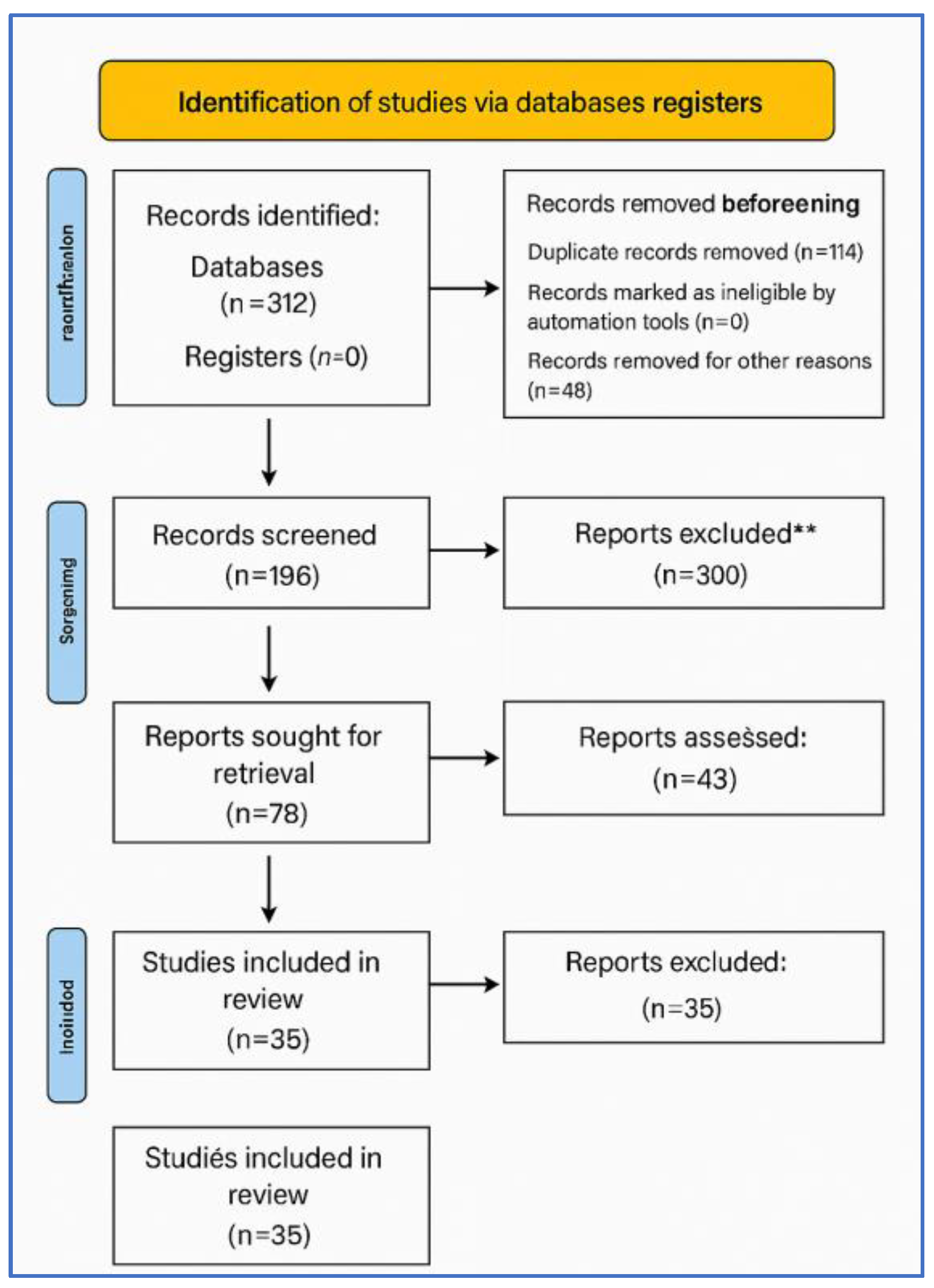
Figure 2.
Descriptive characteristics of the 35 studies included in the review: (a) Publication period; (b) Methodological approach; (c) Primary SDG alignment; (d) Geographical coverage; (e) Thematic focus; (f) Link with SDG 4.7.
Figure 2.
Descriptive characteristics of the 35 studies included in the review: (a) Publication period; (b) Methodological approach; (c) Primary SDG alignment; (d) Geographical coverage; (e) Thematic focus; (f) Link with SDG 4.7.
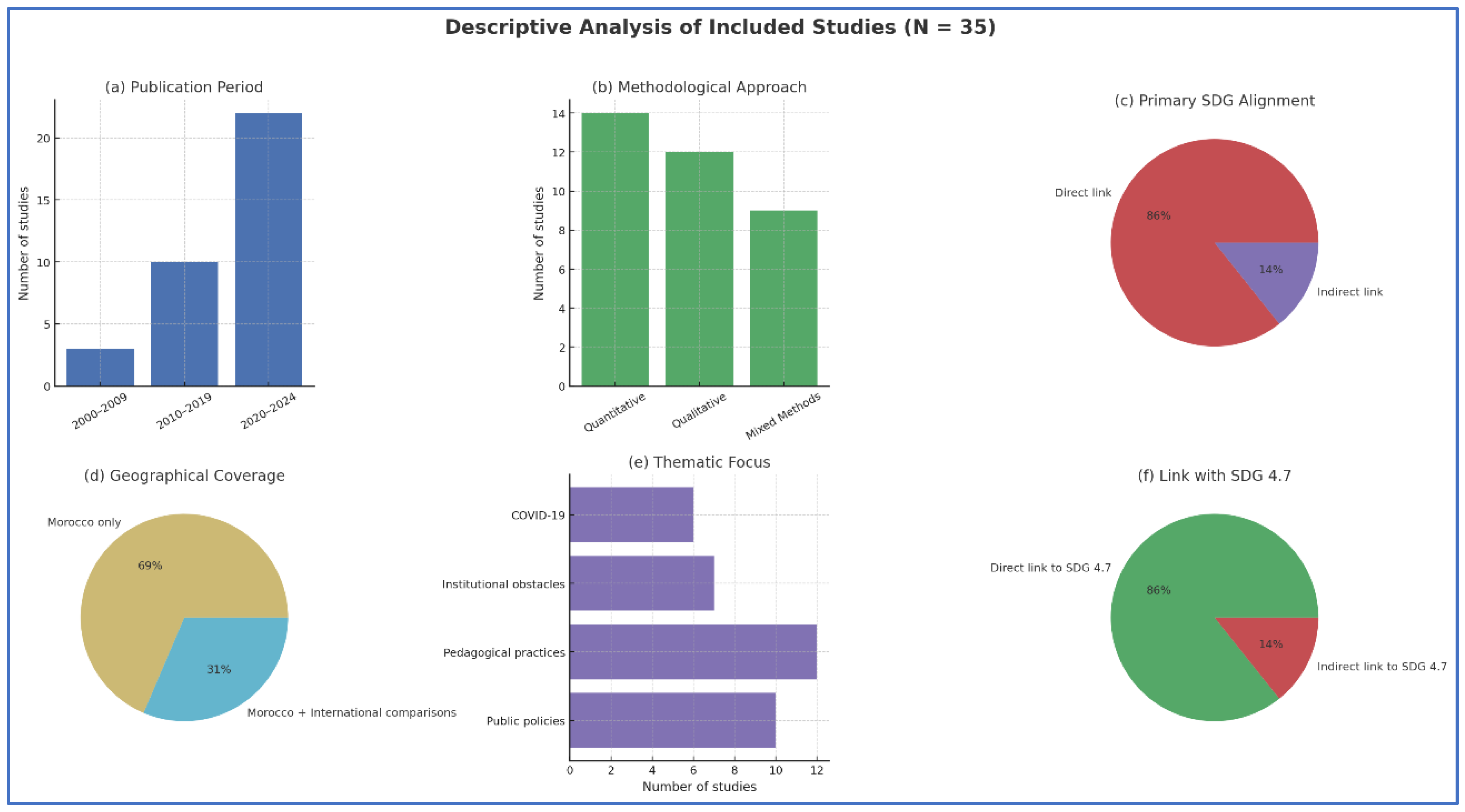
Figure 3.
Conceptual synthesis of Moroccan Environmental Education (EE): Policies–Practices–Obstacles–Recommendations.
Figure 3.
Conceptual synthesis of Moroccan Environmental Education (EE): Policies–Practices–Obstacles–Recommendations.
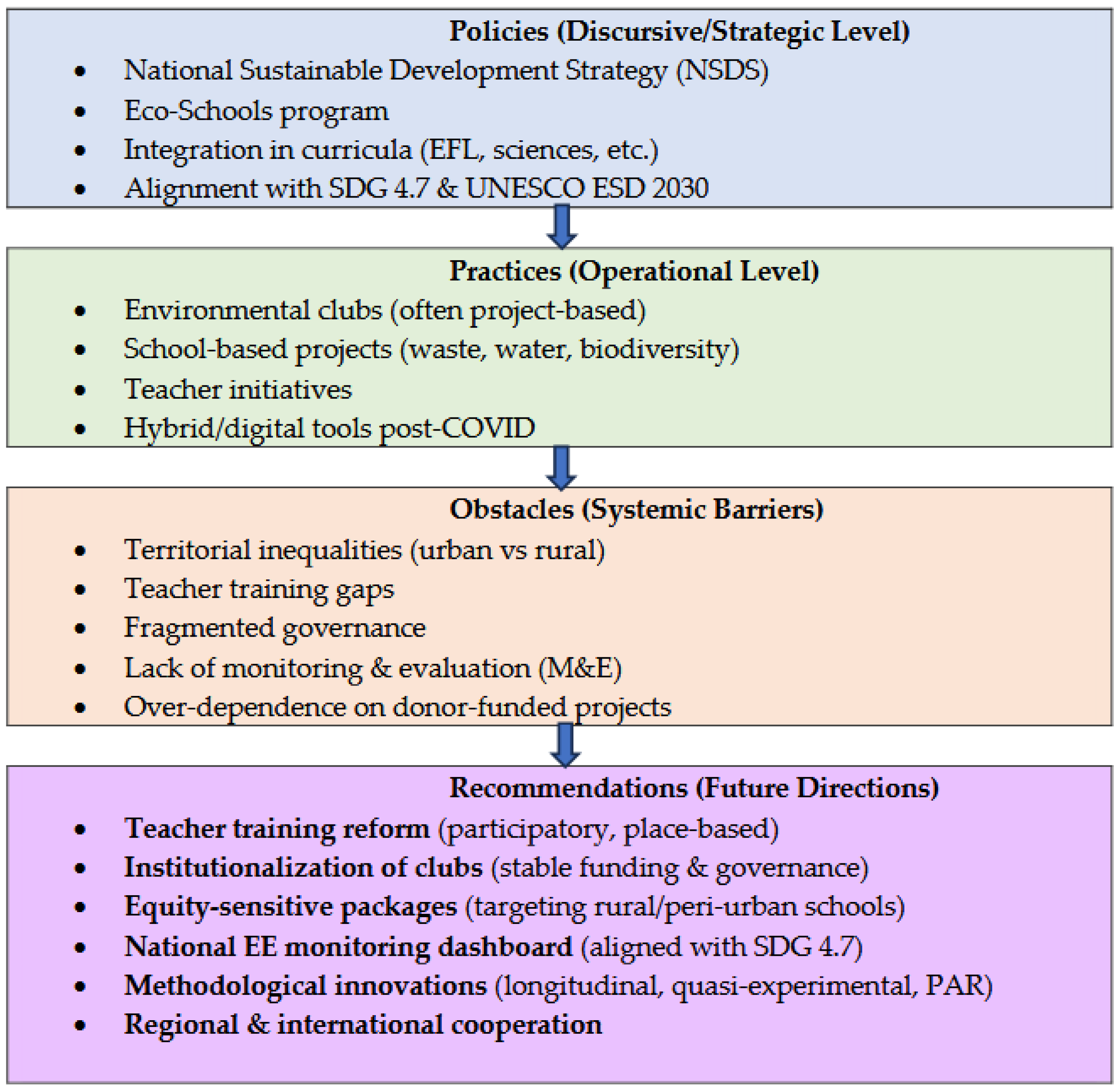

Table 1.
Quality assessment summary.
| Study Type | High Quality | Acceptable Quality | Low Quality | Total |
|---|---|---|---|---|
| Quantitative/Mixed-methods | 8 | 13 | 2 | 23 |
| Qualitative | 1 | 9 | 0 | 10 |
| Policy/Official documents | 0 | 2 | 0 | 2 |
| Total | 9 | 24 | 2 | 35 |
Notes: MMAT = Mixed Methods Appraisal Tool; CASP = Critical Appraisal Skills Programme; AACODS = Authority, Accuracy, Coverage, Objectivity, Date, Significance.
Table 2.
Summary of the 35 studies included in the review, with study context, methodological approach, identified obstacles, and good practices.
Table 2.
Summary of the 35 studies included in the review, with study context, methodological approach, identified obstacles, and good practices.
| No. | Authors & Year | Context/Education Level | Study Type & Methodology | Main Obstacles | Levers/Good Practices |
|---|---|---|---|---|---|
| 1 | El-Batri et al. [11] | Primary schools (4, Morocco) | Quantitative (survey & test) | Limited contextualization; socio-economic inequalities | Adapt content to local context; practical activities fostering learning |
| 2 | El-Batri et al. [12] | Teachers (636, Fès–Meknès) | Quantitative (survey) | Lack of training/resources; reliance on traditional methods | Continuous professional development; active pedagogy; interdisciplinary integration |
| 3 | Sayad et al. [47] | High schools (6, Fez) | Quantitative (survey—teachers & students) | Lack of admin support; limited resources | Student & teacher willingness to engage in EE |
| 4 | Cherai et al. [34] | 15 schools (Tangier–Tétouan–Al Hoceima) | Mixed-method (survey + testimonies) | Heavy workload; lack of follow-up/materials | Teacher training; collaborative projects; participatory approaches |
| 5 | Ameziane [66] | Secondary LES curricula (10 high schools) | Documentary + Survey | Limited environmental content; overly informative approach; weak resources | Stronger curricular integration; diversified pedagogical methods |
| 6 | Sbai et al. [67] | High schools—Bouarfa & Jerada (Eastern Morocco) | Quantitative (survey + multivariate analysis) | Predominantly anthropocentric conceptions; limited ecological representation | Adapt pedagogy to include ecocentric values; context-sensitive content |
| 7 | Bouhazzama & Mssassi [68] | Tangier Summer University (30 participants) | Qualitative (case study; observation + interviews) | Limited resources; theory–practice gap; insufficient funding | Experiential learning workshops; emotional/contextual learning |
| 8 | El Moussaouy et al. [51] | Oujda Academy (90 physics & biology teachers) | Mixed-methods (documentary + survey) | Low EE integration; dominance of informative pedagogy; lack of interdisciplinarity | Curricular reform; teacher training; active, integrated pedagogies |
| 9 | El Azzouzi et al. [69] | Fez–Meknes (120 physics teachers) | Quantitative (survey) | Lack of curricular contextualization; weak teacher training | Curricular innovation; contextualized EE to stimulate engagement |
| 10 | Eco-Schools Morocco [70] | National (5,000+ schools) | Documentary—Institutional report | Dependence on external funding; territorial disparities | Community-based approaches; concrete projects (gardens, recycling, water) |
| 11 | Daoudi 71] | Morocco—prospective analysis | Theoretical (prospective scenarios) | Absence of renewable energy training in schools | Integrate energy topics into curricula |
| 12 | Daoudi [72] | Morocco—policy analysis | Documentary (policy review) | Education–energy sector disconnect | Align curricula with green transition & labor market |
| 13 | Bekhat et al. [73] | High schools (various regions) | Quantitative (survey) | Traditional pedagogy; limited resources | Continuous training; ecological field trips |
| 14 | Rachad & Oughdir [74] | Fès—150 high school students | Quantitative (survey; pre/post-test) | Digital divide; lack of practical tools | E-learning improved outcomes; supports blended learning |
| 15 | Idrissi [75] | Pre-service STEM teachers (Fès–Meknès) | Quantitative (survey) | Low climate content knowledge; weak training support | High motivation; integrate climate modules in training |
| 16 | El-Alami & Cit [76] | Morocco—general population (>500) | Quantitative (national survey) | Limited knowledge; low pro-environmental behaviours | Awareness campaigns; integration into education |
| 17 | Fanini & Fahd [77] | Primary schools (Tétouan) | Experimental (storytelling intervention) | Low student engagement without cultural relevance | Storytelling; use of local heritage |
| 18 | Guaadaoui et al. [78] | Morocco—national analysis | Conceptual (policy review) | Institutional fragmentation; regional disparities | Integrated national strategies; cross-sectoral planning |
| 19 | Ifqiren et al. [79] | 96 Life & Earth Sciences teachers | Quantitative (survey) | Limited use of modelling; weak training in methods | Introduce modelling tasks; teacher professional development |
| 20 | Kurtuluş & Tatar [80] | International (incl. Morocco) | Bibliometric review | Low Moroccan research presence | Position Morocco in global EE research; identify priorities |
| 20b | Nourredine et al. [81] | Casablanca—public high school | Case study—Participatory action | Weak curricular integration; low awareness | Experiential/interdisciplinary projects; researcher–school partnerships |
| 21 | Laaloua [82] | 8 high schools, Agadir (524 students) | Quantitative (survey + textbook analysis) | Limited human–environment links; weak multicultural lens | Enrich geography curricula; promote critical/multicultural thinking |
| 22 | Maaroufi et al. [83] | Oriental region | Regional review—Documentary | Regional disparities; lack of coordination | Context-adapted strategies; regional partnerships |
| 23 | Rachad & Oughdir [84] | Primary schools (teachers/admins) | Quantitative (survey) | Weak experimental culture; lack of teaching materials | Develop experimental pedagogy; teacher training |
| 24 | Ait El Mokhtar et al. [85] | Secondary schools—SVT | Mixed-methods (surveys + practice analysis) | Weak teacher training in 21st-century skills | Project-based learning; ICT integration; SD-oriented skills |
| 25 | Riouch & Benamar [35] | Morocco—national perspective | Documentary (critical analysis) | Institutional fragmentation; regional disparities; weak training | Intersectoral coordination; regionalized programs |
| 26 | Zerrouqi et al. [86] | Middle schools—SVT textbooks | Documentary (content analysis) | Limited content; lack of local contextualization | Revise textbooks; include local themes |
| 27 | Ouzemri & Bensasi (2021) [87] | orocco—primary curriculum | Mixed-method (curriculum analysis + policy review) | Curriculum–practice alignment gap | Update curriculum content; integrate EE dimension |
| 28 | El Alaoui, A. A. E., Abdelali, F., & Kafssi, M. [88] | Morocco—national level | Qualitative & policy analysis (documentary + institutional review) | Partial and uneven implementation of SDGs in education, weak governance, and fragmented strategies | Strengthen national coordination; reinforce teacher training; align curricula with SDG 4.7 and ESD 2030 Roadmap |
| 29 | Zerrouqi, Z., Iyada, A., & Bouamiech, M. (2016) [89] | Middle schools—SVT textbooks | Documentary (content analysis) | Limited content; local/global imbalance | Update textbooks; integrate local content |
| 29 | Abid et al. [90] | Secondary schools—SVT | Documentary (content analysis) | Uneven ESD integration | Harmonize ESD modules; strengthen interdisciplinary activities |
| 30 | UNESCO [91] | Morocco—national profile | Policy/institutional report | Weak EE/ESD integration; fragmentation | National commissions; supportive structures |
| 32 | Saayoun et al. [92] | Middle & high schools (243 teachers) | Quantitative (survey) | Cultural irrelevance; language issues | Teacher feedback loops; culturally adapted textbooks |
| 33 | Id-Babou et al. [93] | High schools—Guelmim (rural & urban) | Quantitative & qualitative (Q & interviews) | Incomplete biodiversity concept; weak pedagogical activities | Integrate biodiversity activities; curricular conceptualization |
| 34 | Idrissi Boutaybi et al. [94] | Gardening school for NEET youth | Qualitative (case study) | Barriers for vulnerable youth; limited resources | Place-based hands-on learning; partnerships; green jobs pathways |
| 35 | Lbadaoui-Darvas et al. [95] | Rabat universities—climate/air quality | Programmatic (project-based curriculum + sensors) | Limited monitoring coverage; climate vulnerability; resources | Sensor-based learning; Climate Club; capacity building; open data outreach |
Table 3.
Structural barriers and context-sensitive strategies for strengthening environmental education in Morocco.
Table 3.
Structural barriers and context-sensitive strategies for strengthening environmental education in Morocco.
| Dimension | Identified Barriers | Recommended Strategies |
|---|---|---|
| Territorial nequality | Urban–rural/peri-urban disparities in infrastructure, staffing, connectivity, and functionality of environmental clubs [13,47,48,51]. | Targeted resourcing and operational support for under-served schools; minimum service standards for EE inputs |
| Teacher training | Limited integration of participatory, place-based, and critical EE pedagogies in pre-service/in-service programs [49,50,59]. | Systematic mainstreaming of EE in teacher education; practice-based modules, mentoring, and school-based inquiry |
| Institutional coordination | Reliance on short-term, project-based initiatives; weak guidance and uneven practices [11,12,23,44]. | Stable funding lines; standardized monitoring and evaluation; participatory school governance for EE |
| Policy–practice gap | Alignment with SDG 4.7/ESD 2030 but uneven implementation guidance (roles, resources, indicators), especially in rural/peri-urban contexts [1,13,53] | Locally grounded delivery models; multi-stakeholder engagement (schools–communities–NGOs–municipalities) |
Table 4.
Post-pandemic challenges and policy opportunities for environmental education in Morocco.
| Theme | Challenges Identified | Opportunities for EE |
|---|---|---|
| Educational disruptions | School closures; uneven readiness for remote/hybrid delivery; limited guidance for EE activities online [14,15]. | Embed health–environment/One Health content in hybrid, flexible models; provide low-tech options and classroom–community projects that can continue during disruptions [52,56]. |
| Exacerbated inequalities | Widened digital and resource gaps in rural/peri-urban contexts; uneven access to clubs and materials [16]. | Targeted investment in devices/connectivity and EE kits; community-based initiatives with local authorities/NGOs; equity-sensitive monitoring of participation/outcomes [1]. |
| Ad hoc adaptations | Reliance on individual leadership; project discontinuity; limited institutional anchoring [23,24]. | Institutionalize clubs with baseline grants and light-touch M&E; formalize stewardship projects in school plans; create simple continuity protocols for crises |
| Policy window | Heightened awareness not yet translated into system-level reforms [55]. | Strengthen teacher PD (participatory/place-based EE; micro-credentials); integrate EE into standards and appraisal; align finance and indicators with ESD-2030 priority areas [1,49]. |
Table 5.
Comparative synthesis of descriptive results and interpretive implications (N = 35 studies).
Table 5.
Comparative synthesis of descriptive results and interpretive implications (N = 35 studies).
| Dimension | Key Result | Interpretation/Implication |
|---|---|---|
| Publication period | Three phases: low output (2000–2009, 9%), moderate growth (2010–2019, 28%), surge post-2020 (63%). | COVID-19 acted as a catalyst, intensifying EE research. Crises can mobilize scientific and institutional attention. |
| Methodological approach | 40% quantitative, 34% qualitative, 26% mixed. Mixed methods rising after 2017. | Segmentation reflects different research aims but limited triangulation. Growing use of mixed designs signals a positive trend toward integrative approaches. |
| SDG alignment | 86% direct link to SDG 4.7; 14% indirect via SDGs 3, 6, 13. | Strong discursive integration into global agendas. Yet, systemic institutionalization remains weak, limiting impact. |
| Geographical coverage | 69% Morocco only, 31% comparative. | Limited international benchmarking restricts policy transfer and cross-context learning. |
| Thematic focus | Pedagogy (31%), institutional barriers (20%), COVID-19 (20%), policy (14%). | Pedagogy dominates while governance and institutional analyses are underexplored. Pandemic themes highlight health–environment linkages. |
| Link with SDG 4.7 | 86% explicit, 14% indirect. | Confirms Morocco’s anchoring in SDG 4.7 but remains largely declarative; stronger operationalization is needed. |
Table 6.
Strengths and Weaknesses of Moroccan EE (2010–2024).
| Strengths | Weaknesses |
|---|---|
| - Steady growth in EE-related publications since 2015, reflecting rising academic and institutional interest (Figures a, b). | - Geographic concentration of studies in urban and coastal regions; underrepresentation of rural and mountain areas (Figures c, d). |
| - Diverse methodological approaches, including quantitative, qualitative, and mixed methods, enabling triangulation of findings (Figures e, f). | - Limited longitudinal and experimental designs, reducing capacity for causal inference. |
| - Increasing thematic diversification, covering policy, pedagogy, community engagement, and post-pandemic adaptation. | - Fragmentation in data sources and inconsistent operational definitions of EE indicators, hindering cross-study comparability. |
| - Emerging collaborations between academia, NGOs, and governmental actors, fostering interdisciplinary approaches. | - Scarcity of large-scale, nationally representative datasets. |
Table 7.
Opportunities and Threats for Moroccan EE (2010–2024.
| Opportunities | Threats |
|---|---|
| - Alignment of Moroccan EE goals with the SDGs and the ESD 2030 roadmap, offering leverage for international funding and partnerships. | - Persistent socio-territorial inequalities in resources and teacher training, risking widening gaps in EE access and outcomes. |
| - Integration of health–environment education post-COVID-19, enhancing EE’s relevance for resilience and public health agendas. | - Vulnerability to political and funding shifts that can destabilize long-term EE programs. |
| - Potential for digital tools, citizen science, and place-based learning to extend EE’s reach to underserved areas. | - Climate-related crises and competing policy priorities may divert attention and resources from EE. |
| - Opportunities to institutionalize environmental clubs and embed participatory methods in teacher training. | - Risk of “project-based dependency” without sustainable institutional frameworks. |
Disclaimer/Publisher’s Note: The statements, opinions and data contained in all publications are solely those of the individual author(s) and contributor(s) and not of MDPI and/or the editor(s). MDPI and/or the editor(s) disclaim responsibility for any injury to people or property resulting from any ideas, methods, instructions or products referred to in the content. |
© 2025 by the authors. Licensee MDPI, Basel, Switzerland. This article is an open access article distributed under the terms and conditions of the Creative Commons Attribution (CC BY) license (http://creativecommons.org/licenses/by/4.0/).
Copyright: This open access article is published under a Creative Commons CC BY 4.0 license, which permit the free download, distribution, and reuse, provided that the author and preprint are cited in any reuse.


