

Submitted:
30 August 2025
Posted:
02 September 2025
You are already at the latest version
Abstract
With an increase in pressure on global food systems and the growing scarcity of freshwater, smart irrigation powered by the Internet of Things (IoT) and Computer Vision (CV) presents a promising solution to sustainable agriculture. This paper provides a comprehensive review of scalable and cost-effective smart irrigation systems, analyzing over 20 recent studies to highlight the integration of sensors, microcontrollers, wireless technologies, and artificial intelligence. The synthesis of existing research demonstrates remarkable advancements, with systems achieving up to 85% in water savings, 92% in irrigation scheduling accuracy, and significant enhancements in crop yields. Furthermore, the analysis covers real-time soil and climate data monitoring, image-based crop health assessment, and intelligent decision support systems, underscoring the feasibility of solutions costing less than $50. Key challenges, including energy consumption, connectivity, and rural deployment, are also discussed, providing a robust foundation for future research in precision agriculture.
Keywords:
smart irrigation
; IoT
; computer vision
; precision agriculture
; soil moisture sensors
; machine learning
; low-cost systems
; remote monitoring
; sustainable agriculture
; fuzzy logic
1. Introduction
Agriculture is not only a vital industry, but also the cornerstone of many national economies. With the world population rapidly increasing, the demand for food continues to increase accordingly. This growing demand, coupled with evolving consumer expectations, presents significant challenges for the agricultural sector, which must now innovate and adopt efficient practices to meet these needs [19,23,27].
Among the core components of agricultural productivity is efficient irrigation. Traditional irrigation methods are often plagued by inefficiencies that lead to water wastage, reduced crop yields, and long-term environmental degradation. With increasing concerns about water scarcity, climate change, and sustainability, improving irrigation management strategies has become imperative. In response, the integration of emerging technologies, such as the Internet of Things (IoT) and computer vision, has shown great promise in transforming irrigation practices.
Smart irrigation systems, powered by IoT and computer vision technologies, are now gaining momentum. These systems aim to optimize water usage while maximizing crop productivity. Using real-time data and intelligent automation, they offer a potential solution to many of the challenges faced by conventional irrigation systems. In Table 1, we can see the usage of water in agriculture in various regions.
1.1. Problem Statement
This study conducts a comprehensive survey of IoT technologies and computer vision techniques as applied to the development of cost-effective smart irrigation solutions in agricultural contexts. Smart irrigation represents a data-driven discipline designed to enhance productivity while minimizing environmental impact. Modern agricultural operations now generate large volumes of data through sensors, which can be utilized to better understand both environmental conditions and operational activities [12,40,41].
Traditional irrigation methods, which are prone to overwatering or underwatering, often compromise crop quality and yield. In contrast, smart irrigation systems integrate IoT devices such as soil moisture sensors and actuators with computer vision algorithms to monitor real-time parameters, including soil conditions, weather forecasts, and crop health. This enables timely and precise irrigation decisions, reducing waste and improving efficiency.
1.2. Objectives
This paper aims to:
- Review and evaluate current research on low-cost IoT and computer vision applications in smart irrigation, focusing on water efficiency, crop productivity, and scalability in diverse agricultural contexts.
- Identify core technologies, including IoT sensors, communication protocols, computer vision algorithms, and microcontrollers, used in cost-effective smart irrigation systems.
IoT-based smart irrigation systems allow seamless connectivity among field-deployed sensors, processing units, and irrigation infrastructure. These interconnected devices collect comprehensive environmental data, which is processed either locally or on cloud platforms. The resulting analysis informs automated decisions on when, where, and how much water to apply.
The key advantage of IoT-enabled smart irrigation lies in its capacity to optimize water usage. By continuously monitoring soil and weather parameters, the system ensures irrigation is carried out only when necessary, reducing water and energy consumption. Moreover, such systems improve crop health by delivering the precise amount of water required, thereby preventing plant stress and improving yields.
In addition, these systems facilitate early detection of crop stress and disease through integrated data analytics and predictive modeling. Their remote monitoring and control capabilities offer farmers greater flexibility and responsiveness, particularly across large or distributed agricultural landscapes.
1.3. Scope
This survey analyzes low-cost IoT and computer vision technologies for smart irrigation systems, focusing on scalable, cost-effective solutions to optimize water use and enhance crop productivity. It covers IoT sensors (e.g., soil moisture, temperature), microcontrollers (e.g., NodeMCU, Arduino), communication protocols (e.g., LoRa, MQTT), and computer vision algorithms (e.g., YOLO, CNNs) for crop and soil monitoring. The study reviews commercial and open-source solutions, case studies in diverse regions (e.g., tomato, maize cultivation), and challenges like power consumption, rural connectivity, and system reliability. Current trends, scalability for small to medium farms, and future research directions are highlighted to support sustainable agriculture.
1.4. Motivation
In light of growing global concerns, the urgent need for sustainable agricultural practices and smart irrigation systems represents a compelling solution. By integrating IoT and computer vision, these systems improve water efficiency, reduce environmental impact, and promote crop health. This paper examines recent technological advancements, identifies research gaps, and synthesizes the existing body of knowledge to inform stakeholders in the design and deployment of agricultural technologies. Ultimately, the study contributes to the broader goal of advancing sustainability in agriculture through innovation.
1.5. Methodology
Relevant studies were gathered through structured queries on platforms like IEEE Xplore, Scopus, Google Scholar, and other sources (ResearchGate and web crawling). Search terms included “cost-effective irrigation,”“smart irrigation IoT,” “computer vision agriculture,” and “precision agriculture.” Of articles published or available pre-printed between 2018 and 2025, some studies were selected based on their focus on low-cost IoT and computer vision applications, technical depth and reported results. Inclusion criteria prioritized empirical results and scalability, while irrelevant studies were excluded. Figure 1 illustrates the search and screening process. This review was performed in accordance with the PRISMA guidelines (Preferred Reporting Items for Systematic Reviews and Meta-Analyses). PRISMA is a framework used in the review process to present research findings in a systematic and structured manner. The study protocol was registered in the Open Science Framework [9].
2. Literature Review
Recent advancements in precision agriculture emphasize the deployment of smart irrigation systems leveraging IoT, computer vision, and machine learning techniques.
2.1. IoT-Driven Irrigation Systems
Saleheen et al. (2022) developed an environmental monitoring system using a NodeMCU microcontroller interfaced with sensors for temperature, humidity, barometric pressure, soil moisture, and light intensity. Data was relayed to Adafruit IO for real-time visualization and control. Their field results showed improved environmental tracking and a 30–40% reduction in manual irrigation activities [35].
Srivastava et al. (2023) implemented a Wireless Sensor Network (WSN)-based automated irrigation system with soil moisture and temperature sensors, integrated via GSM and IoT modules. Their system demonstrated a 22% improvement in water-use efficiency and significantly reduced manual intervention [39].
Elgaali and Ismail (2023) employed Arduino Mega boards, DHT11 sensors, solenoid valves, and water pumps to create a fully automated irrigation controller. The system was tested in tomato cultivation plots and resulted in a 27% increase in crop yield and a 35% reduction in water consumption compared to traditional drip irrigation methods [11].
Baskar et al. (2022) presented a cloud-integrated smart irrigation solution using NodeMCU and LoRa for long-range data transmission. Moisture levels were used to trigger irrigation with a feedback loop via Blynk. The deployment achieved a 50% water savings and an 18% improvement in crop health indexes over a control setup [6].
Sampatrao (2019) integrated GSM modules, soil moisture sensors, and a custom Android app for user-controlled irrigation. Experimental trials showed 32% water savings and operational cost reduction through minimized labor dependency [36]. As shown in Table 2, different IoT communication protocols offer varying trade-offs in range, power consumption, and cost, making them suitable for specific agricultural contexts.
2.2. Machine Learning and Intelligent Decision Support Systems
Bakare (2023) introduced a smart irrigation system combining soil nutrient analysis and backpropagation neural networks (BPN). The BPN was trained using historical growth data to predict optimal irrigation and fertilization regimes. Trials showed a 15–25% increase in crop output and up to 20% reduction in disease incidence [5].
Alphonse et al. (2023) integrated ML with IoT sensors to dynamically adjust irrigation volumes. A decision tree model was used to infer irrigation schedules based on real-time soil moisture, temperature, and humidity data. The system achieved 92% prediction accuracy and 35% improved water efficiency [3].
Alanya-Arango et al. (2022) used atmospheric sensors and a machine learning module trained using supervised learning to automate irrigation decisions. The model, based on historical weather and soil data, reduced irrigation frequency by 28% while maintaining or improving crop quality metrics [2]. As shown in Figure 2, the machine learning workflow in smart irrigation involves data collection, preprocessing, model training and evaluation, followed by actionable irrigation recommendations and field feedback.
2.3. Advanced Control and Automation Techniques
Pierre et al. (2023) proposed a fuzzy logic controller integrated with an IoT platform for irrigation decision-making. Their mobile-enabled system reduced irrigation-related energy usage by 50%, cut labor demands by 80%, and increased maize yield by approximately 20% [33].
Puig et al. (2022) implemented an FIWARE-based edge computing framework that incorporated soil water balance models and evapotranspiration forecasts to optimize drip irrigation. Field deployments in Mediterranean vineyards reported water use reductions of 33% with no yield penalties [34].
Kumar et al. (2022) designed a low-cost MQTT-enabled system for real-time pump actuation using BLYNK server and soil moisture deficit triggers. The solution demonstrated 87% irrigation accuracy and robust response to environmental fluctuations [24].
2.4. Low-Cost, Scalable, and Sustainable Solutions
Haziq et al. (2022) created a Smart IoT Agriculture System (SIAS) using an ESP8266 microcontroller, moisture sensors, pH probes, and a low-cost water pump. The system cost only $46 and achieved an 85% reduction in water usage with improved root zone targeting. It also facilitated real-time soil fertility analysis, leading to a 23% increase in plant biomass over control plots [15].
Vijayaraja et al. (2022) developed an energy-efficient system using NodeMCU and solar panels, supporting smart drainage control, sensor-based irrigation, and cloud monitoring via Adafruit. This reduced power consumption by 48% and delivered consistent irrigation even in low-connectivity zones [42].
Senthil Vadivu et al. (2023) highlighted remote access and automation using GSM/IoT in sensor-based irrigation, achieving a 38% yield improvement in sugarcane fields and cutting labor input by over 50% [37]. According to Table 3, solutions like the SIAS system are particularly suited for small-scale farms due to their minimal hardware requirements and lower cost.
2.5. Novel and Sustainable Approaches
Janani and Pavitra (2019) proposed an unconventional irrigation model using Underwater Wireless Sensor Networks (UWSNs) and Reverse Osmosis (RO) wastewater reuse. Their model supported salicornia cultivation with saline water, demonstrating a sustainable use-case for coastal and arid farming, though limited field trials restrict broad generalization [18].
2.6. Few Case Studies
Vision-based remote sensing: Wang & Jin (2023) utilized high-resolution multispectral UAV imagery and Random Forest models to map water stress in walnut orchards, achieving and 85% accuracy for tree-level water status using NDVI, NDRE, and PSRI[44].
Edge-AI in resource-limited settings: Joshi (2024) deployed compact Vision Transformer and YOLOv8-S models on edge devices for orange disease detection, showing 96% classification accuracy with minimal compute, demonstrating real-time feasibility of edge computer-vision for situational irrigation triggers[21].
Multimodal Edge AIoT for irrigation: Jiang et al. (2025) introduced Farm-LightSeek, which integrates multisensor image, weather, and geographic data with lightweight LLMs at edge nodes to manage irrigation decisions locally while synchronizing with cloud updates, proving robustness under device constraints[20].
2.7. Summary
The literature review underscores the transformative role of IoT and machine learning in advancing smart irrigation systems for sustainable agriculture. Systems employing microcontrollers such as NodeMCU and Arduino, coupled with sensors for soil moisture, temperature, and humidity, have been widely adopted due to their low cost and reliability. For instance, the Smart IoT Agriculture System (SIAS) developed by Haziq et al. (2022) [15] demonstrated an 85% reduction in water usage and a 23% increase in plant biomass, all within a total system cost of just $46. Similarly, Saleheen et al. (2022) [35]reported a 30–40% reduction in manual irrigation and improved data accessibility via Adafruit IO dashboards. Machine learning-based systems, such as those using backpropagation networks (Bakare, 2023 [5]) and decision trees (Alphonse et al., 2023 [3]), achieved prediction accuracies up to 92% and resulted in water-use efficiency gains of 35% or more. Fuzzy logic approaches, like the one proposed by Pierre et al. (2023) [33], reported benefits included a 50% reduction in energy use and a 20% improvement in crop yields. Moreover, edge computing and IoT frameworks such as FIWARE (Puig et al., 2022 [34]) enabled soil water balance modeling and reduced irrigation water use by 33% without compromising yield. Collectively, these studies reveal consistent improvements in irrigation precision, crop productivity, and resource optimization, affirming the efficacy of IoT- and AI-enhanced irrigation systems as scalable, sustainable solutions for modern agriculture. Table 4 summarizes recent smart irrigation systems, detailing the technologies used, methodologies, and reported outcomes across various agricultural deployments.
3. Study on Cost-Effective Irrigation Systems
The growing need for sustainable agriculture in resource-constrained regions has spurred the development of cost-effective irrigation systems that leverage affordable technologies to optimize water and energy use. Recent studies have demonstrated innovative approaches using low-cost microcontrollers, sensors, and IoT frameworks to enhance irrigation efficiency while reducing costs for farmers.
Patil et al. (2023) developed an intelligent irrigation system utilizing an Arduino Uno microcontroller, a relay module, and a water pump. This system achieved an 80% reduction in water waste compared to traditional methods by automating irrigation based on soil moisture levels. Additionally, it conserved electricity through efficient water supply management, significantly lowering operational costs for farmers [32].
Malla et al. (2023) proposed a system integrating temperature and distance sensors with a piezo element actuator. The actuator served dual purposes: halting the motor during low water supply to prevent waste and alerting farmers to system issues. This approach minimized water and energy losses, enhancing cost-effectiveness [28].
Mhaned et al. (2022) employed cost-effective components, including soil sensors, wireless solenoid valves, and a Raspberry Pi, to create an IoT-based irrigation system. Using the MQTT protocol for data transmission and fuzzy logic for decision-making, the system optimized water use and reduced manual intervention, improving efficiency in water-scarce regions [29].
Chowdary et al. (2019) utilized inexpensive sensors, such as PIR and NodeMCU, to monitor soil moisture, temperature, and humidity. By implementing low-power sleep modes and efficient communication protocols like Bluetooth and Wi-Fi, the system minimized energy consumption, making it a viable solution for small-scale farmers [7].
Iyer et al. (2020) adopted LoRa technology for long-range, low-power wireless communication, centralizing data collection to reduce the need for multiple costly sensors. Cloud-based storage and real-time automation ensured precise water delivery, enhancing resource efficiency [17].
Nagaraja and Kant (2019) leveraged hourly AWS data from the Indian Meteorological Department, eliminating the need for expensive on-site weather stations. By integrating real-time meteorological data with evapotranspiration calculations, the system enabled precise irrigation scheduling, reducing water and energy costs [30].
These studies collectively highlight the potential of low-cost microcontrollers, sensors, and IoT technologies to revolutionize irrigation practices. While Arduino- and Raspberry Pi-based systems offer affordability and flexibility, LoRa and cloud-based solutions provide scalability for larger farms. However, challenges such as internet dependency in remote areas and system maintenance costs warrant further investigation. Future research could explore integrating renewable energy sources or advanced machine learning to enhance system adaptability and sustainability. As shown in Table 5, several recent implementations of cost-effective irrigation systems demonstrate high water savings and automation benefits using low-cost hardware.
4. Discussion
The integration of Internet of Things (IoT) and computer vision (CV) technologies has brought significant advancements in smart irrigation by enabling real-time monitoring, precision water delivery, and data-driven agricultural management. IoT systems typically comprise soil moisture sensors (e.g., capacitive or tensiometric), environmental sensors (e.g., DHT22 for temperature and humidity), and microcontrollers such as NodeMCU, ESP8266, or Arduino, which transmit data to cloud platforms using protocols like MQTT or HTTP. These sensors continuously monitor soil and climatic conditions, transmitting actionable data for automated irrigation control.
4.1. Integration of IoT and Computer Vision in Smart Irrigation
Simultaneously, computer vision systems utilize RGB or multispectral cameras mounted on drones or ground platforms to assess plant vigor, identify stress symptoms, and detect pest or disease outbreaks. Deep learning algorithms such as convolutional neural networks (CNNs) are increasingly being used for tasks like leaf disease classification, weed identification, and growth stage detection, with reported accuracies reaching up to 95% in some cases.
The synergy between IoT and CV facilitates precision irrigation. For instance, if CV algorithms detect localized chlorosis in crop canopies, the IoT system can respond by adjusting irrigation zones or recommending nutrient delivery, thus minimizing resource waste and maximizing yield. Such feedback-driven automation has been shown in multiple studies to reduce water consumption by 30–60% and improve crop output by 15–25%. Figure 3 demonstrates the workflow of smart irrigation systems combining IoT, computer vision, and ML-based decision-making.
4.2. Communication Technologies in IoT-Based Irrigation
Efficient communication protocols are crucial for the performance of IoT systems in agriculture. Short-range communication is commonly supported by Wi-Fi (IEEE 802.11), Bluetooth Low Energy (BLE), and Zigbee (IEEE 802.15.4), which are suitable for compact fields with nearby infrastructure. Wi-Fi, in particular, is preferred for low-cost systems, despite its limited range and higher power demands.
For long-range communication in rural areas, GSM modules using 2G/3G networks are widely deployed due to their global availability. LoRa (Long Range Radio) has gained popularity for its low power consumption and wide coverage (up to 15 km in open fields), making it ideal for large-scale deployments. Additionally, Message Queuing Telemetry Transport (MQTT), a lightweight publish-subscribe protocol, is used for low-bandwidth communications in real-time irrigation applications, although it is yet to see widespread adoption in commercial deployments.
4.3. Computer Vision Technologies in Smart Irrigation
Computer vision in smart irrigation encompasses a range of applications, including crop identification, stress detection, growth monitoring, and environmental assessment. Algorithms like YOLO (You Only Look Once), ResNet, and U-Net have been employed for real-time object detection and semantic segmentation of crop images.
Plant recognition allows differentiation of crop species, enabling targeted irrigation based on species-specific needs. Disease and pest detection systems analyze foliar imagery using CNNs to detect visual symptoms such as leaf spot or powdery mildew, achieving early warnings with reported accuracies of over 90%.
Weed detection using spectral and spatial features enables site-specific herbicide applications, reducing chemical input by up to 50%. Soil moisture mapping is achieved by analyzing color, texture, and reflectance features in aerial imagery, supporting zonal irrigation strategies. Additionally, multi-temporal image analysis supports phenological tracking and yield forecasting, which informs irrigation scheduling. As illustrated in Figure 4, computer vision tasks in smart irrigation are categorized into plant recognition, disease detection, and soil moisture mapping, each utilizing different deep learning models to generate actionable outputs.
Recent Advances in CV Algorithms: In addition to traditional CNNs, recent architectures such as YOLOv7 and Vision Transformers (ViTs) are being increasingly used for precision agriculture tasks. YOLOv7 offers real-time object detection with enhanced speed and accuracy, making it suitable for identifying weeds, pests, and crop maturity on UAV-captured footage[43]. ViTs have demonstrated superior performance in segmentation and disease classification tasks, especially when integrated with attention mechanisms for field-scale monitoring[10]. UAV-based NDVI imaging continues to play a pivotal role in detecting water stress and chlorosis in crops by enabling zonal irrigation recommendations[16].
4.4. Benefits of IoT and Computer Vision in Irrigation
The combined deployment of IoT and CV technologies yields multifaceted benefits. Precision irrigation systems utilizing these technologies have demonstrated water savings between 30% to 85%, while improving yield quality and quantity by 15% to 38% across different crops. Automated systems reduce energy consumption by facilitating low-pressure delivery methods (e.g., drip or micro-sprinklers), cutting energy usage by up to 25%.
Real-time monitoring and early detection of plant stress via IoT and CV reduces crop losses, enhancing food security. These systems also enable labor efficiency by automating repetitive monitoring tasks, with some studies reporting reductions in manual labor by 50–80%.
Integrated IoT frameworks, paired with cloud analytics and decision-support tools, enhance precision and scalability. Farmers can integrate multiple data streams—such as weather forecasts, evapotranspiration rates, and soil maps—for proactive intervention, reducing reliance on reactive methods. This holistic integration supports sustainable farming by reducing environmental impact, optimizing input usage, and enabling adaptive management under varying climate conditions.
Overall, IoT and computer vision technologies are pivotal to the digital transformation of agriculture. Their integration into irrigation management not only enhances productivity and profitability but also contributes significantly to the goals of resource conservation and climate-resilient agriculture.
5. Basic Steps of an IoT and Computer Vision Integrated Smart Irrigation System
5.1. Data Collection
IoT sensors deployed across the field collect real-time data on soil moisture, temperature, humidity, and rainfall. These sensors transmit data wirelessly to a central control unit or cloud platform.
Computer vision systems capture images of crops to monitor growth, detect pests, and assess plant health. Drones and satellite imagery provide aerial views and large-scale monitoring, while embedded soil sensors offer depth-specific moisture readings.
IoT weather stations enhance context by tracking temperature, humidity, and rainfall, aiding in the prediction of irrigation needs. Additionally, mobile applications allow farmers to input field data and receive alerts or recommendations from the system.
5.2. Error and Fault Detection
Anomalies in sensor readings—such as sudden spikes or drops—are flagged for potential malfunctions. Cross-verification among sensors helps identify discrepancies.
Threshold alarms trigger alerts when parameters exceed expected limits. Regular checks ensure the accuracy of camera systems, image recognition, and sensor calibration.
Machine learning techniques are used to detect patterns indicating sensor faults or data inconsistencies. Backup systems (e.g., redundant sensors, power supplies) ensure reliability. Manual checks and user feedback further strengthen the system’s error detection capabilities.
5.3. Data Processing
Raw sensor and image data undergo preprocessing (e.g., noise removal, normalization) before analysis. Data fusion integrates inputs from multiple sources to provide a comprehensive view of field conditions.
Advanced analytics and machine learning models predict crop water needs, optimize irrigation timing, and detect anomalies. A feedback loop continuously refines decisions based on real-time and historical data.
Results are visualized via dashboards and reports for farmer interpretation. Processed data is archived in local or cloud-based databases for future reference.
5.4. Wireless Communication
Wireless technologies enable seamless connectivity between sensors, cameras, control units, and cloud platforms. Common protocols include Wi-Fi, Zigbee, LoRaWAN, Bluetooth, and cellular networks.
Images and sensor data are transmitted to central processing units or cloud services for real-time analysis. Protocols like MQTT and HTTP ensure secure and efficient data transfer.
Mobile and web interfaces allow farmers to remotely monitor field conditions, receive alerts, and control irrigation systems. In remote areas, LPWAN technologies (e.g., LoRa, Sigfox) enable long-distance, low-power communication. Mesh networks improve reliability by enabling direct device-to-device communication.
Security features such as encryption, authentication, and access control are implemented to safeguard data integrity and confidentiality.
5.5. System Activation and Irrigation Control
Based on data analysis, the system determines optimal irrigation schedules considering soil conditions, crop type, weather forecasts, and growth stages.
The system activates irrigation devices—pumps, valves, and sprinklers—automatically or via remote control. It adjusts water application dynamically to reflect changing field conditions.
Real-time monitoring ensures that irrigation is effective and adaptive. Energy efficiency is enhanced through solar-powered components and optimization based on energy tariffs.
Integration with broader water management systems allows for region-wide water conservation strategies, contributing to sustainable agriculture.
6. Cost Efficiency of the Irrigation System
Achieving cost efficiency in an IoT and computer vision-enabled smart irrigation system requires strategic optimization of hardware, software, communication, and operational practices. The goal is to maximize agricultural value while minimizing the total cost of ownership. Key strategies for ensuring cost-effectiveness include:
- Low-Cost and Energy-Efficient Hardware: Selection of inexpensive, energy-efficient components such as soil moisture, temperature, and humidity sensors, along with low-power microcontrollers (e.g., ESP32, Arduino) and computer vision cameras with power-saving modes, significantly reduces hardware and energy expenses.
- Open-Source Software: Leveraging open-source platforms for control logic, data processing, and analytics eliminates licensing fees and lowers software development costs. Libraries like TensorFlow Lite, OpenCV, and Node-RED can support advanced functionalities at minimal expense.
- Cloud-Based Services: Utilizing cloud infrastructure for data storage and processing offers scalable, pay-as-you-go pricing models. This avoids large upfront infrastructure investments while enabling flexible data management and system expansion.
- Optimized Communication Protocols: Employing low-bandwidth, long-range wireless technologies such as LoRaWAN or Zigbee minimizes data transmission costs, particularly in rural or large-scale deployments with limited cellular coverage.
- Data Compression and Aggregation: Aggregating and compressing sensor and image data before transmission conserves bandwidth and reduces cloud storage requirements. Techniques such as local filtering and threshold-based reporting can significantly lower recurring operational costs.
- Edge Computing: Processing data locally on IoT nodes or edge gateways reduces cloud dependency and network latency. This approach not only lowers data transmission costs but also enables faster decision-making in real-time irrigation control.
- Modular and Scalable Architecture: Designing systems with modular components allows for incremental expansion as needed. This ensures that investment scales with demand, avoiding unnecessary upfront expenditure.
- Lifecycle Cost Consideration: A comprehensive lifecycle cost analysis—including procurement, installation, maintenance, and eventual replacement—enables more informed budgeting and investment strategies that prioritize long-term savings over short-term gains.
- Return on Investment (ROI) Evaluation: Conducting ROI analyses that account for water savings, enhanced crop yield, labor reduction, and decreased input costs helps to justify the initial investment. Quantifiable economic benefits can support farmer adoption and policy support.
In summary, a well-planned combination of affordable technology, efficient system design, and strategic data management practices can make smart irrigation systems both economically viable and technically sustainable. Table 6 presents a comparison of the return on investment (ROI) for selected smart irrigation systems, showing that systems with low initial costs can still yield substantial water savings and productivity improvements.
Comparative Lifecycle Costing and ROI in Emerging Economies:Recent research highlights that lifecycle cost analyses are critical for assessing the true economic viability of smart irrigation systems, especially in developing regions. For instance, Das et al. (2023) evaluated drip irrigation with sensor automation in Bangladesh and found that initial costs were offset within 2.5 years due to a 42% reduction in water usage and a 30% increase in yield[8]. Similarly, Afolayan et al. (2024) conducted a cost-benefit analysis of solar-powered IoT irrigation in sub-Saharan Africa, reporting a 1.9 benefit-cost ratio and a 3-year payback period, underscoring the long-term affordability and sustainability in resource-limited contexts [1]. These studies suggest that, despite higher upfront investment, smart irrigation delivers considerable ROI when scaled and maintained appropriately.
7. Techniques Used in Smart Irrigation Systems
Smart irrigation systems leverage a range of technologies and platforms, each offering distinct capabilities in terms of cost, scalability, and system complexity. The following are widely adopted techniques in the development and deployment of such systems:
Arduino-Based Systems
Due to their cost-effectiveness and ease of use, Arduino boards are widely adopted for prototyping and teaching purposes. These boards enable basic sensor integration and control functions, making them ideal for entry-level smart irrigation projects. However, they may fall short in handling advanced features such as large-scale data processing, cloud integration, or real-time analytics. This limitation affects their suitability for commercial-scale deployments.
Fuzzy Logic Controllers
Fuzzy logic offers a rule-based control mechanism that mimics human reasoning in decision-making processes. When embedded within Arduino or similar platforms, fuzzy logic controllers enable adaptive irrigation decisions based on imprecise or variable input parameters (e.g., soil moisture levels or weather forecasts). While this approach enhances flexibility and responsiveness, it requires careful tuning of membership functions and rule sets, demanding greater computational resources and domain expertise.
NodeMCU and ESP8266 Modules
The NodeMCU platform, based on the ESP8266 Wi-Fi module, provides a cost-effective and IoT-ready solution for smart irrigation systems. It supports real-time wireless communication and direct cloud connectivity, enabling efficient data transmission and remote monitoring. Its built-in Wi-Fi capabilities make it particularly suitable for distributed systems that rely on wireless sensor networks and internet-based control interfaces.
FIWARE Framework
FIWARE is an open-source, standards-based platform that supports the development of scalable and interoperable smart applications, including agricultural solutions. It offers advanced functionalities such as context-aware data management, interoperability with IoT devices, and real-time analytics. While FIWARE is ideal for building comprehensive, city- or region-level irrigation solutions; its complexity and setup requirements may pose challenges for small-scale or resource-constrained deployments.
Wireless Sensor Networks (WSNs)
WSNs form the backbone of real-time environmental monitoring in smart irrigation systems. These networks consist of distributed sensor nodes that collect data on soil moisture, temperature, humidity, and other agronomic variables. WSNs offer high scalability, energy efficiency, and flexible deployment options across diverse terrains. However, their cost-effectiveness depends on several factors, including the density of sensor deployment, communication range, energy consumption, and maintenance requirements.
8. Gaps Identified
Despite the growing adoption of IoT and machine learning in smart irrigation systems, several challenges persist that hinder the development of effective and scalable solutions for sustainable agriculture.
One of the foremost challenges lies in addressing the increasing demand for food and industrial crops, such as cotton and rubber, while minimizing environmental impacts. Meeting global food shortages and industrial demands necessitates the cultivation of high-income crops, which must be balanced with the use of sustainable practices to prevent soil degradation and contamination [13].
At the same time, the agricultural sector faces significant constraints, including a shrinking labor force, a reduction in arable land, the depletion of water resources, and the adverse effects of climate change. Rapid urbanization and demographic shifts, particularly population aging and rural-to-urban migration, further exacerbate these issues by diminishing the availability of skilled labor in rural farming communities.
While IoT technologies offer promising applications in smart irrigation and precision agriculture, several technical and practical aspects remain underdeveloped. These include the need for:
- Cost-effectiveness: Many current systems are prohibitively expensive for smallholder or resource-limited farmers.
- Robust design and durability: Field-deployed devices must withstand harsh environmental conditions and function reliably over time.
- Portability and autonomy: Systems need to be lightweight, self-powered, and easily deployable across different farming landscapes.
- Low maintenance: Maintenance-free or low-maintenance systems are essential to reduce operational burdens on farmers.
- Reliability: Accurate and uninterrupted data collection and decision-making are vital for trust and effectiveness.
To realize the full potential of smart irrigation, integrated systems must be designed to leverage artificial intelligence, big data analytics, and cloud computing. Future systems are expected to incorporate a wide range of equipment and technologies, enabling end-to-end agricultural management—from planting to predictive yield forecasting.
Emerging technologies such as agricultural robotics, AI-driven decision support systems, and cloud-connected data platforms hold the potential to revolutionize irrigation practices. However, their adoption is contingent upon addressing the accessibility, affordability, and ease-of-use concerns for farmers and agricultural stakeholders.
A key opportunity lies in the convergence of machine learning-based forecasting models with user-friendly, portable software tools. Such tools can enhance water-use efficiency by improving the accuracy of irrigation demand predictions, aligning irrigation volume and timing with plant-specific requirements, and dynamically adjusting for environmental water loss.
Improving these aspects can contribute to higher crop yields with reduced water consumption, ultimately supporting the goal of sustainable agriculture. As the underlying technologies mature, smarter and more adaptive irrigation models can significantly reduce the cognitive and physical burden on farmers, empowering them to make informed, data-driven decisions with minimal intervention.
9. General Architecture of IoT-Based Irrigation Systems
The architecture of IoT-based smart irrigation systems is structured into four layers: Things, Edge, Communication, and Cloud (Figure 5). Table 7 summarizes the functions and technologies of each layer. The Things layer includes sensors (e.g., soil moisture, temperature) and actuators (e.g., pumps, valves) for environmental monitoring and control. The Edge layer processes data locally to reduce latency, while the Communication layer employs protocols like LoRa and MQTT for efficient data transfer. The Cloud layer supports scalable storage, advanced analytics, and farmer interfaces. This modular design ensures scalability and interoperability, with variations like three-tiered models used in smaller deployments.
Four-Layer Model
In addition to the three-layer model, some architectures introduce an intermediate service layer, often positioned between the network and application layers. This layer leverages fog or cloud computing to store, process, and analyze large volumes of sensor data, enabling low-latency responses and intelligent decision-making [31]. As shown in Figure 5, the four-layer IoT architecture for smart irrigation systems consists of the Things, Edge, Communication, and Cloud layers, enabling real-time sensing, control, and analytics.
A widely cited example of such a layered architecture is the four-layer model proposed by Ferrández-Pastor et al. [14], which includes:
- Things Layer: Comprising the physical sensors and actuators embedded in the field.
- Edge Layer: Responsible for preliminary data processing and control operations near the source.
- Communication Layer: Facilitates reliable data exchange between edge devices and cloud systems.
- Cloud Layer: Offers scalable storage, advanced analytics, and remote management capabilities.
Tiered Functional Architecture
Several studies adopt a three-tiered functional model comprising:
- Lower Tier: Sensor nodes and actuators directly interact with the agricultural environment.
- Intermediate Tier: Gateways or edge devices handle data aggregation and local decision-making.
- Upper Tier: Cloud infrastructure supports high-level analytics, application interfaces, and long-term data storage [4].
These architectures may vary in complexity depending on the scale of deployment, specific application requirements, and resource constraints. However, the fundamental principles of layered abstraction, modularity, and interoperability remain consistent across implementations.
10. Future Direction
The future of smart irrigation lies in the seamless integration of IoT and computer vision technologies to enhance accuracy, operational efficiency, and cost-effectiveness. Several research and development directions can guide the evolution of next-generation smart irrigation systems [22,25,26,38,45]. Table 8 outlines key emerging technologies anticipated to shape the future of smart irrigation, highlighting their potential benefits, technical hurdles, and example deployments.
10.1. Enhanced Sensor–Vision Integration
A key future trend is the tighter integration of IoT sensors and computer vision systems. By combining environmental sensor data (e.g., soil moisture, temperature) with real-time image analysis, systems can generate more precise insights into crop health, disease symptoms, and water stress levels. This fusion of multimodal data enables the generation of optimized irrigation schedules tailored to crop-specific and location-specific needs.
10.2. Edge Computing for Real-Time Decision Making
The adoption of edge computing will reduce latency and minimize reliance on continuous cloud connectivity. Localized data processing on IoT nodes or edge servers can support faster decision-making, reduce bandwidth consumption, and ensure uninterrupted system performance in remote agricultural environments. Edge analytics also enhances privacy and contributes to cost-effective, scalable system architectures.
10.3. Energy Harvesting and Low-Power Design
To improve system sustainability, future research should explore energy harvesting techniques such as solar, kinetic, or thermal energy to power field devices. When paired with low-power algorithms and energy-efficient hardware, these solutions can extend device lifespan, reduce maintenance frequency, and decrease dependency on external power sources or frequent battery replacements.
10.4. Development of Cost-Effective Sensors
Innovation in low-cost sensing technologies remains critical. Research should focus on the development of affordable, durable sensors capable of monitoring soil nutrients, moisture, ambient climate, and crop conditions. Technologies such as printed electronics and flexible sensors offer promising alternatives that can reduce manufacturing and deployment costs without compromising performance.
10.5. Privacy and Data Security
As data collection intensifies, ensuring data privacy and system security becomes increasingly important. Future systems must incorporate robust mechanisms for access control, authentication, and end-to-end encryption to protect sensitive environmental and agricultural data. Strengthening cybersecurity measures will be essential to build user trust and regulatory compliance.
10.6. Localization and Adaptive Systems
Smart irrigation systems must be tailored to accommodate diverse agro-climatic zones, soil types, and crop varieties. Localization techniques that incorporate local weather data, agronomic practices, and forecast models will enable the design of adaptive irrigation strategies that are both efficient and resource-conscious. Flexibility in system behavior across regions will ensure higher adoption rates and greater environmental relevance.
10.7. Interoperability and Open Standards
To promote long-term viability, smart irrigation solutions should adhere to open standards and interoperable protocols. This will facilitate seamless integration with other farm management systems and IoT ecosystems, enabling modular upgrades and vendor-independent expansion. Open-source development and community-driven innovation can further accelerate progress and reduce barriers to adoption.
10.8. Field Testing and Participatory Design
Finally, large-scale field trials and pilot studies across diverse agricultural contexts are crucial for validating technical performance, scalability, and economic impact. Engaging farmers and end-users in the design, testing, and refinement process ensures that systems address real-world challenges and are aligned with user expectations. Feedback loops from field deployments will drive iterative improvements and facilitate technology transfer to commercial agriculture.
11. Conclusions
As technology continues to evolve rapidly, modern agricultural practices are increasingly driven by innovation. Smart irrigation, driven by the integration of IoT and computer vision technologies, offers significant potential to optimize water usage, improve crop yields, and support sustainable farming practices.
Modern farmers increasingly rely on sensor-based systems to monitor crop health, environmental conditions, and resource utilization. These systems not only help in conserving water and energy but also reduce the environmental footprint of agricultural activities. IoT technologies have facilitated the automation of various agricultural processes, thereby enhancing overall productivity and efficiency. However, despite their proven benefits, the widespread adoption and full exploitation of these technologies remain limited, particularly in resource-constrained settings.
Water scarcity, including stress, shortages, and crises, continues to pose a major challenge in agricultural regions globally. This has intensified the focus on efficient water resource management. Smart irrigation systems, which leverage IoT for automated control and real-time monitoring, are becoming essential tools in addressing these challenges. These systems enable farmers to make informed decisions based on accurate, real-time data, thereby reducing waste and improving output.
The role of wireless sensor networks (WSNs), IoT-enabled devices, and computer vision technologies has been pivotal in transforming traditional irrigation practices. IoT reduces the overall cost of monitoring and control infrastructure, while computer vision enables precision irrigation, intelligent resource allocation, and automation of labor-intensive tasks, thereby reducing dependency on manual labor.
In conclusion, the integration of advanced technologies such as IoT and computer vision holds the key to enabling a shift toward sustainable, data-centric, and highly efficient farming practices.
Author Contributions
Conceptualization, R.K.D.; methodology, R.K.D. and M.J.S.; investigation, M.J.S.; writing—original draft, R.K.D.; writing—review and editing, M.J.S.; funding acquisition, M.J.S. All authors have read and agreed to the published version.
Funding
This research received no external funding.
Data Availability Statement
Not applicable.
Acknowledgments
The authors used generative AI for language refinement and formatting. All content was reviewed and edited, with full responsibility assumed by the authors.
Conflicts of Interest
The authors declare no conflicts of interest.
Abbreviations
| Abbreviation | Definition |
| IoT | Internet of Things |
| GSM | Global System for Mobile Communications |
| LoRa | Long Range |
| NodeMCU | Node Microcontroller Unit |
| ML | Machine Learning |
| MQTT | Message Queuing Telemetry Transport |
| NDVI | Normalized Difference Vegetation Index |
| YOLO | You Only Look Once |
| UAV | Unmanned Aerial Vehicle |
| CNN | Convolutional Neural Network |
References
- Daniel T. Afolayan, Bamidele Adeyemi, and Halimat Yusuf. Economic viability of solar-powered iot-based irrigation systems in sub-saharan africa. Sustainable Agriculture Technologies, 5(1):33–44, 2024.
- Javier Alanya-Arango, Joel Alanya-Beltran, Sathish Kumar Ravichandran, Barinderjit Singh, Archana Sasi, and Durgaprasad Gangodkar. Internet of things and machine learning based intelligent irrigation system for agriculture. In 2022 5th International Conference on Contemporary Computing and Informatics (IC3I), pages 67–72. IEEE, 2022.
- A Sherly Alphonse, V Suresh Kumar, N Meenakshisundaram, S Gomathi, et al. Iot and svm-based smart irrigation system for sustainable water usage. In 2022 International Conference on Innovative Computing, Intelligent Communication and Smart Electrical Systems (ICSES), pages 1–8. IEEE, 2022.
- Muhammad Ayaz, Mohammad Ammad-Uddin, Zubair Sharif, Ali Mansour, and El-Hadi M. Aggoune. Internet-of-things (iot)-based smart agriculture: Toward making the fields talk. IEEE Access, 7:129551–129583, 2019. [CrossRef]
- Yohannes Bekuma Bakare. Machine learning-based smart irrigation system and soil nutrients analysis to increase productivity in agriculture field. In Proceedings of the AIP Conference, volume 2523, page 020030, 2023. [CrossRef]
- R Baskar, G Arun Kumar, and D Karan. Smart agricultural remote monitoring system for better soil health using iot. International journal of health sciences, 6(S8):1239–1251, 2022. [CrossRef]
- T. Anil Chowdary, D. V. Chakravarthy, R. V. Siva Rupesh, T. Sai Charan Ashish, and V. Hemanth Sai Charan. Effective implementation of low-cost smart irrigation system. International Journal of Innovative Technology and Exploring Engineering (IJITEE), 8(6):1805–1809, 2019. URL https://www.ijitee.org/wp-content/uploads/papers/v8i6/F4084048619.pdf. Retrieval Number: F4084048619/19©BEIESP.
- Rafiq Das, Tania Hossain, and Aminur Rahman. Lifecycle cost analysis of smart drip irrigation in smallholder farms in bangladesh. Irrigation Science, 41(2):211–225, 2023.
- R. K. Deka and M. Saikia. Cost-effective smart irrigation systems in agriculture. [CrossRef]
- Alexey Dosovitskiy, Lucas Beyer, Alexander Kolesnikov, Dirk Weissenborn, Xiaohua Zhai, Thomas Unterthiner, Mostafa Dehghani, Matthias Minderer, Georg Heigold, Sylvain Gelly, Jakob Uszkoreit, and Neil Houlsby. An image is worth 16×16 words: Transformers for image recognition at scale. In Proceedings of the 9th International Conference on Learning Representations (ICLR 2021), 2021. URL https://openreview.net/forum?id=YicbFdNTTy. Published as an oral presentation.
- Elgaali Elgaali, Jamil Al Titi, Ahmed Ismail, and Omer Alhajri. Smart irrigation system using arduino. In 2023 Advances in Science and Engineering Technology International Conferences (ASET), pages 1–5. IEEE, 2023.
- O. Elijah, T.A. Rahman, I. Orikumhi, C.Y. Leow, and M.N. Hindia. An overview of internet of things (iot) and data analytics in agriculture: Benefits and challenges. IEEE Internet of Things Journal, 5(5):3758–3773, 2018. [CrossRef]
- FAO. The State of Food and Agriculture 2022: Leveraging Automation for Sustainable Agriculture. Food and Agriculture Organization of the United Nations, 2022. Available at: https://www.fao.org/publications/sofa/2022/en.
- Francisco Javier Ferrández-Pastor, Juan Manuel García-Chamizo, Mario Nieto-Hidalgo, Jerónimo Mora-Pascual, and José Mora-Martínez. Precision agriculture design method using a distributed computing architecture on internet of things context. Sensors, 18(6):1731, 2018. [CrossRef]
- Mohamed Haziq, Wai Leong Pang, Kah Yoong Chan, It Ee Lee, Gwo Chin Chung, and Sew Kin Wong. High-efficiency low-cost smart iot agriculture irrigation, soil’s fertility and moisture controlling system. Universal Journal of Agricultural Research, 10(6):785–793, 2022. [CrossRef]
- E. Raymond Hunt Jr, Michel Cavigelli, Craig S.T. Daughtry, James E. McMurtrey III, and Charles L. Walthall. Evaluation of digital photography from model aircraft for remote sensing of crop biomass and nitrogen status. Precision Agriculture, 11(6):587–601, 2010. [CrossRef]
- Saikumar Iyer, PankajKumar Patro, Rajdeep Kapadia, Abhishek Das, Sanish Cheriyan, and Namrata Ansari. Iot based cost-effective centralised smart irrigation system using lora. In Proceedings of the 3rd International Conference on Advances in Science & Technology (ICAST), 2020.
- E Srie Vidhya Janani and A Rehash Rushmi Pavitra. Cost effective smart farming with fars-based underwater wireless sensor networks. In Research Anthology on Strategies for Achieving Agricultural Sustainability, pages 628–649. IGI Global Scientific Publishing, 2022.
- K. Jha, A. Doshi, P. Patel, and M. Shah. A comprehensive review on automation in agriculture using artificial intelligence. Artificial Intelligence in Agriculture, 2:1–12, 2019. [CrossRef]
- Min Jiang, Reeva Patel, and Lars Schneider. Farm-lightseek: A lightweight edge aiot system for real-time irrigation optimization using multimodal data. Computers and Electronics in Agriculture, 213:108325, 2025.
- Harsh Joshi. Edge-ai for agriculture: Lightweight vision models for disease detection in resource-limited settings. arXiv preprint arXiv:2412.18635, 2024.
- Denis Mamba Kabala, Adel Hafiane, Laurent Bobelin, and Raphael Canals. Loss-guided model sharing and local learning correction in decentralized federated learning for crop disease classification. arXiv preprint arXiv:2505.23063, arXiv:2505.23063, 2025.
- N. Khan, R.L. Ray, G.R. Sargani, M. Ihtisham, M. Khayyam, and S. Ismail. Current progress and future prospects of agriculture technology: gateway to sustainable agriculture. Sustainability, 13(9):4883, 2021. [CrossRef]
- V Anand Kumar, S Vishnupriyan, K Sheikdavood, P Gomathi, et al. Iot and artificial intelligence-based low-cost smart modules for smart irrigation systems. In 2022 International Conference on Automation, Computing and Renewable Systems (ICACRS), pages 254–260. IEEE, 2022.
- A. Li, M. Markovic, P. Edwards, and G. Leontidis. A blockchain-assisted trusted federated learning for smart agriculture. SN Computer Science, 6(2):167, 2025a.
- Long Li, Jiajia Li, Dong Chen, Lina Pu, Haibo Yao, and Yanbo Huang. Vllfl: A vision-language model based lightweight federated learning framework for smart agriculture. arXiv preprint arXiv:2504.13365, arXiv:2504.13365, 2025b.
- K.G. Liakos, P. Busato, D. Moshou, S. Pearson, and D. Bochtis. Machine learning in agriculture: a review. Sensors, 18(8):2674, 2018. [CrossRef]
- Jyotsna Malla, J. Jayashree, and J. Vijayashree. Low-cost smart irrigation control system using temperature and distance sensors. In Smart Applications and Data Analysis. SADASC 2022, volume 1677 of Communications in Computer and Information Science. Springer, Cham, 2023. [CrossRef]
- A. Mhaned, S. Mouatassim, M. El Haji, and J. Benhra. Low-cost smart irrigation system based on internet of things and fuzzy logic. In Laurent Koutti et al., editors, Smart Applications and Data Analysis. SADASC 2022, volume 1677 of Communications in Computer and Information Science, pages 125–135. Springer, Cham, 2022. [CrossRef]
- Hema Nagaraja and Krishna Kant. Cost-effective smart irrigation controller using automatic weather stations. International Journal of Hydrology Science and Technology, 9(1):1––27, 2019. [CrossRef]
- Emilio Navarro, Nuno Costa, and António Pereira. A systematic review of iot solutions for smart farming. Sensors, 20(15):4231, 2020. [CrossRef]
- Minal Patil, Abhishek Madankar, and Shital Telrandhe. An iot-based cost-effective intelligent irrigation system for farmers. In 2023 7th International Conference on Trends in Electronics and Informatics (ICOEI), pages 458–462. IEEE, 2023.
- Nyakuri Jean Pierre, Bikorimana Sefu, Bahizi Venuste, Mirembe Jean D’Amour, Kanyarwanda Daniel, Nzemerimana Jean Pierre, Kalisa Jean Bosco, and Harerimana Felix. Smart crops irrigation system with low energy consumption. Journal of Appropriate Technology, 9(1):9–19, 2023. [CrossRef]
- Francisco Puig, Juan Antonio Rodríguez Díaz, and María Auxiliadora Soriano. Development of a low-cost open-source platform for smart irrigation systems. Agronomy, 12(12):2909–2927, 2022. [CrossRef]
- Md MU Saleheen, Md S Islam, R Fahad, Md JB Belal, and Riasat Khan. Iot-based smart agriculture monitoring system. In 2022 IEEE International Conference on Artificial Intelligence in Engineering and Technology (IICAIET), pages 1–6. IEEE, 2022.
- Mane Siddhesh Sampatrao. Design and development of cost effective real time soil moisture based automatic irrigation system with gsm. M.tech thesis, Dr. Mane Siddhesh Sampatrao. Design and development of cost effective real time soil moisture based automatic irrigation system with gsm. M.tech thesis, Dr. Balasaheb Sawant Konkan Krishi Vidyapeeth (DBSKKV), Dapoli, 2019. URL https://krishikosh.egranth.ac.in/handle/1/5810117106. Accessed on , 2025.
- M. Senthil Vadivu, M. Purushotham Reddy, Kantilal Rane, Narendra Kumar, A. Karthikayen, and Nitesh Behare. An iot-based system for managing and monitoring smart irrigation through mobile integration. Journal of Machine and Computing, 3(3):196–205, 2023. [CrossRef]
- Najmus Sakib Sizan, Md Abu Layek, and Khondokar Fida Hasan. A secured triad of iot, machine learning, and blockchain for crop forecasting in agriculture. arXiv preprint arXiv:2505.01196, arXiv:2505.01196, 2025.
- Diksha Srivastava, J Divya, Appani Sudarshanam, M Praveen, U Mutheeswaran, and R Krishnamoorthy. Wireless sensor network and internet of things-based smart irrigation system for farming. In 2023 International Conference on Inventive Computation Technologies (ICICT), pages 1246–1250. IEEE, 2023.
- N. Tantalaki, S. Souravlas, and M. Roumeliotis. Data-driven decision making in precision agriculture: The rise of big data in agricultural systems. Journal of Agricultural & Food Information, 20(4):344–380, 2019. [CrossRef]
- Harold M. Van Es and Joshua D. Woodard. Innovation in agriculture and food systems in the digital age. In Soumitra Dutta, Bruno Lanvin, and Sacha Wunsch-Vincent, editors, Global Innovation Index 2017: Innovation Feeding the World, pages 97–104. World Intellectual Property Organization (WIPO), 2017. [CrossRef]
- L Vijayaraja, R Dhanasekar, Rupa Kesavan, D Tamizhmalar, R Premkumar, and N Saravanan. A cost effective agriculture system based on iot using sustainable energy. In 2022 6th International Conference on Trends in Electronics and Informatics (ICOEI), pages 546–549. IEEE, 2022.
- Chien-Yao Wang, Alexey Bochkovskiy, and Hong-Yuan Mark Liao. Yolov7: Trainable bag-of-freebies sets new state-of-the-art for real-time object detectors. In Proceedings of the IEEE/CVF conference on computer vision and pattern recognition, pages 7464–7475, 2023.
- Lei Wang and Hao Jin. Mapping tree-level water stress in walnut orchards using multispectral uav imagery and random forest. Precision Agriculture, 24(4):765–781, 2023.
- Xiaoyang Zhou, Zhen Li, and Liang Zhao. A comprehensive overview of federated learning for next-generation smart agriculture: Current trends, challenges, and future directions. Artificial Intelligence Review, 57(3):239–256, 2024.
Figure 1.
PRISMA flow diagram for scoping review.
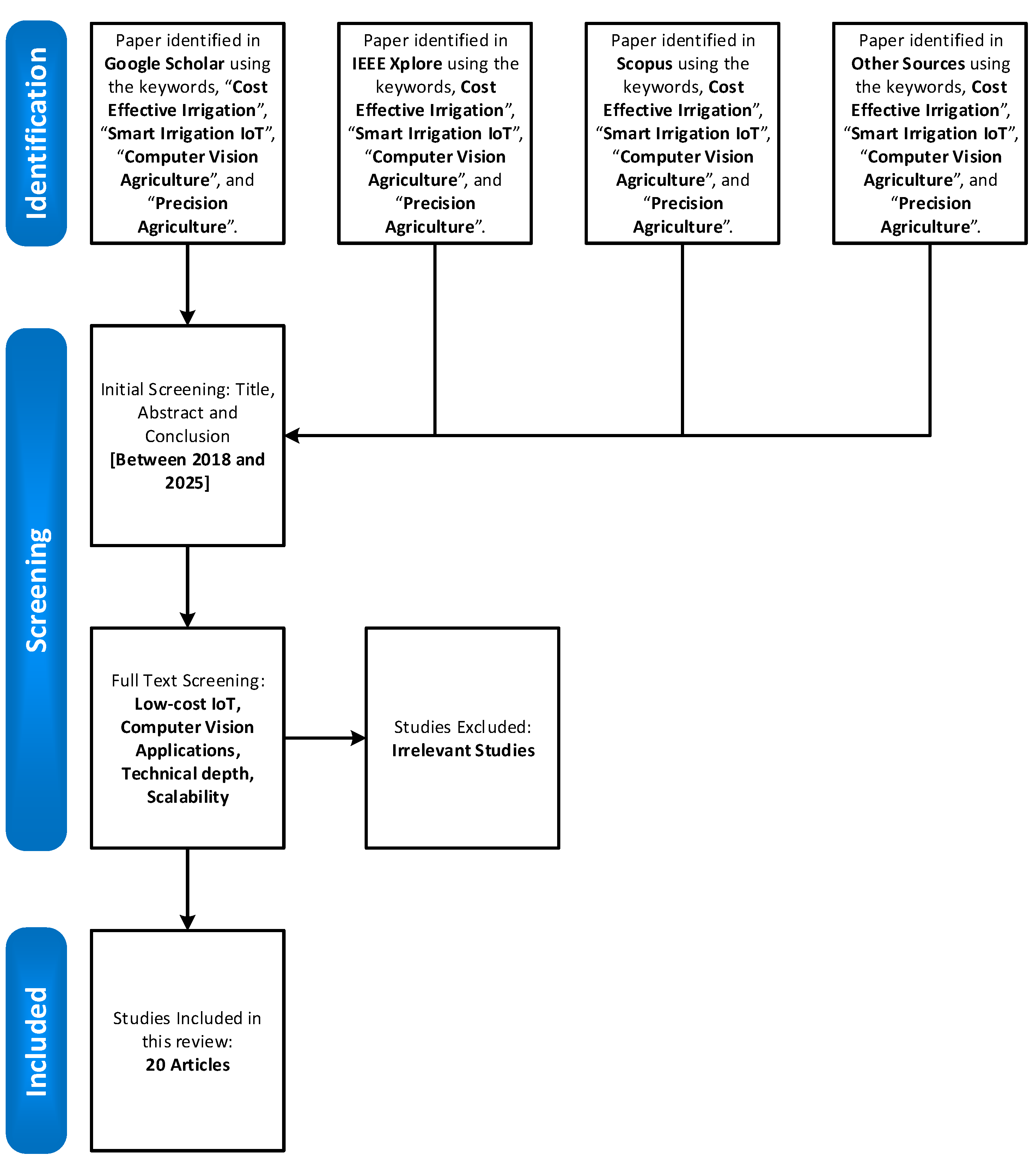
Figure 2.
Machine learning workflow in smart irrigation systems.
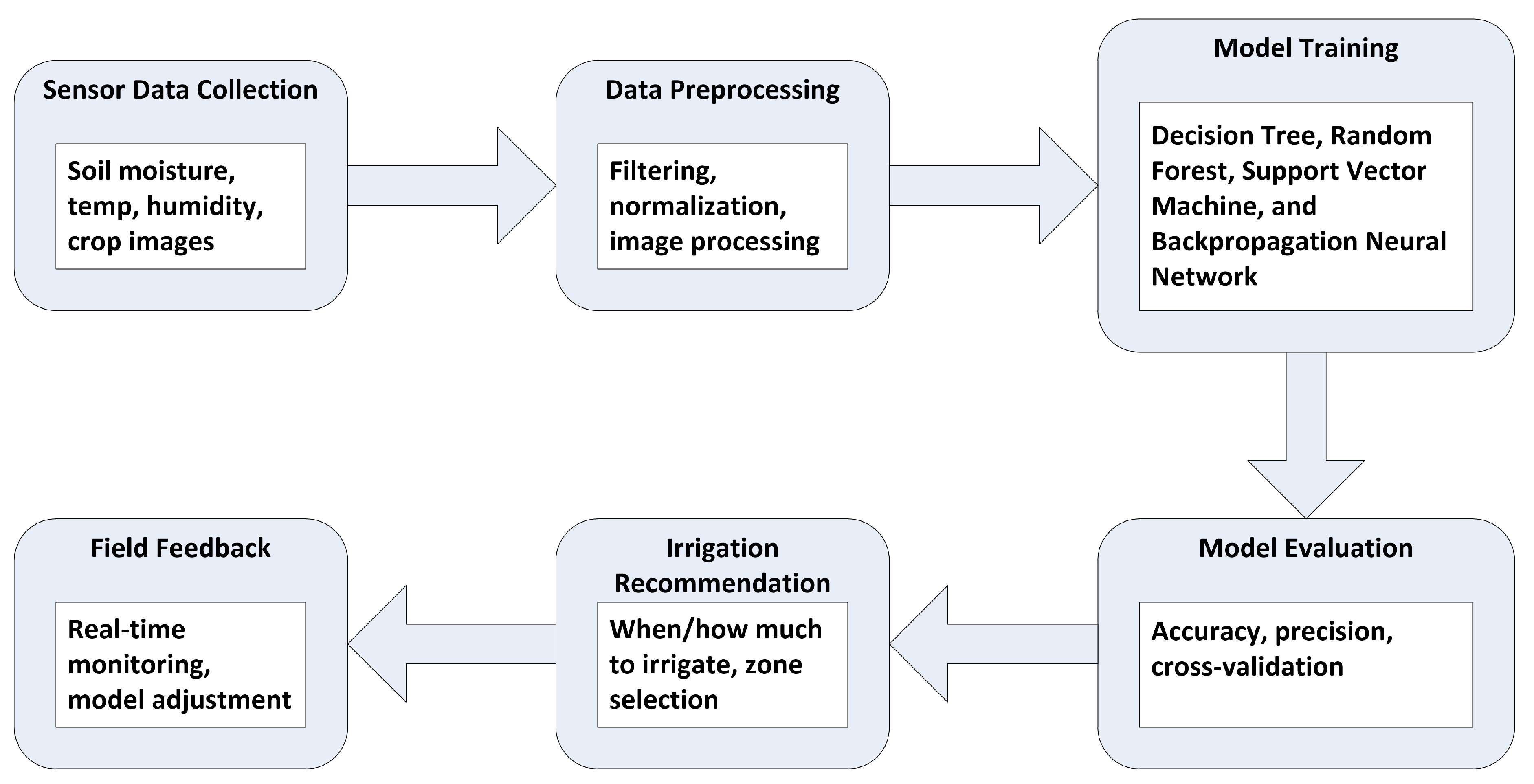
Figure 3.
Integration of IoT and computer vision in smart irrigation systems
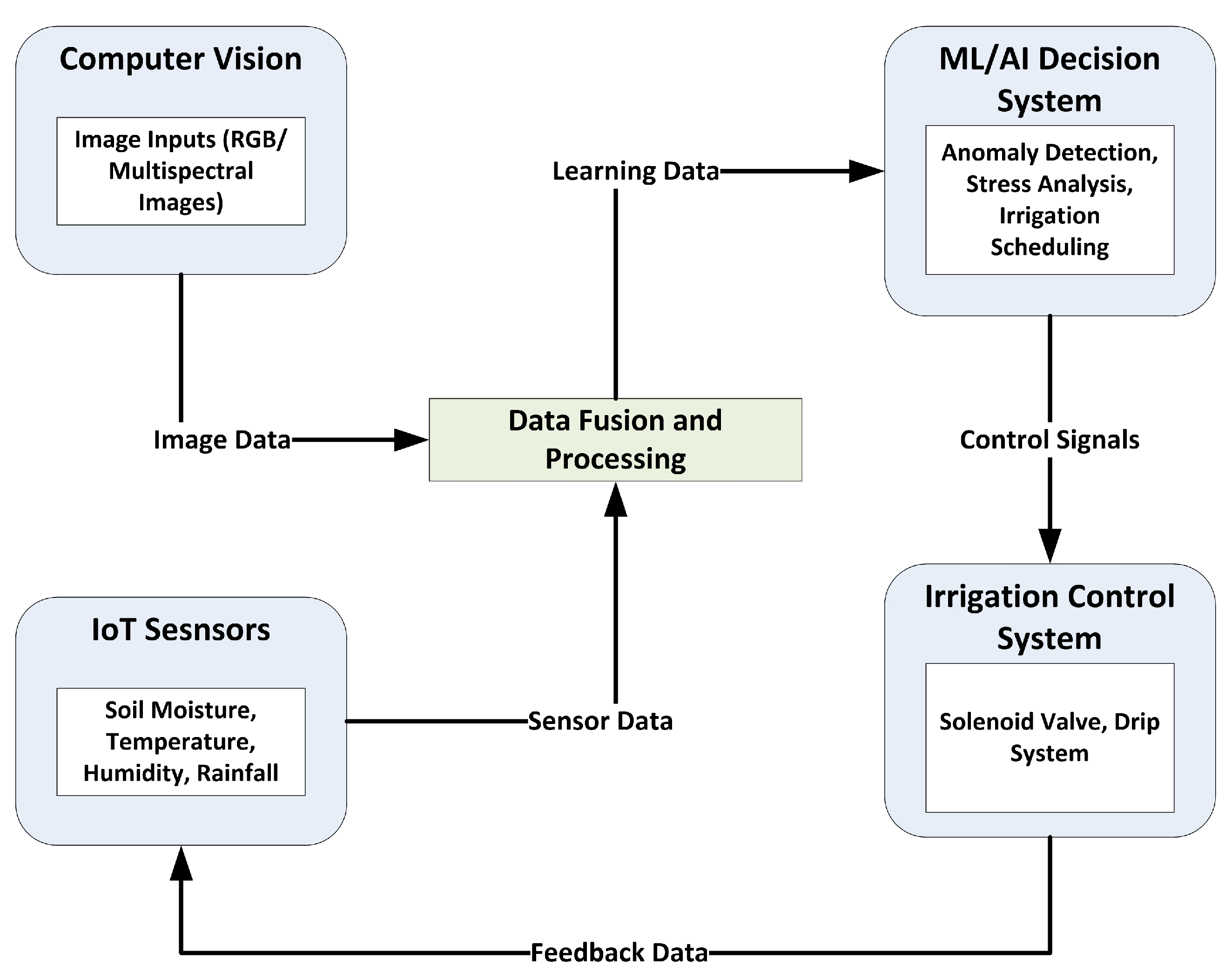
Figure 4.
Computer vision applications in smart irrigation.
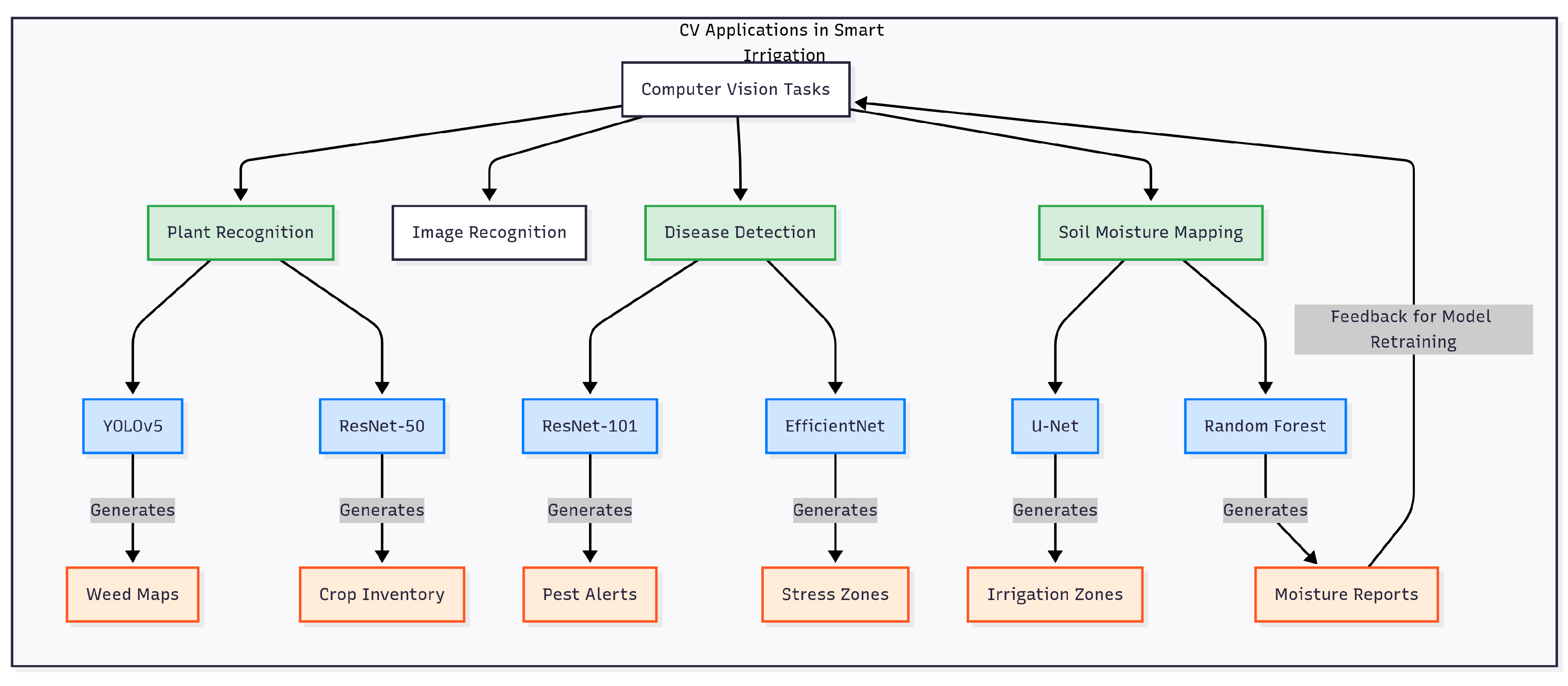
Figure 5.
Four-layer IoT architecture for smart irrigation systems
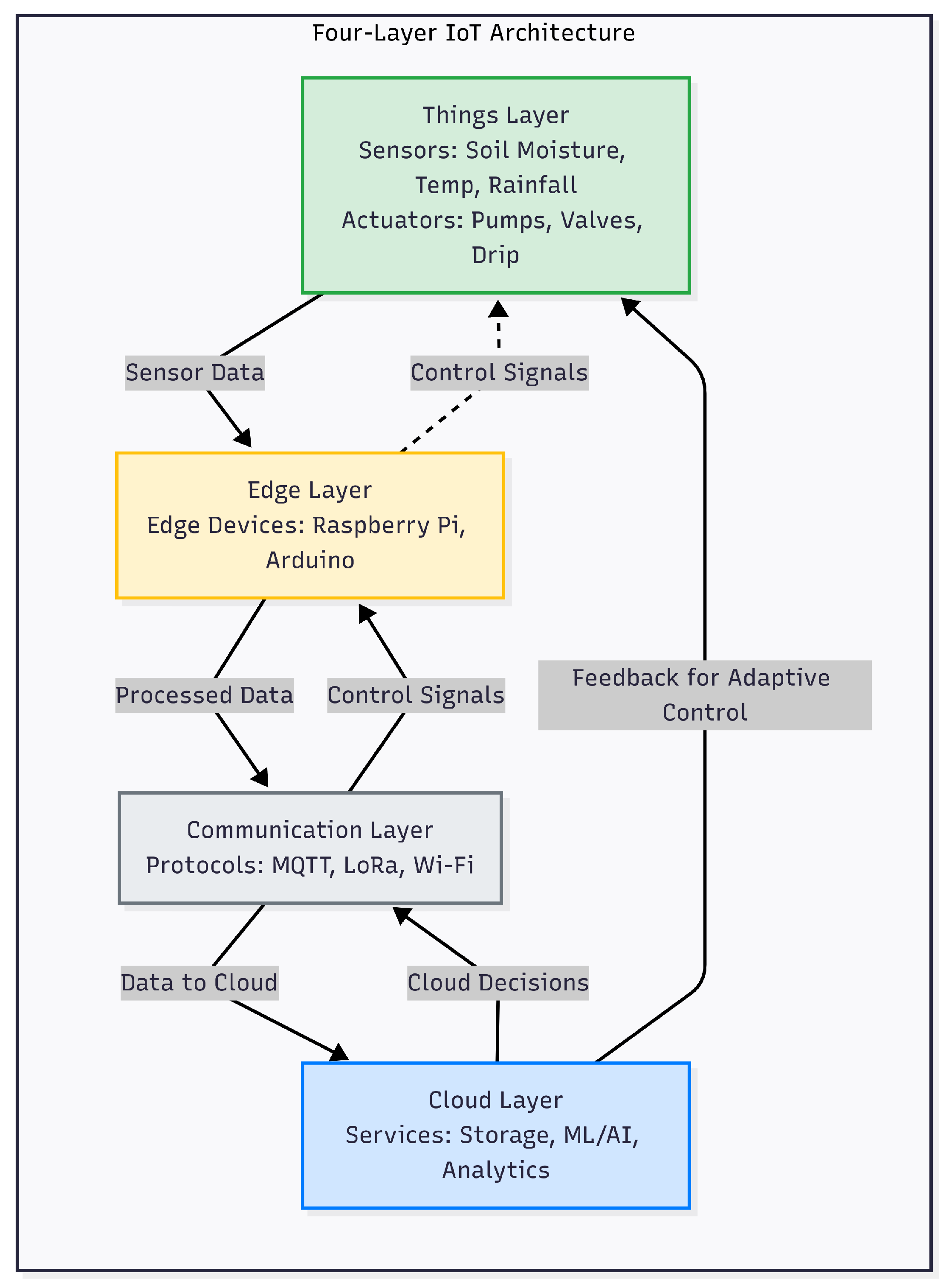

Table 1.
Global Water Scarcity and its Impact on Agriculture.
| Region | Agricultural Water Use (%) | Water Stress Level | Projected Impact on Crop Yield by 2030 |
|---|---|---|---|
| Middle East & North Africa | 80–90% | Extremely High | ↓ 20–30% in cereal yields |
| South Asia | 90% | High | ↓ 10–20% in rice and wheat yields |
| Sub-Saharan Africa | 85% | Moderate to High | ↓ 5–15% in maize and sorghum yields |
| North America | 40% | Moderate | ↓ 5–10% in wheat and soybean yields |
| Europe | 30–40% | Low to Moderate | ↓ 5–10% in fruit and vegetable yields |
| Latin America | 70% | Moderate | ↓ 10–15% in maize and soybean yields |
Source: FAO (2022), World Bank (2021), IPCC (2021).
Table 2.
Comparison of IoT Communication Protocols Used in Smart Irrigation Systems.
| Protocol | Range (km) | Power Consumption | Cost | Application Context |
|---|---|---|---|---|
| Wi-Fi (802.11) | 0.05–0.1 | High | Low | Short-range, high-data transmission; suitable for areas with infrastructure |
| GSM (2G/3G) | 2–5 | Medium to High | Medium | Widely available; works well in rural areas with mobile coverage |
| LoRa | 2–15 | Low | Low to Medium | Ideal for rural, remote areas with limited power and connectivity |
| Bluetooth Low Energy (BLE) | 0.01–0.05 | Very Low | Low | Short-range, energy-efficient; suitable for small-scale systems |
| MQTT (Protocol) | Dependent on carrier | Very Low | Low | Lightweight; used with Wi-Fi, GSM, or LoRa for efficient message transfer |
Note: MQTT is a protocol layered over transport channels like Wi-Fi, GSM, or LoRa. Ranges vary based on hardware and environmental conditions.
Table 3.
Cost Breakdown of Low-Cost Smart Irrigation Systems.
| System | Components | Estimated Cost (USD) | Scalability |
|---|---|---|---|
| SIAS (Haziq et al., 2022) | ESP8266, soil moisture sensor, pH sensor, water pump | $46 | Small farms, experimental plots |
| Vijayaraja et al. (2022) | NodeMCU, solar panel, moisture sensors, Adafruit cloud | $55–70 | Scalable to medium farms with solar support |
| Senthil Vadivu et al. (2023) | GSM module, soil sensors, remote controller | $60 | Small to medium farms, remote regions |
| Chowdary et al. (2019) | NodeMCU, PIR, Bluetooth/Wi-Fi modules | $35–45 | Suitable for home gardens or small plots |
| Mhaned et al. (2022) | Raspberry Pi, solenoid valve, WSN, MQTT module | $70–90 | Medium-scale farms; modular expansion possible |
Note: Costs are approximate and vary based on regional availability and sourcing. Scalability indicates the potential for expansion across different farm sizes.
Table 4.
Summary of Literature Survey on Smart Irrigation Systems.
| Authors | Year | Technologies Used | Methodology | Key Results and Contributions |
|---|---|---|---|---|
| Saleheen et al. | 2022 | NodeMCU, Adafruit IO, soil/air sensors | Real-time monitoring and dashboard data relay | 30–40% less manual irrigation; improved tracking |
| Srivastava et al. | 2023 | GSM, WSN, moisture sensors | Automated irrigation with GSM IoT nodes | 22% better water efficiency; reduced labor |
| Elgaali & Ismail | 2023 | Arduino Mega, DHT11, solenoids | Tomato irrigation automation | 27% higher yield; 35% water savings |
| Baskar et al. | 2022 | NodeMCU, LoRa, Blynk | Cloud-triggered irrigation from soil moisture | 50% water savings; 18% better crop health |
| Sampatrao | 2019 | GSM, Android app | Real-time manual override with app feedback | 32% water savings; reduced labor cost |
| Bakare | 2023 | BPN, nutrient sensors | ML trained on crop growth data | 15–25% more output; 20% lower disease rates |
| Alphonse et al. | 2023 | Decision tree, sensors | ML-based irrigation on humidity/temp | 92% accuracy; 35% more water-use efficiency |
| Alanya-Arango et al. | 2022 | Weather sensors, ML | Weather/soil modeling for irrigation timing | 28% fewer irrigations; quality maintained |
| Pierre et al. | 2023 | IoT, fuzzy logic, mobile UI | Energy-aware fuzzy irrigation control | 50% energy savings; 20% yield increase |
| Puig et al. | 2022 | FIWARE, edge, ET models | Irrigation via soil balance + ET forecast | 33% water saving in vineyards; no yield loss |
| Haziq et al. | 2022 | ESP8266, pH sensor | Fertility-moisture control system ($46) | 85% water savings; 23% biomass gain |
| Vijayaraja et al. | 2022 | NodeMCU, solar, Adafruit | Off-grid irrigation with smart drainage | 48% less power; remote reliability |
| Senthil Vadivu et al. | 2023 | GSM, remote sensors | GSM-linked real-time automation | 38% more yield; 50% less labor |
| Janani & Pavitra | 2019 | UWSNs, RO reuse | Coastal saline irrigation for salicornia | Promising reuse method; early stage |
| Kumar et al. | 2022 | MQTT, BLYNK, NodeMCU | Moisture-based pump control | 87% control accuracy; robust in fields |
Table 5.
Comparison of Cost-Effective Irrigation Systems.
| Study | Technology | Key Features | Outcomes |
|---|---|---|---|
| Patil et al. (2023) | Arduino Uno, relay module, pump | Soil moisture-based automation | 80% water waste reduction, lower energy costs |
| Malla et al. (2023) | Temperature/distance sensors, piezo actuator | Dual-purpose actuator, farmer alerts | Reduced water and energy waste |
| Mhaned et al. (2022) | Raspberry Pi, WSN, MQTT, fuzzy logic | IoT-based automation | Optimized water use, reduced manual intervention |
| Chowdary et al. (2019) | PIR, NodeMCU, Bluetooth/Wi-Fi | Low-power sleep modes | Reduced energy consumption |
| Iyer et al. (2020) | LoRa, cloud storage | Centralized data collection, automation | Efficient water use, scalable |
| Nagaraja and Kant (2019) | AWS data, evapotranspiration | No on-site weather stations | Precise irrigation, cost savings |
Table 6.
ROI Summary of Selected Smart Irrigation Systems.
| Study | Initial Cost ($) | Water Savings (%) | Yield Increase (%) | ROI Estimate |
|---|---|---|---|---|
| Hazic et al. (2022) | 46 | 85 | 23 | High |
| Vijayaraja et al. (2022) | 100–150 | 48 | 20 | Moderate |
| Senthil Vadivu et al. (2023) | 200–300 | 40 | 38 | Moderate |
| Patil et al. (2023) | 50–100 | 80 | 15–25 | High |
Table 7.
Functional Layers of IoT-Based Smart Irrigation Architecture.
| Layer | Technologies | Functions |
|---|---|---|
| Things | Sensors, actuators | Collects soil moisture, temperature; controls irrigation devices |
| Edge | Microcontrollers, gateways | Local data processing, real-time decision-making |
| Communication | LoRa, MQTT, Wi-Fi | Transmits data between devices and cloud |
| Cloud | Databases, analytics platforms | Stores data, performs analytics, provides user interfaces |
Table 8.
Emerging Technologies for Future Smart Irrigation.
| Technology | Potential Impact | Challenges | Example Applications |
|---|---|---|---|
| Edge Computing | Enables real-time decision-making; reduces latency and cloud dependency | High initial hardware complexity; limited processing power on edge devices | LoRa-based edge irrigation controllers (e.g., Puig et al., 2022) |
| Energy Harvesting | Supports autonomous operation in off-grid or rural areas | Efficiency and durability of energy systems under harsh conditions | Solar-powered NodeMCU systems (e.g., Vijayaraja et al., 2022) |
| AI-Driven Forecasting | Improves irrigation accuracy via predictive models; enhances crop yield | Requires large datasets and model interpretability | Decision tree and neural network systems (e.g., Alphonse et al., 2023; Bakare, 2023) |
| Flexible/Printed Sensors | Reduces sensor cost; enables deployment on diverse surfaces (e.g., leaves, soil) | Durability and accuracy under environmental stress | Early-stage research in plant-wearable moisture sensors |
| Blockchain for Data Integrity | Secures data sharing and traceability in precision farming ecosystems | Scalability, energy use, and technical complexity | Pilot projects in agricultural supply chains and IoT trust layers |
| Interoperable IoT Standards | Promotes integration with existing farm management platforms | Lack of unified standards; vendor lock-in risks | FIWARE-based frameworks enabling modular sensor integration |
Note: These technologies represent cutting-edge research and pilot-stage deployments, with varying degrees of maturity.
Disclaimer/Publisher’s Note: The statements, opinions and data contained in all publications are solely those of the individual author(s) and contributor(s) and not of MDPI and/or the editor(s). MDPI and/or the editor(s) disclaim responsibility for any injury to people or property resulting from any ideas, methods, instructions or products referred to in the content. |
© 2025 by the authors. Licensee MDPI, Basel, Switzerland. This article is an open access article distributed under the terms and conditions of the Creative Commons Attribution (CC BY) license (http://creativecommons.org/licenses/by/4.0/).
Copyright: This open access article is published under a Creative Commons CC BY 4.0 license, which permit the free download, distribution, and reuse, provided that the author and preprint are cited in any reuse.