

Submitted:
31 August 2025
Posted:
01 September 2025
You are already at the latest version
Abstract
In 2014, NASA measured with high precision that the universal space has an Euclidean shape. This result is a challenge for new models of gravity and bending of light that challenge General Relativity. We developed a mathematical model where we extend the mass-energy equivalence principle to universal space. We gave universal space the physical property of the variable energy density. Our model elegantly describes gravity as the pushing force of space and the bending of light as a result of the changed refractive index due to the changed variable energy density of space when light moves closer or away from the stellar object.
Keywords:
geometry of space
; gravity
; bending of light
1. Introduction
The advancement of physics requires that theoretical models be adjusted accordingly to the experimental data. NASA's measurement in 2014 requires re-examination of General Relativity and its curvature of space model: “Recent measurements (c. 2001) by a number of ground-based and balloon-based experiments, including MAT/TOCO, Boomerang, Maxima, and DASI, have shown that the brightest spots are about 1 degree across. Thus, the universe was known to be flat to within about 15% accuracy prior to the WMAP results. WMAP has confirmed this result with very high accuracy and precision. We now know (as of 2013) that the universe is flat with only a 0.4% margin of error. This suggests that the Universe is infinite in extent; however, since the Universe has a finite age, we can only observe a finite volume of the Universe” [1]. We replaced the curvature of space with the variable energy density of superfluid space, resulting in an elegant model where the gravitational force is the push of superfluid space [2]. Our model supports Einstein's idea from 1920 that General Relativity without ether is unthinkable [3]. It was already Newton’s idea that gravity is the result of the variable energy density of ether: “Doth not this aethereal medium in passing out of water, glass, crystal, and other compact and dense bodies in empty spaces, grow denser and denser by degrees, and by that means refract the rays of light not in a point, but by bending them gradually in curve lines? . . . Is not this medium much rarer within the dense bodies of the Sun, stars, planets and comets, than in the empty celestial space between them? And in passing from them to great distances, doth it not grow denser and denser perpetually, and thereby cause the gravity of those great bodies towards one another, and of their parts towards the bodies; everybody endeavoring to go from the denser parts of the medium towards the rarer?” [4]. French physicist Mayeul Arminjon also suggested in 2011 that gravity acts as a pressure force of the ether [5], see Figure 1:
Superfluid space is a four-dimensional type of energy. Stellar objects are three-dimensional; they are somehow trapped in a four-dimensional superfluid space. Stellar objects diminish the energy density of superfluid space according to the extension of the mass energy equivalence principle to superfluid space which causes gravitational force. [3].
In our model, light bends because of the variable energy density of superfluid space. When light moves towards the stellar object, the energy density of the superfluid space decreases; when light moves away from the stellar object, the energy density of the superfluid space increases. This causes a change of the refractive index, which causes light changes its trajectory and bend, see Figure 2.
2. Calculations of the Light Bending Based on the Variable Energy Density of Superfluid Space
- (Assumption: for weak gravity where n=1, light bends smoothly near Sun, there is spherical symmetry)
- Where: (n is the Refractive index of space)
G: Gravitational constant
: Planck energy density of intergalactic space =
: Energy density of superfluid space in the center of the Sun = 20
c: Speed of light
R: Impact Parameter (Sun’s Radius)
= × 10-6 × 206264.86
1.75 arc seconds
According to Einstein’s General Relativity (1915), gravity causes light to bend near massive bodies like the Sun, with the bending angle given by where M is the Sun’s mass and R is the impact parameter (Sun’s radius). In his equation we replaced mass with the variable energy density of superfluid space, that we derive from the Eq. (2) which represents the mass-energy equivalence extension on superfluid quantum space:
We combine Eq. (1) and Eq. (2) and we get:
With the Eq. (3) we show that it is not mass that bends the light, it is the diminished energy density of superfluid space in the centre of the Sun that changes the refraction index of light which bends light. Gravitational constant G we can express with the energy density of superfluid space, see Eq. (4):
We combine Eq. (3) and Eq. (4) and we get:
Velocity of light we can change with Planck units
Eq. (6) confirms that the bending of light depends only on the energy density of superfluid space in the centre of the Sun. If Sun had the same mass and a smaller volume, the bending of light would be bigger: when in Eq. (2) mass remains the same and volume decreases, the value of the energy density of superfluid space in the centre also decreases, which increases the bending of the light, see Figure 3:
3. Discussion
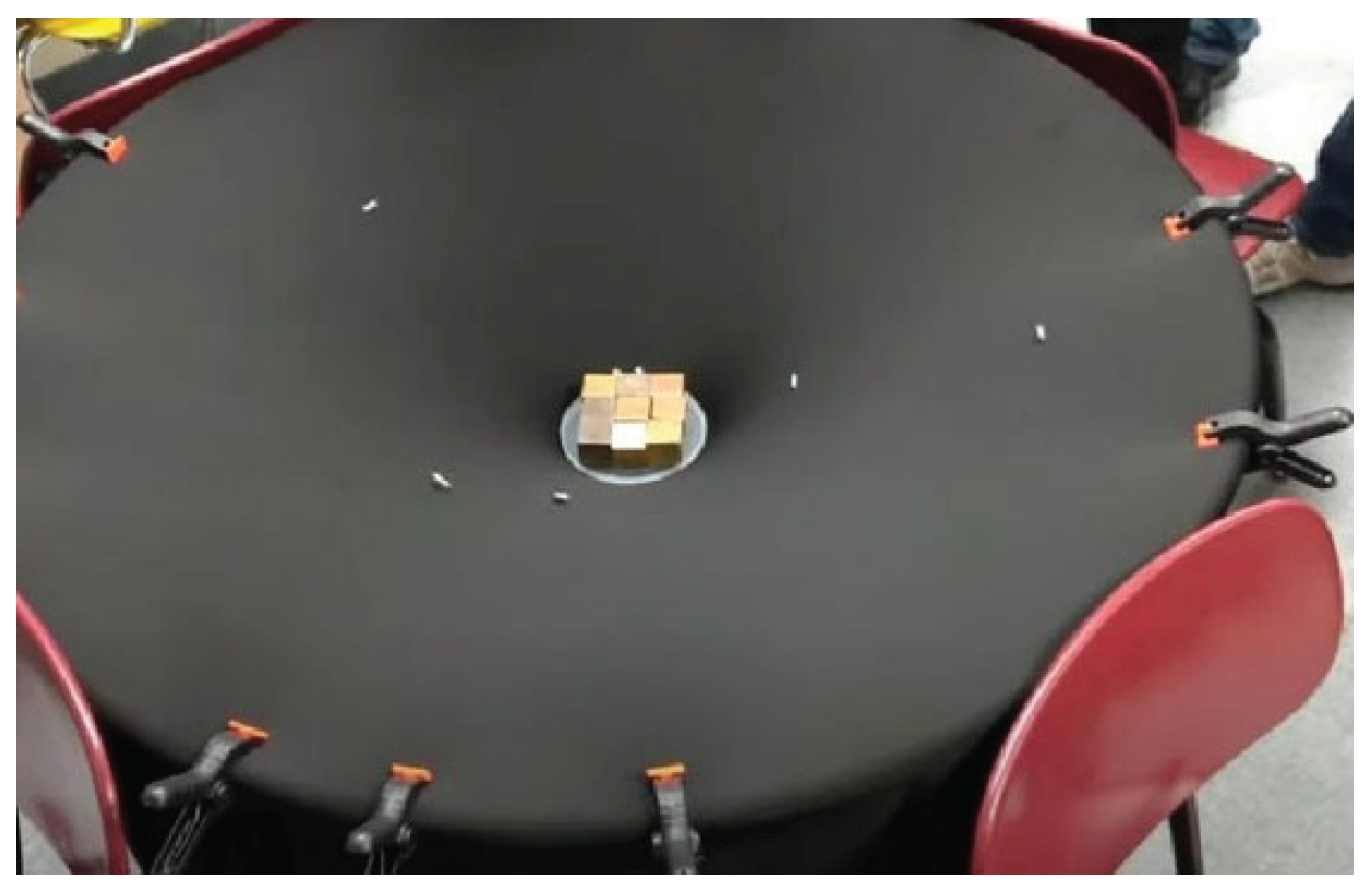
The Einstein field equations in General Relativity have a weak point, as they cannot calculate the gravitational force between stellar objects [3]. Geometrization of gravity with the curved space is a model of gravity which has no physical meaning. The simulation of curvature of space as the origin of gravity with the canvas, see Figure 4 below is not adequate.
Smaller objects are rolling towards the big object in the center because of the Earth’s gravity, not because of the taut canvas. If we were to fix the canvas with a rope at its center so that it would maintain the same shape and bring it to the orbital station, this simulation would not work because on the orbital station there is no Earth’s gravity. Simulation of gravity with a canvas has been misleading physics students for decades. It is time to refuse such an unscientific, superficial approach to the study of gravity. Gravity is a force, and curved space cannot generate force. This has to be clear if we want to progress our modelling of gravity [3]. In our model, gravity is a real force embedded in the fundamental structure of space, which has a variable energy density. Gravity acts as a pushing force of the superfluid space, and objects within space move in the direction of this push. Gravitational acceleration measures the gravity vector at a specific point in space. Gravity is always present. If there is nothing to exert force, there will be no force. If an object exists, it will reduce the energy density of the superfluid space, and the gravitational force will act, as shown in Figure 1.
Universal space is timeless, time-invariant. Time as duration is an emergent physical quantity that enters existence when measured by the observer. In the universe, there is no time; there are only change and motion, which have a given velocity. To measure velocities, humans invented clocks and time [8]. In our model, after 120 years, space and time are again separated. Space is timeless, and time is the duration of motion in space. Gravity is a vector of timeless superfluid quantum space that points from higher to the lower energy density of space. That time is not the 4th dimension of space is confirmed by the basics Eq. (7) of Special Relativity:
which yields:
Considering time as a 4th dimension of space was an oversimplification that, still today, is one of the main obstacles to the development of physics.
4. Conclusions
Einstein's theory of relativity is a great intellectual achievement of the 19th century. If we take it as some final theory that has no chance of development, we are doing a great injustice to physics. NASA's results show that the curvature of the universe needs to evolve with some more fundamental property of space, which is its variable energy density. The more space is curved, the less space is dense. Here is the key to the new horizons of gravitational physics.
References
- NASA, Our Universe (2014) https://wmap.gsfc.nasa.gov/universe/uni_shape.html.
- Amrit Srecko Sorli, Rado Gorjup, Niko Gorjup, Tomaz Makovec, Akash Saroj, Akash Ranjan, Piyush Singh, Re-examination of Penrose's and Kerr's singularities and the origin of protons in astrophysical jets, Advanced Studies in Theoretical Physics, Vol. 18, 2024, no. 2, 61-82 https://www.m-hikari.com/astp/astp2024/astp1-4-2024/92117.html.
- Amrit S. Sorli, Einstein Legacy: Ether Relativity and Cosmology, International Journal of Quantum Foundations, Volume 11, Issue 4, pages 527-559 (2025) https://ijqf.org/archives/7583.
- I. Newton, The Third Book of Optics (1718), https://www.newtonproject.ox.ac.uk/view/texts/normalized/NATP00051.
- Mayeul Arminjon, Gravitation as a pressure force: a scalar ether theory (2011). [CrossRef]
- M. Born & E. Wolf, Principles of Optics, Cambridge University Press, 7th ed., 1999.
- Gravity simulation https://www.youtube.com/watch?v=b9XhexlQMZw (2025).
- Amrit Sorli, Implications of Time-Invariant Superfluid Quantum Space Model in Fundamental Physics and Cosmology, Applied physics research, Vol. 17, No. 1, 2025. [CrossRef]
Figure 1.
Gravity between Moon and Earth as a pushing force of superfluid space.
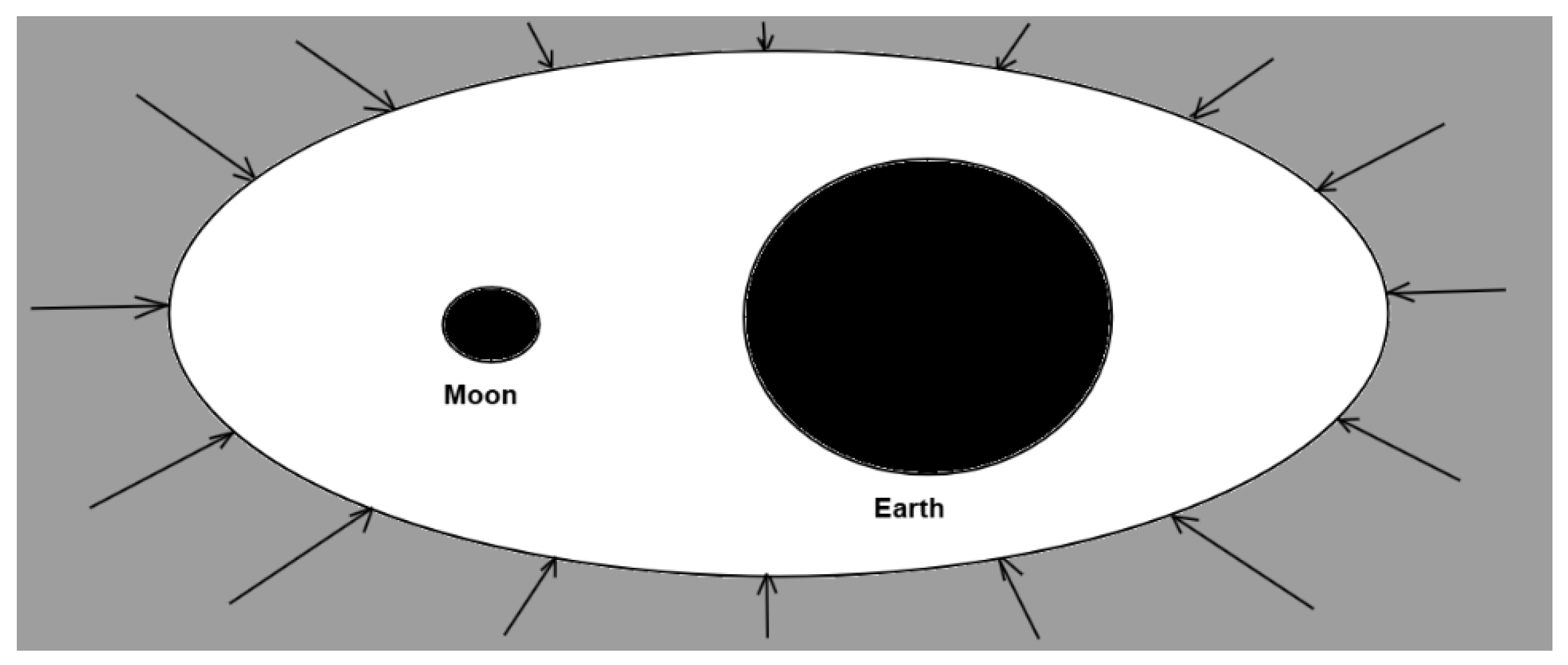
Figure 2.
Light bending is caused by the variable energy density of superfluid space.
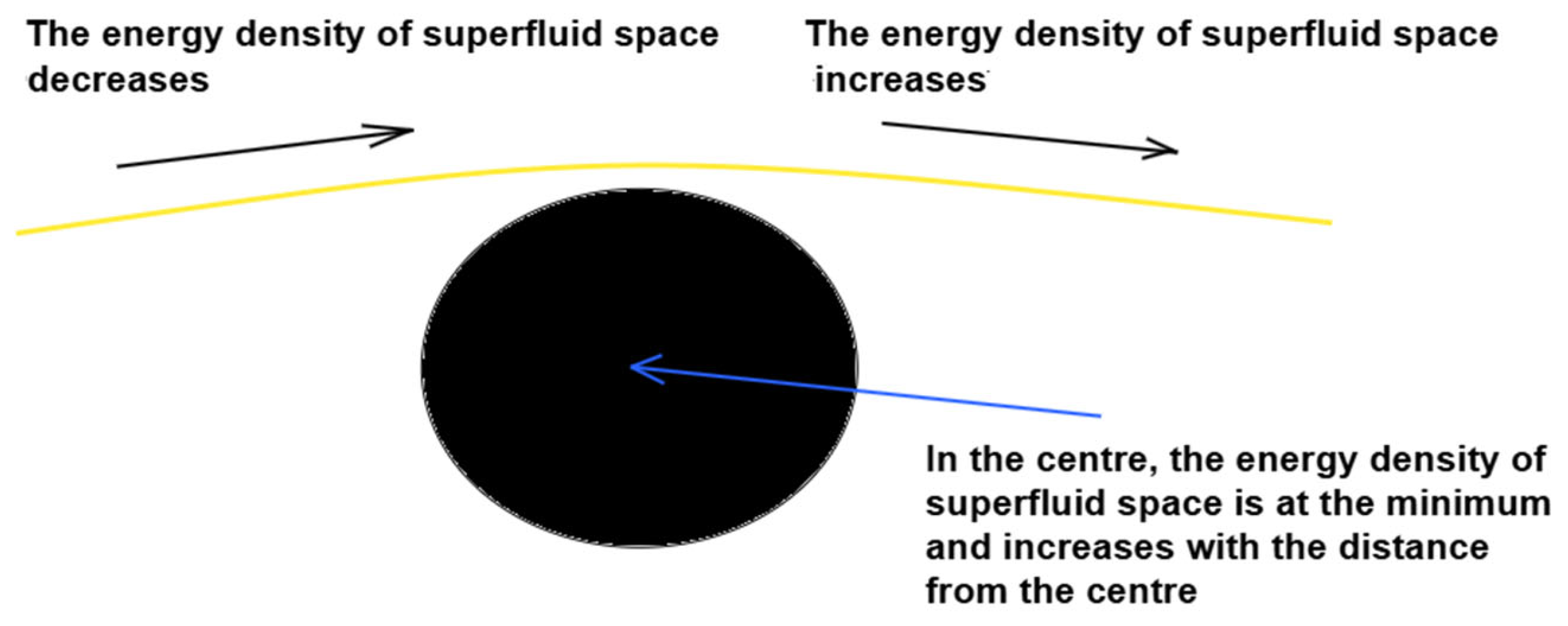
Figure 3.
Diminishing of the volume decreases the energy density of superfluid space in the centre.
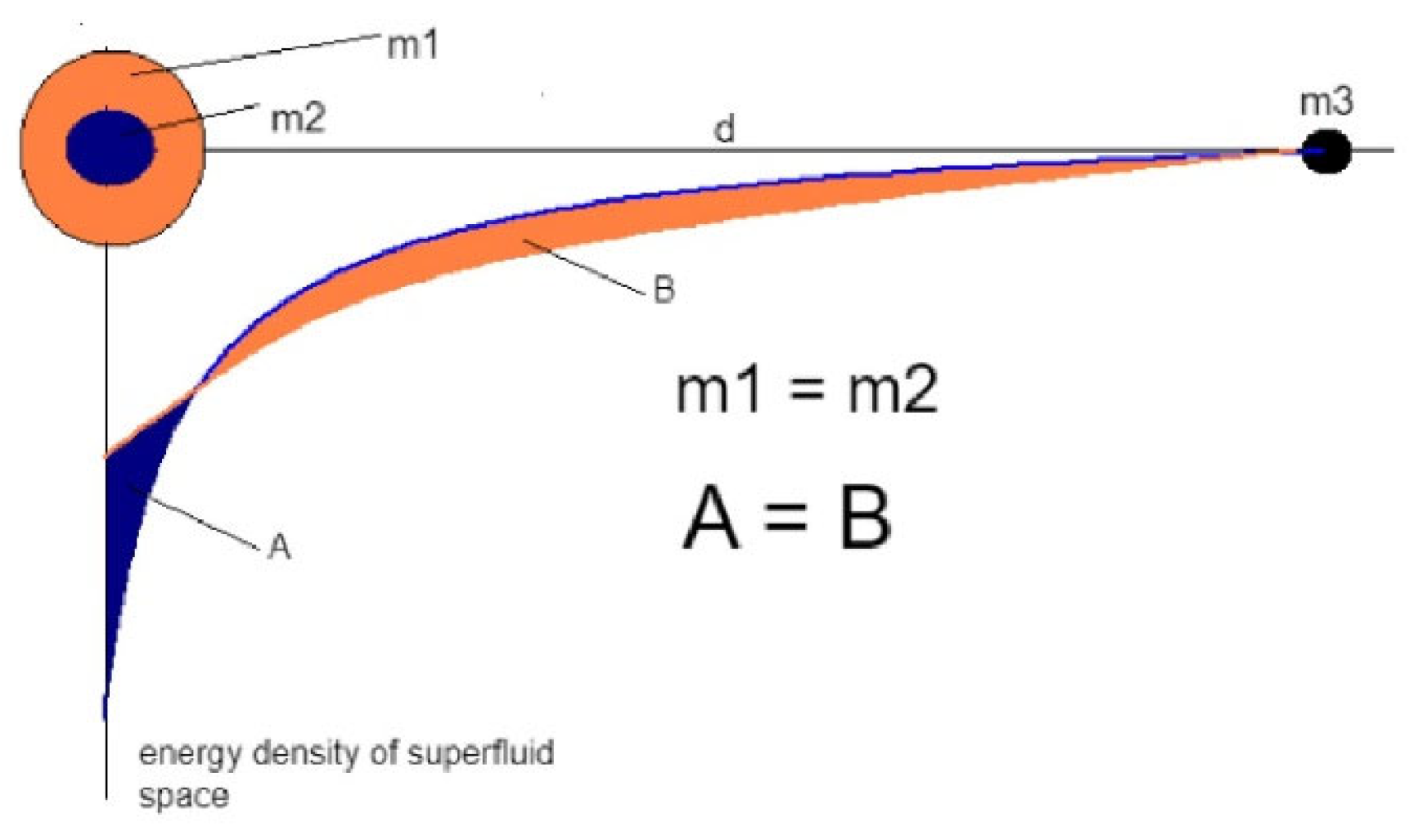
Figure 4.
Simulation of gravity with a taut canvas.
Disclaimer/Publisher’s Note: The statements, opinions and data contained in all publications are solely those of the individual author(s) and contributor(s) and not of MDPI and/or the editor(s). MDPI and/or the editor(s) disclaim responsibility for any injury to people or property resulting from any ideas, methods, instructions or products referred to in the content. |
© 2025 by the authors. Licensee MDPI, Basel, Switzerland. This article is an open access article distributed under the terms and conditions of the Creative Commons Attribution (CC BY) license (http://creativecommons.org/licenses/by/4.0/).
Copyright: This open access article is published under a Creative Commons CC BY 4.0 license, which permit the free download, distribution, and reuse, provided that the author and preprint are cited in any reuse.