

Submitted:
28 August 2025
Posted:
30 August 2025
You are already at the latest version
Abstract
This systematic review examined the health risk assessment methods of studies of whole-body vibration exposure from occupational vehicles or machines utilizing the International Standard ISO 2631-1 (1997) and/or the European Machine Directive 2002/44. This review found inconsistent reporting of measurement parameters in studies on whole-body vibration (WBV) exposure. Although many authors tread the ISO 2631-1 HGCZ as a medical health standard with defined threshold levels, there is no epidemiological evidence for these limits. Similarly, the EU Directive offers risk management guidance and numeric limits without supporting evidence. Authors note discrepancies between international and national standards. Future publications should report all relevant parameters from ISO 2631-1 and clearly stating study limitations, exercising caution when applying ISO 2631-1 HGCZ in health and safety assessments. We recommend a qualitative risk management with an emphasis on prevention.
Keywords:
vibration
; ISO 2631-1
; EU machine directive 2002/44/EC
; health guidance
; occu-pational health
; safety assessment
; prevention
1. Introduction
The International Standard Organization (ISO) develops standards based on consensus of representatives of government agencies, companies, individual experts, and professional organizations from around the world to determine acceptable practices, equipment, measurement methodology and criteria for preventing occupational injuries and illnesses. [1,2] The international standard ISO 2631-1 (1997) (Mechanical vibration and shock – evaluation of human exposure to whole-body vibration, Part 1) provides in the ‘informative’ Annex B guidance for the assessment of whole-body vibration (WBV) with respect to health risk and suggesting a ‘health guidance caution zones’ (HGCZ) figure B.1 for use. [3] In 2002, the Parliament and Commission of the European Community agreed to ‘minimum health and safety requirements for the exposure of workers to the risks arising from vibration’ (Machine Directive 2002/44/EC). [4,5] The EU Directive defines qualitative requirements and quantitative requirements in the form of ‘’exposure action values’’ and ‘’exposure limit values’’.[4,6,7] These guidelines are referenced in industrial hygiene and epidemiological studies and used for comparison in a health risk assessment by the authors. However, there appears to be often a lack of full understanding of the guidance and their limitations regarding the suggested quantitative norms in respect to the assessment of health risk and intervention requirements. The Standard ISO 2631-1 is currently under revision. A review of the scientific basis of the numeric guidance for basic vibration (rms) or suggested parameter for vibration containing multiple shocks (VDV) exposure appears to be needed. The potential benefit of qualitative guidance in an occupational risk assessment and intervention of WBV exposure will be appraised in this scoping review of the available health science literature. [8] The objective of this review is to examine if the provided guidance to ‘ISO 2631-1’ (1997) described in the informative Annex B (Guide to the effects of vibration on health) and/or the ‘EU Directive 2002/44/EC’ in published peer-reviewed WBV field exposure studies of various vehicles and equipment discussion of its limitations by the investigators/authors. Furthermore, it will be assessed if the numeric vs qualitative guidance generally accepted by the experts are considered by the authors (numeric values vs guidance on reducing risk to a minimum) ? [9] Are models of WBV intervention strategies offered by the published studies? [10] The description of study limitations provides meaningful information for the reader and may guide future research. Complete and honest discussion of the study is considered an obligation and mandatory by many Journals and their editors and improves the quality of the study. [11,12] Since many experts have pointed out inconsistencies and methodological shortcomings regarding the ISO 2631-1 (1997) Standard such a discussion of study limitations in field studies addressing health risks of workers appears prudent.[9,13,14,15,16,17,18]
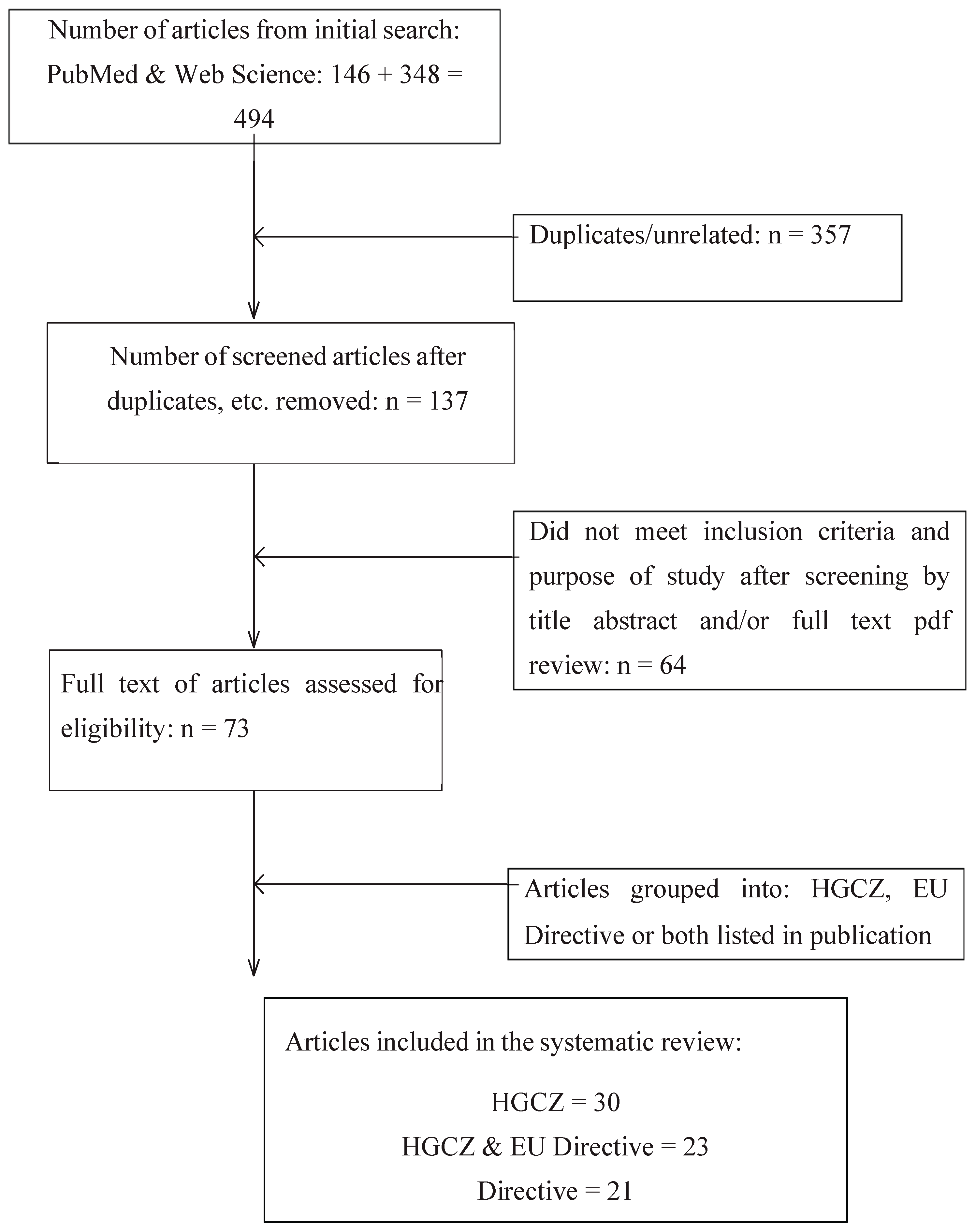
Figure 1.
Study selection process.
2. Materials and Methods
The protocol was drafted using the ‘Preferred Reporting Items for Systematic Reviews and Meta-analysis Protocols’ (PRISMA-ScR). [19] The final protocol was registered prospectively with the Open Science Framework on 6/23/2025.
To be included in this review, papers needed to list either ISO 2631 and/or the EU Machine Directive 2002/44/EC in the searchable text fields *Title, Abstract, All fields” of an institutional available search engine (EndnoteTM 2025, built 19000) providing online searches of PubMed and Web of Science). Citations covered human WBV and subjects, vehicle testing, epidemiological and occupational health studies, intervention studies, all published in English. Only peer-reviewed and online available publication dates from the year 1997 (ISO 2631 Standard Year) to 2025 (current 6/25) were considered. Papers were excluded if they did not fit into the conceptual framework of the study. Excluded were specifically citations that dealt with non-occupational exposure to WBV (i.e., medical treatments utilizing vibrating devices, laboratory/experimental and methodological studies), hand-arm vibration (HAV), building or comfort related studies, laboratory studies, motion sickness, animals and children’s studies [20] as well as studies employing the older version of ISO 2631-1 from 1985.
The final search results were exported into the reference manager software EndnoteTM 2025, duplicates were removed and grouped according to referencing either the “health guidance caution zone” (HGCZ) from ISO 2631-1 Annex B, the EU Directive or both. Furthermore, any discussions regarding study limitations in the determination and assessment of risks were checked (i.e., listing of the Crest Factor, VDV, typical driver posture). Papers were examined if the guidance provisions of the EU directive 2002/44 were considered (i.e.: The assessment of the level of exposure to vibration is based on the calculation of daily exposure A(8) expressed as equivalent continuous acceleration over an eight-hour period, calculated as the highest (rms) value, or the highest vibration dose value (VDV) of the frequency-weighted accelerations, determined on three orthogonal axes (1,4a wx , 1,4a wy , a wz for a seated or standing worker) in accordance with Chapters 5, 6 and 7, Annex A and Annex B to ISO standard 2631-1(1997) [Directive 2002/44/EC Annex B.1] [13].
Guidelines exist for publishing observational studies that suggest including consideration of study bias, data limitations, confounding effects, reproducibility, objective assessment of the findings, avoid overinterpretations and suggest recommendations for future research. [21,22,23] Each study was checked for a discussion of study limitations either as a separate paragraph or embedded within the discussion. Furthermore, the listing of the application and limitations cited in the ISO 2631-1 Annex B was examined.
The results of text analysis and the data-charting were tabulated in a MS spreadsheet (ExcelTm) and summarized (available upon request).
3. Results
A total of 137 publications from 1997 to June of 2025 listed the measurement Standard ISO 2631 in the searchable title or abstract in PubMed or in Web of Science. Of these, seventy-three publications were reviewed regarding the use of the health risk assessment by either the ISO 2631-1 (1997) Annex B guidance with the HGCZ, or the EU Directive 2002/44 of both. Table 1 shows a breakdown of the studied vehicles and usage/industries and the utilized risk assessment guidance. Studies utilizing the HGCZ for a risk assessment [24,25,26,27,28,29,30,31,32,33,34,35,36,37,38,39,40,41,42,43,44,45,46,47,48,49,50,51,52] involved heavy vehicles used in mining compared to studies of vehicles in construction and transport that tended to utilize the EU Directive [53,54,55,56,57,58,59,60,61,62,63,64,65,66,67,68,69,70,71,72,73] or both risk assessment guidance [74,75,76,77,78,79,80,81,82,83,84,85,86,87,88,89,90,91,92,93,94,95,96].
Studies included a wide variety of vehicles and situations including heavy earthmoving [16,24,27,41] or agricultural vehicles [44,73,79,96], transport (taxi, rail, buses) [55,61,66,83], aviation (helicopter)[42,81], sport devices [70,71], horses [95], wheelchairs [26,34,38], ambulances [53] and medical devices (MRI) [60]. The majority of the health outcomes studied ranged from WBV exposure related to back disorders[56,63,64] or to neck disorders [68], but also to neonatal head and torso impact [53], feet [31], the circulatory system [84], and semen quality[52].
WBV exposure was explored in epidemiological investigations of vehicle operators [24,27,51,57,63,78,81,82,97]. Several studies focused on comparison of operators’ seat design [29,49,55,62,80,98,99,100].
Most publications used quantitative (numeric) guidance (73%), while others (27%) followed qualitative recommendations for vibration reduction. Studies referencing the HGCZ and EU Directive most often included qualitative guidance (39%).
The ISO 2631-1 (1997) provides under paragraph 6 a “basic evaluation method” using weighted root-mean-square acceleration (rms). All studies, except for one, reported numerical “rms” values for the basic evaluation method. Furthermore, the standard describes the “applicability” of the basic evaluation method using the HGCZ guidance if the peak vibration crest factor (CF) (“describing the severity of the vibration in relation to its effects on human beings”) is less than 9 (ISO 2631-1 6.2) and additional evaluation parameters are suggested such as the fourth power Vibration Dose Value (VDV) (ISO 2631-1 6.3.2). Only 52 % of the publications utilized the HGCZ guidance listed the crest factor in their publications and only 14% of the studies referring to the EU Directive as well as the HGCZ guidance in their risk assessment. The additional evaluation method suggesting the fourth power VDV was listed by 76% of the studies utilizing the HGCZ risk assessment and 61% using the EU Directive.
Several studies n=35 also reported the values for an additional proposed risk analysis method for vibration containing multiple shocks described in ISO 2631-5 (2004 or 2018).
In terms of clearly addressing study limitations as suggested by editors and Journals guidelines only 48% of all publications objectively described such limitations of their findings and only 4 % specifically referred to the guidance limitations described in Annex B of ISO2631-1 (1997). (Table 2)
4. Discussion
This systematic review examined the health risk assessment methods of studies of whole-body vibration exposure from occupational vehicles or machines utilizing the International Standard ISO 2631-1 (1997) and/or the European Machine Directive 2002/44. The Standard is currently under review by the Technical Committee ISO/TC 108/SC 4. The Standard ISO 2631, consists of following parts, under the general title Mechanical vibration and shock - evaluation of human exposure to whole-body vibration: Part 1: General requirements, which primary purpose is to define methods of quantifying whole-body vibration in relation to “human health and comfort”, and Annexes A to E. Annex B titled “Guide to the effects of vibration on health”, which is explicitly “for information only”, is commonly used for a quantitative (numeric) risk assessment by investigators and apparently considered by many authors like a health standard. Although the Standard states that there is no clear and universally recognized dose-response relationship or “threshold” effects of vibration on health, Annex B provides under B.3 boundaries of “health effects” which are “clearly documented and/or objectively observed” and “above the zone health risks are likely”. However, there are no defining references cited in the Standard that support this statement for the basic evaluation method (rms) as well as the vibration dose value (VDV) lower and upper boundaries. Regardless, it is recognized that WBV with increasing levels of exposure and duration an increased risk for low back pain (LBP), sciatic pain, and degenerative changes in the spinal system, including lumbar intervertebral disc disorders and the connected nervous system. [101,102,103,104]
It appears that almost all the authors implying the HGCZ have not considered the specific conditions and limitations set forth in Annex B in their risk assessment, namely that it applies to “people in normal health” and that only measurements of the vertical axis (z=axis) should be compared to the caution zones only if the crest factor is below 9 the HGCZ boundaries otherwise it may underestimate “health disorders”. It is remarkable that only half of the studies reported the crest factor. The alternative risk assessment method under ISO 2631-1 using the estimated vibration dose value (VDV) has been reported by 70 % of the studies. However, the corresponding lower and upper bounds of the zone have also not been referenced or validated with epidemiological studies and the source of the suggested values is unknown. The recommendation of the HGCZ in Annex B is “mainly based on exposures in the range of 4 to 8 hours”, which none of the reviewed studies mentioned and many studies do not specify typical exposure durations. Modifying or confounding factors such as operator’s posture, temperature, draught, age and gender, rest periods are not considered in the algorithm of the HGCZ. In a laboratory study age and gender were found to have significant effects on fatigue strength of the spine, with gender differences extending beyond those accounted for by endplate area disparities. [105] These are factors that should have been discussed in the study limitation section to help the reader to better understand numeric values and to avoid under- or overestimating the true health risk.
In the European Union, the Directive 2002/33/EC was adopted in 2002 addressing “minimum health and safety requirements regarding exposure of workers to the risks arising from physical agents (vibration)”. [5,6,7,13] It is a framework for national standards within the EU that builds on employers’ duties to manage risks to health and safety of employees. It uses exposure action (EAV) and limit values (ELV) for whole body vibration and introduces a risk management approach for professional drivers and machine operators by setting minimum requirements for the prevention of vibration related health problems. These EAV and ELV of the EU Directive have been used by the authors in this review to quantify risks but only 27% of the reviewed studies proposed qualitative guidance with recommendation for prevention. Griffin (2004), pointing out discrepancies of the ISO 2631 with the EU Directive and the British Standard 6841 (1987) requirements was advocating a “qualitative guidance” (reducing risk to a minimum) rather than quantitative (numeric) guidance. Such a health surveillance and monitoring program has been described by Hulshof et al (1993) and others. [106] A “holistic approach” to reduce WBV exposure to professional drivers in context with other risk factors, such as postural concerns and manual handling operations was detailed by Nelson (2005). [5]
The key challenges in establishing limits for occupational medicine regarding whole-body vibration (WBV) include inconsistencies in exposure assessment methods, limited consideration of individual differences, and a lack of integration of long-term cumulative effects. There is notable variability among standards and regulatory frameworks, such as the European Directive 2002/44/EC and ISO 2631-Part 1 or 5. These standards employ different metrics (e.g., A (8), VDV, Sed, Risk Factor R), which can produce differing risk assessments for identical exposure scenarios and may complicate the determination of safe exposure thresholds. Existing limits often do not fully account for factors like body mass index, posture, and anthropometric differences that can impact susceptibility to WBV-related health effects. most regulatory limits focus on short-term (daily) exposure, neglecting the cumulative effects of WBV over a worker’s career. Musculoskeletal disorders and other adverse outcomes may result from long-term, repeated exposure, which is not adequately captured by daily exposure limits [9,41,77]. There is a lack of consensus on the best way to characterize and measure WBV exposure, especially regarding impulsive versus continuous vibration, predominant versus non-predominant axes, and the translation of exposure metrics to actual health outcomes. This introduces uncertainty in risk prediction and complicates the implementation of effective preventive measures.
In the USA, no Occupational Safety and Health Administration (OSHA) regulation or standard specifically for WBV exists and there are no numeric guidelines for EAV or ELV. The National Institute for Occupational Safety and Health (NIOSH) and regulatory agencies have adopted the qualitative approach of keeping exposure as low as technically possible in the workplace and musculoskeletal disorders should be generally addressed with ergonomic programs. [107,108] The American National Standards Institute (ANSI) has adopted key portions of ISO 2631 as a consensus standard under S3.18. The ANSI S3.18/ISO 2631 standard is strictly voluntary and should not be considered a health standard such as those issued by the Occupational Safety and Health Administration (OSHA) regulations. The ‘American Conference of Governmental Industrial Hygienist’ (ACGIH), a professional organization, has proposed the concept of ‘Threshold Limit Values’ (ACGIH-TLVw) as industry guidelines for the control of WBV at the workplace, which are also voluntary guidelines and not enforceable by law in the USA. The Navy and Marine Corps Force Health Protection Command issued a “Human Vibration Guide 2023” for industrial hygienist and safety professionals but mischaracterize that ISO has established occupational exposure limits (OELs) along with the ACGIH and ANSI and refers to the HGCZ.[109]
In several European countries spinal injury caused by WBV is recognized as an occupational disease and may be compensable. The WBV-related injury claims process includes a review of the work history, and a workplace exposure assessment which is typically based on measurements following the ISO 2631 Standard. [110]
Much of the research that is the background of the HGCZ relates to back disorders in workers with very high WBV exposure, seated and healthy subjects in laboratory experiments and therefore the use of the HGCZ boundaries for other outcomes i.e., semen, circulative, cognitive function and infants or children is clearly questionable and would not be supported by the data.
5. Study Limitations
This study considered publications in English and cited in only two common online citation resources (PubMed maintained by the National Center for Biotechnology Information (NCBI) at the U.S. National Library of Medicine (NLM) and Web of Sciences) accessed online and with a reference manager software. There are other citations and reference manager available that may have produced more and other publications with the desired keywords. However, PubMed and Web of Science are well-known tools used by occupational health professionals to quickly assess the availability of peer-reviewed literature.
Publications cannot be clearly divided into qualitative or quantitative guidelines; classification depends on the reviewer’s interpretation of the discussion, conclusion, and data, which may introduce bias.
The description of study limitations is not a requirement for all Journals in some situations it may be omitted for a variety of reasons. Nevertheless, a superior quality study nowadays should not be without a clear description of objective shortcomings, biases, and confounders.
The Standard ISO 2631 does not mandate the reporting of certain, or all parameters defined in the text, such as rms, crest factor, MTVV, VDV and measurement parameters such as the magnitude or duration of sampling, driver posture, weight, height, gender or age and it is up to the authors, peer reviewers and editors to provide guidance. However, proper reporting of all collected data will help the reviewer to make a better assessment of the provided exposure information and application to occupational health risk evaluation
6. Conclusions
This review found inconsistent reporting of measurement parameters in studies on whole-body vibration (WBV) exposure. Although the ISO 2631-1 HGCZ is often treated as a medical standard with threshold levels, there is no epidemiological evidence for these limits. Similarly, the EU Directive offers risk management guidance and numeric limits without supporting evidence. Authors note discrepancies between international and national standards. In summary, the primary challenges include methodological inconsistency, limited individualization, insufficient assessment of cumulative exposure, and ongoing uncertainty regarding the relationships between exposure and health outcomes. We recommend reporting all relevant parameters from ISO 2631-1 and clearly stating study limitations, exercising caution when applying ISO 2631-1 HGCZ in health and safety assessments.
References
- Armstrong, T.J., et al., Scientific basis of ISO standards on biomechanical risk factors. Scand J Work Environ Health, 2018. 44(3): p. 323–329. [CrossRef]
- Armstrong, T.J., et al., Authors’ response: Letter to the Editor concerning OCRA as preferred method in ISO standards on biomechanical risk factors. Scand J Work Environ Health, 2018. 44(4): p. 439–440. [CrossRef]
- IS0, I.O.f.S., ISO 2631-1:1997 Mechanical vibration and shock — Evaluation of human exposure to whole-body vibration, in Part 1: General requirements. 1997, IS0 International Organization for Standardization: Geneva, Switzerland.
- 2002/44, E.D., Directive 2002/44/EC of the European Parliament and of the Council of 25 June 2002 on the minimum health and safety requirements regarding the exposure of workers to the risks arising from physical agents (vibration). 2002, European Commision: Official Journal of the European Communities.
- Nelson, C.M. and P.F. Brereton, The European vibration directive. Ind Health, 2005. 43(3): p. 472–9.
- Bovenzi, M., Health risks from occupational exposures to mechanical vibration. Med Lav, 2006. 97(3): p. 535–41.
- Donati, P.S., M; Szopa, J.; Starck, J..; Iglesias, E.G.; Senovilla, L.P.; Fischer, S.; Flaspoeler, E.; Reinert, D.; de Beeck, R.O.; , Workplace exposure to vibration in Europe: an expert review. 2008, European Agency for Safety and Health at Work: Luxembourg: Office for Official Publications of the European Communities.
- Peters, M.D., et al., Guidance for conducting systematic scoping reviews. Int J Evid Based Healthc, 2015. 13(3): p. 141–6.
- Griffin, M.J., Minimum health and safety requirements for workers exposed to hand-transmitted vibration and whole-body vibration in the European Union; a review. Occup Environ Med, 2004. 61(5): p. 387–97. [CrossRef]
- Hulshof, C.T., et al., Evaluation of an occupational health intervention programme on whole-body vibration in forklift truck drivers: a controlled trial. Occup Environ Med, 2006. 63(7): p. 461–8.
- Ross, P.T. and N.L. Bibler Zaidi, Limited by our limitations. Perspect Med Educ, 2019. 8(4): p. 261–264.
- Sumpter, J.P., et al., A ‘Limitations’ section should be mandatory in all scientific papers. Science of The Total Environment, 2023. 857: p. 159395.
- Griffin, M.J.P., P.M.; Fischer, S.; Kaulbars, U.; Donati, P.M.; Bereton, P.F.;, Guide to good practice on Whole-Body Vibration - Non-binding guide to good practice with a view to implementation of Directive 2002/44/EC on the minimum health and safety requirements regarding the exposure of workers to the risks arising from physical agents (vibrations). (EU Good Practice Guide WBV), T.W.P.V.m.b.t.A.C.o.S.a.H.a.W.i.c.w.t.E. Commission., Editor. 2006. p. 65.
- Dong, R.G., D.E. Welcome, and T.W. McDowell, Some important oversights in the assessment of whole-body vibration exposure based on ISO-2631-1. Appl Ergon, 2012. 43(1): p. 268–9.
- Maeda, S., Necessary research for standardization of subjective scaling of whole-body vibration. Ind Health, 2005. 43(3): p. 390–401. [CrossRef]
- Mansfield, N.J., G.S. Newell, and L. Notini, Earth moving machine whole-body vibration and the contribution of Sub-1Hz components to ISO 2631-1 metrics. Ind Health, 2009. 47(4): p. 402–10.
- Waters, T., et al., A new framework for evaluating potential risk of back disorders due to whole body vibration and repeated mechanical shock. Ergonomics, 2007. 50(3): p. 379–95.
- Bainbridge, A., et al., Whole body vibrations and lower back pain: a systematic review of the current literature. BMJ Mil Health, 2025.
- Tricco, A.C., et al., PRISMA Extension for Scoping Reviews (PRISMA-ScR): Checklist and Explanation. Ann Intern Med, 2018. 169(7): p. 467–473.
- Giacomin, J., Absorbed power of small children. Clin Biomech (Bristol), 2005. 20(4): p. 372–80.
- Cuschieri, S., The STROBE guidelines. Saudi J Anaesth, 2019. 13(Suppl 1): p. S31–s34.
- Ghaferi, A.A., T.A. Schwartz, and T.M. Pawlik, STROBE Reporting Guidelines for Observational Studies. JAMA Surg, 2021. 156(6): p. 577–578. [CrossRef]
- Moher, D., et al., Guidance for developers of health research reporting guidelines. PLoS Med, 2010. 7(2): p. e1000217.
- Atal, M.K., et al., Occupational exposure of dumper operators to whole-body vibration in opencast coal mines: an approach for risk assessment using a Bayesian network. Int J Occup Saf Ergon, 2022. 28(2): p. 758–765.
- Burgess-Limerick, R. and D. Lynas, Long duration measurements of whole-body vibration exposures associated with surface coal mining equipment compared to previous short-duration measurements. J Occup Environ Hyg, 2016. 13(5): p. 339–45. [CrossRef]
- Candiotti, J.L., et al., Analysis of Whole-Body Vibration Using Electric Powered Wheelchairs on Surface Transitions. Vibration, 2022. 5(1): p. 98–109.
- Chaudhary, D.K., et al., Whole-body vibration exposure of heavy earthmoving machinery operators in surface coal mines: a comparative assessment of transport and non-transport earthmoving equipment operators. Int J Occup Saf Ergon, 2022. 28(1): p. 174–183.
- Chen, J.C., et al., Predictors of whole-body vibration levels among urban taxi drivers. Ergonomics, 2003. 46(11): p. 1075–90.
- Conrad, L.F., et al., Selecting seats for steel industry mobile machines based on seat effective amplitude transmissibility and comfort. Work, 2014. 47(1): p. 123–36.
- Dhatrak, S.V., I.A. Shah, and S.S. Prajapati, Determinants of discomfort from combined exposure to noise and vibration in dumper operators of mining industry in India. J Occup Environ Hyg, 2024. 21(6): p. 389–396.
- Eger, T., et al., Vibration induced white-feet: overview and field study of vibration exposure and reported symptoms in workers. Work, 2014. 47(1): p. 101–10.
- Garcia-Mendez, Y., et al., Health risks of vibration exposure to wheelchair users in the community. J Spinal Cord Med, 2013. 36(4): p. 365–75.
- Grenier, S.G., T.R. Eger, and J.P. Dickey, Predicting discomfort scores reported by LHD operators using whole-body vibration exposure values and musculoskeletal pain scores. Work, 2010. 35(1): p. 49–62.
- Hischke, M. and R.F. Reiser, 2nd, Effect of Rear Wheel Suspension on Tilt-in-Space Wheelchair Shock and Vibration Attenuation. PM R, 2018. 10(10): p. 1040–1050.
- Howard, B., R. Sesek, and D. Bloswick, Typical whole body vibration exposure magnitudes encountered in the open pit mining industry. Work, 2009. 34(3): p. 297–303.
- Jack, R.J., et al., Six-degree-of-freedom whole-body vibration exposure levels during routine skidder operations. Ergonomics, 2010. 53(5): p. 696–715. [CrossRef]
- Lan, F.Y., et al., An investigation of a cluster of cervical herniated discs among container truck drivers with occupational exposure to whole-body vibration. J Occup Health, 2016. 58(1): p. 118–27.
- Lee, C.D., et al., Usability and Vibration Analysis of a Low-Profile Automatic Powered Wheelchair to Motor Vehicle Docking System. Vibration, 2023. 6(1): p. 255–268.
- Lynas, D. and R. Burgess-Limerick, Whole-Body Vibration Associated with Dozer Operation at an Australian Surface Coal Mine. Ann Work Expo Health, 2019. 63(8): p. 881–889.
- Lynas, D. and R. Burgess-Limerick, Whole-body vibration associated with underground coal mining equipment in Australia. Appl Ergon, 2020. 89: p. 103162.
- Marin, L.S., et al., Assessment of Whole-Body Vibration Exposure in Mining Earth-moving Equipment and Other Vehicles Used in Surface Mining. Ann Work Expo Health, 2017. 61(6): p. 669–680. [CrossRef]
- De Oliveira, C.G. and J. Nadal, Transmissibility of helicopter vibration in the spines of pilots in flight. Aviat Space Environ Med, 2005. 76(6): p. 576–80.
- Paddan, G.S. and M.J. Griffin, EVALUATION OF WHOLE-BODY VIBRATION IN VEHICLES. Journal of Sound and Vibration, 2002. 253(1): p. 195–213.
- Park, M.S., et al., Health risk evaluation of whole-body vibration by ISO 2631-5 and ISO 2631-1 for operators of agricultural tractors and recreational vehicles. Ind Health, 2013. 51(3): p. 364–70. [CrossRef]
- Pollard, J., et al., The effect of vibration exposure during haul truck operation on grip strength, touch sensation, and balance. Int J Ind Ergon, 2017. 57: p. 23–31.
- Prajapati, S.S., et al., Whole-body Vibration Exposure Experienced by Dumper Operators in Opencast Mining According to ISO 2631-1:1997 and ISO 2631-5:2004: A Case Study. Indian J Occup Environ Med, 2020. 24(2): p. 114–118.
- Sharma, A. and B.B. Mandal, A Critical Assessment of Boundary Limits of Health Risks Associated with WBV Exposure Based on Field Studies on LHD Vehicles in Indian Underground Coal Mines. Indian J Occup Environ Med, 2024. 28(3): p. 198–206. [CrossRef]
- Smets, M.P., T.R. Eger, and S.G. Grenier, Whole-body vibration experienced by haulage truck operators in surface mining operations: a comparison of various analysis methods utilized in the prediction of health risks. Appl Ergon, 2010. 41(6): p. 763–70.
- Smith, S.D., Seat vibration in military propeller aircraft: characterization, exposure assessment, and mitigation. Aviat Space Environ Med, 2006. 77(1): p. 32–40.
- Upadhyay, R., et al., Role of whole-body vibration exposure and posture of dumper operators in musculoskeletal disorders: a case study in metalliferous mines. Int J Occup Saf Ergon, 2022. 28(3): p. 1711–1721. [CrossRef]
- Upadhyay, R., et al., Association between Whole-Body Vibration exposure and musculoskeletal disorders among dumper operators: A case-control study in Indian iron ore mines. Work, 2022. 71(1): p. 235–247.
- Zarei, S., et al., Assessment of semen quality of taxi drivers exposed to whole body vibration. J Occup Med Toxicol, 2022. 17(1): p. 16.
- Blaxter, L., et al., Neonatal head and torso vibration exposure during inter-hospital transfer. Proc Inst Mech Eng H, 2017. 231(2): p. 99–113.
- Blood, R.P., P.W. Rynell, and P.W. Johnson, Whole-body vibration in heavy equipment operators of a front-end loader: role of task exposure and tire configuration with and without traction chains. J Safety Res, 2012. 43(5-6): p. 357–64.
- Blood, R.P., et al., Whole-body Vibration Exposure Intervention among Professional Bus and Truck Drivers: A Laboratory Evaluation of Seat-suspension Designs. J Occup Environ Hyg, 2015. 12(6): p. 351–62.
- Bovenzi, M., et al., A cohort study of sciatic pain and measures of internal spinal load in professional drivers. Ergonomics, 2015. 58(7): p. 1088–102.
- Bovenzi, M., et al., Relationships of low back outcomes to internal spinal load: a prospective cohort study of professional drivers. Int Arch Occup Environ Health, 2015. 88(4): p. 487–99.
- Calvo, A., et al., Vibration and Noise Transmitted by Agricultural Backpack Powered Machines Critically Examined Using the Current Standards. Int J Environ Res Public Health, 2019. 16(12).
- Coggins, M.A., et al., Evaluation of hand-arm and whole-body vibrations in construction and property management. Ann Occup Hyg, 2010. 54(8): p. 904–14.
- Ehman, E.C., et al., Vibration safety limits for magnetic resonance elastography. Phys Med Biol, 2008. 53(4): p. 925–35.
- Hanumegowda, P.K. and S. Gnanasekaran, Risk factors and prevalence of work-related musculoskeletal disorders in metropolitan bus drivers: An assessment of whole body and hand-arm transmitted vibration. Work, 2022. 71(4): p. 951–973.
- Jonsson, P.M., et al., Comparison of whole-body vibration exposures in buses: effects and interactions of bus and seat design. Ergonomics, 2015. 58(7): p. 1133–42.
- McBride, D., et al., Low back and neck pain in locomotive engineers exposed to whole-body vibration. Arch Environ Occup Health, 2014. 69(4): p. 207–13. [CrossRef]
- Milosavljevic, S., et al., Exposure to whole-body vibration and mechanical shock: a field study of quad bike use in agriculture. Ann Occup Hyg, 2011. 55(3): p. 286–95.
- Noorloos, D., et al., Does body mass index increase the risk of low back pain in a population exposed to whole body vibration? Appl Ergon, 2008. 39(6): p. 779–85. [CrossRef]
- Okunribido, O.O., et al., City bus driving and low back pain: a study of the exposures to posture demands, manual materials handling and whole-body vibration. Appl Ergon, 2007. 38(1): p. 29–38.
- Picoral Filho, J.G., et al., Case study on vibration health risk and comfort levels in loading crane trucks. Int J Health Plann Manage, 2019. 34(4): p. e1448–e1463.
- Rehn, B., et al., Neck pain combined with arm pain among professional drivers of forest machines and the association with whole-body vibration exposure. Ergonomics, 2009. 52(10): p. 1240–7. [CrossRef]
- Sanchez-Perez, J.F., et al., Characterization of workers or population percentage affected by low-back pain (LPB), sciatica and herniated disc due to whole-body vibrations (WBV). Heliyon, 2024. 10(11): p. e31768.
- Supej, M., J. Ogrin, and H.C. Holmberg, Whole-Body Vibrations Associated With Alpine Skiing: A Risk Factor for Low Back Pain? Front Physiol, 2018. 9: p. 204.
- Tarabini, M., B. Saggin, and D. Scaccabarozzi, Whole-body vibration exposure in sport: four relevant cases. Ergonomics, 2015. 58(7): p. 1143–50.
- Thrailkill, E.A., B.R. Lowndes, and M.S. Hallbeck, Vibration analysis of the sulky accessory for a commercial walk-behind lawn mower to determine operator comfort and health. Ergonomics, 2013. 56(1): p. 115–25. [CrossRef]
- Vallone, M., et al., Risk exposure to vibration and noise in the use of agricultural track-laying tractors. Ann Agric Environ Med, 2016. 23(4): p. 591–597.
- Birlik, G., Occupational exposure to whole body vibration-train drivers. Ind Health, 2009. 47(1): p. 5–10.
- Cann, A.P., A.W. Salmoni, and T.R. Eger, Predictors of whole-body vibration exposure experienced by highway transport truck operators. Ergonomics, 2004. 47(13): p. 1432–53.
- de la Hoz-Torres, M.L., et al., A methodology for assessment of long-term exposure to whole-body vibrations in vehicle drivers to propose preventive safety measures. J Safety Res, 2021. 78: p. 47–58.
- de la Hoz-Torres, M.L., et al., Whole Body Vibration Exposure Transmitted to Drivers of Heavy Equipment Vehicles: A Comparative Case According to the Short- and Long-Term Exposure Assessment Methodologies Defined in ISO 2631-1 and ISO 2631-5. Int J Environ Res Public Health, 2022. 19(9).
- Funakoshi, M., et al., Measurement of whole-body vibration in taxi drivers. J Occup Health, 2004. 46(2): p. 119–24. [CrossRef]
- Futatsuka, M., et al., Whole-body vibration and health effects in the agricultural machinery drivers. Ind Health, 1998. 36(2): p. 127–32.
- Johnson, P.W., et al., A Randomized Controlled Trial of a Truck Seat Intervention: Part 1-Assessment of Whole Body Vibration Exposures. Ann Work Expo Health, 2018. 62(8): p. 990–999.
- Kåsin, J.I., N. Mansfield, and A. Wagstaff, Whole body vibration in helicopters: risk assessment in relation to low back pain. Aviat Space Environ Med, 2011. 82(8): p. 790–6.
- Kim, J.H., et al., Whole Body Vibration Exposures and Health Status among Professional Truck Drivers: A Cross-sectional Analysis. Ann Occup Hyg, 2016. 60(8): p. 936–48.
- Lewis, C.A. and P.W. Johnson, Whole-body vibration exposure in metropolitan bus drivers. Occup Med (Lond), 2012. 62(7): p. 519–24.
- Mahbub, M.H., et al., A systematic review of studies investigating the effects of controlled whole-body vibration intervention on peripheral circulation. Clin Physiol Funct Imaging, 2019. 39(6): p. 363–377.
- Mahbub, M.H., et al., Acute Effects of Whole-Body Vibration on Peripheral Blood Flow, Vibrotactile Perception and Balance in Older Adults. Int J Environ Res Public Health, 2020. 17(3).
- Mandal, B.B. and N.J. Mansfield, Contribution of individual components of a job cycle on overall severity of whole-body vibration exposure: a study in Indian mines. Int J Occup Saf Ergon, 2016. 22(1): p. 142–51. [CrossRef]
- Mayton, A.G., C.C. Jobes, and S. Gallagher, Assessment of whole-body vibration exposures and influencing factors for quarry haul truck drivers and loader operators. Int J Heavy Veh Syst, 2014. 21(3): p. 241–261.
- Mayton, A.G., et al., Investigation of human body vibration exposures on haul trucks operating at U.S. surface mines/quarries relative to haul truck activity. Int J Ind Ergon, 2018. 64: p. 188–198.
- Medina Santiago, A., et al., Diagnosis and Study of Mechanical Vibrations in Cargo Vehicles Using ISO 2631-1:1997. Sensors (Basel), 2023. 23(24).
- Moschioni, G., B. Saggin, and M. Tarabini, Long term WBV measurements on vehicles travelling on urban paths. Ind Health, 2010. 48(5): p. 606–14.
- Orelaja, O.A., et al., Evaluation of Health Risk Level of Hand-Arm and Whole-Body Vibrations on the Technical Operators and Equipment in a Tobacco-Producing Company in Nigeria. J Healthc Eng, 2019. 2019: p. 5723830.
- Rehn, B., et al., Whole-body vibration exposure and non-neutral neck postures during occupational use of all-terrain vehicles. Ann Occup Hyg, 2005. 49(3): p. 267–75.
- Sherwin, L.M., et al., Influence of tyre inflation pressure on whole-body vibrations transmitted to the operator in a cut-to-length timber harvester. Appl Ergon, 2004. 35(3): p. 253–61.
- Wolfgang, R. and R. Burgess-Limerick, Whole-body vibration exposure of haul truck drivers at a surface coal mine. Appl Ergon, 2014. 45(6): p. 1700–4. [CrossRef]
- Zeng, X., C. Trask, and A.M. Kociolek, Whole-body vibration exposure of occupational horseback riding in agriculture: A ranching example. Am J Ind Med, 2017. 60(2): p. 215–220.
- Zeng, X., et al., Whole body vibration exposure patterns in Canadian prairie farmers. Ergonomics, 2017. 60(8): p. 1064–1073.
- Tiemessen, I.J., C.T. Hulshof, and M.H. Frings-Dresen, Low back pain in drivers exposed to whole body vibration: analysis of a dose-response pattern. Occup Environ Med, 2008. 65(10): p. 667–75.
- Davies, H.W., et al., Exposure to Whole-Body Vibration in Commercial Heavy-Truck Driving in On- and Off-Road Conditions: Effect of Seat Choice. Ann Work Expo Health, 2022. 66(1): p. 69–78.
- Ittianuwat, R., M. Fard, and K. Kato, Evaluation of seatback vibration based on ISO 2631-1 (1997) standard method: The influence of vehicle seat structural resonance. Ergonomics, 2017. 60(1): p. 82–92.
- Fard, M., et al., Effects of seat structural dynamics on current ride comfort criteria. Ergonomics, 2014. 57(10): p. 1549–61.
- Bovenzi, M. and C.T. Hulshof, An updated review of epidemiologic studies on the relationship between exposure to whole-body vibration and low back pain (1986-1997). Int.Arch.Occup.Environ.Health, 1999. 72(6): p. 351–365. [CrossRef]
- Bernard, B., P., et al., Low back and musculoskeletal disorders: Evidence for work-relatedness., in Musculoskeletal disorders (MSDs) and Workplace Factors, B.P. Bernard and e. al, Editors. 1997, U.S. Dep Health and Human Services - CDC&P - National Institute for Occupational Safety and Health (NIOSH). Cincinnati, Oh. p. 6–1–6–39.
- Teschke, K., et al., Whole Body Vibration and Back Disorders Among Motor Vehicle Drivers and Heavy Equipment Operators - A Review of the Scientific. 1999: Vancouver, BC.
- Seidel, H., et al., Intraspinal forces and health risk caused by whole-body vibration – predictions for European drivers.
- and different field conditions. Int J Ind Ergon, 2008. 38: p. 856–867.
- Schmidt, A.L., et al., Risk of lumbar spine injury from cyclic compressive loading. Spine (Phila Pa 1976), 2012. 37(26): p. E1614–21. [CrossRef]
- Hulshof, C.T., J.H. Verbeek, and F.J. van Dijk, Development and evaluation of an occupational health services programme on the prevention and control of effects of vibration. Occup.Med.(Lond), 1993. 43 Suppl 1: p. S38–S42.
- Cohen, A.G., CC; Fine, LJ; Bernard, BP; McGlothlin, JD;, ed. Elements of Ergonomics Programs - A Primer Based on Workplace Evaluations of Musculoskeletal Disorder. PB97-144901, ed. N.I.f.O.S.a. Health. 1997, National Institute for Occupational Safety and Health: Cincinnati, Ohio.
- (NIOSH), N.I.f.O.S.a.H. Elements of Ergonomics Programs. 2024 [cited 2025 8/24/2025]; The Elements of Ergonomics Programs is a step–by–step guide]. Available from: https://www.cdc.gov/niosh/ergonomics/ergo-programs/.
- command, N.a.m.c.f.h.p. Human Vibration Guide. 2023 [cited 2025 8/24/2025]; Human Vibration Guide 2023]. Available from: https://www.med.navy.mil/Portals/62/Documents/NMFA/NMCPHC/root/Industrial%20Hygiene/Human-Vibration-Technical-Guide.pdf.
- Johanning, E., Whole-body vibration-related health disorders in occupational medicine--an international comparison. Ergonomics, 2015. 58(7): p. 1239–52.

Table 1.
Studies of vehicles and usage/industry and the utilization of the risk assessment guidelines following the ISO 2631-1 Annex B guidance or the EU Directive.
Table 1.
Studies of vehicles and usage/industry and the utilization of the risk assessment guidelines following the ISO 2631-1 Annex B guidance or the EU Directive.
| Machinery/Vehicle | Usage / Industry | HGCZ | HGCZ & EU-Directive | EU Directive | |
|---|---|---|---|---|---|
| 1 | tractor, combine, horse | agriculture | 1 | 3 | 4 |
| 2 | helicopter, propeller aircraft | aviation | 2 | 0 | 0 |
| 3 | truck, dumper, skidder | construction | 3 | 1 | 5 |
| 4 | forest machine, frame saw, timber harvester | forestry | 1 | 1 | 1 |
| 5 | ambulance, wheelchair, MRI | health / medical | 4 | 2 | 2 |
| 6 | fork lift, platform, pot hauler | industrial | 1 | 1 | 0 |
| 7 | dumpster, haul truck, earth mover, dozer | Mining | 15 | 4 | 0 |
| 8 | ski, snowboards, bicycle, kite | sport | 0 | 0 | 2 |
| 9 | bus, cars, taxi, All-Terraine-Vehicle, rail | transport | 3 | 9 | 7 |
| Sum | 30 | 21 | 21 |
Table 2.
Studies utilizing risk assessment guidance, reported parameters, discussion of limitations and quantitative (numeric) versus qualitative risk assessment.
Table 2.
Studies utilizing risk assessment guidance, reported parameters, discussion of limitations and quantitative (numeric) versus qualitative risk assessment.
| All studies | % | HGCZ | % | HGCZ & EU Directive | % | EU Directive | % | |
|---|---|---|---|---|---|---|---|---|
| Total No of studies | 74 | 100% | 30 | 100% | 23 | 100% | 21 | 100 |
| RMS listed | 73 | 99 | 30 | 100 | 22 | 96 | 21 | 100 |
| Crest factor listed | 38 | 51 | 17 | 57 | 14 | 61 | 7 | 33 |
| VDV listed | 52 | 70 | 22 | 73 | 17 | 74 | 13 | 62 |
| ISO 2631-5 included | 17 | 23 | 5 | 17 | 6 | 26 | 6 | 9 |
| Study limitation included | 36 | 49 | 16 | 53 | 10 | 43 | 10 | 48 |
| ISO 2631-1 Annex B limitation | 3 | 4 | 2 | 7 | 1 | 4 | n/a | n/a |
| Quantitative guidance | 54 | 73 | 25 | 83 | 14 | 61 | 15 | 71 |
| Qualitative guidance | 20 | 27 | 5 | 17 | 9 | 39 | 6 | 29 |
Disclaimer/Publisher’s Note: The statements, opinions and data contained in all publications are solely those of the individual author(s) and contributor(s) and not of MDPI and/or the editor(s). MDPI and/or the editor(s) disclaim responsibility for any injury to people or property resulting from any ideas, methods, instructions or products referred to in the content. |
© 2025 by the authors. Licensee MDPI, Basel, Switzerland. This article is an open access article distributed under the terms and conditions of the Creative Commons Attribution (CC BY) license (http://creativecommons.org/licenses/by/4.0/).
Copyright: This open access article is published under a Creative Commons CC BY 4.0 license, which permit the free download, distribution, and reuse, provided that the author and preprint are cited in any reuse.


