

Submitted:
27 August 2025
Posted:
29 August 2025
You are already at the latest version
Abstract
This article focuses on ponds and reservoirs (PRs) in Sanuki, Kagawa Prefecture, Japan. Sanuki is a region in the Seto Inland Sea with low annual rainfall. In 1999, there were 14,619 PRs in the 1,877-square-kilometer area. Mannō-ike, the largest PR, is said to have been constructed at the beginning of the ninth century by Kūkai, one of Japan's most prominent Buddhist monks. Such huge man-made structures could have been achieved only through collective human labor. The motivation to build large PRs was driven by the risk of drought. However, it is important to note that there were many more small PRs managed by individuals or families than one might imagine. PRs can range in size from huge to small and in location from mountainous areas to mountain foothills and plains. Rather than hard clustering, which classifies PRs according to a single logic, this article takes a new, historically holistic approach by using soft clustering to analyze the classification mechanism by considering the "Living Spaces," the world of all living organisms, including humans, and quantifying its complex logic.
Keywords:
1. Introduction: An Environmental History of Japan
2. Key Questions: Ponds and Reservoirs (PRs) Culture in Sanuki
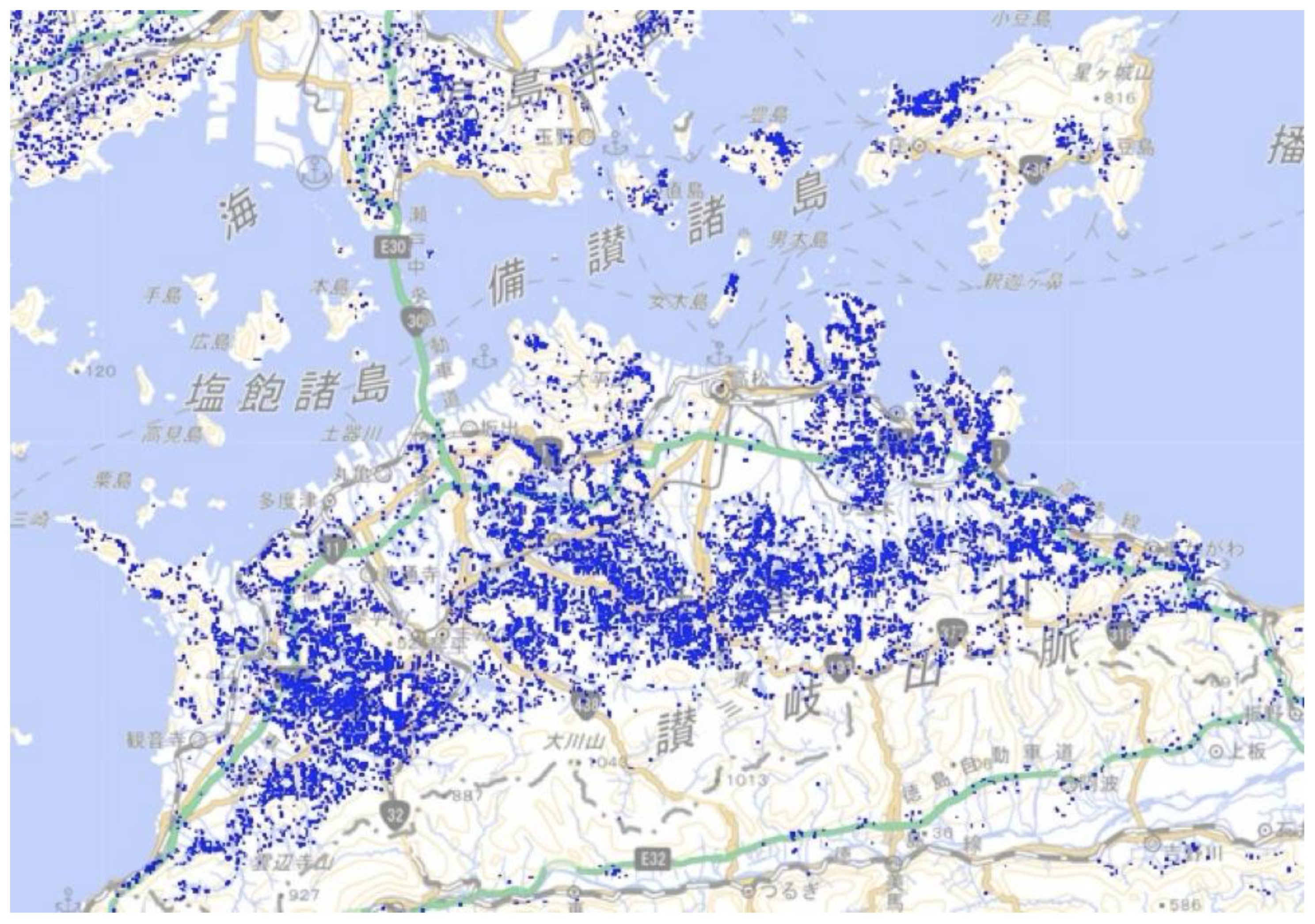
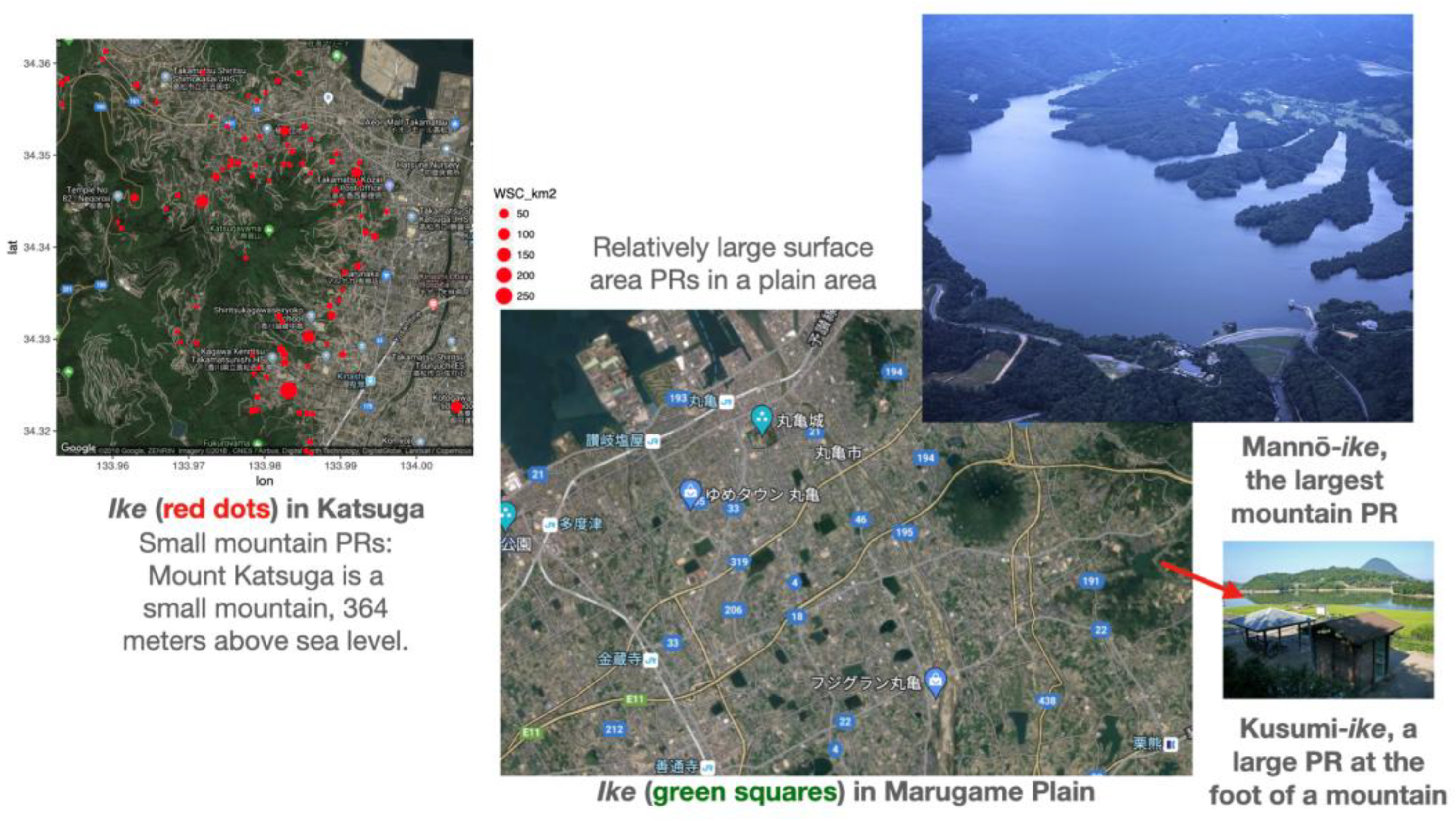
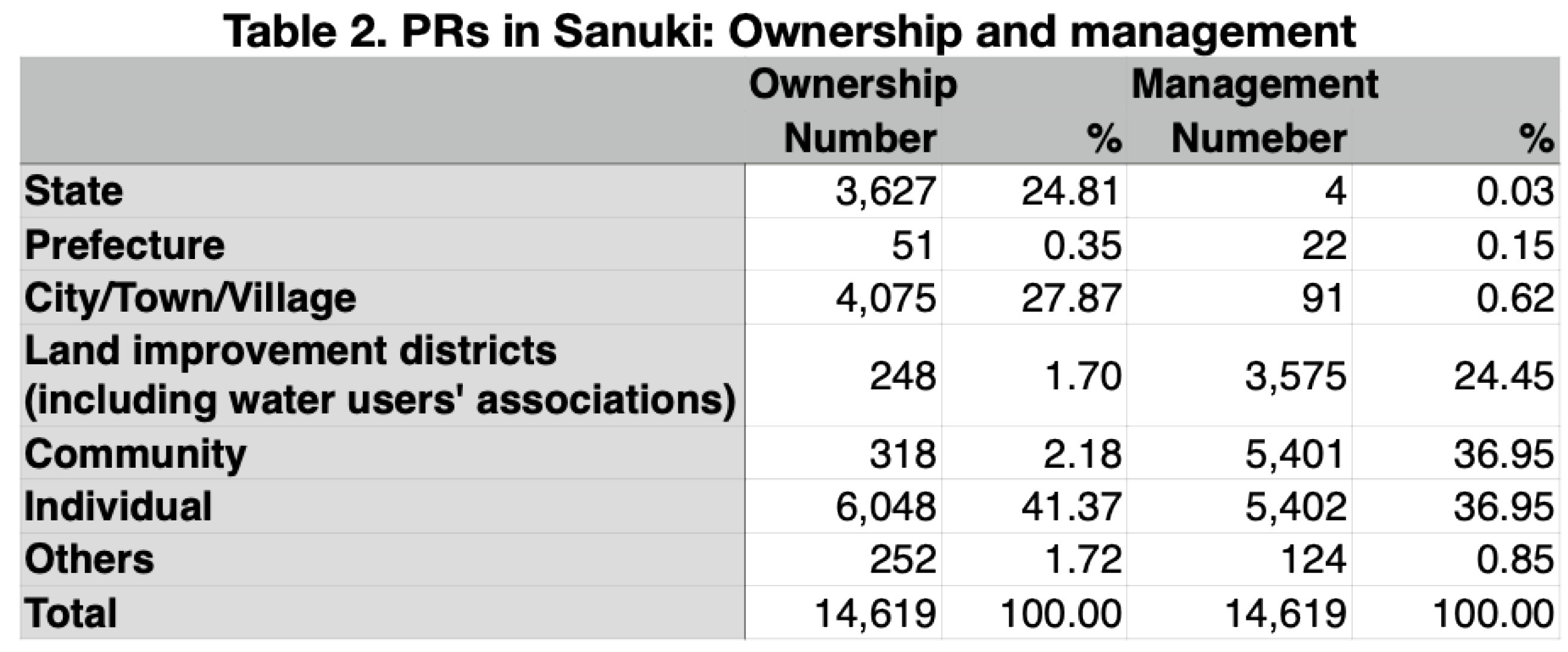
3. Materials and Methods
4. Results
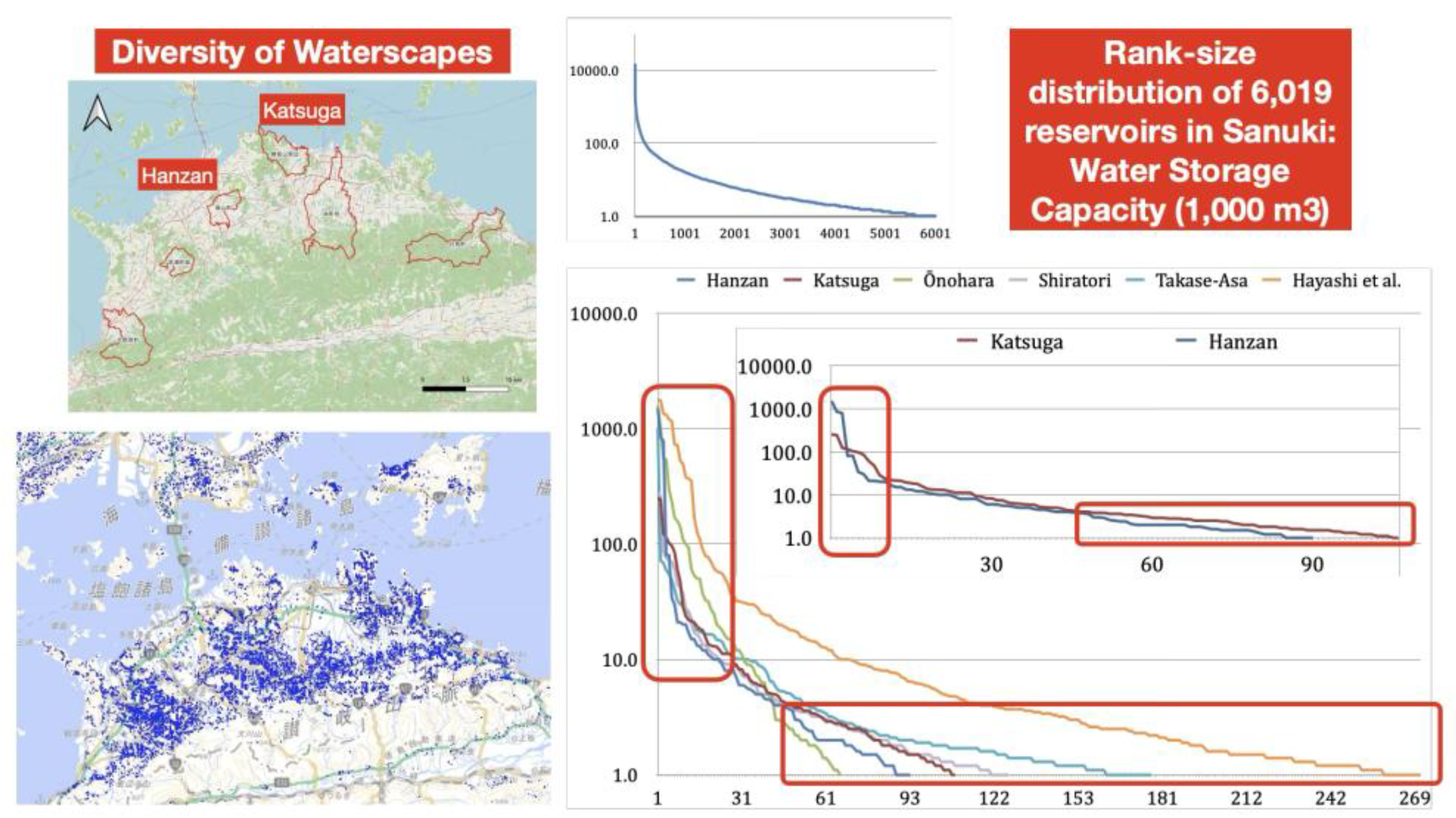
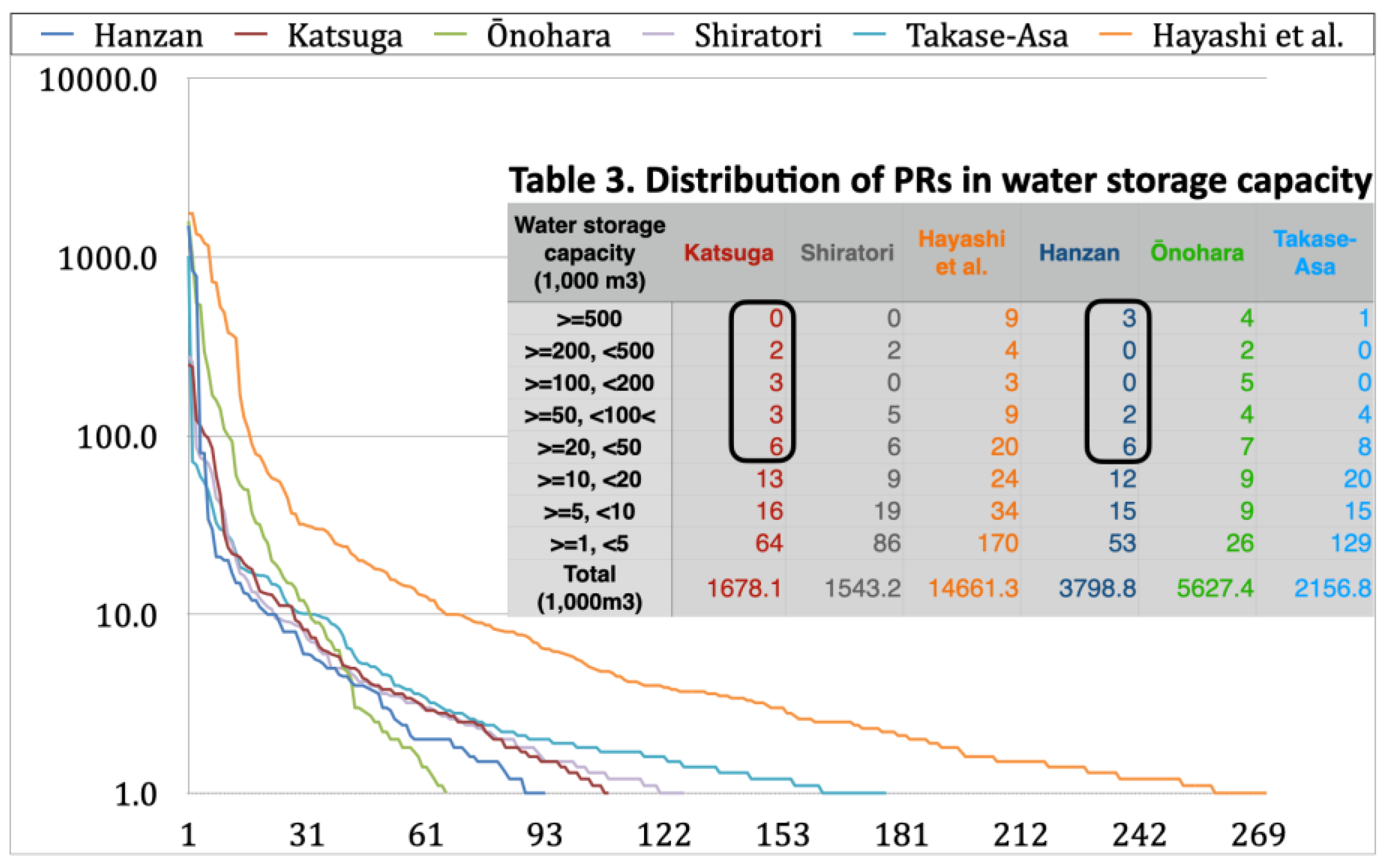
4.1. Rank-Size Distribution of PRs
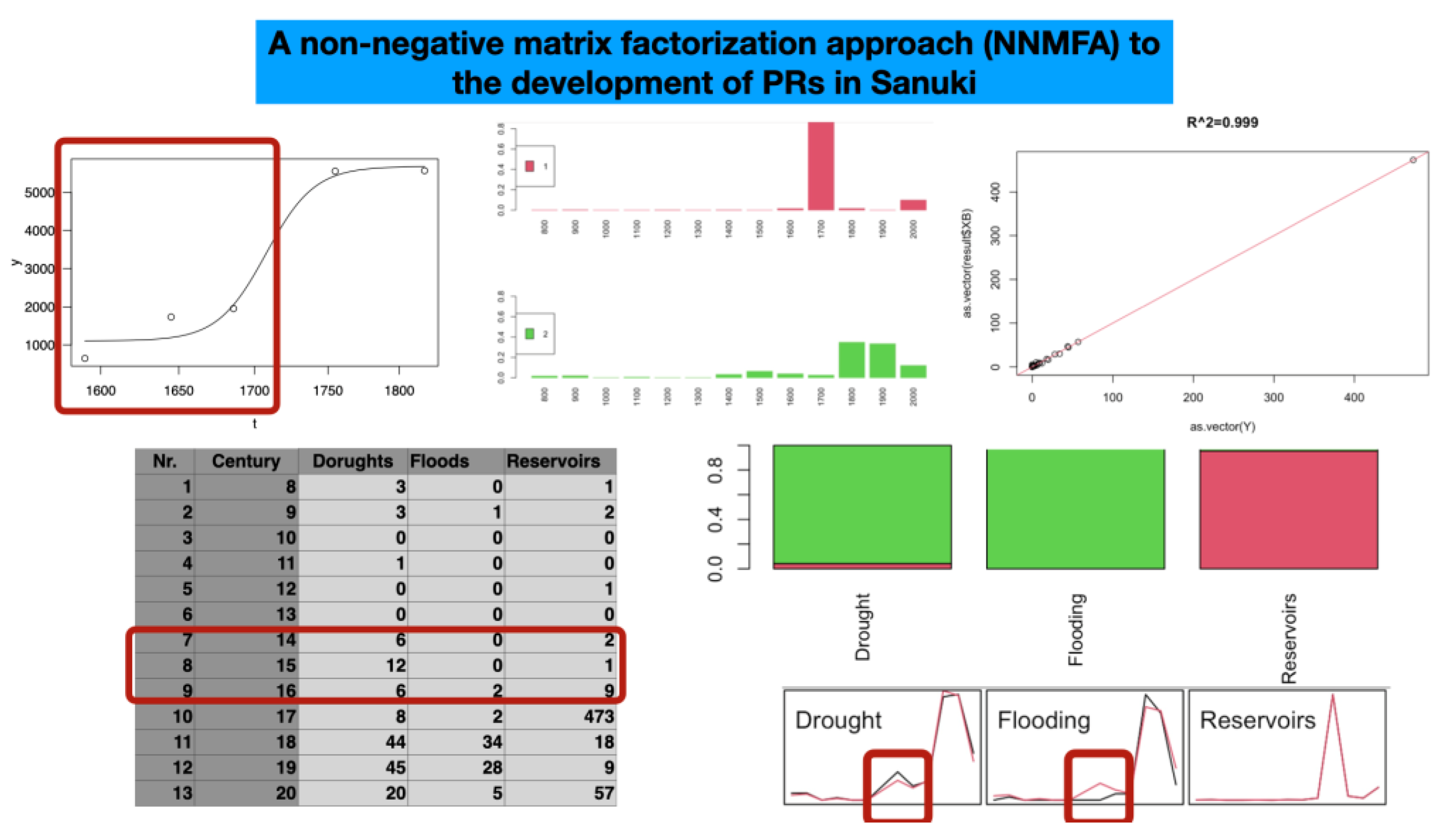
4.2. The NNMFA to a Logistic Curve Fitting of PRs

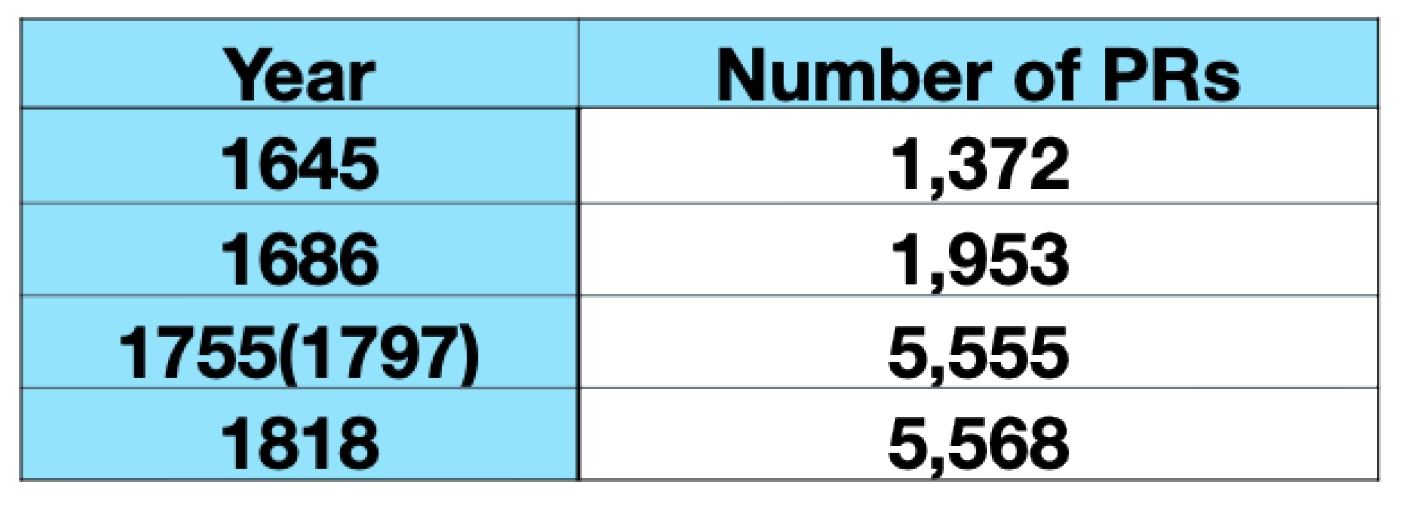 |
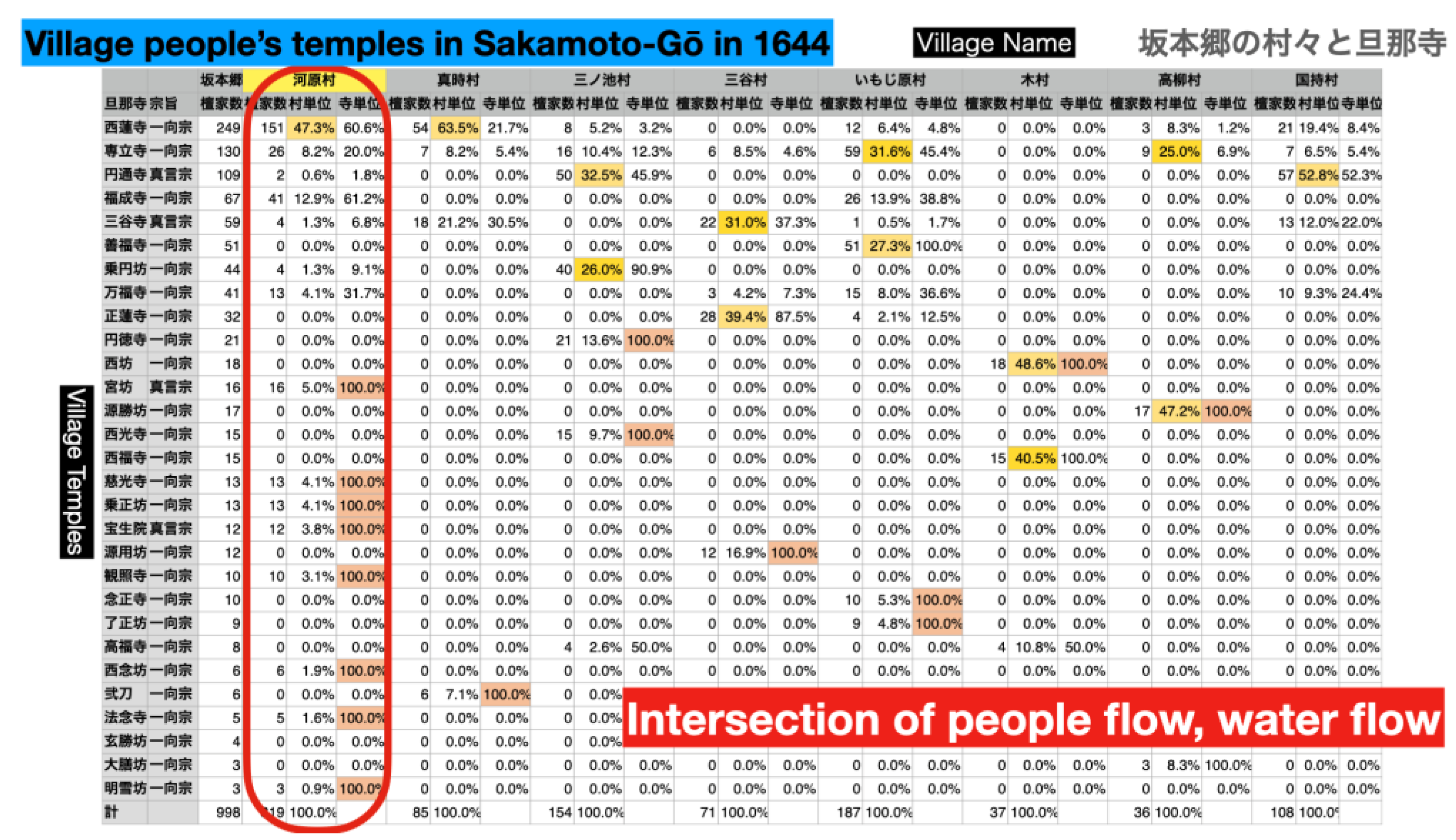
4.3. People Flow and PRs
 |
5. Concluding Remarks
Funding
Conflicts of Interest
Abbreviations
| JSPS | Japan Society for the Promotion of Science |
| NA | Not Available |
| PR | Pond and Reservoir |
| PRs | Ponds and Reservoirs |
| NMMFA | Non-Negative Matrix Factorization Approach |
Appendix A
Dataset for PRs in Sanuki (Original dataset)
References
- (Fujihara ed. 2023) Fujhara, T., ed. Handbook of Environmental History in Japan (Handbooks on Japanese Studies, Amsterdam University Press, 2024 (online, print publication year, 2023).
- (Hanzan Chōshi 1988) Hanzan Chōshi Hensan Iinkai [The Committee of Hanzan Chōshi] ed., Hanzan Chōshi [History of Hanzan-chō].
- (Hayami 1986) Hayami, A. 1986. A great transformation: Social and economic change in sixteenth and seventeenth century Japan. Bonner Zeitschrift für Japanologie, 8, 3–13.
- (Hayami 2003) Hayami, A. 2003. Sangyo Kakumei tai Kinben Kakumei [The Industrial Revolution vs. The Industrious Revolution]; In Kinsei Ni-hon no Keizai Shakai [Economic Society of Early Modern Japan]; Reitaku University Press: Tôkyô, Japan; pp. 307–322.
- (Murayama and Nakamura 2021) Murayama, S.; Nakamura, H. 2021. “Industrious Revolution” Revisited: A Variety of Diligence Derived from a Long-Term Local History of Kuta in Kyô-Otagi, a Former County in Japan. Histories, 1(3), 108-121. [CrossRef]
- (Murayama 2025) Murayama, S. 2025. An Introduction to the Living Spaces Concept. Pp. 9-28 in (Murayama et al. 2025) Changing Living Spaces. Subsistence and Sustenance in Eurasian Economies from Early Modern Times to the Present. https://www.hippocampus.si/ISBN/978-961-293-399-9/7-28.pdf.
- (Murayama et al. 2025a) Murayama, S., Z. Lazarevic, and A. Panjek, eds. 2025. Changing Living Spaces. Subsistence and Sustenance in Eurasian Economies from Early Modern Times to the Present, Slovenia Scientific Series in Humanities, 12, Koper: University of Primorska Press. ISBN 978-961-293-399-9 | PDF; ISBN 978-961-293-400-2 | HTML. [CrossRef]
- (Murayama et al. 2025b) Murayama, S., H. Nakamura, N. Higashi, and T. Terao. 2025. Agricultural Crises Due to Flood, Drought, and Lack of Sunshine in the East Asian Monsoon Region: An Environmental History of Takahama in the Amakusa Islands, Kyushu, Japan, 1793-1818. [CrossRef]
- (Nagamachi 2013) Nagamachi, H. 2013. Sanuki no Tameike Bunka to Kagawa Yousui: Kinsei Tameike Suiri no Hattatsu [Sanuki's Ponds and reservoirs culture in Sanuki and Kagawa Waterway: Development of irrigation management in the early modern period], Mizu to Tomoni [With Water] (Mizu Shigen Kikou [Japan Water Agency]), 9, 10-13.
- (Nakatsuka 2022) Nakatsuka, T. 2022. Kikō Tekiou no Nihon-shi. Jin-Shin-Sei wo Norikoeru Shiten. [The History of Climate Adaptation in Japan: Perspectives for Overcoming the Anthropocene.] Yoshikawa Kobunkan.
- (Nishitani 2021) Nishitani, M. 2021. Chūsei wa Kaku-Kazoku dattanoka. Minshū no Kurashi to Ikikata [Was the Middle Ages a nuclear family? The lives and lifestyles of the common people.] Yoshikawa Kobunkan.
- (Rinsen Shoten 2020-21) Nakatsuka T. et al. eds, Kikou Hendō kara Yominaosu Nihon-shi [Rereading Japanese History form the Perspective of Climate Change. Rinsen Shoten, 6 volumes.
- (Saito 2018) Saito, O. 2018. 1600-nen no zenkoku jinkō. 17 seiki jinkōkeizaishi saikōchiku no kokoromi [Japan’s population in 1600: An attempt to reconstruct the history of population and economy in the seventeenth century]. Shakai-Keizaishigaku [Socio Econ. Hist.], 84, 3–23.
- (Saito 2022) Saito, O. 2022. Chūsei Nihon wa donoyōna imi de kaku-kazoku shakai dattanoka: Chien-kyōdōtai, shinzoku-shūdan, yashiki-chi [In what sense was medieval Japan a nuclear family society? Local community, kinship, farm-family compound], Syakai-keizai shigaku [Socio-Economic History], 88(3), 51-66.
- (Sanuki no Tameike-shi 2000) Sanuki no Tameike-shi Hensan Iinnkai 2000. [Topography of Ponds and Reservoirs in Sanuki] ed., Sanuki no Tameike-shi [Topography of Ponds and Reservoirs in Sanuki], Gyōsei.
- (Satoh 2024) Satoh K. 2024. Applying Non-negative Matrix Factorization with Covariates to the Longitudinal Data as Growth Curve Model. [CrossRef]
- (Shūmon-chō of Sakamoto-gō 1644) “Kan-ei Nijū-ichi Nen Ichi-gatsu Uta-gun Sakamoto-gō Kirishitan Shūmon-On-Aratamechō” [Religious Register of Sakamoto-go in 1644] A. Takamatsu City Historical Museum Collection: A copy in April 1924, owned by Senzō Miyake, B: Kamata Kyōsai-kai Local History Museum Collection, owned by Takahiko Mitani, C: A reprinting of the historical materials of B in Kagawa-ken Hensan [Kagawa Prefecture, ed.], Kagawa Ken-shi [History of Kagawa Prefecture] Dai Jyukkan [vol. 10], Kinsei-Siryō-hen II [Pre-modern historical materials II], 1987, 5-47.
- (Takagi 2023) Takagi, H. 2023. Sengoku Nihon no Seitai-kei: Shomin no Seizon-senryaku wo Fukugen Suru [The Ecosystem of Warring States Japan: Reconstructing the Survival Strategies of the Common People] Kodan-sha Metier.
- (Takashima 2017) Takashima, M. 2017. Keizai Seichô no Nihonshi. Kodai kara Kinsei no Chōchōki GDP Suikei, 730–1874 [Economic Growth in the Japanese Past: Estimating GDP, 730–1874]; University Press: Nagoya, Japan.
- (Takashima 2023) Takashima, M. 2023. Chingin no Nihon-shi: Shigoto to Kurashi no 1500 nen [A History of Wages in Japan: 1,500 Years of Work and Life] Yoshikawa Kobun-kan.
- (Totman 2014) Totman, C. 2014. Japan. An Environmental History.I.B.Tauris & Co.Ltd, London/New York.
- (Wrigley 2016) Wrigley, E.A. 2016. The Path to Sustained Growth: England’s Transition from an Organic Economy to an Industrial Revolution. Cam-bridge University Press: Cambridge, UK.
- (Yoshikawa Kobunkan 2012-3) Hirakawa, M., Miyake, K., Ihara, K., Mizumoto, K., and Torigoe, H. eds. Series: Japanese History of the Environment, Yoshikawa Kobunkan, 5 volumes.
| Prefecture (main PRs area in Japan) | Number of PRs | Total storage capacity (100 million m2) | Paddy fields area (ha) | Total area (1,000 m2) of each prefecture | Average storage capacity per PR | Number of PRs per total area (km2) |
| Hyōgo | 44,207 | NA | 74,800 | 8,390 | N.N. | 5.27 |
| Hiroshima | 21,010 | 80.3 | 47,300 | 8,476 | 3.8 | 2.48 |
| Kagawa (Sanuki) | 14,619 | 146.1 | 28,600 | 1,876 | 10.0 | 7.79 |
| Yamaguchi | 11,976 | 58.8 | 44,400 | 6,110 | 4.9 | 1.96 |
| Ōsaka | 11,230 | NA | 11,700 | 1,893 | N.N. | 5.93 |
| Japan as a whole | 205,531 | NA | 2,679,288 | 377,780 | N.N. | 0.54 |
Disclaimer/Publisher’s Note: The statements, opinions and data contained in all publications are solely those of the individual author(s) and contributor(s) and not of MDPI and/or the editor(s). MDPI and/or the editor(s) disclaim responsibility for any injury to people or property resulting from any ideas, methods, instructions or products referred to in the content. |
© 2025 by the authors. Licensee MDPI, Basel, Switzerland. This article is an open access article distributed under the terms and conditions of the Creative Commons Attribution (CC BY) license (http://creativecommons.org/licenses/by/4.0/).


