

Submitted:
25 August 2025
Posted:
25 August 2025
You are already at the latest version
Abstract
Maslow’s hierarchy of needs once offered educators a clear path: meet basic needs, and motivation will follow. But today’s world complicates that promise. Identity is shaped not just by experience, but by algorithms. Esteem is measured in likes and metrics. Transcendence, once personal and sacred, is now archived in institutional artifacts. The curriculum can no longer climb a simple ladder—it must navigate a spiral of meaning, where agency, ethics, and machine mediation constantly intertwine. While models like Tay and Diener’s offer valuable insights into subjective well-being, they often miss the deeper story: that motivation isn’t just about satisfying needs—it’s about coherence, calling, and the courage to act with purpose. This article critiques the limitations of Maslow’s framework and the recurring gaps in reactive models that reduce human flourishing to fulfillment alone. It proposes a metaphysical reorientation through the Philosophy of Quintuple Learning Plus (PQL+)—not as a replacement, but as a living scaffold for curriculum transformation. PQL+ reframes learning as a vocation rooted in ethical clarity, adaptive imagination, and ontological depth. In doing so, it invites educators to see curriculum not just as a tool, but as a legacy—one that shapes who we become in an age of intelligent transformation.
Keywords:
co-evolution
; curriculum reform
; metaphysical coherence
; ontological inquiry
; trans-philosophical framework
1. Introduction
In 1943, Abraham Maslow introduced his Hierarchy of Needs—a five-tier model of human motivation that has shaped psychology, education, and organizational theory for decades. His pyramid begins with physiological survival and ascends toward self-actualization, suggesting that human fulfillment follows a linear progression. While historically influential, Maslow’s model is increasingly inadequate for the complexities of 21st-century life—especially in an era defined by artificial intelligence, digital embodiment, and institutional co-evolution.
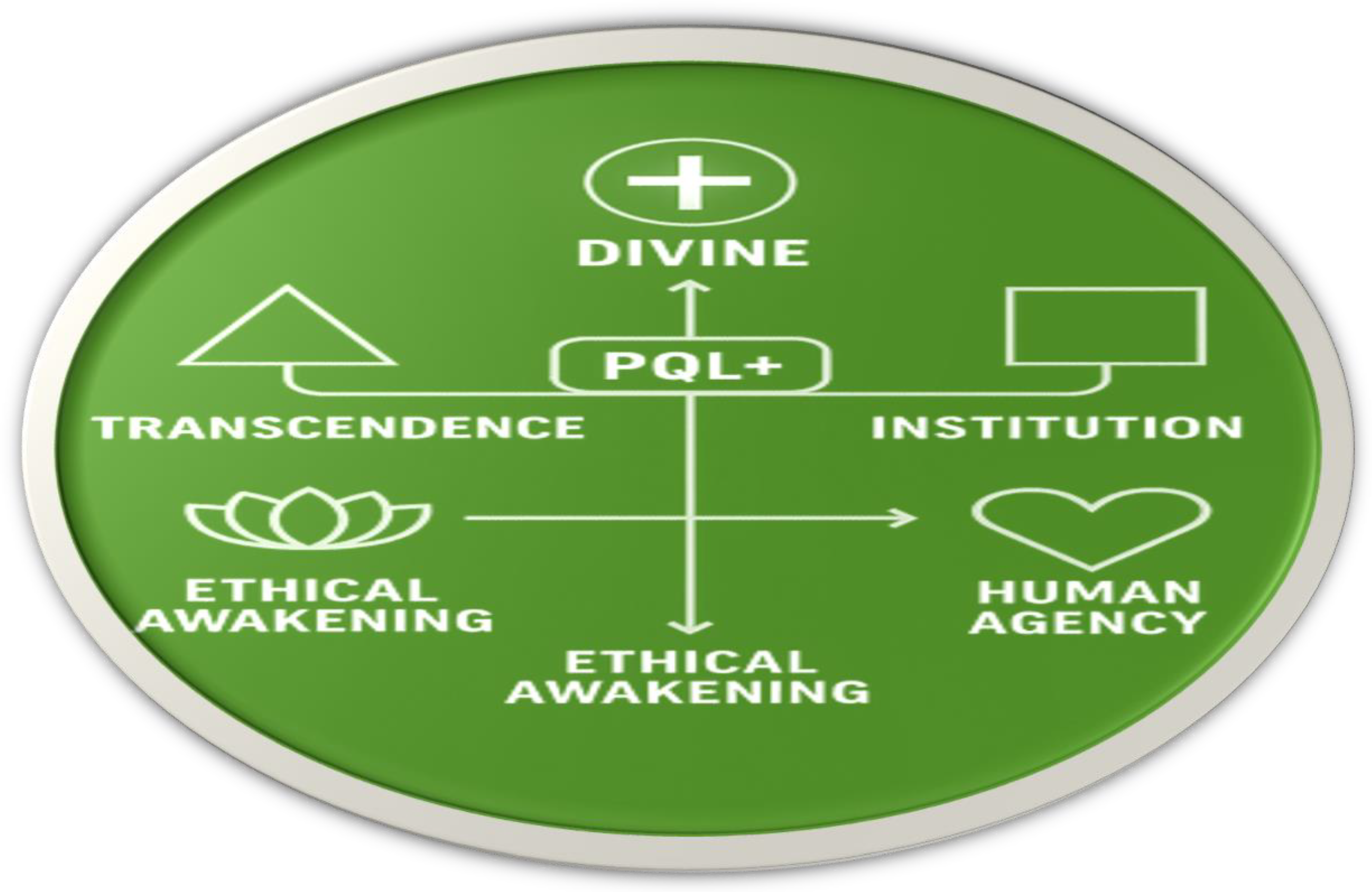
Figure 1.
The cross (Divine) stands highest—not just as a symbol, but as the source of meaning that holds everything together. From it flows PQL+, the living language that connects man’s deepest longings, moral stirrings, shared structures, and personal choices. Through PQL+, transcendence reaches upward with hope, ethical awakening stirs the conscience toward what is good, institution becomes a space where values take root, and human agency finds its voice in responsible freedom. Motivation emerges not from a hierarchy of unmet needs, but from the dynamic resonance among these elements—where meaning inspires movement, coherence fuels commitment, and calling awakens the will to act (ethical awakening). Unlike Malo’s model, which moves in rigid steps, this framework invites movement, dialogue, and inclusion—where each element speaks to the others, and none stands alone.
Figure 1.
The cross (Divine) stands highest—not just as a symbol, but as the source of meaning that holds everything together. From it flows PQL+, the living language that connects man’s deepest longings, moral stirrings, shared structures, and personal choices. Through PQL+, transcendence reaches upward with hope, ethical awakening stirs the conscience toward what is good, institution becomes a space where values take root, and human agency finds its voice in responsible freedom. Motivation emerges not from a hierarchy of unmet needs, but from the dynamic resonance among these elements—where meaning inspires movement, coherence fuels commitment, and calling awakens the will to act (ethical awakening). Unlike Malo’s model, which moves in rigid steps, this framework invites movement, dialogue, and inclusion—where each element speaks to the others, and none stands alone.
This paper critiques Maslow’s hierarchy for its conceptual rigidity and anthropocentric bias, advancing PQL+ (Philosophy–Quality–Learning Plus) as a post-Maslovian, metaphysical framework for curriculum reform. PQL+ reconfigures educational practice around ethical coherence, institutional legacy, and human–AI symbiosis—while affirming human dignity and recognizing divine coherence as the ontological foundation of educational purpose.
2. Revisiting Maslow’s Hierarchy of Needs and Its Critiques
Maslow’s Hierarchy of Needs remains one of the most cited yet increasingly contested frameworks in psychology and education. While its tiered structure offers a compelling visual metaphor for human motivation, each level invites deeper philosophical and cultural interrogation—revealing not just what humans seek, but how meaning, context, and transcendence shape those pursuits (Maslow, 1943; Pass, 2024).
Physiological Needs. At the foundation of Maslow’s model are physiological needs—food, water, shelter, sleep—considered the most prepotent and biologically essential. Yet framing these as purely survival-based risks flattening the richness of embodied experience. In many traditions, hunger and rest are not merely biological imperatives but spiritual disciplines, as seen in fasting, asceticism, or voluntary simplicity. Rudin (2021) suggests that even internet access now functions as a baseline need in digital societies, reshaping what “basic” truly means.
Safety Needs. Maslow’s second tier encompasses safety—physical security, financial stability, and protection from harm. While this reflects a universal desire for predictability, it remains grounded in a secular framework that overlooks metaphysical forms of safety, such as divine providence or existential assurance. Dahiam and Ghaleb (2024) argue that safety is not merely the absence of threat but the presence of moral order and trust, which Maslow’s model does not fully accommodate.
Love and Belonging Needs. The third level addresses the human longing for connection—intimacy, friendship, and social inclusion. Maslow rightly identifies this as a powerful motivator, yet the model treats belonging as a psychological need rather than a metaphysical vocation. In philosophical terms, love is not just relational but ontological: it defines being itself. Lee (2023) emphasizes that teaching and learning are ethical encounters, not transactional exchanges, and that community is a sacred space of co-authored identity.
Esteem Needs. Esteem involves achievement, recognition, and self-worth. Maslow distinguishes between self-esteem and esteem from others, yet both are framed within individualistic paradigms. Philosophically, esteem is not just about personal validation but about ethical contribution—how one’s actions resonate within a moral and communal framework. Gattupalli (2025) critiques the model’s anthropocentrism, arguing that esteem must be reimagined as dialogic and co-evolutionary, especially in AI-mediated learning environments.
Self-Actualization. At the original pinnacle of the hierarchy is self-actualization: the fulfillment of one’s potential through creativity, authenticity, and purpose. Maslow viewed this as the highest human need, yet it remains secular and self-referential. In metaphysical terms, actualization is not merely self-directed but divinely aligned. The Philosophy of Quintuple Learning Plus (PQL+) reframes this as a vocational calling—less about becoming what one wants, and more about becoming what one is summoned to be.
Maslow later postulated a sixth level: self-transcendence, where individuals seek meaning beyond the self—through altruism, spirituality, or legacy. This addition gestures toward metaphysical depth, yet it remains an appendage rather than a structural reorientation. As the Power Platform Community (2025) notes, the persistence of the pyramid metaphor distorts Maslow’s own fluid understanding of needs. PQL+ responds by placing transcendence at the core, affirming that human flourishing is not a climb but a spiral—where agency and divine coherence co-evolve.
3. Literature Review Integration: From Maslow to PQL+
Maslow’s (1943) hierarchy has long shaped educational and organizational thinking. Its elegant pyramid—often reproduced without scrutiny—suggests a linear ascent from survival to self-actualization. Yet beneath its simplicity lies conceptual fragility. Wahba and Bridwell (1976) found little empirical support for the idea that human needs unfold in a fixed order. Pass (2024) reinforces this critique, noting the model’s cultural bias and oversimplification of human motivation.
Tay and Diener (2011), drawing on global data, revealed that individuals often report high life satisfaction even when basic needs are unmet. This challenges the presumed universality of Maslow’s model and invites a more pluralistic, culturally sensitive understanding of human flourishing. Dahiam and Ghaleb (2024) propose a dynamic model that reflects the simultaneity and interdependence of needs, rather than their sequential fulfillment.
These critiques resonate with the philosophical departure enacted by PQL+. Where Maslow’s model assumes a fixed path, PQL+ embraces recursion, co-agency, and metaphysical coherence. It does not merely revise the pyramid—it softens it, replacing hierarchy with spiral, and linearity with dialogue. Rudin (2021) and Gattupalli (2025) both argue that AI and digital transformation demand a rethinking of human needs, especially as creativity and wisdom become central to educational purpose.
In this way, PQL+ becomes more than a framework—it becomes a philosophical act of restoration. It honors the complexity of human experience, the diversity of cultural narratives, and the ethical demands of intelligent transformation. It invites educators not to ascend a pyramid, but to spiral through meaning—guided by wisdom, technology, and the moral imperative to keep learning human.
4. Integration: From Maslow to PQL+
For decades, Maslow’s (1943) hierarchy of needs has shaped how educators understand motivation. As mentioned early on, its elegant pyramid suggests a linear ascent from survival to self-actualization. Yet beneath its visual simplicity there undeniably lies a conceptual brittleness. Wahba and Bridwell (1976), in their comprehensive review, found little empirical support for the idea that human needs unfold in a fixed order. Their findings suggest that motivation is not a staircase but a mosaic—shaped by context, culture, and individual complexity.
As pointed out by Tay and Diener (2011), empirical data from over 60,000 individuals across 123 countries reveals a striking paradox: many report high life satisfaction even when basic needs remain unmet. This challenges the presumed universality and linearity of Maslow’s hierarchy, inviting a more pluralistic and culturally attuned understanding of human flourishing—one that transcends material thresholds and embraces axiological diversity.
These critiques resonate deeply with the philosophical departure enacted by the Philosophy of Quintuple Learning Plus (PQL+). Where Maslow’s model assumes a fixed path, PQL+ embraces recursion, co-agency, and metaphysical coherence. It does not merely revise the pyramid—it thaws it, replacing hierarchy with spiral, and linearity with dialogue.
As Wahba and Bridwell (1976) and Tay and Diener (2011) have shown, the hierarchy of needs is neither empirically robust nor culturally universal. PQL+ responds to this epistemic gap by offering a metaphysical architecture that reframes learning as co-evolution—where human insight and machine intelligence converge to cultivate ethical clarity, adaptive imagination, and pluralistic flourishing.
In this way, PQL+ becomes more than a framework—it becomes a philosophical act of restoration. It honors the complexity of human experience, the diversity of cultural narratives, and the ethical demands of intelligent transformation. It invites educators not to ascend a pyramid, but to spiral through meaning—guided by wisdom, technology, and the moral imperative to keep learning human.
5. The Limits of Maslow in the Age of AI and Ontological Inquiry
Maslow’s hierarchy, once a guiding framework for understanding human motivation, now feels increasingly out of step with the realities of our digitally entangled world. While its pyramid offered a useful scaffold for mid-20th-century psychology, today’s learners and educators inhabit a landscape where human flourishing is no longer linear, nor solely psychological. It is digitally mediated—where AI regulates sleep, nutrition, safety, and social connection through wearable tech, predictive analytics, and algorithmic nudges (Center for Curriculum Redesign, 2025). It is algorithmically shaped—where online validation, digital reputation, and curated identities influence self-worth and esteem far more than traditional social feedback (King-Hill, 2015). It is co-intelligently constructed—where creativity, research, and reform are increasingly co-authored by human insight and machine intelligence (Eslit, 2025).
Even transcendence, once the domain of mysticism and spiritual longing, is now institutionally archived. Legacy is measured through audit-ready artifacts, accreditation metrics, and digital portfolios that attempt to quantify meaning. In this context, metaphysical grounding becomes precarious: human values are often treated as emergent phenomena—fluid, adaptive, and context-dependent—rather than as reflections of an ontologically anchored moral universe (Wahba & Bridwell, 1976). Tay and Diener (2011) further challenge the universality of Maslow’s model, showing that subjective well-being does not always correlate with the sequential fulfillment of needs, especially across diverse cultural and economic contexts.
What Maslow’s framework omits is the possibility that dignity, justice, and coherence are not merely psychological aspirations—they are metaphysical imperatives. These are not optional enhancements to human experience but echoes of a deeper moral architecture, possibly rooted in a morally excellent Creator. The Philosophy of Quintuple Learning Plus (PQL+) responds to this ontological gap by offering a trans-philosophical framework where learning is not a climb toward self-actualization, but a spiral of co-evolution—where human agency and intelligent systems converge to cultivate ethical clarity, adaptive imagination, and pluralistic flourishing (Eslit, 2025).
In this age of intelligent transformation, curriculum design must move beyond Maslow—not by discarding its insights, but by transcending its limitations. It must embrace complexity, honor metaphysical depth, and prepare learners not just to survive or succeed, but to live wisely, ethically, and meaningfully.
6. The PQL+: A Post-Maslovian and Metaphysical Curriculum Architecture
Figure 2.
A Post-Maslovian Curriculum Architecture.
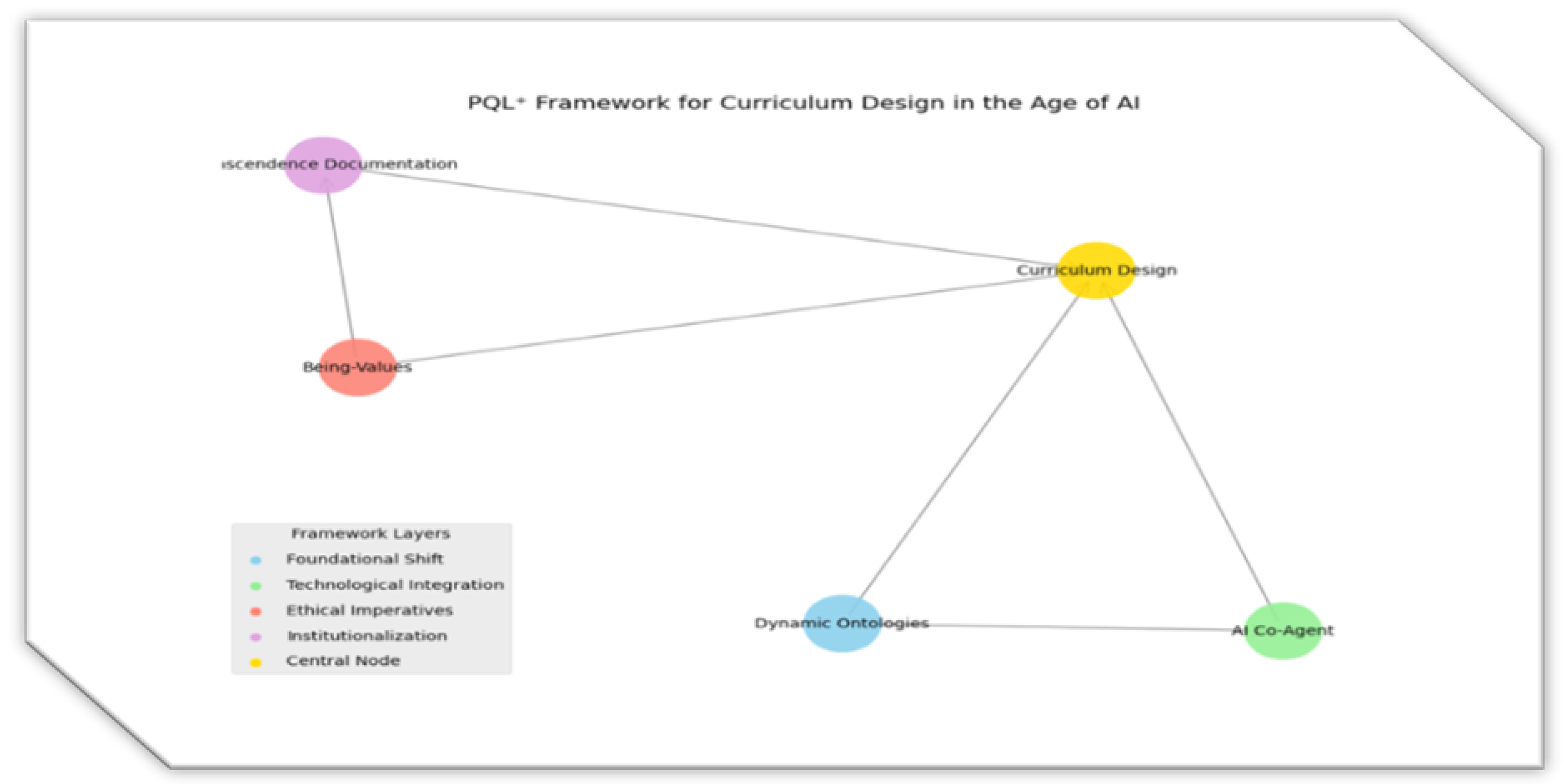
PQL+ offers a radical departure from Maslow’s hierarchy. It repositions curriculum as a diagnostic instrument—not a delivery mechanism—and integrates AI as a reflective partner in institutional reform. More importantly, it affirms that human values are not arbitrary; they are ontologically grounded, and reflect divine design.
Core Dimensions of PQL+:
| PQL+ Element | Function in Curriculum Reform |
| Dynamic Ontologies | Replaces static hierarchies with evolving models of learning, meaning, and institutional purpose |
| AI Co-Agency | Positions AI as a co-intelligent agent in diagnostics, reform, and legacy-building |
| Being-Values | Elevates God, truth, justice, coherence, and ethical transparency as curricular imperatives |
| Transcendence Artifacts | Institutionalizes legacy through audit-ready documentation and axiological clarity |
| Theological Coherence | Recognizes curriculum as a reflection of divine purpose and moral law—not just human aspiration |
PQL+ does not seek to fulfill needs—it seeks to co-design futures. It transforms curriculum into a site of philosophical inquiry, ethical stewardship, and spiritual reflection.
Let’s illustrate a curriculum sample to bring this to life by using literature as the topic. Imagine a classroom where literature isn’t just about decoding metaphors or memorizing themes and authors—it’s a space where students wrestle with what it means to live well, to speak truth, and to honor stories that shape our shared humanity. A poem becomes more than a text; it’s a mirror, a map, sometimes even a prayer. Learners explore characters not just for plot, but for the ethical choices they make, the silences they carry, and the legacies they leave behind.
In this kind of curriculum, quality isn’t measured by perfect grammar or polished essays alone—it’s seen in the coherence between thought, voice, and purpose. Students co-create rubrics that ask: Did this text move me? Did it challenge me to think differently? Did it help me see the world with more compassion? AI tools are invited in not to replace human insight, but to extend it—highlighting patterns, suggesting connections, and provoking new questions.
And at the heart of it all is reflection: not just academic, but spiritual. Literature becomes a sacred space where learners ask, What kind of person am I becoming? What kind of world am I helping to build? These questions—rooted in vocation, legacy, and metaphysical coherence—reach far beyond Maslow’s hierarchy of needs. While Maslow accounts for personal growth and self-actualization, it does not fully capture the spiritual longing, ethical stewardship, and intergenerational responsibility that this curriculum invites. Here, education is not just about fulfilling needs—it’s about cultivating purpose, honoring transcendence, and shaping a life that resonates beyond the self.
7. Implications for Educational Practice
By adopting PQL+, institutions move beyond performative compliance and superficial innovation. They could embrace:
- Curriculum as sacred stewardship: A living system of values, not a static syllabus
- Documentation as legacy: Audit-readiness becomes a philosophical and theological act
- AI as collaborator: Not a threat, but a co-agent in ethical reform
- Transcendence as praxis: Legacy is built through institutional clarity and metaphysical coherence
This shift redefines educational leadership—not as management, but as axiological and spiritual stewardship. It’s time. Time to move beyond Maslow’s well-worn ladder of needs and into a deeper architecture—one that doesn’t just support learning, but honors it. PQL+ invites us to reimagine education not as a system of survival or self-fulfillment, but as a sacred space where values live, legacies are built, and transcendence becomes practice. This isn’t about ticking boxes or chasing metrics. It’s about reclaiming curriculum as stewardship, documentation as ethical memory, and leadership as a calling. In a world that often settles for surface-level change, this is the moment to go deeper—to build institutions that don’t just perform, but truly transform.
8. Conclusions
Maslow’s hierarchy of needs, while once a useful guide, no longer speaks to the layered realities of human motivation in a world shaped by intelligent systems, cultural plurality, and ethical disruption. Decades ago, Wahba and Bridwell (1976) questioned its empirical footing, and Tay and Diener (2011) demonstrated that well-being does not follow a fixed order—needs are fulfilled in patterns that vary across cultures and contexts. Today, in 2025, our needs are no longer stacked; they are braided, recursive, and deeply entangled with the way we live, learn, and lead. The Philosophy of Quintuple Learning Plus (PQL+) does not attempt to patch Maslow’s pyramid—it moves beyond it. It responds to the recurring gaps in reactive models: the neglect of cultural nuance, the flattening of ethical agency, and the absence of metaphysical grounding. PQL+ offers a metaphysical architecture where curriculum becomes a mirror for reflection, a compass for ethical direction, and a vessel for legacy. It affirms that human agency and divine coherence are in constant connection—they are co-authors of educational purpose. Learning, in this light, is not a ladder to climb, but a spiral of meaning to inhabit. And while there may be other insights and frameworks that seek to illuminate the future of education, PQL+ is a bold attempt to loosen another lens—one that invites reflection, ethical stewardship, and metaphysical depth. It does not invent the future; it offers the language through which it can be understood.
Declaration:
The author assumes responsibility for the conceptualization, philosophical development, and writing of this manuscript. No external funding was received, and no competing interests are declared. Ethical approval was not required, as the article involves no human participants or sensitive data. All insights are grounded in independent scholarship and institutional practice, with acknowledgment to Google Scholar, ResearchGate, Mendeley, Academia.edu, Microsoft Copilot, the library and online resources of St. Michael College of Iligan, Inc.
References
- Center for Curriculum Redesign. (2025). Education for the age of AI. https://curriculumredesign.org/our-work/education-for-the-age-of-ai/.
- Dahiam, B., & Ghaleb, S. (2024). Towards a dynamic model of human needs: A critical analysis of Maslow’s hierarchy. International Journal of Multidisciplinary Advanced Research Studies, 2(3), 1028–1046. [CrossRef]
- Eslit, E. R. (2025). *The philosophy of Quintuple Learning Plus (PQL+): A trans-philosophical framework for human-AI co-evolution in education* [Preprint]. Preprints.org. [CrossRef]
- Gattupalli, S. (2025). AI and the philosophy of education: A rupture in the making [Working paper]. University of Massachusetts Amherst. https://hdl.handle.net/20.500.14394/55425.
- King-Hill, S. (2015). Critical analysis of Maslow’s hierarchy of needs. University of Cumbria. https://insight.cumbria.ac.uk/id/eprint/2942/.
- Lee, S.-E. (2023). Otherwise than teaching by artificial intelligence. Journal of Philosophy of Education, 57(2), 553–570. [CrossRef]
- Maslow, A. H. (1943). A theory of human motivation. Psychological Review, 50(4), 370–396. [CrossRef]
- Microsoft Copilot. (2025). Response to user query on manuscript declarations and ethical transparency [AI-generated content]. Microsoft. https://copilot.microsoft.com.
- Pass, J. C. (2024). Criticism of Maslow’s hierarchy of needs. Simply Put Psych. https://simplyputpsych.co.uk/psych-101-1/criticism-of-maslows-hierarchy-of-needs.
- Power Platform Community. (2025). Confidently wrong: Why we misquote Maslow and misunderstand AI. Power Community. https://www.powercommunity.com/confidently-wrong-why-we-misquote-maslow-and-misunderstand-ai/.
- Rudin, P. (2021). Is artificial intelligence changing Maslow’s pyramid of needs? Singularity 2030. https://singularity2030.ch/is-artificial-intelligence-changing-maslows-pyramid-of-needs/.
- Tay, L., & Diener, E. (2011). Needs and subjective well-being around the world. Journal of Personality and Social Psychology, 101(2), 354–365. [CrossRef]
- Wahba, M. A., & Bridwell, L. G. (1976). Maslow reconsidered: A review of research on the need hierarchy theory. Organizational Behavior and Human Performance, 15(2), 212–240. [CrossRef]
Disclaimer/Publisher’s Note: The statements, opinions and data contained in all publications are solely those of the individual author(s) and contributor(s) and not of MDPI and/or the editor(s). MDPI and/or the editor(s) disclaim responsibility for any injury to people or property resulting from any ideas, methods, instructions or products referred to in the content. |
© 2025 by the authors. Licensee MDPI, Basel, Switzerland. This article is an open access article distributed under the terms and conditions of the Creative Commons Attribution (CC BY) license (http://creativecommons.org/licenses/by/4.0/).
Copyright: This open access article is published under a Creative Commons CC BY 4.0 license, which permit the free download, distribution, and reuse, provided that the author and preprint are cited in any reuse.


