
Submitted:
21 August 2025
Posted:
22 August 2025
You are already at the latest version
Abstract
Neural networks (NNs), inspired by the biological visual cortex, have been widely applied in computer vision, natural language processing, and beyond. As Moore's Law approaches its physical limits, photonic neural networks (PNNs), which leverage photons rather than electrons as information carriers, have emerged as a promising technological advancement. With ultrafast speeds and ultralow energy consumption in ultra-high throughput, PNNs usher in a new generation of intelligent computing. Moreover, the advent of photonic integrated circuits (PICs) provides a compact and reliable hardware platform for computing, further advancing the development of PNNs. In this paper, we review recent advances in linear and nonlinear computation and integrated optical devices serving as fan-in and fan-out. We also summarize large-scale on-chip PNN and discuss the future challenges associated with their monolithic integration.
Keywords:
optical neuromorphic processing
; integrated optics
; machine learning
; artificial intelligence
Introduction
Deep learning, a rapidly developing breakthrough technology, is leading the change in science and technology [1,2]. It adopts NNs to extract the data representations by performing extensive algebraic operations on the input data, such as matrix multiplication and convolution, thereby creating an ever-increasing demand for computing performance.
In recent years, electronic hardware with higher performance has been developed to better support the computation of NNs, such as the tensor processing unit proposed by Google [3] and the Cambrian series acceleration chip launched by the Computing Institute of the Chinese Academy of Sciences[4].
Nevertheless, the size of integrated circuit devices is approaching the physical limit, accompanied by other phenomena such as quantum tunneling, parasitic effects, etc., which hinder further progress. Indeed, in the post-Moore age, traditional microelectronic computing chips based on Complementary Metal-Oxide-Semiconductor (CMOS) technology encounter a bottleneck in meeting the growing demand for computing power. Hence, the pursuit of novel computing and processing methods, along with their physical realizations, has garnered increasing attention.
PNNs, a deep fusion of optical information processing and neural network theory, aim to leverage the interaction between light and matter to map the network computation onto the optical field and utilize the transmission functions of different optical devices to perform computation, thereby executing specific tasks, as shown in Figure 1. PNNs have shown great potential in supporting the NNs computation due to their ultra-high bandwidth, low energy consumption, low latency, and high parallelism. While substantial progress has been made in developing PNNs implemented through discrete off-chip optical devices[6,7], integration remains the dominant approach for addressing the challenges of scalability, efficiency, and practical development within operational environments. In particular, the development of diverse material platforms has enabled the fabrication of various optical devices, driven by advancements in integrated photonics technology. This progress has significantly accelerated the realization of PNNs and other photonic-based technologies, paving the way for more efficient and scalable solutions in the field.
In this review, we provide a comprehensive introduction to the three fundamental components of PNNs: linear operators, nonlinear operators, and data interfaces. We analyze recent advancements in these areas, highlighting researches that leverage various optical devices or materials. Additionally, we provide an overview of large-scale on-chip integrated PNNs and discuss the challenges associated with their further development.
Linear Operators
Linear operation is the fundamental computation in NNs, playing a crucial role in a wide range of AI tasks. Since each layer of NNs typically consists of neurons that perform linear mappings, a significant portion of the computational cost arises from performing large-scale linear operations. The light’s high parallelism has the inherent advantage of performing linear operators, and such operations are already available in different photonic devices.
Linear operator based on Mach-Zehnder Interferometer (MZI)
As a fundamental passive optical device, a single MZI typically consists of two couplers and two interference arms. By applying external electronic control signals to the heaters deposited on top of each MZI arm, the device can be configured to provide independent power splitting ratios and relative phase shifts, making it a simple linear operator.
Any arbitrary unitary transformation can be realized by designing appropriate routing structures (e.g., triangular or rectangular) [8]. Furthermore, large-scale MZI calibration relies on various extensively studied algorithms[9,10,11,12], providing a solid foundation for implementing linear operators based on MZI[13,14,15,16,17,18].
2017, Shen et al. experimentally demonstrated the essential part of the concept using a programmable nanophotonic processor featuring a cascaded array of 56 programmable MZI in a silicon photonic integrated circuit and show its utility for vowel recognition (Figure 2a)[13]. Theoretically, any matrix can be decomposed into one diagonal matrix and two unitary matrices using the singular value decomposition method. The optical attenuators can implement any diagonal matrix function, and the beam splitters and phase shifters can achieve any unitary matrix function. Thus, the training weight matrices of PNNs can be physically implemented one-to-one via integrated optical elements.
Besides the real-valued computation, some works reported complex-valued linear operators utilizing MZI mesh.
In 2021, Zhang et al. utilized both the phase and amplitude of light by cleverly assigning routes in the MZI mesh, implementing input preparation, weight multiplication, reference light, and coherent detection onto a single chip (Figure 2b)[14]. The work demonstrated relatively completed work such as logic gate operation, IRIS dataset category prediction, nonlinear data (circle and spiral) classification, and MNIST dataset handwritten digit recognition.
In 2022, Zhu et al. proposed an integrated chip diffractive neural network(DNN), using an MZI array to implement convolution operations in the complex field after finishing an optical discrete Fourier transform (ODFT) operation (Figure 2c)[15].
Linear operator based on microring resonator (MRR)
Compared to MZI, MRR generally requires more meticulous design efforts in optimizing coupling parameters to achieve sufficient extinction ratios. However, MRR-based architectures can perform precise linear operations through resonance wavelength tuning. This distinctive feature makes MRR particularly advantageous for implementing programmable linear operators.[19,20,21,22,23,24,25,26,27,28,29].
In 2016, Tait et al. conducted a detailed study on the MRR weight banks, including the principle of MRR, mutual channel crosstalk, and its design methods[19]. Afterward, they demonstrated a broadcast-and-weight system that is very significant in linear operators based on MRR weight banks (Figure 3a)[20]. Its core idea is that incoming WDM signals are weighted by reconfigurable, continuous-valued filters called photonic weight banks and then summed by total power detection. The works above provide theoretical support for using MRR weight banks in linear operators.
In 2021, Huang et al. fabricated MRR weight banks based on a silicon-on-insulator platform and demonstrated that they can complete nonlinear compensation assistance with electronic hardware (Figure 3b)[21].
In 2022, Bai et al. proposed a parallel photonic processing unit integrating MRR and delay lines and performing a convolution operator (Figure 3c)[22]. The add-drop MRR weight bank simultaneously performs spectrum slicing, kernel weight loading, and spectrum recombination, achieving a record-high weight precision of 9 bits.
To improve convolution parallelism, in the same year, Xu et al. proposed an integrated photonic tensor flow processor based on MRR and WDM (Figure 3d)[23]. The three weight banks were divided by two delay lines, and each weight bank included four MRR, which can weigh four different wavelengths. The team then used the same chip to implement analog spatiotemporal feature extraction, facilitating the further expansion of the application scene[24].
Optical devices based on optical storage mediums
Significant progress has been made in the development of non-volatile memory devices integrating optical storage materials with waveguides for PNNs. Optical storage materials, such as phase-change materials (PCMs), can undergo rapid and reversible structural phase transitions under the influence of electrical or laser pulses, resulting in non-volatile differences in electrical or optical properties. These materials are considered one of the key candidates for enabling non-Von Neumann computing architectures. Several linear operators based on optical storage media have been proposed and extensively investigated.
Feldmann et al. developed a fully connected all-light peak neural network photon chip. Under the action of light pulses, the PCMs unit coupled to the waveguide structure controls the neuronal weight and performs summation operations on the multiple optical signals through the MRR array (Figure 4a)[30]. Afterward, they demonstrated that integrated photonics tore based on PCMs can perform at speeds of trillions of multiply-accumulate per second (Figure 4b)[31].
In 2023, Zhou et al. developed non-volatile electronically reprogrammable PCMs memory cells (Figure 4c)[32]. Variable Optical Attenuator (VOA) encodes image information in different wavelengths, electronically controlling weight based on PCMs cells, which can perform 4-bit weight encoding and low energy consumption per modulation depth. At last, the multiplication results were obtained by PD. The same year, Dong et al. proposed higher-dimensional in-memory computing with continuous-time data based on PCMs (Figure 4d)[33]. Inputting 3D array data into the photonic tensor core, whose basic building block is the MZI cascading PCMs memory. Specifically, using the MZI’s route function to perform data summation, the PCMs’ state is controlled to perform data weighting.
Linear operator based on modulator array
Modulators are common devices for signal input. Notably, they function as linear operators only when a direct current (DC) bias voltage is applied. Based on this working mechanism, modulator arrays are also form a crucial architecture of linear operators[36,37,38,39,40,41].
In 2021, Xu et al. demonstrated that an optical coherent dot-product chip can implement sophisticated regression tasks (Figure 5a)[40]. The laser was split into seven branches, with one as a reference path for providing local oscillator light, and the other branches have two modulators. Utilizing modulators work in different models to perform signal modulation and computing matrix load.
In 2024, Moralis-Pegios et al. presented a 4x4 coherent crossbar structure and performed 1000 arbitrary linear transformations achieving a record-high fidelity of 99.997%±0.002 (Figure 5b)[41]. The main component device is a 50 GHz silicon germanium (SiGe)-based electro-absorption modulator, functioning as an input vector and transformation matrix.
Linear operators based on other integrated optical devices
Other devices, like multimode interference (MMI) P-doped-intrinsic-N-doped (PIN), can also perform linear operators, in addition to traditional optical devices[42,43,44,45,46]. These devices offer unique advantages in implementing linear computation, further expanding the range of tools available for photonic-based processing.
In 2022, Ashtiani et al. proposed an integrated end-to-end photonic deep neural network that performs sub-nanosecond image classification (Figure 5c)[42]. The linear part of this work was realized by tuning long PIN current-controlled attenuators; every attenuator can control the optical power to complete weight mapping respectively.
In 2023, Meng et al. designed and fabricated two MMI cells and four phase shifters to perform parallel convolution operations (Figure 5d)[43]. This work used 4×4 MMI's transmission function, four tunable phase shifters, and off-chip SOA to build the convolutional kernel. Ten-class classification of handwritten digits from the MNIST database is experimentally demonstrated.
Linear operator based on on-chip diffractive metasurfaces
On-chip diffractive metasurfaces have found widespread applications in diffractive optical neural networks (DONNs) due to their ability to perform linear computations by controlling the wavefront of reflected beams [47,48,49,50,51,52].
In 2023, Fu et al. fabricated 1-hidden-layer and 3-hidden-layer on-chip DONNs with footprints of 0.15 mm[2] and 0.3 mm[2] and experimentally verified their performance on the classification task of the Iris plants dataset, yielding accuracies of 86.7% and 90%, respectively. The on-chip DONN architecture is based on an integrated one-dimensional (1D) dielectric metasurface (Figure 5e)[51], which consists of a series of silicon slots filled with silicon dioxide; it represents the hidden layer (HL) in on-chip DONNs.
In 2024, Cheng et al. proposed and demonstrated a trainable diffractive optical neural network (TDONN) chip based on on-chip diffractive optics with massive tunable elements (Figure 5f)[52]. The TDONN chip includes one input layer, five hidden layers, and one output layer, and only one forward propagation is required to obtain the inference results without frequent optical-electrical conversion.
Nonlinear operator
Nonlinear computation is an essential component of neural networks, as introducing nonlinearity between linear layers is crucial for achieving optimal performance. Implementing nonlinear operations represents a significant step toward realizing all-optical computing. However, developing efficient and fully integrated all-optical nonlinearities remains a substantial challenge. Currently, nonlinear operators mostly rely on active devices[53,54,55,56,57] or nonlinear optical materials[58,59,60].
Realizing nonlinear processing through the photoelectric effects of active devices is a feasible approach. Numerous schemes have been proposed, leveraging modulators and photodetectors to achieve this functionality.
In 2021, Oh et al. released a Mott neuron based on vanadium dioxide (Figure 6a)[56]. The core of this work is to simulate the linear increment of the Relu activation function by transitioning vanadium dioxide from an insulator to a metal-semiconductor phase, effectively modulating its band gap. The study demonstrates the classification performance of Mott activation regions in recognizing handwritten digits within the LeNet-5 network.
In 2022, Shi et al. designed nonlinear germanium-silicon photodiodes to construct on-chip optical neurons and a self-monitored all-optical neural network (Figure 6b)[57]. With specifically engineered optical-to-optical and optical-to-electrical responses, the proposed neuron merges all-optical activation and nonintrusive monitoring functions in a compact footprint of 4.3 × 8 μm[2].
In addition to utilizing active devices, exploring the intrinsic nonlinearity of materials is also a significant research focus, as it can mitigate the need for photoelectric conversion to some extent.
In 2017, Cheng et al. reported the development of a hardware synapse implemented entirely in the optical domain through a photonic integrated-circuit approach (Figure 6c)[60]. Utilizing purely optical methods offers the advantages of ultrafast operation speed and virtually unlimited bandwidth and eliminates electrical interconnect power losses. The synapse employs phase-change materials in conjunction with integrated silicon nitride waveguides.
In 2024, Chen et al. developed an integrated nonlinear optical activator based on the butt-coupling integration of two-dimensional (2D) MoTe2 and optical waveguides (Figure 6d)[61]. The activator exhibits an ultra-broadband response from visible to near-infrared wavelength, a low activation threshold of 0.94 μW, a small device size (~50 μm[2]), an ultra-fast response rate (2.08 THz), and high-density integration. The excellent nonlinear effects and broadband response of 2D materials have been utilized to create all-optical nonlinear functions. These functions were applied to simulate MNIST handwritten digit recognition, achieving an accuracy of 97.6%.
Fan-in and Fan-out
In large-scale integrated photonic computing systems, modulators and photodetectors (PDs) serve as critical electro-optic interfaces for data input and output. These devices enable efficient conversion between electrical and optical signals, facilitating precise optical signal processing in the photonic domain. In the context of optical computing, several key performance metrics are essential for evaluating modulators and photodetectors, including 3 dB bandwidth, data throughput, integration capacity, CMOS compatibility, and modulation efficiency. The capacity of modulators and PDs to achieve these performance benchmarks, along with their seamless integration into existing optical systems, is critical for facilitating the development of high-speed, scalable photonic circuits. This section provides an overview of recent advancements in modulator technologies, especially focusing on thin-film lithium niobate (TFLN) platforms, and explores their potential for integration into optical computing systems. By reviewing the current state of these technologies, we highlight the suitability for addressing the demands of large-scale photonic computing, emphasizing the ongoing efforts to improve their performance across these key metrics.
TFLN MZI Modulators
TFLN is often referred to as ‘optical silicon’ due to its prominent nonlinear electro-optic Pockels effect, which provides a significantly high electro-optic coefficient and enables highly efficient modulation performance. In addition to these material properties, TFLN significantly improves light confinement, integration, and compactness, resulting in high modulation efficiency[62]. These characteristics align with the performance metrics outlined later, positioning TFLN as the suitable material for modulators in large-scale PICs. Numerous miniaturized and high-performance TFLN modulators have already been demonstrated, further showcasing the platform’s potential.
Typically, TFLN modulators are designed using a MZI structure. In this configuration, modulation is achieved through the interference phenomenon caused by the phase difference between the two arms of the MZI modulator. These phase changes result in corresponding intensity changes, called Mach-Zehnder Modulator (MZM).
In 2018, Wang et al. proposed the first TFLN MZM in a traveling-wave MZI structure[63]. This design demonstrated a modulation efficiency of 2.2 V·cm and an electro-optic bandwidth of over 100 GHz, while maintaining a CMOS-level voltage levels and supporting data rates beyond 200 G baud. This milestone represented a significant breakthrough in the development of TFLN-based integrated modulators (Figure 7a). Further, Feng et al. demonstrated an innovative application of a MZI structured TFLN modulator for medical image processing (Figure 7b) [64]. The TFLN MZM they used exhibits a 3dB bandwidth exceeding 67GHz while maintaining a modulation efficiency of 2.6V·cm. The researchers successfully implemented an optical image edge detection system within a deep convolutional neural network framework, achieving remarkable segmentation accuracy of 97.3% in their edge-enhanced computational model. This groundbreaking research not only showcases the potential of PICs in advanced computing applications but also establishes a significant foundation for the convergence of photonic technologies and artificial intelligence systems.
Subsequent progress on TFLN-based modulators has introduced a variety of advanced architectures. Examples include single-polarization In-phase & Quadrature (IQ) modulators[65], dual-polarization TFLN IQ modulators[66,67], and multi-loop design modulators[68]. For instance, Cai’s group reported the first dual-polarization IQ (DP-IQ) modulator[67] (Figure 7c) which achieved a V_π of 1 V and an ultra-high 3-dB bandwidth of over 110 GHz for all sub-MZMs. Moreover, this DP-IQ modulator delivered a net bit rate of up to 1.96 Tb/s with ultra-low power consumption per bit (1.04 fJ/bit) at CMOS-level voltages. This work significantly advanced electro-optic interface speeds for integrated photonic computing systems while maintaining low power consumption.
Today, state-of-the-art TFLN MZMs have reached modulation efficiency of 0.21V·cm with a modulation bandwidth of surpassing 110GHz[69]. In other implementations, TFLN modulators exhibit a modulation efficiency of approximately 1 V·cm, 3-dB bandwidths surpassing 170 GHz[70], and insertion losses of only a few decibels[71].
TFLN cavity-based modulators.
In pursuit of minimizing the spatial occupation of modulators on integrated circuits, enhancing EO modulation efficiency, suppressing RF losses in MZI modulators and ensuring precise velocity matching, cavity-based modulators have emerged as a critical paradigm in the field of optical modulation technology. These devices often integrate a ring waveguide with an applied electric field, employing configurations such as photonic crystal cavities[72], ring cavities[73], Fabry-Perot (FP) cavities[74], and Bragg grating resonator cavities[75], all of which are engineered to confine photons for extended durations. Owing to the structural constraints inherent in cavity design, a fundamental trade-off exists between the bandwidth and quality factor (Q) in these modulators. As a representative example, Wang et al.[76] proposed a novel architecture that synergistically combines a coplanar waveguide microwave resonator electrode with an on-chip optical racetrack resonator, demonstrating significant performance enhancements (Figure 7d). This optimized configuration demonstrates significant performance metrics, achieving a quality factor (Q factor) of 8.5×10^5 through implementation of a 2.3 mm racetrack resonator. The device successfully generates broadband optical frequency combs (OFCs) with a spectral coverage exceeding 85 nm, while maintaining a free spectral range (FSR) of approximately 25 GHz, which corresponds to the microwave driving frequency. These experimental results substantiate the viability of this approach as a practical and economically favorable solution for developing high-performance integrated electro-optic frequency comb generators in photonic integrated circuits.
Beyond TFLN modulators, a variety of other materials have been demonstrated on the silicon photonics platform, including pure silicon modulators[77,78], silicon-based thin-film lithium tantalate modulators[79], silicon-based germanium modulators[80,81], and silicon-based polymer hybrid modulators[82,83]. For example, an advanced slow-light silicon modulator has achieved an impressive bandwidth of 110 GHz, supporting a data rate of 112 Gbps within an 8 nm spectral window for on-off keying (OOK) signals[77]. Pure silicon modulators are particularly well-suited for large-scale, cost-effective photonic chips due to the maturity of CMOS fabrication technology. While silicon's centrosymmetric crystal structure inherently limits its nonlinear electro-optic properties, ongoing research continues to explore alternative approaches to enhance modulation capabilities within silicon photonic platforms.
Photodetector
In programmable photonic circuits composed of large arrays of MZI or MRR, PD primarily serve to convert optical signals into electrical signals[84,85]. Moreover, in certain convolutional computing operations, PDs also perform summation functions across multiple convolutional kernels[6,86]. As the demand for increased speed and data throughput continues to rise, striking an optimal balance between bandwidth, internal responsivity, and sensitivity for PDs becomes an increasingly pressing challenge.
In recent years, significant advancements in low-power optical signals in fibre optic communication, sensing biotechnologies and quantum applications have driven the development of high-speed and high sensitivity PDs[87], which have progressively matured with improvements in material quality and processing technologies. Based on the photoactive materials used, PDs can be categorized into those employing III-V compounds, such as InGaAs[88], HgCdTe[89,90]and InP[91], AlInAsSb[92], emerging two-dimensional (2D) materials, including graphene[93], perovskites[94] and germanium[95,96,97].
Therein, germanium-on-silicon (GeSi) technology has advanced rapidly, achieving high compatibility and maturity in integrated photonic applications. For instance, Zhang et al. demonstrated a breakthrough by achieving a bandwidth exceeding 100 GHz with vertically integrated germanium photodetectors, along with an impressive optical responsivity of 0.95 A/W. Additionally, their work successfully realized open eye diagrams for 120 Gbps on-off keying (OOK) and 200 Gbps four-level pulse amplitude modulation (PAM-4) signal transmission[98]. This work offers a promising solution for ultra-fast photodetection on chip (Figure 7e). In addition, L. Zimmermann et al. achieved a remarkable breakthrough in photodetector bandwidth, demonstrating an ultrahigh 3 dB bandwidth of 265 GHz on a silicon waveguide-coupled germanium structure [99] (Figure 7f). While the internal responsivity of the device at 1550 nm is limited to 0.3 A/W, highlighting a trade-off between bandwidth performance and responsivity. Broadly speaking, the large bandwidth, high sensitivity and nice internal responsivity PD still needs a long way to go on the manufacture and technologies.

Table 1.
Performance comparison of modulator across various architectures or material platforms.
| Ref. | Platform | Structure | Bandwidth-3dB (GHz) | physical size | Vπ | Signal rate |
| 63 | TFLN | MZM | 45GHz | 20mm | 1.4V | 210Gbit/s 8-ASK |
| 63 | TFLN | MZM | 100GHz | 5mm | 4.4V | 200Gbaud |
| 67 | TFLN | DPIQ | 110GHz | 23.5mm | 1V | 1.96Tb/s 400QAM |
| 69 | TFLN | MZM | 110GHz | 1mm | 2.1V | N.A. |
| 100 | TFLN | Folded MZM | >67GHz | 22.5mm | 1V | 703Gb/s |
| 101 | TFLN | Micro-structured electro | >100GHz |
N.A. | 1.3V | N.A. |
| 72 | TFLN | EOM resonator | 17.5GHz | ~0.58 | N.A. | 12Gb/s |
| 77 | Si | Bragg grating | 110GHz | 0.124mm |
5V | 112Gb/s |
| 80 | SiGe | MZM | 43GHz | 500mm | 3.8V | 128Gb/s |
Large-scale on-chip photonic neural networks
In the domain of photonic neural networks, enhancing computational performance, enabling large-scale photonic computing, and optimizing energy efficiency are essential objectives. To meet these demands, a key strategy is the integration of heterogeneous components onto a monolithic chip. Furthermore, the deployment of multi-layer neural network architectures within a single chip is critical for realizing scalable and efficient photonic computing solutions. Recently, there has been a considerable amount of research focused on achieving this goal.
For example, Dai’s group introduced ACCEL[103], an all-analog chip combining diffractive optical and electronic analog computing, achieving on-chip scalability, nonlinearity, and flexibility (Figure 8a). By encoding information directly into light fields and using photodetectors for nonlinear operations, ACCEL achieved 97.1% accuracy on 10-class MNIST, offering a promising framework for intelligent computing. The following year, the same group developed Taichi[18], a large-scale photonic chiplet platform with a diffractive-interference hybrid design (Figure 8b). Taichi excelled in complex tasks like 1000-category classification, advancing photonic computing for artificial general intelligence (AGI) applications.
In 2024, MIT achieved a breakthrough with the fully monolithic integration of coherent optical neural networks[102], combining a coherent matrix multiplication unit and optical nonlinear function unit on a single chip as shown in Figure 8c. Fabricated using a commercial silicon photonics process, the chip integrates programmable linear and nonlinear transformations, enabling in-situ training, nanosecond latency, and femtojoule efficiency. This advancement achieved 92.5% accuracy on vowel classification, marking a significant step toward scalable and efficient optical computing.
Additionally, we have compiled a comprehensive summary of recent advancements in integrated ONNs in Table 2, highlighting key developments in power consumption, computational speed, and integration density over the past few years.
Outlook/Discussion
PNNs based on PICs have significantly improved in the areas discussed above. Notably, substantial progress has been achieved in implementing linear operators, with various architectures leveraging different optical devices. Photonics offers distinct advantages in computational speed and energy efficiency, and it has demonstrated substantial industrial relevance. The computing speed of linear operators typically reaches the trillions of operations per second (TOPS) level. In certain specialized diffractive metasurfaces, even peta-operations per second (POPS) can be achieved. Furthermore, as optical material platforms continue to mature, a wide range of active optical devices—such as modulators, photodetectors, and lasers—can now facilitate input/output (I/O) operations and nonlinear functions. Despite these advancements, several challenges persist.
a) Multi-linear layers based on integrated photonic circuits
Currently, the implementation of linear operators based on PICs has attained a level of maturity, with most works showcasing a single layer of linear operations in the optical domain. However, multiple layers of linear operators are crucial for facilitating complex AI tasks and deep neural networks. Therefore, there is a necessity to further enhance the integration of PICs in the future, fully leveraging the benefits of optical linear computations to enable multi-layer operations that can address more intricate challenges.
b) Implementing all-optical nonlinear operators
Implementing optical nonlinear operators remains predominantly at the research stage. The mainstream architecture of PNNs employs a hybrid photoelectric computing approach, in which linear computations are executed in the optical domain while nonlinear operations are performed in the electrical domain. However, due to limitations such as photoelectric rate mismatches and additional energy consumption, this approach fails to fully exploit optical computing’s advantages.
c) Monolithic integrated photonic networks
A conventional neural network consists of an input layer, an output layer, linear operators (weight matrices), and nonlinear operators (activation functions). Implementing these functions within the photonic domain requires the integration of lasers, passive components, and active components to establish a fully functional computing system. However, due to the limitations of material characteristics and integrated processing technology, most works integrated only partial functions within the optical domain or leveraged different material platforms to develop specialized devices.
Various integrated photonics technologies have been developed to address these challenges, with minimizing optical waveguide loss being a fundamental prerequisite for achieving large-scale integration. Hence various low-loss optical waveguides have been proposed on different materials, including Si3N4, SiO2, and silicon[105,106,107,108]. The lowest loss has reached approximately 0.1 dB/cm. In addition, emerging material platforms such as graphene, MoS₂, and WS₂ hold great potential for enabling disruptive advancements in nonlinear and active photonic devices[109,110]. Heterogeneous integration has emerged as the most promising strategy to fully leverage the advantages of diverse material platforms and ultimately realize monolithic PNNs, as demonstrated in Figure 9 [111,112,113]. Overall, integrated photonics technology is shaping the present and future of PNNs, paving the way for more efficient and scalable optical computing architectures.
These results confirm the effectiveness of optical microcombs in forming the basis for transversal filter microwave spectral filters [114,115,116,117,118,119,120,121,122,123,124,125,126,127,128] potentially involving advanced circuit designs [136,137,138,139,140,141,142,143,144,145,146,147,148,149,150,151,152,153,154,155,156,157,158,159,160,161,162,163,164,165,166,167,168,169,170,171,172,173,174,175,176,177,178,179,180,181,182,183,184,185,186,187,188,189,190,191,192,193,194,195] including graphene oxide and other 2D material based devices, [174,175,176,177,178,179,180,181,182,183,184,185,186,187,188,189,190,191,192,193,194,195,196,197,198,199,200,201,202,203] with applications to quantum optics. [190,191,192,193,194,195,196,197,198,199,200,201,202,203,204,205,206,207,208,209,210,211,212,213,214,215,216,217,218,219,220,221,222,223,224,225,226,227,228,229,230,231,232,233,234,235,236,237,238,239,240,241]
References
- Lecun, Y. et al. Deep learning. Nature 521, 436-444 (2015).
- Siilver, D. et al. Mastering the game of go without human knowledge. Nature 550, 354-359 (2017).
- Jouppi, N. P. et al. In-datacenter performance analysis of a tensor processing unit. Proceedings of the 44th annual international symposium on computer architecture.1-12 (2017).
- Chen, T. et al. A small-footprint high-throughput accelerator for ubiquitous machine-learning. ACM SIGARCH Computer Architecture News 42, 269-284 (2014).
- Zhang, S. et al. Cambricon-X: An accelerator for sparse neural networks. 49th Annual IEEE/ACM International Symposium on Microarchitecture (MICRO). 1-12 (2016).
- Xu, X. Y. et al. 11 TOPS photonic convolutional accelerator for optical neural networks. Nature 589, 44–51 (2021).
- Stelzer, F. et al. Deep neural networks using a single neuron: folded-in-time architecture using feedback-modulated delay loops. Nat. Commun. 12, 5164 (2021).
- Perez, D. et al. Silicon Photonics Rectangular Universal Interferometer. Laser Photonics Rev. 11, 1700219 (2017).
- Hughes, T. W. et al. Training of photonic neural networks through in situ backpropagation and gradient measurement. Optica 5, 864-871 (2018).
- Harris, N. C. et al. Linear programmable nanophotonic processors. Optica 5, 1623-1631 (2018).
- Bogaerts, W. et al. Programmable photonic circuits. Nature 586, 207-216 (2020).
- Bandyopadhyay, S. et al. Hardware error correction for programmable photonics. Optica 8, 1247-1255 (2021).
- Shen, Y. et al. Deep learning with coherent nanophotonic circuits. Nat. Photonics 11, 441-446 (2017).
- Zhang, H. et al. An optical neural chip for implementing complex-valued neural network. Nat. Commun. 12, 457 (2021).
- Zhu, H. H. et al. Space-efficient optical computing with an integrated chip diffractive neural network. Nat. Commun. 13, 1044 (2022).
- Cong, G. et al. On-chip bacterial foraging training in silicon photonic circuits for projection-enabled nonlinear classification. Nat. Commun. 13, 3261 (2022).
- Wang, X. Y. et al. Chip-based high-dimensional optical neural network. Nano- Micro Lett. 14, 221 (2022).
- Xu, Z. H. et al. Large-scale photonic chiplet Taichi empowers 160-TOPS/W artificial general intelligence. Science 384, 202-209 (2024).
- Tait, A. N. et al. Microring weight banks. IEEE J. Sel. Top. Quantum Electron. 22, 312-325 (2016).
- Tait, A. N. et al. Neuromorphic photonic networks using silicon photonic weight banks. Sci. Rep. 7, 7430 (2017).
- Huang, C. et al. A silicon photonic–electronic neural network for fibre nonlinearity compensation. Nat. Electron. 4, 837-844 (2021).
- Bai, B. et al. Microcomb-based integrated photonic processing unit. Nat. Commun. 14, 66 (2023).
- Xu, S. et al. High-order tensor flow processing using integrated photonics circuits. Nat. Commun. 13, 7970 (2022).
- Xu, S. et al. Analog spatiotemporal feature extraction for cognitive radio-frequency sensing with integrated photonics. Light Sci. Appl. 13, 50 (2024).
- Chen, J. et al. Human emotion recognition with a microcomb-enabled integrated optical neural network. Nanophotonics 12, 3883-3894 (2023).
- Yin, R. Y. et al. Integrated WDM-compatible optical mode division multiplexing neural network accelerator. Optica 10, 1709-1718 (2023).
- Ohno, S. et al. Si microring resonator crossbar array for on-chip inference and training of the optical neural network. ACS Photonics 9, 2614-2622 (2022).
- Zhang, W. P. et al. Silicon microring synapses enable photonic deep learning beyond 9-bit precision. Optica 9, 579-584 (2022).
- Meng, X. et al. High-integrated photonic tensor core utilizing high-dimensional lightwave and microwave multidomain multiplexing. Light Sci. Appl. 14, 27 (2025).
- Feldmann, J. et al. All-optical spiking neurosynaptic networks with self-learning capabilities. Nature 569, 208-214 (2019).
- Feldmann, J. et al. Parallel convolutional processing using an integrated photonic tensor core. Nature 589, 52-58 (2021).
- Zhou, W. et al. In-memory photonic dot-product engine with electrically programmable weight banks. Nat. Commun. 14, 2887 (2023).
- Dong, B. et al. Higher-dimensional processing using a photonic tensor core with continuous-time data. Nat. Photonics 17, 1080-1088 (2023).
- Wu, C. et al. Programmable phase-change metasurfaces on waveguides for multimode photonic convolutional neural network. Nat. Commun. 12, 96 (2021).
- Dong, B. et al. Partial coherence enhances parallelized photonic computing. Nature 632, 55-52 (2024).
- Lin, Z. et al. 120 GOPS Photonic tensor core in thin-film lithium niobate for inference and in situ training. Nat. Commun. 15, 9081 (2024).
- Mourgias-Alexandris, G. et al. Noise-resilient and high-speed deep learning with coherent silicon photonics. Nat. Commun. 13, 5572 (2022).
- Fan. L, Experimental realization of convolution processing in photonic synthetic frequency dimensions. Sci. Adv. (2023).
- George, G. et al. Neuromorphic silicon photonics with 50 GHz tiled matrix multiplication for deep-learning applications. Adv. Photonics 5, 016004 (2023).
- Xu, S. et al. Optical coherent dot-product chip for sophisticated deep learning regression. Light Sci. Appl. 10, 221-232 (2021).
- Moralis-Pegios, M. et al. Perfect linear optics using silicon photonics. Nat. Commun. 15, 1-8 (2024).
- Ashtiani, F. et al. An on-chip photonic deep neural network for image classification. Nature 606, 501-506 (2022).
- Meng, X. et al. Compact optical convolution processing unit based on multimode interference. Nat. Commun. 14, 3000 (2023).
- Moughames, J. et al. Three-dimensional waveguide interconnects for scalable integration of photonic neural networks. Optica 7, 640-646 (2020).
- Sunada, S. et al. Photonic neural field on a silicon chip: large-scale, high-speed neuro-inspired computing and sensing. Optica 8, 1388-1396 (2021).
- Wu, T. W. et al. Lithography-free reconfigurable integrated photonic processor. Nat. Photonics 17, 710-716 (2023).
- Goi, E. et al. Nanoprinted high-neuron-density optical linear perceptrons performing near-infrared inference on a CMOS chip. Light Sci. Appl. 10, 40 (2021).
- Wang, Z. et al. Integrated photonic metasystem for image classifications at telecommunication wavelength. Nat. Commun. 13, 2131 (2022).
- Yan, T. et al. All-optical graph representation learning using integrated dif- fractive photonic computing units. Sci. Adv. 8, 7630 (2022).
- Zarei, S. et al. Realization of optical logic gates using on-chip diffractive optical neural networks. Sci. Rep. 12, 15747 (2022).
- Fu, T. Z. et al. Photonic machine learning with on-chip diffractive optics. Nat. Commun. 14, 70 (2023).
- Cheng, J. et al. Multimodal deep learning using on-chip diffractive optics with in situ training capability. Nat. Commun. 15, 6189 (2024).
- Jha, A. et al. Reconfigurable all-optical nonlinear activation functions for neuromorphic photonics. Opt. Lett. 45, 4819-4822 (2020).
- Mourgias-Alexandris, G. et al. An all-optical neuron with sigmoid activation function. Opt. Expr. 27, 9620-9630 (2019).
- Amin, R. et al. ITO-based electro-absorption modulator for photonics neural activation function. APL materials 7, 081112 (2019).
- Oh, S. et al. Energy-efficient Mott activation neuron for full-hardware implementation of neural networks. Nat. Nanotechnology 16, 680-687 (2021).
- Shi, Y. et al. Nonlinear germanium-silicon photodiode for activation and monitoring in photonic neuromorphic networks. Nat. Commun. 13, 6048 (2022).
- Shi, J. et al. Plasmonic enhancement and manipulation of optical nonlinearity in monolayer tungsten disulfide. Laser & Photonics Rev. 12, 1800188-1800194 (2018).
- Yang Z. et al. MXene-based broadband ultrafast nonlinear activator for optical computing. Adv. Optical Materials 10, 2200714-2200725 (2022).
- Cheng, Z. et al. On-chip photonic synapse. Sci. Adv. 3, e1700160 (2017).
- Chen, C. et al. Ultra-broadband all-optical nonlinear activation function enabled by MoTe2/ optical waveguide integrated devices, Nat. Commun. 15, 9047 (2024).
- Yu, M. et al. Integrated electro-optic isolator on thin-film lithium niobate. Nat. Photonics 17, 666-671 (2023).
- Wang, C. et al. Integrated lithium niobate electro-optic modulators operating at CMOS-compatible voltages. Nature 562, 101-104 (2018).
- Feng, H. et al. Integrated lithium niobate microwave photonic processing engine. Nature 627, 80-87 (2024).
- Xu, M. et al. High-performance coherent optical modulators based on thin-film lithium niobate platform. Nat. Commun. 11, 3911 (2020).
- Wang, X. et al. Thin-film lithium niobate dual-polarization IQ modulator on a silicon substrate for single-carrier 1.6 Tb/s transmission. APL Photonics 7, 076101 (2022).
- Xu, M. et al. Dual-polarization thin-film lithium niobate in-phase quadrature modulators for terabit-per-second transmission. Optica 9, 61-62 (2022).
- Zhang, K. et al. A power-efficient integrated lithium niobate electro-optic comb generator. Commun. Phys. 6, 17 (2023).
- Shen, J. et al. Highly Efficient Slow-Light Mach–Zehnder Modulator Achieving 0.21 V·cm Efficiency with Bandwidth Surpassing 110 GHz. Laser Photonics Rev., 2401092 (2024).
- Zhang, Y. et al. Systematic investigation of millimeter-wave optic modulation performance in thin-film lithium niobate. Photonics Res. 10, 2380-2387 (2022).
- Xie, Z. et al. Recent development in integrated Lithium niobate photonics. Adv. in Physics: X 9. (2024).
- Li, M. et al. Lithium niobate photonic-crystal electro-optic modulator. Nat. Commun. 11, 4123 (2020).
- Hu, Y. et al. High-efficiency and broadband on-chip electro-optic frequency comb generators. Nat. Photonics 16, 679-685 (2022).
- Liu, H. et al. Ultra-compact lithium niobate photonic chip for high-capacity and energy-efficient wavelength-division-multiplexing transmitters. Light: Advanced Manufacturing 4, 13 (2023).
- Chen, G. et al. Compact slow-light waveguide and modulator on thin-film lithium niobate platform. Nanophotonics 12, 3603-3611 (2023).
- Chen, Z. et al. Microwave-resonator-enabled broadband on-chip electro-optic frequency comb generation. Photon. Res. 13, 426-432 (2025).
- Han, C. et al. Slow-light silicon modulator with 110-GHz bandwidth. Sci. Adv. 9, 5339 (2023).
- Abdul, R. et al. Taking silicon photonics modulators to a higher performance level: state-of-the-art and a review of new technologies. Adv. Photon. 3, 024003 (2021).
- Keith, P. et al. DC-stable electro-optic modulators using thin-film lithium tantalate. Opt. Expr. 32, 44115-44122 (2024).
- Yue, H. et al. High-Speed Optically Tunable RF Signal Generation with Low Power Threshold Based on On-Chip Germanium Photoelectric Effect. ACS Photonics 11, 5138-5146 (2024).
- D. W. U. Chan et al. A Compact 112-Gbaud PAM-4 Silicon Photonics Transceiver for Short-Reach Interconnects. J. Lightwave Technol. 40, 2265-2273 (2022).
- Taghavi, I. et al. Polymer modulators in silicon photonics: review and projections. Nanophotonics 11, 3855-3871 (2022).
- Hillier, J. et al. Co-planar Stripline Mach-Zehnder Modulator Enabling 160 GBd PAM-4 on an Indium Phosphide Platform. Optical Fiber Communication Conference (OFC) (2024).
- Zhang, H. et al. An optical neural chip for implementing complex-valued neural network. Nat. Commun., 2021, 12,457 (2021).
- Xu, S. et al. Analog spatiotemporal feature extraction for cognitive radio-frequency sensing with integrated photonics. Light Sci. Appl. 13, 50 (2024).
- Fan, L. et al. Experimental realization of convolution processing in photonic synthetic frequency dimensions. Sci. Adv. 9, 4956 (2023).
- Shi, Y. et al. Avalanche photodiode with ultrahigh gain–bandwidth product of 1,033 GHz. Nat. Photonics 18, 610-616 (2024).
- Li, L. et al. Ultra-fast waveguide MUTC photodiodes Over 220 GHz. J. Lightwave Technol. 42, 7451-7457 (2024).
- Wang, Z. et al. A noble metal dichalcogenide for high-performance field-effect transistors and broadband photodetectors. Advanced Functional Materials 30, 1907945 (2020).
- Wen, P. et al. Waveguide coupled III-V photodiodes monolithically integrated on Si. Nat. Commun. 13, 909 (2022).
- Xue, Y. et al. High-performance III-V photodetectors on a monolithic InP/SOI platform. Optica 8, 1204-1209 (2021).
- Naseem. et al. Top-illuminated avalanche photodiodes with cascaded multiplication layers for high-speed and wide dynamic range performance. J. Lightwave Technol. 40, 7893-7900 (2022).
- Abbas, K. et al. Graphene photodetectors integrated with silicon and perovskite quantum dots. Microsyst Nanoeng 10, 81 (2024).
- Li, X. et al. Machine learning-assisted design of high-performance perovskite photodetectors: a review. Advanced Composites and Hybrid Materials 8, 1-18 (2025).
- Li, Z. et al. Ultrahigh-Power Germanium Photodetector Enabling Amplifier-Free Wireless Communication. Laser Photonics Rev., 2401469 (2024).
- Chen, D. et al. 67 GHz light-trapping-structure germanium photodetector supporting 240 Gb/s PAM-4 transmission. Photon. Res. 10, 2165-2171 (2022).
- Lischke, S. et al. Ultra-fast germanium photodiode with 3-dB bandwidth of 265 GHz. Nat. Photonics 15, 925-931 (2021).
- Shi, Y. et al. 103 GHz germanium-on-silicon photodiode enabled by an optimized U-shaped electrode. Photon. Res. 12, 1-6 (2024).
- Lischke, S. et al. Ultra-fast germanium photodiode with 3-dB bandwidth of 265 GHz. Nat. Photonics 15, 925-931 (2021).
- Xu, M. et al. Attojoule/bit folded thin film lithium niobate coherent modulators using air-bridge structures. APL Photonics 8, 066104 (2023).
- Kharel, P. et al. Breaking voltage–bandwidth limits in integrated lithium niobate modulators using micro-structured electrodes. Optica 8, 357-363 (2021).
- Bandyopadhyay, S. et al. Single-chip photonic deep neural network with forward-only training. Nat. Photonics 18, 1335-1343 (2024).
- Chen, Y. et al. All-analog photoelectronic chip for high-speed vision tasks. Nature 623, 48-57 (2023).
- Liao, K. et al. Hetero-integrated perovskite/Si3N4 on-chip photonic system. Nat. Photonics (2025).
- Wang, X. et al. Continuously tunable ultra-thin silicon waveguide optical delay line. Optica 4, 507-515 (2017).
- Ji, X. et al. On-chip tunable photonic delay line. APL Photonics 4, 090803 (2019).
- Lee, H. et al. Ultra-low-loss optical delay line on a silicon chip. Nat. Commun. 3, 867 (2012).
- Zhang, L. et al. Ultralow-Loss Silicon Photonics beyond the Singlemode Regime. Laser & Photonics Rev. 16, 2100292 (2022).
- Tong, L. et al. Programmable nonlinear optical neuromorphic computing with bare 2D material MoS2. Nat. Commun. 15, 10290 (2024).
- Fu, S. et al. Long-lived charge separation following pump-wavelength–dependent ultrafast charge transfer in graphene/WS2heterostructures. Sci. Adv. 7, eabd9061 (2021).
- Xiang, C. et al. 3D integration enables ultralow-noise isolator-free lasers in silicon photonics. Nature 620, 78-85 (2023).
- Choi, C. et al. Reconfigurable heterogeneous integration using stackable chips with embedded artificial intelligence. Nat. Electron 5, 386-393 (2022).
- Xiang, C. et al. A narrow-linewidth III-V/Si/Si3N4 laser using multilayer heterogeneous integration. Optica 7, 384026, (2019).
- L. Razzari, et al., “CMOS-compatible integrated optical hyper-parametric oscillator,” Nature Photonics, vol. 4, no. 1, pp. 41-45, 2010.
- D. J. Moss, R. Morandotti, A. L. Gaeta, and M. Lipson, “New CMOS-compatible platforms based on silicon nitride and Hydex for nonlinear optics,” Nature Photonics, vol. 7, no. 8, pp. 597-607, 2013/08/01, 2013.
- A. Pasquazi, et al., “Sub-picosecond phase-sensitive optical pulse characterization on a chip”, Nature Photonics, vol. 5, no. 10, pp. 618-623 (2011).
- M Ferrera et al., “On-Chip ultra-fast 1st and 2nd order CMOS compatible all-optical integration”, Optics Express vol. 19 (23), 23153-23161 (2011).
- Bao, C., et al., Direct soliton generation in microresonators, Opt. Lett, 42, 2519 (2017).
- M.Ferrera et al., “CMOS compatible integrated all-optical RF spectrum analyzer”, Optics Express, vol. 22, no. 18, 21488 - 21498 (2014).
- M. Kues, et al., “Passively modelocked laser with an ultra-narrow spectral width”, Nature Photonics, vol. 11, no. 3, pp. 159, 2017.
- M. Ferrera, et al., “Low-power continuous-wave nonlinear optics in doped silica glass integrated waveguide structures,” Nature Photonics, vol. 2, no. 12, pp. 737-740, 2008.
- M.Ferrera et al.“On-Chip ultra-fast 1st and 2nd order CMOS compatible all-optical integration”, Opt. Express, vol. 19, (23) pp. 23153-23161 (2011).
- D. Duchesne, M. Peccianti, M. R. E. Lamont, et al., “Supercontinuum generation in a high index doped silica glass spiral waveguide,” Optics Express, vol. 18, no, 2, pp. 923-930, 2010.
- H Bao, L Olivieri, M Rowley, ST Chu, BE Little, R Morandotti, DJ Moss, ... “Turing patterns in a fiber laser with a nested microresonator: Robust and controllable microcomb generation”, Physical Review Research vol. 2 (2), 023395 (2020).
- M. Ferrera, et al., “On-chip CMOS-compatible all-optical integrator”, Nature Communications, vol. 1, Article 29, 2010.
- A. Pasquazi, et al., “All-optical wavelength conversion in an integrated ring resonator,” Optics Express, vol. 18, no. 4, pp. 3858-3863, 2010.
- Pasquazi, Y. Park, J. Azana, et al., “Efficient wavelength conversion and net parametric gain via Four Wave Mixing in a high index doped silica waveguide,” Optics Express, vol. 18, no. 8, pp. 7634-7641, 2010.
- Peccianti, M. Ferrera, L. Razzari, et al., “Subpicosecond optical pulse compression via an integrated nonlinear chirper,” Optics Express, vol. 18, no. 8, pp. 7625-7633, 2010.
- M Ferrera, Y Park, L Razzari, BE Little, ST Chu, R Morandotti, DJ Moss, ... et al., “All-optical 1st and 2nd order integration on a chip”, Optics Express vol. 19 (23), 23153-23161 (2011).
- M. Ferrera et al., “Low Power CW Parametric Mixing in a Low Dispersion High Index Doped Silica Glass Micro-Ring Resonator with Q-factor > 1 Million”, Optics Express, vol.17, no. 16, pp. 14098–14103 (2009).
- M. Peccianti, et al., “Demonstration of an ultrafast nonlinear microcavity modelocked laser”, Nature Communications, vol. 3, pp. 765, 2012.
- A. Pasquazi, et al., “Self-locked optical parametric oscillation in a CMOS compatible microring resonator: a route to robust optical frequency comb generation on a chip,” Optics Express, vol. 21, no. 11, pp. 13333-13341, 2013.
- Pasquazi, et al., “Stable, dual mode, high repetition rate mode-locked laser based on a microring resonator,” Optics Express, vol. 20, no. 24, pp. 27355-27362, 2012.
- Pasquazi, A. et al. Micro-combs: a novel generation of optical sources. Physics Reports Vol. 729, 1-81 (2018).
- H. Bao, et al., Laser cavity-soliton microcombs, Nature Photonics, vol. 13, no. 6, pp. 384-389, Jun. 2019.
- Antonio Cutrona, Maxwell Rowley, Debayan Das, Luana Olivieri, Luke Peters, Sai T. Chu, Brent L. Little, Roberto Morandotti, David J. Moss, Juan Sebastian Totero Gongora, Marco Peccianti, Alessia Pasquazi, “High Conversion Efficiency in Laser Cavity-Soliton Microcombs”, Optics Express Vol. 30, Issue 22, pp. 39816-39825 (2022). https://. [CrossRef]
- A. Cutrona, M. Rowley, A. Bendahmane, V. Cecconi,L. Peters, L. Olivieri, B. E. Little, S. T. Chu, S. Stivala, R. Morandotti, D. J. Moss, J. S. Totero-Gongora, M. Peccianti, A. Pasquazi, “Nonlocal bonding of a soliton and a blue-detuned state in a microcomb laser”, Nature Communications Physics Vol. 6 Article 259 (2023). https://. [CrossRef]
- Aadhi A. Rahim, Imtiaz Alamgir, Luigi Di Lauro, Bennet Fischer, Nicolas Perron, Pavel Dmitriev, Celine Mazoukh, Piotr Roztocki, Cristina Rimoldi, Mario Chemnitz, Armaghan Eshaghi, Evgeny A. Viktorov, Anton V. Kovalev, Brent E. Little, Sai T. Chu, David J. Moss, and Roberto Morandotti, “Mode-locked laser with multiple timescales in a microresonator-based nested cavity”, APL Photonics Vol. 9 031302 (2024). [CrossRef]
- Andrew Cooper, Luana Olivieri, Antonio Cutrona, Debayan Das, Luke Peters, Sai Tak Chu, Brent Little, Roberto Morandotti, David J Moss, Marco Peccianti, and Alessia Pasquazi, “Parametric interaction of laser cavity-solitons with an external CW pump”, Optics Express Vol. 32 (12), 21783-21794 (2024).
- A. Cutrona, M. Rowley, A. Bendahmane, V. Cecconi,L. Peters, L. Olivieri, B. E. Little, S. T. Chu, S. Stivala, R. Morandotti, D. J. Moss, J. S. Totero-Gongora, M. Peccianti, A. Pasquazi, “Stability Properties of Laser Cavity-Solitons for Metrological Applications”, Applied Physics Letters vol. 122 (12) 121104 (2023). [CrossRef]
- Caitlin E. Murray, Mengxi Tan, Chawaphon Prayoonyong, Sai T. Chu, Brent E. Little, Roberto Morandotti, Arnan Mitchell, David J. Moss and Bill Corcoran, “Investigating the thermal robustness of soliton crystal microcombs”, Optics Express Vol. 31 (23), 37749-37762 (2023).
- Yonghang Sun, James Salamy, Caitlin E. Murry, Brent E. Little, Sai T. Chu, Roberto Morandotti, Arnan Mitchell, David J. Moss, Bill Corcoran, “Enhancing laser temperature stability by passive self-injection locking to a micro-ring resonator”, Optics Express Vol. 32 (13) 23841-23855 (2024) https://. [CrossRef]
- Yonghang Sun, James Salamy, Caitlin E. Murray, Xiaotian Zhu, Brent E. Little, Roberto Morandotti, Arnan Mitchell, Sai T. Chu, David J. Moss, Bill Corcoran, “Self-locking of free-running DFB lasers to a single microring resonator for dense WDM”, Journal of Lightwave Technology Vol. 43, (4) 1995-2002 (2025). [CrossRef]
- X. Xu, J. Wu, M. Shoeiby, T. G. Nguyen, S. T. Chu, B. E. Little, R. Morandotti, A. Mitchell, and D. J. Moss, “Reconfigurable broadband microwave photonic intensity differentiator based on an integrated optical frequency comb source,” APL Photonics, vol. 2, no. 9, 096104, Sep. 2017.
- Xu, X., et al., Photonic microwave true time delays for phased array antennas using a 49 GHz FSR integrated micro-comb source, Photonics Research, vol. 6, B30-B36 (2018).
- X. Xu, M. Tan, J. Wu, R. Morandotti, A. Mitchell, and D. J. Moss, “Microcomb-based photonic RF signal processing”, IEEE Photonics Technology Letters, vol. 31 no. 23 1854-1857, 2019.
- Xu, et al., “Advanced adaptive photonic RF filters with 80 taps based on an integrated optical micro-comb source,” Journal of Lightwave Technology, vol. 37, no. 4, pp. 1288-1295 (2019).
- X. Xu, et al., “Photonic RF and microwave integrator with soliton crystal microcombs”, IEEE Transactions on Circuits and Systems II: Express Briefs, vol. 67, no. 12, pp. 3582-3586, 2020. [CrossRef]
- X. Xu, et al., “High performance RF filters via bandwidth scaling with Kerr micro-combs,” APL Photonics, vol. 4 (2) 026102. 2019.
- M. Tan, et al., “Microwave and RF photonic fractional Hilbert transformer based on a 50 GHz Kerr micro-comb”, Journal of Lightwave Technology, vol. 37, no. 24, pp. 6097 – 6104, 2019.
- M. Tan, et al., “RF and microwave fractional differentiator based on photonics”, IEEE Transactions on Circuits and Systems: Express Briefs, vol. 67, no.11, pp. 2767-2771, 2020. [CrossRef]
- M. Tan, et al., “Photonic RF arbitrary waveform generator based on a soliton crystal micro-comb source”, Journal of Lightwave Technology, vol. 38, no. 22, pp. 6221-6226 (2020). [CrossRef]
- M. Tan, X. Xu, J. Wu, R. Morandotti, A. Mitchell, and D. J. Moss, “RF and microwave high bandwidth signal processing based on Kerr Micro-combs”, Advances in Physics X, VOL. 6, NO. 1, 1838946 (2021). [CrossRef]
- X. Xu, et al., “Advanced RF and microwave functions based on an integrated optical frequency comb source,” Opt. Express, vol. 26 (3) 2569 (2018).
- M. Tan, X. Xu, J. Wu, B. Corcoran, A. Boes, T. G. Nguyen, S. T. Chu, B. E. Little, R. Morandotti, A. Lowery, A. Mitchell, and D. J. Moss, “"Highly Versatile Broadband RF Photonic Fractional Hilbert Transformer Based on a Kerr Soliton Crystal Microcomb”, Journal of Lightwave Technology vol. 39 (24) 7581-7587 (2021).
- Wu, J. et al. RF Photonics: An Optical Microcombs’ Perspective. IEEE Journal of Selected Topics in Quantum Electronics Vol. 24, 6101020, 1-20 (2018).
- T. G. Nguyen et al., “Integrated frequency comb source-based Hilbert transformer for wideband microwave photonic phase analysis,” Opt. Express, vol. 23, no. 17, pp. 22087-22097, Aug. 2015.
- X. Xu, et al., “Broadband RF channelizer based on an integrated optical frequency Kerr comb source,” Journal of Lightwave Technology, vol. 36, no. 19, pp. 4519-4526, 2018.
- X. Xu, et al., “Continuously tunable orthogonally polarized RF optical single sideband generator based on micro-ring resonators,” Journal of Optics, vol. 20, no. 11, 115701. 2018.
- X. Xu, et al., “Orthogonally polarized RF optical single sideband generation and dual-channel equalization based on an integrated microring resonator,” Journal of Lightwave Technology, vol. 36, no. 20, pp. 4808-4818. 2018.
- X. Xu, et al., “Photonic RF phase-encoded signal generation with a microcomb source”, J. Lightwave Technology, vol. 38, no. 7, 1722-1727, 2020.
- X. Xu, et al., Broadband microwave frequency conversion based on an integrated optical micro-comb source”, Journal of Lightwave Technology, vol. 38 no. 2, pp. 332-338, 2020.
- M. Tan, et al., “Photonic RF and microwave filters based on 49GHz and 200GHz Kerr microcombs”, Optics Comm. vol. 465,125563, Feb. 22. 2020.
- X. Xu, et al., “Broadband photonic RF channelizer with 90 channels based on a soliton crystal microcomb”, Journal of Lightwave Technology, Vol. 38, no. 18, pp. 5116 – 5121 (2020). [CrossRef]
- M. Tan et al, “Orthogonally polarized Photonic Radio Frequency single sideband generation with integrated micro-ring resonators”, IOP Journal of Semiconductors, Vol. 42 (4), 041305 (2021). [CrossRef]
- Mengxi Tan, X. Xu, J. Wu, T. G. Nguyen, S. T. Chu, B. E. Little, R. Morandotti, A. Mitchell, and David J. Moss, “Photonic Radio Frequency Channelizers based on Kerr Optical Micro-combs”, IOP Journal of Semiconductors Vol. 42 (4), 041302 (2021). [CrossRef]
- Corcoran, et al., “Ultra-dense optical data transmission over standard fiber with a single chip source”, Nature Communications, vol. 11, Article:2568, 2020.
- X. Xu et al, “Photonic perceptron based on a Kerr microcomb for scalable high speed optical neural networks”, Laser and Photonics Reviews, vol. 14, no. 8, 2000070 (2020). [CrossRef]
- X. Xu, et al., “11 TOPs photonic convolutional accelerator for optical neural networks”, Nature vol. 589, 44-51 (2021).
- Xingyuan Xu, Weiwei Han, Mengxi Tan, Yang Sun, Yang Li, Jiayang Wu, Roberto Morandotti, Arnan Mitchell, Kun Xu, and David J. Moss, “Neuromorphic computing based on wavelength-division multiplexing”, IEEE Journal of Selected Topics in Quantum Electronics Vol. 29 (2) 7400112 (2023). [CrossRef]
- Yunping Bai, Xingyuan Xu,1, Mengxi Tan, Yang Sun, Yang Li, Jiayang Wu, Roberto Morandotti, Arnan Mitchell, Kun Xu, and David J. Moss, “Photonic multiplexing techniques for neuromorphic computing”, Nanophotonics vol. 12 (5): 795–817 (2023). [CrossRef]
- Chawaphon Prayoonyong, Andreas Boes, Xingyuan Xu, Mengxi Tan, Sai T. Chu, Brent E. Little, Roberto Morandotti, Arnan Mitchell, David J. Moss, and Bill Corcoran, “Frequency comb distillation for optical superchannel transmission”, Journal of Lightwave Technology vol. 39 (23) 7383-7392 (2021). [CrossRef]
- Mengxi Tan, Xingyuan Xu, Jiayang Wu, Bill Corcoran, Andreas Boes, Thach G. Nguyen, Sai T. Chu, Brent E. Little, Roberto Morandotti, Arnan Mitchell, and David J. Moss, “Integral order photonic RF signal processors based on a soliton crystal micro-comb source”, IOP Journal of Optics vol. 23 (11) 125701 (2021). https://. [CrossRef]
- Yang Sun, Jiayang Wu, Yang Li, Xingyuan Xu, Guanghui Ren, Mengxi Tan, Sai Tak Chu, Brent E. Little, Roberto Morandotti, Arnan Mitchell, and David J. Moss, “Optimizing the performance of microcomb based microwave photonic transversal signal processors”, Journal of Lightwave Technology vol. 41 (23) pp 7223-7237 (2023). [CrossRef]
- Mengxi Tan, Xingyuan Xu, Andreas Boes, Bill Corcoran, Thach G. Nguyen, Sai T. Chu, Brent E. Little, Roberto Morandotti, Jiayang Wu, Arnan Mitchell, and David J. Moss, “Photonic signal processor for real-time video image processing based on a Kerr microcomb”, Nature Communications Engineering Vol. 2 94 (2023). [CrossRef]
- Mengxi Tan, Xingyuan Xu, Jiayang Wu, Roberto Morandotti, Arnan Mitchell, and David J. Moss, “Photonic RF and microwave filters based on 49GHz and 200GHz Kerr microcombs”, Optics Communications, vol. 465, Article: 125563 (2020). [CrossRef]
- Yang Sun, Jiayang Wu, Yang Li, Mengxi Tan, Xingyuan Xu, Sai Chu, Brent Little, Roberto Morandotti, Arnan Mitchell, and David J. Moss, “Quantifying the Accuracy of Microcomb-based Photonic RF Transversal Signal Processors”, IEEE Journal of Selected Topics in Quantum Electronics vol. 29 no. 6, pp. 1-17, Art no. 7500317 (2023). 10.1109/JSTQE.2023.3266276.
- Yang Li, Yang Sun, Jiayang Wu, Guanghui Ren, Bill Corcoran, Xingyuan Xu, Sai T. Chu, Brent. E. Little, Roberto Morandotti, Arnan Mitchell, and David J. Moss, “Processing accuracy of microcomb-based microwave photonic signal processors for different input signal waveforms”, MDPI Photonics Vol. 10, 10111283 (2023). [CrossRef]
- Yang Sun, Jiayang Wu, Yang Li, and David J. Moss, “Comparison of microcomb-based RF photonic transversal signal processors implemented with discrete components versus integrated chips”, MDPI Micromachines Vol. 14, 1794 (2023). https://. [CrossRef]
- Mengxi Tan, David J. Moss, “The laser trick that could put an ultraprecise optical clock on a chip”, Nature Vol. 624, (7991) 256-257 (2023). [CrossRef]
- Weiwei Han, Zhihui Liu, Yifu Xu, Mengxi Tan, Chaoran Huang, Jiayang Wu, Kun Xu, David J. Moss, and Xingyuan Xu, “Photonic RF Channelization Based on Microcombs”, IEEE Journal of Selected Topics in Quantum Electronics Vol.30 (5) 7600417 (2024). [CrossRef]
- Yang Li, Yang Sun, Jiayang Wu, Guanghui Ren, Xingyuan Xu, Mengxi Tan, Sai Chu, Brent Little, Roberto Morandotti, Arnan Mitchell, and David Moss, “Feedback control in micro-comb-based microwave photonic transversal filter systems”, IEEE Journal of Selected Topics in Quantum Electronics Vol. 30 (5) 2900117 (2024). [CrossRef]
- Weiwei Han, Zhihui Liu, Yifu Xu, Mengxi Tan, Yuhua Li, Xiaotian Zhu, Yanni Ou, Feifei Yin, Roberto Morandotti, Brent E. Little, Sai Tak Chu, Xingyuan Xu, David J. Moss, and Kun Xu, “Dual-polarization RF Channelizer Based on Microcombs”, Optics Express Vol.32, No. 7, 11281-11295 (2024). [CrossRef]
- Zhihui Liu, Haoran Zhang, Yuhang Song, Xiaotian Zhu, Yunping Bai, Mengxi Tan, Bill Corcoran, Caitlin Murphy, Sai T. Chu, David J. Moss, Xingyuan Xu, and Kun Xu, “Advances in Soliton Crystals Microcombs”, Photonics Vol. 11, 1164 (2024). https://. [CrossRef]
- Mazoukh, L. Di Lauro, I. Alamgir1 B. Fischer, A. Aadhi, A. Eshaghi, B. E. Little, S. T. Chu, D. J. Moss, and R. Morandotti, “Genetic algorithm-enhanced microcomb state generation”, Nature Communications Physics Vol. 7, Article: 81 (2024). [CrossRef]
- Shifan Chen, Yixuan Zheng, Yifu Xu, Xiaotian Zhu, Sirui Huang, Shuai Wang, Xiaoyan Xu, Chengzhuo Xia, Zhihui Liu, Chaoran Huang, Roberto Morandotti, Sai T. Chu, Brent E. Little, Bill Corcoran, Yuyang Liu, Yunping Bai, David J. Moss, Xingyuan Xu, and Kun Xu, “High-bit-efficiency TOPS optical tensor convolutional accelerator using micro-combs”, Laser & Photonics Reviews Vol.19 2401975 (2025). [CrossRef]
- Weiwei Han, Zhihui Liu, Yifu Xu, Mengxi Tan, Yuhua Li, Xiaotian Zhu, Yanni Ou, Feifei Yin, Roberto Morandotti, Brent E. Little, Sai Tak Chu, David J. Moss, Xingyuan Xu, and Kun Xu, “TOPS-speed complex-valued convolutional accelerator for feature extraction and inference”, Nature Communications Vol.16 292 (2025). [CrossRef]
- Yang Li, Yang Sun, Jiayang Wu, Guanghui Ren, Roberto Morandotti, Xingyuan Xu, Mengxi Tan, Arnan Mitchell, and David J. Moss, “Performance analysis of microwave photonic spectral filters based on optical microcombs”, Advanced Physics Research Vol.4 (9) 2400084 (2025). [CrossRef]
- Luigi di Lauro, Stefania Sciara, Bennet Fischer, Junliang Dong, Imtiaz Alamgir, Benjamin Wetzel, Goëry Genty, Mitchell Nichols, Armaghan Eshaghi, David J. Moss, Roberto Morandotti, “Optimization Methods for Integrated and Programmable Photonics in Next-Generation Classical and Quantum Smart Communication and Signal Processing”, Advances in Optics and Photonics Vol. 17 (2) (2025).
- Bill Corcoran, Arnan Mitchell, Roberto Morandotti, Leif K. Oxenlowe, and David J. Moss, “Optical microcombs for ultrahigh-bandwidth communications”, Nature Photonics Vol.19 (5) 451 - 462 (2025). [CrossRef]
- Qihang Ai, Mengxi Tan, Hanxiao Feng, Xinyu Yang, Xingyuan Xu, Roberto Morandotti, Arnan Mitchell, Donglin Su, and David J. Moss, “Photonic real-time signal processing”, unpublished (2025).
- Xingyuan Xu, Jiajia Wang, Xiaotian Zhu, Yifu Xu, Shifan Chen, Haoran Zhang, Shuying Li, Yunping Bai, Zhihui Liu, Roberto Morandotti, Brent E. Little, Arthur J. Lowery, David J. Moss, Sai T. Chu, and Kun Xu, “Microcomb-enabled parallel self- calibration optical convolution streaming processor”, unpublished (2025).
- Shifan Chen, Yixuan Zheng, Yifu Xu, Xiaotian Zhu, Sirui Huang, Shuai Wang, Xiaoyan Xu, Chengzhuo Xia, Zhihui Liu, Chaoran Huang, Roberto Morandotti, Sai T. Chu, Brent E. Little, Bill Corcoran, Yuyang Liu, Yunping Bai, David J. Moss, Xingyuan Xu, and Kun Xu, “Integrated photonic neural networks”, npj Nanophotonics Vol.2, 28 (2025).
- M. Rowley, Pierre-Henry Hanzard, Antonio Cutrona, Hualong Bao, Sai T. Chu, Brent E. Little, Roberto Morandotti, David J. Moss, Gian-Luca Oppo, Juan Sebastian Totero Gongora, Marco Peccianti and Alessia Pasquazi, “Self-emergence of robust solitons in a micro-cavity”, Nature Vol. 608 (7922) 303 – 309 (2022).
- Hamed Arianfard, Saulius Juodkazis, David J. Moss, and Jiayang Wu, “Sagnac interference in integrated photonics”, Applied Physics Reviews Vol.10 (1) 011309 (2023). [CrossRef]
- Hamed Arianfard, Jiayang Wu, Saulius Juodkazis, and David J. Moss, “Optical analogs of Rabi splitting in integrated waveguide-coupled resonators”, Advanced Physics Research Vol.2 2200123 (2023). [CrossRef]
- Hamed Arianfard, Jiayang Wu, Saulius Juodkazis, and David J. Moss, “Spectral shaping based on optical waveguides with advanced Sagnac loop reflectors”, Paper No. PW22O-OE201-20, SPIE-Opto, Integrated Optics: Devices, Materials, and Technologies XXVI, SPIE Photonics West, San Francisco CA January 22 - 27 (2022). [CrossRef]
- Hamed Arianfard, Jiayang Wu, Saulius Juodkazis, David J. Moss, “Spectral Shaping Based on Integrated Coupled Sagnac Loop Reflectors Formed by a Self-Coupled Wire Waveguide”, IEEE Photonics Technology Letters vol. 33 (13) 680-683 (2021). [CrossRef]
- Hamed Arianfard, Jiayang Wu, Saulius Juodkazis and David J. Moss, “Three Waveguide Coupled Sagnac Loop Reflectors for Advanced Spectral Engineering”, Journal of Lightwave Technology vol. 39 (11) 3478-3487 (2021). [CrossRef]
- Hamed Arianfard, Jiayang Wu, Saulius Juodkazis and David J. Moss, “Advanced Multi-Functional Integrated Photonic Filters based on Coupled Sagnac Loop Reflectors”, Journal of Lightwave Technology vol. 39 Issue: 5, pp.1400-1408 (2021). [CrossRef]
- Hamed Arianfard, Jiayang Wu, Saulius Juodkazis and David J. Moss, “Advanced multi-functional integrated photonic filters based on coupled Sagnac loop reflectors”, Paper 11691-4, PW21O-OE203-44, Silicon Photonics XVI, SPIE Photonics West, San Francisco CA March 6-11 (2021). [CrossRef]
- Jiayang Wu, Tania Moein, Xingyuan Xu, and David J. Moss, “Advanced photonic filters via cascaded Sagnac loop reflector resonators in silicon-on-insulator integrated nanowires”, Applied Physics Letters Photonics vol. 3 046102 (2018). [CrossRef]
- J. Wu, H. Lin, D. J. Moss, K. P. Loh, and B. Jia, “Graphene oxide for photonics, electronics and optoelectronics,” Nature Reviews Chemistry, vol. 7, no. 3, pp. 162-183, 2023/03/01, 2023.
- Y. Zhang, J. Wu, L. Jia, Y. Qu, Y. Yang, B. Jia, and D. J. Moss, “Graphene Oxide for Nonlinear Integrated Photonics,” Laser & Photonics Reviews, vol. 17, no. 3, pp. 2200512, 2023/03/01, 2023.
- J. Hu, J. Wu, W. Liu, D. Jin, H. E. Dirani, S. Kerdiles, C. Sciancalepore, P. Demongodin, C. Grillet, C. Monat, D. Huang, B. Jia, and D. J. Moss, “2D graphene oxide: a versatile thermo-optic material,” Advanced Functional Materials, vol. 34, no. 46, pp. 2406799, 2024.
- J. Wu, L. Jia, Y. Zhang, Y. Qu, B. Jia, and D. J. Moss, “Graphene Oxide for Integrated Photonics and Flat Optics,” Advanced Materials, vol. 33, no. 3, pp. 2006415, 2021.
- Y. Zhang, J. Wu, Y. Yang, Y. Qu, L. Jia, T. Moein, B. Jia, and D. J. Moss, “Enhanced Kerr Nonlinearity and Nonlinear Figure of Merit in Silicon Nanowires Integrated with 2D Graphene Oxide Films,” ACS Applied Materials & Interfaces, vol. 12, no. 29, pp. 33094-33103, 2020/07/22, 2020.
- Junkai Hu, Jiayang Wu, Di Jin, Wenbo Liu, Yuning Zhang, Yunyi Yang, Linnan Jia, Duan Huang, Baohua Jia, and David J. Moss, “Integrated waveguide and microring polarizers incorporating 2D reduced graphene oxide”, Opto-Electronic Science Vol. 4 240032 (2025). [CrossRef]
- Jin, J. Wu, J. Hu, W. Liu, Y. Zhang, Y. Yang, L. Jia, D. Huang, B. Jia, and D. J. Moss, “Silicon photonic waveguide and microring resonator polarizers incorporating 2D graphene oxide films,” Applied Physics Letters, vol. 125, no. 5, 2024.
- H. Arianfard, S. Juodkazis, D. J. Moss, and J. Wu, “Sagnac interference in integrated photonics,” Applied Physics Reviews, vol. 10, no. 1, 2023.
- Jin, S. Ren, J. Hu, D. Huang, D. J. Moss, and J. Wu, “Modeling of Complex Integrated Photonic Resonators Using the Scattering Matrix Method,” Photonics, vol. 11, no. 12, pp. 1107, 2024.
- J. Wu, Y. Yang, Y. Qu, X. Xu, Y. Liang, S. T. Chu, B. E. Little, R. Morandotti, B. Jia, and D. J. Moss, “Graphene Oxide Waveguide and Micro-Ring Resonator Polarizers,” Laser & Photonics Reviews, vol. 13, no. 9, pp. 1900056, 2019.
- J. Hu, J. Wu, D. Jin, S. T. Chu, B. E. Little, D. Huang, R. Morandotti, and D. J. Moss, “Thermo-Optic Response and Optical Bistablility of Integrated High-Index Doped Silica Ring Resonators,” Sensors, vol. 23, no. 24, pp. 9767, 2023.
- Yunyi Yang, Jiayang Wu, Xingyuan Xu, Sai T. Chu, Brent E. Little, Roberto Morandotti, Baohua Jia, and David J. Moss, “Enhanced four-wave mixing in graphene oxide coated waveguides”, Applied Physics Letters Photonics vol. 3 120803 (2018). [CrossRef]
- Wu, J. et al., “Graphene oxide waveguide and micro-ring resonator polarizers”, Laser and Photonics Reviews Vol. 13, 1900056 (2019).
- Jiayang Wu, Yunyi Yang, Yang Qu, Xingyuan Xu, Yao Liang, Sai T. Chu, Brent E. Little, Roberto Morandotti, Baohua Jia, and David J. Moss, “Graphene oxide waveguide polarizers and polarization selective micro-ring resonators”, Laser and Photonics Reviews vol. 13 (9) 1900056 (2019). [CrossRef]
- Wu, J. et al. “2D layered graphene oxide films integrated with micro-ring resonators for enhanced nonlinear optics”, Small Vol. 16, 1906563 (2020).
- Yang Qu, Jiayang Wu, Yunyi Yang, Yuning Zhang, Yao Liang, Houssein El Dirani, Romain Crochemore, Pierre Demongodin, Corrado Sciancalepore, Christian Grillet, Christelle Monat, Baohua Jia, and David J. Moss, “Enhanced nonlinear four-wave mixing in silicon nitride waveguides integrated with 2D layered graphene oxide films”, Advanced Optical Materials vol. 8 (21) 2001048 (2020). arXiv:2006.14944. [CrossRef]
- Jiayang Wu, Yunyi Yang, Yang Qu, Yuning Zhang, Linnan Jia, Xingyuan Xu, Sai T. Chu, Brent E. Little, Roberto Morandotti, Baohua Jia, and David J. Moss, “Enhanced nonlinear four-wave mixing in microring resonators integrated with layered graphene oxide films”, Small vol. 16 (16) 1906563 (2020). [CrossRef]
- Jiayang Wu, Yunyi Yang, Yang Qu, Xingyuan Xu, Yao Liang, Sai T. Chu, Brent E. Little, Roberto Morandotti, Baohua Jia, and David J. Moss, “Graphene oxide waveguide polarizers and polarization selective micro-ring resonators”, Paper 11282-29, SPIE Photonics West, San Francisco, CA, 4 - 7 February (2020). [CrossRef]
- Yuning Zhang, Jiayang Wu, Yang Qu, Linnan Jia, Baohua Jia, and David J. Moss, “Design and optimization of four-wave mixing in microring resonators integrated with 2D graphene oxide films”, Journal of Lightwave Technology Vol. 39 (20) 6553-6562 (2021). [CrossRef]
- Yang Qu, Jiayang Wu, Yuning Zhang, Yao Liang, Baohua Jia, and David J. Moss, “Analysis of four-wave mixing in silicon nitride waveguides integrated with 2D layered graphene oxide films”, Journal of Lightwave Technology Vol. 39 (9) 2902-2910 (2021). [CrossRef]
- Y. Qu, J. Wu, Y. Zhang, L. Jia, Y. Yang, X. Xu, S. T. Chu, B. E. Little, R. Morandotti, B. Jia, and D. J. Moss, “Graphene oxide for enhanced optical nonlinear performance in CMOS compatible integrated devices”, Paper No. 11688-30, PW21O-OE109-36, 2D Photonic Materials and Devices IV, SPIE Photonics West, San Francisco CA March 6-11 (2021). [CrossRef]
- Yuning Zhang, Jiayang Wu, Yang Qu, Linnan Jia, Baohua Jia, and David J. Moss, “Optimizing the Kerr nonlinear optical performance of silicon waveguides integrated with 2D graphene oxide films”, Journal of Lightwave Technology Vol. 39 (14) 4671-4683 (2021). [CrossRef]
- Yang Qu, Jiayang Wu, Yuning Zhang, Yunyi Yang, Linnan Jia, Baohua Jia, and David J. Moss, “Photo thermal tuning in GO-coated integrated waveguides”, Micromachines Vol. 13 1194 (2022). [CrossRef]
- Zhang Y, Wu J, Qu Y, Jia L, Jia B, D.J. Moss, “Graphene oxide-based waveguides for enhanced self-phase modulation”, Annals of Mathematics and Physics Vol. 5 (2) 103-106 (2022). [CrossRef]
- Yuning Zhang, Jiayang Wu, Yunyi Yang, Yang Qu, Linnan Jia, Baohua Jia, and David J. Moss, “Enhanced spectral broadening of femtosecond optical pulses in silicon nanowires integrated with 2D graphene oxide films”, Micromachines Vol. 13 756 (2022). [CrossRef]
- Yuning Zhang, Jiayang Wu, Yunyi Yang, Yang Qu, Linnan Jia, Houssein El Dirani, Sébastien Kerdiles, Corrado Sciancalepore, Pierre Demongodin, Christian Grillet, Christelle Monat, Baohua Jia, and David J. Moss, “Enhanced supercontinuum generated in SiN waveguides coated with GO films”, Advanced Materials Technologies Vol.8 (1) 2201796 (2023). [CrossRef]
- Yuning Zhang, Jiayang Wu, Yunyi Yang, Yang Qu, Houssein El Dirani, Romain Crochemore, Corrado Sciancalepore, Pierre Demongodin, Christian Grillet, Christelle Monat, Baohua Jia, and David J. Moss, “Enhanced self-phase modulation in silicon nitride waveguides integrated with 2D graphene oxide films”, IEEE Journal of Selected Topics in Quantum Electronics Vol. 29 (1) 5100413 (2023). [CrossRef]
- Yang Qu, Jiayang Wu, Yuning Zhang, Yunyi Yang, Linnan Jia, Houssein El Dirani, Sébastien Kerdiles, Corrado Sciancalepore, Pierre Demongodin, Christian Grillet, Christelle Monat, Baohua Jia, and David J. Moss, “Integrated optical parametric amplifiers in silicon nitride waveguides incorporated with 2D graphene oxide films”, Light: Advanced Manufacturing Vol.4 39 (2023). https://. [CrossRef]
- Jiayang Wu, Yuning Zhang, Junkai Hu, Yunyi Yang, Di Jin, Wenbo Liu, Duan Huang, Baohua Jia, David J. Moss, “Novel functionality with 2D graphene oxide films integrated on silicon photonic chips”, Advanced Materials Vol. 36 2403659 (2024). [CrossRef]
- Di Jin, Jiayang Wu, Junkai Hu, Wenbo Liu, Yuning Zhang, Yunyi Yang, Linnan Jia, Duan Huang, Baohua Jia, and David J. Moss, “Silicon photonic waveguide and microring resonator polarizers incorporating 2D graphene oxide films”, Applied Physics Letters, Vol. 125, 053101 (2024). [CrossRef]
- Yuning Zhang, Jiayang Wu, Linnan Jia, Di Jin, Baohua Jia, Xiaoyong Hu, David Moss, Qihuang Gong, “Advanced optical polarizers based on 2D materials”, npj Nanophotonics Vol.1, 28 (2024). [CrossRef]
- Y. Zhang, J. Wu, Y. Yang,Y. Qu, L. Jia, C. Grillet, C. Monat, B. Jia, and D.J. Moss, “Graphene oxide for enhanced nonlinear optics in integrated photonic chips”, Paper 12888-16, Conference OE109, 2D Photonic Materials and Devices VII, Chair(s): Arka Majmdar; Carlos M. Torres Jr.; Hui Deng, SPIE Photonics West, San Francisco CA, January 27 – February 1 (2024). Proceedings Volume 12888, 2D Photonic Materials and Devices VII; 1288805 (2024). https://. [CrossRef]
- Di Jin, Wenbo Liu, Linnan Jia, Junkai Hu, Duan Huang, Jiayang Wu, Baohua Jia, and David J. Moss, “Thickness and Wavelength Dependent Nonlinear Optical Absorption in 2D Layered MXene Films”, Small Science Vol. 4 2400179 (2024). [CrossRef]
- Yuning Zhang, Jiayang Wu, Junkai Hu, Linnan Jia, Di Jin, Baohua Jia, Xiaoyong Hu, David J. Moss, Qihuang Gong, “2D material integrated photonics: towards industrial manufacturing and commercialization”, Applied Physics Letters Photonics Vol.10, 000000 (2025). [CrossRef]
- Linnan Jia, Yang Qu, Jiayang Wu, Yuning Zhang, Yunyi Yang, Baohua Jia, and David J. Moss, “Third-order optical nonlinearities of 2D materials at telecommunications wavelengths”, Micromachines, 14 307 (2023). https://. [CrossRef]
- Linnan Jia, Jiayang Wu, Yuning Zhang, Yang Qu, Baohua Jia, Zhigang Chen, and David J. Moss, “Fabrication Technologies for the On-Chip Integration of 2D Materials”, Small: Methods Vol. 6, 2101435 (2022). [CrossRef]
- Linnan Jia, Dandan Cui, Jiayang Wu, Haifeng Feng, Tieshan Yang, Yunyi Yang, Yi Du, Weichang Hao, Baohua Jia, David J. Moss, “BiOBr nanoflakes with strong nonlinear optical properties towards hybrid integrated photonic devices”, Applied Physics Letters Photonics vol. 4 090802 vol. (2019). [CrossRef]
- Linnan Jia, Jiayang Wu, Yunyi Yang, Yi Du, Baohua Jia, David J. Moss, “Large Third-Order Optical Kerr Nonlinearity in Nanometer-Thick PdSe2 2D Dichalcogenide Films: Implications for Nonlinear Photonic Devices”, ACS Applied Nano Materials vol. 3 (7) 6876–6883 (2020). [CrossRef]
- Kues, M. et al. “Quantum optical microcombs”, Nature Photonics vol. 13, (3) 170-179 (2019). [CrossRef]
- Reimer, L. Caspani, M. Clerici, et al., “Integrated frequency comb source of heralded single photons,” Optics Express, vol. 22, no. 6, pp. 6535-6546, 2014.
- Reimer, et al., “Cross-polarized photon-pair generation and bi-chromatically pumped optical parametric oscillation on a chip”, Nature Communications, vol. 6, Article 8236 (2015). [CrossRef]
- L. Caspani, C. Reimer, M. Kues, et al., “Multifrequency sources of quantum correlated photon pairs on-chip: a path toward integrated Quantum Frequency Combs,” Nanophotonics, vol. 5, no. 2, pp. 351-362 (2016).
- Reimer et al., “Generation of multiphoton entangled quantum states by means of integrated frequency combs,” Science, vol. 351, no. 6278, pp. 1176-1180, 2016.
- M. Kues, et al., “On-chip generation of high-dimensional entangled quantum states and their coherent control”, Nature, vol. 546, no. 7660, pp. 622-626, 2017.
- P. Roztocki et al., “Practical system for the generation of pulsed quantum frequency combs,” Optics Express, vol. 25, no. 16, pp. 18940-18949, 2017.
- Y. Zhang, et al., “Induced photon correlations through superposition of two four-wave mixing processes in integrated cavities”, Laser and Photonics Reviews, vol. 14, no. 7, pp. 2000128, 2020. [CrossRef]
- C. Reimer, et al., “High-dimensional one-way quantum processing implemented on d-level cluster states”, Nature Physics, vol. 15, no.2, pp. 148–153, 2019.
- P.Roztocki et al., “Complex quantum state generation and coherent control based on integrated frequency combs”, Journal of Lightwave Technology vol. 37 (2) 338-347 (2019).
- S. Sciara et al., “Generation and Processing of Complex Photon States with Quantum Frequency Combs”, IEEE Photonics Technology Letters vol. 31 (23) 1862-1865 (2019). [CrossRef]
- Nicola Montaut, Agnes George, Monika Monika, Farzam Nosrati, Hao Yu, Stefania Sciara, Benjamin Crockett, Ulf Peschel, Zhiming Wang, Rosario lo Franco, Mario Chemnitz, William J. Munro, David J. Moss, José Azaña, and Roberto Morandotti, “Progress in integrated and fiber optics for time-bin based quantum information processing”, Advanced Optical Technologies Vol. 14 1560084 (2025). [CrossRef]
- Hao Yu, Benjamin Crockett, Nicola Montaut, Stefania Sciara, Mario Chemnitz, Sai T Chu, Brent E Little, David J Moss, Zhiming Wang, José Azaña, and Roberto Morandotti, “Exploiting nonlocal correlations for dispersion-resilient quantum communications”, Physical Review Letters Vol. 134 (2025).
- Stefania Sciara, Piotr Roztocki, Bennet Fisher, Christian Reimer, Luis Romero Cortez, William J. Munro, David J. Moss, Alfonso C. Cino, Lucia Caspani, Michael Kues, J. Azana, and Roberto Morandotti, “Scalable and effective multilevel entangled photon states: A promising tool to boost quantum technologies”, Nanophotonics vol. 10 (18), 4447–4465 (2021). [CrossRef]
- L. Caspani, C. Reimer, M. Kues, et al., “Multifrequency sources of quantum correlated photon pairs on-chip: a path toward integrated Quantum Frequency Combs,” Nanophotonics, vol. 5, no. 2, pp. 351-362, 2016.
- H. Yu, S. Sciara, M. Chemnitz, N. Montaut, B. Fischer, R. Helsten, B. Crockett, B. Wetzel, T. A. Göbel, R. Krämer, B. E. Little, S. T. Chu, D. J. Moss, S. Nolte, W.J. Munro, Z. Wang, J. Azaña, R. Morandotti, “Quantum key distribution implemented with d-level time-bin entangled photons”, Nature Communications Vol.16 171 (2025). [CrossRef]
Figure 1.
The components and applications of the PNNs.
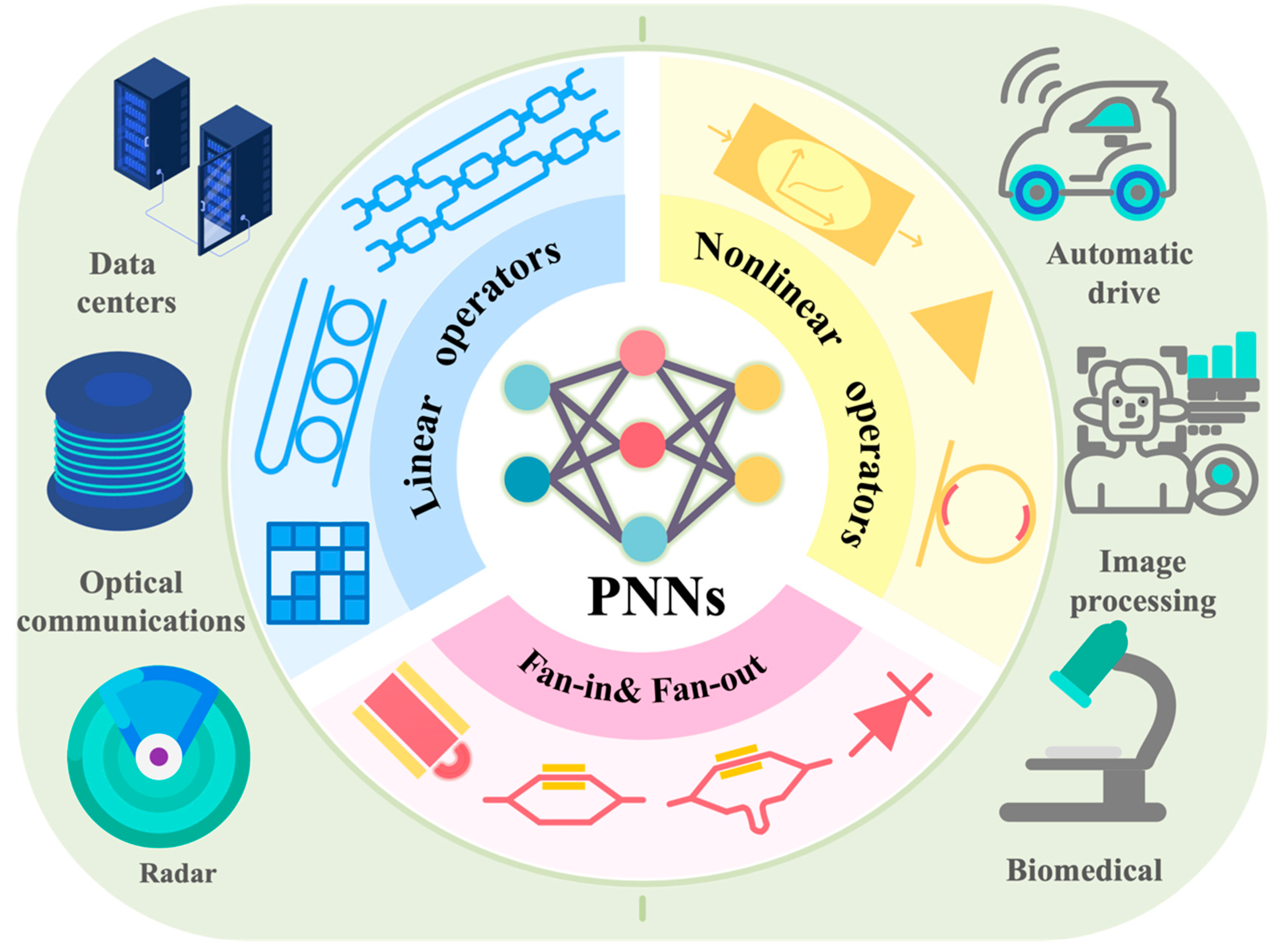
Figure 2.
Linear operators based on MZI. a Programmable nanophotonic processor based on 56 MZI. b Complex-valued neural network chip based on MZI mesh. c On-chip DNN based on MZI array.
Figure 2.
Linear operators based on MZI. a Programmable nanophotonic processor based on 56 MZI. b Complex-valued neural network chip based on MZI mesh. c On-chip DNN based on MZI array.
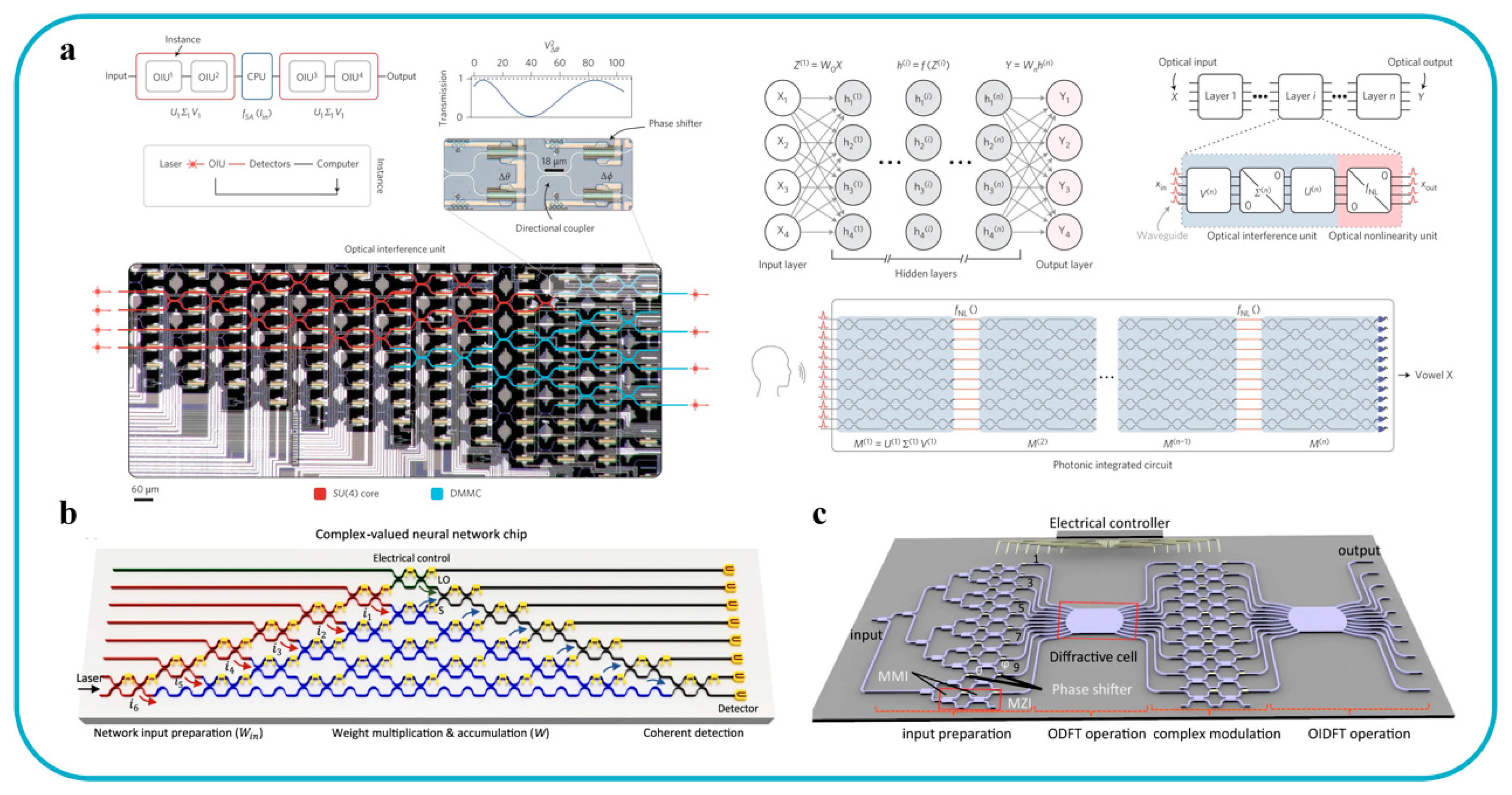
Figure 3.
Linear operator based on MRR. a Broadcast-and-weight system based on MRR weight banks. b Nonlinear compensation based on MRR weight banks. c Integrated photonics processing unit based on MRR. d Integrated photonic tensor flow processor based on MRR.
Figure 3.
Linear operator based on MRR. a Broadcast-and-weight system based on MRR weight banks. b Nonlinear compensation based on MRR weight banks. c Integrated photonics processing unit based on MRR. d Integrated photonic tensor flow processor based on MRR.
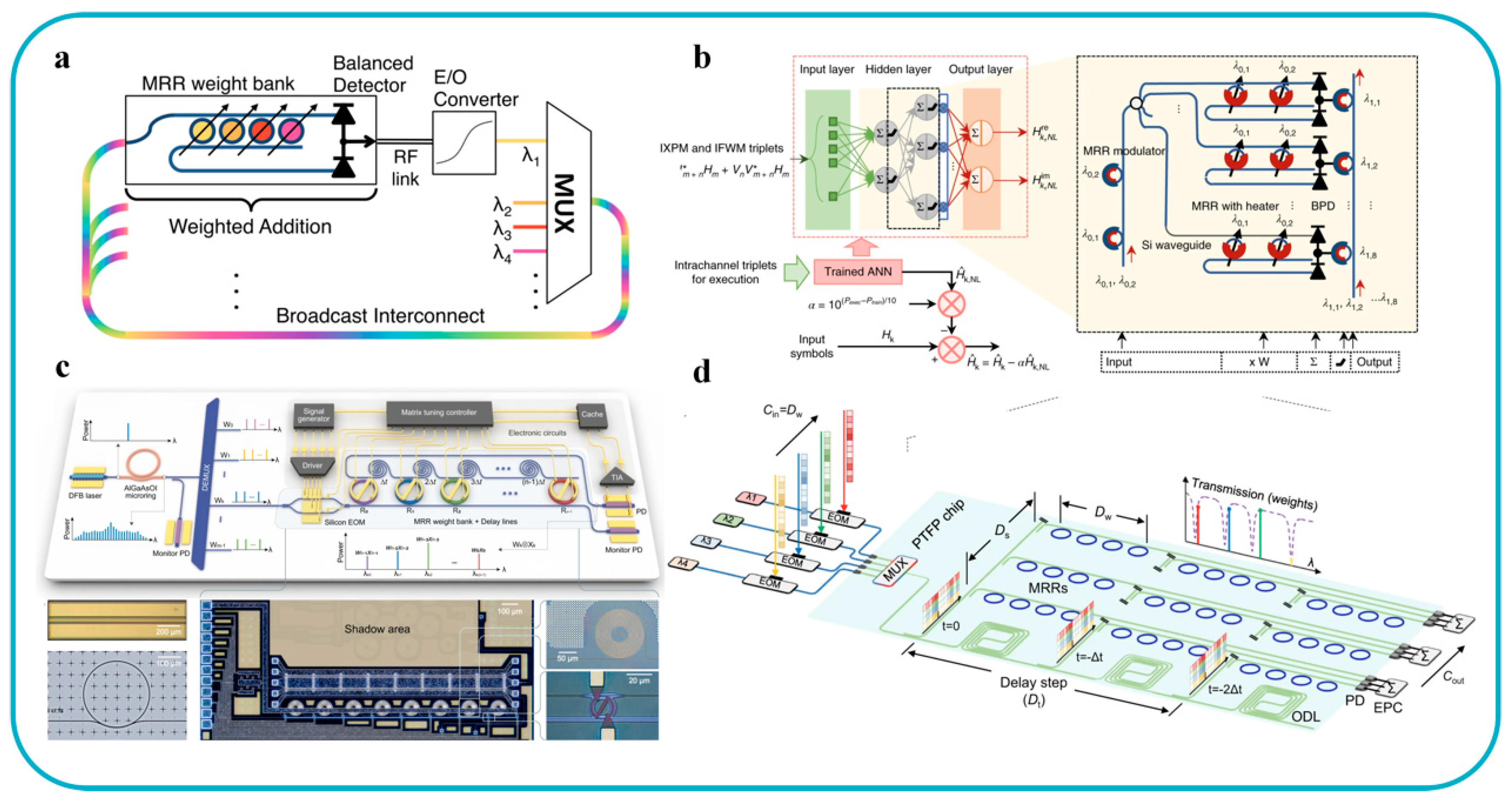
Figure 4.
Linear operator based on optical storage medium. a All-optical spiking neuronsynaptic network based on PCMs. b Photonic in-memory computing based on PCMs units. c In-memory photonic–electronic dot-product engine based on PCMs. d Photonic tensor core based on PCMs.
Figure 4.
Linear operator based on optical storage medium. a All-optical spiking neuronsynaptic network based on PCMs. b Photonic in-memory computing based on PCMs units. c In-memory photonic–electronic dot-product engine based on PCMs. d Photonic tensor core based on PCMs.
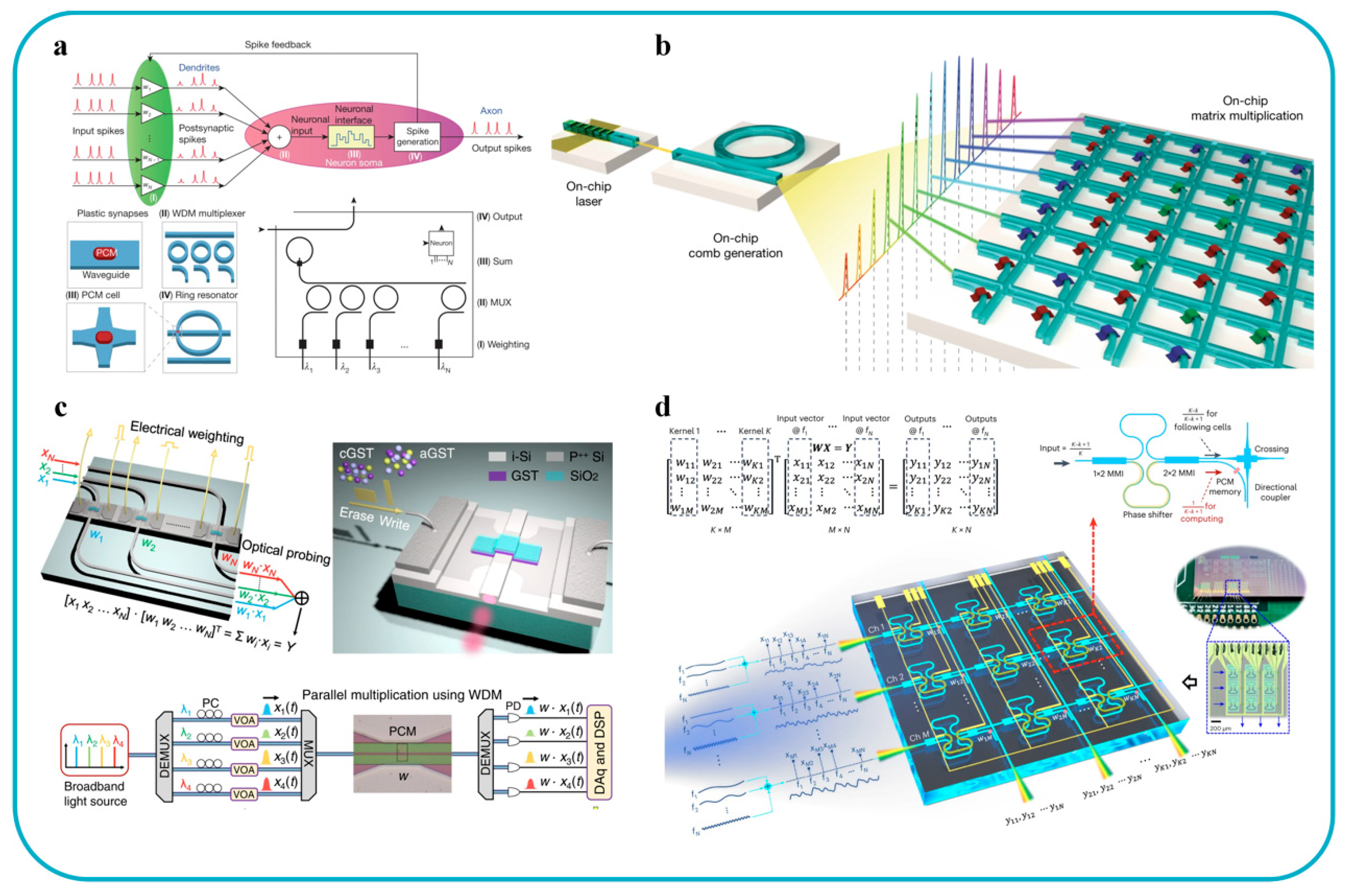
Figure 5.
Linear operators based on modulator arrays other integrated optical devices, and on-chip diffractive metasurfaces. a Optical coherent dot-product chip based on modulator array. b On-chip linear operator based on N × M crossbar architecture. c PDNN based on PIN. d Parallel convolution processing unit based on MMI. e On-chip DONN architecture based on a 1D dielectric metasurface. f On-chip diffractive metasurfaces for multimodal deep learning.
Figure 5.
Linear operators based on modulator arrays other integrated optical devices, and on-chip diffractive metasurfaces. a Optical coherent dot-product chip based on modulator array. b On-chip linear operator based on N × M crossbar architecture. c PDNN based on PIN. d Parallel convolution processing unit based on MMI. e On-chip DONN architecture based on a 1D dielectric metasurface. f On-chip diffractive metasurfaces for multimodal deep learning.
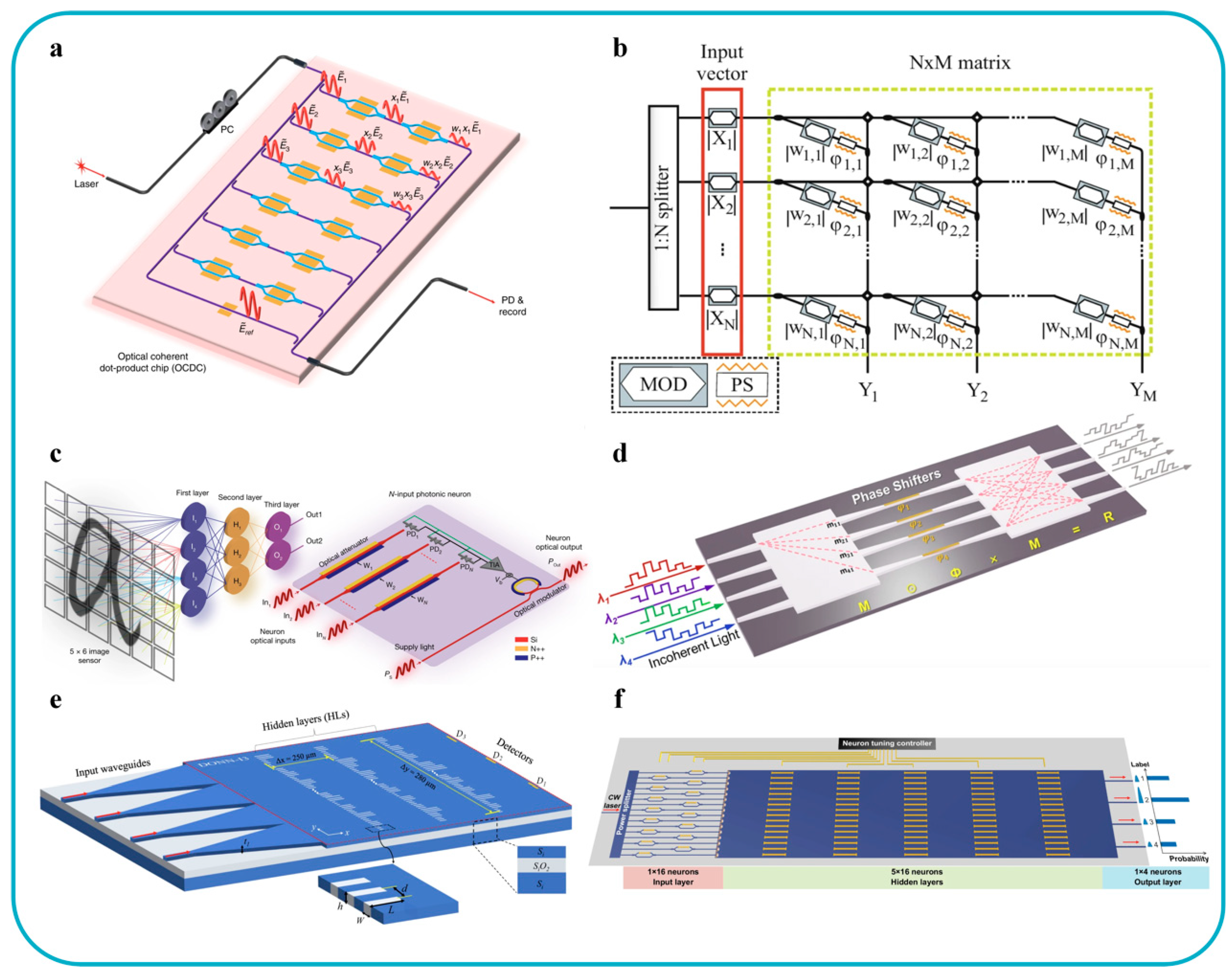
Figure 6.
Nonlinear operators. a Mott activation neuron based on vanadium dioxide. b Nonlinear function based on germanium-silicon photodiodes. c On-chip photonic synapse based on PCMs. d Optical activator based on optical waveguides.
Figure 6.
Nonlinear operators. a Mott activation neuron based on vanadium dioxide. b Nonlinear function based on germanium-silicon photodiodes. c On-chip photonic synapse based on PCMs. d Optical activator based on optical waveguides.
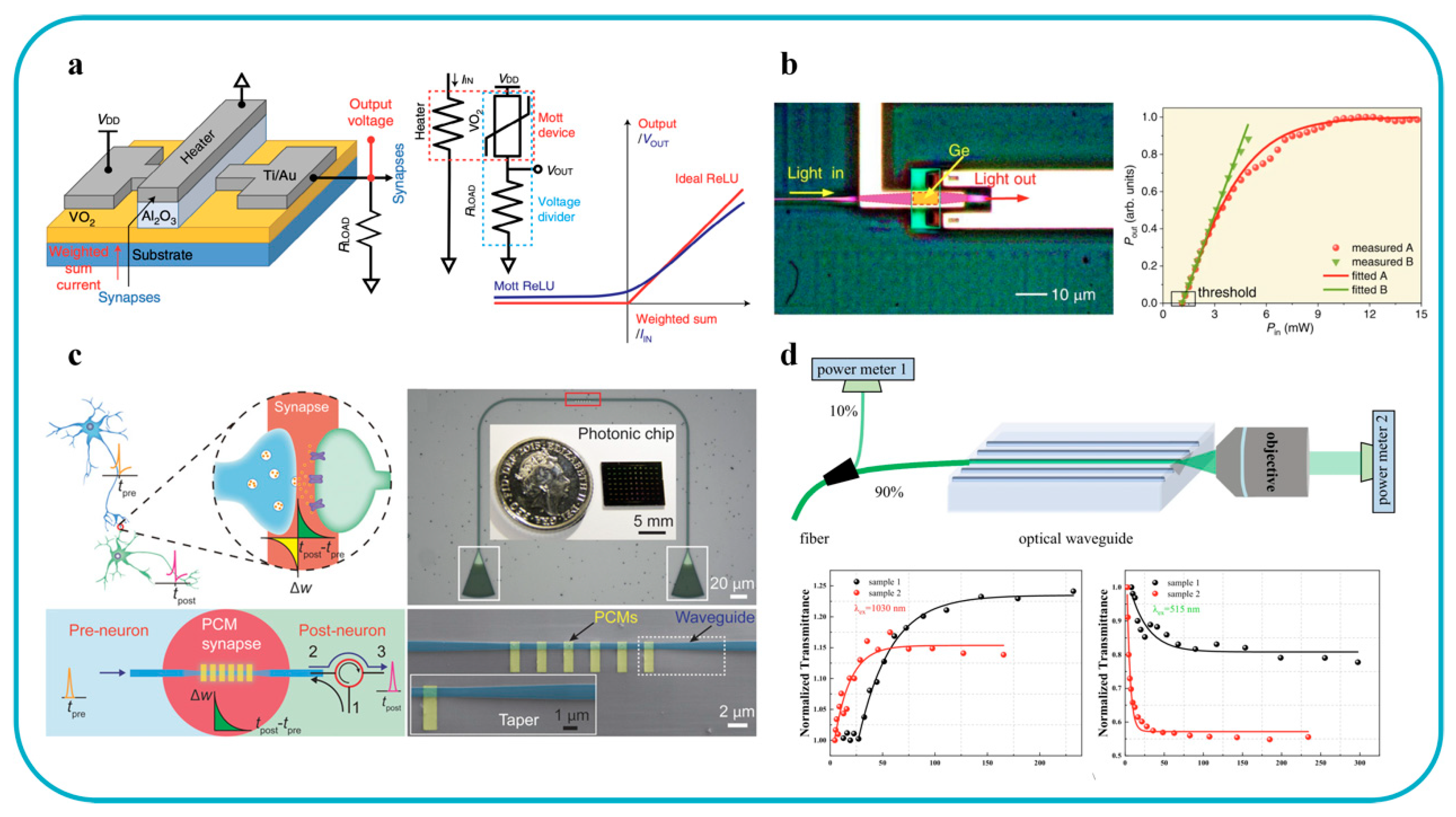
Figure 7.
Typical high-speed electro-optical interfaces: modulators and photodetectors. a First MZI structure TFLN MZM. b First DP-IQ TFLN modulator. c Integrated lithium niobate microwave photonic processing engine. d A coplanar waveguide microwave resonator with an on-chip optical racetrack resonator TFLN modulator. e An optimized U-shaped electrode Ge-Si PD. f An ultra-high bandwidth of 260 GHz PD.
Figure 7.
Typical high-speed electro-optical interfaces: modulators and photodetectors. a First MZI structure TFLN MZM. b First DP-IQ TFLN modulator. c Integrated lithium niobate microwave photonic processing engine. d A coplanar waveguide microwave resonator with an on-chip optical racetrack resonator TFLN modulator. e An optimized U-shaped electrode Ge-Si PD. f An ultra-high bandwidth of 260 GHz PD.
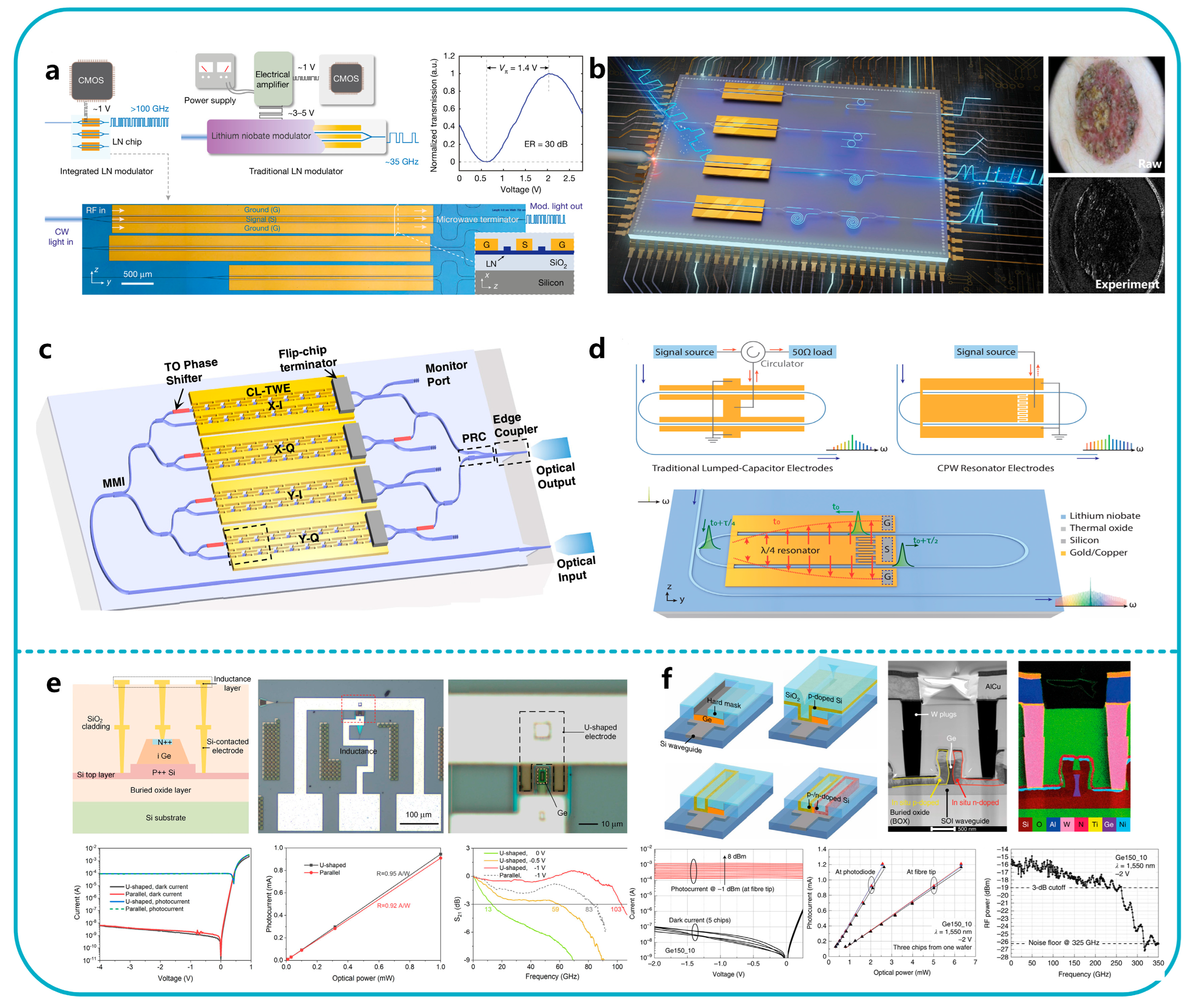
Figure 8.
Large scale PNNs. a ACCEL. b Taichi. c Single-chip PNN.
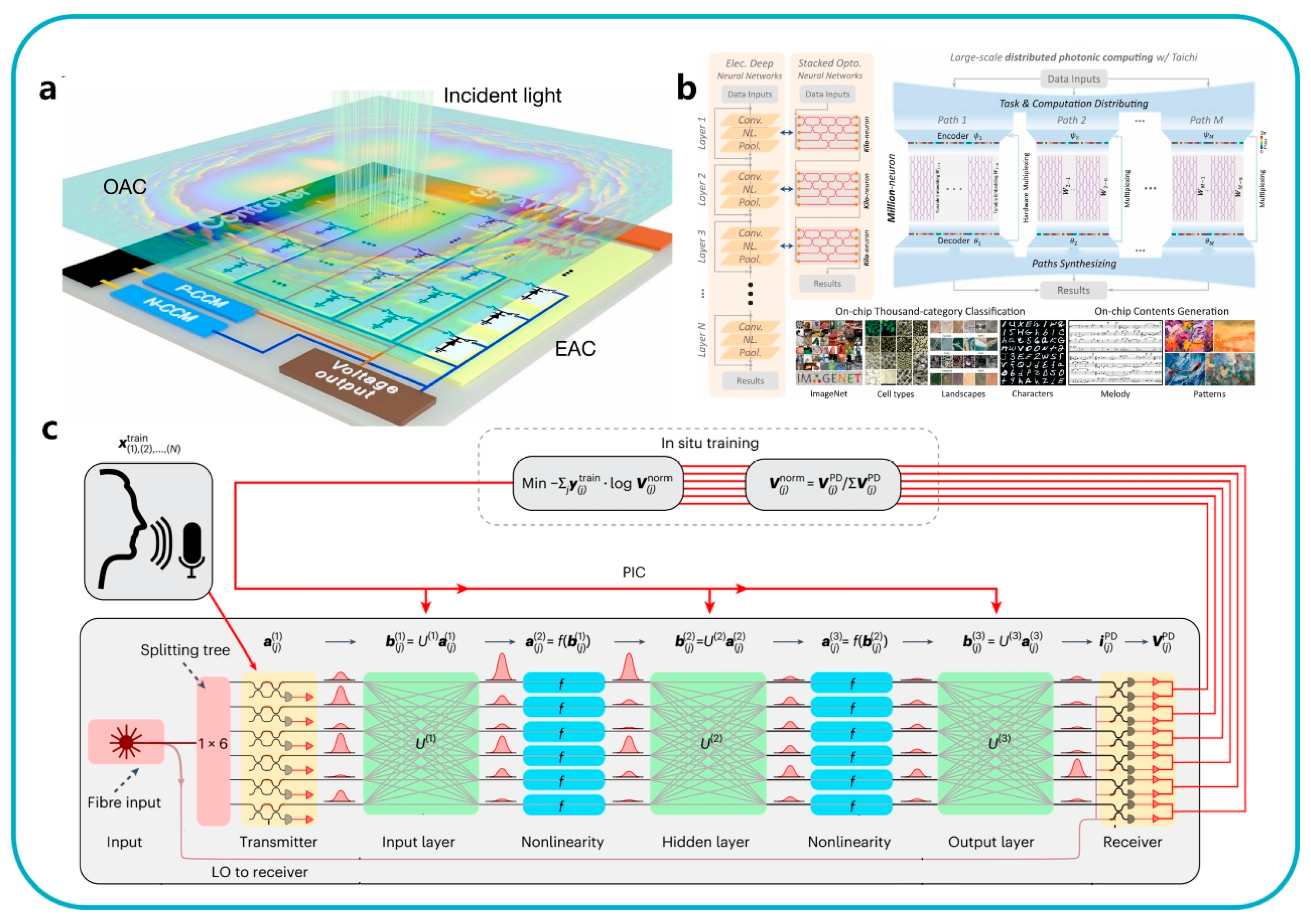
Figure 9.
Schematic of monolithically integrated PNNs.
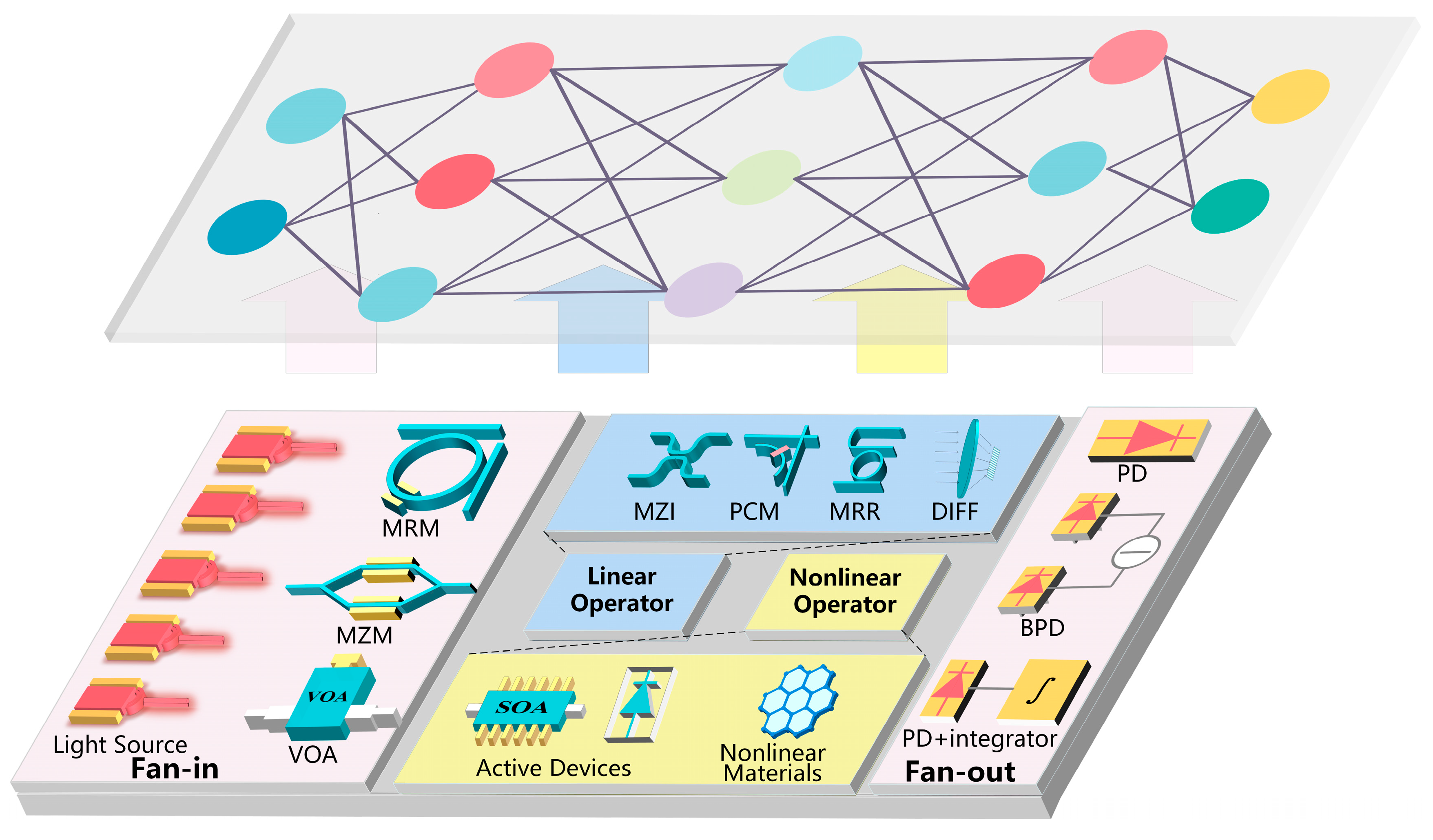
Table 2.
Comparison of state-of-the-art integrated photonic neural network systems.
| Ref. |
Integration Level |
Integrated Devices |
Computing Speed (TOPS) |
Power (TOPS/W) |
Materials | Tasks | Latency |
Footprint (mm[2]) |
|
| 102 | End-to-end DNN | MZM PD MZI MRR |
0.59 | 0.013 | SiP | Six-class vowel classification (92.5%) |
410ps | 34.2 | |
| 42 | End-to-end PDNN | PIN PD MZM |
0.27 | 0.07 | SiP SiGe |
Two-class classification (93.8%) |
0.57 ns/frame | 9.3 | |
| 31 | Linear unit light source |
MRR PCM |
4 | 0.4 | Si3N4 Ge2Sb2Te5 |
MNIST (95.3%) |
8.1×ns/frame | ~6.5 | |
| 103 | Linear unit Nonlinear unit |
Phase mask PD |
4.55×10[3] | 7.48×10[4] | SiO2 | Time-lapse video recognition (92.6%) |
72 ns | 4.7 | |
| 18 | Input Output Linear unit |
Diff. units PS MZI VOA |
5×10[4] | 160.82 | Si TiN |
1623-category Omniglot dataset (91.8%) | 3.79 ms | N.A. | |
| 25 | Light source Linear unit |
OFC MRR |
51.2 | 4.18 | Si3N4 | Human emotion recognition (78.5%) |
N.A. | ~5 | |
| 104 | Light source Output Linear unit |
LED PD gratings |
N.A. | N.A. | perovskite Si3N4 |
Edge detection (85%) |
N.A. | ~5 | |
| 22 | Light source Input Linear unit |
OFC EOM MRR DL |
0.136 | 0.2 | SiP AlGaAs |
Edge detection (96.9%) |
58.88ps | 0.131 | |
Disclaimer/Publisher’s Note: The statements, opinions and data contained in all publications are solely those of the individual author(s) and contributor(s) and not of MDPI and/or the editor(s). MDPI and/or the editor(s) disclaim responsibility for any injury to people or property resulting from any ideas, methods, instructions or products referred to in the content. |
© 2025 by the authors. Licensee MDPI, Basel, Switzerland. This article is an open access article distributed under the terms and conditions of the Creative Commons Attribution (CC BY) license (http://creativecommons.org/licenses/by/4.0/).
Copyright: This open access article is published under a Creative Commons CC BY 4.0 license, which permit the free download, distribution, and reuse, provided that the author and preprint are cited in any reuse.