
Submitted:
19 August 2025
Posted:
19 August 2025
You are already at the latest version
Abstract
Philippine educational systems continue to grapple with unprecedented challenges that extend beyond traditional volatility and uncertainty to encompass the brittleness, anxiety, nonlinearity, and incomprehensibility characteristic of the BANI era. This position paper proposes the SPECTRA (Situationally Participatory, Empathetic, Context-Tailored, and Responsive Administration) Framework as an innovative leadership model specifically designed to address these contemporary educational realities. Drawing from and extending three foundational theories (Participatory Leadership, Knowledge Management, and Contingency Theory), SPECTRA reconceptualizes educational leadership as both an administrative function and a fundamentally human endeavor that integrates emotional intelligence, collaborative decision-making, and adaptive responsiveness. The framework transforms participatory leadership into an emotional support system, knowledge management into an active strategic component, and contingency thinking into built-in organizational flexibility. Through examination of four representative crisis scenarios (teacher shortages, natural disasters, technological failures, and anxiety crises), this paper demonstrates how SPECTRA enables school leaders to navigate complex challenges through inclusive stakeholder engagement, real-time institutional learning, and context-sensitive adaptation. The framework offers a holistic approach to educational leadership that acknowledges the emotional, psychological, and relational dimensions of contemporary school management while maintaining practical applicability in resource-constrained Philippine educational contexts.
Keywords:
educational leadership
; BANI Framework
; participatory leadership
; knowledge management
; contingency theory
; organizational management
; adaptive administration
1. Introduction
Educational systems worldwide have faced intensifying waves of upheaval characterized by volatility, uncertainty, ambiguity, diversity, and disruption, also known as VUCAD2 (Sum, 2022; Rogayan & Dantic, 2021). These compounded pressures have required school leaders to adopt more strategic, inclusive, and flexible approaches to governance (Leithwood, 2020; OECD, 2020). However, the post-pandemic landscape has revealed a deeper layer of crisis, which is not merely structural or logistical, but also emotional and psychological. The BANI framework (emphasizing brittleness, anxiety, nonlinearity, and incomprehensibility) offers a more current and relevant lens for understanding the fragility and unpredictability of today’s educational systems (Cascio, 2020). Unlike VUCAD2, BANI captures the brittles of school structures, emotional exhaustion of educators, the nonlinear cause-effect patterns in policy and crisis response, and the unpredictable ripple effects of global and local disruptions.
In the Philippine setting, such realities are intensified by a persistent reliance on top-down, bureaucratic leadership models (Torneo & Mojica, 2020). Although decentralization initiatives, such as School-Based Management (SBM), have been implemented to empower schools and communities, their effects remain uneven and often lack responsiveness to local contexts (Aldaba, Sescon, Alconis, 2024). Teachers and community members are not consistently engaged in meaningful decision-making processes, institutional knowledge is rarely shared across academic institutions, and leadership strategies remain rigid in the face of rapid, complex challenges (Macapobre, et al. 2024; Perez, 2023). These gaps reveal a lack of a cohesive leadership model that empowers local actors through inclusive participation, preserves and mobilizes institutional knowledge for responsiveness, and adjusts leadership strategies to fit shifting school contexts.
This paper emphasizes the necessity for a more cohesive and adaptive leadership model. Such framework must strengthen local stakeholders, support both emotional and organizational resilience, and responds effectively to today’s shifting school environments. To address this need, the paper proposes the SPECTRA Framework, a leadership model designed to guide Philippine educational leaders through the BANI era.
2. Review of Relevant Theories
In response to the complex and unpredictable nature of the BANI environment, school leadership cannot rely on a single theoretical lens. Instead, it requires a synthesis of complementary, yet distinct approaches (Uhl-Bien & Arena, 2018). This paper draws on three core theories (i.e., Participatory Leadership, Knowledge Management (KM), and Contingency Theory), offering critical insights, but also limitations when taken in isolation.
One of the most relevant foundations is Participatory Leadership, which emphasizes shared decision-making among key stakeholders such as teachers, parents, and community members (Gamage & San Antonio, 2007). In educational settings, this approach challenges traditional hierarchical models by valuing the insights and agency of those people who experience and interact with school realities directly (Armstrong, 2004). Especially during periods of crisis, participation promotes trust, strengthens collaboration, and distributes leadership tasks more sustainably (Ahn & Bessiere, 2022). Contemporary research has shown that schools led with participatory values are better equipped to respond to rapidly changing environments (Chatzipanagiotou & Katsarou, 2023; Mansaray, 2019), recognizing that individual leaders cannot possess all necessary solutions.
In the Philippines, participatory leadership has been promoted through policies like School-Based Management (SBM) (Anabo, 2024). However, these initiatives have often functioned more as procedural formalities than genuine power-sharing mechanisms, with many decisions still made by central authorities (Saguin & Ramesh, 2020). As a result, the potential of participatory leadership to foster genuine responsiveness and emotional investment has not yet been fully realized, especially in BANI conditions marked by heightened anxiety and fragmentation.
However, simply involving people in decisions is insufficient. In fast-moving crises, even empowered communities can struggle to make sound decisions without access to lessons gained from past and shared experiences (Zamiri & Esmaeili, 2024). This is where Knowledge Management (KM) Theory becomes crucial. Knowledge Management refers to the systematic collection, sharing, and use of knowledge across an organization (Yeboah, 2023). In academic institutions, this includes everything from instructional innovations and policy strategies to community-based solutions during emergencies (Iacuzzi, et al., 2020). KM creates continuity and adaptability, which allows leaders to build on what they have learned from previous disruptions rather than having to figure everything out from the beginning each time.
Despite such advantage, KM practices tend to be weak or scattered in educational institutions, especially in top-heavy systems or those lacking adequate resources (Dubina, 2022). For instance, successful practices are frequently undocumented, and valuable knowledge can disappear during leadership transitions (Thomas, 2024). While Knowledge Management complements participatory structures by offering a shared foundation for action, its implementation often requires deliberate planning and cultural change (Walczak, 2005), which are not easily achieved in brittle systems.
Even when leadership is both participatory and rich in shared knowledge, it can be inadequate in unpredictable scenarios. Here, Contingency Theory provides essential guidance. Rather than adhering to predetermined leadership approaches, contingency theory maintains that leadership effectiveness depends fundamentally on the specific situation, and this includes the task nature, organizational culture, and stakeholder readiness (Omazić, et al., 2023). Leaders must assess the demands of the moment and adjust accordingly (e.g., sometimes stepping back, other times providing clearer direction, depending on what the situation requires) (Fiedler, 2015).
While Contingency theory offers valuable adaptability, it also introduces implementation challenges. Frequent strategic adjustments can create confusion, particularly within systems where roles and expectations operate within well-defined parameters (Chaudhry, 2020). Furthermore, without foundational shared values or structural consistency (which participatory and KM approaches can provide), purely situational leadership may risk inconsistency or undermine collective direction (Yukl, 2011).
The three theories show both how complementary strengths and inherent tension. Participatory Leadership fosters inclusion but needs Knowledge Management to sustain learning and avoid fragmentation. KM builds institutional memory, but it requires Contingency Thinking to remain useful under rapidly shifting conditions. Contingency Theory, in turn, may function effectively when anchored in participatory foundations and shared knowledge systems, to guide adaptation while avoiding organizational chaos.
This theoretical synthesis establishes the foundation for the paper’s central position that effective educational leadership in the BANI era must be inclusive, informed, and adaptive –and this is rooted in participation, strengthened by knowledge, and responsive to whatever context leaders find themselves in.
3. Theoretical Position
The current educational climate today is being tested in ways that go beyond complexity, and introduces challenges that are brittle, emotionally intense, and resistant to linear solutions (Jedaman, et al. 2025). Traditional leadership models that rely heavily on structure, control, or static routines seems to be insufficient. To address these challenges, this paper proposes the SPECTRA (Situationally Participatory, Empathetic, Context-Tailored, and Responsive Administration) Framework. While grounded in three well-established theories (i.e., Participatory Leadership, Knowledge Management, and Contingency Theory), SPECTRA is aimed at simply going beyond combining them. Instead, the framework extends such theories to fit the emotional, structural, and adaptive demands of today’s school environments.
First, SPECTRA reconceptualizes participatory leadership as more than just a method for including stakeholders in decision-making processes, but also as an emotional support system. In environments marked by anxiety and fragility, participation must go beyond practical cooperation to foster psychological safety, trust, and shared emotional strength. This expands participation from mere procedural involvement to genuine affective relationships.
Second, knowledge management within SPECTRA is not treated as a passive archive of past strategies. It operates as an active leadership component, specifically designed to capture real-world experiences, emotional responses, and local insights that often go undocumented in traditional systems. SPECTRA emphasizes dynamic knowledge flow, where institutional memory is co-created and used in real-time decision-making, not merely stored for reference.
Third, while contingency theory stresses flexibility in response to varying situations, SPECTRA integrates this flexibility into every aspect of leadership to ensure that responsiveness is a fundamental characteristic rather than an occasional adjustment. Leaders operating within the framework must not simply modify their strategies when circumstances change. They are to be trained and structured to anticipate change, manage emotional environments, and adapt while preserving a shared sense of direction/ purpose.
SPECTRA’s distinctive contribution lies in its integration of emotional intelligence, participatory practices, institutional learning, and contextual adaptation within a single comprehensive framework. It addresses the BANI conditions holistically and acknowledge that educational leadership today is not just technical or managerial, but also deeply relational, cultural, and psychological.
4. Application and Implications
The application of SPECTRA is illustrated through four representative crisis scenarios that reflect the BANI conditions in Philippine Education: teacher shortage, natural disaster, technological failure, and anxiety crisis. The examples demonstrate the framework’s potential impact, as well its limitations, particularly in under-resourced or highly rural contexts.
- Teacher Shortage (Brittleness + Nonlinearity)
Unexpected teacher departures due to resignations, illness, or unfilled positions continue to plague some Philippine public/ private schools (Trazo & Peñas, 2024). Traditional top-down responses typically lead to extended delays excessive workloads for remaining staff and diminished educational quality (Stacey, et al., 2023). The SPECTRA approach begins with immediate collaborative meetings involving teacher leaders, parent groups, and local education partners to develop stop-gap solutions such as workload redistribution, temporary modular learning, or tapping retired educators and trained volunteers.
Simultaneously, the knowledge management component activates past successful practices, such as flexible scheduling during the pandemic (Macapobre et al., 2024) and use them as templates for context-sensitive adaptation. These practices are not only retrieved, but also updated to reflect current realities.
Using contingency-based reasoning, school administrators assess critical factors: Are replacement/substitute teachers available in the local area? Which temporary measures will protect learning outcomes and teacher well-being? The solution implemented in a rural school with limited substitute teacher access will necessarily differ from that of an urban school, highlighting the importance of customized responses.
- Natural Disaster (Brittleness + Incomprehensibility)
Natural disasters including typhoons, earthquakes, and floods regularly disrupt schooling in the Philippines (Llego, et al. 2025). While disaster risk reduction (DRRM) protocols exist, their implementation frequently encounters obstacles due to administrative inflexibility or communication failures (Sumaylo, 2023). SPECTRA transforms preparedness into a community-driven collaborative effort. Prior to disaster events, leadership groups work together to develop planning exercises that are situation-specific, assign rotating response roles, and draft localized contingency manuals.
Knowledge Management tools are central in this context. Schools collect and regularly update reports, photos, and staff reflections from past events to build a comprehensive resource of crisis responses that enhances preparedness and minimizes repeated mistakes.
In terms of contingency planning, leadership maintains adaptability. When key personnel become unavailable, or disasters escalates unpredictably, responsibilities or roles are adjusted. For instance, in one school, a parent-teacher emergency committee may assume temporary leadership.
- Technological Failure (Anxiety + Incomprehensibility)
Post-pandemic education has relied heavily on digital tools. However, frequent connectivity interruptions, equipment shortages, and low digital literacy, especially in geographically isolated communities, reveal significant system vulnerabilities (Han & Li, 2025). Through SPECTRA, school leaders organize inclusive discussions with parents and students to develop integrated learning approaches, such as printed modules or community learning hubs.
Though knowledge management processes, schools monitor information from previous disruptions (e.g., attendance records, material return rates, and teacher observations) to recognize patterns and identify effective solutions. For instance, a school may find that text message-based feedback is more effective than online learning platforms in signal -poor areas.
On the other hand, contingency thinking allows school leaders to determine the specific nature of the disruption: Does the problem stem from equipment failure, insufficient training, or external infrastructure issues? Responses are then adjusted to match these circumstances.
- Anxiety Crisis Among Students or Staff (Anxiety + Incomprehensibility)
Emotional and psychological crises often remain invisible, yet they deeply affect learning and school culture. These may emerge as burnout, withdrawal, sudden absenteeism, or low morale (Oberg, 2025). Under SPECTRA, such issues are addressed proactively and not just when they reach critical levels.
Through participatory practices, school institutionalize safe spaces for dialogue (e.g., discussion forums, confidential feedback systems, and regular wellness conversations). Mental health support becomes integrated into daily school life rather than treated as an occasional intervention.
Knowledge management procedures collect and preserve informal approaches and community-based strategies that promote emotional wellness. Peer support programs, professional referral networks, or mindfulness practices are incorporated into leadership training.
Contingency principles, on the contrary, help leaders assess both the severity and extent of emotional challenges: Is this an individual case of staff exhaustion, or does it represent a widespread pattern of institutional demoralization? Leaders should respond with targeted strategies based on actual emotional evidence rather than standardized policies.
5. Conclusion
The BANI era has revealed that schools today are dealing with more than just operational problems, but with brittle structures, unpredictable challenges, and emotional volatility. In this environment, traditional leadership approaches that are rooted in rigid hierarchy or isolated decision-making, may not be effective anymore.
There is a need to recalibrate leadership through an integrated, context-sensitive, and emotionally conscious approach. By integrating Participatory Leadership, Knowledge Management, and Contingency Theory, and extending their use, the SPECTRA framework provides an innovative leadership model that is specifically designed for Philippine educational realities in our post-pandemic, BANI-influenced world. SPECTRA strengthens these existing theories by integrating emotional intelligence directly into collaborative decision-making processes, transforming knowledge-sharing into an active and strategic leadership, and making adaptability a built-in expectation rather than a last resort.
In real-world scenarios (e.g., teacher shortages, disasters, technological disruptions, and anxiety crises, SPECTRA can support school leaders in making decisions that are collaborative, informed, and flexible. Simultaneously, it acknowledges the challenges of applying such a model, particularly in under-resourced or rural contexts, where institutional support and capacity-building are essential.
Looking ahead, the SPECTRA Framework calls for continued experimentation, improvement, and professional discussion. Its effectiveness relies on leaders who are prepared to view uncertainty not as a threat, but as an opportunity to lead with empathy, creativity, and courage. As education continues to evolve, leadership must evolve alongside it and SPECTRA offers one pathway for beginning that transformation.
6. Conceptual Framework
The SPECTRA Framework (Situationally Participatory, Empathetic, Context-Tailored, and Responsive Administration) offers a leadership model that is specifically designed to address the challenges of the BANI era which is marked by brittleness, anxiety, nonlinearity, and incomprehensibility. It integrates and transforms three foundational theories (Participatory Leadership, Contingency Theory, and Knowledge Management into a cohesive system that enables school leaders to lead with both adaptability and care.
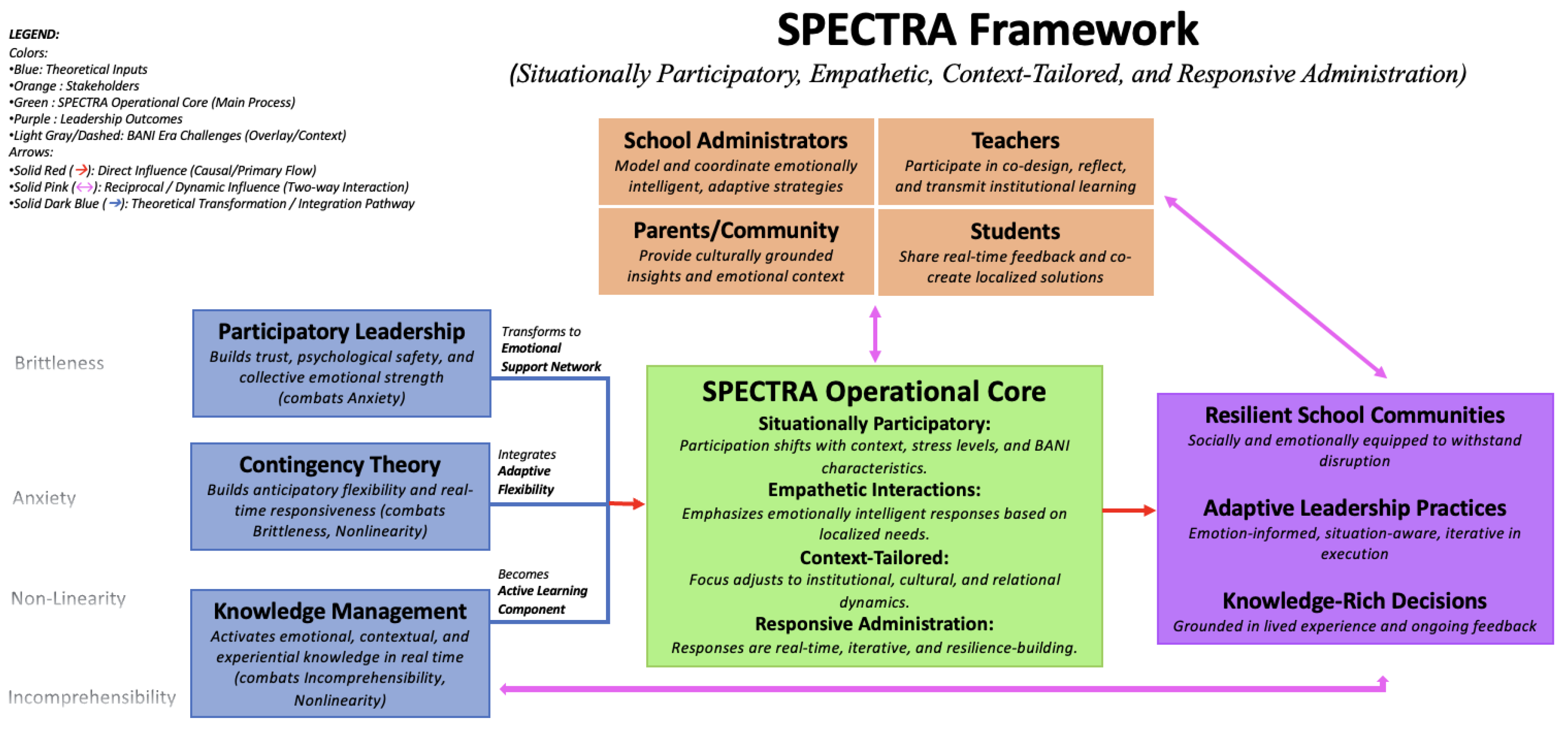
Figure 1.
The SPECTRA Framework: Situationally Participatory, Empathetic, Context-Tailored, and Responsive Administration.
Figure 1.
The SPECTRA Framework: Situationally Participatory, Empathetic, Context-Tailored, and Responsive Administration.
In this model, each theory responds to today’s emotional and organizational realities. Participatory Leadership becomes an emotional support network, expanding beyond stakeholder inclusion to promote psychological safety, trust, and collective strength. Contingency Theory is reimagined as adaptive flexibility, enabling leadership decisions to change fluidly with evolving contexts. Meanwhile, Knowledge Management becomes an active learning component, ensuring that emotional, experiential, and institutional insights are captured and applied in real time. These transformed elements directly feed into the core of SPECTRA framework.
At the core, SPECTRA leadership is defined by four key dimensions. Situationally Participatory leadership adjusts stakeholder involvement depending on the crisis, context, and community readiness. Empathetic Interactions place emotional intelligence at the center of decision-making, recognizing that leadership must also support human well-being. Context-Tailored responses rely on localized experience and institutional memory to ensure decisions are grounded in cultural and social realities. Finally, Responsive Administration encourages real-time feedback, flexibility, and resilience-building, which turns uncertainty into an opportunity of reflection and recalibration.
Stakeholders (i.e., school leaders, teachers, parents, and community members, and students) are not passive recipients in this model. Instead, they are active participants who shape the leadership processes. Their contributions that range from local wisdom and co-designed solutions to emotional feedback and classroom experiences, directly influence the way the SPECTRA Core operates. These reciprocal relationships ensure that leadership remains responsive, relational, and rooted in lived realities.
From this core, the framework generates three important outcomes: First, it fosters resilient school communities, socially and emotionally prepared to face disruptions. Second, it cultivates adaptive leadership practices, where decisions are flexible, inclusive, and emotionally attuned. Third, it supports knowledge-rich decision-making, where leadership is guided not just by standard procedures, but both data and experience.
The framework also includes feedback loops wherein outcomes reinforce stakeholder engagement and theoretical development to create a continuous learning process within the system. This cycle reflects the real-world nature of school leadership under pressure, which constantly evolves, as well as informed by both insights and challenges.
As flexibility, empathy, participation, and context-awareness are embedded into a unified structure, the SPECTRA Framework transforms leadership from a purely administrative function into a fundamentally human endeavor. It redefines educational management/leadership as moving beyond simple problem solving to cultivating resilient communities equipped to handle uncertain challenges collaboratively.
References
- Ahn, Y. J., & Bessiere, J. (2022). The Role of Participative Leadership in Empowerment and Resident Participation. Sustainability, 14(18), 11223. [CrossRef]
- Anabo, R. O. (2024). Instructional leadership in school-based management of DepEd schools in Samar Island: Systematic approach review. http://dx.doi.org/10.2139/ssrn.4799364.
- Antonio, D. M. S., & Gamage, D. T. (2007). Building trust among educational stakeholders through Participatory School Administration, Leadership and Management. Management in Education, 21(1), 15-22. (Original work published 2007). [CrossRef]
- Aldaba, F., Sescon, J, & Alconis, K. (2024). Strengthening CHED's developmental and regulatory capacity. PIDS Discussion Paper Series. https://doi:10.62986/dp2024.41.
- Armstrong, H. D. (2004). Agency fragmentation: The dilemma facing participative management school principals. The Journal of Educational Thought (JET)/Revue de la Pensée Educative, 3-17.
- Cascio, J. (2020). A framework for understanding a turbulent world. BANI: facing the age of chaos.
- Chaudhry, S. (2020). Understanding change enablers in service organizations: A contingency theory perspective. South Asian Journal of Marketing & Management Research, 27(2), 5- 83.
- Chatzipanagiotou, P., & Katsarou, E. (2023). Crisis Management, School Leadership in Disruptive Times and the Recovery of Schools in the Post COVID-19 Era: A Systematic Literature Review. Education Sciences, 13(2), 118. [CrossRef]
- Dubina, I. (2022). Global Rankings in Swedish Universities: A Qualitative Study of Knowledge Management Practices.
- Fiedler, (2015). Contingency theory of leadership. In Organizational Behavior 1 (pp. 232-255). Routledge.
- Han, X., & Li, Y. (2025). Equity in Digital Education: Addressing the Digital Divide in a Post- Pandemic World. Frontiers in Educational Research, 8(1), 41-47.
- Iacuzzi, S., Fedele, P., & Garlatti, A. (2020). Beyond Coronavirus: the role for knowledge management in schools responses to crisis. Knowledge Management Research & Practice, 19(4), 433–438. [CrossRef]
- Jedaman, P., Pitchaya-Auckarakhun, M., Kasorn, K., & Kenaphoom, S. (2025). Sustainability Education Management Scenarios under Changes in the BANI Era. Sustainable Development, Humanities, and Social Sciences for Society 5.0.
- Llego, J., Permison, P. E., Imbuido, N., Concepcion, M., Caneja, L. J., & Zaulda, F. J. (2025). Academic Challenges During Flood Disaster Among Nursing Students at a University in the Philippines. Teaching and Learning in Nursing, 20(2), 154-160.
- Leithwood, K., Harris, A., & Hopkins, D. (2019). Seven strong claims about successful school leadership revisited. School Leadership & Management, 40(1), 5–22. [CrossRef]
- Macapobre, K., Kilag, O. K., Sasan, J. M., Uy, F., Villegas, M. A., Solatorio, R., & Suba-an, J. (2024). Educational Leadership in the Philippines: The Challenges. International Multidisciplinary Journal of Research for Innovation, Sustainability, and Excellence (IMJRISE), 1(6), 1021-1026. https://risejournals.org/index.php/imjrise/article/view/547.
- Mansaray, H. E. (2019). The role of leadership style in organisational change management: a literature review. Journal of Human Resource Management, 7(1), 18-31.
- OECD (2020), “Schooling disrupted, schooling rethought: How the Covid-19 pandemic is changing education”, OECD Policy Responses to Coronavirus (COVID-19), OECD Publishing, Paris, . [CrossRef]
- Oberg, G. (2025). Moral injury in teaching: the systemic roots of ethical conflict and emotional burnout in education. Educational Review, 1–24. [CrossRef]
- Omazić, M. A., Labaš, D., & Uroić, P. (2023). Contingency theory. In Encyclopedia of Sustainable Management (pp. 1-9). Cham: Springer International Publishing.
- Perez, J. E. (2023). Navigating Educational Leadership Challenges: Transformations and Policy Implications for Filipino Principals. The Asian Journal of Education and Human Development (AJEHD), 4(1).
- Rogayan Jr., D., & Dantic, M. (2021). Backliners: Roles of Science Educators in the Post- COVID Milieu. Aquademia, 5(2), ep21010. [CrossRef]
- Saguin, K. I., & Ramesh, M. (2020). Bringing governance back into education reforms. The case of the Philippines. International Review of Public Policy, 2(2: 2), 159-177.
- Stacey, M., McGrath-Champ, S., & Wilson, R. (2023). Teacher attributions of workload increase in public sector schools: Reflections on change and policy development. Journal of Educational Change, 24(4), 971-993. [CrossRef]
- Sumaylo, D. J. (2023). Engaging isolated communities in disaster preparation and communication in the Philippines. Springer.
- Sum, N. (2022). School leaders’ perceptions of their roles during the pandemic: an Australian case study exploring volatility, uncertainty, complexity and ambiguity (VUCA leadership). School Leadership & Management, 42(2), 188–207. [CrossRef]
- Thomas, A. (2024). Digitally transforming the organization through knowledge management: A socio-technical system (STS) perspective. European Journal of Innovation Management, 27(9), 437-460.
- Torneo, A, & Mojica, B. (2020). The strategic performance management system in selected Philippine National Government agencies: Assessment and policy recommendations.
- Asian Politics & Policy, 12(3), 432-454. [CrossRef]
- Trazo, S. P., & Peñas, J. M. U. (2024). Predictors of teachers'tendency to leave the profession. European Journal of Education Studies, 11(9), 295.
- Uhl-Bien, M., & Arena, M. (2018). Leadership for organizational adaptability: A theoretical synthesis and integrative framework. The leadership quarterly, 29(1), 89-104. [CrossRef]
- Walczak, S. (2005). Organizational knowledge management structure. The learning organization, 12(4), 330-339. The Learning Organization: An International Journal (2005) 12 (4): 330–339. [CrossRef]
- Yeboah, A. (2023). Knowledge sharing in organization: A systematic review. Cogent Business & Management, 10(1). [CrossRef]
- Yukl, G. (2011). Contingency theories of effective leadership. The SAGE handbook of leadership, 24(1), 286-298.
- Zamiri, M., & Esmaeili, A. (2024). Methods and technologies for supporting knowledge sharing within learning communities: A systematic literature review. Administrative Sciences, 14(1), 17. [CrossRef]
Disclaimer/Publisher’s Note: The statements, opinions and data contained in all publications are solely those of the individual author(s) and contributor(s) and not of MDPI and/or the editor(s). MDPI and/or the editor(s) disclaim responsibility for any injury to people or property resulting from any ideas, methods, instructions or products referred to in the content. |
© 2025 by the authors. Licensee MDPI, Basel, Switzerland. This article is an open access article distributed under the terms and conditions of the Creative Commons Attribution (CC BY) license (http://creativecommons.org/licenses/by/4.0/).
Copyright: This open access article is published under a Creative Commons CC BY 4.0 license, which permit the free download, distribution, and reuse, provided that the author and preprint are cited in any reuse.