
Preprint
Article

This version is not peer-reviewed.

The Past, Present, and Future Care for Refractory Chronic Cough in Children and Adults

Submitted:

17 August 2025

Posted:

19 August 2025

You are already at the latest version

Abstract

Chronic cough without explanation or diagnosis has been described in medial books for over 300 years. Since 1977, some comorbidities, such as gastroesophageal reflux and post-nasal drip, have been attributed to be causes of otherwise unexplained chronic cough. Since 2005, publications have reported that unexplained chronic cough could be a distinct entity refractory to usual treatment. This was explained by dysregulation of cough centers involving the brainstem, subcortical, and cortical areas for which a neuromodulator would be essential for treatment. However, an 1886 publication described this disorder as a type of involuntary habit, and recommended treatment to break the habit. Supporting this alternative paradigm were studies that showed the urge to cough resulted from local airway inflammation with exposed nerve endings that resulted from the frequent daily coughing. The result was a vicious cycle where coughing caused the urge to cough resulting in repetitive daily coughing. Treatment has been demonstrated by a behavioral technique that breaks the habit .That behavioral technique, called suggestion therapy, has been highly successful in children and is now recognized as the standard of care for this disorder at pediatric referral centers. The proof of concept that suggestion therapy is effective in adults with refractory chronic cough has been demonstrated in selected adults but is not yet a common practice at special cough centers.

Keywords: 
;  ;  ;  ;  
Occasional acute cough is universal. Chronic cough occurs only in some. When present, it can be a miserable problem. It inhibits social activity, school attendance for children, and occupational activity for adults. Chronic cough can be associated with various clinical disorders including asthma,[1] COPD,[2] pulmonary fibrosis,[3] inhibitors of angiotensin-converting enzyme,[4] and occasionally anatomic abnormalities of the upper airway.[5,6] The frequency of chronic cough is reported to be as high as 10% of the adult population, but varies in different publications.[7] Consequently, physicians frequently encounter patients with chronic cough.
This review focuses on chronic cough that is unexplained and refractory to usual guidelines for pharmacological treatment. Much of the current assessment and treatment of chronic cough has been based on medical experience over the past 50 years. To understand current common medical practice of refractory chronic cough, we review the beliefs and practice that have been the basis of the various published recommendations and guidelines.[8,9,10] We review the clinical experience of the past, current controversies of care, and the potential for the future improvement in care.

The Past

Chronic cough unrelated to an etiology has been described in medical texts for over 300 years and has often been referred to as habitual cough.[11,12] Willis in 1685 described a woman with”…a violent dry Cough following her day and night, unless when she was fallen asleep”[11] This description is consistent with the current definition of the habit cough disorder.[13] Mercurius in 1694 described an “…habitual cough, which often continues after the cough caused by a cold is gone….”[12] This is consistent with histories commonly obtained from parents of children and adults with refractory chronic cough. Charles Creighton in 1886 described, “…a habit cough – a reflex effect persisting after the cause is gone …. or an acquired habit….the treatment of it is to break the habit…”[14] Dr. Creighton’s insightful comments are consistent with the subsequent description of a curative procedure for habit cough.[15]
Despite these early descriptions, chronic cough as an entity did not appear in the medical lexicon until much later. Chronic cough was a rare to nonexistent subject in medical school, nor is chronic cough mentioned in the massive 2 volumes of the 2001 15th Edition of Harrison’s Principles of Internal Medicine. No diagnostic code for chronic cough was in ICD9 which was used from 1979 until the 2015 change to ICD10. Awareness of chronic cough reappeared, but as a symptom of some disorder such as asthma, post-nasal drip, and/or gastrointestinal reflex.
Richard Irwin was a major contributor to 20th century publications on chronic cough. In a 1977 Comprehensive Review of Cough, he described the importance of post-nasal drip as the cause of chronic cough.[16] This was reiterated in a 1981 publication that reported post-nasal drip as the most common cause of chronic cough among 49 consecutive unselected patients with chronic cough. In addition to 29% of the patients having post-nasal drip diagnosed as the cause of cough, cough was due to asthma in 25%, postnasal drip plus asthma in 18%, chronic bronchitis in 12%, gastroesophageal reflux disease (GERD) in 10%, and miscellaneous disorders in 6%.[17] Dr. Irwin and colleagues concluded that use of an anatomic diagnostic protocol provided that the cause of cough could be consistently determined. This expression of confidence in diagnosing the cause of chronic cough was reiterated in subsequent reviews by Dr. Irwin in 2000 and 2018.[18,19]
That diagnostic certainty was questioned by the 2006 publication of Dr. Rubaiyat Haque and colleagues.[20] They reported that after a thorough, systematic investigation of 100 consecutive unselected patients, 22% had post-nasal symptoms, 16% had GERD, and 7% had asthma as the cause of their chronic cough. But 42% had no identified cause for their chronic cough. Those 42% were considered to be a distinct entity that they called “chronic idiopathic cough.” Two subsequent reviews of chronic cough also reported that over 40% of patients with chronic cough were undiagnosed and were not responsive to usual treatment.[21,22] Terminology for Haque’s chronic idiopathic cough eventually become unexplained and refractory chronic cough.[23]
While most of the experience described in the medical literature involved chronic cough in adults, chronic cough also occurs throughout the pediatric spectrum. Unlike in adults, chronic cough in children has rarely been attributed to post-nasal drip or GERD.[24] Etiology of childhood chronic cough relates to age. Protracted bacterial bronchitis, primarily in infants and toddlers, is the most common cause of chronic cough in children[25,26] but has also been reported in adults.[27]
A few case reports of chronic cough in children with unexplained cause have been published with variable terminology.[28,29] However, it was Dr. Bernard Berman, a pediatric allergist in Boston, who published his experience in 1966 of 3 boys and 3 girls, ages 9-13, seen in his practice over 5 years.[15] They all had a daily involuntary cough for several months that was absent during sleep. In considering terminology for those children, he noted the absence of motor tics, the absence of psychologic disorders, and the response to his use of a simple behavioral technique. He stated that he used “the art of suggestion” to provide sustained cessation of cough. Dr. Berman therefore considered the 6 children to have an involuntary habit disorder. Consistent with the proposal 80 years earlier by Dr. Charles Creighton to “break the habit,”[14] Dr. Berman used suggestion to break the habit cough in all 6 children.[15]

The Present

Dr. Richard Irwin, in his 2025 review in the New England Journal of Medicine,[23] continued to recommend care for chronic cough by evaluating for asthma, upper airway cough syndrome (formerly post-nasal drip), and GERD as causes of chronic cough. His review restated his prior conclusion[17] that a rigorous systematic review could identify a cause of chronic cough. However, he now acknowledged that 10% could have no identified cause and would be considered unexplained and refractory.[23]
In contrast, a recent review in Lancet Respiratory Medicine questioned the presence of the external causes of chronic cough described by Dr. Irwin. That publication indicated that up to 50% of patients at referral cough clinics had unexplained chronic cough.[30] The Lancet review was consistent with the previous work of Dr. Rubaiyat Haque that chronic cough is a distinct disease rather than a symptom of some disorder. Drs. Woo-Jung Song, Alyn Morice and others proposed cough hypersensitivity as the key explanation for chronic cough. They suggested that various common co-morbidities like GERD and upper airway cough syndrome (UAC) might be triggers, but not the cause.[31,32] This challenged previous paradigms. These authors expressed concern that the assumption of an external cause for chronic cough results in overuse of medications that have little or no effect. Their concept is that chronic cough is the result of neuronal dysregulation involving the brainstem, subcortical, and cortical circuits.[33] Since reflex hypersensitivity was thought to be the key treatable trait, neuromodulation was regarded as needed for cough suppression. However, previous neuromodilators provided little consistent benefit.[34] The first new neuromodulator with more specific receptor effect was gefapixant. Extensive testing of gefapixant, had only a small, though statistically significant effect, on chronic cough and was associated with unpleasant adverse effects.[35]
An alternative explanation for unexplained and refractory chronic cough is based on the observations of local neuropathology caused by the incessant coughing. Inflammation in the airway mucosa was demonstrated in the report of Irwin and colleagues who bronchoscopically obtained mucosal biopsies from young adults with and without chronic cough.[36] The inflammation was the same in those whose cough had no cause as those with an identified cause. Inflammation was not present in volunteers without cough. They suggested that the inflammation in those whose coughing was without a cause occurred as trauma from the incessant coughing. Perpetuation of cough was also suggested as the cause of increased mucosal nerve density from bronchoscopically obtained samples of otherwise healthy adults with unexplained chronic cough.[37] Chronic cough can therefore be explained as a vicious cycle of mucosal neuropathic inflammation caused by incessant coughing. This is consistent with the clinical awareness of irritation, often described as a “tickle,” that triggers the urge to cough. Hilton and colleagues identified this sensation as the common trait among patients with chronic cough.[38]
Suggestion therapy, The behavioral technique, described initially by Berman,[15] has been used successfully in the treatment of children and adolescents with incessant coughing who report irritation or a “tickle” as a trigger for their cough.[39,40] This method has been used at the University of Iowa Pediatric Allergy and Pulmonary Clinic in hundreds of children diagnosed with habit cough since 1975.[41,42] In February 2019, the same method used to treat children in the clinic was used remotely by teleconference for a 12-year-old girl with 3 months of refractory chronic cough. A video of that teleconference was published on YouTube and on a Web site established by the girl’s father (www.habitcough.com). Many adults and parents of children with chronic intractable cough reported to us by email that viewing the video demonstrating suggestion therapy (https://www.youtube.com/watch?v=l6-fffL7Bh0) was associated with resolution of their cough or their children’s cough (Figure 1).[41,42]

The Future

Suggestion therapy has become the standard of care for children with intractable chronic cough over the past 4 years. This was accomplished by dissemination of publications demonstrating a high percentage of cough cessation from suggestion.[40,41,42,43,44] Following communication through a pediatric pulmonology list-serve (ped-lung), many pulmonary divisions at academic centers requested presentations to improve their evaluation and care of children with intractable chronic cough.
Publications demonstrating cessation of chronic cough in adults have been limited and not widely disseminated.[43,44] However, adults who have self-identified cessation of refractory chronic cough after watching and emulating an online video of suggestion therapy provide a proof of concept that suggestion therapy can be an effective means of providing cough cessation in adults with refractory chronic cough (Table 1). Adults with refractory chronic cough therefore can have habit cough similar to that reported in children. This may then be the future for treating the conundrum of chronic refractory cough in adults.
The goal for the future then is education of physicians who treat adults, especially those likely to be consulted for chronic unexplained and refractory cough. An understanding of habit cough as a potential disorder in adults is important for physicians to accept this new paradigm. An explanation for the benefit of suggestion can be found in the psychology of suggestion[45] that can influence physical sensations.[46] Chronic refractory daily cough in adults who have a normal exam, spirometry, and chest x-ray is unlikely to be caused by a respiratory disorder. Those with a repetitive, dry daily cough that is absent during sleep may resolve their chronic cough with suggestion therapy.
Since adults who have reported responding to viewing a video of successful suggestion therapy are self-selected and not a random sample, there is a need to characterize patients with chronic cough seeking medical care. Who and how many adults with chronic cough have the clinical characteristics seen in patients who report cough cessation utilizing suggestion therapy? Specifically, who and how many have a repetitive dry cough during most waking hours that is absent during sleep? Those patients could then be evaluated in a controlled clinical trial.
Based on currently available data and our clinical experience, how should those with unexplained refractory cough be treated? Since, by definition, these patients have little or no benefit from usual guideline treatment, It seems to us that the first intervention should be a recommendation that they view the suggestion therapy video, which is free, simple, and non-invasive. Methods of speech therapy have been reported to provide benefit for some, but special skills and only limited cough cessation occurs.[47,48] Guided self-hypnosis has been of benefit for pediatric patients,[49] which also should be investigated in adults. Although lacking the financial support of a pharmaceutical company, the epidemiological and psychological investigations for unexplained refractory cough may be more fruitful than current efforts to find the perfect neuromodulator for treatment of cough hypersensitivity.

References

  1. Doan T, Patterson R, Greenberger PA. Cough variant asthma: usefulness of a diagnostic-therapeutic trial with prednisone. Ann Allergy. 1992 Dec;69(6):505-9.
  2. Sykes DL, Mason P, Rahunathan N, Hart SP, Morice AH, Crooks MG. The Effect of Long-Term Azithromycin on Objective and Subjective Cough in Chronic Respiratory Disease: A Systematic Review and Meta-analysis of Randomised Controlled Trials and Noncomparative Studies. Lung. 2024 Oct;202(5):569-579.
  3. Myall KJ, Cho PSP, Birring SS. What causes cough in pulmonary fibrosis, and how should we treat it? Curr Opin Pulm Med. 2024 Sep 1;30(5):523-529.
  4. Semple PF, Herd GW. Cough and wheeze caused by inhibitors of angiotensin-converting enzyme. N Engl J Med. 1986 Jan 2;314(1):61.
  5. Richard K, Gurgel RK, Brookes JT, Weinberger MM. Smith RJ. Chronic Cough and Tonsillar Hypertrophy: A Case Series. Pediatric Pulmonology 2008;43:1147–1149.
  6. Najada A, Weinberger M. Unusual Cause of Chronic Cough in a Four-Year-Old Cured by Uvulectomy. Pediatric Pulmonology 2002;34:144–146.
  7. Song WI, Chang YS, Faruqi S, Kim JY, Kang MG, Kim S, et al. The global epidemiology of chronic cough in adults: a systematic review and meta-analysis. Eur Respir J 2015;45:1479-1481.
  8. Morice AH, Millqvist E, Bieksiene K, Birring SS, Dicpinigaitis P, Domingo Ribas C, et al. ERS guidelines on the diagnosis and treatment of chronic cough in adults and children. Eur Respir J. 2020 Jan 2;55(1):1901136.
  9. Prentice DA. Cough in Children and Adults: Diagnosis, Assessment and Management (CICADA). Summary of an updated position statement on chronic cough in Australia. Med J Aust. 2024 May 20;220(9):492.
  10. Rouadi PW, Idriss SA, Bousquet J, Morais-Almeida M, Azar CR, Al-Ahmad MS, et al. WAO - ARIA consensus on chronic cough: Executive summary. World Allergy Organ J. 2025 Feb 24;18(3):101034.
  11. Willis, T. The London Practice of Physick, in the Pharmaceutic Rationalis; 1685; p. 265.
  12. Mercurius, F. Habitual Cough, in The Spirit of Diseases; Printed for Sarah Hawkins in George-Yard, in Lombard-Street; 1694; p. 118.
  13. Weinberger M. Commentary: The Habit Cough: Diagnosis and Treatment. Pediatric Pulmonology 2018; 53:535–537.
  14. Creighton, C. Illustrations of Unconscious Memory in Disease; HK Lewis: London, UK, 1886; p. 63.
  15. Berman BA. Habit cough in adolescent children. Annals of allergy 1966;24:43-46.
  16. Irwin RB, Rosen MJ, Braman SS. Cough – A Comprehensive Review. Arch Intern Med 1977;137:11186-1190.
  17. Irwin RS, Corrao WM, Pratter MR. Chronic Persistent Cough in the Adult: the Spectrum and Frequency of Causes and Successful Outcome of Specific Therapy. Am rev respir dis 1981;123:413-417.
  18. Irwin RS, French CL, Chang AB, Altman KW; CHEST Expert Cough Panel*. Classification of Cough as a Symptom in Adults and Management Algorithms: CHEST Guideline and Expert Panel Report. Chest. 2018 Jan;153(1):196-209.
  19. Irwin RS, Madison JM. The diagnosis and treatment of cough. N Engl J Med. 2000 Dec 7;343(23):1715-21.
  20. Haque RA, Usmani OS, Barnes PJ. Chronic idiopathic cough: a discrete clinical entity? Chest. 2005 May;127(5):1710-3.
  21. Smith, J.A.;Woodcock, A. Chronic cough. N. Engl. J. Med. 2016, 375, 1544–1551.
  22. Gibson, P.G. Management of cough. J. Allergy Clin. Immunol. Pract. 2019, 7, 1724–1729.
  23. Irwin RS, Madison M. Unexplained or refractory chronic cough in adults. N Engl J Med 2025;392:1203-1213.
  24. Chang AB, Oppenheimer JJ, Weinberger MM, et al. Use of management pathways or algorithms in children with chronic.
  25. cough: systematic review. Chest. 2016;149(1):106-119.
  26. Chang AB, Robertson CF, van Asperen PP, et al. A multi-centre study on chronic cough in children: burden and etiologies based on a standardized management pathway. Chest. 2012;142(4):943-950.
  27. Kompare M, Weinberger M. Protracted bacterial bronchitis in young children: association with airway malacia. J Pediatr 2012;160:88-92.
  28. Weinberger M, Hurvitz M. Diagnosis and management of chronic cough: similarities and differences between children and adults. F1000Res. 2020 Jul 22;9:F1000 Faculty Rev-757.
  29. Bernstein L. A respiratory tic: the barking cough of puberty. Laryngoscope 1963;73:315.
  30. Baker DC Jr. Chronic cough in children. N Y State J Med. 1963;163:1535-1539.
  31. Chung KF, Mazzone SB, McGarvey L, Song WJ. Chronic cough as a disease: implications for practice, research, and health care. Lancet Respir Med. 2025 Feb;13(2):110-112.
  32. Song W-J, Chang Yoon-Seok, Morice AH. Changing the paradigm for cough:; does ‘cough hypersensitivity’ aid our understanding? Asia Pac Allergy 2014;4:3-13.
  33. Song W-J, Morice AH. Song WJ, Morice AH. Cough Hypersensitivity Syndrome: A Few More Steps Forward. Allergy Asthma Immunol Res. 2017 Sep;9(5):394-402.
  34. Song WJ, Manian DV, Kim Y, Zhang M, Morice AH. Cough Reflex Hypersensitivity as a Key Treatable Trait. J Allergy Clin Immunol Pract. 2025 Mar;13(3):469-478.
  35. Sandham K, Emmett S, Nguyen DD, Madill C, Novakovic D. Predictive Factors and Treatment Effects of Neuromodulators in Chronic Refractory Cough. J Otolaryngol Head Neck Surg. 2025 Jan-Dec;54:19160216251333354.
  36. McGarvey LP, Birring SS, Morice AH, Dicpinigaitis PV, Pavord ID, Schelfhout J, et al.; COUGH-1 and COUGH-2 Investigators. Efficacy and safety of gefapixant, a P2X3 receptor antagonist, in refractory chronic cough and unexplained chronic cough (COUGH-1 and COUGH-2): results from two double-blind, randomised, parallel-group, placebo-controlled, phase 3 trials. Lancet 2022;399:909–923.
  37. Irwin RS, Ownbey R, Cagle PT, Baker S, Fraire AE. Interpreting the histopathology of chronic cough: a prospective, controlled, comparative study. Chest 2006;130: 362–70.
  38. Shapiro CO, Proskocil BJ, Li Oppegaard, Blum ED, Kappel NL, Chang CH, et al. Airway sensory nerve density is increased in chronic cough. Am J Respir Crit Care Med 2021;203:348–55.
  39. Hilton E, Marsden P, Thurston A, Kennedy S, Decalmer S, Smith JA. Clinical features of the urge-to-cough in patients with chronic cough. Respir Med 2015;109: 701–7.
  40. Kim Y, Birring SS, McGarvey L, Morice AH, Song WJ. How Will a Treatable Traits Approach Reshape Clinical Practice in Chronic Cough? Allergy Asthma Immunol Res. 2025 May;17(3):304-316.
  41. Weinberger M. The Habit Cough Syndrome Pediatr Pulm 2024;59:260–262.
  42. Lockshin B, Lindgren S, Weinberger M, Koviach J. Outcome of habit cough in children treated with a brief session of suggestion therapy. Ann Allergy 1991;67:579-582.
  43. Weinberger M, Hoegger M. The Cough without a Cause: The Habit Cough Syndrome. J Allergy Clin Immunol 2016;137:930-931.
  44. Weinberger M, Buettner D. Habit cough is a cause of chronic cough in adults. Ann Allergy Asthma Immunol 2023;130(6):808-809.
  45. Weinberger M, Anbar RD, Buettner D. Interrupt a vicious cycle to cure refractory chronic cough. Am J Otolaryngol. 2025 Jul-Aug;46(4):104627.
  46. Michael RB, Garry M, Kirsch I. Suggestion, Cognition, and behavior. Curr Dir Psychol Sci 2012;21:151–6.
  47. Peerdeman KJ, van Laarhoven AI, Donders AR, Hopman MT, Peters ML, Evers AW. Inducing expectations for health: effects of verbal suggestion and imagery on pain, itch, and fatigue as indicators of physical sensitivity. PloS One 2015;10:e0139563.
  48. Vertigan AE, Haines J. Nonpharmacological Approaches to Chronic Cough. J Allergy Clin Immunol Pract. 2025 Mar;13(3):480-488.
  49. Slovarp LJ, Reynolds JE, Gillespie AI, Jetté ME. Reframing Refractory Chronic Cough: The Role of Interoception. Lung. 2025 Feb 12;203(1):32.
  50. Anbar RD, Hall HR. Childhood habit cough treated with self-hypnosis. J Pediatr 2004;14;213-217.
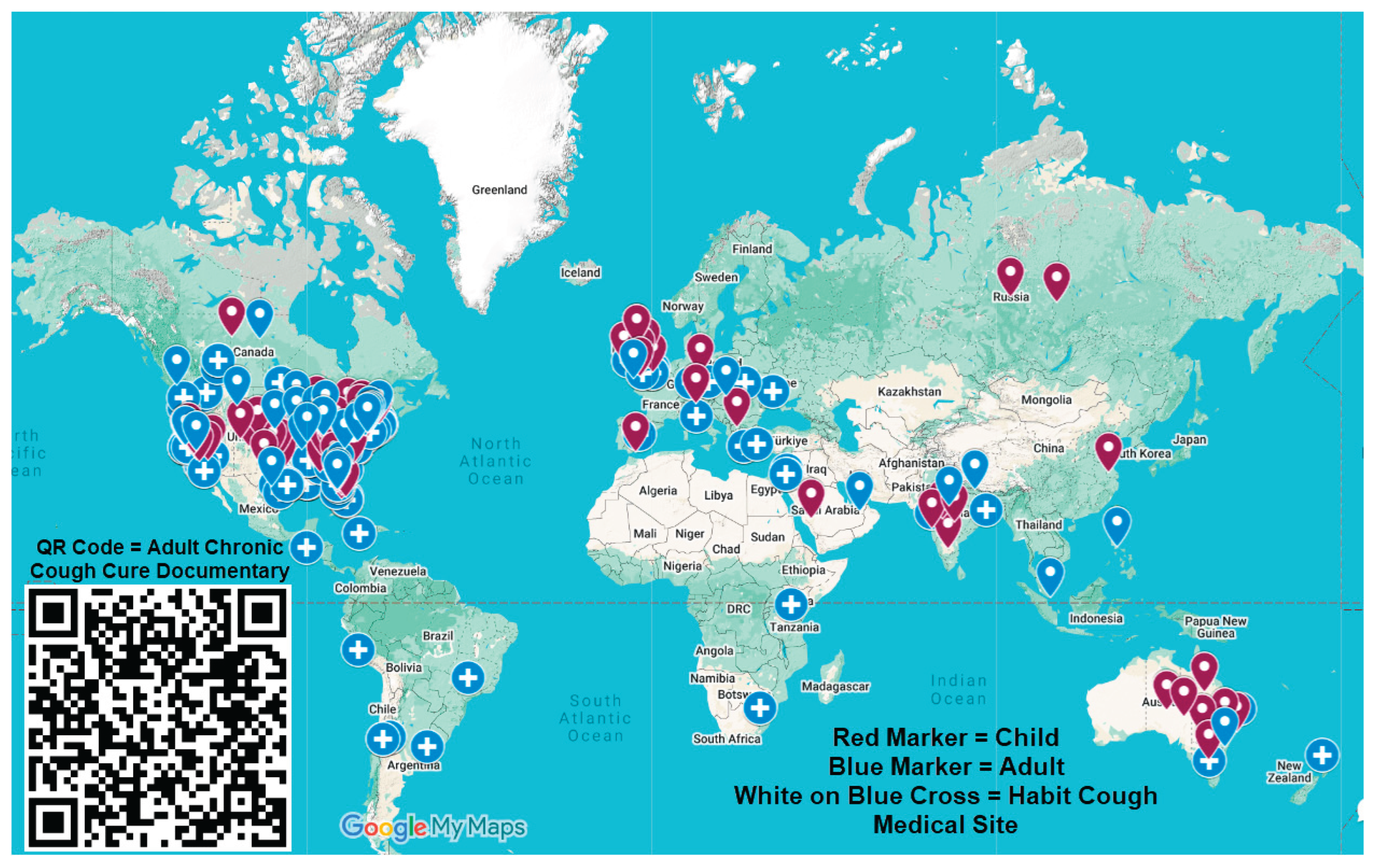
Figure 1. This map provides markers indicating those where the video https://www.youtube.com/watch?v=l6-fffL7Bh0 was viewed and contributed to the cessation of chronic cough. An interactive version of this map is at Cures! World Habit Cough Telemedicine Instant Cure Map - Google My Maps .Clicking on a marker of that interactive map provides individual clinical information.
Preprints 172785 g001
Table 1. 44 adults who self-identified cessation of chronic cough (as of 2024) after watching an online video of suggestion therapy (https://youtu.be/jnQUvD8Qdj0). r identifies those where viral respiratory infections (VRI) repeatedly resulted in many months of chronic cough with eventual spontaneous resolution and recurrence following the next VRI.
Contact date Sex Age (yr) Location Cough duration (months)
3/23/2019 F 68 Canada 72
6/9/2019 F 58 Minnesota 12
6/25/2019 M 22 Iowa 24
9/5/2019 M 27 Canada 36
12/13/2019 M 26 Nepal 60
1/15/2020 M 60 Philippines 180
7/14/2020 F 24 Singapore 9
8/4/2020 F 62 Iowa 120
9/2/2020 F 41 Florida 60
9/16/2020 M 23 Illinois 120
9/21/2020 F 41 Nebraska 60
10/17/2020 M 21 India 5
10/28/2020 F 44 California 17
10/30/2020 F 41 Ireland 20
11/4/2020 M 30 Minnesota 24
11/28/2020 M 25 Florida 4
12/1/2020 M 53 Texas 240
7/31/20201 M 42 Illinois 30
9/21/2021 F 24 Canada 168
12/2/2021 M 29 Hungary 4
12/3/2021 F 41 Florida 1
12/12/2021 F 38 New Jersy r60
5/22/2022 F 61 Maryland 180
8/7/2022 F 31 New York r120
8/29/2022 F 70 California 66
10/4/2022 M 22 Vietnam 8
3/15/2023 M 42 New Hampshire r240
4/17/2023 F 34 Michigan 17
5/25/2023 F 28 Maryland 1
9/29/2023 F 45 Indiana 36
10/22/23 M 53 Virginia r240
1/5/2024 F 58 Ohio 144
4/2/2024 M 44 New Jersey r168
5/3/2024 F 36 Indonesia r228
5/24/2024 F 70 Michigan 24
5/28/2024 F 67 Canada 40
6/13/2024 F 49 England 18
10/4/2024 M 57 St. Louis 192
10/14/2024 F 41 Utah 2
10/25/2024 F 48 Florida 3
12/27/2024 M 34 Oregon 300
1/9/2025 M 24 India 36
1/19/2025 M 34 England 48
3/32025 F 42 New York 60
Disclaimer/Publisher’s Note: The statements, opinions and data contained in all publications are solely those of the individual author(s) and contributor(s) and not of MDPI and/or the editor(s). MDPI and/or the editor(s) disclaim responsibility for any injury to people or property resulting from any ideas, methods, instructions or products referred to in the content.
Copyright: This open access article is published under a Creative Commons CC BY 4.0 license, which permit the free download, distribution, and reuse, provided that the author and preprint are cited in any reuse.
Prerpints.org logo

Preprints.org is a free preprint server supported by MDPI in Basel, Switzerland.

Subscribe

Disclaimer

Terms of Use

Privacy Policy

Privacy Settings

© 2025 MDPI (Basel, Switzerland) unless otherwise stated
