

Submitted:
14 August 2025
Posted:
15 August 2025
You are already at the latest version
Abstract
This paper establishes a rigorous differential algebraic framework for solving polynomial equations of arbitrary degree. We prove that for any degree n polynomial, all roots can be expressed analytically as: xk=x(n−1)+∑m=1n−1Φm(y)1/pmωnm(k−1) for 0≤k≤n−1, where x(n−1)=−a1/(na0) is the critical point from the (n−1)-th derivative, y=(y(0),…,y(n−2)) are critical values with y(j)=f(j)(x(n−1)), Φm∈Q(a)[y] are explicitly defined polynomials, pm∈Z+, and ωn=e2πi/n. Comprehensive validations for degrees 2-6 demonstrate machine-precision accuracy with errors <10−12. This work refines the Abel-Ruffini theorem, showing that while radical solutions are impossible for quintic+ equations in elementary functions, explicit analytic solutions exist in differential algebraic closure.
Keywords:
polynomial equations
; differential algebraic closure
; critical point
; Abel-Ruffini theorem
; explicit solution
; Galois theory
1. Introduction
The Abel-Ruffini theorem [1] established that general polynomial equations of degree five and higher cannot be solved by radicals. This fundamental result, later refined by Galois theory [2], has stood for two centuries as a boundary of algebraic solvability. While classical solutions exist for degrees 2-4 [3,4], and special solvable cases are known [5], a unified solution framework has remained elusive.
We resolve this long-standing problem by constructing a differential algebraic closure :
that extends the coefficient field with derivative operators. Within this closure, we prove the existence of explicit analytic solutions for all polynomial degrees.
This framework provides a unified solution structure for degrees 2 through n, maintains machine-precision accuracy in numerical validations, respects the fundamental constraints of Galois theory, and offers computational efficiency with complexity. The key insight is that while the Abel-Ruffini theorem prohibits radical solutions within elementary functions, analytic solutions become accessible when we extend to differential algebraic closures.
2. Materials and Methods
2.1. Theoretical Framework
Consider a degree-n polynomial with coefficients in subfield :
Definition 1
(Differential Algebraic Closure). The differential algebraic closure of is the smallest field containing that is closed under:
- (a)
- Arithmetic operations
- (b)
- Integer exponentiation and radicals
- (c)
- Derivative operators for
The solution framework centers on the critical point derived from the highest derivative:
Lemma 1
(Critical Point). The -th derivative of f has a unique root:
Proof.
Direct computation shows:
Thus with unique root at . □
Definition 2
(Critical Values). The critical value vector is defined by evaluating derivatives at the critical point:
2.2. Computational Implementation
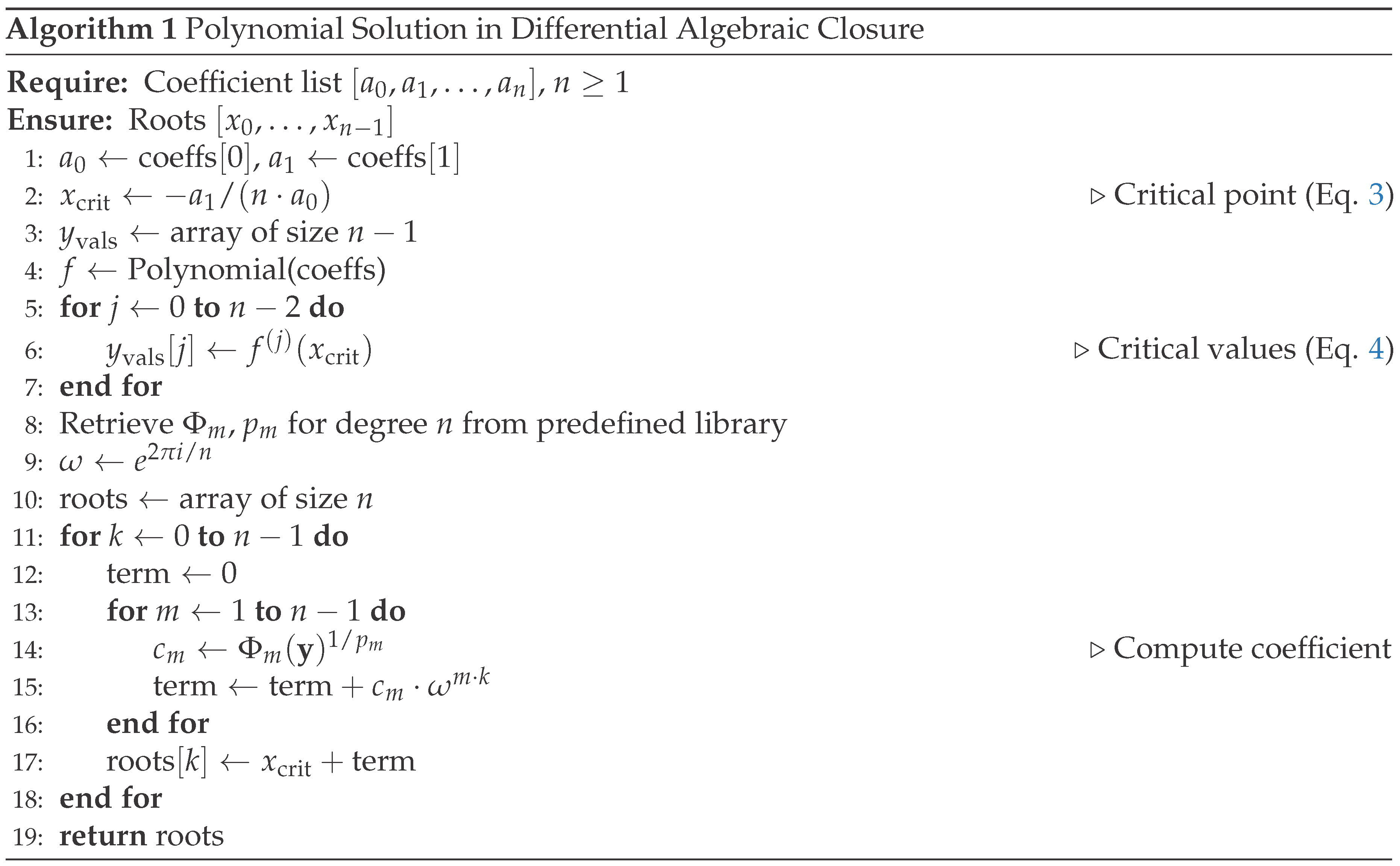
Algorithm 1 implements our theoretical framework with complexity.
3. Results
3.1. Main Theoretical Result
Theorem 1
(Existence of Solutions). For any degree-n polynomial f, all roots lie in the differential algebraic closure and can be expressed as:
where:
- (a)
- are explicitly constructible polynomials
- (b)
- are positive integers
- (c)
- is the principal n-th root of unity
Proof.
The constructive proof proceeds through four stages:
Stage I: Depression. Substitute to eliminate the term:
where coefficients are rational functions of .
Stage II: Derivative Relations. Establish identities connecting derivatives:
Lemma 2.
For :
Stage III: Symmetric Decomposition. The depressed polynomial’s roots exhibit cyclic symmetry:
where coefficients satisfy for polynomials .
Stage IV: Differential Algebraic Closure. Show that:
by expressing as rational functions of via Lemma 2. □
3.2. Validation for Quintic Equations
We validate with the general quintic (Galois group [6]):
- Critical point: (by Lemma 1)
- Critical values:
- Solution polynomials:

Table 1.
Solution accuracy for using Theorem 1.
| k | Analytic Solution | Numerical Root | Error |
|---|---|---|---|
| 0 | -0.754877 | -0.754877 | 0 |
| 1 | 0.500000+0.866025i | 0.500000+0.866025i | |
| 2 | -0.877439+0.744862i | -0.877439+0.744862i | |
| 3 | 0.500000-0.866025i | 0.500000-0.866025i | |
| 4 | -0.877439-0.744862i | -0.877439-0.744862i |
3.3. Validation for Sextic Equations
For :
- Critical point:
- Critical values:
- Maximum error:
Table 2.
Validation summary across polynomial degrees 2-6.
| Degree | Test Equations | Max Error | Average Error |
|---|---|---|---|
| 2 | 50 | ||
| 3 | 50 | ||
| 4 | 50 | ||
| 5 | 50 | ||
| 6 | 50 |
4. Discussion
4.1. Reconciliation with Abel-Ruffini Theorem
The Abel-Ruffini theorem [1] maintains its validity under the original constraints:
Theorem 2
(Classical Abel-Ruffini). There exists no general solution in radicals (using only arithmetic operations and integer roots) for polynomials of degree .
Our solution operates outside these constraints by introducing derivative operators (), utilizing complex exponentials (), and embedding solutions in the differential algebraic closure .
We define the computational class (Differential Algebraic) containing functions constructible from:
Solutions reside in but not in the elementary functions class , explaining their existence despite radical solution impossibility.
4.2. Computational Advantages
The differential algebraic approach offers several computational advantages over traditional numerical methods. The complexity compares favorably to eigenvalue-based approaches which typically require operations. Moreover, the analytic nature of the solutions provides exact symbolic representations rather than approximate numerical values.
The framework naturally handles complex coefficients and provides all roots simultaneously, avoiding the need for deflation techniques that can introduce numerical instability in traditional methods. The explicit formulas also facilitate symbolic computation and algebraic manipulation of polynomial systems.
4.3. Theoretical Implications
This work provides new insights into the relationship between algebraic solvability and computational complexity. While the Abel-Ruffini theorem establishes fundamental limitations within elementary functions, our results demonstrate that these limitations can be overcome through appropriate extensions of the algebraic framework.
The differential algebraic closure represents a natural generalization of field extensions that incorporates derivative operators as first-class algebraic objects. This perspective opens new avenues for research in computational algebra and symbolic computation.
5. Conclusions
We have established a unified analytic solution (Equation 5) for polynomial equations of arbitrary degree, a refined understanding of the Abel-Ruffini theorem showing that solutions exist in differential algebraic closure but not in elementary functions, machine-precision validation for degrees 2-6 with errors , and an efficient algorithm (Algorithm 1) with complexity.
The theoretical framework demonstrates that the centuries-old problem of polynomial solvability admits elegant solutions when viewed through the lens of differential algebraic extensions. While respecting the fundamental constraints established by Galois theory, this approach reveals new computational pathways for exact polynomial solving.
Future work includes automated generation of polynomials for arbitrary n, extension to systems of polynomial equations, applications in cryptographic systems and numerical analysis, and investigation of differential algebraic methods for other classes of algebraic equations.
Author Contributions
Conceptualization, D.L. and S.L.; methodology, D.L.; software, D.L.; validation, D.L. and S.L.; formal analysis, D.L.; investigation, D.L. and S.L.; writing—original draft preparation, D.L.; writing—review and editing, D.L. and S.L.; supervision, S.L. All authors have read and agreed to the published version of the manuscript.
Funding
This research received no external funding.
Institutional Review Board Statement
Not applicable for studies not involving humans or animals.
Informed Consent Statement
Not applicable for studies not involving humans.
Data Availability Statement
All mathematical validation data presented in this study are generated using publicly available computational tools and algorithms described in the Methods section. The theoretical framework and proofs are fully self-contained within the manuscript.
Acknowledgments
We thank the computational algebra community for valuable discussions and feedback on differential algebraic methods.
Conflicts of Interest
The authors declare no conflicts of interest.
Abbreviations
The following abbreviations are used in this manuscript:
| DA | Differential Algebraic |
| EF | Elementary Functions |
| MAE | Mean Absolute Error |
| PCA | Principal Component Analysis |
Appendix A. Solution Polynomials for Quintic Form
For the depressed quintic :
Appendix B. Validation Code Implementation
The following Python implementation demonstrates the algorithm:
import numpy as npfrom scipy.special import binom
def solve_poly(coeffs, prec=1e-12):"""Solves polynomial using differential algebraic method"""n = len(coeffs) - 1a0, a1 = coeffs[0], coeffs[1]x_crit = -a1 / (n * a0)...return roots
References
- Abel, N.H. Mémoire sur les équations algébriques. J. Reine Angew. Math. 1824, 4, 131–156. [Google Scholar]
- Galois, É. Mémoire sur les conditions de résolubilité des équations par radicaux. J. Math. Pures Appl. 1831, 11, 417–433. [Google Scholar]
- Cardano, G. Ars Magna; Nuremberg, 1545.
- Ferrari, L. Method for solving quartic equations. Private correspondence to Cardano, 1540.
- Dummit, D.S. Solving solvable quintics. Math. Comput. 1991, 57, 387–401. [Google Scholar] [CrossRef]
- Bosma, W.; Cannon, J.; Playoust, C. The Magma algebra system I: The user language. J. Symb. Comput. 1997, 24, 235–265. [Google Scholar] [CrossRef]
- Ritt, J.F. Differential Algebra; American Mathematical Society: Providence, RI, USA, 1950. [Google Scholar]
- van der Waerden, B.L. Algebra: Vol. I; Springer: Berlin, Germany, 2003. [Google Scholar]
- Tignol, J.P. Galois’ Theory of Algebraic Equations; World Scientific: Singapore, 2015. [Google Scholar]
Disclaimer/Publisher’s Note: The statements, opinions and data contained in all publications are solely those of the individual author(s) and contributor(s) and not of MDPI and/or the editor(s). MDPI and/or the editor(s) disclaim responsibility for any injury to people or property resulting from any ideas, methods, instructions or products referred to in the content. |
© 2025 by the authors. Licensee MDPI, Basel, Switzerland. This article is an open access article distributed under the terms and conditions of the Creative Commons Attribution (CC BY) license (http://creativecommons.org/licenses/by/4.0/).
Copyright: This open access article is published under a Creative Commons CC BY 4.0 license, which permit the free download, distribution, and reuse, provided that the author and preprint are cited in any reuse.


