
Submitted:
12 August 2025
Posted:
13 August 2025
You are already at the latest version
Abstract
In 2025, the U.S. is facing its largest measles outbreak in decades, driven largely by vaccine hesitancy. This article explores the scientific and theological foundations for receiving the measles, mumps, and rubella (MMR) vaccine. It presents an overview of measles epidemiology, vaccine efficacy, safety, and ethical concerns, especially among faith communities. Drawing on Scripture, doctrine, and historical theological voices, it argues that scientific truth is part of God’s revelation and that vaccination is a moral and loving act of care for others. After addressing common objections, the article encourages Christian healthcare professionals to promote vaccination as both medically wise and biblically faithful.
Keywords:
bioethics of vaccines
; measles vaccine
1. Outbreaks of Measles
In 2025, the US is experiencing the largest measles outbreak in decades, with 1309 cases, a 13% hospitalization rate, and 3 preventable deaths.[1] Only 4% of cases received the recommended 2 doses of measles, mumps, and rubella vaccine (MMR). Many cases occur in communities of faith. The purpose of this article is to review the biblical and scientific justifications for MMR.
2. God’s Truth in Scripture, Creation, and Providence Includes Scientific Truths
The speech of God, which is always truthful, results in scripture, creation, and providence. The cultural mandate in Genesis 1:26-28 directs humans to have dominion, multiply, and promote flourishing. The fields of science and medicine directly flow from it. “The God of Christian theism and the conception of his counsel as controlling all things in the universe is the only presupposition that can account for the uniformity of nature that the scientist needs.”[2] Indeed, discoveries based on such regularities are true whether they were found by Christians or atheists. Calvin wrote: “ All truth is from God; and consequently, if wicked men have said anything true and just, we ought not to reject it; for it has come from God.”[3]
3. Measles Disease
Measles virus is highly contagious even without direct contact because airborne respiratory droplets remain infectious for 2 hours.[4,5] The period of communicability begins 4 days before the onset of rash, meaning that infectious persons can spread the virus without knowing it.
Symptoms of measles include fever, cough, coryza, conjunctivitis, and rash. Complications consist of diarrhea, dehydration, pneumonia, otitis media, encephalitis, and subacute sclerosing panencephalitis, which eventually leads to progressive neurological decline, and death. About 30% of cases have complications. Before vaccination, an estimated 3-4 million cases occurred annually in the US, resulting in 500 deaths.[4]
4. Measles Vaccine
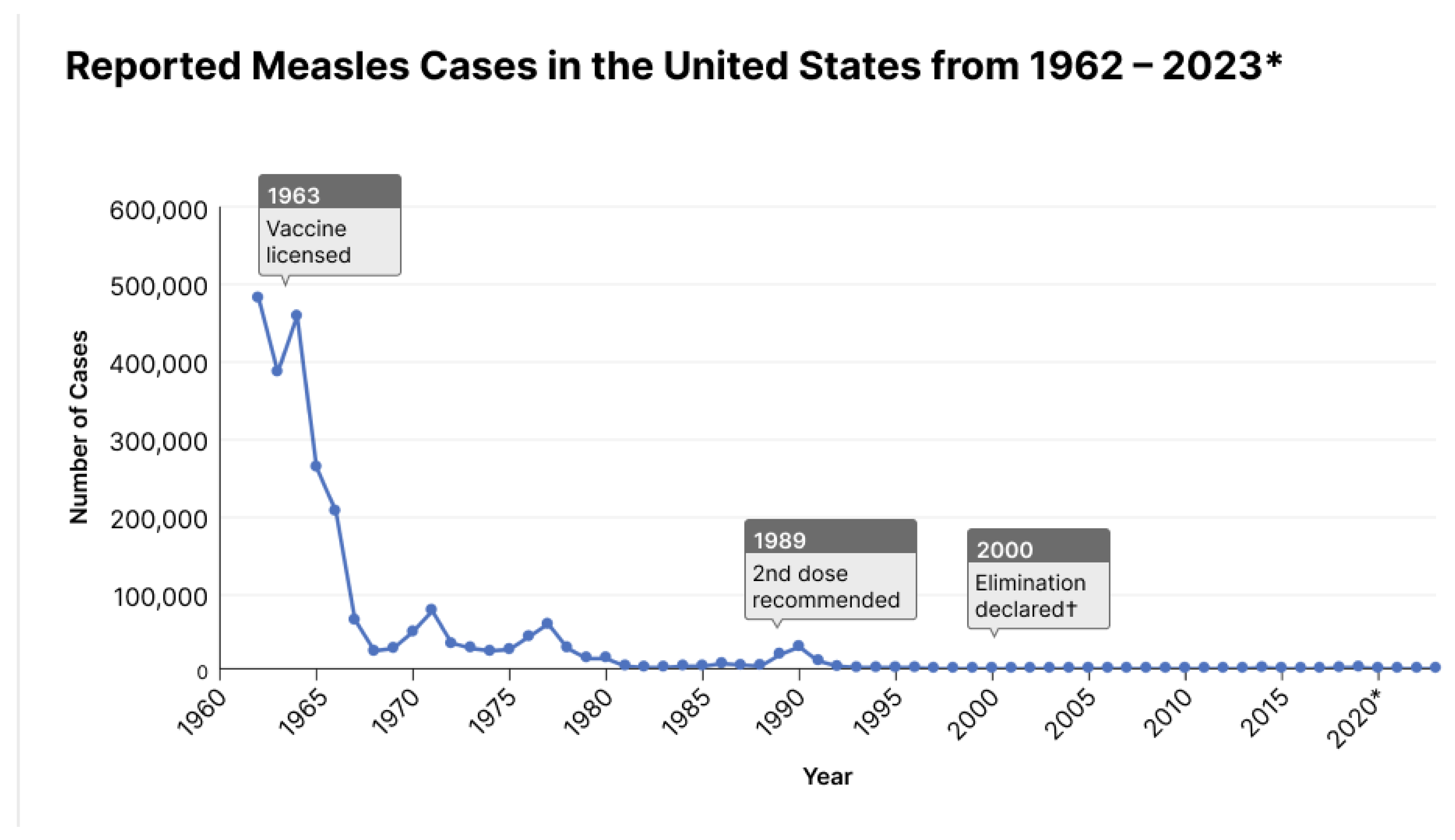
MMR is a live attenuated vaccine. After two doses of vaccine, 99% of children produce antibodies.[4] As Figure 1 shows, the dramatic decrease is due to vaccination because general sanitation measures were already available. Indeed, measles vaccine has reduced deaths by 85,000, hospitalizations by 13,172,000, and cases by 104,984,000 in the US from 1994-2023.[6]
Figure 1.
Source: Centers for Disease Control and Prevention. Measles Cases and Outbreaks. Updated July 16, 2025 (https://www.cdc.gov/measles/data-research/index.html).
Figure 1.
Source: Centers for Disease Control and Prevention. Measles Cases and Outbreaks. Updated July 16, 2025 (https://www.cdc.gov/measles/data-research/index.html).
The primary risks from MMR are rash (5%), fever (5-15%), and febrile seizures (1 in every 3,000-4,000 doses) without sequelae;[4] all of these are far less common than from wild measles disease. Injection site pain also occurs. Anaphylaxis occurs in 8-14.4 cases per million doses. Due to the rubella component of MMR, 25% of women recipients experience arthralgias, which last about 2 days.[4] Rarely, MMR causes immune thrombocytopenic purpura at about 1 case per 40,000 vaccinated children, which is typically transient.[7] Because immunocompromised persons experienced complications from live MMR, it is contraindicated in them.
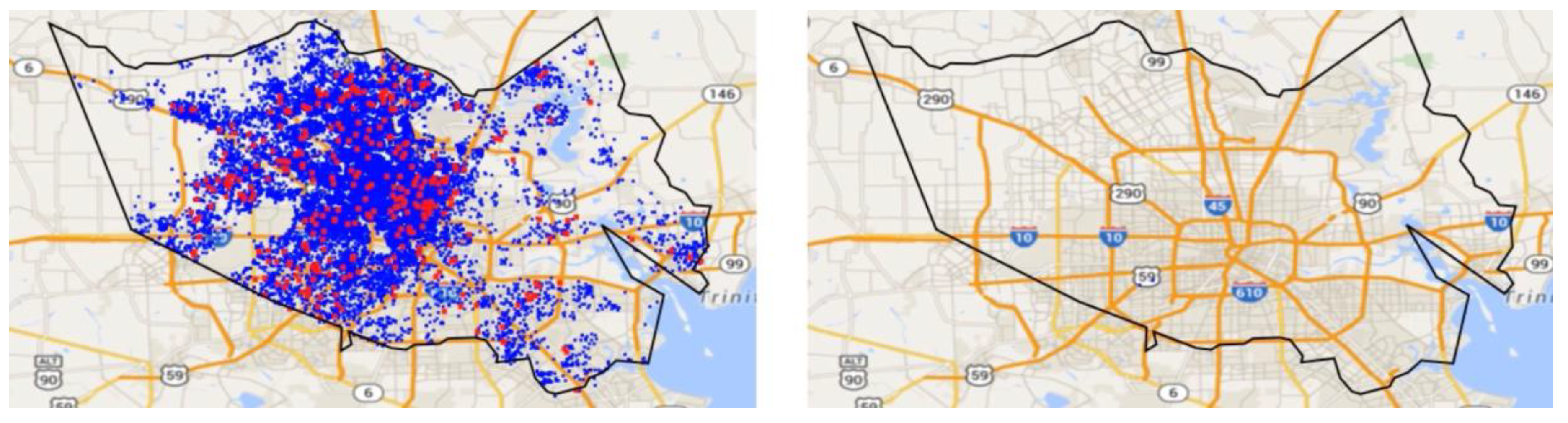
The vaccine coverage required for herd immunity is 94%. If it falls below that, outbreaks will recur. Simulations showing the impact of high vs. moderate coverage levels are in Figure 2.
5. Reasons for Vaccine Hesitancy and Counterarguments
Multiple reasons exist for vaccine hesitancy, including COVID-19 fatigue, false allegations about adverse effects, concern about moral complicity, anti-science presuppositions, confusion about God’s sovereignty and concerns about conflicts of interest. Fatigue due to COVID-19 is common due to the prolonged pandemic’s social distancing and multiple vaccine updates.
Allegations of vaccine side effects often rely on logical fallacies and previously debunked claims. For example, a false dilemma may present only two options—such as blaming a vaccine for a disability or denying the disability—ignoring other causes like genetics or accidents. Another common fallacy is post hoc ergo propter hoc, assuming that because one event follows another, the first caused the second—like believing a team won because someone wore a “lucky” shirt. Allegations about autism were thoroughly refuted by multiple studies and reviews, including the Institute of Medicine.[8,9,10] The primary article alleging this adverse effect was retracted,[11,12] and the lead investigator received large payments for litigation against a MMR manufacturer and lost his medical license.[13,14]
Some vaccines are grown in nearly perpetual cell lines that were derived from a few abortions that occurred decades ago, raising concerns about moral complicity with evil, which is defined by CMDA as “culpable association with or participation in wrongful acts.”[15] Rubella vaccine virus, a component of MMR, is grown in such a cell line. Orr’s criteria for addressing moral complicity include: (1) timing, (2) proximity, (3) certitude, (4) knowledge, and (5) intent.[16] For fetal cell lines, the timing is remote—they were developed in the 1960 and 1970s. Can one drive a German-made car from WWII without being complicit in the Holocaust? I think so. Proximity is remote: the abortionist is separated from researchers, who are separated from manufacturers, who are further separated from clinicians and patients.[17,18] No new abortions are needed to perpetuate these lines. A chemistry teacher isn’t culpable if a student later misuses their knowledge to make a bomb years later. Vaccine refusal now cannot change the past and will not affect the abortion debate. The intent of vaccine makers, clinicians, and parents is to prevent disease and reduce suffering—clearly good motives. Nonetheless, according to the CMDA statement, “Patients with decision-making capacity have the right to refuse treatment, even when such refusal would bring them harm. When a patient’s refusal of treatment threatens the lives of others, the patient’s right to refuse treatment should be subordinate to the protection of others...”[19]
Some Christians hold anti-science presuppositions. However, scientists who correctly find truth are thinking God’s thoughts after him. Indeed, many prominent scientists were believers, including Issac Newton, Lord Kelvin, and Joseph Lister. Furthermore, common grace, that is “every undeserved providential act of God’s restraint, goodness, and mercy toward the sinful inhabitants of this fallen world,”[20] is based on passages such as Genesis 9:11 and Matthew 5:45. Calvin noted “But if the Lord has been pleased to assist us by the work and ministry of the ungodly in physics, dialectics, mathematics, and other similar sciences, let us avail ourselves of it, lest, by neglecting the gifts of God spontaneously offered to us, we be justly punished for our sloth.”[3]
Some persons confuse God’s sovereignty, human responsibility, and determinism. I have been told by a patient the following: “God is sovereign; therefore, vaccination is unneeded because God will determine whether or not I am infected and the outcome if I am infected.” To resign all responsibility for contracting or transmitting measles suggests an underlying philosophy of determinism, leaving humans to dance on the strings of a grand puppet-master. It contrasts with a biblical conception of God’s sovereignty and human responsibility. Commandments would seem unnecessary if human actions are all predetermined rather than ordained. Consider David’s sinful census resulting in a choice of consequences in 1 Chronicles 21:11-12. The Westminster Confession of Faith handles this complexity well: “From all eternity and by the completely wise and holy purpose of his own will, God has freely and unchangeably ordained whatever happens. This ordainment does not mean, however, that God is the author of sin (He is not), that he represses the will of his created beings, or that he takes away the freedom or contingency of secondary causes. Rather, the will of created beings and the freedom and contingency of secondary causes are established by Him.”[21] As a counterexample, should a parent allow their precious child to walk on a dangerous highway, claiming that God is sovereign? I dare say not! This would be masquerading a deterministic or fatalistic worldview as sovereignty.
Concerns about conflict of interest (COI) are important. However, the Advisory Committee on Immunization Practices, which is chartered by Congress to advise the government on civilian immunization policy, has strict rules on COI.[22] These rules restrict employment, royalties, and other COI with vaccine manufacturers; in addition, any allowable COI has to be declared publicly, and the holder is recused from voting.
6. Scriptural Admonitions for Prevention and Caring for Others
The scriptural basis for prevention is based on (1) the cultural mandate, (2) scriptural passages promoting prevention, (3) promotion of justice, and (4) admonitions to care for one another. “In view of this, the idea that Christians should not take aspirin or participate in any sort of medical research is wrong … In the anti-medicine view: ‘We should not try to improve the human condition in this way or that, the argument goes, because to do so would be to usurp God’s prerogative.’”[23] “In the creation mandate, that is precisely what God tells Adam and Eve to do!”[23]
Prevention has a biblical basis, as shown by the need for railings when people stayed on a flat roof for the cool of night in an arid area: “When you build a new house, be sure to put a railing around the edge of the roof. Then you will not be responsible if someone falls off and is killed” (Deuteronomy 22:8, Good News Translation (GNT)). Furthermore, punishment was in order if preventive measures were not taken: ”If, however, the bull has had the habit of goring and the owner has been warned but has not kept it penned up and it kills a man or woman, the bull is to be stoned and its owner also is to be put to death.” (Exodus 21:29, NIV). Luther affirms this for infectious diseases: “I shall ask God mercifully to protect us. Then I shall fumigate, help purify the air, administer medicine, and take it… so act toward others that no one becomes unnecessarily endangered on his account and so cause another’s death”.[24] Indeed, during the polio outbreaks of the 1950s and 1960s, US churches served as vaccination centers.
The promotion of justice is biblical. The Lord loves justice (Isaiah 61:8) and commands it (Micah 6:8). A distributive justice concern is “freeriding,” which depends on herd immunity by relying on other parents to vaccinate their children without joining the effort, from a communal ethical perspective. Furthermore, freeriding fails to protect those who, due to no fault of their own, cannot be vaccinated due to a medical contraindication or whose genetics preclude response to vaccination.
The “Love one another” passages in the New Testament support caring for another, with direct attention to caring for physical needs: “…our love should not be just words … shows itself in action.” (1 John 3:18 GNT). Being vaccinated dramatically reduces the risk that one will transmit the measles virus to others. “He will reply, ‘Truly I tell you, whatever you did not do for one of the least of these, you did not do for me.’” (Matthew 25:45 NIV).
I would like to encourage my colleagues in CMDA to share these ideas with their pastors and patients. As for me and my household, we have been vaccinated and are thankful for it.
Funding
This paper did not receive any funding.
Conflicts of Interest
Via the University of Pittsburgh, Dr. Zimmerman has an investigator-initiated grant from Sanofi Pasteur on influenza vaccine.
Disclaimer
This paper represents the views of the author and not of his institution or of any funding organization.
References
- Centers for Disease Control and Prevention. Measles Cases and Outbreaks. July 16, 2025 (https://www.cdc.gov/measles/data-research/index.html).
- Van Til C, Edgar W. Christian apologetics. 2nd ed. Phillipsburg, N.J.: P&R Pub., 2003.
- Calvin J. Institutes of the Christian religion. Philadelphia,: Westminster Press, 1960.
- Centers for Disease Control and Prevention. Measles. In: Hall E. WAP, Hamborsky J., et al., eds, ed. Epidemiology and Prevention of Vaccine-Preventable Diseases. 14th ed. Washington, D.C.: Public Health Foundation; 2021.
- Bloch AB, Orenstein WA, Ewing WM, et al. Measles outbreak in a pediatric practice: airborne transmission in an office setting. Pediatrics 1985;75(4):676-83. (https://www.ncbi.nlm.nih.gov/pubmed/3982900).
- Zhou F, Jatlaoui TC, Leidner AJ, et al. Health and Economic Benefits of Routine Childhood Immunizations in the Era of the Vaccines for Children Program - United States, 1994-2023. MMWR Morb Mortal Wkly Rep 2024;73(31):682-685. [CrossRef]
- Centers for Disease Control and Prevention. Measles, Mumps, Rubella (MMR) Vaccine Safety. July 31, 2024 (https://www.cdc.gov/vaccine-safety/vaccines/mmr.html).
- Madsen KM, Hviid A, Vestergaard M, et al. A population-based study of measles, mumps, and rubella vaccination and autism. N Engl J Med 2002;347(19):1477-82. [CrossRef]
- Institute of Medicine (US) Immunization Safety Review Committee. Immunization Safety Review: Vaccines and Autism. Washington (DC): National Academy Press, 2004.
- DeStefano F, Shimabukuro TT. The MMR Vaccine and Autism. Annu Rev Virol 2019;6(1):585-600. [CrossRef]
- Wakefield AJ, Murch SH, Anthony A, et al. Ileal-lymphoid-nodular hyperplasia, non-specific colitis, and pervasive developmental disorder in children. Lancet 1998;351(9103):637-41. [CrossRef]
- Retraction--Ileal-lymphoid-nodular hyperplasia, non-specific colitis, and pervasive developmental disorder in children. Lancet 2010;375(9713):445. [CrossRef]
- Deer B. How the case against the MMR vaccine was fixed. BMJ 2011;342:c5347. [CrossRef]
- Fitness to Practise Panel General Medical Council. Determination on Serious Professional Misconduct (SPM) and sanction for Dr Andrew Jeremy Wakefield. (https://www.circare.org/autism/Wakefield_SPM_and_SANCTION_32595267.pdf).
- Christian Medical & Dental Associations. Moral Complicity with Evil. (https://cmda.org/policy-issues-home/position-statements/).
- Orr R. Addressing Issues of Moral Complicity: When? Where? Why? and Other Questions. Dignity 2003;9(2).
- Zimmerman RK. Ethical analyses of vaccines grown in human cell strains derived from abortion: arguments and Internet search. Vaccine 2004;22(31-32):4238-44. [CrossRef]
- Christian Medical & Dental Associations. Vaccines and Immunizations. (https://cmda.org/policy-issues-home/position-statements/).
- Christian Medical & Dental Associations. Healthcare Right of Conscience Statement. (https://cmda.org/policy-issues-home/position-statements/).
- Ligonier Ministries. Common Grace. (https://learn.ligonier.org/guides/common-grace).
- Westminister Confession of Fatih in Modern English. Third ed. Orlando, FL: Evangelical Presbyterian Church, 2010.
- Centers for Disease Control and Prevention. Advisory Committee on Immunization Practices Policies and Procedures. (https://www.cdc.gov/acip/downloads/Policies-Procedures-508_1.pdf).
- Watkin C. Thinking through creation : Genesis 1 and 2 as tools of cultural critique. Phillipsburg, New Jersey: P&R Publishing, 2017.
- Luther M. Whether One May Flee from the Deadly Plague. In: J.J. Pelikan HCO, and H.T. Lehmann, ed. Luther’s Works, Devotional Writings II. Philadelphia, PA: Fortress Press; 1999:119-138.
Figure 2.
Comparison in measles cases by 80% vs. 95% vaccine coverage in simulation in Harris County (Houston), Texas after 238 days with red showing infectious cases and blue recovered cases. Public Health Dynamics Laboratory, University of Pittsburgh. FRED U.S. Measles Simulator (Framework for Reconstructing Epidemiological Dynamics). (https://fred.publichealth.pitt.edu/measles). Conducted July 22, 2025.
Figure 2.
Comparison in measles cases by 80% vs. 95% vaccine coverage in simulation in Harris County (Houston), Texas after 238 days with red showing infectious cases and blue recovered cases. Public Health Dynamics Laboratory, University of Pittsburgh. FRED U.S. Measles Simulator (Framework for Reconstructing Epidemiological Dynamics). (https://fred.publichealth.pitt.edu/measles). Conducted July 22, 2025.
Disclaimer/Publisher’s Note: The statements, opinions and data contained in all publications are solely those of the individual author(s) and contributor(s) and not of MDPI and/or the editor(s). MDPI and/or the editor(s) disclaim responsibility for any injury to people or property resulting from any ideas, methods, instructions or products referred to in the content. |
© 2025 by the authors. Licensee MDPI, Basel, Switzerland. This article is an open access article distributed under the terms and conditions of the Creative Commons Attribution (CC BY) license (http://creativecommons.org/licenses/by/4.0/).
Copyright: This open access article is published under a Creative Commons CC BY 4.0 license, which permit the free download, distribution, and reuse, provided that the author and preprint are cited in any reuse.


