

Submitted:
12 August 2025
Posted:
13 August 2025
You are already at the latest version
Abstract
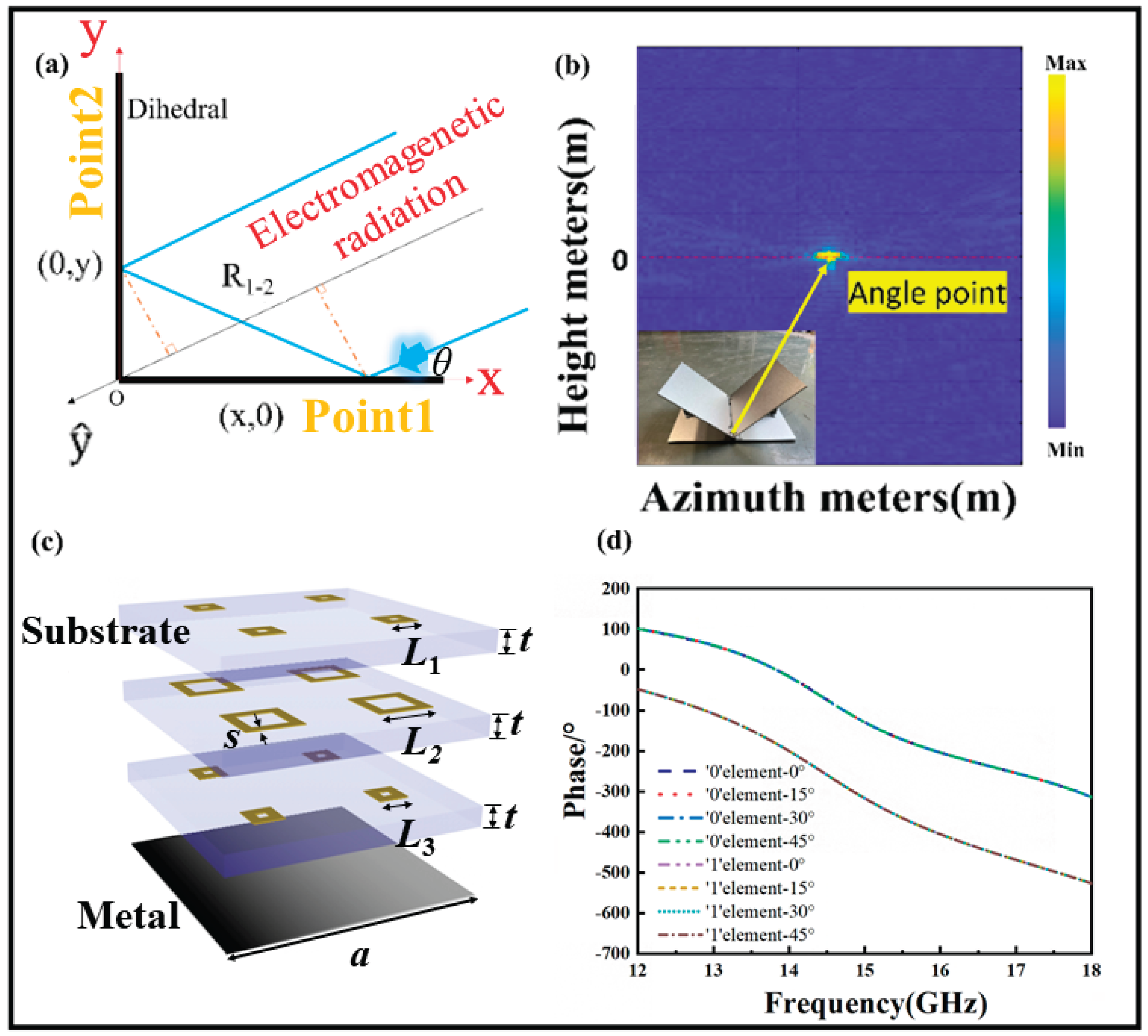
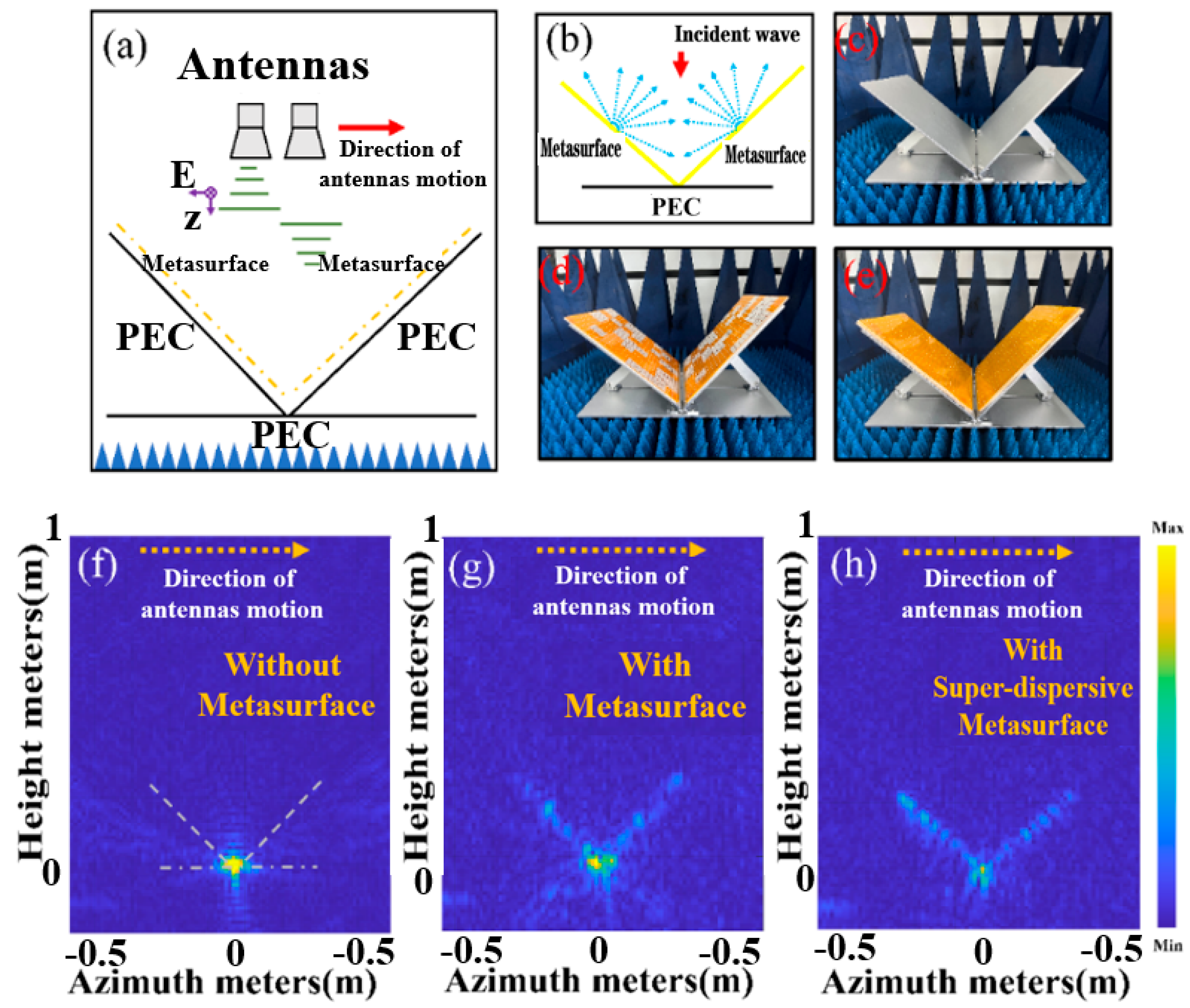
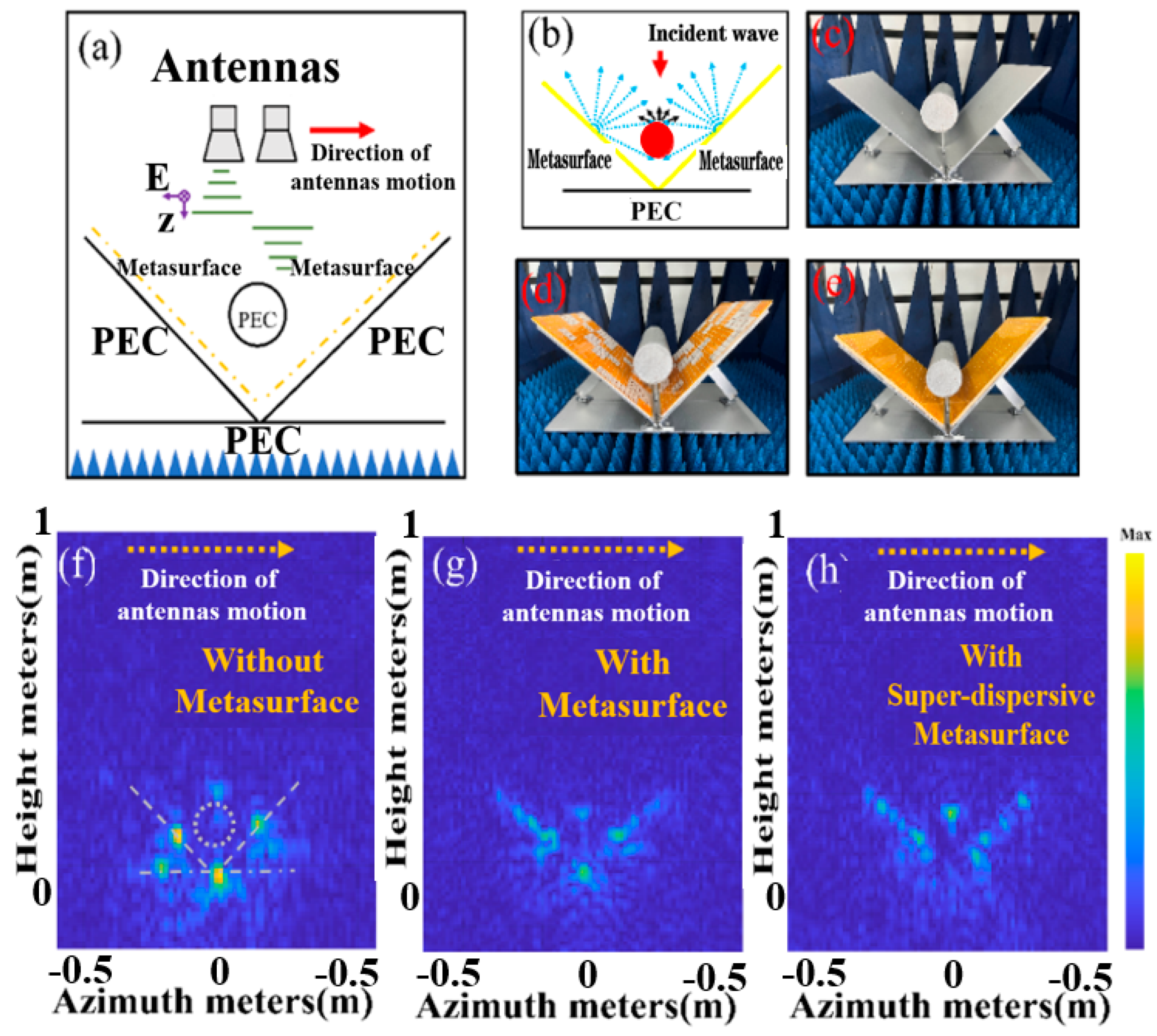
The dihedral angular structure is a key source of strong dispersion in radar images and serves as a crucial basis for radar image recognition. Modifying the scattering characteristics of the dihedral angular structure is essential for achieving stealth recognition in jamming radar systems. In this paper, we design a wideband super-dispersion coded surface (SDES) and apply it to the angular surfaces of dihedral angular structures to adjust their local scattering characteristics, enabling regional stealth camouflage. Experimental results show that the SDES effectively disperses the cumulative spectral components of dihedral angular structures, thereby modulating the radar target's scattering properties in these regions. Given that dihedral angular structures are often associated with cylindrical structures in practical applications, we also investigate the scattering characteristics of dihedral angular structures incorporating cylinders to further refine the stealth strategy. This research introduces a novel method for the stealth and camouflage of jamming target imaging radar and has the potential to be extended to other frequency bands, enabling multi-band electromagnetic wave stealth and camouflage.
Keywords:
1. Introduction
2. Demonstration of Scattering Property Change Mechanism
3. Construction of SDES
4. Experimental Validation for the Effect of the Scattering Property Changes by SDES
5. Conclusion
References
- H. Wang, W. H. Wang, W. Zhang, and Y. Zhang, "Automatic Target Recognition of SAR Images Based on a Fused Deep Learning Model," IEEE Transactions on Geoscience and Remote Sensing, 2019, vol. 57, no. 3, pp. 1730-1741.
- X. Li, Y. X. Li, Y. Shi, and S. Liu, "SAR Target Recognition via Joint Sparse Representation and Deep Learning Features," IEEE Transactions on Aerospace and Electronic Systems, 2019, vol. 55, no. 4, pp. 1884-1898.
- J. M. Jin, D. J. J. M. Jin, D. J. Riley, and D. S. Weile, "A Study of Induced Currents and Magnetic Fields in Electromagnetic Scattering Problems," IEEE Transactions on Antennas and Propagation,,2020, vol. 45, no. 8.
- R. F. Harrington and J. R. Mautz, "Field Computation by Moment Methods Applied to Electromagnetic Scattering," IEEE Transactions on Antennas and Propagation, 1971, vol. 19, no. 5, pp. 623-628.
- P. H. Pathak, N. P. H. Pathak, N. Wang, and R. J. Burkholder, "Fast Computational Techniques for the Analysis of Scattering and Radiation From Large Complex Targets," IEEE Transactions on Antennas and Propagation, 1997, vol. 45, no. 3, pp. 409-420.
- L. Tsang, J. A. L. Tsang, J. A. Kong, and R. T. Shin, "Theory of Microwave Remote Sensing Applied to Electromagnetic Scattering From Random Rough Surfaces," IEEE Transactions on Antennas and Propagation, 1982, vol. 30, no. 5, pp. 775-785.
- Freeman, A.; Durden, S.L. A three-component scattering model for polarimetric SAR data. IEEE Trans. Geosci. Remote Sens. 1998, 36, 963–973. [Google Scholar] [CrossRef]
- F. Xu and Y.-Q. Jin, "Automatic Target Recognition of SAR Images Based on the Fractal Feature," IEEE Transactions on Geoscience and Remote Sensing, 2007, vol. 45, no. 6, pp. 1746-1755.
- M. Soumekh, "Synthetic Aperture Radar Signal Processing with MATLAB Algorithms," John Wiley & Sons, 1999, pp. 352-358.
- Cloude, S.; Pottier, E. An entropy based classification scheme for land applications of polarimetric SAR. IEEE Trans. Geosci. Remote. Sens. 1997, 35, 68–78. [Google Scholar] [CrossRef]
- Y. Li, X. Y. Li, X. Zhao, and H. Chen, "Manipulation of Scattering properties for Radar Cross Section Reduction Using Metasurfaces," IEEE Transactions on Antennas and Propagation, 2017, vol. 65, no. 6, pp. 3245-3253.
- M. Chen, W. M. Chen, W. Cao, and C. R. Simovski, "Scattering Manipulation and RCS Reduction Using 3-D Printing of Dielectric Objects," IEEE Transactions on Microwave Theory and Techniques, 2018, vol. 66, no. 2, pp. 839-846.
- Q. Zhang, H. Q. Zhang, H. Zhang, and Y. Shi, "Control of Electromagnetic Scattering and Cloaking Using Tunable Metamaterials," Progress In Electromagnetics Research,,2017, vol. 160, pp. 183-196.
- Alù, A.; Engheta, N. Achieving transparency with plasmonic and metamaterial coatings. Phys. Rev. E 2005, 72, 016623. [Google Scholar] [CrossRef] [PubMed]
- Y. Li, X. Y. Li, X. Zhao, and H. Chen, "Manipulation of Scattering properties for Radar Cross Section Reduction Using Metasurfaces," IEEE Transactions on Antennas and Propagation, 2017, vol. 65, no. 6, pp. 3245-3253.
- W. Ma, P. W. Ma, P. Wang, and L. Wang, "Broadband Absorbing Metamaterials to Control the Scattering of Electromagnetic Waves," Advanced Optical Materials, 2017, vol. 5, no. 17, pp. 1700761.
- F. Costa, S. F. Costa, S. Genovesi, and A. Monorchio, "A Frequency Selective Radome with Polarization Diversity for Radar Cross Section Reduction," IEEE Transactions on Antennas and Propagation, 2012, vol. 60, no. 6, pp. 2740-2747.
- X. Shang, C. X. Shang, C. Chan, and K. F. Man, "Absorptive Frequency Selective Surface for Broadband Radar Cross-Section Reduction," IEEE Antennas and Wireless Propagation Letters, 2012, vol. 11, pp. 1394. [Google Scholar]
- Wqrner, D.; Ganguly, S. An overview of fractal antenna engineering research. IEEE Antennas Propag. Mag. 2003, 45, 38–57. [Google Scholar] [CrossRef]
- N. Landy, S. N. Landy, S. Sajuyigbe, J. Mock, D. Smith, and W. Padilla, "Perfect Metamaterial Absorber," Physical Review Letters, 2008, vol. 100, no. 20, pp. 207402.
- Cui, T.J.; Qi, M.Q.; Wan, X.; Zhao, J.; Cheng, Q. Coding metamaterials, digital metamaterials and programmable metamaterials. Light. Sci. Appl. 2014, 3, e218–e218. [Google Scholar] [CrossRef]
- G. D. Giovampaola and N. Engheta, "Digital metamaterials," Nat. Mater., 2014, vol. 13, no. 12, pp. 1115–1121.
- Jing, H.B.; Ma, Q.; Bai, G.D.; Cui, T.J. Anomalously Perfect Reflections Based on 3-Bit Coding Metasurfaces. Adv. Opt. Mater. 2019, 7. [Google Scholar] [CrossRef]
- L. Zhang, C. L. Zhang, C. Huang, J. Yang, K. P. Esselle, S. Xu, and Y. J. Guo, "Broadband Metasurface for High-Efficiency Diffuse Scattering and Multibeam Reflections," IEEE Transactions on Antennas and Propagation, 2020, vol. 68, no. 4, pp. 2980-2987.
- Cui, T.-J.; Liu, S.; Li, L.-L. Information entropy of coding metasurface. Light. Sci. Appl. 2016, 5, e16172–e16172. [Google Scholar] [CrossRef] [PubMed]
- Y. Yang, C. Y. Yang, C. Huang, B. Zheng, and S. Xu, "Coding Metasurface for Controlling Diffuse Scattering in Electromagnetic Waves," IEEE Antennas and Wireless Propagation Letters, 2019, vol. 18, no. 7, pp. 1469-1473.
- H. Li, W. H. Li, W. Tang, and T. J. Cui, "Multifunctional Diffuse Scattering Metasurface With Optical Transparency," Advanced Optical Materials, 2019, vol. 7, no. 1, pp. 1800679.
- Q. Ma, Z. Q. Ma, Z. Wang, and J. Geng, "Metasurface-Based Diffuse Scattering for Suppressing Radar Cross Section," Applied Physics Letters, 2019, vol. 115, no. 10, pp. 103502.
- L. Zhang, Q. L. Zhang, Q. Wen, Y. Zhang, and W. Liu, "Design and Optimization of Coding Metasurfaces for Diffuse Scattering Applications," IEEE Transactions on Antennas and Propagation, 2019, vol. 67, no. 4, pp. 2766-2774.
- X. Liu, H. X. Liu, H. Li, T. J. Cui, and Y. Liu, "Optimized Coding Metasurface for Efficient Diffuse Scattering Control," IEEE Antennas and Wireless Propagation Letters, 2018, vol. 17, no. 11, pp. 1976-1980.
- Y. Li, R. Y. Li, R. Cui, and W. Xu, "Coding Unit Design for Metasurfaces: Optimizing Scattering Patterns via Genetic Algorithms," IEEE Access, 2019, vol. 7, pp. 180562-180570.
- Liu, S.; Cui, T.J.; Zhang, L.; Xu, Q.; Wang, Q.; Wan, X.; Gu, J.Q.; Tang, W.X.; Qi, M.Q.; Han, J.G.; et al. Convolution Operations on Coding Metasurface to Reach Flexible and Continuous Controls of Terahertz Beams. Adv. Sci. 2016, 3. [Google Scholar] [CrossRef] [PubMed]
- Sun, Y.; Cao, X.; Yuan, H.; Sun, W.; Yuan, X.; Ding, F.; Chen, M. Symbiotic Electromagnetic Shadow for Regional Invisibility and Camouflage. ACS Appl. Mater. Interfaces 2024, 16, 35716–35722. [Google Scholar] [CrossRef] [PubMed]
Disclaimer/Publisher’s Note: The statements, opinions and data contained in all publications are solely those of the individual author(s) and contributor(s) and not of MDPI and/or the editor(s). MDPI and/or the editor(s) disclaim responsibility for any injury to people or property resulting from any ideas, methods, instructions or products referred to in the content. |
© 2025 by the authors. Licensee MDPI, Basel, Switzerland. This article is an open access article distributed under the terms and conditions of the Creative Commons Attribution (CC BY) license (http://creativecommons.org/licenses/by/4.0/).