

Submitted:
11 August 2025
Posted:
15 August 2025
You are already at the latest version
Abstract
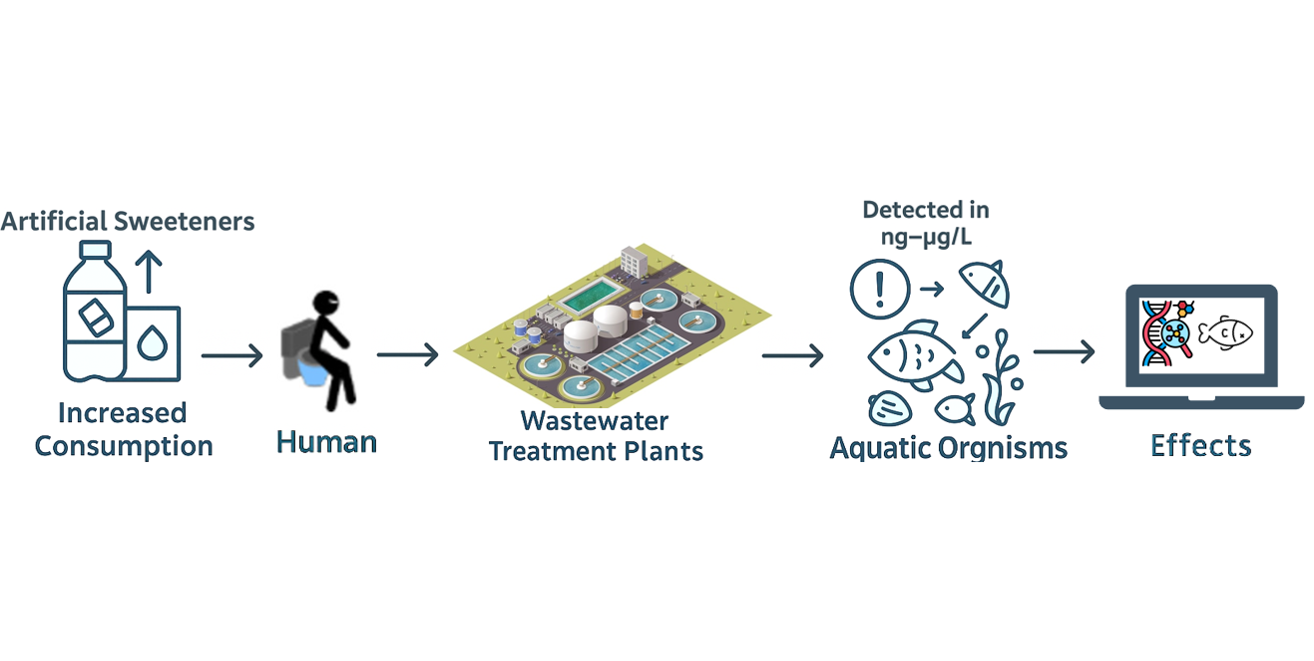
The growing consumption of synthetically manufactured sugar substitutes, coupled with the lack of adequate national and international regulations, has led to the presence of various compounds, in different environmental matrices. Within this group, artificial sweeteners, despite their prevalence in mass consumption products, are one of the least studied pollutants. The high consumption of artificial sweeteners, together with the low efficiency of wastewater treatment plants, facilitates their detection in various aquatic ecosystems at concentrations ranging from ng to µg L-1. These concentrations have shown to generate adverse effects on the organisms that inhabit these aquatic ecosystems. The main objective of this review is to provide updated information on the global consumption of sweeteners, reported concentrations in various environmental matrices, and, in particular, the effects of exposure to these compounds on aquatic organisms.
Keywords:
artificial sweeteners
; aquatic ecosystems
; river
; marine ecosystems
; waste waters
1. Introduction
High-intensity artificial sweeteners, synthetically manufactured sugar substitutes, were introduced to the market in 1983 [1] and their production and consumption have continued to increase. The most widely used sweeteners worldwide are acesulfame-k, aspartame, cyclamate, neotame, saccharin, and sucralose, which are mainly used in beverages and foods, contributing minimal or no calories [2]. Their use is aimed at reducing calorie intake in people with diabetes, athletes, and those seeking to control their weight [3,4,5]. These compounds, which have been introduced into the environment for several years, have acquired the status of emerging contaminants as their detection in the environment has only been possible thanks to advances in highly sensitive analytical techniques [6,7]
These compounds, like other emerging contaminants, are approved for use worldwide. Despite being recognized as safe for human consumption within the recommended average acceptable daily intake (ADI), concerns have grown about their persistence in aquatic systems and their potential chronic effects in non-target organisms and, as an example, cyclamate is restricted in certain countries, such as the United States and Japan [8]. Although there are regulatory agencies around the world, such as the European Food Safety Authority (EFSA), the US Food and Drug Administration (FDA), and the National Institute for Food and Drug Surveillance (INVIMA) in Colombia, the great use of such compounds lies in the excessive consumption of the population, which has increased over time, driven by factors such as disease, trends, and social stereotypes. As an example, global consumption in 2017 was estimated at approximately 159,000 metric tons, with the highest levels of consumption reported in Asia, Oceania, and the United States [9]
The high consumption of artificial sweeteners, coupled with their low absorption rate in the human body, favors their release into wastewater [9]. Due to the limited efficiency of conventional treatment systems, these compounds are not completely eliminated and are consequently discharged into different environmental matrices in concentrations ranging from ng to µg L⁻¹ [10]. While some sweeteners such as aspartame degrade relatively quickly [11] others, such as sucralose and acesulfame-K, resiste purification processes and remain in aquatic ecosystems resulting in a high persistence [12,13].
The presence of these compounds in aquatic ecosystems could pose a risk to the organisms that inhabit them. Although there are several studies that demonstrate the effects of exposure to these compounds, most focus on acute effects at high concentrations (mg L-1) [14,15], which probably do not reflect their real effects on the environment. As a result, sublethal effects originating from molecular alterations derived from chronic exposure to environmentally relevant concentrations are often unnoticed.
The main objective of this review is to provide updated information on the global consumption of sweeteners, reported concentrations in various environmental matrices and, in particular, the effects of exposure to these compounds on aquatic organisms reported to date.
2. Bibliographic Search
The literature search was conducted using online scientific databases such as Google Scholar, PubMed, Scopus, and ScienceDirect, using keywords such as artificial sweeteners, aquatic ecosystems, river, marine ecosystems, and waste waters. Publications between 1985 and 2025 were considered; however, only 7 articles prior to 2010 were selected, with the aim of contextualizing the historical evolution of the study of these compounds. Most of the works analyzed correspond to the period 2015–2025 and were included according to the following criteria: (I) evaluation of the use and consumption of artificial sweeteners in different countries; (II) analysis of the routes of entry of these compounds into the environment; (III) identification of limitations in wastewater treatment plants; (IV) reports of concentrations in aquatic ecosystems; and (V) use of aquatic organisms in exposure tests. In total, 85 articles were selected that met at least one of these criteria.
3. Use and Consumption
Artificial sweeteners are commonly used in a wide variety of food and beverage products, such as sugar-free foodstuff, nutritional and energy drinks, carbonated beverages, and artificial juices. In addition, these compounds are used in personal care products, such as toothpaste and mouthwashes. Among the most widely consumed sweeteners are acesulfame K (ACE-K), aspartame (ASP), cyclamate (CYC), neotame (NEO), saccharin (SAC), and sucralose (SUC).
Global consumption of artificial sweeteners has increased significantly over the years, reaching 159,000 metric tons in 2017, with an estimated market value of $2 billion [9]. In 2017, China led global consumption, accounting for 32% of the total, followed by Asia and Oceania, which together represent 23%, the United States with 23%, Europe with 12%, and Africa with 7% [16]. This geographical landscape reflects an uneven distribution of consumption, influenced by factors such as the availability of these products, local regulations, and cultural preferences regarding food and health.
More recently, in 2021, global sweetener market revenue reached approximately $21.3 bil-lion and is estimated to increase to $28.9 billion by 2026 [17], high-lighting the growing interest and expansion of their use in various industries. This is mainly attributed to the demand for low-calorie products created through effective marketing campaigns, the growing acceptance of sweeteners as a health-beneficial option, and technological innovations in the production of next-generation sweeteners.
ASP was the global market leader in 2017, with an estimated consumption of 18.5 thousand metric tons, followed by saccharin with 9.7 thousand metric tons, ACE-K with 6.8 thousand metric tons, and sucralose with 3.3 thousand metric tons [9]. The consumption of these compounds varies considerably between different countries, reflecting both consumer preferences and local regulations in each region. For example, SUC was approved for human consumption in the United States in 1998 and has since then authorized in more than 80 countries with a global growth rate of approximately 5.1% per year from 2008 to 2015 [18]. In 2004, sales of SUC in the United States exceeded $172 million [19], and in 2014, its consumption reached 1,500 tons per year in the United States, 400 tons in Europe, and 1,090 tons in China [20], reflecting its remarkable acceptance in the global market.
SAC, which has also been approved by various regulatory agencies around the world is consumed in more than 90 countries, establishing itself as one of the most widely used sweeteners globally [21]. On the other hand, Bahndorf and Kienle (2004) reported in 2001 that global consumption of ACE-K was 2,500 tons, with America leading consumption at 47%, followed by Europe at 34%, and Asia at only 15%, while Africa and Oceania accounted for just 4% [22]. In the United States, in 2008, 1,103 and 974 products containing ACE-K and ASP, respectively, were reported [23]. In contrast, in countries such as Switzerland and Germany, CYC is the most widely consumed artificial sweetener [24]. On the other hand, China is the leading consumer and producer of artificial sweeteners in Asia, with ACE-K and SUC standing out as the market leaders [25]. In Korea, ASP and SAC production reached 838 and 348 tons in 2011, respectively, with per capita consumption of 8.38 mg/day and 17.4 mg/day for ASP and SAC, respectively [26].
Finally, it is estimated that global consumption of these compounds will continue to grow [27], reflecting the continued expansion and growing demand for these products worldwide.
4. Sources of Artificial Sweeteners in Aquatic Ecosystems
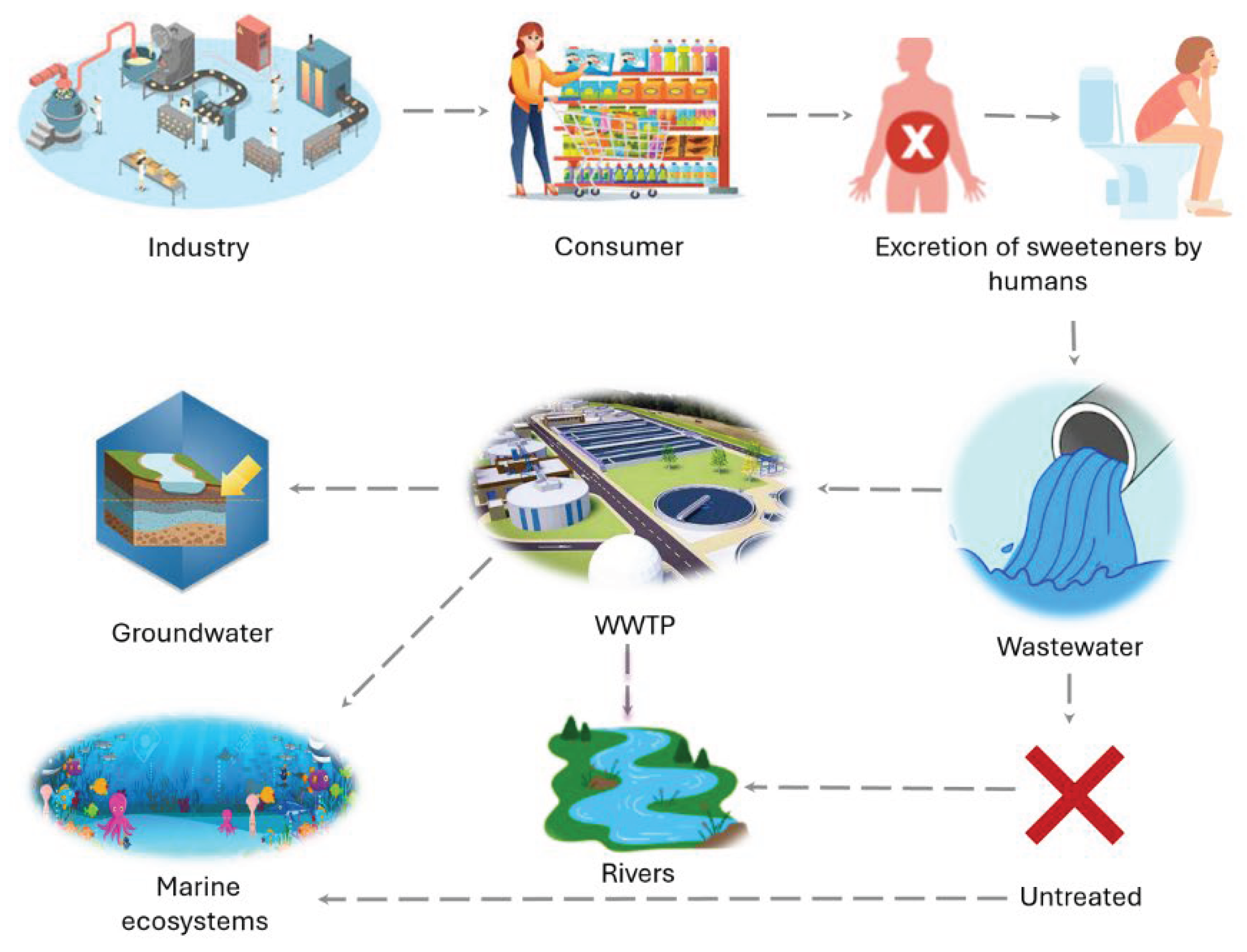
The environmental cycle of sweeteners begins with their industrial production and extends to their arrival in aquatic ecosystems, as shown in Figure 1. These compounds are incorporated into a wide variety of food products, beverages and personal care products. Once consumed, sweeteners are not completely metabolized by humans [28,29], leading to their excretion through urine and feces (Figure 1). The resulting waste enters the sewer system and can be discharged directly into surface waters or aquatic ecosystems or after being treated in wastewater treatment plants (WWTPs).
The most commonly used conventional treatments in WWTPs worldwide include activated sludge, anaerobic digestion, and sequencing batch reactors [7]. However, there are more advanced alternatives, such as membrane bioreactors, bioelectrochemical systems, and constructed wetlands, which offer more effective solutions for the removal of these compounds [7].
Other alternatives, such as the use of UV light in combination with periodate for the removal of NEO, electro-Fenton processes for the removal of SUC, and upflow anaerobic sludge blanket (UASB) reactors for the degradation of CYC, have been shown to achieve removal rates of up to 97% [30,31], 96.1% [32], and 99.6%, respectively [33].
These advances underscore the importance of incorporating innovative technologies into WWTPs to remove artificial sweeteners and other emerging contaminants from waste waters before their reintroduction into surface and marine environments. Research on anaerobic reactors, electro-Fenton processes, and UV-based methods has not only shown high removal efficiencies but has also provided valuable insights into the kinetics and toxicity of these processes, facilitating their optimization.
5. Concentrations of Sweeteners in Environmental Matrices
The reported concentrations of artificial sweeteners in various environmental matrices range from ng to µg L-1 [34]. Analysis reveals interesting patterns that suggest variations depending on the type of matrix and the efficiency of wastewater treatment. Globally, the highest concentrations of artificial sweeteners have been found in wastewater, followed by surface water and, finally, seawater [13], while their detection in marine environments has been limited. Only a few studies have documented their presence in seawater, with concentrations ranging from 5.23 ng L⁻¹ to 50.2 μg L-1 [35].

Table 1.
Concentrations of artificial sweeteners in different countries and aquatic environments.
| Sweeteners | Country | Aquatic environmental | Concentrations (μg L-1) | References |
|---|---|---|---|---|
| Cyclamate | Germany | WWTP influent | 190 | [36] |
| WWTP influent | 250 | [37] | ||
| Korea | Groundwater | 0.155 | [38] | |
| Surface water | 120 | [39] | ||
| Canada | Groundwater | 0.003 | [40] | |
| Spain | WWTP influent | 26.7–78.3 | [41] | |
| Coastal waters | 0.01–0.08 | |||
| WWTP effluent | 0.03–0.06 | |||
| Surface water | 0.08 | [42] | ||
| WWTP effluent | 19.2 | |||
| Neotame | China | WWTP influent | 0.03 | [43] |
| WWTP effluent | 0.03 | [43] | ||
| WWTP effluent | 10 | [12] | ||
| Surface water | 9.3 | [12] | ||
| Drinking water | 6.94 | [44] | ||
| Aspartame | Vietnam | WWTP effluent | 3.1 | [45] |
| China | Surface water | 0.21 | [39] | |
| River sediments | 0.3 | [43] | ||
| Spain | WWTP influent | 0.07 | [41] | |
| WWTP effluent | 0.09 | [41] | ||
| Switzerland | WWTP effluent | 0.01 | [42] | |
| USA | WWTP effluent | 0.1 | [9] | |
| WWTP influent | 0.1 | |||
| WWTP influent | 1.6 | [26] | ||
| WWTP effluent | 1.8 | |||
| WWTP influent | 0.13 | [33] | ||
| Saccharin | Germany | WWTP influent | 40 | [36] |
| Australia | WWTP effluent | 7.1 | [46] | |
| China | Coastal waters | 0.21 | [47] | |
| WWTP effluent | 0.42 | [39] | ||
| Seawater | 50.2 | [33] | ||
| Spain | WWTP effluent | 9.1 | [48] | |
| WWTP influent | 18.4 | |||
| Seawater | 0.00523 | [35] | ||
| India | WWTP influent | 303.0 | [26] | |
| USA | WWTP effluent | 15.1 | [26] | |
| WWTP influent | 1.4 | [26] | ||
| Vietnam | Surface water | 1.3 | [45] | |
| Table 1. Cont | ||||
| Switzerland | WWTP effluent | 16.2 | [42] | |
| Acesulfame | Australia | Groundwater | 0.34 | [49] |
| Germany | Groundwater | 34 | [50] | |
| WWTP influent | 22.9 | [51] | ||
| WWTP influent | 40 | [36] | ||
| Brazil | WWTP effluent | 13 | [33] | |
| Canada | Surface water | 0.227 | [52] | |
| Groundwater | 0.653 | [51] | ||
| Korea | Groundwater | 0.0329 | [38] | |
| China | Surface water | 2.78 | [53] | |
| Surface water | 2.9 | [51] | ||
| Spain | WWTP effluent | 155 | [42] | |
| Italy | WWTP effluent | 2,500 | [13] | |
| Norway | Surface water | 25 | [54] | |
| Nigeria | WWTP effluent | 16 | [55] | |
| Czech Republic | WWTP influent | 22.67 | [56] | |
| Switzerland | Groundwater | 0.524 | [57] | |
| Groundwater | 4.7 | [24] | ||
| Singapore | WWTP effluent | 29.9 | [51] | |
| 135.76 | [58] | |||
| 10.51 | [59] | |||
| USA | WWTP effluent | 50 | [60] | |
| Sucralose | Norway | Surface water | 8 | [61] |
| Sweden | Surface water | 3.5 | [61] | |
| Korea | WWTP influent | 1.5 | [62] | |
| Brazil | WWTP influent | 31 | [33] | |
| China | WWTP effluent | 1.9 | [46] | |
| China | WWTP effluent | 1.5 | [43] | |
| WWTP influent | 1.0 | [43] | ||
| Spain | WWTP influent | 5.3 | [48] | |
| WWTP effluent | 18.1 | |||
| Italy | River | 0.344 | [61] | |
| Switzerland | WWTP effluent | 4.5 | [63] | |
| WWTP influent | 4.5 | [24] | ||
| USA | Surface water | 1.8 | [62] | |
| Drinking water | 2.4 | [64] | ||
| WWTP effluent | 650 | [26] | ||
| 30 | [63] | |||
| 1.8 | [47] | |||
| Table 1. Cont | ||||
| 0.9 | [65] | |||
| WWTP influent | 1 | [60] | ||
| 1.9 | [64] | |||
| 27.7 | [26] | |||
Among the sweeteners reported here, SUC and ACE-K stand out for having the highest concentrations in the aquatic environment [65] due to their widespread use and high persistence [66]. For example, ACE-K reaches levels of up to 2,500 μg L-1 in wastewater effluents in Italy [13]. On the other hand, SUC, although detected in WWTP effluents at lower concentrations of around 10.8 μg L-1 [66], shows significant persistence in water bodies such as rivers and lakes, with values of up to 9.6 μg L-1 [12]. In contrast, NEO has concentrations in the order of 0.03 μg L-1 in wastewater influents and effluents in China [43] suggesting greater efficiency in its removal or lower use globally.
In the case of CYC, marked differences are observed between matrices. While in WWTP influents values can reach up to 250 μg L-1 [37], in groundwater the levels are considerably lower, with only 0.003 μg L-1 [40], reflecting the lower mobility of this compound to deeper layers or its greater degradation in certain environments. In contrast, ASP has higher concentrations, with 3.1 μg L-1 in Vietnam [45], followed by 1.8 μg L-1 in the US [26]. It is important to note that although aspartame is one of the most widely consumed artificial sweeteners worldwide, its presence in aquatic ecosystems tends to be limited, probably due to its low environmental persistence. On the other hand, saccharin has been found in remarkably high concentrations, such as 303 μg L-1 in WWTP influents in India [26] or 50.2 μg L-1 in seawater in China [33].
Finally, it is essential to understand that the presence of these compounds in aquatic matrices is influenced by the amount consumed, the type of treatment used in wastewater treatment plants, and the chemical persistence of each sweetener in the receiving environment. While conventional waste water-treatments may be more effective at removing certain compounds such as CYC, others such as SUC and ACE-K seem to resist degradation processes and remain in the environment. As a result, aquatic ecosystems can act as long-term reservoirs for these emerging pollutants, posing a potential risk to aquatic organisms.
6. Effects
Whilst there is substantial evidence of the adverse effects of artificial sweeteners on freshwater organisms, covering a wide range of biological responses, research in marine environments is still limited and fragmented. Despite detection of these compounds in seawater, especially in coastal areas, little is known about their impact on marine species. This gap highlights an urgent need for targeted studies to understand their potential eco-logical risks in saltwater ecosystems.
Several studies have shown that sweeteners can induce measurable biological responses even at extremely low concentrations, similar to those detected in aquatic environments [67]. These alterations range from sublethal responses, such as changes in physiological and behavioral biomarker activity, to lethal effects in acute toxicity tests, indicating a potentially significant ecotoxicological impact [68,69].
A notable observation is that compounds such as SUC and ACE-K had the highest number of studies and a wide range of effects, concentration levels as low as ng L-1 [67]. This highlights their potential to indice long term cumulative sublethal effects if they persist in the environment. In contrast, SAC and CYC showed a smaller range of studied effects, with less diversity in the parameters evaluated, although this does not necessarily imply lower toxicity, but rather indicate a lack of knowledge and further research needs into the potential effects of these compound in natural environment.
Among the most relevant effects are alterations in physiology (oxidative stress, apoptosis, DNA damage) [70] in the nervous system (alteration of acetylcholinesterase activity, hyperlocomotion, loss of coordination [67,71], as well as in behavior (increased anxiety, decreased learning and memory capacity) [72], and vital functions such as reproduction, feeding, and swimming [67,73]. These effects, although in some cases non-lethal, can compromise the viability of populations and affect the ecological stability of aquatic ecosystems.
It should be noted that chronic tests offer a more complete view of environmental toxicity, revealing cumulative and long-term effects that acute tests do not always detect. Long term monitorisation of biomarkers such as lipid peroxidation (LPX), superoxide dismutase (SOD), hydroperoxide content (HPC), protein carbonyl (PCC), sirtuin 1 (SIRT1), and acetylcholinesterase (AChE) allow us to infer the activation of antioxidant defense mechanisms, which could indicate a situation of sustained cellular stress, with the potential to trigger adverse effects on higher organizational levels such as the development, reproduction, and survival of organisms [67,71,74,75].
Freshwater fishes, such as Danio rerio and Cyprinus carpio, have demonstrated their utility for identifying behavioral and molecular alterations [72], while invertebrates, such as Daphnia magna and Nitocra spinipes, are suitable for assessing effects on reproduction, feeding, mobility, and acute or chronic toxicity parameters [69,73]. In combination, this diversity of organisms allowes for a more robust assessment of the potential impact of sweeteners at different trophic levels.
Despite the relevance of these findings, there is a significant shortage of studies applying mass molecular analysis techniques, such as proteomic, transcriptomic, and genomic approaches. This gap limits deep understanding of the molecular mechanisms by which sweeteners affect aquatic organisms and restricts the development of predictive models of toxicity at the cellular and physiological levels. Furthermore, most experimental studies have focused on evaluating a single sweetener at a time, without considering the possible synergistic, additive, or antagonistic effects that could arise from combined exposures. This limitation represents a significant gap in knowledge, given that these compounds frequently coexist in complex mixtures in the environment.
Finally, it is important to note that, unlike other emerging pollutants such as antibiotics, many sweeteners do not exhibit obvious acute toxicity in the environment [7]. However, their sublethal and chronic effects, especially on sensitive organisms, highlight the need to reassess their permissible limits in aquatic environments. Furthermore, their widespread presence in WWTP effluents and their persistence suggests that their efficient removal in treatment plants still represents a technical and environmental challenge to be addressed.
Table 2.
Main reported effects of artificial sweeteners on aquatic organisms.
| Sweeteners | Organisms | Concentration µg L-1 |
Assay | Effects | References |
|---|---|---|---|---|---|
| Ace-K | Danio rerio | 50 | Biomarker assay | Increased HPC and LPX activity | [16] |
| 10,000 | Light/dark preference test (LDP) | Increased anxiety | [72] | ||
| 10,000 | Test NTDT | Increased anxiety | [72] | ||
| 10,000 | CPP behavioral testing | Impaired learning and memory capacity | [72] | ||
| >1,000,000 | Acute toxicity test LC50 - 96h | Mortality | [51] | ||
| 24 | Toxicity test IC50 -24h | Effects on swimming and feeding | [67] | ||
| Cyprinus carpio | 0.05 | Biomarker assay | Increased HPC and SOD activity |
[76] | |
| Carassius auratus | 100 | Biomarker Assay | Increased SOD activity | [75] | |
| Daphnia magna | 100 | In vivo cardiac toxicity assay | Increased cardiac | [77] | |
| 24 | Toxicity test IC5O-24h | Swimming impairment | [67] | ||
| 28 | Toxicity test IC5O-24h | Affecting feeding activity | [67] | ||
| 1,600,000 | Acute Toxicity Test LC50 - 48h | Mortality | [56] | ||
| 0.1 | Biomarker assay | Decreased AChE activity | [67] | ||
| Aspartame | Daphnia magna | 0.1 | Biomarker assay | Increased AChE activity | [67] |
| Danio rerio | 0.49 | In situ hybridization assay | Inhibition of neutrophil production | [78] | |
| 20 | Teratogenicity test | Cartilage malformation | [71] | ||
| 20 | In vitro Toxicity Assay | Decreased in locomotor activity | [71] | ||
| 60 | Western Blot Technique | Decreased expression of SIRT1 and FOXO3a proteins in neurons. | [71] | ||
| Cyclamate | Danio rerio | 100 | Biomarker assay | Increased AChE activity |
[68] |
| Table 2. Cont. | |||||
| Daphnia magna | 1,000 | Chronic toxicity test 21-d | Difficulty in reproduction | [73] | |
| Saccharin | Danio rerio | 1,000 | Light/dark preference tests (LDP) | Alteration of neurotrans-mitter homeostasis in the brain. | [79] |
| 100,000 | Acute Toxicity Test EC50-48h | Immobilization | [80] | ||
| 1,000 | Light/dark preference test (LDP) | Excessive increase during swimming | [81] | ||
| 100 | Biomarker assay | Increased dopamine | [68] | ||
| Sucralose | Danio rerio | 0.05 | Biomarker assay |
Increased in LPX, HPC, and PCC activity |
[74] |
| 0.05 | qRT-PCR molecular technique | Over-expression of Nrf1a and Nrf2a genes | [74] | ||
| 116. 5 | Acute Toxicity Test LC50-96h | Mortality | [74] | ||
| Cyprinus carpio | 0.05 | Comet assay | DNA damage | [70] | |
| Tunnel test | Apoptosis | [70] | |||
| 0.05 | Biomarker assay | Increased in HPC, LPX, PCC and SOD activity | [82] | ||
| Gammarus zaddachi | 500 | Biomarker assay | Increased AChE and LPX activity | [83] | |
| 5,000 | Toxicity test 14-d | Increased respiration | [84] | ||
| Daphnia magna | 20.1 | Biomarker assay | Increased AChE activity | [67] | |
| 5 | Toxicity Test (Toximeter II) |
Increased swimming | [84] | ||
| 0.1 | Biomarker assay | Increased AChE activity | [83] | ||
| 175 | Toxicity test IC50-24h |
Abnormal swimming | [67] | ||
| 235 | Toxicity test IC50-24h |
Alteration in feeding activity | [67] | ||
| Nitocra spinipes | 0.5 | Acute Toxicity Test LC50-96h | Mortality | [84] | |
| Calanus glacialis | 0.05 | Toxicity test 72-h | Decrease in egg production | [85] | |
Ache: Acetylcholinesterase; CAT: Catalase; SOD: Superoxide dismutase; FOXO3a: Forkhead box protein O3a; HPC: Hydroperoxide content; LPX: Lipid peroxidation; Nrf1a: Nuclear respiratory factor 1a; Nrf2a: Nuclear respiratory factor 2a; PCC: Protein carbonyl; SIRT1: Sirtuin 1; Test CPP: Conditioned Place Preference; Test NTDT: Novel tank diving test.
7. Conclusions
The growing global consumption of artificial sweeteners, driven by demand for low-calorie products and health concerns, has contributed to their classification as emerging pollutants due to their persistent presence in various environmental matrices. Their low metabolism rate and the limited effectiveness of conventional wastewater treatments have facilitated the accumulation of artificial sweeteners in the environment, with sucralose and ACE-K being the most commonly detected compounds. Even in cases where certain sweeteners degrade relatively quickly, their continuous introduction into the environment through domestic and industrial discharges gives them a pseudo-persistent character, which exacerbates their potential ecological impact and reinforces the need for their monitoring and control. Although their concentrations are usually low (ng–µg L⁻¹), multiple studies have shown that they can cause physiological, neurological, reproductive, and behavioral effects in aquatic organisms, even at levels close to those found in the environment, which represents a significant ecological risk. However, most of this research has been conducted in freshwater ecosystems, while studies in marine environments are scarce and fragmentary, preventing an adequate characterization of the environmental risk in the latter. Therefore, there is an urgent need to promote research aimed at evaluating the behavior, persistence, and ecotoxicological effects of these compounds in marine and coastal ecosystems. Similarly, it is important to strengthen environmental regulation, implement advanced water treatment technologies, and promote mechanistical studies based on high throughput molecular approaches to better understand their long-term impact on population dynamics.
Author Contributions
Conceptualization, R.F, V.P, C.G. and S.O.; methodology, R.F., V.P., S.O., H.J.B.-A. and G.A., writing—original draft preparation, R.F., C.G, V.P., S.O., H.J.B.-A., M.H. and G.A., writing—review and editing, R.F., G.A., M.H. and. All authors have read and agreed to the published version of the manuscript.
Funding
This study was funded by Simón Bolívar University, the University of Cádiz and Institute of Marine Sciences of Andalusia (ICMAN - CSIC)
Data availability statement
The data supporting the reported results can be obtained by contacting the first author directly.
Acknowledgments
This work was supported by Simón Bolívar University.
Conflicts of interest
The authors declare that they have no conflicts of interest.
References
- von Rymon Lipinski, G.W. The New Intense Sweetener Acesulfame K. Food Chem 1985, 16, 259–269. [CrossRef]
- Sang, Z.; Jiang, Y.; Tsoi, Y.K.; Leung, K.S.Y. Evaluating the Environmental Impact of Artificial Sweeteners: A Study of Their Distributions, Photodegradation and Toxicities. Water Res 2014, 52, 260–274. [CrossRef]
- Bowen, A.; Denny, V.; Zahedi, I.; Bidaisee, S. The Whey and Casein Protein Powder Consumption: - ProQuest Available online: https://www.proquest.com/docview/2136005450?sourcetype=Scholarly%20Journals (accessed on 1 June 2025).
- Higgins, J.P.; Babu, K.; Deuster, P.A.; Shearer, J. Energy Drinks: A Contemporary Issues Paper. Curr Sports Med Rep 2018, 17, 65–72. [CrossRef]
- Sievenpiper, J.L.; Chan, C.B.; Dworatzek, P.D.; Freeze, C.; Williams, S.L. Nutrition Therapy. Can J Diabetes 2018, 42, S64–S79. [CrossRef]
- Naidu, R.; Arias Espana, V.A.; Liu, Y.; Jit, J. Emerging Contaminants in the Environment: Risk-Based Analysis for Better Management. Chemosphere 2016, 154, 350–357. [CrossRef]
- Fernandez, R.; Colás-Ruiz, N.R.; Bolívar-Anillo, H.J.; Anfuso, G.; Hampel, M. Occurrence and Effects of Antimicrobials Drugs in Aquatic Ecosystems. Sustainability 2021, Vol. 13, Page 13428 2021, 13, 13428. [CrossRef]
- Roberts, A. The Safety and Regulatory Process for Low Calorie Sweeteners in the United States. Physiol Behav 2016, 164, 439–444. [CrossRef]
- Praveena, S.M.; Cheema, M.S.; Guo, H.R. Non-Nutritive Artificial Sweeteners as an Emerging Contaminant in Environment: A Global Review and Risks Perspectives. Ecotoxicol Environ Saf 2019, 170, 699–707. [CrossRef]
- Li, S.; Ren, Y.; Fu, Y.; Gao, X.; Jiang, C.; Wu, G.; Ren, H.; Geng, J. Fate of Artificial Sweeteners through Wastewater Treatment Plants and Water Treatment Processes. PLoS One 2018, 13, e0189867. [CrossRef]
- Trawiński, J.; Skibiński, R. Stability of Aspartame in the Soft Drinks: Identification of the Novel Phototransformation Products and Their Toxicity Evaluation. Food Research International 2023, 173, 113365. [CrossRef]
- Ma, X.; Liu, Z.; Yang, Y.; Zhu, L.; Deng, J.; Lu, S.; Li, X.; Dietrich, A.M. Aqueous Degradation of Artificial Sweeteners Saccharin and Neotame by Metal Organic Framework Material. Science of The Total Environment 2021, 761, 143181. [CrossRef]
- Loos, R.; Carvalho, R.; António, D.C.; Comero, S.; Locoro, G.; Tavazzi, S.; Paracchini, B.; Ghiani, M.; Lettieri, T.; Blaha, L.; et al. EU-Wide Monitoring Survey on Emerging Polar Organic Contaminants in Wastewater Treatment Plant Effluents. Water Res 2013, 47, 6475–6487. [CrossRef]
- Kobeticová, K.; Mocová, K.A.; Mrhálková, L.; Petrová, Š. Effects of Artificial Sweeteners on Lemna Minor. https://cjfs.agriculturejournals.cz/doi/10.17221/413/2016-CJFS.html 2018, 36, 386–391. [CrossRef]
- Tollefsen, K.E.; Nizzetto, L.; Huggett, D.B. Presence, Fate and Effects of the Intense Sweetener Sucralose in the Aquatic Environment. Science of the Total Environment 2012, 438, 510–516. [CrossRef]
- Colín-García, K.; Elizalde-Velázquez, G.A.; Gómez-Oliván, L.M.; García-Medina, S. Influence of Sucralose, Acesulfame-k, and Their Mixture on Brain’s Fish: A Study of Behavior, Oxidative Damage, and Acetylcholinesterase Activity in Danio Rerio. Chemosphere 2023, 340. [CrossRef]
- Chen, Z. wei; Shen, Z. wei; Hua, Z. lin; Li, X. qing Global Development and Future Trends of Artificial Sweetener Research Based on Bibliometrics. Ecotoxicol Environ Saf 2023, 263. [CrossRef]
- Sylvetsky, A.C.; Rother, K.I. Trends in the Consumption of Low-Calorie Sweeteners. Physiol Behav 2016, 164, 446–450. [CrossRef]
- Mead, R.N.; Morgan, J.B.; Avery, G.B.; Kieber, R.J.; Kirk, A.M.; Skrabal, S.A.; Willey, J.D. Occurrence of the Artificial Sweetener Sucralose in Coastal and Marine Waters of the United States. Mar Chem 2009, 116, 13–17. [CrossRef]
- Sharma, V.K.; Oturan, M.; Kim, H. Oxidation of Artificial Sweetener Sucralose by Advanced Oxidation Processes: A Review. Environmental Science and Pollution Research 2014, 21, 8525–8533. [CrossRef]
- Cp, K. Determination of the Saccharin Content in Some Ice Creams Available in Market. International Journal of Food Science and Nutrition www.foodsciencejournal.com 2018, 3, 158–160.
- Bahndorf, D.; Kienle, U. World Market of Sugar and Sweeteners; 2004;
- Q Yang Gain Weight by “Going Diet?” Artificial Sweeteners and the Neurobiology of Sugar Cravings: Neuroscience 2010 - PubMed Available online: https://pubmed.ncbi.nlm.nih.gov/20589192/ (accessed on 2 June 2025).
- Buerge, I.J.; Buser, H.R.; Kahle, M.; Müller, M.D.; Poiger, T. Ubiquitous Occurrence of the Artificial Sweetener Acesulfame in the Aquatic Environment: An Ideal Chemical Marker of Domestic Wastewater in Groundwater. Environ Sci Technol 2009, 43, 4381–4385. [CrossRef]
- Foodchem Consumo de Edulcorantes de Alta Intensidad a Nivel Mundial - FOODCHEM Available online: https://www.foodchem.cn/News/126.html (accessed on 2 June 2025).
- Subedi, B.; Kannan, K. Fate of Artificial Sweeteners in Wastewater Treatment Plants in New York State, U.S.A. Environ Sci Technol 2014, 48, 13668–13674. [CrossRef]
- Colín García, K. Efectos Tóxicos Inducidos Por Concentraciones Ambientalmente Relevantes de Sucralosa, Acesulfame- k y Sus Mezclas En Danio Rerio. 2024.
- John, B.A.; Wood, S.G.; Hawkins, D.R. The Pharmacokinetics and Metabolism of Sucralose in the Mouse. Food and Chemical Toxicology 2000, 38, 107–110. [CrossRef]
- Roberts, A.; Renwick, A.G.; Sims, J.; Snodin, D.J. Sucralose Metabolism and Pharmacokinetics in Man. Food and Chemical Toxicology 2000, 38, 31–41. [CrossRef]
- Li, R.; Wang, J.; Wu, H.; Zhu, Z.; Guo, H. Periodate Activation for Degradation of Organic Contaminants: Processes, Performance and Mechanism. Sep Purif Technol 2022, 292. [CrossRef]
- Niu, L.; Zhang, K.; Jiang, L.; Zhang, M.; Feng, M. Emerging Periodate-Based Oxidation Technologies for Water Decontamination: A State-of-the-Art Mechanistic Review and Future Perspectives. J Environ Manage 2022, 323, 116241. [CrossRef]
- Lin, H.; Oturan, N.; Wu, J.; Zhang, H.; Oturan, M.A. Cold Incineration of Sucralose in Aqueous Solution by Electro-Fenton Process. Sep Purif Technol 2017, 173, 218–225. [CrossRef]
- Alves, P. da C.C.; Rodrigues-Silva, C.; Ribeiro, A.R.; Rath, S. Removal of Low-Calorie Sweeteners at Five Brazilian Wastewater Treatment Plants and Their Occurrence in Surface Water. J Environ Manage 2021, 289, 112561. [CrossRef]
- Coronado-Apodaca, K.G.; Rodríguez-De Luna, S.E.; Araújo, R.G.; Oyervides-Muñoz, M.A.; González-Meza, G.M.; Parra-Arroyo, L.; Sosa-Hernandez, J.E.; Iqbal, H.M.N.; Parra-Saldivar, R. Occurrence, Transport, and Detection Techniques of Emerging Pollutants in Groundwater. MethodsX 2023, 10, 102160. [CrossRef]
- Brumovský, M.; Bečanová, J.; Kohoutek, J.; Borghini, M.; Nizzetto, L. Contaminants of Emerging Concern in the Open Sea Waters of the Western Mediterranean. Environmental Pollution 2017, 229, 976–983. [CrossRef]
- Scheurer, M.; Brauch, H.J.; Lange, F.T. Analysis and Occurrence of Seven Artificial Sweeteners in German Waste Water and Surface Water and in Soil Aquifer Treatment (SAT). Anal Bioanal Chem 2009, 394, 1585–1594. [CrossRef]
- Zirlewagen, J.; Licha, T.; Schiperski, F.; Nödler, K.; Scheytt, T. Use of Two Artificial Sweeteners, Cyclamate and Acesulfame, to Identify and Quantify Wastewater Contributions in a Karst Spring. Science of The Total Environment 2016, 547, 356–365. [CrossRef]
- Lee, H.J.; Kim, K.Y.; Hamm, S.Y.; Kim, M.S.; Kim, H.K.; Oh, J.E. Occurrence and Distribution of Pharmaceutical and Personal Care Products, Artificial Sweeteners, and Pesticides in Groundwater from an Agricultural Area in Korea. Science of The Total Environment 2019, 659, 168–176. [CrossRef]
- Gan, Z.; Sun, H.; Wang, R.; Hu, H.; Zhang, P.; Ren, X. Transformation of Acesulfame in Water under Natural Sunlight: Joint Effect of Photolysis and Biodegradation. Water Res 2014, 64, 113–122. [CrossRef]
- Van Stempvoort, D.R.; Roy, J.W.; Grabuski, J.; Brown, S.J.; Bickerton, G.; Sverko, E. An Artificial Sweetener and Pharmaceutical Compounds as Co-Tracers of Urban Wastewater in Groundwater. Science of The Total Environment 2013, 461–462, 348–359. [CrossRef]
- Baena-Nogueras, R.M.; Traverso-Soto, J.M.; Biel-Maeso, M.; Villar-Navarro, E.; Lara-Martín, P.A. Sources and Trends of Artificial Sweeteners in Coastal Waters in the Bay of Cadiz (NE Atlantic). Mar Pollut Bull 2018, 135, 607–616. [CrossRef]
- Arbeláez, P.; Borrull, F.; Pocurull, E.; Marcé, R.M. Determination of High-Intensity Sweeteners in River Water and Wastewater by Solid-Phase Extraction and Liquid Chromatography-Tandem Mass Spectrometry. J Chromatogr A 2015, 1393, 106–114. [CrossRef]
- Guo, W.; Li, J.; Liu, Q.; Shi, J.; Gao, Y. Tracking the Fate of Artificial Sweeteners within the Coastal Waters of Shenzhen City, China: From Wastewater Treatment Plants to Sea. J Hazard Mater 2021, 414, 125498. [CrossRef]
- Dietrich, A.M.; Pang, Z.; Zheng, H.; Ma, X. Mini Review: Will Artificial Sweeteners Discharged to the Aqueous Environment Unintentionally “Sweeten” the Taste of Tap Water? Chemical Engineering Journal Advances 2021, 6, 100100. [CrossRef]
- Watanabe, Y.; Bach, L.T.; Van Dinh, P.; Prudente, M.; Aguja, S.; Phay, N.; Nakata, H. Ubiquitous Detection of Artificial Sweeteners and Iodinated X-Ray Contrast Media in Aquatic Environmental and Wastewater Treatment Plant Samples from Vietnam, the Philippines, and Myanmar. Arch Environ Contam Toxicol 2016, 70, 671–681. [CrossRef]
- Li, D.; O’Brien, J.W.; Tscharke, B.J.; Choi, P.M.; Zheng, Q.; Ahmed, F.; Thompson, J.; Li, J.; Mueller, J.F.; Sun, H.; et al. National Wastewater Reconnaissance of Artificial Sweetener Consumption and Emission in Australia. Environ Int 2020, 143, 105963. [CrossRef]
- Naik, A.Q.; Zafar, T.; Shrivastava, V.K. Environmental Impact of the Presence, Distribution, and Use of Artificial Sweeteners as Emerging Sources of Pollution. J Environ Public Health 2021, 2021, 6624569. [CrossRef]
- Ordóñez, E.Y.; Quintana, J.B.; Rodil, R.; Cela, R. Determination of Artificial Sweeteners in Water Samples by Solid-Phase Extraction and Liquid Chromatography-Tandem Mass Spectrometry. J Chromatogr A 2012, 1256, 197–205. [CrossRef]
- Mora, A.; Torres-Martínez, J.A.; Capparelli, M. V.; Zabala, A.; Mahlknecht, J. Effects of Wastewater Irrigation on Groundwater Quality: An Overview. Curr Opin Environ Sci Health 2022, 25, 100322. [CrossRef]
- Lange, F.T.; Scheurer, M.; Brauch, H.J. Artificial Sweeteners-A Recently Recognized Class of Emerging Environmental Contaminants: A Review. Anal Bioanal Chem 2012, 403, 2503–2518. [CrossRef]
- Belton, K.; Schaefer, E.; Guiney, P.D. A Review of the Environmental Fate and Effects of Acesulfame-Potassium. Integr Environ Assess Manag 2020, 16, 421–437. [CrossRef]
- Sérodes, J.B.; Behmel, S.; Simard, S.; Laflamme, O.; Grondin, A.; Beaulieu, C.; Proulx, F.; Rodriguez, M.J. Tracking Domestic Wastewater and Road De-Icing Salt in a Municipal Drinking Water Reservoir: Acesulfame and Chloride as Co-Tracers. Water Res 2021, 203, 117493. [CrossRef]
- Fu, K.; Wang, L.; Wei, C.; Li, J.; Zhang, J.; Zhou, Z.; Liang, Y. Sucralose and Acesulfame as an Indicator of Domestic Wastewater Contamination in Wuhan Surface Water. Ecotoxicol Environ Saf 2020, 189, 109980. [CrossRef]
- Kokotou, M.G.; Asimakopoulos, A.G.; Thomaidis, N.S. Artificial Sweeteners as Emerging Pollutants in the Environment: Analytical Methodologies and Environmental Impact. Analytical Methods 2012, 4, 3057–3070. [CrossRef]
- Hu, L.X.; Olaitan, O.J.; Li, Z.; Yang, Y.Y.; Chimezie, A.; Adepoju-Bello, A.A.; Ying, G.G.; Chen, C.E. What Is in Nigerian Waters? Target and Non-Target Screening Analysis for Organic Chemicals. Chemosphere 2021, 284, 131546. [CrossRef]
- Kerberová, V.; Zlámalová Gargošová, H.; Čáslavský, J. Occurrence and Ecotoxicity of Selected Artificial Sweeteners in the Brno City Waste Water. International Journal of Environmental Science and Technology 2022, 19, 9055–9066. [CrossRef]
- Ens, W.; Senner, F.; Gygax, B.; Schlotterbeck, G. Development, Validation, and Application of a Novel LC-MS/MS Trace Analysismethod for the Simultaneous Quantification of Seven Iodinated X-Ray Contrast Media and Three Artificial Sweeteners in Surface, Ground, and Drinking Water. Anal Bioanal Chem 2014, 406, 2789–2798. [CrossRef]
- Tran, N.H.; Hu, J.; Li, J.; Ong, S.L. Suitability of Artificial Sweeteners as Indicators of Raw Wastewater Contamination in Surface Water and Groundwater. Water Res 2014, 48, 443–456. [CrossRef]
- Tran, N.H.; Gan, J.; Nguyen, V.T.; Chen, H.; You, L.; Duarah, A.; Zhang, L.; Gin, K.Y.H. Sorption and Biodegradation of Artificial Sweeteners in Activated Sludge Processes. Bioresour Technol 2015, 197, 329–338. [CrossRef]
- Oppenheimer, J.; Eaton, A.; Badruzzaman, M.; Haghani, A.W.; Jacangelo, J.G. Occurrence and Suitability of Sucralose as an Indicator Compound of Wastewater Loading to Surface Waters in Urbanized Regions. Water Res 2011, 45, 4019–4027. [CrossRef]
- Loos, R.; Gawlik, B.M.; Boettcher, K.; Locoro, G.; Contini, S.; Bidoglio, G. Sucralose Screening in European Surface Waters Using a Solid-Phase Extraction-Liquid Chromatography–Triple Quadrupole Mass Spectrometry Method. J Chromatogr A 2009, 1216, 1126–1131. [CrossRef]
- Ferrer, I.; Thurman, E.M. Analysis of Sucralose and Other Sweeteners in Water and Beverage Samples by Liquid Chromatography/Time-of-Flight Mass Spectrometry. J Chromatogr A 2010, 1217, 4127–4134. [CrossRef]
- Li, D.; O’Brien, J.W.; Tscharke, B.J.; Choi, P.M.; Zheng, Q.; Ahmed, F.; Thompson, J.; Li, J.; Mueller, J.F.; Sun, H.; et al. National Wastewater Reconnaissance of Artificial Sweetener Consumption and Emission in Australia. Environ Int 2020, 143, 105963. [CrossRef]
- Mawhinney, D.B.; Young, R.B.; Vanderford, B.J.; Borch, T.; Snyder, S.A. Artificial Sweetener Sucralose in U.S. Drinking Water Systems. Environ Sci Technol 2011, 45, 8716–8722. [CrossRef]
- Cantwell, M.G.; Katz, D.R.; Sullivan, J.C.; Shapley, D.; Lipscomb, J.; Epstein, J.; Juhl, A.R.; Knudson, C.; O’Mullan, G.D. Spatial Patterns of Pharmaceuticals and Wastewater Tracers in the Hudson River Estuary. Water Res 2018, 137, 335–343. [CrossRef]
- Soh, L.; Connors, K.A.; Brooks, B.W.; Zimmerman, J. Fate of Sucralose through Environmental and Water Treatment Processes and Impact on Plant Indicator Species. Environ Sci Technol 2011, 45, 1363–1369. [CrossRef]
- Wiklund, A.K.E.; Guo, X.; Gorokhova, E. Cardiotoxic and Neurobehavioral Effects of Sucralose and Acesulfame in Daphnia: Toward Understanding Ecological Impacts of Artificial Sweeteners. Comparative Biochemistry and Physiology Part - C: Toxicology and Pharmacology 2023, 273. [CrossRef]
- Saputra, F.; Lai, Y.H.; Fernandez, R.A.T.; Macabeo, A.P.G.; Lai, H.T.; Huang, J.C.; Hsiao, C. Der Acute and Sub-Chronic Exposure to Artificial Sweeteners at the Highest Environmentally Relevant Concentration Induce Less Cardiovascular Physiology Alterations in Zebrafish Larvae. Biology 2021, Vol. 10, Page 548 2021, 10, 548. [CrossRef]
- Wiklund, A.K.E.; Breitholtz, M.; Bengtsson, B.E.; Adolfsson-Erici, M. Sucralose – An Ecotoxicological Challenger? Chemosphere 2012, 86, 50–55. [CrossRef]
- Heredia-García, G.; Gómez-Oliván, L.M.; Orozco-Hernández, J.M.; Luja-Mondragón, M.; Islas-Flores, H.; SanJuan-Reyes, N.; Galar-Martínez, M.; García-Medina, S.; Dublán-García, O. Alterations to DNA, Apoptosis and Oxidative Damage Induced by Sucralose in Blood Cells of Cyprinus Carpio. Sci Total Environ 2019, 692, 411–421. [CrossRef]
- Pandaram, A.; Paul, J.; Wankhar, W.; Thakur, A.; Verma, S.; Vasudevan, K.; Wankhar, D.; Kammala, A.K.; Sharma, P.; Jaganathan, R.; et al. Aspartame Causes Developmental Defects and Teratogenicity in Zebra Fish Embryo: Role of Impaired SIRT1/FOXO3a Axis in Neuron Cells. Biomedicines 2024, 12, 855. [CrossRef]
- Dong, G.; Li, X.; Han, G.; Du, L.; Li, M. Zebrafish Neuro-Behavioral Profiles Altered by Acesulfame (ACE) within the Range of “No Observed Effect Concentrations (NOECs)”. Chemosphere 2019, 243, 125431–125431. [CrossRef]
- Perkola, N. Fate of Artificial Sweeteners and Perfluoroalkyl Acids in Aquatic Environment. 2014.
- Colín-García, K.; Elizalde-Velázquez, G.A.; Gómez-Oliván, L.M.; Islas-Flores, H.; García-Medina, S.; Galar-Martínez, M. Acute Exposure to Environmentally Relevant Concentrations of Sucralose Disrupts Embryonic Development and Leads to an Oxidative Stress Response in Danio Rerio. Science of The Total Environment 2022, 829, 154689. [CrossRef]
- Ren, Y.; Geng, J.; Li, F.; Ren, H.; Ding, L.; Xu, K. The Oxidative Stress in the Liver of Carassius Auratus Exposed to Acesulfame and Its UV Irradiance Products. Science of The Total Environment 2016, 571, 755–762. [CrossRef]
- Cruz-Rojas, C.; SanJuan-Reyes, N.; Fuentes-Benites, M.P.A.G.; Dublan-García, O.; Galar-Martínez, M.; Islas-Flores, H.; Gómez-Oliván, L.M. Acesulfame Potassium: Its Ecotoxicity Measured through Oxidative Stress Biomarkers in Common Carp (Cyprinus Carpio). Science of The Total Environment 2019, 647, 772–784. [CrossRef]
- Ferry Saputra; Lai, Y.-H.; Fernandez, R.A.; Macabeo, A.P.G.; Lai, H.-T.; Huang, J.-C.; Hsiao, C.-D. In Vivo Modelling of Toxicity of Eight Commercial Artificial Sweeteners in Daphnia Neonates and Zebrafish Embryos through Cardiac Performance Assessments. 2020. [CrossRef]
- Wu, Y.; Lin, Z.; Chen, F.; Zhang, X.; Liu, Y.; Sun, H. Evaluation of Aspartame Effects at Environmental Concentration on Early Development of Zebrafish: Morphology and Transcriptome1. Environmental Pollution 2024, 361, 124792. [CrossRef]
- Li, X.; Dong, G.; Han, G.; Du, L.; Li, M. Zebrafish Behavioral Phenomics Links Artificial Sweetener Aspartame to Behavioral Toxicity and Neurotransmitter Homeostasis. J Agric Food Chem 2021, 69, 15393–15402. [CrossRef]
- Kobetičová, K.; Mocová, K.A.; Mrhálková, L.; Fryčová, Z.; Kočí, V. Artificial Sweeteners and the Environment. Czech Journal of Food Sciences 2016, 34, 149–153. [CrossRef]
- Du, L.; Han, G.; Li, X.; Dong, G.; Zhang, L.; Gao, J.; Li, M. Phenotyping Aquatic Neurotoxicity Induced by the Artificial Sweetener Saccharin at Sublethal Concentration Levels. J Agric Food Chem 2021, 69, 2041–2050. [CrossRef]
- Saucedo-Vence, K.; Elizalde-Velázquez, A.; Dublán-García, O.; Galar-Martínez, M.; Islas-Flores, H.; SanJuan-Reyes, N.; García-Medina, S.; Hernández-Navarro, M.D.; Gómez-Oliván, L.M. Toxicological Hazard Induced by Sucralose to Environmentally Relevant Concentrations in Common Carp (Cyprinus Carpio). Science of the Total Environment 2017, 575, 347–357. [CrossRef]
- Eriksson Wiklund, A.K.; Adolfsson-Erici, M.; Liewenborg, B.; Gorokhova, E. Sucralose Induces Biochemical Responses in Daphnia Magna. PLoS One 2014, 9. [CrossRef]
- Wiklund, A.K.E.; Breitholtz, M.; Bengtsson, B.E.; Adolfsson-Erici, M. Sucralose – An Ecotoxicological Challenger? Chemosphere 2012, 86, 50–55. [CrossRef]
- Hjorth, M.; Hansen, J.H.; Camus, L. Short-Term Effects of Sucralose on Calanus Finmarchicus and Calanus Glacialis in Disko Bay, Greenland. Chemistry and Ecology 2010, 26, 385–393. [CrossRef]
Figure 1.
Sources of artificial sweeteners in aquatic ecosystems.
Disclaimer/Publisher’s Note: The statements, opinions and data contained in all publications are solely those of the individual author(s) and contributor(s) and not of MDPI and/or the editor(s). MDPI and/or the editor(s) disclaim responsibility for any injury to people or property resulting from any ideas, methods, instructions or products referred to in the content. |
© 2025 by the authors. Licensee MDPI, Basel, Switzerland. This article is an open access article distributed under the terms and conditions of the Creative Commons Attribution (CC BY) license (http://creativecommons.org/licenses/by/4.0/).
Copyright: This open access article is published under a Creative Commons CC BY 4.0 license, which permit the free download, distribution, and reuse, provided that the author and preprint are cited in any reuse.


