

Submitted:
08 August 2025
Posted:
12 August 2025
You are already at the latest version
Abstract
This study examines how tariffs were used as instruments of strategic communication under the presidency of Donald Trump and examines more closely the rhetorical and symbolic use of tariffs in the discourse of trade policy. Limited to economic motivations of safeguarding domestic industries and correcting trade imbalances, tariffs have conventionally been used for economic aims. With this research looking at how tariffs were used in the administration of Trump for projecting political intent, expressing national strength, and recruiting the public mood. This research examines speeches, tweets and official documents looking for recurring themes such as Populist Framing, Costly Signals in Strategic Bargaining, Strategic Language Use, and Predictions and Prepositions based on Fairclough’s model of Critical Discourse Analysis (CDA). The time frame includes President Trump’s first term i.e. 2017 to 2021 and the ongoing current term respectively. The study synthesizes theoretical frameworks of game theory, public choice theory and behavioral institution led to conceptualizing how tariffs served as both economic instruments and communicational acts. Research revealed that in Trump’s discourse, tariffs were portrayed as moral and patriotic compulsions that were rewritten as symbols of sovereignty and resistance against felt foreign exploitation. Nevertheless, although a rhetorically viable tact, it frequently had negative economic repercussions such as increased consumer spending and retaliation by foreign entities and reduced international confidence. The analysis points to the more general consequences of politicizing trade policy and the changing role of strategic language in this area of global economic relations.
Keywords:
tariffs
; trade relations
; fairclough model
; trump’s presidency
1. Introduction
From Donald Trump's presidency, several trade strategies were put into place that were aggressive in the United States' trade policies than before. Among these policies were extremely high tariffs on imported goods from important trading partners, including China, Canada, and Mexico, up to 145% on certain Chinese merchandise (Wang, 2025). Backing these steps, the administration claimed they were designed to preserve American industries, lower trade deficits and address national security issues (Cirzan, 2022). Nevertheless, such actions also resulted in retaliatory tariffs from the affected countries and sparked debates concerning their impact on the economy, with critics largely believing the costs were largely borne by the American consumers and businesses.
1.2. Problem Statement
While Trump’s tariffs were justified as economic tools to protect domestic industries and address trade imbalances, they also served as instruments of strategic communication. However, there is limited scholarly exploration of how tariffs were used to project national strength and shape international negotiations, revealing a gap in understanding the symbolic and rhetorical functions of trade policy under populist governance.
1.3. Research Context
The economic consequences of Trump's tariffs were merely that, while they were a kind of strategic communication. These policies were used by the administration to publicly assert American strength and negotiate better trade deal by championing tariffs (Sfakianakis, 2025). It interpreted tariffs as economic instruments also to project power and resolve in the international realm under a broader, America first agenda.
1.4. Research Aim, Objectives & Research Questions
This research aims to explore how the Trump administration used tariffs as tools of political signaling and strategic communication to shape public opinion and achieve political objectives. This analysis considers how the administration’s political signaling through discourse on tariffs in the early months of his presidency was developed. The study examines how tariffs were depicted and utilized to send strategic messages, develop a public opinion, and achieve political goals by reviewing official communications, speeches, and policy documents.
1.4.1. Research Objectives
- RO1: To examine how tariffs were framed and communicated in official speeches, policy documents, and public statements.
- RO2: To analyse the strategic messaging behind tariff discourse during the early months of Trump’s presidency.
- RO3: To investigate how this discourse influenced public perception and served broader political goals under the "America First" agenda.
1.4.2. Research Questions
- RQ1: How were tariffs depicted in Trump’s official communications and speeches?
- RQ2: In what ways did the administration use tariff discourse to send strategic signals domestically and internationally?
- RQ3: How did this rhetorical use of tariffs influence public opinion and support political objectives?
2. Literature Review
This literature review examines Trump’s tariff policy through multiple lenses, including its economic justification, strategic signalling role, and real-world impacts. It draws on game theory (signalling models), public choice theory, and behavioural institutionalism to explore how tariffs functioned not only as economic tools but also as political symbols and instruments of public persuasion.
2.1. Economic Perspectives of Trump’s Tariffs
Tariffs have traditionally served as instruments to protect domestically vested interest, generate government revenue in the face of imbalance of trade. Government can impose tariffs only to shield nascent industries from foreign competition; thus, allowing them to grow and become competitive in time (York, 2025). It can also be the response to such unfair trade practices, in order to make international trade more even, as tariffs can work against any unfair trade practices. In the case of the United States’ tariffs on steel and aluminum imports in 2018, the United States cited necessity to protect domestic producers and a related national security grounds (Forster, 2022).
In addition to their protective roles, tariffs have also been deployed to be used as negotiation 'tools' in large scale international matters. Through the use of tariffs, countries can force their trading partners to concede to get better trade terms as the bargaining power changes (Yongbi et al., 2022). This approach is exemplified by the U.S-Sino trade tensions, where the U.S. imposed tariffs on Chinese goods that are a wide range of goods to cries for concerns over intellectual property theft and trade imbalances (Yongbi et al., 2022).
It was in part the result of the administration’s strategic use of tariffs as a signaling device for Phase One trade deal signed between the United States and China in January 2020 (Pu, 2023). Throughout 2018 and 2019, working with Congress, the Trump administration went from presenting tariffs as a necessary tool for protecting American industries and encouraging serious concessions, to increasing tariffs on hundreds of billions of dollars of Chinese goods (Chow and Sheldon, 2020). China agreed to the Phase One deal, consisting of buying another $200 billion worth of U.S. goods and services over two years and further structural reforms like through intellectual property, financial services, etc. culminating of course (Chow and Sheldon, 2020). However, tariffs were not erased as majority tariffs still remained enforced to maintain pressure, but the agreement was symbolic and real in recognizing the U.S. strategy (Bown, 2020). In political discourse, it highlights how tariffs also served as a means to change trade flows, reinforce strength, reclaim sovereignty, and demonstrate executive resolve, characteristic of Trump’s broader use of tariffs as tools of strategic communication (York, 2018).
Tariffs can serve as leverage to counterbalance China's trade dominance by pressuring Beijing to alter unfair trade practices, such as subsidies and intellectual property violations. By imposing tariffs, the U.S. signals economic strength and asserts negotiating power, forcing concessions or recalibrations in trade terms. In this context, tariffs function not only as economic barriers but as strategic tools to regain control over critical supply chains and reassert sovereignty in global trade relations.
2.2. Strategic Signaling and Communication
Strategic signaling is a key term used in political communication, which is defined as the use of messages to signal, with intent, commitments, intentions, and threats to domestic and international audiences (Janusch and Mucha, 2017). In this context, tariffs can be taken as signaling and tangible signals of the country’s position towards the trade policy and their willingness to protect the national interest (Fidler, 2017). Within the framework of tariff as a policy aimed at addressing unfair trade practices and the 'America First' ideologies, the administration signaled a rupture to the existing trade norms and a new engagement in the process of renegotiating global trade relationships (Liss, 2017). Critics of “America First” often overlook a basic truth: Trump was elected to serve the U.S., not the world. Expecting the U.S. president to prioritize global interests over national ones misunderstands the nature of sovereign leadership. The discomfort with this doctrine may reflect a resistance to American assertiveness rather than a genuine critique of trade policy. In international relations, all states pursue self-interest then why should the U.S. be an exception? It seems as if even economic decisions are politicized, which is problematic as it raises questions on how the adult population can intercept and digest basic economic knowledge which is concerning.
Theories in international political economy of economic instruments provides strategic use of tariffs (Milner, 2017). Actions of this kind can encourage or dissuade other states from behaving in undesirable ways, can deter undesired action, or induce concessions in negotiation. These signals are effective depending on how credible, clear and how they were interpreted. This critique also reveals an underlying asymmetry in global expectations, where U.S. restraint is demanded even as other nations act strategically. It exposes the double standard applied to American power, where global leadership is only acceptable when it conforms to liberal multilateral norms. Such contradictions undermine honest discourse about sovereignty, negotiation, and national interest in a multipolar world.
2.3. Economic Impact of Trump’s Tariff’s Policy
The tariffs had a multiplicity of effects on the economy though aimed at strengthening the domestic industries and the decrease in the foreign import dependency, they also resulted in higher cost for the consumers and businesses in the U.S (Amiti et al., 2019). For 2020, the Congressional Budget Office estimated real GDP would reduce approximately 0.5% and consumer prices would rise by about the same amount as a result of those trade barriers between January 2018 and January 2020 (Fried, 2019). In addition, retaliatory tariffs from affected countries at U.S. exports, in sectors such as agriculture and manufacturing, cutting into abroad competitiveness and putting American producers on the financial downturn (Contractor, 2025).
Donald Trump’s tariff policy marked an entirely new U.S. economic path away from the traditional tariff as protection and to become a strategic communication tool (Amiti et al., 2019). The administration tried to show economic sovereignty and get the terms in trade perceived by the administration as not favorable to the United States by imposing tariffs on key trading partners like China, Canada, and Mexico (Smith, 2020). This approach was not just about correcting trade imbalances but also about signaling to the world that an ‘America First’ agenda would receive the country’s full support and reflect its strength in the international arena.
It also created great uncertainty on global markets. The uncertainty of tariff implementation and trade negotiations caused the problem in supply chain management and investment planning for businesses (York, 2025). Along with the administration’s use of tariffs as leverage for additional geopolitical matters unrelated to the issue, this uncertainty was heightened when the administration took actions that were against the legal procedures and deviated from international norms in established international trade, damaging relationships with longstanding political allies (Tran, 2025). This observation underscores the complexity of the Trump administration's tariff strategy and highlights a key gap in current scholarship. While such actions may have strained traditional alliances and deviated from established trade norms, the long-term geopolitical and economic consequences remain uncertain. This ambiguity opens a valuable pathway for future empirical studies to assess the actual impact of these policies, as their effects are still unfolding and may vary across contexts and time horizons.
2.4. Game Theory (Signaling Models)
Tariff discourse under Trump can also be explained through the game theory, signaling models. In international relations signaling is used in reducing uncertainty by communicating credible intentions to others, like an `opponent of ally (Polat and Akan, 2021). Imposing tariffs can be considered a ‘costly signal’ by Trump in order to show resolve in renegotiating trade agreements and shifting the bargaining power dynamics (Polat and Akan, 2021). Repeated threats and tariffs set as a means to provoke reactions, test limits, and extract reciprocal action were strategically used again to play out the middle ground of game theoretical signaling (El Namaki, 2018). The strong signals that Trump's messages contained were powerful signals of the influence to change opponent’s expectations and behavior.
2.5. Public Choice Theory
This theory utilizes public choice theory to explain tariff discourse, and politics, in terms of self-interest, incentives and institutional constraints for behavior (Fetzer and Schwarz, 2021). At times, Trump has touted that tariffs are the best way to protect ‘the American worker’ or to achieve better deals, appealing to key bases of his voters who reside in industrial and rural regions (Wallin and Åström, 2018). From the public choice perspective, this translates into visible, emotional rhetoric to keep the base voting for some visible, emotional economic activity.
2.6. Behavioral Institutionalism
The behavioral institutional approach is meant to explain how political actors are conformed by such norms, heuristics, and cognitive biases operating within institutional settings. Although Trump’s approach toward tariffs was notably unorthodox, it was definitely not in accord with past practice from U.S. trade policy (Samad et al., 2025). It also points to how institutional roles i.e., the presidency, used in a new way, were employed to communicate and reinforce economic signals.
Behavioral institutionalism serves the purpose of describing how institutional norms and structures shape Trump’s administration, allowing us to reflect how they affected the presidency’s communication strategies and its policy implementations. For example, Trump's assertive use of tariffs represents both his personal leadership style and an institutional expectation of the executive branch to protect national economic interests (Hopewell, 2021). Rather, his rhetoric more often consisted of direct, populist language that interacted with institutional frameworks to impact public perception and outcomes of policy.
Additionally, this approach accounts for how Trump in turn changed institutional norms. His unusual ways of communicating through frequent use of social media, one of which Trump uses Twitter; social media platform for its policy announcements. It also provides a platform to challenge traditional institutional practices and forced the rethinking of how political messages are delivered and received (Djuyandi et al., 2023). This dynamic demonstrates clarity regarding the reciprocal relationship characteristic of behavioral institutionalism. Individual behavior is affected by institutions and the reverse holds true as well: through their actions, individuals can affect institutional change (Fry, 2023).
Applying behavioral institutionalism to the study of Trump’s tariff politics will enable researchers to better understand how individual agency and institutional structures interact to produce outcomes. From this perspective, it is possible to illuminate how political leaders navigate and alter the institutional landscapes, generating evidence about the means and difficulties of policy making and delivery in current governance.
3. Methodology
This study employs a qualitative research design, utilising Critical Discourse Analysis (CDA) to examine how tariffs were framed as tools of strategic communication during the Trump administration. The analysis follows Fairclough’s three-dimensional model, which considers the textual, discursive, and social practice levels of language. This approach allows for a deep examination of how economic policy discourse was constructed to serve political narratives, assert power, and shape public perception.
3.1. Research Design
Qualitative research design has been employed to investigate tariff’s implementation as economic tools along with as an instrument to assess strategic communication during Donald Trump’s first and second ongoing presidencies. Data collection is from secondary sources such as White House registry, news articles, that provided such texts to understand asserted framed international relationships from 2017 till the current time.
3.2. Critical Discourse Analysis
In this study, a framework of Critical Discourse Analysis (CDA) by Norman Fairclough is employed to analyze how the tariff related discourse during the Trump’s administration was used as a strategic communication tool (Arpzell, 2020). Three interrelated dimensions of Fairclough’s model are textual analysis, discursive practice and sociocultural practice. Linguistic feature of the discourse features like vocabulary, grammar, cohesion is the strength of textual analysis (Awawdeh, 2021). The discursive practice studies the processes of the production, distribution and consumption of the texts in relation to the social praxis in which they are embedded and through which they are produced, distributed and consumed (Lafta et al., 2020). Discourse is placed within the broader social and cultural contexts in societies culture understanding situation, exposing it to the way it reflects and reinforces power line and ideology.
3.3. Fairclough’s Three-DIMENSIONAL framework
For this analysis the corpus is a subset Donald Trump’s public communication on tariffs consisting of tweets, speeches and policy docs dated from 2017 to 2021. All of these texts were taken from publicly available archives to include Trump Twitter Archive and the American Presidency Project. In order to systematically code and thematic analysis, the data was imported into NVivo, a qualitative data analysis software (Khader, 2020). In this corpus NVivo’s tools permitted identification of recurring themes, patterns and linguistic features across the corpus which allowed for a full scale of the discourse.
Using the Fairclough Model, it provides a major framework to assess political language since it bridges the linguistic features and links the social practices. Critical Discourse Analysis (CDA) developed by Norman Fairclough is a suitable model for analysis of political language as it links linguistic features with broader social practices and power relations within the discourse (Khader, 2020). The model's focus on language makes it a valuable tool for unpacking how language was used strategically not only to justify economic policies, but also to assert political power and ideological positions, particularly in the context of Trump's tariff discourse (Amanda and Handayani, 2024). With Fairclough’s three-dimensional framework: textual analysis, discursive practice, and sociocultural practice, one can completely analyze how meaning is constructed and spread through political texts in the form of speeches, tweets, and official government papers.
The reason Fairclough model’s application is justified is because it may show how discourse is used to build political reality and impact to public opinion. Trump's rhetoric about tariffs did not come as mere description (Wirzburger, 2018). Its performative, and it was part of a process of playing to the domestic audiences and of negotiating internationally. According to Fairclough's model, which emphasizes the ideological function of language in the reproduction or contesting of power relations, his constant use of emotive language, binary oppositions and nationalist narratives is well suited to his purpose of reproducing the social power relations.
The power relations and ideological positions associated with language are regarded through discourse analysis as something that can be constructed through language (Arpzell, 2020). Norman Fairclough’s Critical Discourse Analysis (CDA) interest lies in the interplay between language, power, ideology and how discourse constitutes and is constituted in social structures (Rubing and Sandaran, 2023). Michel Foucault’s theory of power knowledge demonstrates that discourse is employed in the sort of creation and steadying of force, and that language plays a critical part in the setting up of what is viewed as reality (Keller, 2017).
3.4. Implementation of the Discourse Analysis
In the implementation of the discourse analysis of Donald Trump’s tariff policies, language functions as a strategic tool for the construction of political narratives, assertion of authority and shaping of domestic as well as international audiences. At the textual level, Trump’s speeches and statements about tariffs tended to use assertive and emotive language to portray tariffs as a means to politically and emotionally charge the country (Skonieczny, 2018). One such instance is tariffs can make “America rich again” and making “America great again,’ which he linked economic measures to patriotic themes and created a narrative around tariffs promoting them as the necessary for national identity and prosperity (Price, 2025). Through such themes, it helped in creating a linguistic framing that galvanized constituents that felt marginalized with globalization and the free trade agreements.
The discursive practice shows how the messages regarding intensification of xenophobia in the US were disseminated by Trump’s administration by means of social media, press briefings and official documents (Khan et al., 2021). Key phrases were repeated, and announcements were made strategically at the appropriate times in order for the intended messages to really resonate with the target audiences (Khan et al., 2021). As an example, labor unions and industry sectors made sympathetic noises to the administration claiming tariffs to be protectionist measures to preserve American jobs even as some economists cautioned that the implications could be negative.
Trump’s tariff discourse must also be understood against the backdrop of rising nationalism and destabilizing the relation to globalization. The administration leveraged the widespread sentiment of disenfranchisement from economics and the current of anxiety over culture to frame tariffs as weapons against unfair trade practices and in the service of regaining economic sovereignty (Higgott, 2019). Not only did this approach explain and legitimize the idea of tariffs, it also meant that tariffs became symbols of resistance against some perceived external threats.
Fairclough’s CDA allows him to address the production and consumption of discourses through different channels of media and the reflection, replication, and resistance of sociopolitical norms. In this study, its use lets us trace intertextual and interdiscursive connections in Trump’s communication and how key themes such as ‘economic sovereignty’ and ‘unfair trade’ recur in different contexts to construct a coherent narrative. Moreover, it complements the thematic analysis by revealing, in a systematic way, how linguistic choices interact with more general strategic goals, and this makes it a basic tool for the analysis of the communicative potential of Trump’s tariff policy.
3.5. Philosophical Stances
Drawing on a realist ontology perspective, the research takes the existence of tariffs as institutions with built up functions which exist even independently of individual perceptions (Newman, 2020). The approach to the study is positivist in its epistemology and methodological rigor and it has adopted systematic coding and analysis technique. Yet it also has elements of Interpretivist approach to the discourse in order to understand the nuanced meaning and implications of the discourse from its specific political context (Sims-Schouten, 2020). The research is value neutral axially, in order to analyze objectively what often appears to be a strategic portion of political discourse such as tariff communication.
4. Results
The qualitative software initially identified six broad thematic clusters as shown in Figure 1 as costly signals, tariffs, populist framing, strategic language use, predictions and prepositions, and growth narratives. Upon deeper manual analysis, these clusters were refined into four central themes presented in the results: Theme 1: Predictions and Prepositions, Theme 2: Strategic Language Use, Theme 3: Costly Signals in Strategic Bargaining, and Theme 4: Populist Framing. These four themes represent the most conceptually rich and recurrent patterns across the data and subsume the broader categories generated by the software. For instance, “growth narratives” and general “tariffs” discourse are embedded within the strategic and populist framings, while “costly signals” and “strategic language” are elaborated with greater theoretical depth in the refined themes.
Thematic Classifications Figure
Figure 1.
shows the thematic Classification figure.
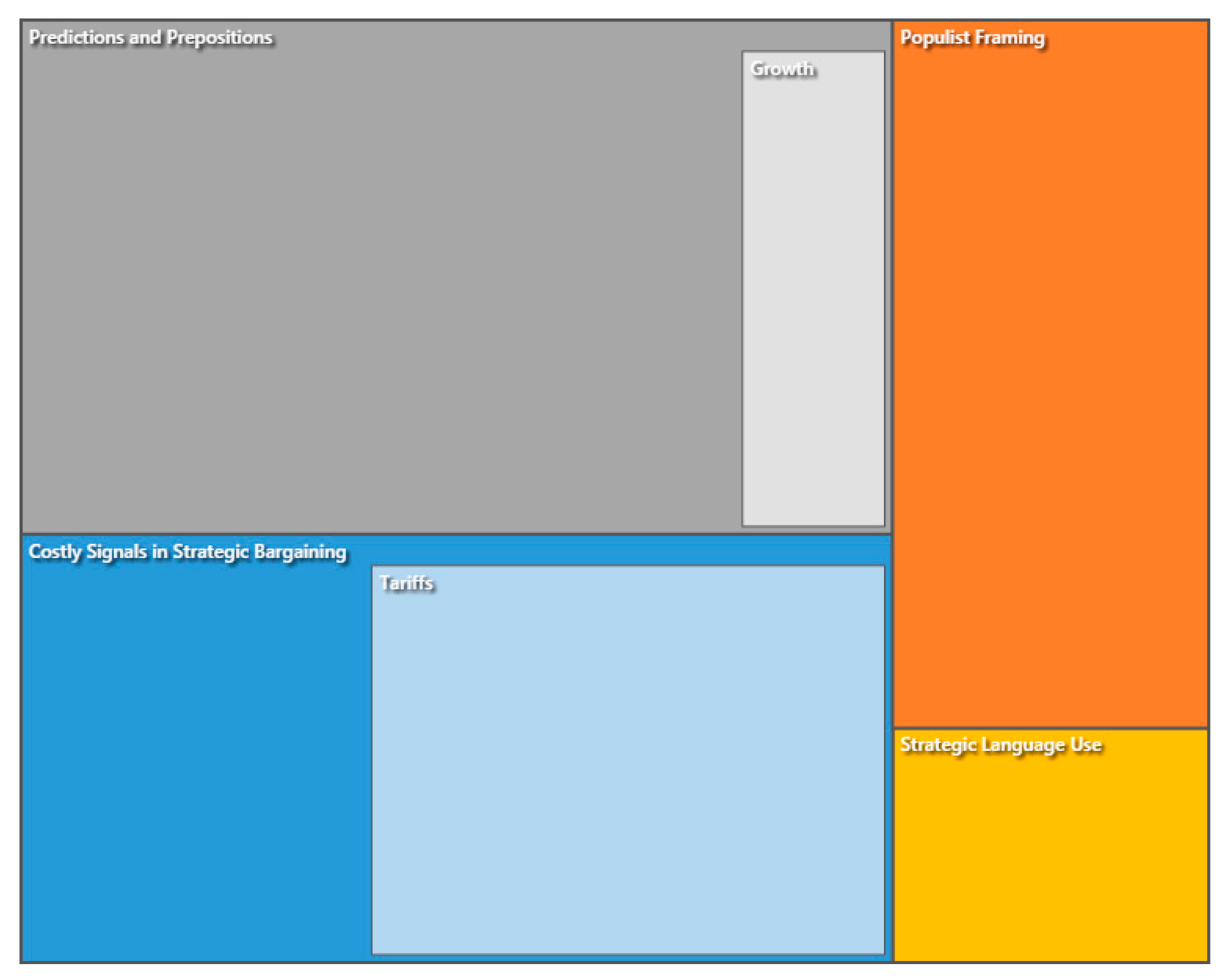
The theme classification in Figure 1 shows distribution of thematic categories derived from Trump’s tariff discourse, with comparatively huge ‘Predictions and Prepositions’ landing in the top place. The theme of this is about how Trump’s language seemed certain and confident in declarative statements with “we will win on trade,” “they will come back to the table,” all established with moral and nationalistic prepositional phrases such as “against unfair trade” or “for American workers.” The immense size of this theme points out that the use of forward looking and motivational language played an important role in Trump’s rhetorical strategy.
The theme that emerges next concerns "Costly Signals in Strategic Bargaining," which uses the tariff as a high cost, high reward lever with which the U.S. can pressure international actors and make its point that it is serious about its negotiating positions using principles of game theory. It shows the specific operational focus of this discourse in the segment labeled ‘Tariffs’ embedded within it. "Strategic Language Use" occupies a defined but smaller space, as a deliberate linguistic structuring of language to be authoritative, justifying or strong. Finally, “Growth” is very much present as a much smaller subtheme second to the two previously discussed ideological and strategic themes, indicating that though economic hope was invoked, it was not as presiding a theme compared to the other two.
Word Cloud Analysis
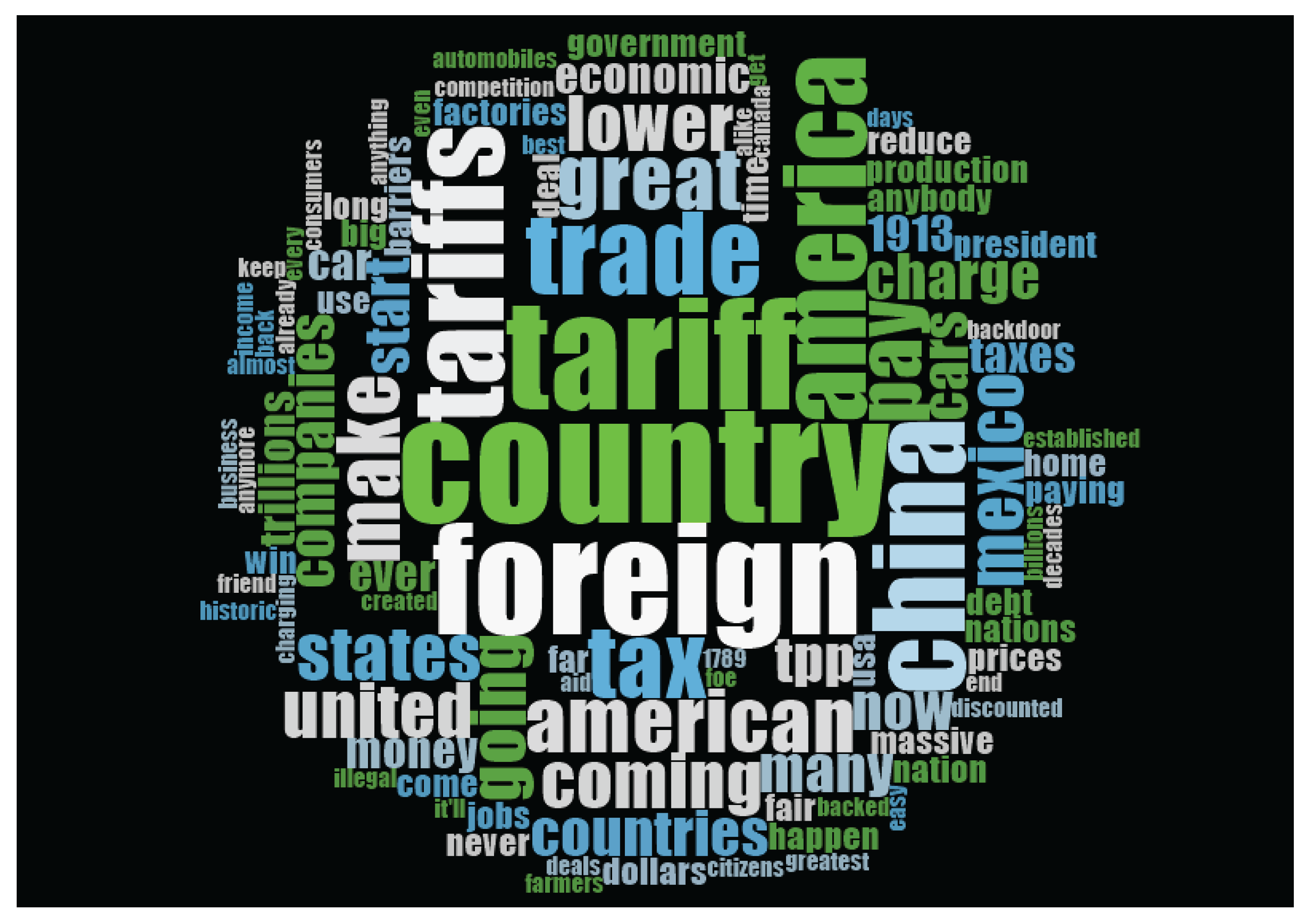
The word cloud image in Figure 2 provides a visual representation of the most commonly used words in Donald Trump’s discourse on tariffs while he was president. It also allows for some connections back to the core themes in your analysis. Populist Framing, Strategic Language Use, Costly Signals in Strategic Bargaining, and Predictions and Prepositions.
The dominant words at the center of the visualization i.e. "country," "foreign," "tariff," and "trade" highlight that, like Trump, the outward facing, sovereignty story was at the center of this presidency. These terms fit under the heading of Costly Signals in Strategic Bargaining, as tariffs were not just policy tools but communications intended to send a message of strength and America’s unwillingness to be taken advantage of in international trade. When followed by its geopolitical embeddedness i.e. short articles like those on DNS servers or on network and computer security do not receive them i.e. it highlights the positioning of “China” and “Mexico” and other countries as rivals or unfair competitors who are all common in zero sum bargaining language.
It’s the theme of Populist Framing: words with an emotional flare like “American,” “jobs,” “factories” and “great.” These terms are a narrative of national revival, which addresses working class voters and which describe tariffs as a return to lost industrial past glory. Those words carry the same tone and mirror administration’s framing of tariffs as tools of fairness and accountability, suggesting that foreign nations were finally going to “pay” their dues.
Strategic Language Use would be words like "massive," "greatest," and "coming" which are hyperbolic/motivational rhetoric that Trump often used to essentially bully in order to assert authority and gain support. Choice of adjectives and that declarative style of speech ties directly into Predictions and Prepositions, the theme of future forward language meant to instill faith and exalt control over economic outcomes.
4.1. Theme 1: Predictions and Prepositions
On the level of declarative language and predictive statements, this theme discusses how Trump’s tariff discourse constructed the future. The 'We will win on trade' or 'Our partners will come back to the table' expressions, in which confidence was projected and intent was also signaled (Archive, 2016). The administration's statement made it prepositioned against unfair practices, or in favor of American workers, as moral and nationalist justifications to its trade policies. The knowledge of this language was not to inform, but to shape expectations, to mobilize support.
Trump's statements are laden with assertive predictions and strategic prepositions designed to put the U.S. in a favorable position in negotiations. For instance, his declaration: “The tariffs are going to be the greatest thing we’ve ever done as a country. It’s going to make our country rich again”. Moreover, the quote also extends further and highlights tariff signaling as a result of tariffs imposition as it is noted in one of its statements: “At some point, I’m going to lower them because otherwise you could never do business with them”(Liu, 2025).
The aforementioned quote uses superlative ("greatest") and future oriented modality ("going to be") in order to assert confidence and inevitability in regards to the positive outcomes that tariffs bring. Not just rhetorical, these linguistic choice but are part of a larger rhetorical practice to alter the lore of international trade. Trump frames the tariffs as beneficial for America, correcting abuse at the hands of others, with Americans as a reactive source, not a destination. Trump frames the tool of the tariff both as a bargaining one — part of an ongoing process of trade and as a protective measure. His TransPacific Partnership (TPP) critique: “The TPP would lower tariffs on foreign cars, while leaving in place the foreign practices that keep American cars from being sold overseas. The TPP even created a backdoor for China to supply car parts for automobiles made in Mexico”.(Mcdermott, 2025). However, designed to delegitimize multilateral trade agreements and push for bilateral, where the US can have its way. This discursive strategy is consistent with Fairclough's (2003) concept of interdiscursivity in that texts rely on and retune existing discourses in order to create new significations and therefore new power relations.
Meanwhile, at the level of social practice, Trump's discourse projects and reproduces a nationalist economic ideology that stresses national production and opposes globalization. His call to action: “They should get on it, start investing, start moving, shift production here to the United States of America, where they will pay no tariff”(Egan, 2025). A direct appeal is to corporations to operate fairly, and support this agenda, for economic patriotism is both a duty, and also a smart strategy. Trump's language thus fits with Fairclough's focus on the function of discourse as a means of perpetuating and transforming social structures, as his construction of economic practice aims to change it along the contours of his administration's ideological flourishes.
4.2. Theme 2: Strategic Language Use
When it comes to tariff related discourse, this theme constructs authority, intent and justification with formal elements of language. The administration's position was anchored into a moral and nationalist frame with Trump using prepositions (e.g. 'against unfair trade,' for 'American workers'), less groupie happy nor descriptive. As with so many pundits, predicting language: “We will win” or “they will cave”, served to assert confidence, project inevitability and being forwards of an inevitability narrative. These were no random linguistic choices; they were vital in reinforcing the administration’s more general signaling intent in projecting a message of strength coupled with anticipated outcomes to listeners at home and abroad.
Trump's language stresses assertive declaration and historical reference in reporting tariffs as a necessary part of a national identity and economic strength. For instance, his statement: “Without steel, you don’t have a country”(Navarro, 2018). Using a definite structure, industrial production is directly linked to national sovereignty. Similarly, his proclamation: “This Is One of The Most Importance Days In American History; ‘It’s Our Declaration Of Economic Independence”(India, 2025). And for him, economic policy decisions take on a significance that approaches that of the Declaration of Independence, which he invokes by historical parallel. The textual choices in these passages serve to justify the incarnation of tariffs as patriotic imperatives.
In the discursive context, Trump's rhetoric creates a story off reciprocal justice and national resurgence. His assertion: "They charge us, we charge them, we charge them less. So how can anybody be upset? They will be, because we never charged anybody anything. But now we're going to charge."(India, 2025). Rather, it positions the U.S. in making up for past trade imbalances and casting the tariff imposition as retaliation rather than aggression. This is in line with a larger campaign of the USA as a victim of unfair trade practice and now to assertively retrieve its dues.
Trump's language reinforces a socially nationalist ideology that favors the interests of the domestic economy over that of foreign ones and frames other entities as threats to the American way of life. His reference to historical economic policies. “From 1789 to 1913 we were a tariff backed nation, and the United States was proportionately the wealthiest it has ever been," "In 1913 for reasons unknown to mankind, they established the income tax so that citizens, rather than foreign countries, would start paying the money necessary to run our government”(Wolf, 2025). The aforementioned quote contends for a return to protectionist policies for rebuilding national grandeur. Trump goes to historical success, seeking to mobilize a collective memory of economic strength bound up in self-reliance, for justification of many of the policy shifts of today.
4.3. Theme 3: Costly Signals in Strategic Bargaining
This theme was built on game theory that tariffs were communicated as deliberate and credible threats to alter expectations and behavior of partners in trade. Credibility in strategic signaling models is associated with cost, such that imposing tariffs sufficed as a signal of seriousness of negotiation. Trump pushes tariffs as ‘tools or ‘leverage’ because they are both economic weapon and communication signal. The theme focuses on the how these messages were presented in terms of ambiguity, and how pressure could be maximized while covering specific policy intentions needed as well when communicating strategically in international relations.
A purported saturation of automotive trade tariffs between the United States and China is pointed out by President Donald Trump. He also stressed his administration's position on righting what it saw as unfair trade practices. Expanding on this, the statement spans across three dimensions that captures the stance of his administration in rectifying what it deemed to be unfair trade practices.
“If the U.S. sells a car into China, there is a tax of 25%. If China sells a car into the U.S., there is a tax of 2%. Does anybody think that is FAIR? The days of the U.S. being ripped off by other nations is OVER!” (Howard, 2018). This statement serves to bridge textual analysis, discursive practice, and social practice within discursive perspective, and in the discourse of economic nationalism and protectionism at large. It does so by showcasing instances of differential tariffs that justify retaliatory trade measures. This narrative permits a justification of correction as a response to an unfair position the US has been put in with global trade. President Trump plays on public concerns about economic uncertainty, and on national pride. It resonates with the audiences concerned about international trade impacts on the domestic industries because it prepares the issue as about fairness and being exploited.
“Jobs and factories will come roaring back into our country” (AFP, 2025). This is a declarative sentence using emotion and vivid language. The phrase 'come roaring back' paints a picture of a return with sheer force and speed, and conveys strength and vitality. "The 'our country' personalizes the message, inducing a feeling of nationhood and national pride.". This is part of a wider political narrative geared to appeal to domestic audiences worried about job losses and deindustrialization. Speeches and media channels were used to broadcast the administration’s vow to help reinvigorate the manufacturing sector.
The assertion is also grounded in economic nationalism and the desire to bring back a perceived former industrial élan. Yet, evidence from the real-world points to the fact that despite the fact that tariffs may safeguard some industries, they could also result in higher manufacturing costs and punishing retaliatory moves by trade partners by canceling out any jobs created.
Tariffs are the greatest! Either a country which has treated the United States unfairly on Trade negotiates a fair deal, or it gets hit with Tariffs (AFP, 2025) This is a rhetoric used to legitimize the proposed use of tariffs as a bargaining chip in trade negotiations. This promotes the U.S. as a proactive justice rectifier in order to drum up public support for protectionist policies through political speeches and media outlets. While supposed to push partners into concessions, these measures prompted counter tariffs and strained relations between the great powers. For example, high tariffs on Chinese goods were imposed leading to the reciprocal tariffs with undesired ramifications to various sectors of the U.S. economy.
While the metaphor of "death blow" suggests an essential and irreparable hit, it also connotes an urgent tone of threat. It's definitive language, categorically and categorically denouncing the Trans Pacific Partnership (TPP). “The TPP would be the death blow for American manufacturing”(Mcdermott, 2025). This is a part of a larger forceful argument against multinational trade agreements. It does this by depicting the TPP as an enemy of domestic industries and a general skepticism about globalization. Further, entering into trade agreements helps get access to new markets and boost the economy. Withdrawal from the TPP may have relinquished Asian influence to other powers, infringing upon a U.S. facet of strategic economic interests.
4.4. Theme 4: Populist Framing
The second theme investigates how the crafting of tariff discourse acted to resonate with domestic political audience. Trump’s use oftentimes justified tariff language in appeals to the ‘forgotten American’, ‘our great farmers’, ‘jobs coming back’, which correspond to the public choice theory and populist communication strategy.
“Jobs and factories will come roaring back into our country, and you see it happening already. We will supercharge our domestic industrial base. We will pry open foreign markets and break down foreign trade barriers, and ultimately, more production at home will mean stronger competition and lower prices for consumers”(AFP, 2025). Forced tariffs were written as morally justified acts of economic justice and retaliation rather than technocratic tools. “Will win on trade. we will start winning again. together, we will make America wealthy again. we will make America strong again. we will make America safe again. and we will make America great again”(Archive, 2016)
“The TPP would lower tariffs on foreign cars, while leaving in place the foreign practices that keep American cars from being sold overseas. The TPP even created a backdoor for China to supply car parts for automobiles made in Mexico”(Archive, 2016). This statement discusses how the framing functioned to mobilize political support, frame political adversaries (domestic and foreign), as well as connecting trade policy to an entire set of national identity and sovereignty narratives.
“If our formally targeted farmers need additional aid until such time as the trade deals with china, Mexico, Canada and others fully kick in, that aid will be provided by the federal government, paid for out of the massive tariff money coming into the USA!”(Archive, 2024). Tariffs imposed during his first term on countries such as China created a reaction which resulted in the economy of these countries striking back at our agricultural exports, especially soybeans. The Trump administration authorized massive financial aid to farmers to counteract these effects. To that end, for instance, approximately $28 billion in 2018 and 2019 was aimed at offsetting losses arising from Chinese trade retaliation. Most of these funds were accrued from the revenue generated through the movement of the tariffs. These reports reveal that the 1% on top of the recipient list received an average of over $183,000, while the 80% on the bottom received less than $5,000 (McDonough, 2022).
5. Discussion
Donald Trump’s tariff policy is a prototypical example of the economic tools as tools of political communication and strategic signalling. Instead of economic goals as the only focus, the tariffs were a tool of proves strength and determination both at home and abroad. The administration by imposing heavy tariffs on imports from nations such as the nationals of China, Mexico and Canada wanted to tell a story of economic nationalism and assertiveness.
The rhetoric around these tariffs was crafted carefully to have no impact on the domestic people, especially the marginalized people by the globalization (Janusch and Mucha, 2017). Tariffs were used, in a game-theoretic sense, as a strategic imposition meant to affect the behaviour of international trade partners. The Trump administration’s reliance on tariffs to coerce other countries into negotiation or concessions can be perceived aggressive and unaccommodating of its allies. The tariffs have also formulated tremendous political implications. That was the tactic to target them to key voter’s bases, particularly in industrial and agricultural regions that were important to the election success of Trump. By appeasing concerns of these cantons, the tariffs became mediums to tighten political support and a way to show that the administration is not comfortable by sending American jobs and industries packing.
But the economic impacts of the tariffs were significant since these have escalated costs to American consumers and business persons, have disrupted supply chains, and triggered retaliatory actions from its allied countries (Liss, 2017). Such outcomes led to doubts about sustained and effective use of tariffs as the main instrument of policy. Further, the uncertainty and one-sided nature in the tariff introduction breached the world trade norms and damaged relations with conventional allies.
Trump’s tariff policy indicates the existence of more profound structural contradictions which contradict their supposed objectives. Though these tariffs were created to safeguard domestic industries and eliminate trade deficit, empirical evidence shows that the tariffs have in most cases resulted into the unintended consequences in the economy. For example, apparently, despite profound tariffs, levied on China since 2018, the U.S trade deficit with China was still large and with Canada and Mexico even increased: to $80.1 billion and $131.1 billion in 2022 respectively. This implies that tariff may not be a good solution of trade imbalances, rather may actualize them.
In addition, the tariffs have created a dislocation in the global supply chains which increases the costs of doing business for Americans both as consumers and businesses. The approximate state of almost 3 times the current tariff rate on all U.S. imports would increase from around 2.5% to over 7% and reach 50 year peak. This rise in price could cost American consumers between $120 and $225 billion annually adding fuel to the inflationary rhetoric about tariffs. Such inflationary activities are capable of humiliating consumer purchasing power and dampening the rates of economic growth.
Under the public choice theory, it can be discussed that tariffs can be regarded as a reflection of retaliatory measures of domestic interest groups, which demand protection against foreign competition. The tariff policies of the Trump administration often went after specific industries, like steel and aluminium, industries which had a lot of political clout and were highly concentrated in sectors of key elections.
Unpredictability of tariff enforcing has also created uncertainty in businesses making long term investment a difficult process. This has also discouraged economic planning in the business community. This doubt may result in declining productivity and competitiveness, since firms dabble their resources without clear policy guidelines. More so, retaliatory actions by trade partners have further complicated the economic environment as trade war that may destabilize the world economy may arise.
Elevating the preceding analysis, it is important to examine the theoretical frameworks that deepen our understanding of the meaning of Trump’s tariff strategies. This finding corroborates with the work of Giesecke and Waschik (2025) is of the view that the intervention by the government in the form of tariffs can bring about a shift of profit from foreign to domestic firms in oligopolistic ally competitive industries. This theory indicates that these types of intervention may produce national welfare by changing strategic interactions among firms on an international stage. Though the intent might have been to support domestic industries, the trade conflicts generated and reciprocal threats have caused disruptions of global supply chains and the increased price tag for American consumerists and businessmen. Such results suggest that the strategic advantages, expected by the theory may be over turned by the very term economic impact of such protectionism policies.
In addition, the institutional economic outlook Skonieczny (2018) focused on how the formal and informal institutions determine economic performance. Trump’s tariff policy are a shift away from the traditional norms of international trade and challenge the institutional settings which have guided global economic interplay. This change has brought unpredictability, has strained relationships with the US’s traditional allies and may wear off the trust and cooperation that maintenance of international trade agreements is based on. The uncertainty that will emanate from this may discourage investment and long-term economic planning within as well as outside the nation.
Moreover, the Game Theory underlines a strong effect that such protectionist actions can have on complex webs of production and supply constituencies across different countries. Shuffling of supply chains by companies was inadvertently encouraged by the Trump administration’s imposition of tariffs in that it forced them to introspect and, in some cases, to restructure the way their supply chain was operating to reduce the impact of higher costs and trade barriers.
6. Conclusions
Discourse analysis of Trump’s tariffs demonstrate that the trade policy of his administration had gone much beyond the framework of economic protectionism and had become a conscious means of strategic communication. Both the political spectrums i.e. left- and right-wing leaning administrations equated tariffs to patriotic symbolism, adopted the tools to signal strength, elicit concessions, and consolidate political support. However, the results of the empirics question the success of these goals. Inflation was caused by tariffs because they disrupted supply chains, caused a rise in consumer prices and led to a reaction of retaliation; however, the tariffs did not materially alleviate trade deficits. However, these theories identify tensions between ideological intentions and economic outcome and tariffs as both economic weapons and communicative acts points at an emergent trend in the performative role of trade policy as an instrument of populist governance, but with clear trade-offs of global credibility and economic balance.
7. Future Implications
In the future implications, multiple implications can be expected from Trump’s tariff strategies as incoming administrations, the history of tariffs can work as a performative and communicative practice threatens to mainstream economic nationalism at the expense of multilateralism. This change may sustain diminishing confidence in global trade institutions as it also tests norms supporting collective economic governance. The outstanding international partners may be more hesitant about the reliability of the United States as a trade actor especially if the trade policy itself remains volatile and rhetorically led. The strategy at home may sustain the beliefs of some constituencies that drastic trade move are indications of an economic rebound, even when the numbers do not indicate such on the ground. As such, policymakers walk helter-skelter between populist rhetoric and economic evidence through proper application of trade tools which are transparent as well as strategic in nature. Last, the increasing complexity of global supply chains implies that protectionist disruptions (which used to be perceived as independent incidents) cannot be viewed that way any longer as they incur from interdependent systems and intensify uncertainty. In future the trade regimes will have to plan for the global interconnectedness while taking advantage of the political imperatives of nationalism and strategic signalling.
References
- AFP. 2025. 'A little tough love': Top quotes from Trump tariff talk [Online]. VNEXPRESS. Available: https://e.vnexpress.net/news/news/a-little-tough-love-top-quotes-from-trump-tariff-talk-4869366.html?utm_source [Accessed 2025].
- AMANDA, R. A. & HANDAYANI, T. 2024. Language, Power, and Ideology on Joe Biden's Speech: A Critical Discourse Analysis. ELTALL: English Language Teaching, Applied Linguistic and Literature, 5, 192-211. [CrossRef]
- AMITI, M., REDDING, S. J. & WEINSTEIN, D. E. 2019. The impact of the 2018 tariffs on prices and welfare. Journal of Economic Perspectives, 33, 187-210. [CrossRef]
- ARCHIVE, I. 2016. Donald Trump Holds Rally in Sioux City Iowa CSPAN November 6, 2016 9:39pm-10:16pm EST [Online]. Available: https://archive.org/details/CSPAN_20161107_023900_Donald_Trump_Holds_Rally_in_Sioux_City_Iowa/start/300/end/360?utm_source [Accessed 2025].
- ARCHIVE, T. 2024. Twitter.
- ARPZELL, F. 2020. A Strategic Move Towards Power?: A critical discourse analysis of how national leaders of China and the United States frame their foreign trade policies in the trade war.
- AWAWDEH, N. 2021. A critical discourse analysis of President Donald Trump’s speeches during the coronavirus pandemic crisis. Master, Department of English Language and Literature Faculty of Arts and Sciences Middle East University, 11.
- BOWN, C. P. 2020. Trump’s phase one trade deal with China and the US election. Peterson Institute for International Economics, 27.
- CHOW, D. C. & SHELDON, I. M. 2020. Understanding the Economic and Political Effects of Trump's China Tariffs. Wm. & Mary Bus. L. Rev., 12, 273.
- CIRZAN, A. M. 2022. Trading presidential rhetoric: the relationship between shifting rhetoric and policy in trade from Obama to Trump. Northern Arizona University.
- CONTRACTOR, F. J. 2025. Assessing the economic impact of tariffs: adaptations by multinationals and traders to mitigate tariffs. Review of international business and strategy, 35, 190-213. [CrossRef]
- DJUYANDI, Y., GHAISANI, J. A. & ALISUCI, M. S. 2023. Trump’s winning strategy in the 2016 US presidential election: In new-institutionalism analysis. Geopolitics Quarterly, 19, 229-245.
- EGAN, M. 2025. Trump’s tariff problem: He might need a third or fourth term for his plan to work [Online]. CNN. Available: https://edition.cnn.com/2025/03/18/business/trump-tariffs-trade-war-manufacturing-jobs/index.html#:~:text=Trump%20has%20argued%20that%20automakers,chains%2C%20there%20would%20be%20consequences. [Accessed 2025].
- EL NAMAKI, M. 2018. Trump, Xi and Game Theory. Scholedge International Journal of Business Policy & Governance, 5.
- FETZER, T. & SCHWARZ, C. 2021. Tariffs and politics: Evidence from Trump’s trade wars. The Economic Journal, 131, 1717-1741. [CrossRef]
- FIDLER, D. P. 2017. President Trump, trade policy, and American grand strategy: From common advantage to collective carnage. Asian J. WTO & Int'l Health L & Pol'y, 12, 1.
- FORSTER, D. 2022. President Trump’s 2018 Tariffs on Steel. Sigma: Journal of Political and International Studies, 39, 7.
- FRIED, D. 2019. The Effects of Tariffs and Trade Barriers in CBO’s Projections. Congressional Budget Office, 22.
- FRY, N. 2023. Dairy concessions in Canadian trade: A discursive institutionalist account. Canadian Foreign Policy Journal, 29, 73-92. [CrossRef]
- GIESECKE, J. & WASCHIK, R. 2025. Economic analysis of US tariffs introduced over March-April 2025. Centre of Policy Studies Working Paper No. G-352, Victoria University, 3.
- HIGGOTT, R. 2019. From trade diplomacy to economic warfare: the international economic policy of the Trump Administration. Elcano Royal Institute, 31.
- HOPEWELL, K. 2021. Trump & trade: The crisis in the multilateral trading system. New Political Economy, 26, 271-282. [CrossRef]
- HOWARD, P. W. 2018. Trump: Now Ford can build Focus in U.S.; Ford: That makes no sense [Online]. Detroit Free Press. Available: https://www.freep.com/story/money/cars/ford/2018/09/09/ford-analysts-trump-tweet-focus/1250457002/ [Accessed 2025].
- INDIA, T. O. 2025. Trump imposes 10% tariff on nearly all countries, calls it 'economic independence' [Online]. India Times. Available: https://timesofindia.indiatimes.com/world/us/trump-imposes-10-tariff-on-nearly-all-countries-calls-it-economic-independence/articleshow/119923844.cms [Accessed].
- JANUSCH, H. & MUCHA, W. 2017. America first: Power and geopolitics in US trade policy under president Trump. Sicherheit und Frieden (S+ F)/Security and Peace, 110-114. [CrossRef]
- KELLER, R. 2017. Michel Foucault: Discourse, power/knowledge and the modern subject. The Routledge handbook of language and politics. Routledge.
- KHADER, A. I. Y. 2020. The Deal of the Century in Light of the Critical Discourse Analysis: Trump and Netanyahu's Speech as a Model. Eastern Mediterranean University (EMU)-Doğu Akdeniz Üniversitesi (DAÜ).
- KHAN, M. H., QAZALBASH, F., ADNAN, H. M., YAQIN, L. N. & KHUHRO, R. A. 2021. Trump and Muslims: A critical discourse analysis of Islamophobic rhetoric in Donald Trump’s selected tweets. Sage Open, 11, 21582440211004172. [CrossRef]
- LAFTA, H. T., HASSAN, H., AL JABBARAL MANSEER, F. & AL MAWLA, F. 2020. Power and ideology in Donald Trump‟ s speech at the United Nations: A critical discourse analysis. International Journal of Psychosocial Rehabilitation, 24, 5498-5509.
- LISS, J. 2017. Trump's" America First" Trade Policy and the Politics of US International Investment Agreements, City University of New York.
- LIU, J. 2025. Trump says he will lower tariffs on China ‘at some point’ [Online]. CNN. Available: https://edition.cnn.com/2025/05/05/business/trump-lower-tariffs-on-china-intl-hnk [Accessed 2025].
- MCDERMOTT, R. 2025. Trump-speeches.
- MCDONOUGH, S. 2022. During Covid, most governments just gave people money [Online]. Vox. Available: https://www.vox.com/future-perfect/23277830/covid-cash-transfers-money-global-inequality [Accessed 2025].
- MILNER, H. V. 2017. The political economy of international trade. Global Trade. Routledge.
- NAVARRO, P. 2018. Trump Steel Tariffs Bring Hope, Prosperity Back to Granite City [Online]. Available: https://trumpwhitehouse.archives.gov/articles/trump-steel-tariffs-bring-hope-prosperity-back-granite-city/ [Accessed 2025].
- NEWMAN, J. 2020. Critical realism, critical discourse analysis, and the morphogenetic approach. Journal of Critical Realism, 19, 433-455. [CrossRef]
- POLAT, M. & AKAN, Y. 2021. An examination of the us-china trade war within the framework of game theory. Research & Reviews in Social, Human and Administrative Sciences.
- PRICE, M. L. 2025. How Trump justifies his tariffs — from budget balancing to protecting ‘the soul’ of America [Online]. Associated Price. Available: https://www.ap.org/news-highlights/spotlights/2025/how-trump-justifies-his-tariffs-from-budget-balancing-to-protecting-the-soul-of-america/?utm_ [Accessed 2025].
- PU, Z. 2023. A Corpus-Based Critical Discourse Analysis of Trump’s China-Related Political Discourses. Journal of Linguistics and Communication Studies, 2, 66-74. [CrossRef]
- RUBING, G. & SANDARAN, S. C. 2023. A critical discourse analysis of news discourse on in the times. International Journal of Academic Research in Business and Social Sciences, 13, 968-984.
- SAMAD, A., MALIK, M. F., ROOH, S. & NAZ, E. 2025. Assessing the Impact of Trump's' America First'Policy on EU-US Trade Relations (2017-2021): A Realist and Liberal Analysis. Journal of Political Stability Archive, 3, 22-40. [CrossRef]
- SFAKIANAKIS. 2025. Trump’s Economic Disruption: The World Adapts [Online]. Council of Councils. Available: https://www.cfr.org/councilofcouncils/global-memos/trumps-economic-disruption-world-adapts [Accessed 2025].
- SIMS-SCHOUTEN, W. 2020. Critical Realist Discourse Analysis, motherhood, and gender: A systematic methodological approach to analysis. Critical Realism, Feminism, and Gender: A Reader. Routledge.
- SKONIECZNY, A. 2018. Emotions and political narratives: Populism, Trump and trade. Politics and governance, 6, 62-72. [CrossRef]
- SMITH, S. T. 2020. The Effect of the Trump Tariffs on Major US Trade Partners.
- TRAN, H. 2025. Global implications of the tariff war: A focus on the new South. POLICY.
- WALLIN, E. & ÅSTRÖM, E. 2018. " Trade wars are good, and easy to win": A study of Trump’s steel tariffs and international trade.
- WANG. 2025. The U.S. Has a Long History of Tariffs. Here’s How Trump’s Compare [Online]. Time.com. Available: https://time.com/7268866/history-of-tariffs-trump/ [Accessed 9th May 2025].
- WIRZBURGER, A. 2018. A critical discourse analysis of US media coverage of government leaking during the Trump administration. Syracuse University.
- WOLF, Z. 2025. Why is Trump rewriting US economic history? Anyone? [Online]. CNN Politics. Available: https://www.cnn.com/2025/04/03/politics/why-is-trump-rewriting-us-economic-history [Accessed].
- YONGBI, Z., WENJING, Y. & RAN, Z. 2022. A Corpus-Based Critical Discourse Analysis of Trump and Biden Administrations’ China Policies. International Relations, 10, 175-189. [CrossRef]
- YORK, E. 2018. Impact of Trade and Tariffs on the United States, Washington, DC: Tax Foundation.
- YORK, E. 2025. Trump Tariffs: The Economic Impact of the Trump Trade War.
Figure 2.
Word Cloud Analysis.
Disclaimer/Publisher’s Note: The statements, opinions and data contained in all publications are solely those of the individual author(s) and contributor(s) and not of MDPI and/or the editor(s). MDPI and/or the editor(s) disclaim responsibility for any injury to people or property resulting from any ideas, methods, instructions or products referred to in the content. |
© 2025 by the authors. Licensee MDPI, Basel, Switzerland. This article is an open access article distributed under the terms and conditions of the Creative Commons Attribution (CC BY) license (http://creativecommons.org/licenses/by/4.0/).
Copyright: This open access article is published under a Creative Commons CC BY 4.0 license, which permit the free download, distribution, and reuse, provided that the author and preprint are cited in any reuse.


