
Submitted:
07 August 2025
Posted:
07 August 2025
You are already at the latest version
Abstract
Tokenization is a foundational step in Natural Language Processing (NLP), yet its impact on morphologically rich, low-resource languages like Sinhala is not well understood. This paper presents a systematic evaluation of five tokenization strategies—Byte, Character, Grapheme Cluster, WordPiece, and Word-level—to determine their effect on downstream task performance and computational efficiency. We train and assess Transformer-based models on four datasets: a clean baseline, and three variants synthetically corrupted with minor typos, aggressive typos, and code-mixing to simulate real-world text. Our results reveal a critical trade-off. Word-level tokenization achieves the highest F1-score (0.727) on clean text and is the most computationally efficient, but its performance degrades significantly on noisy text. Conversely, WordPiece demonstrates superior robustness, maintaining high performance across all conditions, making it the most reliable choice for real-world applications, albeit at a higher computational cost. Grapheme Cluster tokenization emerges as a strong, balanced alternative. This study provides crucial empirical evidence to guide the selection of tokenizers for Sinhala NLP, establishing a baseline for performance, robustness, and efficiency.
Keywords:
machine learning
; natural language processing
; low resource language
; tokenization
1. Introduction
Tokenization, the process of segmenting raw text into fundamental units, is a critical initial step in any Natural Language Processing (NLP) pipeline. The chosen strategy directly dictates how linguistic information is structured for a model, thereby influencing its performance, robustness, and computational demands. While subword-based tokenizers like WordPiece [1] and Byte Pair Encoding (BPE) [2] are standard for high-resource languages, their efficacy for morphologically complex, low-resource languages such as Sinhala remains underexplored.
This research addresses this gap by investigating a central question: What is the optimal tokenization strategy for Sinhala NLP, considering the trade-off between model performance, robustness to textual noise, and computational efficiency?
To answer this, we conduct a comparative analysis of five distinct tokenization methods: Byte-level, Character-level, Grapheme Cluster, WordPiece (subword), and Word-level. We evaluate these by training Transformer-based classification models from scratch on four datasets designed to mirror real-world conditions: a clean dataset from social media, and three variants synthetically generated to include typographical errors and code-mixing (the use of Romanized "Singlish").
Although pre-training large language models (e.g., BERT [3]) from scratch for each tokenizer would be ideal, the prohibitive computational cost necessitates a more focused approach. This study therefore provides a rigorous evaluation of tokenizer effectiveness within a controlled experimental framework, offering a vital baseline for researchers and practitioners building robust NLP systems for the Sinhala language.
2. Methodology
The core of our methodology involves a systematic comparison of five distinct tokenization strategies in the four different Sinhala NLP corpus. This results in a total of 20 experimental setups (), allowing for a comprehensive analysis of the interplay between tokenization and task performance.
2.1. Tokenization Strategies
We evaluate five tokenization methods, ranging from simple character splits to complex subword segmentation.
2.1.1. Character-Level Tokenization
This is the most granular tokenization method, where the input text is decomposed into individual characters. While this approach creates a small, fixed vocabulary and avoids any out-of-vocabulary (OOV) issues, it disassembles semantically meaningful units (like words or morphemes) into components that lack intrinsic context.
Figure 1.
An example of Character-Level Tokenization in Sinhala.

2.1.2. Grapheme Cluster Tokenization
Unlike simple character splitting, Grapheme Cluster Tokenization splits text into visually and linguistically cohesive units. In Sinhala, a single perceived "letter" is often composed of a base consonant and one or more diacritics (vowel signs, or "pili"). This tokenizer correctly groups these components into a single token, which preserves more semantic meaning than an individual character.
Figure 2.
An example of Grapheme Cluster Tokenization, which correctly groups base consonants with their diacritics.
Figure 2.
An example of Grapheme Cluster Tokenization, which correctly groups base consonants with their diacritics.

2.1.3. Byte-Level Tokenization
This method tokenizes text at the raw byte level based on its UTF-8 encoding. As Sinhala characters are typically represented by 3 bytes, this results in significantly longer token sequences. The primary advantage is the ability to model any text without encountering OOV tokens. The trade-off is that it creates long sequences and splits fundamental grapheme clusters into meaningless byte tokens, posing a challenge for the model.
Figure 3.
An example of Byte-Level Tokenization, showing how a single grapheme is split into multiple byte tokens.
Figure 3.
An example of Byte-Level Tokenization, showing how a single grapheme is split into multiple byte tokens.

2.1.4. Subword-Based Tokenization (WordPiece)
Subword tokenization is the de facto standard in modern NLP. We use the WordPiece algorithm, notably employed by BERT [3]. WordPiece starts with a vocabulary of individual characters and iteratively merges frequent pairs of subword units to maximize the likelihood of the training corpus. This method strikes a balance between character- and word-level approaches, keeping common words intact while breaking rare words into meaningful subword units, effectively handling morphology and reducing the OOV problem.
Figure 4.
An example of WordPiece subword tokenization.

2.1.5. Word-Based Tokenization
We also evaluate a traditional word-based tokenizer that splits text based on spaces and punctuation. While this method produces the shortest token sequences, it suffers from the out-of-vocabulary (OOV) problem, where any word not seen during training is mapped to a single "unknown" token. This is particularly problematic for morphologically rich languages like Sinhala. Nevertheless, it is included in our analysis to provide a comprehensive baseline.
3. Model Architecture
The classification model used for all experiments is based on the Transformer encoder architecture introduced by Vaswani et al. [4]. As depicted in Figure 5, our classification model comprises three main components: an embedding layer, a stack of Transformer encoder blocks, and a final classification head.
First, the input sequence of token IDs is converted into dense vector representations by the Token Embedding layer. To provide the model with information about the order of the tokens, these embeddings are added element-wise with Positional Embeddings. The resulting combined embeddings are passed through a stack of N identical Transformer Blocks. Each block contains two primary sub-layers: a Multi-Head Self-Attention mechanism and a position-wise Feed-Forward Network (FFN). A residual connection followed by layer normalization is applied after each sub-layer.
Finally, for classification, the output representation of the first token in the sequence (i.e., the `[CLS]` token) from the final encoder block is used as an aggregate representation for the entire sequence. This vector is passed through a linear layer followed by a softmax function to produce a probability distribution over the target classes.
4. Experiment Setup
4.1. Datasets and Data Augmentation
To assess tokenizer effectiveness for a low-resource language in a manner that reflects real-world use cases, we used the original SOLD [5] dataset as a baseline and created three synthetic variants. Real-world text data often contains typographical errors and code-mixing. Therefore, our data augmentation process was designed to simulate these practical concerns by generating the following datasets:
- Minor Typos: Each character in the original text has a 5% probability of being randomly deleted, replaced, or swapped with an adjacent character.
- Aggressive Typos: The character-level error probability is increased to 10%.
- Code-Mixing and Typos: This variant combines minor typos (5% character error rate) with code-mixing, where each word has a 30% probability of being transcribed into its romanized form ("Singlish").
An example of the data augmentation is shown below:
- Original:

- Aggressive Typos:

- Code-Mixing:

4.2. Model Training and Hyperparameters
For each of the 20 experiments, we train the Transformer-based classification model from scratch. While the vocabulary size varies with the tokenizer, the core architecture hyperparameters are kept constant to ensure a fair comparison. All models are trained using the AdamW optimizer. Model performance is evaluated using the macro F1-score, which is suitable for potentially imbalanced datasets. The key hyperparameters are detailed in Table 1.
5. Results and Discussion
This section analyzes our empirical findings, focusing on the trade-offs between performance, robustness across different data conditions, and computational cost.
Discussion
Our results reveal a clear and critical trade-off between performance, robustness, and computational efficiency. We discuss these findings and their practical implications below.
Performance vs. Robustness
On clean, well-formed text (`Original` dataset), the Word-level tokenizer achieves the highest F1-score (0.7274). This indicates that when the vocabulary is stable, preserving whole words as semantic units is most effective. However, its performance is brittle, degrading significantly as data quality worsens.
Conversely, tokenizers that operate at a sub-word level demonstrate superior robustness. WordPiece (WPE) excels in noisy conditions, becoming the top performer on the `Aggressive Typos` dataset (F1=0.7000). By breaking unknown words into known sub-units, it effectively mitigates the out-of-vocabulary problem that cripples the Word-level tokenizer.
Performance Stability Across Tasks
The standard deviation reported in Table 2 measures how much a tokenizer’s performance varies across the four different datasets. A low standard deviation indicates high stability. The Byte-level tokenizer is the most stable (Std. Dev. = 0.0060), but this is stability at a low performance level. More importantly, WordPiece shows remarkable stability (Std. Dev. = 0.0142) at a high performance level, making it a reliable choice for diverse applications. The relatively high deviation for Word (0.0215) and GCT (0.0250) highlights their sensitivity to changes in data quality.
The Efficiency-Robustness Trade-Off
Figure 6 starkly illustrates the computational cost of robustness. There is an inverse relationship between representational granularity and training speed. The Word-level tokenizer is the fastest by a significant margin, making it attractive for rapid prototyping. The most robust methods, WPE and Byte-level, are the slowest due to the much longer token sequences they produce, which increases the computational load on the Transformer architecture.
6. Conclusions
This study provides a comprehensive analysis of five tokenization methods for Sinhala NLP, evaluating the trade-offs between performance, robustness, and efficiency.
The Word-level tokenizer is fastest and best on clean text but is too brittle for noisy, real-world data. Conversely, WordPiece (WPE) emerges as the most effective all-around strategy, offering the best robustness against textual corruption, making it the premier choice for production systems despite its high computational cost. For applications where this cost is prohibitive, the Grapheme Cluster (GCT) tokenizer presents an excellent, balanced alternative.
Future work should extend this analysis by pre-training large language models from scratch for each tokenization strategy to explore their full potential. Nonetheless, this study provides a crucial empirical foundation for making informed, scenario-aware decisions when developing NLP systems for Sinhala and other morphologically rich, low-resource languages.
References
- Wu, Y.; Schuster, M.; Chen, Z.; Le, Q.V.; Norouzi, M.; et al. Google’s neural machine translation system: Bridging the gap between human and machine translation. arXiv 2016, arXiv:1609.08144. [Google Scholar]
- Sennrich, R.; Haddow, B.; Birch, A. Neural machine translation of rare words with subword units. arXiv 2015, arXiv:1508.07909. [Google Scholar]
- Devlin, J.; Chang, M.W.; Lee, K.; Toutanova, K. Bert: Pre-training of deep bidirectional transformers for language understanding. arXiv 2018, arXiv:1810.04805. [Google Scholar]
- Ashish Vaswani, Noam Shazeer, Niki Parmar, Jakob Uszkoreit, Llion Jones, Aidan N. Gomez, Łukasz Kaiser, and Illia Polosukhin. Attention is all you need. In Advances in Neural Information Processing Systems 30, pages 5998–6008, 2017.
- Ranasinghe, T.; Anuradha, I.; Premasiri, D.; et al. SOLD: Sinhala offensive language dataset. Lang Resources & Evaluation 2025, 59, 297–337. [Google Scholar] [CrossRef]
Figure 5.
The Transformer-based classification architecture. Input tokens are converted into embeddings, processed by a stack of N identical encoder layers, and the final representation of the first token is passed to a linear layer for classification.
Figure 5.
The Transformer-based classification architecture. Input tokens are converted into embeddings, processed by a stack of N identical encoder layers, and the final representation of the first token is passed to a linear layer for classification.
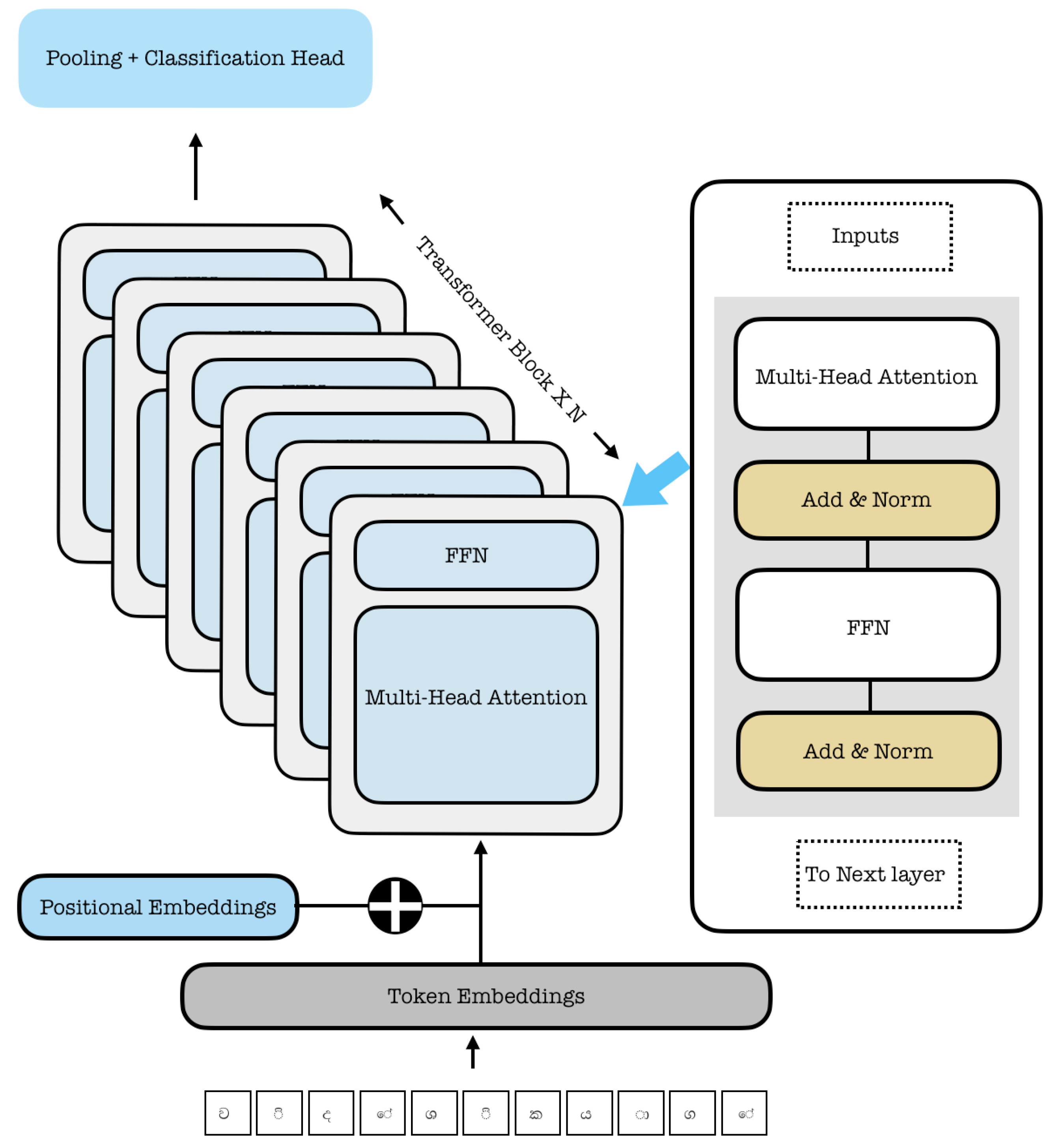
Figure 6.
Total training time comparison. The Word-level tokenizer is over 3x faster to train than the most robust tokenizer, WPE, highlighting a critical performance-efficiency trade-off.
Figure 6.
Total training time comparison. The Word-level tokenizer is over 3x faster to train than the most robust tokenizer, WPE, highlighting a critical performance-efficiency trade-off.
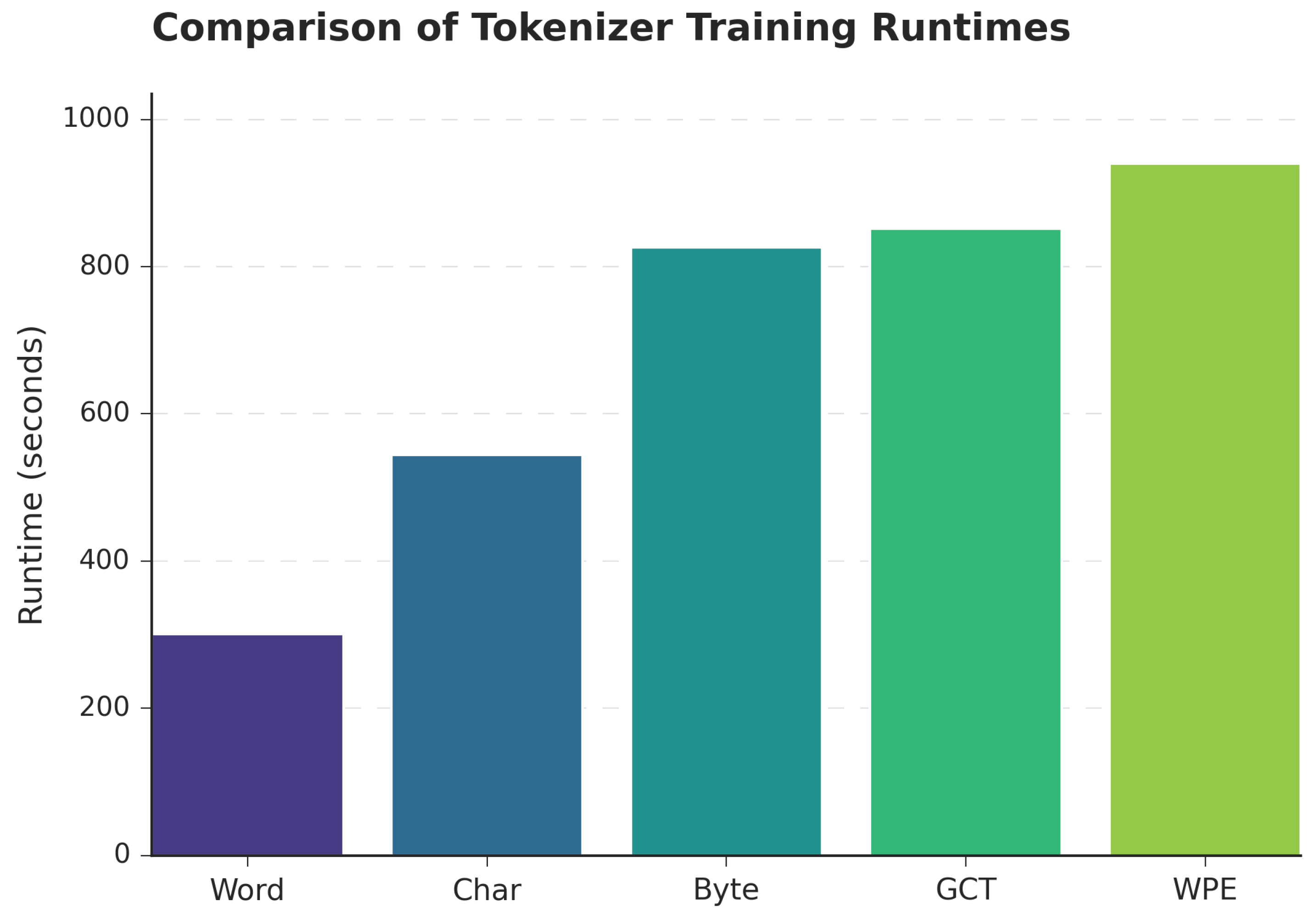

Table 1.
Key hyperparameters for the Transformer model.
| Hyperparameter | Value |
|---|---|
| Hidden Size () | 512 |
| FFN Intermediate Size | 512 |
| Number of Attention Heads | 8 |
| Dropout Probability | 0.2 |
| Learning Rate | |
| Max Sequence Length | 512 |
| Optimizer | AdamW |
| Weight Decay | 0 |
Table 2.
F1-Scores for all tokenization methods across four datasets. The highest F1-score in each row is in bold. The final row shows the standard deviation of F1-scores for each tokenizer across the four tasks, indicating performance stability under varying data conditions.
Table 2.
F1-Scores for all tokenization methods across four datasets. The highest F1-score in each row is in bold. The final row shows the standard deviation of F1-scores for each tokenizer across the four tasks, indicating performance stability under varying data conditions.
| Dataset | Byte | Char | GCT | Word | WPE |
|---|---|---|---|---|---|
| Original | 0.6580 | 0.6671 | 0.7073 | 0.7274 | 0.7100 |
| Minor Typos | 0.6566 | 0.6651 | 0.7007 | 0.7044 | 0.7000 |
| Aggressive Typos | 0.6604 | 0.6785 | 0.6987 | 0.6884 | 0.7000 |
| Mixed Coding | 0.6468 | 0.6526 | 0.6528 | 0.6779 | 0.6776 |
| Std. Dev. (across tasks) | 0.0060 | 0.0106 | 0.0250 | 0.0215 | 0.0142 |
Disclaimer/Publisher’s Note: The statements, opinions and data contained in all publications are solely those of the individual author(s) and contributor(s) and not of MDPI and/or the editor(s). MDPI and/or the editor(s) disclaim responsibility for any injury to people or property resulting from any ideas, methods, instructions or products referred to in the content. |
© 2025 by the author. Licensee MDPI, Basel, Switzerland. This article is an open access article distributed under the terms and conditions of the Creative Commons Attribution (CC BY) license (http://creativecommons.org/licenses/by/4.0/).
Copyright: This open access article is published under a Creative Commons CC BY 4.0 license, which permit the free download, distribution, and reuse, provided that the author and preprint are cited in any reuse.


