

Submitted:
07 January 2026
Posted:
08 January 2026
You are already at the latest version
Abstract
Climate change has caused tremendous concerns in many societies on all continents. However, the decline in biodiversity, which is at least as serious a crisis, is mostly ignored. An increasing number of technological approaches for carbon dioxide reduction (CDR), which are in fact geoengineering, are being studied, partially at the pilot scale. The Intergovernmental Panel on Climate Change (IPCC) supports technologies such as direct air capture (DAC), carbon capture and storage (CCS) and the use of captured CO2 (CCU). A new concept for objectively judging “sustainability” is described: entropy as a generally applicable criterion for sustainability, followed by an analysis of whether CDR technologies are sustainable. It becomes clear that such technologies are seriously unsustainable. Therefore, after the CDR potential of natural ecosystems is explored, the contributions of bioagriculture to CO2 capture and long-term storage (deeply in soil) are shown, as well as their impact on biodiversity recovery via fully integrated bioagriculture – which proves to be sustainable according to the entropy criterion. Practical examples are taken from the German Kattendorf biofarm (450 hectares leased pastures and fields). Their experience with solar and bioenergy will be reported, bird/plant species diversity will be detailed for selected areas, and CO2eq emissions vs. storage figures will be given for milk production, cheese manufacturing and for the whole farm. CDR by natural/renaturalized ecosystems, including bioagriculture, is not only sustainable but also much more capable than CDR technologies and contributes to biodiversity recovery, in contrast to technological approaches. We must address species decline and climate change without mitigating one crisis with approaches that exacerbate the other.
Keywords:
entropy
; sustainability
; climate change
; carbon dioxide reduction (CDR)
; direct air capture (DAC)
; carbon sequestration
; agriculture
; bioagriculture
; soil fertility
; biodiversity
; species decline
; carbin dioxide fixation in soil
; mycorrhizae
1. Introduction
This study aims to show, that “Net Zero Agriculture” can be sustainably reached only if not just the carbon dioxide emission is minimized and CO2 concentration in the air is reduced by technological means, but if, at the same time, the dramatic species decline is stopped and biodiversity recovered to a significant degree. It is assumed that the readers are aware of the main causes of climate change and of the dramatic situation of the biodiversity worldwide – but the role of conventional agriculture using chemical fertilizers and pesticides goes beyond what is generally known: It has been shown that the effect of pesticides is far broader than only to eliminate the targeted organisms which had been studied before the pesticides had been approved [5.1]. We refrain from describing widely known facts in this article and assume that the readers know and support the need to reduce the CO2 concentration (CDR) and the need to stabilize and recover biodiversity, i.e., for instance number, distribution and diversity of insects, birds and also fungi (in soil) which all are heavily threatened by conventional agriculture [5.2]. These two references alone prove that conventional agriculture is the most important cause species decline, which is confirmed by the United Nations Environment Programme [19]. Section 2.2.2 describes the alternative to this form of agriculture, bioagriculture in the form of diverse and integrated organic farming.
First, we discuss the lack of attention given to the biodiversity crisis and the associated one-dimensional understanding of “sustainability”, a term that is far too vague to be productive. To examine the sustainability of CDR technologies, we look at the results of an analysis of sustainability in the broadest sense of the term.
As far as the major two environmental crises (species decline and climate change) are concerned, public debate in Western societies is heavily unbalanced, with headlines mentioning and articles addressing “climate change” and any related terms accounting for almost 100 times more than “species decline” or “biodiversity”. The German press database “genios” [1] listed the keyword “climate change” 1,322,756 times, whereas it showed only 11,414 times “species decline,”, i.e., less than 1%. The German weekly newspaper “DIE ZEIT” offers an interactive data tool showing how often a certain word was used in plenary speaches in the German Parliament (“Bundestag”) since its foundation in 1949 [2]: terms related to “climate” were used more than 30,000 times, whereas “species decline” or “biodiversity” in total hardly reached 1,000 times. For example, “climate protection” (“Klimaschutz”) was used 936 times in 2019, while “species decline” was mentioned only 3 times, and “biodiversity” (“Artenvielfalt”) 38 times in the same year, i.e., 0.3% and 4% (compared with “climate” related terms), respectively.
Very often, the biodiversity crisis is addressed only in connection with “climate (change)”, suggesting that climate change is causing the loss of biodiversity, as if there were no species decline without climate change. Therefore, when searching for biodiversity loss-related articles in “The New York Times”, you will find all of these in the online news section “climate”, such as the one discussing how tree species decline [3]. “Climate” is mentioned several times in this article (e.g., “For temperate regions, pests and diseases are a major threat to trees. Climate change is an emerging threat.”), again suggesting that climate change is the cause of species decline. To be fair, we should give the author credit for writing “biggest threats to trees are agriculture and logging, followed by urbanization”, but for the average reader, this statement gets lost owing to the focus on “climate”. In reality, monoculture forests for wood production and new forests with especially fast-growing trees are increasingly considered measures to capture CO2 and provide CO2 emission compensation but actually cause ecosystem destruction [4], which is not mentioned in this article.
In recent times, the term “sustainability” has been widely reduced to something such as a CO2 footprint, as if “climate-neutral” is automatically “sustainable”, and something is “sustainable” if “climate-neutral”, e.g., [54]. In addition, the use of “sustainability” is inflated and is often misused just for commercial or political marketing, without any meaning or falsifiable criteria.1
In fact, mankind is definitely living very unsustainably, as one can see increasing raw material consumption, the accumulation of waste, marine littering and pollution, and dramatic species declines, as demonstrated by the “Earth Overshoot Day” [56]. Not only has this been the case for just over 100 years, but we have a long active history of damaging and destroying our environment; additionally, the increased CO2 concentration is an indicator of nonsustainability. A meta-analysis [5.1] revealed a nonspecific but much broader mode of action than the claimed mode of action of pesticides and, with their long-term effects, that agriculture is the most important cause of species decline.
Therefore, the goal of this study is to analyze the sustainability of CDR technologies with “sustainability” in a wider sense, and to show that agriculture can contribute to a truly sustainable approach to mitigate climate change and, at the same time, prevent species decline and recover biodiversity if agriculture would be transformed to true organic farming.
2. Materials and Methods
2.1. Brief Introduction to the Concept of “Entropy as a Criterion for Sustainability” and Its Application to CDR Technologies
2.1.1. Entropy as a Criterion for Sustainability
There are widespread, rather inaccurate preconceptions and prejudices, especially about thermodynamics, and entropy in particular. This section therefore attempts to outline modern thermodynamics, at least briefly. A more detailed and complete, still easy-to-understand introduction can be found in [6].
The first prejudice is that thermodynamics is an old and outdated science with no big value for any of our modern scientific questions and even less for our actual global crises, cf., e.g., [55]. However, this approach ignores the modern nonequilibrium thermodynamics created by Ilya Prigogine, who was awarded for this achievement with the Nobel Prize in 1977 [7]. The name of his thermodynamics addresses a preconception: This science field not only consists of the old and well-known equilibrium thermodynamics with a side branch of close-to-equilibrium nonequilibrium systems but also far-from-equilibrium systems.
The second preconception concerns entropy: According to the 2nd law of thermodynamics, entropy cannot decrease, which thus far is correct. However this is valid only for isolated closed systems with no exchange of energy or matter with anything outside. However, people assume that entropy is always increasing everywhere. Only closed systems tend to reach equilibrium, which is associated with the highest entropy level characteristic of this system. Consequently, it is widely overlooked that by far most real systems are open systems that exchange energy/matter with their environment (third preconception). Prigogine found that entropy can and will inevitably decrease if the energy influx is overcritical (an amount that is different and characteristic of each system for each process). If this happens, the system will spontaneously develop very complex, so-called “dissipative” structures. “Dissipative” because said systems cannot cope with this overcritical energy influx other than by exporting entropy, i.e., entropy decreases inside said system, whereas entropy increases by orders of magnitude more outside it. Importantly, an entropy minimum is combined with the formation of complex structures and complex processes within this system. In other words, loss of complexity is equivalent to an increase in entropy. We can also generalize and say that loss of valuability (be it energy, matter, or functioning complexity) is accompanied by an increasing amount of entropy in the systems where this loss is happening.
This leads us to a fourth preconception or, better, oversimplification: Entropy is widely misunderstood as simply being a measure of disorder [57]. However, first and foremost, entropy is a measure for lower valuability of energy (and hence also lower valuability of matter). Boltzman’s interpretation of the entropy of a system by the probability of the arrangement of the system’s components and interpretation is not (as often misunderstood) the definition of entropy. The definition of entropy2 tells us that there is no process with energy (and often matter) turnover that would not produce entropy. In other words, with every such process, energy (and matter) within a given system will inevitably reach a lower level of valuability or “usability” unless more energy in an overcritical amount flows into this system, which, on the other hand, will increase entropy wherever the energy comes from.
In addition, while products or services generated or enabled by this energy supply are used, entropy is again generated. Entropy constantly affects us and the entire environment. We cannot escape it, nor can we ignore it, just as we cannot escape or ignore gravity, whether we like it or not. An increase in entropy can be “seen” in all kinds of forms, such as waste heat, heat loss from our living space (we must heat our houses constantly unless we live in hot regions where air conditioning produces entropy), efficiency loss in power plants and car motors, such as waste (ash, industry and household waste), corrosion, friction and abrasion, and microplastic, as well as our own (and any other animals’) urine and feces, loss of water and emission of CO2 during breathing, as well as CO2 emissions from power plants, combustion engines or concrete plants, and environmental pollution. All this is a manifestation of entropy.
CO2 itself represents a higher standard entropy [8] than C (carbon in the gaseous state) and O (oxygen), and more entropy is produced when CO2 and H2O (water) are diluted within the atmosphere; this entropy is the so-called “entropy of mixing”.
Any process with turnover of energy and matter is principally irreversible: heat in a living room cannot be converted back to wood, coal, oil, or to gas which when burnt had generated the heat. Nuclear fusion in the sun can and will not be reversed (i.e., helium+heat+infrared cannot be reformed into hydrogen); a few billion years from now, the earth will no longer be habitable; electricity transported to industry and households will be used and cannot flow back to the power plant, recover fossil oil or gas and generate new electricity: there is no perpetuum mobile; iron oxide on bridges generated by corrosion cannot be reversed to intact steel bars; and microplastics cannot be collected and recycled into clean raw plastics or bottles, packaging and other materials, such as tire abrasion, generated and lost during driving, can never become tires again. A boiled egg cannot be turned back into a fresh raw egg, and the eggshells that end up in the trash when we peel the boiled egg cannot be given back to the chicken, it can’t use it for a new egg.
The same is true for biodiversity: the complex interactive network in the ecosystems of our biosphere consists of unnumerable kinds of species, and it therefore represents a state of minimal entropy (which, if not destroyed by us, is maintained by constant overcritical influx of solar energy). Reducing the number of representative species in a region or globally and reducing the number of species on earth are equivalent to reducing complexity, i.e., increasing entropy. If the number and diversity of species in the soil of agricultural land is reduced by pesticides and if fertile soil is lost by erosion3 [9], then the entropy again increases, partially because of loss of complexity and partially because of the entropy of mixing as nutrients, organic and inorganic components of the eroded soil are distributed or dissolved first in flowing water and finally in the sea. In addition, extinct species can never be brought back to exist.
Considering all this, the author has proposed the use of entropy as a criterion for sustainability, with the following understanding:
- -
- Sustainability comprises the whole biosphere, not only the climate, i.e., it concerns the whole biosphere and not only humans and their (relatively short-term) needs but also all members and components of ecosystems as humans live from what the earth can sustainably produce (including but by far not only pure water, fresh clean air, and fertile soil). (This understanding of sustainability is far from what ecocentrism is promoting.)
- -
- A certain product or process A can be called “more sustainable” than alternative B, if A produces less entropy, entropy in any form.
- -
- Entropy is a quantitative indicator for any kind of (utility) value loss in energy, matter or functional complexity. Insofar, it is a general sustainability indicator that does not specifically tell us whether losses are for example caused by the transformation of primary energy (such as coal) into electricity (thereby generating also lower value energy in the form of heat and low value matter in the form of ash); or whether electricity used for air conditioning results in a lower level of energy value; or whether the entropy increase indicates value loss by intoxification of ground or coastal waters leading to serious degradation of ecosystems.
This concept was first published by the author in 2024 [10]. It was laid out in even more detail in his new book “on the origin of unpredictability, complexity, crises and time” [11] and in a compact form in [12]. The novel value of this concept is – in contrast to former fuzzy mentions of entropy in connection with sustainability – that it introduces entropy as a hard and quantitative criterion for sustainability and examples of how to quantitatively use and qualitatively interpret it (cf. section 2.1.2).
2.1.2. Sustainability Analysis of CDR Technologies with the Entropy Criterion
This concept allows us to check whether or not CDRs, such as direct air capture (DAC), carbon capture and storage (CCS), and carbon capture and use (CCU) technologies, are sustainable or at least more sustainable than other alternatives in public discourse. For details of the processes to be examined and of the calculation leading to the results shown below, the readers are referred to references [10,11,12] and the references cited therein, [10,12] which also contain English translations of the original publications.
The total heat and electricity requirement for DAC is 7*106 kJ per metric ton of CO2 captured. This amount is almost six times greater than we had received as valuable energy for industrial, infrastructure, household and other uses when generating and emitting 1 ton of CO2, not yet taking into account that more recent numbers disclosed by Climeworks for their two DAC plants in Iceland are showing the practical electricity demand to be 2 to 3 times higher than previously predicted [13]. To stabilize the current CO2 concentration in the atmosphere (i.e., not yet reduce it), one would need 22 PWh of electricity (plus primary energy for heat) only to remove the emissions remaining after projected emissions reductions. Taking the electricity production figures for 2024 (assuming that the real energy demand is 1.5 or – as recently reported – 2 to 3 times higher than originally published), an energy amount equivalent to the actual total worldwide electricity production or even much more would be required for DAC to remove the current emissions only ([12], and literature cited therein).
Moreover, when looking just at the shear volume of CO2 to be captured, it was reported that capturing only daily worldwide emissions would require an industry (capable of handling such volumes) equivalent to 10 to 20 times the size of the actual oil extraction and further processing industry ([12], and literature cited therein).
When looking at the entropy production only for running DAC plants (not yet for building them and the infrastructure needed for it, and not considering entropy production during storing the compressed gas deep in the earth), one can see that for 1 ton of captured CO2, the atmosphere entropy is reduced by 4.15 MJ/K, which includes the entropy contribution caused by capturing H2O, which cannot be avoided. To reduce the entropy of mixing in the atmosphere, more than 1,000 times as much entropy (approximately 7 GJ/K) is produced on the Earth’s surface and in the oceans ([11], p. 231). This means that for 1 unit of positive climate stabilization effect, we have to “pay” with more than 1,000 units of negative environmental effects, which translates into pollution, destruction, degeneration, massive consumption of environmental goods and losses of all kinds, not least in terms of species decline.
Although the CO2 concentration is much higher in CCS plants than in the atmosphere, the results of the sustainability analysis would not be much better than those for DAC. This is not only because much more water is absorbed together with CO2 but also because the various power or cement and concrete plants’ waste gasses contain many other partially toxic or otherwise harmful or troublesome gasses. Because the storage part of CCS requires CO2 transportation from the source to some central location with a suitable infrastructure where the CO2 would be stored deep underground (for Germany, Denmark and Norway, it is intended to be stored under the North Sea, which is being tested at the pilot scale). Transport is planned to occur in pipelines, with transfer across water carried out by ships, at least in the beginning. As CO2 will inevitably be accompanied by massive amounts of water, steel will be corroded quickly, especially as CO2 from many different emitters (including various accompanying gases, including water), will be mixed [14]. To overcome this, both very strict specifications for the gasses to be transported and much more efficient corrosion-resistant steels are needed.
For CCU, the situation is much worse. Not only does CO2 need to be captured first (which is already anything but sustainable), but it must also be purified; otherwise, the following chemical reactions will not (efficiently enough) work. It was reported (cf. references in [10,12]) that – only theoretically, assuming that any organic chemical in use in the global chemical industry would be generated from CO2 as a raw material – this would require more than 18.1 PWh of electricity from regenerative sources, which not only are not available (because at least 22 PWh are already used by DAC!), but moreover, it would add another 55% of the total global electricity generation projected for 2030. However, it would account for only 10% of the actual CO2 emissions. This shows how the use of CO2 as a raw material for the chemical industry would be absurd.4
In addition to the use of captured CO2 for the chemical industry, the promotion of “CO2-free (climate-neutral)” fuels is popular. However, if the electricity necessary for the hydrogen generation and further chemical steps to produce such “sustainable” fuels is used directly for driving electric vehicles, these vehicles can drive 10 times more kilometers than when “green” fuels are used. The same is the case for producing so-called “sustainable air fuel” (SAF, an allegedly sustainable fossil-based kerosin replacement). This can be seen in Figure 1.
Unsurprisingly, chemically reducing CO2 to methanol (MeOH) or other industrially important organic chemicals, or allegedly “sustainable kerosin”, is extremely energy demanding, as CO2 represents a high content of entropy. It requires much energy to split up the C‒O bond (in other words: reducing the entropy content of CO2), much more than we had been able to use the energy released during the formation of this bond, and it requires more energy to add some hydrogen to finally obtain CH3OH, methanol. Moreover, providing the necessary amount of energy for reducing the entropy of the reaction system containing CO2 and H2 to generate CH3OH unavoidably creates large amounts of entropy outside the reaction vessels.
A large portion of this is the high demand of electricity for the electrolysis of water to generate “green” hydrogen (H2). However, there is already a basic problem: Solar or wind power is mostly available where there is either no water (in desert land with plenty of sunshine) or plenty of water but with high salt concentrations (such as in the windy North Germany). In both cases, it is necessary to build and run desalination plants—again, more electricity and more entropy, including another mostly ignored form of environmental damage: The coastal areas where the desalination plants are running become polluted with brine effluent [15] and have extremely high salt concentrations together with many other components in sea water hence being toxic to coastal ecosystems. In addition, brine contains even more chemicals necessary for the desalination of polluting coastal waters.
In conclusion:
- -
- CO2 emission and dilution in the atmosphere are understood as a process leading toward thermodynamic equilibrium, i.e., accompanied by increasing entropy (in the atmosphere: the entropy of mixing); the same is true for any pollution of rivers, ground or coastal waters, and soil erosion in agriculture with loss of nutrients and humus into the seas: processes toward equilibrium with increasing entropy; this is also the case with the formation and distribution of microplastic, abrasion or corrosion products and any degradation of functioning complexity, such as ecological networks, and a decrease in biodiversity: entropy increases toward equilibrium. CDR requires an overcritical amount of energy accompanied by a decrease in entropy of the atmosphere and orders of magnitude greater increase in entropy of the Earth’s surface.
- -
- The newly proposed concept of “entropy as a criterion for sustainability” allows the quantitative evaluation of the degree of sustainability of products and processes. Entropy is a useful physical quantity for objectively and falsifiably judging sustainability, comparing different processes or products with respect to their degree of (non)sustainability. Life is a “dissipative structure” (or process) with minimum entropy created in nonequilibrium far from equilibrium, “equilibrium is death”6. To technologically maintain functioning nonequilibrium systems, constant overcritical energy influx and energy-consuming work are needed. The increase in entropy accompanied by these processes will accumulate on Earth as waste, pollution, complexity decay and losses if it (the entropy) cannot be emitted as infrared radiation into space (cf. below).
- -
- Energy demand and entropy increase analysis reveals that CDR technologies are far from sustainable; in fact, collateral environmental damage will be orders of magnitude greater than the positive effect in mitigating climate change.
2.2. Preservation of Biodiversity Plus Natural CO2 Capture and Storage Mechanisms in Ecosystems (with a Focus on Bioagriculture)
2.2.1. Sustainability of Natural Processes from an Entropy Standpoint of View
The extreme energy requirements and entropy costs of technological approaches to mitigating climate change are not sustainable in terms of comprehensive “sustainability” that encompasses the entire biosphere and not just the climate. If a product or a process is CO2 neutral, this does not necessarily mean that it is also sustainable. CDR technologies are not sustainable at all, as shown above.
Therefore, we must develop an approach capable of addressing both crises, i.e., species decline and climate change, without mitigating one crisis with approaches that exacerbate the other. It is quite obvious to look at natural ecosystems, as plants are living from CO2. The necessary amount of overcritical energy is provided by the sun. The nominally low efficiency of photosynthesis (approximately 1%) partially shows how much entropy is also generated during this natural process because of the extremely complex reaction sequences and cycles, which allow entropy reduction (in plants and ecosystems) during CO2 conversion to plants and their complex structures, with their energy providing content used by animals, including humans. However, solar power also drives weather and climate, provides warmth, drives the global water and methane cycles, and creates ozone.
With respect to entropy, it is important to note that these natural processes (including those occurring on organically managed agricultural land), while reducing entropy due to build-up of complex structures (ecosystems), also produce considerable amounts of entropy, such as every process connected with turnover of energy/matter. However, this entropy is mostly exported into space as low-temperature heat via longwave infrared radiation (the sun imports an average of 235 W/m² from the Earth’s surface, and the Earth exports the equivalent amount of entropy [17], cf. Figure 2). This entropy export is connected with the origin [18] and later maintenance of life, including evolution: “dissipative structures” in Prigogine’s terminology of his nonequilibrium thermodynamics. We can therefore consider natural CDR processes via photosynthesis to be truly sustainable. These activities take place in many different ecosystems, such as forests with a wide variety of tree species and grassy openings, moors and other wetlands, river floodplains, mangrove and kelb forests, seagrass beds and savannas, and large open grasslands with their wild inhabitants, as reviewed with their respective CDR potential in chapter 8 of [11].
2.2.2. Biodiversity Improvement and CDR Contribution by Organic Farming
“Net zero agriculture” is a goal within the United Nations “net-zero food plan”7, so we analyze how and what biological (green) agriculture can contribute to the preservation of biodiversity. After this, we will look at the CDR mechanisms in ecosystems with a focus on soil.
There is no need to describe the actual and already decades-long dramatic worldwide species decline, which is a very serious threat to the survival of mankind. Conventional agriculture is the most important cause for the loss of species and decrease in biodiversity, both for plants and for land, air and water organisms [19], owing to the practices involving chemicals used for fertilization and suppression of (in view of crop yield) “harmful” weeds, insects and other organisms [5.1], in combination with land consolidation, monoculture crop cultivation and high mechanization with ever and ever heavier machines compressing the soil.
We will therefore look at how bioagriculture could change this, and instead of trying to describe a theoretical worldwide potential picture, we will focus on just one specific real-life example in Germany. This describes what can also be realized on a medium-large scale, as the farm to be looked at is not small and can serve as a model: the Kattendorf farm.8
The core of the present farm has a historic root in an approximately 110 ha large farm run by a Christian foundation located at Hamburg. Thirty years ago, the farmer Mathias von Mirbach closed a contract with this foundation and rented the farmstead (land and buildings). A few years later, he changed sales channels to the “community supported agriculture” (CSA)9 model. In the following years, dairy farming (which was part of the farm concept from the beginning) was supplemented with cheese dairy. Starting in 2009 with an investment by the author, a new farm shop (in addition to an older small shop at the farm) started in Hamburg, approximately 30 km away from the farm. In 2012, the farm’s structure changed from a civil law partnership10 to a special German form of a limited liability company11. This was the initiation and foundation for starting to include more partners in KGs, active field and vegetable farmers and pure financial investors. In parallel, a few more farm shops in Hamburg were opened during the coming years.
Together, these factors enabled the farm to lease increasingly more arable land and pastures, to start a second farm site approximately 20 km away from Kattendorf, close to the small town of Bad Oldesloe, and to buy the core area with the farm buildings in Kattendorf. Currently, the farm operates 450 ha of leased land, 320 of which are fields and land for growing vegetables, and 130 are grasslands for grazing milk cows and cattle (a small area of 3.5 ha is forest). The farm also breeds a special pig race, the Angeln saddleback. In total, 50 milk cows, 15 nurse cows, approximately 150 heads of calves and cattle, and more than 100 heads of pigs are now kept by the farm. In this way, the farm offers practically everything for living, except for eggs and fruit, which are provided to the farm’s shops by partner companies, and bread, which is supplied by a relatively large bakery that is almost fully supplied with the farm’s cereals and which sells its bread everywhere else in North Germany.
To date, the CSA of farms has grown to become one of the largest CSA units in Europe, probably the largest one supplying such an almost complete food portfolio. The CSA is run partially in more than a dozen smaller private groups with their own storage rooms (refilled once per week by the farm) and in its own 7 farm shops as pick-up points, 5 in Hamburg, 1 in Bad Oldesloe and 1 in Kattendorf at the original farm site. The shops are also selling the farm’s products to any bypassing or regular customer. Notably, sales of the farm’s products cannot (for German tax laws and agriculture regulations) be run by the farm as a company itself but need to be through a special sales company, which, in this case, is part of the GmbH & Co. KG company construction. This sales KG partnership is owned only partially by the same partners as the farm KG, and one shareholder of the sales KG is not a partner in the farm KG.12 Both the farm and the shops, including the administration, are run by more than 80 people, approximately two-thirds of whom are working part-time, such as 20 or 30 hours per week.
The farm operates a cheese dairy using only its own milk (230,000 liters per year; additionally, approximately 80,000 liters are sold as milk, partially – only directly at the farm – as raw milk). In addition to many varieties of cheese, yogurt, curd cheese, butter and buttermilk are also produced. The necessary steam is mostly generated by a wood gasifier powered by the farm’s own wood taken from 12,51 kilometers of wall hedges around the fields and pastures (which are trimmed down to approximately 20 … 30 cm above the ground every 15 years rotating segment by segment, almost 1 km each year, to collect up to 20 solid cubic meters per year). These trees must be trimmed to provide dense bushes against wind (preventing soil erosion); if they are not trimmed, instead of a bush line, a much less dense line of trees would emerge with open spaces in between, too open for wind and much less suitable for birds, hares and numerous other animal species. The bioenergy provided by the gasifier saves up to 70% of the former fossil gas supply. The farm is planting more wall hedges on fields that had been leased starting only a few years ago and were conventionally farmed until then, when wall hedges had been removed long ago.13
The electricity demand is on average between 10 and 20 kW, with the maximum power demand sometimes reaching 70 kW. The farm generates approximately 82,000 kWh per year with its own 100 kW PV plant on two of the farm’s barn roofs. In times, when there is more solar irridiation (maximum effective power up to ~85 kW), the surplus electricity is stored in a 90-kWh battery; after the battery is fully loaded, any further surplus electricity is used by heaters in two hot water tanks for the dairy. The total electricity demand per year is approximately 160,000 kWh; thus, the farm generates approximately half of its electricity demand via PV.
2.2.3. Crop Rotation
The biodiversity and climate protection provided by Kattendorf farming are based on two major pillows: a six-year crop rotation and a highly segmented cropfield structure (further below). We begin by looking at the crop rotation:
First, livestock fodder, which involves the cultivation of clover and alfalfa grass mixtures, is cultivated as green manure. These mixtures of Fabaceae and various grasses constitute the first step in the six-year crop rotation. Fabaceae are able to use atmospheric nitrogen through a symbiotic relationship with rhizobiaceae directly for their growth and that of their grass mixture partners. In addition, after two years of use (with 3–4 harvests per year for feeding the cattle), the Fabaceae/grass mixture leaves approximately 250 kg of nitrogen in the soil for the following crops over the next 2–3 years. In preparation for the fields used for this culture, plowing is performed very shallowly (approximately 4 cm deep) immediately after the last grain harvest. Approximately one week later, a shallow plow furrow (12–15 cm deep) is prepared, immediately followed by rolling with levelling front tools, which produces a smooth, reconsolidated seedbed. This is followed by shallow sowing with a seed drill, whose pressure rollers press the seed down so that it immediately has contact with the residual moisture in the soil. A sowing rate of 2.5 - 3 g per m² is optimal.
In mid-October, a mower is used to cut grains that have fallen during harvesting and taller weeds that compete with the crop. Since these grass/Fabaceae mixtures remain in the field for two years, approximately one-third of the total arable land is used for this crop. Each year, the farmers plow half of this area and resow the same size on other fields so that each year, they have half of the clovergrass areas in the first main year of use and the other half in the second year.
In the third year of crop rotation, they sow a grain with a high nitrogen requirement: wheat on better soils, spelt on medium soils, and winter rye on very sandy soils.
In the fourth year of crop rotation, spelt will be grown. Additionally, potatoes, which are the most labor-intensive crop, are planted in the fourth year. This process begins with soil preparation, fertilization (with cattle manure), and preparation of the planting material and continues with potato planting, hilling and hoeing two to three times, watering once or twice, mulching the foliage and weeds, and finally harvesting.
In the fifth year of crop rotation, three different varieties of leguminosae (legumes) are grown: field beans, which need to be sown as early and as deep as possible, and beans, which are up to eight centimeters deep and are almost four times deeper than cereals. A second crop in this group is grain peas, either as summer peas alone or as winter peas with triticale as a support crop.
The third crop is blue sweet lupin. Once the content of bitter substances is low enough, they are processed into various foods. Lupins can also be harvested with a combine harvester, usually after field beans.
In the sixth year, various types of grain are grown, with winter rye making up the largest proportion. Another grain of choice is winter barley, which needs to be sown early, requires good fertilization, and is also the first grain to be harvested in summer. Barley is the best grain for pig feed. With increasingly warm and early dry summers, summer barley is a reliable crop because it requires very little water. Oats and A. nuda (naked oat) are also crops used for the sixth year.
The farm takes part in a nature conservation program that requires
- -
- 5% of the cropland (15 hectares in this study) to be planted with a diverse mixture of flowers, which remain in place from May 15 to mid-February of the following year and actively promote insect populations while also providing a good shelter and food source for birds in winter.
- -
- Each field was divided into at least three smaller fields, with no area smaller than 2 hectares and no area larger than 5 hectares. In their largest field (over 50 hectares), there are 11 different fields and three flower strips.
To manage these small field sections, digital maps were created, and the tractors and the combined harvester used GPS-controlled driving on the basis of these maps.
The wall hedges surrounding the fields, and large areas with high plant, insect and bird species varieties are offered; thus, the farm area is a haven for biodiversity.
2.2.4. Carbon Storage in Soils - Mechanism
With respect to CO2 capture and storage by photosynthesis, another widely distributed prejudice or misunderstanding exists: Mostly, only the CO2 bound to the above-ground plants is taken into account (the roots are considered negligible); therefore, the ability to plant fast-growing trees in large monoculture forests is strongly promoted.14 It is predominantly overlooked what happens in the soil.
First, as shown in Figure 3 [20a], much more carbon is stored underground in permafrost (1700 GtC) and in the soil (1500– 2400 GtC) than in the atmosphere (860 GtC) and above ground in plants (450–650 GtC). The ocean contains the largest amount of (inorganically bound) carbon (38000 GtC), and ocean sediments store another significant amount of organically bound C (1750 GtC). In another secondary source [20.2], the amount in soil is said to be 2500 GtC, out of which 1550 GtC are organically bound and 950 GtC are either elemental C or inorganically bound, such as in carbonates. This latter source includes 560 GtC that are above-ground bound in plants.
How is it possible that carbon is stored underground in soil? For this purpose, we need to look at the processes occurring above the soil and later underground. Figure 4 schematically shows what is happening on and within the soil.
An important and eye-opening overview of the role of mycorrhizae (fungal mycelia) is given in [21.1]. Fungal mycelia form symbiotic partnerships with plants of all kinds (trees, shrubs, grasses) called mycorrhizae. They are associated with the fine roots of plants and receive photosynthesis products (sugars) from the plants. In return, they supply plants with nutrients (such as phosphates, nitrates, and salts) and water. This is basically well known. However, the role of mycorrhizae in transporting carbon into deep soil has been poorly researched. The authors find this “surprising,” given that 75% of carbon is stored underground and that the storage process begins with mycorrhizae. The authors of this publication reported that, on average, between 3% and 13%, depending on the plant/fungal mycelium network, up to 50% of the net carbon produced from photosynthesis is transported into the soil by mycorrhizae. According to their results, this could amount to approximately 13 Gt CO2 (corresponding to approximately 3.5 Gt C) for the different types of mycorrhizae.
On the other hand, it does not involve mycorrhizae alone but rather involves a total of four different mechanisms in the soil that ensure that carbon is stored [22]. Earthworms, snails, beetles, and rain transport them into upper soil layers; some dead plant remains are also emitted back into the atmosphere as CO2 (1). Microorganisms, mainly bacteria and nonsymbiotic fungi, feed on dead plant remains (2). Mycorrhizae promote the storage of carbon compounds obtained from decomposed plant remains and transport them to other plants as nutrients (3). All kinds of soil organisms eat plant debris and excrete waste products such as feces, which contain a wide variety of carbon compounds (4). These compounds are stabilized and stored in the soil by three different mechanisms: hard-to-degrade compounds such as tannins and lignin accumulate; aggregates are formed that protect these and other (more easily degradable) substances from further degradation by microorganisms; and finally, complexes of low-molecular-weight compounds with clays form in deeper layers of the earth, after which these substances remain in the soil for centuries and millennia, a mechanism that has been little noticed or even unrecognized until now (5).
These mechanisms can work only if the soils are natural and full of life. This is not the case in monoculture forests with little or no internal structure (clearings, undergrowth, damp depressions, etc.) and not in intensively farmed fields and pastures treated with mineral fertilizers and pesticides. Conventional (quasi-industrial) agriculture is therefore known to be a massive CO2 emitter and contributes massively, if not as the main responsible party, to the biodiversity crisis [19].
If soil life above and under ground is allowed and supported, which requires diverse plant societies on the ground inviting animals of all kinds to live there from these plants, then numerous earthworms, snails, beetles and the kind will be active and will start what the fungal mycelia and microbes can jointly perform, with the result of carbon being stored underground in massive amounts for a very long time.
In addition to what is actually stored in the soil, renaturalized mixed forests with diverse structures, including clearings, could double the CO2 capture and storage capacity. This means that 226 GtC could be additionally stored, equivalent to approximately 20 times what is actually emitted per year, if this study [23] can be taken seriously. If many more wild animals are allowed to roam renaturalized forests and graze in forest clearings, the storage capacity of these ecosystems can be more than doubled. [24]
The same processes would work on agricultural land; however, the use of pesticides and chemical fertilizers essentially kills all the necessary varieties of species capable of running these complex interconnected processes. For example, in Germany, approximately 50% of the area is in agricultural use (cropland and grassland), whereas (mostly monocultural age-class) forests account for almost 30%, and the urban/infrastructure area is close to 15%. [25] For the whole European Union (EU), the rounded figures are 39% (agriculture) and 35% (forests). [26] At the global scale, 44% of the habitable land is used for agriculture (with cropland one-third and grassland two-thirds), and 38% is covered by forests. [27] This shows how important the agricultural lands are for climate and biodiversity, considering that conventionally farmed land is actually a strong net CO2 emitter and that it is the number one cause for species decline because of the intensive use of pesticides [5.1] and chemical fertilizers, in addition to the partially large fields covered with one crop and often no or very poor crop rotation. [19]
The same carbon storage mechanism described above operates on organically farmed arable land and on wild but grazed meadows deep in their living soils, where thick humus layers allow active and diverse beetle and insect life and where no chemical fertilizers or pesticides are used. Hence, the large-scale conversion of agriculture to organic farming, on the one hand, and the conversion of forests to near-natural forests, on the other hand, could result in a large increase in CO2 storage potential. (Other very important ecosystems are moors and wetlands, which cannot be discussed here, too; they offer even more carbon storage potential per hectare than forests do, and despite their minimal area portion compared with forests and agriculture, they can capture and store even double as much CO2 as forests in absolute figures despite covering only 1% of the land area.15)
Similarly, the planting of many hundreds (if not thousands) of kilometers of field hedges (wall hedges) can contribute to both biodiversity and climate stabilization. In Schleswig-Holstein, such hedge lines have been protected for centuries, but in other federal states, they were largely destroyed during land consolidation. Now, their replanting is partially financially supported. The new EU law on renaturation [28], asking for renaturalization of 20% of the land and sea area, can also contribute to both objectives if it is consistently implemented in the countries and regions of the EU (which, unfortunately, is far from guaranteed).
As mentioned above, forests can store twice as much CO2 as before if they are allowed to grow naturally to permanent-cover forests and are populated by wild animals. However, if intensive agriculture (currently a CO2 emitter) is converted to organic farming, an additional 1.6 times (50% of land area vs. 31% of forests) greater than what near-natural forests would achieve in CO2 storage could be achieved on agricultural land. This number would be 6 to 32 times greater than what mankind currently emits in CO2. Moreover, at the same time, this would address the biodiversity crisis literally at its roots.
2.2.5. Methane Emission Issues Associated with Milk Production vs. CO2 Storage while Grazing
More specifically, we look at pastures where milk cows and cattle graze. Critically commenting on dairy farming has become popular among environmentally concerned people. Cows are often labeled “climate killers” in media because of their methane emissions. Many people want to eat in a climate-friendly way and therefore drink oat “milk” (more correctly, oat drinks) and do not eat cheese manufactured from cow milk. However, like many simple equations in ecology, this simplistic view of “cows = climate killers” is untenable. Upon closer inspection, it proves to be at best a one-dimensional (and rather fundamentally flawed) view, one that is not appropriate for complex systems and processes. Therefore, one needs to take a step back:
Ruminants have existed on Earth since the Eocene epoch. Without the taxonomy of the species, giraffes, musk oxen, wildebeests, deer, roe deer, moose, ibex, cattle, sheep, and goats are given as examples; kangaroos, camels, and llamas are also ruminants. Before Europeans arrived in North America and took over the land, approximately 50 million bison [29] lived in the prairies there (which are grasslands, i.e., very large pastures, enormous wild meadows with mixed grass species). In addition, they were by no means the only ruminants roaming the prairies and forests. The situation was similar (and in some cases still is) in the savannahs of Africa, where even today, there are still approximately 1.5 million wildebeests. Most likely, in populations not quite as large as those of bisons in North America (population estimates are not yet possible), ruminants roamed Europe, such as musk oxen and aurochs [30], which grazed and ruminated throughout Eurasia and North Africa since the glaciers retired with the end of the ice age. They were later domesticated into modern cattle, whereas the original wild species soon became extinct. There were also steppe bisons, as well as wisents, which had developed from hybrids between aurochs and steppe bisons [31], but these bisons were also becoming increasingly less numerous. Elk and deer, roe deer and reindeer also lived there. It is becoming increasingly clear that Central Europe was not simply covered by dense, dark forest but by a park-like landscape in which richly structured forests alternated with grassy clearings and larger grasslands, apart from the actual steppe landscapes that we still find in Europe today. [32] There grazed ruminants and emitted methane, wild horses and forest elephants kept forests open.
All ruminants have always been landscape designers: they eat and digest plants, keep the forests open, open up the soil and thus repeatedly prepare new small and large habitats for many other animals and even more plant species. There are approximately 2.5 million roe deer in Germany today, plus 200,000 red deer and additional fallow deer.16 By way of comparison, there are approximtely 10 million cattle in Germany. The per capita meat consumption in developed countries is too high from a “net zero” standpoint of view (and from a health preseverance viewpoint as well), and even more is raised in former rainforest areas. However, this is not the topic to be discussed in this paper. Rather, here, it is necessary to address the fundamental question: Are cows climate killers?
The annual total global methane emissions are estimated to be between 575 and 669 Mt/year. [33] Most of this is offset by the quantities that are decomposed in the atmosphere through (photo)chemical reactions (approximately 561 Mt/year) and those that are stored and decomposed in the soil (approximately 33 Mt/year). Therefore, approximately 21 to 36 Mt/year remain in the atmosphere, as shown in Figure 5 [34].
Enteric fermentation in agriculture represents approximately 30–32% of the total anthropogenic CH4 emissions [35]. To see what this means in terms of “net zero agriculture,” one must look into the details per cow and liter milk and per hectare pasture. It is not easy to obtain clear and reliable figures about methane emissions per cow and/or per liter of milk. Detailed data were given by S. Engelke et al. [36]. These findings indicate that if cows (held in stables all the time) are fed more energy-containing food, they will emit up to 700 liters of CH4 per day. Hence, these cows, which are not outside for grazing, each emit 165 kg CH4 per year.17
This contrasts with cows, which were held outside and could graze all day starting in spring until mid-autumn on pastures that offered a variety of grass varieties, so we can assume that these cows were held under conditions comparable to those at the Kattendorf farm. This paper [37] shows quite different results compared with [36]: grazing cows emit 8 to 10 g CH4 per liter of milk, which—taking the average Kattendorf cow’s yearly milk delivery—for 6,000 liters of milk per year are 54 kg per year, a reduction of two-thirds compared with the cows receiving concentrated feed in stables. For the 2.5 cows per hectare at Kattendorf farm (see below), approximately 15,000 liters of milk will be delivered; consequently, 135 kg of CH4 per hectare, which is said to have a CO2 greenhouse equivalent of 2818, i.e., equivalent to 3.78 tons of CO2, will be produced.
However, as shown below, such a biologically managed hectare of pasture will store approximately 12 t of CO2 per year deep in its soil. Therefore, biological dairy farming benefitting from grazing cows and generating forage mixtures, such as the Kattendorf farm, results in net negative CO2 emissions of approximately 8 t/ha annually after the methane emissions (greenhouse gas equivalents) from cows are deducted.
We had already taken a look back and seen that cows are not the only ruminants that emit methane; many other wild and domesticated species (including sheep and goats) do so too, and they have been around for two or three dozen million years. Therefore, methane has always been emitted—and in no small quantities. The methane cycle has existed on Earth for billions of years, but much about it is still unknown. [38] Certain microbes produce methane, others live off it, and methane is oxidatively broken down in the atmosphere into CO2 and H2O. The CH4 concentration has increased since the beginning of industrialization. There is also no question that fossil oil and gas extraction and (industrial, conventional chemical) agriculture contribute a large portion to this development.
However, what is known about cattle in particular and ruminants in general, especially when pastures are extensively used, contradicts the much too generalized and completely undifferentiated “cows = climate killers” narrative. Even back then, grazing ruminants (together with nonruminant wild horses, incidentally) ensured that grasslands developed and persisted for long periods, which in turn led to humus formation and ultimately the final storage of carbon in the soil, with the help of the mechanisms described above. However, there is much more ongoing than “only” CO2/CH4 fixation in the soil when cows are grazing [39]:
After a cow has dropped a cowpat, the first dung flies arrive within minutes, followed shortly afterwards by dung beetles. Eggs are laid, dung beetles feed on the cow dung, and an increasing number of different flies and beetles appear. The holy pill roller (found in the Mediterranean region and Africa) forms a ball out of the dung, which rolls away and buries, and the female lays an egg in it. Central European dung beetle species, which are related to the former, also use cow dung and horse manure. Dung beetles dig deep tunnels to store the dung in the ground for their own use. The turn of the earthworms contributes to the processes mentioned above.
This extensively used pasture is very different from a hay meadow, which is chemically fertilized and kept free of “undesirable” weeds, which are mowed several times in spring and summer. The latter is essentially a monoculture of the fastest and densest regrowing grasses (good for hay yield), but when used as pasture close to natural conditions, it is a haven of biodiversity, humus formation, and carbon storage.
J. Buse reported the following [40]: “This means that a [single] 600 kg cow produces over eleven tons of manure on pasture land in the course of a year. This is used by 120 kg of insect larvae”, i.e., over the course of a year, one grazing cow provides the basis for the emergence and life of insects with a total weight of one-fifth of the cow’s weight. A single cowpat can contain up to 4,000 individual insects, together with animals from the soil, including several hundred different species. In addition, countless flies and butterflies visit cow dung for a short period. However, this is only the case if the cow is not in the barn, as is unfortunately the case for the vast majority of cows today, but is out grazing on a pasture that itself is covered with many different grass and plant species.
The dung of other grazing animals, such as sheep, goats, or horses, is used and processed in a similar way, as is, of course, that of deer and roe deer when they are able to leave the forests and graze in open grasslands. The insects are followed by numerous bird species.
According to figures from the Thünen Institute [41], 2.22 tons of carbon can be stored per hectare per year on grazed grassland. This corresponds to 8.15 tons of CO2 removed annually from the atmosphere. No distinction was made here between organically and conventionally farmed grasslands, but the figures for the former are very likely to be significantly higher by at least 50%, i.e., approximately 12 t CO2/ha,year are captured and stored. Conventional agriculture, on the other hand, shows an annual (!) loss of 0.2 tons of carbon. A comparison of the storage of these 12 tons per hectare of CO2 with the energy required for direct air capture (DAC), cf. above, reveals that nine million kJ of primary energy per ton of CO2 is needed, i.e., 9 GJ. One (1) hectare of grazed grassland therefore saves 108 GJ of primary energy per year, which would be needed if 12 tons of CO2 would be captured via DAC (or if corrected by the CO2 equivalents of CH4: 72 GJ).
However, a biopasture not only stores CO2 but also delivers meat and milk and creates and preserves biodiversity. At the Kattendorf farm, there are 2.5 dairy cows per hectare19, each of which (fed exclusively on home-grown feed and fresh grass) produces an average of approximately 6,000 liters of milk per year. The 2.5 cows per hectare produce a corresponding amount of milk: approximately 15,000 liters per year, in addition to CO2 storage and providing nurseries and food for clouds of insects (2.5*120 kg = 300 kg of insect larvae per year). A single hectare achieves all this in addition to saving 108 GJ (or, if corrected by the CO2 equivalents of CH4: 72 GJ) of primary energy necessary for DAC, and this hectare avoids all the collateral damage caused by the DAC described above. One only has to extrapolate the figures to Germany’s or the world’s farms’ pastures to see that grazed grassland could become a DAC method with much more storage potential than anything planned for industrial DAC (and this with virtually no energy input) – but only if biologically managed. At the same time, it promotes biodiversity and produces healthy food.
2.2.6. Organic Farming and Carbon Content in Soil
At the 2015 Climate Change Conference in Paris, the hosts launched a “4-per-1000” initiative, which Germany has joined. [42] This is based on the realization that if just 4 parts per thousand more humus are formed on all agricultural land worldwide, these soils could store the entire amount of CO2 currently emitted and store it in deeper soil layers.
As Kattendorf Farm has gradually taken over an increasing amount of farmland and pasture that was originally conventionally farmed, it has created far more than four parts per thousand additional humus. Kattendorf Farm’s humus content is approximately 4.5%, and humus can visually be found down to 35 cm deep (not the maximum depth of organic matter in the soil, which is much deeper). On the other hand, the humus content in the farmland of industrial agricultural operations is mostly less than 1% and decreases annually: 0.2 tons of pure organic carbon are lost per hectare of conventional farmland each year, whereas the Kattendorf Farm’s soil is full of life, is visible to the naked eye and continuously adds more humus.
The strong humus formation in organically managed soils is due to the use of manure instead of mineral fertilizers and to the 2 years of green fertilization in the crop rotation plan. Notably, the soil only is only being worked very shallowly and is not deeply dug over; the 6-year crop rotation system, which alternates between humus- and nutrient-depleted crops and green manure and nitrogen-fixing plants, is key to success. While conventional agriculture causes humus losses of a few percentage points per year, the humus content of organically farmed soils increases by several percent annually. [43]
In addition, with respect to climate change, humus is extremely important and powerful in preserving water. In 2018/2019, Germany, especially North Germany, experienced very severe drought phases starting in April and May, ending only in September/October. Kattendorf Farm has experienced serious crop losses, but “only” between 40% and 70% losses, depending on the field and crop type. None of the fields experienced complete crop loss—while many conventional farmers suffered up to 100% losses on their fields.
The EU’s support measures under the Common Agricultural Policy (CAP) are a consequence of the “4 per 1000 initiative” mentioned above. According to the CAP eco-Regulation 533, grassland areas are now subsidized with a certain amount of Euros per hectare if they contain at least four species from a regionally varying list of characteristic species, with at least three specimens of each species at a distance of 10 meters from each other. In 2023, Kattendorf Farm participated for the first time in this subsidy program and subsequently analyzed various pastures. The results of two pastures are listed here as examples: at least 58 different species were found, 28 of which are included in the Schleswig–Holstein list of characteristic species according to the CAP Organic Regulation 5; this list comprises 44 characteristic species. Twenty-eight of the 44 characteristic species were found on only these two pastures.
We can conclude that only if agricultural procedures are adapted to natural mechanisms can the role of agriculture in exacerbating biodiversity and climate crises be improved and even reversed. This means that no pesticides, no synthetic fertilizers, but rather fertilization via the use of animal excrement in a type of circular agriculture involving a 5- to 7-years crop rotation between nutrient-depleted and soil-recovering plants.
3. Results
The most important results are obvious when looking at the biodiversity of fields and pastures.20 There are many types of insects in high numbers: >60 species of beetles and flying insects had been documented (including wild bees, the very rare Eumenes coronatus wasp, the butterfly “old word swallowtail” (Papilio machaon)). In addition to migrating birds that preferably rest on the farm’s fields, up to 120 bird species (not counting birds that were just seen when flying over the areas) have been observed during every of the past 2 years; a bird observation walk for only 4 hours in May 2024, passing through only 80 hectares of the farm’s fields, resulted in the observation of 38 species.
Some species indicative of unique species diversity richness compared with neighboring conventional fields, where these birds do not occur, are mentioned here: Eurasian skylark (alauda avensis, with at least 12 territories), red-backed shrike (lanius collurio), common linnet (linaria cannabina, currently very rare in the countryside, but it has become a permanent breeding bird at the farm’s land with at least two pairs), european quail (cuturnix coturnix, with at least 8 pairs), common raven (corvus corax, 2 pairs), practically all birds of prey species with a minimum of 1 pair, e.g., eurasian hobby (quite rare in Germany, falco subbuteo, breeding in a tree right in the center of an approximately 100 hectares part), red kite (milvus milvus), peregrine falcon (falco peregrinus, very rare, nesting on a tower at the borders of Kattendorf farm land), eagle owl (bubo bubo), i.e., on the fields and greenlands, they can find enough dragonflies (eurasian hobby) and small mammals (other raptors), respectively, to feed their offspring and themselves.
Numerous bats hunt at dusk, and during the night, they rest (and spend the winter) in nearby old military protective shelter ruins.
It is also possible to at least roughly draft a yearly CO2 emission vs fixation / (in soil) storage balance. For this purpose, we take the storage potential figures mentioned above and derived from the Thünen Institute [41] and the somewhat lower, more cautious figures from the FAO [44]. Then, we can obtain the following result (Table 1):
The results indicate that CO2 in-soil-storage is (by a factor of 3 to more than 8) greater than production- and logistics-related emissions are, and this is the fact together with a significant—albeit locally limited to a total of 450 hectares—contribution to the recovery of biodiversity. Notably, these are not the only results achieved by the farm: the farm’s main business is producing and selling healthy food, so it supplies several thousand customers with sustainably produced food each week.
4. Discussion
It is much too one-dimensional not only for agriculture to focus solely on the “climate change” and “net zero” goals. This crisis must be addressed in a completely integrated manner together with the “species decline” crisis. Farming methods and field/pasture layouts should be designed under (locally adapted) principles aimed at mitigating climate change and drastically reducing CO2(eq) emissions with methods capable of significantly improving biodiversity as well, and vice versa. This also has to include the rewetting of moors and other wetlands that are actually in conventional agricultural use, and also coastal ecosystems (with mangroves or seagrass beds), which are either destroyed (and need to be rebuilt) or endangered owing to overfertilized farmland and phosphates/nitrates being transported into the sea by effluents or rivers and creeks.
It is extremely important to preserve mycorrhizae in agricultural soils, as they play a key role in CO2 fixation in soils. The recent report by van Nuland et al. [48] should strongly appeal to protect the global hotspots of mycorrhizae, which is actually not the case. It is also not a good indicator (not good for biodiversity protection and not for climate change mitigation) that the average nature protection area size in Germany is only 302 hectares [49], which is considered too small to avoid negative influences from the surrounding agricultural and settlement areas, and they lack connections so that the migration of animals is more difficult if not impossible. Organically farmed land such as the 450 hectares of the Kattendorf farm can very well serve as such connection points, which (in this case) are even offering a source of biodiversity owing to the much higher flora and fauna diversity than often found in nature protection areas.
When discussing “net zero agriculture” or “net negative emission and positive biodiversity agriculture” here, economic aspects need to be considered. For the Kattendorf farm, their marketing strategy, which is based on almost 100% direct sales22, is the key factor for their financial survival thus far23. This can be a model for agricultural transformation for a biodiversity-rich and climate-neutral future: Retaining the added value of trade for producers themselves, rather than leaving it to wholesalers and supermarket chains who squeeze the producers.
The economic situation is also characterized by the following imbalance:
- -
- Conventional farms have socialized the cost of environmental pollution caused by them (such as increased water cleaning to remove fertilizer and other toxic residues from ground and surface waters or to combat algae blooms), not to address the unknown future costs of species decline caused by pesticides.
- -
- The Kattendorf organic farm (like several others) creates added value for society and ecology, which it is not paid for. The ecological added value for increased biodiversity cannot be quantified, but CO2 fixation and storage of 3404 tons of CO2 per year would be worth approximately 250.000 € if the EU emission trading course (73 €/t) were taken as of July 30, 2025 [45]. If the CCS or DAC costs for CO2 removal would be taken, the value would be in the range of 1.7 million Euro [46], and even if the costs as hoped for DAC (150 €/t) would be worth half a million Euro.
It must not be taken for granted that a biofarm delivers CO2 fixation and storage for free, while for example, Climeworks in Iceland and many other companies are building a business model for the same purpose; however, this business model has an enormous demand in energy, whereas such a biofarm can provide significant energy savings together with much higher DACCS performance than what the technologies under investigation are offering. In addition, the farm provides the basis for improving biodiversity, and one should not forget the farm’s main purpose: to produce and sell healthy food. All that should also be a value which not only some selected customers, but the society should be willing to pay for.
Comparably critical comments are justified for projects planting fast-growing forests that destroy savannahs or for growing trees to be burned for heat supply [50], with the absurd idea to catch the emitted CO2 again with CCS technology. Additionally, recent concepts to create enormous sargasso algae farms will be detrimental to the environment, especially for marine ecosystems. [51] As a technology in combination with organic CO2 fixation, the concept of “buildings as global carbon sinks” seems to be the optimal approach. [52] Additionally, the urgent need for biodiversity recovery needs to be implemented. This is possible when transforming age-class forests into permanent cover forests. [53]
5. Conclusions
Humans need food for living. The question is how it should be produced. The article above shows that fully integrated organic farming (raising animals for dairy farming and meat; producing cereals, potatoes and vegetables; and fertilized with green and animal dung manure) without chemical fertilizers and pesticides is not only capable of supplying healthy food but also provides living spaces for diverse plant, bird, mammal and insect species and for capturing and storing carbon dioxide. The worldwide discussion trend to implement CDR technologies is counterproductive, as the analysis of energy demand and entropy production during their operation shows that these technologies are anything other than sustainable, and this to a drastically high degree.
Compared with CDR technologies, conventional agriculture is no more sustainable, which causes soil erosion, overfertilization and biodiversity degradation by pesticides. This is due to political and market structures. With respect to markets, the predominance of large whole-sale groups and large supermarket chains drives agriculture toward quasi-industrial production. The system of agro-subsidies that (in Europe) is oriented at the number of hectares, is a political issue. To date, only very inadequate financial support is available for organic farming methods, which needs to be changed. The key criterion for granting subsidies should be the degree of environmental benefits in terms of biodiversity, humus generation and CO2 fixation/storage.
If society—be these countries with financial support, be these private investors—is willing to pay for (unsustainable) CDR technologies, then it should even more be prepared to pay for sustainable CDR plus biodiversity provided by organically working farms.
Author Contributions
Dr. Bernhard Wessling started 2009 as investor and shareholder in the Kattendorf farm and was up to June 2025 one of the general managers; he is chemist by education and active researcher (including fundamental polymer and colloidal science and thermodynamics) during all his years in business with a focus on fundamentally new sustainable chemical technologies, introducing these into worldwide markets as chemistry entrepreneur and company CEO; he is at the same time volunteering in environmental and nature protection projects, hobby ornithologists with practical experience in international crane behaviour and cognition research and species recovery projects (whooping cranes), so he has many decades of practical experience in sustainability. He developed the “entropy as criterion for sustainability” concept, conceived the article and wrote it completely himself. No A.I. contribution was involved in writing this article.
Funding
No funding was received for this article, and no payment was received from the farm.
Institutional Review Board Statement
not applicable.
Informed Consent Statement
The farm management is informed about the article, answered several of the author’s questions and agreed that the article should be published.
Data Availability Statement
The species data summarized in this article are available from the author upon reasonable request. Any further request for more specific data regarding the farm will be considered gently and usually answered.
Acknowledgments
The author thanks Mathias von Mirbach (farmer by education, the founder of the Kattendorf farm and shareholder, up until October 2025 one of the general managers) for advice with respect to farming methods and various data and figures; the shareholders Marc Török (biologist by education) for help with data about insects and bird species; and Julia Hinrichsen and Lukas Fröhlich (vegetable farmers responsible for the farm’s vegetable farming) for help with information on plant species. Thank you to all shareholders for constructive discussions about the business model and investment strategy and other general company issues.
Conflicts of Interest
The author declares no competing interests.
| 1 | For an overview describing the various meanings of “sustainability” cf https://en.wikipedia.org/wiki/Sustainability
|
| 2 | Its definition is dS = dQ/T, with dS being change in entropy, dQ the change in heat per temperature T. For chemical reactions it is dG = dH – TdS [or: dS = (dH – dG)/T], i.e.: entropy change is the difference of reaction enthalpy and free energy change divided by temperature. Boltzman’s formula S = k*lnP (k being the "Boltzman constant“, P the probability) is just one interpretation of entropy. |
| 3 | The amount of erosion, i.e., loss of potentially fertile soil, even in flat regions amounts to almost 2 mm/year equivalent to 22.5 +/- 7.2 metric tons per hectare and year for conventionally farmed land, which are in total 57.6 × 10⁹ +/- 37.8 × 10⁹ tons over the past 150 years in the study area in Midwestern US [9]a). Soil erosion is much less on biologically farmed land (approximately 0.2 tons per hectare and year, compared to 22.5 tons per hectare and year) depending on the farming practice, especially whether or not land is covered with plants all year round [9]b). |
| 4 | It can not be an excuse to argue one does not plan to use CO2 as raw material for all and any organic chemical actually in use in the chemical industry and beyond it, but "only“ for very well selected ones. The calculation shows that any CCU project is even more unsustainable than already DAC alone which is true for any small or large scale. |
| 5 | |
| 6 | Ludwig von Bertalanffy, the creator of the "steady state“ ("Fliessgleichgewicht“) theory, wrote: "Biologically, life is not maintenance or restoration of equilibrium but is essentially maintenance of disequilibria [i.e.: "nonequilibrium“ in the sense of Prigogine’s theory, BW], as the doctrine of the organism as open system reveals. Reaching equilibrium means death and consequent decay.” [16] |
| 7 | |
| 8 | "Kattendorfer Hof“, https://www.kattendorfer-hof.de
|
| 9 | This is a form of direct marketing in which the individual consumers are booking a share of the farm’s crops harvest and products, so that the farm does not at all or only partially sell products to dairiesor wholesale trading comanies, cf. https://en.wikipedia.org/wiki/Community-supported_agriculture. |
| 10 | German: "Gesellschaft bürgerlichen Rechts“, GbR |
| 11 | GmbH & Co. KG, "KG“ (= Kommanditgesellschaft, a personal partnership with limited personal liability) in combination with the GmbH (= "Inc.“) as the "personally“ liable partner, which itself is a limited liability partnership |
| 12 | The GmbH is owned by shareholders who are partners in both KGs. |
| 13 | Conventional farming does not prefer to have wall hedges as they make farming more work-intensive due to the fields being smaller, and due to loss of "productive“ area. In the case of the Kattendorf farm, the 12.51 km wall hedges correspond to approximately 2.5 to 3 hectares which conventionally would be judged as "unproductive“ or even "counterproductive“, but they are very productive in terms of biodiversity and prevention of soil erosion by wind. |
| 14 | Also fast-growing forests for conversion of the wood into heat, electricity, fuels and catch the emitted CO2 again with CCS technology, or fast growing macroalgae farms are "en vogue“, we will take a critical look at these in section 4 "Discussion“. |
| 15 | cf. chapter 8, p. 260 ff [11] |
| 16 | |
| 17 | 365 days x 700 l/day x 0.6443 g/l CH4 = 165 kg/cow, year; the value 0.6443 was calculated using wolframalpha’s web site: https://www.wolframalpha.com/input/?i=mass+of+1+l+methane+at+300+K+and+1+bar
|
| 18 | |
| 19 | in total 50 milk cows plus 15 nurse cows, and approximately 150 heads cattle/calves |
| 20 | As the Kattendorf farm is not a limited and small experimental project or an object of research for an external research institute but a real-life and relatively big economic undertaking, there is no capacity to completely quantitively investigate and document the species diversity and density over 450 hectares leased land having such a highly differentiated and dynamic plant coverage. Therefore, the very obvious differences to the neighboring conventional fields can be mentioned as well as selected detailed observations (made by 4 of the shareholders: 1 biologist (insects, birs), 1 hobby ornithologist, 2 M. A. vegetable farmers). A neighbor, who since more than 20 years lives in the very small village (5 houses) right besides the 240 hectares leased farmland, said: "Here is much more bird life since you are renting this land.“ The lease of fields at the 2nd location started 2018 with first 80 hectares and 2020 with the remaining 160 hectares, then starting to convert the fields from conventional, very intensive corn farming to organic farming. |
| 21 | in addition to the farm’s own wood from wall hedges which are counted with Zero CO2 emissions |
| 22 | Only the cereals are sold to a relatively big biobakery which in return also supplies bread to the farm’s shops, but sells much more bread to many other shops in North Germany. |
| 23 | The wording "survival“ is used on purpose (instead of "success“) as during the 30 years of existence, only a few years had been appropriately profitable, mostly the profit was minimal and just sufficient to survive. In light of low food prices for conventional food and increasingly also for (sometimes only "so-called“) biofood in supermarkets, it is very hard for the Kattendorf farm to survive in spite of its business model. After Russia’s invasion of Ukraine and the following increase of the inflation rate (leading to a strong shift of the biofood market to the 4 biggest supermarket chains in Germany with 85% of the market share and to specialized biofood-supermarket chains), sales have decreased by approximately 20%, many other smaller organic food stores have experienced the same and closed, the farm’s own shops thus far have survived but may need to become restructured; it helped that sales have somewhat recovered in 2024 so that sales are now only 10% below sales in 2020/2021. Also the farms’ CSA organization has lost approximately 15% of its members. |
References
- German press data information provider https://genios.de/, searched on July 16, 2025.
- interactive graph in the online edition of the German weekly magazine “DIE ZEIT” https://www.zeit.de/politik/deutschland/2024-09/75-jahre-bundestag-reden-sprache-parteien, searched on July 16, 2025.
- article in The New York Times “How Are the World’s Trees Doing? A New Assessment Has Answers.” https://www.nytimes.com/2024/10/28/climate/trees-extinction-iucn-report-biodiversity.html?searchResultPosition=5.
- C. L. Parr, M. Te Beest, N. Stevens, “Conflation of reforestation with restoration is widespread” Science 16 February 2024, 383 (6684). [CrossRef]
- N.-F. Wan et al., “Pesticides have negative effects on nontarget organisms” Nature Communications (2025) 16:1360. [CrossRef]
- [52IPBES Transformative Change Assessment, Intergovernmental Science-Policy Platform on Biodiversity and Ecosystem Services (IPBES), ISBN No: 978-3-947851-47-8, https://www.ipbes.net/transformative-change-assessment. [CrossRef]
- B. Wessling “What a Coincidence! On Unpredictability, Complexity and the Nature of Time”, SpringerNature 2023. [CrossRef]
- Press release by the Nobel prize committee explaining the reasons for granting the Nobel Prize for Chemistry 1977 to Ilya Prigogine https://www.nobelprize.org/prizes/chemistry/1977/press-release/.
- Online version of a chemistry students textbook containing helful data tables https://chem.libretexts.org/Bookshelves/General_Chemistry/Chemistry_1e_(OpenSTAX)/22%3A_Appendices/22.09%3A_Standard_Thermodynamic_Properties_for_Selected_Substances.
- E. A. Thaler et al., “Rates of Historical Anthropogenic Soil Erosion in the Midwestern United States”, Earth’s Future, 10, e2021EF002396. [CrossRef]
- M. Kainz, “Weniger Bodenerosion durch Ökolandbau”, report by TU Munich 2010 (German) https://kritischer-agrarbericht.de/fileadmin/Daten-KAB/KAB-2010/Kainz.pdf.
- B. Wessling, “Entropie als Kriterium für Nachhaltigkeit”, Naturwissenschaftliche Rundschau 5-2024, p. 228 – 239, corrected, updated and translated version available here: “Entropy as Criterion for Sustainability” https://www.bernhard-wessling.com/wp-content/uploads/2024/05/entropy-sustainability-V7-translation-from-German.pdf.
- Thus far still only in German: B. Weßling, “Was für ein Zufall! Zum Ursprung von Unvorhersehbarkeit, Komplexität, Krisen und Zeit” (2nd updated and significantly extended issue), SpringerNature 2025. [CrossRef]
- B. Wessling, “Thermodynamische Analyse der CO2-Entnahme und -Speicherung: Entropie als Kriterium für Nachhaltigkeit”, Physik in unserer Zeit June 2025, a similar (but extended and updated) english article is preliminarily available as preprint here: https://www.preprints.org/manuscript/202512.2416. [CrossRef]
- Icelandic weekly magazine (online) https://heimildin.is/grein/24581/ citing https://www.nikkei.com/prime/gx/article/DGXZQOGN210B20R20C24A5000000.
- “correctiv” is a network of investigative journalists organized in form of a non-profit limited liability company having published a background research about pipelines needed for CCS: https://correctiv.org/aktuelles/klimawandel/2025/04/11/co2-lager-gefahr-durch-geplante-pipeline-im-rheinland/.
- E. Gies, “Slaking the World’s Thirst with Seawater Dumps Toxic Brine in Oceans” Scientific American Feb 7, 2019, cf. https://www.scientificamerican.com/article/slaking-the-worlds-thirst-with-seawater-dumps-toxic-brine-in-oceans/.
- M. O. Saeed, M. Ershath, I. A. Al-Tisan, “Perspective on desalination discharges and coastal environments of the Arabian Peninsula”, Marine Environm. Res.145 (2019), 1-10. [CrossRef]
- A. Panagopoulos, K.-J. Haralambous “Environmental impacts of desalination and brine treatment - Challenges and mitigation measures” Marine Pollution Bulletin Vol. 161, Part B, December 2020, 111773. [CrossRef]
- M. Berkün, “Environmental Impacts of Desalination Plant Intakes and Discharges and Hydraulic Planning” 1st International Black Sea Congress on Environmental Sciences (IBCESS), Giresun, Turkey, 2016 (cf. https://www.researchgate.net/publication/307593276_Environmental_Impacts_of_Desalination_Plant_Intakes_and_Discharges_and_Hydraulic_Planning).
- Ludwig von Bertalanffy, General Systems Theory, Verlag George Braziller, N. Y. 1968, p. 191 (see https://www.academia.edu/38207367/Von_Bertalanffy_Ludwig_General_System_Theory).
- J. T. Kiehl Kevin E. Trenberth, Earth’s Annual Global Mean Energy Budget, Bulletin of the American Meteorological Society, February 1997. [CrossRef]
- U. C. Schreiber, C. Mayer “The First Cell - The Mystery Surrounding the Beginning of Life” SpringerNature 2020. [CrossRef]
- https://www.unep.org/news-and-stories/press-release/our-global-food-system-primary-driver-biodiversity-loss.
- Friedlingstein et al., “Global Carbon Budget 2020, Earth Systems Science Data 12, 3269–3340, 2020”. [CrossRef]
- T. A. Ontl, L. A. Schulte, “Soil Carbon Storage” (2012) Soil Carbon Storage. Nature Education Knowledge 3(10):35, cf https://www.nature.com/scitable/knowledge/library/soil-carbon-storage-84223790/.
- H.-J. Hawkins et al., “Mycorrhizal mycelium as a global carbon pool”, Current Biology 33, R560–R573, June 2023. [CrossRef]
- “Pour La Science”, sister magazine of “Scientific American”; use of raw files courtesy by the publisher Humensis, S. Coq et F.-X. Joly, Stockage du carbone: le rôle insoupçonné du petit monde du sol, Pour la Science, n°544, 2023; Spektrum der Wissenschaft 8.2024, Grafik S. 32/33.
- G. Angst, F.-X. Joly, A. Potapov, S. Angst, Conceptualizing soil fauna effects on labile and stabilized soil organic matter, Nature Communications · June 2024. [CrossRef]
- Mo, L., Zohner, C.M., Reich, P.B. et al. Integrated global assessment of the natural forest carbon potential. Nature 624, 92–101 (2023). [CrossRef]
- Schmitz, O.J., Sylvén, M., Atwood, T.B. et al. Trophic rewilding can expand natural climate solutions. Nat. Clim. Chang. 13, 324–333 (2023). [CrossRef]
- German Environmental Agency with complete data differentiating area use in Germany: https://www.umweltbundesamt.de/daten/flaeche-boden-land-oekosysteme/flaeche/struktur-der-flaechennutzung#die-wichtigsten-flachennutzungen.
- The European Union statistical agency with data of land use in Europe: https://ec.europa.eu/eurostat/statistics-explained/index.php?title=Land_use_statistics.
- The non-profit organisation “Global Change Data Lab” with data showing “Half of the world’s habitable land is used for agriculture”: https://ourworldindata.org/global-land-for-agriculture.
- Document 32024R1991, Regulation (EU) 2024/1991 of the European Parliament and of the Council of 24 June 2024 on nature restoration and amending Regulation (EU) 2022/869 (Text with EEA relevance), cf https://eur-lex.europa.eu/eli/reg/2024/1991/oj/eng.
- online version of the encyclopaedia “Britannica” with information about the American bison: https://www.britannica.com/animal/bison.
- Mona, S., Catalano, G., Lari, M. et al. Population dynamic of the extinct European aurochs: genetic evidence of a north–south differentiation pattern and no evidence of postglacial expansion. BMC Evol Biol 10, 83 (2010). according to this, the aurochs population survived the Ice Age in Italy as such, while the aurochs that repopulated Central and Northern Europe after the Ice Age came from Eastern Eurasia. [CrossRef]
- J. Soubrier and 48 additional authors, “Early cave art and ancient DNA record the origin of European bison”, nature communications, 18. 10. 2016. [CrossRef]
- Frans Vera, “Grazing Ecology and Forest History”, CABI Publishing Wallingford, GB/New York, USA 2000, vgl. auch Frans Vera, “The dynamic European Forest”, Arboricultural Journal 26(3):179–211. [CrossRef]
- M. Saunois et al., “Global Methane Budget 2000 - 2020”, Earth Syst. Sci. Data, 17, 1873–1958, 2025. [CrossRef]
- Figure 7 in [33].
- K. Soder, A. Brito, “Enteric methane emissions in grazing dairy systems”, Agronomy for Sustainable Development (2018) 38: 27. [CrossRef]
- Engelke, S.W., Daş, G., Derno, M. et al., Milk fatty acids estimated by mid-infrared spectroscopy and milk yield can predict methane emissions in dairy cows. Agron. Sustain. Dev. 38, 27 (2018). [CrossRef]
- C. Loza et al., Methane Emission and Milk Production from Jersey Cows Grazing Perennial Ryegrass–White Clover and Multispecies Forage Mixtures, Agriculture 2021, 11, 175. [CrossRef]
- Wang, Y., Wegener, G., Hou, J. et al. Expanding anaerobic alkane metabolism in the domain of Archaea. Nat Microbiol 4, 595–602 (2019). [CrossRef]
- F. Schwinn, “Die Klima-Kuh”, Westend-Verlag, Neu-Isenburg (2024) (German).
- J. Buse, “Bedeutung des Dungs von Weidetieren für wirbellose Tiere, insbesondere koprophage Käfer”, in: Bunzel-Drüke (Hrsg.), “Naturnahe Beweidung”, Arbeitsgemeinschaft Biologischer Umweltschutz Soest e. V. (2019) S. 280, translated by the author (translated title of the cited publication: “Importance of grazing animal dung for invertebrates, especially coprophagous beetles”, published in a collection with the title “Near-natural grazing”.
- A. Jacobs et al., “Landwirtschaftlich genutzte Böden in Deutschland – Ergebnisse der Bodenzustandserhebung” (transl.: “Agricultural land in Germany – results of the soil condition survey”) http://dx.doi.org/10.3220/REP1542818391000.
- the United Nations department of Economic and Social Affairs/Sustainable Development, describing the “4 per 1000 initiative and its implementation”: https://sdgs.un.org/partnerships/4-1000-initiative-and-its-implementation, cf. also the international “4 per 1000” Initiative “Soils for Food Security and Climate” https://4p1000.org/?lang=en.
- G. Leithold “Humus supply in organic farming: Analysis and evaluation of humus balance using humus balances” (German), University of Giessen (no year information) https://jlupub.ub.uni-giessen.de/server/api/core/bitstreams/1d2d6b97-a95e-4e8f-ab00-390ee16fb36f/content.
- M. Dondini, C. De Camillis, A. Uwiceye, T. Robinson, H. Steinfeld, “Global assessment of soil carbon in grasslands - From current stock estimates to sequestration potential”, FAO Animal Production and Health/Paper 187, Food and Agriculture Organization of the United Nations Rome, 2023. [CrossRef]
- finance information website monitoring European finance data: https://www.boerse.de/rohstoffe/CO2-Emissionsrechtepreis/XC000A0C4KJ2.
- CO2 removal and capture market website: https://carbonherald.com/new-study-places-future-direct-air-capture-costs-230-540-range/.
- German Environmental Agency data about CO2 emissions for electricity generation: https://www.umweltbundesamt.de/themen/co2-emissionen-pro-kilowattstunde-strom-2024.
- Van Nuland, M.E., Averill, C., Stewart, J.D. et al. Global hotspots of mycorrhizal fungal richness are poorly protected. Nature (2025). [CrossRef]
- the German Agency for Nature Protection with data and maps about nature protection areas in Germany: https://www.bfn.de/daten-und-fakten/naturschutzgebiete-deutschland.
- E.-D. Schulze, C. Körner, B. Law, H. Haberl, S. Luyssaert, Large-scale bioenergy from additional harvest of forest biomass is neither sustainable nor greenhouse gas neutral, GCB Bioenergy (2012) 4, 611–616. [CrossRef]
- cf. Bach, L.T., Tamsitt, V., Gower, J. et al. Testing the climate intervention potential of ocean afforestation using the Great Atlantic Sargassum Belt. Nat Commun 12, 2556 (2021). cf. L. Levin et al., Deep-sea impacts of climate interventions, Science 9 Mar 2023, Vol 379, Issue 6636, pp. 978-981, https://doi.org/10.1126/science.ade7521,. [CrossRef]
- cf. Tianqi Xiong et al., Seaweed farming environments do not always function as CO2 sink under synergistic influence of macroalgae and microorganisms, Agriculture, Ecosystems & Environment, Vol. 361, 2024, 108824, cf. also on the author’s web site a critical comment about algae farming: https://www.bernhard-wessling.com/kritik_an_ewg-konzept_algenfarm. [CrossRef]
- G. Churkina, J. Schellnhuber et al., Buildings as global carbon sink, nature sustainability Vol. 3, April 202, p. 269–276. [CrossRef]
- P. Spathelf, A. Bolte, Continuous-cover forestry – the appropriate concept for climate change adaptation of forests in Germany? Sciencia Florestal Vol. 35, (90715), p. 1-16, 2025. [CrossRef]
- An online platform crafted with the purpose of providing a comprehensive collection of articles focused on scientific research and advancements across various disciplines: https://physixis.com/articles/understanding-ipcc-carbon-neutrality/ with some selected citations of many to be found therein:“The Intergovernmental Panel on Climate Change (IPCC) serves as a critical authority on climate science, bringing together extensive research and diverse perspectives from around the world. Established in 1988 by the United Nations, the IPCC systematically assesses scientific information related to climate change, providing essential guidance for governments and organizations aiming for a sustainable future. … The concept of carbon neutrality has gained significant attention in recent years as an essential framework for tackling climate change. At its core, carbon neutrality involves balancing the amount of carbon dioxide emitted with an equivalent amount sequestered or offset. This balancing act is crucial not just for reducing greenhouse gas emissions but also for fostering a sustainable future. The importance of this concept is multi-faceted.” (Emphasis added by the author).
- S. Hossenfelder, “Essential Physics – A Scientist’s Guide to the Life’s Biggest Questions”, Viking, 2022, ISBN 978-1984879455.
- https://overshoot.footprintnetwork.org/ “Earth Overshoot Day is an initiative of Global Footprint Network, an international research organization that is changing the way the world measures and manages its natural resources. The date of Earth Overshoot Day is calculated with National Footprint and Biocapacity Accounts data, available for free at data.footprintnetwork.org.”.
- Dyer, Dan, “Entropy as Disorder: History of a Misconception”, Phys. Teach. 57, 454–458 (2019). [CrossRef]
Figure 1.
graph on the right side, shows the efficiency loss for the supply of electricity for direct use, e.g., in an electric car (10% loss), compared with that for synthetic methane, graph on the left side, (70 to 82% loss). (The author thanks the Future Cleantech Architects Thinktank5, Remscheid, Germany, for providing this graph.).
Figure 1.
graph on the right side, shows the efficiency loss for the supply of electricity for direct use, e.g., in an electric car (10% loss), compared with that for synthetic methane, graph on the left side, (70 to 82% loss). (The author thanks the Future Cleantech Architects Thinktank5, Remscheid, Germany, for providing this graph.).
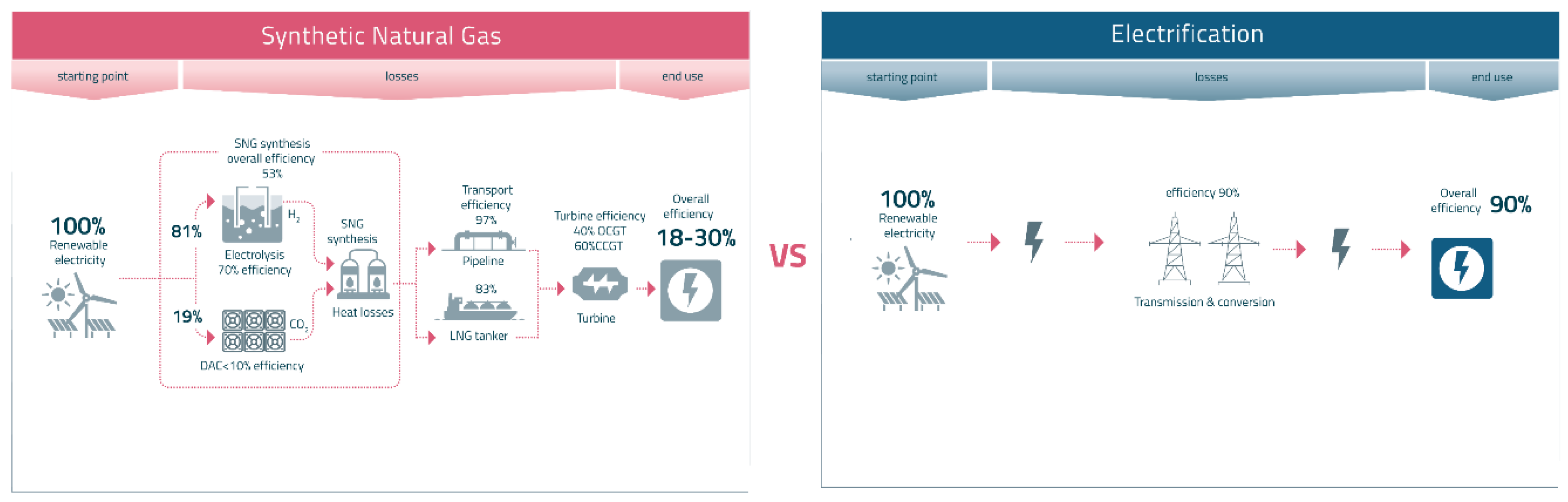
Figure 2.
Global energy budget: Reflected solar irradiation does not contribute to the energy influx, which is approximately 235 W/m²; the equivalent amount is exported as entropy in the form of longwave infrared radiation [17].
Figure 2.
Global energy budget: Reflected solar irradiation does not contribute to the energy influx, which is approximately 235 W/m²; the equivalent amount is exported as entropy in the form of longwave infrared radiation [17].
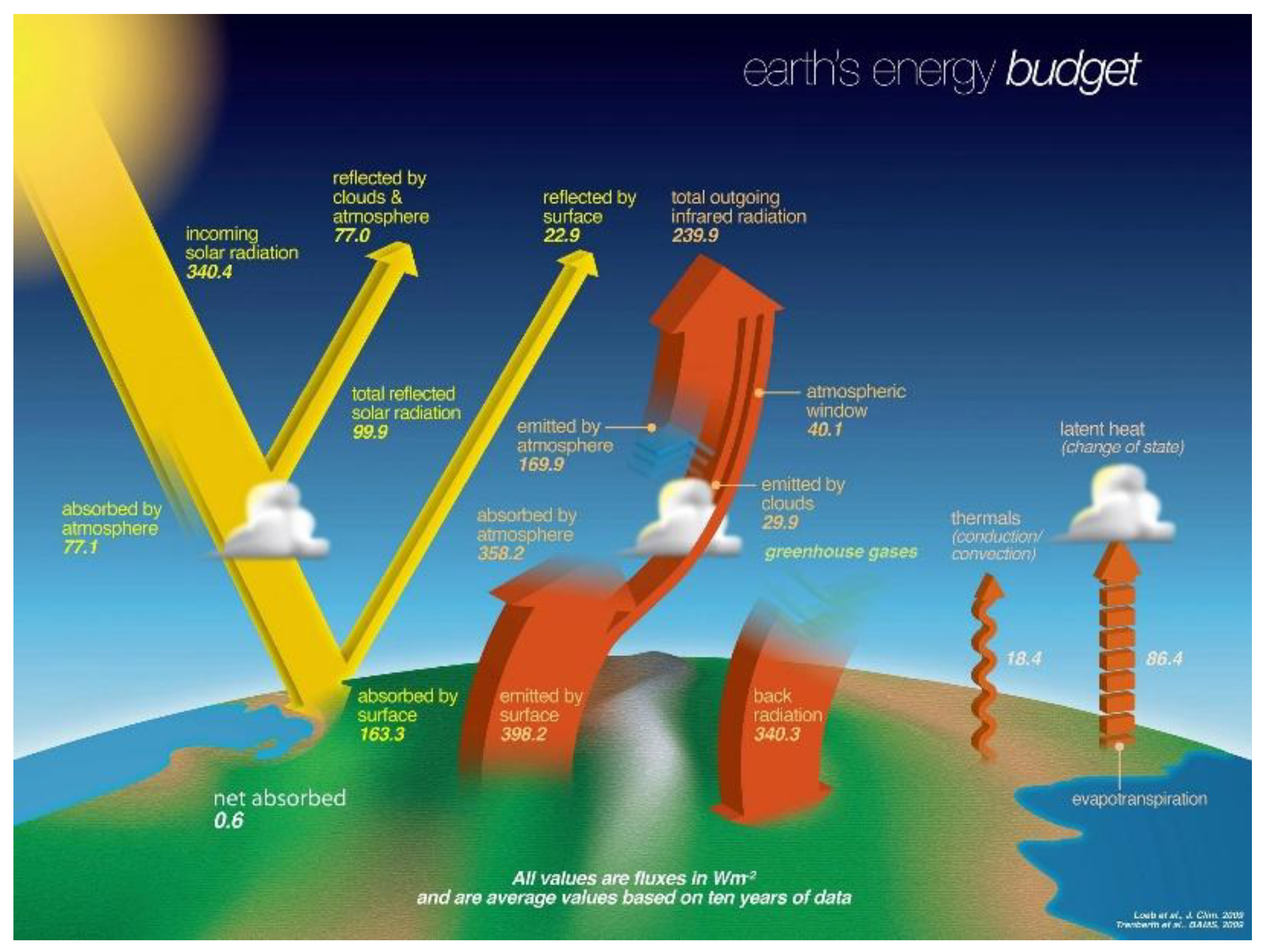
Figure 3.
Global carbon cycle: Natural ecosystems currently absorb approximately half of anthropogenic CO2 emissions. [20.1] It is obvious that they could absorb significantly more. (Creative Commons Attribution 4.0 License).
Figure 3.
Global carbon cycle: Natural ecosystems currently absorb approximately half of anthropogenic CO2 emissions. [20.1] It is obvious that they could absorb significantly more. (Creative Commons Attribution 4.0 License).
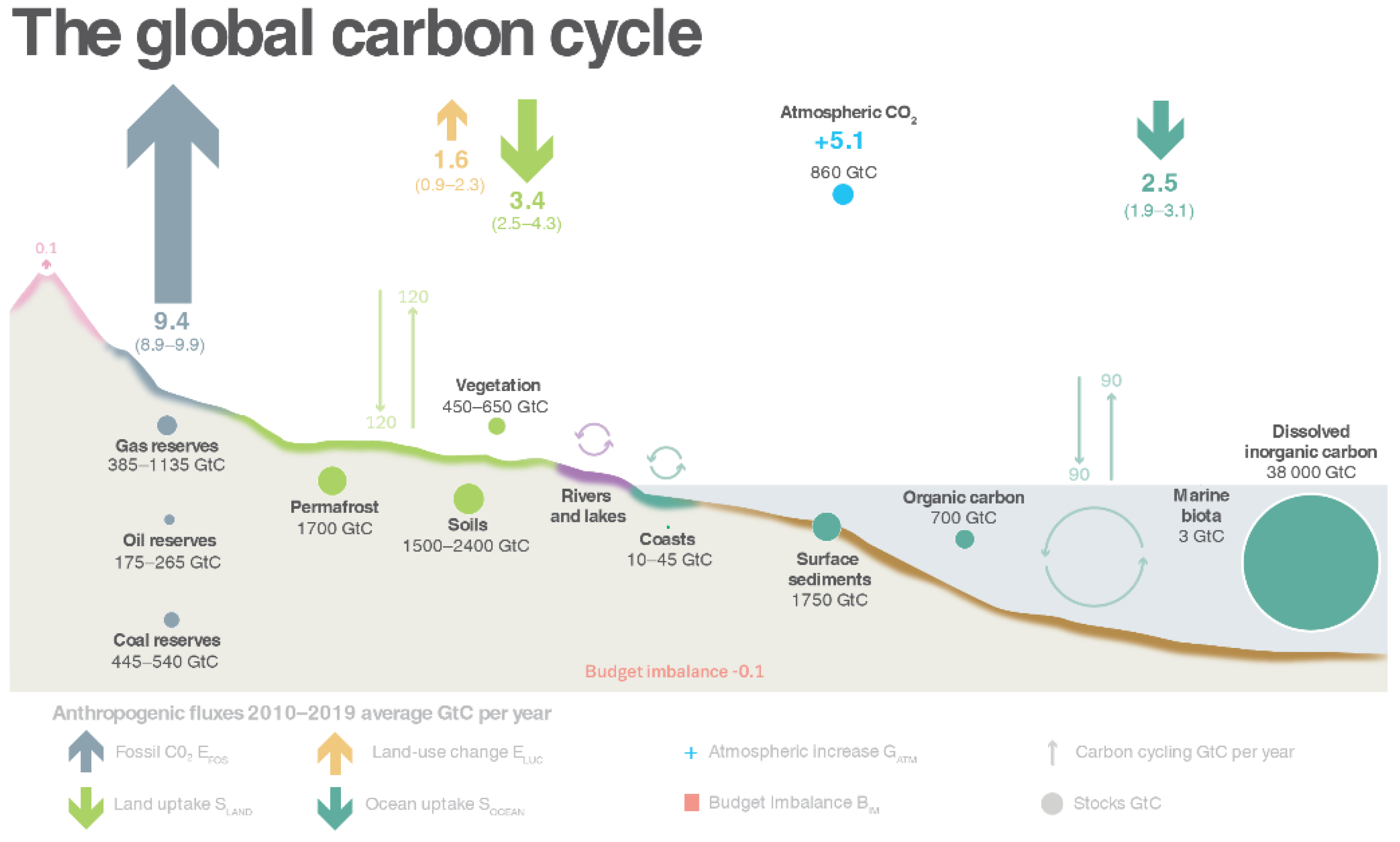
Figure 4.
Mechanisms of carbon storage in soil (the numbers in the graph point to the numbers in brackets in the following text). [21.2].
Figure 4.
Mechanisms of carbon storage in soil (the numbers in the graph point to the numbers in brackets in the following text). [21.2].
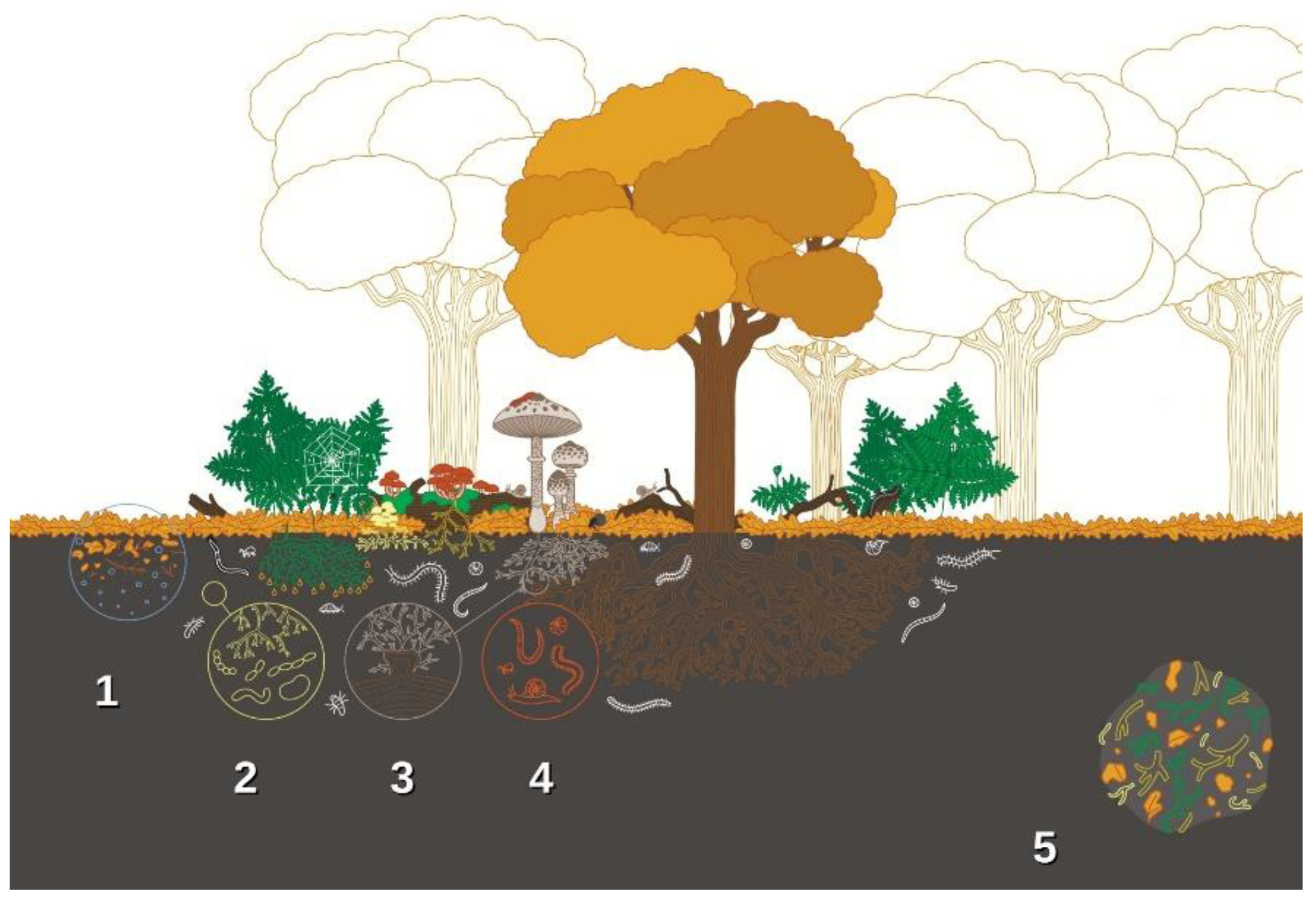
Figure 5.
The global methane budget includes emissions and sinks (with the largest sink being the atmosphere with methane degradation reactions). [34].
Figure 5.
The global methane budget includes emissions and sinks (with the largest sink being the atmosphere with methane degradation reactions). [34].
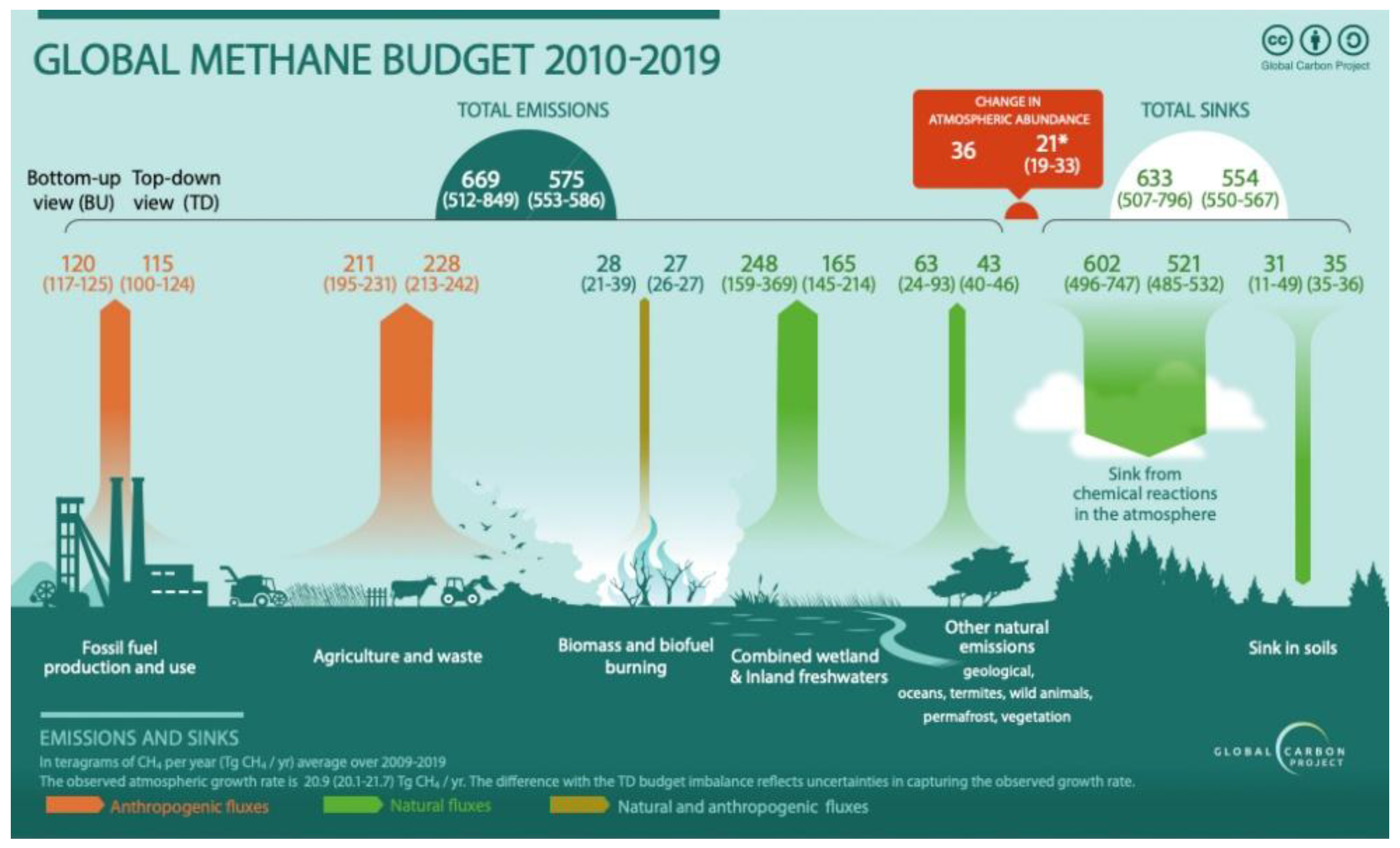

Table 1.
Carbon dioxide (and climate-impacting CO2 equivalents) emissions and capture / storage balance of the Kattendorf farm, also considering emissions resulting from logistics due to the farm’s own direct direct sales to consumers via CSA and its own small shops in Hamburg, Bad Oldesloe and Kattendorf.
Table 1.
Carbon dioxide (and climate-impacting CO2 equivalents) emissions and capture / storage balance of the Kattendorf farm, also considering emissions resulting from logistics due to the farm’s own direct direct sales to consumers via CSA and its own small shops in Hamburg, Bad Oldesloe and Kattendorf.
| Yearly CO2 emissions / fixation-storage balance | min/max t CO2(eq) |
Remarks |
|---|---|---|
| Emissions | (460) | total |
| CO2eq (enteric methane) | 269 | 155 cows/cattle with 54 kg CO2eq/yr, 50 calves with 25 kg CO2eq/yr |
| fossil gas (remaining demand21) and electricity (remaining demand) | 45 | With 0,2 kg CO2 for fossil gas kWh, 0,363 kg CO2 for external current/German mix [47] |
| diesel (tractors, combine harvester, and trucks for logistics) | 146 | In total approximately 55,000 Liters diesel with 2,65 kg CO2 per liter |
| CO2 fixation/in-soil-storage | (1393/3864) | Total |
| pastures | 870/1560 | 6,7/12 t CO2, resp., per hectare |
| fields | 523/2304 | 60% of pastures’ potential |
| Result | 933/3404* | Total CO2 fixation/in-soil-storage minus emissions |
*equivalent to savings of 6617 MWh (if captured by DAC) (at least 7*106 kJ per ton CO2 captured by DAC = 1,944 MWh/t CO2 and with 1 kJ = 0,000277 kWh), the farm itself consumes 160 MWh (PV and from grid) + 540 MWh (Diesel) + 80 MWh fossil gas and wood from wall hedges = 780 MWh (11% savings), resulting in net savings of above 5000 MWh of energy, equivalent to an estimated primary energy amount of 14 GWh or 50 000 GJ.
Disclaimer/Publisher’s Note: The statements, opinions and data contained in all publications are solely those of the individual author(s) and contributor(s) and not of MDPI and/or the editor(s). MDPI and/or the editor(s) disclaim responsibility for any injury to people or property resulting from any ideas, methods, instructions or products referred to in the content. |
© 2026 by the authors. Licensee MDPI, Basel, Switzerland. This article is an open access article distributed under the terms and conditions of the Creative Commons Attribution (CC BY) license (http://creativecommons.org/licenses/by/4.0/).
Copyright: This open access article is published under a Creative Commons CC BY 4.0 license, which permit the free download, distribution, and reuse, provided that the author and preprint are cited in any reuse.


