

Submitted:
07 April 2026
Posted:
08 April 2026
Read the latest preprint version here
Abstract
We prove that the set \( T=\Bigl\{n\in\mathbb{N}: \exists p,q\in\mathbb{N}\;\Bigl((2n=(p+q)(p+q+1)+2q)\;\wedge\ \) \( \forall (x_0,\ldots,x_p)\in\mathbb{N}^{p+1}\;\exists (y_0,\ldots,y_p)\in\{0,\ldots,q\}^{p+1}\ \) \( \bigl((\forall k\in\{0,\ldots,p\}\;(1=x_k \Rightarrow 1=y_k))\;\wedge\ \) \( (\forall i,j,k\in\{0,\ldots,p\}\;(x_i+x_j=x_k \Rightarrow y_i+y_j=y_k))\;\wedge\ \) \( (\forall i,j,k\in\{0,\ldots,p\}\;(x_i\cdot x_j=x_k \Rightarrow y_i\cdot y_j=y_k))\bigr)\Bigr)\Bigr\}\ \) is not recursively enumerable. By using Gödel's \( \beta \) function, we prove that the formula that defines the set T can be easily translated into a first-order formula which uses only + and \( \cdot \). The same properties has the set \( \Bigl\{n\in\mathbb{N} : \exists p,q\in\mathbb{N}\;\Bigl((2n=(p+q)(p+q+1)+2q)\;\wedge\ \) \( \forall (x_0,\ldots,x_p)\in\mathbb{N}^{p+1}\;\exists (y_0,\ldots,y_p)\in\{0,\ldots,q\}^{p+1}\ \) \( \bigl((\forall j,k\in\{0,\ldots,p\}\;(x_j+1=x_k \Rightarrow y_j+1=y_k))\;\wedge\ \) \( (\forall i,j,k\in\{0,\ldots,p\}\;(x_i\cdot x_j=x_k \Rightarrow y_i\cdot y_j=y_k))\bigr)\Bigr)\Bigr\}\ \).
Keywords:
computable function
; eventual domination
; Gödel's β function
; limit-computable function
; recursively enumerable set
; undecidable decision problem
MSC: 03D25
This article is a shortened version of the article [6]. Semi-algorithms differ from algorithms, as they may not terminate.
Definition 1.
(cf. ([4], pp. 233–235)). A computation in the limit of a function is a semi-algorithm which takes as input a non-negative integer n and for every prints a non-negative integer such that .
By Definition 1, a function is computable in the limit when there exists an infinite computation which takes as input a non-negative integer n and prints a non-negative integer on each iteration and prints on each sufficiently high iteration.
For , let
Theorem 1.
([3], p. 118). There exists a limit-computable function which eventually dominates every computable function .
We present an alternative proof of Theorem 1. For , denotes the smallest such that if a system of equations has a solution in , then S has a solution in . The function is computable in the limit and eventually dominates every computable function , see [5]. The term "dominated" in the title of [5] means "eventually dominated".
Theorem 2.
([5]). Flowchart 1 shows a semi-algorithm which computes in the limit.
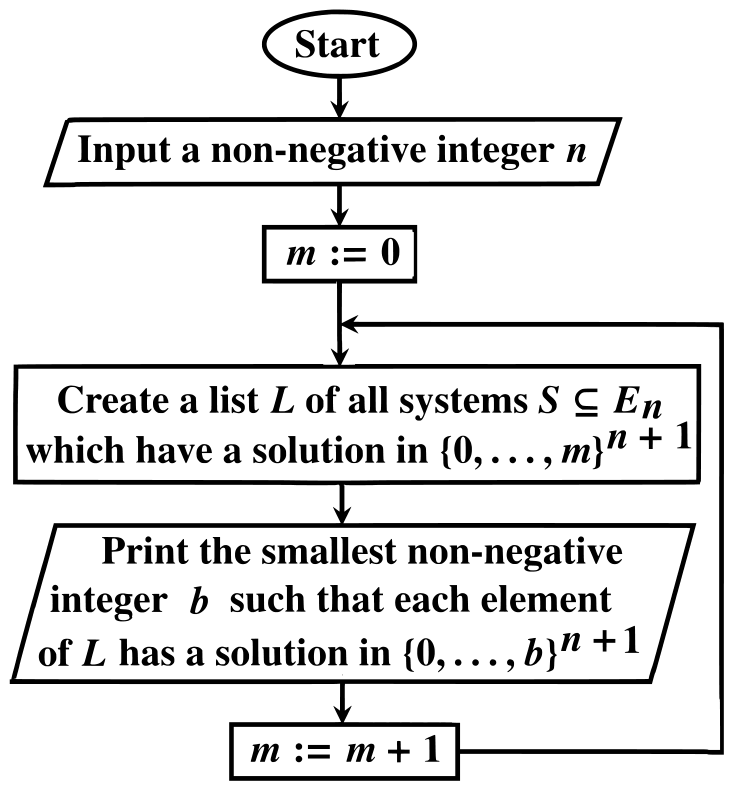
Flowchart 1
A semi-algorithm which computes in the limit
Definition 2.
An approximation of a tuple is a tuple such that
Observation 1.
For every , there exists a set such that
and every tuple possesses an approximation in .
Flowchart 2 shows a simpler semi-algorithm which computes in the limit.
Flowchart 2
A simpler semi-algorithm which computes in the limit
Lemma 1.
For every , the number printed by Flowchart 2 does not exceed the number printed by Flowchart 1.
Proof.
For every ,
□
Lemma 2.
For every , the number printed by Flowchart 1 does not exceed the number printed by Flowchart 2.
Proof.
Let . For every system of equations , if and solves S, then solves the following system of equations:
□
Theorem 3.
For every , Flowcharts 1 and 2 print the same number.
Proof.
It follows from Lemmas 1 and 2. □
Corollary 1.
For every , Flowcharts 1 and 2 print the smallest such that every tuple possesses an approximation in .
Theorem 4.
For every , is the smallest such that every tuple possesses an approximation in .
Proof.
It follows from Theorem 2 and Corollary 1. □
Theorem 5.
No algorithm takes as input non-negative integers n and m and decides whether or not
Proof.
Since the function f is not computable, it follows from Theorem 4. □
Lemma 3.
([2]). The function
is bijective.
Theorem 6.
No algorithm takes as input a non-negative integer n and decides whether or not
Proof.
It follows from Theorem 5 and Lemma 3. □
Let
Theorem 7.
The set is recursively enumerable.
Proof. 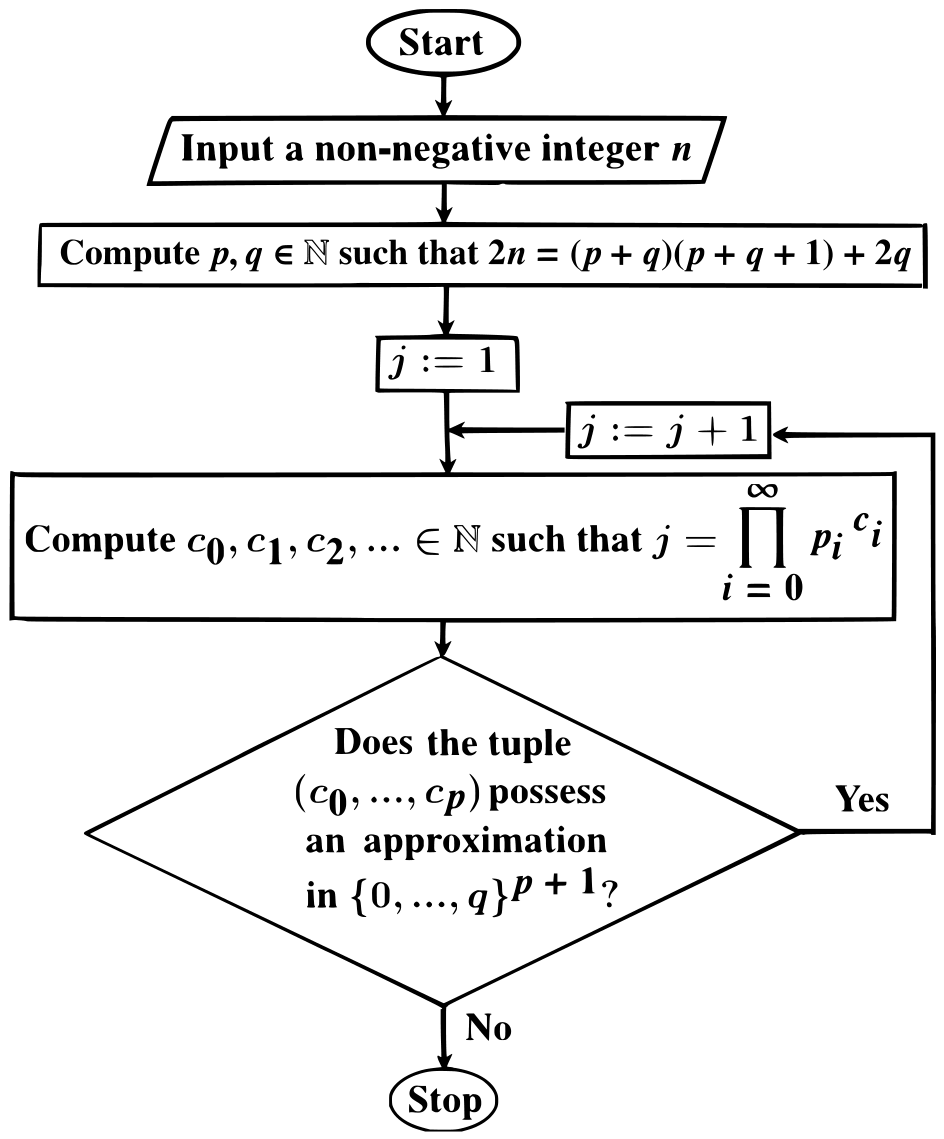
For , let denote the i-th prime number. Flowchart 3 shows a semi-algorithm which takes as input and terminates if and only if .
Flowchart 3
A semi-algorithm which takes as input and terminates if and only if □
Theorem 8.
The set T is not recursively enumerable.
Proof.
It follows from Theorems 6 and 7. □
Let denote Gödel’s function, see [1]. For , equals the remainder after integer division of by .
Lemma 4.
([1]). If , then .
Theorem 9.
The formula that defines the set T can be easily translated into a first-order formula which uses only + and ·.
Proof.
By Lemma 4, the set T consists of all such that
The above formula can be easily translated into a first-order formula which uses only + and ·. □
A more sophisticated proof shows that the set
is not recursively enumerable, see [6]. By using Gödel’s function, the formula that defines the set W can be easily translated into a first-order formula which uses only + and ·.
References
- Gödel’s β function. Available online: https://en.wikipedia.org/wiki/G%C3%B6del%27s_%CE%B2_function.
- Pairing function. Available online: https://en.wikipedia.org/wiki/Pairing_function.
- Royer, J. S.; Case, J. Subrecursive Programming Systems: Complexity and Succinctness; Birkhäuser: Boston, 1994. [Google Scholar]
- Soare, R. I. Interactive computing and relativized computability. In Computability: Turing, Gödel, Church and beyond; Copeland, B. J., Posy, C. J., Shagrir, O., Eds.; MIT Press: Cambridge, MA, 2013; pp. 203–260. [Google Scholar]
- Tyszka, A. All functions g:N→N which have a single-fold Diophantine representation are dominated by a limit-computable function f:N∖{0}→N which is implemented in MuPAD and whose computability is an open problem. In Computation, cryptography, and network security; Daras, N. J., Rassias, M. Th., Eds.; Springer: Cham, 2015; pp. 577–590. [Google Scholar] [CrossRef]
- Tyszka, A. There exists a non-recursively enumerable subset of N. which has a short definition in terms of arithmetic. Available online: https://arxiv.org/abs/1309.2605.
Disclaimer/Publisher’s Note: The statements, opinions and data contained in all publications are solely those of the individual author(s) and contributor(s) and not of MDPI and/or the editor(s). MDPI and/or the editor(s) disclaim responsibility for any injury to people or property resulting from any ideas, methods, instructions or products referred to in the content. |
© 2026 by the author. Licensee MDPI, Basel, Switzerland. This article is an open access article distributed under the terms and conditions of the Creative Commons Attribution (CC BY) license.
Copyright: This open access article is published under a Creative Commons CC BY 4.0 license, which permit the free download, distribution, and reuse, provided that the author and preprint are cited in any reuse.


