Preprint
Article

This version is not peer-reviewed.

Effect of Creatinine on Various Clinical Outcomes in Patients with Severe Traumatic Brain Injury (TBI)

A peer-reviewed article of this preprint also exists.

Submitted:

31 July 2025

Posted:

05 August 2025

You are already at the latest version

Abstract

Background: Traumatic brain injury (TBI) is a major public health concern. Creatinine (Cr) has been well studied as a marker of renal function, specifically the development of acute kidney injury (AKI) in TBI patients. We aimed to evaluate the effect of Cr on various clinical outcomes in patients with severe TBI. Methods: We investigated the relationship between Cr levels at various time points and a range of clinical variables, using parametric (ANOVA, two-tailed t-test, and linear regression modeling) statistical testing. Results: 1,000 patients were included in our study. We found a significant association between sex and Cr level at intensive care unit (ICU) admission (p=0.001) and ICU discharge (p=0.005). Degree of creatinemia had a significant effect on both mean ISS (p=0.0003) and GCS (p=0.004) scores at ICU admission as well as ISS (p=0.017) and GCS (p=0.001) scores at patient death timepoints. Change in Cr from Hospital to ICU admission was significantly correlated with vent days (p=0.045). Change in Cr from ICU admission to ICU discharge was significantly correlated with hospital length of stay (LOS; p=0.001), ICU LOS (p=0.000), and vent days (p=0.011). Overall, there were significant correlations between Cr at admission and ICU LOS (p=0.043), Cr at ICU admission and ICU LOS (p=0.001), and Cr at ICU admission and vent days (p=0.031). Conclusion: Our findings support existing literature that demonstrates a positive relationship between Cr levels, ICU LOS, and vent days amongst patients with severe TBI.

Keywords: 
;  ;  ;  ;  ;  

1. Introduction

Creatinine (Cr) is chemically known as α-methyl guanidinoacetic acid, and is the final breakdown product of creatine phosphate in skeletal muscle, produced at a relatively constant rate proportional to muscle mass. Serum creatinine is formed through a spontaneous non-enzymatic anhydration of creatine in muscle cells. Levels are influenced by muscle mass, age, sex, and certain medications. As creatinine is freely filtered by the glomerulus and minimally secreted by renal tubules, it is the most widely used endogenous marker for estimating glomerular filtration rate (GFR) in clinical practice [1]. As such, a rise in creatinine is central to the diagnosis and staging of acute kidney injury (AKI). However, serum creatinine levels may lag behind acute changes in GFR, particularly in the early phase of AKI or after trauma, where rapid shifts in renal function and muscle metabolism occur [2].
In the context of traumatic brain injury (TBI) and major trauma, serum creatinine is often used to diagnose and stage acute kidney injury (AKI). AKI is a frequent and early complication after TBI, occurring in approximately 10–19% of patients, and is independently associated with increased mortality and worse neurological outcomes [3,4,5]. A 2021 study investigating occurrence rate, risk factors, timing, and association with outcome of acute kidney injury in a large cohort of TBI patients across sixty-five ICUs in Europe reported that patients with AKI had a significantly increased ICU length of stay compared to patients without AKI, and that AKI occurrence was associated with increased ICU and overall mortality [3].
Hemodynamic instability, the use of nephrotoxic agents such as mannitol or vancomycin, rhabdomyolysis, and systemic inflammatory responses are all factors that can contribute to AKI and altered creatinine levels in TBI [5]. Additionally, serum creatinine at admission is an independent risk factor for subsequent AKI in TBI patients [5,6]. Some studies have also noted augmented renal clearance following TBI, especially in younger patients, leading to deceptively low serum creatinine despite increased glomerular filtration [7,8]. Thus, close monitoring of renal function and creatinine trends is essential in the management of TBI.
TBI is defined as an alteration in brain function, or other evidence of brain pathology, caused by an external mechanical force such as a blow, jolt, or penetration to the head. TBIs are classified by severity—mild, moderate, or severe—based on clinical criteria such as the Glasgow Coma Scale (GCS), duration of loss of consciousness, and presence of amnesia or focal neurological deficits [9,10,11]. GCS is the most widely used clinical scale to measure the severity of TBI, assessing eye, verbal, and motor responses to categorize TBI as mild (GCS 13–15), moderate (GCS 9–12), or severe (GCS ≤8) [12]. TBI severity can also be measured using the Abbreviated Injury Scale (AIS), an anatomical scoring system that uses clinical and imaging findings to rate injury severity in six body regions (head/neck, face, thorax, abdomen, extremities, external) on a scale from 1 (minor) to 6 (maximal/fatal) [13]. The Injury Severity Score (ISS) is a widely used composite score derived from AIS scores. It is calculated by summing the squares of the three highest AIS scores from different body regions. An ISS >15 is commonly used to define major trauma [14].
Mild TBI, or concussion, accounts for the majority of TBI cases and is characterized by transient neurological dysfunction, typically with GCS 13–15, brief or no loss of consciousness, and no abnormalities on standard neuroimaging. Most patients with mild TBI recover within weeks, though a small percentage may experience persistent symptoms (post-concussive syndrome), including headache, dizziness, cognitive impairment, and mood disturbances [9,15,16]. Moderate and severe TBIs are associated with more pronounced and prolonged impairment, including risk of permanent disability or death. The primary injury, or mechanical disruption of brain tissue at the moment of trauma, is followed by secondary injury, such as delayed cellular and molecular cascades (i.e., inflammation, oxidative stress, and neurovascular dysfunction) [9,17].
Based on the most recent CDC data, there were approximately 214,110 TBI-related hospitalizations in 2020 and 69,473 TBI-related deaths in 2021. People aged 75 years and older account for about 32% of TBI-related hospitalizations and 28% of TBI-related deaths. Additionally, males are nearly two times more likely to be hospitalized and three times more likely to die from a TBI than females [18]. TBI is a major public health concern, with millions of cases occurring annually worldwide. Management is tailored to severity, with acute stabilization, prevention of secondary injury, and multidisciplinary rehabilitation as key components for moderate-to-severe cases [10,11].
Creatinine is a well-studied endogenous marker of GFR and is frequently used to stage AKI in the setting of trauma. Our study aimed to analyze the relationship of creatinine to several clinical outcomes and timeframes amongst patients admitted with severe TBI.

2. Methods

We performed a single-center, retrospective review at Elmhurst Hospital, a Level 1 trauma center in Queens, New York City. All patients who presented to the hospital with a severe traumatic brain injury, defined as an AIS score of 3 or higher, between January 1, 2020, and December 31, 2023, were included in the study. Patients who tested positive for COVID-19 at the time of admission, those who died or were discharged within 24 hours of their original injury, and those who had non-severe and minor injuries were excluded. Patient data were obtained from the National Trauma Registry of the American College of Surgeons (NTRACS) database at our institution. Data extracted and organized in Excel included demographics (sex, age), injury type (blunt vs. penetrating), mechanism of injury (e.g., fall, motor vehicle collision, assault), diagnosis (e.g., concussion, subdural hematoma, subarachnoid hemorrhage), and number of injuries (one to four or more). After data review, a final cohort of 1,000 patients was included in the analysis.
We conducted several levels of analysis:
-
Analysis 1: Creatinine levels were compared at five time points against demographic and clinical factors using two-tailed t-test for 2-category analyses (sex, injury type) and ANOVA one-way test, with Welch’s transformation when Bartlett’s assumptions of equal variance were violated, for analyses of more than 2-categories (age range, injury mechanism, diagnosis, number of injuries).
-
Analysis 2: Degree of creatinemia was related to mean GCS and ISS scores across various time points using a one-way ANOVA test, with Welch’s transformation when Bartlett’s assumptions of equal variance were violated.
-
Analysis 3: Linear regression modeling was used to assess correlations between the continuous independent variable (change in creatinine level) and continuous (hospital length of stay, Intensive Care Unit length of stay, ventilator days) and categorical (mortality) dependent variables.
-
Analysis 4: Linear regression modeling was used to assess correlations between the continuous independent variable (creatinine levels across admission) and continuous (hospital length of stay, Intensive Care Unit length of stay, ventilator days) and categorical (mortality) dependent variables.

3. Results

This study consisted of a cohort of 1,000 patients (Table 1; 23% female, N=232). Most patients (N=793, 64.26%) received the diagnosis of intraparenchymal hemorrhage (IPH). This was followed by subarachnoid hemorrhage (SAH; N=424, 34.36%), and concussion (N=15, 1.22%).
Analysis 1 (Table 2) revealed a significant association between sex and Cr level at intensive care unit (ICU) admission (p=0.001) and ICU discharge (p=0.005). No significant associations were found between other demographic or clinical factors and creatinine levels at any of the measured time points.
Analysis 2 (Table 3) examined the effects of five different categories of creatinemia on mean ISS and GCS scores over five time points. For the Cr level at ICU admission, the creatinemia category had a significant effect on both mean ISS (p=0.0003) and GCS (p=0.004) scores. Likewise, at the Cr at patient death time point, creatinemia category had a significant effect on both mean ISS (p=0.017) and GCS (p=0.001) scores. No significant effect was seen on mean ISS or GCS scores at hospital admission, ICU discharge, or hospital discharge Cr.
The third level of analysis (Table 4) assessed correlations between change in creatinine level and continuous (hospital length of stay, ICU length of stay, ventilator days) and categorical (mortality) dependent variables. Change in Cr from Hospital to ICU admission was significantly correlated with ventilator days (p=0.045; Coefficient ± 95% CI= -0.500 ± -0.989 – -0.011). Change in Cr from ICU admission to ICU discharge was significantly correlated with hospital length of stay (Figure 1; p=0.001; Coefficient ± 95% CI= -1.380 ± -2.180 – -0.580), ICU length of stay (p=0.000; Coefficient ± 95% CI= -0.542 ± -0.827 – -0.257), and ventilator days (p=0.011; Coefficient ± 95% CI= -0.322 ± -0.569 – -0.074).
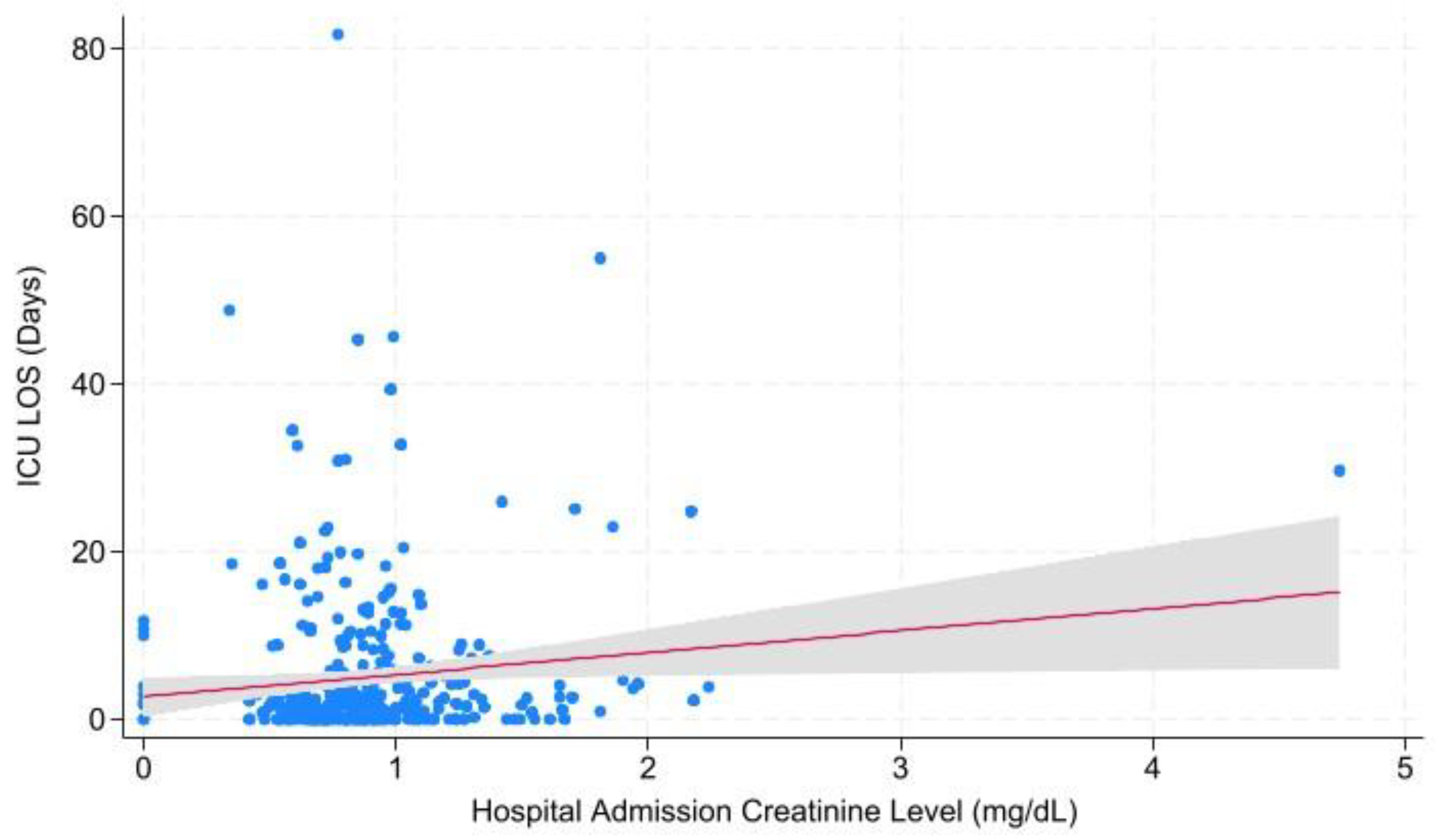
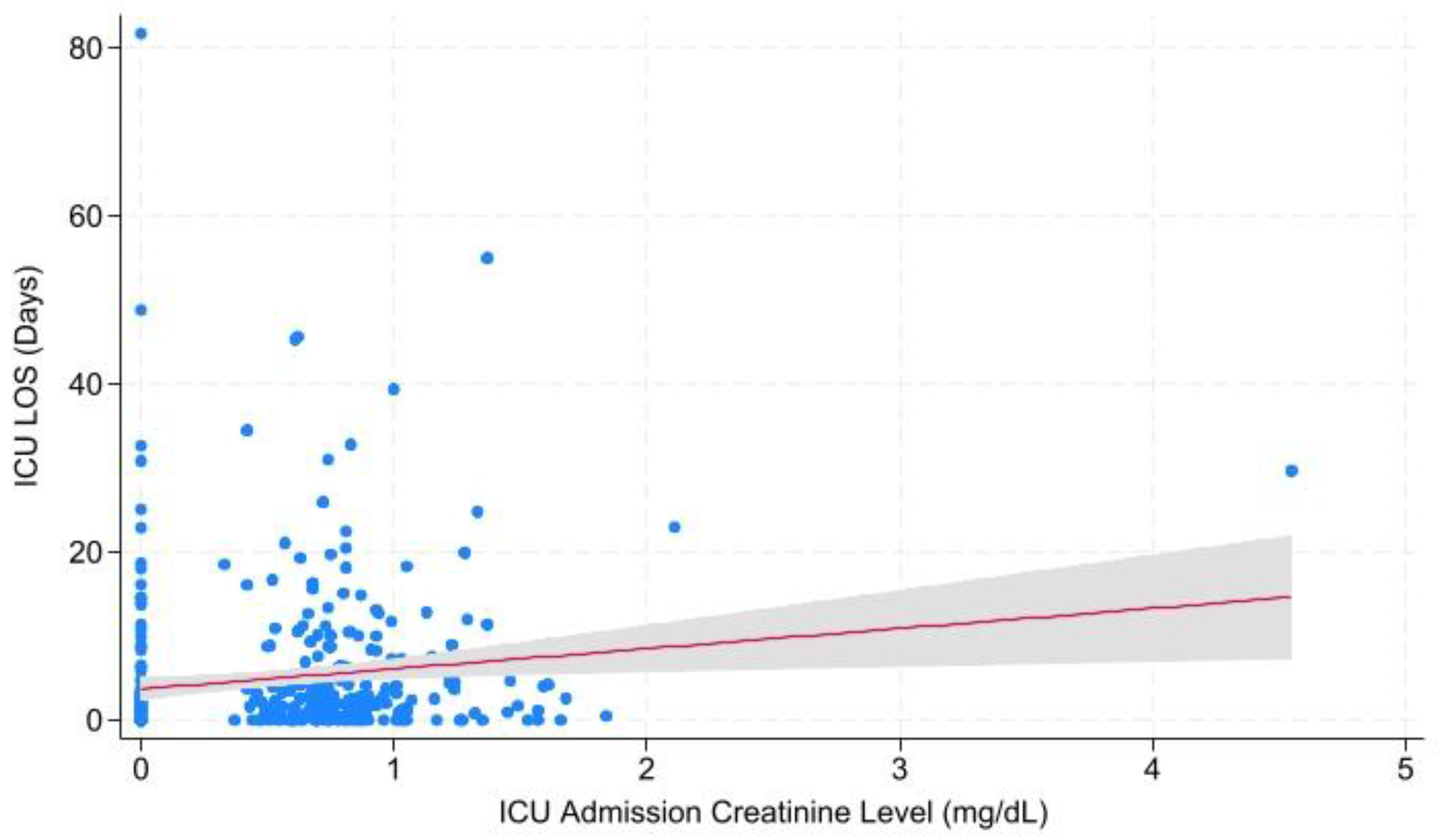
Analysis 4 (Table 5) assessed correlations between creatinine level across admission and continuous (hospital length of stay, ICU length of stay, ventilator days) and categorical (mortality) dependent variables. Overall, there were significant correlations between Cr at admission and ICU length of stay (p=0.043; Coefficient ± 95% CI= 0.586 ± 0.019 – 1.152), Cr at ICU Admission and ICU length of stay (p=0.001; Coefficient ± 95% CI= 1.029 ± 0.429 – 1.630) and Cr ICU Admission and vent days (p=0.031; Coefficient ± 95% CI= 0.576 ± 0.054 – 1.098). For patients with 1 injury (N=508), there were significant correlations between Cr at ICU admission and hospital length of stay (p=,0.024; Coefficient ± 95% CI= 1.238 ± 0.162 – 2.315), ICU length of stay (p=0.003; Coefficient ± 95% CI= 0.766 ± 0.255 – 1.276), and vent days (p=0.002; Coefficient ± 95% CI= 0.508 ± 0.186 – 0.831). For patients with 2 injuries (N=367), there were significant correlations between Cr at admission and ICU length of stay (Figure 2; p=0.029; Coefficient ± 95% CI= 2.629 ± 0.277 – 4.980) and between Cr at ICU admission and ICU length of stay (Figure 3; p=0.010; Coefficient ± 95% CI= 2.399 ± 0.572 – 4.227).
No significant associations were noted amongst patients who sustained 3 or more injuries. However, this subset comprised a relatively small cohort (N=89 for 3 injuries and N=19 for 4 or more injuries). Thus, these findings may represent a Type II error.

4. Discussion

The impact of creatinine levels among patients suffering severe TBI has been well studied, but mostly in the context of AKI, often defined by changes in serum creatinine, and its association with ICU outcomes in TBI populations [3,4,5,6,7,8,19,20]. Large multicenter cohort studies have demonstrated that AKI is associated with increased ICU length of stay and worse neurological outcomes in TBI patients. The Collaborative European NeuroTrauma Effectiveness Research in Traumatic Brain Injury (CENTER-TBI) study found that AKI (using KDIGO [21] creatinine criteria) was associated with longer ICU stays and higher mortality at 6 months [3]. Similarly, severe AKI (stage 3 or greater, based on creatinine) has been linked to increased hospital length of stay and greater need for tracheostomy and gastrostomy, which are indirect markers of prolonged ventilator dependence [19]. While our study did not examine AKI as a composite endpoint in examining TBI outcomes, we did consider the direct relationship between creatinine levels and a number of important clinical outcomes.
When comparing creatinine levels at different time points to demographic factors, we found a significant difference among sexes for creatinine at ICU admission and ICU discharge, with males presenting with higher creatinine levels at these time points. One 2021 study found sex-based differences in serum creatinine response after TBI [22]. In the acute phase, both male and female TBI patients showed changes in creatinine. However, elevated creatinine is associated with improved short-term neurological recovery in males, but not in females [22].
While we did not note any other significant relationships between demographics and creatinine in our study, existing literature suggests age is a strong predictor of both renal outcomes and overall prognosis after TBI, with patients < 65 years old having a higher risk of developing chronic kidney disease (CKD) post-injury [23,24]. One 2023 case-control study aimed to investigate the clinical outcomes of TBI patients with or without CKD comorbidity at the time of injury and found that ICU length of stay and hospitalization expenses were higher in the CKD group than the non-CKD group, although not statistically significant, and advanced age, low admission GCS score, elevated blood urea, and creatinine levels were significantly associated with a poor neurological prognosis [24].
There is no evidence in the medical literature that injury type (i.e., blunt vs. penetrating), injury mechanism, or specific type of intracranial injury (i.e., subarachnoid hemorrhage, epidural hematoma, etc.) has a significant independent impact on creatinine levels or the risk of AKI in patients with TBI. However, the number of injuries, and specifically whether a patient has isolated TBI or polytrauma, is associated with an increased risk of AKI and higher creatinine levels [3,5,25].
In this study, we did not note significant associations between the number of injuries and measured creatinine at any particular time point. We did, however, find significant relationships between baseline creatinine levels at certain timepoints and specific outcomes such as ICU length of stay and vent days when stratified by number of injuries. Specifically, patients with one or two injuries had a significant relationship between creatinine level at the time of ICU admission and ICU length of stay. This is in keeping with robust research that demonstrates higher creatinine levels and the development of AKI are associated with increased ICU length of stay in patients with TBI [26,27]. Overall, and for patients with 1 injury, creatinine level at ICU admission was significantly associated with ventilator days. As with increased ICU length of stay, previous multicenter studies and meta-analyses have shown that the number of vent days is positively correlated with AKI, as defined by creatinine levels [25,28,29].
Lastly, we found that the range of creatinemia was significantly associated with ISS and GCS scores at ICU admission and patient death timepoints. While the range of creatinemia has not been related to injury severity scoring in previous studies, several existing studies have shown that lower GCS and higher ISS are associated with higher creatinine levels and increased risk of AKI in severe TBI patients [5,20]. Zhang et al. (2025) conducted a systematic review and meta-analysis and reported that lower GCS at admission and GCS ≤8 were significantly associated with increased risk of AKI, as defined by elevated creatinine. Higher admission serum creatinine was also identified as a risk factor for AKI in TBI patients [5]. De Cássia et al. (2024) conducted a retrospective cohort study of severe TBI and showed that higher New Injury Severity Score (NISS) and lower GCS were independently associated with both the occurrence and severity of AKI, as well as with an increase in in-hospital mortality [20].
An important limitation of this study is the lack of demographic variables assessed in our analysis of the relationship between creatinine levels and severe TBI. While age and sex-based differences have been reported in serum creatinine levels following TBI [22,23,24], other demographic factors such as race and ethnicity have also been shown to influence creatinine levels [25]. In addition, pre-existing comorbidities such as diabetes mellitus, hypertension, chronic kidney disease, congestive heart failure, and higher body mass index (BMI) have all been shown to be associated with increased risk of increased creatinine levels and AKI in patients with severe TBI [25,30,31]. Secondly, most studies evaluated creatinine in the context of AKI, not as a standalone endpoint. There was little literature on creatinine as it relates to TBI alone, as it is so commonly used to assess GFR and AKI. As a result, the relationship between creatinine and our measured outcomes of interest may have low external validity as it pertains to the measurement of renal function.

5. Conclusion

Our analysis corroborates existing literature that demonstrates a positive relationship between creatinine levels, ICU length of stay, and ventilator days amongst patients with severe traumatic brain injury. Future research should focus on expanding clinical and demographic factors in the assessment of creatinine changes associated with severe TBI, as well as potentially including measurement of renal function and other clinical endpoints related to creatinine levels.

Author Contributions

Conceptualization—B.S.; Resources- B.S., and G.A.; Methodology- B.S. and Z.S., Formal analysis- B.S. and S.R., Investigation- B.S., K.T. and N.D.B., writing—original draft preparation—B.S. and S.D.M.; writing—review and editing—B.S. and J.W., supervision—B.S.; project administration—B.S. All authors have read and agreed to the published version of the manuscript.

Funding

There is no grant support or financial relationship for this manuscript.

Institutional Review Board Statement

This retrospective study was approved by the IRB at Elmhurst Facility on 5 July 2024, with IRB number 24-12-092-05G.

Informed Consent Statement

Retrospective analysis was performed on anonymized data, and informed consent was not applicable.

Data Availability Statement

The data was requested from the Elmhurst Trauma registry and extracted using electronic medical records after receiving approval from the Institutional Review Board at our facility (Elmhurst Hospital Center).

Conflicts of Interest

The authors have no competing interests to declare.

References

  1. Ávila M, Mora Sánchez MG, Bernal Amador AS, Paniagua R. The Metabolism of Creatinine and Its Usefulness to Evaluate Kidney Function and Body Composition in Clinical Practice. Biomolecules 2025, 15, 41. [Google Scholar] [CrossRef] [PubMed]
  2. Ronco C, Bellomo R, Kellum JA. Acute kidney injury. Lancet 2019, 394, 1949–1964. [Google Scholar] [CrossRef] [PubMed]
  3. Robba C, Banzato E, Rebora P, Iaquaniello C, Huang CY, Wiegers EJA, Meyfroidt G, Citerio G; Collaborative European NeuroTrauma Effectiveness Research in Traumatic Brain Injury (CENTER-TBI) ICU Participants and Investigators. Acute Kidney Injury in Traumatic Brain Injury Patients: Results From the Collaborative European NeuroTrauma Effectiveness Research in Traumatic Brain Injury Study. Crit Care Med. 2021, 49, 112–126. [Google Scholar] [CrossRef] [PubMed]
  4. Barea-Mendoza JA, Chico-Fernández M, Quintana-Díaz M, Serviá-Goixart L, Fernández-Cuervo A, Bringas-Bollada M, Ballesteros-Sanz MÁ, García-Sáez Í, Pérez-Bárcena J, Llompart-Pou JA; Neurointensive Care and Trauma Working Group of the Spanish Society of Intensive Care Medicine (SEMICYUC). Traumatic Brain Injury and Acute Kidney Injury-Outcomes and Associated Risk Factors. J Clin Med. 2022, 11, 7216. [Google Scholar] [CrossRef] [PubMed] [PubMed Central]
  5. Zhang Y, Diao H, Ding J, Lu G, Jiang S, Zhang Y, Wei Q, Wang Z, Yu H, Shao J, Li Y. Risk factors associated with acute kidney injury in patients with traumatic brain injury: A systematic review and meta-analysis. J Crit Care. 2025, 89, 155126. [Google Scholar] [CrossRef] [PubMed]
  6. Wang RR, He M, Ou XF, Xie XQ, Kang Y. The Predictive Value of Serum Uric Acid on Acute Kidney Injury following Traumatic Brain Injury. Biomed Res Int. 2020, 2020, 2874369. [Google Scholar] [CrossRef] [PubMed] [PubMed Central]
  7. Udy AA, Jarrett P, Lassig-Smith M, Stuart J, Starr T, Dunlop R, Deans R, Roberts JA, Senthuran S, Boots R, Bisht K, Bulmer AC, Lipman J. Augmented Renal Clearance in Traumatic Brain Injury: A Single-Center Observational Study of Atrial Natriuretic Peptide, Cardiac Output, and Creatinine Clearance. J Neurotrauma. 2017, 34, 137–144. [Google Scholar] [CrossRef] [PubMed]
  8. Campassi ML, Repetto FG, Banegas Litardo DM, Castor R, Gómez G, Tiseyra B, Flores L, Ramirez I, Maspoli D, Báez J, Boroni I, Bertola R, Estenssoro E, Dubin A. Incidence and determinants of augmented renal clearance in traumatic brain injury: A prospective observational study. J Crit Care. 2022, 70, 154065. [Google Scholar] [CrossRef] [PubMed]
  9. Blennow K, Brody DL, Kochanek PM, Levin H, McKee A, Ribbers GM, Yaffe K, Zetterberg H. Traumatic brain injuries. Nat Rev Dis Primers. 2016, 2, 16084. [Google Scholar] [CrossRef] [PubMed]
  10. Capizzi A, Woo J, Verduzco-Gutierrez M. Traumatic Brain Injury: An Overview of Epidemiology, Pathophysiology, and Medical Management. Med Clin North Am. 2020, 104, 213–238. [Google Scholar] [CrossRef] [PubMed]
  11. Eapen BC, Allred DB, O’Rourke J, Cifu DX. Rehabilitation of moderate-to-severe traumatic brain injury. Semin Neurol. 2015, 35, e1–e3. [Google Scholar] [CrossRef] [PubMed]
  12. Jain S, Iverson LM. Glasgow Coma Scale. [Updated 2023 Jun 12]. In: StatPearls [Internet]. Treasure Island (FL): StatPearls Publishing; 2025 Jan-. Available from: https://www.ncbi.nlm.nih.gov/books/NBK513298/.
  13. Civil ID, Schwab CW. The Abbreviated Injury Scale, 1985 revision: a condensed chart for clinical use. J Trauma. 1988, 28, 87–90. [Google Scholar] [CrossRef] [PubMed]
  14. Palmer CS, Gabbe BJ, Cameron PA. Defining major trauma using the 2008 Abbreviated Injury Scale. Injury. 2016, 47, 109–15. [Google Scholar] [CrossRef] [PubMed]
  15. Mott TF, McConnon ML, Rieger BP. Subacute to chronic mild traumatic brain injury. Am Fam Physician. 2012, 86, 1045–51. [Google Scholar] [PubMed]
  16. Bielanin JP, Metwally SAH, Paruchuri SS, Sun D. An overview of mild traumatic brain injuries and emerging therapeutic targets. Neurochem Int. 2024, 172, 105655. [Google Scholar] [CrossRef] [PubMed]
  17. Orr TJ, Lesha E, Kramer AH, Cecia A, Dugan JE, Schwartz B, Einhaus SL. Traumatic Brain Injury: A Comprehensive Review of Biomechanics and Molecular Pathophysiology. World Neurosurg. 2024, 185, 74–88. [Google Scholar] [CrossRef] [PubMed]
  18. CDC. TBI Data. Traumatic Brain Injury & Concussion. Published April 29, 2024. https://www.cdc.gov/traumatic-brain-injury/data-research/index.html.
  19. Luu D, Komisarow J, Mills BM, Vavilala MS, Laskowitz DT, Mathew J, James ML, Hernandez A, Sampson J, Fuller M, Ohnuma T, Raghunathan K, Privratsky J, Bartz R, Krishnamoorthy V. Association of Severe Acute Kidney Injury with Mortality and Healthcare Utilization Following Isolated Traumatic Brain Injury. Neurocrit Care. 2021, 35, 434–440. [Google Scholar] [CrossRef] [PubMed] [PubMed Central]
  20. de Cássia Almeida Vieira R, de Barros GL, Paiva WS, de Oliveira DV, de Souza CPE, Santana-Santos E, de Sousa RMC. Severe traumatic brain injury and acute kidney injury patients: factors associated with in-hospital mortality and unfavorable outcomes. Brain Inj. 2024, 38, 108–118. [Google Scholar] [CrossRef] [PubMed]
  21. KDIGO. “KDIGO Clinical Practice Guideline for Acute Kidney Injury.” Journal of the International Society of Nephrology, Mar. 2012.
  22. Zheng B, Fan J, He R, Yin R, Wang J, Zhong Y. Antioxidant status of uric acid, bilirubin, albumin, and creatinine during the acute phase after traumatic brain injury: sex-specific features. Int J Neurosci. 2021, 131, 833–842. [Google Scholar] [CrossRef] [PubMed]
  23. Wu CL, Kor CT, Chiu PF, Tsai CC, Lian IB, Yang TH, Tarng DC, Chang CC. Long-term renal outcomes in patients with traumatic brain injury: A nationwide population-based cohort study. PLoS One. 2017, 12, e0171999. [Google Scholar] [CrossRef] [PubMed] [PubMed Central]
  24. Mo H, Fan F, Liu J, Zhang W, Wang Q, Yuan X. Chronic kidney disease as a predictive factor for poor prognosis in traumatic brain injury among older adults: a case-control study. Front Neurol. 2023, 14, 1286592. [Google Scholar] [CrossRef] [PubMed] [PubMed Central]
  25. Maragkos GA, Cho LD, Legome E, Wedderburn R, Margetis K. Prognostic Factors for Stage 3 Acute Kidney Injury in Isolated Serious Traumatic Brain Injury. World Neurosurg. 2022, 161, e710–e722. [Google Scholar] [CrossRef] [PubMed]
  26. Böhmer AB, Just KS, Lefering R, Paffrath T, Bouillon B, Joppich R, Wappler F, Gerbershagen MU. Factors influencing lengths of stay in the intensive care unit for surviving trauma patients: a retrospective analysis of 30,157 cases. Crit Care. 2014, 18, R143. [Google Scholar] [CrossRef] [PubMed] [PubMed Central]
  27. Corral L, Javierre CF, Ventura JL, Marcos P, Herrero JI, Mañez R. Impact of non-neurological complications in severe traumatic brain injury outcome. Crit Care. 2012, 16, R44. [Google Scholar] [CrossRef] [PubMed] [PubMed Central]
  28. Søvik S, Isachsen MS, Nordhuus KM, Tveiten CK, Eken T, Sunde K, Brurberg KG, Beitland S. Acute kidney injury in trauma patients admitted to the ICU: a systematic review and meta-analysis. Intensive Care Med. 2019, 45, 407–419. [Google Scholar] [CrossRef] [PubMed]
  29. Harrois A, Soyer B, Gauss T, Hamada S, Raux M, Duranteau J; Traumabase® Group. Prevalence and risk factors for acute kidney injury among trauma patients: a multicenter cohort study. Crit Care. 2018, 22, 344. [Google Scholar] [CrossRef] [PubMed] [PubMed Central]
  30. Al-Thani H, Ramzee AF, Asim M, El-Menyar A. Predisposing Factors and Outcome of Acute Kidney Injury After Blunt Trauma: A 10-Year Study. J Surg Res. 2023, 284, 193–203. [Google Scholar] [CrossRef] [PubMed]
  31. Ahmed N, Mathew RO, Kuo YH, Md AA. Risk of severe acute kidney injury in multiple trauma patients: Risk estimation based on a national trauma dataset. Injury 2020, 51, 45–50. [Google Scholar] [CrossRef] [PubMed]
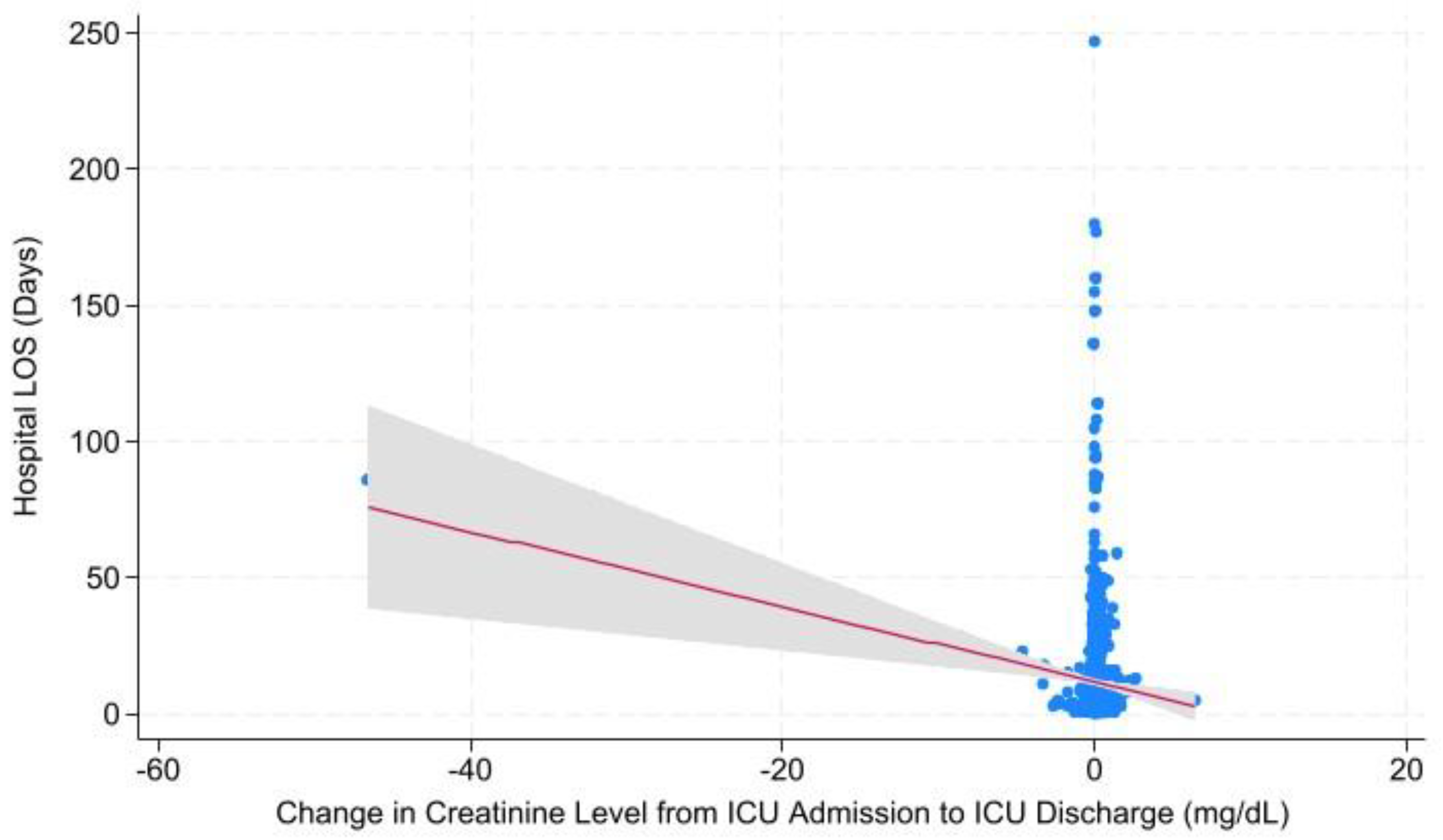
Figure 1. Change in ICU Admission to ICU Discharge Creatinine vs. Hospital Length of Stay. The relationship between hospital length of stay in days and change in creatinine level from ICU admission to ICU discharge, which was a statistically significant finding (p=0.001). Abbreviations: LOS = Length of Stay; ICU = Intensive Care Unit.
Preprints 170541 g001
Figure 2. Hospital Admission Creatinine Level vs. ICU Length of Stay for Patients with Two Injuries. The significant relationship between creatinine level at the time of hospital admission and ICU length of stay in days among patients who sustained two injuries. Abbreviations: ICU = Intensive Care Unit; LOS = Length of Stay.
Preprints 170541 g002
Figure 3. ICU Admission Creatinine Level vs. ICU Length of Stay for Patients with Two Injuries. The significant relationship between creatinine level at the time of ICU admission and ICU length of stay in days among patients who sustained two injuries. Abbreviations: ICU = Intensive Care Unit; LOS = Length of Stay.
Preprints 170541 g003
Table 1. Demographics.
Male Female
N (%) 768 (77%) 232 (23%)
Age (mean ± SD) 52.95 ± 9.83 years 72.4 ± 4.26 years
Creatinine at Hospital Admission (mean ± SD) 0.87 ± 0.07 mg/dL 0.755 ± 0.08 mg/dL
Creatinine at ICU Admission (mean ± SD) 0.75 ± 0.17 mg/dL 0.66 ± 0.055 mg/dL
Creatinine at ICU Discharge (mean ± SD) 0.625 ± 0.005 mg/dL 0.635 ± 0.065 mg/dL
Creative at Hospital Discharge (mean ± SD) 0.76 ± 0.04 mg/dL 0.325 ± 0.325 mg/dL
Creatinine at Death (mean ± SD) 0.00 ± 0.00 mg/dL 0.00 ± 0.00 mg/dL
Race (n, %)
  White 128 (17%) 53 (23%)
  Black 61 (8%) 16 (7%)
  Asian 92 (12%) 55 (23%)
  Native Hawaiian or Other Pacific Islander 2 (0.25%) 2 (1%)
  Other 469 (61%) 102 (44%)
  Unknown 14 (2%) 4 (2%)
Ethnicity (n, %)
  Hispanic 384 (50%) 80 (34%)
  Non-Hispanic 352 (46%) 142 (61%)
  Unknown 31 (4%) 10 (5%)
Trauma Type (n, %)
  Blunt 749 (98%) 230 (99%)
  Penetrating 19 (2%) 2 (1%)
Patient Weight (mean ± SD) 66.5 ± 8.5 kg 93 ± 39 kg
Glasgow Coma Score (mean ± SD) 9 ± 6 15 ± 0
Injury Severity Score (mean ± SD) 19.5 ± 1.5 20 ± 2
Hospital Length of Stay (mean ± SD) 13.5 ± 12.5 8.5 ± 2.5
ICU Length of Stay (mean ± SD) 4.92 ± 4.92 1.165 ± 1.165
Ventilator Days (mean ± SD) 0 ± 0 0.38 ± 0.38
Injury Pattern (n, %)
  EDH 0 (0%) 1 (0%)
  SDH 1 (0%) 0 (0%)
  SAH 338 (28%) 86 (26%)
  IPH 603 (50%) 190 (57%)
  Concussion 11 (1%) 4 1(%)
  Other 248 (21%) 55 (16%)
Mortality (n, %) 83 (11%) 25 (11%)
Table 1: Demographic characteristics of the 1,000 patients included in the analysis. The cohort was predominantly male (n=768), identified as “other” race (n=571), non-Hispanic (n=494), sustained blunt injuries (n=979), and received a diagnosis of intraparenchymal hemorrhage (n=793). Abbreviations: ICU = Intensive Care Unit; EDH = epidural hematoma; SDH = subdural hematoma; SAH = subarachnoid hemorrhage; IPH = intraparenchymal hemorrhage.
Table 2. Comparison of Creatinine Levels at Five Time Points Against Demographic and Clinical Factors.
Admission Cr ICU Admission Cr ICU Discharge Cr Hospital Discharge Cr Death Cr
Sex Female 0.894 0.454 0.373 0.821 0.063
Male 0.963 0.603 0.577 0.740 1.475
p-value 0.241 0.001 0.005 0.770 0.303
Age Range Under 18 0.696 0.530 0.434 0.440 0.000
18-45 0.903 0.552 0.608 0.548 0.077
46-74 0.973 0.593 0.494 0.800 2.866
75+ 0.974 0.563 0.455 1.08 0.151
p-value 0.283 0.947 0.806 0.443 0.804
Injury Type Blunt 0.9455 0.569 0.532 0.760 1.168
Penetrating 0.978 0.519 0.416 0.6901 0.138
p-value 0.754 0.657 0.309 0.617 0.339
Injury Mechanism Fall 0.981 0.555 0.520 0.880 1.781
Blunt Assault 0.909 0.634 0.578 0.636 0.071
MVC 0.886 0.554 0.600 0.464 0.171
Pedestrian Struck 0.871 0.616 0.530 0.532 0.158
Micro MVC 0.846 0.564 0.501 0.534 0.026
Penetrating Assault 0.996 0.545 0.437 0.696 0.145
Other 0.843 0.302 0.209 0.672 0.000
p-value 0.693 0.802 0.992 0.888 0.997
Diagnosis Subdural 1.550 0.000 0.000 0.000 0.000
Subarachnoid 0.942 0.605 0.628 0.600 0.129
Epidural 0.640 0.460 0.530 0.610 0.000
Intraparenchymal 0.962 0.577 0.556 0.809 1.433
Concussion 1.160 0.786 0.707 0.489 0.293
Other 0.884 0.560 0.486 0.560 0.097
p-value >0.05 >0.05 >0.05 >0.05 >0.05
Number of Injuries One 0.979 0.550 0.457 0.936 2.140
Two 0.886 0.546 0.595 0.548 0.119
Three 1.040 0.734 0.700 0.689 0.165
Four+ 0.844 0.732 0.498 0.465 0.104
p-value 0.217 0.124 0.469 0.399 0.831
Table 2: Cr at five time points (admission, ICU admission, ICU discharge, hospital discharge, and death) against demographics (sex, age range), and clinical factors (injury type, injury mechanism, diagnosis, number of injuries). Abbreviations: Cr = Creatinine; ICU = Intensive Care Unit; MVC = Motor Vehicle Collision.
Table 3. Effect of Creatinine Category on ISS and GCS Scores Across All Time Points.
Extreme Hyper-creatinemia Hyper-creatinemia Normo-creatinemia Hypo-creatinemia Extreme Hypo-creatinemia p-Value
Cr at Hospital Admission ISS 19.78 21.75 18.17 17.34 18.05 0.056
GCS 12.05 12.28 12.74 13.32 13.00 0.230
Cr at ICU Admission ISS 20.81 22.16 19.89 18.90 17.29 0.0003
GCS 11.79 12.61 12.16 13.48 13.10 0.004
Cr at ICU Discharge ISS 19.95 17.64 19.21 18.44 18.20 0.607
GCS 11.84 14.64 12.75 12.53 12.74 0.326
Cr at Hospital Discharge ISS 20.32 19.18 17.83 17.79 18.91 0.448
GCS 12.26 14.47 13.07 12.86 12.43 0.055
Cr at Death ISS 21.00 26.25 19.10 38.50 18.36 0.017
GCS 10.33 11.75 11.14 6.50 12.84 0.001
Table 3: The effect of various levels of creatinemia (extreme hyper-creatinemia, hyper-creatinemia, normo-creatinemia, hypo-creatinemia, and extreme hypo-creatinemia) on ISS and GCS severity rating scores across all five measured time points (hospital admission, ICU admission, ICU discharge, hospital discharge, and death). Abbreviations: Creatinine; ICU = Intensive Care Unit; ISS = Injury Severity Score; GCS = Glasgow Coma Scale.
Table 4. Correlation Between Hospital LOS, ICU LOS, Ventilator Days, and Mortality in Changes in Creatinine Level.
Timeframe Outcome P-value Coefficient ± 95% CI
Change in Cr Level from Hospital Admission to ICU Admission Hospital LOS 0.497 -0.550 ± -2.14 – 1.04
ICU LOS 0.265 0.321 ± -0.887 – 0.244
Ventilator Days 0.045 -0.500 ± -0.989 – -0.011
Mortality 0.139 -0.019 ± -0.043 – 0.006
Change in Cr Level from ICU Admission to ICU Discharge Hospital LOS 0.001 -1.380 ± -2.180 – -0.580
ICU LOS 0.000 -0.542 ± -0.827 – -0.257
Ventilator Days 0.011 -0.322 ± -0.569 – -0.074
Mortality 0.148 0.009 ± -0.003 – 0.022
Table 4: The relationship between changes in creatinine level during two time frames (hospital admission to ICU admission, and ICU admission to ICU discharge) and various outcomes (hospital length of stay, ICU length of stay, ventilator days, and mortality). Abbreviations: Creatinine; ICU = Intensive Care Unit; LOS = Length of Stay.
Table 5. Comparison of Cr Levels at Various Time Points to Clinical Outcomes, Stratified by Number of Sustained Patient Injuries.
Timeframe Outcome P-value Coefficient ± 95% CI
Overall Cr at Admission Hospital LOS 0.472 0.584 ± -1.008 – 2.175
ICU LOS 0.043 0.586 ± 0.019 – 1.152
Ventilator Days 0.981 0.006 ± -0.486 – 0.497
Mortality 0.755 -0.004 ± -0.029 – 0.021
Cr at ICU Admission Hospital LOS 0.135 1.289 ± -0.404 – 2.982
ICU LOS 0.001 1.029 ± 0.429 – 1.630
Ventilator Days 0.031 0.576 ± 0.054 – 1.098
Mortality 0.211 0.017 ± -0.010 – 0.043
Cr at ICU Discharge Mortality 0.417 -0.005 ± -0.017 – 0.007
1 Injury Cr at Admission Hospital LOS 0.174 0.617 ± -0.272 – 1.506
ICU LOS 0.061 0.404 ± -0.019 – 0.826
Ventilator Days 0.408 0.113 ± -0.155 – 0.391
Mortality 0.948 0.001 ± -0.022 – 0.023
Cr at ICU Admission Hospital LOS 0.024 1.238 ± 0.162 – 2.315
ICU LOS 0.003 0.766 ± 0.255 – 1.276
Ventilator Days 0.002 0.508 ± 0.186 – 0.831
Mortality 0.197 0.018 ± -0.009 – 0.045
Cr at ICU Discharge Mortality 0.274 -0.017 ± -0.049 – 0.014
2 Injuries Cr at Admission Hospital LOS 0.927 0.314 ± -6.437 – 7.065
ICU LOS 0.029 2.629 ± 0.277 – 4.980
Ventilator Days 0.516 0.562 ± -1.139 – 2.263
Mortality 0.613 0.024 ± -0.070 – 0.119
Cr at ICU Admission Hospital LOS 0.420 2.151 ± -3.083 – 7.385
ICU LOS 0.010 2.399 ± 0.572 – 4.227
Ventilator Days 0.154 0.960 ± -0.362 – 2.285
Mortality 0.602 0.019 ± -0.053 – 0.093
Cr at ICU Discharge Mortality 0.577 -0.004 ± -0.019 – 0.011
3 Injuries Cr at Admission Hospital LOS 0.824 0.802 ± -6.337 – 7.942
ICU LOS 0.699 0.365 ± -1.504 – 2.234
Ventilator Days 0.478 -1.111 ± -4.209 – 1.988
Mortality 0.420 -0.028 ± -0.098 – 0.041
Cr at ICU Admission Hospital LOS 0.747 -0.938 ± -6.691 – 4.816
ICU LOS 0.936 0.061 ± -1.443 – 1.566
Ventilator Days 0.956 -0.070 ± -2.569 – 2.429
Mortality 0.958 -0.001 ± -0.058 – 0.055
Cr at ICU Discharge Mortality 0.943 -0.002 ± -0.058 – 0.054
4+ Injuries Cr at Admission Hospital LOS 0.469 10.642 ± -20.387 – 41.671
ICU LOS 0.159 7.644 ± -3.435 – 18.723
Ventilator Days 0.406 3.980 ± -6.090 – 14.050
Mortality 0.203 -0.478 ± -1.251 – 0.296
Cr at ICU Admission Hospital LOS 0.549 -7.523 ± -34.124 – 19.078
ICU LOS 0.863 0.832 ± -9.435 – 11.098
Ventilator Days 0.924 0.397 ± -8.432 – 9.225
Mortality 0.198 0.411 ± -0.246 – 1.068
Cr at ICU Discharge Mortality 0.133 -0.547 ± -1.285 – 0.192
Table 5: The correlations between Cr Levels at various time frames (Cr at admission, Cr at ICU admission, Cr at ICU discharge) and clinical outcomes of interest (hospital length of stay, ICU length of stay, ventilator days, mortality), stratified by number of injuries sustained by the patient (overall, one, two, three, or four or more). Abbreviations: Creatinine; ICU = Intensive Care Unit; LOS = Length of Stay.
Disclaimer/Publisher’s Note: The statements, opinions and data contained in all publications are solely those of the individual author(s) and contributor(s) and not of MDPI and/or the editor(s). MDPI and/or the editor(s) disclaim responsibility for any injury to people or property resulting from any ideas, methods, instructions or products referred to in the content.
Copyright: This open access article is published under a Creative Commons CC BY 4.0 license, which permit the free download, distribution, and reuse, provided that the author and preprint are cited in any reuse.
Prerpints.org logo

Preprints.org is a free preprint server supported by MDPI in Basel, Switzerland.

Subscribe

Disclaimer

Terms of Use

Privacy Policy

Privacy Settings

© 2025 MDPI (Basel, Switzerland) unless otherwise stated