

Submitted:
31 July 2025
Posted:
01 August 2025
You are already at the latest version
Abstract
Food systems are highly vulnerable to geopolitical instability, which can disrupt agricultural production, trade, and market access, ultimately undermining food security and sustainability. Unlike peacetime food insecurity driven by poverty or climate, food insecurity caused by geopolitical context involve agricultural disruptions, blockades, and deliberate famine, severely impacting civilians while undermining long-term food system resilience. This bibliometric review explores how food security and resilience under the strain of conflict has been addressed in academic literature over the past two decades, with a focus on its intersections with war, global food security, and sustainable systems. Using Web of Science database and tools like VOSviewer, we mapped thematic clusters, influential authors, publishers, and countries to understand evolving scholarly attention. Key findings highlight an increasing awareness about food being used as a tool of war, politicization of food aid, and the fragility of agricultural systems in conflict settings. The analysis also reveals a significant gap in research regarding “unconventional” food sources like black markets and underground supply chains which are sometimes more developed than traditional chains in times of geopolitical turbulence. The results highlight a growing academic interest in the fragility of agricultural systems under geopolitical stress, the management of food assistance, and gaps in understanding adaptive mechanisms such as informal or alternative supply chains. By synthesizing existing knowledge, this review identifies research priorities that can inform strategies to enhance the resilience and sustainability of global food systems in an increasingly uncertain geopolitical landscape.
Keywords:
zero hunger
; food security
; sustainable systems
; geopolitical instability
; resilience
; black markets
; agricultural disruption
; alternative supply chains
; famine
; bibliometric analysis
1. Introduction
“Food is a weapon.” [1] or “Food is power” [2]. These astonishingly simple phrases, famously uttered by a U.S. statesman in the 70s, capture a grim reality: throughout history, food and hunger have been used as tools of power in geopolitical instability. Food weaponization – as in the deliberate use of food supply as a means to achieve military or political objectives – has gained renewed international attention in the 2010s and 2020s amid a confluence of global crises. From civil wars and insurgencies (where belligerent forces deny food to populations) to international conflicts (where exports and aid are manipulated as leverage), the intersection of food and conflict poses acute humanitarian and security challenges [3].
According to Armed Conflict Location & Event Data (ACLED) [4], as of December 2024, 50 countries are actively involved in conflicts, with more than 665 million people being exposed to violence worldwide. Between 1 June 2024 and 30 May 2025, there were 191,448 total events recorded, involving battles, explosions, remote violence, or violence against civilians across 153 countries, marking a near-doubling of incidents since 2020, reflecting a sharp deterioration in global security, mostly located in the Southern hemisphere, as reflected in Figure 1. ACLED’s 2025 Conflict Watchlist [5] warns of long-term crises in these regions, with no near-term resolution expected for Ukraine, Palestine, or Mexico’s cartel wars. According to combined reports from SIPRI (Stockholm International Peace Research Institute), FSIN (Food Security Information Network), OCHA (Office for the Coordination of Humanitarian Affairs), and IRC (International Rescue Committee), conflicts in Sudan, Gaza, and Ukraine, exacerbated through climate shocks and economic collapse, have pushed acute hunger to 295 million people globally, double the 2020 figure [6,7,8].
In Syria and Yemen, for example, combatants have looted farms, destroyed markets, and obstructed relief as tactics of war [10]. In 2018, the United Nations Security Council, recognizing the severity of these tactics, unanimously condemned the starvation of civilians as a warfare method and affirmed the link between armed conflict and food insecurity [11]. Also, the war in Ukraine further underscored the global dimension: Russia’s blockade of grain exports and targeting of Ukraine’s agricultural infrastructure not only sought to weaken an adversary’s economy but also upended global food markets, driving up prices and hunger far beyond the conflict zone[10].
Fragility, Conflict and Violence (FCV) collection, jointly managed by the World Bank, UNHCR, and UK Aid [12] provide one of the most valuable resources highly relevant to food insecurity in conflict settings because it provides empirical data that captures how systemic fragility, violence, and displacement directly affect food systems. The FCV dataset collection offers operational insight into how conflict-induced displacement, agricultural disruption, and institutional collapse interact to produce acute food insecurity—highlighting the empirical foundation beneath conceptual debates around food weaponization. Figure 2 visually reinforces the direct spatial correlation between active conflict zones (as illustrated in Figure 1) and prevalence of severe food insecurity projected for 2025. Countries in Central and Eastern Africa, the Middle East, parts of South Asia, and Latin America exhibit both high levels of violence and food insecurity, often exceeding a 41% prevalence threshold. This geographic overlap underscores a systemic pattern: conflict not only destabilizes food systems, but does so persistently and predictably in specific regions, compounding vulnerability through repeated cycles of displacement, economic collapse, and institutional fragility.
The data further supports the argument that food insecurity is not simply a collateral effect of conflict, but often a deliberately engineered outcome, facilitated by the destruction of agricultural infrastructure, market obstruction, and the political manipulation of aid flows. Such overlap aligns with findings from recent FCV datasets and reinforces the urgent need for a research and policy framework that treats food security as a peace and security issue, not just a development concern.
However, the world faces escalating food security threats not only from conflict but also from climate change, pandemics, and economic volatility. All of these other threats often interplay with conflict in a vicious cycle: conflict breeds hunger, and hunger fuels grievances that can spark unrest. By 2021, up to 60% of undernourished people and 75% of stunted children were living in conflict-affected countries, as highlighted in the 2021 Global Hunger Index [14]. Conflict remains the single greatest driver of hunger worldwide, with food systems in conflict-affected countries experiencing severe disruptions across production, trade, and aid delivery channels. The report emphasizes that these disruptions are not incidental but often strategically targeted to weaken adversaries or control populations—further reinforcing the notion of food weaponization as a deliberate mechanism of power. Such sobering statistics jeopardize progress toward the Sustainable Development Goals (SDGs) – notably SDG2: Zero Hunger, as well as goals on poverty, health, and peace [15]. Indeed, food security, conflict, and sustainable development are deeply entwined: without peace, efforts to end hunger struggle; without food security, stable development and conflict prevention are undermined. These interlinkages have given rise to the necessity of a body of research at the confluence of food, conflict, and sustainability, drawing on disciplines of agriculture, political science, economics, public health, and environmental studies.
While developing a previous material [16], our team observed in available literature frequent mentions of conflict as a facilitator of food insecurity and food chains ethics disruptions. However, these mentions were largely tangential, conflict and war being treated more like an afterthought than as a focal point. With active conflict unfolding just across the border of the authors’ country of origin, we have however witnessed firsthand how natural food supply chains are severely disrupted and strained by the evolving dangers of war. As such, these immediate and observable impacts compelled us to critically examine the extent to which the academic community has engaged with the topic of food supply chain resilience and sustainability in conflict settings across time. How deeply is this issue explored in scholarly research, and are current approaches sufficient to address the growing complexity of food insecurity in times of war?
To guide our bibliometric review, we have identified four relevant research questions:
RQ1: How has scholarly understanding of the role of food in geopolitical contexts evolved since 2010, and how is it connected to broader crisis-related actions?
RQ2: Is there a bias in the academic research ecosystem going more towards depoliticizing food-related violence by framing it primarily as a humanitarian or development issue rather than a strategic act of war?
RQ3: Are “unconventional” food supply chains—such as black markets, informal networks, and underground distribution systems—adequately examined in the literature, particularly in their role during armed conflict?
RQ4: Which other key knowledge gaps and underexplored themes remain in the academic discourse on food security and conflict, and how can researchers strategically address these to enhance the relevance and impact of their work?
By addressing these timely and critical research questions, this study aims to illuminate patterns in research and identify implications for both scholarship and policy on building food system resilience in an era of conflict, while contributing to sparking deeper dialogue and inspire the pursuit of creative, unconventional solutions to mitigate hunger in conflict-affected regions.
This convergence of conflict and food insecurity detailed in all the international reports, signals a crucial need for a deeper academic and strategic understanding of food systems as inherently geopolitical instruments, not merely humanitarian infrastructures. Despite the increasing relevance of this topic in policy and aid discussions, the scholarly landscape remains fragmented, often siloed within disciplines such as development studies, international relations, or agricultural economics, without fully integrating the notion of food weaponization into broader war and security paradigms, creating an obvious research gap.
This review aims to help fill this gap by using a bibliometric analysis to map and interrogate the state of academic research on the intersection of food, conflict, and systemic disruption. Bibliometrics offers a powerful, data-driven lens to evaluate not only what has been studied, but also what remains unexplored—revealing blind spots, disciplinary biases and thematic silences in the literature.
The four research questions outlined above serve as guiding anchors for our inquiry and help structure the conceptual framework of the study (see Figure 3). In particular, we aim to surface new angles of inquiry—for example, examining the resilience of informal food networks in besieged areas, the political economy of food embargoes, or the role of emerging technologies (like drones or blockchain) in circumventing food blockades.
Ultimately, the bibliometric evidence generated in this study is intended not only to synthesize past work but also to provoke new intellectual and practical directions. In a time when conflict dynamics are increasingly hybrid and transnational, the capacity to understand and disrupt food-based tactics of coercion must be seen as an essential pillar of peacebuilding, humanitarian intervention, and global food governance.
2. Materials and Methods
In determining the most appropriate approach for this topic, we carefully evaluated several types of literature reviews, including bibliometric analysis, meta-analysis, and systematic literature reviews. After thorough consideration, appropriating the necessary steps and studying the main points of differentiation [17,18,19,20,21], we chose to employ bibliometric analysis, as our primary objective is to map and synthesize the existing body of literature rather than to develop or extend theoretical frameworks. The tools we have used in this paper were:
- -
- Zotero – A well-known reference management software used to collect, organize, and manage bibliographic data. Zotero facilitated the systematic collection of publications, ensured consistent citation formatting, and supported the export of metadata required for bibliometric analysis.
- -
- Excel - Used for data cleaning, sorting, and preliminary descriptive analysis. Excel allowed us to manually inspect the metadata, identify inconsistencies, and generate basic statistical summaries
- -
- Bibliomagika – A bibliometric Excel based software employed to automatically clean, structure, and extract metadata from large publication datasets. Bibliomagika was particularly useful in processing CSV files, standardizing author and keyword fields, and preparing the data for our chosen visualization tool.
VOSviewer - A specialized bibliometric visualization tool used to map co-authorship networks, keyword co-occurrence, and citation relationships. VOSviewer enabled us to visually explore the intellectual structure and thematic clusters within the literature.
Our analysis is based on a WebofScience core collection search encompassing publications from 2010 through mid-2025. The initial search query used was as follows:
TS=((“food security” OR “hunger” OR “malnutrition” OR “nutrition” OR “food systems” OR “agrifood systems” OR “diets” OR “food access”) AND (“conflict” OR “fragility” OR “violence” OR “war” OR “humanitarian crisis” OR “displacement” OR “fragile settings” OR “armed conflict” OR “post-conflict” OR “war zones”) AND (“resilience” OR “improving” OR “improvement” OR “policy” OR “policies” OR “intervention” OR “interventions” OR “R&D” OR “research and development” OR “innovation” OR “strategies” OR “solutions”)).
The above query is designed to identify pertinent literature relevant to the broader theme of enhancing food security in conflict landscapes—an increasingly important area of research that requires more nuanced approaches as live situations evolve on the ground.
We conducted a Topic Search in the database, meaning the search terms were applied to titles, abstracts, and author keywords. The search strategy was structured across three levels of terms to ensure an extensive coverage of the subject. The first level addressed food security as a main topic for the research, with connected words like “hunger/malnutrition/nutrition/…” etc., because we are thinking about “Food security” as it has been defined in the 2024 Global Report on Food Crises [6]: “(…) All people, at all times, have physical, social, and economic access to sufficient, safe and nutritious food that meets their dietary needs and food preferences for an active and healthy life (…)”. The second level refers to the context of conflict and systems frailty with search terms like “conflict, fragility, violence, war, “humanitarian crisis”, displacement, “fragile settings”, “armed conflict”, “post-conflict” or “war zones”. These terms are necessary to frame the context of food insecurity caused by the conflict setting, not referring to peacetime food insecurity. The third level addresses the solutions proposed across different research articles. Whether these involve policy recommendations, research and development initiatives, strategic approaches, or innovations, we aimed to identify the types of solutions put forward by our peers and assess whether there is a consistent, systemic direction or if the proposed measures are more context-specific and locally adapted.
All the results gathered from the WoS database were then processed with Microsoft Excel, BiblioMagika 2.10.0 and VOSviewer version 1.6.18, powerful tools for cleaning, analyzing, and visualizing bibliometric data, tools that enabled the creation of compelling visual outputs revealing key patterns, thematic clusters, and research trajectories, and offering clear insights into the evolution of the field from past developments to future directions. Data cleaning steps included removing duplicates from the list of papers, harmonizing affiliations, countries and keywords. All figures (timeline, networks, maps) were generated from the data and are presented with appropriate scaling.
Our analysis focused on the past 25 years, including only articles and reviews published from the year 2010 onward, because we believe this timeframe is appropriate given the rapidly evolving geopolitical landscape and the significant shifts in the nature of modern warfare since the turn of the century. Contemporary conflicts are substantially different from those before 2010, not only in their dynamics but also in the tools and strategies employed and there is proof that the accelerating development of technologies and artificial intelligence in the coming decades will likely introduce entirely new forms of warfare, making recent literature more relevant for understanding current and future challenges to food security in a conflict landscape.
While our desire was to produce a highly relevant study, we must also acknowledge several limitations in conducting the current research. First, because our dataset was confined to WebofScience as the sole database may have excluded relevant studies indexed in other databases such as Scopus or Google Scholar, as well as publications from non-indexed journals, books, and grey literature that might have been relevant but were not selected. Second, we restricted our analysis to English-language publications due to language barriers. This exclusion may have inadvertently omitted important research published in other languages, particularly in regions directly affected by the geopolitical issues discussed. Third, bibliometric analysis in general is more of a quantitative method rather than a qualitative one and it serves to identify publication trends and relationships but does not deeply interpret the content or quality of individual studies. It subsequently cannot assess theoretical nuance or methodological rigor. Lastly, our study is constrained by the rapidly evolving nature of geopolitical events, particularly those related to conflict and food security. As these developments continue to unfold in real-time, there is a risk that our findings may quickly become incomplete. This highly-dynamic context stresses the importance of viewing our analysis as a snapshot in time, which can—and should—be revisited as new data and reports emerge.
3. Results and Discussion
Messer and Cohen [22] remind us that food as a weapon is as old as written records. On the one hand, this includes the challenge to feed armies sufficiently. A well-known quote from the Roman Empire states that “armies are more often destroyed by starvation than battle” [23]. Whenever armies were on the move, the domestic population suffered [24]. For the armies themselves, garrison armies were even more difficult to feed, as local food networks had already been destroyed [25].
The food supply of armies in times of warfare, however, is more a logistical question than a weaponization of food. Over many centuries, sieges were the main instrument of food weaponization. Whether the siege of Jerusalem by the Roman army in the first century [26], the siege of Chippenham by the Vikings in the eighth century [27] or the infamous siege of Leningrad during the 20th century [28] all followed the rationale to cut off the urban population from food supplies to make them unable to defend themselves. In a review of different sieges, McGlynn [29] called hunger “the most decisive weapon of all”.
The more food trade intensified over the course of history, the more it became a strategic tool for governments as well. Rothschild [30] and Paarlberg [31] were among the first reflecting on this aspect in depth, before the American philosopher William Aiken [32] suggested that food was often used as a weapon. However, it took another 22 years before the term of the weaponization of food was coined by another philosopher on a US university, Eduardo Mendieta [33]. He used it for the notion that, under the shield of the NAFTA agreement, the United States would push genetically modified maize seed into Mexico.
Since then, academic analysis on the weaponization of food has gained momentum. In the following sub-sections, we present our key findings on this topic, derived from existing academic paper.
3.1. How Has Scholarly Understanding of the Role of Food in Geopolitical Contexts Evolved Since 2010, and How Is It Connected to Broader Crisis-Related Actions?
As outlined in the Materials and Methods section, our initial step involved conducting a comprehensive search within the Web of Science database, and a summary of the preliminary results obtained from this search are depicted in Table 1 below.
To ensure the relevance and focus of our analysis, we applied specific inclusion criteria during the search process. First, we limited our dataset to articles and review articles published from the year 2010 onward, reflecting two key considerations: the need for contemporary perspectives on food systems and the emergence of global sustainability discourse in the early 21st century.
Additionally, to capture literature that specifically addresses the food supply dimension of our topic, we filtered results by selecting only those publications linked to Sustainable Development Goal (SDG) 2 – Zero Hunger [34]. This criterion was crucial for anchoring our analysis in research that directly engages with issues such as food security, agricultural sustainability, nutrition, and hunger eradication. By focusing on SDG 2, we ensured that the selected studies contribute meaningfully to the broader discourse on sustainable food systems, particularly in the context of geopolitical conflict and global development.
An additional exclusion criterion applied to our query concerned the topical focus of the papers. Specifically, we excluded studies primarily addressing human or animal healthcare, as these tend to frame food-related issues through the lens of nutrition and disease rather than conflict. While such research is valuable, it typically explores food as a vector for health outcomes rather than as a strategic or systemic component of warfare.
Our intention was to retain only those studies that examine food within the context of conflict, power dynamics, and systemic disruption, rather than those focused on health-related consequences alone. However, we chose to retain papers addressing pediatric issues, as our screening process revealed that children represent one of the most vulnerable demographic groups affected by disruptions to food supply chains. Unlike adults, children are often unable to flee conflict zones or actively resist oppressive conditions, making them disproportionately exposed to the consequences of food scarcity, malnutrition, and systemic deprivation. By including this body of literature, we aimed to capture the unique and often overlooked ways in which food weaponization impacts the most defenseless populations during armed conflict.
After also excluding non-English publications and duplicate records, we identified 1,073 research articles and 162 review papers, resulting in a final dataset of 1,235 documents that have been included in the analysis and visualization.
The volume of publications on food security and geopolitical turbulence has grown exponentially since 2010. In 2010, only 10 relevant papers were published, whereas by 2020 the annual output exceeded 100, and by 2022–2025 it easily exceeded 150 papers per year (Figure 4). This growth reflects increasing scholarly (and policy) attention to issues of hunger in war and the resilience of food systems amid crises. Several notable inflection points align with real-world events:
- 2011–2013: A slight uptick corresponds with global food price spikes and the Arab Spring, which included countries like Syria, Gaza or Iraq [35,36,37]. Many papers focus on the nutritional status and challenges faced by specific groups, particularly women and children in regions like India, Kenya, the DRC or Uganda. These studies examine undernutrition, maternal autonomy in feeding practices, and fluctuations in child wasting, highlighting health disparities in fragile or resource-limited settings [38,39,40].
- 2014–2019: A steady rise in papers tracks the long-lasting Syrian civil war, Yemen conflict, and South Sudan famine. Concepts like “weaponization of food” enter the discourse as the UN, WFP. FAO and different NGOs sounded alarms on siege tactics causing famine. A large number of papers explore the impact of conflict on food security, particularly in countries like Yemen, Nigeria, Somalia, and Gaza. These studies focus on malnutrition, displacement, humanitarian responses, and the structural vulnerabilities exposed during crises. Papers such as “Acute malnutrition among children, mortality, and humanitarian interventions in conflict-affected regions – Nigeria [41] and “The effects of violent conflict on household resilience and food security: Evidence from the 2014 Gaza conflict” [42] underscore the deep entanglement of war, hunger, and systemic fragility. The adoption of UNSC Resolution 2417 in 2018 [11] – explicitly linking conflict and hunger – may have further catalyzed academic inquiry, as indicated by a jump in publications around 2019.
- 2020-2021: The literature expands rapidly, partly due to mounting evidence of climate-conflict-food interlinkage, and high-impact papers addressed how climate change exacerbates conflict risks and undermines crop yields. By 2020, the COVID-19 pandemic became another focus: publications emerged on how conflict-affected states coped with pandemic-related supply disruptions. Our data show “COVID-19” rapidly became a top keyword, reflecting concern that pandemic lockdowns and economic shocks could intensify food insecurity in fragile settings.
- 2022–2023: A significant event during this period is Russia’s invasion of Ukraine in February 2022. The war’s global fallout on food supplies prompted a flurry of research and commentary, from analyses of Black Sea grain exports to broader discussions of food as a geopolitical tool. In 2022 alone, at least 150 publications appeared, including highly-cited pieces on the war’s impact on global food security. 2023 also sustained high academic output, examining ongoing crises (e.g., drought and conflict in the Horn of Africa, instability in Haiti, and the Sahel). Topics range from child malnutrition to cash transfer efficacy, food assistance targeting, and the mental health impact of hunger in fragile settings.
- 2024 - 2025 (partial): While our data for 2025 is incomplete (covering early-year publications up to June), the trajectory suggests continued high engagement. Themes like food systems resilience, climate adaptation, and humanitarian response in conflict zones remain prominent. We also see emergent topics (e.g., the food security implications of the Gaza conflict and sanctions regimes). In these last 2 years, studies span food availability, household coping mechanisms, malnutrition, famine monitoring, and humanitarian assistance evaluation. Papers like “Dying of starvation if not from bombs: assessing measurement properties of the Food Insecurity Experiences Scale (FIES) in Gaza’s civilian population experiencing the world’s worst hunger crisis” and “Food insecurity and coping strategies in war-affected urban settings of Tigray” [43,44] capture the deadly convergence of violence and hunger while others assess conflict-specific food aid efficiency, nutrition for displaced populations, or post-war agricultural reconstruction (e.g., Ukraine, Colombia, Syria) [27,28,29,30,31]. Notably, some 2023–2024 works are already influential – for instance, a Foreign Affairs analysis by Helder et al. (2023) calling food weaponization an “ancient tactic making a deadly comeback” has garnered policy attention [10].
Researchers in this domain tend to have limited publication frequency, with only 189 authors contributing to two or more papers within the dataset. This suggests that while the field is thematically rich, it remains relatively dispersed in terms of sustained scholarly authorship. The most prolific contributor identified is Peter H. Verburg, who stands out with the highest number of publications by a single author (5 in total), indicating a focused and ongoing engagement with topics at the intersection of land use, food systems, and sustainability.
The most cited paper is “Global Land Use Change, Economic Globalization, and the Looming Land Scarcity” by Lambin and Meyfroidt [50] published in Proceedings of the National Academy of Sciences (PNAS), with an extraordinary 2,089 citations and a C/Y of 139.27. This suggests it has become a foundational work in the field, likely due to its early and comprehensive synthesis of land use dynamics, global economic pressures, and ecological constraints. Its inclusion signals how macro-structural, system-level analyses continue to anchor debates in food security and land governance. PNAS, as a top-tier journal, amplifies its visibility and reinforces its intellectual authority. While not directly connected to conflict, main points from the paper can be applied to conflict-affected areas and can help identify how productive land scarcity can negatively impact food security in certain areas.
The second most cited work, “Land Grabbing in Latin America and the Caribbean” by Borras and team [51], also carries significant weight with 373 citations and a solid C/Y of 26.64, published in Journal of Peasant Studies. This reflects the growing relevance of land sovereignty, dispossession, and agrarian justice, particularly in the context of global south resource politics. The choice of journal is telling: Journal of Peasant Studies is known for its critical, political economy lens, and this work clearly resonates with readers interested in the intersection of land, power, and inequality.
Notably, one of the most recent articles on the list, “Impacts Of The Russia-Ukraine War On Global Food Security: Towards More Sustainable And Resilient Food Systems?”, is a very recent analysis of the Russia–Ukraine war’s impact on global food security. It has already reached 345 citations and an outstanding C/Y of 86.25. Its publication in Foods and its recency underscore both the topical urgency and the rapid diffusion of literature that directly engages with contemporary geopolitical shocks. This demonstrates that timely, conflict-driven analyses—especially when tied to global food system disruptions—are being quickly and widely cited, confirming a paradigm shift toward viewing conflict as central to food system fragility.
While publishing more papers may signal academic productivity, it does not necessarily equate to higher scholarly impact. To better exemplify this dynamic, Figure 5 presents a world map visualizing the ratio between the total number of citations and the number of cited papers—a metric indicative of average citation influence per publication. In this map, darker shades represent countries with higher citations per cited paper (C/CP ratio), suggesting greater visibility or influence of each individual publication.
From the map, several key patterns emerge:
- Zimbabwe stands out with the highest C/CP ratio (75.0), implying that although the absolute number of publications is very low (1), this paper that addresses various behavioral response patterns of African Farmers tends to receive substantial scholarly attention—possibly due to the high-profile of the case study and its importance for the African Continent [52].
- Countries like New Zealand (67.4), Argentina (57.2), China (36.81), Australia (37.63) or the United States (34.87) also exhibit high citation-per-paper ratios, reflecting a vast established academic infrastructure, strong global networks, and frequent publication in high-impact journals.
- In contrast, high-output regions like Italy (21.12), Ethiopia (11.21) or Niger (18.14) show lower C/CP values, indicating that while many papers are being produced, their individual citation impact is more modest.
- Notably, conflict-prone states such as Yemen, Syria, and Afghanistan (shown in lighter tones) have medium to upper levels of citation-per-paper ratios, suggesting that while these contexts are frequently mentioned, they are often the subjects of external research rather than producers of high-impact academic work themselves, but the work they produce still gather attention.
In summary, the observed publications trend underscores that this field is dynamic and responsive to contemporary events. The nearly tenfold increase in publication output from 2010 to 2024 mirrors the elevation of food-security-in-conflict as a critical global issue. This growth also reflects broadening scholarly participation: early 2010s research was often led by development economists and agronomists, whereas by the 2020s, we see contributions from security studies, law, public health, climate science, and beyond. Researchers increasingly linked food weaponization to modern warfare strategies, noting that contemporary conflicts exhibit intentional hunger infliction despite international prohibitions. Notably, Russia’s invasion of Ukraine brought renewed focus on “geopolitical” food weaponization, especially because by targeting Ukraine’s grain infrastructure, Russia endangered multiple African countries dependent on Ukrainian exports.
3.2. Is There a Bias in the Academic Research Ecosystem Going More Towards Depoliticizing Food-Related Violence by Framing It Primarily as a Humanitarian or Development Issue Rather than a Strategic Act of War?
A critical finding is a tension in framing within the scholarly literature on food insecurity and conflict. A portion of the research—particularly from development studies and humanitarian journals—presents conflict-induced hunger as a humanitarian problem, emphasizing food insecurity, malnutrition, and nutrition outcomes as tragic but technically addressable consequences of war. These studies often focus on agriculture, food systems, and resilience, assessing how violence affects crop production, market access, or dietary diversity. In doing so, they contribute valuable knowledge, yet they also risk implicitly depoliticizing the issue by framing hunger as a function of disrupted systems or failed development, rather than as a deliberate act of conflict or political violence.
If we compare the dominant keyword clusters visualized in VOSviewer (Figure 6 from which we zoomed in on the 2 dominant clusters), a clear pattern emerges. The green cluster (Figure 6a.) centers around terms such as “food security”, “climate change”, “agriculture”, and “sustainability”, and is the largest in both node count and spatial distribution. This indicates a prevailing developmental and environmental framing of food security research, emphasizing systemic challenges, resilience, and long-term adaptation strategies.
In contrast, the red cluster (Figure 6b.), composed of terms like “health”, “nutrition”, “malnutrition”, and “children”, is smaller and more peripheral in the first visualization. While “conflict” is present within this cluster, it occupies a subordinate position, suggesting that the scholarly focus is more often on the humanitarian consequences of food insecurity—such as undernutrition or health outcomes—rather than on its strategic or structural causes. This reflects a dominant tendency in the literature to depoliticize hunger, framing it as a symptom of crisis rather than as a deliberate tactic embedded in conflict dynamics.
However, the keyword “conflict” emerges as a co-dominant node with “health”, forming dense linkages with “violence”, “armed conflict”, “displacement”, and “malnutrition”. This network structure marks a discursive realignment, wherein conflict is no longer treated as a contextual backdrop but rather as a central driver of food insecurity in this cluster. The proximity of terms like “civil war”, “interventions”, and “nutrition status” to the conflict node suggests an evolving research agenda after 2015, an agenda that increasingly views hunger not only as an outcome but as a weaponized mechanism within broader geopolitical and military strategies.
Moreover, the strength of interconnections in the second graph—particularly among red-cluster keywords—indicates a maturing and consolidating body of literature at the intersection of conflict, food systems and health. This trend supports the hypothesis that the academic discourse is gradually shifting toward a more politicized and security-oriented framing of food insecurity, consistent with calls for greater accountability in the use of hunger as a method of war. The rising prominence of such framings aligns with developments in international law (e.g., UNSC Resolution 2417) and with growing scholarly interest in the strategic logic of starvation, sieges, and food supply manipulation in contemporary conflicts.
By performing a keyword count, widely used terms such as “food security,” “nutrition,” and “resilience” dominate the literature (with keyword frequencies of 268, 53, and 44 respectively), whereas terms like “starvation crimes” or “weaponization of food” appear far less frequently (Table 2). This emphasis aligns with the humanitarian narrative that centers on the needs and vulnerabilities of populations—particularly in contexts like Sub-Saharan Africa/Gaza/Ukraine and during compounding crises such as COVID-19 or climate change—but often overlooks the agency of perpetrators or the strategic use of hunger in warfare. Thus, while such literature contributes to sustainable development goals, it may obscure the intentionality behind certain food-related harms in armed conflict.
Many studies detail how conflict disrupts agriculture, markets and nutrition outcomes but do so in a neutral tone, focusing on quantifying impacts (e.g., reduced dietary diversity or higher child malnutrition) rather than explicitly naming these acts as tactics or crimes [41,53,54]. Such framing aligns with a humanitarian narrative that stresses victims’ needs and resilience, sometimes overlooking the agency of perpetrators.
On the other hand, a growing body of scholarship and commentary explicitly politicizes the issue by identifying intentionality and power. These works use terms like “food as a weapon of war”, “starvation crimes”, or “siege warfare”, directly calling out armed actors’ strategic logic [39,44,55,56]. For instance, Hammoudeh et al. (2022) [57] note that “food insecurity may not only be an externality of conflict but also food deprivation may be utilized as a weapon to discourage residency in contested territories”. Alex de Waal author of the book “Mass Starvation: The History and Future of Famine” [58] and many others argue that famines in places like Yemen are not simply man-made but man-caused – i.e., specific leaders and commanders have purposefully engineered starvation and should be held accountable. However, we see an increase in academic discourse adopting this critical stance, especially after 2017–2018 when the term “starvation as warfare” gained currency following mass atrocities [59,60,61].
Bibliometric reviews—intended to map knowledge production—often reproduce this bias, emphasizing development, humanitarian aid, nutrition, or resilience frameworks, while sidelining or omitting analysis of intentionality, power, and strategic use of food systems in conflict. In our dataset, we found 39 papers defined as reviews in “document type” and a critical reading of these literature reviews reveals a pronounced tendency within academic research to frame hunger as a developmental or public health issue, often stripped of its political and strategic dimensions. Many of these studies emphasize nutrition, food access, and resilience, portraying hunger as a consequence of poor infrastructure, limited agricultural productivity, or climate-induced challenges [62,63,64,65,66,67,68,69,70,71,72,73]. In these reviews, food insecurity is frequently analyzed through a technical or systems-oriented lens, focusing on improving urban agriculture models, enhancing nutrition delivery platforms, or strengthening food systems in the face of environmental stress. Hunger is discussed in relation to global health goals, sustainable development agendas, and community well-being, with conflict appearing, if at all, as a background variable rather than a causal or strategic factor. This approach, while valuable in addressing immediate humanitarian needs, often depoliticizes food-related violence, rendering invisible the intentional uses of food as a tool of control, punishment or warfare.
Conversely, a smaller but notable subset of studies engages with hunger as an explicit outcome of conflict, coercion, and geopolitical maneuvering. These reviews interrogate the ways in which food systems are disrupted not only by environmental volatility, but by direct acts of aggression, displacement, and economic warfare. In such framings, hunger is not incidental, but rather a deliberately inflicted condition, shaped by blockades, forced migration, destruction of agricultural infrastructure, and the politicization of aid. These reviews explicitly address the strategic manipulation of food supply in both domestic and international conflicts, positioning hunger within broader structures of power and violence. The distinction between these two framing orientations—technocratic-humanitarian versus political-strategic—is critical, as it shapes the types of solutions researchers prioritize, the actors they hold accountable, and the language through which crises are interpreted and addressed [53,60,74,75,76].
The keyword analysis for the Reviews reveals a dominant focus on technical, developmental, and humanitarian framings of food-related issues in conflict settings. Terms such as “performance,” “safety,” dynamics” “nutrition,” “sustainability,” and “supply chain” appear prominently, indicating an emphasis on food systems as logistical or public health challenges (Figure 7).
In contrast, keywords that reflect strategic or political intent—such as “weaponizing food,” “siege,” “coercion,” or even “starvation as a method of war”—are notably absent or marginal. While “conflict” and “risk factors” appear, they are rarely paired with language that suggests intentional manipulation of food systems as a tool of power.
This lexical pattern also suggests a depoliticized academic narrative, where food insecurity is framed predominantly as a humanitarian emergency rather than a deliberate tactic used by state or non-state actors. Consequently, the research ecosystem may unintentionally obscure agency and accountability, focusing on outcomes rather than mechanisms.
We can say that we have clearly identified a bias toward depoliticization that lingers in some academic circles – hunger in conflict is frequently discussed under the apolitical rubric of “food security and development” rather than as a product of deliberate violence. This bias can obscure issues of culpability and justice. Political ecology perspectives highlight this concern: they critique how mainstream development discourse treats famine and food insecurity as technical problems (crop shortfalls, logistic issues) detached from the power relations and political decisions that create vulnerability. Our findings reinforce that integrating political analysis – naming the use of hunger as a weapon – is crucial for a complete understanding.
3.3. Are “Unconventional” Food Supply Chains—Such as Black Markets, Informal Networks, and Underground Distribution Systems—Adequately Examined in the Literature, Particularly in Their Role During Armed Conflict?
A notable and revealing gap in the current literature is the limited academic attention given to black markets, smuggling networks, and informal food systems in conflict settings, despite their evident and well-documented significance on the ground. To address this, we conducted a supplementary bibliometric query, designed to build upon and expand the initial Web of Science (WoS) results maintaining the same inclusion/exclusion criteria. Specifically, we searched for the following topic string:
TS=((“food security” OR “hunger” OR “malnutrition” OR “nutrition” OR “food systems” OR “agrifood systems” OR “diets” OR “food access”) AND (“conflict” OR “fragility” OR “violence” OR “war” OR “humanitarian crisis” OR “displacement” OR “fragile settings” OR “armed conflict” OR “post-conflict” OR “war zones”) AND (“resilience” OR “improving” OR “improvement” OR “policy” OR “policies” OR “intervention” OR “interventions” OR “R&D” OR “research and development” OR “innovation” OR “strategies” OR “solutions”) AND (“black market*” OR “informal food distribution” OR “illicit trade” OR “smuggling” OR “parallel market*” OR “war economy”)).
This targeted query aimed to add a focused layer of analysis connecting food security discourse with illicit trade, parallel food economies, and informal distribution systems—dimensions that are often present in real-world conflict zones but remain marginalized in mainstream academic treatment. While some related records were retrieved, the overall yield reinforces the observation that such intersections between food systems resilience and alternative, extralegal supply chains during armed conflict remain under-theorized and under-represented in scholarly research. This additional query yielded only 54 records, of which 22 were categorized under “History” according to Web of Science subject classifications. Notably, none of these 54 publications intersected with the initial core dataset, indicating a clear thematic and disciplinary separation between research on illicit or informal food systems and mainstream scholarly discussions on food security in conflict settings.
The largest block in Figure 8 indicates that most research on food, conflict, and related systems is housed in historical analysis suggesting a strong emphasis on past famines, colonial-era food policies, or historical war economies [77,78,79,80,81,82,83,84], but potentially a lack of contemporary systems-based or policy-forward analysis. From a supply chain standpoint, historical insights are valuable for understanding long-term vulnerabilities and precedents, but may not address the complexities of modern supply chain disruption, globalized trade, or technological interventions.
The resulted papers illustrate the complex interplay between weak governance, conflict, and food insecurity, while highlighting the often-overlooked role of illicit economies and informal supply chains. A 2024 study focused on Torghar, Pakistan, demonstrates how inadequate governance, political instability, and the disruption of formal food supply chains—compounded by smuggling of food commodities—have contributed to heightened vulnerability and hunger at the household level. The study identifies militancy and insurgent activity as factors that not only damage existing logistical infrastructures but also fuel nepotism and underground market practices, directly linking armed conflict to the erosion of food systems [85].
A recent analysis on famine in global war economies co-authored by Alex de Waal situates the reemergence of famine post-2016 within what it terms the “challenge of the BRICS club”. The paper argues that politico-economic contestation and normative backsliding at the international level have enabled the resurgence of famine through military and political means, offering a structural understanding of how famine conditions have reappeared and will evolve in post-2000 conflicts [86].
The literature also points to how smuggling and illicit trade in borderland or conflict regions intersect with food insecurity in both direct and indirect ways. A 2020 study on cattle smuggling along the India–Bangladesh border reveals how national export bans and regional demand transform illicit trade into a precarious livelihood strategy. These practices expose marginalized groups—particularly Muslim cattle herders and their families—to extended periods of deprivation and insecurity, oscillating between “windows of opportunity” and “episodes of heightened national security and imminent violence” [87].
Similarly, a study from 2020 on illegal, unreported, and unregulated (IUU) fishing link this activity to broader criminal networks, including human trafficking and labor exploitation. Although not directly tied to narcotics or arms trafficking, IUU fishing is shown to be associated with forced labor, rights violations, and modern slavery, highlighting how illicit markets undermine maritime food security and coastal livelihoods [88].
Other forms of informal cross-border commerce present parallel threats. A 2019 review of transboundary swine disease outbreaks identifies informal livestock trade and personal smuggling of animal products as key vectors for disease spread, jeopardizing both national biosecurity and local farmers’ food security [89]. In a related case, a 2014 study on khat smuggling into Saudi Arabia reveals the pesticide contamination of contraband agricultural goods—illustrating how even non-essential commodities circulate through persistent illicit food-linked networks [90].
Amid the current war in Ukraine, a 2024 article underscores the mounting risks of agricultural smuggling under crisis conditions. It emphasizes the critical role of customs enforcement and trade regulation in safeguarding national food security during armed conflict, when opportunistic flows of agricultural goods may bypass oversight mechanisms [91].
However, the low number of resulted papers indicates this is indeed an under researched area. In many war zones, when formal economies and supply lines break down, unconventional networks arise: war profiteers who import or hoard food to sell at high prices, clandestine trade routes that evade blockades, local bartering systems, and diaspora or charity supply pipelines. The existing literature on black markets and informal food economies in conflict-affected regions is predominantly shaped by reports and situational assessments produced by international organizations, rather than by peer-reviewed academic research. Institutions such as the United Nations (UN) [92], the World Food Programme (WFP) [93], World Bank [94] and the Food and Agriculture Organization (FAO) [95] play a central role in documenting real-time developments in conflict zones. These organizations regularly issue field-based analyses, emergency updates, and policy briefs that provide critical insights into how illicit trade networks, informal food distribution systems, and war economies affect food availability and access on the ground.
Unlike academic studies, which often focus on conceptual frameworks or longitudinal datasets, these institutional reports tend to be operational in nature, offering explicit warnings about the rapid deterioration of food security in specific regions. They frequently highlight the role of smuggling, hoarding, and informal cross-border trade in shaping local food systems—especially in contexts where state capacity is weakened, and formal supply chains are disrupted by violence, blockades, or sanctions.
However, while these reports are indispensable for understanding the lived realities of food insecurity in fragile settings, they often lack systematic theoretical framing or comparative analytical depth, which limits their integration into mainstream academic discourse. This reinforces a structural divide: critical empirical knowledge about black market food systems exists, but it remains largely outside the boundaries of scholarly publication, pointing to a missed opportunity for academic engagement and cross-sectoral synthesis.
There is no comprehensive body of literature on informal food supply chains in conflict equivalent to, say, the extensive literature on arms trafficking or conflict diamonds and rare metals. The implications of this gap are significant: by overlooking informal food systems, researchers may miss how civilians actually cope (or fail to cope) with sieges and sanctions, and policymakers may neglect opportunities to support or regulate these networks. Our analysis suggests that, particularly in long-lasting conflicts, informal food networks can play a dual role: they are lifelines for populations (getting food where official channels cannot), but they can also entrench conflict by enriching war profiteers and incentivizing blockades (since traders and commanders can profit). For example, warlords in some African conflicts have deliberately restricted food aid so that black markets under their control thrive – a dynamic known but under-analyzed in academic literature. The topic also intersects with criminal networks (smuggling routes for food may overlap with those for weapons or drugs) and with community resilience (local mutual-aid food distribution vs. exploitative black marketeering).
In conclusion, the academic ecosystem has yet to fully integrate the study of underground food supply chains during conflict. RQ3’s answer is that such issues are not adequately examined to date, representing a blind spot that, if addressed, could deepen understanding of wartime political economies and inform more effective humanitarian interventions.
3.4. Which Key Knowledge Gaps and Underexplored Themes Remain in the Academic Discourse on Food Security and Conflict, and How Can Researchers Strategically Address These to Enhance the Relevance and Impact of Their Work?
Beyond the under-examination of informal supply chains (as noted above), our scanning of the paper list identified several other blind spots in the scholarly discourse on food security and conflict:
- -
- Neglect of certain regions and conflict types: A large share of the articles focuses on high-profile conflicts in the Middle East and sub-Saharan Africa (Syria, Yemen, South Sudan, Somalia etc.), as well as on global phenomena like food price spikes. Conflicts in other regions (e.g., Asia or Latin America) where food insecurity plays a significant role have received less attention in the English-language scholarly press. Similarly, slow onset political crises causing hunger (e.g., Venezuela’s collapse) are often analyzed in economic terms rather than conflict terms. Future inquiry could be more geographically inclusive, examining, for example, the interplay of conflict and food security in Central America, South Asia, or the Caucasus. This also ties to a language bias: many studies in our dataset are written by Western scholars; incorporating local researchers and sources (in Arabic, French, Spanish etc.) would enrich the perspectives.
- -
- Discourse and framing analysis: While the keyword analysis highlights the depoliticization vs. strategic framing issue, this has not been explicitly studied in many publications. In other words, few academic papers themselves turn the lens on how narratives are constructed. This is a blind spot in that the assumptions and language used in food security research (e.g., calling something a “humanitarian crisis” vs “war tactic”) are rarely discussed, yet they carry implications for national, regional or international policies. For example, future research could analyze UN Security Council debates, NGO appeals, and media coverage to see whether the rhetoric around conflict-induced hunger is shifting post-2018 (after UNSC 2417) or whether “hunger as a weapon” remains an uncomfortable topic that is sidestepped in favor of technical jargon. Understanding this will shape how future advocacy can more effectively frame the issue – either galvanizing political action or remaining in the realm of depoliticized development talk.
- -
- Integrated models of conflict-food interactions: The literature tends to silo different aspects of the conflict-food intersection. One stream looks at how food insecurity can lead to conflict (e.g., via riots or recruitment into armed groups when livelihoods fail) an approach that is often treated separately from the stream looking at how conflict causes food insecurity. In reality, on-site reports show that these dynamics form feedback loops (as acknowledged by the UNSC statement that hunger is both a cause and effect of conflict). There is a need for holistic frameworks that merge these perspectives, possibly drawing on complex systems theory or conflict trap models. The concept of “food wars” has been proposed to encompass two-way connections. Yet, current quantitative models seldom incorporate both directions simultaneously due to data and methodological challenges. A future research frontier could be developing models (perhaps agent-based simulations or network analyses) that capture how food insecurity, governance, violence, climate shocks, and external aid interact in conflict-susceptible systems. Such models could identify tipping points where food insecurity might ignite violence or, conversely, where peace interventions could stabilize food systems.
Table 3 offers critical insight into the publishing dynamics and scholarly influence of journals active in the intersecting domains of food security, sustainability, agriculture, and nutrition. It evaluates each journal based on several key metrics, including the total number of publications (TP), number of cited articles (NCA), number of citing papers (NCP), total citations (TC), and two citation performance indicators—citations per paper (C/P) and citations per cited paper (C/CP). These indicators allow for a nuanced evaluation of the knowledge ecosystem shaping discourse on food systems under conflict and crisis, particularly in assessing whether visibility, influence, and research quality align with publication output.
Among the most prolific sources, Sustainability stands out with 56 publications in the dataset, making it the top contributor in terms of volume. However, its influence at the level of individual article impact is more modest. The average citations per paper (C/P) stand at 18.66, while citations per cited paper (C/CP) are 20.10. These values suggest that although Sustainability publishes a high number of articles relevant to the field, the average impact per article is relatively low, likely a result of the journal’s broad interdisciplinary scope and open-access publishing model, which may accommodate a wide range of topics and variable methodological rigor. A similar pattern is visible in Frontiers in Sustainable Food Systems, which also shows a high publication count (TP = 41) but low citation metrics (C/P = 9.32; C/CP = 11.58), supporting the observation that high publication volume does not necessarily equate to greater scholarly influence.
In contrast, several journals exhibit a markedly different profile—publishing fewer papers, but achieving significantly higher citation impact per article (Table 4). The standout journal in this list is Proceedings of the National Academy of Sciences (PNAS), with only 5 publications (TP) but an astonishing 2,969 total citations (TC)—yielding both a citations per paper (C/P) and citations per cited paper (C/CP) value of 593.80. This exceptionally high score underscores PNAS’s role as a top-tier, high-impact interdisciplinary journal, where even a small number of contributions can exert enormous influence across academic fields. This reflects not only the prestige of the journal itself but also the likely groundbreaking nature or global relevance of the individual articles published there.
Overall, the data from Table 3 and Table 4 reinforce a key structural observation: within food security and sustainability research, there exists a noticeable trade-off between quantity of output and citation impact. High-volume journals like Sustainability and Frontiers play a significant role in shaping the publication landscape, but they often produce research with lower per-article influence. Conversely, journals such as Land Use Policy, Food Policy, Nutrients, and Foods provide leaner but more impactful contributions, suggesting that they may be more strategic venues for authors seeking scholarly recognition and engagement. For researchers working at the nexus of conflict, food insecurity, and policy interventions, selecting journals with higher citation-to-paper ratios may enhance both visibility and influence within global academic and policy communities. This also points to the need for more strategic dissemination strategies that bridge the gap between highly cited academic work and real-world policy relevance in regions most affected by food crises.
Scholars aiming to publish in the domain of food security, conflict, and informal food systems should prioritize journals that combine scholarly influence with thematic relevance. While high-output platforms such as Sustainability provide broad access and visibility, their lower citation-per-paper ratios suggest that publication volume does not necessarily translate into impact. By contrast, journals like Land Use Policy, Food Policy, World Development, and Global Environmental Change demonstrate strong citation performance and a consistent focus on systemic, policy-relevant, and often interdisciplinary work. Targeting these outlets increases the likelihood of meaningful scholarly engagement and ensures contributions are positioned within high-impact debates.
At the same time, the data clearly illustrate that quality consistently outperforms quantity. Journals with limited publication volume, including PNAS and Global Environmental Change, have yielded the highest citation impact, suggesting that rigorously designed, theoretically informed, and methodologically transparent research is more likely to attract attention than high-frequency but diffuse outputs. Scholars in this field should therefore focus on developing fewer, more robust papers that offer original insights into critical or underexplored aspects of food systems under stress.
Moreover, researchers have significant opportunities to contribute to understudied and emerging areas. As this report demonstrates, themes such as black markets, informal food supply chains, illicit agricultural trade, and the strategic use of hunger during conflict remain marginal in much of the mainstream literature. Addressing these gaps—especially through empirical case studies or critical discourse frameworks—can position scholars at the forefront of conceptual innovation while responding to urgent real-world dynamics.
Publishing strategies should also include a commitment to interdisciplinary collaboration and geographical diversity. The most influential journals often favor submissions that draw upon multiple disciplines—combining insights from economics, environmental science, political ecology, and public health—and that foreground voices and data from the Global South. Co-authoring with researchers embedded in affected regions not only improves contextual nuance and ethical grounding but also contributes to epistemic equity within global academic discourse.
Additionally, authors should be intentional about how they frame and keyword their research. Bibliometric analysis shows that a significant portion of the literature remains couched in developmental and technocratic language, emphasizing concepts like resilience and sustainability. However, there is a growing appetite for work that explicitly names the political and strategic dimensions of food insecurity—using terms like “starvation crimes,” “siege warfare,” or “food as a weapon.” Aligning one’s framing with these emerging discourses can increase both relevance and citation potential, particularly in the context of international legal, policy, and humanitarian debates.
Finally, while academic journals remain the primary venue for peer recognition, scholars should also consider dual-track publication strategies that engage both academic and practitioner audiences. Publishing condensed versions of findings as policy briefs, working papers, or commentaries for organizations such as FAO, WFP, IFPRI, or regional NGOs can amplify real-world impact and bridge the gap between scholarship and applied food system interventions. This blended approach ensures that research not only contributes to academic debates but also informs practice and policy in conflict-affected and food-insecure regions.
4. Conclusions
Between 2010 and 2025, scholarly understanding of the links between food security and conflict has significantly expanded, both in depth and scope. Once relegated to the margins of humanitarian discourse, tactics such as starvation sieges, crop destruction, and food supply blockades are now increasingly recognized as central features of contemporary warfare—and as urgent humanitarian and political concerns [96]. Our bibliometric and discourse analyses confirm a growing interdisciplinary interest in these issues and reveal a discernible shift in framing: where hunger in conflict zones was once described in technocratic or apolitical terms, today we see an increasing willingness to label it as weaponization and demand accountability from involved parties. This reframing marks an important shift in researchers’ bias, but it is still far from universal. A core tension persists in the literature—between understanding food insecurity in war as a neutral problem to solve [97] and recognizing it as a deliberate crime to condemn [86]. Bridging that divide is both an analytical and moral imperative.
Our findings highlight several areas of convergence within the scholarly communities and international organizations’ reports. First, there is growing consensus that deliberate starvation tactics violate international norms, yet they continue to be deployed with near to no consequences in conflicts ranging from Syria to Ethiopia [98]. Second, the impacts of conflict on food systems are not only immediate—causing hunger and displacement—but also long-term, undermining human development, governance, and regional stability. Third, durable solutions require a cross-sectoral approach that integrates humanitarian aid, development planning, security policy, and local knowledge. Communities affected by conflict have developed adaptive strategies—from smuggling networks to informal farming systems—that deserve closer scholarly attention and institutional support, not marginalization [99].
At the same time, our analysis exposes persistent blind spots. While the literature on food security and conflict is broad, it remains uneven. Environmental and development perspectives dominate, while critical engagement with informal economies, actor intentionality, and the strategic logic of hunger remains underdeveloped. The weaponization of food is still often treated as a secondary effect rather than a primary tactic, and informal food supply chains—such as black markets, smuggling routes, and war economies—even though essential to survival in many conflict-affected areas, remain largely ignored in peer-reviewed literature. Where this knowledge does exist, it tends to reside in grey literature and institutional reports rather than in mainstream academic outlets. Addressing this gap is not only a matter of academic completeness but a necessity for shaping more responsive and just policy interventions and for forcing competent authorities to take action.
The research community must also acknowledge the profound disruptions that acute conflict inflicts on formal food systems [64]. As conflicts grow in both frequency and complexity, there is an urgent need to design adaptive, decentralized, and scalable interventions that can operate in unstable environments. These responses must go beyond immediate relief to support resilience-building strategies tailored to local realities, such as urban agriculture, cross-border trade networks, and informal governance mechanisms. Solutions cannot be one-size-fits-all, nor can they be imposed from above. Instead, they must emerge from inclusive, context-sensitive research and collaboration with affected populations [100].
Another structural issue concerns epistemic inequality in global knowledge production. While Northern and Anglophone scholars and institutions dominate citations and authorship, many of the regions most affected by food weaponization—such as the Horn of Africa, the Sahel, and the Middle East—remain underrepresented in high-impact publishing. This imbalance raises questions about research gatekeeping and the marginalization of Southern voices, which are critical to understanding local dynamics, resistance practices, and culturally appropriate interventions. Future research must prioritize inclusive co-authorship, equitable knowledge sharing, and capacity-building for local scholars and institutions.
To advance the field, greater interdisciplinary integration is needed. Scholars of war and peace must engage more directly with experts in food systems, and vice versa. While recent years have seen a modest increase in academic publications linking food security with defense and security studies, much more can be done to bridge these domains. Theoretical contributions from political ecology, conflict-resource theory, and food regime analysis can enrich this dialogue by situating food weaponization within broader structures of global inequality, trade dependency, and resource control. For example, the global concentration of grain exports and dependency on foreign aid create structural vulnerabilities that can be exploited as tools of coercion [101]. Expanding the conflict versus resource discourse—which has traditionally focused on oil, water, and minerals—to explicitly include food as a contested and controlled resource would offer new analytical leverage.
Looking forward, the direction of academic inquiry will directly influence the global community’s capacity to confront and preempt the weaponization of hunger. Research that exposes the political economy of war profiteering in food systems may help pressure institutions to regulate or disrupt these networks. Studies that demonstrate the effectiveness of legal or technological interventions—such as sanctions enforcement, food convoys, or blockchain tracking of aid—can be scaled up. However, to maximize impact, scholars must also be strategic in where and how they publish – by choosing journals with both high visibility and thematic relevance will help ensure that findings reach both policymakers and communities of practice.
In conclusion, while the 2010–2025 period has seen important progress—greater scholarly awareness, UN Security Council resolutions, and field-based innovation—devastating gaps remain. Famines continue to be used as tools of war. Food is still exploited as leverage. To shape a different future, we must move from the paradigm of “food as a weapon” to one of “food as peace”. This means not only documenting abuses but also advancing frameworks for accountability, resilience, and justice. The scholarly community has a central role to play in this transformation by naming power, amplifying marginalized voices, and building bridges between disciplines, sectors, and regions.
Author Contributions
All researchers equally contributed to this paper in all development stages. All authors have read and agreed to the published version of the manuscript.”
Funding
This research received no external funding
Conflicts of Interest
The authors declare no conflicts of interest
References
- Butz, E. Interview with Earl Butz, US Secretary of Agriculture 1974.
- Wilson, M. Food as a Weapon. Science for the People 1979, 11, 4 & 42. [Google Scholar]
- Conflict and Hunger | World Food Programme. Available online: https://www.wfp.org/conflict-and-hunger (accessed on 24 June 2025).
- ACLED (Armed Conflict Location and Event Data). Available online: https://acleddata.com/ (accessed on 10 June 2025).
- Conflict Watchlist 2025. ACLED.
- FSIN and Global Network Against Food Crises GRFC 2024 2024.
- 3.3. Food Security and Livelihoods (FSL) | Humanitarian Action. Available online: https://humanitarianaction.info/article/33-food-security-and-livelihoods-fsl (accessed on 10 June 2025).
- IRC. 2024 Annual Report; 2024. [Google Scholar]
- Cohen, M.J.; Messer, E. Food Wars: Conflict, Hunger, and Globalization; Oxfam, 2024. [Google Scholar]
- Helder, Z.; Espy, M.; Glickman, D.; Johanns, M.; Vorwerk, D.B. Foreign Affairs; 22 March 2024. [Google Scholar]
- Adopting Resolution 2417 (2018), Security Council Strongly Condemns Starving of Civilians, Unlawfully Denying Humanitarian Access as Warfare Tactics | Meetings Coverage and Press Releases. Available online: https://press.un.org/en/2018/sc13354.doc.htm (accessed on 24 June 2025).
- Fragility, Conflict and Violence. Available online: https://microdata.worldbank.org/index.php/collections/FCV (accessed on 26 June 2025).
- World - World Food Security Outlook. Available online: https://microdata.worldbank.org/index.php/catalog/6103 (accessed on 26 June 2025).
- von Grebmer, K.; Bernstein, J.; Delgado, C.; Smith, D.; Wiemers, M.; Schiffer, T.; Hanano, A.; Towey, O.; Ní Chéilleachair, R.; Foley, C.; et al. 2021 Global Hunger Index: Hunger and Food Systems in Conflict Settings; Welthungerhilfe and Concern Worldwide: Bonn and Dublin, 2021. [Google Scholar]
- Wang, D.; Hao, M.; Li, N.; Jiang, D. Assessing the Impact of Armed Conflict on the Progress of Achieving 17 Sustainable Development Goals. iScience 2024, 27, 111331. [Google Scholar] [CrossRef]
- Beciu, S.; Arghiroiu, G.A.; Bobeică, M. From Origins to Trends: A Bibliometric Examination of Ethical Food Consumption. Foods 2024, 13. [Google Scholar] [CrossRef] [PubMed]
- Donthu, N.; Kumar, S.; Mukherjee, D.; Pandey, N.; Lim, W.M. How to Conduct a Bibliometric Analysis: An Overview and Guidelines. Journal of Business Research 2021, 133, 285–296. [Google Scholar] [CrossRef]
- Ninkov, A.; Frank, J.R.; Maggio, L.A. Bibliometrics: Methods for Studying Academic Publishing. Perspectives on Medical Education 2022, 11, 173–176. [Google Scholar] [CrossRef] [PubMed]
- Raan, T. Advances in Bibliometric Analysis: Research Performance Assessment and Science Mapping. 2014; Vol. 87, pp. 17–28. ISBN 978-1-85578-195-5. [Google Scholar]
- Passas, I. Bibliometric Analysis: The Main Steps. Encyclopedia 2024, 4, 1014–1025. [Google Scholar] [CrossRef]
- Öztürk, O.; Kocaman, R.; Kanbach, D.K. How to Design Bibliometric Research: An Overview and a Framework Proposal. Review of Managerial Science 2024. [Google Scholar] [CrossRef]
- Messer, E.; Cohen, M.J. Breaking the Links Between Conflict and Hunger Redux. World Med. Health Policy 2015, 7, 211–233. [Google Scholar] [CrossRef]
- Renatus, F.V. Vegetius: Epitome of Military Science; Liverpool University Press - Translated Texts for Historians Series; Liverpool University Press, 1996; ISBN 978-0-85323-910-9. [Google Scholar]
- Erdkamp, P. Hunger and the Sword: Warfare and Food Supply in Roman Republican Wars (264-30 B.C.); Classical Studies - Book Archive pre-2000; Brill, 1998; ISBN 978-90-5063-608-7. [Google Scholar]
- Bennett, J. Agricultural Strategies and the Roman Military in Central Anatolia during the Early Imperial Period. Olba 2013, 21, 315–344. [Google Scholar]
- Álvarez, J.D.R. The Weaponization of Hunger: An Analysis of Food Security in Conflict and Post-Conflict Scenarios. Journal of Human Security and Global Law 2024, 3, 1–24. [Google Scholar] [CrossRef]
- Bradbury, J. The Medieval Siege; Boydell Press, 1992; ISBN 978-0-85115-312-4. [Google Scholar]
- Steiner, S.P. The Food Distribution System during the Siege of Leningrad: 1941 to 1944. Master’s thesis, San José State University, 1993. [Google Scholar]
- McGlynn, S. A History of the Early Medieval Siege, c.450–1200, by Peter Purton A History of the Late Medieval Siege, 1200–1500, by Peter Purton. The English Historical Review 2012, 127, 1191–1194. [Google Scholar] [CrossRef]
- Rothschild, E. Foreign Affairs, 1 January 1976.
- Paarlberg, R. Food as an Instrument of Foreign Policy. Proceedings of the Academy of Political Science 1982, 34. [Google Scholar] [CrossRef]
- Aiken, W. Using Food as a Weapon. In Social Policy and Conflict Resolution; Philosophy, B.G.S. in A., Ed.; Bowling Green Studies in Applied Philosophy; Philosophy Documentation Center, 1984; Vol. 6, pp. 49–58. [Google Scholar]
- Mendieta, E. Biopiracy and Bioterrorism: Banana Republics, NAFTA, and Taco Bell. Peace & Change 2006, 31, 80–89. [Google Scholar] [CrossRef]
- UN Goal 2: Zero Hunger. United Nations Sustainable Development, 2016.
- Doocy, S.; Sirois, A.; Anderson, J.; Tileva, M.; Biermann, E.; Storey, J.D.; Burnham, G. Food Security and Humanitarian Assistance among Displaced Iraqi Populations in Jordan and Syria. Soc. Sci. Med. 2011, 72, 273–282. [Google Scholar] [CrossRef]
- Mason, M.; Zeitoun, M.; El Sheikh, R. Conflict and Social Vulnerability to Climate Change: Lessons from Gaza. Clim. Dev. 2011, 3, 285–297. [Google Scholar] [CrossRef]
- Ibnouf, F.O. Challenges and Possibilities for Achieving Household Food Security in the Western Sudan Region: The Role of Female Farmers. Food Secur. 2011, 3, 215–231. [Google Scholar] [CrossRef]
- Olack, B.; Burke, H.; Cosmas, L.; Bamrah, S.; Dooling, K.; Feikin, D.R.; Talley, L.E.; Breiman, R.F. Nutritional Status of Under-Five Children Living in an Informal Urban Settlement in Nairobi, Kenya. J. Heatlh Popul. Nutr. 2011, 29, 357–363. [Google Scholar] [CrossRef]
- Rubin, O. The Politics of Starvation Deaths in West Bengal: Evidence from the Village of Amlashol. J. South Asian Dev. 2011, 6, 43–65. [Google Scholar] [CrossRef]
- Dancause, K.N.; Akol, H.A.; Gray, S.J. Beer Is the Cattle of Women: Sorghum Beer Commercialization and Dietary Intake of Agropastoral Families in Karamoja, Uganda. Soc. Sci. Med. 2010, 70, 1123–1130. [Google Scholar] [CrossRef]
- Leidman, E.; Tromble, E.; Yermina, A.; Johnston, R.; Isokpunwu, C.; Adeniran, A.; Bulti, A. Acute Malnutrition Among Children, Mortality, and Humanitarian Interventions in Conflict-Affected Regions - Nigeria, October 2016-March 2017. MMWR-Morb. Mortal. Wkly. Rep. 2017, 66, 1332–1335. [Google Scholar] [CrossRef] [PubMed]
- Brueck, T.; d’Errico, M.; Pietrelli, R. The Effects of Violent Conflict on Household Resilience and Food Security: Evidence from the 2014 Gaza Conflict. World Dev. 2019, 119, 203–223. [Google Scholar] [CrossRef]
- Gebrihet, H.G.; Gebresilassie, Y.H.; Gebreselassie, M.A. Food Insecurity and Coping Strategies in War-Affected Urban Settings of Tigray, Ethiopia. Economies 2025, 13, 7. [Google Scholar] [CrossRef]
- Fekih-Romdhane, F.; Jebreen, K.; Swaitti, T.; Jebreen, M.; Radwan, E.; Kammoun-Rebai, W.; Nawajah, I.; Shamsti, O.; Obeid, S.; Hallit, S. Dying of Starvation If Not from Bombs: Assessing Measurement Properties of the Food Insecurity Experiences Scale (FIES) in Gaza’s Civilian Population Experiencing the World’s Worst Hunger Crisis. Int. J. Equity Health 2025, 24, 80. [Google Scholar] [CrossRef]
- Abu Hatab, A. Africa’s Food Security under the Shadow of the Russia-Ukraine Conflict. Strateg. Rev. South. Afr. 2022, 44, 37–46. [Google Scholar] [CrossRef]
- Abbas, S.; Alnafrah, I. Food Security in Pakistan: Investigating the Spillover Effect of Russia-Ukraine Conflict. Sustain. Futures 2024, 8, 100300. [Google Scholar] [CrossRef]
- Prokopa, I.; Rykovska, O.; Mykhailenko, O.; Fraier, O. The Agriculture of Ukraine amidst War and Agroecology as a Driver of Post-War Reconstruction. Stud. Agric. Econ. 2024, 126, 90–100. [Google Scholar] [CrossRef]
- Chohan, J.K. The Corporate Food Regime in Conflict Zones: Armed Violence and Agriculture in the Zona de Reserva Campesina-Valle Del Rio Cimitarra, Colombia. Geoforum 2024, 156, 104112. [Google Scholar] [CrossRef]
- Baliki, G.; Al Daccache, M.; Ghattas, H.; Brueck, T. Short- and Medium-Term Impacts of Small-Scale Vegetable Support on Food Security: Evidence from Syria. Food Secur. 2024, 16, 921–932. [Google Scholar] [CrossRef]
- Lambin, E.F.; Meyfroidt, P. Global Land Use Change, Economic Globalization, and the Looming Land Scarcity. Proc. Natl. Acad. Sci. U. S. A. 2011, 108, 3465–3472. [Google Scholar] [CrossRef]
- Borras, S.M.; Franco, J.C.; Gomez, S.; Kay, C.; Spoor, M. Land Grabbing in Latin America and the Caribbean. J. Peasant Stud. 2012, 39, 845–872. [Google Scholar] [CrossRef]
- Mapfumo, P.; Adjei-Nsiah, S.; Mtambanengwe, F.; Chikowo, R.; Giller, K.E. Participatory Action Research (PAR) as an Entry Point for Supporting Climate Change Adaptation by Smallholder Farmers in Africa. Environ. Dev. 2013, 5, 6–22. [Google Scholar] [CrossRef]
- Akpoghelie, E.O.; Chiadika, E.O.; Edo, G.I.; Al-Baitai, A.Y.; Zainulabdeen, K.; Keremah, S.C.; Ainyanbhor, I.E.; Akpoghelie, P.O.; Owheruo, J.O.; Onyibe, P.N.; et al. Malnutrition and Food Insecurity in Northern Nigeria: An Insight into the United Nations World Food Program (WFP) in Nigeria. Discov. Food 2024, 4, 165. [Google Scholar] [CrossRef]
- Al-zangabila, K.; Adhikari, S.P.; Wang, Q.; Sunil, T.S.; Rozelle, S.; Zhou, H. Alarmingly High Malnutrition in Childhood and Its Associated Factors A Study among Children under 5 in Yemen. Medicine (Baltimore) 2021, 100, e24419. [Google Scholar] [CrossRef]
- Lander, B.; Richards, R.V. Addressing Hunger and Starvation in Situations of Armed Conflict - Laying the Foundations for Peace. J. Int. Crim. Justice 2019, 17, 675–698. [Google Scholar] [CrossRef]
- Tranchant, J.-P.; Gelli, A.; Bliznashka, L.; Diallo, A.S.; Sacko, M.; Assima, A.; Siegel, E.H.; Aurino, E.; Masset, E. The Impact of Food Assistance on Food Insecure Populations during Conflict: Evidence from a Quasi-Experiment in Mali. World Dev. 2019, 119, 185–202. [Google Scholar] [CrossRef]
- Lin, T.K.; Kafri, R.; Hammoudeh, W.; Mitwalli, S.; Jamaluddine, Z.; Ghattas, H.; Giacaman, R.; Leone, T. Pathways to Food Insecurity in the Context of Conflict: The Case of the Occupied Palestinian Territory. Confl. Health 2022, 16, 38. [Google Scholar] [CrossRef]
- de Waal, A. Mass Starvation: The History and Future of Famine; Polity Press: Cambridge, 2018; ISBN 978-1-5095-2466-2. [Google Scholar]
- Warsame, A.A.; Abdukadir Sheik-Ali, I.; Hassan, A.A.; Sarkodie, S.A. The Nexus between Climate Change, Conflicts and Food Security in Somalia: Empirical Evidence from Time-Varying Granger Causality. Cogent Food Agr. 2024, 10, 2347713. [Google Scholar] [CrossRef]
- Hassoun, A.; Al-Muhannadi, K.; Hassan, H.F.; Hamad, A.; Khwaldia, K.; Buheji, M.; Al Jawaldeh, A. From Acute Food Insecurity to Famine: How the 2023/2024 War on Gaza Has Dramatically Set Back Sustainable Development Goal 2 to End Hunger. Front. Sustain. Food Syst. 2024, 8, 1402150. [Google Scholar] [CrossRef]
- Tezanos-Vazquez, S. Why Do Famines Still Occur in the 21st Century? A Review on the Causes of Extreme Food Insecurity. J. Econ. Surv. 2024. [Google Scholar] [CrossRef]
- Abebe, M.G. Impacts of Urbanization on Food Security in Ethiopia. A Review with Empirical Evidence. J. Agric. Food Res. 2024, 15, 100997. [Google Scholar] [CrossRef]
- Mukherjee, M.; Fransen, S. Exploring Migration Decision-Making and Agricultural Adaptation in the Context of Climate Change: A Systematic Review. World Dev. 2024, 179, 106600. [Google Scholar] [CrossRef]
- Munialo, C.D; Mellor, D.D. A Review of the Impact of Social Disruptions on Food Security and Food Choice. Food Science and Nutrition 2024, 12. N/A. [Google Scholar] [CrossRef]
- Onyeaka, H.; Duan, K.; Miri, T.; Pang, G.; Shiu, E.; Pokhilenko, I.; Ogtem-Young, O.; Jabbour, L.; Miles, K.; Khan, A.; et al. Achieving Fairness in the Food System. Food Energy Secur. 2024, 13, e572. [Google Scholar] [CrossRef]
- Omer, M.A. Climate Variability and Livelihood in Somaliland: A Review of the Impacts, Gaps, and Ways Forward. Cogent Soc. Sci. 2024, 10, 2299108. [Google Scholar] [CrossRef]
- Lopez-Munoz, F.; Soto-Bruna, W.; Baptiste, B.L.G.; Leon-Pulido, J. Evaluating Food Resilience Initiatives Through Urban Agriculture Models: A Critical Review. Sustainability 2025, 17, 2994. [Google Scholar] [CrossRef]
- Das, A.; Kumar, S.; Kasala, K.; Nedumaran, S.; Paithankar, P.; Kumar, A.; Jain, A.; Avinandan, V. Effects of Climate Change on Food Security and Nutrition in India: A Systematic Review. Curr. Res. Environmental Sustainability 2025, 9, 100286. [Google Scholar] [CrossRef]
- Iannotti, L.; Kleban, E.; Fracassi, P.; Oenema, S.; Lutter, C. Evidence for Policies and Practices to Address Global Food Insecurity. Annu. Rev. Public Health 2024, 45, 375–400. [Google Scholar] [CrossRef] [PubMed]
- Naim, R.M.; Mutalib, M.A.; Shamsuddin, A.S.; Lani, M.N.; Ariffin, I.A.; Tang, S.G.H. Navigating the Environmental, Economic and Social Impacts of Sustainable Agriculture and Food Systems: A Review. Front. Agric. Sci. Eng. 2024, 11, 652–673. [Google Scholar] [CrossRef]
- Bridge, R.; Lin, T.K. Evidence on the Impact of Community Health Workers in the Prevention, Identification, and Management of Undernutrition amongst Children under the Age of Five in Conflict-Affected or Fragile Settings: A Systematic Literature Review. Confl. Health 2024, 18, 16. [Google Scholar] [CrossRef]
- El Bilali, H.; Ben Hassen, T. Regional Agriculture and Food Systems Amid the COVID-19 Pandemic: The Case of the Near East and North Africa Region. Foods 2024, 13, 297. [Google Scholar] [CrossRef]
- Duarte, L.A.P.; Mendez, M.R.; Munoz-Rojas, J. Territorial Embeddedness of Sustainable Agri-Food Systems: A Systematic Review. Agroecol. Sustain. Food Syst. 2025, 49, 948–988. [Google Scholar] [CrossRef]
- El Bilali, H.; Ben Hassen, T. Disrupted Harvests: How Ukraine - Russia War Influences Global Food Systems - a Systematic Review. Policy Stud. 2024, 45, 310–335. [Google Scholar] [CrossRef]
- Le, K.; Nguyen, M. The Impacts of Armed Conflict on Child Health: Evidence from 56 Developing Countries. J. Peace Res. 2023, 60, 243–257. [Google Scholar] [CrossRef]
- Gooding, C.; Musa, S.; Lavin, T.; Sibeko, L.; Ndikom, C.M.; Iwuagwu, S.; Ani-Amponsah, M.; Maduforo, A.N.; Salami, B. Nutritional Challenges among African Refugee and Internally Displaced Children: A Comprehensive Scoping Review. Children-Basel 2024, 11, 318. [Google Scholar] [CrossRef]
- Aldous, C. Contesting Famine: Hunger and Nutrition in Occupied Japan, 1945-1952. JOURNAL OF AMERICAN-EAST ASIAN RELATIONS 2010, 17, 230–256. [Google Scholar] [CrossRef]
- Malarney, S.K. Dangerous Meats in Colonial Ha Noi. JOURNAL OF VIETNAMESE STUDIES 2018, 13, 80–120. [Google Scholar] [CrossRef]
- Moure, K. La Capitale de La Faim: Black Market Restaurants in Paris, 1940-1944. FRENCH HISTORICAL STUDIES 2015, 38, 311–341. [Google Scholar] [CrossRef]
- Sinnreich, H.J. Illicit Food Access Smuggling, Theft, and the Black Market. In ATROCITY OF HUNGER: Starvation in the Warsaw, Lodz and Krakow Ghettos during World War II; 2023; pp. 143–168. [Google Scholar]
- Moure, K. FOOD RATIONING AND THE BLACK MARKET IN FRANCE (1940-1944). FRENCH HISTORY 2010, 24, 262–282. [Google Scholar] [CrossRef]
- Texeira, E.B. Hunger in Post-War Spain: Power, Survival Strategies, and Daily Resistance from a ⟪Micro⟫ Perspective (Malaga, 1939-1951). HISTORIA Y MEMORIA 2023, 177–210. [Google Scholar]
- Roman Ruiz, G.; del Arco Blanco, M.A. Resisting With Hunger? Everyday Strategies against the Post-War Francoist Autarchy. AYER 2022, 107–130. [Google Scholar]
- Lozano, A.N. “Scarcity Becomes Famine”: Historiographical Reflection On Supply And Scarcity In The Study Of The Spanish Civil War. REVISTA DE HISTORIOGRAFIA 2024, 39, 447–472. [Google Scholar]
- Khan, Y.; Bojnec, S.; Daraz, U.; Zulpiqar, F. Exploring the Nexus between Poor Governance and Household Food Security. ECONOMIC CHANGE AND RESTRUCTURING 2024, 57. [Google Scholar] [CrossRef]
- de Waal, A. Hunger in Global War Economies: Understanding the Decline and Return of Famines. DISASTERS 2025, 49. [Google Scholar] [CrossRef]
- Sur, M. TIME AT ITS MARGINS: Cattle Smuggling across the India-Bangladesh Border. CULTURAL ANTHROPOLOGY 2020, 35, 546–574. [Google Scholar] [CrossRef]
- Mackay, M.; Hardesty, B.D.; Wilcox, C. The Intersection Between Illegal Fishing, Crimes at Sea, and Social Well-Being. FRONTIERS IN MARINE SCIENCE 2020, 7. [Google Scholar] [CrossRef]
- Beltran-Alcrudo, D.; Falco, J.R.; Raizman, E.; Dietze, K. Transboundary Spread of Pig Diseases: The Role of International Trade and Travel. BMC VETERINARY RESEARCH 2019, 15. [Google Scholar] [CrossRef] [PubMed]
- Hassan, A.A.; Abdullah, S.M.; Khardali, I.A.; Shaikhain, G.A.; Oraiby, M.E. Evaluation of Pesticides Multiresidue Contamination of Khat Leaves from Jazan Region, Kingdome Saudi Arabia, Using Solid-Phase Extraction - Gas Chromatography/Mass Spectrometry. TOXICOLOGICAL AND ENVIRONMENTAL CHEMISTRY 2013, 95, 1477–1483. [Google Scholar] [CrossRef]
- Voronov, K.; Ivanchenko, E.; Kachuriner, V. CUSTOMS CONTROL OF FOREIGN ECONOMIC ACTIVITY IN THE AGRICULTURAL SECTOR: ECONOMIC AND LEGAL ASPECTS. BALTIC JOURNAL OF ECONOMIC STUDIES 2024, 10, 135–143. [Google Scholar] [CrossRef]
- Letter Dated 22 January 2021 from the Panel of Experts on Yemen Addressed to the President of the Security Council; UN. Panel of Experts Established pursuant to Security Council Resolution 2140, (2014), Ed.; UN: New York; p. 25.
- World Food Programme. WFP 2025 Global Outlook; World Food Programme: Rome, 2025. [Google Scholar]
- Townsend, R.; Verner, D.; Adubi, A.; Saint-Geours, J.; Leao, I.; Juergenliemk, A.; Robertson, T.; Williams, M.; Preneuf, F.; Jonasova, M.; et al. Future of Food: Building Stronger Food Systems in Fragility, Conflict, and Violence Settings; 2021. [Google Scholar]
- FAO, W., IFAD, UNICEF; WHO. The State of Food Security and Nutrition in the World 2024 – Financing to End Hunger, Food Insecurity and Malnutrition in All Its Forms; FAO: Rome, 2024. [Google Scholar]
- Sova, C.; Zembilci, E. Dangerously Hungry: The Link between Food Insecurity and Conflict. 2023. [Google Scholar]
- Raposo, A.; Han, H. The Multifaceted Nature of Food and Nutrition Insecurity around the World and Foodservice Business. Sustainability (Switzerland) 2022, 14, 7905. [Google Scholar] [CrossRef]
- Jaspars, S.; Kuol, L.B.D. Famine and Food Security: New Trends and Systems or Politics as Usual? An Introduction. Disasters 2025, 49. [Google Scholar] [CrossRef]
- Richards, P. The History and Future of African Rice Food Security and Survival in a West African War Zone. Afr. Spectr. 2006, 41, 77–93. [Google Scholar]
- Bene, C.; d’Hotel, E.M.; Pelloquin, R.; Badaoui, O.; Garba, F.; Sankima, J.W. Resilience - and Collapse - of Local Food Systems in Conflict Affected Areas; Reflections from Burkina Faso. World Dev. 2024, 176, 106521. [Google Scholar] [CrossRef]
- Kozlovskyi, S.; Yousuf, A.; Butenko, V.; Kulinich, T.; Bohdaniuk, O.; Nikolenko, L.; Lavrov, R. The Influence of the World Grain Market on Prevalence of Mankind’s Undernourishment in the Times of War on the Ukraine. Probl. Ekorozw. 2024, 19, 31–42. [Google Scholar] [CrossRef]
Figure 1.
Active conflict sites around the world. Source: “Food Wars: Conflict, Hunger, and Globalization” – FAO Report [9].
Figure 1.
Active conflict sites around the world. Source: “Food Wars: Conflict, Hunger, and Globalization” – FAO Report [9].

Figure 2.
Prevalence of food insecurity in % for 2025. Source: World Bank, Development Data Group [13].
Figure 2.
Prevalence of food insecurity in % for 2025. Source: World Bank, Development Data Group [13].
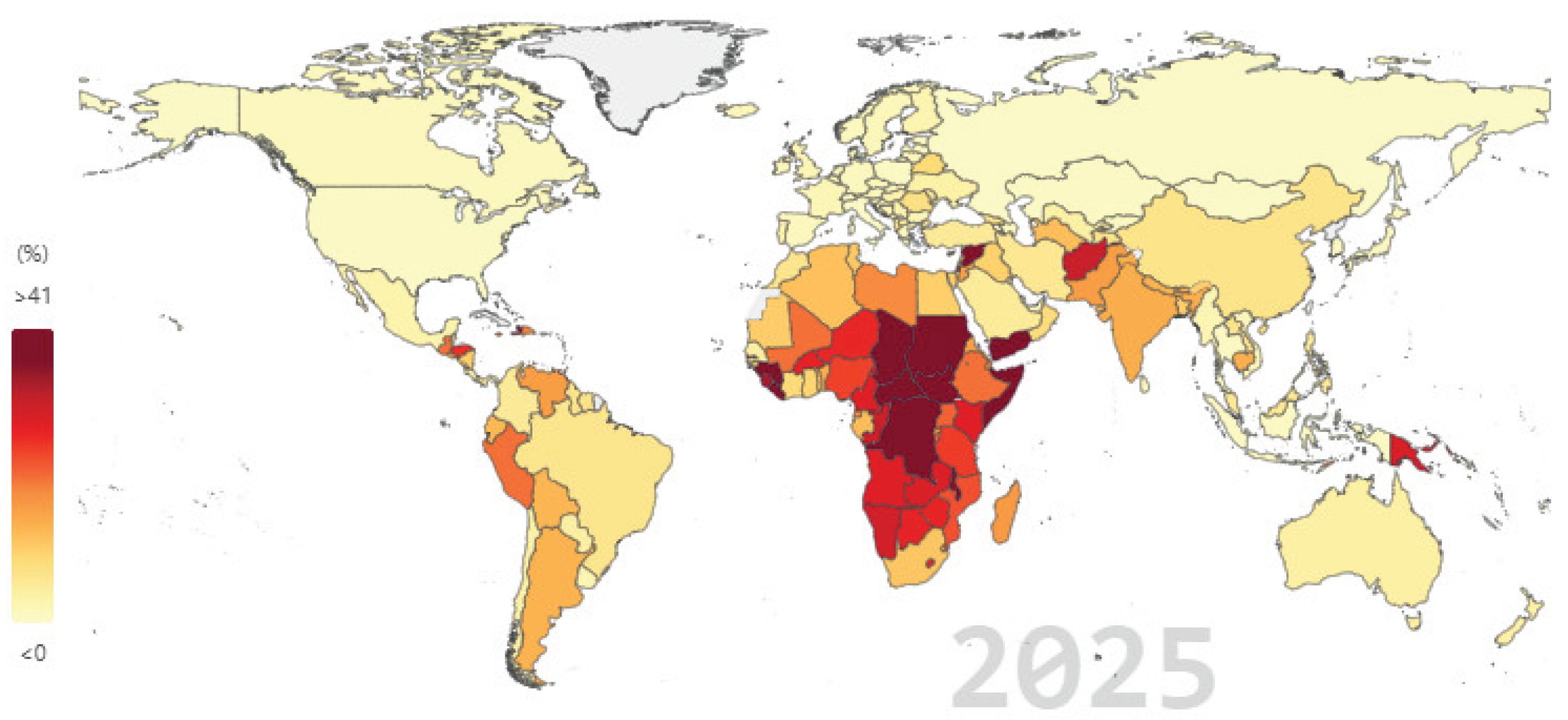
Figure 3.
Conceptual framework for analyzing food as a tool in conflict and security contexts. Source: Created by the author with Canva.
Figure 3.
Conceptual framework for analyzing food as a tool in conflict and security contexts. Source: Created by the author with Canva.

Figure 4.
Number of identified articles published between 2010 and 2024 and total citations for the published years. Note: Data for 2025 is partial, extracted on 17.06.2025
Figure 4.
Number of identified articles published between 2010 and 2024 and total citations for the published years. Note: Data for 2025 is partial, extracted on 17.06.2025
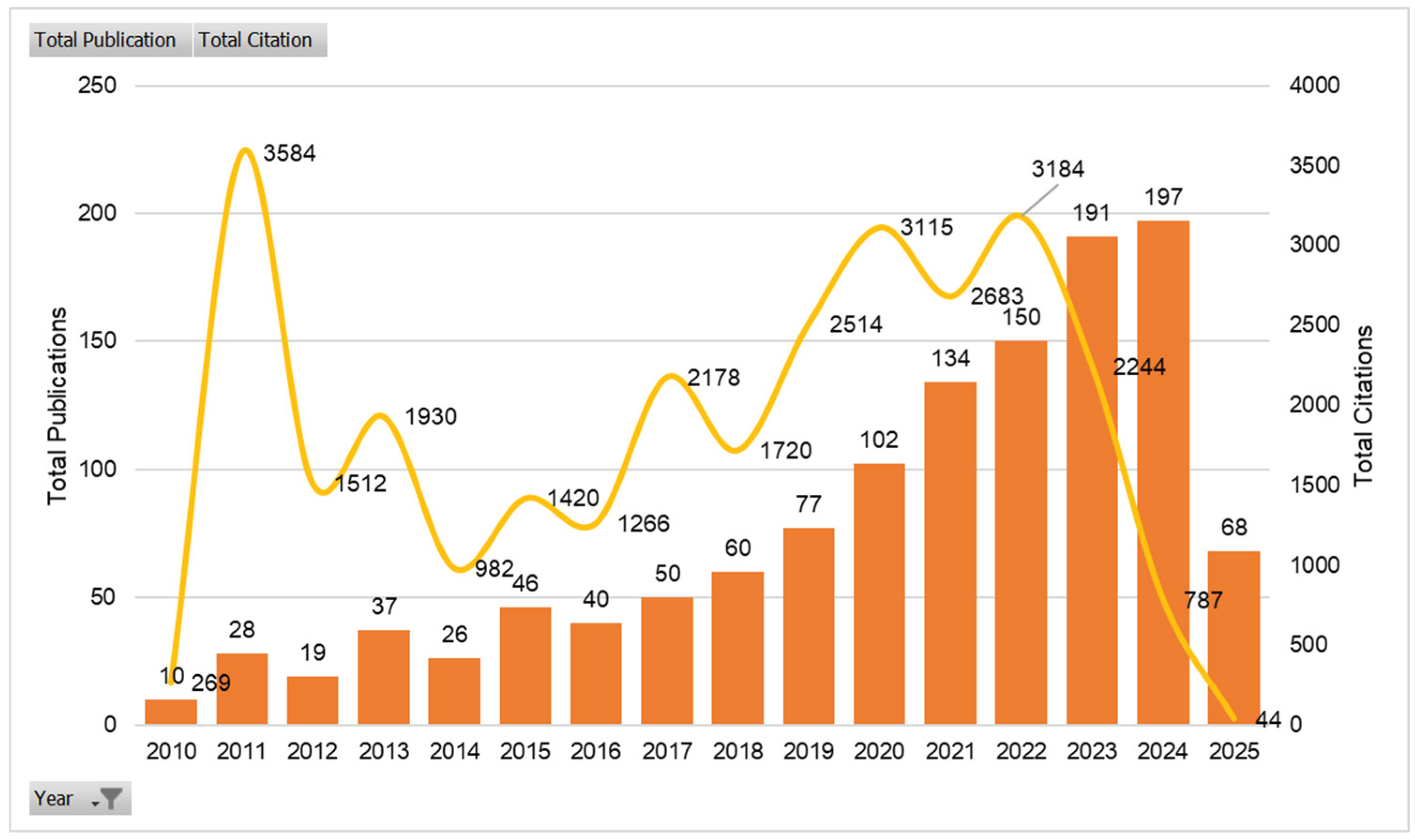
Figure 5.
Map dispersion of the Total citations per cited paper ratio.
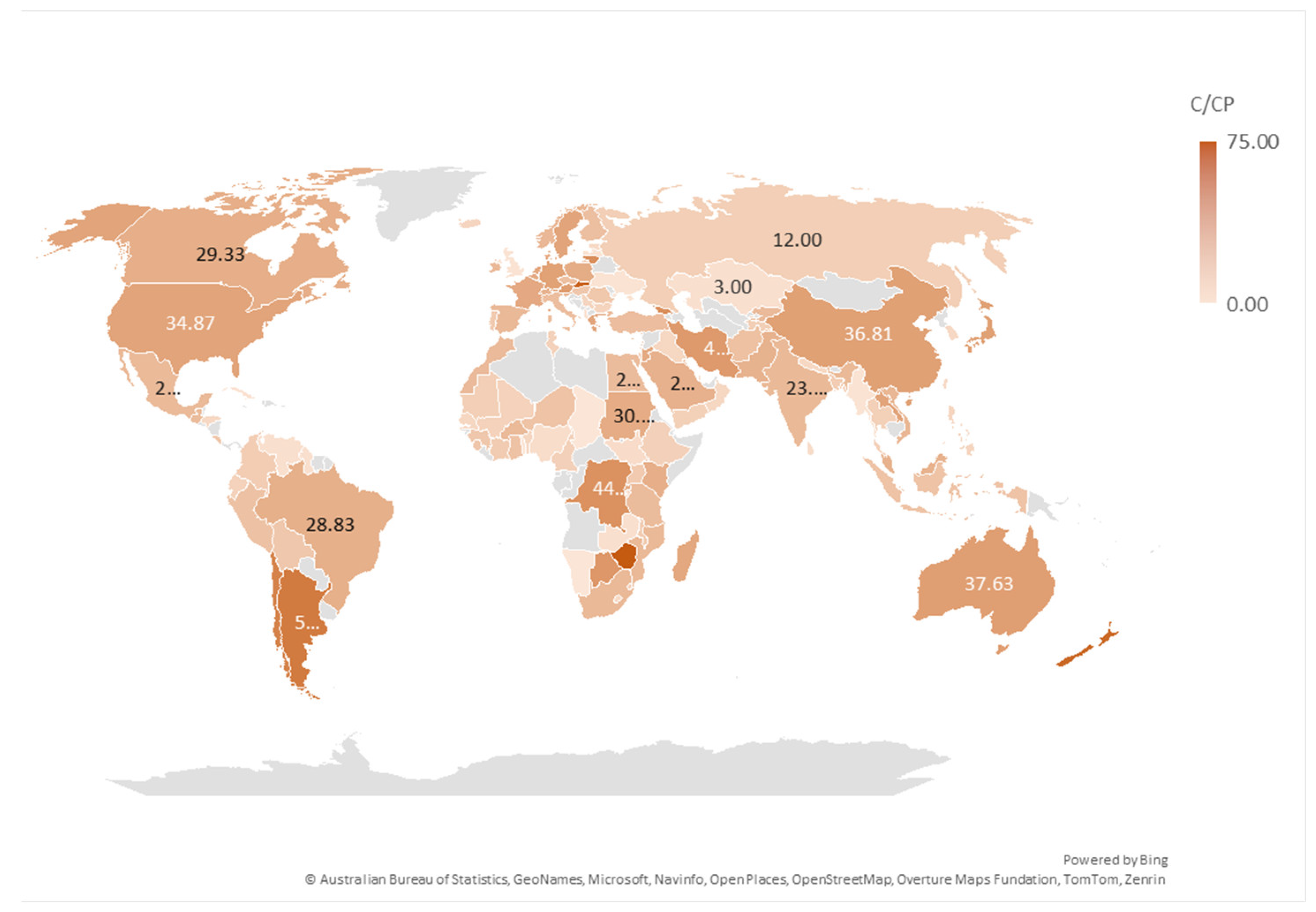
Figure 6.
VOSviewer Network visualization of keyword occurrence for words with more than 20 occurrences, N = 73 words meeting the criteria. (a). VOSviewer Network visualization for the dominant “Food security” cluster derived from Figure 6. (b). VOSviewer Network visualization for the second most dominant “Health” cluster, derived from Figure 6.
Figure 6.
VOSviewer Network visualization of keyword occurrence for words with more than 20 occurrences, N = 73 words meeting the criteria. (a). VOSviewer Network visualization for the dominant “Food security” cluster derived from Figure 6. (b). VOSviewer Network visualization for the second most dominant “Health” cluster, derived from Figure 6.
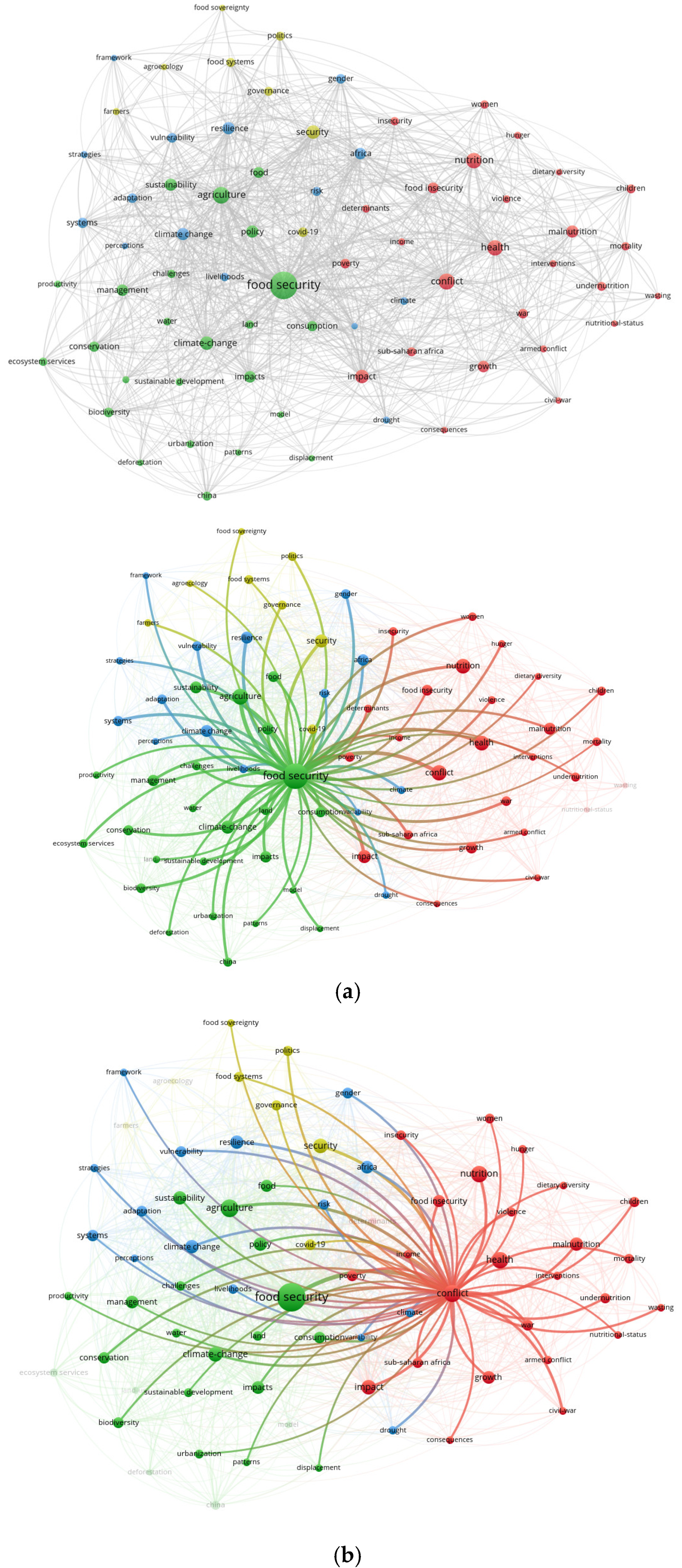
Figure 7.
Keyword Emphasis in Bibliometric Reviews on Food Security and Conflict. Source: Created by the authors with keywords from Keyword Plus.
Figure 7.
Keyword Emphasis in Bibliometric Reviews on Food Security and Conflict. Source: Created by the authors with keywords from Keyword Plus.
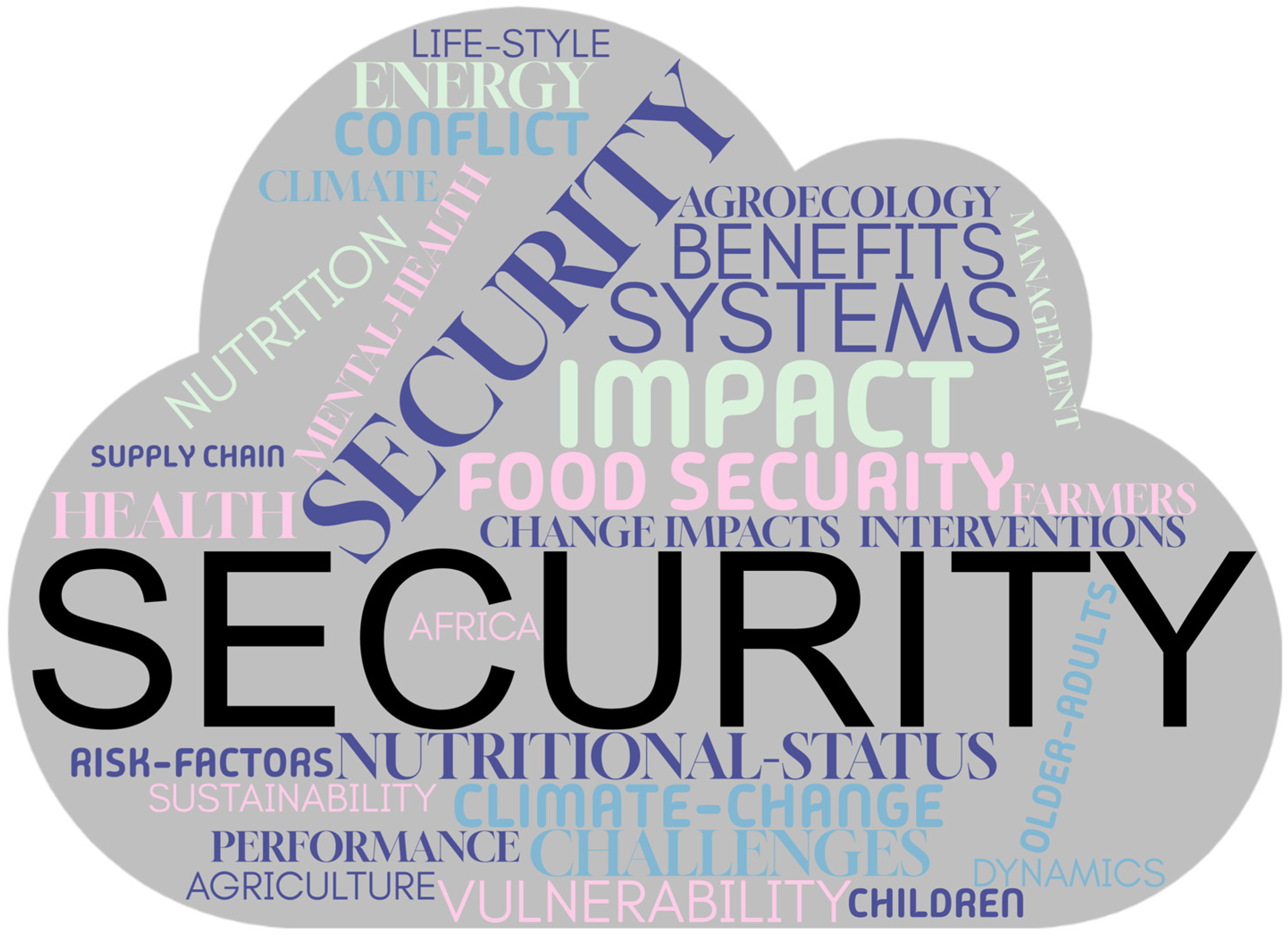
Figure 8.
Web of Science Categories for selected papers. Source: WoS generated TreeMap Chart.
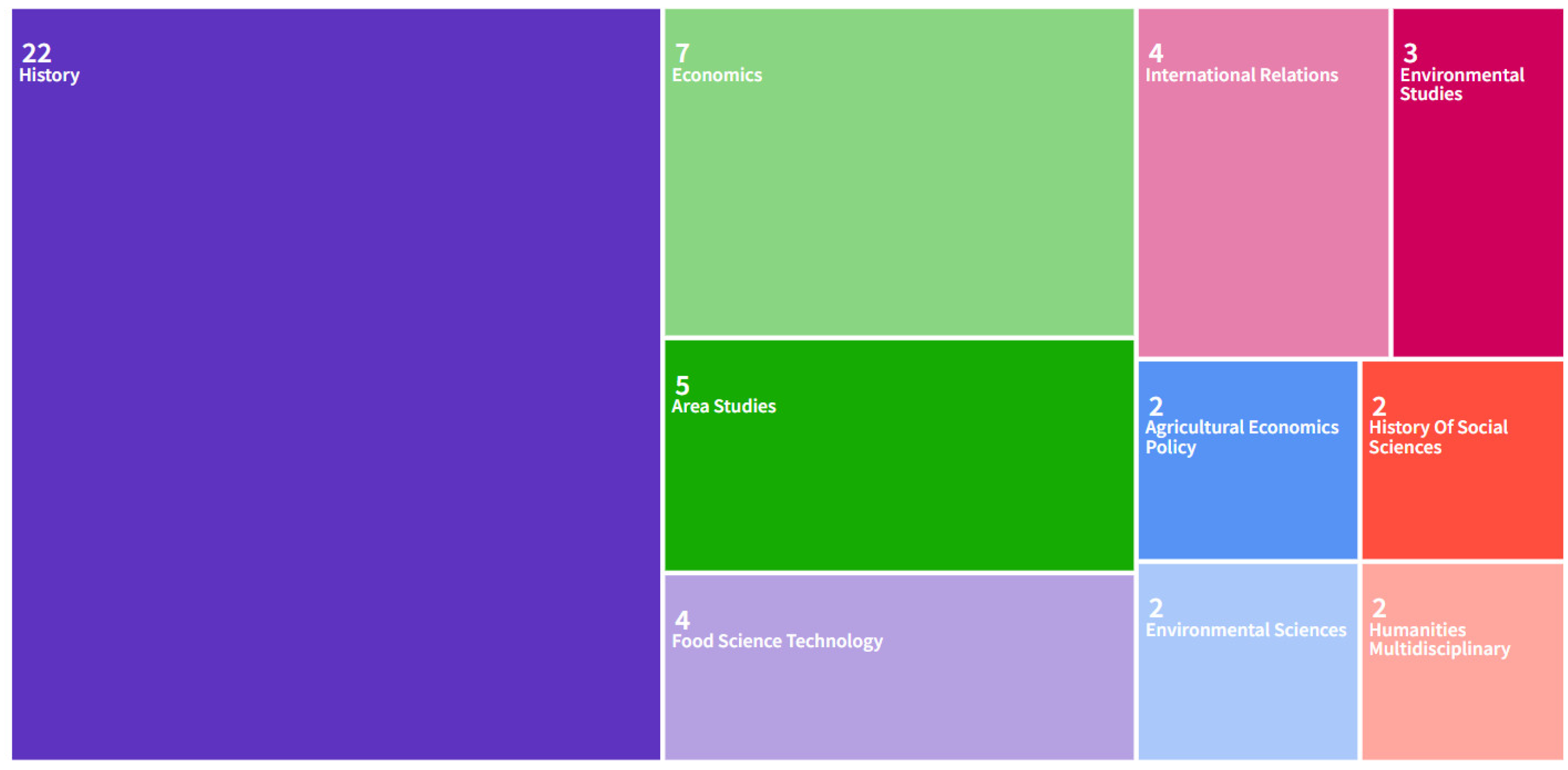

Table 1.
Preliminary dataset extracted from WebofScience.
| Description | Values |
|---|---|
| Time span | 2010-2025 |
| Documents (Articles and Review papers) | 1235 |
| Authors | 5300 |
| Affiliations | 3365 |
| Countries | 130 |
| Cited papers | 1099 (88.9%) |
| Times cited – all databases | 29432 |
| Citations per cited paper | 26.78 |
| Unique keywords | 3681 |
Table 2.
Keywords occurrence. Source: Generated by the author(s) using BiblioMagika® (Ahmi, 2024).
| Keywords | Documents |
|---|---|
| FOOD SECURITY | 268 |
| CLIMATE CHANGE | 77 |
| AGRICULTURE | 59 |
| CONFLICT | 57 |
| NUTRITION | 53 |
| MALNUTRITION | 48 |
| FOOD INSECURITY | 48 |
| RESILIENCE | 44 |
| COVID-19 | 40 |
| SUSTAINABILITY | 39 |
| FOOD SYSTEMS | 36 |
| SUB-SAHARAN AFRICA | 28 |
| AFRICA | 28 |
| GENDER | 27 |
| SUSTAINABLE DEVELOPMENT | 24 |
| ------------------------ | ---- |
| WAR | 19 |
| STARVATION (WAR/CRIMES/DEATH) | 3 |
| WEAPONIZING FOOD | 1 |
Table 3.
Comparative bibliometric indicators of leading journals by volume. Source: Generated by the author using BiblioMagika® (Ahmi, 2024).
Table 3.
Comparative bibliometric indicators of leading journals by volume. Source: Generated by the author using BiblioMagika® (Ahmi, 2024).
| Source Title | TP | NCA | NCP | TC | C/P | C/CP |
|---|---|---|---|---|---|---|
| SUSTAINABILITY | 56 | 238 | 52 | 1045 | 18.66 | 20.10 |
| FRONTIERS IN SUSTAINABLE FOOD SYSTEMS | 41 | 239 | 33 | 382 | 9.32 | 11.58 |
| LAND USE POLICY | 30 | 117 | 29 | 1570 | 52.33 | 54.14 |
| FOOD SECURITY | 22 | 84 | 19 | 475 | 21.59 | 25.00 |
| WORLD DEVELOPMENT | 21 | 86 | 21 | 761 | 36.24 | 36.24 |
| PLOS ONE | 19 | 136 | 13 | 226 | 11.89 | 17.38 |
| BMC PUBLIC HEALTH | 18 | 121 | 15 | 411 | 22.83 | 27.40 |
| LAND | 17 | 102 | 15 | 321 | 18.88 | 21.40 |
| GLOBAL FOOD SECURITY | 16 | 54 | 15 | 503 | 31.44 | 33.53 |
| MATERNAL AND CHILD NUTRITION | 16 | 88 | 13 | 322 | 20.13 | 24.77 |
Table 4.
Comparative bibliometric indicators of leading journals by citations. Source: Generated by the author using BiblioMagika® (Ahmi, 2024).
Table 4.
Comparative bibliometric indicators of leading journals by citations. Source: Generated by the author using BiblioMagika® (Ahmi, 2024).
| Source Title | TP | NCA | NCP | TC | C/P | C/CP |
|---|---|---|---|---|---|---|
| PNAS | 5 | 71 | 5 | 2969 | 593.80 | 593.80 |
| LAND USE POLICY | 30 | 117 | 29 | 1570 | 52.33 | 54.14 |
| SUSTAINABILITY | 56 | 238 | 52 | 1045 | 18.66 | 20.10 |
| WORLD DEVELOPMENT | 21 | 86 | 21 | 761 | 36.24 | 36.24 |
| JOURNAL OF PEASANT STUDIES | 9 | 20 | 9 | 686 | 76.22 | 76.22 |
| FOODS | 14 | 49 | 13 | 618 | 44.14 | 47.54 |
| FOOD POLICY | 15 | 44 | 15 | 613 | 40.87 | 40.87 |
| REGIONAL ENV. CHANGE | 8 | 25 | 8 | 537 | 67.13 | 67.13 |
| GLOBAL ENVIRONMENTAL CHANGE | 3 | 11 | 3 | 520 | 173.33 | 173.33 |
| GLOBAL FOOD SECURITY-AGR. POLICY | 16 | 54 | 15 | 503 | 31.44 | 33.53 |
Disclaimer/Publisher’s Note: The statements, opinions and data contained in all publications are solely those of the individual author(s) and contributor(s) and not of MDPI and/or the editor(s). MDPI and/or the editor(s) disclaim responsibility for any injury to people or property resulting from any ideas, methods, instructions or products referred to in the content. |
© 2025 by the authors. Licensee MDPI, Basel, Switzerland. This article is an open access article distributed under the terms and conditions of the Creative Commons Attribution (CC BY) license (http://creativecommons.org/licenses/by/4.0/).
Copyright: This open access article is published under a Creative Commons CC BY 4.0 license, which permit the free download, distribution, and reuse, provided that the author and preprint are cited in any reuse.


