

Submitted:
31 July 2025
Posted:
01 August 2025
You are already at the latest version
Abstract
In a global context where soft skills have become decisive for employability and
professional advancement, this study analyses its role in the career paths of university
graduates in Ecuador. Based on an analysis of 1,884 graduates from the Salesian Polytechnic
University (Cuenca campus), it was found that more than 90% of them work at operational
levels within organisations. In comparison, only 5% hold tactical or managerial positions.
This finding highlights a disconnect between university education and the skills required
by the contemporary labour market.
The study proposes a curriculum improvement strategy based on the sectoral identification
of key soft skills, differentiated by economic sectors such as education, health, commerce,
public administration, industry, and primary activities. This proposal is based on the
cross-referencing of empirical data with international theoretical frameworks. It seeks
to guide the progressive inclusion of crosscutting skills such as leadership, adaptability,
critical thinking, and effective communication within university curricula.
The results suggest a differentiated training strategy tailored to the productive environment,
which can significantly enhance the career paths of graduates, facilitating their transition to
positions of greater responsibility. The proposal can be replicated in other Latin American
universities facing similar challenges of professional mobility and educational mismatch.
Keywords:
soft skills
; university curriculum
; employability
; career advancement
; Ecuador
; Latin America
1. Introduction
In the current context, characterised by digital transformation and the constant evolution of the labour market, holistic competencies, also known as soft skills, have taken on a leading role in professionals’ employability [1,2,3,4]. These include skills such as effective communication, leadership, and problem solving, which, in synergy with technical knowledge, make for a more competitive professional profile. Holistic competencies, also known as soft skills, have established themselves as a key set of attributes required by the labour market, especially in leadership and decision-making roles [5]. In international corporations such as Toyota and General Motors, selection processes for management positions explicitly prioritise qualities such as critical thinking, emotional management, adaptability, and the ability to act in highly complex contexts [6,7]. These 30 organisations report that such skills account for more than 70% of the criteria used to 31 promote talent from operational positions to middle and senior management, even above 32 sustained technical performance [8].
These skills enable not only effective interaction in multidisciplinary teams, but also resource management, strategic project coordination, conflict resolution, and adaptation to changing environments [9]. Recent research highlights that these qualities are crucial in highly demanding sectors, as they boost productivity, stimulate innovation and promote a more humane and collaborative style of leadership [10,11]. The absence of these skills is identified as a significant barrier to accessing higher hierarchical levels, which highlights the need to integrate them in a structured way into curricula, particularly in areas such as engineering and administration, where management skills and effective communication are essential for successful performance [12].
In areas such as engineering, a growing gap has emerged between the skills acquired by university students and the demands of today’s workplace. Global and regional research [13] agrees that, while technical skills are essential, they are not sufficient to fill strategic and decision-making positions. Employers report difficulties in finding candidates with strong transferable skills, a challenge that is particularly acute in Latin America, where education systems are not yet responding efficiently to these demands [14]. In this context, interna-tional accreditation standards such as those of the Accreditation Board for Engineering and Technology (ABET) offer a valuable benchmark, as they explicitly include competencies such as effective communication, teamwork, professional ethics, and complex problem solving as fundamental criteria for educational quality [15].
In Ecuador, the results of the data update survey conducted in 2021 on 1,884 graduates out of 6,638 registered since 2013 at the Salesian Polytechnic University (UPS), Cuenca campus, highlight this issue. Information is available at the follow-up of graduates from the UPS, specifically Form 01, available on the official platform. The analysis reveals that 90% of graduates work in operational positions, while only 5% occupy tactical and strategic positions. This data is significant, as it suggests a lack of preparation in crosscutting skills that would enable graduates to access roles of greater complexity and responsibility in decision-making.
This phenomenon is not exclusive to Ecuador. In a comparative study on university in- clusion and employability in Argentina and Colombia [11], concluded that in many Latin American universities, most graduates remain stuck in technical roles, without reaching leadership or decision-making levels, due to the limited incorporation of soft skills in the curricula. Similarly, previous research [7,16] has highlighted that a lack of skills such as ef-fective communication, leadership, conflict resolution, and critical thinking represents one of the main barriers to professional advancement, even when there is solid technical train-ing. This convergence of results in different countries highlights the urgent need to rethink the university curriculum approach in Latin America, promoting a more comprehensive education that combines disciplinary knowledge with the development of socio-emotional and strategic skills.
However, the review of the curricula does not identify systematic pedagogical methodolo-gies in higher education institutions (HEIs) that allow these skills to be assessed effectively [17,18]. This gap creates uncertainty about the demands of the labour market and puts pressure on universities to develop strategies that enable them to train well-rounded pro-fessionals who are capable of facing the challenges of the contemporary environment [19]. This disconnect between the curriculum structure and the skills required for professional integration and advancement is even more evident when comparing the UPS findings with other Latin American universities, where the same pattern is repeated of graduates who are well-trained technically but limited in key soft skills.
This article examines the gaps between university education and the holistic skills de-manded by the labour market. Based on the analysis of data collected through institutional surveys of 1,884 graduates, supplemented by interviews with business leaders and key stakeholders, a curriculum alignment strategy is proposed that identifies the key soft skills for each economic sector and their link to the organisational positioning of professionals. The purpose of this study is to generate useful evidence to highlight current employability challenges, guide the redesign of academic programs in line with the productive context, and strengthen the connection between universities and the labour market. In addition, it seeks to promote more sustainable career paths, facilitating the transition of graduates from operational roles to positions of greater leadership, autonomy, and responsibility within their respective sectors.
This issue is aligned with the frameworks of the Higher Education Council (CES), the Higher Education Quality Assurance Council (CACES) and the National Levelling and Admission System (SNNA), which require academic relevance and connection with the productive environment. Its inclusion reinforces the consistency of the analysis with current national policies.
2. Methodology
2.1. Focus
This study adopts a quantitative, descriptive and cross-sectional approach, aimed at analysing university graduates’ perceptions of the applicability of their academic training in the workplace. The research considers the distribution of participants according to economic sector and hierarchical level, allowing for the identification of general patterns linking academic preparation with current professional practice.
2.2. Data Collection Instrument
A structured questionnaire, designed based on previous studies [11,12,13,14], is used to collect information. It is aimed at examining both the objective conditions of professional performance and the subjective perception of the applicability of academic training in the workplace. The instrument is organised into two complementary sections:
- Sectoral and organisational classification. Collect information about the economic sector in which participants work (primary, secondary, or tertiary) and the hierarchical level they have reached within their organisation (operational, tactical, or managerial). This section allows us to contextualise the professional environment and analyse how graduates are distributed within the productive structure.
- Perception of the application of vocational training. Assess the extent to which participants consider that they apply the knowledge acquired in their degree course to their current job performance, using a four-point Likert scale: “Strongly agree”, “Agree to some extent”, “Disagree to some extent” and “Strongly disagree”. This dimension points to a frequent disconnect between academic content and the demands of the labour market [20], which emphasises that academic success alone does not guarantee effective professional integration if there are no mechanisms in place to promote the applicability of learning [21].
Both blocks are designed to offer an integrated view of graduates’ career paths, facilitating a comparative analysis between the context of labour market integration and the relevance of the training received. Table 1 summarises this information, allowing us to observe the sectoral distribution, the hierarchical level achieved and the perception of the application of university knowledge in each sector.
2.3. Participants
The study was conducted with the participation of 1,884 professionals who graduated from the Salesian Polytechnic University (UPS), Cuenca campus, a religious higher educa-tion institution with a humanistic approach. UPS consistently implements an institutional graduate tracking system, designed as a strategy to provide feedback on its academic offerings and evaluate the impact of education on job performance. A key variable in the analysis is the organisational level that participants occupy in their respective work environments: operational, tactical or managerial. This dimension allows us not only to identify their hierarchical position, but also to infer the degree of autonomy, responsibility and crosscutting skills required for each level. As highlighted in various studies [20,21], skills such as effective communication, leadership, decision-making and adaptability become increasingly important as one moves up the organisational ladder. Therefore, including this variable is essential for assessing the correspondence between the academic training received and effective integration into the labour market [22,23].
Ethical Consideration on the Data Source
The data used in this research comes from the institutional graduate tracking system of the Salesian Polytechnic University (UPS), specifically Form 01, hosted on the official platform. This tool is exclusively for qualified professionals and recent graduates, who access it using their personal identification number, which guarantees the authenticity, traceability, and validity of the collected information.
This form is submitted annually as part of a process required by both the university and the national bodies that oversee the higher education system. Its purpose is to generate relevant statistics on job placement, professional performance, and early career paths of graduates, covering both those who are already active in the market and those who are in the process of entering it.
The data used in this study correspond to the period 2013–2021, before the entry into force the Ecuador’s Organic Law on Personal Data Protection. Within this framework, its use has been governed by the institutional regulations in force at the time, for strictly academic and research purposes. The database was treated anonymously, confidentially and ethically, respecting the principles of integrity, personal data protection and scientific responsibility.
3. Results
3.1. Sectoral Analysis of the Professional Practice of Graduates
In order to gain a comprehensive understanding of the relationship between university education and professional practice, a sectoral analysis is carried out focusing on the three major economic sectors: primary, secondary and tertiary. This approach considers three key analytical dimensions: (i) labour market insertion, understood as the proportion of graduates who are actively employed in each sector. (ii) professional performance, referring to the functions performed by graduates concerning the skills acquired during their training. And (iii) organisational positioning, defined by the hierarchical level achieved within the labour structure (operational, tactical or managerial).
This structured approach makes it possible not only to quantify the presence of professionals in different productive sectors, but also to assess the quality of their participation and the real possibilities for professional development. In addition, it enables the identification of structural barriers, opportunities for improvement, and occupational trends that directly affect labour mobility and the construction of sustainable career paths. Below is a detailed analysis by economic sector, based on these three dimensions.
3.1.1. Primary Sector
The primary sector, which includes activities such as agriculture, livestock farming, forestry, fishing and mining, has a marginal participation by university professionals. Ac-cording to the data analysed, less than 2% of the graduates surveyed stated that they were employed in this sector, which highlights the weak link between academic training and the country’s rural and extractive production dynamics.
This trend is replicated in other Latin American contexts, where the primary sector contin ues to be one of the least technologically advanced and with low absorption of university talent [24,25,26,27]. In cases where integration exists, professionals tend to occupy operational roles, with little access to management or planning roles, suggesting an underutilisation of their training capabilities.
Two factors contribute to this scenario: on the one hand, a disconnect in the curriculum, as study programmes do not sufficiently address specific challenges such as environmental sustainability, agro-industrial innovation, or land management. On the other hand, the lack of institutional and public policies that encourage professional participation in these environments limits their development as a viable option for job placement.
However, the primary sector is a strategic area with high potential for transformation. The incorporation of soft skills such as adaptability, community leadership, and intercultural communication, as pointed out in [27], can significantly strengthen the role of professionals in rural contexts characterised by poorly defined organisational structures. More con- textualised, interdisciplinary and territory-oriented training would not only expand job opportunities in this sector but also contribute more effectively to the country’s sustainable development.
3.1.2. Secondary Sector
The secondary sector, which includes activities such as manufacturing, construction, energy generation, and transformation processes, represents a moderate area of employ- ment for university professionals. According to the data analysed, around 10% of graduates work in this sector, mainly in areas related to engineering, industrial maintenance, and operational management.
Although participation exceeds that observed in the primary sector, there continues to be a strong concentration in operational and tactical roles, with little representation at manage- ment levels. This trend suggests the existence of structural barriers that limit professional advancement, attributable to three key factors.
Firstly, technical degrees continue to prioritise disciplinary content without systematically integrating crosscutting skills such as leadership, effective communication, or conflict resolution. As indicated in [28,29], this omission reduces the ability of professionals to take on strategic responsibilities in dynamic and highly demanding industrial environments. Secondly, many industries operate under traditional hierarchical structures, where access to decision-making positions depends more on seniority or length of service than on ac- quired skills. This organisational logic, common in what [30,31,32,33,34,35] refer to as ‘hierarchical capitalism’, restricts the upward mobility of young professionals, even when they have a strong academic background.
Finally, the weak link between universities and industrial companies contributes to out- dated curricula and training that is disconnected from the real needs of the productive environment. This problem, also highlighted in the study by [36] and in A Crosswalk of 21st Century Skills Membership, limits knowledge transfer and hinders the incorporation of high-value-added profiles in the sector.
However, the secondary sector offers a favourable environment for innovation, technologi- cal application and continuous process improvement. To take advantage of this potential, higher education institutions need to strengthen the development of interpersonal and organisational skills and implement strategies such as pre-professional internships, dual training and institutional agreements with companies in the sector. These actions would prepare students to assume leadership roles and facilitate their transition to strategic positions within the industrial structure.
3.1.3. Tertiary Sector
The tertiary sector, comprising service activities such as education, health, commerce, public administration, finance and tourism, is the main area of employment for graduates. According to the data collected, more than 70% of the graduates surveyed are linked to this sector, with the subsectors of education (18.46%), public administration (10.84%), com- merce (10.45%) and health (3.42%) standing out. This high participation suggests a notable correspondence between the university’s academic offerings and the demands of the local labour market.
In contrast to the low representation in the primary sector and limited technical participa- tion in the secondary sector, the tertiary sector shows greater capacity to absorb university graduates, especially in areas related to teaching, public management, professional ser- vices, and customer service. However, the analysis reveals that most graduates remain in operational or tactical roles, with limited access to managerial positions. This indicates broad insertion, but with few opportunities for vertical development, a phenomenon that various studies have described as partial inclusion in organisational environments [30,31,32]. This pattern can be attributed to three interrelated factors. First, service environments require relational skills such as effective communication, empathy, leadership, and conflict resolution [37], which are essential for assuming strategic responsibilities. Their absence or poor development hinders advancement to coordination or management positions. Secondly, subsectors such as commerce and public administration are characterised by high levels of turnover, temporary employment and limited internal promotion, which weakens the consolidation of sustainable career paths. Thirdly, despite these limitations, the tertiary sector constitutes a platform with high potential for social impact, particularly in areas such as health and education, where professional work can generate direct benefits in vulnerable communities.
Consequently, although this sector accounts for the highest proportion of graduates, it is necessary to strengthen their training in social-emotional skills, leadership, team manage- ment, and decision-making. It is also recommended that universities develop institutional policies that promote entrepreneurship, professional mobility, and progressive access to higher hierarchical levels within the field of services.
3.1.4. Data Processing
Figure 1 presents a comparison of the organisational level, as well as the perception of the applicability of the training received, differentiated by economic sector: primary (A), secondary (B) and tertiary (C).
In the primary sector (Figure 1A), most graduates are concentrated in operational (∼ 55%) and tactical (∼ 32%) roles, with little presence in management positions. However, the perception of the use of their professional training is predominantly negative: 63% of respondents say they disagree with the statement ‘I apply my profession’, while 21% say they partially disagree. This shows a significant underutilisation of the skills acquired, possibly related to the low level of technology and limited demand for university graduates in this sector.
In the secondary sector (Figure 1B), there is a clear concentration at operational levels (∼ 70%), followed by 25% at the tactical level, and barely 5% in management positions. Perceptions of the relevance of training are divided: 37% say they fully apply it, while 39% say they do not. This disparity reflects heterogeneous experiences within the industrial environment, where some graduates achieve performance levels consistent with their profile, while others face mismatches between their academic preparation and the duties assigned to them.
In the tertiary sector (Figure 1C), which accounts for the highest percentage of graduate employment, 60% of graduates are reported to be working at the operational level and35% at the tactical level, with a low presence in leadership positions. The perception of professional application is fragmented: 30% say they do not apply what they have learned, while 28% strongly agree. This heterogeneous pattern reflects the diversity of subsectors (education, health, commerce, etc.) that have very different demands and working conditions.
Overall, the results confirm a structural trend: access to employment does not guaran- tee full or meaningful professional integration. The high concentration at lower hierarchical levels, together with negative or inconsistent perceptions of the usefulness of university education, points to an urgent need to rethink curricula. Higher education institutions must promote training that is more closely linked to sectoral contexts and focused on the development of transferable skills, with a view to more meaningful and sustainable job placement, which is aligned with expected professional profiles.
3.2. Soft Skills Analysis
The study highlights a persistent structural trend: a large proportion of graduates remain at operational organisational levels, with little involvement in tactical or managerial roles. This situation is consistently evident in strategic sectors such as education, health, commerce, public administration, industry, and primary activities. Therefore, entering the labour market does not always translate into upward professional development, revealing a disconnect between the graduate profile and the real demands of the productive environ- ment, especially those that go beyond technical knowledge.
Given this scenario, there is a need to strengthen soft skills as a structural component to facilitate organisational advancement. These crosscutting, contextualised and progres- sive skills enable professionals to take on roles associated with leadership, coordination, decision-making and adaptation to dynamic contexts [38,39,40,41], and in Data Reveals The Most In-Demand Soft Skills Among Candidates.
From a conceptual perspective, there is no single classification or universally accepted taxonomy for these skills. They are referred to in the literature as non-technical skills, transferable skills, interpersonal skills, or employability skills, which demonstrates their versatile and highly adaptable nature. This multi-component nature is also reflected in its sectoral expression: certain skills become more relevant depending on the economic sector, enabling professionals to evolve from operational roles to strategic responsibilities.
The study identifies significant differences depending on the sector, with the highest employment rate for graduates in education (18.46%), public administration (10.84%), and commerce (10.45%). The lowest employment rates are found in health (3.42%) and the primary sector (1.84%). The table by sectors is detailed below:
- Education: requires skills such as effective communication, pedagogical leadership, conflict resolution, and collegial decision-making. These skills are key to progressing from teaching to academic management roles.
- Health: requires ethical leadership, time management, empathy, and emotional regula- tion, which are essential in clinical settings where responsibilities include coordination and decision-making in high-pressure environments.
- Commerce: values customer focus, persuasive communication, agility in problem solving, and resilience. These skills are critical for taking on roles such as commercial supervision or operational logistics.
- Public administration: requires skills such as evidence-based decision-making, reg- ulatory adaptability, professional ethics, and institutional leadership. Mastery of these skills is essential for holding middle management or executive positions in government environments.
- Secondary sector (industry): notable for requiring technical problem solving, leader- ship in production processes, openness to technological innovation, and collaboration in structured environments.
- Primary sector: although less represented, it demands autonomy, resilience, commu- nity leadership and independent decision-making, especially for rural development and sustainable agro-industrial projects.
It should be noted that these skills are not restricted solely to the interpersonal sphere. They include intrapersonal dimensions (self-management, change management), cognitive dimensions (critical thinking, informed judgement) and affective dimensions (empathy, active listening), all of which are highly transferable between different work contexts. Therefore, it is proposed that their systematic integration into university curricula should go beyond theoretical incorporation. The use of active methodologies, simulations, case stud- ies, interdisciplinary projects, and performance-based assessment mechanisms is required to enable the gradual and measurable development of these competencies. This training strategy would significantly contribute to overcoming the concentration of graduates in operational roles, promoting more dynamic and sustainable career paths that are aligned with the demands of the 21st century.
3.3. Projection Towards Curricular Improvement
Soft skills are a determining factor in the professional integration and progression of university graduates, regardless of the economic sector in which they work. Various studies agree that skills such as leadership, teamwork, effective communication, problem-solving, adaptability, and informed decision-making are key to advancing beyond the operational level to tactical or leadership roles.
This phenomenon, clearly evident at the Salesian Polytechnic University, Cuenca campus, is not an isolated case. On the contrary, it reflects a widespread problem in many higher ed- ucation institutions in Latin America, where curricula still prioritise technical components, neglecting the systematic and progressive development of cross-cutting skills as an integral part of the graduate profile.
Analysis by economic sector reveals distinct patterns in terms of the type of soft skills that favour professional advancement:
- Interpersonal skills (communication, leadership, collaboration) are essential in areas such as education, health and public services [42].
- Intrapersonal skills (self-management, resilience, tolerance to change) have a signifi- cant impact in sectors such as primary and industrial, where autonomy and continuous adaptation are essential [43].
- Cognitive and affective skills (critical thinking, ethical judgement, empathy) are applied across all sectors and hierarchical levels [44].
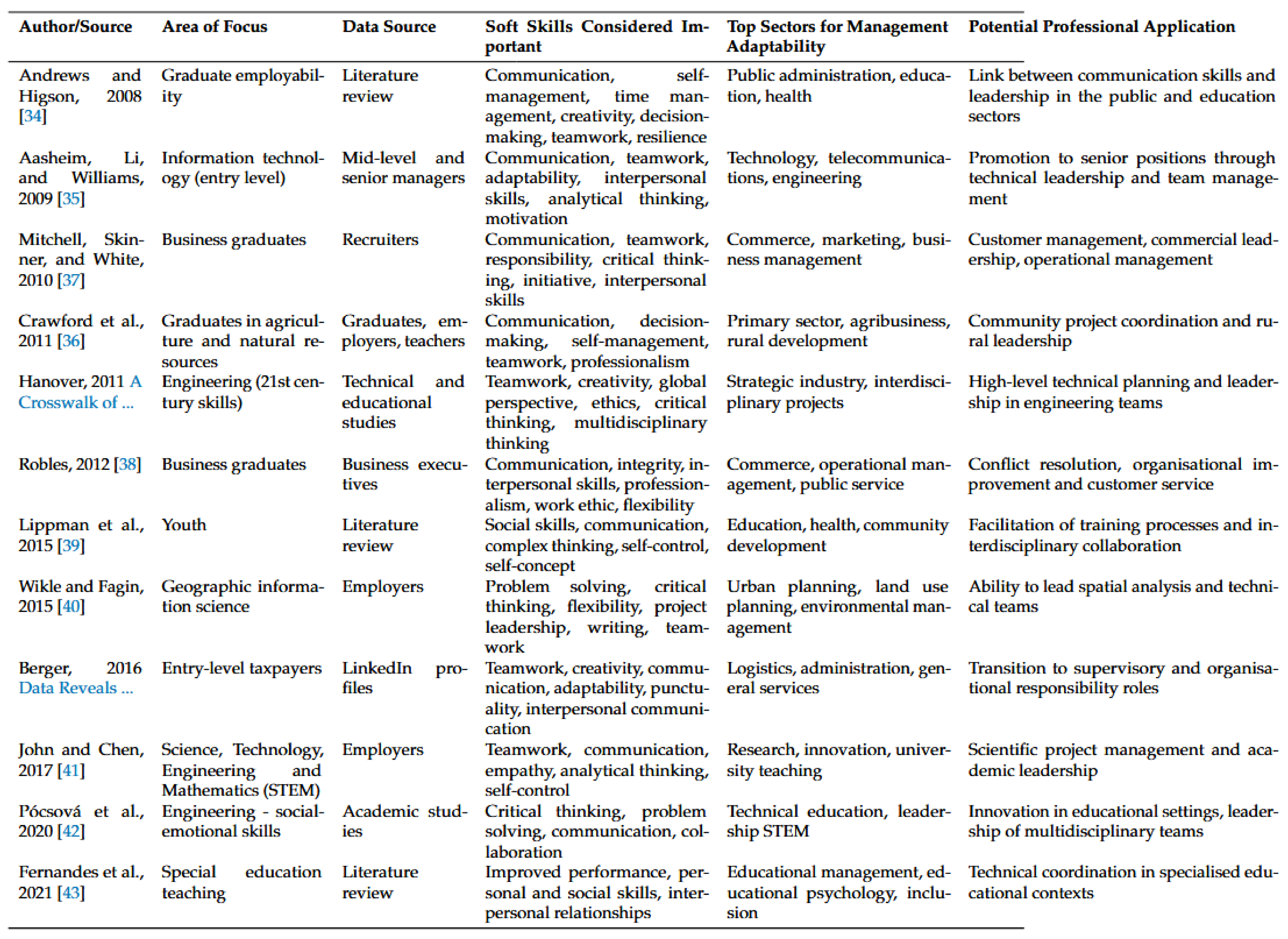
This diagnosis allows us to affirm that improving the quality of the professional profile requires a profound curricular transformation that ensures the development and continuous evaluation of these skills from the earliest stages of training. The proposal presented in Table 2 acts as a strategic input for this process. By classifying soft skills according to international evidence and linking them to specific productive sectors and their potential for organisational projection, a concrete and replicable roadmap is constructed.
Consequently, this study not only identifies a critical need but also offers a structured proposal aligned with the demands of the contemporary work environment [45,46,47]. The integration of soft skills into curriculum redesign in a sector-specific, measurable, and con- textualised manner has the potential to significantly strengthen employability, sustainable professional development, and academic relevance in higher education institutions, both in Ecuador and in other countries in the region.
4. Discussion
This study highlights a structural disconnect between university education and the skills required for the professional growth of graduates in the Ecuadorian labour market. Although the data show a high rate of labour market insertion, more than 90% of graduates remain in operational roles, while only 5% reach tactical or managerial levels. This situation, consistently observed in sectors such as education, health, industry, commerce, and public administration, reflects a lack of preparation in crosscutting skills that are essential for assuming strategic responsibilities.
The proposal put forward in this paper addresses this issue through a differentiated cur- riculum application tool, which is presented in Table 2. This sectoral classification of soft skills identifies, based on empirical evidence, which skills are priorities for professional advancement in each economic sector. Unlike general or abstract approaches, this curricu- lum strategy is structured around occupational reality, allowing for more contextualised and effective pedagogical planning. For example, in education and health, priority is given to the development of collaborative leadership and empathetic communication; while in industry and the primary sector, skills such as resilience, teamwork and adaptability to complex environments are particularly important.
The proposal takes on additional relevance as it aligns with international frameworks such as ABET criteria, which establish the mandatory integration of skills such as effective communication, ethical judgment, and problem-solving in the graduate profile. This con- vergence of theory and practice reinforces the relevance of incorporating a differentiated training strategy, both in technical careers and in service-oriented disciplines. In particular, in areas such as engineering, where a technical approach has historically predominated, there is a clear need to strengthen the socio-emotional dimension of the curriculum to prepare professionals to lead and innovate.
Furthermore, this study not only identifies a problem of educational alignment but also proposes a concrete and adaptable path for curriculum redesign. The progressive integration of soft skills from the earliest levels of education would improve employability, boost professional mobility, and contribute to more equitable, strategic, and sustainable labour market integration. The applicability of this proposal transcends the Salesian Polytechnic University and can be replicated by other higher education institutions in Latin America facing similar challenges of academic relevance and professional stagnation
5. Implications for Education Policy
Incorporate soft skills into graduate profiles: HEIs should integrate skills such as leadership, communication, adaptability, and critical thinking in a crosscutting, assessable, and progressive manner.
Redesign curricula according to economic sectors: Adjusting training content and method- ologies to the specific demands of the productive environment improves the employability and organisational mobility of graduates.
Strengthen university-business ties: Promote dual training, pre-professional internships, and sectoral agreements to facilitate the transition to strategic roles.
Include soft skills indicators in quality assessment: CACES and other agencies should consider these skills in their accreditation standards.
Design policies that promote upward trajectories: Labour market integration strategies must include mechanisms that promote professional development beyond operational levels.
6. Limitations of the Study
This research proposes a strategy for curriculum improvement based on the sectoral integration of soft skills; however, it has certain limitations.
Firstly, the cross-sectional design does not allow for the observation of the temporal evolu- tion of career trajectories, which limits the analysis of long-term changes in the employment status of graduates.
Secondly, the data comes exclusively from the graduate tracking system of a single uni- versity, which limits the generalisation of the results to other institutions or educational contexts. Furthermore, the information is based on self-reported perceptions, which may introduce subjective biases.
Finally, although the instrument was designed based on specialised literature, it was not subjected to a formal psychometric validation process. Therefore, it is recommended that future research include reliability and validity analyses. These considerations pave the way for longitudinal and comparative studies that incorpo- rate the perspectives of employers and key players in the productive environment.
7. Conclusions
The study highlights a structural paradox: despite the high rate of employment among university graduates, their positions within organisations remain concentrated at oper- ational levels. This situation suggests that their academic training is underutilised and reflects a critical gap between university graduate profiles and the actual demands of the professional environment.
One of the most significant findings is the lack of systematic training in soft skills such as leadership, adaptability, effective communication, problem-solving, and critical thinking, which are essential competencies for accessing and performing in coordination, super- vision, or strategic management roles. This limitation is particularly evident in sectors such as education, health, commerce and public administration, where human interaction, decision-making and organisational management are central components of professional work.
Unlike previous approaches that merely list desirable skills, this study moves towards a practical proposal by categorising soft skills according to their applicability by economic sector and their relevance to professional mobility. This classification, supported by em- pirical evidence, allows a bridge to be built between the needs of the labour market and university curriculum design.
The sectoral and progressive approach allows for the projection of educational improvements both at the Salesian Polytechnic University and at other higher education institutions in Ecuador and Latin America.
In summary, the study contributes to strengthening educational relevance by providing a solid foundation for the integration of crosscutting skills into curricula, which in turn would promote more dynamic and sustainable career paths that are aligned with the challenges of the 21st century
Documents used in the analysis
- Form 01: Institutional instrument for monitoring graduates
- Higher Education Quality Assurance Council (CASES). (2019).
- External evaluation model for universities and polytechnic schools. Quito: Council for Quality Assurance in Higher Education.
- Institutional project on professional skills and employability Applied research carried out by the UPS
Active stage, which includes interviews and surveys of business owners in the provinces of Azuay, Cañar, Morona Santiago, Guayas, and Pichincha. The information is stored in the archives of the Outreach Department and has been used for comparative and curriculum diagnostic purposes.
CRediT authorship contribution statement
Moya Loaiza Diana Patricia: Writing – review & editing, Writing – original draft, Formal analysis, Data curation, Conceptualisation. Cárdenas Tapia Juan Alcides: Writing – review & editing, Writing – original draft, Project administration, Methodology, Funding acquisition. Garcia Garcia Cristian Leonardo: Methodology, Visualisation, Investigation.
References
- Espina-Romero, L.; Ríos Parra, D.; Noroño-Sánchez, J.G.; Rojas-Cangahuala, G.; Cervera Cajo, L.E.; Velásquez-Tapullima, P.A. Navigating digital transformation: Current trends in digital competencies for open innovation in organizations. Sustainability 2024, 16, 2119. [Google Scholar] [CrossRef]
- Cˇ irjevskis, A. Exploring coupled open innovation for digital servitization in grocery retail: From digital dynamic capabilities perspective. Journal of Risk and Financial Management 2022, 15, 411. [Google Scholar] [CrossRef]
- McPhillips, M.; Nikitina, T.; Tegtmeier, S.; Wójcik, M. What skills for multi-partner open innovation projects? Open innovation competence profile in a cluster ecosystem context. Sustainability 2022, 14, 13330. [Google Scholar] [CrossRef]
- Gómez-Galán, J.; Martínez-López, J.Á.; Lázaro-Pérez, C.; García-Cabrero, J.C. Open innovation during web surfing: Topics of interest and rejection by Latin American college students. Journal of Open Innovation: Technology, Market, and Complexity 2021, 7, 17. [Google Scholar] [CrossRef]
- Poláková, M.; Suleimanová, J.H.; Madzík, P.; Copuš, L.; Molnárová, I.; Polednová, J. Soft skills and their importance in the labour market under the conditions of Industry 5.0. Heliyon 2023, 9. [Google Scholar] [CrossRef]
- Ishigame, K. Enhancing learning through continuous improvement: case studies of the toyota production system in the automotive industry in South Africa. In Workers, Managers, Productivity: Kaizen in Developing Countries; Springer Singapore Singapore, 2020; pp. 197–219.
- Guo, Y.; Liu, F.; Song, J.S.; Wang, S. Supply chain resilience: A review from the inventory management perspective. Fundamental Research 2025, 5, 450–463. [Google Scholar] [CrossRef]
- Ivanov, D.; Dolgui, A.; Sokolov, B. The impact of digital technology and Industry 4.0 on the ripple effect and supply chain risk analytics. International journal of production research 2019, 57, 829–846. [Google Scholar] [CrossRef]
- Aggrawal, S.; Magana, A.J. Teamwork conflict management training and conflict resolution practice via large language models. Future Internet 2024, 16, 177. [Google Scholar] [CrossRef]
- Karimi, S.; Ahmadi Malek, F.; Yaghoubi Farani, A.; Liobikiene˙, G. The role of transformational leadership in developing innovative work behaviors: The mediating role of employees’ psychological capital. Sustainability 2023, 15, 1267. [Google Scholar] [CrossRef]
- Lefteri, A.; Menon, M.E. Transformational and transactional school leadership as predictors of teacher self-efficacy. Studies in Educational Evaluation 2025, 86, 101476. [Google Scholar] [CrossRef]
- Pacheco-Cubillos, D.B.; Boria-Reverter, J.; Gil-Lafuente, J. Transitioning to agile organizational structures: A contingency theory approach in the financial sector. Systems 2024, 12, 142. [Google Scholar] [CrossRef]
- Amalu, E.H.; Short, M.; Chong, P.L.; Hughes, D.J.; Adebayo, D.S.; Tchuenbou-Magaia, F.; Lähde, P.; Kukka, M.; Polyzou, O.; Oikonomou, T.I.; et al. Critical skills needs and challenges for STEM/STEAM graduates increased employability and entrepreneurship in the solar energy sector. Renewable and Sustainable Energy Reviews 2023, 187, 113776. [Google Scholar] [CrossRef]
- Guerra-Macías, Y.; Tobón, S. Development of transversal skills in higher education programs in conjunction with online learning: relationship between learning strategies, project-based pedagogical practices, e-learning platforms, and academic performance. Heliyon 2025, 11. [Google Scholar] [CrossRef]
- Passow, H.J. Which ABET competencies do engineering graduates find most important in their work? Journal of Engineering Education 2012, 101, 95–118. [Google Scholar] [CrossRef]
- Mwita, K. The role of soft skills, technical skills and academic performance on graduate employability. Technical Skills and Academic Performance on Graduate Employability (January 30, 2024), 30 January.
- Abelha, M.; Fernandes, S.; Mesquita, D.; Seabra, F.; Ferreira-Oliveira, A.T. Graduate employability and competence development in higher education—A systematic literature review using PRISMA. Sustainability 2020, 12, 5900. [Google Scholar] [CrossRef]
- Gkrimpizi, T.; Peristeras, V.; Magnisalis, I. Classification of barriers to digital transformation in higher education institutions: Systematic literature review. Education Sciences 2023, 13, 746. [Google Scholar] [CrossRef]
- Kaputa, V.; Loucˇanová, E.; Tejerina-Gaite, F.A. Digital transformation in higher education institutions as a driver of social oriented innovations. Social innovation in higher education 2022, 61, 81–85. [Google Scholar]
- Hirudayaraj, M.; Baker, R.; Baker, F.; Eastman, M. Soft skills for entry-level engineers: What employers want. Education Sciences 2021, 11, 641. [Google Scholar] [CrossRef]
- Ignácio, F.; Ramirez, R.A.; Bergamo, R.O.C. Competências socioemocionais e educação profissional: práticas docentes em ensino remoto. Revista Interdisciplinar em Educação e Territorialidade–RIET 2021, 2, 246–263. [Google Scholar] [CrossRef]
- Bartram, D. The Great Eight competencies: a criterion-centric approach to validation. Journal of applied psychology 2005, 90, 1185. [Google Scholar] [CrossRef]
- Dwivedi, P.; Basuthakur, Y.; Polineni, S.; Paruchuri, S.; Joshi, A. A stakeholder perspective on diversity within organizations. Journal of Management 2025, 51, 383–426. [Google Scholar] [CrossRef]
- Khan, N.; Fahad, S.; Naushad, M.; Faisal, S. Analysis of livelihood in the world and its impact on world economy. Available at SSRN 3717265 2020. [Google Scholar] [CrossRef]
- Crespi, G.; Zuniga, P. Innovation and productivity: evidence from six Latin American countries. World development 2012, 40, 273–290. [Google Scholar] [CrossRef]
- Lou, Z.; Ye, A.; Mao, J.; Zhang, C. Supplier selection, control mechanisms, and firm innovation: Configuration analysis based on fsQCA. Journal of Business Research 2022, 139, 81–89. [Google Scholar] [CrossRef]
- Parmentola, A.; Ferretti, M.; Panetti, E. Exploring the university-industry cooperation in a low innovative region. What differences between low tech and high tech industries? International Entrepreneurship and Management Journal 2021, 17, 1469–1496. [Google Scholar] [CrossRef]
- Kolster, R. Structural ambidexterity in higher education: excellence education as a testing ground for educational innovations. European Journal of Higher Education 2021, 11, 64–81. [Google Scholar] [CrossRef]
- Scott, J.M.; Davis, F.; Csuti, B.; Noss, R.; Butterfield, B.; Groves, C.; Anderson, H.; Caicco, S.; D’Erchia, F.; Edwards Jr, T.C.; et al. Gap analysis: a geographic approach to protection of biological diversity. Wildlife monographs.
- Ritter, B.A.; Small, E.E.; Mortimer, J.W.; Doll, J.L. Designing management curriculum for workplace readiness: Developing students’ soft skills. Journal of Management Education 2018, 42, 80–103. [Google Scholar] [CrossRef]
- van den Beuken, M.; Loos, I.; Maas, E.; Stunt, J.; Kuijper, L. Experiences of soft skills development and assessment by health sciences students and teachers: a qualitative study. BMC Medical Education 2025, 25, 724. [Google Scholar] [CrossRef]
- Lebese, T.; Motubatse, K. How do soft skills enhance the audit committee’s effectiveness in South African municipalities? International Journal of Business Ecosystem & Strategy (2687-2293) 2025, 7, 232–243. [Google Scholar] [CrossRef]
- Salas-Velasco, M. Mapping the (mis) match of university degrees in the graduate labor market. Journal for Labour Market Research 2021, 55, 14. [Google Scholar] [CrossRef]
- Andrews, J.; Higson, H. Graduate employability,‘soft skills’ versus ‘hard’business knowledge: A European study. Higher education in Europe 2008, 33, 411–422. [Google Scholar] [CrossRef]
- Aasheim, C.L.; Li, L.; Williams, S. Knowledge and skill requirements for entry-level information technology workers: A comparison of industry and academia. Journal of information systems education 2009, 20, 349–356. [Google Scholar]
- Crawford, P.; Lang, S.; Fink, W.; Dalton, R.; Fielitz, L. Comparative analysis of soft skills: What is important for new graduates? Perceptions of employers, alum, faculty and students. Featured paper presented at 2011; pp. 3–5. [Google Scholar]
- Mitchell, G.W.; Skinner, L.B.; White, B.J. Essential soft skills for success in the twenty-first century workforce as perceived by business educators. Delta Pi Epsilon Journal 2010, 52. [Google Scholar]
- Robles, M.M. Executive perceptions of the top 10 soft skills needed in today’s workplace. Business communication quarterly 2012, 75, 453–465. [Google Scholar] [CrossRef]
- Lippman, L.H.; Ryberg, R.; Carney, R.; Moore, K.A. Workforce connections: key" soft skills" that foster youth workforce success: toward a consensus across fields. Child Trends Publication 2015, 56. [Google Scholar]
- Wikle, T.A.; Fagin, T.D. Hard and soft skills in preparing GIS professionals: Comparing perceptions of employers and educators. Transactions in GIS 2015, 19, 641–652. [Google Scholar] [CrossRef]
- John, D.D.; Chen, Y. STEM education redefined. In Proceedings of the 2017 ASEE Annual Conference & Exposition; 2017. [Google Scholar]
- Pócsová, J.; Bednárová, D.; Bogdanovská, G.; Mojžišová, A. Implementation of agile methodologies in an engineering course. Education Sciences 2020, 10, 333. [Google Scholar] [CrossRef]
- Fernandes, P.R.d.S.; Jardim, J.; Lopes, M.C.d.S. The soft skills of special education teachers: Evidence from the literature. Education Sciences 2021, 11, 125. [Google Scholar] [CrossRef]
- Vieira, J.; Gomes da Costa, C.; Santos, V. Talent management and generation Z: A systematic literature review through the lens of employer branding. Administrative sciences 2024, 14, 49. [Google Scholar] [CrossRef]
- Palhau, M.; Carlos Sá, J.; Ávila, P.; Dinis-Carvalho, J.; Rodrigues, C.; Santos, G. Toyota Way-the Heart of TPS and its Impact on Sustainable Company Growth. Quality Innovation Prosperity/Kvalita Inovácia Prosperita 2024, 28. [Google Scholar]
- Puertas, E.B.; Sotelo, J.M.; Ramos, G. Leadership and strategic management in health systems based on primary health care. Revista Panamericana de Salud Publica= Pan American Journal of Public Health 2020, 44, e124–e124. [Google Scholar] [PubMed]
- Alves, P.; Santos, V.; Reis, I.; Martinho, F.; Martinho, D.; Correia Sampaio, M.; José Sousa, M. & Au-Yong-Oliveira, M.(2020). Strategic talent management: The impact of employer branding on the affective commitment of employees. Sustainability, 12 2020, 9993. [Google Scholar]
Figure 1.
Distribución de los graduados, según nivel organizacional ocupado (operativo, táctico y gerencial) y percepción sobre la aplicabilidad de su formación académica en el entorno laboral, diferenciada por sector económico: (A) sector primario, (B) sector secundario y (C) sector terciario. Los gráficos circulares reflejan el grado de acuerdo con la afirmación “Aplico mi profesión”, mediante escala de cuatro niveles: totalmente de acuerdo, de acuerdo en cierta medida, en desacuerdo en cierta medida y totalmente en desacuerdo.
Figure 1.
Distribución de los graduados, según nivel organizacional ocupado (operativo, táctico y gerencial) y percepción sobre la aplicabilidad de su formación académica en el entorno laboral, diferenciada por sector económico: (A) sector primario, (B) sector secundario y (C) sector terciario. Los gráficos circulares reflejan el grado de acuerdo con la afirmación “Aplico mi profesión”, mediante escala de cuatro niveles: totalmente de acuerdo, de acuerdo en cierta medida, en desacuerdo en cierta medida y totalmente en desacuerdo.
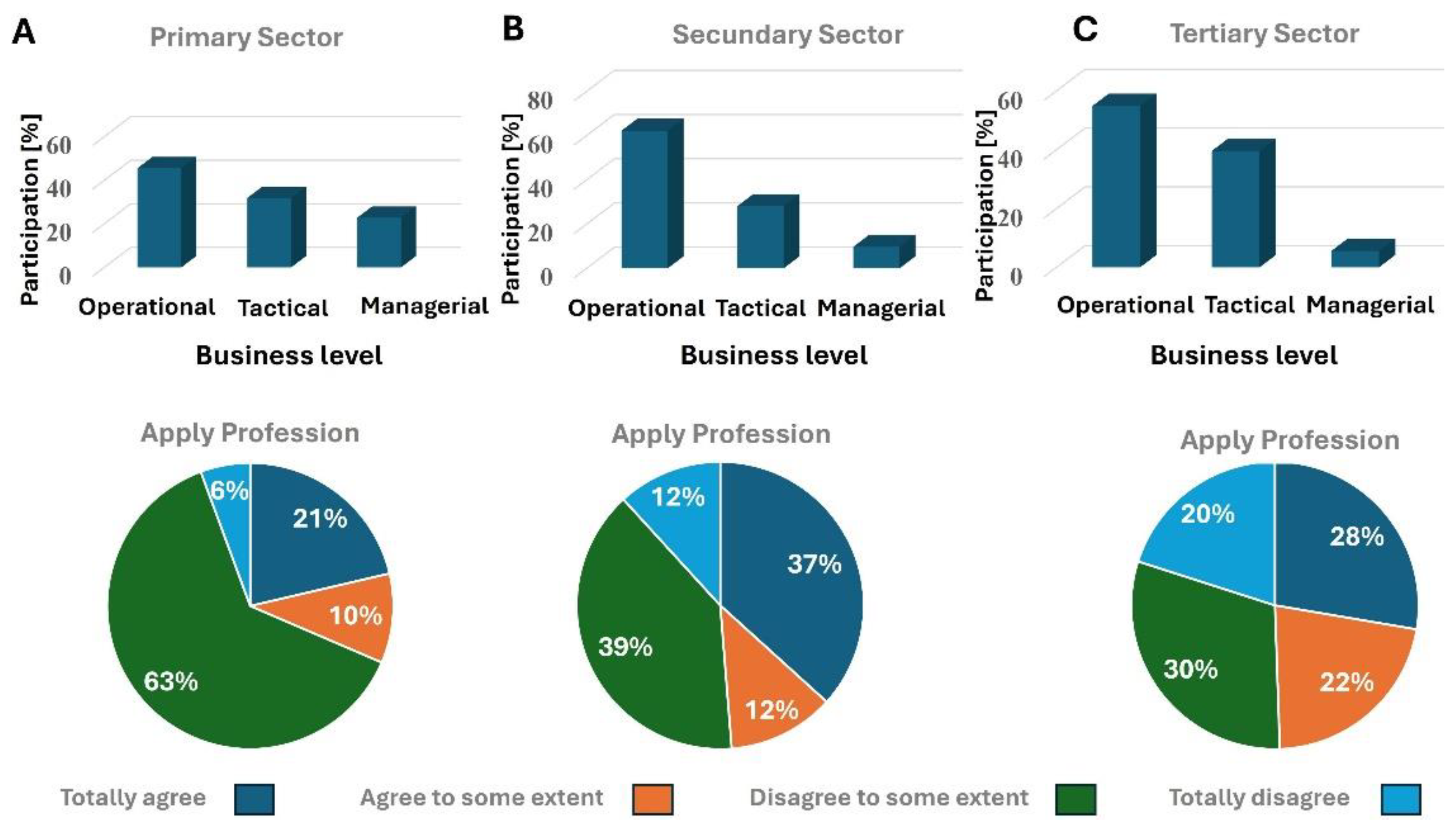

Table 1.
Sectoral distribution of UPS graduates – Cuenca Campus (2013–2021), according to organisational level and perception of the application of their profession: shows the frequency and percentage of graduates by economic sector (primary, secondary and tertiary), their location within the business structure (operational, tactical, and managerial) and their degree of agreement regarding the applicability of university education in their work environment.
Table 1.
Sectoral distribution of UPS graduates – Cuenca Campus (2013–2021), according to organisational level and perception of the application of their profession: shows the frequency and percentage of graduates by economic sector (primary, secondary and tertiary), their location within the business structure (operational, tactical, and managerial) and their degree of agreement regarding the applicability of university education in their work environment.
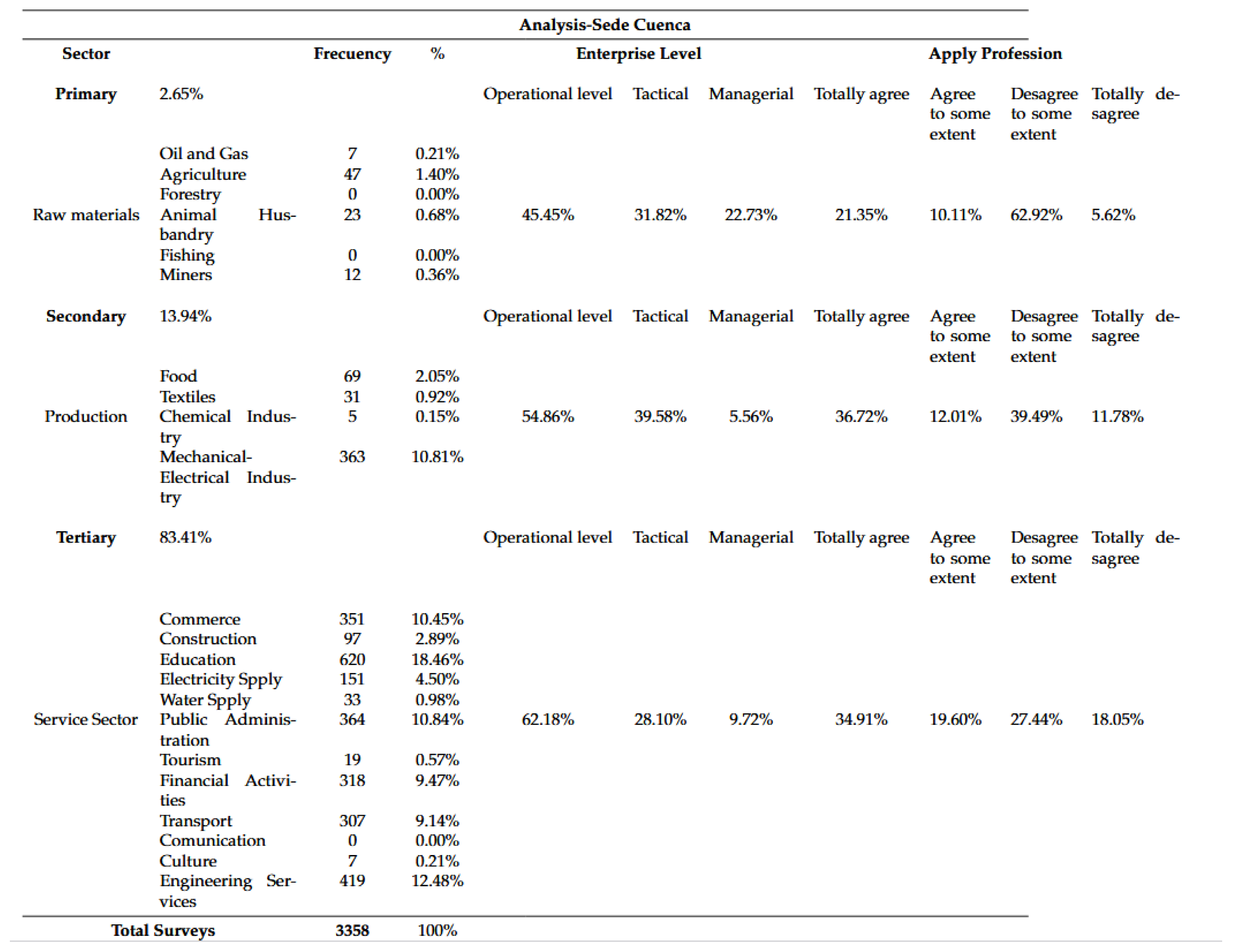
Table 2.
Classification of soft skills according to area of focus, data source, sectors with greatest adaptability, and potential professional application.
Table 2.
Classification of soft skills according to area of focus, data source, sectors with greatest adaptability, and potential professional application.
Disclaimer/Publisher’s Note: The statements, opinions and data contained in all publications are solely those of the individual author(s) and contributor(s) and not of MDPI and/or the editor(s). MDPI and/or the editor(s) disclaim responsibility for any injury to people or property resulting from any ideas, methods, instructions or products referred to in the content. |
© 2025 by the authors. Licensee MDPI, Basel, Switzerland. This article is an open access article distributed under the terms and conditions of the Creative Commons Attribution (CC BY) license (https://creativecommons.org/licenses/by/4.0/).
Copyright: This open access article is published under a Creative Commons CC BY 4.0 license, which permit the free download, distribution, and reuse, provided that the author and preprint are cited in any reuse.


