

Submitted:
30 July 2025
Posted:
30 July 2025
You are already at the latest version
Abstract
The use of seawater in public swimming pools could offer a more sustainable solution considering the challenges posed by climate change faced across Europe and the scarcity of potable water. However, the sector of swimming pools currently lacks a unified European legislative framework and faces significant fragmentation, particularly regarding seawater use. This paper examines the existing regulatory landscape concerning seawater utilization in public swimming pools across 23 European coastal countries, providing an overview of the situation and outlining permitted disinfection methods. It also addresses the chaotic state of standardized physicochemical and microbiological parameters, as well as quality limits imposed on disinfection by-products in pool water and their toxicity. The findings underscore the urgent need for legislative updates and highlight the potential for developing relevant European regulations to standardize practices within the sector, to better manage sustainability and public health in aquatic environments.
Keywords:
swimming pools
; seawater
; freshwater
; regulations
; policy
; DBPs
1. Introduction
The scarcity of freshwater of sufficient quality to meet the needs of both communities and industries is an established concern in numerous regions worldwide. This issue is linked to both the pollution of aquatic environments and climate change, which leads to periods of drought—events that are particularly concerning for Southern Europe. The objective of governments to prevent persistent water stress necessitates the exploration of innovative and sustainable alternatives to the use of potable water. In this context, the recommendations of the Water Framework Directive 2000/60/EC [1] and its so-called “daughter directives” [2] provide a strategic foundation for the management and protection of groundwater resources, which constitute the primary reserve for potable water supply within the European Union (EU) and are aligned with the principle of sustainable development. Furthermore, to mitigate the pollution of available resources and restore a healthy balance within nature and ecosystems, the EU member states have developed and endorsed a package of strategic initiatives aimed at transforming Europe into the first climate-neutral continent by 2050, in accordance with the provisions of the European Green Deal [3].
The aspect of sustainability also pertains to the swimming pool sector, which provides valuable opportunities for sports practice, recreation, relaxation, and rehabilitation for millions of individuals worldwide. Factors such as population growth, lifestyle changes, and the increasing popularity of swimming—engaged in regularly by 13% of the population [4]—are contributing to rising water consumption and necessitating the implementation of water sustainability practices in swimming pools. A sustainable solution to achieve this objective is the utilization of seawater, where feasible.
The quality of swimming pool water represents a significant topic of interest in recent years, with numerous studies being conducted globally on the subject. This interest is primarily driven by the recognition of the health benefits associated with swimming, which is consistently accompanied by the acknowledgment that intensive and/or regular use of swimming pools can pose a considerable risk to public health [5,6,7]. This risk is associated with the presence of microorganisms, including pathogens, in pool water, necessitating disinfection processes to prevent the spread of infectious diseases. Additionally, there is an undesirable consequence, namely the formation of toxic disinfection by-products (DBPs) resulting from the reactions between organic and inorganic compounds in pool water and disinfectants. DBPs are potentially genotoxic and mutagenic compounds that have been associated with various health issues, including asthma, bladder cancer, and liver and kidney diseases [6]. These compounds can be present in both pool water and air, exhibiting diverse chemical natures.
These compounds can be found in both pool water and air, exhibiting diverse chemical natures, the number of identified DBPs has now exceeded 900 and their nature is influenced by several factors, including the type of water used to fill the pools [8,9,10]. Common sources of pool fill water include municipal tap water and freshwater; however, seawater and mixtures of these sources are occasionally used as alternative filling options, as has been reported in the following works [5,6,7,8,9,10,11,12,13,14,15,16,17,18,19,20,21,22,23].
Despite the significant public health risks associated with swimming [24], which necessitate careful consideration and assessment to ensure pool users’ and workers’ safety, there is currently no international standard or European regulation for the treatment of swimming pools, aside from the non-binding recommendations provided by the World Health Organization [25]. Requirements in this sector are often determined by state or local governments, or by guidelines issued by local associations or advisory bodies such as the Pool Water Treatment Advisory Group (PWTAG).
Furthermore, even though the issue of DBPs has been studied for several decades, there appear to be very few global guidelines regarding DBP concentrations in swimming pools, including those widely diffused that utilize potable water. Therefore, in anticipation of a potential need to partially replace freshwater with seawater in swimming pools due to the increasingly severe drought problem in Europe, the objective of this study was to analyze the current state of the highly heterogeneous legislation on swimming pool safety in European coastal countries. This analysis aims to determine whether these regulations permit the use of seawater, assess any existing microbiological and chemical quality requirements, and/or evaluate disinfection protocols to identify critical issues, risks, and gaps within the regulatory framework.
2. Materials and Methods
This study is a scoping review [26] conducted to clarify legislative context regarding the potential use of seawater in public swimming pools within the European Union. It focuses specifically on countries that have access to the sea.
Prior to conducting the review, a research team was established, consisting of two individuals: one with knowledge in the subject of swimming pool water quality and another with experience in conducting scoping reviews.
The primary objective was to map existing regulations or guidelines on the use of seawater in swimming pools, and to identify the physicochemical and microbiological quality indicators monitored across Europe to ensure the hygiene and safety of both bathers and staff. The review also aimed to examine the disinfection methods required by these regulations. Furthermore, it investigated whether there is any scientific evidence indicating a higher chemical risk - particularly in terms of disinfection by-product (DBP) formation - in seawater pools compared to freshwater pools.
This review was conducted following the methodological framework proposed by the Joanna Briggs Institute (JBI) for scoping reviews and is reported in accordance with the PRISMA-ScR (Preferred Reporting Items for Systematic Reviews and Meta-Analyses extension for Scoping Reviews) checklist (Table S5).
The literature search was carried out between January and March 2025. Sources consulted included official institutional websites of relevant European authorities for the identification of regulatory documents. In parallel, two electronic databases - PubMed and Scopus - were systematically searched from their inception to March 2025 to retrieve scientific literature. The search strategy employed a combination of keywords, including: “swimming pools,” “seawater,” “disinfection” and “DBPs.”
Inclusion criteria were as follows:
- Documents or scientific articles published in English or in the original language;
- Studies and regulatory texts specifically addressing the use of seawater in swimming pools;
- Literature providing data on physical-chemical and microbiological parameters, disinfection methods, or DBPs formation in seawater pools.
The selection process consisted of two phases: initial screening of titles and abstracts, followed by full-text review. Disagreements between reviewers were resolved through discussion and consensus.
To compare DBP classes between seawater and freshwater pools, concentrations reported in selected studies were summarized in Table S4. For each DBP class (e.g., HAAs or THMs), an average concentration was calculated based on the values reported in the included articles. Where the total concentration of a DBP class was not explicitly provided, it was estimated by summing the mean concentrations of individual compounds within that class. To enable comparison of the relative toxicity among DBP classes, the average chronic cytotoxicity index for Chinese hamster ovary (CHO) cells was calculated. For each DBP class identified in both seawater and freshwater pools, the concentration that causes a 50% reduction in cell viability (expressed in molar units as %C½ or LC50) was collected from the literature, and the median LC50 value was determined. For graphical representation, the inverse of the median LC50 (i.e., 1/LC50) was used, with higher values indicating greater cytotoxicity.
3. Results
3.1. Overview of the European Legislative Framework on the Use of Seawater in Swimming Pools
In Europe, the public swimming pool sector is regulated by a vast range of technical standards. For instance, the EN 15288 standard provides relevant terminology and specifies design requirements to ensure safety in public swimming pools in its Part I [27]. Part II of this standard [28], outlines safety requirements related to the operation of public swimming pools and offers guidance on risk assessment. The EN 13451 series of standards stipulates specific requirements for the safety of equipment utilized in swimming pools. Additionally, a broad spectrum of regulations, such as EN 15071-15078 and others, governs the requirements for chemicals employed in the treatment (including disinfection, filtration, and pH regulation) of swimming pool water. Other standards, such as EN 16582 series, specifically regulate the domestic swimming pool sector.
However, technical standards are qualified recommendations rather than mandatory regulations that must be adhered to. Their application is voluntary, although universally beneficial. And there are currently no standardized European regulations or community guidelines concerning parameters related to the quality and safety of water and air in swimming pools. Legislation in this area is not uniform and varies from country to country. Local authorities have adopted diverse approaches based on their sensitivity to this aspect of public health. Additionally, most existing regulations in Europe have focused on ensuring adequate water quality, while the aspect of indoor air quality remains relatively overlooked.
According to the definition provided by the EN 15288 standard [27], a swimming pool is described as a “facility, with one or more water areas, intended for swimming, leisure or other water based physical activities”. Swimming pools are classified based on the type of facility as either indoor or outdoor. Furthermore, they are categorized according to the type of users, necessitating a distinct regulatory approach, generally falling into the following classifications:
- Public pools, which include both public and private facilities intended for collective use (e.g., municipal pools, water parks, hotel pools, therapeutic pools, pools in educational institutions, and so forth);
- Private pools, which refer to domestic pools used within a family context.
Inconsistencies arise even within the classification of swimming pools, for example, in Flanders region of Belgium [29] and Finland [30], certain hotel facilities are not classified as public pools. This discrepancy may lead to negative health outcomes for users or result in legal disputes, as regulations generally establish more stringent criteria for water quality parameters and health surveillance protocols for public pools, while private pools are often exempt from such regulations.
Swimming pools can be filled with freshwater, seawater, or thermal water [5]. There is no specific legislation governing pools filled with seawater; however, in several countries, including France, Poland, Germany, Slovenia, Croatia, Lithuania, Latvia, Romania, Denmark and Malta, the common regulations or recommendations applicable to public swimming pools, explicitly permit the use of seawater. These regulations often specify certain qualitative parameters that either do not need to be monitored or, conversely, must be monitored when seawater is used.
It is important to note that European legislation generally distinguishes swimming pools from other categories, such as “bathing areas”, which are defined, for example, by the French “Public Health Code” [31], Article L1332-2, as “any part of surface water where a large number of people are expected to bathe and where the competent authority has not permanently prohibited bathing”. Another category is that of “thermal pools”, as defined by Article D1332-1 as those “supplied by natural mineral water and used for therapeutic purposes in a spa facility”. These categories are considered three distinct types of facilities and are often subject to separate regulatory requirements.
Article D. 1332-4 of the “Public Health Code” (PHC) [31] stipulates that swimming pools are supplied with water sourced from the public distribution network or taken from the natural environment. The use of the second type of water is subject to authorization from the competent authorities. Furthermore, the “Decree of 26 May 2021 on swimming pool water quality standards and reference values, pursuant to Article D.1332-2 of the Public Health Code” [32], explicitly states that certain parameter limits, such as those for bromine content, apply solely to pools filled with seawater. Inversely, the limits for Legionella pneumophila content does not apply in the case of whirlpools supplied with seawater. In addition to the above-mentioned legislation, the “Order of 26 May 2021 on the use of non-potable water sources for supplying swimming pools, pursuant to articles D. 1332-4 and D. 1332-10 of the Public Health Code” [33] is in force. This rule outlines the quality parameters that such water must meet prior to its use.
In Poland, the “Disposal of the Minister of Health of 9 November 2015 on water quality requirements for swimming pools” [34], prescribes that water in swimming pools should meet the microbiological and physicochemical requirements specified in its Annexes 1 and 2, which explicitly apply to waters: “a) fresh, i.e. surface or underground waters meeting the requirements specified in the regulations for drinking water, b) salty, including sea and brine containing from 5 g/L to 15 g/L of minerals, c) thermal, i.e. underground waters, which at the outlet from the intake have a temperature of not less than 20°C (excluding water from the drainage of mining excavations)”.
In Germany, the safety of swimming pool waters is regulated by the “Infection Protection Act” (IfSG), specifically under Section 7, § 37 [35], and the technical rules outlined in the DIN 19643 series. The standard DIN 19643-1 “Treatment of water for swimming pools and baths - Part 1: General requirements” [36] applies to the swimming pool water, including seawater, mineral water, medicinal water, brine and thermal water. It does not apply for the water in facilities with biologically treated water.
In Slovenia, the “Rules on minimum hygiene requirements that must be met by swimming pools and bathing water in pools” [37], requires that bathing water in pools must meet the hygiene requirements set out in Annex 1. The Annex contains tables specifying quality parameters, some of which are regulated differently, depending on whether the pool water is freshwater or seawater. It should be noted here that the Rules divide pools into biological and conventional and apply to both categories, separately regulating their microbiological and chemical parameters.
In Croatia, the Ministry of Health “Rules on sanitary, technical and hygienic conditions of swimming pools and on the health safety of swimming pool waters. No. 1186” [38], is currently in effect. This regulation shares many similarities with the Slovenian one. It also categorizes swimming pools into conventional and biological types, establishing separate parameters for the quality of their waters. Furthermore, it specifies in Table 1 of Annex 1 the distinctions in certain parameters that must be adhered to when using freshwater or seawater for conventional swimming pools.
The Lithuanian hygiene standard HN 109:2016 “Public Health Safety requirements for swimming pools” [39] covering all types of swimming pools, explicitly stipulates that mineral and seawater may be utilized for the provision of pool services. However, it must comply with the requirements set forth in the hygiene standard HN 127:2010 “Mineral and seawater for external use. Health safety requirements” [40], prior to its use.
The Latvian Regulation No. 470 “Hygiene requirements for pool and sauna services” [41], also addresses the possibility of using seawater in pools. It stipulates that “If the pool is supplied with seawater or mineral water, its quality must comply with the microbiological quality indicators specified in Annex 2 of this regulation”.
Regarding Romania, “Order No. 994 of 9 August 2018, amending and supplementing the Public Hygiene and Health Norms No. 119/2014 on the population’s living environment” [42], specifically addresses public swimming pools and explicitly states in Article 102, that “Swimming pools/tubs may be filled with potable water or seawater. If the filling water is sourced locally from means other than the public potable water distribution network, it must comply with the legal provisions applicable to this matter”.
In Spain, the matter of water quality in swimming pools is regulated by “Royal Decree 742/2013 of 27 September, establishing the technical and health criteria for swimming pools” [43], which applies to public and private swimming pools, except for natural swimming pools and thermal or mineral-medicinal baths. This Decree does not explicitly address the issue of the types of water permitted for filling swimming pools. However, it mandates that the competent authorities submit annual reports to the Ministry of Health, Social Services, and Equality, containing periodic basic information related to public swimming pools, as specified in Annex IV. This includes details regarding the source of the water supply, which, according to the text, may originate from: a) public network, b) non-public network or c) seawater.
In Portugal, the standard NP 4542:2017 “Swimming pools. Quality and treatment requirements of water used in the pools” [44] and Directive CNQ No. 23/93 “Quality of public swimming pools” [45], both applicable to public swimming pools, except for thermal and therapeutic pools, stipulate that the water supply must come from a public water supply network. The use of alternative water sources requires authorization from the competent authorities. The standard refers only to salt water in Table 1 “Physicochemical parameters for water quality control”, which indicates that the chlorite measuring method is not applicable in the case of salt water. Additionally, Annex A “Recommendations for the design of water treatment facilities”, specifies that the compensation tank must be designed and sized to receive new water, whether freshwater or seawater. At the same time, the Circular-Normative No. 14/DA “Health surveillance program for swimming pools” [46], separately regulates the physicochemical parameters to be analyzed for freshwater pools and those for seawater pools.
In Sweden, emphasis is placed on self-management and self-inspection by swimming pool operators. The Public Health Agency, in its “Guidance on swimming pools No. 23048 of 5 February 2021” [47], alongside the “General Advice on swimming pools HSLF-FS 2021:11” [48], provides authorities with tools for supervision in accordance with the Environmental Code. The Guidance addresses various issues, including microbiological and chemical hazards associated with swimming pools, as well as examples of what may be included in the operator’s self-inspection and what can be monitored during supervision. These documents do not directly refer to the use of seawater in swimming pools, but they do state that some water quality control methods are not suitable when using saltwater. For example, the guidance states that, when monitoring conductivity and chloride content, “these methods do not make sense to use in pools with salt water”.
In Finland, the “Instructions for the application of the swimming pool water regulation: Swimming pool water quality and monitoring. 2/2017” [30] are enforced by Valvira, the National Authority for Welfare and Health. These guidelines, based on Health Protection Act No. 763/1994 [49] and on the Ministry of Social Affairs and Health Decree No. 315/2002 “On the quality requirements and monitoring studies of pool water in swimming pools and spas” [50], and applicable to swimming pools, water parks, and spas, do not explicitly address the potential use of seawater as fill water. There is only one reference within the text that mentions it: “If the water used in the pools contains bromine (i.e., municipal water derived from seawater), it may also be necessary to determine brominated trihalomethanes”.
Regarding Danish regulations, including the “Guidance on controlling swimming pools. VEJ No. 9605 of 14 July 2020” [51] and the “Executive Order on swimming pool facilities and their water quality. BEK No. 918 of 27 June 2016” [52], it is specified that public swimming facilities (i.e., swimming pools and hot water baths, including spas, water parks, recreational pools, and similar facilities) may utilize surface waters sourced from the sea, rivers, lakes, or fjords. These regulations establish microbiological quality parameter requirements that differ from those applicable to pools using potable water.
The relevant Norwegian legislation is the “Regulation of 13 June 1996, relating to bathing facilities, swimming pools and saunas, etc.” [53] and pertains to all public bathing facilities, including swimming pools and saunas, as well as hot tubs. Regarding the swimming pool water, it stipulates that “the water in swimming pools must be hygienically satisfactory”, however, it does not contain specific provisions concerning the quality of filling water or the potential use of seawater. Overall, this regulation requires updates and enhancements, as it mandates the monitoring of only a limited number of chemical and microbiological parameters related to water quality.
In the Netherlands, the stringent regulations governing water quality in swimming pools have been integrated into the “Environmental Activities Decision” (Bal) [54]. This transition allows for more targeted regulations, and together with the Environmental Act [55], granting operators greater flexibility in how they meet the established requirements, while also imposing increased responsibility for developing risk assessments and safety and hygiene management plans. The Chapter 15 “Providing the opportunity for swimming or bathing in a water pool” of Bal defines the necessary criteria for both water and air quality in a swimming pool, however, it does not address the use of seawater or saline water for pool filling. Nonetheless, it specifies some alternative quality criteria, if the salt content in the pool exceeds 14 g/L.
In Belgium, there is no unified national legislation governing the quality of water in public swimming pools, as it varies by region. In Wallonia, the “Government Order of 13 June 2013, determining full conditions for indoor and outdoor swimming pools used for a purpose other than purely private within the family circle” [56] is in force. As regards the filling water, the Order does not directly mention seawater but indicates in art.13 that “when the swimming pool filling water and supplementary water are not tap water, they meet the standards set for tap water”. In the Brussels-Capital Region, the “Government Order of 16 February 2023 setting operating conditions for swimming pools and other baths” [57] is in force. Concerning the filling water, Article 3 of this Order stipulates that public swimming pools may be supplied with water not sourced from the potable water distribution network, provided that the relevant environmental permit explicitly authorizes this. In such cases, it must be demonstrated that the filling water does not pose a significant risk to the health of bathers or to the operation of the facilities. Meanwhile, in Flanders, compliance with Title II of the “Decree of the Flemish Government of 1 June 1995 containing general and sectoral provisions regarding environmental hygiene” (VLAREM II) [29] is required. Its Article 5.32.8.1.1, in addition to regulating water and air quality in conventional swimming pools, hot whirlpools, and therapy pools, also addresses the quality parameters for natural swimming pools. This regulation does not explicitly mention the use of seawater in pools; however, in the section pertaining to water quality parameters, it specifies that certain parameters “are not applied when using salt water (> 2000 mg Cl/L) or when using salt electrolysis”.
In Italy, the “Agreement of 16 January 2003, concerning the health and hygiene requirements for the construction, maintenance and supervision of swimming pools” [58] is currently in force. This Agreement applies to all types of public swimming pools, with the exception of thermal pools and those intended for rehabilitation and therapeutic use. Clause 3.3 of the Agreement explicitly states that swimming pools may be supplied with: a) freshwater (either surface or groundwater); b) seawater; c) thermal water. It also provides that facilities using seawater and thermal water shall be subject to specific provisions established at the regional level. In the wake of this Agreement, an interregional technical framework titled “Interregional Regulation on swimming pools” [59] was approved on 22 June 2004 to support the harmonisation of regional legislation.
However, despite the formal adoption of this Agreement by all Italian regions, only a subset has subsequently issued implementing regional regulations. Among the regions that have transposed the 2003 State-Regions Agreement into binding regional provisions, only a few, including Emilia-Romagna [60], Liguria [61], Marche [62], and Tuscany [63], addressed in detail specific hygiene and public health aspects in relation to the construction, operation, and supervision of recreational swimming pools, explicitly mentioning the use of seawater. Additionally, during the COVID-19 pandemic, “Guidelines for the reopening of economic and productive activities” were issued by the Conference of Regions and Autonomous Provinces on 11 June 2020 [64]. These guidelines included provisions for the treatments and disinfection of swimming pools supplied with seawater. However, none of the aforementioned documents specify the quality parameters that must be met for pools using seawater. Within this fragmented legislative framework, the need for comprehensive regulation that clearly defines this domain is evident.
In Albania the Regulation “Hygienic and sanitary requirements for swimming pools. Act No. 835 of 30 Novembre 2011” [65], is similar to the Italian regulation and applies to public swimming pools, excluding those designated for therapeutic, curative, and thermal purposes. Notably, the regulation does not address the potential use of seawater for filling swimming pools; however, it mandates that the water supply must comply with all potable water standards.
In Greece, the quality of water in public swimming pools is regulated by Sanitary Order Γ1/443/1973 “On swimming pools with instructions for their construction and operation” [66]. This Order was amended in 1976 and 2006 and is supplemented by a series of subsequent explanatory instructions on the subject. One such document, specifically the Circular ΔΥΓ2/99932/06/2007 “Instructions-clarifications for the implementation of the Health Provisions for the operation of swimming pools” [67], clarifies that the use of seawater to fill the pool does not contradict the provisions of the aforementioned Order, provided that the physical, chemical, and microbiological characteristics of the pool water comply with the specifications outlined in Article 15 of the Order. Within the legislative framework governing the concession of rights to use the foreshore, beach, bank, riparian zone, aquatic environment, seabed, and subsoil, a new provision was introduced this year through Law 5170/2025, Article 14 [68]. This amendment enables the execution of works for the installation of pipelines for the abstraction and discharge of seawater intended for use in swimming pools of legally operated hotel facilities. However, specific criteria on the quality standards of seawater-filled swimming pools have not yet been established.
In Bulgaria, the only existing regulatory act pertaining to the quality of water in public swimming pools appears to be “Instruction No. 34 on the hygiene of sports facilities and equipment” [69], issued by the Ministry of Health. This document does not mention the possibility of using seawater, nor does it generally delineate the sources of water supply. Article 33 specifies only that when selecting a water source for the pool, quality control must be conducted in accordance with the provisions outlined in Article 18.
The Estonian Regulation No. 80, titled “Health protection requirements for swimming pools, pools and aquatic centres” [70], explicitly excludes mineral water and hydrotherapy pools from its scope. Furthermore, it does not address the potential use of seawater for pool replenishment, stating only that the water utilized in pools must comply with the standards established for drinking water.
In Malta, the “Swimming Pools Regulations, 2005, L.N. 129” [71] adopted under the Public Health Act No. XIII of 2003, is applicable to all types of public swimming pools, including thermal and therapeutic pools. These regulations do not specify the type of water that may be used to fill the pool but stipulate that the pool must be supplied with controlled water. Concurrently, the “Subsidiary Legislation 545.07 on Control of swimming pools regulations” [72] is in effect, which in paragraph 6(2) states, “A pool located within a distance of one hundred meters from the sea, may be filled or replenished with seawater, if the requirements of paragraph 9 are observed”. Specifically, paragraph 9 dictates, “Seawater, or any substance derived therefrom, shall not be emptied from any pool or discharged therefrom except via impermeable pipes leading directly to the sea”.
In Cyprus, public health regulation concerning swimming pools is governed by the “Public Swimming Pools Laws of 1992 and 1996” [73] (55(I)/1992 and 105(I)/1996). Water quality standards are delineated by “The Public Swimming Pools Regulations of 1996” (KDP 368/96) [74]. This regulation, which has long been recognized as needing updates, does not explicitly address the use of seawater for filling swimming pools. It contains only two somewhat relevant statements regarding this issue: “The competent Health Authority may, at its discretion, also permit the use of brackish water solely for the requirements of tanks and sanitary facilities” and “in the event of water renewal from a safe, non-chlorinated natural source, there must be a ratio of at least 2.000 litres of water per bather”.
A graphical summary of the legislative situation regarding seawater use in swimming pools across 23 European coastal countries is presented in Figure 1, while an overview is provided in Table 1. Detailed information on the 63 regulatory documents analysed is available in Table S1 of the Supplementary Materials.
3.2. Overview of Swimming Pool Disinfection Requirements in the European Legislative Framework
The necessity for pool water treatment is linked to the risks of infection associated with swimming in contaminated waters. Many microorganisms present in swimming pools originate from bathers, while others are naturally occurring in the environment. In outdoor pools, birds and other animals can introduce contaminants into the water. The presence of microorganisms, such as bacteria, fungi, protozoa, and viruses, can proliferate rapidly in aquatic environments, particularly in crowded areas like swimming pools, thereby posing a significant risk of transmission of infections or diseases to both swimmers and staff [25]. Additionally, bathers introduce substances such as sweat, urine, hair [9], personal care products [20] and other contaminants into the water, exacerbating its contamination. Contaminated water can also quickly emit unpleasant odors, which can diminish the enjoyment of swimming.
Consequently, it is essential that pool water undergoes treatment to remove debris and microorganisms through a combination of cleaning, filtration, flocculation, water replacement, ventilation, and disinfection processes [25]. The main methods of swimming pool water disinfection are as follows:
- Chlorine disinfection: In most public swimming pools, chlorine-containing reagents are employed for water disinfection. Chlorine is usually used in the form of sodium hypochlorite or calcium hypochlorite [47]. Some facilities generate their own chlorine on-site through a process known as electrochlorination [6], which is particularly relevant when utilizing seawater. In this process, sodium chloride (NaCl) is converted into chlorine gas, which is subsequently introduced into the water.
The mechanism for disinfection is the same regardless of whether chlorine gas or hypochlorite is used. The addition of chlorine-based disinfectants to water initiates the reactions as by equation (1), (2), (3), which produces hypochlorous acid (HOCl), the primary disinfectant and a highly effective bactericidal agent due to its high reactivity, enabling it to oxidize various inorganic and organic substances present in the water [6]:
Cl2 + H2O ⇋ HOCl + H+ + Cl−
NaOCl + H2O → HOCl + Na+ + OH−
Ca(OCl)2 + H2O → 2HOCl + Ca2+ + 2OH−
HOCl further dissociates in water producing hypochlorite ions ClO-, as per Equation (4).
HOCl ⇋ OCl− + H+
In the pool, the chlorine is present in the form of ClO-- e HClO. Both substances are responsible for the disinfectant effect and are measured as “free chlorine” [6]. They exist in an equilibrium dependent on pH. As the pH value increases, the formation of HClO decreases. Since ClO-- possess a lower disinfectant capacity compared to hypochlorous acid, the disinfectant efficacy diminishes with rising pH levels unless the amount of free chlorine is simultaneously increased. The release of free chlorine also ensures a residual disinfectant effect, which is essential for maintaining antimicrobial activity in the pool, particularly in the presence of numerous bathers [47].
In addition to chlorine, other disinfectants and disinfection methods are sometimes employed in pool water treatment [25], some of which can be used in combination with chlorine.
- Ozone (O3): Ozone is a strong oxidizer, that makes it an effective disinfectant against bacteria and other microorganisms. It can also be used to eliminate certain contaminants and disinfection by-products in the water. Disinfection with O3 takes place in the treatment tank. Ozone is toxic and it must not be released into areas where people are present [47].
- Ultraviolet light (UV): UV photolysis is often used as a disinfection method because of its ability to kill bacteria, protozoa and most viruses. UV light can also break down chlorine compounds and thereby reduce the content of bound chlorine [17].
Both O₃ and UV light provide localized oxidative and disinfectant effects without exhibiting residual disinfectant activity. Therefore, they are primarily used as complementary agents to chlorine to enhance its disinfectant efficacy through the formation of reactive hydroxyl radicals as intermediates, thereby minimizing chlorine usage and maintaining water quality. This approach results in a reduction of genotoxicity and cytotoxicity in chlorinated pool water. Several studies have indicated that medium-pressure UV lamps are more effective than low-pressure UV lamps for the photodegradation of certain DBPs. However, reaction pathways may also promote the formation of other DBPs when UV treatment is followed by chlorination [17].
- Chlorine dioxide (ClO2): Chlorine dioxide is a highly oxidizing gas that exhibits greater efficacy against microorganisms compared to other chlorine compounds. Its mechanism of action is also distinct. ClO₂ is inherently unstable and is frequently generated in situ by mixing chlorate or chlorite compounds with an acid. Additionally, ClO₂ presents significant toxicity when present in the air, which poses challenges for its use as a disinfectant in swimming pools [47].
- Bromine-based disinfectants: Bromine gas is rarely used; the formation of HOBr and OBr⁻, which possess the ability to inactivate microorganisms [6], is achieved by utilizing bromochlorodimethylhydantoin or by combining sodium bromide with an oxidant (typically chlorine or ozone), leading to the reactions described by equations (5) and (6):
NaBr + HOCl → HOBr + Na+ + Cl−
HOBr ⇋ OBr − + H+
Despite HOBr and OBr⁻ acting similarly to HOCl and OCl⁻, their disinfectant efficacy is lower than chlorine-based compounds. Moreover, they lead to the formation of brominated DBPs, which tend to have greater toxicity than their chlorinated counterparts [11].
- Hydrogen peroxide (H2O2): Hydrogen peroxide is a strong oxidizing agent that is sometimes used as a disinfectant in swimming pools. However, H₂O₂ is a significantly weaker disinfectant with a slower mode of action compared to chlorine. Due to its potent oxidizing properties, H₂O₂ can also cause skin and eye irritation when exposed to relatively low concentrations over extended periods. [47].
Swimming pool water is typically disinfected with mostly chlorine-based disinfectant [9,21] (chlorine [8,11,14], hypochlorites [7,10,12,15,18,23], chlorine dioxide, chlorisocyanurates or their acids [8,11,13,16]) and, less frequently, with ozone [22], UV radiation [20], UV combined with chlorine-based disinfectant [17], chloramines, bromine or bromide, and electrochemically generated mixed oxidants [5,6].
Similarly to the heterogeneous situation on the general issues of use of seawater in swimming pools, European regulations are quite discordant on the methods to be applied for disinfection.
The French PHC, which permits the use of seawater in swimming pools upon obtaining authorization, stipulates in Article D1332-2 the necessity for filtration, treatment, disinfection, renewal, and recycling of water in public swimming pools [31]. Decree No. 81-324 of 7April 1981 [75], amended in 2021 [76]. In Article 10.-I, it mandates that the treatment of pool water must include at least one stage of filtration and disinfection. Furthermore, Article 5.-I [76] authorizes the use of chlorinated products such as gaseous chlorine and bleach for disinfection, as well as compounds containing trichloroisocyanuric acid or sodium or potassium dichloroisocyanurate, or calcium hypochlorite as stabilizers.
The Belgian regulation of Brussels [57] stipulates that water treatment in public swimming pools must include at least pre-filtration, filtration, oxidation in combination with disinfection, pH regulation, and the addition of new water. Furthermore, it requires that chemically disinfected pool water be treated with chlorine, either alone or in combination with other chemical treatments (such as ozone) or physical treatments (such as UV). Similarly, the regulation of the Walloon region [56], which applies to pools that use solely chlorine as the water disinfection process, mandates that the water treatment process includes pre-filtration, filtration, disinfection, and a fresh water supply system. It also requires that the water in each public pool be disinfected and prohibits the direct addition of chemical products into the pool. Additionally, it specifies the substances used for pH regulation. The VLAREM II regulation in Flanders [29] states that “unless otherwise indicated in the environmental permit for the operation of classified facilities, chlorine is the only permitted disinfectant and oxidant”. Contrary to the regulations of Brussels and Wallonia, it prohibits the use of chlorine gas and chlorine stabilizers.
The German IfSG [35] specifies in § 37(2): “In swimming pools or bathing areas, water treatment must include disinfection”, emphasizing the necessity to ensure that there is no risk to human health during swimming activities. The methods employed for disinfection are regulated by the current standard DIN 19643 “Water treatment in swimming pools and basins”, which permits the use of seawater in pools and is divided into five parts. Parts 2 through 5 contain detailed and comprehensive regulations for various combinations of water treatment processes in swimming pools. Specifically, these parts address the following: the use of fixed-bed filters and pre-filters (Part 2) [77], ozonization (Part 3) [78], ultrafiltration (Part 4) [79], and the use of bromine as a disinfectant produced by the ozonation of bromide-rich water (Part 5) [80], which is particularly relevant for seawater rich in bromide.
The Polish regulation [34], which permits the use of seawater in swimming pools, does not explicitly specify the mandatory treatment or disinfection steps. It requires that the pool water, including the water supplied to the pool, meet the microbiological and physicochemical requirements outlined in Annexes 1 and 2 of the regulation. In this context, the water quality parameters specified in the annexes are accompanied by notes, such as “if disinfection with chlorine compounds is supplemented by UV radiation or ozone” or “determined in the case of water ozonation after filtration through absorption”.
Slovenian “Rules” [37] stipulate that, in the preparation of water for conventional swimming pools, it is necessary to perform at least residual disinfection and pH correction. Although an exhaustive list of disinfectants is not provided, continuous and automatic measurement of free chlorine is required when chlorine is used as the disinfectant.
Similarly, Croatian “Rules” [38] stipulates that during the preparation of water for conventional swimming pools, at least a disinfection process with residual effect and pH regulation must be carried out. Regarding substances used in pool water preparation, it is specified that the addition of substances other than those necessary for this process is prohibited. Furthermore, such substances and any impurities contained therein must not be present in the water at concentrations exceeding established limits, and they must not pose a risk to human health.
The Lithuanian standard HN 109:2016 [39] permitting the use of seawater stipulates that pool water must circulate, be filtered, coagulated, disinfected, and have its pH level regulated. Additionally, it specifies that biocidal agents, such as chlorine, bromine, and other compounds, must be employed for water disinfection in accordance with the provisions of Regulation (EU) No 528/2012 concerning the making available on the market and use of biocidal products [92]. The standard further indicates that UV light and ozone may be used as complementary agents to chlorine-based compounds for pool water disinfection, while only ozone is permitted as an adjunct to bromine-based compounds.
Latvian Regulation No. 470 [41], which also permits the use of seawater, generally stipulates that in swimming pools equipped with a water purification system, the purification and disinfection processes must be carried out in accordance with the manufacturer’s instructions for the pool equipment and in compliance with the operational standards for such equipment. Additionally, Appendix 1 provides information on the water quality parameters that must be monitored in a swimming pool, depending on the type of disinfectant employed: chlorine-based or bromine-based.
The Romanian Order [42] stipulates in Article 10 that both indoor and outdoor pools, as well as saltwater pools, must be equipped with water filtration and disinfection systems. Furthermore, Article 104 mandates that chemical products used as disinfectants for pool water must be approved by the National Biocidal Products Committee, in accordance with the relevant government regulation, which establishes the institutional framework and implements measures of Regulation (EU) No. 528/2012 [92].
Regarding Spain, Royal Decree 742/2013 [43] stipulates that recirculation water must be at least filtered and disinfected prior to being introduced into the pool. This requirement also applies to filling water that does not originate from the public distribution network, which may, by extension, include seawater, as indirectly mentioned in the text. Appendix 1 of the decree specifies the water quality parameters, accompanied by annotations indicating the monitoring requirements based on the disinfectant used: “monitored when chlorine or chlorine derivatives are used as disinfectants”, “monitored when bromine is used as a disinfectant”, “monitored when trichloroisocyanuric acid derivatives are used”, and “measured when disinfectants other than chlorine or bromine and their derivatives are used”. The decree further establishes that only biocides classified as Type 2, Disinfectants, pursuant to Royal Decree 1054/2002, may be used for swimming pool water treatment. Additionally, all other chemicals used in pool water treatment must comply with the requirements set forth in Regulation (EC) 1907/2006 (REACH) [93] and any other applicable specific regulations.
In Portugal, the CNQ Directive No. 23/93 [45] and Circular No. 14/DA [46], regarding treatment procedures, specify that for pools authorized to use seawater or other high-dissolution-rate sources, filtration rates must be reduced by 30% or less (as indicated in Section 9.9 of the Directive). Furthermore, Section 9.13 states that “the injection of chemical products must not be performed directly into the pools”. Section 9.14 allows the use of the following chemical disinfectants for pool water sanitation: • Chlorine-based disinfection systems (Type I treatment systems), including chlorine products and derivatives: sodium hypochlorite (NaOCl); calcium hypochlorite (Ca(ClO)₂); liquid chlorine (Cl₂, chlorine gas); products containing trichloroisocyanuric acid or sodium or potassium dichloroisocyanurate, or other isocyanuric acid derivatives, if their use is approved by health authorities. • Bromine-based disinfection systems (Type I treatment systems). • Ozone disinfection systems (Type II treatment systems). Additionally, Section 5.5 of the NP 4542:2017 [44] includes UV light as Type III treatment systems.
Finnish guidelines [30] stipulate that the microbiological quality of pool water must primarily be ensured through chlorination but avoiding organic isocyanurate chlorides such as sodium chloroisocyanurate dihydrate and favoring disinfection with inorganic chlorine compounds. However, the use of alternative disinfection methods, such as ozonation or UV light, is also permitted to enhance the effectiveness of chlorination.
The Swedish HSLF-FS 2021:11 [48] mandates that pool water must be continuously purified and disinfected with an effective amount of disinfectant throughout the entire basin. Concurrently, the Guidance [47] outlines existing disinfection methods, emphasizing that chlorine currently best meets quality and safety criteria and remains the predominant disinfectant for swimming pools. However, the Guidance generally recommends that, when selecting a treatment and disinfection method, operators adhere to the principle of choosing the best available technology, always considering the potential risks to human health.
The Danish Order BEK [52] stipulates that water in swimming pools not utilizing surface water must be recirculated, filtered, and disinfected. According to its § 9, disinfection of pool water must be carried out using chlorine gas or a sodium hypochlorite solution. Conversely, water in swimming pools that use surface water (including seawater) may not require disinfection.
Regarding the Norwegian regulation [53], which does not specify the use of seawater in swimming pools, it states that “each pool must always, and at every point within the circulation system, contain a sufficient amount of disinfectant to eliminate harmful microorganisms that pose a health risk, as well as to prevent the growth of organisms that, under particular circumstances, may cause diseases in humans”. Additionally, when disinfecting water with chlorine (or hypochlorite), specific quality requirements must be met.
The Dutch Environmental Decision (Bal) [54], while not addressing the use of seawater in swimming pools, specifies in Article 15.12 that it applies to pools where water is disinfected. It mandates that cyanuric acid must not be added to the water and that the use of ozone for water treatment must prevent ozone from entering the pool.
In Italy, 2003 State-Regions Agreement [58] does not apply to pools supplied with seawater; however, it provides a comprehensive and detailed list of disinfectants, flocculants, and pH regulators approved for use in pools supplied with drinking water. Examples of such disinfectants include ozone, liquid chlorine, sodium hypochlorite, calcium hypochlorite, anhydrous sodium dichloroisocyanurate, hydrated sodium dichloroisocyanurate, and trichloroisocyanuric acid. The Agreement also stipulates that the use of substances not included in these lists must receive prior authorization from the Ministry of Health. Furthermore, the “Guidelines for the reopening of economic and productive activities 20/94/CR01/COV19” [64] whose current validity remains uncertain, state that: “For seawater pools, where applicable, maintain disinfectant concentrations within the recommended limits and in compliance with international standards and regulations, preferably at maximum capacity limits. Alternatively, implement physical treatments at maximum capacity or ensure maximum water exchange within the limits of the maximum input capacity”.
Similar to Italy, the Albanian Regulation [65], which does not mention the possibility of using seawater for public pools, establishes a detailed list of substances that may be utilized as disinfectants, flocculants, and pH adjusters. The list of disinfectants is consistent with the Italian regulations and includes the following: ozone; liquid chlorine; sodium hypochlorite; calcium hypochlorite; anhydrous sodium dichloroisocyanurate; dihydrate sodium dichloroisocyanurate; and trichloroisocyanuric acid.
In Greece, disinfection requirements are stipulated both by the Health Ordinance Γ1/443/1973 [66] and by Circulars Δ1δ/ΓΠ.οικ. 57290/2019 [90] and ΔΥΓ2/99932/06/2007 [67]. When the text of [90] clarifies the permissible operating conditions for recirculation, renewal, and disinfection systems of swimming pool water, the Circular [67] mandates that disinfection is obligatory in all cases of pool management, as explicitly specified in Article 18 of [66]. However, the operation of pools without disinfection is permitted only when there is a continuous influx of clean water from a safe natural source not subject to chlorination. Regarding disinfection methods, Article 18 states, that pool water must be continuously disinfected by chlorine addition using appropriate devices, in the form of an aqueous solution of gaseous chlorine, calcium hypochlorite, sodium hypochlorite, or chlorine produced by electrolysis, or any other approved chlorinated compound. Furthermore, the use of a disinfection method other than chlorine is permitted, subject to approval by the Health Authority, provided it ensures complete disinfection. Regarding seawater, Law 5170/2025 [68], while allowing its use in pools within legally operating hotel facilities, does not provide specific details concerning its disinfection.
In Bulgaria, the “Instruction No. 34” [69] while does not mention the possibility of using seawater in swimming pools, stipulates in Article 33, that pool water may be utilized for a maximum of 45 days, provided it is recirculated through functioning purification systems and is regularly disinfected. In the absence of such systems, or if the existing systems are non-operational, the water must be completely replaced on a weekly basis and disinfected regularly.
Estonian Regulation No. 80 [70], stipulates that pool water must be treated through filtration and disinfection processes. Additionally, purification methods such as coagulation, activated carbon treatment, ultraviolet radiation, and ozonation are permitted. Furthermore, only disinfectants that comply with the Biocidal Regulation [92] may be used to disinfect pool water, ensuring that their application and quantity do not compromise the water’s properties or pose a risk to human health.
In Malta, where the legislation 545.07 [72] permits the use of seawater in swimming pools located within one hundred meters of the coastline, concurrently, the “Swimming pool regulation, 2005” [71] delineate the disinfectants used in pools, categorizing them based on frequency of application. The most utilized disinfectants in large swimming pools are chlorine-based compounds, which include gaseous chlorine, calcium and sodium hypochlorite, sodium dichloroisocyanurate, electrolytic generation, combination ozone-chlorine, and chlorine dioxide both as a standalone and in combination with chlorine. Less frequently employed disinfectants are bromine-based, comprising liquid bromine, bromochlorodimethylhydantoin, and sodium bromide combined with hypochlorite. Rarely used disinfectants, typically found in smaller pools, include bromide chloride, UV light, UV-ozone combinations, iodine, hydrogen peroxide, silver/copper complexes, and biguanides. Furthermore, the notes in Schedule I of [71] reference non-disinfected pools; however, no guidance is provided regarding the conditions under which pools may be non-disinfected.
In Cyprus, the regulation KDP 368/96 [74], which does not reference the use of seawater in swimming pools, stipulates that pool water must be continuously disinfected through the addition of chlorine using an appropriate device in the form of an aqueous solution of chlorine gas or calcium hypochlorite or sodium hypochlorite, or chlorine produced by electrolysis or another approved chlorine compound. Furthermore, an alternative method for water disinfection may be employed, subject to the approval of the competent Health Service, if it ensures complete disinfection.
More detailed information is provided in Table 1S: An overview of the legislative framework in European coastal countries regarding the use of seawater in swimming pools and disinfection methods required, included in the supplementary material.
3.3. Peculiarities of Seawater Disinfection for Swimming Pool Use
The chlorination of seawater for use in swimming pools presents a viable, albeit complex, prospect. Saltwater chlorination systems, employing electrolysis to generate chlorine from dissolved sodium chloride, are adaptable for seawater. However, the implementation of such systems necessitates specialized salt chlorinators engineered to withstand the corrosive properties and high ionic strength of seawater, often requiring the use of durable construction materials. Alternatively, conventional chlorinating agents can be directly introduced into seawater pools for disinfection purposes. Nonetheless, this approach may lead to challenges related to altered chemical equilibria due to the inherent mineral composition of seawater, potentially necessitating refined chlorination protocols. Moreover, the intrinsic corrosivity of seawater may be exacerbated by the addition of traditional chlorine compounds, adversely affecting the longevity of pool infrastructure. Maintaining optimal water balance parameters—such as pH, alkalinity, and calcium hardness— may also be more intricate in seawater matrices treated with direct chlorine.
In addition to disinfection, the utilization of seawater in swimming pools mandates robust filtration systems to mitigate turbidity and remove particulate and organic matter. The selection of corrosion-resistant materials for all pool components is critical to ensure long-term operational integrity.
Regardless of the chlorination method employed, effective disinfection remains paramount for public health. Furthermore, meticulous water quality management, compliance with local regulations governing seawater use and discharge, and a thorough assessment of the environmental implications of seawater sourcing and disposal are indispensable considerations for the sustainable application of this resource in aquatic recreational aquatic environments. While the chlorination of seawater is technically viable, the implementation of high-salinity-resistant saltwater chlorination systems appears to be a more pragmatic and potentially sustainable approach compared to the direct application of traditional chlorine, which may introduce additional complexities in terms of chemical interactions, material durability, and water chemistry control. Comprehensive planning, the adoption of appropriate technological solutions, and strict regulatory compliance are therefore essential prerequisites for the successful implementation of seawater-based pool systems [7,11].
3.4. Overview of Microbiological and Physicochemical Quality Requirements for Pool Water
To assess the water quality of swimming pools and the effectiveness of its treatment, it is essential to analyze both physicochemical and microbiological indicators. European national regulations or guides governing pools safety, establish a framework of quality indicators that must be verified on-site for certain physicochemical parameters, such as color, odor, pH, turbidity, temperature, and free chlorine. These parameters provide valuable real-time information on water quality and its capacity to support bacterial growth. Furthermore, chemical and biological parameters requiring laboratory analysis are specified, along with monitoring frequency, sampling methods, and analytical procedures.
Similar to the authorization for using seawater to fill pools and approved disinfection methods, the European legislative framework exhibits significant variation in the list of quality indicators to be monitored and their corresponding quantitative limits. This variability ranges from the breadth of parameters recommended for control, to the different terminologies used for equivalent parameters, and the conditions under which the same parameter must be measured.
For example, the microbiological parameter “Cultivable microorganisms” [47] is also referred to as “Heterotrophic colony count” [30], “Bacterial count” [58] or “Colony-forming units” [36], with differing specifications regarding the conditions of measurement—such as after 24 [61] or 48 hours [56], at temperatures of 36 [32], 37 [52], or 36±2 °C [38], or without specified conditions [69]. And, for instance, a chemical parameter like “Oxidizability” may be represented as “KMnO4 consumption in heated solution under acidic conditions” [29] “Oxidizability of MnVII MnII above that of filling water” [34] or simply “Potassium permanganate” [30].
Regarding the spectrum of microbiological parameters to be monitored, the situation varies across countries. Finland [30], for instance, requires control only of basic parameters such as Heterotrophic colony counts and Pseudomonas aeruginosa, whereas Baltic countries like Lithuania and Estonia, which add Helminth eggs [39] or Mycobacterium spp. [70], for example, to the wide spectrum of indicators to be monitored, including pathogenic Escherichia coli, whose monitoring is required by most European countries. For Legionella control [94], some countries require specific testing for Legionella pneumophila [45], while others monitor Legionella spp. [43], referring to it in various ways such as Legionella spec. [36] or simply Legionella [95].
Due to the complexity of summarizing the microbiological monitoring framework, Supplementary Table 2S: Microbiological Parameters of Swimming Pool Waters Regulated in European Coastal Countries presents the full range of parameters, citing their names exactly as reported in the respective regulations.
Similarly, the control of physicochemical parameters presents a complex picture. Some countries, beyond the primary indicators, require monitoring of additional substances such as arsenic [36] or radiological indicators [69]. Certain regulations, like those in France, specify not only permissible quality limits (QL) but also desired quality reference values (RV) [32]. Typically, regulations do not specify quality indicators for water used to fill pools, instead requiring that it conform to potable water standards. However, some regulations, such as those in France [33], establish specific criteria for water used when not sourced from the municipal water supply. In addition, regulations in Poland [34], Italy [58], and Albania [65] specify some indicators for inlet water supplied to the pool basin via the circulation system.
A more complete overview of the physicochemical parameters required for pool water monitoring according to European regulations, together with annotations of some parameter values measured by researchers, is provided in the Supplementary material in Table S3: Physicochemical parameters of pool waters regulated in European countries with sea access.
3.5. Risk Assessment
Effective risk assessment and management strategies in swimming pools are essential for safeguarding public health. In countries such as Greece, where tourism represents a major economic sector, ensuring pool safety is a critical priority. Mplougoura et al. [96] conducted a detailed evaluation of potential hazards, classifying risks based on their likelihood and impact, and proposing appropriate mitigation measures. The authors also emphasized the importance of maintaining the reputation of recreational water facilities.
Risk assessment in seawater-filled pools—compared to freshwater pools—requires consideration of a broader range of potential hazards associated with the use of saltwater in recreational settings. One of the primary concerns involves the corrosive effects of salt on construction materials and infrastructure; however, this risk can be effectively mitigated by employing salt-resistant pool equipment and furnishings.
A subsequent critical consideration is the proliferation of microorganisms in water taken from surface sources, including both naturally occurring aquatic flora and pathogenic organisms introduced via effluent discharge from wastewater treatment plants or through fecal contamination from humans or animals. These microbial risks are exacerbated by elevated water temperatures and inadequate disinfection practices. Such risks can be reduced through effective disinfection strategies, employing for example established technologies such as saltwater chlorination via electrolysis. For example, Gregg et al. [21] demonstrated that even Methicillin-Resistant Staphylococcus aureus is rendered non-viable in seawater pools after chlorination.
Therefore, it is essential to disinfect pool water; however, disinfectants react with organic and inorganic matter present in the water, leading to the formation of DBPs that may pose adverse health effects to users and staff, including irritation of the eyes, skin, nose, and throat [10,17], thus warranting careful evaluation and management. Some DBPs have been reported to have mutagenic and carcinogenic effects [5] and, in some animal studies, have also been shown to induce adverse reproductive and neurotoxic effects [19]. The concentration and nature of DBPs in these environments depend on various factors, including the type of disinfectant, the characteristics of the pool, the hygiene practices of its users, the intended use of the pool (for sports, relaxation or recreational activities), the source of the filling water (freshwater, seawater or thermal water), and the pH of the pool water [24]. The most identified DBPs in pools include trihalomethanes (THMs), haloacetic acids (HAAs), haloamines (HAs), haloacetonitriles (HANs), haloaldehydes, haloketones (HKs), haloamides, halophenols, haloquinones, and N-nitrosamines [19].
The peculiarities of seawater are its pH values, which are generally higher than those of freshwater, and its elevated concentration of bromide (Br−). Bromide, as a natural component of seawater, has an average concentration of approximately 67 mg/L, varying from 15 mg/L in the Baltic Sea to 85 mg/L in the Mediterranean Sea, and reaching exceptional levels of 5.2 g/L in the Dead Sea [17]. These bromide levels can pose significant challenges, particularly when chlorination is employed for disinfecting seawater pools. Bromine (HOBr/OBr−) serves as the predominant disinfectant and oxidizing agent in such pools, as bromide ions react with chlorine, as shown in equations (7) and (8):
HOCl + Br− → HOBr + Cl−, k = 6.8 × 10³ M−1s−1 [89]:
OCl− + Br− → OBr− + Cl−, k = 9.0 × 10⁻⁴ M−1s−1
Elevated bromide concentrations in seawater pools can increase chemical health risks for swimmers and workers, as they lead to an enhanced formation of brominated DBPs [17]. It is also known that brominated DBPs tend to be more cytotoxic, genotoxic, and mutagenic than their chlorinated counterparts [6,9,14], for example, monobromoacetic acid exhibits approximately 280 times more cytotoxic and 47 times higher genotoxic compared to monochloroacetic acid, as demonstrated by Hsieh et al. [97]. Bromate, a common DBP of both swimming pool water and potable water disinfection, is classified as a Category 1B [22] “presumed to have carcinogenic potential for humans”, according to the Regulation (EU) No. 1272/2008 (CLP) [98]. Furthermore, the higher pH levels observed in seawater pools compared to freshwater pools may also influence the formation of DBPs.
Most of the studies on the presence of DBPs have focused on freshwater pools treated with chlorine-based compounds. Very few studies have investigated the speciation and levels of DBPs in seawater-fed pools, aiming to generate data useful for risk assessment studies related to the use of this water source. As revealed by Rhys et al. [6], Manasfi et al. [7,9], Parinet et al. [11], haloacetic acids were the most prevalent chemical class in the water of both types of swimming pools among the analyzed DBPs.
Röhl et al. [22] measured the concentration of bromate, a potential human carcinogen, in several German swimming pools containing seawater disinfected up to 34 mg/L. This concerning concentration was approximately an order of magnitude higher than the levels of this ion typically found in freshwater pools and exceeds the maximum permissible limit of 2 mg/L established by German regulations [36].
The concentrations of total trihalomethanes (TTHMs) were generally lower in chlorinated pools that utilized ozone, compared to those reported in pools treated solely with chlorination. In contrast, saltwater chlorinated pools exhibited, on average, the highest concentrations of TTHMs, according to Rhys et al. [6]. Nitter et al. [23] reported 282% higher mean concentrations of 4TTHMs measured in a facility filled with 33% seawater compared to one filled with freshwater; possible explanations were the use of different disinfectant products and the different ventilation systems. Concurrently, in seawater pools, brominated DBPs were the predominant species, in contrast to freshwater pools, where chlorinated species were the most dominant [9].
Risk assessment conducted by the Swedish Institute of Environmental Medicine suggested that the cancer risks associated with regular exposure to high concentrations of chloroform among swimmers can be minimized by maintaining its concentration below 100 µg/L [47]. But in seawater pools, the predominant species of trihalomethanes is bromoform, which, unlike chloroform, has not yet been classified as a Group 2B (possibly carcinogenic to humans) by the International Agency for Research on Cancer (IARC) [99].
Furthermore, research by Manasfi et al. [7] demonstrated that, from a genotoxicity perspective, according to the results of the Ames test, freshwater pools exhibit higher mutagenicity compared to seawater pools, attributable to their considerably higher levels of DBPs. Additionally, a study by Granger et al. [100] quantified 60 DBPs in a public indoor pool before and after the transition from freshwater to chlorinated, electrolytically disinfected saltwater. The results revealed a 15% increase in total DBPs and a 73% increase in brominated DBPs following the implementation of the saltwater system. Despite these increases, cytotoxicity and genotoxicity, assessed using the TIC-Tox metric, decreased by 45% and 15%, respectively, due to the overall lower toxicity of the newly formed DBPs.
Moreover, Chau et al. [24] emphasized that the health benefits of swimming outweigh the risks associated with exposure to disinfection by-products, including those found in seawater pools. Nonetheless, it is important to note that toxicological data on brominated trihalomethanes, brominated DBPs in general, and the chemistry of disinfected seawater pools remain limited and warrant further investigation.
Environmental risks associated with the discharge of saline, disinfected water containing residual disinfectants, free chlorine or DBPs into municipal wastewater treatment plants or directly into marine environments must also be considered. Currently, there is a lack of comprehensive studies evaluating the environmental impact of such discharges, highlighting the need for further research to assess potential ecological effects and to develop appropriate management strategies.
Table 2 presents literature data on the concentrations of THMs detected in seawater pools compared to those in freshwater pools, along with THM quality limits established by some European regulations. This is because, currently, THMs are the only significant class of regulated organic DBPs in pool water within several European countries, as some THMs, such as chloroform and bromodichloromethane, are classified as Group 2B “possible human carcinogens” by IARC. Additionally, Table 2 reports the inorganic bromate ion concentration, also a suspected carcinogen, but poorly regulated in pool waters. Data on other types of DBPs in seawater-fed pools, compared to those supplied with freshwater, along with the quality limits set by regulations, are reported in the Supplementary Material, Table S4: Concentrations of DBPs in water and air of freshwater and seawater pools and quality limits by the regulations in European countries with sea access.
4. Conclusions
In the context of climate change, enhancing water use efficiency in swimming pools—while considering implications for human health and the environment—is of essential importance. This review summarizes the regulatory framework governing swimming pools across 23 European coastal countries, focusing on the potential use of seawater. The findings reveal that only a few countries explicitly permit the use of seawater, often requiring compliance with specific quality parameters and disinfection methods.
One limitation of this study is its geographical focus, which is restricted to the European region and does not include regulations from other parts of the world; this will be addressed in future research. Additionally, as national regulations are published in their respective official languages, some recent legislative updates may have been inadvertently overlooked due to language barriers.
Regarding disinfection, although seawater chlorination is technically feasible, implementing high-salinity resistant saltwater chlorination systems appears to be a more pragmatic and sustainable strategy than direct application of conventional chlorine, which may present additional challenges related to water chemistry, material durability, and system maintenance. Successful implementation requires comprehensive planning, appropriate technological solutions, and rigorous regulatory compliance to ensure both public health protection and long-term operational reliability.
Further research is essential to fully understand the chemical and environmental implications of seawater pool operations, particularly concerning the formation of brominated, nitrogenous and emerging DBPs, which are generally more toxic than their chlorinated counterparts and remain understudied. Urgent investigations are needed to assess their potential impacts on human health and the marine ecosystem via discharge pathways.
Moreover, a detailed analysis of the European regulatory framework for microbiological and physicochemical parameters of pool water and air, as well as rarely imposed limits for DBPs, emphasized the need for regulatory updates. The COVID-19 pandemic underscored the need for a unified legislative framework to ensure the safe operation of swimming pools across Europe, as each country has implemented different public health protocols to address emerging threats such as SARS-CoV-2.
The development of harmonized European regulations, similar to those for drinking water, is essential to ensure consistent and comprehensive safety standards across Member States. The application of risk assessment based on a common legal basis would strengthen public health protection and facilitate the safe adoption of innovative technologies in swimming pools, including those filled with seawater.
Supplementary Materials
The following supporting information can be downloaded at the website of this paper posted on Preprints.org, Table S1: An overview of the legislative framework in European coastal countries regarding the use of seawater in swimming pools and disinfection methods required; Table S2: Microbiological parameters of pool waters regulated in European countries with sea access; Table S3: Physicochemical parameters of pool waters regulated in European countries with sea access; Table S4: Concentrations of DBPs in water and air of freshwater and seawater pools and quality limits by the regulations in European countries with sea access; Table S5: Preferred Reporting Items for Systematic Reviews and Meta-Analyses extension for Scoping Reviews (PRISMA-ScR) checklist.
Author Contributions
Conceptualization, T.P., A.M., V.R.S.; methodology, T.P., F.V.; software, F.V.; validation, G.M., F.N.D.G., E.V., E.F., A.M.; formal analysis, T.P., G.M.; investigation, T.P., G.M., F.N.D.G., F.V.; data curation, T.P., E.F.; writing—original draft preparation, T.P., A.M., V.R.S.; writing—review and editing, T.P., G.M., F.N.D.G., F.V., E.V., E.F., A.M.,V.R.S.; visualization, T.P., G.M., F.N.D.G., F.V., E.V., E.F., A.M.,V.R.S.; supervision, V.R.S. All authors have read and agreed to the published version of the manuscript.
Funding
This research received no external funding.
Data Availability Statement
Data supporting the findings of this study are available in the Supplementary Materials. Additional data that are not publicly available due to restrictions (e.g., institutional policy or ongoing analyses) can be obtained from the corresponding author upon request.
Acknowledgments
ICSPS “International Conference on Swimming Pools and Spas” network and “AQUAE!” Public Engagement Initiative of the University of Rome “Foro Italico”, for discussion and feedbacks.
Conflicts of Interest
The authors declare no conflicts of interest.
Abbreviations
The following abbreviations are used in this manuscript:
| DBPs | Disinfection by-products |
| THM | Trihalomethane |
| TTHMs | Total trihalomethanes |
| SP | Swimming pool |
| SPs | Swimming pools |
| QL | Quality limit |
| RV | Reference value |
| Ref. | References |
References
- Directive 2000/60/EC of the European Parliament and of the Council of 23 October 2000 establishing a framework for Community action in the field of water policy. Brussels, Belgium, 2000.
- Directive 2006/118/EC of the European Parliament and of the Council of 12 December 2006 on the protection of groundwater against pollution and deterioration, as amended by Commission Directive 2014/80/EU of 20 June 2014. Brussels, Belgium, 2006.
- Communication from the commission to the European Parliament, the European Council, the Council, the European Economic and Social Committee and the Committee of the Regions the European Green Deal. COM/2019/640 final. Brussels, Belgium, 2019.
- Liebersbach, J.; Żabnieńska-Góra, A.; Polarczyk, I.; Sayegh, M. A. Feasibility of grey water heat recovery in indoor swimming pools. Energies 2021, 14(14), 4221. [Google Scholar] [CrossRef]
- Chowdhury, S.; Alhooshani, K.; Karanfil, T. Disinfection byproducts in swimming pool: occurrences, implications and future needs. Water Res. 2014, 15, 68–109. [Google Scholar] [CrossRef]
- Carter, R. A.A.; Joll, C. A. Occurrence and formation of disinfection by-products in the swimming pool environment: A critical review. J Environ Sciences 2017, 58, 19–50. [Google Scholar] [CrossRef]
- Manasfi, T.; De Méo, M.; Coulomb, B.; Di Giorgio, C.; Boudenne, J-L. Identification of disinfection by-products in freshwater and seawater swimming pools and evaluation of genotoxicity. Environ Inter. 2016, 88, 94–102. [Google Scholar] [CrossRef]
- Boudenne, J-L. ; Parinet, J.; Demelas, C.; Manasfi, T.; Coulomb, B. Monitoring and factors affecting levels of airborne and water bromoform in chlorinated seawater swimming pools. J Env Sciences 2017, 2017 58, 262–270. [Google Scholar] [CrossRef]
- Manasfi, T.; Temime-Roussel, B.; Coulomb, B.; Vassalo, L.; Boudenne, J-L. Occurrence of brominated disinfection byproducts in the air and water of chlorinated seawater swimming pools. Int J Hyg Environ Health 2017, 220(3), 583–590. [Google Scholar] [CrossRef] [PubMed]
- Marta, F.; Gabriel, F.; Felgueiras, Z.; Mourão, E.O. Fernades. Assessment of the air quality in 20 public indoor swimming pools located in the Northern Region of Portugal. Environ Int. 2019, 133 B, 105274. [Google Scholar] [CrossRef]
- Parinet, J.; Tabaries, S.; Coulomb, B.; Vassalo, L.; Boudenne, J-L. Exposure levels to brominated compounds in seawater swimming pools treated with chlorine. Water Research 2012, 46(3), 828–836. [Google Scholar] [CrossRef] [PubMed]
- Totaro, M.; Vaselli, O.; Nisi, B.; Frendo, L.; Cabassi, J.; Profeti, S.; Valentini, P.; Casini, B.; Privitera, G.; Baggiani, A. Assessment, control, and prevention of microbiological and chemical hazards in seasonal swimming pools of the Versilia district (Tuscany, central Italy). J Water Health 2019, 17(3), 490–498. [Google Scholar] [CrossRef]
- Mao, Y.; Zhang, L.; Dong, H. Formation of trihalomethanes in swimming pool waters using sodium dichloroisocyanurate as an alternative disinfectant. Water Sci Technol. 2018, 78(8), 1633–1641. [Google Scholar] [CrossRef]
- Manasfi, T.; Coulomb, B.; Ravier, S. ; Boudenne, J-L. Degradation of organic UV filters in chlorinated seawater swimming pools: transformation pathways and bromoform formation. Environ Sci Techol. 2017, 51, 13580–13591. [Google Scholar] [CrossRef] [PubMed]
- Shan, P.; Lin, J.; Zhai, Y.; Dong, S.; How, Z.T.; Rui Qin, R. Transformation and toxicity studies of UV filter diethylamino hydroxybenzoyl hexyl benzoate in the swimming pools. Sci Total Environ. 2023, 881, 163498. [Google Scholar] [CrossRef]
- Lebedev, A.L.; Kralj, M.B.; Polyakova, O.V.; Detenchuk, E.A.; Pokryshkin, S.A.; Trebše, P. Identification of avobenzone by-products formed by various disinfectants in different types of swimming pool waters. Environ Int. 2020, 137, 105495. [Google Scholar] [CrossRef]
- Cheema, W.A.; Manasfi, T.; Kaarsholm, K.M.S.; Andersen, H.R.; Boudenne, J-L. Effect of medium-pressure UV-lamp treatment on disinfection by-products in chlorinated seawater swimming pool waters. Sci Total Environ. 2017, 599–600, 910–917. [Google Scholar] [CrossRef]
- Manasfi, T.; Storck, V.; Ravier, S.; Demelas, C.; Coulomb, B. ; Boudenne J-L. Degradation products of benzophenone-3 in chlorinated seawater swimming pools. Environ Sci Technol. 2015, 49, 9308-16. [Google Scholar] [CrossRef]
- Manasfi, T.; Coulomb, B. ; Boudenne, J-L. Occurrence, origin, and toxicity of disinfection byproducts in chlorinated swimming pools: An overview. Int J Hyg Environ Health. [CrossRef]
- Teo, T.L.; Coleman, H.M.; Khan, S.J. Occurrence and daily variability of pharmaceuticals and personal care products in swimming pools. Environ Sci Pollut Res Int. 2016, 23(7), 6972–81. [Google Scholar] [CrossRef]
- Gregg, M.; Lacroix, R.L. Survival of community-associated methicillin-resistant Staphylococcus aureus in 3 different swimming pool environments (chlorinated, saltwater, and biguanide nonchlorinated). Clin Pediatr (Phila). 2010, 49(7), 635–7. [Google Scholar] [CrossRef]
- Röhl, C.; Batke, M.; Damm, G.; Freyberger, A.; Gebel, T.; Gundert-Remy, U.; Hengstler, G.; Mangerich, A.; Matthiessen, A.; Partosch, F.; Schupp, T.; Wollin K., M.; Foth, H. New aspects in deriving health-based guidance values for bromate in swimming pool water. Arch Toxicol, 2022, 96, 1623–1659. [Google Scholar] [CrossRef]
- Nitter, T.B.; Kampel, W.; Svendsen, K.v.H.; Aas, B. Comparison of trihalomethanes in the air of two indoor swimming pool facilities using different type of chlorination and different types of water. Water Supply. 2018, 18(4), 1350–1356. [Google Scholar] [CrossRef]
- Chau, M.K.N.; Carroll, K.; Li, X-F. Swimming benefits outweigh risks of exposure to disinfection byproducts in pools. J Environ Sci (Cina), 2025, 152, 527–534. [Google Scholar] [CrossRef] [PubMed]
- World Health Organization. Guidelines for safe recreational water environments. Volume 2, Swimming pools and similar environments. Geneva, WHO, 2006.
- Tricco, A.C.; Lillie, E.; Zarin, W.; O’Brien, K.K.; Colquhoun, H.; Levac, D.; Moher, D.; Peters; M. D. J.; Horsley, T.; Weeks, L. Hempel, S.; Akl, E.A.; Chang, C.; McGowan, J.; Stewart, L.; Hartling, L.; Aldcroft, A.; Wilson, M. G.; Garritty, C.; Lewin, S.; Straus, S. E. PRISMA Extension for Scoping Reviews (PRISMA-ScR): Checklist and Explanation. Annals of Internal medicine 2018, 169, 467–473. [Google Scholar] [CrossRef] [PubMed]
- EN 15288-1:2018 +A1:2024. Swimming Pools for Public Use—Part 1: Safety Requirements for Design. European Committee for Standardization: Brussels, Belgium, 2024.
- EN 15288-2:2018. Swimming Pools for Public Use—Part 2: Safety Requirements for Operation. European Committee for Standardization: Brussels, Belgium, 2018.
- Titel II van het VLAREM. Besluit van de Vlaamse regering van 1 juni 1995 houdende algemene en sectorale bepalingen inzake milieuhygiëne. herhaaldelijk gewijzigd. Autorite Flamand. Available online: https://navigator.emis.vito.be/detail?woId=9666 (accessed on 22 April 2025).
- Valvira. Allasvesiasetuksen soveltamisohje. Uima-allasveden laatu ja valvonta. Ohje 2/2017. Available online: https://valvira.fi/documents/152634019/163769316/Allasvesiasetuksen-soveltamisohje.pdf.
- Code de la santé publique. Partie réglementaire (Articles R1110-1 à R6441-2). Première partie: Protection générale de la santé (Articles R1110-1 à R1563-1). Livre III: Protection de la santé et environnement (Articles R1310-1 à R1343-3). Titre III: Prévention des risques sanitaires liés à l’environnement et au travail (Articles R1331-1 à R1339-4). Chapitre II: Piscines et baignades (Articles D1332-1 à D1332-54). Dernière mise à jour des données de ce code: 07 février 2025. Modifiè par Arrêté du 26 mai 2021 relatif aux limites et références de qualité des eaux de piscine pris en application de l’article D. 1332-2 du code de la santé publique. Available online: https://www.legifrance.gouv.fr/codes/section_lc/LEGITEXT000006072665/LEGISCTA000006178733/.
- Arrêté du 26 mai 2021 relatif aux limites et références de qualité des eaux de piscine pris en application de l’article D. 1332-2 du code de la santé publique. NOR: SSAP2004759A. JORF n°. 0121 du 27 mai 2021. Texte n°. 57. Available online: https://www.legifrance.gouv.fr/loda/id/JORFTEXT000043535394/ (accessed on 1 January 2022).
- Arrêté du 26 mai 2021 relatif à l’utilisation d’une eau ne provenant pas d’un réseau de distribution d’eau destinée à la consommation humaine pour l’alimentation d’un bassin de piscine, pris en application des articles D. 1332-4 et D. 1332-10 du code de la santé publique. NOR: SSAP2004760A. JORF n°. 0121 of May 27, 2021. Texte n°. 58. Available online: https://www.legifrance.gouv.fr/loda/id/JORFTEXT000043535409/ (accessed on 1 January 2022).
- Rozporządzenie ministra zdrowia z dnia 9 listopada 2015 r. W sprawie wymagań, jakim powinna odpowiadać woda na pływalniach. Warszawa, dnia 2 grudnia 2015 r. Poz. 2016. Zmieniono 9 czerwca 2022 r. Obwieszczenie Ministra Zdrowia Poz. 1230. Available online: https://isap.sejm.gov.pl/isap.nsf/download.xsp/WDU20220001230/O/D20221230.pdf (accessed on 22 April 2025).
- Gesetz zur Verhütung und Bekämpfung von Infektionskrankheiten beim Menschen (Infektionsschutzgesetz - IfSG). 01.01.2001. uber. § 37 Beschaffenheit von Wasser für den menschlichen Gebrauch sowie von Wasser zum Schwimmen oder Baden in Becken oder Teichen, Überwachung. 2017. Available online: https://www.gesetze-im-internet.de/ifsg/__37.html#:~:text=Bei%20Schwimm%2D%20oder%20Badebecken%20muss,der%20Technik%20entsprechen%2C%20zu%20erfolgen.
- DIN 19643-1:2023-06 “Treatment of water for swimming pools and baths - Part 1: General requirements”. Beuth Verlag GmbH: Düsseldorf, Deutschlands, 2023.
- Pravilnik o minimalnih higienskih zahtevah, ki jih morajo izpolnjevati kopališča in kopalna voda v bazenih. Ministrstvo za zdravje. ID: PRAV12491. Sprejeto: 27.07.2015. Uradni list RS, št. 59/15, 86/15 – popravki in 52/18. Available online: https://pisrs.si/pregledPredpisa?id=PRAV12491.
- Pravilnik o sanitarno-tehničkim i higijenskim uvjetima bazenskih kupališta te o zdravstvenoj ispravnosti bazenskih voda. Ministarstvo zdravstva. Izdanje: NN 59/2020. Broj dokumenta u izdanju: No. 1186. Datum tiskanog izdanja: 20.05.2020. Available online: https://narodne-novine.nn.hr/clanci/sluzbeni/2020_05_59_1186.html.
- Lietuvos Respublikos Sveikatos Apsaugos Ministras. Isakymas dėl Letuvos Higienos Normos HN 109:2016 „Baseinų visuomenės sveikatos saugos reikalavimai” patvirtinimo. 2005 m. liepos 12 d. Nr. V-572. Įsakymas paskelbtas: Žin. 2005, Nr. 87-3277. Suvestinė redakcija nuo 2017-05-01. Nr. V-1334, 2016-11-25. Vilnius. Available online: https://e-seimas.lrs.lt/portal/legalAct/lt/TAD/TAIS.259868/asr (accessed on 08 April 2025).
- Lietuvos Respublikos Sveikatos Apsaugos Ministro ĮSAKYMAS. Dėl Lietuvos Higienos Normos HN 127:2010 „Mineralinis ir jūros vanduo išoriniam naudojimui. Sveikatos saugos reikalavimai” patvirtinimo”. 2010 m. gruodžio 16 d. įsakymas Nr. V-1077. Vilnius. Available online: https://e-seimas.lrs.lt/portal/legalAct/lt/TAD/TAIS.389746?jfwid=.
- Ministru kabineta noteikumi Nr. 470. Higiēnas prasības baseina un pirts pakalpojumiem. Ministru kabineta noteikumi Nr. 470. Gada 28. Jūlijā (prot. Nr. 46 19. §). Rīgā, 2020. Available online: https://likumi.lv/ta/id/316403-higienas-prasibas-baseina-un-pirts-pakalpojumiem.
- Ordin n°. 994 din 9 august 2018 pentru modificarea și completarea Normelor de igienă și sănătate publică privind mediul de viață al populației, aprobate pri Ordinul ministrului sănătății nr. 119/2014. Ministerul Sănătății. Publicat în Monitorul oficial nr. 720 din 21 august 2018. Available online: https://legislatie.just.ro/Public/DetaliiDocument/204003.
- Real Decreto 742/2013, de 27 de septiembre, por el que se establecen los criterios técnico-sanitarios de las piscinas. «BOE» núm. 244, de 11/10/2013. Ministerio de Sanidad, Servicios Sociales e Igualdad. Referencia: BOE-A-2013-10580. Available online: https://www.boe.es/buscar/act.php?id=BOE-A-2013-10580 (accessed on 11 January 2025).
- Norma Portuguesa 4542:2017. Requisitos de qualidade e tratamento da água para uso nos tanques. Instituto Portugues da Qualidade: Caparanica, Portugal. 2017.
- Directiva Conselho Nacional da Qualidade nº 23/93 “A qualidade nas piscinas de uso público”. Conselho Nacional Da Qualidade. Maio, 1993.
- Circular Normativa. Programa de Vigilância Sanitária de Piscinas Nº: 14/DA. Direcção-Geral da Saúde. 21/08/09. Available online: https://www.iasaude.pt/attachments/article/669/DGS_circular_normativa_14-DA-2009_08_21.pdf.
- Folkhälsomyndigheten. Vägledning om bassängbad. Artikelnummer: 23048. Publicerad: 5 februari 2021. Uppdaterad: 27 januari 2023. Available online: https://www.folkhalsomyndigheten.se/publikationer-och-material/publikationsarkiv/v/vagledning-om-bassangbad/?pub=86245 (accessed on 27 January 2023).
- Folkhälsomyndighetens allmänna råd om bassängbad. HSLF-FS 2021:11. Beslutade den 27 januari 2021. Available online: https://www.folkhalsomyndigheten.se/publikationer-och-material/publikationsarkiv/f/folkhalsomyndighetens-allmanna-rad-hslf-fs-2021-11/.
- 763/1994. Terveydensuojelulaki. Antopäivä: 19.8.1994. Available online: https://finlex.fi/fi/lainsaadanto/1994/763.
- 315/2002. Sosiaali- ja terveysministeriön asetusuimahallien ja kylpylöiden allasvesien laatuvaatimuksista ja valvontatutkimuksista. Antopäivä: 17.4.2002. Available online: https://www.finlex.fi/fi/lainsaadanto/saadoskokoelma/2002/315.
- VEJ n°. 9605 af 14/07/2020. Vejledning om kontrol med svømmebade. Miljø- og Ligestillingsministeriet. Available online: https://www.retsinformation.dk/eli/retsinfo/2013/9158.
- BEK n°. 918 af 27/06/2016. Bekendtgørelse om svømmebadsanlæg m.v. og disses vandkvalitet. Miljø- og Ligestillingsministeriet. Available online: https://www.retsinformation.dk/eli/lta/2016/918.
- Forskrift for badeanlegg, bassengbad og badstu m.v. Helse- og omsorgsdepartementet. 592, endret 01.01.2016. Available online: https://lovdata.no/dokument/SF/forskrift/1996-06-13-592.
- Besluit activiteiten leefomgeving (Bal). BWBR0041330. Hoofdstuk 15. Gelegenheid bieden tot zwemmen en baden. Available online: https://wetten.overheid.nl/BWBR0041330/2025-01-01 (accessed on 22 April 2025, will be modified on 01 July 2025).
- Omgevingswet. BWBR0037885. Available online: https://wetten.overheid.nl/BWBR0037885/2024-01-01 (accessed on 22 April 2025, will be modified on 01 July 2025).
- Arrêté du Gouvernement wallon déterminant les conditions intégrales relatives aux bassins de natation couverts et ouverts utilisés à un titre autre que purement privatif dans le cadre du cercle familial lorsque la surface est inférieure ou égale à 100 m² ou la profondeur inférieure ou égale à 40 cm, utilisant exclusivement le chlore comme procédé de désinfection de l’eaus. 13 juin 2013. Available online: https://wallex.wallonie.be/eli/arrete/2013/06/13/2013027127/2013/07/22?doc=25619&rev=26896-17824.
- Arrêté du Gouvernement de la Région de Bruxelles-Capitale fixant des conditions d’exploitation pour les bassins de natation et autres bains. 2023030464. Région de Bruxelles-Capitale. 16 fevrier 2023. Available online: https://etaamb.openjustice.be/fr/arrete-du-gouvernement-de-la-region-de-bruxellescapit_n2023030464.html.
- Accordo Stato-Regioni del 16.01.2003. Accordo tra il Ministro della salute, le regioni e le province autonome di Trento e di Bolzano sugli aspetti igienico-sanitari per la costruzione, la manutenzione e la vigilanza delle piscine a uso natatorio. GU Serie Generale No. 51 del 03.03.2003. Available online: https://www.gazzettaufficiale.it/eli/id/2003/03/03/03A02358/sg.
- Accordo Interregionale “Disciplina Interregionale Delle Piscine”. In attuazione dell’Accordo Stato - Regioni e Province Autonome del 16 gennaio 2003 (G.U. n.51 del 3 marzo 2003). Coordinamento Interregionale Prevenzione, 22 giugno 2004. Available online: https://www.assopiscine.it/wp-content/uploads/2020/11/ACCORDO-INTERREGIONALE-2004.pdf.
- Delibera Giunta Regionale Emilia n. 1092/2005 del 18 luglio 2005. Disciplina Regionale: Aspetti Igienico Sanitari per la Costruzione, la Manutenzione e la Vigilanza delle Piscine ad uso natatorio. Available online: https://www.prassicoop.it/norme/DGR(8)%201092_95.pdf.
- Decisione della Giunta Regionale Liguria DGR 902/2014 del 18.07.2014. Linee di indirizzo per le piscine, riguardando aspetti igienico-sanitari legati alla costruzione, manutenzione, vigilanza e gestione degli impianti. Available online: https://www.regione.liguria.it/homepage-salute/cosa-cerchi/balneazione/piscine.html.
- Deliberazione, n. 1136 del 23.07.2012. “Aspetti Igienico Sanitari per la costruzione, la manutenzione e la vigilanza delle piscine a uso natatorio” - Approvazione Nuovo testo Linee guida. N. 76 Bollettino Ufficiale Della Regione Marche. 6 Agosto 2012.
- Regolamento 26 febbraio 2010, n. 23/R. Regolamento di attuazione della legge regionale 9 marzo 2006, n. 8 (Norme in materia di requisiti igienico - sanitari delle piscine ad uso natatorio). Bollettino Ufficiale n. 13, parte prima, del 5 marzo 2010. Available online: https://raccoltanormativa.consiglio.regione.toscana.it/articolo?urndoc=urn:nir:regione.toscana:regolamento.giunta:2010-03-05;23/R.
- Linee guida per la riapertura delle Attività Economiche e Produttive. Conferenza delle Regioni e delle Provincie autonome. 20/94/CR01/COV19. https://www.regione.fvg.it/rafvg/export/sites/default/RAFVG/salute-sociale/COVID19/allegati/Allegato_Ord_16_PC_FVG_Linee_Guida_Fase_2.pdf.
- Vendim, Nr. 835, datë 30.11.2011. Për miratimin e rregullores “Për kërkesat higjieno-sanitare të pishinave”. Këshilli i Ministrave. Fletore Zyrtare nr.: 172. Data e publikimit në Fletore Zyrtare: 31.12.2011. Available online: https://ins-shendetesor.gov.al/wp-content/uploads/2020/06/VENDIM-I-K%C3%8BSHILLIT-T%C3%8B-MINISTRAVE-Nr.-835-dt.-30.11.-2011-P%C3%8BR-MIRATIMIN-E-RREGULLORES-P%C3%8BR-K%C3%8BRKESAT-HIGJIENO-SANITARE-T%C3%8B-PISHINAVE.pdf.
- H Γ1/443/73 (ΦΕΚ 87/Β/1973) Υ.Δ. «Περί κολυμβητικών δεξαμενών μετά οδηγιών κατασκευής και λειτουργίας αυτών» όπως τροποποιήθηκε με την Γ4/1150/1976 (ΦΕΚ 937/Β/17.7.1976) Υ.Δ. και την ΔΥΓ2/80825/05/2006 (ΦΕΚ 120/Β/2.2.2006) Υ.A. με τις σχετικές εγκυκλίους. Available online: https://www.elinyae.gr/ethniki-nomothesia/ya-g14431973-fek-87b-2411973.
- Εγκ. ΔΥΓ2/99932/06/2007 (ΦΕΚ/--22.3.2007). Oδηγίες-διευκρινίσεις εφαρμογής των Υγειονομικών Διατάξεων «για τη λειτουργία κολυμβητικών δεξαμενών». Available online: https://www.elinyae.gr/ethniki-nomothesia/egk-dyg299932062007-fek-2232007.
- NOMOΣ ΥΠ’ AΡΙΘΜ. 5170 ΦΕΚ A 6/20.01.2025. Θέσπιση προδιαγραφών ακινήτων βραχυχρόνιας μίσθωσης, περιβαλλοντική κατάταξη καταλυμάτων, απλούστευση διαδικασίας ίδρυσης τουριστικών επιχειρήσεων, ειδικότερες διατάξεις ελέγχου και ενίσχυσης πλαισίου τουριστικών υποδομών και λοιπές επείγουσες διατάξεις. Available online: https://www.e-nomothesia.gr/law-news/demosieutheke-sto-phek-nomos-5170-2025.html.
- Държавен вестник, брoй 25 oт 8.III. Инструкция № 34 за хигиената на спoртните oбекти и екипирoвка, Издадена oт министъра на нарoднoтo здраве, Обн. ДВ. бр.82 oт 24 Октoмври 1975г., изм. ДВ. бр.18 oт 2 Март 1984г., изм. ДВ. бр.25 oт 8 Март 2002г. Available online: https://www.ciela.net/svobodna-zona-darjaven-vestnik/document/-19094527/issue/174/instruktsiya-%E2%84%96-34-za-higienata-na-sportnite-obekti-i-ekipirovka.
- Tervisekaitsenõuded ujulatele, basseinidele ja veekeskustele. Vastu võetud 15.03.2007. Vabariigi Valitsus. nr 80. RT I 2007, 26, 149. Muudetud 10.12.2009, 19.08.2011. Available online: https://www.riigiteataja.ee/akt/12806967.
- A.L. 129 tal-2005 li jemendaw ir-Regolamenti dwar is-Swimming Pools. Emendat: A.L. 135 tal-2008. Available online: https://legislation.mt/eli/ln/2005/129/eng/pdf.
- Legislazzjoni Sussidjarja 545.07 Regolamenti Dwar Il-Kontroll Ta’ Swimming Pools. 5 ta’ Gunju, 1998. Emendat: A.L. 107 tal-2009; XXV. 2015.41. Available online: https://legislation.mt/eli/sl/545.7.
- O περί Δημόσιων Κολυμβητικών Δεξαμενών Νόμος του 1992 και 1996 (55(I)/1992 και 105(I)/1996). Available online: https://cylaw.org/nomoi/enop/non-ind/1992_1_55/full.html.
- Oι Περι Δημοσιων Κολυμβητικων Δεξαμενων Κανονισμοι Του 1996. Aριθμός 368. KDP 368/96. Available online: https://cylaw.org/KDP/data/1996_1_368.pdf.
- Décret n°81-324 du 7 avril 1981 fixant les normes d’hygiène et de sécurité applicables aux piscines et aux baignades aménagées. Available online: https://www.legifrance.gouv.fr/loda/id/LEGIARTI000006854877/1991-09-26/#LEGIARTI000006854877.
- Arrêté du 26 mai 2021 modifiant l’arrêté du 7 avril 1981 modifié relatif aux dispositions techniques applicables aux piscines. NOR: SSAP2004753A. JORF n°0121 du 27 mai 2021. Available online: https://www.legifrance.gouv.fr/loda/id/JORFTEXT000043535330/.
- DIN 19643-2:2023-06. “Treatment of water of swimming pools and baths- Part 2: Combinations of process with fixed bed filters and precoat filters”. Beuth Verlag GmbH: Düsseldorf, Deutschlands, 2023.
- DIN 19643-3:2023-06. “Treatment of water of swimming pools and baths - Part 3: Combinations of process with ozonization and chlorination”. Beuth Verlag GmbH: Düsseldorf, Deutschlands, 2023.
- DIN 19643-4:2023-06. “Treatment of water of swimming pools and baths - Part 4: Combinations of process with ultrafiltration”. Beuth Verlag GmbH: Düsseldorf, Deutschlands, 2023.
- DIN 19643-5:2021. “Treatment of water of swimming pools and baths - Part 5: Combinations of process using bromine as disinfectant, produced by ozonation of bromide-rich water”. Beuth Verlag GmbH: Düsseldorf, Deutschlands, 2021.
- Ustawa z dnia 18 sierpnia 2011, r. o bezpieczeństwie osób przebywających na obszarach wodnych Czytaj więcej w Systemie Informacji Prawnej. Available online: https://orka.sejm.gov.pl/proc6.nsf/ustawy/3448_u.htm.
- Norme din 4 februarie 2014 de igienă și sănătate publică privind mediul de viață al populației. Ministerul Sănătății. Publicat în Monitorul Oficial nr. 127 din 21 februarie 2014. Anexa nr. 1. Available online: https://legislatie.just.ro/Public/DetaliiDocumentAfis/293319.
- Hotărâre nr. 546 din 21 mai 2008 privind gestionarea calităţii apei de îmbăiere. Guvernul. Publicat în Monitorul Oficial nr. 404 din 29 mai 2008. Anexa nr. 1. Available online: https://legislatie.just.ro/Public/DetaliiDocumentAfis/93484.
- Ley 14/1986, de 25 de abril. General de Sanidad. Jefatura del Estado. BOE-A-1986-10499. Available online: https://www.boe.es/buscar/act.php?id=BOE-A-1986-10499.
- Miljöbalken (1998:808). SFS nr: 1998:808. Departement/myndighet: Klimat- och näringslivsdepartementet. Utfärdad: 1998-06-11. Ändrad: t.o.m. SFS 2025:270. Available online: https://www.riksdagen.se/sv/dokument-och-lagar/dokument/svensk-forfattningssamling/miljobalk-1998808_sfs-1998-808/.
- LBK, nr. 1093 af 11/10/2024.Miljøbeskyttelsesloven. Miljø- og Ligestillingsministeriet. Available online: https://www.retsinformation.dk/eli/lta/2024/1093.
- Lov om folkehelsearbeid (folkehelseloven). Helse- og omsorgsdepartementet. LOV-2011-06-24-29. Endret 01.01.2024. Available online: https://lovdata.no/dokument/NL/lov/2011-06-24-29 (accessed on 25 March 2022).
- Forskrift om miljørettet helsevern. Helse- og omsorgsdepartementet. FOR-2003-04-25-486. Endret fra 01.05.2022. Available online: https://lovdata.no/dokument/SF/forskrift/2003-04-25-486 (accessed on 01 November 2021).
- Arrêté du Gouvernement de la Région de Bruxelles-Capitale fixant la liste des installations de classe IB, [IC, ID], II et III en exécution de l’article 4 de l’ordonnance du 5 juin 1997 relative aux permis d’environnement. No. 1999031224. 4 Mars 1999. Available online: https://www.ejustice.just.fgov.be/mopdf/1999/08/07_1.pdf#page=33.
- Εγκ. Δ1δ/ΓΠ.οικ.57290/2019 (ΦΕΚ /-- 2.8.2019). Προστασία της δημόσιας υγείας μέσω ασφαλούς λειτουργίας δημόσιων κολυμβητικών δεξαμενών. Available online: https://www.elinyae.gr/ethniki-nomothesia/egk-d1dgpoik572902019-fek-282019.
- Εγκ. Δ1α,δ/ ΓΠ οικ. 23849/2024 (ΦΕΚ /-- 24.4.2024). Μέτρα προστασίας της δημόσιας υγείας από τη νόσο των λεγεωναρίω. Available online: https://www.elinyae.gr/ethniki-nomothesia/egk-d1ad-gp-oik-238492024-fek-2442024.
- Regulation (EU) No 528/2012 of the European Parliament and of the Council of 22 May 2012 concerning the making available on the market and use of biocidal products. Official Journal of the European Union. L 167/1. 27.6.2012.
- Regulation (EC) No 1907/2006 of the European Parliament and of the Council of 18 December 2006 concerning the Registration, Evaluation, Authorisation and Restriction of Chemicals (REACH), establishing a European Chemicals Agency, amending Directive 1999/45/EC and repealing Council Regulation (EEC) No 793/93 and Commission Regulation (EC) No 1488/94 as well as Council Directive 76/769/EEC and Commission Directives 91/155/EEC, 93/67/EEC, 93/105/EC and 2000/21/EC.
- Romano Spica, V.; Borella, P.; Bruno, A.; Carboni, C.; Exner, M.; Hartemann, P.; Gianfranceschi, G.; Laganà, P.; Mansi, A.; Montagna, M.T.; et al. Legionnaires’ Disease Surveillance and Public Health Policies in Italy: A Mathematical Model for Assessing Prevention Strategies. Water 2024, 16, 2167. [Google Scholar] [CrossRef]
- Linee guida per la prevenzione ed il controllo della legionellosi. A cura di Ministero della Salute. 13.05.2015. Available online: http://www.legionellaonline.it/Linee-guida_2015.pdf.
- Mplougoura, A.; Klona, K.; Mavridou, A.; Mandilara, G.D. An Assessment of Hazards and Associated Risks in Greek Swimming Pools. Water 2025, 17, 929. [Google Scholar] [CrossRef]
- Hsieh, M.C.; Lee, W-N. ; Chu, Y-H.; Lin, H.H-H.; Lin, A.Y.C. Sunlight enhanced the formation of tribromomethane from benzotriazole degradation during the sunlight/free chlorine treatment in the presence of bromide. Chemosphere 2024, 357, 142039. [Google Scholar] [CrossRef]
- Regulation (EC) No 1272/2008 of the European Parliament and of the Council of 16 December 2008 on classification, labelling and packaging of substances and mixtures, amending and repealing Directives 67/548/EEC and 1999/45/EC, and amending Regulation (EC) No 1907/2006 (Text with EEA relevance). Brussels. 2008.
- IARC Monographs on the identification of carcinogenic hazards to humans. Monograph 73. Chloroform. Available online: https://monographs.iarc.who.int/list-of-classifications.
- Granger, C.O.; Richardson, S.D. Do DBPs swim in salt water pools? Comparison of 60 DBPs formed by electrochemically generated chlorine vs. conventional chlorine. J Environ Sci (China) 2022, 117, 232–241. [Google Scholar] [CrossRef] [PubMed]
- Wagner, E.D.; Plewa, M.J. CHO cell cytotoxicity and genotoxicity analyses of disinfection by-products: An updated review. J Environ Sci (China) 2017, 58, 64–76. [Google Scholar] [CrossRef] [PubMed]
- Qiu, T.; Shi, W.; Chen, J.; Li, J. Haloketones: A class of unregulated priority DBPs with high contribution to drinking water cytotoxicity. Water Res. 2024, 259, 121866. [Google Scholar] [CrossRef]
Figure 1.
Graphical summary of the
legislative framework in Europe regarding seawater use in SPs.  - countries where regulations
explicitly permit and regulate seawater use;
- countries where regulations
explicitly permit and regulate seawater use;  - countries where regulations indirectly mention seawater use;
  -
countries where seawater use is neither expressly regulated nor forbidden;
-
countries where seawater use is neither expressly regulated nor forbidden;  -
countries where regulations allow the seawater use but explicitly delegate
governance to regional legislation;
-
countries where regulations allow the seawater use but explicitly delegate
governance to regional legislation;  - countries whose legislation allows the
use of seawater in some facilities, without specifying its quality criteria;
- countries whose legislation allows the
use of seawater in some facilities, without specifying its quality criteria;  -
countries whose regulations have not been examined.
-
countries whose regulations have not been examined.
- countries where regulations
explicitly permit and regulate seawater use; - countries where regulations indirectly mention seawater use; -
countries where seawater use is neither expressly regulated nor forbidden; -
countries where regulations allow the seawater use but explicitly delegate
governance to regional legislation; - countries whose legislation allows the
use of seawater in some facilities, without specifying its quality criteria; -
countries whose regulations have not been examined.
Figure 1.
Graphical summary of the
legislative framework in Europe regarding seawater use in SPs. - countries where regulations
explicitly permit and regulate seawater use; - countries where regulations indirectly mention seawater use; -
countries where seawater use is neither expressly regulated nor forbidden; -
countries where regulations allow the seawater use but explicitly delegate
governance to regional legislation; - countries whose legislation allows the
use of seawater in some facilities, without specifying its quality criteria; -
countries whose regulations have not been examined.
- countries where regulations
explicitly permit and regulate seawater use; - countries where regulations indirectly mention seawater use; -
countries where seawater use is neither expressly regulated nor forbidden; -
countries where regulations allow the seawater use but explicitly delegate
governance to regional legislation; - countries whose legislation allows the
use of seawater in some facilities, without specifying its quality criteria; -
countries whose regulations have not been examined.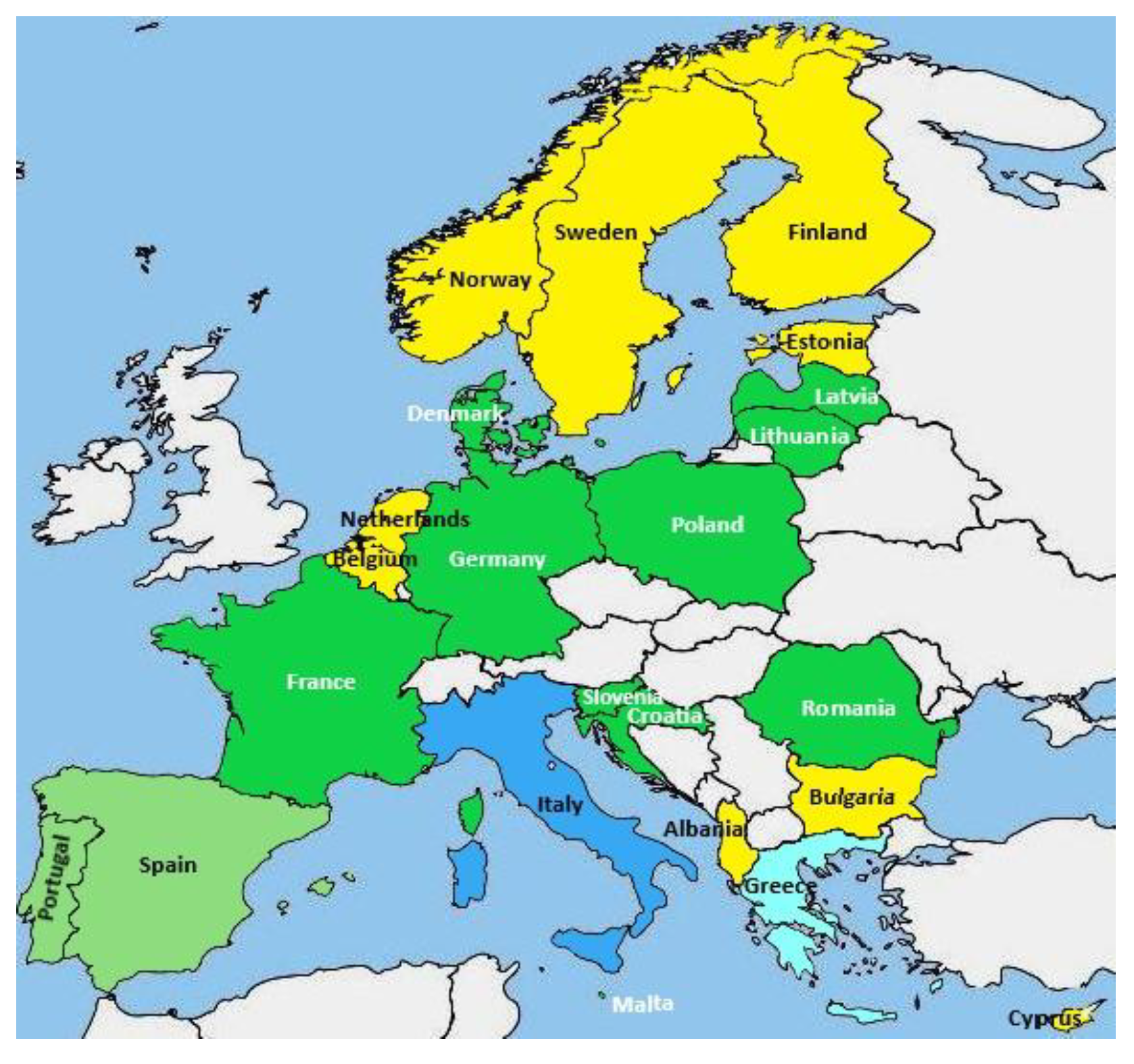
Figure 2.
The distribution of the chemical classes of DBPs in the freshwater and the seawater SPs.
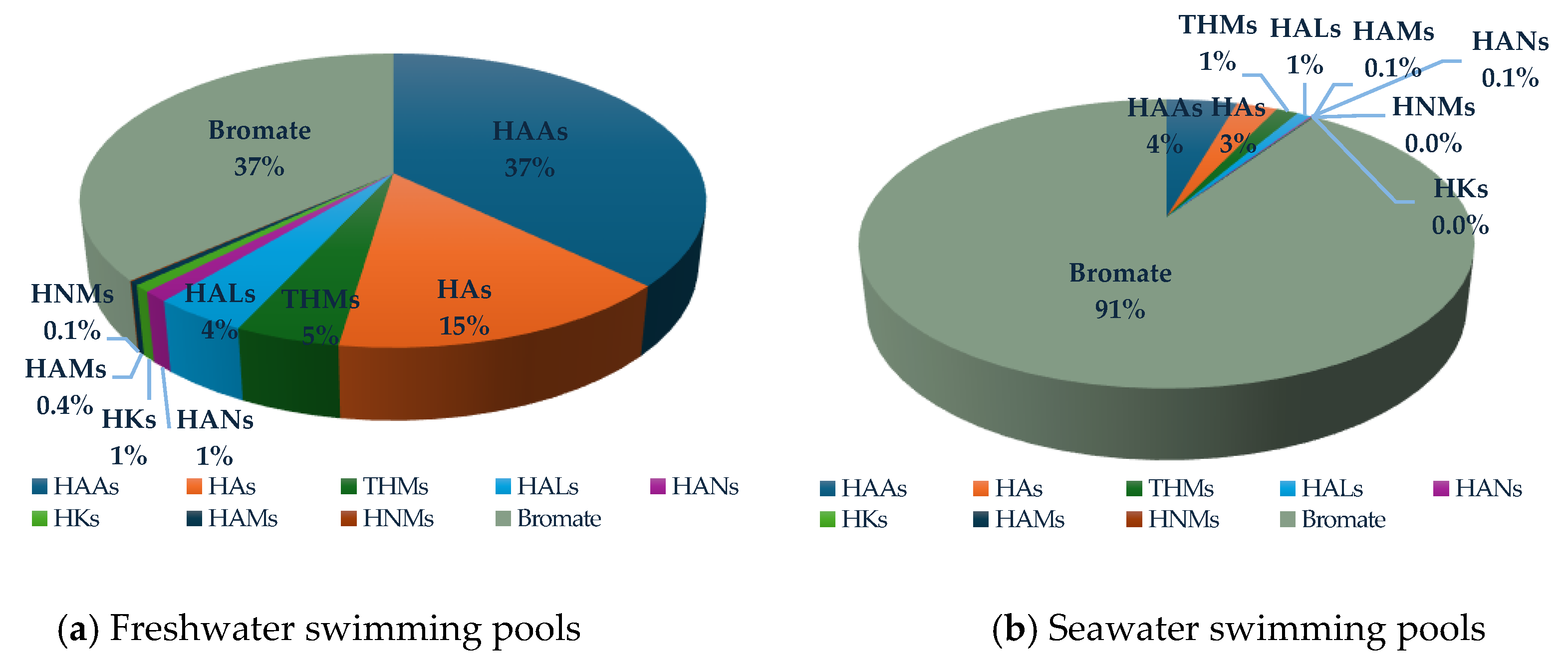
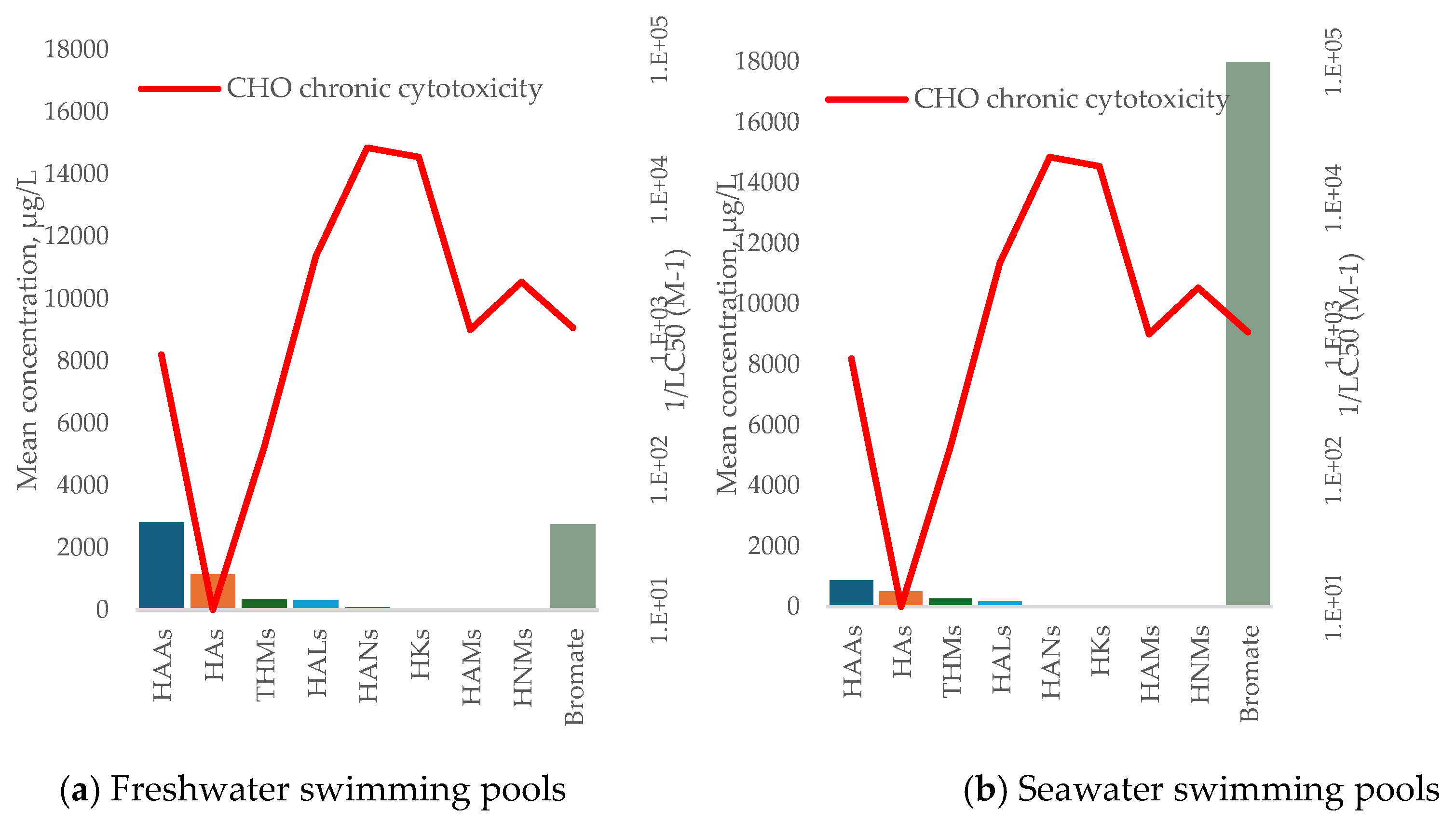

Table 1.
Summary of the legislative situation in European countries with access to the sea regarding the application of seawater in swimming pools.
Table 1.
Summary of the legislative situation in European countries with access to the sea regarding the application of seawater in swimming pools.
| Country | Regulation | Scope of application | Permitted type of fill water | Ref. |
| France | • Public Health Code. Part 1. Book III. Title III. Chapter II: Swimming pools and bathing areas. Articles D1332-1 - D1332-54. | Applies to public/collective swimming pools. Does not apply, except for disinfection provisions, to thermal SPs supplied by natural mineral water used for therapeutic purposes in thermal facilities. | Water from a public distribution network or from water taken from the natural environment, seawater included, after authorization. | [31] |
| • Decree of 26 May 2021 on swimming pool water quality standards and reference values, pursuant to Article D.1332-2 of the Public Health Code (PHC). | [32] | |||
| • Order of 26 May 2021 on the use of non-potable water sources for supplying swimming pools, pursuant to articles D. 1332-4 and D. 1332-10 of the PHC. | [33] | |||
| • Decree No. 81-324 of 7 April 1981 on the hygiene and safety standards for swimming pools and designated bathing areas. | [75] | |||
| • Order of 26 May 2021 amending the Decree of 7 April 1981 on technical provisions applied to swimming pools. | [76] | |||
| Germany | • Infection Protection Act (IfSG). § 37. Quality of water for human consumption and for swimming or bathing in pools or ponds, monitoring. | Apply to public baths, commercial, other non-private-use swimming facilities. Does not apply to private baths; systems with biological water treatment, water playgrounds, floating systems and/or pools; discontinuous water treatments | [35] | |
| • DIN 19643-1:2023-06. Part 1. | Water, including sea, mineral, medicinal, artificially produced brine and thermal water | [36] | ||
| • DIN 19643-2:2023-06. Part 2. | [77] | |||
| • DIN 19643-3:2023-06. Part 3. | [78] | |||
| • DIN 19643-4:2023-06. Part 4. | [79] | |||
| • DIN 19643-5:2021. Part 5. | [80] | |||
| Slovenia | Rules on minimum hygiene requirements that must be met by swimming pools and bathing water in pools. | Apply to bathing areas and water in conventional and biological SPs. Do not apply to natural bathing areas and SPs used by individuals or their family | Freshwater and seawater | [37] |
| Croatia | Rules on sanitary, technical and hygienic conditions of swimming pools and on the health safety of swimming pool waters. No. 1186. | Do not apply to non-public SPs; SPs with medically indicated, therapeutic water (e.g., thermal) not disinfected with residual effect; saunas and hot tubs in which the water is used once; lagoons, flow pools and seawater water slides. | Filling water from a public water supply system, seawater, or other types. | [38] |
| Poland | • Disposal of the Minister of Health of 9 November 2015 on water quality requirements for swimming pools. Amended on 10.05.2022, Item 1230. | Does not apply to swimming pools in which the pool basins are filled with water with medicinal properties. | Freshwater (surface or groundwater) meeting the drinking water requirements, Salty (i.e. sea and brine water) with 5-15 g/L of mineral content, Thermal, with outlet temperature ≥ 20 °C (excluding mine drainage water). |
[34] |
| • Act of 18 August 2011 on the safety of persons staying in water areas. | [81] | |||
| Lithuania | • Hygiene standard HN 109:2016 “Public Health Safety requirements for swimming pools”. | Not specified | Freshwater for pools must meet drinking water quality requirements before use. Mineral and seawater used to supply SPs must meet HN 127:2010 standard before use. |
[39] |
| • Hygiene standard HN 127:2010 “Mineral and seawater for external use. Health safety requirements”. | [40] | |||
| Latvia | Regulation No. 470 “Hygiene requirements for pool and sauna services”. | Pools or saunas, including those in educational, social care, healthcare institutions, sports, entertainment or recreation facilities, and hotels. | Potable water with the mandatory safety requirements for drinking water, sea or mineral water. | [41] |
| Romania | •Order No. 994 of 9 August 2018, amending and supplementing the Public Hygiene and Health Norms No. 119/2014 on the population’s living environment. | Public swimming pools | Drinking or sea water. Filling water not coming from public drinking water network, must comply with legal provisions. | [42] |
| Rules of 4 February 2014 on hygiene and public health for the population’s living environment. Annex I. | For freshwater | [82] | ||
| Decision No. 546 of 21 May 2008 on the management of bathing water quality. Annex I.. | For seawater | [83] | ||
| Spain | Royal Decree 742/2013 of 27 September, establishing the technical and health criteria for swimming pools. | Applies to public SPs. Single-family private SPs and SPs in homeowners’ associations, agrotourism’s, colleges or similar must comply with some provisions of this Decree. Does not apply to natural, thermal or mineral-medicinal pools. | Contains a request to provide periodic reports to the Ministry of Health with basic information on sources of filling water in SPs, which may include public and non-public networks or seawater. | [43] |
| Law 14/1986 of 25 April, General Health Law. BOE-A-1986-10499. | [84] | |||
| Portugal | NP 4542:2017 | Public swimming pools | Water from a public water network. Alternative water sources use requires the authorizations | [44] |
| Circular-Normative No. 14/DA. | Public/semipublic swimming pools | [46] | ||
| CNQ Directive No. 23/93 | Applies to public SPs and aquatic recreational facilities. Does not apply to therapeutic or thermal facilities, SPs used by families or in condominiums with less of 20 units | Mention seawater use | [45] | |
| Finland | Instructions for the application of the swimming pool water regulation: Swimming pool water quality and monitoring. 2/2017. | Apply to public SPs and spas. Do not apply to residential SPs, SPs in which the water is changed after each use, hotels jacuzzi self-filled by users, wading pools without continuous water treatment, portable SPs and rented by customer’s hot tubs. | Nor specified | [30] |
| Health Protection Act 763/1994. 19.8.1994. | [49] | |||
| Decree “On the quality requirements and monitoring studies of pool water in swimming pools and spas” 315/2002. | Applies to public SPs; spa; water parks; recreation and rehabilitation facilities. | Mention filling water rich of bromine | [50] | |
| Sweden | Guidance on swimming pools. No. 23048. | Applies to public SPs, i.e. pools and tubs for swimming, which can be part of pools such as indoor SPs, spas and water parks, or be independent both outdoors and indoors. | Nor specified | [47] |
| General Advice on swimming pools. HSLF-FS 2021:11. | [48] | |||
| Environmental Code. 1988:808 | [85] | |||
| Denmark | Executive Order on swimming pool facilities and their water quality. BEK No. 918. |
Applies to public and hot water SPs, i.e. spas, water parks, recreational, therapy and treatment pools and similar. Does not apply to private SPs, paddling pools where the water is discarded after a few hours, steam, thermal baths and similar. | Potable water and surface water (seawater included) | [52] |
| Guidance on controlling swimming pools. VEJ No. 9605. | [51] | |||
| Environmental Protection Act. LBK No. 1093. |
[86] | |||
| Norway | Regulation of 13 June 1996 on bathing facilities, swimming pools and saunas, etc. | Covers all public SPs, bathing facilities and saunas | Filling water must be hygienically satisfactory | [53] |
| Public Health Act. No. 29. | [87] | |||
| Regulation No. 486 on environmental health protection. | [88] | |||
| Netherlands | Environmental Activities Decision (Bal). Chapter 15. | Does not apply to household SPs, SPs installed for up to 24 consecutive hours, intended for human-animal contact, or installed on vessels not permanently moored. | Water that meets the quality requirements for drinking water. | [54] |
| Environment and Planning Act. | [55] | |||
| Belgium Flanders |
Title II of VLAREM. Government Decree of 1 June 1995 containing general and sectoral provisions regarding environmental hygiene. Art. 5.32.8.1. | Applies to permanent and natural SPs, hot tubes, plunge, splash and therapy pools, open swimming areas, recreation zones. Does not apply to private and hotels SPs not open to the public, which must comply with the provisions on the water treatment and the chemicals storage | Freshwater or salt water | [29] |
| Belgium Walloon |
Government Order of 13 June 2013 determining full conditions for indoor and outdoor swimming pools used for a purpose other than purely private within the family circle. | Applies to indoor and outdoor SPs used non-privately within the family, when the surface area ≤ 100 m² or the depth is ≤ 40 cm, with chlorine used for disinfection | Drinking water from the distribution network. If the filling and supplementary water do not come from the network, it meets the tap water standards | [56] |
| Belgium Brussels-Capital Region |
Government Order of 16 February 2023 setting operating conditions for swimming pools and other baths. | Apply to SPs and other baths listed in Annex 1 of [83]: excluding domestic SPs with a pool area ≤ 200 m2, other bathing facilities, SPs with a pool area over 200 m2. Does not apply to SPs and other baths with alternative water treatment other than chemical disinfection or biological treatment. | Drinking water from distribution network. When supplied water is not coming from the drinking water distribution network, authorization or environmental permit are requested | [57] |
| Government Order of 4 March 1999 listing class IB, [IC, ID], II and III installations, issued under Article 4 of the 5 June 1997 Environmental Permits Ordinance. | [89] | |||
| Italy | State-Regions Agreement of 16 January 2003 on the health and hygiene aspects for the construction, maintenance and supervision of swimming pools. | Applies to public/collective SPs for swimming, training, diving, underwater, recreational activities, for children, multipurpose use. Does not apply to SPs for rehabilitation, curative and thermal use. The systems supplied with thermal and seawater to be regulated by specific regional provisions. | Freshwater (surface or underground) that meets the requirements of potability. If the supply water does not come from a public aqueduct, it is necessary to verify its suitability for human consumption. | [58] |
| Interregional Regulation on swimming pools of 22 June 2004. | [59] | |||
| Guidelines for the reopening of economic and productive activities. 11 June 2020. | Mention seawater use | [64] | ||
| Albania | Regulation “Hygienic and sanitary requirements for swimming pools”. No. 835. | Apply to public/collective SPs for competition, training, diving, underwater activities, recreational, multifunctional and children use, in the hotels, tourist complexes/villages, colleges, schools, universities, gyms, beauty salons, residence complexes with over 4 units. Does not apply to private SPs, residence complexes with up to 4 units, thermal and therapeutic SP. | Potable water. If the water supply is not provided by the water supply company, the water must be tested seasonally for the parameters for assessing the suitability of drinking water. |
[65] |
| Greece | Sanitary Order Γ1/443/1973 “On swimming pools with instructions for their construction and operation”. Amended by Decrees: Γ4/1150/1976, ΔΥΓ2 /80825/05.2006. | Public swimming pools | [66] | |
| Circular Εγκ. ΔΥΓ2/99932/06/2007 “Instructions for the implementation of the Health Provisions “On the operation of swimming pools”. | SPs supply with seawater does not contradict the provisions if the water quality meets the parameters specified in Art.15 of [66] | [67] | ||
| Law 5170/2025 “Establishment of specifications for short-term rental properties and other urgent provisions”. | [68] | |||
| Circular Δ1δ/ΓΠ.οικ. 57290/2019 “On protection of public health through safe operation of public swimming pools”. | [90] | |||
| Circular Εγκ. Δ1α,δ/ ΓΠ οικ. 23849/2024 “Measures to protect public health from Legionnaires’ disease”. | [91] | |||
| Bulgaria | Instruction No. 34 on hygiene of sports facilities and equipment. Amended on: 02.03.1984, 08.03.2002. | Applies to the facilities where sports competitions and training are held | Not specified | [69] |
| Estonia | Health protection requirements for swimming pools, pools and aquatic centres. No. 80 of March 15, 2007. Amended on: 10.12.2009, 19.08.2011 |
Applies to SPs, pools and aquatic centres, in public and private legal entities providing services related to swimming and bathing, including schools and preschool institutions. Do not apply to natural mineral water and hydrotherapy SPs, natural cold-water pools, bathing facilities with flow-through surface water. |
Water used in SP must meet the requirements established for drinking water. | [70] |
| Malta | Public Health Act “Swimming Pools Regulations, 2005”. L.N. 129. Amended by L.N. 135 of 2008. | Applies to public or commercial SPs, including artificial basins, for recreational bathing, swimming, diving, or therapeutic use, located indoors or outdoors. Does not apply to non-public or non-commercial SPs. | Controlled water supply. | [71] |
| Subsidiary Legislation 545.07 on Control of swimming pools regulations. 5 June 1998, amended by: L.N. 107 of 2009; XXV. 2015.41 |
SPs located more than 100 meters from the sea may be filled only with freshwater collected as surface run-off or from public supply network. SPs within 100 m of the sea may be filled by seawater, only if the pool water is discharged to the sea through waterproof pipes |
[72] | ||
| Cyprus | Public Swimming Pools Regulations 368/96. | Applies to SPs: pools used exclusively or principally for the conduct of competitions or for the training or education of athletes; indoor SPs located within an enclosed covered area; public swimming pools. | Filling water should be chemically and microbiologically suitable. Authorities may allow brackish water use for tanks and sanitary facilities. Water renewal from a safe non-chlorinated natural source is allowed with at least 2000 liters per bather. | [73] |
| Public Swimming Pools Laws of 1992 and 1996 (55(I)/1992 and 105(I)/1996). | [74] |
Table 2.
Concentrations of THMs and bromate in water of freshwater and seawater pools and quality limits by the regulations.
Table 2.
Concentrations of THMs and bromate in water of freshwater and seawater pools and quality limits by the regulations.
| Parameter | Freshwater pools | Seawater pools | Ref. | Reference values | Ref. | |||||||
| Country | RV | QL | Note | |||||||||
| THMs, μg/L | ||||||||||||
| Total THMs (4TTHM) | 7–577 | [6] | France | 20 | 100 | The lowest possible value should be achieved without compromising disinfection efficacy | [32] | |||||
| 80.2 | 50.4–91.8 | [7] | ||||||||||
| 51.8-105.8 | [9] | Portugal | 100 | [46] | ||||||||
| 16.8-29.4 | [10] | Germany | 20 | For indoor pools. In outdoor SPs higher QL is permitted. (*Calculated as chloroform) | [36] | |||||||
| 77.7- 995.6 | [11] | Slovenia | 50 | [37] | ||||||||
| 307.6-327.8 | [13] | Poland | 100 | SPs feed with fresh, sea and thermal water | [34] | |||||||
| 122.4-435.5 | [23] | Sweden | 100 | [48] | ||||||||
| 777 | 260-322 | [100] | Denmark | 25 50 |
-Indoor SPs with T ≤ 34°C, -SPs with T > 34°C, outdoor SPs, hot tubs |
[52] | ||||||
| Netherlands | 50 | Calculated as chloroform | [54] | |||||||||
| Croatia | 100 | For conventional pools | [38] | |||||||||
| Chloroform | 0.2–243 | 0.1-6 | [6] | Poland |
20 30 |
SPs feed with fresh, sea and thermal water: -SPs for children up to 3 years old, -Other swimming pools |
[34] | |||||
| 69.8 | N.D. | [7,9] | ||||||||||
| 0.1 (mean)- 0.9 (max) | [8] | |||||||||||
| Finland | 50 | Not applicable to outdoor pools | [30] | |||||||||
| 0.01-0.29 | [11] | Lithuania | 100 | If chlorine-based compounds are used for disinfection | [39] | |||||||
| Bromodichloromethane | 0.13-167 | 0.29-5 | [6] | |||||||||
| 7.9 | N.D. | [7,9] | ||||||||||
| 0.3 (mean) - 2.2 (max) | [8] | |||||||||||
| 0.05-1.10 | [11] | |||||||||||
| Dibromochloromethane | 0.49-120 | 3.57–27 | [6] | |||||||||
| 1.9 | 1.6-5.2 | [7] | ||||||||||
| 18.9 (mean) - 81.0 (max) | [8] | |||||||||||
| 2.1– 5.5 | [9] | |||||||||||
| 3.2-63.6 | [11] | |||||||||||
| Bromoform | 0.04-47 | 50-651 | [6] | |||||||||
| 0.6 | 48.9-86.7 | [7] | ||||||||||
| 300 (mean) - 1029 (max) | [8] |
|||||||||||
| 49.7–101.3 | [9] | |||||||||||
| 73.5-930.7 | [11] | |||||||||||
| Inorganic anions, mg/L | ||||||||||||
| Bromate | 3 | <0.2-34 | [6] | Germany | 2 | [36] | ||||||
| < 0.02-5.0 | [22] | Netherlands | 0.1 | [54] | ||||||||
Disclaimer/Publisher’s Note: The statements, opinions and data contained in all publications are solely those of the individual author(s) and contributor(s) and not of MDPI and/or the editor(s). MDPI and/or the editor(s) disclaim responsibility for any injury to people or property resulting from any ideas, methods, instructions or products referred to in the content. |
© 2025 by the authors. Licensee MDPI, Basel, Switzerland. This article is an open access article distributed under the terms and conditions of the Creative Commons Attribution (CC BY) license (http://creativecommons.org/licenses/by/4.0/).
Copyright: This open access article is published under a Creative Commons CC BY 4.0 license, which permit the free download, distribution, and reuse, provided that the author and preprint are cited in any reuse.