

Submitted:
21 July 2026
Posted:
23 July 2026
You are already at the latest version
Abstract
International seminars and conferences have moved from the periphery of diplomatic life to its centre, becoming instruments through which states project soft power in an era of geostrategic transformation. Drawing on a qualitative, multi-method analysis of major international forums held between 2020 and 2024, this study examines how nations strategically leverage convening platforms to shape global narratives, cultivate alliances, and advance national interests beyond the reach of traditional hard-power instruments. Using case-study, comparative, and thematic analysis grounded in Nye’s soft-power theory and complex-interdependence and constructivist perspectives, the research identifies a qualitative shift in conference function. Contemporary forums operate as hybrid diplomatic–commercial platforms that integrate agenda-setting, convening power, thought leadership, and strategic signalling. The findings show that established powers use conferences to reinforce institutional leadership and norm-setting, whereas emerging powers tie convening strategies directly to economic integration, investment attraction, and national transformation agendas. Technological innovation—particularly the post-pandemic turn to hybrid formats—has both democratised participation and produced new digital hierarchies. The study concludes that the capacity to convene, moderate, and shape international discourse now constitutes a strategically consequential form of power, and it offers a weighted framework for assessing conference effectiveness as a soft-power instrument.
Keywords:
soft power
; conference diplomacy
; public diplomacy
; global governance
; digital diplomacy
; geopolitical transformation
1. Introduction
In an increasingly interconnected and volatile global environment, the metrics by which national power is assessed are being redefined. For much of the modern era, influence was measured chiefly through military strength, economic resources, and territorial control. In the twenty-first century, however, a state’s standing is shaped just as decisively by its capacity to frame global narratives, set agendas, and forge alliances through dialogue, persuasion, and attraction rather than coercion or payment (Nye, 2004, 2021). Within this evolving paradigm, international seminars and conferences have emerged as vital platforms for modern diplomacy and the exercise of soft power. Recent scholarship has begun to treat conference diplomacy as a distinct mode of international ordering, tracing a continuous line from the Congress of Vienna to the contemporary summit circuit (Daase & Schindler, 2024).
This shift became especially pronounced after the disruptions of the COVID-19 pandemic and amid the escalating geopolitical tensions that characterise the present international system. Established and emerging powers alike have recognised the strategic value of hosting, organising, and participating in high-profile gatherings. These events have transcended their earlier role as discussion forums to become venues for decision-making and policy formulation across economics, security, technology, and environmental governance. Their growing prominence signals a broader movement toward inclusive, multi-stakeholder, knowledge-intensive forms of engagement. Figure 1 presents the conceptual framework that organises the analysis, linking host-nation resources and conference design to four soft-power mechanisms and to the influence, material, and reputational outcomes they generate.
1.1. Research Problem
The contemporary international system is undergoing a transformation in the mechanisms through which states project influence. Power-projection paradigms historically dominated by military capability and economic leverage are now supplemented by more nuanced practices that emphasise dialogue, persuasion, and narrative control (Gallarotti, 2011). This evolution has been accelerated by digital connectivity, which has widened access to global audiences while intensifying competition for international attention and legitimacy. Central to this transformation is the emergence of conferences as instruments of soft power, defined by Nye (2004) as the ability to obtain desired outcomes through attraction and persuasion rather than coercion. Despite their growing importance, significant gaps remain in scholarly understanding of how these platforms operate as effective soft-power instruments, particularly amid intensifying rivalries and rapid digital change. A systematic analysis of their operational mechanisms and longer-term effects is therefore warranted.
1.2. Research Objectives
The overarching aim of this study is to analyse the role of international seminars and conferences in contemporary global politics. Its primary objective is to evaluate their evolving function as instruments of soft-power projection during the formative 2020–2024 period. Five secondary objectives support this aim: to examine the strategic approaches different nations employ to leverage conferences; to analyse the mechanisms through which conferences contribute to agenda-setting and policy formation across sectors; to assess the impact of technological innovation and geopolitical tension on the conference industry; to evaluate the effectiveness of conferences in building alliances and shaping narratives; and to explore the challenges and opportunities the sector faces within evolving structures of global governance.
1.3. Significance of the Study
The study contributes to both scholarship and practice. Academically, it advances understanding of soft power in the twenty-first century by providing an empirically grounded analysis of how states have adapted diplomatic tools to contemporary strategic ends. The 2020–2024 timeframe is analytically valuable because it captures the pandemic’s disruption of international relations, the acceleration of digital diplomacy, and the intensification of great-power competition. Practically, the findings inform policymakers and diplomatic practitioners seeking to optimise convening platforms for strategic communication, relationship-building, and the advancement of national interests, and they illuminate the economic and reputational returns associated with hosting major events.
1.4. Thesis Statement
International seminars and conferences have moved from peripheral diplomatic activity to become central instruments of soft-power projection. This transformation reshapes global influence dynamics by enabling states to set international agendas, forge partnerships, and project authority through intellectual leadership and convening power rather than material capability alone. The strategic use of these platforms by established and emerging powers marks a shift toward a more inclusive yet intensely competitive model of global governance, in which the capacities for dialogue facilitation and consensus generation have become as strategically valuable as conventional resources.
2. Literature Review
Research on international seminars and conferences draws on several theoretical traditions in international relations. This section is organised by theoretical foundations, functional and economic dimensions, regional variation, and emerging trends in technology, security, and environmental governance, before identifying the gaps the present study addresses.
2.1. Theoretical Foundations of Soft Power
Joseph Nye’s concept of soft power, first articulated in the late 1980s, has been developed and applied extensively over three decades. Nye (2004) defined soft power as the ability to obtain desired outcomes through attraction rather than coercion or payment, locating its sources in culture, political values, and foreign policy. Subsequent scholarship has refined the concept across public diplomacy, cultural relations, and strategic communication (Cull, 2019; Melissen, 2005). A persistent challenge has been operationalisation—specifying how attractive qualities translate into concrete outcomes (Gallarotti, 2011). Conferences offer one answer: they provide structured environments in which a state can demonstrate its capacity to convene, facilitate dialogue, and contribute to collective problem-solving, thereby rendering attractiveness tangible. More recent work theorises soft power as a relational and processual accomplishment enacted through events rather than a static national attribute (Næss, 2023). The digital age has further reshaped these dynamics, as technological platforms and mediated interactions transform the practice of attraction and influence (Bjola & Holmes, 2015; Manor, 2019). Soft power has not gone uncontested: critics observe that attraction is difficult to convert reliably into outcomes, that its effects are hard to isolate from other factors, and that audiences may resist or reinterpret a state’s preferred narrative (Gallarotti, 2011; Nye, 2021). Conference diplomacy offers a partial answer to this critique, because it renders the otherwise diffuse work of attraction observable and repeatable, embedding it in concrete events whose participation, agendas, and outcomes can be assessed. As shown in Table 1, scholarship on soft power and conference diplomacy has evolved across four broad phases, moving from an early cultural emphasis toward the present recognition of convening power as a distinct asset.
2.2. Conferences and Diplomatic Practice
Conferences have attracted scholarly attention since the emergence of modern diplomacy. Traditional literature focused on formal conferences and summits, examining their role in treaty negotiation, crisis resolution, and norm establishment (Hamilton & Langhorne, 2011). More recent work broadens this lens to a wider array of gatherings and their functions in global governance. Keohane and Nye’s (2011) account of complex interdependence shows how multiple channels of contact—including conferences—shape cooperation in a world where state and non-state actors interact across many issue areas, and where informal channels often prove as consequential as formal negotiation. Building on this tradition, scholars now treat conferences as strategic-communication platforms through which states address global audiences directly, bypassing traditional media gatekeepers while conducting conventional diplomacy (Hedling, 2025; Kobierecka & Kobierecki, 2024; Zaharna, 2010). This dual function distinguishes contemporary forums from their predecessors and enhances their value as soft-power instruments. Table 2 contrasts traditional and contemporary conference functions, underscoring the qualitative shift from information exchange to decision-making, deal-making, and agenda-setting.
2.3. Economic Dimensions of Conference Diplomacy
The economic dimensions of conference diplomacy have received growing attention, particularly regarding trade facilitation and investment flows. The World Economic Forum exemplifies how an economic forum functions simultaneously as a networking venue, a policy incubator, and a site of transnational private authority, allowing business and government elites to converge on shared understandings of global challenges (Graz, 2003; Pigman, 2007). Critical scholarship situates such gatherings within a wider architecture of elite global governance in which agenda-setting power is exercised informally yet consequentially (Moyo, 2024). The strategic use of forums to advance economic diplomacy is equally evident in China’s convening practice: platforms such as the Boao Forum for Asia are deployed to build consensus around connectivity initiatives, including the Belt and Road Initiative, even as empirical assessments caution that the initiative’s measurable economic impact is shaped heavily by pre-existing ties (Delvaje, 2024; Wong & Downes, 2024). Such findings suggest that successful economic conferences generate value for participants while advancing the host’s strategic interests, blurring the line between commercial and political objectives.
These dynamics have prompted a more critical scholarship that interrogates the authority such forums exercise. Graz (2003) characterises the World Economic Forum as a site of private authority whose influence rests less on formal decision-making than on its capacity to assemble elites and naturalise particular policy paradigms—a reading echoed in accounts of the “Davos class” as a transnational governing stratum (Moyo, 2024). Pigman’s (2007) institutional analysis likewise frames the Forum as a multi-stakeholder governance mechanism rather than a mere networking venue. For emerging economies, economic forums perform a complementary function, translating convening capacity into recognition and legitimacy; China’s engagement with multilateral platforms shows a rising power adjusting its role conception to meet external expectations while advancing connectivity agendas (Delvaje, 2024), even as empirical reassessment tempers expansive claims about their material reach (Wong & Downes, 2024). The economic dimension of conference diplomacy is thus double-edged: it generates tangible deal-flow while constituting a symbolic economy of status in which the right to convene is itself a scarce and contested resource.
2.4. Regional Variations in Conference Strategies
Comparative analysis reveals significant regional variation in conference diplomacy, reflecting distinct histories, priorities, and norms. European scholarship has traditionally emphasised multilateral institutions and norm-setting, consistent with the continent’s commitment to a rules-based order and transnational public spheres (Risse, 2010). Research on Asian conference diplomacy highlights different priorities—economic connectivity, regional integration, and an explicit linkage between economic and political objectives, often centred on infrastructure, trade, and technology (Delvaje, 2024). Scholarship on the Gulf states, meanwhile, foregrounds conferences and mega-events as tools of image management, nation-branding, and economic diversification, integral to national development visions aimed at transforming economies and enhancing global standing (El-Dabt et al., 2025; Næss, 2023). Table 3 compares regional hosting strategies, objectives, and investment levels, illustrating how convening priorities map onto broader geostrategic positions.
2.5. Technology and Virtual Diplomacy
The technological transformation of conference formats has generated substantial interest, particularly after the pandemic accelerated virtual practice. Studies of the period document a shift from ad-hoc digital adaptation toward durable hybrid diplomacy, in which virtual venues become a standing feature of diplomatic practice rather than a temporary expedient (Bjola & Coplen, 2023; Bjola & Manor, 2022). Early analyses of academic and policy conferences moving online found that virtual formats expanded participation and lowered costs and carbon emissions, while complicating the relationship-building and trust formation that in-person interaction affords (Achakulvisut et al., 2020; Klöwer et al., 2020). Hybrid formats increased geographical diversity but introduced new hierarchies based on connectivity, digital literacy, and the quality of virtual engagement—an enduring digital divide documented in global connectivity data (International Telecommunication Union, 2023). Table 4 summarises the principal technological innovations reshaping conference diplomacy, their benefits and challenges, and indicative adoption rates across major forums.
The pattern in Table 4 confirms that adoption has been uneven and purpose-driven rather than uniform. Technologies that lower the cost and widen the reach of participation—virtual platforms and data-driven matching—have diffused rapidly, whereas those that demand heavy investment or raise unresolved governance questions, such as immersive media and blockchain, remain experimental. This selective uptake indicates that hosts adopt innovation instrumentally, embracing tools that visibly enlarge or improve their convening reach while deferring those whose diplomatic value is still unproven.
2.6. Security, Environmental, and Technology Forums
Specialised forums have attracted attention for their role in norm formation, signalling, and confidence-building. High-profile security gatherings such as the Munich Security Conference and the Shangri-La Dialogue function as institutionalised “Track 1.5” venues that combine official and expert participation, enabling strategic signalling and coalition management with a candour that formal channels seldom permit (Munich Security Conference, 2024; Longhini & Zimmerman, 2021). Climate conferences occupy a comparably central place in diplomatic studies. The Conference of the Parties operates as both a negotiating forum and an awareness-raising platform, and close analyses of the Paris Agreement reveal how format, coalition dynamics, and closed-door bargaining shape outcomes (Dimitrov, 2016; Ourbak & Magnan, 2018), even as critics question whether the COP process can deliver implementation at the pace required (Depledge, 2024). Technology forums constitute a newer frontier: AI-governance summits such as the 2023 Bletchley Park meeting illustrate how states compete to shape emerging norms, though their agenda-framing has drawn scrutiny (Passchier, 2023; The Lancet Digital Health, 2024).
2.7. Gaps in the Literature
Despite this expanding body of work, several gaps remain. First, systematic analysis of the factors that make conferences effective as soft-power tools is limited, especially beyond immediate outcomes; robust frameworks for measuring longer-term impact are scarce. Second, although regional studies exist, comparative analysis of how nations adapt convening strategies to distinct geostrategic objectives is underdeveloped. Third, most studies emphasise immediate outputs—declarations or agreements—rather than durable effects on influence, relationships, and policy implementation. Fourth, the roles of non-state actors in shaping conference dynamics warrant deeper attention. Fifth, the implications of advanced technologies beyond videoconferencing—artificial intelligence, blockchain, and immersive media—remain insufficiently examined. Finally, the literature concentrates on successful, high-profile events, leaving the dynamics of failure largely unexplored. This study addresses the first four gaps directly and engages the remaining two through its analysis and research agenda.
Taken together, these gaps point to the need for analysis that treats conference diplomacy as a coherent object of study rather than an incidental backdrop to negotiation. Recent scholarship has begun to supply that framing, situating conferences within a long lineage of ordering practices and theorising their distinctive contribution to international society (Daase & Schindler, 2024). The present study advances this emerging programme by specifying the mechanisms through which convening becomes influence, by comparing how differently positioned states deploy those mechanisms, and by proposing a framework for assessing their effects—responding to Nye’s (2021) own reflection that soft power is best understood not as a fixed stock of resources but as a relationship whose value is realised only through skilled practice.
3. Methodology
The study employs a qualitative, interpretive research design that integrates multiple methods to examine international seminars and conferences as soft-power instruments. The interpretive paradigm recognises that the meanings and effects of conference diplomacy are socially constructed and context-dependent (Creswell & Poth, 2018), making it well suited to phenomena that involve material capabilities, symbolic representation, and audience perception. Combining case-study, comparative, and thematic analysis enables triangulation and strengthens the validity of the conclusions.
3.1. Research Design and Theoretical Framework
The design is an in-depth qualitative inquiry focused on how and why conferences are used for soft-power projection. Major international conferences held between 2020 and 2024 were treated as cases, permitting detailed examination of their design, implementation, and outcomes. Comparative analysis spanned national approaches (established versus emerging powers), thematic focus (economic, security, environmental, and technological), regional variation, and format (in-person, virtual, and hybrid). Thematic analysis identified recurring patterns across the data. The framework is grounded in Nye’s (2004) soft-power theory, augmented by complex-interdependence theory (Keohane & Nye, 2011) and constructivist perspectives that foreground the role of ideas, norms, and shared understandings in shaping international behaviour.
3.2. Data Collection and Case Selection
A diverse array of sources supported triangulation. Primary data comprised official conference documentation—programmes, participant lists, declarations, press releases, and post-event reports—together with systematic analysis of associated digital content, including official websites, social-media channels, session recordings, and engagement metrics. Secondary data comprised a review of peer-reviewed scholarship published between 2014 and 2024 and analysis of industry and media reporting on the events sector. Document and digital-content analysis followed established qualitative procedures (Bowen, 2009; Silverman, 2020). Cases were selected for significance—high-level political participation, global or regional scope, substantial media attention, tangible outcomes, and strategic importance to host nations—and for diversity across geography, theme, hosting model, and format. Table 5 lists the principal conferences analysed, organised by region and sector.
3.3. Analysis, Validity, and Ethics
Data were analysed using thematic analysis following Braun and Clarke’s (2006) six-phase approach, complemented by comparative analysis across cases and by elements of quantitative content analysis—examining the frequency of key themes, participation patterns, and reported outcomes. Trustworthiness was reinforced through data, methodological, and theoretical triangulation (Flick, 2004); through member checking with selected organisers and participants where feasible; and through thick description that allows readers to assess transferability. The research relied primarily on publicly available material, minimising privacy concerns; sensitive information was anonymised where necessary; and the researcher maintained reflexivity to mitigate interpretive bias. The study acknowledges several limitations: reliance on public information may omit informal outcomes; the 2020–2024 window provides a snapshot of a dynamic period; documentation quality varied across cases; and the focus on major, high-profile, and largely successful events constrains generalisability. Table 6 summarises the principal methodological choices and their rationale.
4. Results and Discussion
Analysis of international seminars and conferences from 2020 to 2024 reveals a fundamental transformation in how nations conceptualise, organise, and use these gatherings as soft-power instruments. The findings are presented across the strategic evolution of conference diplomacy, national strategies, mechanisms of projection, sectoral patterns, technological change, the field’s constraints, and the measurement of effectiveness.
4.1. The Strategic Evolution of Conference Diplomacy
The evidence demonstrates that contemporary conferences have moved far beyond their role as discussion forums. They now operate as multifaceted platforms that simultaneously host high-level policy dialogue, economic networking, cultural exchange, and strategic signalling—a qualitative shift in their function within the international system that aligns with the historical trajectory of conference diplomacy traced by Daase and Schindler (2024).
4.1.1. From Discussion Forums to Decision-Making Centres
The analysis shows a clear evolution from conferences as venues for exchange to conferences as decision-making centres with tangible policy effects. The World Economic Forum exemplifies this shift: its 2024 annual meeting convened more than 2,800 leaders from over 120 countries and generated concrete initiatives across climate action, technological governance, and economic stability (Pigman, 2007, provides the institutional analysis underpinning this reading). The pattern is most pronounced in economic conferences, where deal-making and investment announcements have become central rather than ancillary. Saudi Arabia’s Future Investment Initiative illustrates the trend, with its sessions reportedly generating multibillion-dollar commitments and functioning as hybrid diplomatic–commercial platforms in which reputation-building and economic advancement reinforce one another. The significance of this shift lies less in the headline figures than in what they signal: hosting capacity has become a recognised arena of competition among states, one in which the ability to attract capital and attention is treated as an index of national standing. Table 7 reports indicative estimates of the economic footprint of leading conferences compiled from organisers’ published reports and industry analyses.
4.1.2. Thematic Expansion and Interdisciplinary Integration
Contemporary conferences also display marked thematic expansion. The World Economic Forum’s evolution from an economic dialogue into a forum addressing artificial intelligence, security, and geopolitics typifies the trend, as do climate summits that now incorporate finance, technology transfer, and social equity. This expansion serves strategic ends: it allows host nations to position themselves as thought leaders and conveners across multiple domains at once, enlarging their soft-power footprint. The magnitude of the material stakes is visible in Figure 2, which compares the estimated annual economic impact of leading forums with the scale of investment and deals announced around them, underscoring why states increasingly treat convening capacity as economic as well as diplomatic infrastructure.
4.2. National Strategies for Conference-Based Soft Power
The research identifies distinct strategic approaches across categories of nations, reflecting their geostrategic positions, resources, and foreign-policy objectives.
4.2.1. Established Powers: Institutional Leadership and Norm-Setting
Established powers concentrate on reinforcing institutional leadership and norm-setting. Germany’s Munich Security Conference and France’s Paris Peace Forum position their hosts as indispensable conveners on critical global challenges, strengthening multilateral frameworks and projecting shared values. The Munich Security Conference functions as a trusted venue for candid dialogue on contested security questions, attracting heads of state and government and reaffirming its host’s role as a mediator even amid heightened tension (Munich Security Conference, 2024; Longhini & Zimmerman, 2021). The Paris Peace Forum, with its emphasis on multilateral solutions and institutional strengthening, advances a particular vision of a rules-based order.
This pattern reflects a broader logic of normative entrepreneurship. By positioning themselves as neutral conveners, established powers convert procedural authority—control over who is invited, what is discussed, and how outcomes are framed—into a durable form of influence that does not depend on coercion. Analyses of the Munich Security Conference and the Shangri-La Dialogue show how such “Track 1.5” forums blend official and unofficial participation to enable candid exchange and quiet coalition management that formal channels cannot easily accommodate (Longhini & Zimmerman, 2021). The value of these venues rises precisely when relations are tense, since the capacity to keep rivals in the same room becomes a strategic asset in its own right. Yet the same neutrality is fragile: when a host is seen to instrumentalise a forum for partisan ends, the convening authority that underwrites its soft power can erode quickly, which helps explain why established powers invest so heavily in the procedural impartiality and institutional continuity of their flagship events.
4.2.2. Emerging Powers: Economic Integration and Regional Leadership
Emerging powers, by contrast, emphasise economic integration, domestic transformation, and regional leadership, frequently linking conference outcomes to national development agendas. China’s use of the Boao Forum for Asia to build support for connectivity initiatives, including the Belt and Road Initiative, exemplifies the model, blending convening diplomacy with economic statecraft (Delvaje, 2024; Wong & Downes, 2024). Saudi Arabia offers an especially comprehensive case. Under Vision 2030, the Kingdom has assembled a portfolio of high-profile events—the Future Investment Initiative, specialised cybersecurity and artificial-intelligence summits, and the Middle East Green Initiative—each serving simultaneously as a platform for dialogue and a mechanism for projecting a modernising national identity, forging partnerships, and attracting foreign investment (El-Dabt et al., 2025; Vision 2030, 2024). The national convening agency has stated a goal of hosting more than 1,000 international conferences annually and generating roughly US$25 billion in associated revenue by 2030 (Saudi Press Agency, 2024). This fusion of conference hosting and soft-power projection reflects an integrated model of engagement that pursues tangible economic returns alongside the more diffuse influence of reputation and connectivity.
The contrast between established and emerging powers should not be overdrawn, for both pursue influence through convening but monetise it differently. Established powers tend to bank reputational capital, accumulating authority as reliable stewards of the multilateral order, whereas emerging powers more often convert convening into immediate material and developmental returns. Saudi Arabia’s portfolio is instructive: the Future Investment Initiative and the Middle East Green Initiative operate at once as investment marketplaces and as instruments of national rebranding, mirroring the wider Gulf turn toward mega-events as vehicles of soft power and diversification (El-Dabt et al., 2025; Næss, 2023). China’s Boao Forum performs an analogous role for connectivity diplomacy, projecting regional leadership while advancing concrete economic agendas (Delvaje, 2024; Wong & Downes, 2024). What unites these cases is the deliberate alignment of convening strategy with national transformation projects, so that the conference becomes an extension of domestic policy by other means.
4.3. Mechanisms of Soft-Power Projection
Four mechanisms recur across the cases. The first is agenda-setting power. By selecting themes, curating speakers, designing formats, and framing outcome declarations, hosts shape which issues command international attention and how they are understood, extending their influence well beyond the event itself. The second is convening and network-building power: the capacity to attract senior, geographically diverse, and returning participants both demonstrates and reinforces a nation’s centrality, while generating relationships through the informal, off-record interaction that conferences uniquely afford. The third is thought leadership: by showcasing research, policy innovation, and expertise, hosts position themselves as sources of credible insight—a mechanism especially valuable to middle and emerging powers seeking influence through intellectual rather than material means. The fourth is strategic signalling, through which states convey intentions, capabilities, and red lines to global audiences without overt displays of force. Together these mechanisms convert convening capacity into structural influence.
These mechanisms operate in combination rather than isolation. Agenda-setting power depends on convening power, since a host can frame an issue only if it can first attract the participants whose presence lends the framing authority; the World Economic Forum’s elevation of themes such as stakeholder capitalism and artificial-intelligence governance shows how curated agendas, prestigious participation, and intensive media amplification reinforce one another (Pigman, 2007). Thought leadership is most potent when institutionalised, as states that sustain a recurring forum on a defined challenge accumulate a reputation for expertise that single events cannot confer. Strategic signalling completes the repertoire, letting leaders communicate resolve or reassurance to several audiences simultaneously. The analytical implication is that conference-based soft power is systemic: its effectiveness derives from the architecture linking inputs, mechanisms, and outcomes depicted in Figure 1, and weakness in any one element—thin participation, an incoherent agenda, or poor follow-through—propagates through the whole.
4.4. Sectoral Patterns
Conference diplomacy operates differently across sectors. Economic conferences exhibit the closest integration of soft power and material outcomes, combining deal-making, policy coordination, market-access promotion, and economic messaging within a single platform. Security conferences provide venues for crisis communication, alliance management, strategic signalling, and Track-II dialogue, typically attracting the highest levels of governmental participation. Environmental conferences enable nations to demonstrate leadership on globally salient challenges while advancing domestic objectives, and they tend to generate the most specific and measurable commitments. Technology conferences—addressing artificial intelligence, cybersecurity, and emerging biotechnologies—constitute a frontier in which norms and governance frameworks are still forming, allowing convening states to shape ethical guidelines and regulatory expectations (Passchier, 2023; The Lancet Digital Health, 2024). Table 8 summarises these conference types, their primary functions, key stakeholders, and characteristic soft-power mechanisms.
Read across its rows, Table 8 reveals a common grammar beneath sectoral variation. In every domain the host couples a substantive function—facilitating trade, managing alliances, mobilising climate finance, or setting technical standards—with a reputational one, using the event to display competence and values to a watching world. The sectors differ chiefly in how directly material outcomes can be observed: economic forums produce visible deal-flow and environmental summits generate quantifiable pledges, whereas security and technology forums trade in the less tangible currencies of trust and norm formation whose effects unfold over longer horizons. That asymmetry carries a practical consequence, since the sectors yielding the most immediate returns are also the most exposed to charges of transactionalism, while those whose value is diffuse demand patience and sustained institutional investment before their soft-power dividends accrue.
4.5. The Impact of Technological Innovation
The 2020–2024 period saw an unprecedented acceleration in the adoption of technology in conference diplomacy, driven initially by the pandemic and consolidated thereafter into durable hybrid practice (Bjola & Manor, 2022).
4.5.1. Virtual and Hybrid Formats: Democratisation and New Hierarchies
The rapid shift to virtual and hybrid formats altered participation dynamics in two directions. On one hand, it produced democratising effects: lower travel and accommodation costs broadened participation; the removal of visa and travel barriers widened access; recording and streaming extended reach to asynchronous audiences; and flexible scheduling accommodated dispersed time zones (Achakulvisut et al., 2020). On the other hand, it generated new hierarchies. Disparities in connectivity, device quality, and digital literacy reproduced existing inequalities, while differences in platform familiarity and the uneven quality of cross-cultural communication created tiered experiences (International Telecommunication Union, 2023). Survey evidence from the period indicates that virtual venues reshaped not only access but also negotiation tactics and perceptions of legitimacy (Bjola & Coplen, 2023). With a substantial share of forums expected to retain hybrid elements, these adaptations appear durable, requiring states to develop strategies for projecting soft power across multiple formats. Figure 3 displays the relative adoption of key technologies across major conferences during the study period.
4.5.2. Artificial Intelligence, Blockchain, and Trust
Beyond videoconferencing, artificial intelligence is beginning to transform conference dynamics. Real-time translation lowers language barriers and supports more sophisticated content analysis and participant matching, even as it raises questions about authenticity, nuance, and bias in mediated diplomatic exchange (Manor, 2019). Blockchain applications are being piloted to record commitments, track implementation, and verify credentials, addressing long-standing concerns about follow-through on declarations. These tools remain nascent, and their diplomatic value will depend on governance arrangements that preserve trust. Table 9 sets out indicative metrics for assessing the performance of the digital channels through which conferences now project influence.
4.6. Challenges and Constraints
Conference-based soft power faces real constraints. Access and equity remain the most pressing: high participation costs, together with visa and mobility restrictions, limit attendance from developing countries and civil-society groups and produce an elite bias, while virtual options introduce their own exclusions through the digital divide. Credibility is a second concern. Where prestigious platforms are used to improve a state’s image without substantive reform—“image washing” or reputation laundering—the authenticity and soft-power value of the forum are undermined. Geopolitical tension constitutes a third constraint: boycotts, rivalries, and security concerns can reduce participation diversity and erode the neutrality on which convening authority depends. Table 10 categorises these challenges, assesses their severity, and identifies mitigation strategies.
The challenges catalogued in Table 10 are not merely operational irritants; several strike at the legitimacy on which conference diplomacy depends. The credibility problem is especially acute, because the soft power of a forum rests on a perception of authenticity, and any suspicion that a host is using the platform to launder its reputation rather than to engage substantively can turn an asset into a liability. The same event that projects modernity to one audience may invite accusations of “image-washing” from another, a tension documented in critical analyses of mega-event hosting (Næss, 2023). Access inequities compound the difficulty by narrowing the range of voices present, undermining both the representativeness and the perceived fairness of outcomes. Effective mitigation therefore cannot be purely technical: it requires hosts to accept genuine scrutiny, to institutionalise follow-through, and to broaden participation in ways that may dilute their own control—the very trade-off that distinguishes durable convening authority from short-lived spectacle.
4.7. Measuring Conference Effectiveness
Assessing conferences as soft-power instruments is difficult because their effects are often diffuse and long-term. The analysis nonetheless identifies complementary quantitative and qualitative indicators. Quantitative measures capture reach and direct outcomes—the number and seniority of participants, geographical diversity, repeat-participation rates, and media reach, alongside the value of agreements announced, the implementation rate of commitments, and citation of conference outputs in subsequent policy and scholarship. Table 11 organises these indicators by category.
4.7.1. A Weighted Framework
Qualitative indicators capture the subtler dimensions that quantitative metrics miss: the quality and durability of relationships, the development of trust, enhanced diplomatic access, and the diffusion of conference themes into other forums and national policy processes. Integrating both types of evidence, the study proposes a weighted framework for evaluating conference effectiveness. As shown in Figure 4, participation quality carries the greatest weight, followed by media impact and economic outcomes, with relationship-building, policy influence, and host-nation benefits completing the model. The framework is intended as a practical instrument for organisers and analysts seeking to compare events on a common basis. Table 12 details its dimensions, indicators, data sources, and assessment frequency.
The weighting reflects the evidentiary patterns observed across the cases, in which the calibre of participation most consistently predicted downstream influence, while economic and media effects, though highly visible, proved more variable. The framework is deliberately modular, allowing weights to be recalibrated for different conference types—security forums, for instance, may warrant heavier weighting of relationship and policy dimensions than of immediate economic outcomes.
4.8. Conferences in Crisis Management
A distinctive finding concerns the role of conferences during acute international crises, when their convening and signalling functions become especially valuable. Across the study period, forums served as rapid-response mechanisms: global health gatherings coordinated pandemic preparedness and reinforced the legitimacy of multilateral health institutions (World Health Organization, 2022); the Munich Security Conference functioned as a focal point for alliance coordination and signalling during the war in Ukraine; successive Conferences of the Parties sustained momentum on climate finance under conditions of geopolitical strain (Depledge, 2024; United Nations Framework Convention on Climate Change, 2023); and emergent AI-safety summits sought to establish governance for a fast-moving technology (Passchier, 2023). Table 13 examines these cases, linking each crisis to the conference response, the host context, the outcomes achieved, and the soft-power implications.
The crises summarised in Table 13 share an instructive feature: in each, the conference supplied a coordinating focal point at a moment when formal institutions were strained or slow. This focal-point function is a distinctive contribution of convening diplomacy to crisis management. By compressing many bilateral interactions into a single time and place, a well-timed forum lowers the transaction costs of cooperation, accelerates the formation of common knowledge about who will do what, and provides a stage for the public commitments that make defection costly. The soft-power dividend accrues to the host seen to have convened effectively under pressure. Yet the same visibility raises the stakes of failure, for a summit that produces only rhetoric in the face of acute crisis can corrode rather than enhance its host’s standing—underscoring that convening power is realised only when matched by credible follow-through (Depledge, 2024).
5. Conclusions
This study demonstrates that international seminars and conferences have undergone a fundamental transformation, evolving from peripheral diplomatic activity into central instruments of soft-power projection. The analysis of major forums from 2020 to 2024 yields four principal findings. First, the function of conferences has shifted qualitatively: contemporary forums are decision-making centres that integrate economic deal-making, policy announcement, and alliance-building within single events. Second, nations differentiate their strategies in patterned ways—established powers reinforce institutional leadership and norm-setting, whereas emerging powers tie convening to development objectives, investment, and regional leadership. Third, sectoral specialisation coexists with cross-domain integration, as states recognise that thought leadership in technical fields translates into geopolitical influence. Fourth, technological innovation has simultaneously democratised participation and produced new hierarchies rooted in digital capability.
5.1. Theoretical and Governance Contributions
Theoretically, the findings extend Nye’s account by specifying convening power and agenda-setting as distinct influence mechanisms that complement culture and values, and by characterising conference diplomacy as a hybrid practice combining traditional, public, economic, and cultural diplomacy within integrated platforms (Daase & Schindler, 2024; Hedling, 2025). They also clarify how technological mediation reshapes diplomatic practice beyond simple digitisation, creating opportunities for participation alongside novel risks to trust and inclusion (Bjola & Manor, 2022). For global governance, the proliferation of specialised, diversely hosted forums points toward more polycentric, issue-specific, and multi-stakeholder arrangements, in which conferences serve as critical nodes that distribute influence across states, organisations, and non-state actors.
5.2. Practical Implications and Final Reflections
For policymakers, the findings suggest that convening capacity should be treated as strategic infrastructure. Nations seeking influence benefit from systematic investment in hosting capability, from developing a thematic portfolio aligned with genuine areas of expertise rather than competing across all domains, from building the digital capabilities that hybrid diplomacy now requires, and from instituting credible mechanisms to track and implement commitments. The Saudi model of integrating a conference strategy with national development objectives illustrates how such investment can yield returns in diversification, reputation, and diplomatic leverage (Vision 2030, 2024). More broadly, the health of the conference sector functions as an indicator of the vitality of the global-governance system: a robust, inclusive convening landscape signals an adaptive international community, whereas a sector hollowed out by prohibitive cost, geopolitical rivalry, or integrity concerns would signal a deeper erosion of multilateral cooperation. Nations that recognise this and invest wisely in convening infrastructure, innovation, and dialogue will be best positioned to shape the contours of an emerging global order.
Ultimately, the trajectory traced in this study suggests that convening has become a constitutive practice of contemporary statecraft rather than an ornamental one. As power continues to diffuse across states, firms, and civil-society actors, the capacity to assemble the right participants around the right questions—and to translate that assembly into agreement and action—will remain a decisive determinant of influence. The states and institutions that cultivate this capacity, while resisting the temptation to treat conferences as mere theatre, will be best placed to shape norms, broker cooperation, and define the agenda of an increasingly multipolar order.
6. Recommendations for Future Research
The field stands at a juncture where technological innovation, shifting geopolitics, and evolving governance create both opportunities and challenges for scholarship. Future research should prioritise longitudinal and mixed-methods designs that track the durability of conference-generated relationships and commitments over five- to ten-year horizons, combining document analysis with surveys, interviews, and social-network analysis to capture both objective outcomes and subjective experience. Comparative work should extend beyond major powers and high-profile events to under-studied regions and, critically, to conferences that fail—whether through boycott, low participation, or unmet objectives—since failure modes illuminate the limits of convening diplomacy. Thematic priorities include the diplomatic implications of artificial intelligence, immersive media, and cybersecurity; the roles of corporations, civil society, and epistemic communities; and the cultural and linguistic dimensions of cross-border dialogue. Theoretically, continued refinement of convening power, hybrid diplomacy, and polycentric governance would strengthen the conceptual foundations of the field. Table 14 projects salient trends through 2030, with indicative probabilities and soft-power implications.
These projections, summarised visually in Figure 5, suggest that the near-term trajectory of conference diplomacy will be defined by the normalisation of hybrid formats, the spread of sustainability requirements, and the mainstreaming of AI-assisted communication, with immersive and blockchain applications maturing more gradually. For scholars and practitioners alike, the central task is to ensure that the evolution of convening practice advances more effective, equitable, and resilient forms of international cooperation.
Funding Statement
This work was supported and funded by the Deanship of Scientific Research at Imam Mohammad ibn Saud Islamic University (IMSIU) (grant number IMSIU-DDRSP2602).
Institutional Review Board Statement
Not applicable. The study relied exclusively on publicly available documents and did not involve human subjects.
Data Availability
The documentary and digital sources analysed in this study are publicly available from the cited conference organisations and institutions.
Conflicts of Interest
The author declares no conflicts of interest, financial or otherwise, in relation to the subject matter or materials discussed in this manuscript.
Transparency
The author confirms that this manuscript is an honest, accurate, and transparent account of the study; that no material aspects have been omitted; and that the work adhered to applicable ethical standards.
References
- Achakulvisut, T.; Ruangrong, T.; Bilgin, I.; Van Den Bossche, S.; Wyble, B.; Goodman, D. F. M.; Kording, K. P. Improving on legacy conferences by moving online. eLife 2020, 9, e57892. [Google Scholar] [CrossRef] [PubMed]
- Bjola, C.; Coplen, M. Virtual venues and international negotiations: Lessons from the COVID-19 pandemic. International Negotiation 2023, 28(1), 69–93. [Google Scholar] [CrossRef]
- Bjola, C.; Holmes, M. (Eds.) Digital diplomacy: Theory and practice; Routledge, 2015. [Google Scholar]
- Bjola, C.; Manor, I. The rise of hybrid diplomacy: From digital adaptation to digital adoption. International Affairs 2022, 98(2), 471–491. [Google Scholar] [CrossRef]
- Bowen, G. A. Document analysis as a qualitative research method. Qualitative Research Journal 2009, 9(2), 27–40. [Google Scholar] [CrossRef]
- Braun, V.; Clarke, V. Using thematic analysis in psychology. Qualitative Research in Psychology 2006, 3(2), 77–101. [Google Scholar] [CrossRef]
- Creswell, J. W.; Poth, C. N. Qualitative inquiry and research design: Choosing among five approaches, 4th ed.; SAGE, 2018. [Google Scholar]
- Cull, N. J. Public diplomacy: Foundations for global engagement in the digital age; Polity Press, 2019. [Google Scholar]
- Daase, C.; Schindler, S. Conference diplomacy and international order. In Conference diplomacy and international order: From the Congress of Vienna to the G7; Schindler, S., Daase, C., Seibel, W., Eds.; Palgrave Macmillan, 2024; pp. 1–24. [Google Scholar] [CrossRef]
- Delvaje, B. C. Multilateralism and soft power made-in-China: (Re)adjusting role conception to meet international expectations. East Asia 2024, 41(4), 325–345. [Google Scholar] [CrossRef]
- Depledge, J. The future of negotiations under the climate change COP (Conference of the Parties): Implementation is not enough. Dialogues on Climate Change 2024, 1(1), 12–17. [Google Scholar] [CrossRef]
- Dimitrov, R. S. The Paris Agreement on climate change: Behind closed doors. Global Environmental Politics 2016, 16(3), 1–11. [Google Scholar] [CrossRef]
- El-Dabt, L.; AlReshaid, F.; Park, K.; AlBuloushi, N.; Al-Enzi, A. Sustainable strategic nation branding through sports: Leveraging soft power via mega-event hosting. Frontiers in Sociology 2025, 10, 1521396. [Google Scholar] [CrossRef] [PubMed]
- Events Industry Council. Global economic significance of business events 2023 (Prepared by Oxford Economics). 2023. Available online: https://www.eventscouncil.org/Initiatives/Global-Economic-Impact.
- Flick, U. Triangulation in qualitative research. In A companion to qualitative research; Flick, U., von Kardorff, E., Steinke, I., Eds.; SAGE, 2004; pp. 178–183. [Google Scholar]
- Gallarotti, G. M. Soft power: What it is, why it’s important, and the conditions for its effective use. Journal of Political Power 2011, 4(1), 25–47. [Google Scholar] [CrossRef]
- Graz, J.-C. How powerful are transnational elite clubs? The social myth of the World Economic Forum. New Political Economy 2003, 8(3), 321–340. [Google Scholar] [CrossRef]
- Hamilton, K.; Langhorne, R. The practice of diplomacy: Its evolution, theory and administration, 2nd ed.; Routledge, 2011. [Google Scholar]
- Hedling, E. Strategic narratives in public diplomacy scholarship: Practices, processes and politics of persuasion; Advance online publication; Place Branding and Public Diplomacy, 2025. [Google Scholar] [CrossRef]
- International Congress and Convention Association. ICCA statistics report 2024: Country and city rankings. 2024. Available online: https://www.iccaworld.org/knowledge/.
- International Telecommunication Union. Measuring digital development: Facts and figures 2023. 2023. Available online: https://www.itu.int/itu-d/reports/statistics/.
- Keohane, R. O.; Nye, J. S. Power and interdependence: World politics in transition; Little, Brown, 1977. [Google Scholar]
- Keohane, R. O.; Nye, J. S. Power and interdependence, 4th ed.; Longman, 2011. [Google Scholar]
- Klöwer, M.; Hopkins, D.; Allen, M.; Higham, J. An analysis of ways to decarbonize conference travel after COVID-19. Nature 2020, 583(7816), 356–359. [Google Scholar] [CrossRef] [PubMed]
- Kobierecka, A.; Kobierecki, M. M. Public diplomacy and nation branding in action: Swiss Embassy’s participation in the Night of Museums event in Warsaw. Place Branding and Public Diplomacy 2024, 20(2), 204–217. [Google Scholar] [CrossRef]
- Longhini, A.; Zimmerman, E. Regional security dialogues in Europe and in Asia: The role of Track 1.5 forums in the practice of international security. European Journal of International Security 2021, 6(4), 481–502. [Google Scholar] [CrossRef]
- Manor, I. The digitalization of public diplomacy; Palgrave Macmillan, 2019. [Google Scholar] [CrossRef]
- Melissen, J. (Ed.) The new public diplomacy: Soft power in international relations; Palgrave Macmillan, 2005. [Google Scholar] [CrossRef]
- Moyo, G. Africa and the age of global elite: The Davos class. In Africa in the global economy; Springer, 2024; pp. 125–139. [Google Scholar] [CrossRef]
- Munich Security Conference. Munich security report 2024: Lose-lose? 2024. Available online: https://securityconference.org/en/publications/munich-security-report-2024/.
- Næss, H. E. A figurational approach to soft power and sport events: The case of the FIFA World Cup Qatar 2022. Frontiers in Sports and Active Living 2023, 5, 1142878. [Google Scholar] [CrossRef] [PubMed]
- Nye, J. S. Bound to lead: The changing nature of American power; Basic Books, 1990. [Google Scholar]
- Nye, J. S. Soft power: The means to success in world politics; PublicAffairs, 2004. [Google Scholar]
- Nye, J. S. Soft power: The evolution of a concept. Journal of Political Power 2021, 14(1), 196–208. [Google Scholar] [CrossRef]
- Ourbak, T.; Magnan, A. K. The Paris Agreement and climate change negotiations: Small islands, big players. Regional Environmental Change 2018, 18(8), 2201–2207. [Google Scholar] [CrossRef]
- Passchier, R. The AI Safety Summit at Bletchley Park asked the wrong questions. The International Journal of Social Quality 2023, 13(1), 1–7. [Google Scholar] [CrossRef]
- Pigman, G. A. The World Economic Forum: A multi-stakeholder approach to global governance; Routledge, 2007. [Google Scholar]
- Risse, T. A community of Europeans? Transnational identities and public spheres; Cornell University Press, 2010. [Google Scholar]
- Saudi Press Agency. SCEGA’s CEO: We aim to attract over 1,000 international conferences annually by 2030. 14 March 2024. Available online: https://www.spa.gov.sa/.
- Silverman, D. Interpreting qualitative data, 6th ed.; SAGE, 2020. [Google Scholar]
- The Lancet Digital Health. Crossing the frontier: The first global AI safety summit [Editorial]. The Lancet Digital Health 2024, 6(2), e78. [Google Scholar] [CrossRef]
- UFI—The Global Association of the Exhibition Industry. Global exhibition barometer, 33rd ed.; 2024; Available online: https://www.ufi.org/research/.
- United Nations Framework Convention on Climate Change. Technical dialogue of the first global stocktake: Synthesis report by the co-facilitators. 2023. Available online: https://unfccc.int/documents.
- Vision 2030. Vision 2030 overview. Kingdom of Saudi Arabia. 2024. Available online: https://www.vision2030.gov.sa/.
- Wong, M. Y. H.; Downes, J. F. Reassessing the impact of China’s Belt and Road Initiative: A mixed methods approach; Advance online publication; Journal of Chinese Political Science, 2024. [Google Scholar] [CrossRef]
- World Health Organization. COVID-19 strategic preparedness and response plan: 1 February 2021 to 31 January 2022. 2022. Available online: https://www.who.int/publications/.
- Zaharna, R. S. Battles to bridges: U.S. strategic communication and public diplomacy after 9/11; Palgrave Macmillan, 2010. [Google Scholar]
Figure 1.
Conceptual Framework: International Conferences as Soft-Power Engines. Note. Developed by the author. The framework links host-nation inputs and conference design to four soft-power mechanisms and the influence, material, and reputational outcomes they generate.
Figure 1.
Conceptual Framework: International Conferences as Soft-Power Engines. Note. Developed by the author. The framework links host-nation inputs and conference design to four soft-power mechanisms and the influence, material, and reputational outcomes they generate.
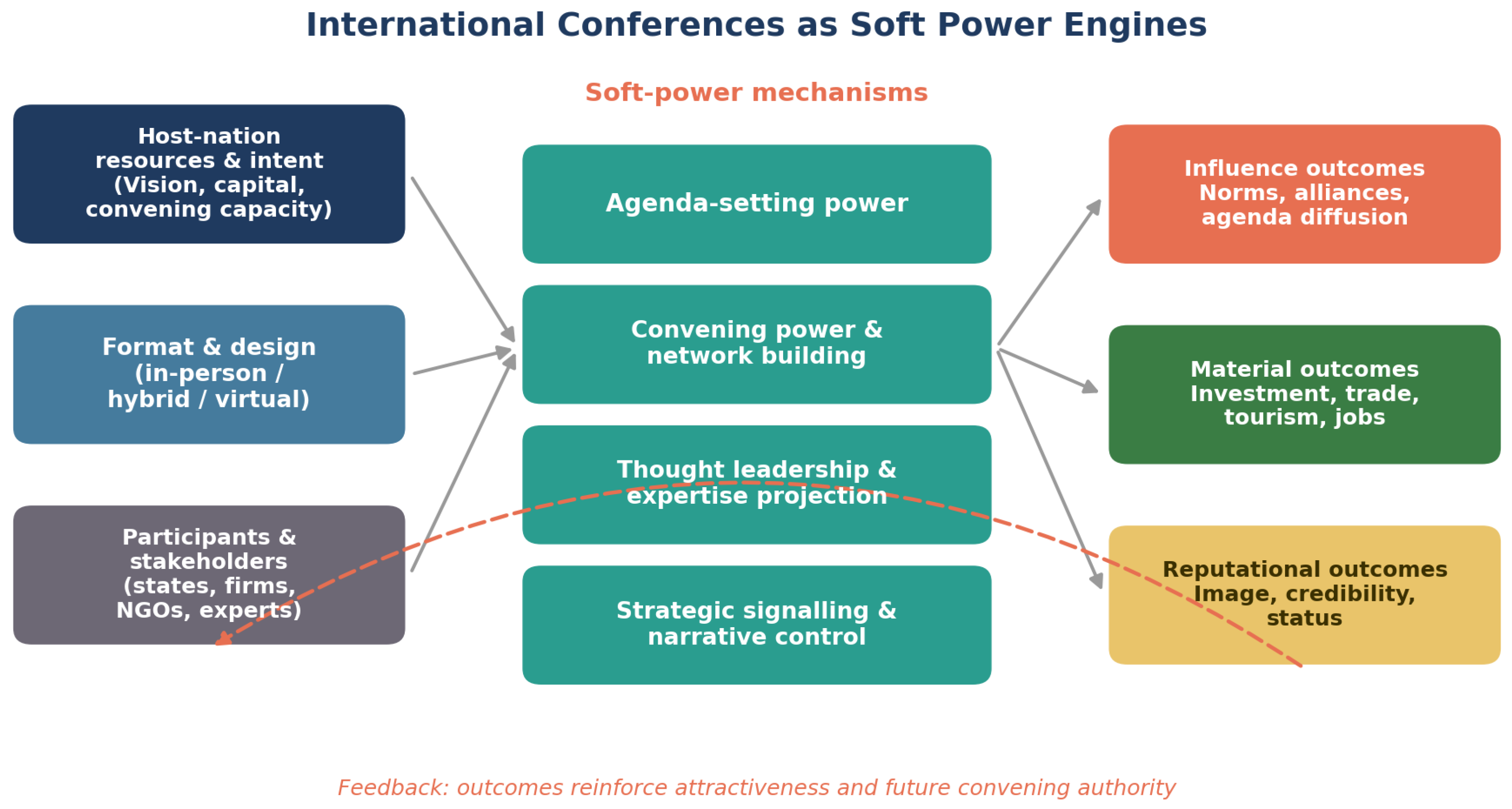
Figure 2.
Estimated Economic Impact and Investment Associated With Major Conferences. Note. Drawn by the author from the indicative estimates in Table 7 (Events Industry Council, 2023; International Congress and Convention Association, 2024). Values are approximate.
Figure 2.
Estimated Economic Impact and Investment Associated With Major Conferences. Note. Drawn by the author from the indicative estimates in Table 7 (Events Industry Council, 2023; International Congress and Convention Association, 2024). Values are approximate.
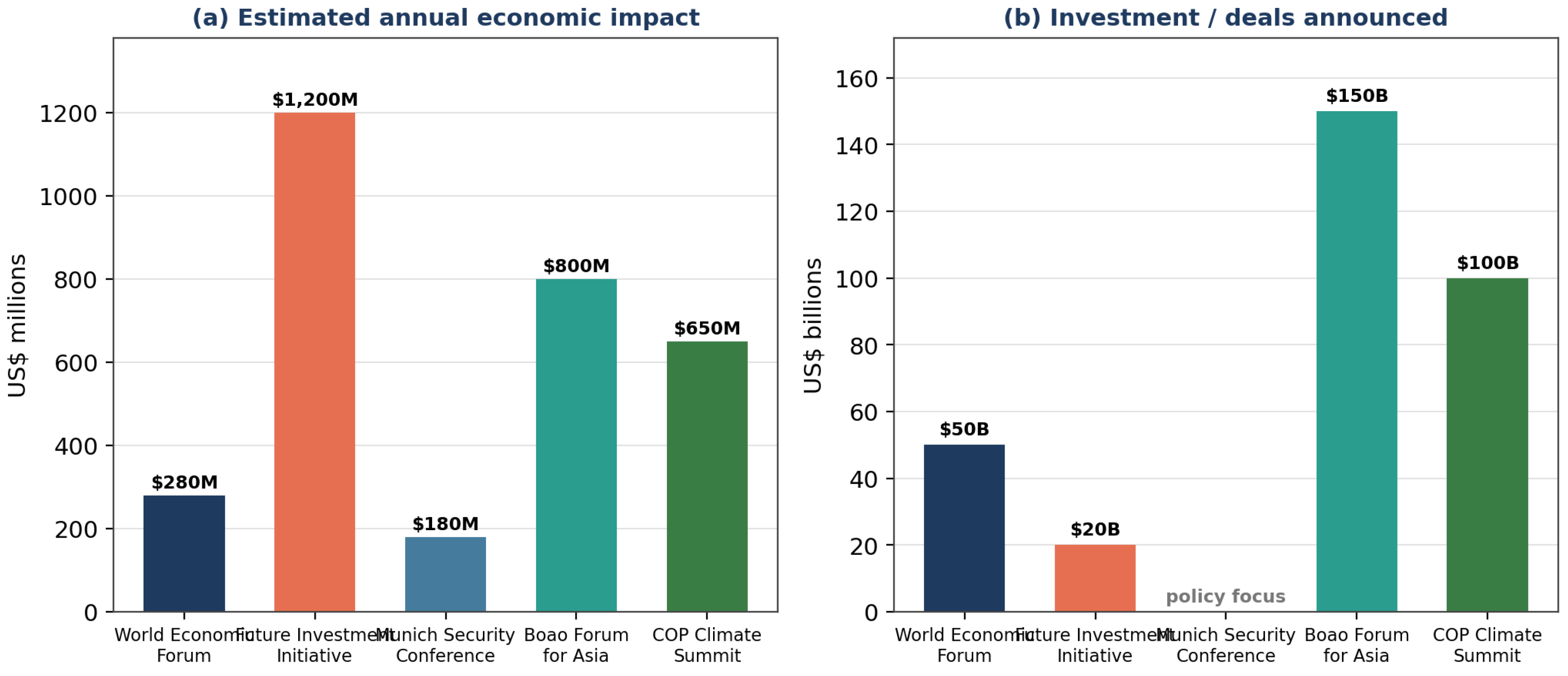
Figure 3.
Adoption of Technological Innovations in Conference Diplomacy, 2020–2024. Note. Drawn by the author from the indicative adoption estimates in Table 4 (International Congress and Convention Association, 2024).
Figure 3.
Adoption of Technological Innovations in Conference Diplomacy, 2020–2024. Note. Drawn by the author from the indicative adoption estimates in Table 4 (International Congress and Convention Association, 2024).
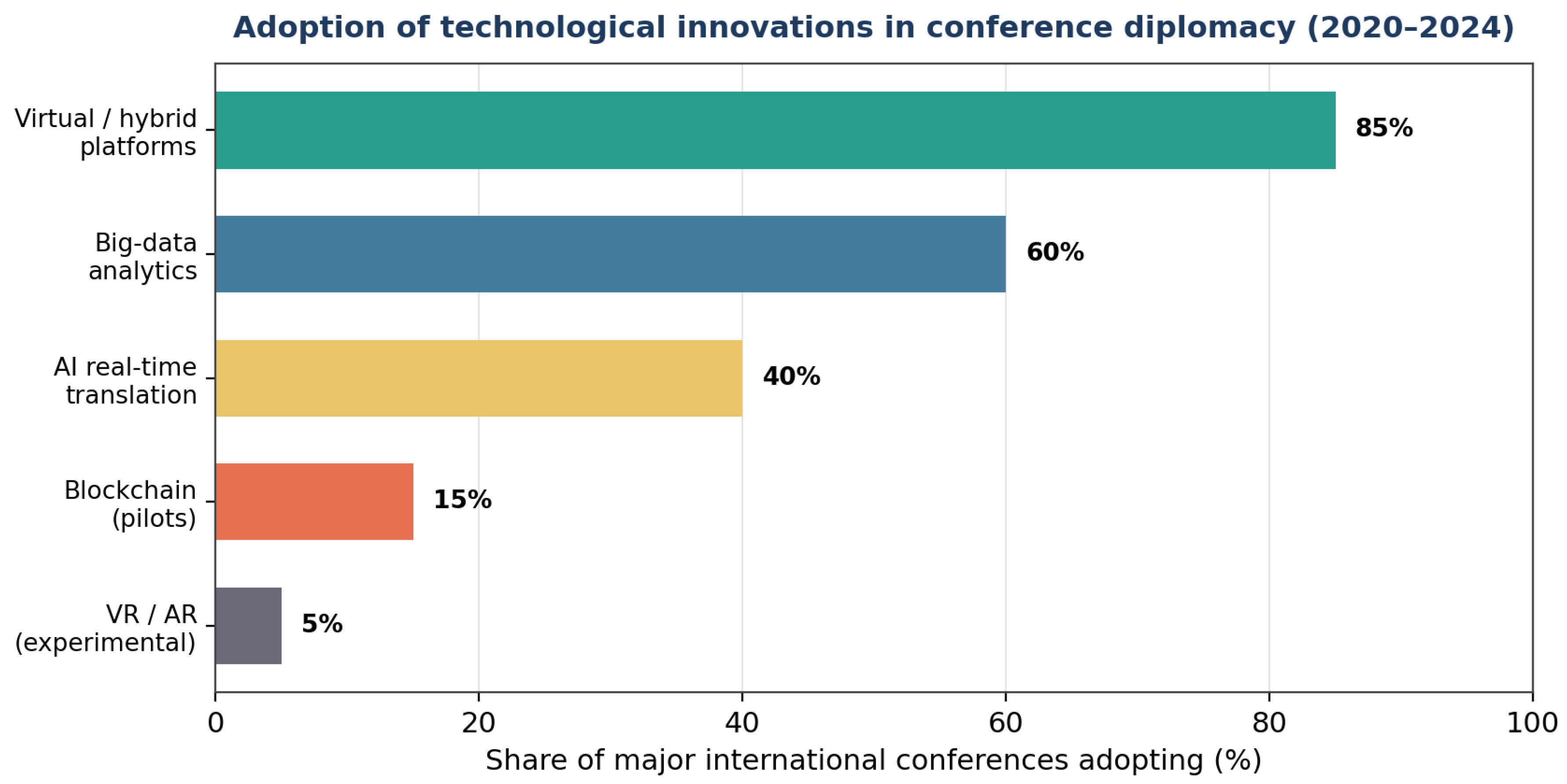
Figure 4.
Weighted Framework for Assessing Conference Soft-Power Effectiveness. Note. Developed by the author (see Table 12). Weights are indicative and may be recalibrated by conference type.
Figure 4.
Weighted Framework for Assessing Conference Soft-Power Effectiveness. Note. Developed by the author (see Table 12). Weights are indicative and may be recalibrated by conference type.
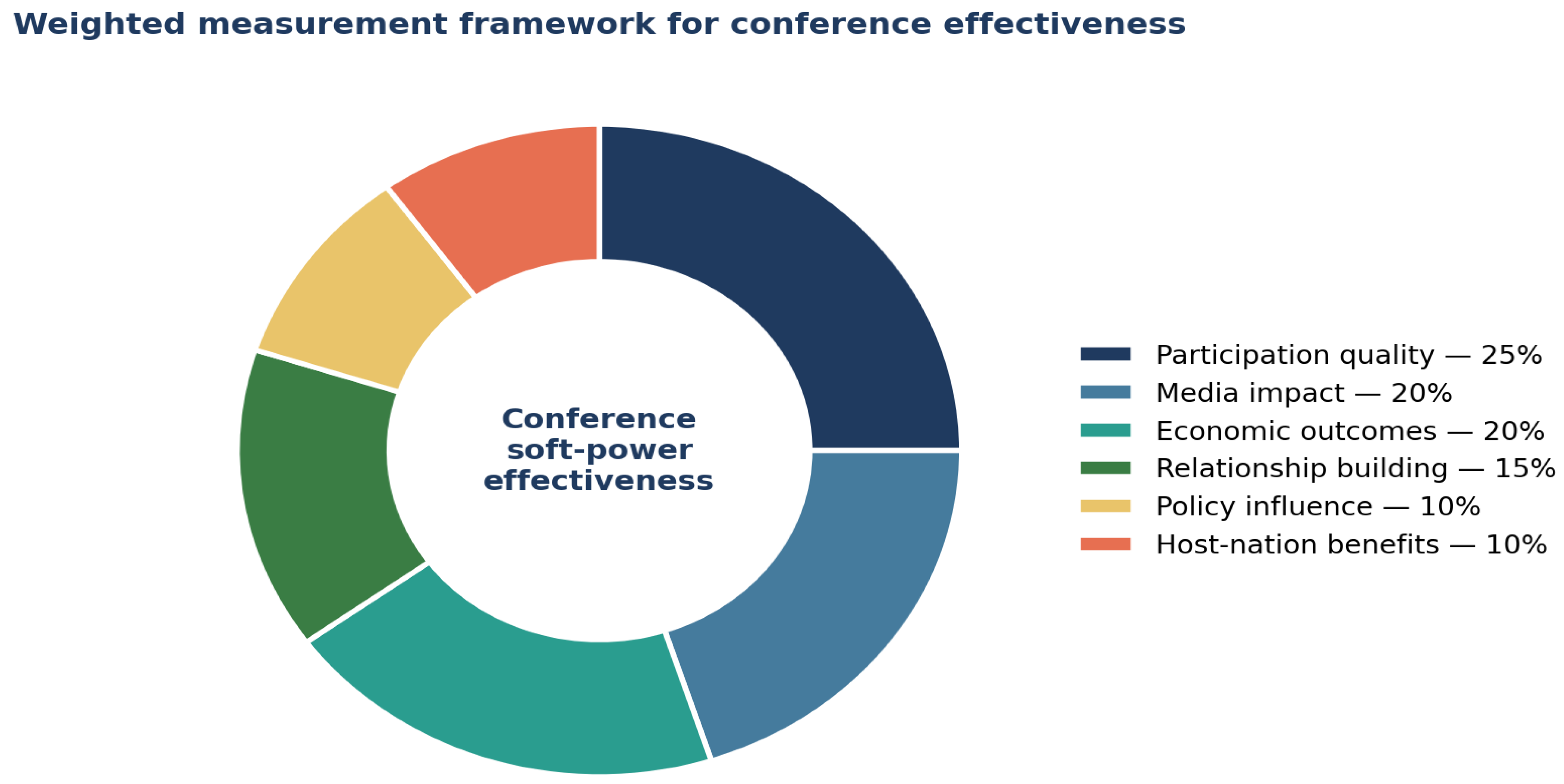
Figure 5.
Projected Trends in Conference Diplomacy, 2025–2030. Note. Drawn by the author from the projections in Table 14. Bubble position reflects the projected adoption window and expert-assessed probability; larger bubbles denote higher probability.
Figure 5.
Projected Trends in Conference Diplomacy, 2025–2030. Note. Drawn by the author from the projections in Table 14. Bubble position reflects the projected adoption window and expert-assessed probability; larger bubbles denote higher probability.
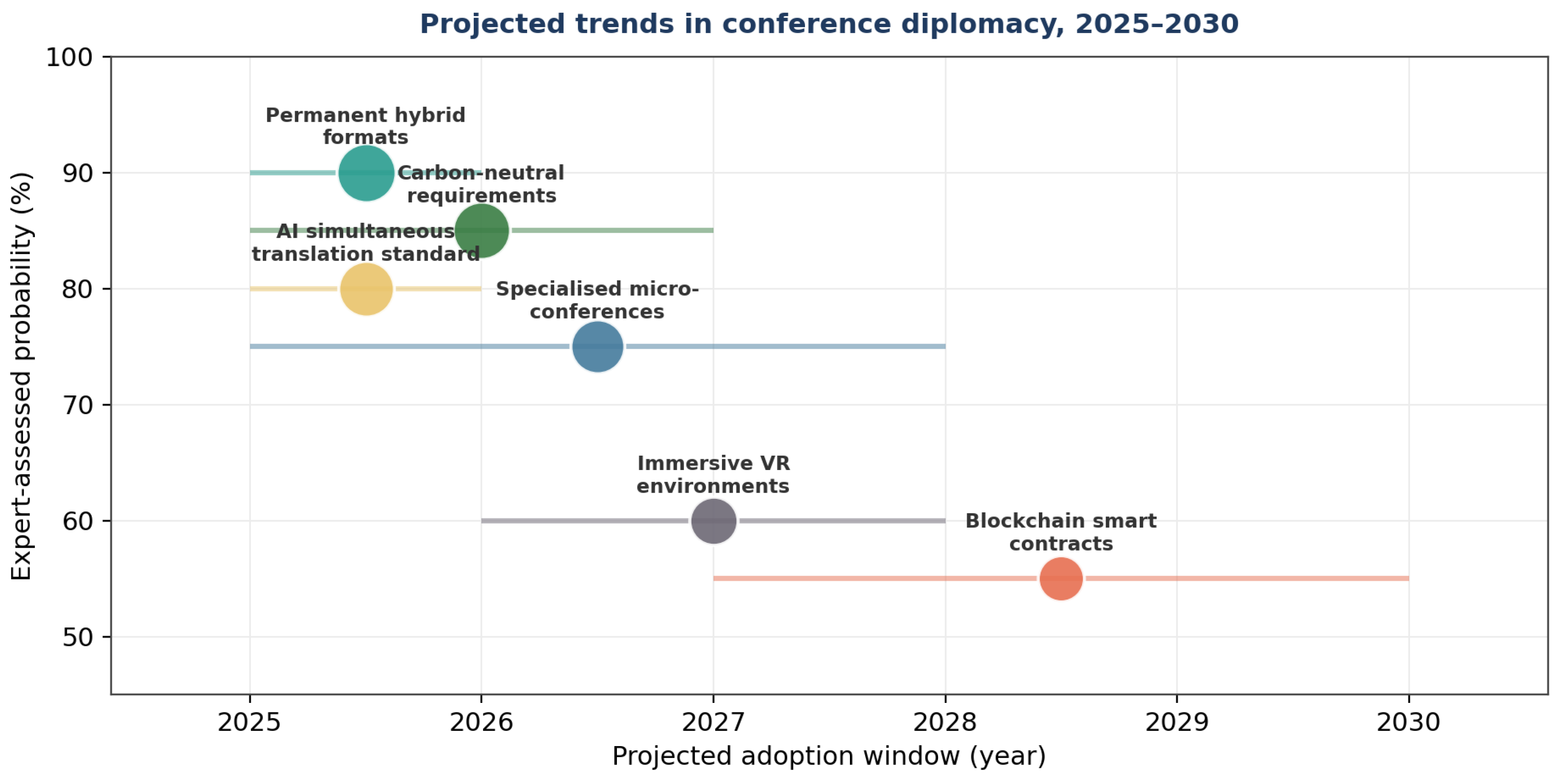

Table 1.
Evolution of Soft Power Theory in the Conference-Diplomacy Literature.
| Period | Key Theoretical Developments | Representative Authors | Relevance to Conference Diplomacy |
| 1990–2000 | Initial conceptualisation of soft power; emphasis on cultural diplomacy | Nye (1990); Keohane & Nye (1977) | Conferences as cultural-exchange platforms fostering mutual understanding |
| 2001–2010 | Integration of public diplomacy; communication focus | Melissen (2005) | Conferences as public-communication venues shaping global perceptions |
| 2011–2020 | Emergence of digital diplomacy; application of network theory | Bjola & Holmes (2015) | Virtual platforms expanding reach and diplomatic networks |
| 2021–present | Hybrid-diplomacy models; recognition of convening power | Gallarotti (2011); Næss (2023) | Post-pandemic transformation; strategic convening as a form of power |
Note. Compiled by the author. The table traces the development of soft-power scholarship as applied to conference diplomacy across four broad phases.
Table 2.
Traditional and Contemporary Conference Functions Compared.
| Aspect | Traditional Conferences (pre-2020) | Contemporary Conferences (2020–2024) |
| Primary purpose | Information-sharing and networking | Decision-making, deal-making, and agenda-setting |
| Participant mix | Government officials and academics | Multi-stakeholder (government, business, NGOs, civil society) |
| Expected outputs | Position papers and declarations | Concrete agreements, investment commitments, and policy initiatives |
| Media engagement | Limited, formal press releases | Extensive social media, live streaming, interactive platforms |
| Follow-up | Informal and ad hoc | Systematic tracking, implementation monitoring, accountability |
| Technology | Basic audio-visual support | AI translation, virtual participation, blockchain, immersive media |
| Economic framing | Minimal; focused on hosting costs | Strategic; investment generation, tourism, and job creation |
Note. Compiled by the author from Bjola and Manor (2022) and Daase and Schindler (2024). The comparison highlights the shift from information exchange toward decision-making and soft-power projection.
Table 3.
Regional Conference-Hosting Strategies and Objectives, 2020–2024.
| Region | Primary Strategy | Key Objectives | Investment Level | Indicative Success Metrics |
| Gulf states | Economic diversification through mega-events | Vision 2030 goals; investment attraction | High | FDI flows; conference numbers; tourism revenue |
| European Union | Multilateral norm-setting and institution-building | Governance leadership; rules-based order | Medium | Policy adoption; alliance strength; normative influence |
| East Asia | Economic integration and technology leadership | Regional connectivity; innovation; trade | High | Trade volumes; technology partnerships; regional stability |
| North America | Business–government integration platforms | Market access; regulatory influence | Medium | Deal announcements; policy impact; thought leadership |
| Latin America | Regional cooperation and development focus | Integration; capacity-building; sustainability | Lower | Cooperation agreements; development outcomes; social impact |
Note. Compiled by the author from Events Industry Council (2023), International Congress and Convention Association (2024), and El-Dabt et al. (2025). Investment levels are indicative author estimates.
Table 4.
Technological Innovations in Conference Diplomacy, 2020–2024.
| Technology | Application | Benefits | Challenges | Indicative Adoption |
| Virtual / hybrid platforms | Remote and blended participation | Lower cost; wider access; reduced emissions | Weaker networking; technical barriers; fatigue | ~85% of conferences |
| AI translation | Real-time multilingual communication | Reduced language barriers; inclusivity | Accuracy and nuance concerns; data privacy | ~40% of major conferences |
| Blockchain | Commitment tracking; credential verification | Transparency; accountability; trust | Complexity; scalability; regulatory uncertainty | ~15% (pilots) |
| VR / AR | Immersive venues and experiences | Engagement; novel interaction; remote presence | High cost; technical and accessibility limits | ~5% (experimental) |
| Big-data analytics | Participant matching; outcome analysis | Optimised networking; strategic insight | Privacy; security; algorithmic bias | ~60% of conferences |
Note. Compiled by the author from International Congress and Convention Association (2024) and Bjola and Manor (2022). Adoption figures are indicative estimates for major international forums.
Table 5.
Major International Conferences Analysed, by Region and Sector, 2020–2024.
| Region | Economic | Security | Environmental | Technology |
| Asia-Pacific | Boao Forum for Asia; APEC Summit | Shangri-La Dialogue; ADMM-Plus | Asia Clean Energy Forum | AI for Good Global Summit |
| Europe | World Economic Forum; Paris Peace Forum | Munich Security Conference | UNFCCC COP summits | European AI Alliance |
| Middle East | Future Investment Initiative; Expo Dubai | IISS Manama Dialogue | Middle East Green Initiative | GITEX Technology Week |
| Americas | Americas Business Dialogue | Halifax International Security Forum | Climate ambition summits | Major technology conferences |
| Africa | Africa Investment Forum | regional security dialogues | African Climate Week | Africa Tech Summit |
Note. Compiled by the author from conference organisers’ published documentation, 2020–2024. The table indicates the global distribution of the forums examined; it is illustrative rather than exhaustive.
Table 6.
Summary of the Research Methodology.
| Component | Approach | Rationale |
| Research design | Qualitative, interpretive, multi-method | Suited to complex social phenomena and constructed meanings |
| Data sources | Documents, digital content, scholarship, reports | Triangulation enhances validity and comprehensiveness |
| Case selection | Major international conferences, 2020–2024 | Captures contemporary trends across a formative period |
| Analysis | Thematic, comparative, and content analysis | Multiple methods provide analytical depth and perspective |
| Validity measures | Triangulation, member checking, thick description | Strengthen credibility, trustworthiness, transferability |
Note. Compiled by the author. The table summarises the principal methodological choices and their justifications.
Table 7.
Estimated Economic Footprint of Major International Conferences.
| Conference | Host Location | Est. Annual Economic Impact | Direct Jobs | International Visitors | Investment / Deals Announced |
| World Economic Forum | Davos, Switzerland | ~US$280 million | ~3,500 | ~3,000 | ~US$50 billion |
| Future Investment Initiative | Riyadh, Saudi Arabia | ~US$1.2 billion | ~8,000 | ~6,000 | ~US$20 billion |
| Munich Security Conference | Munich, Germany | ~US$180 million | ~2,200 | ~2,500 | Policy focus |
| Boao Forum for Asia | Hainan, China | ~US$800 million | ~5,500 | ~4,000 | ~US$150 billion |
| UNFCCC COP summit | Various | ~US$500–800 million | ~4,000–6,000 | ~25,000 | ~US$100 billion (climate finance) |
Note. Indicative estimates compiled by the author from conference organisers’ published reports and industry analyses (Events Industry Council, 2023; International Congress and Convention Association, 2024; UFI, 2024). Figures are approximate and intended for comparison rather than precise accounting.
Table 8.
Conference Types and Their Strategic Functions.
| Conference Type | Primary Functions | Key Stakeholders | Soft-Power Mechanisms |
| Economic forums | Trade facilitation; investment promotion; policy coordination | Officials; business leaders; investors | Deal-making; market-access display; economic confidence |
| Security conferences | Alliance management; crisis communication; norm development | Defence ministers; military and security experts | Trust-building; strategic signalling; mediation |
| Environmental summits | Climate action; technology transfer; funding mobilisation | Environment ministers; scientists; NGOs | Moral leadership; innovation display; commitment-making |
| Technology conferences | Standard-setting; governance-framework development | Technology leaders; regulators; researchers | Thought leadership; regulatory influence |
| Cultural forums | People-to-people exchange; education cooperation | Culture ministers; educators; artists | Cultural attraction; value promotion; civilisational dialogue |
Note. Compiled by the author from analysis of international forums, 2020–2024.
Table 9.
Digital-Diplomacy Metrics and Performance Indicators.
| Platform / Medium | Engagement Metrics | Reach Indicators | Influence Measures | Indicative Effectiveness |
| Official conference websites | Page views; session duration | Unique visitors; geographic spread | Document downloads; citation; media pick-up | High |
| Social media (X) | Likes; shares; comments | Follower growth; hashtag reach | Reposts by officials; sentiment | Very high |
| LinkedIn networks | Post engagement; connections | Network expansion; profile views | Partnership inquiries; thought leadership | High |
| Video platforms | View counts; watch time | Subscriber growth; international views | Educational and policy reference | Medium |
| Virtual platforms | Interaction and chat activity | Registration; global participation | Follow-up meetings; collaborations | High |
Note. Compiled by the author from Manor (2019) and International Telecommunication Union (2023). Effectiveness ratings are qualitative and indicative.
Table 10.
Challenges and Constraints in Conference-Based Soft Power.
| Challenge | Specific Issues | Severity | Mitigation Strategies |
| Access and equity | High participation costs; visa restrictions | High | Sponsorship; virtual participation; regional hubs |
| Digital divide | Connectivity and literacy gaps | Medium | Capacity-building; technology support; offline options |
| Credibility | Image-washing; weak follow-through | High | Accountability and transparency; independent oversight |
| Geopolitical tension | Boycotts; politicisation of technical issues | Medium | Neutral venues; Track-II dialogue; common ground |
| Cultural barriers | Differences in communication and relationship norms | Medium | Cultural-competency training; diverse organising committees |
| Sustainability | Carbon footprint and environmental impact | Lower | Green practices; local sourcing; virtual components |
Note. Compiled by the author from analysis of 2020–2024 forums and International Congress and Convention Association (2024). Severity ratings reflect the author’s qualitative assessment.
Table 11.
Conference Effectiveness Indicators, by Category.
| Category | Quantitative Indicators | Qualitative Indicators |
| Participation | Numbers; geographic diversity; seniority | Engagement quality; relationship development; repeat attendance |
| Outcomes | Agreements signed; commitments; implementation | Policy influence; norm development; follow-up cooperation |
| Economic impact | Direct spending; tourism; trade growth | Business-relationship quality; investor confidence |
| Soft power | Media reach; citation frequency | Reputation; agenda-setting influence; diplomatic access |
Note. Compiled by the author from analysis of major international conferences, 2020–2024.
Table 12.
Weighted Framework for Measuring Conference Effectiveness.
| Dimension | Indicators | Data Sources | Frequency | Weight |
| Participation quality | Senior attendance; geographic diversity | Registration data; media reports | Per event | 25% |
| Media impact | Coverage volume; sentiment; reach | Media monitoring; social analytics | Real-time | 20% |
| Economic outcomes | Investment announcements; trade agreements | Official statements; follow-up reports | Post-event | 20% |
| Relationship-building | New partnerships; repeat participation | Survey data; network analysis | Annual | 15% |
| Policy influence | Adoption of recommendations; citation | Policy documents; scholarship | Long-term | 10% |
| Host-nation benefits | Image improvement; diplomatic access | Opinion polls; diplomatic reporting | Quarterly | 10% |
Note. Compiled by the author, informed by Gallarotti (2011). Weights are indicative and may be recalibrated for different conference types.
Table 13.
Conferences in the Management of Major Global Crises.
| Crisis / Challenge | Conference Response | Host Context | Outcomes Achieved | Soft-Power Implications |
| COVID-19 pandemic | Global health gatherings | Virtual / multiple hosts | Preparedness coordination; response planning | Reinforced multilateral health legitimacy |
| War in Ukraine | Munich Security Conference, 2022–2024 | Germany | Alliance coordination; aid pledges; signalling | Host as focal convener; European cohesion |
| Climate emergency | UNFCCC COP summits | United Kingdom; UAE; Azerbaijan | Implementation focus; climate-finance pledges | Host climate leadership; sustained momentum |
| AI governance gap | AI safety summits | United Kingdom; Republic of Korea | Safety principles; testing commitments | Technology-governance leadership |
| Cybersecurity threats | Cybersecurity conferences | Multiple hosts | Norm development; information-sharing | Recognition of technical expertise |
Note. Compiled by the author from World Health Organization (2022), United Nations Framework Convention on Climate Change (2023), Munich Security Conference (2024), Depledge (2024), and Passchier (2023).
Table 14.
Projected Trends in Conference Diplomacy, 2025–2030.
| Trend | Projected Development | Timeline | Probability | Soft-Power Implications |
| Hybrid formats | Permanent hybrid models become standard | 2025–2026 | Very high (~90%) | Wider access; new participation patterns |
| Sustainability | Carbon-neutral requirements spread | 2025–2027 | High (~85%) | Green showcasing; reputational gains |
| AI translation | AI simultaneous translation becomes standard | 2025–2026 | High (~80%) | Multilingual inclusion; fewer barriers |
| Micro-conferences | Rise of specialised expert gatherings | 2025–2028 | High (~75%) | Niche influence for smaller states |
| Immersive media | Virtual-reality conference environments | 2026–2028 | Medium (~60%) | New forms of presence and engagement |
| Blockchain | Smart contracts for commitment tracking | 2027–2030 | Medium (~55%) | Greater accountability and trust |
Note. Author projections informed by International Congress and Convention Association (2024) and UFI (2024). Probabilities are indicative expert assessments, not statistical forecasts.
Disclaimer/Publisher’s Note: The statements, opinions and data contained in all publications are solely those of the individual author(s) and contributor(s) and not of MDPI and/or the editor(s). MDPI and/or the editor(s) disclaim responsibility for any injury to people or property resulting from any ideas, methods, instructions or products referred to in the content. |
© 2026 by the authors. Licensee MDPI, Basel, Switzerland. This article is an open access article distributed under the terms and conditions of the Creative Commons Attribution (CC BY) license (http://creativecommons.org/licenses/by/4.0/).
Copyright: This open access article is published under a Creative Commons CC BY 4.0 license, which permit the free download, distribution, and reuse, provided that the author and preprint are cited in any reuse.