

Submitted:
06 August 2025
Posted:
07 August 2025
Read the latest preprint version here
Abstract
The universe is multidimensional. Consciousness is the fundamental substratum of the universe, superfluid quantum space (ether) is the next one, and finally, we have matter, which is the energy structure made out of ether. The velocity of light is one of the most fundamental questions in physics. For centuries, the velocity of light has been a subject of scientific discussion. In this article, we will discuss this subject based on the experimental data. Marmet measured in 2000 that light needs 14 μs more when traveling from S.F. to N.Y. than when traveling back in the opposite direction, from N.Y. to S.F. These data are the main standpoint of this research. The result of the study is that light has a constant velocity also in a moving medium (ether). The second postulate of the Special Theory of Relativity is valid in all different local ethers that move with different velocities.
Keywords:
velocity of light
; ether
; consciousness
1. Introduction
The idea that consciousness is the fundamental base of the universe appears in all cultures and has become a topic in biology, neurology, psychology, and quantum physics over the last 50 years. In past years, the author developed a model where the universe is multidimensional and consciousness is the fundamental substratum of the universe [1]. Universe has three fundamental types of energy: consciousness, superfluid quantum space (ether) and matter, see Figure 1:
Consciousness is the substratum of universal space; stellar objects move in consciousness. Consciousness is filled with ether which interacts with stellar objects, it moves and rotates with them. Light is the wave of ether, and when ether moves and rotates with the stellar objects, this influences the velocity of light [2].
Consciousness frequency is , where is Planck time. The wavelength of consciousness is Planck distance . If we imagine that consciousness is composed of units, similarly to how light is composed of photons, we can calculate the energy of one consciousness quanta :
We see that the single unit of consciousness has an immense amount of energy. Consciousness is an n-dimensional field of energy that has a stationary wave. Consciousness is omnipresent, syntropy type of energy. Non-created and eternal. This presentation of consciousness is the best possible in terms of physis; the real nature of consciousness is far beyond. In consciousness research, the experiential aspect is more important than the theoretical aspect; however, physicists try to describe consciousness with mathematical models.
From the perspective of set theory, consciousness is an empty set. Ether and matter are the elements of consciousness:
In every physicist and every human being, the observer is the individuation of consciousness and is presented as an empty set with one element, that is, the number 0.
Quantum physics is searching to integrate consciousness into its models [3]. In this model, consciousness is integrated into Newtonian physics. There is no space, there is no time; physical objects exist in consciousness. When we measure the velocity of motion of a physical object, we measure the velocity that occurs in consciousness and not in some physical space. Time and space lack physical existence. Time becomes part of existence when observed [4], and space is consciousness itself.
Ether has several dimensional layers. Higher-dimensional layers are substrata of mental activity; the last 4-dimensional layer of ether is a substratum that carries gravity and electromagnetism. The variable density of energy in the ether carries gravity and a different spectrum of electromagnetic radiation, which are different waves of the ether. Atoms are 3-dimensional and so matter is 3-dimensional [1]. There is no such thing as “physical space”. Stellar objects are 3D moves in consciousness that is nD, and ether is 4D and 4D+ and fills consciousness. That’s why ether also exists inside 3D objects and interacts with them.
2. Result of the Measurement of the Velocity of Light Depend on the Apparatus Position
Precise measurement confirmed that light needs microseconds extra when traveling from San Francisco to New York: “However, an accurate measurement of the time interval given by the GPS shows that light takes an extra 0.014 microseconds for light to travel eastward (from S.F. to N.Y.)” [5].
Imagine measuring the velocity of light with an apparatus. This apparatus would also move in the ether. That’s why when we would measure light in the direction of S.F.-N.Y., the measured velocity of light would be the velocity of light minus the velocity of the ether in which the apparatus exists. When we would measure in the direction N.Y.-S.F., the measured velocity of light would be the velocity of light plus the velocity of the ether in which the apparatus exists. This measurement confirms that at the latitudes of San Francisco and New York, at the height of GPS satellites, which is 20.200 km above the surface, ether has a velocity of 280 m/s. This causes changes in the velocity of light when moving from S.F. to N.Y. or in the opposite direction.
This measurement confirms that the local ether is moving and rotating with the Earth. Imagine you swim in a lake at a speed of 15 km/h where water is at rest and continue to swim in a river that comes out of the lake, which has a speed of 10 km/h. Your speed on the lake will be 15 km/h. Also, for an observer on the bank of the lake, your speed will be 15 km/h. Your speed in the river will be 5 km/h as for an internal observer and 25 km/h for an observer on the bank of the river. The same happens for an internal observer when measuring the duration of light motion from San Francisco to New York. The observer and the apparatus are in the local ether in motion and so the apparatus measures velocity of light. The lake represents the ether at rest, the river represents moving ether, and you, as the swimmer, represent light and its variable velocity. When you start swimming upstream, you will have a speed of 25 km/h concerning the river. When swimming upstream, for the external observer on the bank of the river, you will have a speed of 5 km/h. The same happens for an external observer in the Fizeau and Sagnac experiments [2].
In measuring the speed of light, the position of the apparatus is crucial. When inside the local ether, the apparatus will give a different reading than when outside of the local ether. This essential insight is that the observer is the function of consciousness, and his position is omnipresent in the entire universe. Consciousness uses the human organism as a tool of observation in a given physical location.
In the case of moving ether, Einstein was correct that the observer’s position affects how devices measure physical reality. However, it’s important to understand that the actual observer in every observation point is consciousness itself. In Ether Relativity, the speed of light is the super-positional velocity: “The speed of light, c, is a type of super-positional velocity, which remains constant throughout the universe; we can say. When measured in different local ethers, the measured velocity of super-positional velocity gives different values. Regarding the velocity of light, Ether Relativity introduces the superposition principle; Einstein’s second postulate of Special Theory of Relativity remains valid [2].
In every physicist, consciousness act as the observer [4]. This is the deep inside of physics. We, as observers, observe stellar objects in our essence. The observer experiences the universe through the senses, but the universe, at the same time, is contained within the observer himself. The consciousness (the observer) is the fundamental arena in which stellar objects move and perceive the relative motion of these objects differently due to the dynamic ether that also moves within the consciousness. Our experience of Mercury’s precession is the result of our Solar System’s local ether rotation. If we were to observe from outside of Solar System, we would experience Mercury’s orbit differently. From the Earth, we see the Pioneer anomaly differently as it would be seen from the position outside of the Solar system because of the local ether inside the Solar system that rotates in the same direction of the rotation of the Sun around its axis. SMBHs in the centre of galaxies are rotating local ether and that’s why from the Earth, we experience motion of stars in other galaxies differently than if we would experience them, if we were inside the galaxies [2]. Imagine we have 3 apparatuses that measure the velocity of light. One is in the orbit of stellar object one, the second is in the orbit of stellar object two, and the third is in interstellar space. All three apparatuses will measure different velocities of light that will be read by the same entity, the same consciousness, which in every physicist acts as the observer, see Figure 2:
The observer is the standpoint of physics objectivity. Without the observer, science would not be possible because in daily life everyone sees the world through their mind. The result is that everyone experiences the world in their own manner. In physics, the rules are different. Everyone is obliged to experience the world through the models of reality that are verified by the experiment. This rule gives the beauty and utility of physics. The observer is the judge of whether the experiment confirms the physical model of reality or not.
3. Dynamic Ether Experiment
Dynamic ether which rotated with the stellar objects has its pushing force. This pushing force causes Mercury precession and galactic curves of stars in the galaxies where central black holes rotate local ether inside the galaxy. This pushing force causes the change of the velocity of light in the Sagnac experiment and the Fizeau experiment [2].
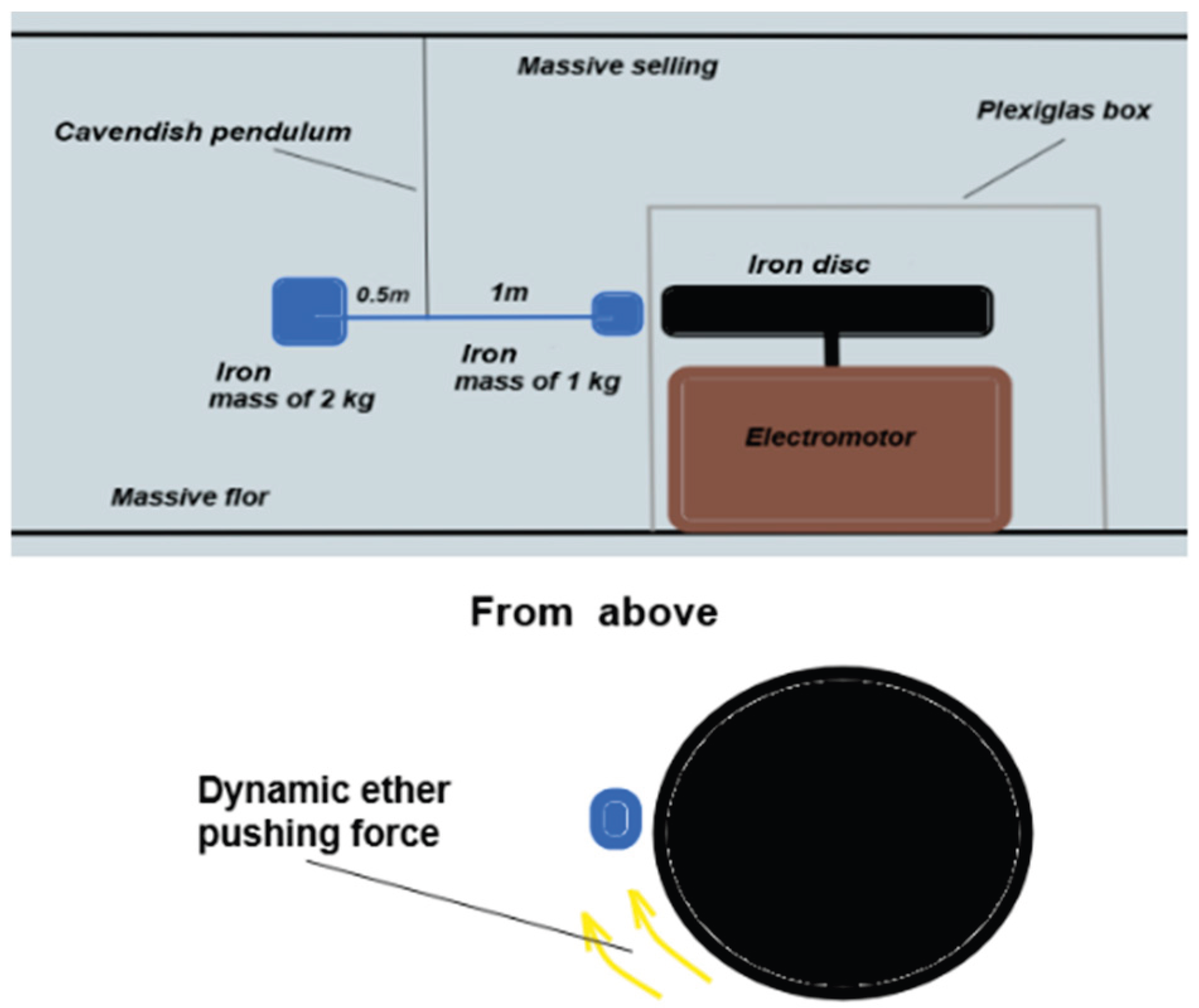
The dynamic ether experiment is a new version of the Cavendish experiment with a rotating disc. We take two iron cubes that have a hole to be fixed on the aluminium rod. One has 1 kilogram, the other has 2 kilograms. We put them on the iron rod with threads so that we can adjust the position of the rod to be horizontal. We hang the rod on the ceiling of a massive building. We have an electromotor which has on the shaft an iron disk with a diameter of 30 cm and, height of 10 cm. We place the electromotor on the massive floor of the building, as you see in the figure below. The electromotor with a disk is in the Plexiglas box, see Figure 3:
We place the rod in a position that is close to the disk. We start the electromotor running. We expect that the disc will also rotate the local ether and that local ether pushing force will move the iron mass of 1 kg and consequently rotate the pendulum with both masses.
4. Discussion
Scientific research on ether and consciousness is fundamental for a better understanding of life and the multidimensionality of the universe. In today’s science, there is a general misunderstanding that consciousness is a kind of information, and its physiological origin is not fully known yet [6]. Consciousness is not information and will never be generated by artificial intelligence. Consciousness is an intrinsic phenomenon of life. And artificial intelligence is and forever will remain a dead electronics machine. Artificial intelligence is about information. And consciousness is not information; consciousness is Being. As consciousness is the substrate of the universe, matter has an intrinsic property that develops into life and intelligent beings [1]. Universe is biologically homogeneous. We are not alone in the universe, and we are not the most evolved form of life. Evolved forms of beings’ support life; to them, life is sacred. On our planet, humans are mercilessly killing other human beings. Our fear that civilizations outside our solar system might visit us and kill us is unnecessary. A civilization that can travel between the solar systems of our galaxy has certainly evolved to a degree that has overcome the animal instinct to kill, which is instinctive in animals and mentally planned in humans. That’s why it is of immense importance that we integrate ether and consciousness into physics, which is the queen of science. Once ether and consciousness become a worldwide educational curriculum, humans will wake up into consciousness, which is the only guarantee for peace and harmonious self-sustainable development.
5. Conclusions
Integration of consciousness and ether into physics explains the most bizarre phenomena, for example Pioneer anomaly. Inertial systems of Einsteinian physics are replaced with the local ethers. The velocity of light in all local ethers is constant. The reading of the velocity of light depends on the position of the measuring apparatus and the position of the observer who uses it to measure the velocity of light. Einstein is right: this world is relative. We see motion of light and motion of objects that move in consciousness differently because of the dynamic ether that is the result of a stellar object’s rotation. Dynamic ether has a pushing force that causes deviations in the orbital velocity of stellar objects.
Acknowledgements
The author wishes to thank Branko Drobnak, Rado Gorjup and Chris Miller for helpful discussions and encouragement.
References
- Sorli, A. Bio-cosmology. Integration of life and consciousness into cosmology. Adv. Stud. Theor. Phys. 2023, 17, 9–20. [Google Scholar] [CrossRef]
- Sorli, A. Einstein Legacy: Ether relativity and cosmology. Int. J. Quantum Found. 2025, 3. Available online: https://ijqf.org/archives/7583.
- Li, T.; Tang, H.; Zhu, J.; Zhang, J.H. The finer scale of consciousness: quantum theory. Ann. Transl. Med. 2019, 7, 585. [Google Scholar] [CrossRef] [PubMed]
- Amrit, Š.; Štefan, Č. Time, observer, and consciousness. Phys. Essays 2022, 35, 123–126(4). [Google Scholar] [CrossRef]
- Entire article is available here https://bijective-physics.org/pdf/2022-Time-observer-and-consciousness.
- Marmet, P. The GPS and the constant velocity of light. Acta Scientiarum 2000, 22, 1269–1279. [Google Scholar]
- Torday, J.S. The holism of cosmology and consciousness. Prog Biophys Mol Biol. 2023, 177, 181–184. [Google Scholar] [CrossRef]
Figure 1.
Three fundamental energies of the universe.
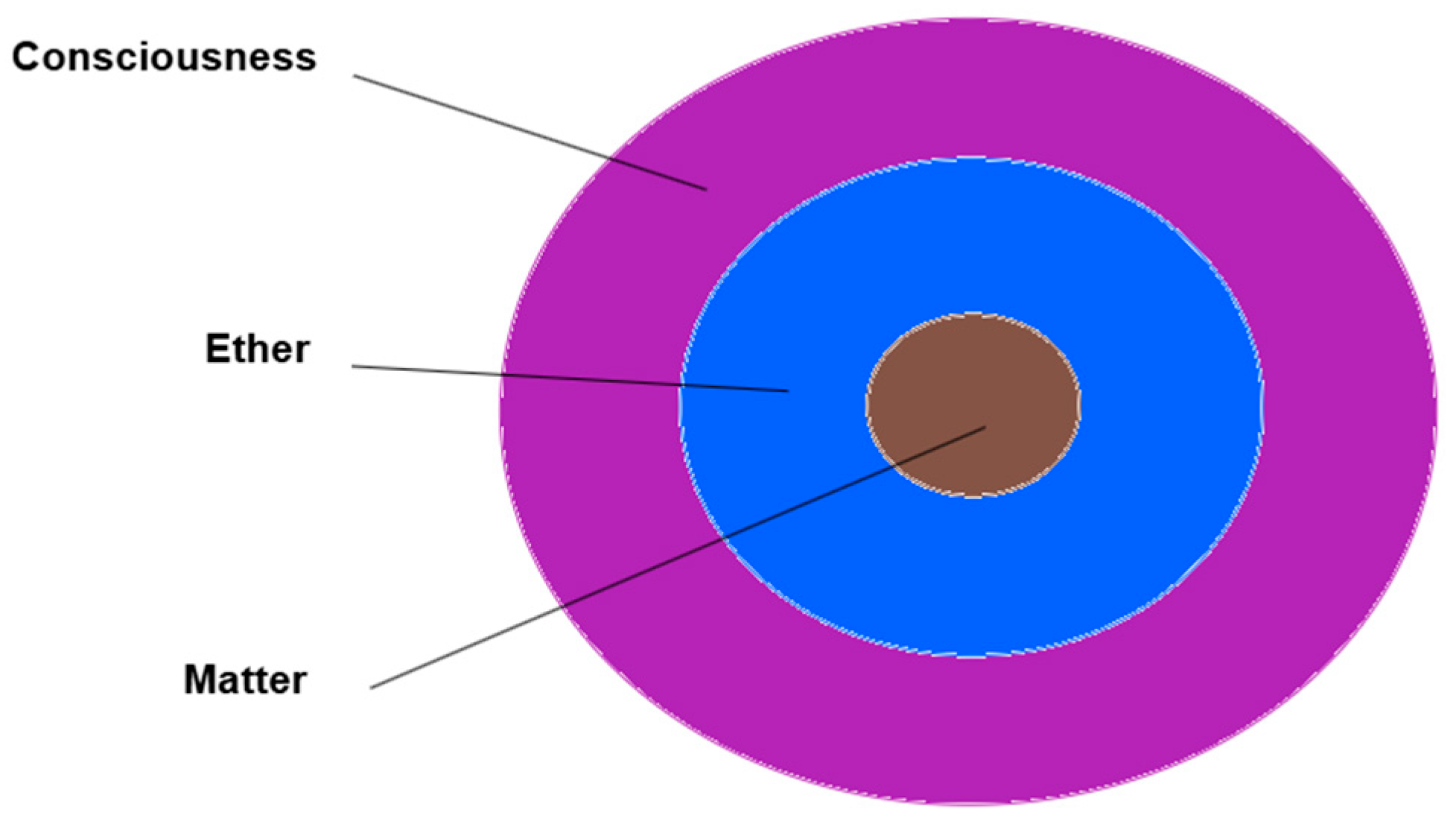
Figure 2.
The observer is the function of omnipresent consciousness.
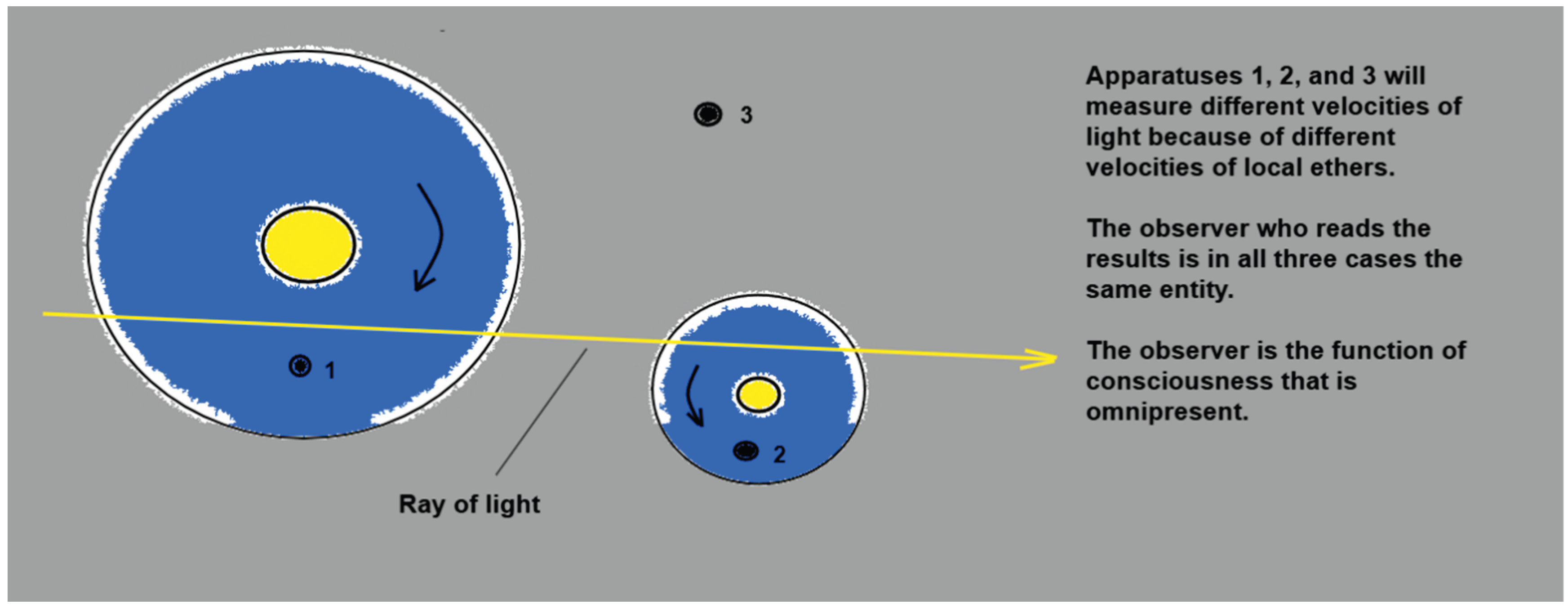
Figure 3.
Dynamic ether pushing force experiment.
Disclaimer/Publisher’s Note: The statements, opinions and data contained in all publications are solely those of the individual author(s) and contributor(s) and not of MDPI and/or the editor(s). MDPI and/or the editor(s) disclaim responsibility for any injury to people or property resulting from any ideas, methods, instructions or products referred to in the content. |
© 2025 by the authors. Licensee MDPI, Basel, Switzerland. This article is an open access article distributed under the terms and conditions of the Creative Commons Attribution (CC BY) license (http://creativecommons.org/licenses/by/4.0/).
Copyright: This open access article is published under a Creative Commons CC BY 4.0 license, which permit the free download, distribution, and reuse, provided that the author and preprint are cited in any reuse.