

Submitted:
23 July 2025
Posted:
24 July 2025
You are already at the latest version
Abstract
This paper examines the Ifugao Rice Terraces of the Philippine Cordillera as a living archaeological landscape whose conservation poses ethical questions about heritage, livelihood, and community agency. While UNESCO has designated these terraces as a World Heritage cultural landscape, conservation policies and tourism discourses often prioritize preserving their iconic rice cultivation for external consumption. Such approaches risk overlooking the dynamic social, economic, and environmental pressures facing Ifugao communities today. Using frameworks from archaeology, and historical ecology, this paper argues that conservation must move beyond aesthetic or static models to support local livelihoods, intangible heritage, and adaptive strategies. We analyze the terraces as a product of communal labor, indigenous engineering, and ritual systems, while also documenting the contemporary shift from heirloom tinawon rice to commercial crops under market and climate pressures. We also critique unequal tourism economies and explore models for equitable stewardship, including community-based tourism and environmental service fees. Finally, we call for an ethical conservation practice grounded in shared responsibility and local agency, recognizing that heritage landscapes are not relics to be frozen but living systems to be sustained in partnership with the people who maintain them.
Keywords:
heritage conservation
; landscape archaeology
; Ifugao
; Philippines
; agricultural terraces
1. Introduction
The Ifugao Rice Terraces of northern Luzon, Philippines (Figure 1), are among the world’s most celebrated examples of engineered landscapes. Often described as the “Eighth Wonder of the World,” these terraces cascade down steep mountain slopes in a series of precisely constructed stone- and mud-walled paddies irrigated by forest-fed water channels. In 1995, UNESCO inscribed them as a World Heritage Site, recognizing them as a “living cultural landscape” that embodies a profound harmony between human ingenuity and mountain ecology (UNESCO, n.d.).
This debate highlights a broader issue in heritage practice: international frameworks such as UNESCO emphasize authenticity and integrity as key criteria for inscription, concepts that often privilege static representations of heritage landscapes. In practice, these standards can encourage the preservation of an idealized, unchanging image of place, even when the landscape’s very history is defined by flexibility, adaptation, and shifting uses. The Ifugao terraces, for example, are not uniform monuments frozen in time, but dynamic systems characterized by continuous reworking. Ethnographic observations and archaeological evidence show that land use has always been fluid, shifting between swidden fields, pond-field rice terraces, house platforms, and even reforested or fallow zones in response to demographic needs, environmental pressures, and cultural practices (Acabado, 2015; Acabado et al., 2019).
The core question, then, is conservation for whom? Whose interests define what is to be conserved, and at what cost? For local farmers, rice terrace maintenance represents intensive labor with minimal economic return. For the Philippine state and the international community, the terraces symbolize national heritage and human achievement, worthy of preservation for aesthetic, cultural, and touristic value. Bridging these perspectives is essential for ethical heritage practice.
Our archaeological work in Ifugao further complicates any notion of static, unchanging heritage (Acabado, 2015; Acabado et al., 2019). Excavations and mapping reveal that terrace systems have not had a single fixed use over time. Land use has shifted flexibly between swidden fields, pond-field rice terraces, house platforms, and even fallow or reforested areas. In some places, terraces originally built for rice were later used for vegetables or converted to residential use, while others reverted to forest or were reactivated for farming depending on need. This historical pattern of adaptive reuse underscores that Ifugao landscapes have always been dynamic, responding to changing social, economic, and environmental conditions.
We, thus, seek to reframe the conservation question through the perspective of settlement archaeology. Settlement archaeology examines human interactions with landscapes as dynamic systems shaped by social organization, subsistence strategies, environmental adaptation, and cultural meaning over time (e.g., Flannery, 2019; Smith, 2011). It rejects static, monumental conceptions of heritage in favor of a processual understanding of landscapes as products of human labor, choice, and adaptation. Applying this approach to Ifugao shows that the terraces have always been shaped by evolving subsistence strategies, environmental conditions, and social relations.
Furthermore, we integrate perspectives from landscape archaeology, historical ecology, and heritage studies to argue for a conservation ethics grounded in shared stewardship and local agency. Historical ecology emphasizes the co-evolution of human societies and their environments, foregrounding how landscapes are historical records of cumulative, negotiated, and often contested relationships between people and nature (Crumley, 1994; Balée & Erickson, 2006). In Ifugao, this perspective highlights the terraces not as static relics, but as evolving socio-ecological systems continually reworked to respond to shifting demographic, economic, and climatic pressures (Acabado & Martin, 2022; Conklin, 1980).
By foregrounding these dimensions, we challenge dominant conservation paradigms that prioritize external aesthetic values over local needs. We call for policy and practice that recognize heritage landscapes as living systems requiring social investment, economic support, and cultural respect. In doing so, we argue that the question “conservation for whom?” must be answered not only with reference to national or global heritage claims but with a commitment to the well-being and dignity of the Ifugao themselves.
2. Conceptual Foundations for Heritage Conservation
2.1. Dynamic Landscapes and Settlement Patterns
Settlement archaeology emerged in the mid-twentieth century to move beyond artifact typologies toward understanding human societies as integrated systems interacting with their environments. Influenced by processual archaeology, it examines how habitation patterns, resource use, and land modification reflect economic, social, and environmental strategies evolving over time (Trigger, 1967; Fletcher, 1986).
Applied to the Ifugao Rice Terraces, this perspective emphasizes that the terraces are not static “monuments” but dynamic parts of a broader settlement system. Terracing, irrigation, village placement, forest management, and ritual spaces together form an interconnected landscape designed to manage resources, distribute labor, and sustain communities (Figure 2).
Archaeological evidence from Ifugao supports this dynamic view. Excavations and mapping have documented how land use shifted over time—from swidden fields to pond-field rice terraces, to residential platforms, and even back to forest or fallow. In some areas, terraces built for rice were later repurposed for vegetables or housing, while others were reactivated for farming as needs changed. This pattern of flexible, adaptive reuse demonstrates that Ifugao landscapes have always evolved in response to social, economic, and environmental pressures (Guimbatan & Baguilat, 2006; Dizon et al., 2012).
2.2. Landscape Archaeology, Historical Ecology, and Intangible Heritage
Landscape archaeology complements settlement archaeology by exploring how human-modified environments embody long-term social, economic, and ecological relationships. Agricultural intensification systems like terracing and irrigation embed labor, social organization, and environmental knowledge in enduring forms (Hayashida, 2005). The Ifugao terraces exemplify this: they are not just stone walls and irrigation channels but integrated systems of labor practices, ecological knowledge, and ritual traditions.
UNESCO’s Cultural Landscape category explicitly recognizes places like the Ifugao terraces as products of the combined works of nature and humankind (UNESCO, n.d.). Yet heritage management often struggles to implement this vision, defaulting to preserving static appearances rather than supporting the living systems that sustain them.
Historical ecology deepens this analysis by showing how human-environment interactions are cumulative, negotiated, and embedded in landscapes over time (Crumley, 1994; Balée & Erickson, 2006). In Ifugao, centuries of Indigenous engineering, social cooperation, and ecological knowledge created a dynamic agricultural system adapted to local conditions. Terrace construction, managed forests (muyong), irrigation networks, and ritual practices all reflect histories of responding to demographic shifts, climate variability, and external pressures (Acabado, 2012).
Current conservation challenges are rooted in these long-term processes. Pressures such as market integration, cash income needs, labor migration, and climate change are not anomalies but part of an ongoing trajectory of adaptation (Martin, 2017). Emphasizing static “authentic” rice landscapes without supporting these adaptive traditions risks ignoring the complex histories that produced them.
Intangible heritage is also inseparable from cultivation practices. UNESCO’s 2003 Convention defines intangible heritage as the practices, representations, knowledge, and skills transmitted across generations. In Ifugao, this includes ritual cycles, oral traditions, and ecological knowledge. The Hudhud chants sung by elder women during harvest encode genealogies and moral lessons (Dulay, 2015; Stanyukovich, 2003). These chants are embedded in the work of rice farming itself. The punnuk tug-of-war ritual at harvest’s end reinforces social cohesion and spiritual ties to land (Acabado and Martin, 2016: 312). As farmers shift to commercial crops, these traditions erode. Conservation efforts that prioritize landscape appearance without supporting traditional farming risk failing to safeguard the full heritage value of the terraces.
2.3. Ethics, Equity, and Shared Stewardship
These interdisciplinary perspectives converge on an important point: conservation is not a neutral technical task, but an ethical practice shaped by choices about whose values count and whose interests are served. Scholars have shown that heritage is inherently political, reflecting struggles over memory, identity, and control of resources (Smith, 2004; Meskell, 2013).
In Ifugao, this means grappling with the question: conservation for whom? Is heritage management serving the aesthetic expectations of tourists and global agencies, or the livelihood needs and cultural practices of local communities? Ethical conservation must move beyond imposing static models of authenticity toward supporting the continued adaptation of living landscapes.
Shared stewardship offers a promising model. It recognizes local communities as primary stakeholders and decision-makers, ensuring that conservation policies align with their needs, values, and aspirations. This approach calls for redistributing tourism revenues, investing in traditional knowledge transmission, and supporting adaptive strategies in the face of climate change.
By grounding this paper in settlement archaeology, landscape archaeology, historical ecology, and intangible heritage theory, we aim to establish an analytical foundation for viewing the Ifugao Rice Terraces not as static relics but as dynamic, living systems. This framework informs the rest of this paper, which examines the terraces as an archaeological landscape, explores contemporary economic and environmental pressures, and proposes ethical conservation strategies rooted in shared stewardship.
3. The Ifugao Rice Terraces as an Archaeological Landscape
3.1. Historical Construction and Indigenous Engineering
The Ifugao Rice Terraces are among the world’s most striking examples of Indigenous engineering. Carved into the steep mountainsides of the Philippine Cordilleras, they extend across multiple municipalities, including Banaue, Kiangan, Hungduan, and Mayoyao. Built with stone and mud walls with complex irrigation systems, these terraces transform rugged upland environments into productive agricultural land.
Archaeological research challenges the once-dominant narrative that the terraces are over two millennia old, instead suggesting a much later, dynamic expansion roughly 400–500 years ago (Acabado 2009; Acabado, 2018; Acabado et al. 2019). This revised chronology situates terrace construction within a period of intensified social organization and resistance to Spanish colonial expansion. The terraces represent a deliberate investment in upland refuge and food security, demonstrating how communities adapted their landscapes in response to political and economic pressures.
The engineering of these terraces required remarkable communal cooperation. Stone retaining walls stabilize the slopes, while gravity-fed irrigation channels distribute water from forest springs and streams. Maintenance is continuous: terrace walls must be repaired after landslides, irrigation channels cleared of debris, and erosion controlled through careful planting. These practices reflect an intimate knowledge of local ecology, hydrology, and soil dynamics, passed down through generations.
3.2. Land Use Change and Adaptation in Ifugao
Archaeological and paleoenvironmental research demonstrates that the Ifugao landscape has never been a static monument of rice farming alone, but a dynamic agroecological system shaped by continual change. Before the 17th century, archaeological evidence from the Old Kiyyangan Village (OKV) shows subsistence was centered on irrigated pond fields growing taro (Colocasia esculenta), complemented by swidden fields and managed forests (Acabado, 2012; Acabado et al., 2019). Archaeobotanical data reveal no trace of wet-rice cultivation prior to 1650 CE, while associated faunal and material evidence point to a significant social reorganization shortly after this time, coinciding with Spanish expansion into northern Luzon (Acabado, 2017).
These shifts were responses to external pressures and internal demographic growth. The transition from taro pond fields and swidden systems to intensive rice terraces after the mid-1600s reflects a strategy of political consolidation, social differentiation, and resistance to colonial taxation systems that prized wet rice (Acabado, 2018; Acabado et al., 2019). This intensification did not replace previous systems entirely but layered onto them, producing an integrated landscape that included rice terraces (payo), swidden fields (uma), house terraces (boble), and private woodlots (muyong) (Conklin, 1980; Findley et al., 2022).
Land use modeling of OKV from 1570 to 1800 CE underscores this adaptability. The village’s population doubled in that period while expanding rice terraces and maintaining swidden and forest cover, achieving intensification without proportional deforestation (Findley et al., 2022). Such transitions highlight the importance of viewing the Ifugao agricultural system as a flexible, resilient socio-ecological complex rather than a static heritage form. As needs and conditions changed—population growth, colonial threats, market integration—land use shifted between forms: swidden fields became terraces, terraces fell fallow or reverted to swidden, house platforms were repurposed, and forest management practices evolved (Acabado, 2012; Acabado et al., 2019).
Recognizing this dynamism is critical for heritage conservation. The terraces are not frozen relics of a single moment in history, but enduring records of Ifugao agency and adaptability. Conservation strategies must therefore account for the lived reality of change and support local capacity to navigate current and future challenges—including climate variability, economic pressures, and demographic shifts—while sustaining the knowledge systems and relationships that make the landscape meaningful.
3.3. The Muyong/Pinugo System and Integrated Resource Management
A critical but often overlooked component of the Ifugao settlement system is the muyong/pinugo, the managed forest zones situated above the terraces (Acabado and Martin, 2018). The muyong is a customary land tenure and agroforestry practice in which families or kin groups manage forest plots to ensure sustainable supply of wood, fruits, medicinal plants, and water. In Banaue and other Ayangan-speaking Ifugao (Ayangan is a variation of Ifugao language spoken in eastern Ifugao), pinugo literally means, “turned into a forest”. The muyong functions as both ecological buffer and resource reservoir, protecting water sources, reducing erosion, and maintaining biodiversity (Camacho et al. 2016; Serrano et al. 2005).
Archaeologically, the muyong demonstrates that the terraces cannot be understood in isolation. The landscape is an integrated system combining cultivated fields, forest management, and settlement clusters (Acabado et al. 2019). The irrigation that sustains the paddies depends on the forest’s capacity to regulate water flow. This integration exemplifies traditional ecological knowledge and a sophisticated understanding of upland resource management (Eder, 1982).
The persistence of the muyong also indicates adaptive resilience. As demographic pressures, market demands, and environmental conditions changed over centuries, the muyong system provided a flexible means of balancing subsistence needs with ecological sustainability. Figure 3 and Figure 4 show how a terrace system in 1912 was abandoned to allow forest regrowth. Some of these abandoned terraces are now being reclaimed for cash crop production. Contemporary conservation strategies often neglect this component, focusing narrowly on the visual icon of rice terraces while overlooking the broader socio-ecological system that sustains them.
3.4. Irrigation, Labor, and Social Organization
The maintenance of the terraces is not only an engineering challenge but a social one. Ifugao communities historically organized labor through kinship networks and community labor exchanges (ubbu) (Acabado and Martin, 2015). Large-scale tasks such as repairing terrace walls or clearing irrigation channels required collective effort coordinated through social obligations and reciprocal arrangements.
This communal labor structure also mediated access to resources and land. Rights to cultivate terrace plots were embedded in complex customary tenure systems, with inheritance patterns, marriage alliances, and ritual obligations shaping land use. These tenure systems ensured not only economic production but social cohesion.
Ritual played a central role in organizing and legitimizing these practices. Agricultural cycles were accompanied by rituals that reinforced social bonds, acknowledged ancestral spirits, and maintained cosmological balance. For example, the Hudhud chants recited during harvest are not just entertainment but vehicles for transmitting genealogies, moral lessons, and shared history (Dulay, 2015).
From an archaeological perspective, these social and ritual dimensions are inseparable from the physical infrastructure of the terraces. The landscape embodies social relations as much as engineering skill. Conservation strategies that focus solely on physical restoration without considering the social systems that maintain them risk producing hollow heritage devoid of living meaning.
3.5. Site Formation Processes: Abandonment, Reuse, Modification
Archaeologists study landscapes not as static snapshots but as dynamic records of human action over time. The Ifugao terraces provide a clear case study in site formation processes – the cumulative effects of construction, maintenance, use, abandonment, and reuse that shape the archaeological record. Abandonment is increasingly visible in Ifugao (see Figure 3). Without continuous maintenance, stone walls collapse, irrigation channels silt up, and terraces become overgrown with invasive grasses and shrubs. Abandoned terraces also alter local hydrology, leading to erosion and increased vulnerability to landslides.
Such processes are not new. Historical and archaeological evidence suggests cycles of expansion, maintenance, and partial abandonment have always characterized the terraces. Factors such as population change, market demand, labor availability, conflict, and environmental stress have historically driven patterns of terrace construction and disuse (Acabado 2015).
Recognizing these processes is essential for ethical conservation. It challenges romanticized visions of the terraces as timeless relics and instead acknowledges them as the product of historical negotiations and choices. It also highlights the labor costs of conservation. Maintaining terraces is not a one-time act but a continuous investment – one that local communities can only sustain if their economic and social needs are met.
3.6. Archaeological Perspectives on Landscape Change
Archaeology brings a long-term perspective to conservation debates (Carman 2003; Comer, 2014). By documenting how the terraces evolved in response to demographic shifts, colonial encounters, market integration, and environmental pressures, archaeologists can challenge static notions of authenticity. The terraces have always been adaptive. Their survival depended on the capacity of Ifugao communities to modify cultivation techniques, shift crop varieties, reorganize labor, and renegotiate social contracts.
This perspective also offers a caution: efforts to freeze the terraces in a particular aesthetic form risk undermining the very adaptability that has ensured their persistence. Conservation must be conceived not as returning the landscape to an imagined past but as supporting local communities to manage change in ways that sustain both heritage value and livelihood.
By framing the Ifugao Rice Terraces as an archaeological landscape, we see them not as monuments to preserve untouched but as living systems that demand active, socially engaged stewardship. This insight sets the stage for examining contemporary challenges, including economic shifts, intangible heritage erosion, and climate change impacts, which we turn to in the next sections.
4. Economic Change and Livelihood Strategies
4.1. From Subsistence to Market Integration
The Ifugao Rice Terraces were historically designed not primarily for subsistence but for prestige production (Acabado, 2013). Heirloom tinawon rice varieties, cultivated once per year, were central to Ifugao social and ritual life. While they provided household consumption needs, their main significance lay in fulfilling ceremonial obligations, competitive feasting, and social display. The production and sharing of tinawon rice were key mechanisms for accumulating prestige, solidifying kinship ties, and negotiating social status within an egalitarian yet competitive society (Acabado, 2013; Acabado & Martin, 2022).
This orientation toward prestige production was embedded in a complex system of customary land tenure, reciprocal labor exchanges, and ritual cycles. Large-scale feasts required mobilizing kin and community labor, redistributing rice and pork, and reinforcing social bonds and ancestral obligations (Conklin, 1980). The terraces themselves were material expressions of this social system, linking landscape modification to status competition and communal identity.
In the contemporary period, however, Ifugao farmers face a dramatically altered economic context. Cash needs have expanded with greater access to education, healthcare, and consumer goods. The integration of upland communities into national and global markets has shifted priorities from prestige-oriented ceremonial production to cash generation. Farmers now operate in a mixed economy that includes off-farm employment, remittances, tourism services, and the commercial sale of agricultural products in lowland markets.
This shift has profound implications for land use. Tinawon, though deeply valued culturally, is low-yielding, labor-intensive, and harvested only once annually. It cannot meet the growing need for cash income. In contrast, cash crops such as inbred rice, cabbage, and tomatoes can be planted and harvested multiple times per year and sold more readily in local markets (Figure 5). For many families, this diversification is not simply a choice but an economic necessity, responding to changing household needs and broader market pressures (Table 1).
4.2. Subsistence Pressures and Labor Dynamics
The shift away from tinawon also reflects changing labor dynamics. Terrace farming is highly labor-intensive, requiring constant maintenance of walls, irrigation systems, and soil fertility. The work is physically demanding and often requires coordinated family or communal labor.
Yet younger generations increasingly migrate to lowland towns or cities for education and wage employment. Remittances have become an important component of rural household economies, but they also reduce available labor for terrace maintenance. The aging of the farming population adds further strain, as older farmers may struggle to maintain terraces without younger helpers.
In this context, cash cropping can offer labor efficiencies. Some commercial crops require less intensive maintenance or shorter growing seasons. Others can be cultivated with purchased inputs (such as fertilizers and pesticides) that reduce labor requirements, though at the cost of dependency on external markets. These choices reflect rational adaptations to demographic and economic pressures, rather than failures of traditional culture.
4.3. Archaeological Analogies for Subsistence Change
Settlement archaeology provides valuable analogies for understanding these processes. Throughout human history, agricultural systems have been reconfigured in response to market opportunities, labor availability, and environmental conditions. Terrace systems in other world regions – from the Mediterranean to the Andes – have similarly experienced cycles of intensification, diversification, and abandonment as social and economic contexts changed.
In Ifugao, the shift to cash crops is best understood as a continuation of this long tradition of adaptive management. Archaeologists studying Ifugao have documented earlier episodes of terrace expansion and reorganization linked to colonial encounters, demographic shifts, and trade networks. Today’s changes represent another phase in this history, not an anomalous break but a contemporary expression of community adaptation.
Recognizing this continuity challenges conservation narratives that define authenticity as a static return to subsistence tinawon cultivation. Such narratives risk erasing the historical agency of Ifugao farmers, who have always made strategic decisions about land use in response to evolving conditions.
4.4. Ethnographic Evidence of Local Decision-Making
Ethnographic research in Ifugao underscores the pragmatic reasoning behind farmers’ livelihood strategies, revealing choices shaped by structural pressures and local knowledge. While tinawon rice retains deep cultural significance, valued for its role in ritual obligations, communal feasting, and ancestral memory, farmers also confront the economic demands of contemporary life. As documented in the Climate Vulnerability Assessment, many describe tinawon as “for consumption only, not for selling,” highlighting that despite its prestige value, it cannot meet rising cash needs (SITMo & ICOMOS Philippines, 2023: 60).
Local officials similarly recognize this tension, explaining that families plant vegetables “because they have expenses” such as school fees and daily needs, while planting traditional rice “is just for food” (SITMo & ICOMOS Philippines, 2023: 64). Such observations illustrate that the move toward cash crops is not a rejection of tradition but a rational adaptation to new economic realities, including market integration and shifting household aspirations.
These choices are further shaped by environmental challenges. Farmers report scaling back rice cultivation due to increased damage from landslides and typhoons, describing the maintenance of terraces after such events as “too hard to repair” (SITMo & ICOMOS Philippines, 2023: 65). Climate variability compounds economic pressures, making labor-intensive traditional rice farming increasingly risky.
These narratives complicate simplistic conservation prescriptions that prioritize maintaining the terraces solely as rice-planted heritage landscapes. They highlight that farmers make calculated, often difficult decisions balancing cultural obligations, environmental risks, and the need for reliable income. Recognizing this pragmatic reasoning is essential for developing heritage conservation strategies that do not romanticize static authenticity but instead engage meaningfully with the lived experiences and needs of local communities.
Supporting the conservation of the Ifugao Rice Terraces thus requires policies that address the material conditions shaping these decisions. This includes creating viable economic incentives for traditional rice farming, improving infrastructure to reduce climate vulnerability, and ensuring that the benefits of tourism are equitably shared with those whose labor maintains the landscape’s global value. By centering local voices and acknowledging their adaptive strategies, heritage management can better align conservation goals with the well-being and dignity of the communities who sustain these extraordinary cultural landscapes.
4.5. Implications for Conservation Policy
These livelihood dynamics have direct implications for heritage management. If conservation goals prioritize preserving rice terraces in their traditional form, they must also address the economic conditions that make tinawon cultivation viable. This could involve subsidies for heirloom rice farming, crop insurance to buffer climate risks, and market development for premium heritage rice products.
Without such support, conservation demands risk replicating colonial dynamics in which external authorities dictate land use without regard for local well-being. Recognizing farmers as heritage stewards means supporting their capacity to sustain both cultural practices and livelihoods. It also means engaging with the economic transformations that shape land use decisions, rather than romanticizing a static vision of the past.
By situating these issues within settlement archaeology, we see that landscape change is a normal, even necessary, feature of human adaptation. Ethical conservation must grapple with this dynamism and support locally defined pathways for balancing heritage preservation with economic survival.
5. Intangible Heritage and Knowledge Systems
5.1. Ritual Landscapes and Embedded Meaning
The Ifugao Rice Terraces are both ritual landscapes and agricultural infrastructure, deeply woven into Ifugao cosmology, social structure, and identity. The physical forms of the terraces – the stone and mud walls, irrigation channels, and stepped paddies – are inseparable from the intangible heritage that gives them meaning.
Ritual practices mark every phase of the traditional rice cycle, from field preparation to harvest. Offerings to ancestral spirits acknowledge the interdependence of human labor and environmental forces, reinforcing moral and cosmological relationships. These rituals are essential to how Ifugao people have historically understood their place in the landscape.
The terraces thus, serve as mnemonic devices and stages for enacting collective memory. Their maintenance is not purely technical but deeply social and spiritual, reinforcing kinship ties and communal obligations. The landscape itself becomes a material archive of social practice, embodying generations of environmental knowledge and cultural meaning.
5.2. Gendered Knowledge and Seed Selection
Intangible heritage in Ifugao is also gendered. Women have historically held key roles as custodians of agricultural knowledge, especially in seed selection and management. Grandmothers and elder women traditionally determined which tinawon varieties to plant each season, based on subtle observations of rainfall, pest cycles, and soil conditions.
Our ethnographic interviews suggest that there were over 20 varieties of tinawon in the 1970s, each with specific ecological and ritual functions. Some varieties were drought-tolerant, others pest-resistant, while certain types were reserved for ceremonial feasts or ancestral offerings (Table 2). This diversity reflects a sophisticated system of in-situ conservation of genetic resources, managed through social structures and experiential knowledge. It also offered resilience: in any given year, if one variety failed, others might succeed.
Today, however, this gendered knowledge is under threat. The shift to commercial seeds, often promoted by external vendors, has narrowed varietal diversity. Farmers increasingly buy lowland rice or vegetable seeds from outside sources, severing intergenerational transmission of local selection practices. Elder women express concern that when they die, the knowledge of which ancestral seeds to plant in which conditions will die with them. Conservation strategies that ignore these gendered dynamics risk further eroding a critical dimension of Ifugao heritage. Supporting women farmers and seed custodians is essential for sustaining both biodiversity and cultural identity.
Beyond seeds and rituals, terrace farming has historically served as a context for transmitting broader cultural values. Children learned not only how to plant and harvest but also how to maintain irrigation channels, repair stone walls, and participate in communal labor exchanges. These activities reinforced cooperation, reciprocity, and respect for ancestral obligations.
With the decline of tinawon cultivation, these teaching contexts are disappearing. Young people increasingly migrate for education and wage labor, reducing their participation in farming. Those who remain often prefer cash crops for their economic returns, bypassing the slower, labor-intensive rice cycle that once structured community life.
This shift has intangible costs. It weakens the “collective memory” that links generations to a shared identity and history. Ritual knowledge, land tenure customs, and ecological management practices risk being lost as they lose their practical relevance in daily life.
5.3. UNESCO Intangible Heritage Framing
The international recognition of practices like the Hudhud highlights the global value of Ifugao intangible heritage. Yet UNESCO inscriptions often create tensions. While they can mobilize resources and visibility, they also risk fossilizing traditions or reducing them to performances for tourists.
In Ifugao, some ceremonies that once held deep communal significance are now staged for visitors, detached from their agricultural contexts. While this can generate income and awareness, it also raises ethical questions about authenticity, appropriation, and local control. Meaningful conservation of intangible heritage cannot rely solely on documentation, staging, or branding. It must support the living practices that sustain it – practices inextricable from terrace cultivation, communal labor, and ritual life. This demands an approach that integrates support for traditional agriculture with respect for local knowledge systems and community agency.
By examining these dimensions, we see that intangible heritage is not an optional supplement to the terraces’ physical conservation. It is the core of social relations that gives meaning to the landscape and ensures its continuity. Effective conservation must therefore engage not only with stone walls and irrigation channels but with the ritual, knowledge, and social practices that sustain them.
6. Environmental Pressures and Climate Change
6.1. The Delicate Balance of Terrace Systems
As underscored above, the Ifugao Rice Terraces are masterpieces of Indigenous engineering designed to manage water, soil, and slope stability in a challenging montane environment. Gravity-fed irrigation channels transport water from forest springs and streams to tiered paddies, distributing it evenly while controlling erosion. The integration of the muyong managed forests above the terraces plays a crucial role in regulating hydrology, stabilizing slopes, and maintaining biodiversity.
This system represents centuries of cumulative knowledge and adaptive management. It has sustained communities through environmental variability, allowing food production in rugged upland terrain. But its success depends on a finely tuned balance of rainfall patterns, soil stability, and forest cover – a balance increasingly threatened by climate change (Soriano et al. 2017).
6.2. Climate Change Projections and Local Observations
Scientific assessments for the Cordillera region project significant climatic shifts in the coming decades. Mean temperatures are expected to rise by approximately 0.9°C by 2020 (already observed) and up to 2.1°C by 2050 relative to historical averages. Rainfall models predict more intense wet seasons with heavier rainfall events, coupled with drier and hotter dry seasons.
Local farmers and elders already report the impacts of these changes. Springs that once flowed year-round now dry up for months, leaving terraces parched. Unseasonal, intense downpours trigger landslides that destroy carefully built stone walls and bury fields in debris. These observations align with broader regional trends of hydroclimatic instability.
A 2024 climate risk assessment for Ifugao Province highlights these vulnerabilities (SITMo and ICOMOS Philippines 2023). The terraces’ tiered structure, while effective under traditional rainfall patterns, is particularly sensitive to shifts in water availability and extreme weather events. When irrigation sources dry up, tinawon fails. When torrential rains overwhelm absorption capacity, walls collapse. The cost of repairing such damage can be prohibitive for small-scale farmers.
6.3. Landslides, Erosion, and Infrastructure Failure
Landslides represent one of the most acute threats. Heavy rains saturate the soil, increasing its weight and reducing friction with underlying rock. The carefully stacked stone walls, designed to withstand normal seasonal rains, buckle under these extreme pressures. Entire sections of terraces can collapse in a single event, with mud and stones washed downslope, destroying fields, irrigation channels, and sometimes homes. Soil erosion also intensifies with climate change. The loss of topsoil reduces fertility, making terrace farming less productive and increasing dependence on chemical fertilizers. Erosion can clog irrigation channels, disrupting water flow across entire networks of terraces.
Such damage is not only physical but social. Rebuilding collapsed walls and restoring irrigation require significant communal labor. When fields lie fallow or are abandoned after damage, the social systems of reciprocal labor exchange that traditionally organized maintenance can break down. The risk of further abandonment rises, creating a vicious cycle.
6.4. Drought and Water Scarcity
Ifugao’s traditional rice cultivation relies on continuous water availability during critical stages of the tinawon growing cycle. Prolonged dry spells threaten this cycle, leaving paddies dry and cracked. Tinawon is particularly sensitive to water stress, as it was developed for stable, cool upland hydrology.
Water scarcity forces difficult decisions. Some farmers leave fields fallow or convert them to drought-hardier cash crops. In Poblacion, Tinoc, water scarcity is identified as one of the primary reasons for the total shift from rice to vegetable crops (Albano, 2025: 46-49). Others rely on lowland rice varieties, which may tolerate different water regimes but require purchased seeds and inputs, further eroding local seed diversity and knowledge systems. Such shifts undermine the resilience of the traditional agricultural system. Irrigation networks fall into disrepair when underused, and the knowledge of water-sharing arrangements, carefully negotiated over generations, begins to fade.
6.5. Impacts on Ritual and Cultural Continuity
Climate change also has cultural ripple effects. Agricultural rituals are tightly tied to planting and harvest cycles. If a terrace is abandoned, or if rice cannot be planted because of drought, the associated ceremonies do not take place. The Hudhud chants, the punnuk tug-of-war, and smaller household rituals are interrupted, weakening their role in social cohesion and ancestral memory.
Elders worry that these disruptions sever the intergenerational transmission of cultural knowledge. As one Ifugao farmer put it after a landslide destroyed her field: “How can we teach the children if we have no rice to plant?” Such cultural losses are harder to measure than economic damages but are no less significant. They represent an erosion of collective identity and historical continuity—what anthropologists might call the landscape’s “cultural biography.”
6.6. Indigenous Knowledge as Climate Adaptation
Yet Ifugao communities have long practiced adaptive management in the face of environmental variability. The muyong system itself is a form of traditional climate adaptation, designed to stabilize slopes, regulate water flow, and maintain soil fertility. By managing forest cover, communities reduce erosion and ensure the longevity of water sources.
Contemporary initiatives are building on this knowledge. Organizations like the Save the Ifugao Terraces Movement (SITMo) collaborate with climate scientists to develop community-led risk assessments and adaptive strategies. Projects include restoring muyong forests, repairing irrigation channels, and integrating traditional water-sharing rules with modern monitoring techniques.
Such hybrid approaches illustrate that Ifugao communities are not passive victims of climate change but active agents of adaptation. However, they also highlight the need for external support. Effective adaptation requires resources, infrastructure investment, and policy frameworks that respect and incorporate Indigenous knowledge systems.
7. Conservation Policy and Tourism Economies
7.1. The Heritage Designation and Its Implications
The Ifugao Rice Terraces’ inscription as a UNESCO World Heritage Site in 1995 recognized them as a “living cultural landscape,” highlighting their integration of human labor, Indigenous knowledge, and environmental management. The designation elevated the terraces as symbols of national and even global heritage, celebrated in tourism campaigns and heritage discourse.
Yet such international recognition also introduces new dynamics and pressures. Heritage designation often entails expectations of maintaining an “authentic” landscape – typically interpreted as rice-planted terraces in a continuous, green, stepped pattern. This aesthetic ideal often aligns more with the gaze of tourists, policymakers, and heritage professionals than with the practical realities faced by local farmers.
These external expectations can create tensions. Farmers are encouraged – explicitly or implicitly – to maintain traditional rice cultivation for the benefit of heritage tourism, even when it is economically unviable. Conservation policies that prioritize the preservation of visual authenticity without supporting local livelihoods risk placing an unequal burden on communities, effectively demanding that they subsidize national heritage out of their own labor and opportunity costs.
7.2. The Growth of Tourism in Ifugao
Tourism has grown into a significant industry in Ifugao Province. Before the COVID-19 pandemic, the province averaged around 71,000 tourists annually (2017–2019), with nearly half being foreign visitors (Lapniten, 2021). Banaue, Batad, and surrounding areas developed as prominent tourism hubs, offering homestays, guided hikes, cultural performances, and viewpoints showcasing the terraces.
Tourism revenues are substantial. In 2019 alone, visitor spending in the province was estimated at almost $18 million (Lapniten, 2021). This income supports local businesses such as hotels, restaurants, souvenir shops, and transportation services. For the local government, tourism taxes and fees represent important budget contributions.
From a heritage management perspective, tourism provides both opportunities and challenges. On the one hand, tourism revenue can theoretically fund conservation, generate employment, and promote cultural awareness. On the other hand, without equitable distribution, tourism can reproduce social inequalities and extract value from local heritage while returning minimal benefits to those who maintain it.
7.3. Unequal Distribution of Tourism Benefits
Despite the overall economic gains, many terrace farmers see little direct benefit from tourism. While some may earn supplemental income through homestays, guiding services, or selling handicrafts and rice, these opportunities are unevenly distributed. Farmers in less accessible areas, or those lacking capital to develop tourism amenities, often remain excluded from tourism’s financial rewards.
Meanwhile, businesses with greater resources, often owned by local elites or even outside investors, capture a disproportionate share of tourism revenue. Transportation services, hotels, and restaurants in town centers see consistent profits, while those performing the labor of maintaining the terraces receive limited compensation.
This disparity raises ethical questions about heritage economies. Tourists come to admire the terraces’ beauty, but the people who literally hold that landscape together may be the ones struggling to pay for school fees, healthcare, or farm inputs. As one local guide noted wryly: “Tourists come to see the terraces. But the people who keep the terraces beautiful are not the ones earning from the tourists.”
Such inequalities risk eroding local support for conservation. When maintenance labor goes unrewarded, the incentive to abandon terraces or shift to cash crops increases, undermining the very heritage tourism depends on.
7.4. Environmental Service Fees and Funding Mechanisms
Recognizing these issues, various stakeholders have proposed mechanisms to redistribute tourism benefits more equitably. One model is the environmental service fee – a small charge levied on visitors that is earmarked for terrace maintenance and community development.
Ifugao’s provincial government and municipal tourism offices have experimented with such fees, collecting payments at tourism entry points like Batad village. These fees can fund terrace restoration projects, irrigation repairs, and training programs for sustainable agriculture. However, challenges remain in ensuring transparency, community participation in decision-making, and equitable distribution of collected funds.
Another model is the adopt-a-terrace initiative, pioneered by NGOs and local stakeholders. In this system, individuals, groups, or corporations can sponsor the restoration and maintenance of specific terrace plots. The financial support goes directly to farmers who commit to maintaining the terraces, offering a tangible, personalized link between donors and conservation outcomes.
7.5. Community-Based Tourism
Community-based tourism (CBT) offers another promising approach. Unlike top-down models that centralize profits, CBT emphasizes local ownership, decision-making, and benefit-sharing. In Ifugao, homestays in villages enable families to earn directly from hosting visitors, while cultural performances, guided hikes, and handicraft sales can supplement farm incomes.
CBT also encourages tourists to engage more meaningfully with local culture, learning about rice farming practices, rituals, and community history from resident experts. This model can transform tourists from passive consumers of heritage scenery into active supporters of cultural continuity and economic sustainability.
However, successful CBT requires capacity-building, marketing support, and careful planning to avoid commodifying culture or overburdening hosts. Ensuring that benefits reach those maintaining the terraces is crucial for aligning tourism with conservation goals.
7.6. Toward Shared Stewardship
These diverse initiatives reflect a broader shift toward shared stewardship – the idea that conservation should be a collaborative responsibility among local communities, government agencies, tourists, NGOs, and the private sector. Shared stewardship recognizes farmers as essential heritage stewards whose labor underpins the landscape’s global value.
Rather than imposing conservation as a burden, this approach seeks to align incentives, redistribute benefits, and empower local decision-making. It treats heritage not as a static image to be preserved for external appreciation but as a living system whose sustainability depends on the well-being and agency of those who maintain it.
8. Conservation for Whom? Recognizing Dynamic Landscapes
The question of conservation for whom? Is central to heritage management in Ifugao. While often described as a global treasure and a symbol of Filipino identity, the rice terraces hold deeper meaning for the Ifugao. They are a working, lived-in system, a site of ancestral memory, and the basis of daily livelihoods.
External valuations can obscure this reality. Demanding that Ifugao communities maintain the terraces in traditional form without providing sustainable economic support effectively asks them to subsidize global heritage with local hardship. Heritage conservation is not neutral; it is a cultural and political process that involves choices about whose values are prioritized, whose labor is recognized, and who benefits (Smith, 2006).
Archaeology shows that these terraces are not static relics of a timeless past, but dynamic systems shaped by ongoing adaptation and negotiation. Excavations, mapping, and modeling of Old Kiyyangan Village (OKV) reveal that Ifugao land use has never been singular or fixed. Over centuries, the landscape shifted flexibly between swidden fields (uma), pond-field terraces for taro, intensive wet-rice terraces (payo), house platforms (bobley), and managed forests (muyong).
Prior to the mid-17th century, subsistence was based largely on taro and root crops in less-extensive terraces and swidden fields (Acabado, 2012; Acabado et al., 2019). The later expansion of rice terraces was an adaptive response to colonial pressures and population growth, enabling communities to increase food production, reinforce social hierarchies, and maintain autonomy (Acabado, 2017; Findley et al., 2022). Land use modeling at OKV from 1570 to 1800 CE demonstrates that the population doubled while intensive rice cultivation expanded, all without proportional deforestation (Findley et al., 2022).
This history shows that change is intrinsic to Ifugao landscapes. Treating the terraces as frozen in a single, idealized form erases their defining adaptability. Conservation must respect this dynamism, supporting the capacity of communities to manage change in culturally meaningful and economically viable ways.
Integrating Heritage Values with Local Livelihoods
An ethical conservation practice must recognize that terrace farmers are not just beneficiaries of preservation but essential stewards. Their knowledge, labor, and cultural practices have sustained the terraces for centuries. Any effort to protect these landscapes must also support farmers’ ability to continue this work in economically viable ways.
Conservation strategies should include direct investments. Subsidies or incentives for cultivating heirloom tinawon rice can help offset higher labor costs and lower cash returns. Supporting premium markets for heritage rice can transform cultural value into real economic benefit. Equally, tourism must be structured to share revenues fairly. Environmental service fees and community-based tourism models can ensure that those who maintain the terraces see tangible rewards.
Infrastructure investment is critical. Improving irrigation systems and stabilizing terrace walls helps farmers adapt to environmental challenges intensified by climate change, reducing crop failure and abandonment. These measures show that heritage preservation is not about keeping a landscape picturesque but about sustaining agricultural production and community resilience.
Recognizing the interdependence of livelihoods and heritage values transforms conservation from an external demand into a shared project of cultural survival and economic justice. This requires a model of shared stewardship that centers local participation in decision-making. By aligning conservation goals with community needs and aspirations, shared stewardship makes preservation both ethically grounded and practically sustainable. Without local buy-in, conservation efforts will fail. With it, the terraces can remain not only standing, but living.
| 1 | 0.5 ha is used here for comparison purpose. In practice, the average farm hectarage for rice is 0.25 ha, while 0.5 ha for commercial vegetables such as tomato. |
| 2 | Cropping period: Tinawon 7 months, Inbred (irik) 5 months, cabbage 3 mos, tomato 4-6 mos, with weekly harvesting in a span of 1-2 months. |
| 3 | Unlike rice, price of vegetables is highly volatile. Data sources: Ifugao PAENRO, Tinoc OMAg (Office of the Municipal Agriculturist), Key informant interviews). |
References
- Acabado, S.B. A Bayesian approach to dating agricultural terraces: A case from the Philippines. Antiquity 2009, 83, 801–814. [Google Scholar] [CrossRef]
- Acabado, S. B. (2012). The Ifugao agricultural landscapes: Complementary systems and the intensification debate. Journal of Southeast Asian Studies, 43, 500–522.
- Acabado, S. B. (2013). Defining Ifugao social organization: “House,” field, and self-organizing principles in the northern Philippines. Asian Perspectives, 16, 1–189.
- Acabado, S. B. (2015). Antiquity, archaeological processes, and highland adaptation: The Ifugao Rice Terraces, Manila: Ateneo de Manila University Press.
- Acabado, S.B. (2018). Zones of refuge: Resisting conquest in the northern Philippine highlands through environmental practice. Journal of Anthropological Archaeology, 52, 180–195. [CrossRef]
- Acabado, S. B. , & Martin, M. (2015). Between pragmatism and cultural context: Continuity and change in Ifugao wet-rice agriculture. In W. Willems & H. van Schaik (Eds.), Water and heritage: Material, conceptual and spiritual connections (pp. 275–297). Leiden: Sidestone Press Academic.
- Acabado, S. , & Martin, M. (2016). The sacred and the secular: Practical applications of water rituals in the Ifugao agricultural system. TRaNS: Trans-Regional and -National Studies of Southeast Asia, 4, 307–327.
- Acabado, S. , & Martin, M. (2018). The Ifugao agroecological system: Bridging culture and nature to enhance tropical biodiversity. In N. Sanz (Ed.), Exploring frameworks for tropical biodiversity: Integrating natural and cultural diversity for sustainability: A global perspective (pp. 228–253). Mexico: UNESCO Mexico Office.
- Acabado, S. B. , & Martin, M. (2022). Indigenous archaeology in the Philippines: Decolonizing Ifugao history, University of Arizona Press: Tucson.
- Acabado, S. B. , Koller, J. M., Liu, C.-h., Lauer, A., Farahani, A., Barretto-Tesoro, G., Martin, J. A., & Peterson, J. A. The short history of the Ifugao Rice Terraces: A local response to the Spanish conquest. Journal of Field Archaeology, 2019; 44, 195–214. [Google Scholar]
- Albano, A. (2025). From rice to vegetable terraces: Agricultural transition and sustainability in western Ifugao, Philippines. Southeast Asian Studies, 14, 37–65.
- Balée, W. , & Erickson, C. L. (Eds.). (2006). Time and complexity in historical ecology: Studies in the Neotropical lowlands, Columbia University Press.
- Camacho, L. D. , Gevaña, D. T., Carandang, A. P., & Camacho, S. C. (2016). Indigenous knowledge and practices for the sustainable management of Ifugao forests in Cordillera, Philippines. International Journal of Biodiversity Science, Ecosystem Services & Management, 12, 5–13.
- Carman, J. (2003). Archaeology and heritage: An introduction, A&C Black.
- Comer, D. C. (2014). Conservation and preservation in archaeology in the twenty-first century. In Encyclopedia of global archaeology (pp. 1640–1646). Springer, New York, NY.
- Conklin, H. C. (1980). Ethnographic atlas of Ifugao: A study of environment, culture, and society in northern Luzon, Yale University Press: New Haven.
- Crumley, C. L. Historical ecology: Cultural knowledge and changing landscapes, School of American Research Press, 1994.
- Dizon, J. T. , Calderon, M. M., Sajise, A. J. U., Andrada II, R. T., & Salvador, M. G. (2012). Youths’ perceptions of and attitudes towards the Ifugao Rice Terraces. Journal of Environmental Science and Management, 15.
- Dulay, M. J. (2015). The values of the Ifugao Hudhud. International Journal of Science and Research, 4, 2776–2779.
- Eder, J. F. (1982). No water in the terraces: Agricultural stagnation and social change at Banaue, Ifugao. Philippine Quarterly of Culture and Society, 10, 100–116.
- Findley, D. M. , Bankoff, G., Barretto-Tesoro, G., Hamilton, R., Kay, A. U., Acabado, S. B., Amano, N., Kaplan, J. O., & Roberts, P. (2022). Land use change in a pericolonial society: Intensification and diversification in Ifugao, Philippines between 1570 and 1800 CE. Frontiers in Earth Science, 10, 680926.
- Flannery, K. V. (2019). The Early Mesoamerican village, Updated ed. Academic Press.
- Fletcher, R. (1986). Settlement archaeology: World-wide comparisons. World Archaeology, 18, 59–83.
- Guimbatan, R. , & Baguilat Jr, T. (2006). Misunderstanding the notion of conservation in the Philippine rice terraces–cultural landscapes. International Social Science Journal, 58, 59–67.
- Hayashida, F. M. (2005). Archaeology, ecological history, and conservation. Annual Review of Anthropology, 34, 43–65.
- Lapniten, K. (2021, August 29). Sustainable livelihood offers a lifeline to Philippines’ dying rice terraces. Mongabay. Retrieved from https://news.mongabay.com/2021/08/sustainable-livelihood-offers-a-lifeline-to-philippines-dying-rice-terraces/.
- Martin, M. M. (2017). The rice terraces of Ifugao province, Philippines. Journal of World Heritage Studies, 1–5.
- Martin, M. , Acabado, S. B., & Macapagal, R. (2019). Hongan di Pa'ge: The sacredness and realism of terraced landscape in Ifugao culture, Philippines. In J. Liljeblad & B. Verschuuren (Eds.), Indigenous perspectives on living with cultural landscapes (pp. 167–179). London: Routledge.
- Meskell, L. (2013). UNESCO’s World Heritage Convention at 40: Challenging the economic and political order of international heritage conservation. Current Anthropology, 54, 483–494.
- Salazar, A. (2017). The Heirloom Rice Project: Rural transformation in the rice terrace landscapes of Ifugao and Mountain Province, Philippines. Tropical Resources, 36, 63–79.
- Serrano, R. C. , & Cadaweng, E. A. (2005). The Ifugao Muyong: Sustaining water, culture and life. In Search of excellence: Exemplary forest management in Asia and the Pacific (pp. 103–112). Regional Community Forestry Training Center for Asia and the Pacific, Food and Agriculture Organization of the United Nations.
- Save the Ifugao Rice Terraces & ICOMOS Philippines. (2023). Climate vulnerability assessment of the Rice Terraces of the Philippine Cordilleras. National Commission for Culture and the Arts. Retrieved from https://openarchive.icomos.org/id/eprint/3320/.
- Smith, L. (2004). Archaeological theory and the politics of cultural heritage, Routledge.
- Smith, M. E. (2011). The comparative archaeology of complex societies.
- Soriano Jr, M. A. , Diwa, J., & Herath, S. (2017). Local perceptions of climate change and adaptation needs in the Ifugao Rice Terraces (Northern Philippines). Journal of Mountain Science 14, 1455–1472.
- Stanyukovich, M. V. (2003). A living shamanistic oral tradition: Ifugao Hudhud, the Philippines. Oral Tradition, 18, 249–251.
- Trigger, B. G. (1967). Settlement archaeology—its goals and promise. American Antiquity, 32, 149–160.
- UNESCO World Heritage Centre. (nd). Rice Terraces of the Philippine Cordilleras [World Heritage List]. UNESCO. https://whc.unesco.org/en/list/722/.
Figure 1.
Ifugao Province, Cordillera Administrative Region, Philippines.
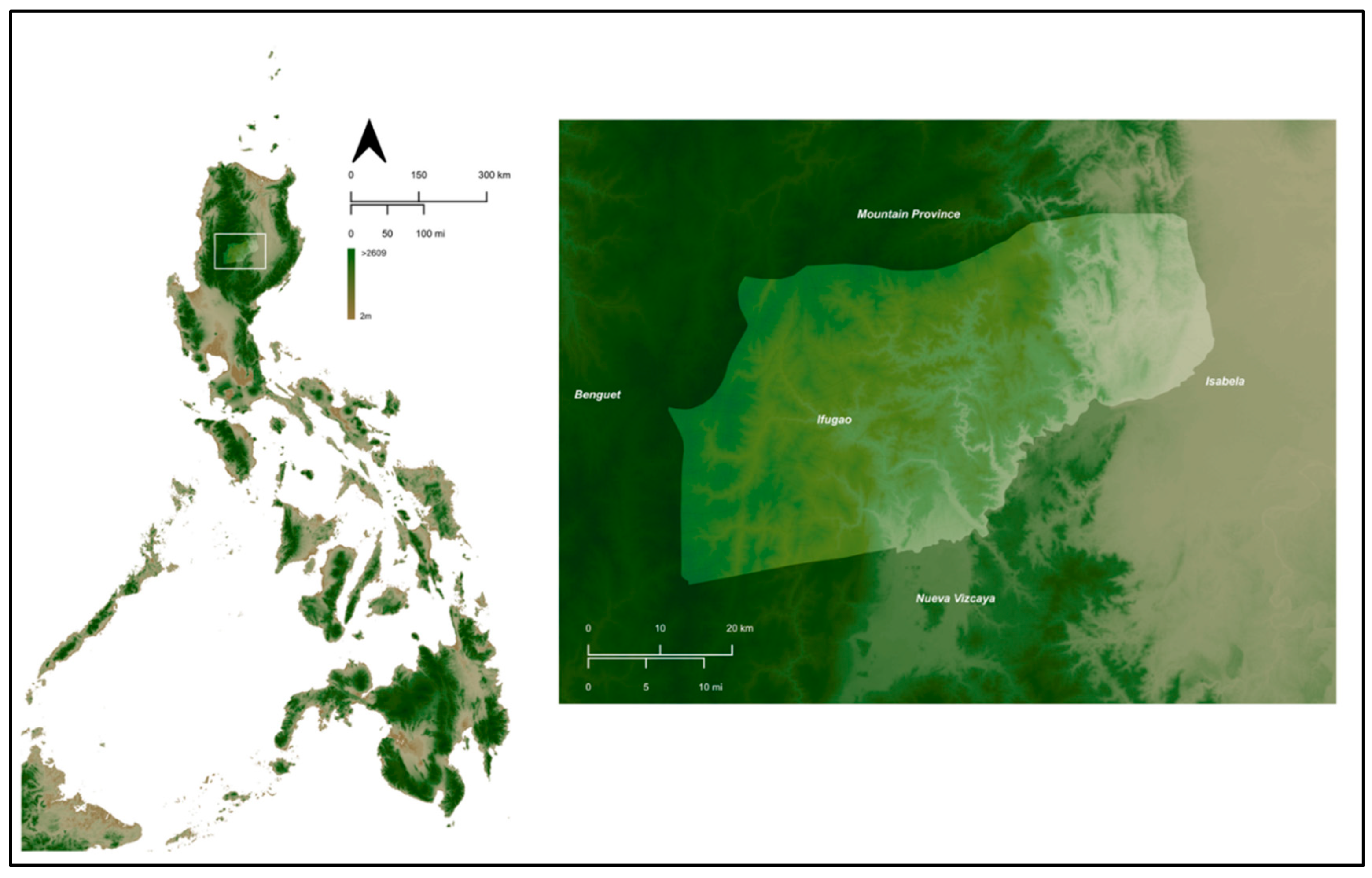
Figure 2.
An artist’s rendition of Ifugao terrace ecology and landscape pattern (by NJ Roxas).
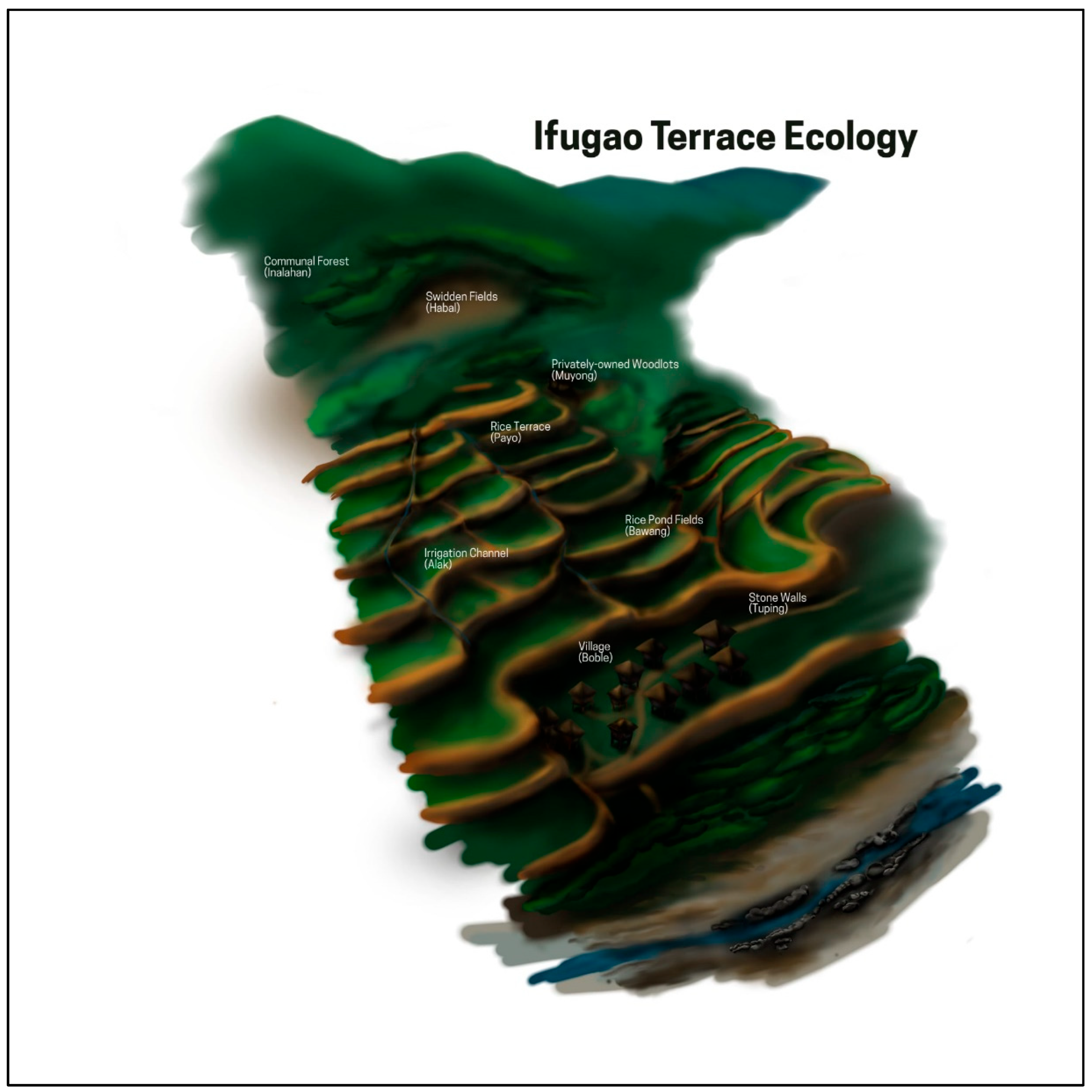
Figure 3.
A historical photo taken by RF Barton in 1912 is now covered with forest growth (left). A LiDAR coverage by EJ Hernandez clearly shows these terraces on a bare earth DEM.
Figure 3.
A historical photo taken by RF Barton in 1912 is now covered with forest growth (left). A LiDAR coverage by EJ Hernandez clearly shows these terraces on a bare earth DEM.
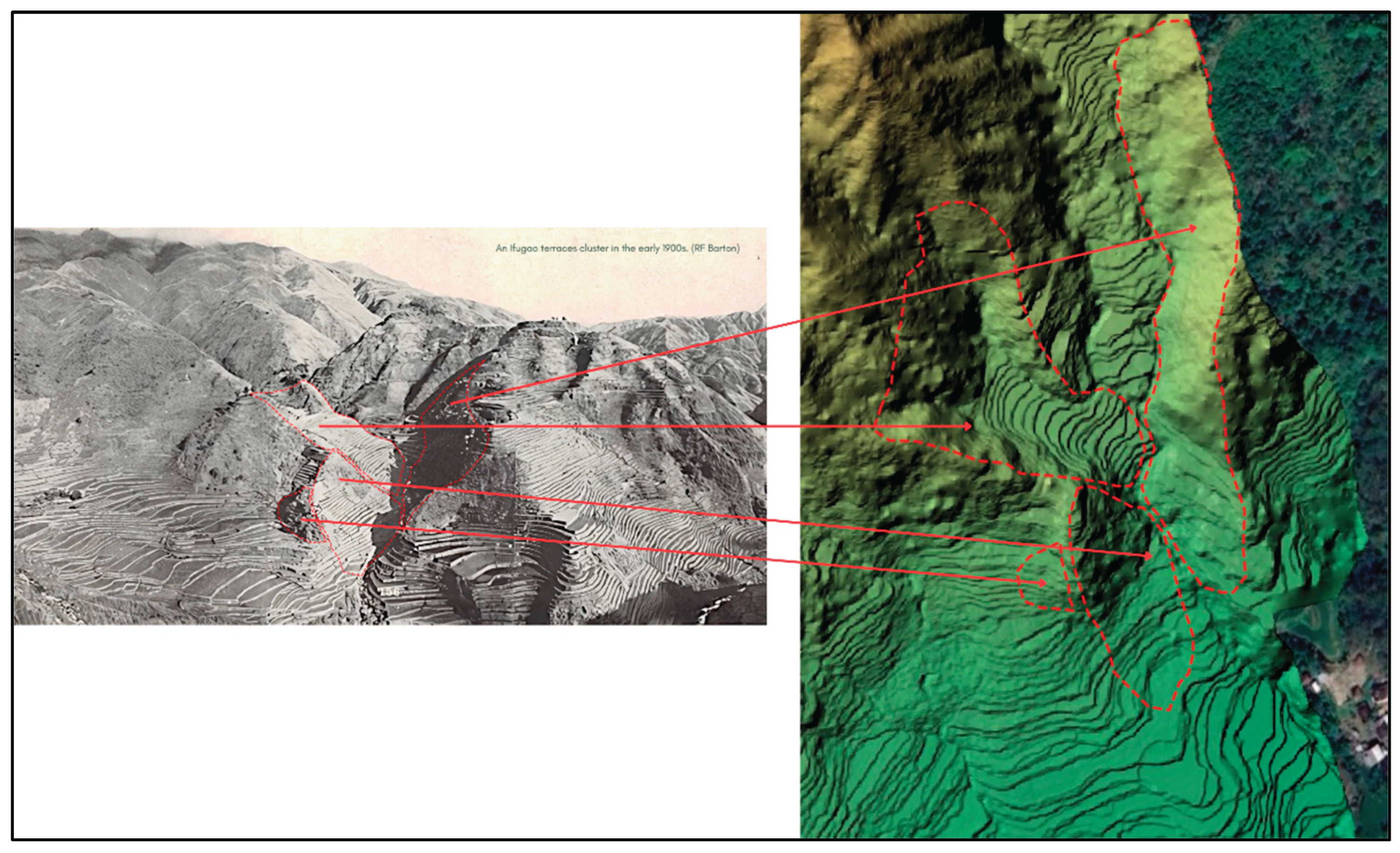
Figure 4.
2D and bare earth DEM images of the terrace system shown above.

Figure 5.
Converted agricultural terraces in Banaue, Ifugao (photo by the IAP and EJ Hernandez).
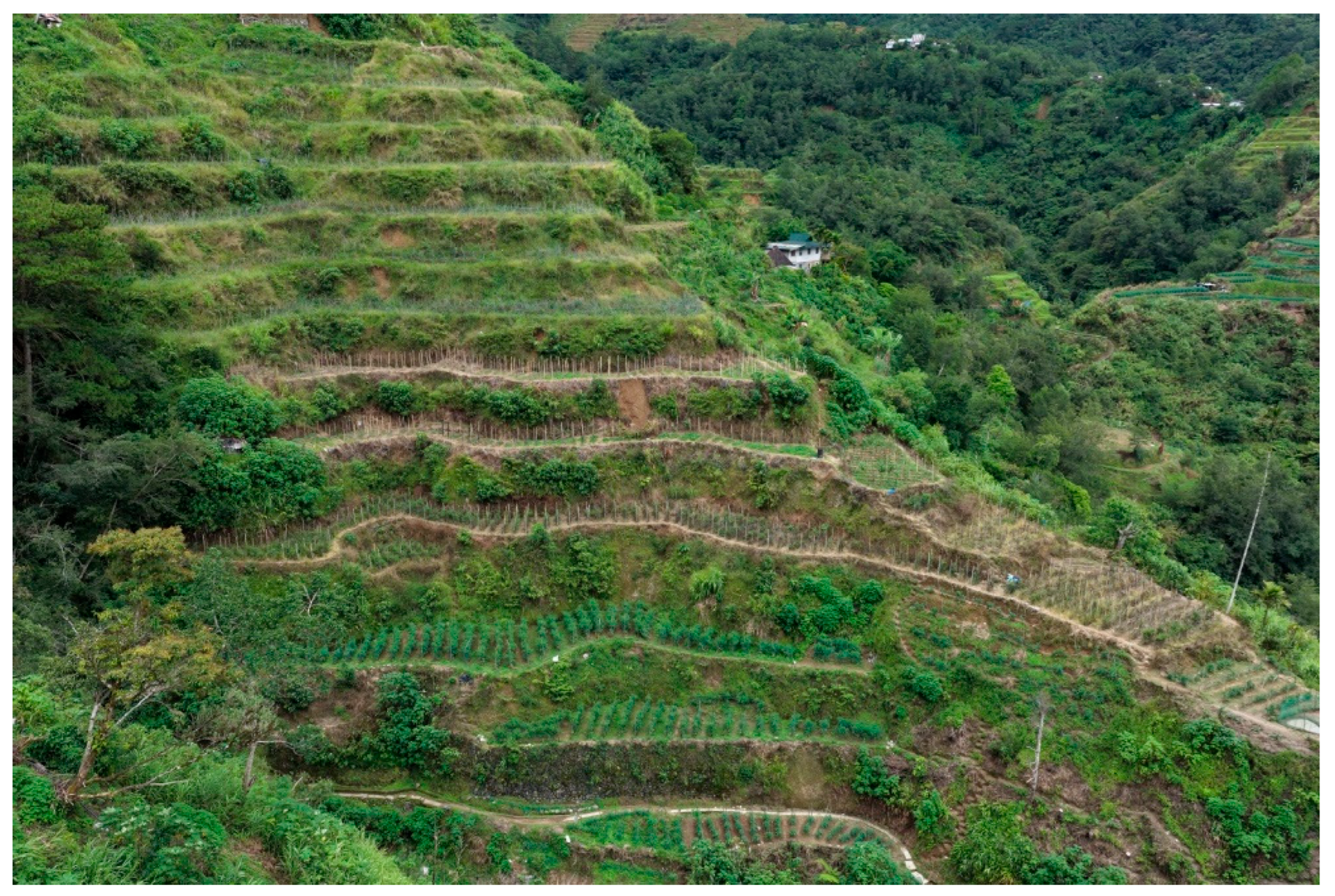

Table 1.
Comparison between income from cash crop vis-à-vis tinawon cultivation.[1].
| Rice | Vegetables | |||
| Tinawon (milled) | Inbred (palay) | Cabbage | Tomato | |
| Ave. Yield (kg/per cropping)[2] | 1,200 | 3,000 | 10,000 | 30,000 |
| Average price (PhP per kg) | 100 | 17 | 25 | 20 |
| Price range (min-max)[3] | 90-110 | 14-20 | 5-70 | 4-90 |
| Gross Income | 120,000 | 51,000 | 250,000 | 600,000 |
| Less Cost | 59,500 | 34,000 | 214,000 | 435,500 |
| Farm Inputs | ||||
| Seed | 4,500 | 1,500 | 16,000 | 5,500 |
| Fertilizer | 6,000 | 45,000 | 50,000 | |
| Pesticide | 1,500 | 17,000 | 60,000 | |
| Others | 6,000 | 60,000 | ||
| Labor | 55,000 | 25,000 | 100,000 | 170,000 |
| Transportation | 20,000 | 60,000 | ||
| Marketing | 10,000 | 30,000 | ||
| Net Income | ||||
| Normal Income/ 0.5 ha | ₱ 60,500.00 | ₱ 17,000.00 | ₱ 36,000.00 | ₱ 164,500.00 |
| Maximum Income | ₱ 72,500.00 | ₱ 26,000.00 | ₱ 486,000.00 | ₱ 2,264,500.00 |
| Minimum income (Maximum Loss) | ₱ 48,500.00 | ₱ 8,000.00 | (164,000.00) | (315,500.00) |
Table 2.
Known and named commercial and local rice varieties cultivated in Kiangan and Hungduan Municipalities gathered by Jacy Moore-Miller in 2014 (Acabado and Martin, 2015: 287).
Table 2.
Known and named commercial and local rice varieties cultivated in Kiangan and Hungduan Municipalities gathered by Jacy Moore-Miller in 2014 (Acabado and Martin, 2015: 287).
| Commercial Varieties | Tinawon Varieties |
|---|---|
| 52 | Binogon |
| 82 | Botnol |
| 222 | Iggamay |
| C-12 | Imbannig |
| C-2 | Imbuukan |
| C-4 | Madduli |
| C-4 red | Mayawyaw |
| Diamond | |
| Halaylay | |
| Ingaspar | |
| Ingaspi | |
| Korean | |
| Migapas | |
| Minmis | |
| Mukoz | |
| Mulmug | |
| Munoz | |
| NSCI-208 | |
| Pakulsa | |
| Oakland | |
| Oklan | |
| Oklan Minaangan | |
| Pangasinan variety | |
| PJ-27 | |
| PJ-7 | |
| RC-218 | |
| RI-152 | |
| RI-238 | |
| Romelia | |
| RP 224 | |
| Super 60 | |
| Taiwan | |
| Thunder |
Disclaimer/Publisher’s Note: The statements, opinions and data contained in all publications are solely those of the individual author(s) and contributor(s) and not of MDPI and/or the editor(s). MDPI and/or the editor(s) disclaim responsibility for any injury to people or property resulting from any ideas, methods, instructions or products referred to in the content. |
© 2025 by the authors. Licensee MDPI, Basel, Switzerland. This article is an open access article distributed under the terms and conditions of the Creative Commons Attribution (CC BY) license (http://creativecommons.org/licenses/by/4.0/).
Copyright: This open access article is published under a Creative Commons CC BY 4.0 license, which permit the free download, distribution, and reuse, provided that the author and preprint are cited in any reuse.


