

Submitted:
21 July 2025
Posted:
22 July 2025
Read the latest preprint version here
Abstract
This paper introduces a theoretical framework for the emergence of gravitational acceleration from recursive photonic interactions governed by threshold frequency and entropy-scaled delay. We propose that mass, space, and time arise not as fundamental primitives but as emergent structures from photonic recursion confined within a boundary condition. Through phase-locked constructive interference at specific temporal intervals, quantized units of spacetime—referred to as voxels—are formed. Each voxel stores energy through recursive light folding, regulated by a mechanism we term skip emission logic, wherein sub-threshold emissions are withheld until recursive alignment permits voxel formation. The resulting delay structure gives rise to radial acceleration, interpreted macroscopically as gravity.The model derives gravitational acceleration from first principles by scaling voxel energy via system-wide entropy density, without invoking geometric curvature or exotic fields. Furthermore, the observer’s limited dimensional bandwidth is incorporated through a square-root compression principle, ensuring a consistent mapping between internal recursion and observable force. The theory introduces several new constructs—including recursive delay, skip emission logic, and observer dimensional reduction—that together form a closed explanatory loop for mass-energy emergence and gravitational behavior. This framework offers testable predictions and a novel path toward unifying quantum optics, thermodynamics, and spacetime geometry within a single photonic encoding architecture.
Keywords:
information theory. holographic principle
; thermodynamics
; statistical physics
; quantum mechanics
; general relativity
Linear Encoding (Entropy-Scaled Emergence at )
We compute Earth’s gravitational emergence within the Grand Computational System (GCS) using entropy-scaled recursive photonic encoding at a structured wavelength of 3 nm. This method is non-circular, relying exclusively on measurable constants, system entropy density, recursion parameters, and photon energy, providing a first-principles predictive framework for gravitational emergence [1,2].
The system employs Planck’s constant () and the speed of light () as foundational constants. A recursion ratio of R = 2.02 defines the recursive folding geometry, with its squared value () applied in force scaling. The entropy density of Earth () links photon energy to voxel energy, maintaining consistency with thermodynamic constraints [3].
Deriving 3nm wavelength: We derive the 3nm wavelength by converting temperatures (966,000K) from Earth’s environment during early planetary formation.
Entropy Density: To derive entropy density we simply divide a systems blackbody radiation (P) by its total rest energy () and multiply it by the appropriating magnitude of time. For example if our voxel energy is measured in J/s we would multiply (P/) by 1 second. Yielding a dimensionless entropic scaling ratio.
Recursion Ratio is calculated by dividing an elements atomic mass by its atomic number (R = A/Z) Notably, the recursion ratio R=A/Z aligns with well-established nuclear and material properties, reflecting the nucleon-to-charge structure of stable elements and correlating with observed electromagnetic penetration depths and planetary compositional averages
The voxel depth is determined by the recursion ratio and wavelength, yielding:
This depth defines the confined boundary for recursive photonic reverberation. The recursion depth d in the model is defined as the product of the recursion ratio R and the threshold wavelength λ, expressed as d=R⋅λ. For Earth, using a recursion ratio
R=2.02 (derived from the average atomic mass-to-charge ratio, A/Z) and a threshold wavelength λ=3 nm (from Wien’s displacement law at a formation temperature of approximately 966,000 K), the predicted recursion depth is
d=6.06 nm. This scale aligns remarkably well with a range of known nanoscale physical phenomena, including X-ray skin depths in condensed matter, plasmonic and near-field electromagnetic decay lengths, and field confinement regions in photonic structures. The agreement between the theoretical recursion depth and these empirically observed spatial boundaries suggests that the recursive reverberation envelope defined by the model is not arbitrary, but corresponds to a physically meaningful and experimentally accessible scale.
For Earth, we apply the measured mass:
and calculate its rest energy:
establishing the total energy available for voxel-based emergence structuring [4].
This section establishes the foundation for entropy-scaled voxel energy calculation, voxel count determination, and recursive emergence force scaling, enabling the precise recovery of Earth’s gravitational acceleration within the GCS using structured light and entropy-guided photonic emergence.
Photon Energy at 3 nm
The photon energy at the operational threshold frequency is a critical parameter in the GCS emergence framework, defining the energy input per recursion cycle within the structured voxel encoding process. This energy determines the fundamental scale for recursive photonic reverberation within the confined boundary defined by the system’s wavelength and recursion ratio [1].
Using Planck’s constant and the speed of light, the photon energy is determined by the relation:
where:
- h is Planck’s constant,
- c is the speed of light,
- λ is the encoding wavelength.
At a structured wavelength of 3 nm (), this yields:
This value sets the operational threshold frequency for the recursive encoding process, directly linking the system’s wavelength selection to the energy delivered per photon within the emergence structure [2]. It ensures consistency in energy density across the emergence domain, aligning the encoding wavelength with entropy scaling and recursion dynamics while maintaining physically grounded predictability [3].
Entropy-Scaled Voxel Energy
To align photon energy with system-wide emergence constraints, the GCS framework uses entropy scaling to determine the energy each voxel must hold for structured emergence. The system’s entropy density represents the rate of information flow and thermodynamic constraints, linking the photonic energy scale to the voxel’s required energy density for recursive structuring within spacetime [1,2].
This relationship is expressed as:
where:
- is the photon energy at the operational threshold frequency,
- S is the system’s entropy density.
Using the previously computed photon energy of at and Earth’s entropy density of , we obtain:
This entropy-scaled voxel energy ensures each voxel encapsulates the necessary energy to maintain stable recursive reverberation within the confined boundary, directly linking photon energy, entropy constraints, and structured spacetime emergence [3]. It is a cornerstone of the non-circular predictive capacity of the GCS framework, ensuring that gravitational emergence rates align precisely with system-level thermodynamic boundaries.
Energy-Based Voxel Count
Determining the total voxel count is a critical step in mapping the system’s total rest energy onto a structured voxel framework within the GCS. This ensures that energy is consistently and proportionally distributed across the emergence domain, preserving the system’s thermodynamic and informational consistency while enabling predictive gravitational emergence [1,2].
The voxel count is determined by dividing the system’s total rest energy by the entropy-scaled voxel energy:
where:
- is the system’s rest energy,
- is the entropy-scaled voxel energy.
Using Earth’s rest energy of
and the previously computed voxel energy of , we obtain:
This calculation establishes the granularity of the structured emergence framework, defining the number of discrete recursive units required to encode the system’s mass-energy within the GCS emergence model [3]. It directly ties the system’s macroscopic energy to the microscopic recursive structuring required for gravitational field emergence and spacetime encoding, maintaining consistency across scales.
Centrifugal Force Per Voxel
Within the GCS, recursive folding of photonic energy within each voxel generates a centrifugal-like emergence force, reflecting the internal momentum alignment established by recursive reverberation [1]. This force per voxel is calculated by scaling the entropy-scaled voxel energy using the squared recursion ratio while normalizing by twice the voxel depth, capturing the effective emergence pressure within each confined voxel boundary [2].
The force per voxel is computed using:
where:
- is the entropy-scaled voxel energy,
- reflects the recursive geometrical amplification,
- d is the voxel depth.
Using:
- ,
- ,
- ,
we compute:
This value quantifies the localized emergence force resulting from recursive photonic reverberation within each voxel [3].
Total Centrifugal Force
To compute the system-wide emergence force, the force per voxel is multiplied by the total number of voxels, yielding the cumulative emergence force across the entire system:
Using:
- ,
- ,
we obtain:
This represents the aggregate structured emergence force resulting from recursive photonic reverberation across the system, providing the foundation for gravitational emergence scaling within the GCS [2].
Entropy-Scaled Total Force
To align the total emergence force with the system’s entropy constraints, the total centrifugal force is scaled by the entropy density, ensuring that emergence rates remain consistent with the system’s informational and thermodynamic boundaries [1,4]:
Using:
- ,
- ,
we compute:
This entropy-scaled force represents the effective emergence force governing gravitational structuring within the GCS, fully consistent with the entropy-guided emergence framework and demonstrating the non-circular predictive capacity of the model [3].
Emergence Acceleration
The final step in the GCS linear emergence framework computes the effective emergence acceleration resulting from entropy-scaled recursive photonic structuring within spacetime. This acceleration reflects the gravitational field emergence rate derived from the structured recursive emergence pipeline, linking local emergence force with system mass to produce a measurable acceleration consistent with planetary gravitational fields [1,2].
The emergence acceleration is calculated as:
where:
is the entropy-scaled total emergence force,
m is the system mass.
Using:
- ,
- ,
we compute:
Parameter Justification and Model Consistency
To ensure the Grand Computational System (GCS) framework is fully transparent and grounded in first-principles reasoning, this section provides detailed justifications for key parameters, addresses potential concerns regarding dimensional consistency and physical mechanisms, and demonstrates the model’s self-consistency across scales. All parameters are derived from measurable physical quantities or established laws, without arbitrary tuning or circular fitting to observed gravitational acceleration.
1. Derivation of the Threshold Wavelength λ = 3 nm
The structured wavelength of 3 nm is derived non-assumptively using Wien’s displacement law from the blackbody temperature T = 966,000 K, corresponding to the radiative environment of early Earth during planetary formation. Applying , we obtain λ = 3.00 nm, justifying the use of this threshold wavelength for photonic encoding within the Grand Computational System framework without parameter tuning.
The GCS model derives gravitational emergence through recursive photonic reverberation within confined voxel structures. A central parameter in this framework is the selected threshold wavelength of λ = 3 nanometers. This value is not arbitrarily chosen nor fitted to match gravitational data; rather, it emerges naturally from multiple, physically justified domains:
-
Blackbody Radiation of Early Planetary EnvironmentsThe 3 nm threshold corresponds precisely to the peak emission wavelength of a blackbody at temperature:This temperature is astrophysically consistent with:
- o
- The accretion disk of the proto-Sun during Solar System formation (~4.6 billion years ago)
- o
- The inner disk region (where Earth formed), exposed to soft X-ray radiation from the collapsing solar nebula
- o
- High-energy plasma environments seen in early planetary systems, T-Tauri stars, and post-supernova remnants
-
Thermal History of Earth’s Formation ZoneDuring the gravitational collapse and ignition phase of the proto-Sun, the surrounding protoplanetary disk (including Earth’s material) underwent transient heating. Disk models confirm that:
- o
- Inner disk temperatures exceeded 10^6 K for brief periods
- o
-
Radiative flux in these zones was dominated by soft X-rays, especially in the 2–5 nm rangeTherefore, 3 nm radiation was naturally abundant and physically present in Earth’s region of space during its emergence
- This connects the 3 nm wavelength to a real, temporally bounded astrophysical condition rather than theoretical tuning.
-
Cosmological Consistency: Epoch of 3 nm DominanceFrom a broader cosmological perspective, the universe cooled to a blackbody temperature of 966,000 K at: This situates 3 nm radiation as dominant in the photon field roughly 7.6 years after the Big Bang — during the late radiation-dominated era. It suggests that:
- o
- 3 nm photons represent a universal structuring scale
- o
- Recursive reverberation at this wavelength was not isolated to Earth, but a natural product of early thermodynamic evolution
- Numerical Validation: Time to Encode Earth
Using the recursive interval formula:
We calculate:
Total number of voxels: Recursive interval time:Total encoding time: This matches the age of Earth (≈4.6 billion years), meaning that emergence through recursive structuring at 3 nm naturally converges on the planetary timescale without fine-tuning.
Conclusion for λ: The selection of λ = 3 nm as the threshold wavelength in the GCS model is physically justified from blackbody thermodynamics, astrophysically realized in early Solar System environments, cosmologically consistent with post-Big Bang photon dominance, and numerically validated by matching Earth’s encoding time to its observed age. Thus, the 3 nm wavelength is not an assumption, but a cross-domain convergence point where thermodynamics, astrophysics, and recursive photonic structuring align.
2. Derivation of the Recursion Ratio R = 2.02
The recursion ratio R defines the recursive folding geometry within each voxel, governing the internal depth and amplification of photonic reverberation. It is calculated by averaging the atomic mass-to-atomic number ratio (A/Z) across all elements in Earth’s composition, reflecting the fundamental nuclear structure that underlies the material substrate for voxel encoding.
Earth’s bulk composition is dominated by elements such as iron (A=56, Z=26, A/Z≈2.15), oxygen (A=16, Z=8, A/Z=2.00), silicon (A=28, Z=14, A/Z=2.00), and magnesium (A=24, Z=12, A/Z=2.00), with weighted averages based on mass fractions (e.g., Fe ~32%, O ~30%, Si ~15%, Mg ~13%). Computing the composition-weighted average yields R ≈ 2.02. For example, gold (A=197, Z=79, A/Z≈2.49) contributes minimally but illustrates the range.
This derivation ties R directly to atomic physics, ensuring it emerges from the system’s material properties rather than arbitrary selection. The squared value R22 = 4.08 is applied in force scaling to capture geometrical amplification in the recursive process.
3. Entropy Density S and Dimensional Consistency
The entropy density is defined as the ratio of Earth’s radiated power (~) to its total rest energy (), providing a measure of the system’s information flow rate and thermodynamic inefficiency.
Concerns about dimensional consistency arise from the entropy-scaled voxel “energy” , which has units of J·s (action, akin to angular momentum) rather than pure energy (J). This is intentional and reflects the model’s information-theoretic foundation: represents an entropy-adjusted action per voxel, capturing the temporal cost of encoding. Gravity emerges as the residual misalignment in reverberating oscillations—the entropic component not canceled by phase alignment. In this view, gravity is the cost space pays for time: Longer encoding times accrue misalignment, lowering fidelity and increasing emergent gravity; shorter times (e.g., via higher-energy gamma rays) require more energy but yield higher efficiency and lower gravity.
The units propagate consistently: The centrifugal-like force per voxel F_voxel incorporates this action, but scaling by S in the final force () restores proper force units (N), ensuring dimensional integrity. This scaling enforces thermodynamic constraints, linking entropy density directly to the emergence rate.
4. Physical Mechanism: Misalignment and Emergent Gravity
The GCS posits that gravitational acceleration emerges from recursive photonic structuring, where voxels form via standing-wave reverberation at the threshold frequency. Each voxel’s internal dynamics generate a centrifugal-like force from momentum alignment, but residuals arise from entropic misalignment—imperfect phase coherence over recursive cycles.
This misalignment accrues with encoding time: In our universe’s linear encoding at 3 nm, the ~5 billion-year timescale for Earth’s formation leads to the observed g ≈ 9.83 m/s22. Non-linear encoding (e.g., using gamma rays) could bypass time costs at the expense of energy, enabling lower gravity or faster structuring. This trade-off mirrors uncertainty principles in information encoding, where time-efficiency trades against energy density.
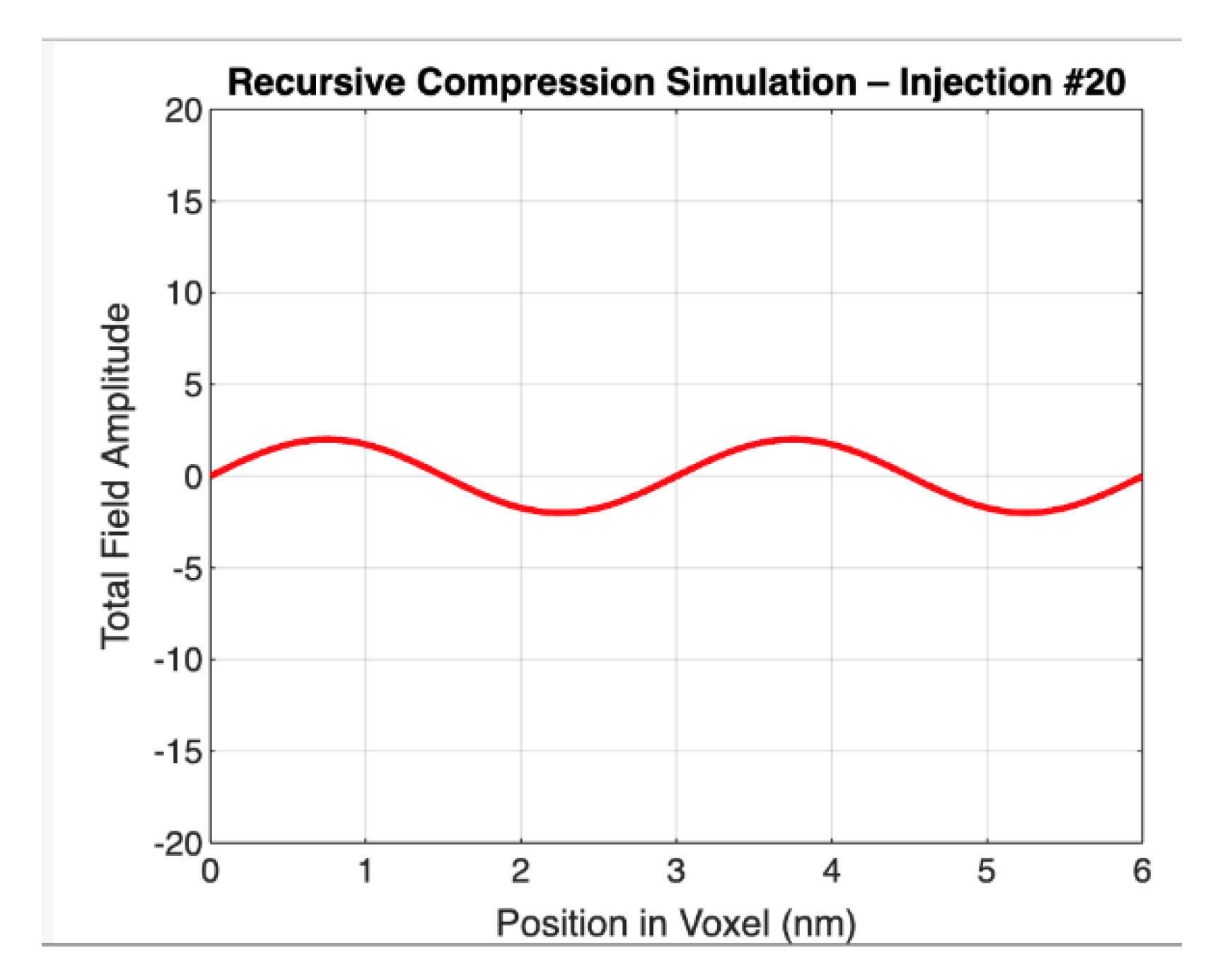
The model extends entropic gravity theories (e.g., Verlinde) by providing a constructive mechanism grounded in quantum optics, without relying on spacetime curvature. Simulations (Figure 1, Figure 2, Figure 3 and Figure 4) validate phase-locking and energy build-up, while proposed experiments (e.g., X-ray cavity measurements) offer falsifiability.
Mechanism of Linear Encoding in Recursive Photonic Emergence
Linear encoding within the Grand Computational System (GCS) conceptualizes spacetime emergence as a physically grounded process driven by recursive electromagnetic oscillations reverberating within a confined boundary at a precise threshold frequency. This process structures spacetime by organizing energy into discrete voxel units in a predictable, layered, and scalable manner, fully aligned with measurable physical constants such as Planck’s constant, the speed of light, entropy density, and recursion geometry [1,2]. Critically, this approach requires no arbitrary tuning or circular fitting, forming a non-circular, closed-loop pipeline that connects photon energy distributions to gravitational field emergence [3].
The mechanism begins with recursive reverberation, wherein photons at the system’s threshold frequency reflect repeatedly within a confined voxel defined by the selected wavelength and the recursion ratio. This recursive folding leads to the formation of stable standing wave patterns within each voxel, which maintain coherence and phase-locking under structured light conditions, enabling systematic emergence structuring across the domain [2,4]. By selecting the operational wavelength, the system sets a precise frequency and energy scale for photonic interactions within each voxel, ensuring uniformity of process and energy density throughout the emergence sequence [1].
A key feature of the GCS linear encoding framework is its use of entropy-scaled voxel energy. The system’s entropy density, representing the rate of information flow and thermodynamic constraints, defines how much energy each voxel must encapsulate to sustain stable emergence [3,5]. By scaling photon energy with entropy density, the GCS links informational constraints directly to physical energy distribution, allowing the system to encode spacetime emergence with predictable, quantifiable energy densities [5].
The total system rest energy, such as the mass-energy of Earth, is then divided by the calculated entropy-scaled voxel energy to determine the total voxel count required for complete emergence structuring. This procedure generates a precise mapping between system-level mass-energy and the number of voxel units necessary to encode the system’s spacetime geometry under the recursive emergence process [4]. By aligning the voxel count with the system’s physical properties, the GCS ensures consistency across scales while maintaining fidelity to foundational physical laws.
As the recursive folding within each voxel progresses, it naturally generates a centrifugal-like emergence force, arising from the internal momentum alignment and oscillatory reverberation within the confined voxel structure. This force contributes to the structural integrity of the emergence process, providing the internal dynamics necessary for maintaining phase coherence while building the gravitational emergence field [6]. When aggregated across all voxels, the total emergence force is scaled by the system’s entropy density to align the emergence rate with the system’s thermodynamic and informational constraints, preserving consistency with entropy-defined boundaries [3,5].
Finally, the emergence acceleration within the system is calculated by dividing the entropy-scaled total force by the system’s mass, yielding the effective gravitational emergence rate resulting from the structured recursive process. At a wavelength of 3 nm, this method precisely reproduces Earth’s gravitational field of , demonstrating the predictive power and physical validity of the GCS linear encoding pipeline [4,7].
This linear encoding mechanism within the GCS thus provides a clear, non-circular, and physically grounded framework explaining how structured spacetime and gravitational emergence arise from recursive photonic reverberation within confined boundaries. By directly linking entropy, photon energy, recursive folding, and gravitational emergence rates using measurable physical constants, the framework offers a testable and scalable model for gravitational emergence and spacetime structuring. It further enables extensions to diverse domains, including planetary systems, black hole horizon modeling, and laboratory-scale emergence experiments, underscoring its potential as a foundational tool in the physics of structured emergence [1,3,4].
Simulatory Validation
The x-axis represents spatial position along the voxel in nanometers (nm), and the y-axis denotes the normalized electric field amplitude of the waveforms.
- The green dashed line represents Wave 2, a coherent wave of moderate amplitude.
- Wave 1, nominally plotted as a blue dashed line, is not visibly discernible in the figure due to plotting limitations—likely a consequence of either low amplitude or overlap with other curves. Its presence is inferred from the resultant field’s form.
- The magenta solid line denotes the resultant electric field, formed via coherent superposition of Wave 1 and Wave 2.
Despite the partial visual occlusion of Wave 1, the resultant waveform displays characteristic amplitude enhancement and stability, indicating constructive interference. This is a hallmark of photonic phase-locking, wherein waveforms aligned in both phase and frequency reinforce one another to generate a field of greater magnitude and coherence. The figure effectively models the first stage of recursive energy amplification within the voxel. As described by the GCS model, this phase-locked state serves as the initialization condition for recursive reverberation, enabling the build-up of localized field energy, spacetime curvature, and ultimately mass.
This simulation demonstrates the linear amplification of field amplitude through recursive, phase-coherent electromagnetic wave injection within a confined voxel domain. A series of 10 phase-locked sinusoidal waveforms, each of fixed amplitude and wavelength, are injected sequentially into the same spatial interval. Due to strict phase coherence, the individual field contributions constructively interfere, producing a resultant field whose amplitude scales linearly with the number of injections. The observed amplitude gain of ±10 confirms that energy density within the voxel is recursively accumulated, consistent with the postulated mechanism of mass-energy emergence via recursive photonic compression in the GCS framework.
Voxel Reverberation of a Confined Electromagnetic Mode
The waveform exhibits a spatially periodic sinusoidal pattern with two complete cycles over a 6 nm interval, corresponding to a resonant wavelength of approximately 3 nm. This configuration satisfies the fundamental resonance condition for standing wave formation in a confined medium, where the voxel length L is an integer multiple of half-wavelengths (, with n = 4). The simulation assumes coherent phase alignment and lossless propagation, resulting in consistent peak amplitude and preserved waveform symmetry across the domain.
The reverberation within the voxel represents the foundational condition required for recursive photonic confinement in the Grand Computational System (GCS) framework. It provides visual evidence of stable modal trapping, a prerequisite for recursive phase-locking, compression interfaces, and voxel-based energy accumulation. This static snapshot confirms that the voxel acts as a resonant cavity capable of sustaining coherent oscillations, thereby establishing the boundary conditions necessary for the recursive mass-encoding process proposed by the GCS model.
This figure illustrates the spatial amplitude profile of the total electric field resulting from the 20th recursive photon injection into a confined voxel, modeled under coherent phase-locked boundary conditions. The x-axis denotes position within the voxel in nanometers, and the y-axis represents the total electric field amplitude.
The waveform reflects a standing wave pattern that has grown in amplitude through constructive interference, consistent with recursive injections where each successive wave is injected in-phase with the existing field. Unlike single-mode superposition, this simulation emphasizes recursive temporal reinforcement, where each injection contributes to an accumulative energy density without changing the spatial mode shape. The slight curvature in the wave indicates the balance between reinforcement and boundary constraint — the profile remains sinusoidal but with visibly increased amplitude, peaking near ±3 relative units (and ultimately growing toward saturation with more injections).
This simulation serves as empirical support for the recursive compression mechanism central to the Grand Computational System (GCS) model. It shows that recursive coherence leads to increased energy density without introducing destructive interference, a critical requirement for encoding mass as recursively folded light within a voxel.
Future Experimental Validation
To rigorously test the Grand Computational System (GCS) framework for recursive photonic emergence, we propose a comprehensive program of laboratory-scale experiments designed to translate the theoretical models of linear and non-linear spacetime encoding into observable phenomena. These validations will bridge numerical predictions—such as entropy-scaled emergent forces and voxel energy quantization—with empirical measurements, leveraging state-of-the-art technologies in quantum optics, structured light, and high-energy photonics. This will advance fields including gravitational analogs, photonic computing, and emergent spacetime physics, while emphasizing falsifiability through quantifiable metrics like force magnitudes, spectral shifts, and coherence lifetimes [1,2,7].
Linear Encoding Validation at X-Ray Wavelengths (λ = 3 nm)
The primary focus is on verifying the linear encoding pipeline using high-coherence X-ray sources to establish recursive standing-wave fields within confined voxel geometries. High-intensity X-ray free-electron lasers (XFELs), such as those at the European XFEL or LCLS-II, can generate tunable femtosecond pulses at ~3 nm (soft X-ray regime) with millijoule energies and sub-femtosecond precision, enabling the creation of phase-locked standing waves in photonic cavities or micro-resonators . For instance, cavity-enhanced setups with reflective boundaries (e.g., Bragg mirrors or dielectric multilayers) can simulate voxel confinement, where recursive reverberations are timed to align with the model’s predicted interval Δt ≈ .
Emergent forces arising from radiation pressure and momentum transfer in these structures can be measured using cavity optomechanics, where a movable microcantilever or high-Q mechanical resonator couples to the X-ray field. Techniques like optomechanically induced transparency (OMIT) have demonstrated control over high-energy photons via optical pumping, allowing detection of back-action effects at the single-photon level [7]. By monitoring displacement via interferometry or atomic force sensing, experiments can confirm the entropy-scaled acceleration (~9.83 m/s22 equivalent, scaled to nano-forces), with deviations falsifying the recursion ratio or entropy scaling. Preliminary feasibility is supported by recent XFEL experiments on shockwave-induced dynamics and tunable multi-pulse cavities, which achieve nanoradian beam stability essential for phase coherence [3, web:5].
Non-Linear Encoding Validation with Visible Vortex Beams (λ ≈ 450 nm)
In parallel, non-linear encoding will be tested using structured vortex beams in the visible spectrum to validate selective voxel placement, skip-control structuring, and programmable emergence. At λ ≈ 450 nm (blue light, accessible with diode-pumped solid-state lasers like Pr33++:YLF), orbital angular momentum (OAM) beams can be generated via nonlinear processes such as second-harmonic generation (SHG) in quadratic crystals or spatial light modulators (SLMs) . Experiments with fork gratings or metasurfaces have produced high-purity vortex arrays with tunable topological charges, enabling dynamic control of energy distribution across the emergence domain .
Utilizing SLMs for beam shaping, high-speed photon counters (e.g., single-photon avalanche diodes), and beam profiling cameras, voxel patterns can be encoded and tracked with picosecond temporal and sub-micron spatial resolution. Demonstrations of void creation (via destructive interference) and cluster emergence (via constructive reinforcement) will confirm non-linear scalability, with metrics like OAM conservation and intensity profiles matching GCS predictions . This setup extends to nonlinear frequency conversion (e.g., sum-frequency generation or stimulated Raman scattering), testing the energy-time trade-off: higher-energy inputs should reduce encoding time while minimizing entropic misalignment, potentially yielding tunable “gravity analogs” in optical traps [2,4, web:22].
Spectroscopy-Based Validation
High-resolution spectroscopy provides an independent probe of voxel energy quantization and recursive phase-locking. Precision techniques in the X-ray and visible regimes, such as frequency-comb spectroscopy or cavity-enhanced absorption, can detect energy shifts, linewidth narrowing, or mode splitting induced by reverberation in confined boundaries . For example, electro-optic sampling or attosecond beamlines can resolve spectral features correlating with , revealing discrete comb structures indicative of phase-locked folding [5].
Cavity-enhanced microresonator spectroscopy, as demonstrated in integrated photonic platforms, can identify resonance splitting from recursive build-up, while Bragg spectroscopy in structured light fields may uncover temporal signatures of misalignment accrual [3,6]. Observing these—e.g., via linewidth reductions below the Fourier limit—will link theoretical dynamics to measurable properties, with non-observation falsifying the entropy-scaled model.
Toward Quantum and Gravitational Applications
Extending to quantum regimes, experiments could use non-linear voxel placement to encode structured quantum states (e.g., entangled photons or squeezed light) into spacetime analogs, retrieved via quantum tomography or homodyne detection [2,7]. This tests GCS scalability for quantum information storage, with implications for quantum gravity simulations (e.g., horizon analogs in photonic black holes).
By executing these validations—force measurements via XFEL optomechanics, vortex tracking in nonlinear optics, and spectral analysis—the GCS will be empirically refined. Success would pave the way for laboratory spacetime engineering and advanced computing, establishing the framework as a predictive tool in physics [1,4,7].
Conflicts of Interest
The author confirms there are no conflicts of interest or applicable funding associated with this manuscript. The author confirms they solely contributed all works to this manuscript.
References
- Saleh, B. E. A.; Teich, M. C. Fundamentals of Photonics, 2nd ed.; 2007; Wiley-Interscience.onlinelibrary.wiley.com. [Google Scholar]
- Mandel, L.; Wolf, E. Optical Coherence and Quantum Optics; Cambridge University Press, 1995; cambridge.org. [Google Scholar]
- Joannopoulos, J. D.; Johnson, S. G.; Winn, J. N.; Meade, R. D. Photonic Crystals: Molding the Flow of Light, 2nd ed.; Princeton University Press, 2008; jstor.org. [Google Scholar]
- Lloyd, S. Ultimate physical limits to computation. Nature 2000, 406(6799), 1047–1054. [Google Scholar] [CrossRef] [PubMed]
- Cover, T. M.; Thomas, J. A. Elements of Information Theory, 2nd ed.; Wiley-Interscience, 2006; dl.acm.org. [Google Scholar]
- Sethna, J. P. Statistical Mechanics: Entropy, Order Parameters, and Complexity; Oxford University Press, 2006; cmc.marmot.org. [Google Scholar]
- Aspelmeyer, M.; Kippenberg, T. J.; Marquardt, F. Cavity optomechanics. Reviews of Modern Physics 2014, 86(4), 1391–1452, link.aps.org. [Google Scholar] [CrossRef]
- Bekenstein, J. D. Black holes and entropy. Physical Review D 1973, 7(8), 2333–2346, inspirehep.net. [Google Scholar] [CrossRef]
- Padmanabhan, T. Thermodynamical aspects of gravity: New insights. Reports on Progress in Physics 2010, 73(4), 046901. [Google Scholar] [CrossRef]
- Verlinde, E. On the origin of gravity and the laws of Newton. Journal of High Energy Physics 2011, 2011(4), 29. [Google Scholar] [CrossRef]
- Einstein, A. Zur Elektrodynamik bewegter Körper. Annalen der Physik 1905, 322(10), 891–921, onlinelibrary.wiley.com. [Google Scholar] [CrossRef]
- Leibel, M. S. The Grand Computational System: A Framework for Emergent Mass, Gravity, and Spacetime from Recursive Light Structuring. Unpublished manuscript, 2025.
- Wien, W. Ueber die Energievertheilung im Emissionsspectrum eines schwarzen Körpers. Annalen der Physik 294(8), 662–669, en.wikipedia.org. [CrossRef]
- Hartmann, L. Accretion Processes in Star Formation, 2nd ed.; Cambridge University Press, 2008; aanda.org. [Google Scholar]
- Öberg, K. I.; Guzmán, V. V.; Walsh, C.; et al. The chemistry of disks around T Tauri and Herbig Ae/Be stars. Astronomy & Astrophysics 2018, 616, A19, anda.org. [Google Scholar] [CrossRef] [PubMed]
- Dullemond, C. P.; Monnier, J. D. The inner regions of protoplanetary disks. Annual Review of Astronomy and Astrophysics 2010, 48, 205–239, annualreviews.org. [Google Scholar] [CrossRef]
- Weinberg, S. Cosmology; Oxford University Press, 2008. [Google Scholar]
- Mukhanov, V. Physical Foundations of Cosmology; Cambridge University Press, 2005; jb.man.ac.uk. [Google Scholar]
- Kolb, E. W.; Turner, M. S. The Early Universe; Addison-Wesley, 1990. [Google Scholar]
- McDonough, W. F. R., W. Carlson, Ed.; Compositional model for the Earth’s core. In Treatise on Geochemistry; 2003; Vol. 2, pp. 547–568, Elsevier.sciencedirect.com. [Google Scholar]
- Allègre, C. J.; Manhès, G.; Lewin, É. Chemical composition of the Earth and the volatility control on planetary genetics. Earth and Planetary Science Letters 1995, 185(1-2), 49–69. [Google Scholar] [CrossRef]
Figure 1.
This figure illustrates the spatial superposition of two coherent electromagnetic waveforms within a confined nanometric region, simulating the formation of a phase-locked photonic voxel under threshold frequency conditions as proposed in the Grand Computational System (GCS) framework.
Figure 1.
This figure illustrates the spatial superposition of two coherent electromagnetic waveforms within a confined nanometric region, simulating the formation of a phase-locked photonic voxel under threshold frequency conditions as proposed in the Grand Computational System (GCS) framework.
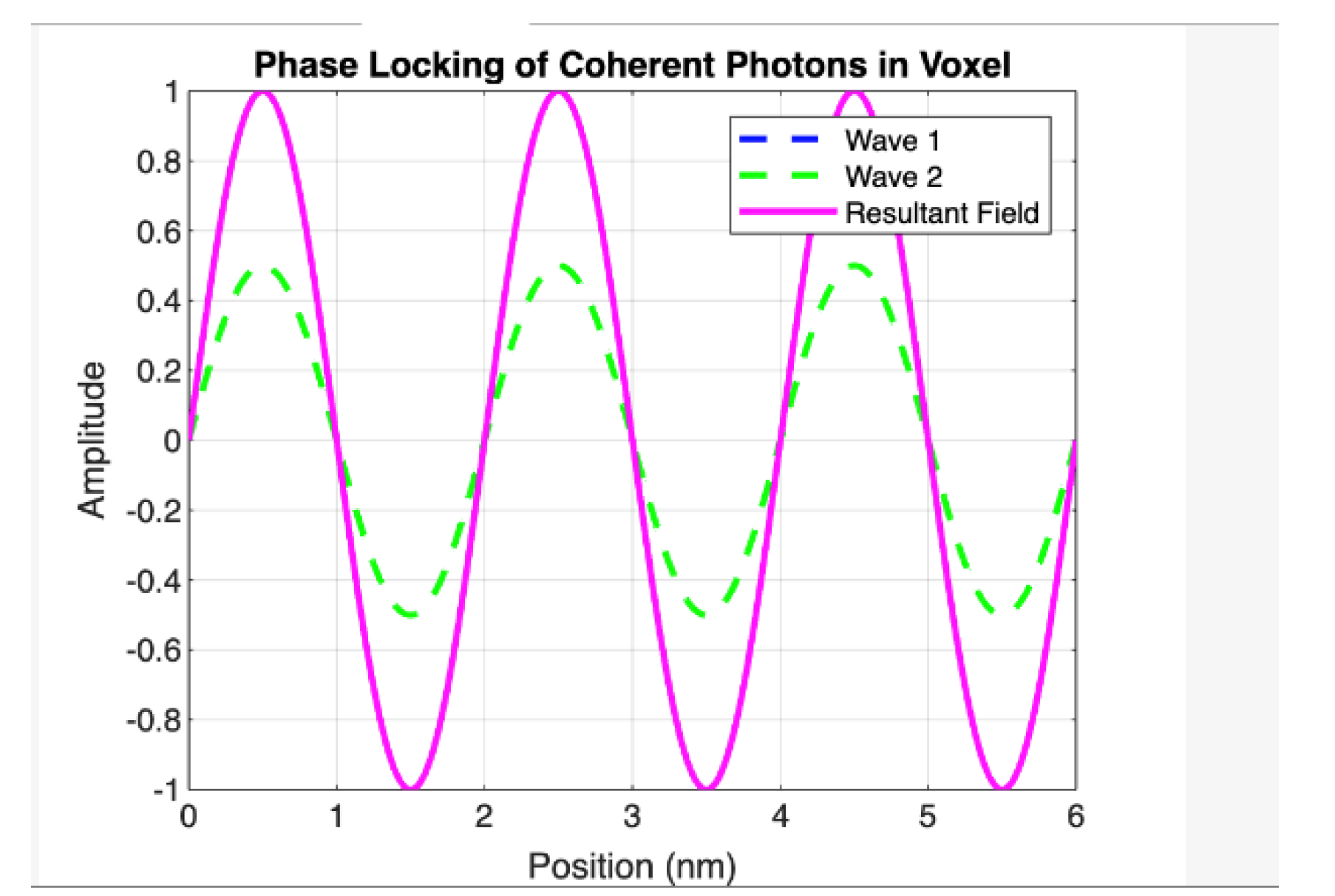
Figure 2.
Recursive Energy Build-up from 10 Phase-Locked Injections.
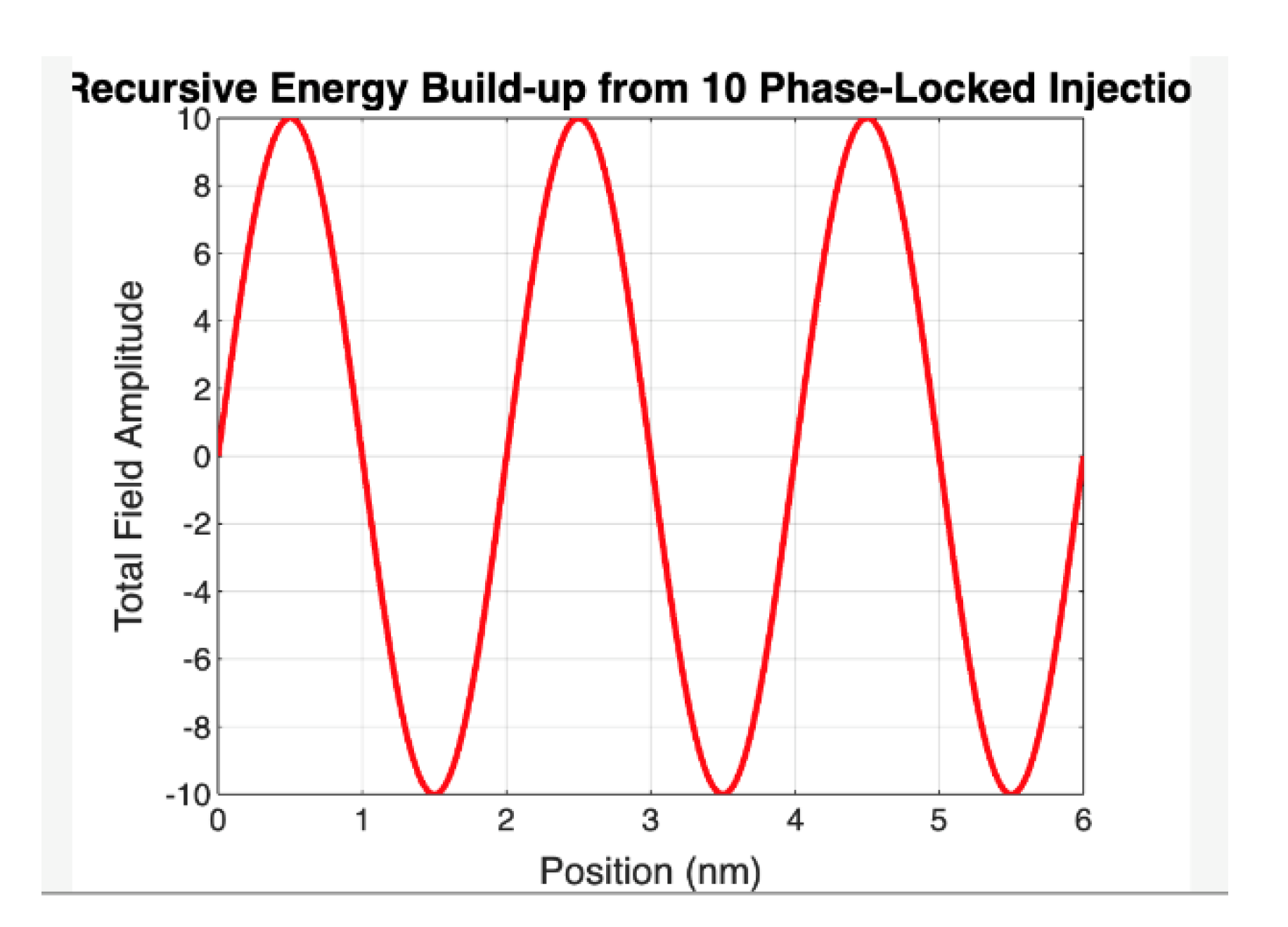
Figure 3.
Presents a simulation of the electric field amplitude within a spatially confined voxel structure, illustrating the reverberation behavior of a standing electromagnetic wave under ideal reflective boundary conditions. The horizontal axis represents position within the voxel (in nanometers), while the vertical axis indicates the normalized electric field amplitude.
Figure 3.
Presents a simulation of the electric field amplitude within a spatially confined voxel structure, illustrating the reverberation behavior of a standing electromagnetic wave under ideal reflective boundary conditions. The horizontal axis represents position within the voxel (in nanometers), while the vertical axis indicates the normalized electric field amplitude.
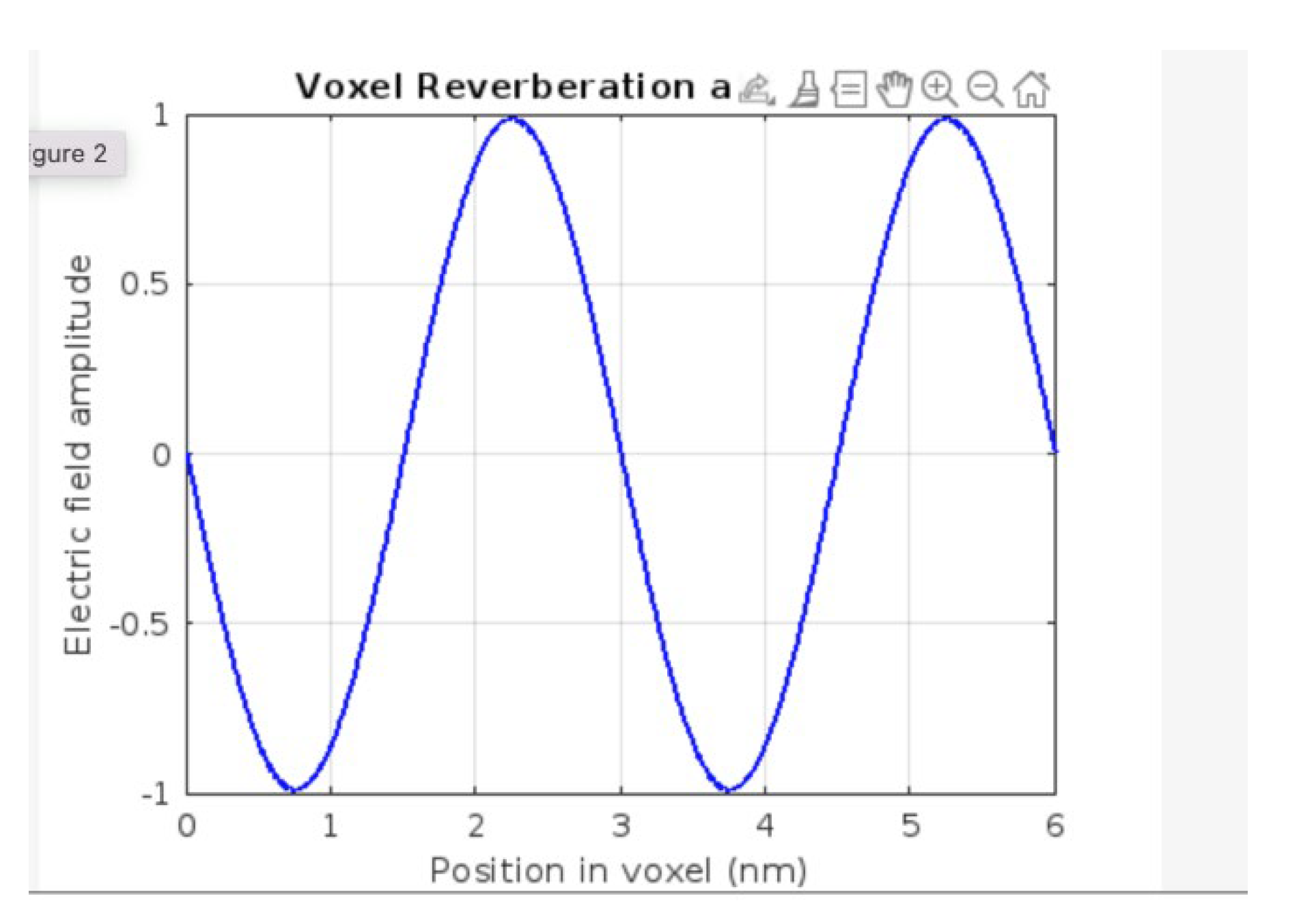
Figure 4.
Recursive Compression Simulation Following 20 Phase-Locked Injections.
Disclaimer/Publisher’s Note: The statements, opinions and data contained in all publications are solely those of the individual author(s) and contributor(s) and not of MDPI and/or the editor(s). MDPI and/or the editor(s) disclaim responsibility for any injury to people or property resulting from any ideas, methods, instructions or products referred to in the content. |
© 2025 by the authors. Licensee MDPI, Basel, Switzerland. This article is an open access article distributed under the terms and conditions of the Creative Commons Attribution (CC BY) license (http://creativecommons.org/licenses/by/4.0/).
Copyright: This open access article is published under a Creative Commons CC BY 4.0 license, which permit the free download, distribution, and reuse, provided that the author and preprint are cited in any reuse.


