

Submitted:
21 July 2025
Posted:
22 July 2025
You are already at the latest version
Abstract
The adoption of Electric Vehicles (EVs) has grown substantially in recent years, offering a cleaner and highly promising pathway toward the decarbonization of urban environments. However, this trend introduces new challenges in charging infrastructure and management. This paper proposes a synergistic integration of Business Intelligence (BI) and Artificial Intelligence (AI) techniques - including machine learning and data analytics - for solving the EVs charging problem. We begin with an in-depth analysis of charging behaviors, leveraging extensive datasets from EVs, Charging Stations (CSs) and auxiliary sources. Based on this analysis, we introduce a BI framework utilizing advanced data mining methods to utilize large-scale data effectively. We then present a BI-based decision-making model that enables comprehensive analysis and optimized solutions for EV charging scheduling and the cooperation among different CSs owners. The model is validated across multiple real-world scenarios and case studies, demonstrating significant improvements in charging efficiency, utilization, and reliability. By showcasing the practical applications of BI-driven analytics, our findings underscore the transformative impact of data-informed methodologies on EV charging operations. The paper concludes with a discussion of open research opportunities in AI‑ and BI-driven intelligent transportation—specifically in EV charging optimization, grid integration, and predictive analytics.
Keywords:
business intelligence
; electric vehicles (EVs)
; electric vehicles charging
; decision model
; data mining
1. Introduction
In recent decades, there have been tremendous advancements in wireless and communications technology that has led to the development of Internet of Things (IoT). IoT includes the interconnection of smart devices and the exchange of information among them. The analysis of the collected data through Artificial Intelligence (AI) technology and machine learning techniques enables faster and more efficient decisions. The use of IoT is extended and affects all the aspects of everyday life, however in this paper, our focus is the Electric Vehicles (EVs) technology [1,2].
1.1. Motivation
The market of EVs is growing at a fast pace due to their advantages. Electric vehicles contribute to the decarbonization of road transport, noise-free traffic, the decrease of operational and maintenance costs [3,4] and the convenience of charging [5]. In addition to being pollution-free and ecologically efficient, EVs frequently use renewable resources and positively contribute to the transportation system of smart cities. However, EV charging poses significant challenges for the power grid network. In order to charge the increasing number of EVs, huge amounts of energy are needed, especially during particular times of the day, when large number of owners of EVs want to charge their vehicles. If charging occurs without control and scheduling, various problems appear, including limited number of Charging Stations (CSs), slow charging and long queues and waiting time. Therefore, the collaboration of many vehicles and charging stations might result in notable energy savings, particularly during periods of peak load. The cooperation concept is of the main contributions of the paper. Furthermore, a major factor in the energy balancing of the smart transportation system is the dynamic utilization of CSs. The proposal of efficient scheduling techniques is important to encourage owners of CSs and EVs to take part and cooperate in the energy charging market. The primary problem is to create an incentive-compatible and energy efficient market that maximizes the benefits of the market participants and allocates energy efficiently in a market model while taking into account EVs and CSs individual interests, and the overall market gains.
1.2. Contributions
In this paper, we explore an energy trading market where a number of EVs are in motion in a geographical area, where a number of CSs, owned by different stakeholders, are deployed. The EVs need to charge their batteries with varying demands and the stakeholders offer energy to sell in different prices. Thus, all the participants of the market are independent and have competitive interests. Additionally, a great challenge of the market includes the ignorance of the preferences, needs, decisions and actions of each of the participants. More specifically, this market characteristic is very crucial during peak demand time periods, since imbalances are created and even delays and queues at the charging stations. These problems are energy inefficient, create unnecessary costs and time wastes for all the participants of the market. Thus, if we assume that the electric vehicles could be motivated to disclose truthfully their demands, a decision making policy could be employed to optimize the operation of the market. An operator is responsible to gather the large volume of information. The abundance of information has to be processed in order to be useful and to be utilized in the decision-making process. With the gathered information, an energy model is proposed to deal with the different desires and needs of the participants and an equilibrium can be reached.
Given the aforementioned issues, and the economic nature of the market, the tools of AI, namely machine learning, data analytics, are exploited and a Business Intelligence (BI) model is proposed. Machine learning and data analytics are appropriate tools when large number of information are in hand. The conflicting interests of the participants involved in the market make the proposal of a BI model suitable for the problem. In the paper, a BI energy trading strategy is proposed. The system layout, time-varying energy characteristics (e.g., peak and off-peak periods), and the unique features of market participants (e.g., electric vehicles and charging stations) are all taken into consideration in the strategy.
The main contributions of the paper are the following:
- We present an innovative system layout, where EVs, owned by distinctive individuals, compete with one another to buy energy from different CSs that are deployed by different stakeholders.
- We summarize the data that are employed in an energy trading market. It is important to identify the sources of spatial and time data that are processed in the BI model.
- We propose a business intelligence model. More specifically, we analyze the different layers that the BI is composed of, including the data layer, the BI layer and the decision layer.
- We present optimal solutions for addressing a number of energy charging problems, including the charging schedule recommendation, the cooperation among different CSs stakeholders and optimal infrastructure planning. Various strategies are investigated, including double auction strategies and iterative approaches.
The remainder of the paper is as follows. In Section 2, we explore an overview of different charging strategies that are investigated in the literature. In Section 3, we describe the system model that we use in our work along with its operation. Additionally, the data sources needed in the charging algorithm are presented. Section 4 focuses on the business intelligence model that we propose. More specifically, a number of challenges and solutions are proposed and explained. The performance evaluation of the proposed solutions are included in Section 5 and a discussion over the results is given in Section 6. Finally, Section 7 concludes the paper.
2. Related Work
The rapid growth growth of the electric vehicles market has directed the attention of the research community towards the advancement of the charging station networks and the energy grid, in general. Since the emergence of the EVs, their charging is among the most discussed issues. A great number of works focused on the different charging technologies [6]–[12]. More specifically, the authors portray the technologies, standards, topologies and methodologies for charging the EVs and discuss the challenges, advancements, limitations and open issues of the energy grid.
However, the emerging use of EVs have created a great deal of challenges concerning the EVs charging and the CSs infrastructure deployment. These two topics have been thoroughly investigated in the literature. As the EVs traffic increased through time, the charging scheduling became difficult problem to be solved, as delays and queues were observed in the CSs. In [13], the authors addressed the problem of charge scheduling and classified the algorithms into unidirectional or bidirectional and centralized or distributed. The economic aspect of the different approaches was examined in [14] and different approached were investigated in [15]. Due to the complexity of the charging problem, the researchers explored a number of optimization solutions. An overview of optimization scheduling techniques is discussed in [16]. A heuristic linear programming method is discussed in [17] and the authors in [18] formulate a dynamic programming algorithm for addressing the charging scheduling problem. Continuously, works [19]–[21] propose optimal charging scheduling scheme, where different optimization objectives are picked, such as charging costs, charging duration and charging demand balancing.
Other works focus on identifying the optimal deployment of the charging stations infrastructure. A comprehensive review of the strategies examining the optimal sites of CSs is provided in [22]. Mixed linear programming is used for CSs planning [23]. A number of optimization methods for determining the best location and capacity of charging stations [24]–[26]. Fewer state-of-the-art works exploit the benefits of AI in order to specify the optimal locations of CSs [27,28]. Clearly, there are not many works that use AI techniques. Thus, this is the focus of our paper.
3. System Model
In this section, we introduce the system model that we use in our work. Additionally, we explore the variable types of data characteristics involved in the EVs charging.
3.1. System Model and Operation
The system model of our work is depicted in Figure 1. We assume an urban geographical area, where a number of CSs are installed by multiple stakeholders and energy providers and a number of EVs are moving within the range of the area. More specifically, we define the participants with the following characteristics:
- EVs: We assume that there are N vehicles in the geographical area, denoted by , where . The EVs move around the area and are in search of CSs in order to charge their batteries. The vehicles are equipped with telematic systems and sensors to make their locations visible and provide useful data in the system.
- CSs: We assume that there is a set of M CSs, denoted by , where . Each CS acts as an aggregator in order to provide the ability to the EVs’ owners to communicate with the power grid. Additionally, fundamental data are provided to the system through the CSs, including locations, energy levels and availability in order to be exploited in the BI model.
The communication between the EVs and the CSs facilitates the vehicles that have individual interests to participate in the energy trading market. EVs declare their needs for energy, while CSs state thier availability.
3.2. Spatial Data
Spatial data plays a critical role in the charging of EVs. Understanding the geographical distribution of both EVs and CSs allows the identification of high-demand areas and the reduction of charging congestion. Moreover, spatial data enables the strategic placement of CSs based on their density, the traffic patterns and the accessibility of locations [29]. The integration of spatial data into BI models allows balanced energy distribution, efficient infrastructure utilization and enhanced user satisfaction.
3.2.1. Location Data of Electric Vehicles
The knowledge of the exact location of the EVs is important in the decision-making process and the predictive analysis. EVs are equipped with GPS and telematics systems to generate continuous data streams. The data are exploited to understand the driving behavior, the travel patterns and the real-time location of the EVs. A BI model uses the data to recommend the proximal CSs, to predict energy demand and to identify the charging hotspots. Thus, tracking EV locations provide valuable insights for the charging scheduling.
3.2.2. Selection of Charging Station Location
The decision upon the CSs infrastructure is critical. The use of EVs is increasing at a fast pace and among the disadvantages of their use is the problem of CSs location. If the CSs are not located in the best locations, the owners of the EVs may be disappointed and this problem may affect their motivation to use their EVs. Surely, the CSs cannot be placed randomly. Many works in the literature have investigated the problem of the selection of the optimal location of the CSs. Consequently, the CSs site election is a multiple criteria problem.
To begin with, the first feature that is considered when choosing the location for the CS deployment is the demographic profile of a geographical area. The demographic profile includes the population of an area and its density, the number of EVs owners and the number of CSs owners that compete in the same geographical area. A second factor that should be considered in the selection of the CSs’ location is the daily activities profiles of the EVs’ owners. More specifically, it is important to examine the daily needs and visits of the people around the geographical areas. For example, shopping malls, super markets, restaurants, university campuses, public services locations, industrial and business locations are widely visited and thus, the need of deploying charging stations in these locations is more than compulsory. Third, the traffic profile of the EVs’ owners is important to be investigated (time variance of the traffic is examined in the next section). CSs can be installed in areas where there is large footfall. For examples, charging station need to be deployed in highways, busy intersections and commuter routes, since EVs are highly concerned with charging their batteries while traveling long distances. Last but not least, an important upgrade will contemplate how delays can be avoided, especially in highly congested areas.
3.2.3. Charging Stations Density
Along with the selection of the CSs location, the charging stations density is crucial. The investigation of both the number and the proximity of EVs charging stations is thoroughly studied in the state-of-the-art works. For example, even if we have a good number of CSs in a geographical area, if they are apart from each other, problems might appear. Similarly, it is not convenient to gather a small or a large number of CSs in a limited geographical area and have other areas with no CSs.
First and foremost, there is a critical factor that must be considered in the CSs density decision. In specific geographical areas and at certain time of the day, the EVs owners may experience high congestion and long waiting time when they want to charge their EVs. This may lead to lower satisfaction, disappointment and frustration. Thus, it is important to be able to predict the charging demand in urban and rural areas at different periods of the day. Over and above that, the accessibility of the areas should be studied thoroughly in order to understand how many electric vehicles CSs could be installed so as to fulfill the energy demands of the EVs owners. Again, shopping malls, super markets, restaurants, university campuses, public services locations and industrial and business locations are ideal areas for placing large number of CSs. Summarizing, the charging duration of an electric vehicle is, moreover, a determining factor that affects the deployment of the CSs infrastructure. When delays can be avoided, if there are are adequate CSs in an area, the life and experience of the EVs owners is facilitated.
3.3. Time Data
Time data is crucial for understanding and predicting fluctuations in EV charging demand throughout the day, week, and year. It enables the identification of peak and off-peak periods and supports load balancing. Incorporating temporal patterns into BI models helps optimize energy distribution and reduce grid congestion during high-demand time periods.
The charging demands vary dynamically over time. The charging profiles and patterns have been investigated in depth in the literature. A large number of researchers investigate how the charging demands differentiate according to the different time of the day. Peak and off-peak time of CSs use is very important in the decision of CSs infrastructure planning. Based on the reports, its is observed that the EVs owners prefer to start charging their vehicles in the afternoon or early evening. In most cases, charging increases at midnight and thereafter decreases in the morning. Similar behavior is observed during workdays and weekends. However, during the weekends, the charging demand is slightly lower than in the workdays. When comparing the charging energy demand during the different periods of the year, we notice that monthly consumption is larger in winter than in the summer, however, the charging profile is similar, meaning that most of the EVs are charged in the afternoon and in the evening [30].
4. Business Intelligence Model
In this section, we analyze the business intelligence model that is studied in this paper. We describe the different aspects of the BI model concerning the data, we make a comprehensive analysis of the EVs charging problems that its approaches and we demonstrate the various solutions that can be proposed.
4.1. System Overview
The last decades, an explosion of data has been observed. Large scale datasets are available. In practice, companies and researchers have a large amount of structured or unstructured data in diverse formats. However, the available data are useless if they are not organized, analyzed, and reported. To this direction, data mining and analytics tools are employed in order for the diverse data gain value and be transformed into information. Techniques such as artificial intelligence, machine learning and statistics are used to create patterns and profiles for the categorization and clustering of the data. BI models include these techniques. The reported data lead to improved data-driven decision and the solutions that are presented, are designed to provide improved performance for the users. Finally, BI models offer data visualization tools, which convert data into charts or graphs to make easier for any key stakeholders or decision-makers to understand better the solutions and to implemented them. The aforementioned procedures are divined into three layers: data layer, BI model layer and decision layer, as shown in Figure 2. The layers are described in details in the next subsections.
4.2. Data Layer
The electric vehicles network produce a vast amount of data. Following, we discuss the sources of the data:
- Data from EVs: The electric vehicles are often equipped with multiple sensors. The data that are gathered include the type of vehicle, the location of the EVs, the direction of the route, the levels of the battery health, the energy consumption, the urgency or not of the energy charging and the vehicle and the driver performance. Additionally, historical data are gathered, e.g., typical charging times, preferred charging locations, preferred routes or planned trips. As technology advances and AI is used, information about predicted routes based on the EVs behavior can be provided to help the BI model. The raw data need to be filtered, categorized in order to be easily accessed and employed.
- Data from CSs: Data are available from the CSs, as well. Important information include the type of CSs, the location of the CSs, the parking locations, their availability for charging, the real-time waiting queues, the potential use of renewable energy sources, the charging speed and the cost of the energy charging (e.g., flat rates, dynamic pricing). Information about the ownership can also be used since the management of CSs through third parties affects both pricing and accessibility. These data are crucial for the decision about charging schedule and infrastructure planning, if they are classified and integrated correctly.
- Data from Geographic Information Systems (GISs) and other applications: The GISs are hardware and software systems that collect, manage, analyze and visualize the geographical data. Both spatial and temporal data are available. The amount and the variety of data from GISs are enormous, nonetheless, we are interested in data that concern location of roads and railroads, traffic zones, buildings locations and even temperature. The analysis of the data provides valuable information about the mobility patterns of the EVs and infrastructure planning of the CSs.
- Other data: Other sources of data include surveys and questionnaires that are addressed to EVs’ owners and CSs’ stakeholders. Additionally, the use of applications by the involved users and parties could provide real-time information and statistics. Other information are gathered concerning the weather conditions, since they affect the energy demand, the traffic peak and off peak conditions and the renewable energy generation. Regulation and law constraints are also important. Based on the data, we are able to understand the the performance of our system and adjust its operation to the needs and demands of the EVs’ users and the CSs’ owners.
Databases aggregated the historical and real-data from the aforementioned sources. Then, the data are preprocessed. Data cleaning includes noise and erroneous values reduction, outliers and missing values handling (e.g., removing outliers in battery level or filling missing GPS coordinates), duplicate and redundant values detection, normalization, units standardization (e.g., energy in kWh, distances in kilometers), etc.
4.3. BI Model Layer
The raw data that are gathered, are then processed in order to find solutions in a number of problems concerning the energy charging of the EVs. Following, we describe the challenging issues that the BI layer deals with:
- Demand balancing: One crucial challenge in electric vehicles charging is the problem of balancing the charging load across the multiple charging stations that are scattered across the geographical area. Charging load balancing is connected to the peak demand management with upper goal to minimize the congestion to certain CSs and to divert charging demand away from peak hour of the day. Another objective is to exploit renewable energy resources. The most common approaches in the literature used to route the EVs individually in order to balance the demand. However, these solutions are not mature and the demand balancing has limited prospects. Another set of state-of-the-art works explore the load balancing demand from the perspective of EVs routing and choosing the most suitable parking lot for charging the vehicle [31]–[34]. Other works focus on the prediction of the EVs demand patterns and the analysis of energy demand fluctuations [35]–[38]. The proposition of a BI system enables the exploitation of the wide range of information that are available and from different resources in order to provide improved solutions. To begin with, BI employs the techniques of data analysis and mining in order to organize raw data, classifies them and finds the useful information. Using this data, charging patterns are identified and peak time demands and spacial congestion points are recognized. The time and spatial behavior of the EVs is then evaluated and effectively analyzed. The main objective of demand prediction is to be able to identify the high-demand time windows and anticipate the CSs use in order to avoid overcrowding. Moreover, understand charging preferences and habits motivates the recommendation of charging schedules based on the EVs behavior. The BI model are able to predict the charging demand in a specific urban region based on EV density and nearby charging stations. ARIMA and Long Short-Term Memory can be used for energy charging forecasting.
- Energy scheduling and control management: It is common that the owners of the electric vehicles choose the time that they charge their vehicles based on their work and duties schedule or based on the battery levels of their car. Therefore, there is no coordination between the EVs’ owners and the CSs to manage convenient charging. However, the uncoordinated charging has negative impact on the energy grid that feeds the CSs infrastructure (e.g., energy deficiencies and fluctuations) and on the satisfaction of the vehicles’ owners (e.g., long waiting times). A number of works in the literature deal with the charging scheduling problem. In the majority of the works, the problem is considered as an optimization problem, where a central controller manages the system and decides the optimal schedule for the CSs’ stakeholder [39]–[47]. Fewer works investigate the problem as a decentralized technique [48]–[52]. Concerning the objective goals, the time and load fluctuations are considered. Additionally, there in the need of balancing the energy charging so as to eliminate the peaks. Finally, the benefits of the CSs stakeholder are on focus. More specifically, the maximization of the utilization of CSs, the reduction of the queuing times and the distribution of the EVs efficiently are the main objectives of the CSs owners. From our point of view, there is a great need to take into account the demands and needs of all the involved parties (e.g., CSs owners, EVs owners, energy providers). Additionally, the demand patterns and the mobility of the vehicles could be exploited. Thus, a BI model considers the offered data at their best. Next, a holistic technique identifies the objectives that may be contradictive and tries to reach the optimal solution for everyone involved. Clustering models, linear regression and optimization tools can be used.
- Cost optimization: Following the aforementioned challenge, it is important to investigate the charging cost for both the EVs and CSs owners. Several works have addressed the specific challenge and proposed solutions whose focus was the charging cost [53]–[58]. It is important to use the BI tools to proposed strategies for dynamic pricing that will motivate the owners of the electric vehicles to cooperate and charge their vehicles at specific time periods so as not to create congestion and delays. Additionally, the research of optimal solutions is enabled through the use of a business intelligence model. Machine learning and data mining can be explored.
4.4. Decision Layer
Following we propose the BI models to address different problems related to EVs and their charging. We provide solutions for both electric vehicle owners and CSs. In order to fully understand the context of our work, we analyze the scenario that is explored. Referring to Figure 1, we consider a scenario with a large number (N) of EVs and a large number (M) of CSs. EVs are moving through a wide geographical area where CSs are located. Both EVs and CSs are equipped with sensors and communication systems in order to share information about battery levels, energy demand, location, availability and charges. We further assume that EVs’ and CSs’ owners agree to cooperate using a BI model with the goal to find overall optimal solution, however without denigrating their own demands and desires.
-
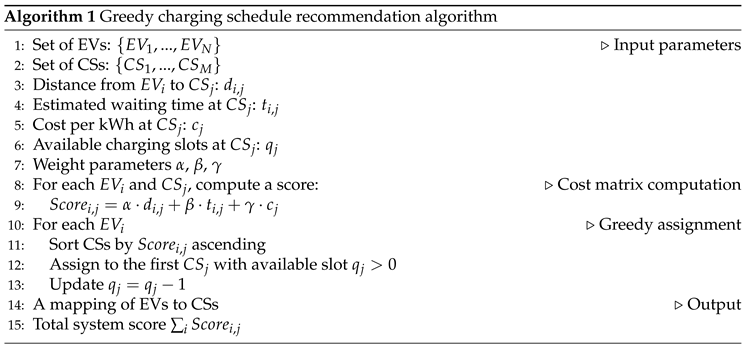
Charging schedule recommendation: Deciding the charging schedule is very important for the improvement of our system performance. More specifically, it is important for the EVs to decide dynamically when and where to charge and not deciding randomly simply based on their proximity to a CS and the battery level. Additionally, CSs can play a crucial role when they cooperate with each other and with the EVs. This is where a BI model is employed. A dynamic schedule using optimization tools can minimize the cost and waiting times of the involved counterparts while at the same time load balance is achieved across the CS by taking into account the proximity of the EVs and CS, the charging speed and the energy cost. An application can notify EVs’ owners for the optimal time and location of charging. The objectives of the optimization problem are among others: (a) the minimization of waiting time and the travel distance of the EVs, (b) the maximization of the CSs utilization and (c) the minimization of overloading the energy grid during peak hours. Linear programming, multi-agent simulations, game theory are employed. In our previous work, we proposed an innovative market formulation in which autonomous EVs and CSs are motivated to cooperate dynamically with changing roles. We adopted a multi-objective strategy that is repeated in steps [66]. Another formulation of the optimization problem considers the minimization of the cost of both EVs and CSs, as follows:where is the distance between and , is the estimated waiting time of at , and is the charging cost per energy unit at . The binary variable indicates the assignment of the at (the value 1 indicates the assignment, 0 is when is not assigned). The coefficients , and are weight parameters for distance, waiting time, and cost, respectively. The optimization problem is minimized under some constraints as follows:Each EV should be assigned to one CS,Each CS has a limited number of available charging slots, , for the EVs to charge,The total energy charged to the EVs at the CSs ( is the charged energy for at ) should not exceed the maximum grid energy level (namely P),The optimization problem mentioned above is a mixed integer linear programming approach and can be easily solved for medium-sized instances like 100 of EVs and CSs. However, solving the charging schedule recommendation problem becomes computationally difficult in large-scale and real-time scenarios. Thus, we adopt an efficient greedy weighted matching approach that approximates the optimal assignment with significantly lower computational complexity. The greedy approach, described in 1, we compute the cost for each EV-CS pair, based in the weighted sum of travel distance, expected waiting time and energy cost. Next, each EV is assigned to the a CS (the one with the lowest score), among those with available capacity. The algorithm is iterative for all EVs. The complexity of the algorithm is , making it suitable for real-time applications.
-
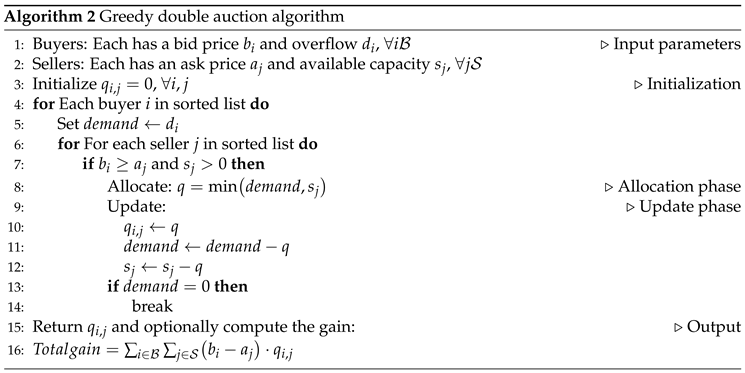
Cooperation among different CSs owners: The second direction of the BI model concerns the motivation for the cooperation of the CS owners in order to optimally utilize the resources and increase the satisfaction of the electric vehicles’ owners. It is evident that the stakeholders that are in charge of deploying the CSs have contraindicative interests. However, a cooperative scheme ensures a fair profit distribution among all the participants of the charging market. After collecting the required data from the EVs (e.g., battery level, charging needs, location, direction of traveling), the CSs (e.g., location, availability, pricing, energy source), the traffic patterns (e.g., peak hours, travel paths) and other sources (e.g., surveys, applications), the data are compiled and processed in order to provide centralized and decentralized solutions, dynamic pricing approaches, load balancing models and profit sharing mechanisms. More specifically, all the CSs’ owners, or at least their majority, are motivated to share some of their data in a common platform or application. Through data processing and the use of AI algorithms, dynamic charging schedules are recommended. These schedules prevent overloading or under-utilization. By using machine learning strategies, we predict peak charging times, and we adjust pricing and availability accordingly by taking into account waiting times, costs, and locations. The BI model decides the charging schedule and then divides the profits fairly among the CSs’ owners based on metrics and key indicators such as utilization and energy contribution. This scheme incentivizes the owners of the charging infrastructure to collaborate without losing their competitiveness. In a previous work, we proposed a double auction mechanism for a wireless network where network operators cooperate to share their traffic [67]. Similar solutions could be employed for the charging market.To facilitate the cooperation among independent CSs, we propose a BI-driven double auction mechanism that enables real-time, market-based coordination of charging demand. In this framework, CSs experiencing excess demand (i.e., overloaded stations) act as buyers (denoted by ), submitting bids, , to offload a portion of their incoming EV traffic. Let be the demand of buyer i, representing the number of EVs they wish to offload. Simultaneously, underutilized CSs act as sellers (denoted by ), offering to accept redirected EVs in exchange for compensation, defined by their ask prices, . We assume is the available capacity of seller j, which is the number of EVs they can accept. The BI system functions as a central auctioneer, matching bids and asks based on pricing compatibility and capacity availability. When a match is found, the participating CSs agree on a clearing price, typically the midpoint between the bid and ask, which ensures mutual benefit. This approach encourages load balancing, enhances overall infrastructure utilization, and creates economic incentives for collaboration, even in competitive environments. The model is scalable, incentive-compatible, and adaptable to both energy and service-based cooperation scenarios. The allocation problem is to determine the optimal solution that maximizes the distinctive objectives of the involved parties in the auction, subject to constraints. The decision variable decides whether a buyer i is matched with a seller j () or not (). We assume the number of EVs transferred from buyer i to seller j. The maximization problem, reflecting the gain from each matched trade, where is the net benefit and is the trade volume, is formulated as follows:s.t.Constraint 6a ensures that each buyer CS i (who wants to offload EVs) cannot offload more EVs than it has in overflow, meaning that the total number of EVs redirected to all sellers from CS i must not exceed demand . Constraint 6b ensures that each seller CS j (who is willing to accept redirected EVs) does not accept more than its remaining charging capacity. The total number of EVs received from all buyers must be less than or equal to the station’s available slots . With constraint 6c, a trade is disallowed between buyer i and seller j if the buyer’s bid is less than the seller’s ask. The constraint 6d links the binary match variable with the number of EVs transferred . If (no trade between i and j), then . If , then can be any value up to a large constant M. Constraint 6e is the binary decision variable and constraint 6f represents a non-negative integer representing the number of EVs traded. A greedy heuristic is a practical solution, which is at the same time fast, simple and effective, to solve the maximization problem in Eq. 5. The double auction approach is shown in Algorithm 2.
5. Case Studies Scenarios and Results
Having described in details the BI model, in this section we outline how the model can be practically applied in the EVs market. The practical paradigms prove the benefits of the proposed BI model. In this section, we present analytical results derived from simulated or real-world datasets, evaluating the performance of the model in terms of scalability, decision support accuracy, and system responsiveness.
The BI model enables strategic decision-making for a wide range of case studies and scenarios. By integrating the data of EVs (e.g., temporal energy charging demand curves, customer preferences and geospatial data), the data from CSs (e.g., information about the CSs infrastructure, real-time charging data) and other data (e.g., surveys and questionnaires), the BI model provides solutions concerning the energy charging problems. Next, we present several scenarios that illustrate the importance of the application of the proposed model to common challenges.
5.1. Charging Schedule Recommendation
To evaluate the performance of the proposed greedy charging schedule recommendation algorithm 1, we assume a real-world urban simulation scenario. There are 6 CSs with varying capacities and service characteristics in the area. More specifically, each CS is located in a km urban region, has a limited charging capacity (number of EVs it can serve concurrently), requires an estimated waiting time and dynamic cost for energy charging that varies with congestion. The simulation parameters of the CSs are summarized in Table 1.
EVs are randomly distributed across the urban region and assigned to CSs based on the score function, denoted in the Algorithm 1. We assume , and , and thus the score is focused on the cost. This assumption is viable, since the minimization of the charging cost is of high importance for the EVs’ owners. The simulation scenario involves 50 EVs that move in the investigated geographical area, requiring energy charging from the CSs.
Figure 3(a) is a heatmap illustrating the EV-to-CS assignment. More specifically, each row represents an EV and each column stands for a CS. When an EV is assigned to a CS, a black square is represented. From the figure, its is served that the proposed algorithm successfully allocates the EVs to the available CSs, while avoiding overlaps and congestion. Additionally, it is noted that the distribution of the EVs across the CSs is non-uniform, reflecting variations in price, distance and waiting time.
In Figure 3(b), the total score, including distance, waiting time and energy cost, of the greedy charging scheduling algorithm is illustrated. Each bar of the histogram represents the number of EVs that are assigned to a CS with a total cost within a specific range. From the figure, it is observed that there is moderate concentration around medium costs (€). This shows that most EVs are assigned to CSs with total scores in this range, highlighting the balance that is achieved through our proposed strategy between distance, waiting time and enegy cost. Very few CSs are willing to accept higher-cost assignments (up to €), however some EVs accept higher-cost assignments when they are far from CSs, or there is high congestion or limited capacity at low-cost CS. Few EVs are assigned to really low-cost CSs (<€) and their low cost is due to the small distance, but still they may suffer from waiting times. From the figure, it is concluded that the algorithm effectively balances load and cost, keeping most costs within a tolerable range. Even though the greedy algorithm does not reach a global optimal solution, it avoids congestion. The algorithm performs well under constraints and provides a viable solution and the BI charging scheduling model realistically distributes the energy resources.
Table 2 provides insight into how the charging schedule recommendation algorithm assigned EVs across available CSs during the simulation. The table includes four key metrics, assigned EVs, CSs capacity, utilization and average cost. It is observed that most CSs achieve high utilization (more than ), indicating the ability of the algorithm to maximize the infrastructure usage. Additionally, the proposed approach is cost-aware, since the CSs that offer energy with higher assignment costs, absorb more EVs if they had excess capacity and are nearer to the EVs. A CS with low utilization might be located further from demand points or have less competitive pricing. This summary validates the effectiveness of the algorithm in spatially distributing EVs, optimizing CS utilization, and maintaining cost-efficiency. It also reveals how BI-based decision-making can balance demand across heterogeneous infrastructure, directly improving the quality of service and economic outcomes in EV environment.
5.2. Cooperation Among Different CSs Owners
To evaluate the BI-based double auction mechanism for the cooperation among different CSs’ owners, we assume 10 independently owned CSs in a high-demand urban area. In more details, we assume that 5 CSs experience traffic overload, each one of them expecting to redirect 5 to 10 EVs that are waiting. Concurrently, 5 underutilized CSs have spare capacity of 4 to 12 available charging slots. The overloaded CSs submit bids indicating the price it is willing to pay per redirected EV, while the underutilized CSs submit ask prices to accept incoming load. The BI model acts as an auctioneer, matching buyer–seller pairs based on bid–ask compatibility and gain maximization. Simulation results show that the auction effectively balances the load, increases infrastructure utilization, and generates measurable economic gain, demonstrating the viability of cooperative load management among CS stakeholders.
Figure 4(a) illustrates the economic gains that are produced after a matching of overloaded buyers CSs with underutilized sellers CSs is succeeded. The rows and the columns represent the buyers and the sellers, respectively. The values in each cell indicate the gains from each feasible matching. From the figure, it is observed that a number of buyer-seller pairs achieve high gains (> €), indicating favorable trading conditions (high bid, low ask, and large quantity). The zero cells represent infeasible matches, when the bids are too low or capacity and demand constraints prevent the trade. Thus, it is concluded that the BI model prioritizes gain-maximizing matches, validating greedy matching logic.
Continuously, Figure 4(b) shows how many EVs each seller CS agreed to accept from overloaded CSs as part of the double auction algorithm. First, one observation is that sellers with lower ask values and higher capacity accept more EVs, confirming the gain maximization. A second observation is noted from the figure. More specifically, one or two sellers may dominate the accepted load, indicating that some CSs are more strategically positioned to absorb redirected traffic - due to either pricing competitiveness or availability. Last, other sellers may accept fewer or no EVs, because: their ask prices were too high relative to bids or their available capacity was exhausted in previous matches. In conclusion, the proposed model improves the utilization and revenue of the CSs through dynamic cooperation rather than isolated pricing strategies.
The histogram of Figure 4(c) shows the distribution of total gain values across all matched buyer–seller pairs in the double auction. First, as it is observed, most matches achieve moderate gains (€), while fewer achieve gain of €4. The distribution of the gains highlights the inefficient or marginally profitable trades are excluded by the greedy approach. The mechanism not only balances load but creates measurable financial value that could be shared among CS stakeholders. This supports the economic feasibility and incentive-alignment of the cooperation model.
6. Discussion
The results of the Algorithm 1 evaluated the performance in an urban scenario with spatial and temporal variations. The assignment approach confirmed that the algorithm successfully distributed EVs across CSs without violating capacity constraints. Additionally, the algorithm balanced user preferences for proximity, waiting time, and cost. Moreover, the cost distribution analysis revealed that the algorithm effectively adapted to spatial heterogeneity, allowing for fair and efficient allocation even in scenarios with uneven demand and congestion. These results confirmed that the strategy offers a scalable and responsive solution suitable for dynamic, urban charging environments.
The proposed double auction mechanism for the CSs’ cooperation was evaluated through a simulated scenario involving multiple overloaded and underutilized charging stations. The auction generated economically beneficial matches between CSs. Additionally, the cooperation was not uniformly distributed, meaning that CSs with competitive ask prices and sufficient spare capacity absorbed a higher share of redirected load, improving utilization. The mechanism offered a great potential for profit-sharing among independent CS operators. Overall, the results validate the viability of using auction-based cooperation as a decentralized, market-compatible method to balance infrastructure loads, reduce customer wait times, and enhance grid-wide efficiency without requiring centralized ownership or regulation.
7. Conclusions
In this paper, we proposed a Business Intelligence model designed to enhance cooperation between electric vehicles and charging station owners. We began by reviewing the state-of-the-art literature, identifying both the innovations and limitations of existing approaches. Building on this foundation, we introduced a multi-layered BI architecture that integrates spatial and temporal data collection, predictive analytics, and decision-making components. The model addresses key challenges in EV charging ecosystems, including demand balancing, energy scheduling, cost optimization, and infrastructure planning.
Two core decision-layer strategies were developed: (i) a real-time, greedy charging schedule recommendation algorithm to efficiently assign EVs to CSs, and (ii) a cooperative double auction mechanism that enables CS operators to dynamically redistribute load and share surplus capacity. Simulation results demonstrated that our model improves charging coverage, energy utilization, infrastructure accessibility, operational efficiency, and revenue distribution among stakeholders. These findings highlight the potential of BI-driven coordination to support scalable, decentralized, and intelligent EV charging networks.
Future work will explore real-time deployment in live urban networks and integration with renewable energy forecasting for grid-aware optimization.
References
- Ehsani, M.; Singh, K. V.; Bansal, H. O.; Mehrjardi, R. T. State of the Art and Trends in Electric and Hybrid Electric Vehicles. in Proceedings of the IEEE. 2021, 109, 6, 967–984. [CrossRef]
- Fesli, U.; Ozdemir, M. B.. Electric Vehicles: A Comprehensive Review of Technologies, Integration, Adoption, and Optimization IEEE Access. 2024, 12, 140908-140931. [CrossRef]
- Su, W.; Eichi, H.; Zeng, W.; Chow, M. Y. A Survey on the Electrification of Transportation in a Smart Grid Environment. IEEE Transactions on Industrial Informatics. 2012, 8, 1 1–10. [CrossRef]
- Qiu, D.; Dong, Z.; Wang, Y.; Zhang, N.; Strbac, G.; Kang, C. Decarbonising the GB Power System via Numerous Electric Vehicle Coordination. IEEE Transactions on Power Systems. 2024, 39, 4 5880–5894. [CrossRef]
- Martin, C.; Starace, F.; Tricoire, J. P. Plectric Vehicles for Smarter Cities the Future of Energy and Mobility. Cologny, Switzerland: World Economic Forum, 2018.
- Ahmad, A.; Alam, M. S.; Chabaan, R. A Comprehensive Review of Wireless Charging Technologies for Electric Vehicles. IEEE Transactions on Transportation Electrification. 2018, 4, 1, 38–63. [CrossRef]
- Ramakrishnan, V.; et al. A Comprehensive Review on Efficiency Enhancement of Wireless Charging System for the Electric Vehicles Applications. IEEE Access. 2024, 12, 46967–46994. [CrossRef]
- Mohamed, N.; et al. Comprehensive Analysis of Wireless Charging Systems for Electric Vehicles. IEEE Access. 2022, 10, 43865–43881. [CrossRef]
- Shanmugam, Y.; et al. A Systematic Review of Dynamic Wireless Charging System for Electric Transportation. IEEE Access. 2022, 10, 133617–133642. [CrossRef]
- Sagar, A.; et al. A Comprehensive Review of the Recent Development of Wireless Power Transfer Technologies for Electric Vehicle Charging Systems. IEEE Access. 2023, 11, 83703–83751. [CrossRef]
- Mohammed, S. A. Q.; Jung J. W. A Comprehensive State-of-the-Art Review of Wired/Wireless Charging Technologies for Battery Electric Vehicles: Classification/Common Topologies/Future Research Issues. IEEE Access. 2021, 9, 19572–19585. [CrossRef]
- Acharige, S. S. G.; Haque, M. E.; Arif, M. T.; Hosseinzadeh, N.; Hasan, K. N.; Oo, A. M. T. Review of Electric Vehicle Charging Technologies, Standards, Architectures, and Converter Configurations. IEEE Access. 2023, 11, 41218–41255. [CrossRef]
- Mukherjee, J. C.; Gupta, A. A Review of Charge Scheduling of Electric Vehicles in Smart Grid. IEEE Systems Journal. 2015, 9, 4 1541–1553. [CrossRef]
- Shuai, W.; Maillé, P.; Pelov, A. Charging Electric Vehicles in the Smart City: A Survey of Economy-Driven Approaches. IEEE Transactions on Intelligent Transportation Systems. 2016, 17, 8 2089–2106. [CrossRef]
- Wang, Q.; Liu, X.; Du, J.; Kong, F. Smart Charging for Electric Vehicles: A Survey From the Algorithmic Perspective. IEEE Communications Surveys & Tutorials. 2016, 18, 2 1500–1517. [CrossRef]
- Al-Alwash, H. M.; Borcoci, E; Vochin, M. C.; Balapuwaduge, I. A. M.; Li, F. Y. Optimization Schedule Schemes for Charging Electric Vehicles: Overview, Challenges, and Solutions. IEEE Access. 2024, 12, 32801–32818. [CrossRef]
- Jin, C.; Tang, J.; Ghosh, P. Optimizing electric vehicle charging with energy storage in the electricity market. IEEE Transactions on Smart Grid. 2013, 4, 1, 311–320. [CrossRef]
- Wang, J.; Kang, L.; Liu, Y. Optimal scheduling for electric bus fleets based on dynamic programming approach by considering battery capacity fade. Renewable and Sustainable Energy Reviews. 2020, 130. [CrossRef]
- Zhou, Y.; Li, Z.; Liu, Y; Wu, X. The multiobjective based large-scale electric vehicle charging behaviours analysis. Complexity. 2018.
- Savari, G. F.; Krishnasamy, V.; Sugavanam, V.; Vakesan, K. Optimal charging scheduling of electric vehicles in micro grids using priority algorithms and particle swarm optimization. Mobile Networks and Applications. 2019, 24, 6, 1835–1847. [CrossRef]
- Alonso, M.; Amaris, H.; Germain, J.; Galan, J. Optimal charging scheduling of electric vehicles in smart grids by heuristic algorithms. Energies. 2014, 7, 4, 2449–2475. [CrossRef]
- Yuvaraj, T.; Devabalaji, K. R.; Kumar, J. A.; Thanikanti, S. B.; Nwulu, N. I. A Comprehensive Review and Analysis of the Allocation of Electric Vehicle Charging Stations in Distribution Networks. IEEE Access. 2024, 12, 5404–5461. [CrossRef]
- de Lima, T. D.; Franco, J. F.; Lezama, F.; Soares, J.; Vale, Z. Joint optimal allocation of electric vehicle charging stations and renewable energy sources including CO2 emissions. Energy Information. 2021, 4, 1–18. [CrossRef]
- Shaaban, M. F.; Mohamed, S.; Ismail, M.; Qaraqe, K. A.; Serpedin, E. Joint planning of smart EV charging stations and DGs in eco-friendly remote hybrid microgrids. IEEE Transactions on Smart Grid. 2019, 10, 5, 5819–5830. [CrossRef]
- Lin, L.; Shen, S.; Liao, Y.; Wang, C.; Shahabi, L. Shunt capacitor allocation by considering electric vehicle charging stations and distributed generators based on optimization algorithm. Energy. 2022, 239, 5819–5830. [CrossRef]
- Golla, N. K.; Sudabattula, S. K.; Suresh, V. Optimal placement of electric vehicle charging station in distribution system using meta-heuristic techniques. Mathematical Modelling and Engineering Problems. 2022, 9, 1, 60–66. [CrossRef]
- Bilal, M.; Alsaidan, I.; Alaraj, M.; Almasoudi, F. M.; Rizwan, M. Techno-economic and environmental analysis of grid-connected electric vehicle charging station using AI-based algorithm. Mathematics 2022, 10, 6, 60–66. [CrossRef]
- Ahmad, F.; Ashraf, I.; Iqbal, A.; Marzband, M.; Khan, I. A novel AI approach for optimal deployment of EV fast charging station and reliability analysis with solar based DGs in distribution network. Energy Reports 2022, 8, 11646–11660. [CrossRef]
- Eldjalil, C.D.A.; Lyes, K. Optimal priority-queuing for EV charging-discharging service based on cloud computing. In Proceedings of the IEEE International Conference on Communications (ICC), Paris, France, 21–25 May 2017; pp. 1–6. [CrossRef]
- Moghaddam, Z.; Ahmad, I.; Habibi, D.; Masoum, M.A.S. A coordinated dynamic pricing model for electric vehicle charging stations. IEEE Transactions on Transportation Electrification. 2019, 5, 226–238. [CrossRef]
- Qin, H.; Zhang, W. Charging scheduling with minimal waiting in a network of electric vehicles and charging stations. In Proceedings of the Eighth ACM international workshop on Vehicular inter-networking (VANET ’11). Association for Computing Machinery. 2011. [CrossRef]
- Häusler, F.; Crisostomi, E.; Schlote, A.; Radusch, I.; Shorten, R. Stochastically Balanced Parking and Charging for Fully Electric and Plug-in Hybrid Vehicles. In Proceedings of the International Conference on Connected Vehicles and Expo (ICCVE). 2012. [CrossRef]
- Klappenecker, A.; Lee, H.; Welch, J. L. Finding available parking spaces made easy. Ad Hoc Networks. 2014. 12. [CrossRef]
- Häusler, F.; Crisostomi, E.; Schlote, A.; Radusch, I.; Shorten, R. Stochastic Park-and-Charge Balancing for Fully Electric and Plug-in Hybrid Vehicles. IEEE Transactions on Intelligent Transportation Systems. 2014. 15, 2. [CrossRef]
- Dai, Q.; Cai, T.; Duan, S.; Zhao, F. Stochastic Modeling and Forecasting of Load Demand for Electric Bus Battery-Swap Station. IEEE Transactions on Power Delivery. 2014. 29, 4, 1909–1917. [CrossRef]
- Chen, L.; Chung, C. Y.; Nie, Y.; Yu, R. Modeling and optimization of electric vehicle charging load in a parking lot. In Proceedings of the IEEE PES Asia-Pacific Power and Energy Engineering Conference (APPEEC). 2013, 1–5. [CrossRef]
- Liu, X.; Feng, T. Energy-storage configuration for EV fast charging stations considering characteristics of charging load and wind-power fluctuation. Global Energy Interconnection. 2021, 4, 1, 48–57. [CrossRef]
- Obeidat, M. A.; Almutairi, A.; Alyami, S.; Dahoud, R.; Mansour, A. M.; Aldaoudeyeh, A.-M.; Hrayshat, E. S. Effect of electric vehicles charging loads on realistic residential distribution system in aqabajordan. World Electric Vehicle Journal. 2021, 12, 4, 218. [CrossRef]
- Sortomme, E.; El-Sharkawi, M. A. Optimal charging strategies for unidirectional vehicle-to-grid. IEEE Transactions on Smart Grid. 2011, 2, 1, 131–138. [CrossRef]
- Han, S.; Han, S.; Sezaki, K. Development of an Optimal Vehicle-to-Grid Aggregator for Frequency Regulation. IEEE Transactions on Smart Grid. 2010, 1, 1, 65–72. [CrossRef]
- Sortomme, E.; El-Sharkawi, M. A. Optimal Scheduling of Vehicle-to-Grid Energy and Ancillary Services. IEEE Transactions on Smart Grid. 2012, 3, 1, 351–359. [CrossRef]
- Koufakis, A. M.; Rigas, E. S.; Bassiliades, N.; Ramchurn, S. D. Offline and Online Electric Vehicle Charging Scheduling With V2V Energy Transfer. IEEE Transactions on Intelligent Transportation Systems. 2020, 21, 5, 2128–2138. [CrossRef]
- Khodayar, M. E.; Wu, L.; Shahidehpour, M. Hourly Coordination of Electric Vehicle Operation and Volatile Wind Power Generation in SCUC. IEEE Transactions on Smart Grid. 2012, 3, 3, 1271–1279. [CrossRef]
- Sortomme, E.; Hindi, M. M.; MacPherson, S. D. J.; Venkata, S. S. Coordinated Charging of Plug-In Hybrid Electric Vehicles to Minimize Distribution System Losses. IEEE Transactions on Smart Grid. 2011, 2, 1, 198–205. [CrossRef]
- Sortomme, E.; El-Sharkawi, M. A. Optimal Combined Bidding of Vehicle-to-Grid Ancillary Services. IEEE Transactions on Smart Grid. 2012, 3, 1, 70–79. [CrossRef]
- Deilami, S.; Masoum, A. S.; Moses, P. S.; Masoum, M. A. S. Real-Time Coordination of Plug-In Electric Vehicle Charging in Smart Grids to Minimize Power Losses and Improve Voltage Profile. IEEE Transactions on Smart Grid. 2011, 2, 3, 456–467. [CrossRef]
- Zhang, T.; Chen, W.; Han, Z.; Cao, Z. Charging Scheduling of Electric Vehicles With Local Renewable Energy Under Uncertain Electric Vehicle Arrival and Grid Power Price. IEEE Transactions on Vehicular Technology. 2014, 63, 6, 2600–2612. [CrossRef]
- He, Y.; Venkatesh, B.; Guan, L. Optimal Scheduling for Charging and Discharging of Electric Vehicles. IEEE Transactions on Smart Grid. 2012, 3, 3, 1095–1105. [CrossRef]
- Wen, C. K.; Chen, J. C.; Teng, J. H; Ting, P. Decentralized Plug-in Electric Vehicle Charging Selection Algorithm in Power Systems. IEEE Transactions on Smart Grid. 2012, 3, 4, 1779–1789. [CrossRef]
- Fan, Z. A Distributed Demand Response Algorithm and Its Application to PHEV Charging in Smart Grids. IEEE Transactions on Smart Grid. 2012, 3, 3, 1280–1290. [CrossRef]
- Ota, Y.; Taniguchi, H.; Nakajima, T.; Liyanage, K. M.; Baba, J.; Yokoyama, A. A Autonomous Distributed V2G (Vehicle-to-Grid) Satisfying Scheduled Charging. IEEE Transactions on Smart Grid. 2012, 3, 1, 559–564. [CrossRef]
- Jin, R.; Wang, B.; Zhang, P.; Luh, P. B. Decentralised online charging scheduling for large populations of electric vehicles: A cyber-physical system approach. International Journal of Parallel Emergent and Distributed Systems. 2013, 28, 1, 29–45. [CrossRef]
- Yang, D.; Sarma, N. J.; Hyland, M. F.; Jayakrishnan, R. Dynamic modeling and real-time management of a system of EV fast-charging stations. Transportation Research Part C: Emerging Technologies. 2021. [CrossRef]
- Tan, M.; Ren, Y.; Pan, R.; Wang, L.; Chen, J. Fair and Efficient Electric Vehicle Charging Scheduling Optimization Considering the Maximum Individual Waiting Time and Operating Cost. IEEE Transactions on Vehicular Technology. 2023, 72, 8, 9808–9820. [CrossRef]
- Hou, L.; Yan, J.; Wang, C.; Ge, L. A Simultaneous Multi-Round Auction Design for Scheduling Multiple Charges of Battery Electric Vehicles on Highways. IEEE Transactions on Intelligent Transportation Systems. 2022, 23, 7, 8024–8036. [CrossRef]
- Zhang, Y.; Yang, Q.; An, D.; Li, D.; Wu, Z. Multistep Multiagent Reinforcement Learning for Optimal Energy Schedule Strategy of Charging Stations in Smart Grid. IEEE Transactions on Cybernetics. 2023, 53, 7, 4292–4305. [CrossRef]
- Shi, J.; Ye, Z.; Gao, H. O.; Yu, N. Lyapunov Optimization in Online Battery Energy Storage System Control for Commercial Buildings. IEEE Transactions on Smart Grid. 2023, 14, 1, 328–340. [CrossRef]
- Moghaddam, Z.; Ahmad, I.; Habibi, D.; Phung, Q. V. Smart Charging Strategy for Electric Vehicle Charging Stations. IEEE Transactions on Transportation Electrification. 2018, 4, 1, 76–88. [CrossRef]
- Lam, A. Y. S.; Leung, Y. W.; Chu, X. Electric vehicle charging station placement. In Proceedings of the IEEE International Conference on Smart Grid Communications (SmartGridComm. 2013, 510–515. [CrossRef]
- Gatica, G.; Ahumada, G.; Escobar, J. W.; Linfati, R. SEfficient heuristic algorithms for location of charging stations in electric vehicle routing problems. Studies in Informatics and Control. 2018, 17, 73–82. [CrossRef]
- Lam, A. Y. S.; Leung, Y. W.; Chu, X. Electric vehicle charging station placement: formulation, complexity, and solutions. IEEE Transactions on Smart Grid. 2014, 5, 6, 2846–2856, Nov. 2014. [CrossRef]
- Zhang, Y.; Wang, Y.; Li, F.; Wu, B.; Chiang, Y. Y.; Zhang, X. Efficient Deployment of Electric Vehicle Charging Infrastructure: Simultaneous Optimization of Charging Station Placement and Charging Pile Assignment. IEEE Transactions on Intelligent Transportation Systems. 2021, 22, 10, 6654–6659. [CrossRef]
- Wang, S.; Dong, Z. Y.; Luo, F.; Meng, K.; Zhang, Y. Stochastic Collaborative Planning of Electric Vehicle Charging Stations and Power Distribution System. IEEE Transactions on Industrial Informatics. 2018, 14, 1, 321–331. [CrossRef]
- Xiong, Y.; Gan, J.; An, B.; Miao, C.; Bazzan, A. L. C. Optimal Electric Vehicle Fast Charging Station Placement Based on Game Theoretical Framework. IEEE Transactions on Intelligent Transportation Systems. 2018, 19, 8, 2493–2504. [CrossRef]
- Fathollahi, A.; Derakhshandeh, S. Y.; Ghiasian, A.; Masoum, M. A. S. Optimal Siting and Sizing of Wireless EV Charging Infrastructures Considering Traffic Network and Power Distribution System. IEEE Access. 2022, 10, 117105–117117. [CrossRef]
- Bousia, A.; Daskalopulu, A.; Papageorgiou, E.I. An Auction Pricing Model for Energy Trading in Electric Vehicle Networks. Electronics. 2023, 12, 3068. [CrossRef]
- Bousia, A.; Daskalopulu, A.; Papageorgiou, E.I. Double Auction Offloading for Energy and Cost Efficient Wireless Networks. Mathematics. 2022, 10, 4231. [CrossRef]
Figure 1.
System model with N EVs and M CSs.
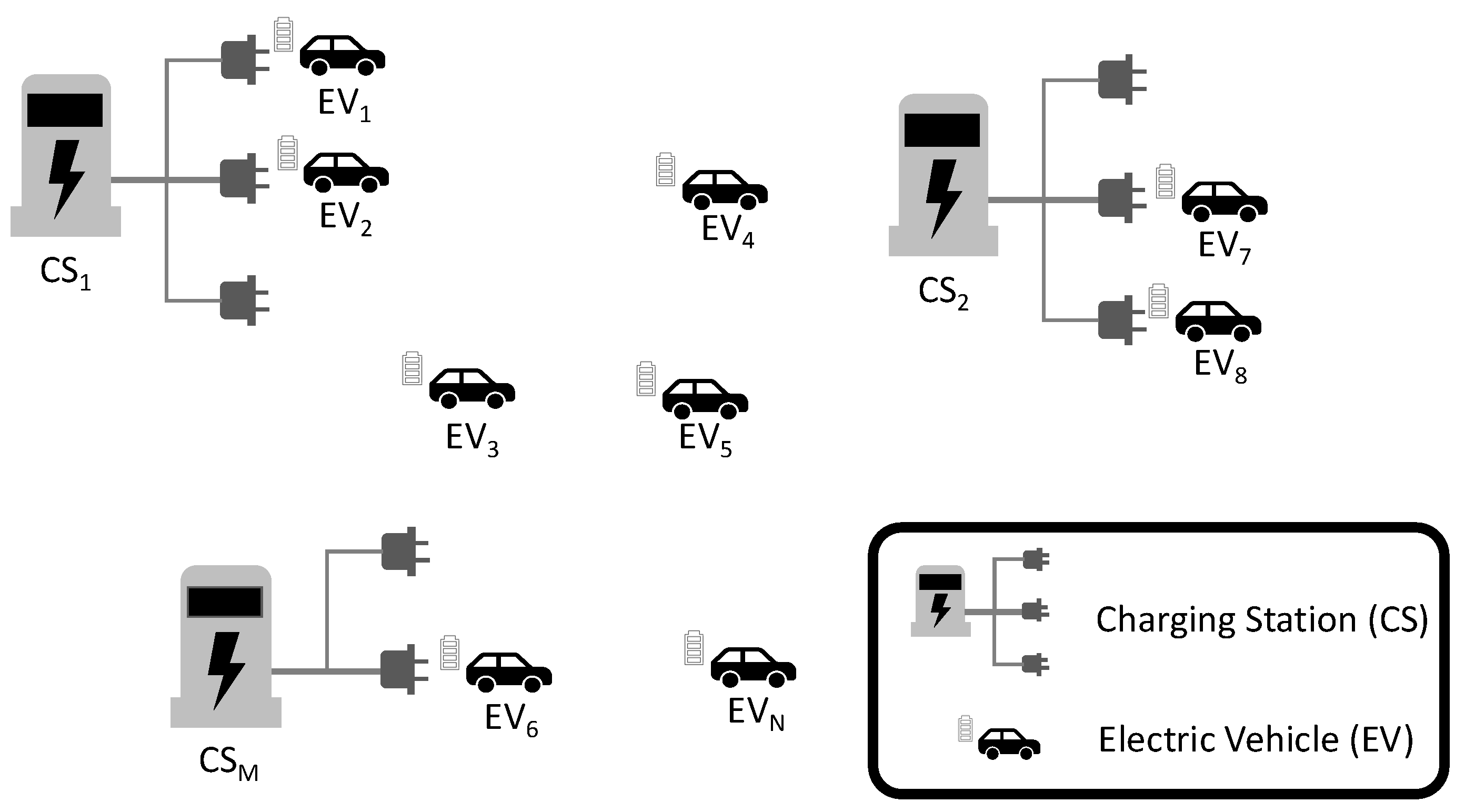
Figure 2.
Business Intelligence Model Architecture.
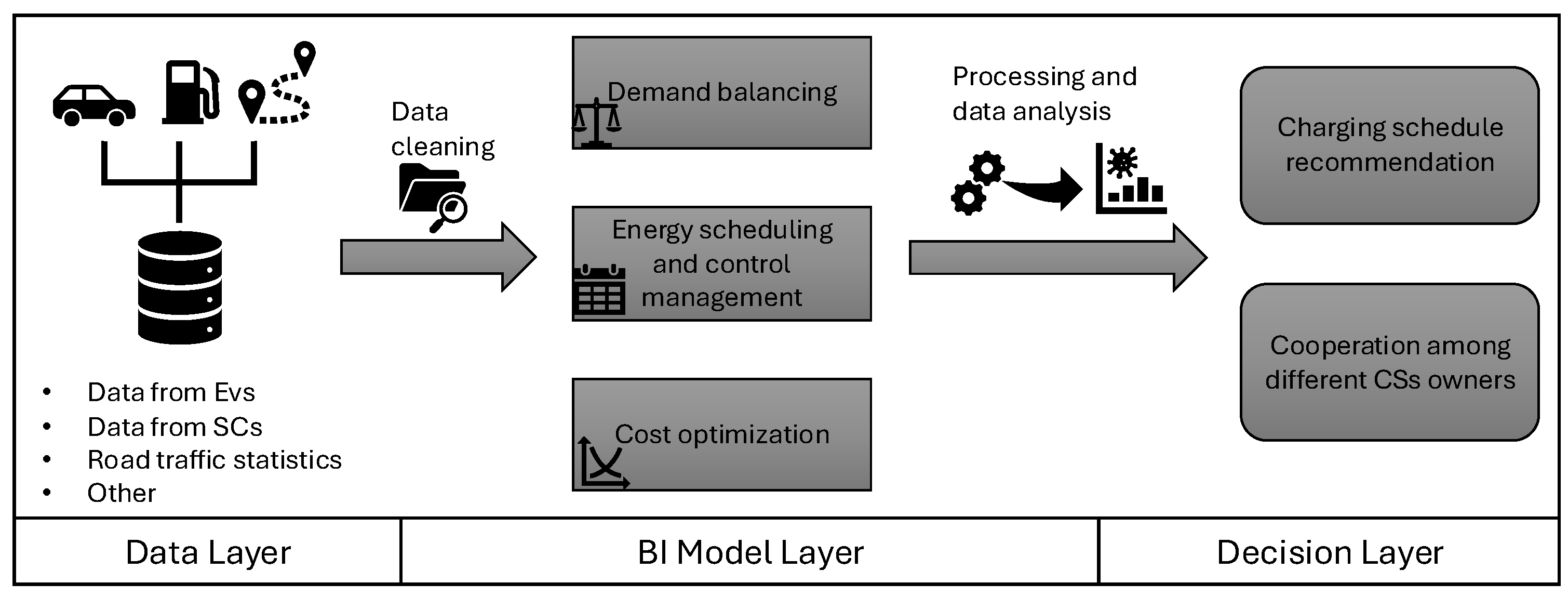
Figure 3.
Charging schedule recommendation results. (a) EVs assignment to CSs. (b) Distribution of assignment costs.
Figure 3.
Charging schedule recommendation results. (a) EVs assignment to CSs. (b) Distribution of assignment costs.
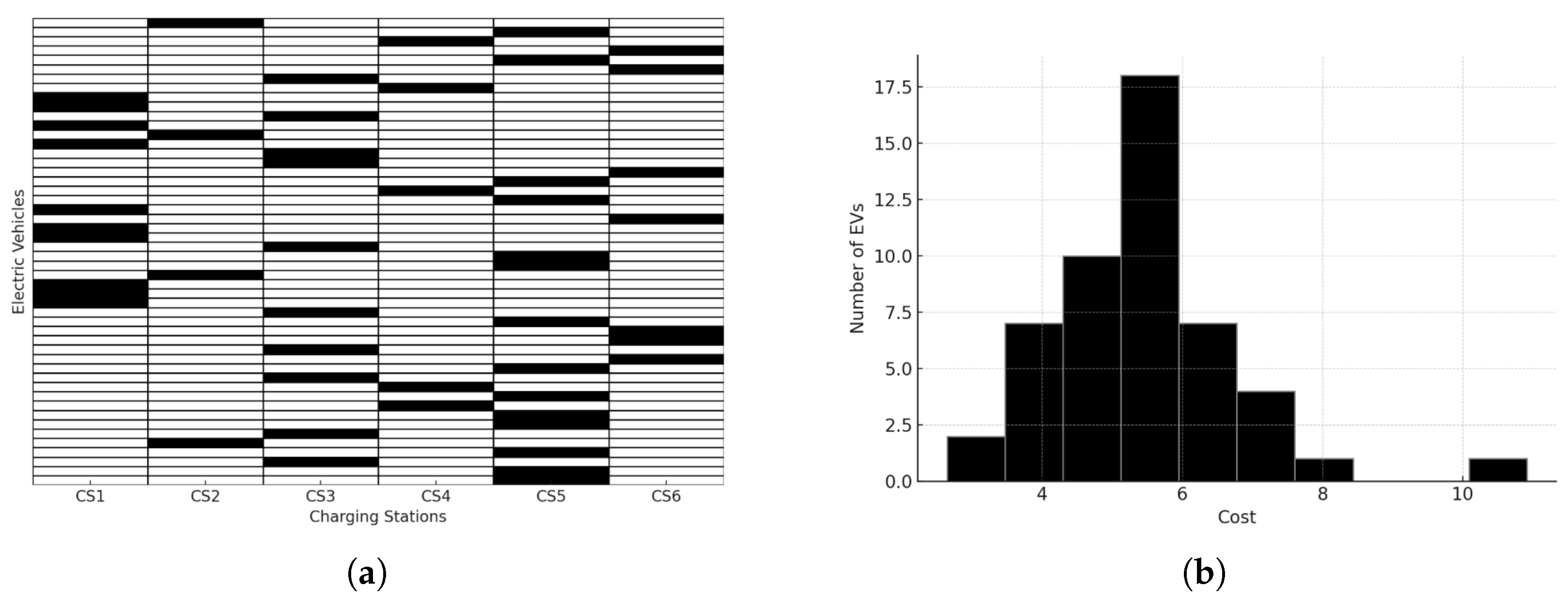
Figure 4.
Cooperation among different CSs owners results. (a) Gains for matching pairs of CSs and EVs. (b) EVs accepted by each seller CS. (c) Distribution of gains across the matching pairs
Figure 4.
Cooperation among different CSs owners results. (a) Gains for matching pairs of CSs and EVs. (b) EVs accepted by each seller CS. (c) Distribution of gains across the matching pairs
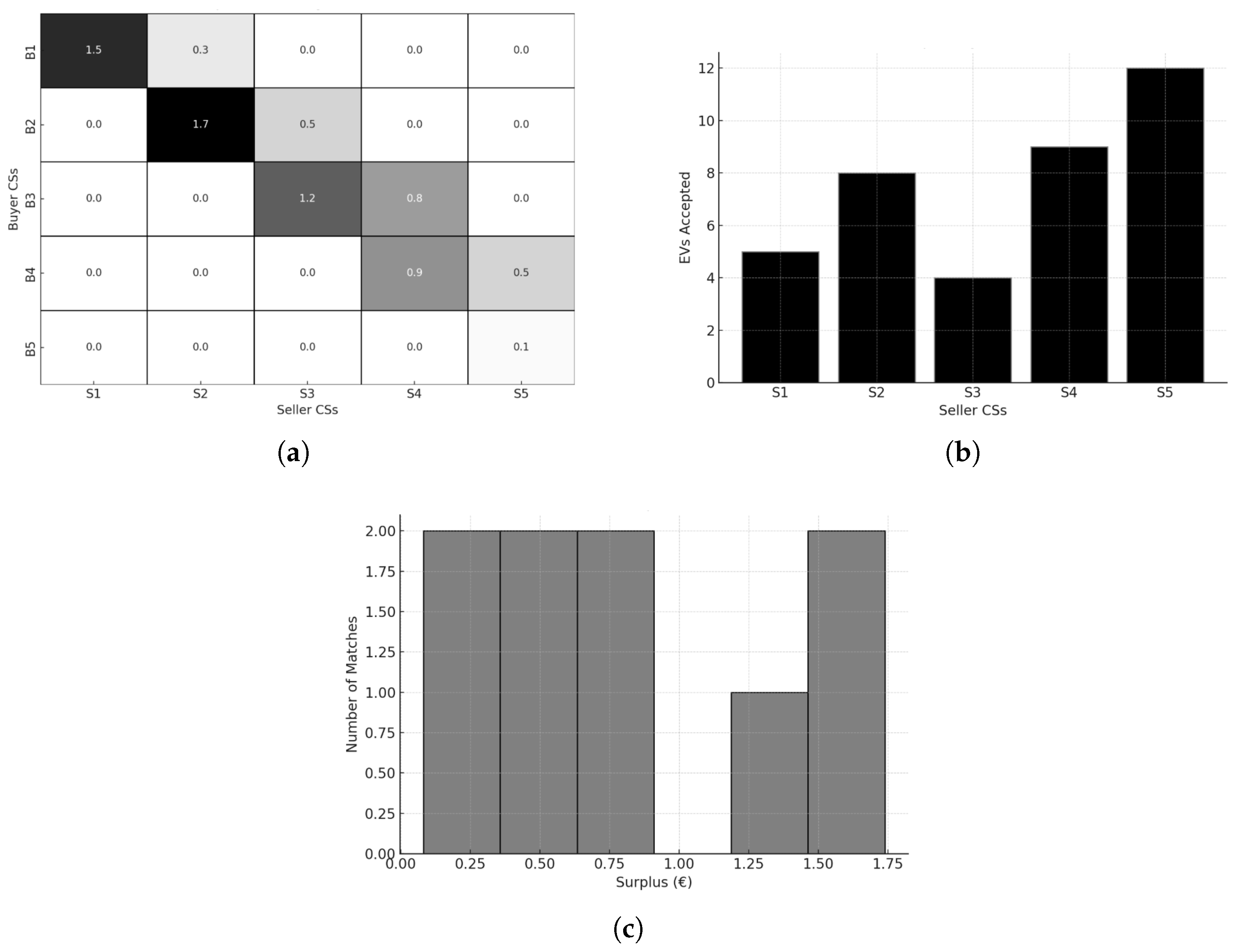

Table 1.
Simulation parameters.
| CS | Capacity | Location coordinates | Wait time (min) | Cost (€/kWh ) |
|---|---|---|---|---|
| 10 | 5 | |||
| 8 | 12 | |||
| 12 | 10 | |||
| 5 | 15 | |||
| 15 | 8 | |||
| 7 | 20 |
Table 2.
Performance summary of charging schedule recommendation strategy.
| CS | Assigned EVs | Capacity | Utilization (%) | Average cost (€) |
|---|---|---|---|---|
| 10 | 10 | |||
| 4 | 8 | |||
| 10 | 12 | |||
| 5 | 5 | |||
| 14 | 15 | |||
| 7 | 7 |
Disclaimer/Publisher’s Note: The statements, opinions and data contained in all publications are solely those of the individual author(s) and contributor(s) and not of MDPI and/or the editor(s). MDPI and/or the editor(s) disclaim responsibility for any injury to people or property resulting from any ideas, methods, instructions or products referred to in the content. |
© 2025 by the authors. Licensee MDPI, Basel, Switzerland. This article is an open access article distributed under the terms and conditions of the Creative Commons Attribution (CC BY) license (http://creativecommons.org/licenses/by/4.0/).
Copyright: This open access article is published under a Creative Commons CC BY 4.0 license, which permit the free download, distribution, and reuse, provided that the author and preprint are cited in any reuse.


