

Submitted:
19 July 2025
Posted:
22 July 2025
You are already at the latest version
Abstract
Nanostores—micro, independent grocery retailers—are often narrowly defined, overlooking their socioeconomic roles and relational significance in favour of primary functional aspects. To close this gap, this study adopts a systemic perspective to examine how multiple stakeholders (such as owners, customers, and suppliers) shape nanostore identity. Accordingly, this study proposes a framework of X-Y-Z identity statements alongside the TASCOI tool to examine nanostore descriptions and map roles, expectations, and transformation processes. This systemic framework, rooted in management cybernetics, enabled the collection and analysis of 178 survey responses from 34 stores in Mexico City. The results show that nanostore identities are varied and context-dependent, operating as grocery stores, family projects, community anchors, economic lifelines, and competitors. This diversity influences stakeholder engagement, resource utilisation, and operational decisions. Overall, this study provides a transferable framework for analysing micro-business identity and transformation, with implications for problem-solving, decision-making, and policy development. Limitations include its geographical cross-sectional design, limited sampling method, reliance on self-reported perceptions, and lack of generalisability to other populations. Future research will involve exploring other urban contexts, utilising longitudinal data, expanding the sample, and adopting a participatory research approach to gain a deeper understanding of identity dynamics and their implications for nanostore resilience and survivability.
Keywords:
corner shops
; emerging markets
; grocery retail
; kirana stores
; management cybernetics
; mop-and-pop stores
; sari-sari stores
; systems thinking
; tienditas
1. Introduction
Nanostores — micro, independent, and often family-operated grocery retailers — play a central role in the daily lives and economies of urban neighbourhoods in emerging market economies [1,2]. In low and middle-income urban areas of many countries in the Global South, their proximity and reliability sustain high consumer reliance for fast-moving consumer goods (D'Andrea et al. 2006; Escamilla González Aragón et al. 2020; Fransoo et al. 2017). Unlike transactional nodes in supply chains, nanostores are embedded establishments that facilitate livelihoods, neighbourhood cohesion, and community trust. However, they also face significant challenges, including competitive pressures from formal and larger retail formats, as well as inefficiencies stemming from their small-scale operations and limited management expertise, which jeopardise their survivability [5].
Recent academic studies have conceptualised nanostores in fairly limited ways, with a focus on narrow operational and functional definitions. Typical definitions focus mainly on primary features such as the sizes of retail units, product ranges provided, working patterns in unorganised settings, or diverse selling modes; however, they pay little attention to larger social as well as economic roles played by these units [1,2,6]. In addition, the varied local terminology assigned to these stores (such as corner shops, sara-sari, kiranas, bodegas, or tienditas) testifies to their locally distinct roles [7,8,9]. While the literature acknowledges heterogeneity, current characterisations still fail to capture the full complexity of nanostore identity —" what they are" [10].
This study addresses the fragmented and limited conceptualisations of nanostore identity as a research problem. Nanostores are characterised as static, rigid entities, defined by what they sell and how they primarily operate as grocery retailers, without recognising other features of their identity [11,12,13]. Omitting this aspect significantly undermines the comprehension of nanostores' constant adaptation (and change) to varied stakeholder demands and shifting environmental contexts. Additionally, it diminishes our capacity to create practical business support and policies, as well as initiatives that could enhance these enterprises' competitiveness, resilience, or even their broader societal contributions [14].
This work considers that nanostores, in particular, do not fully align with conventional logistics or operational definitions of retailers or micro-enterprises. Their operation goes well beyond basic commercial transactions and instead reflects more complex social dynamics. Frequently, these businesses merge household and commercial activities [7], depend on family and kinship-based labour relations [2], provide informal financial services within their communities [5], and foster neighbourhood cohesion and trust [15]. These features collectively indicate that the identity of nanostores is fluid rather than fixed, which emerges from ongoing interactions among shopkeepers, customers, suppliers, competitors, regulators, and even manufacturers [16]. However, few studies offer tools or frameworks for systemically examining these multifaceted identities among stakeholders.
To address this void, the present study adopts a systemic approach rooted in the theory of management cybernetics, "the science of effective organisation" (Beer, 1985; Espejo, Bowling, and Hoverstadt, 1999; Ulrich and Probst, 1984). It conceptualises nanostores as relational systems that constitute their identity through what they do (X), how they function (Y), and why they matter (Z), alongside mapping stakeholder relationships within retail environments employing the TASCOI tool (i.e., Transformation, Actors, Suppliers, Customers, Owners, and Interveners) [18]. This perspective adopts a systemic integrated framework that emphasises the internal and external connections, structure, and significance of nanostores. Therefore, the following research questions (RQ) guide this work:
RQ1: How can nanostores' identity be explored to recognise key elements and characteristics in their roles beyond transactional retail and physical aspects that allow for improving their management and operations across different contexts?
RQ2: How can we effectively address the variations in identity recognition arising from multiple stakeholders' perspectives and relationships to enhance nanostore competitiveness and survivability?
Accordingly, this work aims to provide a framework and methodological approach for the systematic and contextual understanding of nanostore identity, informed by stakeholders. This proposition examines how identity is experienced and articulated across diverse stakeholder roles and functions (contrasting with prior functionalist approaches that focus on physical and operational traits), and integrates the perspectives of multiple stakeholders. Rather than seeking a universal definition, it offers a structured yet flexible framework for recognising identity patterns in specific retail contexts. In this sense, nanostores are regarded as flexible, deeply integrated micro-businesses within their unique and changing retail contexts. Any effective intervention, policy, or strategy must consider the nuanced and particular realities that these retailers navigate daily. Recognising this complexity is essential to support their continued competitiveness and resilience.
This work unfolds into five additional sections. Section 2 presents a literature review of the roles and functions of nanostores. Additionally, it provides a framework for studying nanostores as purposeful systems. Rooted in the work on human activity and interaction systems [18,20], Section 3 presents a methodology that integrates systemic X-Y-Z identity statements and the TASCOI tool to describe the identity of nanostores. The methodology examines the identity of nanostores in Mexico City, highlighting it as a relevant case in developing countries. Section 4 presents the results of stakeholder variations in nanostore identity statements and TASCOI descriptions. Section 5 presents the main findings, implications, limitations, and future work of this study. Finally, Section 6 concludes this work by providing the main takeaways.
2. Literature review
The existing literature on nanostores primarily focuses on their retail operations, roles within supply chains, and interactions with end consumers, aligning with efficientist perspectives from supply chain and operations management. Nevertheless, to better understand nanostores — "what they are"— we must explore “what they do” and their roles in stakeholders' relationships [10]. This idea examines what defines nanostores, focusing on how they distinguish themselves as micro-retail businesses operating in challenging markets and evolving socioeconomic conditions.
Many nanostore owners, or shopkeepers, work to maintain their household livelihoods with the help of nanostore businesses [6]. These individuals often choose to operate them from their own homes, utilising domestic spaces such as kitchens or garages for commercial purposes. This integration of living and working environments helps minimise investments and overhead expenses. Initial investments are typically quite limited, frequently sourced from personal savings or informal lending among acquaintances. In terms of labour, these enterprises generally remain relatively small, commonly involving no more than two participants, who are usually family members [2].
Nanostores are physically constrained (15-40 m²), typically offering counter service, and have limited stock consisting of fast-moving consumer goods [1,2]. However, nanostores consistently adapt their product selections to align with shifting customer preferences and the retail environment (Rangel-Espinosa et al. 2020). The frequency and type of restocking generally depend on the shopkeeper's insights into what local customers seek and what they can practically afford, given the limited cash flow commonly present in these settings [9]. These decisions are often made on the spot, without formal logistics systems, and sometimes influenced directly by the brands or distributors supplying the goods. [2,6].
Nanostores are commonly located in residential areas, a few blocks away from customers and serve about 120 locals. The socioeconomic profile of neighbourhoods influences their significance and role [9,12]. These nanostores frequently provide more than just basic retail in middle- and upper-class neighbourhoods, as they may offer home delivery, digital payment options, utility bill payment services, and a greater range of products.
Conversely, nanostores in low-income areas typically offer limited assortments at small quantities and affordable prices (though often more expensive per unit). Consequently, nanostores demonstrate adaptive and responsive business models that cater to the diverse needs of various end consumers across different contexts [9].
In mid-income neighbourhoods, nanostores often densely cluster near primary and secondary roads close to other retail formats, households, and high-traffic areas. Contrarywise, modern, high-end retail outlets frequently dominate high-income areas with fewer stores, while traditional, scattered nanostore distributions prevail in low-income neighbourhoods. Consequently, the proximity of nanostores to consumers is crucial due to their accessibility to supply and convenience [5].
From a food security perspective, nanostores have a significant impact on food supply and (mal-)nutrition [21,22]. Nanostores are proximity supply points for food and household essentials in communities. However, food product assortments mainly focus on high-calorie CPGs rather than fresh produce or nutritious alternatives. The short shelf life of perishable products creates this situation due to the highly competitive prices of processed food, long expiration dates, and high rotation of junk food [23,24]. Therefore, nanostores influence the type of food available in neighbourhoods.
Nanostores also contribute significantly to the generation of solid waste from an environmental perspective [25,26]. Cardboard and packaging materials frequently accumulate and, in other cases, are discarded without proper supervision or use. This persistent generation of waste underscores the necessity for responsible and environmentally friendly practices. However, despite this need, these waste management methods are usually unofficial, unattractive, or completely disregarded in developing countries. Hence, nanostores must play a crucial role in waste reduction to benefit their communities environmentally.
In some cases, nanostores sustain strong, long-lasting relationships and recurrent contact with their clientele, driven by their proximity, familiarity, empathetic treatment, and genuine sense of community [5,13]. This condition makes them an essential part of neighbourhoods due to their social capital [14].
Moreover, nanostores often function as community gathering points, facilitating the sharing of local stories and narratives, while also overlooking local security issues. They also provide personal, emotional, and even daily financial support to individuals within the neighbourhood (Coen et al. 2008; D'Andrea et al. 2006). Due to these efforts, nanostores strengthen community socioeconomic bonds [15].
Accordingly, a nanostore's identity either aligns with or differs from its context, influencing nanostore management, competitiveness, and its impact on the community. Framing nanostores as systemically embedded units—rather than isolated business units—can provide a richer, more actionable understanding of their roles and challenges in today's evolving retail environment. In this sense, this study examines how various stakeholder viewpoints, including those of owners, consumers, suppliers, and competitors, influence our understanding of the nanostore functions and identity. We can better understand the distinct identities of nanostores and enhance our ability to support their competitiveness, resilience, and integration into larger retail systems by considering these varied perspectives.
The existing literature on nanostores primarily focuses on their retail operations, roles within supply chains, and interactions with end consumers, aligning with efficientist perspectives from supply chain and operations management. Nevertheless, to better understand nanostores — "what they are"— we must explore “what they do” and their roles in stakeholders' relationships [10]. This idea examines what defines nanostores, focusing on how they distinguish themselves as micro-retail businesses operating in challenging markets and evolving socioeconomic conditions.
Many nanostore owners, or shopkeepers, work to maintain their household livelihoods with the help of nanostore businesses [6]. These individuals often choose to operate them from their own homes, utilising domestic spaces such as kitchens or garages for commercial purposes. This integration of living and working environments helps minimise investments and overhead expenses. Initial investments are typically quite limited, frequently sourced from personal savings or informal lending among acquaintances. In terms of labour, these enterprises generally remain relatively small, commonly involving no more than two participants, who are usually family members [2].
Nanostores are physically constrained (15-40 m²), typically offering counter service, and have limited stock consisting of fast-moving consumer goods [1,2]. However, nanostores consistently adapt their product selections to align with shifting customer preferences and the retail environment (Rangel-Espinosa et al. 2020). The frequency and type of restocking generally depend on the shopkeeper's insights into what local customers seek and what they can practically afford, given the limited cash flow commonly present in these settings [9]. These decisions are often made on the spot, without formal logistics systems, and sometimes influenced directly by the brands or distributors supplying the goods. [2,6].
Nanostores are commonly located in residential areas, a few blocks away from customers and serve about 120 locals. The socioeconomic profile of neighbourhoods influences their significance and role [9,12]. These nanostores frequently provide more than just basic retail in middle- and upper-class neighbourhoods, as they may offer home delivery, digital payment options, utility bill payment services, and a greater range of products.
Conversely, nanostores in low-income areas typically offer limited assortments at small quantities and affordable prices (though often more expensive per unit). Consequently, nanostores demonstrate adaptive and responsive business models that cater to the diverse needs of various end consumers across different contexts [9].
In mid-income neighbourhoods, nanostores often densely cluster near primary and secondary roads close to other retail formats, households, and high-traffic areas. Contrarywise, modern, high-end retail outlets frequently dominate high-income areas with fewer stores, while traditional, scattered nanostore distributions prevail in low-income neighbourhoods. Consequently, the proximity of nanostores to consumers is crucial due to their accessibility to supply and convenience [5].
From a food security perspective, nanostores have a significant impact on food supply and (mal-)nutrition [21,22]. Nanostores are proximity supply points for food and household essentials in communities. However, food product assortments mainly focus on high-calorie CPGs rather than fresh produce or nutritious alternatives. The short shelf life of perishable products creates this situation due to the highly competitive prices of processed food, long expiration dates, and high rotation of junk food [23,24]. Therefore, nanostores influence the type of food available in neighbourhoods.
Nanostores also contribute significantly to the generation of solid waste from an environmental perspective [25,26]. Cardboard and packaging materials frequently accumulate and, in other cases, are discarded without proper supervision or use. This persistent generation of waste underscores the necessity for responsible and environmentally friendly practices. However, despite this need, these waste management methods are usually unofficial, unattractive, or completely disregarded in developing countries. Hence, nanostores must play a crucial role in waste reduction to benefit their communities environmentally.
In some cases, nanostores sustain strong, long-lasting relationships and recurrent contact with their clientele, driven by their proximity, familiarity, empathetic treatment, and genuine sense of community [5,13]. This condition makes them an essential part of neighbourhoods due to their social capital [14].
Moreover, nanostores often function as community gathering points, facilitating the sharing of local stories and narratives, while also overlooking local security issues. They also provide personal, emotional, and even daily financial support to individuals within the neighbourhood (Coen et al. 2008; D'Andrea et al. 2006). Due to these efforts, nanostores strengthen community socioeconomic bonds [15].
Accordingly, a nanostore's identity either aligns with or differs from its context, influencing nanostore management, competitiveness, and its impact on the community. Framing nanostores as systemically embedded units—rather than isolated business units—can provide a richer, more actionable understanding of their roles and challenges in today's evolving retail environment. In this sense, this study examines how various stakeholder viewpoints, including those of owners, consumers, suppliers, and competitors, influence our understanding of the nanostore functions and identity. We can better understand the distinct identities of nanostores and enhance our ability to support their competitiveness, resilience, and integration into larger retail systems by considering these varied perspectives.
2.1. Nanostores as purposeful systems
Various terms describe collectives when referring to groups of people within human society. Companies, firms, enterprises, businesses, and institutions are labels or designations commonly used to characterise them (Beer 1985). However, when defining a research object, it is common to find limited clarification of these terms in the management and business literature. These types of collectives or organisations originate from the synergetic integration of people, intentions, and resources, which evolve from recurrent human interactions that achieve stability over time [16,19]. This systemic view can apply to the study of nanostores.
In existing research, micro and small businesses have been studied using systems thinking to uncover their adaptive strategies and their embeddedness in local contexts [27,28]. This approach aligns with the ongoing conclusions in the literature, which advocate for more comprehensive and purpose-driven analyses of small enterprises [29].
Nanostores, from a systemic perspective, may function as purposeful systems, integrating stakeholder interactions to fulfil societal roles [19]. Accordingly, nanostores might serve as retail channels, supply points, socialisation spaces, businesses for family income, and community catalysts for development. This type of purposeful system can be depicted as dynamic units, circumscribed externally by their environments, and which appear therein. Accordingly, nanostores can be understood to operate in the interplay between stakeholders' meanings, norms, and rules, and their created relationships to satisfy their needs and sanction their achievements [10,30].
This proposition suggests nanostores exist within shopkeepers' and staff's relationships, as well as external networks of customers, suppliers, CPG manufacturers, competing retailers, and other relevant entities in the government or the community. This approach is paramount for understanding the multi-perspective (and systemic) nature of nanostores and the roles different stakeholders might play in their interactions. Therefore, nanostores must build and undertake the necessary functions to ensure their purposes and survival in their environments (Beer 1994).
Specifically, building up their capacity for survival in nanostores may involve collecting the meanings and expectations that relevant stakeholders attach to their interactions with the nanostore and providing sufficient support for them [32]. This idea is about knowing their consumer preferences, requirements and needs (e.g. walking distance, opening hours, variety of products, home delivery service or personal treatment) concerning the societal functions or purposes they have (e.g. traditional retailing and community support) and their translation into the necessary processes (e.g. inventory management and selling), resources (e.g. product assortment, facilities and technology), and relations (e.g. loyalty or discount programmes).
Summarising, studying nanostores as purposeful systems focuses on the interactions between people and the structure of processes and resources operating within nanostores [33]. These ideas have powerful implications for defining (what and) how to observe, assess, design, and implement actions to improve nanostores [34].
Figure 1 presents a stakeholder interaction systemic map, visually representing the nanostore as a relational business. The map focuses on the people, roles, resources, and interactions that sustain it. At the heart of this map is a nanostore, seen as a focused and organised system comprising internal roles—such as the shopkeeper and family members—and essential resources, including physical space, technology, and inventory. Surrounding it are various external players: customers, suppliers, competitors, local officials, and community members.
The map depicts (i) bidirectional relationships between stakeholders; (ii) structural dependencies (such as supply networks and regulatory influences); (iii) transactional exchanges (like product purchases); (iv) informal practices (like customer credits); and (v) small labels representing each stakeholder's various meanings, purposes, and expectations.
The contextual layer, which surrounds the entire diagram, represents the broader social, economic, and cultural environment in which the nanostore and its stakeholders operate and interact. This concept emphasises that the identity and operation of the nanostore are not isolated but rather result from shared goals, cultural backgrounds, resource integration, and embedded social relationships throughout the network of interactions. Figure 1 thus supports a systemic inquiry into the social construction of identity within and outside nanostores.
The following section presents the methodology used in this work to study nanostores as purposeful systems. It introduces the integration of X-Y-Z identity statements and the TASCOI tool into a framework for examining nanostore identity from diverse stakeholder perspectives.
3. Methodology
This work adopts a perspective that emphasises social structures and human dynamics within and around the nanostore. It sees nanostores built through recurring human interactions — i.e., relationships — that stabilise into socio-economic business entities. This lens includes [18,33,35]:
Actors and roles: Shopkeepers, family workers, end consumers, suppliers, local authorities, community members.
Purposes and expectations: Income and revenue generation, convenient access to goods, social interaction, community contribution, and business continuity.
Social processes: Rule formation, informal practices (e.g., offering informal credit), relational trust, conflict negotiation, and identity construction.
Resource configurations: Include physical assets (e.g., space and shelves), technological elements (e.g., point-of-sale systems, mobile payments, and other devices), and intangible assets (e.g., reputation and loyalty).
Structural patterns: Authority relationships, habitual routines, customer relationship dynamics, and roles in shop management and operations.
This methodological perspective deepens the understanding of nanostore operations by highlighting the changing and interconnected relationships among stakeholders. Grounded in management cybernetics and systems theory (Beer 1985; Beer 1994; Checkland and Scholes 1999), nanostores can be explored as purposeful systems through an integrated identity-based lens using X-Y-Z identity statements and the TASCOI tool [18]. The X-Y-Z identity statements provide a structured way to express the systemic nature of nanostores as follows:
"What systems do (X)" describes the business identity of nanostores, such as family-run grocery micro-retailers.
"How they function (Y)" refers to nanostores' operational dynamics, for example, delivering essential goods through personalised, proximity-based service.
"Why they matter (Z)" captures the broader impact of nanostores on family livelihood, the provision of daily essentials, and social cohesion in communities.
In parallel, the TASCOI tool facilitates a structured examination of key transformation processes and stakeholder roles and relationships within/outside the system:
Transformation—the core process of converting goods into sales and services.
Actors—those performing the transformation, such as shopkeepers, employees, and family members.
Suppliers—those entities providing goods, such as CPG manufacturers, grocery wholesalers, or distributors.
Customers—community members and households who purchase from the nanostore.
Owners—often, the families who operate and depend on the nanostore.
Interveners—external influencers, such as competing retailers, regulatory bodies, or contextual constraints.
Using this approach allows for exploring nanostores as organisations by combining what happens on the outside (such as the products they sell and how they serve customers) with what goes on inside (such as daily operations and the role of family members) [32]. Additionally, different stakeholders see the identity of a nanostore in their particular way, shaped by their expectations, experiences, and interactions. These diverse stakeholder perspectives influence how nanostores are understood, managed, and supported, and in turn, shape their relationships within the retail and community context [16]. The identity of nanostores thus emerges as a product of ongoing, situated interactions and varies across environments.
The X-Y-Z identity and the TASCOI tool, as a study framework, align with other established theories that examine small-scale retail systems through multidimensional lenses. First, stakeholder theory justifies the inclusion of diverse perspectives to capture co-constructed identities that emerge from interdependent relationships [36]. Second, social embeddedness [37] emphasises the influence of social relations and networks on economic actions. Lastly, the resource-based theory (Barney 1991) examines dependence on strategic resources to achieve and sustain competitive advantage.
Therefore, the X-Y-Z and TASCOI framework provides a comprehensive approach to understanding nanostore identity, connecting nanostore activities (X) and everyday functions (Y) with their broader social contexts (Z), and mapping stakeholder interactions.
3.1. Research Design
Using the combined X-Y-Z and TASCOI framework, this work analysed nanostore identity through qualitative surveys with stakeholders (e.g., owners, employees, end consumers) across Mexico City boroughs [18]. The methodology employs a qualitative mixed-methods strategy, combining structured face-to-face surveys with observational (verbal) reports on what participants have seen or experienced regarding nanostores (de Zeeuw 1996; Vahl, 1997). This approach enables the collection of both direct stakeholder feedback and contextual observations, thereby enriching the understanding of how nanostores operate and are perceived.
The research process, as shown in Figure 2, unfolded in several stages: (i) formulation of research questions; (ii) review of relevant literature; (iii) methodology design, (iv) data collection; (v) data organisation and analysis; (vi) results reporting; and (vii) discussion. Earlier sections presented the research questions and literature review. This section outlines the data collection and analysis procedure, along with the rationale for interpreting and presenting the findings.
3.1.1. Data Collection
A structured survey, containing 17 questions in three sections, helped map stakeholder roles and perceptions through the X-Y-Z/TASCOI framework (see Appendix A). A team of 25 field researchers (i.e., undergraduate industrial engineering and systems students acting as data collectors) collected data from 34 nanostores across different Eastern, Southern, and Western boroughs of Mexico City during the first semester of 2021.
A (non-probabilistic) convenience sample of nanostores was chosen based on how close they were to the data collector's home and whether the owners were willing to take part in the study [40,41]. Since this study is exploratory and faced some logistical challenges, a non-random sampling method was used. This approach allowed for a variety of nanostores from different socioeconomic backgrounds to be included, but it also means the results cannot be generalised statistically. The study, therefore, prioritised depth and variation over representativeness.
Respondents fell into the TASCOI stakeholder categories. The researchers approached stakeholders face-to-face onsite to enlist those who were present, available, and willing to complete the survey. By these means, the researchers managed to capture a diversity of perspectives across neighbourhoods and income levels. The X-Y-Z identity statements and the TASCOI tool did not require collecting demographic data from survey respondents.
A total of 261 surveys were collected during the first semester of 2021. Invalid responses (16%, 12% and 8% for X-Y-Z questions and 22% for the TASCOI transformation) were unclear, irrelevant, or non-informative answers (e.g., "No answer", "I don't know", or "I’m not sure”). Among the usable entries, some responses (5%, 14%, and 5% for X-Y-Z questions and 5% for the TASCOI transformation) included valid but overly general statements like “it sells products” or “to earn money,” which, although true, lacked detail to fall into more specific categories meaningfully. Additionally, some responses containing combined descriptions (e.g., “sells products in-store and through home delivery service” or “generates income and provides family sustenance”) were split across multiple sub-dimensions but only counted once. Overall, 168 responses (68%) were complete. Additionally, nanostore owners reviewed collected data and provided feedback onsite to enhance the reliability of the findings.
The study adhered to ethical protocols: participants voluntarily participated, their verbal consent was obtained, responses were anonymised, and no identifying data were collected. The research process utilised securely stored data exclusively for research purposes.
Several measures were taken to mitigate potential biases resulting from convenience sampling, the exploratory nature of this study, and the challenges of accessing nanostore stakeholders in densely populated urban areas [42].
First, trained data collectors (industrial engineering and systems students) helped to minimise interviewer bias by following a standardised survey protocol. Second, nanostores were sampled across diverse boroughs of Mexico City (in high-, middle-, and low-income neighbourhoods) to capture socioeconomic variability, a strategy aligned with prior nanostore studies [43]. Validation of preliminary findings through member checking with a subset of nanostore owners, a technique recommended for qualitative rigour, allowed for enhanced reliability (Birt et al., 2016). Although the sample is not statistically generalisable, its purposive diversity aligns with the study’s goal of identifying identity patterns across contexts (Fransoo et al., 2017).
3.1.2. Data Organisation and Analysis
Data underwent thematic analysis using deductive (X-Y-Z/TASCOI mapping) and inductive coding. Deductive structural coding was applied to map responses to the X-Y-Z and TASCOI categories [44,45]. Inductive content coding facilitated the identification of additional themes and unexpected insights, employing techniques such as recognising repeated concepts and noting missing data [46].
Therefore, the X-Y-Z categories and the TASCOI roles guided the response coding. A frequency analysis revealed variations in identity, while stakeholder commentary provided additional contextual depth and insight. Appendix A (Section C) presents the specific guiding questions/codes for the X-Y-Z and TASCOI study.
3.1.3. Results Reporting and Discussion
Results are presented in Section 4 through summary tables and narrative descriptions, highlighting the diversity of identity statements and TASCOI roles across stakeholder groups. Section 5 discusses these findings in relation to the research questions and the broader literature, emphasising the contextualised nature of nanostore identities and their implications for management and support.
This research design provides a clear and organised approach to understanding the identity of nanostores in practice. In the next section, the study presents results from an investigation of a group of nanostores in Mexico City, a significant case study of a megacity retail environment.
4. Results
This study developed a systematic, inclusive, and enriched description of nanostores’ identity based on a thematic analysis of identity statements through X-Y-Z and TASCOI codes. Below are the statement results extracted from the responses (available at [47]) in Section 4.1 and 4.2.
4.1. Identity Statement Descriptions by Stakeholders
4.1.1. Categorisation of “X”—What the nanostore does.
The present-day activities and perceived significance of nanostores are not uniform but shaped by the roles and interests of different stakeholders. The systematic analysis of responses to the question "What the nanostore does" across actors, owners, customers, and competitors uncovers consensus and divergence in how nanostores are understood and valued in their communities. Such insights are vital for designing interventions and policies that respond to the realities of local commerce.
A review of all 168 responses reveals that the core activity of the nanostore — selling consumer goods — remains central across all stakeholder groups. However, the meaning and emphasis of this activity differ according to the stakeholder’s relationship to the nanostore.
82% of actors emphasised income generation, describing roles like product sales and customer service. All owners (100%) linked nanostores to family sustenance, while 67% of customers prioritised convenience. Interveners (64%) predominantly viewed stores as competitors. Additionally, actors (15%) mentioned the nanostore’s community function.
Owners, though fewer in number, offered a more strategic and personal view. All owner responses (100%) viewed the nanostore as a means of financial sustenance and personal investment, often referring to the store as “a large part of their sustenance” or “a project made possible by their savings”. Owners also emphasised the importance of customer loyalty and profitability, demonstrating a dual focus on both personal entrepreneurship and business survivability.
Customers primarily viewed the nanostore as a convenient provider of essential goods and services. Ten client responses (67%) described the nanostore’s role as a “sale of basic necessities” or emphasised its proximity and reliability for last-minute purchases. For customers, the nanostore represents accessibility and the satisfaction of immediate needs, rather than employment or investment.
Competitors and community stakeholders (i.e., interveners) tended to define the nanostore in terms of market presence and competition. Fourteen responses (64%) referred to the nanostore as a “competitor” or “barrier,” and described its activities as “purchase and sale of products”. For these stakeholder barriers, the nanostore was primarily seen as a rival or as a business that shapes the local commercial landscape.
The variations in responses can be explained by the stakeholders’ direct or indirect relationship to the nanostore. Table 1 summarises the leading identity roles (X) reported by each stakeholder group. While sales and employment dominate across groups, actors and owners also cite personal and community dimensions. Notably, customers associate nanostores primarily with convenience, while interveners more often view them through a competitive or economic lens.
4.1.2. Categorisation of “Y”—How the nanostore functions.
By examining responses to “how the nanostore functions” across stakeholders, this research uncovers consensus and divergence in how nanostore operations are understood.
A review of all 168 responses reveals that the core resources and means by which nanostores operate are consistently identified as the physical establishment, human resources, and supplier networks (see Table 2). However, the emphasis and level of detail in describing these resources vary across stakeholder groups.
Actors who represent the majority of responses (124 entries), predominantly described nanostore operations as relying on physical stores, staff, and inventory management. Seventy-four per cent of actor responses mentioned using the physical premises, while 65% highlighted the importance of personnel, such as cashiers, attendants, or delivery staff. Thirty-one per cent of responses mentioned supplier relationships, with employees often emphasising the importance of regular deliveries and inventory restocking. Additionally, 15% mentioned specific operational tools or processes, such as cash registers, refrigerators, or delivery bicycles, reflecting a practical focus on the tangible assets that enable daily work.
Seven owner responses, although few, mentioned supplier management and procurement as critical, while six (86%) referenced administrative activities such as accounting, inventory tracking, and financial oversight. Owners were also more likely to mention the integration of technology or systems (3 responses, 43%), including point-of-sale software or credit systems, reflecting their broader oversight of business processes.
Customers focused on the visible, customer-facing aspects of nanostore operations. Eleven customer responses (73%) mentioned the store’s physical location and the presence of attentive staff as key operational features. Customers rarely mentioned back-end processes or supplier relationships; instead, they emphasised the accessibility and organisation of products.
Competitors and community stakeholders (i.e., interveners) often described nanostore operations in terms of market interaction and competition. Fourteen responses (64%) referenced the process of buying and selling goods, while only seven (32%) mentioned specific resources, such as staff or suppliers. This group’s perspective is shaped by their business interests, often viewing the nanostore as a competitor or part of the local retail landscape.
Then, while the physical store, staff, and supplier networks are generally the backbone of nanostore operations, the operational detail and focus differ by stakeholder type. The most comprehensive information came from employees and owners directly involved in daily operations, who have firsthand experience with resource allocation and operational logistics. Customers prioritise the aspects that shape their shopping experience, while competitors and community members focus on transactional and market-facing dimensions.
Therefore, nanostores function as both logistical systems and service providers managed by their staff and owners while serving clients and competing entities in the local market. The relatively low frequency of references to technology and administrative systems indicates that these elements are less visible or relevant to stakeholders who are not owners.
4.1.3. Categorisation of “Z”—Purpose of nanostores (Why it matters).
The purpose of a nanostore is a concept shaped by the perspectives and interests of those who interact with it. By examining responses to the purpose of nanostores across different stakeholder types, this study uncovers shared and divergent meanings attributed to nanostores by multiple stakeholders (see Table 3).
Actors, representing the largest group in the dataset, overwhelmingly described the nanostore as a means to generate personal or family income. Out of 124 actor responses, 106 (85%) explicitly mentioned “generate revenue,” “have a livelihood,” or similar phrases. Many actors also highlighted the purpose of “serving the community” or “attending to clients’ needs” (18 responses, 15%), indicating that service orientation is a secondary but present motivation.
Regarding owners, despite a small response rate (7 responses), there was unanimous agreement that the nanostore's primary goal is to ensure their personal and family economic well-being, as indicated by their use of terms such as "earnings," "sustenance," and "revenue." Owners were also more likely than other groups to mention “business growth,” “customer loyalty,” and “personal investment” (4 responses, 57%), reflecting their dual role as both managers and beneficiaries.
Customers mostly perceived the nanostore as a convenient source for essential goods. Eleven customer responses (73%) cited the purpose as "meet basic needs" or "provide basic necessities," while only four (27%) mentioned the economic benefit for the owner or employees. For customers, the store's raison d'être is its social function as a neighbourhood resource.
Interveners (such as competitors and community stakeholders) often described nanostore operations in terms of market interaction and competition. Fourteen responses (64%) referenced the process of buying and selling goods, while only seven (32%) mentioned specific resources, such as staff or suppliers. This group’s perspective is shaped by their business interests, competition pressure, or the configuration of the local retail landscape.
Broadly, the primary reason for operating a nanostore is to provide economic support to the owner, employees, or the business itself. While employees and owners emphasise the store's financial success, customer value and the store as a service provider. Competitors and community members emphasise their economic position or the overall market context.
4.2. X-Y-Z Identity Descriptions of the Nanostore: Patterns, Alternatives, and Significance
Looking at the overall responses, the most prevalent “what they do” (X) is the nanostore description as a retail outlet for daily goods; however, this closely intertwines with its role as a source of employment and income, especially among employees and owners. Some customers and community members emphasised its convenience and service role, while a minority view the nanostore as a family venture or a competitor in the local market.
For “how they do it” (Y), the operational backbone is the physical store and its infrastructure, complemented by the essential role of human resources. Supplier networks are vital for effective inventory management, and operational tools or processes (such as delivery, refrigeration, or point-of-sale systems) are crucial where efficiency or service differentiation is essential. Customer service and community engagement are more frequently noted by those who interact directly with customers or see the store as a neighbourhood hub.
The primary purpose of the nanostore, as stated in “why it matters” (Z), is to generate income and provide personal/family sustenance. However, a significant subset of responses highlights the importance of supplying essential goods, supporting family projects, or serving the broader community. These alternative purposes are more prominent among customers, family members, and some owners who see the nanostore as a vehicle for social or familial advancement.
Stakeholder perspectives reflected their relational roles, encompassing both economic and operational aspects (owners/employees), as well as service and accessibility (customers and community members), and market presence (competitors). These perspectives signify a nanostore’s simultaneous identity as a business, a livelihood, a social resource, and a community anchor. For further details, see Table 4.
4.3. A Systemic View of the Nanostore: Integrating TASCOI with X, Y, Z, and Transformation Variations
Understanding nanostores as purposeful systems requires a precise mapping of stakeholder roles and a nuanced appreciation of how activities, resources, and purposes (the X, Y, Z framework) are enacted and experienced. The TASCOI tool provides a structured approach to analysing these systems by identifying the Transformation process, Actors, Suppliers, Customers, Owners, and Interveners. When the X, Y, and Z framework maps these roles, and especially when the Transformation process sheds light on different X identities, a rich, actionable picture emerges.
Table 5 illustrates how TASCOI elements align with the core X-Y-Z descriptions. Examples from the dataset show the diversity of roles and relationships that define the nanostore retail landscape.
The transformation, which involves how inputs convert into outputs, varies significantly depending on the nanostore's dominant X identity. Table 6 illustrates how each X identity frames the logic of transformation differently, influencing its production and the perception and delivery of value.
The TASCOI analysis revealed that transformation processes varied by stakeholder lens: inventory-to-sales (retail), labour-to-wages (employment), or trust-building (community). Thus, the transformation is closely connected, for instance, to family dynamics, skills transfer, product availability, and the economic benefits associated with family or personal investment. Market competitors may view this transformation as shaped by rivalry that focuses on differentiation, customer retention, and defensive/aggressive strategies.
5. Discussion
5.1. Findings
5.1.1. Findings on Identity Statements and the TASCOI Tool.
Regarding RQ1, nanostores emerge as purposeful systems where stakeholder roles (TASCOI) and identity dynamics (X-Y-Z) converge, which reveals new insights into their contextual operations.
Table 7 proposes a set of X-Y-Z identity statements to explain and improve nanostores. The statements capture the multidimensional identity of nanostores and translate these insights into actionable levers for management, problem-solving, decision-making, and policymaking.
Nanostores were primarily understood as retail outlets and sources of income—this includes roles such as employment generation, family-run projects, and small-scale entrepreneurship, all of which relate to their core activities (X). However, other descriptions revealed additional roles, such as convenient local shops, personal or family investments, and competitors within the neighbourhood market. These perspectives highlight nanostores as hybrid units that combine economic, social, and family-oriented functions. Practically speaking, any intervention or management strategy needs to recognise these overlapping functions. Failing to do so could risk weakening the social or familial value that is deeply embedded in the store’s daily operations.
The Y dimension — how the nanostore operates — centres on the interplay between physical infrastructure, human resources, supplier networks, and operational routines. The majority of responses point to the centrality of the physical store, attentive staff, and reliable suppliers as the backbone of daily operations. Some stakeholders further emphasise the importance of specific tools, such as delivery vehicles or refrigeration, as well as the relational aspect of customer service and familiarity. Theoretically, this dimension underscores the embeddedness of nanostores in tangible, often informal, operations systems (including processes and resources) of labour and logistics. Investing in facilities, staff training, supplier reliability and efficiency, effective operational methods, and technology adoption is essential to improve nanostore performance and also to ensure its prevalence in and connection to the community.
When examining the Z dimension—the purpose or intent—it is clear that while earning a living is central, it is not the only motivation behind nanostore operations. Many stakeholders emphasise income generation for themselves or their families, but they also express goals like providing everyday essentials, supporting family initiatives, or contributing to their community. Therefore, nanostores blend financial aims with social responsibilities. This understanding encourages more nuanced approaches to nanostore business support and policy making, different from a narrow economic consideration.
5.1.2. Findings on Nanostore Identity and Transformation
Concerning RQ2, a central finding is that the transformation processes within nanostores are highly contingent upon their perceived identity viewed through diverse lenses. Retail-focused transformations converted inventory into sales through effective merchandising. Employment-focused transformations translated labour into wages and household stability. Community-oriented stores prioritised social capital through trust-building. This shift is not merely semantic; it fundamentally alters which processes are critical, elevating human resource management and employee satisfaction to the same level as sales and inventory turnover.
The research also highlights that community service, public engagement, and convenience identities create a transformation logic centred on social capital. In these cases, the nanostore processes are less about maximising transactions and more about cultivating trust, reliability, socioeconomic development, capacity building, and local embeddedness. Extended hours, personalised service, and responsiveness to neighbourhood needs become the main vehicles for converting store resources into outputs valued by the community. This transformation is subtle but powerful, as it positions nanostores as social anchors rather than just businesses.
When perceiving the nanostore as a family or personal investment, the transformation process becomes a hybrid of economic and social outcomes. Family labour and pooled resources are not only turned into income but also into a shared experience, intergenerational skill transfer, and a sense of collective achievement. Decision-making is more collaborative, and the boundaries between owner, actor, and even customer can blur, as family members cycle through these roles over time.
In highly competitive markets, competition and market defence influence the transformation of the nanostore. There is a transformation of inputs such as pricing strategies, product selection, place/location tactics, and marketing into customer loyalty and market share through constant adaptation and vigilance. The nanostore’s outputs are not just sales, but also the maintenance of competitive advantage, survival, and (re) shaping the retail landscape.
The TASCOI analysis further reveals that these transformation logics are not static. Inventory, staff time, and supplier goods lead to product selling and customer satisfaction. Key processes include stocking, merchandising, sales, and checkout. For instance, a decline in supply deliveries or service levels can force a nanostore to transition from a transactional approach to a survival-oriented transformation. Alternatively, increasing community support can enhance the store’s role in building social capital, thereby improving customer loyalty and retention.
A remarkably fresh insight is that the same nanostore may simultaneously enact multiple transformation logics, depending on the time of day, the stakeholder involved, or the external pressures faced. Morning operations might prioritise family collaboration and community service, while afternoons shift toward retail efficiency and competitive tactics. This flexibility challenges simplistic views because of nanostores' ability to adapt and redefine their identity and processes in response to changing stakeholder expectations and environmental conditions.
In summary, the main findings of this research demonstrate an understanding of nanostores where identity and transformation processes are co-constructed and dynamically negotiated among stakeholders. The application of the TASCOI tool, in conjunction with identity statements, reveals the underlying complexity and adaptability of nanostores. This idea introduces a novel approach for both academic research and real-world applications with nanostores.
5.2. Implications
5.2.1. Theoretical Implications
From the perspective of management cybernetics, the findings of this work can be interpreted to support the existing literature in the field. As nanostores are contingent on their perceived identity, this proposition aligns with purposeful systems that are (re-)created and self-constructed through their moment-to-moment interactions within their internal and external networks of relationships [10,16]. Moreover, the multi-stakeholder purposes in nanostores underscore their systemic nature, triggering (potential) response efforts to produce desirable outcomes [16,33]. Additionally, the coexistence of diverse transformations and activity configurations associated with different overlapping functions demands that nanostores effectively self-organise and develop cohesion and adaptation capabilities [32,48]. Moreover, possible misalignments among activities, resources and purposes call for interventions to develop the requisite structures that support desirability [49].
Additionally, managing relationships is crucial for balancing the needs of both internal and external stakeholders, thereby addressing their complexity and ensuring survivability [50]. Finally, the operation of nanostores, which centres on relational capital with hybrid economic and social outcomes, supports the idea of addressing aspects of business performance and organisational citizenship [10]. Hence, these notions are linked to the study of nanostores as organisational systems and their structural mechanisms, which enable the production of their identity and their organisational fitness [48]. In this sense, the use of the Viable System Model (namely, the VSM) and the Viplan Method can help in this direction as a framework for guiding improvement interventions [17,18]. This work opens the possibility of enriching the management cybernetics conversation regarding nanostores and their roles in emerging markets.
5.2.2. Practical Implications
X-Y-Z statements can support managers in aligning daily activities (X) and functions (Y) with stakeholder expectations (Z), thereby determining their priorities and allocating resources accordingly. This application may uncover misalignments between perceptions and actual nanostore performance (X versus Y versus Z). For instance, the nanostore's performance in terms of revenue targets, internal workflows, product/service offerings, technology use, and relationships with the local community could be out of alignment. Problem solvers must identify and bridge the gap between the X, Y, and Z.
For decision-makers, trade-offs might affect progress in one area, compromising other essential priorities. For instance, increasing operational efficiency may lead to a decrease in people’s trust. In operational terms, it means being clear about which specific activities (X), functions (Y), and purposes (Z) are most relevant in any given context so that adjustments are practical and in line with the store's broader purpose.
For policymakers, X-Y-Z statements and the TASCOI tool provide a platform to adapt existing programmes to nanostores' multifunctional identities, with three key applications emerging. First, waste programmes like Recicla CDMX in Mexico City could boost participation by leveraging nanostores' community functions to serve as neighbourhood recycling hubs [43]. Second, financial initiatives could offer identity-aligned microloans, providing flexible terms for family-focused stores and technology-inventory bundles for those focused on market competition [21]. Third, nutrition interventions could partner with suppliers to promote healthier stock, such as CPG brands, to co-design healthier product bundles and implement shelf-space incentives for nutritious options. Such targeted adaptations would advance Sustainable Development Goals (SDGs) [51] by formalising nanostores' sustainability-related roles while respecting their self-identified purposes, with the TASCOI mapping serving as a diagnostic toolkit for policymakers to identify key leverage points for specific goals.
In summary, this section discussed the perceptions of various stakeholders regarding the roles of nanostores, which extend beyond simply being a source of income to encompass their social and community contributions. This idea can help develop interventions that are grounded in the current realities and challenges of these micro-businesses.
5.3. A Discussion on Validity, Reliability, Transferability, and Generalisability
Validity, reliability, and transferability criteria are addressed by this work’s methodology regarding data collection, organisation, and analysis. Validity is reinforced by comparing different points of view and the use of established models—namely, the X-Y-Z identity statements and the TASCOI tool, which closely mirror the research questions and capture the lived realities of nanostores across stakeholder groups. The congruence between established theoretical concepts in small business, organisational studies, and stakeholder theory, and the emergent categories from the data (such as retail, employment, community service, family investment, and market rivalry) further supports validity.
Reliability is supported by a systematic and transparent coding process, with recurring patterns and convergence in themes demonstrating strong internal consistency. Although a single coder conducted the analysis, member checking with store owners added a layer of credibility to the results. The X-Y-Z statements with TASCOI structures were utilised repeatedly throughout the dataset, with responses organised with consistent procedures. High internal consistency was revealed through repeated patterns as well as convergence among stakeholders in crucial issues, such as the emphasis on retail sales, the importance of revenue generation, and the role of suppliers.
In terms of transferability, the findings of this work are encouraged for use as a starting point in other situations or contexts, particularly regarding the proposed framework, while remaining attentive to local variations and emergent themes. The descriptive account of stakeholder roles, transformation processes, and nanostore dynamics provides a helpful guideline for applying the approach in other geographic, cultural, or economic settings similar to those considered in this study. However, since this research is rooted in a single local city, the findings may not have generalisability. Therefore, further work is necessary to determine if the findings have broader applicability.
5.4. Limitations and Future Work
5.4.1. Limitations
This research, despite its nuanced analysis of nanostore identity and stakeholder dynamics, acknowledges several limitations. First, the representativeness of the results is limited by the non-probabilistic convenience sample drawn from nanostores, particularly in Mexico City boroughs. The sample may have been biased as certain types of stores, neighbourhoods, or participant viewpoints were chosen based on their proximity, availability and willingness. This condition means that the study may not have captured the full range of nanostore experiences in Mexico City or other cities with different social, cultural, and economic settings.
Second, there is a natural level of subjectivity in both how people describe their experiences and how those responses are interpreted, as the data originate from the participants' reports. Although coding was applied consistently and the research followed an organised methodology using the X-Y-Z and TASCOI frameworks, some interpretation bias may have gone unchecked due to the lack of a second coder. The participants' situation at the time of the survey, their understanding or perception of the issue, or a lack of knowledge may have influenced their answers.
Additionally, even with other research members cross-checking, the study might have leaned more towards economic concerns, since that is what participants emphasised. Perhaps, in this case, this is why environmental issues or regulatory pressure did not appear as distinct [26].
Third, since this is a cross-sectional study, it does not illustrate the temporal dynamics of stakeholder relationships or nanostores themselves. It thus omits essential elements of the evolutionary trajectory of such businesses, such as scaling operations, shifts in consumer behaviour, new regulations, market pressure, or the adoption of new technologies.
Fourth, valuable insights were gained from nanostore customers, owners, suppliers, and other key players through the data. However, it revealed far less information, for instance, from interveners (including regulators, NGOs, and infrastructure providers), as well as their influence over nanostore operations or improvements. These gaps reduced the depth of the TASCOI analysis and made it harder to fully map the broader system interactions and external influences at play.
Fifth, although the study applied systematic coding procedures using both deductive (X-Y-Z/TASCOI frameworks) and inductive thematic strategies, all coding was conducted by a single researcher. The absence of inter-coder reliability (ICR) testing introduces the possibility of interpretive bias in theme identification and classification. To enhance the credibility and reproducibility of future analyses, researchers should involve multiple coders and report ICR metrics—such as Cohen’s Kappa or percentage agreement—following established qualitative research standards [52].
Finally, it is worth noting that this research offers a detailed examination of Mexico City's nanostore retail markets. Local specifics, such as Mexico City's highly urbane setting, the prevalence of store informality, as well as supply chain hurdles, complicate the generalisation of findings. For example, in Southeast Asia, nanostores in the region frequently rely heavily on mobile payment systems [13]. In contrast, in some regions of Africa, these stores are governed by more stringent regulations [8]. Such variations imply that, regardless of whether X-Y-Z identities can be achieved in theory in diverse contexts, locally solidified institutions, markets, cultures, and conditions will, in any case, dictate the particular realisation of their operational (Y) and purpose (Z) aspects.
5.4.2. Future Research
For future research aimed at refining the understanding of diverse practices and identities related to nanostores, this work can be applied in various settings, such as businesses facing differing economic structures, bureaucratic environments, and diverse contextual details. By gathering additional observations, interviews, and quantitative indicators—such as inventory levels, demand trends, or consumer traffic levels—an enriched, more detailed description can be formulated.
Furthermore, longitudinal designs should be employed in future studies to document changes in stakeholder relationships, transformation processes, and nanostore identity. To gain a deeper understanding of nanostore resilience and survivability, new studies could examine how nanostores respond to market changes, new regulations, or local demands. Additionally, random sampling may help represent a broader range of stakeholder perspectives.
There is also a need to conduct a further detailed stakeholder analysis, particularly regarding individuals with external influence or potential for interference. Subsequent studies can systematically map out the roles and contributions of suppliers, rivals, local government bodies, as well as community leaders. This alternative can be achieved using network analysis or participatory mapping approaches to visualise such associations further and gain additional insight into the subject matter.
Further research could be substantially improved with the adoption of methodologies utilising several data coders. An investigation of several interpretations could yield more accurate and less biased descriptions. Use of ethnographic procedures in combination with interviews can produce a more refined understanding with greater completeness. In addition, establishing primary communication channels with stakeholders—by reporting findings in workshop presentations or discussion groups—would enhance both the relevance and potential validity of the research.
Finally, there is a need for research that applies managing cybernetics concepts and tools, such as X-Y-Z identity statements and TASCOI tools, in field-based interventions in nanostores. Testing these concepts and frameworks in practical nanostore scenarios and pilot projects aimed at enhancing nanostores might provide valuable insights into their effectiveness in real-world settings and enrich management cybernetics discussions.
6. Conclusions
This study examined how nanostores can be understood as purposeful systems, utilising a combined framework of X-Y-Z identity statements and the TASCOI tool to capture the diversity of roles, functions, and meanings attributed to them by various stakeholders in response to RQ1. The findings show that nanostores are not only retail outlets but also serve as sources of family income, community support, and local competition, depending on the perspective taken. These roles influence how nanostores operate, from informal credit and personalised service to inventory decisions and supplier relations. Therefore, this framework can aid in potential interventions that improve or address nanostore management problems for their effective organisation. Answering RQ2 shows that each group of stakeholders—owners, customers, suppliers, competitors, and others—has its view of a nanostore's identity. These different viewpoints affect not only daily choices but also how the business operates and what it prioritises, (re-)shaping the nanostore's identity. This recognition lays the groundwork for more flexible management practices, community-based policies, and support strategies that enhance nanostores’ response capacity to the needs of those involved.
This study offers a conceptual advancement in understanding small-scale grocery retailers and practical insights for developing context-sensitive support strategies by utilising the X-Y-Z identity TASCOI framework. The connection between stakeholder perspectives and nanostore functionality emphasises the importance of inclusive, systemic approaches in research and policy interventions targeting traditional retail in emerging markets. This work offers the foundations for future investigations into how adaptive micro-enterprises contribute to urban resilience and local retail landscapes.
Supplementary Materials
The following supporting dataset is available at: DOI 10.17632/sszwrtmt4g.1.
Author Contributions
Conceptualisation, D.E.S.-N.; methodology, D.E.S.-N.; validation, D.E.S.-N., E.V.-P., R.M.H, and C.M.-A.; formal analysis, D.E.S.-N.; investigation, D.E.S.-N.; resources, D.E.S.-N.; data curation, D.E.S.-N.; writing—original draft, D.E.S.-N.; writing—review and editing, D.E.S.-N., E.V.-P., R.M.H, and C.M.-A.; visualisation, D.E.S.-N.; supervision, D.E.S.-N.; project administration, D.E.S.-N.; funding acquisition, D.E.S.-N. All authors have read and agreed to the published version of the manuscript.
Funding
The APC was funded by Centros Culturales de Mexico (Universidad Panamericana, Facultad de Ingeniería), Mexico City, Mexico.
Data Availability Statement
The data that support the findings of this study are available from the corresponding author (D.E.S.-N.) upon reasonable request.
Institutional Review Board Statement
Ethical review and approval were waived for this study (“A systematic study of nanostores in traditional grocery retailing in Mexico City”) by Universidad Panamericana Facultad de Ingeniería, as the review board determined it qualified as “Research without risk.” The study relied solely on retrospective documentary research techniques and methods and did not involve any intervention or modification of physiological, psychological, or social variables among participants. Such research methods—such as questionnaires, interviews, or reviews of clinical records—do not address or identify sensitive aspects of participants’ identities or behaviours.
Informed Consent Statement
Participant anonymity was maintained throughout the study. Participation was entirely voluntary, and no identifying information was collected at any stage of the process. Before beginning the survey, participants were informed that their responses would be used for academic research and potentially published. Completion of the survey indicated that they had given informed verbal consent under these conditions.
Conflicts of Interest
The authors declare that they have no conflicts of interest. The funding sources had no involvement in the study’s design, data collection, analysis, interpretation, manuscript preparation, or the decision to publish the findings.
Abbreviations
The following abbreviations are used in this manuscript:
| RQ | Research Question |
| X-Y-Z | What they do (X), how they function (Y), and why they matter (Z), |
| TASCOI | Transformation, Actors, Suppliers, Customers, Owners, and Interveners) |
Appendix A: Survey Questionnaire
Section A
- Identify the type of stakeholder to be interviewed (e.g., actor, supplier, client, owner, or intervenor).
- Describe the key characteristics and attributes of the selected stakeholder.
- What is the stakeholder’s specific role within the store?
- In what ways does the stakeholder regularly interact with the nanostore?
- What makes this stakeholder particularly important or relevant to the nanostore’s operations?
- What specific tasks or activities does the stakeholder perform in or in collaboration with the nanostore?
Section B
- What are the stakeholders’ expectations, needs, requirements, or preferences regarding the nanostore and its operations?
- How does the stakeholder assess their relationship with the nanostore?
Section C
- Do “X” (What they do): What does the nanostore do? What are the nanostore’s primary activities?
- Through “Y” (How they function): How does the nanostore conduct its operations? What resources and processes are used to operate?
- With the purpose of “Z” (Why they matter): What is the underlying purpose? Why does it matter?
- Transformation: Which inputs are converted into which outputs in the nanostore? What are the key nanostore processes carried out?
- Actors: Who performs the nanostore activities?
- Suppliers: Who supplies/inputs the products that the nanostore sells?
- Customers/Beneficiaries: Who benefits from (or is affected by) the activities conducted by the nanostore? In what ways?
- Owner: Who is responsible for the nanostore operation? And how?
- Interveners: Who shapes the broader context? Who, from the outside, provides the nanostore with the context for its functioning and operation?
References
- Fransoo, J.C.; Blanco, E.; Mejia-Argueta, C. Reaching 50 Million Nanostores: Retail Distribution in Emerging Megacities; CreateSpace Independent Publisher Platform, 2017; ISBN 978-1-9757-4200-3.
- Boulaksil, Y.; Fransoo, J.; Koubida, S. Small Traditional Retailers in Emerging Markets. BETA publicatie: working papers; Vol. 460. Technische Universiteit Eindhoven. 2014.
- D’Andrea, G.; Lopez-Aleman, B.; Stengel, A. Why Small Retailers Endure in Latin America. International Journal of Retail & Distribution Management 2006, 34, 661–673. [CrossRef]
- Escamilla González Aragón, R.; C. Fransoo, J.; Mejía Argueta, C.; Velázquez Martínez, J.; Gastón Cedillo Campos, M. Nanostores: Emerging Research in Retail Microbusinesses at the Base of the Pyramid. Academy of Management Global Proceedings 2020, 161.
- Paswan, A.; Pineda, M. de los D.S.; Ramirez, F.C.S. Small versus Large Retail Stores in an Emerging Market—Mexico. Journal of Business Research 2010, 63, 667–672. [CrossRef]
- Ortega-Jimenez, C.H.; Amador-Matute, A.M.; Parada-Lopez, J.S. Logistics and Information Technology: A Systematic Literature Review of Nanostores from 2014 to 2023. In Proceedings of the 21st LACCEI International Multi-Conference for Engineering, Education and Technology (LACCEI 2023): “Leadership in Education and Innovation in Engineering in the Framework of Global Transformations: Integration and Alliances for Integral Development”; Latin American and Caribbean Consortium of Engineering Institutions, 2023.
- Coen, S.E.; Ross, N.A.; Turner, S. “Without Tiendas It’s a Dead Neighbourhood”: The Socio-Economic Importance of Small Trade Stores in Cochabamba, Bolivia. Cities 2008, 25, 327–339. [CrossRef]
- Kinlocke, R.; Thomas-Hope, E. Characterisation, Challenges and Resilience of Small-Scale Food Retailers in Kingston, Jamaica. Urban Forum 2019, 30, 477–498. [CrossRef]
- Rangel-Espinosa, M.F.; Hernández-Arreola, J.R.; Pale-Jiménez, E.; Salinas-Navarro, D.E.; Mejía Argueta, C. Increasing Competitiveness of Nanostore Business Models for Different Socioeconomic Levels. In Supply Chain Management and Logistics in Emerging Markets; Yoshizaki, H.T.Y., Mejía Argueta, C., Mattos, M.G., Eds.; Emerald Publishing Limited, 2020; pp. 273–298 ISBN 978-1-83909-333-3.
- Espejo, R. Aspects of Identity, Cohesion, Citizenship and Performance in Recursive Organisations. Kybernetes 1999, 28, 640–658. [CrossRef]
- Baron, S.; Harris, K.; Leaver, D.; Oldfield, B.M. Beyond Convenience: The Future for Independent Food and Grocery Retailers in the UK. The International Review of Retail, Distribution and Consumer Research 2001, 11, 395–414. [CrossRef]
- Ortega-Jiménez, C.H.; Amador-Matute, A.; Parada López, J.; Zavala-Fuentes, D.; Sevilla, S. A Meta-Analysis of Nanostores: A 10-Year Assessment. In Proceedings of the 2nd LACCEI International Multiconference on Entrepreneurship, Innovation and Regional Development (LEIRD 2022): “Exponential Technologies and Global Challenges: Moving toward a new culture of entrepreneurship and innovation for sustainable development”; Latin American and Caribbean Consortium of Engineering Institutions, 2022.
- Pathak, A.A.; Kandathil, G. Strategizing in Small Informal Retailers in India: Home Delivery as a Strategic Practice. Asia Pac J Manag 2020, 37, 851–877. [CrossRef]
- Salinas-Navarro, D.E.; Vilalta-Perdomo, E.; Michel-Villarreal, R. Empowering Nanostores for Competitiveness and Sustainable Communities in Emerging Countries: A Generative Artificial Intelligence Strategy Ideation Process. Sustainability 2024, 16, 11244. [CrossRef]
- Everts, J. Consuming and Living the Corner Shop: Belonging, Remembering, Socialising. Social & Cultural Geography 2010, 11, 847–863. [CrossRef]
- Espejo, R. What Is Systemic Thinking? System Dynamics Review (Wiley) 1994, 10, 199–212.
- Beer, S. Diagnosing the System for Organizations; Classic Beer Series; Wiley, 1985; ISBN 978-0-471-90675-9.
- Espejo, R.; Bowling, D.; Hoverstadt, P. The Viable System Model and the Viplan Software. Kybernetes 1999, 28, 661–678. [CrossRef]
- Self-Organization and Management of Social Systems: Insights, Promises, Doubts, and Questions; Ulrich, H., Probst, G., Eds.; Springer series in synergetics; Springer-Verlag: Berlin; New York, 1984; ISBN 978-0-387-13459-8.
- Checkland, P.; Scholes, J. Soft Systems Methodology: A 30-Year Retrospective; New ed.; Wiley: Chichester, Eng.; New York, 1999; ISBN 978-0-471-98605-8.
- Granados-Rivera, D.; Mejía, G.; Tinjaca, L.; Cárdenas, N. Design of a Nanostores’ Delivery Service Network for Food Supplying in COVID-19 Times: A Linear Optimization Approach. In Production Research; Rossit, D.A., Tohmé, F., Mejía Delgadillo, G., Eds.; Communications in Computer and Information Science; Springer International Publishing: Cham, 2021; Vol. 1408, pp. 19–32 ISBN 978-3-030-76309-1.
- Salinas-Navarro, D.E.; Alanis-Uribe, A.; da Silva-Ovando, A.C. Learning Experiences about Food Supply Chains Disruptions over the Covid-19 Pandemic in Metropolis of Latin America. In Proceedings of the 2021 IISE Annual Conference; Ghate, A., Krishnaiyer, K., Paynabar, K., Eds.; Institute of Industrial and Systems Engineers (IISE): Norcross, GA, USA, 2021; pp. 495–500.
- Haboush-Deloye, A.L.; Knight, M.A.; Bungum, N.; Spendlove, S. Healthy Foods in Convenience Stores: Benefits, Barriers, and Best Practices. Health Promotion Practice 2023, 24, 108S-111S. https://doi.org/10.1177/15248399221147878.
- Salinas, D.; Fransoo, J.; Mejia-Argueta, C.; Benitez, V. Food Logistics. October 19 2018.
- Ochoa, A.F.; Duarte, M.G.; Bueno, L.A.S.; Salas, B.V.; Alpírez, G.M.; Wiener, M.S. Systemic Analysis of Supermarket Solid Waste Generation in Mexicali, Mexico. JEP 2010, 01, 105–110. https://doi.org/10.4236/jep.2010.12013.
- Hidalgo-Carvajal, D.; Gutierrez-Franco, E.; Mejia-Argueta, C.; Suntura-Escobar, H. Out of the Box: Exploring Cardboard Returnability in Nanostore Supply Chains. Sustainability 2023, 15, 7804. [CrossRef]
- Bocken, N.M.P.; Short, S.W.; Rana, P.; Evans, S. A Literature and Practice Review to Develop Sustainable Business Model Archetypes. Journal of Cleaner Production, 2014, 65, 42–56. [CrossRef]
- Ram, M.; Theodorakopoulos, N.; Worthington, I. Policy Transfer in Practice: Implementing Supplier Diversity in the UK. Public Administration 2007, 85, 779–803. [CrossRef]
- Corner, P.D.; Pavlovich, K. Shared Value Through Inner Knowledge Creation. J Bus Ethics 2016, 135, 543–555. [CrossRef]
- Giddens, A. The Constitution of Society: Outline of the Theory of Structuration; First paperback edition.; University of California Press: Berkeley, Los Angeles, 1986; ISBN 978-0-520-05728-9.
- Beer, S. Decision and Control : The Meaning of Operational Research and Management Cybernetics; Stafford Beer Classic Library; John Wiley & Sons, Ltd.: UK, 1994; ISBN 978-0-471-94838-4.
- Salinas-Navarro, D.E. Performance in Organisations, An Autonomous Systems Approach; Lambert Academic Publishing: Saarbrücken, Germany, 2010; ISBN 978-3-8383-4887-2.
- Espejo, R. Self-construction of Desirable Social Systems. Kybernetes 2000, 29, 949–963. [CrossRef]
- Argyris, C.; Schön, D.A. Organizational Learning II: Theory, Method, and Practice; Addison-Wesley series on organizational development; Nachdr.; Addison-Wesley: Reading, Mass., 1999; ISBN 978-0-201-62983-5.
- Espejo, R. Requirements for Effective Participation in Self-Constructed Organizations. European Management Journal 1996, 14, 414–422. [CrossRef]
- Freeman, R.E.E.; McVea, J. A Stakeholder Approach to Strategic Management. SSRN Journal 2001. [CrossRef]
- Granovetter, M. Economic Action and Social Structure: The Problem of Embeddedness. American Journal of Sociology 1985, 91, 481–510.
- de Zeeuw, G. Three Phases of Science: A Methodological Exploration. Working Paper 7. Centre for Systems and Information Sciences, University of Lincolnshire and Humberside 1996, 7.
- Vahl, M. Doing Research in the Social Domain. In Systems for Sustainability; Stowell, F.A., Ison, R.L., Armson, R., Holloway, J., Jackson, S., McRobb, S., Eds.; Springer US: Boston, MA, 1997; pp. 147–152 ISBN 978-1-4899-0267-2.
- Hoffmann, V.; Doan, M.K.; Harigaya, T. Self-Selection versus Population-Based Sampling for Evaluation of an Agronomy Training Program in Uganda. Journal of Development Effectiveness 2024, 16, 375–385. [CrossRef]
- Stratton, S.J. Population Research: Convenience Sampling Strategies. Prehosp. Disaster med. 2021, 36, 373–374. [CrossRef]
- Birt, L.; Scott, S.; Cavers, D.; Campbell, C.; Walter, F. Member Checking: A Tool to Enhance Trustworthiness or Merely a Nod to Validation? Qual Health Res 2016, 26, 1802–1811. [CrossRef]
- Mora-Quiñones, C.; Cárdenas-Barrón, L.; Velázquez-Martínez, J.; Karla Gámez-Pérez The Coexistence of Nanostores within the Retail Landscape: A Spatial Statistical Study for Mexico City. Sustainability 2021, 13, 10615. [CrossRef]
- Guest, G.; MacQueen, K.; Namey, E. Applied Thematic Analysis; SAGE Publications, Inc.: 2455 Teller Road, Thousand Oaks, California 91320 United States, 2012; ISBN 978-1-4129-7167-6.
- Saunders, M.N.K.; Lewis, P.; Thornhill, A. Research Methods for Business Students; 9th ed.; Financial Times/Prentice Hall: Harlow, England; New York, 2007; ISBN 978-0-273-70148-4.
- Braun, V.; Clarke, V. Using Thematic Analysis in Psychology. Qualitative Research in Psychology 2006, 3, 77–101. [CrossRef]
- Salinas-Navarro, D.E. Nanostore Identity Exploration Mexico City 2021-Semester 01 2025.
- Organisational Fitness: Corporate Effectiveness through Management Cybernetics; Espejo, R., Schwaninger, M., Eds.; Campus-Verl: Frankfurt am Main, 1993; ISBN 978-3-593-34783-7.
- Espejo, R. An Enterprise Complexity Model: Variety Engineering and Dynamic Capabilities. International Journal of Systems and Society 2015, 2, 1–22. [CrossRef]
- Espejo, R.; Stewart, N.D. Systemic Reflections on Environmental Sustainability. Syst. Res. 1998, 15, 483–496. [CrossRef]
- United Nations Transforming Our World: The 2030 Agenda for Sustainable Development; United Nations: New York, NY, 2015;
- O’Connor, C.; Joffe, H. Intercoder Reliability in Qualitative Research: Debates and Practical Guidelines. International Journal of Qualitative Methods 2020, 19. [CrossRef]
Figure 1.
A Stakeholder-Interaction System Map of Nanostores (own elaboration).
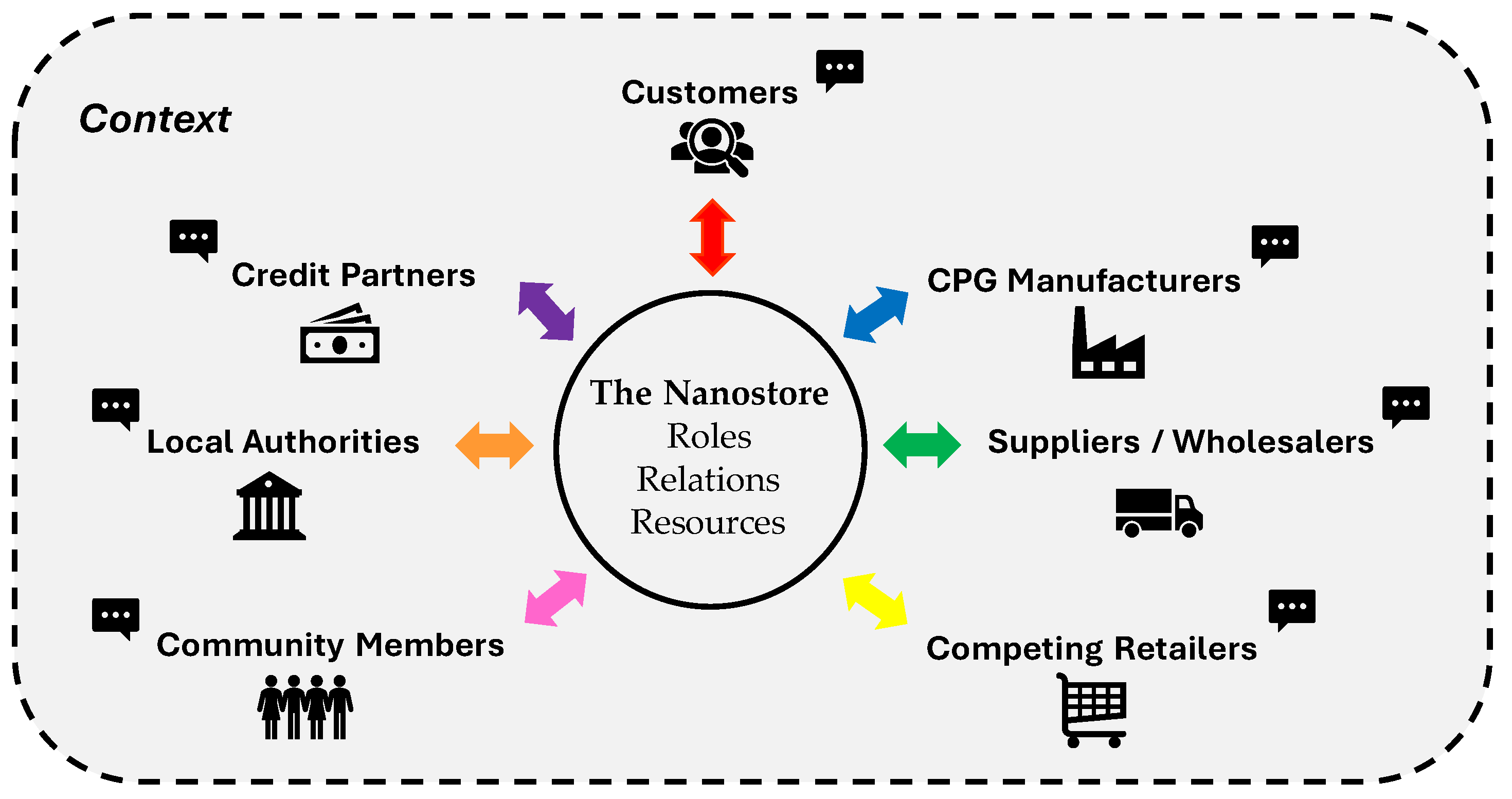
Figure 2.
The Research Methodology (own elaboration).
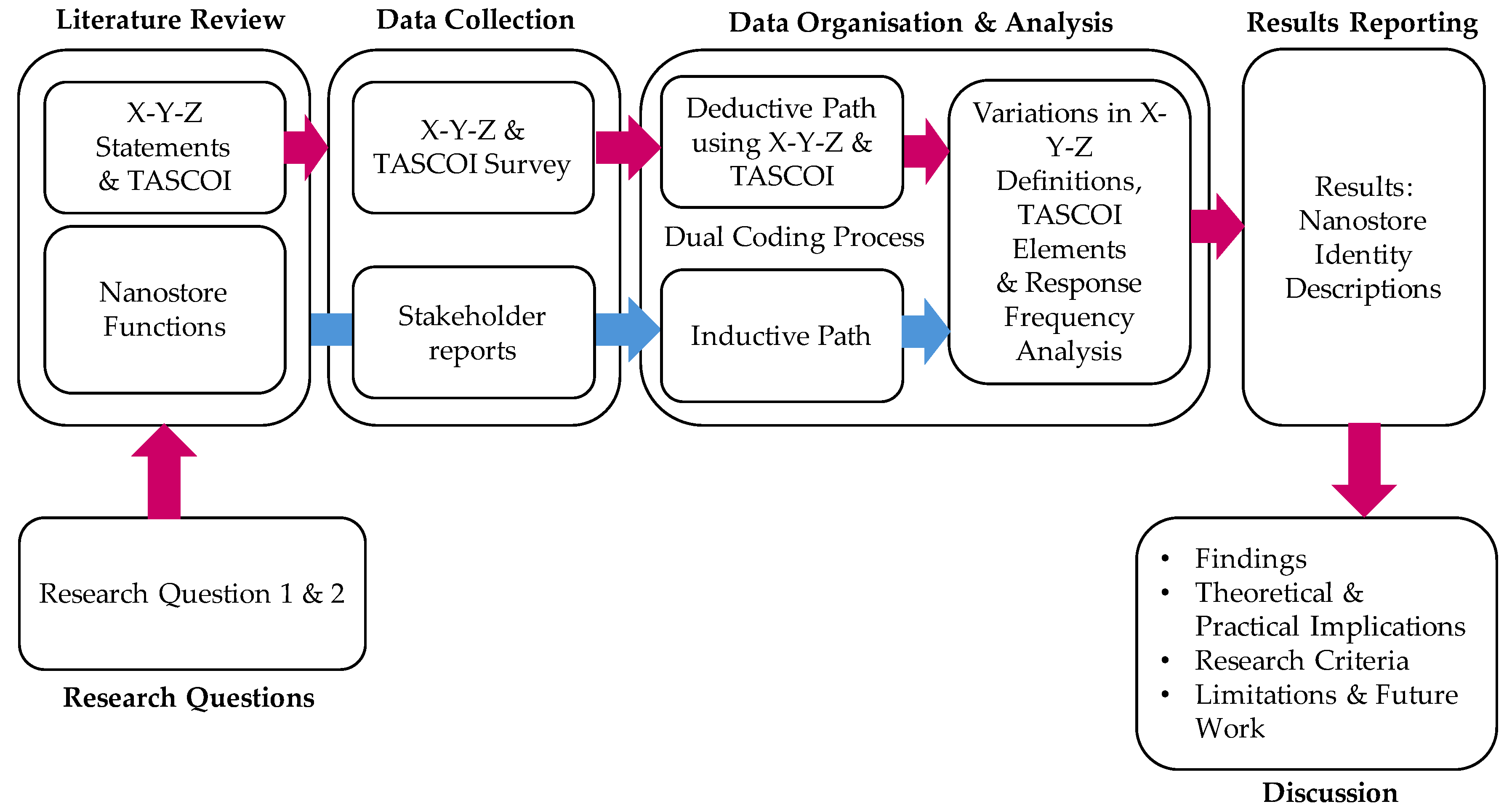

Table 1.
Key Themes by Stakeholder Type (own elaboration).
| Stakeholder Type | N | Sale of Goods | Source of Income/ Employment | Convenience/ Essential Goods | Market Rival/ Barrier | Personal Investment/ Sustenance | Community Service |
| Actors | 124 | 110 (89%) | 102 (82%) | 18 (15%) | 0 (0%) | 3 (2%) | 18 (15%) |
| Customers | 15 | 13 (87%) | 2 (13%) | 10 (67%) | 0 (0%) | 0 (0%) | 2 (13%) |
| Owner | 7 | 7 (100%) | 7 (100%) | 2 (29%) | 0 (0%) | 7 (100%) | 1 (14%) |
| Interveners | 22 | 19 (86%) | 0 (0%) | 3 (14%) | 14 (64%) | 0 (0%) | 1 (5%) |
Note: Some responses mentioned more than one theme, so percentages may not sum to 100%.
Table 2.
Main Operational Means Cited by Stakeholder Type (own elaboration).
| Stakeholder Type | N | Physical Store | Human Resources | Suppliers | Admin/ Tech Systems | Specific Tools/ Processes | Market Transactions |
| Actors | 124 | 92 (74%) | 81 (65%) | 39 (31%) | 7 (6%) | 18 (15%) | 0 (0%) |
| Owner | 7 | 6 (86%) | 5 (71%) | 7 (100%) | 3 (43%) | 2 (29%) | 0 (0%) |
| Customers | 15 | 11 (73%) | 9 (60%) | 2 (13%) | 0 (0%) | 1 (7%) | 0 (0%) |
| Interveners | 22 | 7 (32%) | 5 (23%) | 7 (32%) | 1 (5%) | 0 (0%) | 14 (64%) |
Note: Some responses mentioned multiple resources or processes, so percentages may not add up to 100%.
Table 3.
Primary Purposes Cited by Stakeholder Type (own elaboration).
| Stakeholder Type | N | Generate Income/ Sustenance | Serve Community/ Clients | Business Growth/ Loyalty | Provide Essential Goods | Market Competition |
| Actors | 124 | 106 (85%) | 18 (15%) | 6 (5%) | 14 (11%) | 0 (0%) |
| Owner | 7 | 7 (100%) | 2 (29%) | 4 (57%) | 2 (29%) | 0 (0%) |
| Customers | 15 | 4 (27%) | 3 (20%) | 0 (0%) | 11 (73%) | 0 (0%) |
| Interveners | 22 | 15 (68%) | 1 (5%) | 0 (0%) | 5 (23%) | 7 (32%) |
Note: Some responses mentioned multiple resources or processes, so percentages may not add up to 100%.
Table 4.
Common and Alternative Descriptions of X-Y-Z (own elaboration).
| Dimension | Category (Theme) | Description | Example Responses | Frequency (approx.) |
|---|---|---|---|---|
| X | Retail Sales of Everyday Goods | The nanostore sells groceries, snacks, pharmacy items, stationery, and other essential products. | “Sale of consumer products such as soft drinks, ham, etc.”, “Sale of stationery products.” | ~82% |
| Source of Employment/Income | The nanostore is a workplace and the primary source of income for staff and owners. | “It's a source of employment.” “My source of income.” |
~68% | |
| Community Service/Convenience | The nanostore is valued for its accessibility, convenience, and service to the neighbourhood. | “Serve nearby customers.”, “Meet neighbourhood needs.” |
~20% | |
| Family/Personal Investment | The nanostore is seen as a family project or personal investment. | “Family project.”, “Own business.” | ~10% | |
| Market Rival/Barrier | The nanostore is seen as a competitor or obstacle in the local market. | “Direct competition.”, “It represents a barrier because it is direct competition.” | ~7% | |
| Y | Physical Store/Infrastructure | Operations depend on the physical location, premises, and tangible infrastructure. | “Through its establishment.”, “At your premises.” |
~77% |
| Human Resources/Personnel | Staff, owners, or family members carry out activities. | “Staff who attend.”, “A person who attends all day.” | ~61% | |
| Supplier Networks | The nanostore sources goods from external suppliers and brands. | “Buys products from suppliers.”, “Receives merchandise from Bimbo, Sabritas, and others.” | ~33% | |
| Operational Tools/Processes | Use of specific tools, equipment, or routines (e.g., delivery bikes, refrigerators). | “Use bicycles for delivery.”, “Cash register.” | ~18% | |
| Customer Service/Community Engagement | Focus on serving clients and engaging with the community. | “Serve customers.”, “It offers home delivery service.” | ~22% | |
| Z | Generating Income/Sustenance | The primary purpose is to provide economic benefit or financial security. | “Generate income for the family.”, “To have a livelihood.” |
~79% |
| Providing Essential Goods/Services | The purpose is to provide essential products and services to the community. | “Meet customer needs.”, “Offer basic necessities.” | ~28% | |
| Supporting Family/Personal Project | The nanostore is a family business or personal investment. | “Family project.”, “Help the family." | ~11% | |
| Serving the Community | The purpose is to contribute to or support the local community. | “Helping the community.” “To be useful to the neighbourhood.” | ~8% |
Note: Some responses mentioned multiple resources or processes, so percentages may not add up to 100%.
Table 5.
Mapping the TASCOI roles to the X, Y, and Z dimensions (own elaboration).
| TASCOI Role | X: What/Who (Identity & Activity) | Y: How (Means & Resources) | Z: Why (Purpose) | Example from the Dataset | Variations/Notes |
| Actors | Carry out retail, service, and logistics | Staff, owners, and family members | Seek employment, business growth, and community value | “Staff who attend all day” | These actors may include delivery staff, cashiers, and family members |
| Suppliers | Enable product variety and availability | Deliver goods, maintain supply chains | Support the store’s commercial viability | “Suppliers of each sold product” | Local vs national suppliers, reliability varies |
| Customers | Receive goods/services, define demand | Interact at the store, purchase, and give feedback | Satisfy needs, seek convenience, and community ties | “Close customers”, “People who are passing by” | Frequency, loyalty, and needs differ by segment |
| Owners | Oversee, invest, and manage | Make strategic, financial, and operational choices | Ensure family sustenance, long-term viability | “The owner... is responsible for the operation.” | Sometimes a double role as actors/owners |
| Interveners | Influence context and competition | Compete, manage, or enable operations | Shape the market, set competition norms, and provide retail infrastructure | “Direct competition”, “The government and the arrangements” | It can be positive (support) or negative (barriers) |
Table 6.
Variations in Transformations According to X Identities (own elaboration).
| X Identity (What/Who) | Transformation: Inputs → Outputs & Key Processes | Example from the Dataset | Variation/Significance |
| Retail Sales of Everyday Goods | Inventory, staff time, supplier goods → Sold products, customer satisfaction. Key processes include stocking, merchandising, sales, and checkout. | “Sale of consumer products such as soft drinks, ham, etc.” “Arrange material and sell.” |
Transformation is transactional and product-focused. |
| Source of Employment/Income | Employee labour, store infrastructure, inventory → Wages, financial stability, job satisfaction. Key processes include shift management, payroll, and customer service. | “It's a source of employment.”, “Your source of income.” |
Transformation centres on converting labour into livelihoods and security. |
| Community Service/Convenience | Access to location, product variety, staff attention → Neighbourhood convenience, social capital, trust. Key processes: extended hours, personalised service, local engagement. | “Serve nearby customers.” “Meet neighbourhood needs.” |
Transformation emphasises the social value and accessibility over pure sales. |
| Family/Personal Investment | Family labour, personal capital, shared responsibilities → Family income, business experience, generational skills. Key processes include joint decision-making, intergenerational training, and flexible roles. | “Family project.”, “Own business.” | Transformation integrates economic and family/social outcomes. |
| Market Rival/Barrier | Competitive pricing, product selection, marketing efforts → Market share, customer retention, barriers to entry for others. Key processes include monitoring competitors, conducting promotional activities, and adjusting the product mix. | “Direct competition.”, “It represents a barrier because it is direct competition.” | External market dynamics and the level of competition shape the transformation. |
Table 7.
Framework Application: Management, Problem-Solving, Decision Making, Policy (own elaboration).
Table 7.
Framework Application: Management, Problem-Solving, Decision Making, Policy (own elaboration).
| Dimension | For Management & Problem Solving | For Decision Making & Policy |
| X | Identify core and alternative roles; diversify offerings; strengthen identity as an employer, service provider, or family asset. | Design and deploy support programmes that reflect nanostores’ social and economic functions and impact on their communities. |
| Y | Improve resource utilisation and processes; invest in infrastructure, staff development, and supplier relations; adopt relevant technology. | Set standards for fair, efficient, reliable supply chains, labour, and infrastructure support. |
| Z | Align goals with stakeholder needs (income, service, family, community); measure performance beyond sales. | Develop policies for microenterprise income stability, social impact, and local access. Ensure product availability, accessibility, and affordability. |
Disclaimer/Publisher’s Note: The statements, opinions and data contained in all publications are solely those of the individual author(s) and contributor(s) and not of MDPI and/or the editor(s). MDPI and/or the editor(s) disclaim responsibility for any injury to people or property resulting from any ideas, methods, instructions or products referred to in the content. |
© 2025 by the authors. Licensee MDPI, Basel, Switzerland. This article is an open access article distributed under the terms and conditions of the Creative Commons Attribution (CC BY) license (http://creativecommons.org/licenses/by/4.0/).
Copyright: This open access article is published under a Creative Commons CC BY 4.0 license, which permit the free download, distribution, and reuse, provided that the author and preprint are cited in any reuse.


