

Submitted:
17 July 2025
Posted:
18 July 2025
You are already at the latest version
Abstract
Animals are used in behavioural and biological research in special and significant ways. Many medical advancements that improve human life are based on laboratory animal research studies. Scientists carefully and thoughtfully select and justify the specific animal models used in their research, adhering to current legal requirements, the principles of the 3 R´s (reduction, reuse, and refinement), and ensuring that animals are used only when no other research solution is feasible or available. The laboratory animals most often used in biomedical research so far have been rodents (mice, rats, and guinea pigs), but in the current development of research, researchers have turned their attention to alternatives such as zebra fish and the Xenopus (clawed frog), although anatomically and physiologically different from humans, following the sequencing of their genomes, it was demonstrated that the main genes involved in certain pathologies in humans are similar to those in these animal models.
Keywords:
animal models
; 3Rs principle (replacement
; reduction
; refinement)
; animal research
; animal welfare
; biomedical research
; in vivo experiments
1. Introduction
For more than a century, laboratory animals have been of invaluable help on growing our scientific understanding and for achieving major medical advances. Whether it's figuring out basic biology or creating treatments that save lives, animal models have been key in connecting fundamental research to real-world medical use. Researchers have been able to investigate intricate bodily functions using these models in ways that wouldn't be feasible or morally acceptable with people.
Even though there are continuous ethical discussions and nowadays more alternative techniques are available, laboratory animals are still a vital part of biomedical research. This is because they share biological similarities with humans, can be easily kept and bred under controlled conditions, they have a short life span, and help produce consistent results in experiments. With these things in mind, this paper will try to shade some light into why lab animals are so important in scientific research, looking at what they've contributed, the ethical issues surrounding their use, and what their future might look like as science progresses.
For example, many researches in the field of osteosynthesis of fractures, development of new materials with biological interest, drugs used in chemotherapy, the usage of stem etc., have hugely benefited from animal experimentation [1].
For the use in experimentation, animal models are strictly selected to satisfy the needs and to justify the research projects in work and the use of the animals must strictly obey the national, international laws and ethical considerations. [2]
Animal used in research are occasionally utilized in experimental clinical studies as: before a surgical device or new drug is marketed or used in regenerative surgical medicine. [3]
2. Materials and Methods
For this review we made an electronic search on the internet searching on MEDLINE (PubMed), Google Scholar, Web of Science and Researchgate platforms, using keywords such as “use of” and “laboratory” and “animals” or ”3R” or ”animal models” and ”zebrafish” ”Xenopus”, applying some filters such as: papers no older than 10 years, text availability as abstracts and full papers without other restrictions such as language. As results we had over 20 000 papers showed, selected over 100, and used only 53.
The presentation poster was edited according the conference specification and presented on site.
3. Results and Discussion
Traditional Animal Model: Rodents
The most commonly used animal models in biomedical research for decades have been rodents, mainly: mice, rats, hamsters and guinea pigs. This is due of a number of variables and factors, including the fact that they are biologically comparable to humans, the ease of keeping, breeding and usage in laboratories.
Rodents are used is a variety of studies such as: obesity [4,5], Parkinson's disease [6,7], stroke [8,9], aging (Figure 1) [10] and various other domains of biomedical research.
Mice, rats and other rodents are the most common species used in research (Table 1), almost approximately 95% of all studies involving animals [11]. Their high use comes from a remarkable genetic similarity to humans, sharing over 95% of their DNA.
Of the many advantages of using mice (Mus musculus), we can include a smaller size that the rest of the animals used in scientific research, that ease the maintenance and housing requirements, their life cycle is shorter, that allows for studies of diseases throughout the whole life of the animals and even over multiple generations, and with a great reproductive rate, they can provide a great number of pups to be used in different projects. [12]. Additionally, the vast field of genetic kits and procedures applicable for mice, joint with the ease to produce genetically modified mouse models (GEMs) with pin point accuracy and mutations reflecting human illnesses, have improved research zones like pharmacology with drug development [13].
Scientists have managed to create over 5,000 mouse models for more than 1,500 diseases, and so mice are helpful in the research of various conditions such as: diabetes, heart and coronary diseases, neurodegenerative disorders, and different types of tumors [14].
Relying on the specificity of the research projects ideas and procedures, various strains of mice are utilized, which can include: outbred and inbred, SPF (Specific Pathogen Free), gnotobiotic, germ-free, immunodeficient, oncology-specific and transgenic [15]. What is interesting is, that even outbred mice with a strong genetically diversity are able to be of high value for the resemblance to the variance oh human populations genetics and the help of extrapolating of research findings [16].
Rats (Rattus norvegicus), with bigger body than mice, are playing an essential part within biomedical research, with many advantages for different types of studies [17].
The larger body, with a complex physiology and ethological traits give an advantage for rats in the usage within the toxicology, tumors, heart diseases, nutrition and bone and joint diseases. Noticeably, various disease-linked human genes have correspondent in the rat genes, so rats are important models for biomedical research [18].
Rats have a higher ability for cognition in comparison to mice, making the rat an ideal candidate for psychological studies involving behavior, learning and cognition [19]. Their bigger brain size can ease procedures that studies brain cancer or the functions of the central nervous system, with the help of fine surgery or intracranial insertions [20].
The most recent advancements within gene editing technologies, for example CRISPR, made possible the creation of genetically enhanced and engineered rat models, enhancing and expanding the rat’s utility in scientific research. [21].
Rats have a high rate of usage in the research of medical conditions like: osteoporosis, sclerosis, some types of diabetes, and brain carcinomas, also and they have an important contribution to advancements in heart and cardiovascular studies, transplantation and healing of wounds [22,23,24,25,26].
Guinea pigs (Cavia porcellus) have a unique position between rodent models, especially in human immunology studies. Their immune system is quite similar to humans rather than of mice, and based on this consideration they are preferred in testing vaccines and biodefense agents [27]. Guinea pigs are also used in nutritional research, especially in the study of vitamin C, as guinea pigs share the same needs as humans for an external source of this essential vitamin [28]. Additionally, they are used in toxicology, allergies, asthma or other respiratory diseases due to for their same capacity to react and sensitivity to hazardous effects as humans, [29]
Emerging Alternative Animal Models: Zebrafish and Xenopus Frogs
Because of various scientific advantages and ethical problems, in the most recent years, many researchers are focusing on other alternatives for animal models, such as zebrafish and Xenopus frogs,
Due to high genetic resemblance to us, humans, zebrafish - Danio rerio, have become the second most common animal model used in laboratory, sharing almost 70% of protein-coding genes. Moreover, approximately 84% of known genes associated with some diseases in humans also have an analogue in zebrafish. [30].
One of the biggest advantages of keeping zebrafish is that they reproduce fast, lay hundreds of clear eggs externally, which are then used by researchers for embryonic developmental observation, at cellular level, in real time and without sophisticated and invasive procedures and instruments.
The pace of research, using zebrafish is accelerated because of the short life cycle and rapid reproducing periods. Additionally, they can be housed in a large number, needing small spaces, are easy and inexpensive to grow and reproduce, thus making them cost effective for many various types of studies. [31].
Because the embryos have the ability to absorb substances that are added in the growing tank, this facilitates the gene modification in zebrafish and thus the study of gene alteration is simplified. Also, by this method can be studied the absorbance and effects of chemicals and drugs
Genetic modification in zebrafish is also facilitated by the fact that their embryos can absorb substances added to their tank water, simplifying the study of gene alterations and the effects of drugs and chemicals [32].
Because zebrafish have an exceptional capacity of regenerating limbs and organs, such as the liver, kidneys, fins, pancreas, and heart, makes them an important subject for regenerative medicine research [33]. To use, grow and experiment with zebrafish is also necessary to adhere to ethical principles of the 3 Rs. The use of early-stage embryonic zebrafish also aligns with the ethical principles of the 3Rs, particularly replacement and reduction, as they are considered lower on the animal hierarchy [34].
Xenopus frogs, especially Xenopus laevis (African clawed frog) and Xenopus tropicalis (Western clawed frog), are new and widely adopted animal model in biomedical research because of their genetic resemblance with humans [35] and there have been some estimation that almost 80% of diseases from humans could find an equivalent in Xenopus tropicalis [36].
Xenopus frogs are easy to maintain in laboratory aquatic facility, can lay, externally, a staggering 30000 eggs in a lifetime, opaque for the first few days and after that will become clear, and the tadpoles can be easily observed throughout all stages of development. Xenopus tropicalis diploid genome and a high degree of similarity with human genome, makes it a great candidate for genetic studies and [37].
Oocytes from Xenopus frog are used in the field of ion transport and physiology of channel transport, toxicology studies [38].
As well as zebrafish, Xenopus frogs have the ability to regenerate various parts of their body and can self-repair other complex structures like brain, the optic nerve and parts of spinal cord, which makes them useful animal models in regenerative studies [39].
The advantages and disadvantages of using different animal models are presented below, in Table 2, showing the capacity of new animal models (zebrafish and Xenopus frogs) to satisfy the requests in biomedical research.
Ethical Consideration: 3 Rs
The use of animals in scientific research is closely guided on an ethical level by the world-wide accepted principles known as 3Rs: replacement, reduction, and refining [40]. Those 3 principles are providing a baseline for working with animals in scientific research and are embedded in various regulations, national and international laws [41]. The usage of various methods or different technologies that can replace the usage of animals in scientific research is the principal goal of replacement.
There are two types of replacement: partial or relative replacement. The first one includes animals but has an aim for those species that have a lesser pain sensing and the other one doesn`t use animals at all but use different technologies [42].
Advanced computer modeling that replicates complex biological processes, research done using “in vitro” cell cultures and the usage of different type of live-like dummies are good examples of replacement at full scale [43].
The use of nematodes (C. elegans), fruit fly (Drosophila spp.) or other vertebrates within early development stages that are currently considered less sentient can count as partial replacement [38].
Replacement is not a static idea, but it is seen as whole, and each development, stage and step closer to a complete replacement is viewed as positive in this direction. Researchers are urged to make a thorough search of the scientific literature to find methodologies that are feasible and relevant to their interests and research areas [44].
Strategies of reducing the total number of used animals to have trustworthy results from a scientific point of view are the key for reduction.
The reduction principle shows how important is to use the adequate statistical techniques, a well-made experimental design is such a way that is ensured the accomplishment of the goals of the study by using the lowers possible number of animals.
One important approach into reduction is to be sure of the maximum amount of data and information received from every animal used in the study, for example: the use of longitudinal studies will allow for more data, with repeated measurements taken over time or multiple blood micro samples, from the same animal [43].
It is important to find a good balance between reduction of animals used and good consideration of possible additional suffering caused by repeated procedures.
Other, good method of reduction is that of sharing the resources, gathered data, animals or equipment within various research groups, thus preventing duplications and unnecessary experiments [45].
Also, usage of both sexes in studies, can led to reduction by evading the need of euthanizing unwanted pups.
The main goals of refinement are to elevate laboratory animal’s welfare, reducing the pain and suffering or long-term distress through the whole experiment. This applies to all the parts of the scientific experiment: from husbandry and housing to involved scientific procedures performed on the animals [46]. Examples of refinement may be: allowing animals to express their specific behavior by giving them proper housing and care, usage of anesthesia and analgesia when invasive procedures are done, training of the animals before the required procedures are performed to reduce the stress.
For example, giving drugs mixed into feed can give better results and less stress for the animals than other methods and for reducing the anxiety during procedures, animals can be trained by positive reinforcement [43].
Refinement should not be limited only for the phase of the experiment but be extended for the entire life of the animals, form birth until euthanasia [46]. What is important is there are evidence that minimizing the stress and pain of animals involved in research can give much more reliable results and reproducible experiments by reducing variability induced by stress in their physiological and ethologic responses [45].
Regulatory Framework: Laws in Animal Research in Europe and Romania
Throughout Europe, the care and use of laboratory animals in scientific research is governed and regulated by a strict legal and ethical framework, mostly based on EU Directive 2010/63/EU.
This directive, that member states had to implement into their national sets of laws by January 2013, promotes the principles of the 3 Rs and sets o series of standards for animal welfare in the whole European Union [47].
In rapport with the EU Directive, the use of animals in scientific research is permitted when a scientific justification is in place and the results and benefits of the study surpass the risks and suffering of the involved animals. Also, experimenting on animals is permitted only when no feasible alternative methods are available for reaching the proposed objectives. Each research project that use animals must pass an ethical evaluation by authorities that includes an assessment of the benefits of the project at the cost of the animal suffering and stress induced [48].
All living non-human vertebrate animals, including live cephalopods and the independently nourished larval and fetal forms of mammals in their final trimester of development, are covered by the broad EU Directive [49].
The usage of non-human primates is subject to very tight restrictions. Only basic or specialized medical research, with a focus on species preservation, or situations where there is a compelling scientific case that no other species can be used for the research can use them. The EU Directive prohibits the use of great apes (chimpanzees, bonobos, gorillas, and orangutans) in research [50].
Another important consideration under EU law is the origin of the animals used in research. Species commonly used in laboratory research that require particular development for this purpose include mice, rats, zebrafish, frogs, rabbits, cats, dogs, and non-human primates. The use of stray animals or animals taken from the wild is only allowed in specific, well-founded situations when it is required to achieve the study's objectives [51]. Any organization that grows, donates, or use animals for research must be properly registered and authorized by the appropriate national authorities.
The facilities and equipment used by these companies or establishments must be suitable for the species they house and the therapies they offer.
For a minimum of five years, thorough records of the animals, their provenance, and their intended use must be kept and ready at all time to be submitted for evaluation [52].
Also, all personnel, researchers or any person involved in day-to-day care, carrying out procedures on laboratory animals should undergo adequate training and must demonstrate that they are competent before working unsupervised.
A very important part of the EU Directive is the requirement of implementing the principles of 3Rs, throughout care and usage of the animals in scientific research [48].
Annual statistics on the use of animals in research, including information on the species employed, the severity of the procedures, and the animals' origins, must be gathered and made publicly available by EU member states. Each EU member state must set up national committees devoted to protecting animals used in scientific research in order to better enhance animal welfare. These committees assist and advise animal welfare organizations within research institutions.
Finally, when animals are no longer needed for study or when it is in their best interests to do so, the EU Directive outlines compassionate ways to end their lives [52].
In Romania, the EU Directive 2010/63/EU is transpose trough Romanian Law 43/2014 (regarding the protection of animals used for scientific purposes) and a series of normative acts of the National Sanitary Veterinary and Food Safety Authority for the approval of some veterinary norms related to the existence and proper functioning of units that holds and use animals used in scientific research (Order 97/2015, Order 106/2016, Order 32/2021) [53].
4. Conclusions
Animals used in scientific research have played a very important role in biomedical research advancement, which leads to numerous life-saving procedures and therapies that improved the human and also animal health and well-being.
The considerations of ethical use of laboratory animals in research are essential and the 3Rs principles – replacement, reduction and refinement – should be used as a day to day guiding framework and base of procedures for the “in vivo” experimenting.
The discovery and usage of new alternative models, such as Xenopus frogs and zebrafish, that provides significant scientific benefits and satisfies the requirement of ethical matter of minimizing the usage of more sentient animals is becoming more important in the rapid and constant developing area of biomedical research and usage of laboratory animals.
The field of using laboratory animals in research is developing constant, with a major emphasis on finding, developing and adopting of new alternatives as animal models, software and even hardware component that can mimic tissues and organs.
In the future of using laboratory animals in research, refining the 3Rs concepts should be a commitment, as well as searching for other non-animal alternatives and the selection of the appropriate animal model for exact type of research, putting in balance the ethical matter and the scientific outcome.
Continuous technological advancements and research hold the promise of further reducing our reliance on animal models while maintaining the essential pace on scientific discovery that will benefits all the living beings.
Acknowledgements
The authors express their gratitude to their colleagues in Department of Animal Resources and Technologies from Faculty of Animal and Food Resources Engineering at “Ion Ionescu de la Brad” Iasi University of Life Sciences (FIRAA - IULS) for their assistance. Also, the authors would like to thank to Assoc. Prof. Dr. Eng. Ioan Huțu from “Horia Cernescu” Research Unit at „King Michael I„ University of Life Sciences - Timișoara for his support and the good collaboration over the years.
References
- Saraf, S. K., & Kumaraswamy, V. (2013). Basic research: Issues with animal experimentations. Indian Journal of Orthopaedics, 47(1), 6-9. [CrossRef]
- Petetta, F., & Ciccocioppo, R. (2021). Public perception of laboratory animal testing: Historical, philosophical, and ethical view. Addiction biology, 26(6), e12991. [CrossRef]
- Cicero, L., Fazzotta, S., Palumbo, V. D., Cassata, G., & Lo Monte, A. I. (2018). Anesthesia protocols in laboratory animals used for scientific purposes. Acta bio-medica: Atenei Parmensis, 89(3), 337–342. [CrossRef]
- Doulberis, M., Papaefthymiou, A., Polyzos, S. A., Katsinelos, P., Grigoriadis, N., Srivastava, D. S., & Kountouras, J. (2020). Rodent models of obesity. Minerva endocrinologica, 45(3), 243–263. [CrossRef]
- Kleinert, M., Clemmensen, C., Hofmann, S. M., Moore, M. C., Renner, S., Woods, S. C., Huypens, P., Beckers, J., de Angelis, M. H., Schürmann, A., Bakhti, M., Klingenspor, M., Heiman, M., Cherrington, A. D., Ristow, M., Lickert, H., Wolf, E., Havel, P. J., Müller, T. D., & Tschöp, M. H. (2018). Animal models of obesity and diabetes mellitus. Nature reviews. Endocrinology, 14(3), 140–162. [CrossRef]
- Taguchi, T., Ikuno, M., Yamakado, H., & Takahashi, R. (2020). Animal Model for Prodromal Parkinson's Disease. International journal of molecular sciences, 21(6), 1961. [CrossRef]
- Dovonou, A., Bolduc, C., Soto Linan, V., Gora, C., Peralta Iii, M. R., & Lévesque, M. (2023). Animal models of Parkinson's disease: bridging the gap between disease hallmarks and research questions. Translational neurodegeneration, 12(1), 36. [CrossRef]
- Li, Y., & Zhang, J. (2021). Animal models of stroke. Animal models and experimental medicine, 4(3), 204–219. [CrossRef]
- Fluri, F., Schuhmann, M. K., & Kleinschnitz, C. (2015). Animal models of ischemic stroke and their application in clinical research. Drug design, development and therapy, 9, 3445–3454. [CrossRef]
- Cai, N., Wu, Y., & Huang, Y. (2022). Induction of Accelerated Aging in a Mouse Model. Cells, 11(9), 1418. [CrossRef]
- The Pennsylvania Society for Biomedical Research, Animal research, The Animals, 2025, address: https://www.psbr.org/animal-research/the-animals.
- Bryda E. C. (2013). The Mighty Mouse: the impact of rodents on advances in biomedical research. Missouri medicine, 110(3), 207–211.
- James Vitale (2025), Taconic Biosciences, Animal Models in Drug Discovery, Home page address: https://www.taconic.com/resources/animal-models-drug-discovery.
- Oladimeji Ewumi (2023), MedicalNewsToday, How do mouse studies relate to human health, home page address: https://www.medicalnewstoday.com/articles/mouse-studies.
- Lidebiotech (2023), Mouse Models: Applications, Types, Advantages, and Disadvantages, home page address: https://www.lidebiotech.com/blog/mouse-models-applications-types-advantages-and-disadvantages.
- The Jackson Laboratory, We are getting more and more biological and genomic data from people all the time, but for most applications — including true scientific discovery — those data aren't effective for developing new medical advances. Why?, home page address: https://www.jax.org/about-us/why-mice.
- Cyagen Biosciences Inc (2015), The rat choice for your experiments, home page address: https://www.cyagen.com/us/en/community/technical-bulletin/rat-choice-for-your-experiments.html.
- The Increasingly Important Use of Rat Models in Genetic Experiments (2018), The Advantages of Rat Models, home page address: https://www.genetargeting.com/ingenious-blog/the-advantages-of-rat-models.
- Ménard, C., Hodes, G. E., & Russo, S. J. (2016). Pathogenesis of depression: Insights from human and rodent studies. Neuroscience, 321, 138–162. [CrossRef]
- Travis, Z. D., Sherchan, P., Hayes, W. K., & Zhang, J. H. (2019). Surgically-induced brain injury: where are we now?. Chinese neurosurgical journal, 5, 29. [CrossRef]
- Lu, J., Liu, J., Guo, Y., Zhang, Y., Xu, Y., & Wang, X. (2021). CRISPR-Cas9: A method for establishing rat models of drug metabolism and pharmacokinetics. Acta pharmaceutica Sinica. B, 11(10), 2973–2982. [CrossRef]
- Vestergaard B. (2016). Establishment and use of surgical rat models for assessment of organ specific in vivo clearance. Danish medical journal, 63(6), B5247.
- Zhao, Y., Qu, H., Wang, Y., Xiao, W., Zhang, Y., & Shi, D. (2020). Small rodent models of atherosclerosis. Biomedicine & pharmacotherapy = Biomedecine & pharmacotherapie, 129, 110426. [CrossRef]
- Al-Awar, A., Kupai, K., Veszelka, M., Szűcs, G., Attieh, Z., Murlasits, Z., Török, S., Pósa, A., & Varga, C. (2016). Experimental Diabetes Mellitus in Different Animal Models. Journal of diabetes research, 2016, 9051426. [CrossRef]
- Sahu, U., Barth, R. F., Otani, Y., McCormack, R., & Kaur, B. (2022). Rat and Mouse Brain Tumor Models for Experimental Neuro-Oncology Research. Journal of neuropathology and experimental neurology, 81(5), 312–329. [CrossRef]
- Rajab T. K. (2019). Techniques for lung transplantation in the rat. Experimental lung research, 45(9-10), 267–274. [CrossRef]
- Stokes, J. V., Walker, D. H., & Varela-Stokes, A. S. (2020). The guinea pig model for tick-borne spotted fever rickettsioses: A second look. Ticks and tick-borne diseases, 11(6), 101538. [CrossRef]
- Hemilä, H., & de Man, A. M. E. (2024). Vitamin C deficiency can lead to pulmonary hypertension: a systematic review of case reports. BMC pulmonary medicine, 24(1), 140. [CrossRef]
- Broad Institut, (2025). Guinea Pig Genome Project, home page address: https://www.broadinstitute.org/guinea-pig/guinea-pig-genome-project.
- Choi, T. Y., Choi, T. I., Lee, Y. R., Choe, S. K., & Kim, C. H. (2021). Zebrafish as an animal model for biomedical research. Experimental & molecular medicine, 53(3), 310–317. [CrossRef]
- The Francis Crick Institute, Why do we use fish in research? (2025) Home page address: https://www.crick.ac.uk/research/animal-research/why-and-how-we-use-animals/why-do-we-use-fish-in-research.
- Petrovici, A., Savuța, G., Lucini, C., Robea, M. A., & Solcan, C. (2025). Combined Neurotoxic Effects of Commercial Formulations of Pyrethroid (Deltamethrin) and Neonicotinoid (Imidacloprid) Pesticides on Adult Zebrafish (Danio rerio): Behavioral, Molecular, and Histopathological Analysis. Life, 15(4), 538.
- Marques, I. J., Lupi, E., & Mercader, N. (2019). Model systems for regeneration: zebrafish. Development (Cambridge, England), 146(18), dev167692. [CrossRef]
- Caroline Brennan, (2014). NC3Rs, Five reasons why zebrafish make excellent research models, Home page address: https://nc3rs.org.uk/news/five-reasons-why-zebrafish-make-excellent-research-models.
- Exner, C. R. T., & Willsey, H. R. (2021). Xenopus leads the way: Frogs as a pioneering model to understand the human brain. Genesis (New York, N.Y. : 2000), 59(1-2), e23405. [CrossRef]
- Your Genome, (2025). 68. Model organisms: the clawed frog, Home page address: https://www.yourgenome.org/theme/model-organisms-the-clawed-frog/.
- University of Cambridge, (2025). Animal research, What types of animal do we use?, Xenopus, Home page address: https://www.cam.ac.uk/research/research-at-cambridge/animal-research/what-types-of-animal-do-we-use/xenopus.
- Wheeler, G. N., & Brändli, A. W. (2009). Simple vertebrate models for chemical genetics and drug discovery screens: lessons from zebrafish and Xenopus. Developmental dynamics : an official publication of the American Association of Anatomists, 238(6), 1287–1308. [CrossRef]
- Boster Biological Technology, (2024). Xenopus as a Model Organism, Home page address: https://www.bosterbio.com/blog/post/xenopus-as-a-model-organism.
- USDA National Agricultural Library (2025), Animal Use Alternatives (3Rs), home page address: https://www.nal.usda.gov/animal-health-and-welfare/animal-use-alternatives.
- Strech, D., & Dirnagl, U. (2019). 3Rs missing: animal research without scientific value is unethical. BMJ open science, 3(1), bmjos-2018-000048. [CrossRef]
- Neziri, S., Köseoğlu, A. E., Deniz Köseoğlu, G., Özgültekin, B., & Özgentürk, N. Ö. (2024). Animal models in neuroscience with alternative approaches: Evolutionary, biomedical, and ethical perspectives. Animal models and experimental medicine, 7(6), 868–880. [CrossRef]
- Swiss Academy of Sciences, (2025). Animal experimentation explained, Definition and examples of the 3Rs, Home page address: https://naturalsciences.ch/animal-experimentation-explained/alternative_methods/3rs_principles/examples_3rs.
- Avian Welfare Institute, (2025). The 3 Rs, Home page address: https://awionline.org/content/the-3rs.
- NC3Rs, (2025). Who we are, The 3Rs, Home page address: https://nc3rs.org.uk/who-we-are/3rs.
- European Council, (2025). Scientific Committees Toolbox, Three Rs principle (in animal experimentation), Home page address: https://ec.europa.eu/health/scientific_committees/opinions_layman/en/non-human-primates/glossary/tuv/three-rs-principle.htm.
- Karolinska Institutet, (2025). Laws and regulations on animal experimentation, Home page address: https://ki.se/en/comparative-medicine/for-new-researchers/laws-and-regulations-on-animal-experimentation.
- University of Ferrara, (2025). How Europe and Italy protect animals used in research, Home page address: https://www.unife.it/en/research/research-integrity/protect-animals.
- Speaking of research, (2025). Animal Research Regulations in the EU, Home page address: https://speakingofresearch.com/facts/animal-research-regulations-in-the-eu/.
- Marinou, K. A., & Dontas, I. A. (2023). European Union Legislation for the Welfare of Animals Used for Scientific Purposes: Areas Identified for Further Discussion. Animals: an open access journal from MDPI, 13(14), 2367. [CrossRef]
- European Animal Research Association EARA, (2025). EU regulations on animal research, Home page address: https://www.eara.eu/animal-research-law.
- European Union (2024). EUR-lex, Protection of laboratory animals, Home page address: https://eur-lex.europa.eu/EN/legal-content/summary/protection-of-laboratory-animals.html.
- A.N.S.V.S.A., (2025). Animal welfare legislation, home page address: https://www.ansvsa.ro/legislatie/bunastarea-animalelor/.
Figure 1.
Aging-related diseases using mice as animal model (after Cai, N. et al., 2022).
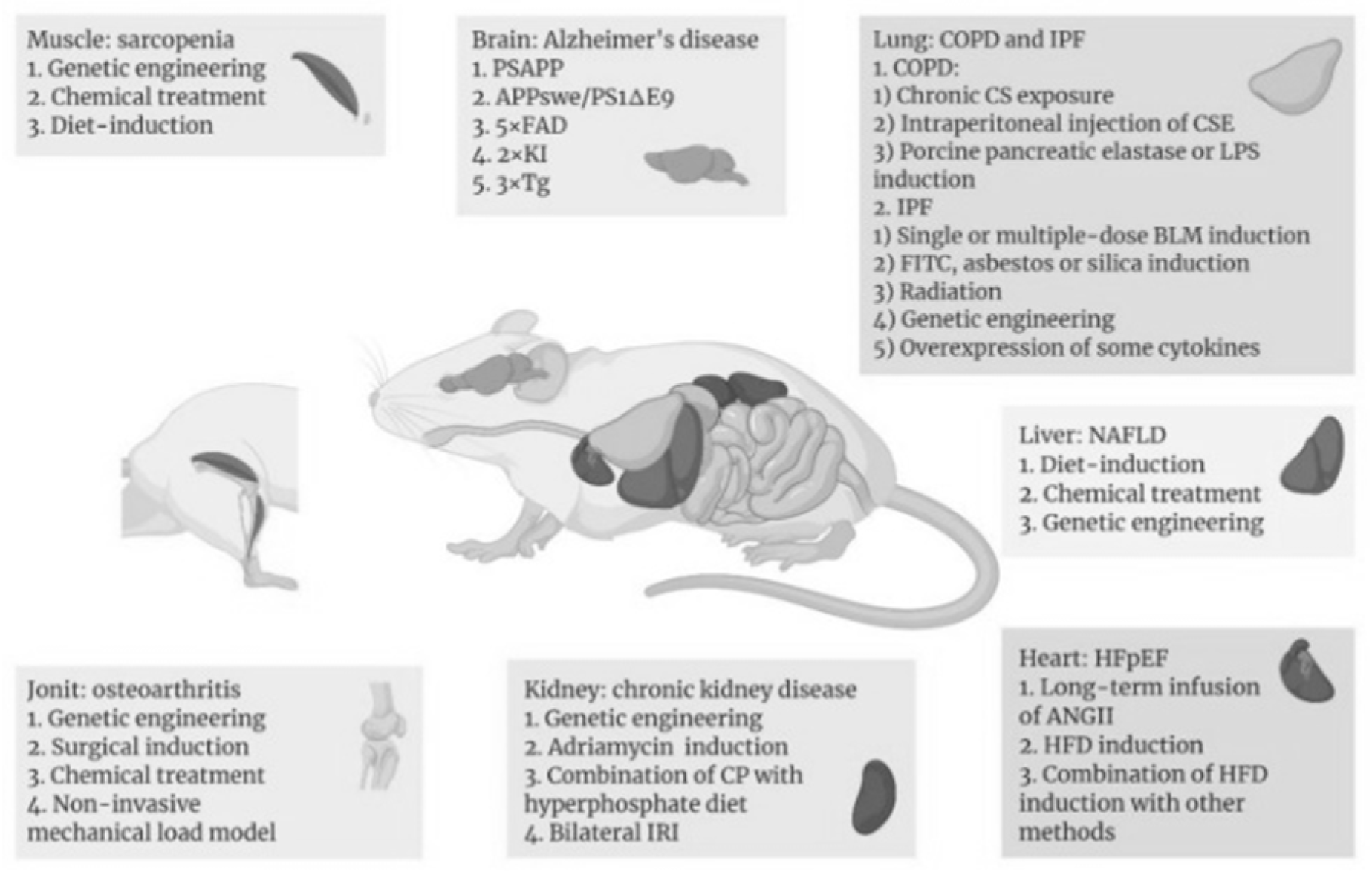

Table 1.
Rodent models – advantages and common usage.
| Animal model | Key advantages | Common research uses |
| Mouse | Many genetic resources, great genetic similarity to humans, small size, short life cycle, quick reproduction rate, and simplicity of genetic manipulation. | Modeling a range of human diseases, such as diabetes, cancer, and neurological disorders; genetic research; behavioral studies; and drug development and testing. |
| Rat | They are larger than mice, have more complex physiology and behavior, have a larger brain for neurological study, are more genetically tractable, and have a higher cognitive capacity. | Behavioral studies, pharmacology, nutrition, toxicology, cardiovascular research, cancer, osteoporosis, and neural regeneration. |
| Guinea pig | They require vitamin C in their diet, have immunological genes that are very similar to those of humans, and are vulnerable to negative outcomes. | Research on hearing, immunology, toxicology, vaccination testing, nutrition (vitamin C), allergies and respiratory conditions, and infectious diseases (tuberculosis). |
Table 2.
Advantages and disadvantages of como animal models* adapted after: Wheeler, G. N., & Brändli, A. W. (2009).
Table 2.
Advantages and disadvantages of como animal models* adapted after: Wheeler, G. N., & Brändli, A. W. (2009).
| Category: | C. elegans | Drosophila | Zebrafish | Xenopus | Chicken | Mouse |
| Brood size | 250-300 | 80-100 | 100-200 | 500-3000+ | 1 | 5-8 |
| Cost / embryo | low | low | low | low | medium | high |
| High-throughput multiwell-format screening | good | good | good | good | poor | poor |
| Access to embryos | good | good | good | good | poor | poor |
| Micro-manipulation of embryos | limited | limited | fair | good | good | poor |
| Genome | known | known | known | known | known | known |
| Genetics | good | good | good | fair | none | good |
| Knockdowns (RNAi, morpholinos) | good | good | good | good | limited | limited |
| Transgenesis | good | good | good | good | poor | good |
| Evolutionary distance to human | very distant | very distant | distant | intermediate | intermediate | close |
*Color code: light grey, best in category; dark grey, worst in category.
Disclaimer/Publisher’s Note: The statements, opinions and data contained in all publications are solely those of the individual author(s) and contributor(s) and not of MDPI and/or the editor(s). MDPI and/or the editor(s) disclaim responsibility for any injury to people or property resulting from any ideas, methods, instructions or products referred to in the content. |
© 2025 by the authors. Licensee MDPI, Basel, Switzerland. This article is an open access article distributed under the terms and conditions of the Creative Commons Attribution (CC BY) license (http://creativecommons.org/licenses/by/4.0/).
Copyright: This open access article is published under a Creative Commons CC BY 4.0 license, which permit the free download, distribution, and reuse, provided that the author and preprint are cited in any reuse.