

Submitted:
14 July 2025
Posted:
16 July 2025
You are already at the latest version
Abstract
This article focuses on a very specific type of vault found in Valencia through a particular example: the vault of the access space of the Más Palace in Valencia. This vault variant reflects two very specific characteristics, typical of Valencian construction practices. On the one hand, it is a star-shaped vault, that is, a vault conceived similarly to the multi-ribbed vaults of the late Gothic period, but without ribs. On the other hand, it is a brick vault constructed in a partitioned manner. That is, it is a very thin vault, which also has no load-bearing function, but rather to create a "false ceiling" or protection for the wooden floor above it. The vault analyzed is not a unique or singular case, as there are many others that are still preserved. It is an architectural type that enjoyed a certain diffusion due to its formal, constructive, and economical characteristics, and should be studied as such. The article offers a historical approach to the formal and constructive characteristics of this type, and through the example of the Palacio Más, it determines, to the extent possible, the importance of this construction method, since it has not been treated independently in studies conducted to date. In other words, this type of vault has always been presented as a (partly secondary) product of the era of stone groin vaults. However, star-shaped brick vaults deserve special attention, due to their greater diffusion than the previous ones, and their more functional and pragmatic characteristics, in keeping with the needs of their time. The article, for its part, is based on a laser scanner survey of the Palacio Más vault in order to determine as much as possible the set of formal and constructive parameters that govern it.
Keywords:
historical structures
; partitioned vaults
; star-shaped vault
; groin vault
; 15th-century Valencian architecture
; Francesc Martí Biulaygua
; Más Palace
; terrestrial laser scanner
1. Research Object and Strategy
The object of study of this article is a very specific architectural type or variant: a star-shaped vault construction solution found in Valencia in the early 16th century. A specific example of this has been analyzed in detail: the vault over the entrance to the Más Palace in Valencia. This particular architectural and construction type has certain distinctive characteristics: a star-shaped floor plan, a formal/structural solution without ribs in the intrados, and a construction solution with a partitioned vault.
It should also be noted that the expression “star-shaped vault” can be misleading, as it refers only to the floor plan representation. We are not talking, therefore, about a specific architectural type, but rather about possible, disparate architectural solutions. For this reason, we will develop a systematic classification of star-shaped solutions, which will allow us to distinguish groups and even clearly establish some specific typological variants.
This process, on the other hand, cannot be limited to a mere taxonomy, since the term “star-shaped vault” extends over a very broad historical period (from the 13th to the 17th century). This circumstance is reason enough to establish a series of historical or chronological questions that help organize the appearance of all these cases beforehand.
With this, we will be able to clearly identify the variant that fits the vault of the Palacio Más, and we will be able to address its analysis. This will give us the contextual perspective necessary to discuss the relevance of both the architectural type or variant and the example analyzed.
With this, we will be ready to address the analysis of the selected example: a vault probably built in the early 16th century, located in Valencia, and in which we have had the unusual opportunity to access/observe the extrados. This has allowed us to clarify some additional constructive and functional issues that complete our understanding of the architectural type. In addition, laser scanning equipment was used for metric analysis, allowing formal issues to be addressed with the greatest possible precision.
2. Lifting strategy
The vault was surveyed using a Trimble TX6 laser scanner (Figure 1). The scanner has a range of up to 30 meters. The capture capacity is 500,000 points per second, and its accuracy is ±2 mm. Angular coverage is 360° horizontally and 317° vertically, and it features an integrated camera system, whose information will allow the chromatic/material texturing of the scanned elements.
Not only was the vault itself scanned above the palace vestibule, but other areas (the exterior façade and the main interior spaces) were also recorded. A total of 39 scan positions were recorded (Figure 2).
In addition, reflective targets were used to facilitate the connection between shots. The data obtained was processed using the specialized software Trimble RealWorks. This program generated a three-dimensional model of the vault and the palace complex (Figure 3).
3. La Bóveda Estrellada Entre la Tradición Gótica y El Contexto Meridional
The first examples that we can define as star-shaped vaults occur in France during the Radiant Gothic period. According to Barrón 1, These star-shaped vault designs date back to the 13th century, and the most notable is the transept of Amiens Cathedral (1264). We are therefore talking about the evolutionary process of the Gothic style: increasing the number of keystones and ribs, and facilitating construction by reducing the number of plenums. Furthermore, the name is immediately apparent given the stonemasons’ design: two diagonals in simple vaults, hence the “cross vault”; and star-shaped in cases with multiple ribs.
However, the usual construction principle of star-shaped vaults, laid out over the course of a nave, belongs to the Germanic brick tradition – Backsteingotik – and took place in territories dominated by the Teutonic Order.2, in East Prussia and the present-day Baltic countries. This process gave rise to German Sterngewölbe, which were exported from these states to the rest of Europe.
Although Gothic multi-ribbed vaults were present from this time on in very diverse areas of Europe, it is difficult to establish a documented network of knowledge exchange, or to establish a single network, or one that applies to all cases. Furthermore, the very process of Gothic multiplicity is, to a certain extent, natural, and it is not difficult for different masters to arrive at the same solutions without knowing each other. As Bertachi indicates 3 “(…) There is no reason why we cannot assume that there has been a direct exchange of constructive knowledge beyond the national territory, especially in the case of countries strongly connected by mutual influences or relations of domination.”
Towards the 14th and 15th centuries, the Gothic system entered, to a certain extent, into a process of transformation towards complexity: a multiplicity of ribs, keystones, and the appearance of curved ribs. However, in the 15th century, and especially towards the end, this process was truncated with the appearance of architectural types that deviated from the principle of arranging ribs and plements. This is the case of English fan vaults, German diamond vaults, or Valencian groin vaults. In these cases, the form fits within the parameters of the Gothic, but the lack of ribs implies a radical change in conformation, which in some way negates this construction system and puts an end to an entire evolutionary process.
The presence of these star-shaped vaults in the Iberian Peninsula dates back relatively early, and there are already examples of constructed cases from the 14th century, some of them of notable dimensions (such as the chapter house of Valencia Cathedral). However, it was from the 15th century onwards, with the arrival of master builders from the Lower Rhine region to the Iberian Peninsula, when a profound renewal of the architecture of the kingdoms of Castile and Aragon took place. At this time, the (simpler) French models were gradually replaced by increasingly complex and sophisticated vaulted forms 4 5, and also producing certain variants that are specifically Spanish (or, rather, Castilian or Aragonese).
To this architectural context we must add another group of cases that are also classified as star-shaped vaults, but which present very different characteristics with respect to what has just been explained. In the Salentine province of Lecce (former kingdom of Naples), also from the 15th century, a very unique type of vaulted structure began to develop: It is called volta leccese a stella (star-shaped vault).6(Figura 4 ).
The abundance of stone in the area, easy to work, provided the material for these constructions, which seek to constructively resolve the meeting of two barrel vaults, avoiding the need for formwork7. The way to resolve this situation is to extend the cantilevered “canyons” (in the shape of a point) until the central space at the intersection to be covered acquires a star shape in plan. This significantly reduces the central space and allows for its construction without formwork. This system was highly successful in its geographical area and has been in use for a long time, from the late 15th century (1481) to the present day (since this construction tradition is still maintained). However, the period of splendor of this approach is throughout the 16th and 17th centuries. Bertachi directly links this development to the presence of the Aragonese royal family and its courtiers, as well as that of the Spanish noble families and the merchants of Salentino, Veneti, Lombardy, and Genoa.8.
Although formal analogies can be found between these Italian and Spanish structures, the differences are evident, based on the fact that the Italian cases solve the problem of the meeting of two barrel vaults (pointed or semicircular), while the Spanish ones derive from the resolution of a Gothic vault. This implies that the surface form is already different: Italian vaults are defined by radiated surfaces (the barrel vaults) and ruled surfaces (the interior star-shaped space to be covered), while Spanish star-shaped vaults (or Gothic vaults in general) are formed from ribs and plements (which, depending on the case, will have a structure and shape). For this reason, the rigging of the Salento vaults is apparently9 of the French type (courses perpendicular to the arches, precisely because they are barrel vaults), and that of the Spanish vaults of the English type 10 (courses perpendicular to the diagonal arches, although this does not occur in all cases). (Figure 5).
4. Formal Matters
The morphology of Gothic star-shaped vaults has been studied extensively and systematically by numerous researchers, among whom it is worth mentioning to Isabel Martínez Espejo11, Juan Carlos Navarro Fajardo12, José Carlos Palacios Gonzalo 13 14, Enrique Rabasa, Ana López Mozo. All these authors agree, when studying vaults, on representing them graphically using, as far as possible, the basic principles put into practice by ancient draftsmen (in the layouts that have been preserved): definition of the plan in terms of rib or edge axes and definition of the true magnitude of each of the arches/edges/rampants that make up the vault.
This simple and effective way of representing the vaults will facilitate their classification, and will be adopted later to order the morphology “under simple principles whose combination generates gradients of increasing complexity” 15. In this way, the star-shaped vaults will be arranged according to their layout, thus defining the shape of the floor plan, the shape of the different ribs, and finally the resolution of the plenums.
First, we will consider the plan layout of the star-shaped vaults. The first option we will consider is to align the secondary ribs (or tiercerons) on the bisector between the diagonal and the side of the square. This, developed graphically, can be obtained in a simplified manner by inscribing the square of the plan within a circle and extending the tiercerons to one of its singular points. This solution using a circle can also be achieved with rectangular plans, obtaining similar results (ad germanicum) (Figure 6).
The second option is to fix the tierceron not to the point on the circle, but to the midpoint of the opposite side (ad cuadratum). This variation is more common in Central Europe, and in Spain it appears mainly in rectangular floor plans (where it makes less sense to use angle bisectors). 16. Its use allows for the orderly fragmentation of the vault plan and the determination of strategic points for locating keystones or intersections of edges (Figure 7). These two rules or options (tercelet on the bisector and modulation) are not mutually exclusive and can be used together on the same vault.
Second, we will consider each of the lines corresponding to ribs or edges and establish their true magnitude on paper. Here, too, two large groups are identified. First, the general trend is the use of a single radius. That is, defining all or most of the ribs or edges as being defined by a single radius, which results in overall vault shapes that do not conform to known patterns. The other approach found is the use of different radii for different edges, which is usually due to formal issues of the vaults, such as their suitability with respect to adjacent vaults, etc. However, in this last group, there are vaults whose radii respond to another pattern, that of a spherical shape.
Thirdly, we will consider not the edges that arise from the springs, but the rampant edges, which are arranged between keystones, or between the highest points of arches. The rampant edge is of particular interest because it will help us understand the overall shape of the vault, and because in the late 15th and early 16th centuries a debate will arise about the ideal shape of vaults based on their rampant. According to Fernando Chueca Goitia Chueca, what most concerned medieval masters at this time was the rampant edge17. Two groups emerged among professionals, some preferring the traditional “plain rampant” style, while others favored the “modern” “round rampant.” From this point on, rampant styles were classified as “straight” or “plain” rampant styles, which run in a straight line from the two arch points or keystones, and “curved rampant styles,” which describe an arched shape rather than a straight line.
The proponents of the round rampant architecture believed that the strength of the vaults lay more in the curvature of the plenum shell than in the strength of the ribs. That is, more in the continuous, spheroidal structure than in the scaffolding of the arches18. The “round rampant” also had the advantage of greater adaptability, “(…) the two rampants of the vault can be unequal, leaving full freedom to the formeros and tiercerons to reach the heights they deem appropriate”19. As for the straight rampant, it should be noted that it functions as a lintelled or flat arch. And, in fact, strictly flat rampant arches are rare, as it is easier to constructively give them a slight curve (sometimes so slight that it is imperceptible) to facilitate the arrangement of the pieces.
Regarding the definition of the plements in star-shaped ribbed vaults, the main trend is the English approach, with courses perpendicular to the diagonal rib. However, sometimes the plements solution does not meet this characteristic; instead, each free space between ribs is designed in a direction that ensures the maximum support for the members, while minimizing the arching of the surfaces.
It is appropriate here to summarize the main peculiarity of the Salento vaults, although their main differences with respect to the Gothic ones have already been pointed out. Gustav Adolf Breymann20, He considers the Salento vaults as a particular expression of the groin vault. The German architect attributed an independent role to star vaults, considering them a unique class21. Silvia Bertachi also states that, if one studies the geometric composition of the star vault, one can see that it derives from the groin vault.
5. Constructive Questions
In order to clarify some issues regarding the construction of groin vaults, we must first consider the taxonomy or classification that has been made previously.
First, when we talk about ribbed vaults, the construction sequence for these vaults will be analogous to that of cross vaults: definition and construction of the formwork, placement of the ribs (which can be stone or brick), and completion with the enclosure of the space by the plenum, which can be primarily stone or brick. In the latter case, it would be necessary to specify whether the brickwork has the thickness of the brickwork thread or if it is brickwork, since brickwork (typical of the original context of the Crown of Aragon) has a very rapid assembly process thanks to the use of plaster.
When star-shaped vaults are defined by the groined vaults typical of the Valencian region (former Crown of Aragon), the construction process needs to be completely redefined. This applies both to stone and brick (which will almost always be bricked). This will be discussed later when these construction variants are discussed in this article.
Finally, some questions about the Salento vaults are worth considering, as their construction process is unique (although this is not the subject of this article). These vaults are built without formwork, following a very clear construction sequence: first, the perimeter arches or barrel vaults are constructed, which end in a cantilever, and then the remaining space (star-shaped in plan) is filled from bottom to top with pieces resting on both sides of each point of the star.
6. The Crown of Aragon and the Valencian Context
At the time of the development of the late Gothic period, the boundaries of the Kingdom of Castile were limited to the Iberian Peninsula. However, the political boundaries of the Kingdom of Aragon did not correspond exclusively to the territories that remain Spanish today. At that time, the Crown of Aragon comprised the peninsular Kingdom of Aragon, the Principality of Catalonia, the Kingdom of Valencia, the island kingdoms of Sardinia and Majorca, Provence in France, the Duchies of Athens and Neopatria, and later, the kingdoms of Sicily and Naples. Different languages were spoken in these kingdoms, and sometimes different religions were practiced, with the monarch being “the only institutional link that united them. However, the existence of a common Mediterranean foundation, a strong community of interests, a well-organized chancellery, and the itinerancy of the court itself ended up shaping a shared, identifiable culture, not devoid of civic values”22. During the 14th and 15th centuries, the Aragonese monarchy saw architecture as a very important element of identity, which allowed them to consolidate their kingdoms. Sometimes, the kings personally took charge of transmitting any construction innovation that occurred in any of them to all their kingdoms.23. The former great kingdom of Aragon has disappeared, and its lands are now divided between Spain, Italy, France, and Greece, hence the paradoxical architectural unity found in the buildings constructed at that time.
The city of Valencia from the end of the 14th century to the end of the 15th century, largely due to the patronage of the Aragonese kings, became “a meeting point for master builders, stonemasons and designers from other places, where the exchange of knowledge took place with notable intensity”24. Thus, there is evidence of the presence of important stonemasons and master builders such as Andreu Juliá (?-1381), Pere Balaguer (1335-1424), Joan del Poyo (?-1439)25, Pere Llobet (S. XIV) or Antoni Dalmau (S. XV)26. It was in this environment that the work of Francesc Baldomar (1395-1476) and Pere Compte (?-1506) would later develop.
In the Kingdom of Aragon, the construction of star-shaped vaults evolved relatively early, and in fact, examples of the earliest Spanish vaults are still preserved in these territories. On the other hand, star-shaped vaults coexisted naturally with the cross vaults typical of the Gothic style27, and the latter continued to be used well into the 17th century. 28.
It should also be noted that in the Valencian context, various forms of ribbed vaulting coexisted: with stone ribs and brick ribs. Although the ribs were usually made of stone, the use of masonry as a suitable material for ribbed vaulting was widespread. Rafael Marín states that “Curiously, in Valencian territories, ribbed vaults with stone ribs and brick ribs arranged in a threaded pattern seem to have been used long before those made with stone ribs.”29. Based on recent discoveries, Marín reasons that these brick-based techniques for solving plementeries would be implemented in order to reduce costs, reduce the input of materials to build the formwork (in an area where wood is scarce), prevent the risk of fires, and shorten construction times.
7. The Grooved Vaults
An episode of great interest is that of the groin vaults in Valencia. Towards the middle of the 15th century, a new architectural type emerged in Valencia under the master Francesc Baldomar: vaults whose form is analogous to Gothic ones but which dispense with ribs and instead solve the spatial covering with a continuous groin surface.30. These vaults, as far as we know, were originally made of stone, and had a certain diffusion in the local area between 1440 and 1550. This new architectural variant did not distance itself from the Gothic context in the formal plane, but the change from rib to groin implied reconsidering a series of questions of the carving of the pieces and of conformation that in a certain way deny the raison d’être of the Gothic procedure.31. On the other hand, they are vaults that are unequivocally different from the groin vaults resulting from the meeting of cylinders.
According to Arturo Zaragozá, “Grooved vaults are those formed from edges that have replaced the place and generative function of the transept arches of cross vaults. The plenums of these vaults can be double-curved surfaces similar to those found in groin vaults. Visually, they seek to dematerialize the preceding and consistent ribbed cross vaults. Constructively, they attempt to construct without ribs.”32. This change does not represent a mere modification in the patterns of the prevailing architectural system, but rather a profound change in conception, implying a technical development comparable to the great architectural challenges achieved in the rest of Europe, and allowing for greater creative freedom.33.
Among the main professionals working in Valencia, experts agree in pointing to Francesc Baldomar as an innovator and his work on the Santo Domingo convent as the new constructive manifesto in which he put into practice the new architectural typology.34. This Mestre Piquer, in 1440, received the royal commission to build the tomb of the King of Aragon, Alfonso V the Magnanimous, in the convent of Santo Domingo in Valencia 35. This chapel (where King Alfonso was finally buried, not the Marquises of Cenete) is covered by what is considered the first great materialization of this new 36. This work, for its part, has been the subject of study by numerous researchers. 37 (Figure 8).
Baldomar used this new method of covering in other places, such as the tribune of the Quart portal (1441-1460) 38, and to cover the connecting corridor of the cathedral with the bell tower of Miguelete (c. 1460) 39. In the last work, known as the vault of the carreró or the alley, the vaults adopt star-shaped types40 (Figure 9).
One of the most complex issues to address regarding groin vaults is their construction process. In cross vaults, it’s logical to establish the construction sequence of ribs with formwork, and then plenums, but this isn’t the case with the new typology. By eliminating the ribs, the surface is continuous, and in principle, the formwork element is no longer strictly necessary. Eliminating the rib forces us to work without the initial advantage that the geometric generation of the vault from the formwork provides (and sometimes for its stability). For this reason, it’s difficult to understand how these elements, theoretically without supports, maintained themselves until completion, or how they were supported.
Although there have been more recent publications 41, John Fichten’s 1961 book42, On the construction of Gothic cathedrals, it has become a canonical text for the question of self-stability in the construction process of the vaults. Fitchen uses a constructive approach based on common sense, trying to deduce the possible techniques of those medieval stonemasons in order to carry out his objective in an easy and economical way.43. The author claims that those components of sufficiently large dimensions were resolved with the help of counterweights to hold the pieces together. Among current Spanish researchers who share this theory, albeit with reservations, are Arturo Zaragoza44 and Santiago Huerta45, inter alia.
To test the viability of Fitchen’s hypotheses, the work developed by Pablo Navarro Camallonga in his doctoral thesis is very useful 46 and later published to the public, in his book on groin vaults 47.
Following this hypothesis, to execute a scale model, Navarro turned to the counterweight system proposed by Fichten for the construction of Gothic cathedral plein airs. The method applied to the experimental case was based on placing four masts at the corners of the space to be vaulted, on the already completed walls. Ropes are suspended from these masts, each with counterweights (or hooks, thus considering nuances to the English proposal). The friction caused by the pressure of these ropes or the action of the hook itself holds the vault members in place during the construction process, thus avoiding the use of formwork. The model took into account that the weight remaining at the end of the rope should be approximately the same as that of the stone to be supported. Logically, the ropes must be long enough to cover the different radii that must be absorbed when placing the members of each course (Figure 10).
During the scale work, it was found that once the top of the vault is reached, the counterweights become insufficient. Based on this fact, Navarro hypothesized that to complete the vault, it would be necessary to build a second floor on the central platform to accommodate struts, which would serve as formwork, until the corresponding course was closed. 48 (Figure 11).
8. The Partitioning Technique Applied to Star Vaults
The vaulted, partitioned construction has been linked to the Roman architectural heritage on the peninsula, and to the arrival of the Renaissance in Spain, but in recent years it has even been possible to establish a different origin through documentation. The idea that an element of Roman roots could be resolved into the form of Muslim builders took shape when the Spanish architect and archaeologist Antonio Almagro discovered the remains of a vaulted staircase in a 12th-century Islamic house in Siyasa (Murcia)49.
Which leads us to affirm that in the 12th century the first brick vaults appeared in the popular construction of Shark-al-Andalus, an ancient Islamic kingdom that extended throughout the Spanish Levant50. After the certainty of the Hispano-Muslim origin, experts point to the surroundings of Xátiva, in the Valencian Costera region (border) as the place where this technique began to be applied to the construction of large vaulted spaces, already in Christian times.
The brick vaults are those built with bricks placed on their flat face and joined with plaster both at the joints and on their faces51. Generally, two or three layers (also called “falfas”) are superimposed, and the bricks that form the intrados are hidden from view by a covering. This intrados covering has several names: Valencian documentation calls it “llafardat,” Castilian “jaharrado,” and Aragonese “zaboyado,” “lavado,” or “espalmado.”5253.
These vaults are light and strong, and their construction does not require large formwork, forcing the setting time of the plaster to a rapid construction. 54 55. In the Valencia area, the use of this technique can be seen as the most used in Christian times, especially in the last third of the 14th century. 56.
Towards the end of the 15th century, almost in parallel with the stone groin vaults of the Baldomar circle, vaults emerged whose form was completely analogous to those of Mestre Piquer, but built of brick (chronologically parallel to, or at least very slightly later). This formula, which appears to translate the groin forms invented by Francesc Baldomar into brick, was extremely successful in Valencia until the mid-16th century.
Although the economic value and the ease of not needing formwork for its execution are valued, Javier Ibáñez points out that “the structural ribs and Gothic fragmentations could not disappear permanently as long as the floor plan configurations were maintained”57. In fact, especially in exceptionally stretched vaults, the ribs should continue to be turned, in some way, although hidden by the extrados, to ensure stability58. In this regard, it is worth recalling Thunissen’s statement: “The ribs could be placed either under the vault’s shell or between the panels, so that the shell exerted a lateral thrust on them; sometimes they protruded beyond the back of the plenum.”59.
Regarding the widespread use of plaster, Ibáñez emphasizes: “Instead of using stonework, the ribs used in the territories of the Crown of Aragon were usually made of plaster due to the wealth of this material in these lands and the scarcity of stone material.” 60. Rafael Marín also states: “The cross vaults formed by prefabricated plaster voussoirs, with a structural function and generally combined with partitioned plenums, constitute an unprecedented episode in the history of construction that can be attributed to a crossroads of technological cultures”61. The technique of using plaster as a durable, rather than merely decorative, building material began to spread from the epicenter of Zaragoza throughout the Crown and continued to spread throughout the 15th century. These plasterworks could be carved, modeled, or molded, and their use also reached Valencia, where it became more widespread as the 15th century progressed62. These plasterwork could be carved, modeled, or molded. The development of this connection between vaults and plaster structures seems to be linked to the expansion of brick vaults. Its use resulted in “the lightening of roof systems and the elimination of ribs during the modern period when their constructive and ornamental role was outdated.”63.
Most of the groined vaults, due to their formal correspondences, can be linked in their beginnings to the same personality (Francesc Martí Biulaygua) or, at least, to the same circle.64.
A distinction worth making at this point is that of master stonemasons (stonemasonry) and master builders (brick construction workers). Traditionally, the work of the latter has tended to be considered secondary or of lesser importance. However, a careful examination of historical documents reveals that both trades were important and, at the very least, complementary.
This is confirmed by the case of the master Frances Martí, alias Biulaygua (1451-1484), who was the most famous master builder of the Valencian 15th century65. This master is the one who, it seems, began to translate the forms invented by Baldomar in stonework, into brick66. According to Mercedes Gómez-Ferrer, Francesc Martí “Biulaygua,” also known as Francisco Martínez, was the son of the master builder Jaume Martí, alias Biulaygua, and father of Galcerá Martí (who followed in his footsteps professionally). After committing a terrible crime, Biulaygua was expelled from Aragon and temporarily exiled to the kingdom of Castile (1466)67.
During his exile in Castile, he found abundant work, even achieving professional renown. Serra observes that “his time in Castile had important consequences for his development, as it was only upon his return from exile that he emerged prominently in Valencian architecture, and then appeared accompanied by a team of workers of Castilian origin and his nephew, Joan Martínez.”68. Upon his return from exile to Valencia, his almost familial relationship with Master Racional Guillem Çaera enabled him to be at the head of major construction projects, both in the city and the kingdom.
Although there are several documentary sources that mention Biulaygua, his personality gains historical significance when a chapter is dedicated to him in the Valencian manuscript of the chaplain of Alfonso the Magnanimous. The work, Chronicle and Diet of the Chaplain of Alfonso the Magnanimous, was written by Melchor Miralles during a visit to Valencia, and he dedicates chapter LXIII, “De la bregua de Mestre Biulaygua,” to him. In this chapter, he pays attention to his built work69, as well as his personal life. He describes Francesc Martí as an important and wealthy industrialist, who directed many projects and is surprised by the fact that he owned a significant number of slaves. He also attributes to him a large number of employees. According to the chaplain, “he continually had twenty young men under his command”70.
Amadeo Serra highlights among his collaborators Bartomeu de Seville, Francisco de Toledo, the Biscayan stonemason Miguel de Alpis, Pedro de Pastrana, Pedro de Requena, Joan de Vesarril, Joan de Salcedo, Martí de Tolosa and Joan Yvarra 71. Among the singular works in which Biulaygua or his circle are known to have participated, there are some dependencies of the monastery of the Trinity (Valencia), of the monastery of Santa María de Valldigna (Simat de Valldigna), the cloister of the remembrances of the Carthusian monastery of Portaceli, and certain dependencies of the Carthusian monastery of Valdecristo (Altura), the choir of the church of the convent of Luchente (Valencia) and works in the monastery of San Jerónimo de Cotalba (Gandía). In addition to the vaults of the cloister of said monastery, his work on the five vaults of the sotacoro of the church is especially noteworthy.72 (1481-1485)73 (Figure 12).
The most representative vault attributable to Biulaygua or his circle is that of the so-called Tribune of Queen Mary of Castile in the Monastery of the Trinity. It is a partitioned structure with a pentagonal floor plan, in which the brickwork is exposed and has never been plastered. In this example, the original finish of the period can be seen, perfectly resolved, without any construction errors.
Finally, it is worth mentioning some unique cases parallel to the episode of the brick vaults outside the peninsula. Brick vaults like those described can be found in the former territories of the Crown of Aragon. This is the case of the schianciane vaults of Pescara (Kingdom of Naples), where the rigging is also arranged in the English style, a solution identical to that adopted in the Valencian stone groin vaults of the 15th century74.
9. The Case of the Vault of the Más Palace
In Valencian civil buildings, such as palaces, most of the large rooms were covered with wooden coffered ceilings, but secondary spaces such as stables, studios, etc., were covered with brick vaults75. This can be seen in the Más Palace, where the halls are covered with polychrome coffered ceilings and the vestibule with a partitioned vault. The latter will be the subject of study in this work, that is, the example through which we will further explore this specific variant of the star-shaped vault.
The vault of the vestibule of the Más Palace can be dated, in the Valencian context, between the second half of the 15th century and the 16th century. Given the shape of some of the moldings at the base, similar to those of the Generalitat Palace, it could be said that it was built in the early decades of the 16th century.
Throughout the 15th century, the urban planning and construction activity undertaken by the Consell in the city of Valencia was very intense, and as the century progressed, the interventions on private initiative increased in number and quality, turning the city of Valencia into “a luxurious and populated city”, as described in 1484 by Nicolás de Popielovo on his visit76.
The Más Palace is located in a central area of the city, very close to the palace of the Generalitat, which in those years was being renovated by the masters Pere Compte and Joan Corbera. 77. Also nearby, in front of San Bartolomé, the palace of Alfonso de Aragón (1455-1513), then bishop of Tortosa, was being built.
Also nearby, work was beginning on the Borja family palace (now known as Benicarló), where Biulaygua’s presence is documented. A few years later, the Spera Tower (which housed the city’s public clock) was also built nearby, overlooking the street called the Reloj Viejo Street.78.
The certainty of Biulaygua’s intervention, and the presence of other recognized master builders in the area surrounding the Más Palace, together with the features of the vault we are analyzing, seem to be able to point to this master or his circle or followers as its authors.
10. Análisis Formal
The vault is conceived as a four-pointed star stretched between the façade, a segmental arch, which provides access to the courtyard, and two side walls, which define the vestibule. It is clad and painted beige, and according to the owners, it previously had a brick grating finish, although this may not have been the original finish. (Figure 13).
The space that forms the vestibule housing the vault, at level 0, is an irregular rectangle measuring 4.00 x 3.75 meters, with a diagonal of 5.41 meters (Figure 14). It is an irregular space that is worked differently on each of its four sides (Figure 15).
As for the breakdown of what we would call plementeries, it is difficult to determine the rigging, but, nevertheless, in some areas it can be seen that the joint planes are perpendicular to the diagonal, which corroborates the use of the so-called “English” rigging79 (similar, for example, to the vault of the Carreró of the Cathedral of Valencia). To better define the vault and its section, two sections have been made from the scan, which are detailed below (Figure 16).
Figure 16.
a: Plan with indication of the sectional drawings. Drawing by the authors.
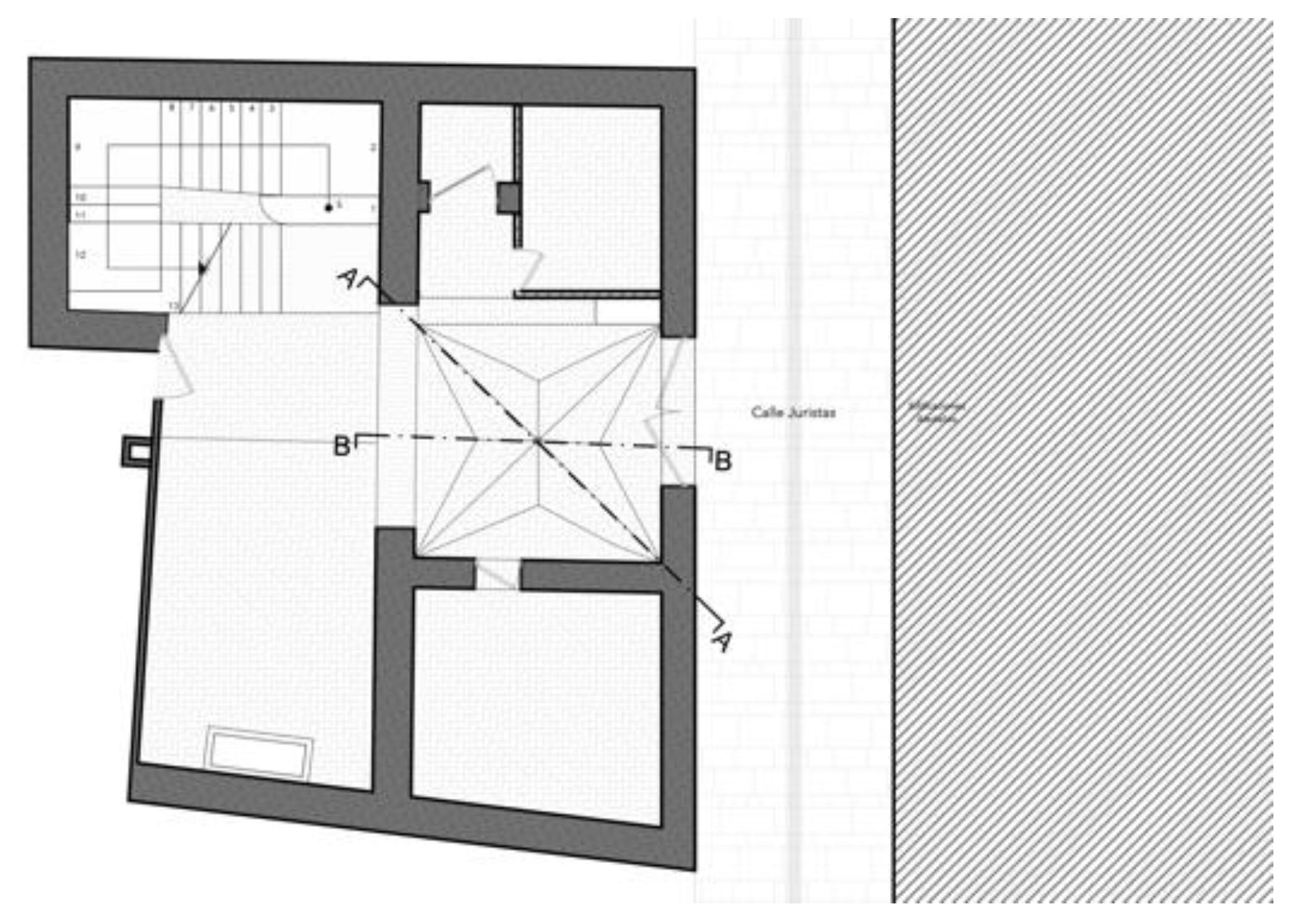
Figure 16.
b: Section by plane A-A’: a. Scanned / Drawing by the authors.
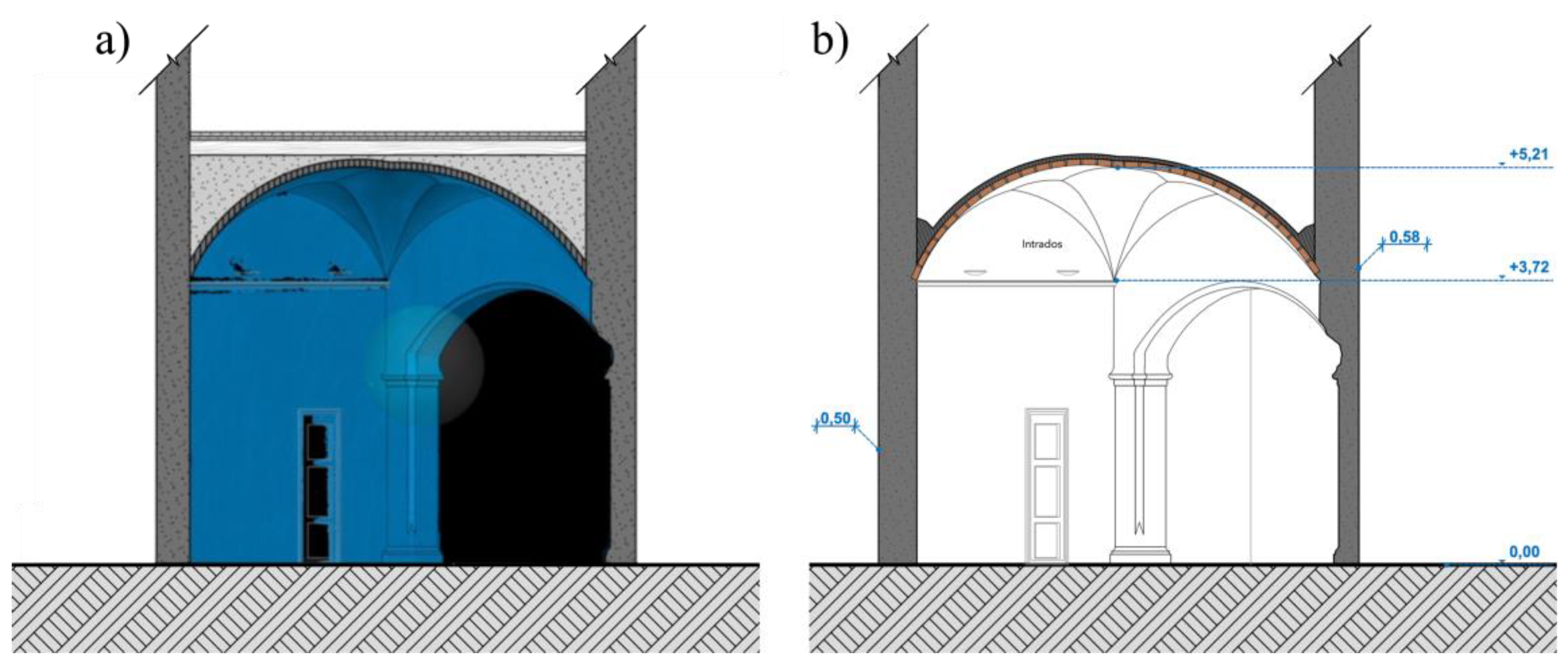
Figure 16.
c: Section by plane B-B’: Scanned / Drawing by the authors.
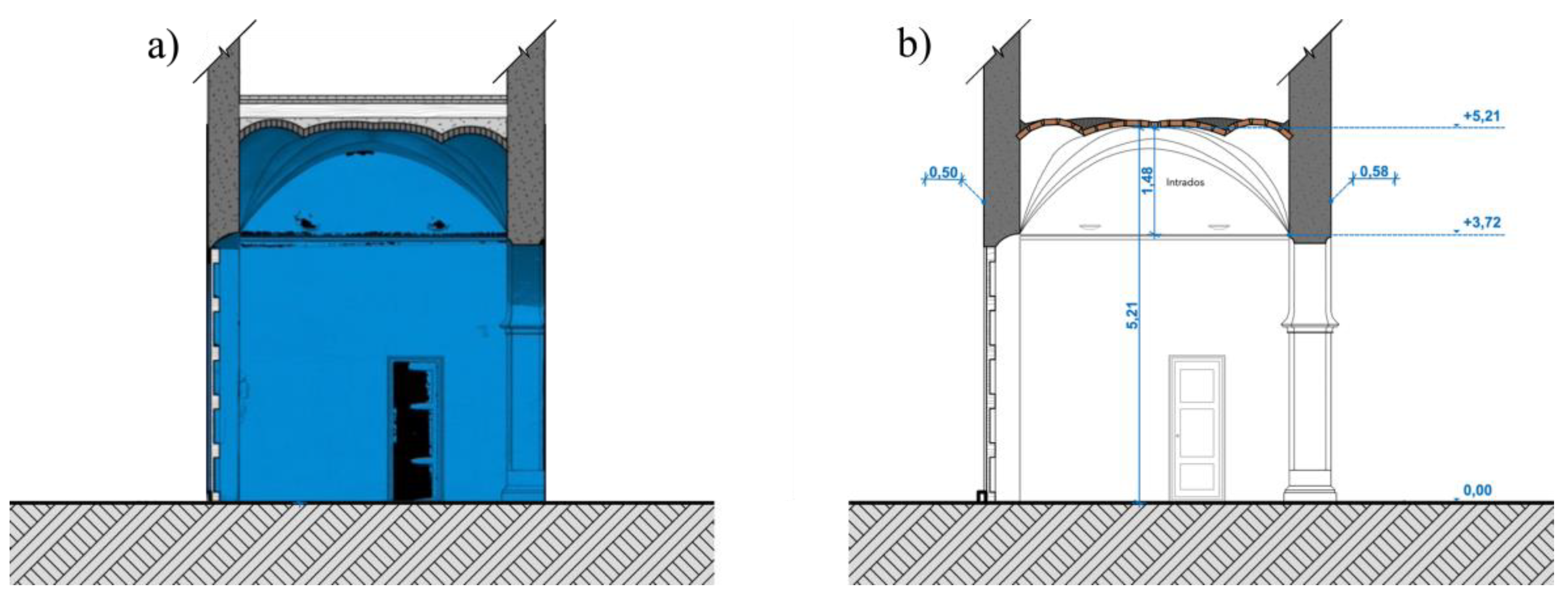
Figure 16.
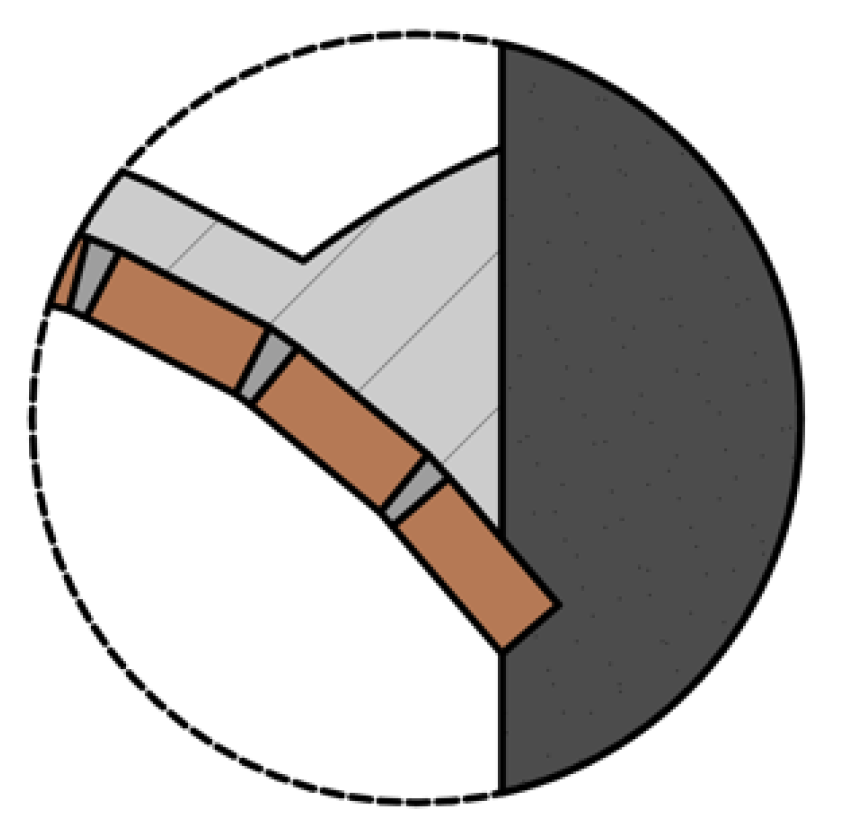
d: Detail of the meeting of the partitioned vault with the wall. Drawing by the authors.
In the case under analysis, as mentioned above, we had the opportunity to access the extrados of the vault, observing the following characteristics: The vault of the Palacio Más is not a load-bearing vault, or, in other words, it does not support any floor or flooring, but rather it closes off an interior space, separating it from the next floor by defining an intermediate, lost space between the wooden floor and the vault. This approach to building an interior enclosure can be seen in other later works with similar characteristics, such as the vaults of the cloister of the Colegio del Patriarca, which, although from a later period, follow the same tradition and feature similar construction systems.
Thanks to the kindness of the owners of the Más Palace, a test was carried out on the wall supporting the vault and above it. Through this opening, photographs were taken of the extrados of one of these partitioned vaults (Figure 17), and not only was it confirmed that it is not a load-bearing vault, but it was also possible to observe the structure and finish of the extrados, which is of enormous interest.
First, Figure 13 clearly shows that the vault’s kidneys are filled to some extent with rubble, and presumably lime mortar (or plaster, which could not be determined). Although not readily apparent, it has also been determined that the areas corresponding to the vault’s edges are “solidified” with plaster cords that seal and provide cohesion to the ceramic planes that make up the vault (Figure 18).
11. Restitution of the Trace
From the information obtained in the laser scanning process, an architectural survey of the vault space has been prepared, and a formal analysis of the same has also been carried out through the restitution of its layout, in accordance with the conventions of the treatise of drawing all its elements in true magnitude arranged on the plan (Figure 19).
When defining the vault’s layout, we will follow the same process as described in the initial taxonomy, but adapting it to the dimensions of the Palacio Más space. We will therefore define the irregular quadrilateral of the floor plan, and based on the survey, we will define the traceable shape used.
Since the floor plan’s shape is not excessively different from a square, the main edges, based on the laser scanner survey, correspond to the diagonal lines of the rhomboid, and the points of the “star” of the vault’s layout correspond with almost no error to the midpoints of each side. With this, the floor plan’s layout would be perfectly defined without any major problems (Figure 20).
It therefore remains to analyze the curvatures of the different edges on the survey carried out. By arranging all the edges in true magnitude on the same starting point, a clear design pattern is observed. The designer conceived the vault based on two main radii: one common to the perimeter edges of the vault, and another corresponding to the diagonals and tiercerons.
The vault’s peculiarity, that said, is that since its floor plan is not regular, the edges present certain adjustments that are somewhat difficult to detect during the survey, but which obey construction logic: The edges of each vault section should have a slightly different radius to absorb irregularities, but instead, the construction practice of the time solved the problem by raising or lowering the initial or final points of each edge until the desired height of the point was obtained. In other words, the height of the meeting points between edges (keystones, if we were talking about a ribbed vault) is established before the radius of the edges themselves. Or, an initial radius is established, corresponding to the diagonal, and with this, the rest of the vault is resolved by establishing heights for the keystones.
This process, somewhat complicated to explain, would be very simple on the construction site, and actually makes it unnecessary to have a perfectly defined vault plan in relation to the irregularities of the space to be covered. We are therefore talking about the constructive logic of the Gothic system applied to a distinct architectural type, but one that still owes its formal origins to medieval practices.
The result, therefore, is the image shown, which with a few lines can usefully define the totality of elements that must be built or used for the construction process (Figure 21).
12. Constructive Analysis
he choice of this vault, as mentioned, does not serve a load-bearing structural function, but rather responds to other issues, namely, ornamental and functional ones. It is possible that the vault was conceived to some extent to complement the representative character of the access space it occupies, but given that there are other examples of this type of vault in secondary spaces, it is more likely that the primary purpose of this vault is to conceal the wooden floor for a functional reason, such as fire prevention. Plaster is a material with relatively good fire resistance characteristics, and even more so if its purpose is to protect another element, this one a structural one.
Another question that must be addressed is the construction process or sequence, which, being partitioned, seems to be in no way other than from the bottom up. The construction sequence must have begun with the construction of the walls, that is, the perimeter. It must have then been necessary to delimit on the ground itself or on some scale plan (most likely on the ground at full scale or reduced to 1/2 or 1/3) the location where the main and secondary edges would be located. With this, the radius or radii needed to construct small guides to control the shape of the vault during its construction process could be drawn (they would not actually be formwork, since they have no load-bearing function). Next, to begin construction, it must have been necessary to make grooves on the walls, marking the perimeter edges and bases. And with all this, the construction of the vault itself could begin from its foundations, arranging the bricks “on the board” and joining them with plaster, which, by hardening almost immediately, would allow progress at great speed (Gómez-Ferrer, 2003; Marín, 2011).
Once the ridges were started, which, as in other examples in Valencia, such as the Quart Towers, usually correspond to circular arches on non-parallel planes (Vivó & Calvo López, 2010), the panels would be defined by courses that varied in orientation as they rose, adjusting to the geometry guided by the tiercerons and ties (Vivó & Calvo López, 2010). In this type of vault, the ridges replace the traditional role of the structural ribs, organizing the space without playing an explicit supporting role (Sánchez Simón, 2011; Ibáñez, 2012). And at this point, it would be necessary to form the cords that are located on the back of the ridges with plaster to provide stability.
Once the upper areas were reached, the vault would be closed without much difficulty, and all that remained was to apply the intrados coating with a layer of fine plaster, or “llafardat.” This not only homogenizes the surface finish but also contributes to the fire resistance of the entire structure (Marín, 2011; Zaragoza & Ibáñez, 2011). This construction system offers formal, constructive, economic, and even fireproof advantages, which explains its widespread use over a long period of time in ecclesiastical, civil, and courtly settings (Zaragoza, 2012; Marín, 2018).
13. Conclusions
13.1. Methodological Conclusions
The methodology used in this research, based on surveying using a Trimble TX6 laser scanner, has been previously employed and validated in numerous technical and scientific studies on architectural heritage documentation. This method has repeatedly demonstrated its ability to accurately record complex historical structures, allowing for the production of detailed and accurate three-dimensional digital models. The successful implementation of this technique in the detailed documentation of the star-shaped, partitioned vault of the Palacio Más once again confirms its effectiveness, methodological soundness, and suitability for future similar work focused on structural, construction, or architectural conservation analysis.
The formal and typological study has corroborated the specificity of star-shaped vaults. That is, it makes sense to consider them as an architectural type somewhat “emancipated” from simple ribbed vaults.
The historical study conducted has allowed (in addition to previously establishing the star-shaped vault as an emancipated architectural type) to identify a unique episode of interest: the emergence of star-shaped vaults resolved in a partitioned form.
The implementation of this technique marks an episode limited to the Valencian area within a very specific period of time, through a few specific examples.
13.2. Conclusions of the Analysis of the Vault
The main unique feature of this article is that it offers an analysis of a vault of this type, located in the city of Valencia, in a noble house/palace, where, for the first time ever, visual and instrumental access to its extrados has been obtained.
The main technical contribution and uniqueness of this article lies in the exhaustive and detailed analysis of a star-shaped, partitioned vault located in the Mas Palace, a building within the urban context of Valencia. The study is specifically notable for the unprecedented visual and instrumental access to the extrados of this structure, an aspect usually inaccessible in conventional studies. This exceptional access has made it possible to document with technical rigor construction features that normally remain hidden, such as the configuration of internal fillings with rubble and mortar in the upper areas, as well as the precise identification of elements to reinforce and unify the structural edges from the extrados. The collection and analysis of these data have provided new technical information about the original construction process, as well as about the specific functions of this architectural typology, particularly highlighting its role in fireproofing the upper slab. Thus, this work constitutes a significant contribution to the technical and historical knowledge of Valencian partitioned vaults, also proposing new lines of research based on these specific findings.
| 1 | Barrón García, Aurelio A., “bóvedas con figuras de estrellas y combados del |
| 2 | Tardogótico en la Rioja”. TVRIASO XXI, p. 222. |
| 3 | Barrón García, Aurelio A., “bóvedas con figuras de estrellas y combados del |
| 4 | Tardogótico en la Rioja”. TVRIASO XXI, p. 225. |
| 5 | Bertachi, Silvia, “Modelos de bóvedas en estrella: forma y geometría”. En Juan Carlos Navarro Fajardo (ed.), Bóvedas valencianas. Arquitecturas ideales, reales y virtuales en época medieval y moderna, Editorial Universitat Politécnica de Valencia, Valencia 2014, p. 138. |
| 6 | Palacios Gonzalo, José Carlos, “Las bóvedas de crucería españolas, ss. XV y XVI”. En A. Graciani, S. Huerta, E. Rabasa, M. Tabales (eds.). Actas del Tercer Congreso Nacional de Historia de la Construcción, Sevilla, 26-28 octubre 2000, eds., Madrid: I. Juan de Herrera, SEdHC, Universidad de Sevilla, Junta Andalucía, COAAT Granada, CEHOPU, 2000, p. 749. |
| 7 | Tellia, Fabio y Palacios, José Carlos, “Las bóvedas de crucería del manuscrito Llibre de trasas de viax y muntea, de Joseph Ribes”, LOCVS AMOENVS 13, 2015, p. 33. |
| 8 | Bertachi, Silvia, “Modelos de bóvedas en estrella: forma y geometría”. En Juan Carlos Navarro Fajardo (ed.), Bóvedas valencianas. Arquitecturas ideales, reales y virtuales en época medieval y moderna, Editorial Universitat Politécnica de Valencia, Valencia 2014, p. 145. |
| 9 | Bertachi, Silvia, “Modelos de bóvedas en estrella: forma y geometría”. En Juan Carlos Navarro Fajardo (ed.), Bóvedas valencianas. Arquitecturas ideales, reales y virtuales en época medieval y moderna, Editorial Universitat Politécnica de Valencia, Valencia 2014, p. 140. |
| 10 | Pecoraro, Ilaria, “Las bóvedas estrelladas del Salento. Una arquitectura a caballo entre la edad media y la edad moderna”. En Eduard Mira y Arturo Zaragozá Catalán (com.), Una arquitectura gótica mediterránea Vol. II, Generalidad valenciana, Valencia, 2003, p. 59. |
| 11 | Pecoraro, Ilaria, “Las bóvedas estrelladas del Salento. Una arquitectura a caballo entre la edad media y la edad moderna”. En Eduard Mira y Arturo Zaragozá Catalán (com.), Una arquitectura gótica mediterránea Vol. II, Generalidad valenciana, Valencia, 2003, p. 59. |
| 12 | Bertachi, Silvia, “Modelos de bóvedas en estrella: forma y geometría”. En Juan Carlos Navarro Fajardo (ed.), Bóvedas valencianas. Arquitecturas ideales, reales y virtuales en época medieval y moderna, Editorial Universitat Politécnica de Valencia, Valencia 2014, p. 139. |
| 13 | Martínez-Espejo Zaragoza, Isabel. “Técnicas de levantamiento con escáner láser del patrimonio arquitectónico. Hipótesis y restitución virtual de la bóveda de una iglesia”. En José Antonio Melgares Guerrero y Pedro Enrique Collado Espejo (dirs. congr.). XXII Jornadas de patrimonio cultural de la Región de Murcia: (4 de Octubre - 8 de Noviembre de 2011) Cartagena, Murcia, 2011, pp. 275-284. |
| 14 | Navarro Fajardo, Juan Carlos, “La lonja de valencia a la luz de las trazas de |
| 15 | Montea”, ARCHÉ. publicación del instituto universitario de restauración del patrimonio de la UPV - Núms. 4 y 5 – 2010, pp. 245-253. |
| 16 | Palacios Gonzalo, José Carlos, La geometría de la bóveda de crucería española del XVI. Conferencia leída en el III Seminario de bóvedas, impartido dentro del máster de restauración de la Universidad Politécnica de Valencia, Gothicmed.com. A virtual museum of mediterranean gothic arquitecture, Archivo Digital UPM, 2007, pp. s. n. Acceso en línea: https://oa.upm.es/30744/
|
| 17 | Palacios Gonzalo, José Carlos, “Las bóvedas de crucería españolas, ss. XV y XVI”. En A. Graciani, S. Huerta, E. Rabasa, M. Tabales (eds.). Actas del Tercer Congreso Nacional de Historia de la Construcción, Sevilla, 26-28 octubre 2000, eds., Madrid: I. Juan de Herrera, SEdHC, Universidad de Sevilla, Junta Andalucía, COAAT Granada, CEHOPU, 2000, pp. 743-750. |
| 18 | Palacios Gonzalo, José Carlos, “Las bóvedas de crucería españolas, ss. XV y XVI”. En A. Graciani, S. Huerta, E. Rabasa, M. Tabales (eds.). Actas del Tercer Congreso Nacional de Historia de la Construcción, Sevilla, 26-28 octubre 2000, eds., Madrid: I. Juan de Herrera, SEdHC, Universidad de Sevilla, Junta Andalucía, COAAT Granada, CEHOPU, 2000, p. 744. |
| 19 | Palacios Gonzalo, José Carlos, La geometría de la bóveda de crucería española del XVI. Conferencia leída en el III Seminario de bóvedas, impartido dentro del máster de restauración de la Universidad Politécnica de Valencia, Gothicmed.com. A virtual museum of mediterranean gothic arquitecture, Archivo Digital UPM, 2007, pp. s. n. Acceso en línea: https://oa.upm.es/30744/
|
| 20 | Chueca, Fernando. La catedral nueva de Salamanca. Historia documental de su construcción. Volumen del Acta Salmanticensia, Filosofía y Letras tomo IV, N.º 3, Salamanca, Universidad de Salamanca, 1951. |
| 21 | Zaragozá Catalán, Arturo, Arquitectura gótica valenciana siglos XIII-XV. Monumentos de la Comunidad Valenciana. Catálogo de monumentos y conjuntos declarados e incoados, Tomo I, Generalitat valenciana, Valencia, 2000, p. 174. |
| 22 | Palacios Gonzalo, José Carlos, La geometría de la bóveda de crucería española del XVI. Conferencia leída en el III Seminario de bóvedas, impartido dentro del máster de restauración de la Universidad Politécnica de Valencia, Gothicmed.com. A virtual museum of mediterranean gothic arquitecture, Archivo Digital UPM, 2007, pp. s. n. Acceso en línea: https://oa.upm.es/30744/
|
| 23 | Breymann, Gustav Adolf, Allgemeine Bau-Constructions-Lehre, mit Besonderer Beziehung auf das Hochbauwesen ein Leiftaden zu Vorlesungen und zum Selbstunterrichte. Constructionen in Metall Eisenconstrutionen (1858). |
| 24 | Bertachi, Silvia, “Modelos de bóvedas en estrella: forma y geometría”. En Juan Carlos Navarro Fajardo (ed.), Bóvedas valencianas. Arquitecturas ideales, reales y virtuales en época medieval y moderna, Editorial Universitat Politécnica de Valencia, Valencia 2014, p. 147. |
| 25 | Zaragozá Catalán, Arturo y Ibáñez Fernández, Javier, “Materiales, técnicas y significados en torno a la arquitectura de la Corona de Aragón en tiempos del Compromiso de Caspe (1410-1412)”, Artigrama, nº 26, 2011, p. 22. |
| 26 | This interest is sufficiently documented, with specific examples, in royal chronicles. For example, when the first brick vaults were built in the Royal Palace of Valencia (1382), King Pedro IV the Ceremonious asked the merino of Zaragoza to send Master Faraig Delbadar and another of his best to Valencia to learn the new technique. He explained that a new type of construction method based on brick and plaster had been developed in Valencia. In 1407, the royal chapel of Martin the Humane in Barcelona Cathedral was already being vaulted in this same way. |
| 27 | [1] Navarro Camallonga, Pablo. Tesis: Arcos, bóvedas de arista y bóvedas aristadas de cantería en el círculo de Francesc Baldomar y Pere Compte. Directores Ignacio Bosch Reig y Luis Bosch Roig. Escuela Técnica Superior de Arquitectura de Valencia (UPV), 2018, p. 79. |
| 28 | [1] Serra Desfilis, Amadeo, “Al servicio de la ciudad: Joan del Poyo y la práctica de la arquitectura en Valencia (1402-1439)”. Ars longa: cuadernos de arte, Nº. 5, 1994, pp. 111-119. |
| 29 | [1] López Lorente, Víctor Daniel, “Mestres d’obra, Mestres de cases e imaginaires: la semántica de la construcción a finales de la edad Media en el contexto lingüístico catalán, Medievalismo, 30, 2020, pp. 331-352. |
| 30 | Palacios Gonzalo, José Carlos, La geometría de la bóveda de crucería española del XVI. Conferencia leída en el III Seminario de bóvedas, impartido dentro del máster de restauración de la Universidad Politécnica de Valencia, Gothicmed.com. A virtual museum of mediterranean gothic arquitecture, Archivo Digital UPM, 2007, pp. s. n. Acceso en línea: https://oa.upm.es/30744/
|
| 31 | A good example of this is the ribbed vaults that cover the church of the College of Corpus Christi in Valencia or College of the Patriarch Saint John of Ribera, which were built between 1586 and 1606. |
| 32 | Marín Sánchez, Rafael, “Bóvedas de crucería con nervios prefabricados de yeso y de ladrillo aplantillado”. En S. Huerta, I. Gil Crespo, S. García, M. Taín (eds.). Actas del Séptimo Congreso Nacional de Historia de la Construcción, Santiago 26-29 octubre 2011, Madrid: Instituto Juan de Herrera, 2011, p. 843. |
| 33 | Navarro Camallonga, Pablo, “Transverse Arches in Spanish Ribless Vaults”, Nexus Network Journal Architecture and Mathematics, 22, (4), p. 1. |
| 34 | Barrón García, Aurelio A., “bóvedas con figuras de estrellas y combados del |
| 35 | Tardogótico en la Rioja”. TVRIASO XXI, p. 225. |
| 36 | Zaragozá Catalán, Arturo "Una Catedral, una escuela. La arquitectura y la escultura valenciana del cuatrocientos a través de los maestros Dalmau, Baldomar y Compte". En Manuel Muñoz Ibáñez (coord.) La catedral de Valencia: historia, cultura y patrimonio 2018, p. 42.
|
| 37 | Martín Lloris, Catalina, “El monasterio de Santa María de la Valldigna: símbolo en la organización territorial del Antiguo Reino de Valencia”, Revista valenciana d'estudis autonòmics, nº 58 · Vol. I, 2013, p. 83. |
| 38 | Zaragozá Catalán, Arturo, “Cuando la arista gobierna el aparejo: Bóvedas aristadas”. En Amadeo Serra Desfilis (coord.) Arquitectura en construcción en Europa en época medieval y moderna, Universidad de Valencia 2010, p. 186. |
| 39 | Finalmente Alfonso V fue enterrado en el Monasterio de Poblet (Tarragona) |
| 40 | Chiva Maroto, German Andreu. Tesis doctoral Francesc Baldomar. Maestro de obra de la Seo. geometría e inspiración bíblica. Departamento de Composición Arquitectónica, UPV, Valencia 2014. |
| 41 | Navarro Camallonga, Pablo, “Transverse Arches in Spanish Ribless Vaults”, Nexus Network Journal Architecture and Mathematics, 22, (4), pp. 1-22. DOI 10.1007/s00004-020-00524-x.; “Las bóvedas nervadas de Baldomar. Singularidad y representación del poder en tiempos de Alfonso el Magnánimo”, Universidad Politécnica de Valencia, pp. 101-116. / Soler Estrela et al.: Soler Estrela, Alba; Garfella Rubio, José Teodoro y Cabeza González, Manuel. “Geometría y construcción en la capilla real del convento de santo Domingo. valencia”. En Francisco Hidalgo Delgado (coord..). XI Congreso Internacional de Expresión Gráfica aplicada a la Edificación. Universidad Politécnica de Valencia. Valencia, 2012, pp. 527-534/ Zaragozá Catalán, Arturo: Zaragozá Catalán, Arturo, “Cuando la arista gobierna el aparejo: Bóvedas aristadas”. En Amadeo Serra Desfilis (coord.) Arquitectura en construcción en Europa en época medieval y moderna, Universidad de Valencia 2010, pp. 187-224.; “Bóvedas del gótico mediterráneo”. En Eduardo Mira y Arturo Zaragozá Catalán (eds.). Una arquitectura del gótico mediterráneo. Catálogo de la exposición. Generalitat Valenciana. Conselleria de Cultura i Educació. Subsecretaria de Promoció Cultural. Valencia, 2003. · 2 volúmenes: 1º volumen, pp. 129-142. / Sánchez Simón, Ignacio, “Traza y montea de la bóveda de la Capilla Real del convento de Santo Domingo de Valencia. La arista del Triángulo de Reuleaux entre las aristas de la bóveda”. En S. Huerta, I. Gil Crespo, S. García, M. Taín (eds.). Actas del Séptimo Congreso Nacional de Historia de la Construcción, Santiago 26-29 octubre 2011. Madrid, Instituto Juan de Herrera, 2011, pp. 1302-1309., etc. |
| 42 | Natividad Vivó, Pau; Calvo López, José y Muñoz Cosme, Gaspar. “La bóveda de crucería anervada del portal de Quart de Valencia”. EGA Expresión Gráfica Arquitectónica nº 19 (2012), Pp. 190-199 |
| 43 | Zaragozá Catalán, Arturo y Marín Sánchez, Rafael, “El monasterio de San Jerónimo de Cotalba (Valencia). Un laboratorio de técnicas de albañilería (ss. XIV-XVI)”. En Santiago Huertas y Paula Fuentes (coords.). Actas del Noveno Congreso Nacional y Primer Congreso Internacional Hispanoamericano de Historia de la Construcción: Segovia, 13 a 17 de octubre de 2015, Vol. 3, 2015, p. 1799. |
| 44 | Navarro Camallonga, Pablo. Tesis: Arcos, bóvedas de arista y bóvedas aristadas de cantería en el círculo de Francesc Baldomar y Pere Compte. Directores Ignacio Bosch Reig y Luis Bosch Roig. Escuela Técnica Superior de Arquitectura de Valencia (UPV), 2018, p. 100. |
| 45 | Shelby, Lon R, 1977. Gothic Design techniques: The 15th Century Design Booklets of Mathes Roriczer and Hans Schumttermayer, Carbondale and Edwardsville: Southern Illinois University Press. / |
| 46 | Shelby, Lon R and Mark, R, 1979. Late Gothic Structural Design in the 'Instructions' of Lorenz Lechler." Architectura, 9, pp. 1 13-131. / Coenen, U, 1990. Die spãtgotischen Werkmeisterbücher in Deutschland. Untersuchung und Edition der Lehrschriften fiir Entwurfund Ausfiihrung von Sakralbauten. (Beitrüge zur Kunstwissenschaft, Bd. 25), München: Scaneg. / Müller, Werner, 1990. Grundlagen gotischer Bautechnik, München: Deutscher Kunstverlag. / Binding, G, 1993. Baubetrieb im Mittelalter, Darmstadt: Wissenshaftliche Gesellschaft. |
| 47 | Fitchen, J, 1981 (first. ed. 1961). The construction of Gothic Cathedrals: A Study of Medieval Vault Erection, Chicago: The University of Chicago Press. |
| 48 | Huerta, Santiago and Ruiz, Antonio. “Some Notes on Gothic Building Processes: The Expertises of Segovia Cathedral”. In M. Dunkeld, J. Campbell, Hentie Louw, M. Tutton, B. Addis, R. Thorne (eds.). The Second International Congress on Construction History (2006), London, p. 1619. |
| 49 | Zaragozá Catalán, Arturo, Arquitectura gótica valenciana siglos XIII-XV. Monumentos de la Comunidad Valenciana. Catálogo de monumentos y conjuntos declarados e incoados, Tomo I, Generalitat valenciana, Valencia, 2000. |
| 50 | Huerta, Santiago and Ruiz, Antonio. “Some Notes on Gothic Building Processes: The Expertises of Segovia Cathedral”. In M. Dunkeld, J. Campbell, Hentie Louw, M. Tutton, B. Addis, R. Thorne (eds.). The Second International Congress on Construction History (2006), London, pp. 1619-1631.
|
| 51 | Navarro Camallonga, Pablo. Tesis doctoral, Arcos, Bóvedas de Arista y Bóvedas Aristadas de Cantería en el Círculo de Francesc Baldomar y Pere Compte. Departamento de expresión gráfica, UPV, Valencia, 2018. |
| 52 | Navarro Camallonga, Pablo. Bóvedas aristadas. Levantamiento y estudio histórico-constructivo. Editorial Universidad de Alcalá, 2021. |
| 53 | Navarro Camallonga, Pablo. Tesis: Arcos, bóvedas de arista y bóvedas aristadas de cantería en el círculo de Francesc Baldomar y Pere Compte. Directores Ignacio Bosch Reig y Luis Bosch Roig. Escuela Técnica Superior de Arquitectura de Valencia (UPV), 2018, p. 178. |
| 54 | Huerta Fernández, Santiago, “Las bóvedas tabicadas en Alemania: la larga migración de una técnica constructiva”. Actas del Segundo Congreso Internacional Hispanoamericano, Noveno Nacional, de Historia de la Construcción, Vol. 2, Instituto Juan de Herrera, Madrid, p. 762. |
| 55 | The new kingdom stretched from the northern part of the Valencian region to the present-day region of Murcia, with some territories in the province of Teruel. This new Almoravid kingdom reached its peak under the reign of Ibn Mardanis, known to the Christians as the "Rey Lobo". |
| 56 | The rapid setting of plaster requires a fast pace of execution, because if it is not used immediately, the plaster begins to set and loses its plasticity. |
| 57 | Marín Sánchez, Rafael, “Bóvedas de crucería con nervios prefabricados de yeso y de ladrillo aplantillado”. En S. Huerta, I. Gil Crespo, S. García, M. Taín (eds.). Actas del Séptimo Congreso Nacional de Historia de la Construcción, Santiago 26-29 octubre 2011, Madrid: Instituto Juan de Herrera, 2011, p. 845. |
| 58 | Ibáñez Fernández, Javier, “Técnica y ornato: aproximación al estudio de la bóveda tabicada en Aragón y su decoración a lo largo de los siglos XVI y XVII”, Artigrama, núm. 25, 2010, p. 368. |
| 59 | Gómez-Ferrer Lozano, Mercedes, “Las bóvedas tabicadas en la arquitectura valenciana durante los siglos XIV, XV y XVI”. En Eduard Mira y Arturo Zaragozá Catalán (com.), Una arquitectura gótica mediterránea Vol. II, Generalidad valenciana, Valencia, 2003, p. 135. |
| 60 | Marín Sánchez, Rafael, “Aspectos constructivos de las bóvedas levantinas de albañilería (S. XV-XVI) a la luz de las obras y los documentos”. En Mercedes Gómez-Ferrer y Yolanda Gil Saura (eds.). Ecos culturales, artísticos y arquitectónicos entre Valencia y el Mediterráneo en Época Moderna. Cuadernos Ars Longa nº 8, 2018, p. 68. |
| 61 | Zaragozá Catalán, Arturo, “Hacia una historia de las bóvedas tabicadas”. En Arturo Zaragozá Catalán, Rafael Soler y Rafael Marín (eds.), Construyendo bóvedas tabicadas. Actas del simposio internacional de bóvedas tabicadas, Valencia 26, 27 y 28 de mayo de 2011, Editorial UPV, Valencia, 2012, p.20. |
| 62 | Ibáñez Fernández, Javier, “De la crucería al cortado: importación, implantación y desarrollo de la bóveda tabicada en Aragón y su decoración a lo largo de los siglos XVI y XVII”. En Arturo Zaragozá, Rafael Soler y Rafael Marín (eds.). Construyendo bóveda tabicadas. Actas del Simposio Internacional sobre Bóvedas tabicadas, Valencia 26, 27 y 28 de mayo de 2011. Editorial Universidad Politécnica de Valencia, Valencia, 2012, p. 87. |
| 63 | Ibáñez Fernández, Javier, “De la crucería al cortado: importación, implantación y desarrollo de la bóveda tabicada en Aragón y su decoración a lo largo de los siglos XVI y XVII”. En Arturo Zaragozá, Rafael Soler y Rafael Marín (eds.). Construyendo bóveda tabicadas. Actas del Simposio Internacional sobre Bóvedas tabicadas, Valencia 26, 27 y 28 de mayo de 2011. Editorial Universidad Politécnica de Valencia, Valencia, 2012, p. 87. |
| 64 | Thunissen H. J. W., Bóvedas su construcción y empleo en la arquitectura, Instituto Juan de Herrera, Madrid, 2012, p. 169. |
| 65 | Like the middle Ebro valley in Aragon or in most of Valencian territory. |
| 66 | Marín Sánchez, Rafael, “Aspectos constructivos de las bóvedas levantinas de albañilería (S. XV-XVI) a la luz de las obras y los documentos”. En Mercedes Gómez-Ferrer y Yolanda Gil Saura (eds.). Ecos culturales, artísticos y arquitectónicos entre Valencia y el Mediterráneo en Época Moderna. Cuadernos Ars Longa nº 8, 2018, p. 81. |
| 67 | Zaragozá Catalán, Arturo y Ibáñez Fernández, Javier, “Materiales, técnicas y significados en torno a la arquitectura de la Corona de Aragón en tiempos del Compromiso de Caspe (1410-1412)”, Artigrama, nº 26, 2011, p. 54. |
| 68 | Marín Sánchez, Rafael, “Bóvedas de crucería con nervios prefabricados de yeso y de ladrillo aplantillado”. En S. Huerta, I. Gil Crespo, S. García, M. Taín (eds.). Actas del Séptimo Congreso Nacional de Historia de la Construcción, Santiago 26-29 octubre 2011, Madrid: Instituto Juan de Herrera, 2011, p. 841. |
| 69 | Zaragozá Catalán, Arturo, “Hacia una historia de las bóvedas tabicadas”. En Arturo Zaragozá Catalán, Rafael Soler y Rafael Marín (eds.), Construyendo bóvedas tabicadas. Actas del simposio internacional de bóvedas tabicadas, Valencia 26, 27 y 28 de mayo de 2011, Editorial UPV, Valencia, 2012, p.27. |
| 70 | Zaragozá Catalán, Arturo, Arquitectura gótica valenciana siglos XIII-XV. Monumentos de la Comunidad Valenciana. Catálogo de monumentos y conjuntos declarados e incoados, Tomo I, Generalitat valenciana, Valencia, 2000, p. 153. |
| 71 | Gómez-Ferrer, Mercedes y Zaragozá, Arturo, “Lenguajes, fábricas y oficios en la arquitectura valenciana del tránsito entre la Edad Media y la Edad Moderna. (1450-1550)”, Artigrama, nº 23, 2008, p. 173. |
| 72 | Corbalán–de Celis y Durán, Juan. “De obras públicas y maestros de obras en la Valencia del siglo XV e inicios del XVI. El entorno de la iglesia de San Bartolomé”. Boletín de la sociedad castellonense de cultura Tomo LXXXIII • Enero-Junio 2007 • Cuad. I-II, p. 116. |
| 73 | Serra Desfilis, Amadeo. “A través de la frontera: los maestros de Castilla y la arquitectura tardogótica en Valencia”. En Juan Carlos Navarro Fajardo (coord.). Bóvedas valencianas: arquitecturas ideales, reales y virtuales en época medieval y moderna, Universidad de Cantabria, 2014, p.15. |
| 74 | Miralles, in addition to indicating that he participated in "all" of the city's works, specifically mentions his work in the Seu and in the monasteries of Portaceli and San Jerónimo la Virgen María in la Murta, Trinidad de Santa Clara and Valdexpi. |
| 75 | Melcior Miralles, Crònica i dietari del capellà d’Alfons el Magnànim, edició a cura de Mateu Rodrigo Lizondo, Fonts Històriques Valencianes, 47, València Universitat de València, 2011. |
| 76 | Serra Desfilis, Amadeo. “A través de la frontera: los maestros de Castilla y la arquitectura tardogótica en Valencia”. En Juan Carlos Navarro Fajardo (coord.). Bóvedas valencianas: arquitecturas ideales, reales y virtuales en época medieval y moderna, Universidad de Cantabria, 2014, p.15. |
| 77 | According to José Manuel Barrera Puigdollers, financed by Beatriz Villaragut. Report p. 41 |
| 78 | Barrera Puigdollers, J. M., PLAN ESPECIAL ZONA NORTE DE ALFAUIR (PE); URBANÍSTICA Y PATRIMONIAL Plan Especial de Protección del Monumento- Monasterio de San Jerónimo de Cotalba (PEP). |
| 79 | Zaragozá Catalán, Arturo, “Hacia una historia de las bóvedas tabicadas”. En Arturo Zaragozá Catalán, Rafael Soler y Rafael Marín (eds.), Construyendo bóvedas tabicadas. Actas del simposio internacional de bóvedas tabicadas, Valencia 26, 27 y 28 de mayo de 2011, Editorial UPV, Valencia, 2012, p.34. |
| 80 | Gómez-Ferrer Lozano, Mercedes, “Las bóvedas tabicadas en la arquitectura valenciana durante los siglos XIV, XV y XVI”. En Eduard Mira y Arturo Zaragozá Catalán (com.), Una arquitectura gótica mediterránea Vol. II, Generalidad valenciana, Valencia, 2003, p. 145. |
| 81 | Corbalán–de Celis y Durán, Juan. “De obras públicas y maestros de obras en la Valencia del siglo XV e inicios del XVI. El entorno de la iglesia de San Bartolomé”. Boletín de la sociedad castellonense de cultura Tomo LXXXIII • Enero-Junio 2007 • Cuad. I-II, p. 109. |
| 82 | Corbalán–de Celis y Durán, Juan. “De obras públicas y maestros de obras en la Valencia del siglo XV e inicios del XVI. El entorno de la iglesia de San Bartolomé”. Boletín de la sociedad castellonense de cultura Tomo LXXXIII • Enero-Junio 2007 • Cuad. I-II, p. 116. |
| 83 | Serra Desfilis, Amadeo, “El fasto del palacio inacabado. la casa de la ciudad de valencia en los siglos XIV y XV”, Historia de la ciudad III: Arquitectura y transformación urbana de la ciudad de Valencia, COACV, 2004, p. 95. |
| 84 | Bertachi, Silvia, “Modelos de bóvedas en estrella: forma y geometría”. En Juan Carlos Navarro Fajardo (ed.), Bóvedas valencianas. Arquitecturas ideales, reales y virtuales en época medieval y moderna, Editorial Universitat Politécnica de Valencia, Valencia 2014, p. 140. |
References
- Barrera Puigdollers, J. M. , PLAN ESPECIAL ZONA NORTE DE ALFAUIR (PE); URBANÍSTICA Y PATRIMONIAL Plan Especial de Protección del Monumento- Monasterio de San Jerónimo de Cotalba (PEP).
- Barrón García, Aurelio A.
- Tardogótico en la Rioja”. TVRIASO.
- Bertachi, Silvia, “Modelos de bóvedas en estrella: forma y geometría”. En Juan Carlos Navarro Fajardo (ed.), Bóvedas valencianas. Arquitecturas ideales, reales y virtuales en época medieval y moderna, Editorial Universitat Politécnica de Valencia, Valencia 2014, pp. 137-162.
- Breymann, Gustav Adolf, Allgemeine Bau-Constructions-Lehre, mit Besonderer Beziehung auf das Hochbauwesen ein Leiftaden zu Vorlesungen und zum Selbstunterrichte. Constructionen in Metall Eisenconstrutionen ( 1858.
- Chiva Maroto, German Andreu. Tesis doctoral Francesc Baldomar. Maestro de obra de la Seo. geometría e inspiración bíblica. Departamento de Composición Arquitectónica, UPV, Valencia 2014.
- Chueca, Fernando. La catedral nueva de Salamanca. Historia documental de su construcción. Volumen del Acta Salmanticensia, Filosofía y Letras tomo IV, N.º 3, Salamanca, Universidad de Salamanca, 1951.
- Coenen, U, 1990. Die spãtgotischen Werkmeisterbücher in Deutschland. Untersuchung und Edition der Lehrschriften fiir Entwurfund Ausfiihrung von Sakralbauten, Beitrüge: zur Kunstwissenschaft, Bd. 25), München: Scaneg.
- Corbalán-de Celis y Durán, Juan. “De obras públicas y maestros de obras en la Valencia del siglo XV e inicios del XVI. El entorno de la iglesia de San Bartolomé́”. Boletín de la sociedad castellonense de cultura Tomo LXXXIII • Enero-Junio 2007, Cuad. I-II, pp. 105-122.
- Fitchen, J, 1981 (first. ed. 1961). The construction of Gothic Cathedrals: A Study of Medieval Vault Erection, Chicago: The University of Chicago Press.
- Gómez-Ferrer Lozano, Mercedes, “Las bóvedas tabicadas en la arquitectura valenciana durante los siglos XIV, XV y XVI”. En Eduard Mira y Arturo Zaragozá Catalán (com.), Una arquitectura gótica mediterránea Vol. II, Generalidad valenciana, Valencia, 2003, pp. 135-155.
- Gómez-Ferrer, Mercedes y Zaragozá, Arturo, “Lenguajes, fábricas y oficios en la arquitectura valenciana del tránsito entre la Edad Media y la Edad Moderna. (1450-1550)”, Artigrama, nº 23, 2008, pp. 149-184.
- Huerta, Santiago and Ruiz, Antonio. “Some Notes on Gothic Building Processes: The Expertises of Segovia Cathedral”. In M. Dunkeld, J. Campbell, Hentie Louw, M. Tutton, B. Addis, R. Thorne (eds.). The Second International Congress on Construction History (2006), London, pp. 1619-1631, 1619.
- Huerta Fernández, Santiago, “Las bóvedas tabicadas en Alemania: la larga migración de una técnica constructiva”. Actas del Segundo Congreso Internacional Hispanoamericano, Noveno Nacional, de Historia de la Construcción, Vol. 2, Instituto Juan de Herrera, Madrid, 2017, pp. 759-772.
- Ibáñez Fernández, Javier, “Técnica y ornato: aproximación al estudio de la bóveda tabicada en Aragón y su decoración a lo largo de los siglos XVI y XVII”, Artigrama, núm. 25, 2010, pp. 363-405.
- Ibáñez Fernández, Javier, “De la crucería al cortado: importación, implantación y desarrollo de la bóveda tabicada en Aragón y su decoración a lo largo de los siglos XVI y XVII”. En Arturo Zaragozá, Rafael Soler y Rafael Marín (eds.). Construyendo bóveda tabicadas. Actas del Simposio Internacional sobre Bóvedas tabicadas, Valencia 26, 27 y 28 de mayo de 2011. 2012; Editorial Universidad Politécnica de Valencia, Valencia, 2012.
- López Lorente, Víctor Daniel, “Mestres d’obra, Mestres de cases e imaginaires: la semántica de la construcción a finales de la edad Media en el contexto lingüístico catalán, Medievalismo, 30, 2020, pp. 331-352.
- Marín Sánchez, Rafael, “Bóvedas de crucería con nervios prefabricados de yeso y de ladrillo aplantillado”. En S. Huerta, I. Gil Crespo, S. García, M. Taín (eds.). Actas del Séptimo Congreso Nacional de Historia de la Construcción, I: 26-29 octubre 2011, Madrid, 2011: Instituto Juan de Herrera, 2011, pp. 841-850.
- Marín Sánchez, Rafael, “Aspectos constructivos de las bóvedas levantinas de albañilería (S. XV-XVI) a la luz de las obras y los documentos”. En Mercedes Gómez-Ferrer y Yolanda Gil Saura (eds.). Ecos culturales, artísticos y arquitectónicos entre Valencia y el Mediterráneo en Época Moderna. Cuadernos Ars Longa; nº 8, 2018.
- Martín Lloris, Catalina, “El monasterio de Santa María de la Valldigna: símbolo en la organización territorial del Antiguo Reino de Valencia”, Revista valenciana d’estudis autonòmics, nº 58 · Vol. I, 2013, pp. 65-85.
- Martínez-Espejo Zaragoza, Isabel. “Técnicas de levantamiento con escáner láser del patrimonio arquitectónico. Hipótesis y restitución virtual de la bóveda de una iglesia”. En José Antonio Melgares Guerrero y Pedro Enrique Collado Espejo (dirs. congr.). XXII Jornadas de patrimonio cultural de la Región de Murcia: (4 de Octubre - 8 de Noviembre de 2011) Cartagena, Murcia, 2011, pp. 275-284.
- Melcior Miralles, Crònica i dietari del capellà d’Alfons el Magnànim, edició a cura de Mateu Rodrigo Lizondo, Fonts Històriques Valencianes, 47, València Universitat de València, 2011.
- Müller, Werner, 1990. Grundlagen gotischer Bautechnik, München: Deutscher Kunstverlag. / Binding, G, 1993. Baubetrieb im Mittelalter, Darmstadt: Wissenshaftliche Gesellschaft.
- Natividad Vivó, Pau; Calvo López, José y Muñoz Cosme, Gaspar. “La bóveda de crucería anervada del portal de Quart de Valencia”. EGA Expresión Gráfica Arquitectónica nº 19 (2012), Pp. 190-199.
- Navarro Fajardo, Juan Carlos, “La lonja de valencia a la luz de las trazas de.
- Montea”, ARCHÉ. publicación del instituto universitario de restauración del patrimonio de la UPV - Núms. 4 y 5 – 2010, pp. 245-253.
- Navarro Camallonga, Pablo. Tesis: Arcos, bóvedas de arista y bóvedas aristadas de cantería en el círculo de Francesc Baldomar y Pere Compte. Directores Ignacio Bosch Reig y Luis Bosch Roig. Escuela Técnica Superior de Arquitectura de Valencia (UPV), 2018.
- Navarro Camallonga, Pablo, “Transverse Arches in Spanish Ribless Vaults”, Nexus Network Journal Architecture and Mathematics, 22, (4), 2020, pp. 1-22. . https://doi.org/. [CrossRef]
- Navarro Camallonga, Pablo. Bóvedas aristadas. Levantamiento y estudio histórico-constructivo. Editorial Universidad de Alcalá, 2021.
- Navarro Camallonga, Pablo, “Las bóvedas nervadas de Baldomar. Singularidad y representación del poder en tiempos de Alfonso el Magnánimo”, Universidad Politécnica de Valencia, pp. 101-116.
- Palacios Gonzalo, José Carlos, “Las bóvedas de crucería españolas, ss. XV y XVI”. En A. Graciani, S. Huerta, E. Rabasa, M. Tabales (eds.). Actas del Tercer Congreso Nacional de Historia de la Construcción, Sevilla, 26-28 octubre 2000, eds., Madrid: I. Juan de Herrera, SEdHC, Universidad de Sevilla, Junta Andalucía, COAAT Granada, CEHOPU, 2000, pp. 743-750.
- Palacios Gonzalo, José Carlos, La geometría de la bóveda de crucería española del XVI. Conferencia leída en el III Seminario de bóvedas, impartido dentro del máster de restauración de la Universidad Politécnica de Valencia, Gothicmed.com. A virtual museum of mediterranean gothic arquitecture, Archivo Digital UPM, 2007, pp. s. n. Acceso en línea: https://oa.upm.es/ 30744/. 3074.
- Pecoraro, Ilaria, “Las bóvedas estrelladas del Salento. Una arquitectura a caballo entre la edad media y la edad moderna”. En Eduard Mira y Arturo Zaragozá Catalán (com.), Una arquitectura gótica mediterránea Vol. II, Generalidad valenciana, Valencia, 2003, pp. 53-66.
- Redondo Martínez, Esther. Tesis: La Bóveda Tabicada en España en el Siglo XIX. La Transformación de un Sistema Constructivo. Dirigida por Santiago Huerta Fernández, Escuela Técnica Superior de Arquitectura de Madrid, Madrid, 2013.
- Sánchez Simón, Ignacio, “Traza y montea de la bóveda de la Capilla Real del convento de Santo Domingo de Valencia. La arista del Triángulo de Reuleaux entre las aristas de la bóveda”. En S. Huerta, I. Gil Crespo, S. García, M. Taín (eds.). Actas del Séptimo Congreso Nacional de Historia de la Construcción, Santiago 26-29 octubre 2011. Madrid, Instituto Juan de Herrera, 2011, pp. 1302-1309.
- Serra Desfilis, Amadeo, “Al servicio de la ciudad: Joan del Poyo y la práctica de la arquitectura en Valencia (1402-1439)”. Ars longa: cuadernos de arte, Nº. 5, 1994, pp. 111-119.
- Serra Desfilis, Amadeo, “El fasto del palacio inacabado. la casa de la ciudad de valencia en los siglos XIV y XV”, Historia de la ciudad III: Arquitectura y transformación urbana de la ciudad de Valencia, COACV, 2004, pp. 73-99.
- Serra Desfilis, Amadeo. “A través de la frontera: los maestros de Castilla y la arquitectura tardogótica en Valencia”. En Juan Carlos Navarro Fajardo (coord.). Bóvedas valencianas: arquitecturas ideales, reales y virtuales en época medieval y moderna, Universidad de Cantabria, 2014, pp. 10-33.
- Shelby, Lon R, 1977. Gothic Design techniques: The 15th Century Design Booklets of Mathes Roriczer and Hans Schumttermayer, Carbondale and Edwardsville: Southern Illinois University Press.
- Shelby, Lon R and Mark, R, 1979. Late Gothic Structural Design in the ‘Instructions’ of Lorenz Lechler.” Architectura, 9, pp. 1 13-131.
- Soler Estrela, Alba; Garfella Rubio, José Teodoro y Cabeza González, Manuel.
- “Geometría y construcción en la capilla real del convento de santo Domingo. valencia”. En Francisco Hidalgo Delgado (coord..). XI Congreso Internacional de Expresión Gráfica aplicada a la Edificación. Universidad Politécnica de Valencia. Valencia, 2012.
- Tellia, Fabio y Palacios, José Carlos, “Las bóvedas de crucería del manuscrito Llibre de trasas de viax y muntea, de Joseph Ribes”, LOCVS AMOENVS 13, 2015, pp. 29 -41.
- Thunissen H. J., W. , Bóvedas su construcción y empleo en la arquitectura, Instituto Juan de Herrera, Madrid, 2012.
- Varagnoli, Claudio; Serafini, Lucia; Pezzi, Aldo y Zullo, Enza, “Arte y cultura de la construcción histórica del Abruzzo 2: las estructuras horizontales”. En M. Arenillas, C. Segura, F. Bueno y S. Huerta (eds.). Actas del Quinto Congreso Nacional de Historia de la Construcción, Burgos: 7-9 junio 2007, Madrid: I. Juan de Herrera, SEdHC, CICCP, CEHOPU, 2007, pp. 925-934.
- Zaragozá Catalán, Arturo, Arquitectura gótica valenciana siglos XIII-XV. Monumentos de la Comunidad Valenciana. Catálogo de monumentos y conjuntos declarados e incoados, Tomo I, Generalitat valenciana, Valencia, 2000.
- Zaragozá Catalán, Arturo, “Historia de las bóvedas tabicadas”. En Eduard Mira y Arturo Zaragozá Catalán (com.), Una arquitectura gótica mediterránea Vol. I, Generalidad valenciana, Valencia, 2003, pp. 129-140.
- Zaragoza, Catalán, Arturo. “Bóvedas del gótico mediterráneo”. En Eduardo Mira y Arturo Zaragozá Catalán (eds.). Una arquitectura del gótico mediterráneo, Catálogo: de la exposición. Generalitat Valenciana. Conselleria de Cultura i Educació. Subsecretaria de Promoció Cultural. Valencia, 2003. · 2 volúmenes, : 1º volumen, pp. 129-142.
- Zaragozá Catalán, Arturo, “Cuando la arista gobierna el aparejo: Bóvedas aristadas”. En Amadeo Serra Desfilis (coord.) Arquitectura en construcción en Europa en época medieval y moderna, Universidad de Valencia 2010, pp. 187-224.
- Zaragozá Catalán, Arturo y Ibáñez Fernández, Javier, “Materiales, técnicas y significados en torno a la arquitectura de la Corona de Aragón en tiempos del Compromiso de Caspe (1410-1412)”, Artigrama, nº 26, 2011, pp. 21-102.
- Zaragozá Catalán, Arturo, “Hacia una historia de las bóvedas tabicadas”. En Arturo Zaragozá Catalán, Rafael Soler y Rafael Marín (eds.), Construyendo bóvedas tabicadas. Actas del simposio internacional de bóvedas tabicadas, Valencia 26, 27 y 28 de mayo de 2011, Editorial UPV, Valencia, 2012, pp. 11-46.
- Zaragozá Catalán, Arturo y Marín Sánchez, Rafael, “El monasterio de San Jerónimo de Cotalba (Valencia). Un laboratorio de técnicas de albañilería (ss. XIV-XVI)”. En Santiago Huertas y Paula Fuentes (coords.). Actas del Noveno Congreso Nacional y Primer Congreso Internacional Hispanoamericano de Historia de la Construcción: Segovia, 13 a 17 de octubre de 2015, Vol. 3, 2015, pp. 1793-1802.
- Zaragozá Catalán, Arturo “Una Catedral, una escuela. La arquitectura y la escultura valenciana del cuatrocientos a través de los maestros Dalmau, Baldomar y Compte”. En Manuel Muñoz Ibáñez (coord.) La catedral de Valencia: historia, cultura y patrimonio 2018, pp. 13-60.
Figure 1.
Trimble TX6 equipment installed to lift the façade of the Palacio Más. Source: Own authorship.
Figure 1.
Trimble TX6 equipment installed to lift the façade of the Palacio Más. Source: Own authorship.
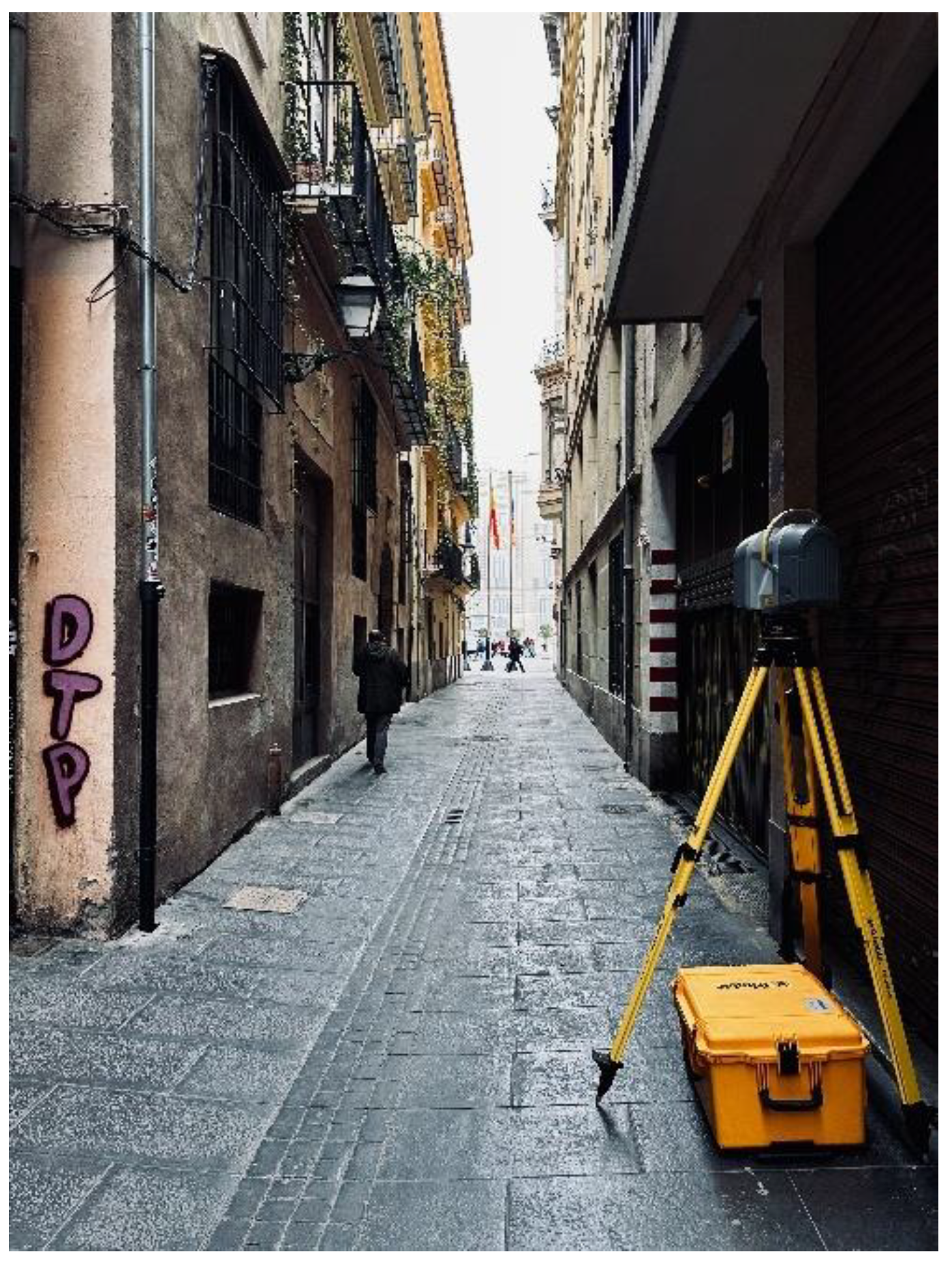
Figure 2.
Laser scanning positions. Source: Authors.
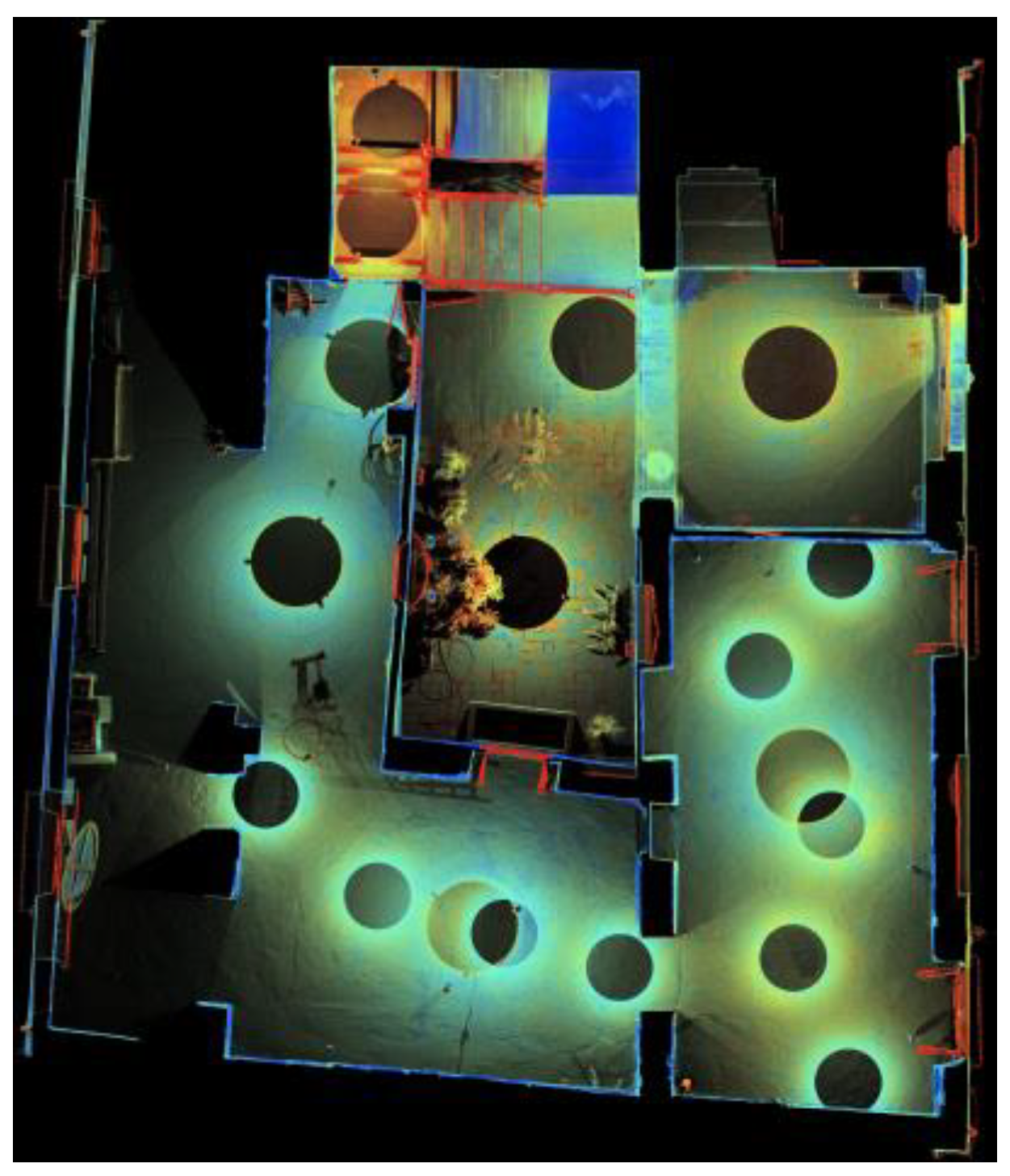
Figure 3.
(a). Three-dimensional model of the vault and its assembly. Source: Authors.(b). Vault: West coffered ceiling. Source: Author’s own work. (c). Vault: southern coffered ceiling. Source: Authors.
Figure 3.
(a). Three-dimensional model of the vault and its assembly. Source: Authors.(b). Vault: West coffered ceiling. Source: Author’s own work. (c). Vault: southern coffered ceiling. Source: Authors.
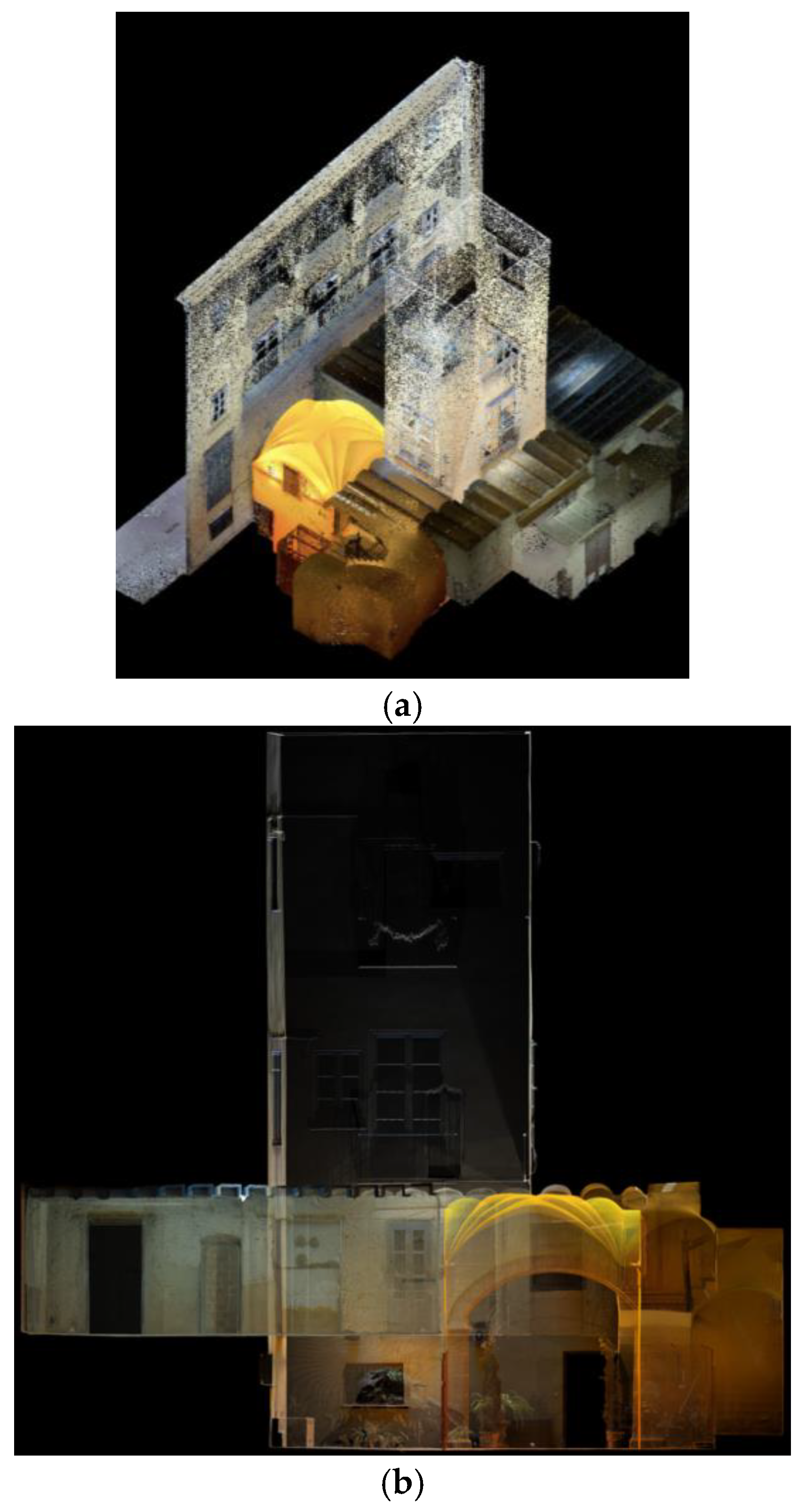
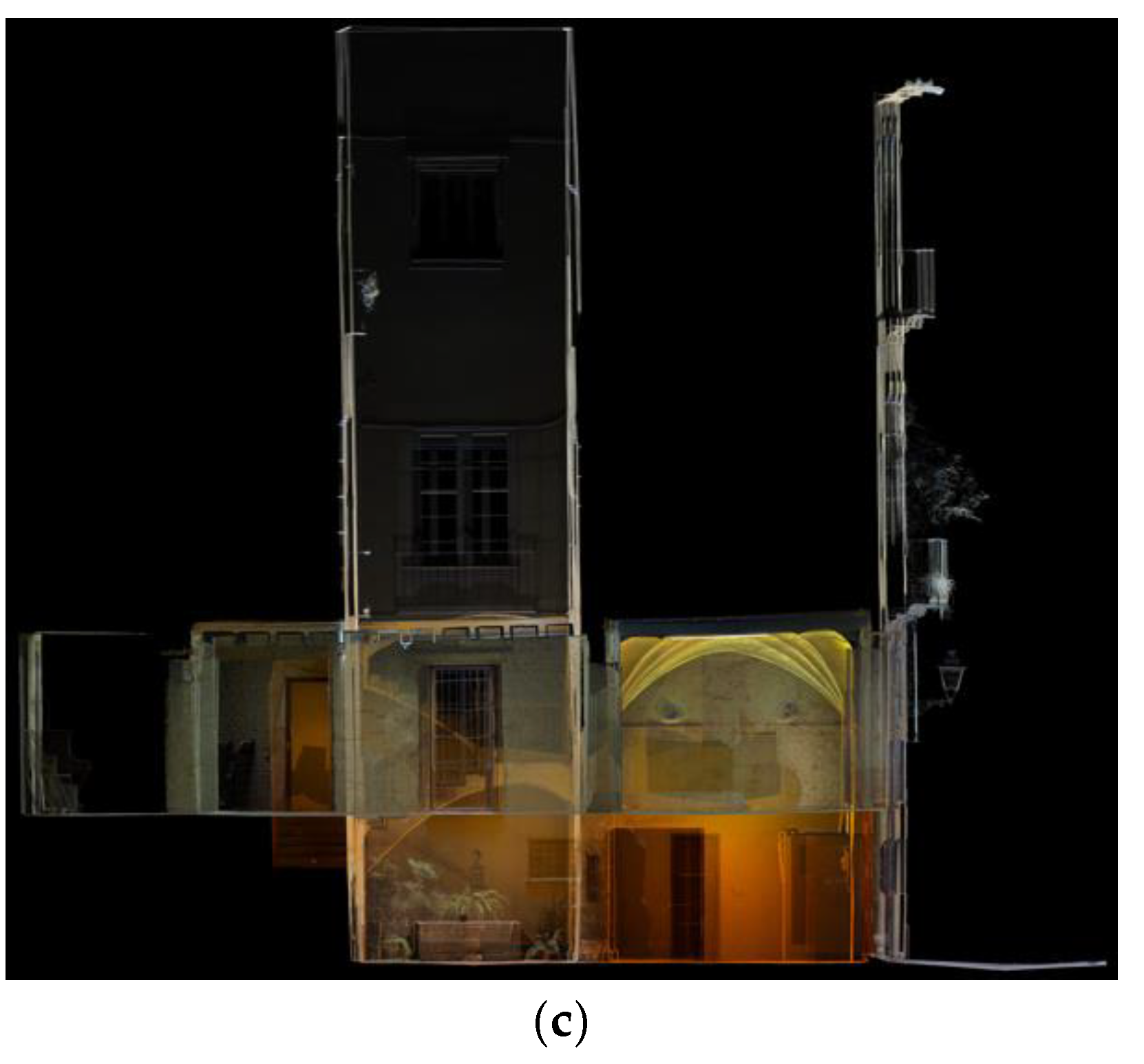
Figure 4.
A volta leccese a stella. Church of San Giovanni Battista in Matera region of the Basilicata. https://commons.wikimedia.org/wiki/File:Chiesa_di_San_Giovanni_Battista_-_Matera_05.jpg.
Figure 4.
A volta leccese a stella. Church of San Giovanni Battista in Matera region of the Basilicata. https://commons.wikimedia.org/wiki/File:Chiesa_di_San_Giovanni_Battista_-_Matera_05.jpg.
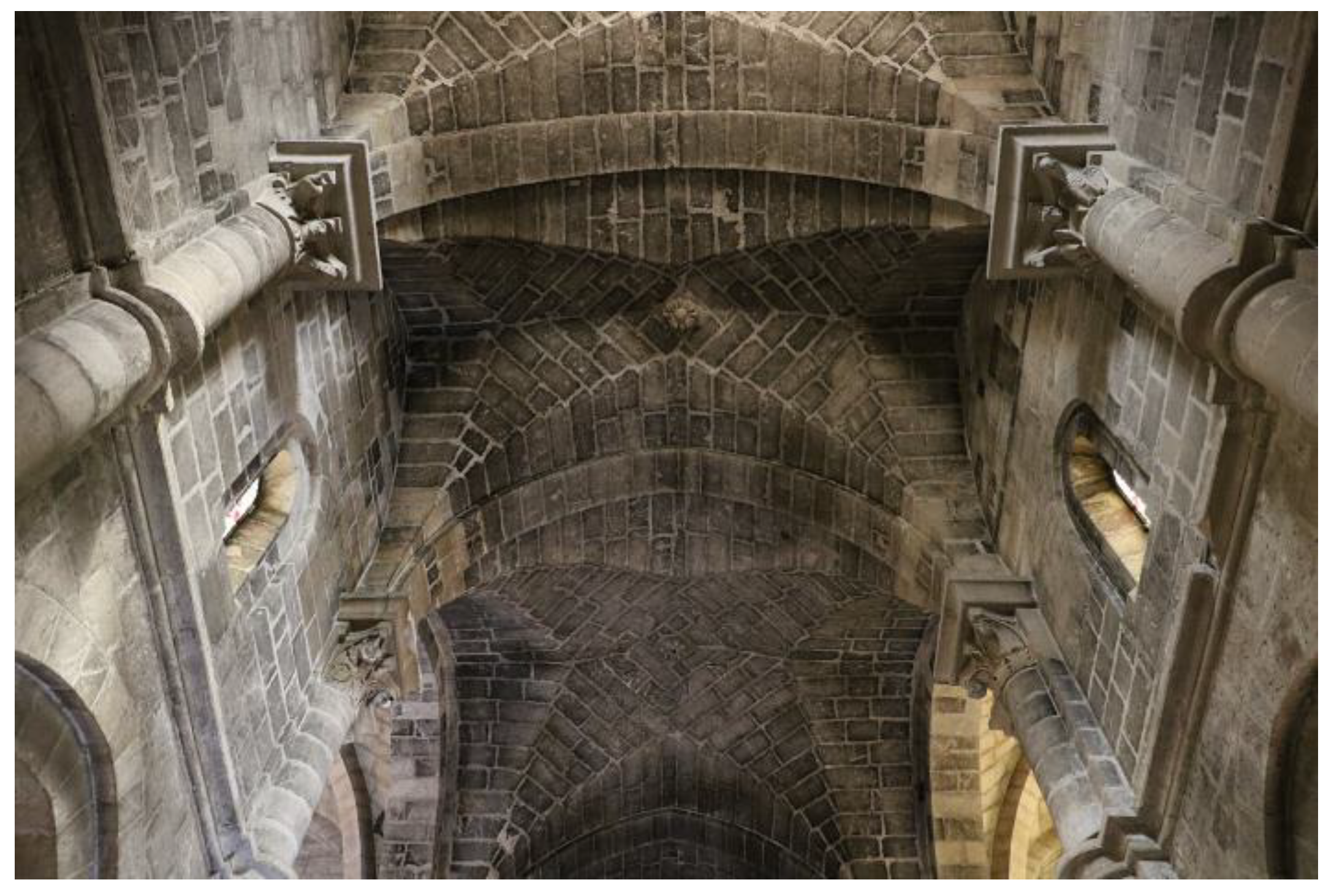
Figure 5.
Rigging used in vault construction. A) English rigging; b) French rigging. Drawing by the authors.
Figure 5.
Rigging used in vault construction. A) English rigging; b) French rigging. Drawing by the authors.
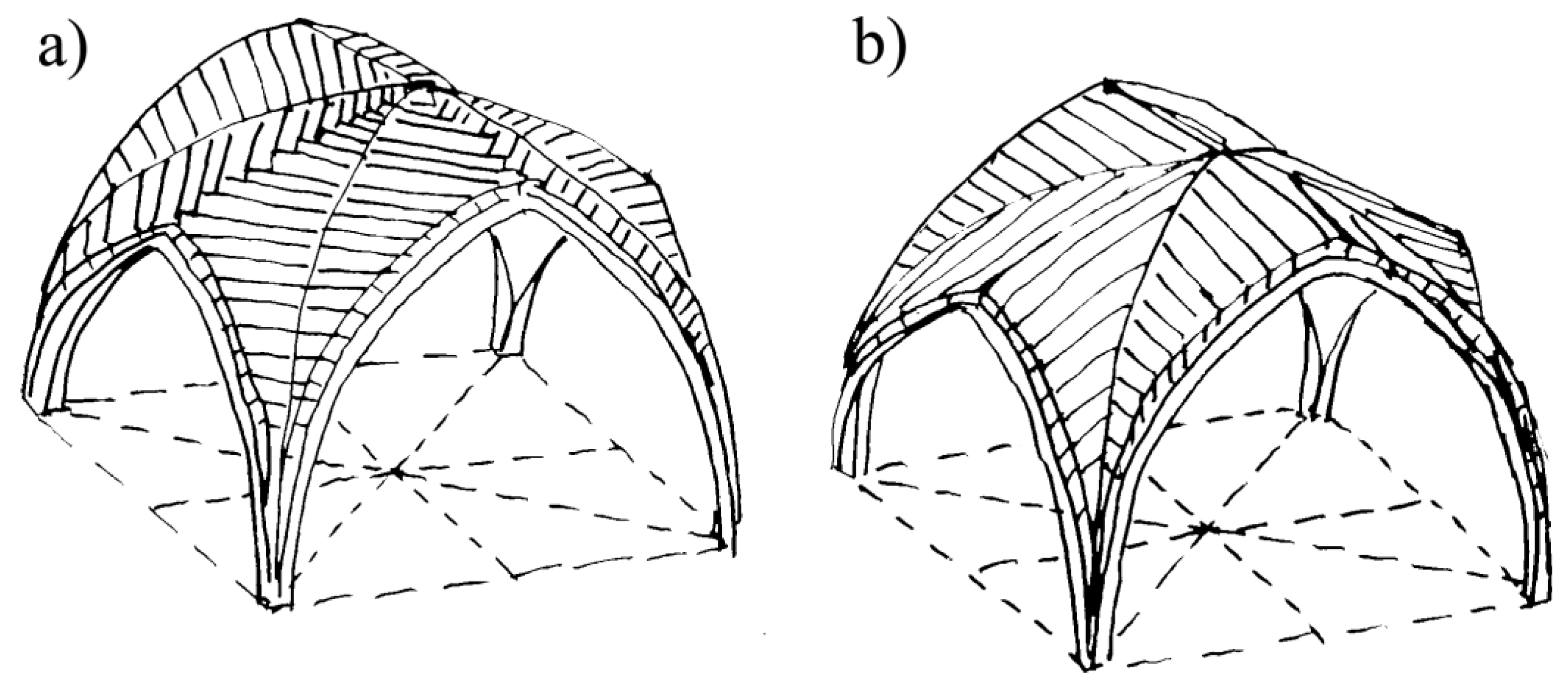
Figure 6.
Calculation of the edges of a star-shaped vault: a) joining the corner of the inscribed square with the intersection of the axis of symmetry with the edge of the square. b) joining the corner of the inscribed square with the intersection of the axis of symmetry with the perimeter of the circumscribed circle. Source: Author’s own work.
Figure 6.
Calculation of the edges of a star-shaped vault: a) joining the corner of the inscribed square with the intersection of the axis of symmetry with the edge of the square. b) joining the corner of the inscribed square with the intersection of the axis of symmetry with the perimeter of the circumscribed circle. Source: Author’s own work.

Figure 7.
Calculation of the edges of a star-shaped vault, based on an ad quadratum pattern. Source: Authors.
Figure 7.
Calculation of the edges of a star-shaped vault, based on an ad quadratum pattern. Source: Authors.
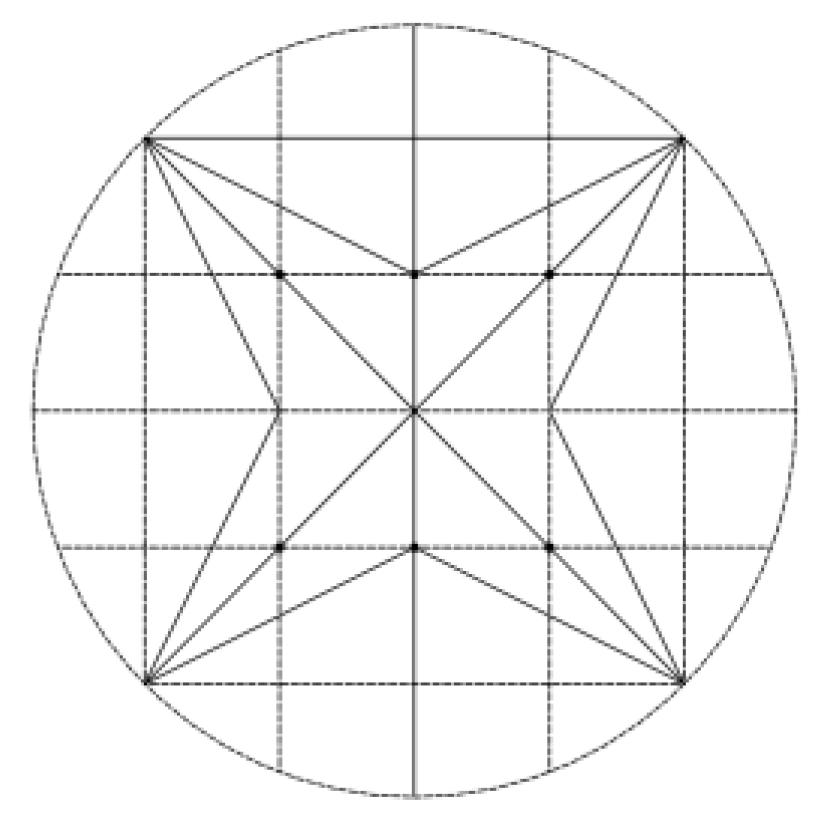
Figure 8.
Royal Chapel of Santo Domingo, Francesc Baldomar (c. 1450). Photo: Pablo Navarro Camallonga.
Figure 8.
Royal Chapel of Santo Domingo, Francesc Baldomar (c. 1450). Photo: Pablo Navarro Camallonga.
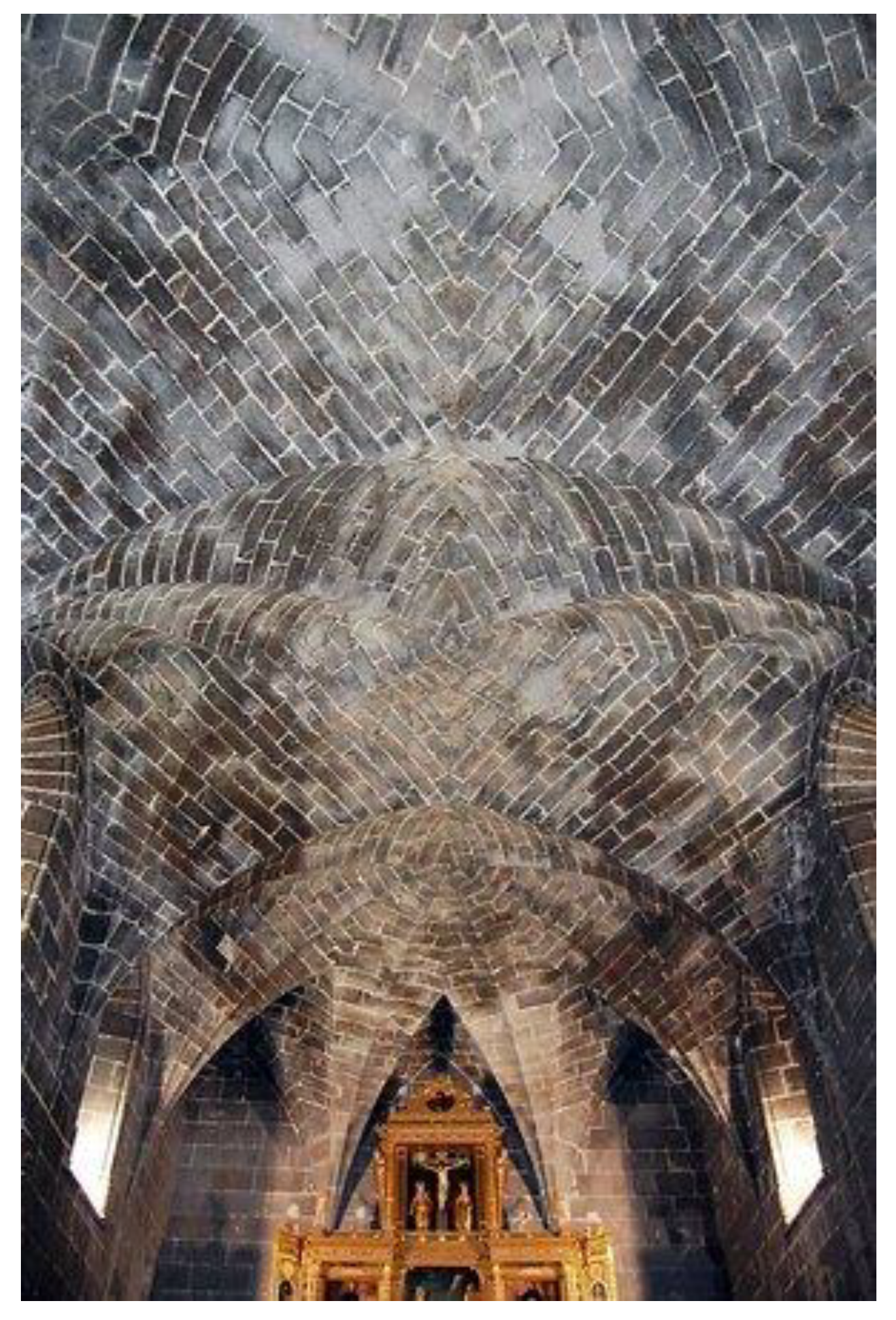
Figure 9.
Vault covering the junction of the Miguelete bell tower with the cathedral, or the Carreró vault. Photo: Pablo Navarro Camallonga.
Figure 9.
Vault covering the junction of the Miguelete bell tower with the cathedral, or the Carreró vault. Photo: Pablo Navarro Camallonga.
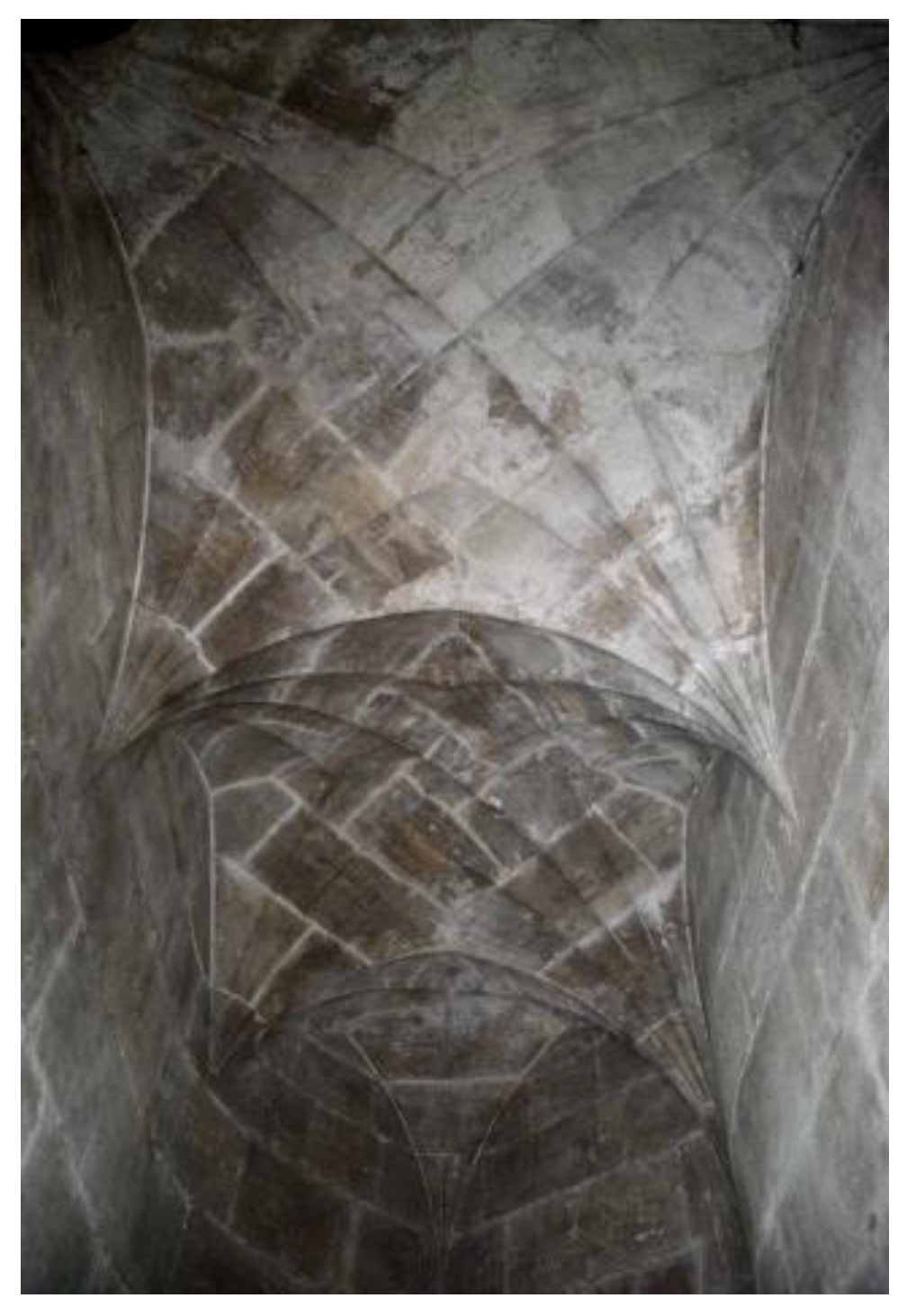
Figure 10.
Experimental study. Assembly of a reduced-scale vault model. Photo: Pablo Navarro Camallonga.
Figure 10.
Experimental study. Assembly of a reduced-scale vault model. Photo: Pablo Navarro Camallonga.
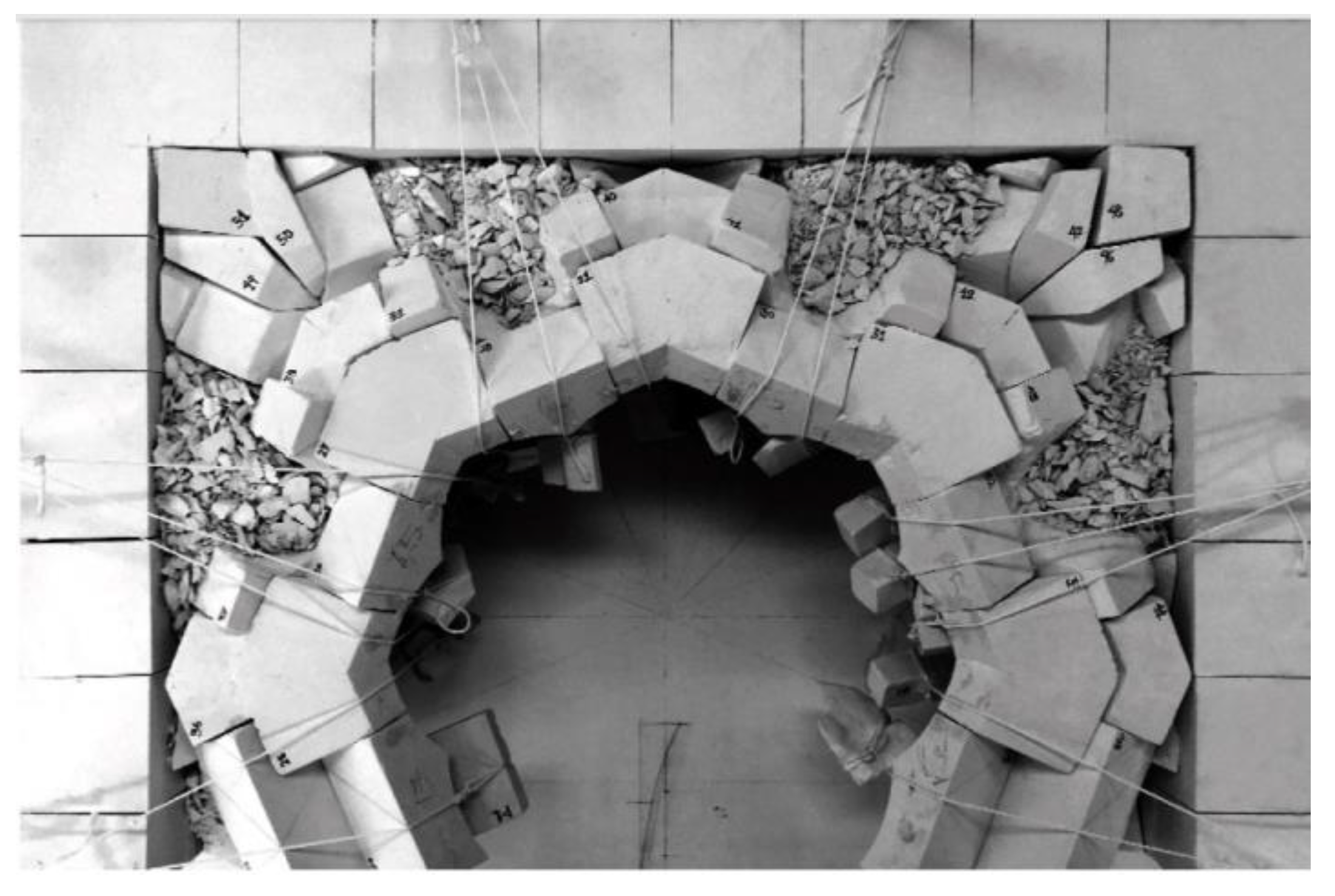
Figure 11.
Navarro’s hypothesis on how to complete the vault. Photo: Pablo Navarro Camallonga.
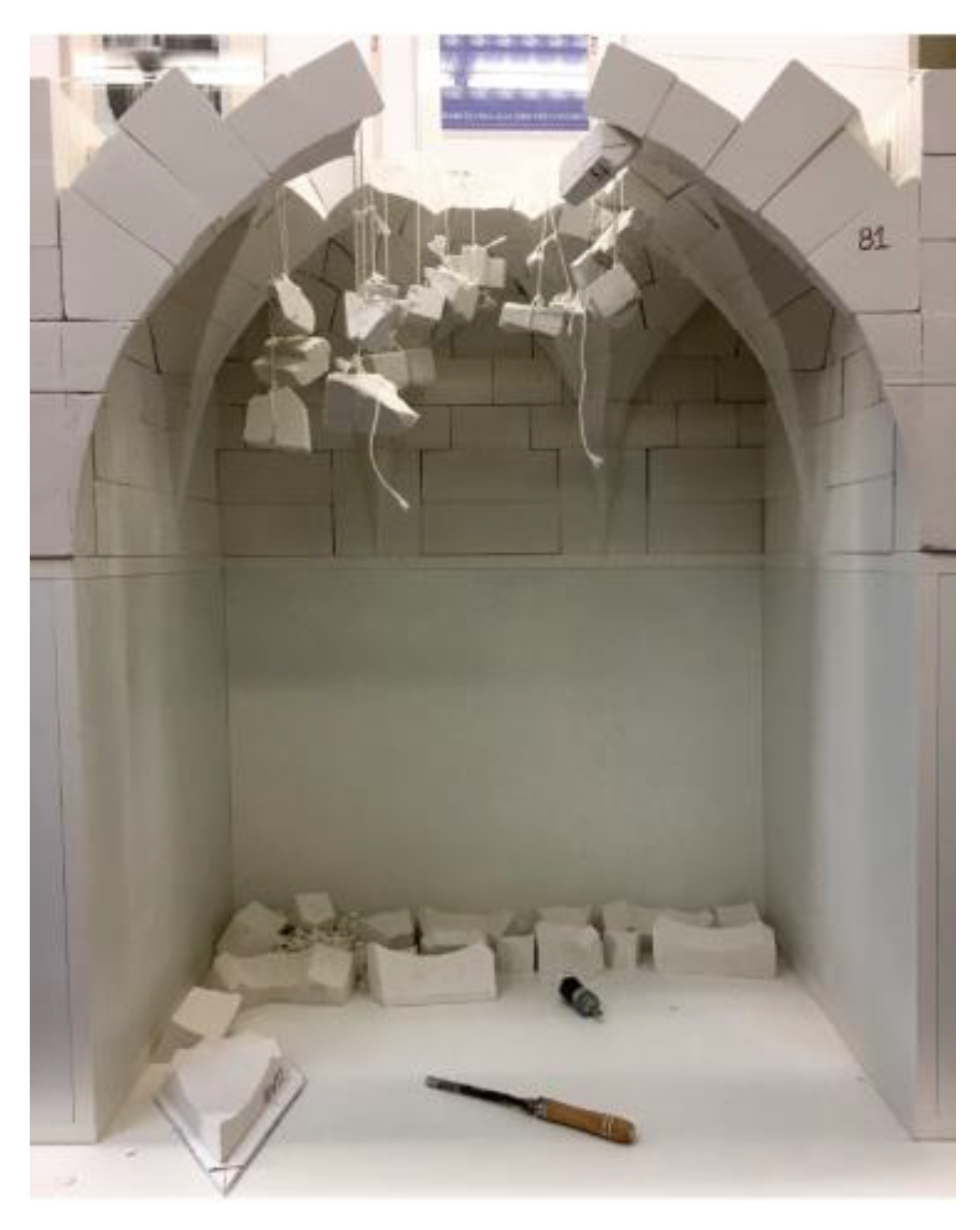
Figure 12.
Sotacoro of the church of the Hieronymite monastery of Cotalba (Gandía). Photo: Jose Mª. Barrera Puigdollers.
Figure 12.
Sotacoro of the church of the Hieronymite monastery of Cotalba (Gandía). Photo: Jose Mª. Barrera Puigdollers.
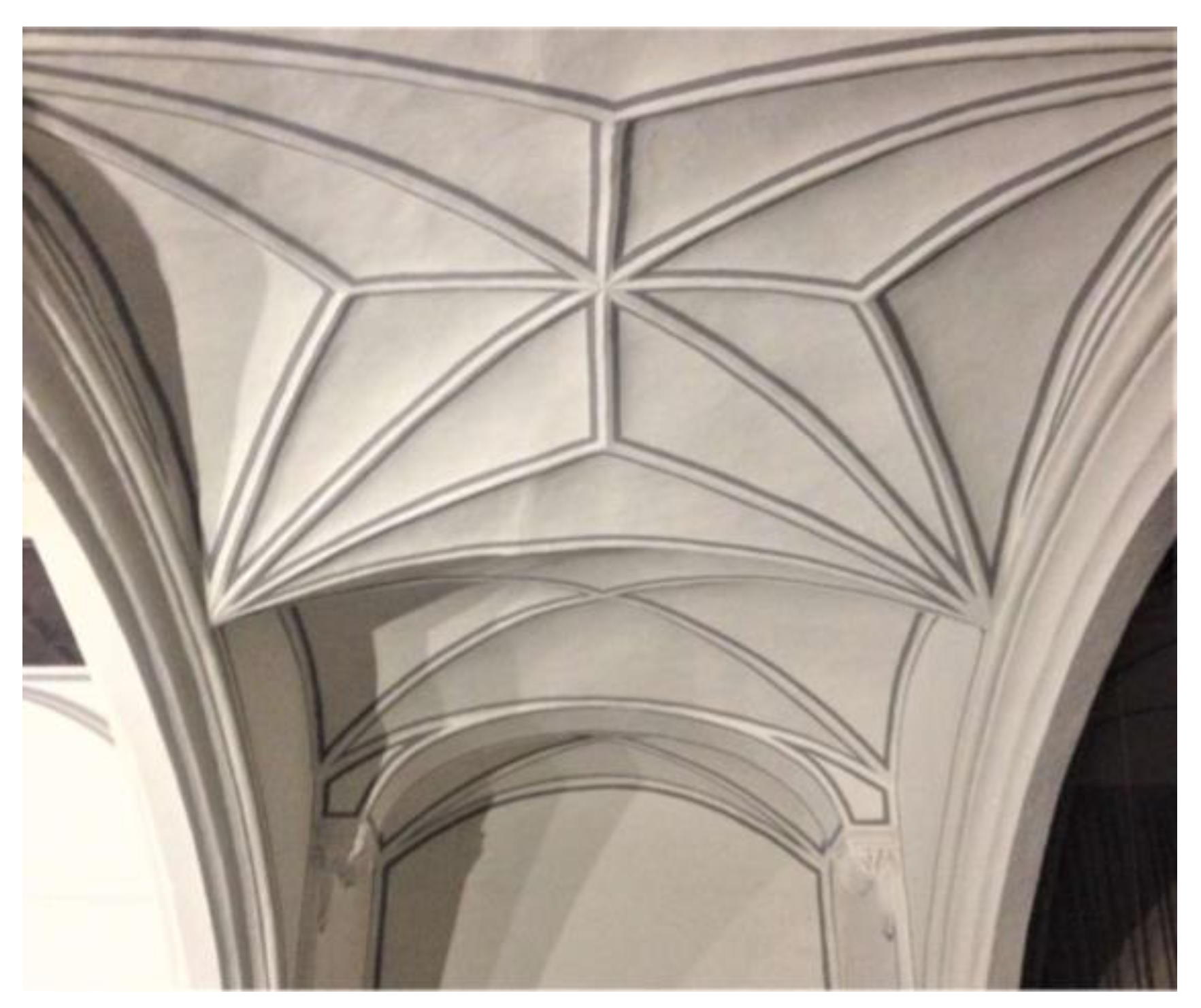
Figure 13.
Vault of the Más Palace. Photo by the authors.
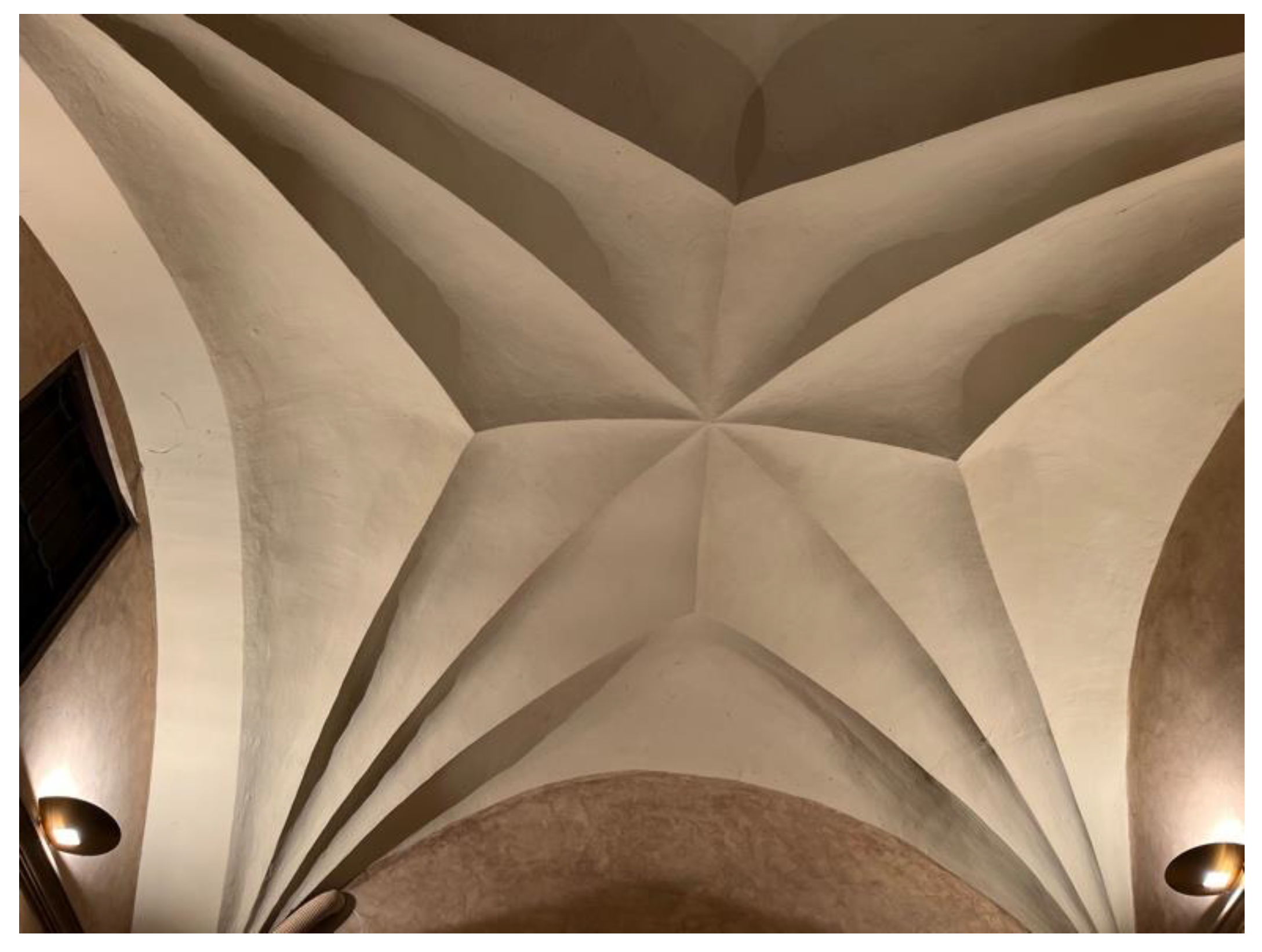
Figure 14.
Floor plan of the Más Palace lobby in Valencia. Drawing by the authors.
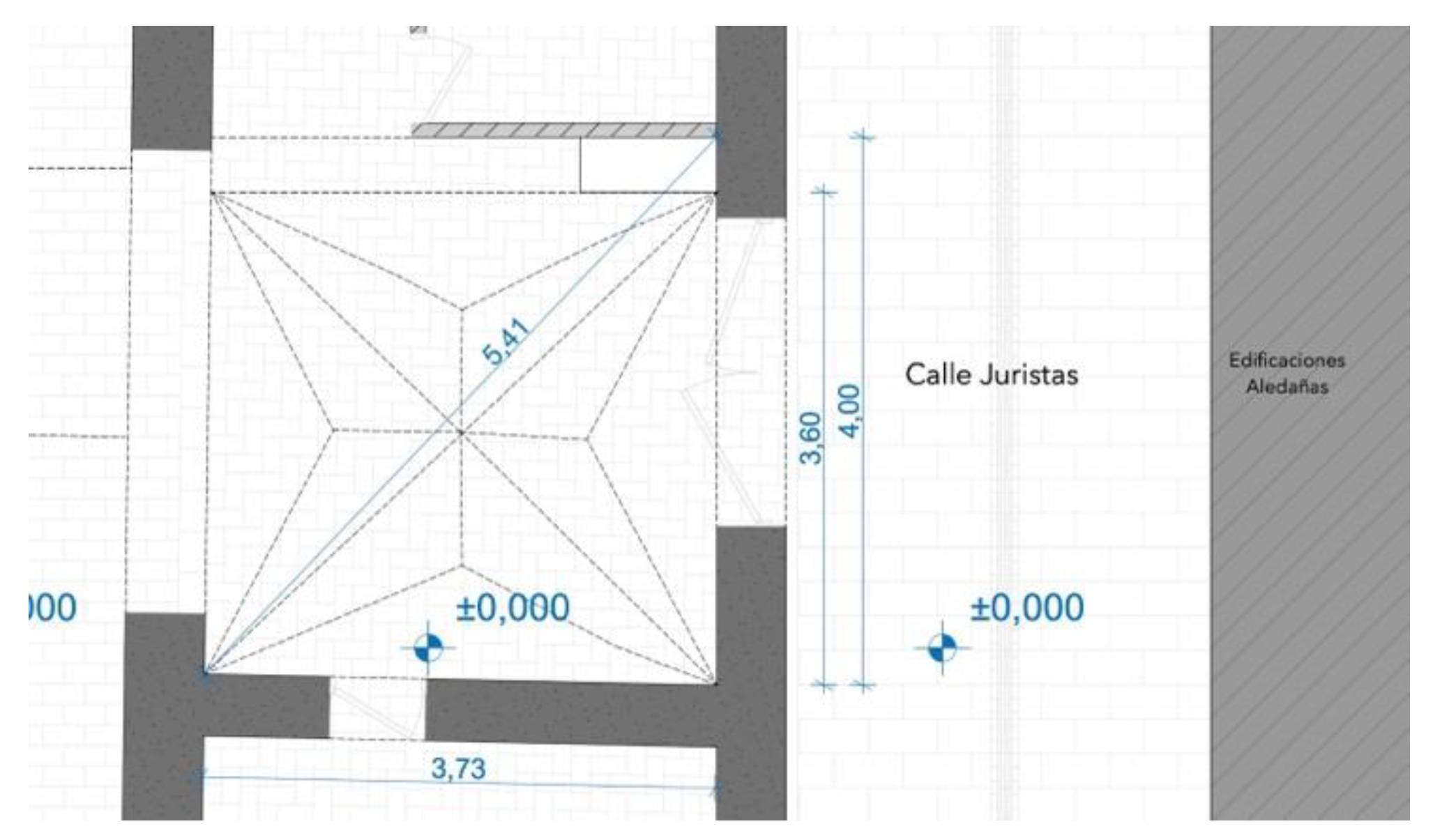
Figure 15.
Vault perimeter: a) Access plane, from Jurists Street, located on the east side of the vault. b) Arch separating the vestibule from the palace courtyard (west side). It should be noted that this arch is not aligned with the vault axis. Photo by the authors. c) Junction with the north wall. d) Junction with the south wall. Photo by the authors.
Figure 15.
Vault perimeter: a) Access plane, from Jurists Street, located on the east side of the vault. b) Arch separating the vestibule from the palace courtyard (west side). It should be noted that this arch is not aligned with the vault axis. Photo by the authors. c) Junction with the north wall. d) Junction with the south wall. Photo by the authors.
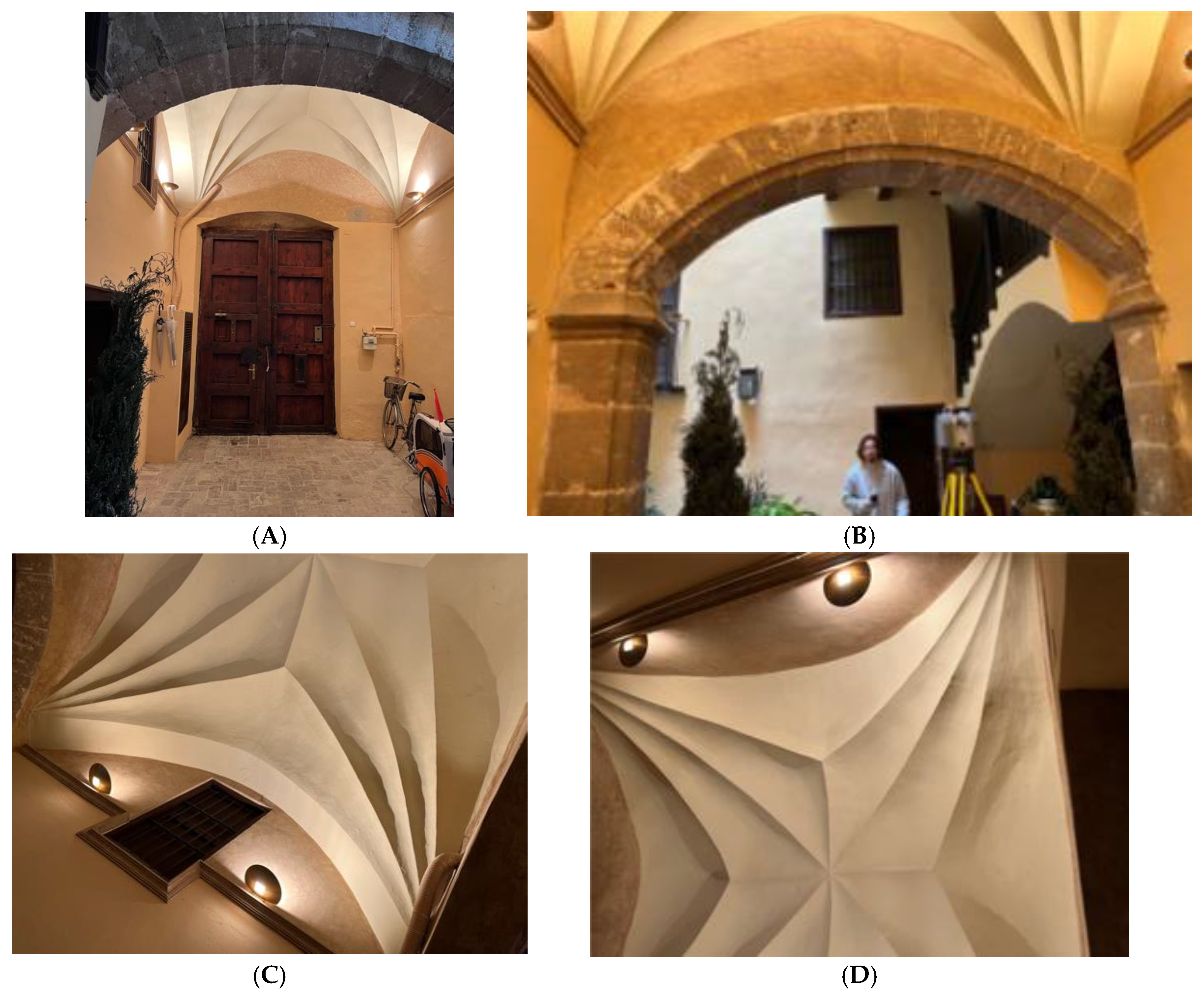
Figure 17.
Back of the vault of the Mas Palace. Source: Authors.
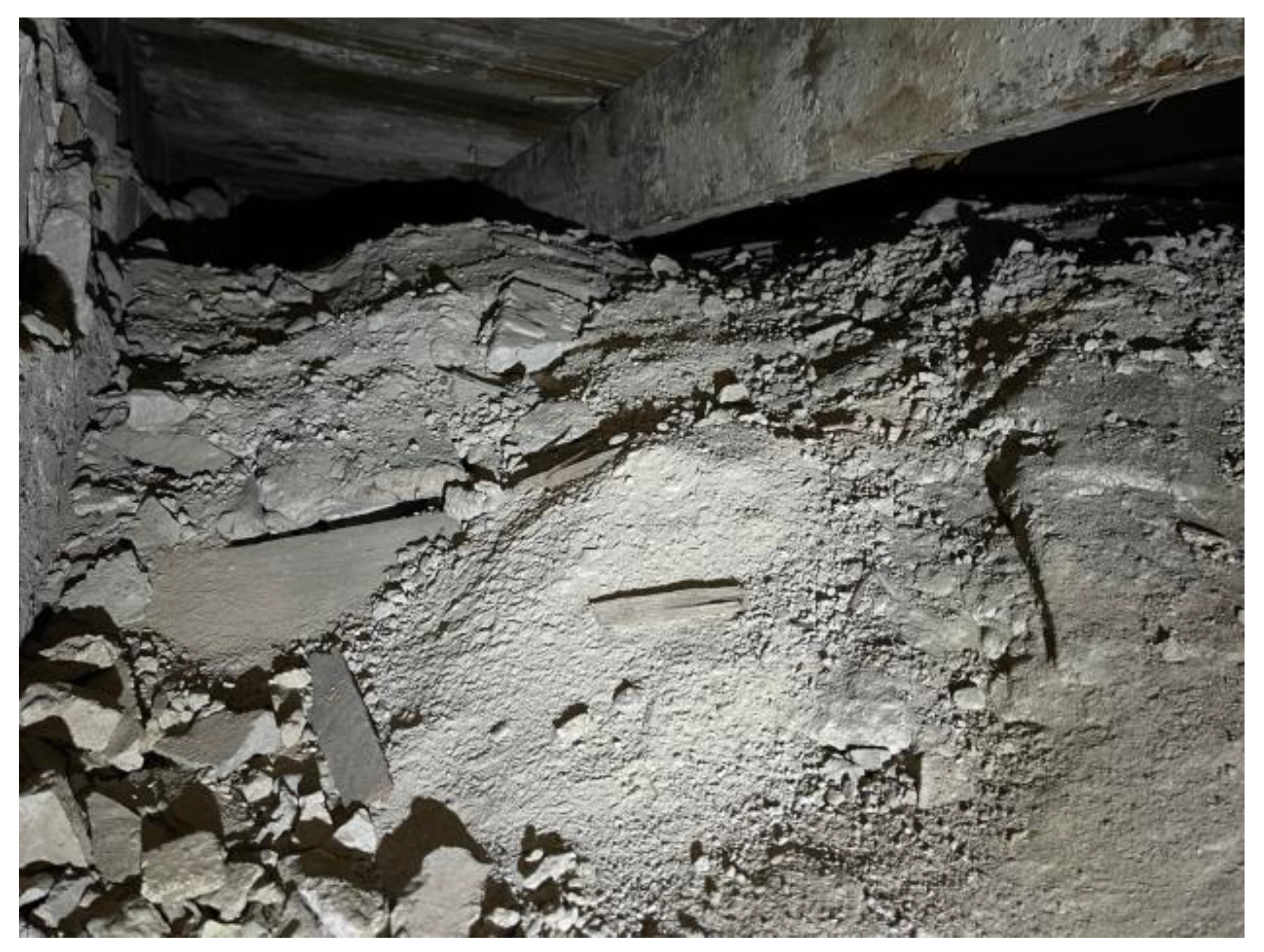
Figure 18.
Plaster cords placed over the joints of the brick planes, which reinforce the cohesion of the vault. More. Drawing by the authors.
Figure 18.
Plaster cords placed over the joints of the brick planes, which reinforce the cohesion of the vault. More. Drawing by the authors.
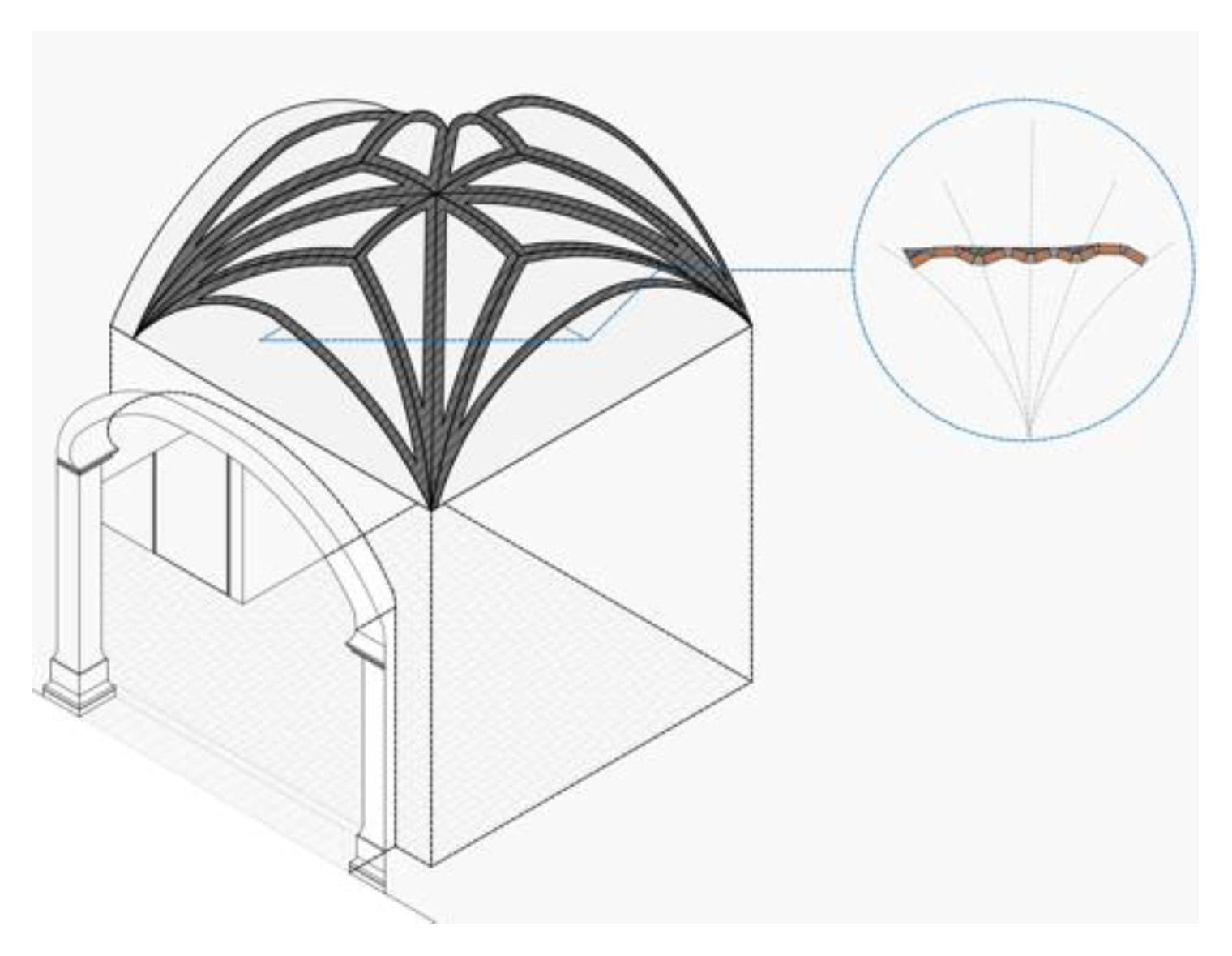
Figure 19.
Restoration of the vaulted ceiling of the Más Palace. Source: Authors.
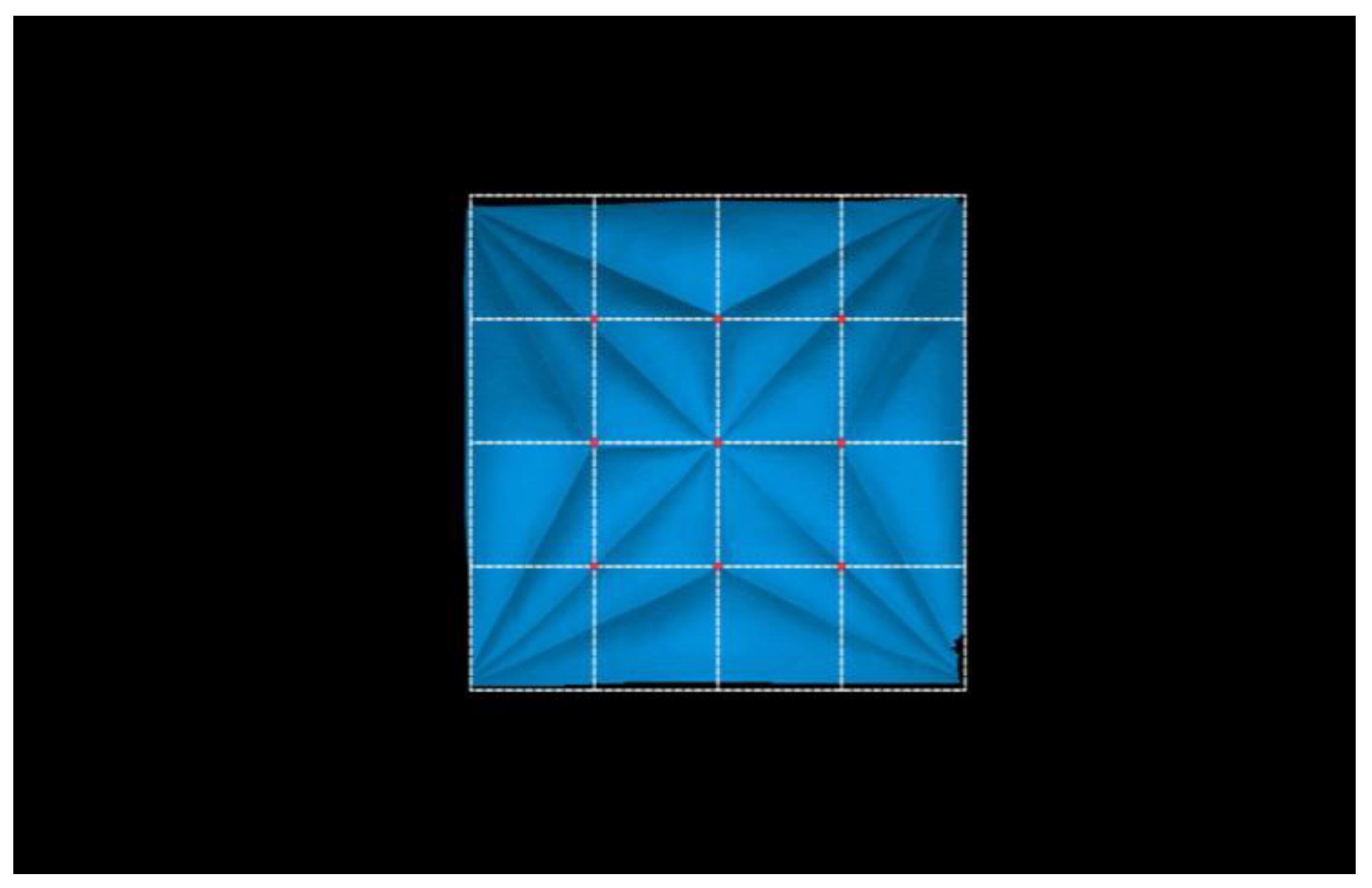
Figure 20.
Definition of the layout of the Mas Palace vault. Source: Author’s own work.
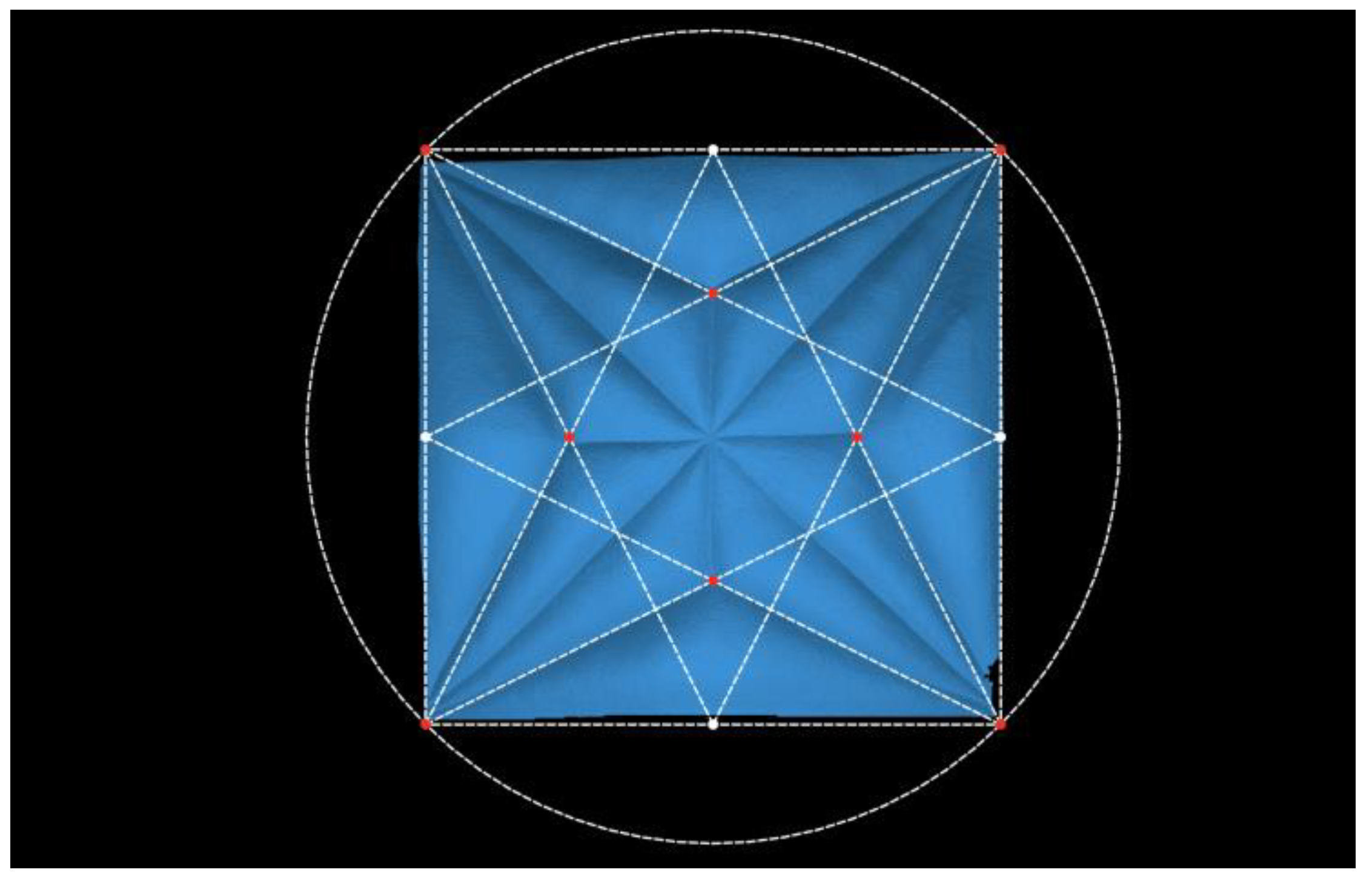
Figure 21.
Vault of the Mas Palace. Photo by the authors.
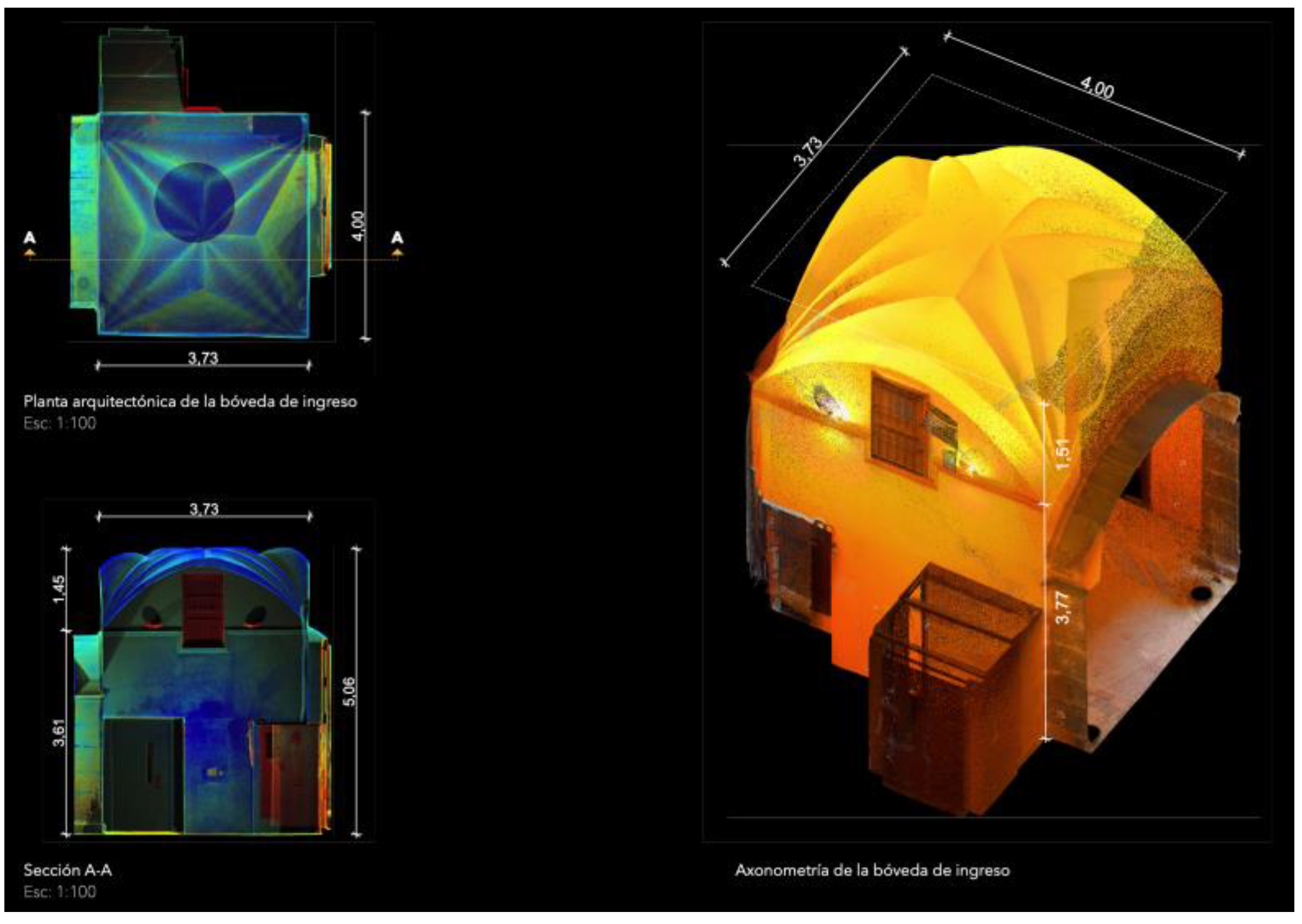
Disclaimer/Publisher’s Note: The statements, opinions and data contained in all publications are solely those of the individual author(s) and contributor(s) and not of MDPI and/or the editor(s). MDPI and/or the editor(s) disclaim responsibility for any injury to people or property resulting from any ideas, methods, instructions or products referred to in the content. |
© 2025 by the authors. Licensee MDPI, Basel, Switzerland. This article is an open access article distributed under the terms and conditions of the Creative Commons Attribution (CC BY) license (http://creativecommons.org/licenses/by/4.0/).
Copyright: This open access article is published under a Creative Commons CC BY 4.0 license, which permit the free download, distribution, and reuse, provided that the author and preprint are cited in any reuse.


