

Submitted:
14 July 2025
Posted:
16 July 2025
You are already at the latest version
Abstract
The livestock sector in Serbia has been experiencing a prolonged period of structural and economic challenges, characterised by decreasing animal numbers, low productivity, and reduced competitiveness in both domestic and EU markets. This study analyses key structural, technological, economic, and policy factors shaping these trends to provide strategic recommendations for sustainable sector revitalisation. The methodology integrates macroeconomic analysis, agricultural economic accounts, and international trade data, applying regression modelling to examine relationships between domestic food prices, exchange rates, and agri-food import volumes. Results indicate that livestock’s share in agricultural gross value added remains below 35%, significantly lower than EU averages, while export quotas remain underutilised and the trade balance for animal products is persistently negative. Contributing factors include fragmented farm structures, outdated production technologies, limited adoption of innovations, demographic decline in rural areas, and insufficient alignment with EU CAP Strategic Plans and Green Deal objectives. Climate change impacts, such as droughts and heat stress, alongside animal disease outbreaks and macroeconomic pressures, further exacerbate these vulnerabilities. The study recommends modernising production systems through investment in technological upgrades, strengthening farmer organisations and cooperatives, enhancing biosecurity and animal welfare standards, and improving policy frameworks to align with EU sustainability objectives. Emphasis is placed on developing integrated approaches that simultaneously address productivity, economic resilience, and environmental sustainability. Implementing these strategic measures is essential for enhancing food security, supporting rural development, and ensuring Serbia’s successful integration into the EU market as part of a more sustainable and resilient agri-food system.
Keywords:
livestock production
; economic sustainability
; economic accounts for agriculture (EAA)
; gross value added (GVA)
; competitiveness
; climate-smart livestock
; Serbia
1. Introduction
Livestock production has historically been the backbone of food systems, providing high-value proteins and essential micronutrients critical for human nutrition and health (FAO, 2018a). Beyond its nutritional role, livestock contributes significantly to rural economies through employment opportunities and income generation, while also preserving cultural landscapes, culinary traditions, gastronomic heritage, and the cultural and historical identity of communities (FAO, 2018b). The European Union (EU) is among the world’s leading producers of animal-origin food, accounting for approximately 20% of global meat production and over 20% of global milk production, with livestock representing around 40% of total agricultural output value in the EU (EUROSTAT, 2020). This sector plays a central role in ensuring food security and maintaining a positive agri-food trade balance, which reached a €58 billion surplus in 2022, driven largely by dairy and meat exports (EC, 2025).
However, despite its global significance, the EU livestock sector faces structural challenges, including a gradual decline in herd sizes. For example, the total cattle population decreased from 78 million in 2013 to approximately 71,86 million in 2024. The number of pigs in EU has shown a gradual but persistent decline from 141,859 in 2013 to 132,136 in 2024 (EUROSTAT, 2025). This decline is primarily driven by changing consumer preferences towards plant-based diets and evolving consumer preferences away from red meat, environmental concerns related to greenhouse gas emissions, rising production costs, stricter animal welfare regulations, and outbreaks of African Swine Fever (ASF) (EC, 2024). In response, the EU is implementing targeted measures to revitalise the sector, such as supporting eco-schemes within the Common Agricultural Practice (CAP) 2023–2027 framework, promoting precision livestock farming and digitalisation, strengthening producer organisations, and incentivising young farmers to enter animal production. These measures are embedded within the EU’s broader Vision for Agriculture and Food, which builds upon the CAP framework to ensure that agriculture remains a strategic, competitive, and future-proof sector by focusing on sustainability, innovation, and rural resilience (EC, 2025). These EU measures reflect a broader understanding that the future of agriculture depends on its capacity to integrate sustainability principles into all production systems.
In this context, the concept of sustainable agriculture becomes particularly relevant. Sustainable agriculture is understood as an approach that is economically viable, environmentally friendly, and socially acceptable (Velten et al., 2015). Economic sustainability implies that only agricultural production which is market-oriented and economically justified can endure in the long term. Environmental sustainability requires preserving natural resources for future generations while protecting or enhancing ecosystems affected by agricultural activities, thus viewing agriculture as an ecosystem management system based on the soil–plant–animal–human balance. Social sustainability involves fulfilling broader societal values, including a high quality of life for farmers and rural communities, while preserving cultural heritage and traditions. Furthermore, agriculture must be multifunctional, contributing to environmental protection and biodiversity, ensuring food security and safety, and supporting rural economic development through economic growth, diversification, and the maintenance of socially vibrant rural settlements (Çakmakçı et al., 2023).
Similarly, Serbia’s livestock sector has been experiencing a prolonged decline, with national data showing significant reductions in cattle and pig numbers over the past two decades (SORS, 2025a; Grujić Vučkovski, 2022). While in the EU this decline is primarily driven by market-related and environmental factors, in Serbia it largely stems from systemic challenges within the agricultural sector (SORS, 2025a). Currently, livestock contributes only ~30–35% of Serbia’s agricultural gross value added (GVA), compared to 40–60% in EU countries, highlighting structural disparities (SORS, 2025a). Contributing factors include fragmented farm structures, technological stagnation, underdeveloped genetic improvement programs, and demographic decline in rural areas (Aničić et al., 2025; SORS, 2025a). Productivity and competitiveness are further constrained by delays in aligning with EU standards for product quality, environmental sustainability, and biosecurity (Aničić et al., 2025; SORS, 2025a). Limited adoption of innovative technologies – such as artificial intelligence, precision livestock farming, and IoT-based monitoring – restricts efficiency and adaptation to market and climate demands (Bošković et al., 2023; Stanković et al., 2024). Unlike the EU, where comprehensive strategies and investments are being deployed to counter these negative trends, Serbia lacks effective policies and sufficient financial mechanisms to revitalise its livestock sector and achieve sustainable production levels that ensure national self-sufficiency in animal-derived food.
Therefore, this study aims to analyse the economic drivers behind the sector’s decline, identify structural, technological, and policy determinants, and propose strategic recommendations for revitalising livestock production and enhancing its sustainability in line with EU priorities. Such timely insights are essential for ensuring food security, strengthening rural development, and facilitating Serbia’s integration into the EU market within an increasingly climate-challenged and competitive agri-food system.
2. Materials and Methods
The methodological framework of this paper is based on a comprehensive analysis of quantitative economic data relevant to the livestock sector in Serbia (SORS, 2025b). The following data sources were utilized:
National statistical databases, including the Statistical Office of the Republic of Serbia (SORS), for data on livestock numbers, production volumes, and agricultural output.
Economic Accounts for Agriculture (EAA), harmonized with the System of National Accounts (UN, 2009), are used to assess the contribution of livestock production to the gross value added of the agricultural sector.
International databases, such as Eurostat and Trademap.org (ITC, 2025) for comparative data on livestock production, yields, trade flows, and agri-food export/import balances.
Macroeconomic indicators from the National Bank of Serbia (NBS, 2025) and the International Monetary Fund (IMF, 2025) reports, including inflation rates and average annual exchange rates.
To ensure analytical consistency, all monetary values were deflated to real terms using 2013 as the base year. The reliability and relevance of these data sources are affirmed through their alignment with EU methodologies and international statistical standards. Additionally, a simple linear regression model was employed to evaluate the relationship between agricultural imports and macroeconomic variables, particularly domestic food price growth and exchange rate fluctuations. Variables were log-transformed to address differences in scale and interpret elasticity coefficients.
2.1. Literature Review and Keywords
To support this analysis, a comprehensive literature review was conducted to identify peer-reviewed studies examining livestock production systems, economic performance, competitiveness, and sustainability in Serbia and EU countries. The search spanned major scientific databases, indexing services, and publisher platforms, including PubMed, Scopus, Web of Science, Google Scholar, CAB Abstracts, Wiley Interscience, Springer/Kluwer, Science Direct, and Taylor & Francis Online, covering the period 2012 to 2025.
Keywords used included: “livestock production Serbia,” “agricultural economics,” “farm profitability,” “Economic Accounts for Agriculture (EAA),” “agri-food competitiveness,” “dairy sector productivity,” “climate change agriculture Serbia,” “animal welfare,” “biosecurity,” “AI in livestock production,” “agrarian policy Serbia,” “rural demography,” “food security,” and “sustainable food production.”
Over 50 peer-reviewed papers, national reports, and policy documents were analyzed to identify systemic weaknesses, structural challenges, and potential policy interventions required to revitalize the Serbian livestock sector and align it with EU standards of economic performance, sustainability, and food system resilience.
3. Present Situation in Livestock Production in Serbia
The Serbian livestock sector has experienced significant structural shifts over the past two decades (Petrović et al., 2015). Analysis of recent data (Figure 1 and Figure 2) reveals a continuous decline in livestock numbers across major categories. For example, cattle herds decreased from approximately 1,056 thousand heads in 2007 to 699 thousand in 2024, while pig numbers fell from 3,429 thousand to 2,349 thousand in the same period (SORS, 2025a). Sheep herds have remained relatively stable at around 1,759 thousand heads, whereas poultry numbers have grown moderately (14774), driven primarily by intensive production systems (Aničić et al., 2025; Vukoje et al., 2022). According to the Statistical Office of the Republic of Serbia (SORS, 2025a), as of December 1, 2024, compared to the same date in 2023, the total number of cattle decreased by 3.7%, while the number of pigs increased by 9.7%, sheep by 2.5%, and poultry by 3.5%. Regionally, cattle are predominantly raised in the Šumadija and Western Serbia region (accounting for 45.6% of the national herd), whereas pig farming is concentrated in the Vojvodina region (43.7% of the national pig population). When viewed in the context of the ten-year average (2014–2023), the structural decline becomes even more evident. The total number of cattle has decreased by 19.5%, pigs by 18.4%, and poultry by 7.0%, while only the sheep population has recorded a modest increase of 3.0%. These figures reflect a long-term contraction in herd sizes and a reorientation of production structures that continues to shape the Serbian livestock sector’s trajectory.
These changes are reflected in production outputs. In Table 1, data indicate that production of meat, milk, and eggs has generally stagnated or declined over the past decade, despite periodic fluctuations. Beef and pork outputs remain below their 2013 levels, and milk production has shown only limited increases, insufficient to reduce the productivity gap compared to EU averages (Vukoje et al., 2022). These trends indicate a deepening structural crisis in livestock production, exacerbated by limited technological advancement and insufficient policy support (Anđelković et al., 2024). However, a comprehensive understanding of this decline also requires reflection on the historical context. Data from the socio-metabolic study of Yugoslavia indicate that livestock populations in the region began declining as early as the 1980s, continuing throughout the post-conflict period and reflecting structural and institutional disruptions (FAOSTAT, 2024). This long-term downward trend in livestock numbers was further exacerbated by the economic marginalisation of agriculture in the post-socialist period, as investments were disproportionately directed toward industrial sectors. Despite Serbia’s favourable natural and climatic conditions—particularly in regions like Vojvodina and parts of Central Serbia—agriculture was pushed to the margins of economic development, lacking adequate public investment (Madžar, 2021). While the disintegration of the SFRY and the post-transition restructuring explain much of the sector’s initial decline, a comprehensive understanding must also consider the evolving global and domestic challenges that have continued to shape livestock production in Serbia. Multiple global and domestic factors have contributed to these negative trend.
3.1. Global Factors
Climate change has emerged as a critical constraint, with more frequent droughts and heat stress events reducing pasture productivity and feed crop yields, thus undermining farm economic viability (FAO, 2022). Outbreaks of animal diseases, such as African Swine Fever and Avian Influenza, have periodically curtailed production capacity and disrupted trade flows (Stanković et al., 2024). Additionally, geopolitical tensions, particularly the conflict in Ukraine, have destabilized global grain and energy markets, leading to higher feed and input costs for Serbian farmers (Aničić et al., 2025). Energy price volatility, including fuel, fertilizer, and electricity costs, has further increased production expenses and narrowed profit margins (Novaković et al., 2025).
3.1. Domestic Factors
Demographic decline in rural areas, driven by outmigration and population ageing, has reduced the agricultural labor force and accelerated farm closures (Aničić et al., 2025). Farm structures dominated by small, extensive holdings with limited investment capacity continue to constrain modernization and efficiency improvements. Moreover, despite the availability of EU IPARD funds, many farmers face administrative barriers and lack the capacity to develop eligible projects (Radović et al., 2024). As highlighted by Marković and Simonović (2025), inadequate agricultural policy frameworks and rigid subsidy criteria weaken the sector’s market orientation and sustainability prospects. Furthermore, reductions in milk premiums and limited effectiveness of direct support measures, as discussed by Đurić et al. (2019), have further undermined the income stability and competitiveness of dairy producers.
Underdeveloped rural infrastructure—including insufficient livestock markets, slaughterhouses, and cold storage facilities—weakens value chains and limits market access, particularly for smallholders (Anđelković et al., 2024). Macroeconomic imbalances, with cumulative inflation exceeding 130% between 2007 and 2023 and only modest exchange rate adjustments (+17%), have eroded purchasing power parity and diminished the competitiveness of domestic products relative to imports (IMF, 2025; NBS, 2025).
Taken together, these global and local pressures have created a livestock sector characterized by declining productivity, weak competitiveness, and limited resilience. As Bešić et al. (2024) emphasize, addressing these challenges will require a comprehensive approach encompassing structural modernization, farm consolidation, targeted policy reforms, and strategic investments in innovation, genetic improvement, and climate adaptation. Such measures are essential to prepare the sector for alignment with upcoming analyses of its economic contributions, discussed in the following section.
3.3. Economic Accounts for Agriculture in Serbia
Economic Accounts for Agriculture (EAA) provide an essential framework for evaluating the structural performance and policy outcomes of livestock production in Serbia. Between 2007 and 2023, data indicate that while nominal agricultural gross value added (GVA) increased, real growth adjusted to constant 2007 prices remained minimal, signaling persistent economic stagnation within the sector (SORS, 2025). The following Table 2 presents a summary of Serbia’s agricultural economic accounts for the period 2013 to 2023, illustrating trends in gross value added and highlighting the relative contribution of livestock production to the overall agricultural sector. These data provide a basis for assessing structural strengths and weaknesses, as further discussed below.
Analysis of Table 2 shows that agriculture accounts for approximately 6.8% of Serbia’s national GDP. However, within this sector, livestock production remains structurally weak. Its share of agricultural GVA consistently falls below 35%, significantly lower than the EU average of 60–70% (SORS, 2025; Anđelković et al., 2024). This underscores livestock’s declining contribution to national economic output and highlights fundamental limitations in competitiveness, productivity, and sustainability. Key factors shaping these EAA trends include:
- Strategic and structural factors
The absence of a comprehensive livestock development strategy aligned with EU CAP Strategic Plans and the Green Deal continues to limit sectoral transformation (Aničić et al. 2025). Farm fragmentation remains widespread, with production dominated by small-scale holdings of limited economic viability and market orientation (Radović et al., 2024). Additionally, agricultural policies and subsidy frameworks often fail to incentivize livestock-specific investments, constraining development opportunities (Đurić et al. (2019).
- Technological factors
Technological modernization remains insufficient, with outdated housing systems and limited uptake of innovations such as precision livestock farming technologies, artificial intelligence, IoT, and robotics (Bešić et al., 2024). Consequently, productivity remains below EU benchmarks; for instance, average milk yield per cow in Serbia is 3,500–4,500 L/year compared to over 7,000 L in EU countries (Radišić et al., 2021).
- Economic and financial factors
Low profitability characterizes both farms and agri-food SMEs, primarily due to high indebtedness and poor liquidity (Aničić et al. 2025; Radišić et al. 2021). Although IPARD funds offer opportunities for investment and modernization, their utilization remains limited, with less than 50% of applications implemented successfully (Radović et al., 2024). Macroeconomic pressures, including cumulative inflation exceeding 130% (2007–2023) alongside a relatively stable exchange rate, have reduced the competitiveness of domestic livestock products relative to imports (SORS, 2025; NBS, 2025).
- Market organization and branding
Weak organization of livestock markets persists, with few producer groups or clusters to strengthen domestic and export competitiveness (Marković & Simonović, 2025). Furthermore, the sector underutilizes geographical indications and traditional branding, limiting product differentiation and added value (Anđelković et al., 2024).
- Biosecurity and animal health
Biosecurity protocols and veterinary monitoring systems remain insufficient, constraining export potential and sector resilience to disease risks (Stanković et al., 2024).
- Climate and environmental factors
Climate change continues to reduce forage yields and pasture productivity, threatening economic sustainability (FAO, 2022). Limited adaptation strategies to droughts and heat stress further exacerbate these vulnerabilities adoption of climate change (Županić et al., 2021).
- Demographic factors
Rural depopulation and an ageing farming population continue to erode labor availability and limit capacity for innovation and digital transformation (Anđelković et al., 2024).
These trends should also be evaluated in the context of the European Commission’s CAP strategic indicators, which emphasize fair income distribution, generational renewal, rural vitality, and improved environmental performance as pillars of long-term economic viability of livestock farming (EC, 2025). Although Serbia is not yet an EU member state, its alignment with these CAP principles is essential to ensure sustainable transition and competitiveness in the regional market.
In addition to these structural, technological, and demographic constraints, macroeconomic factors further influence the competitiveness and sustainability of Serbia’s livestock sector. One such dimension is the indicative exchange rate of the dinar against the euro, which estimates the rate necessary to maintain purchasing power parity between domestic and foreign currencies, taking into account relative inflation rates in Serbia and the Eurozone. For the end of 2024, the indicative exchange rate is calculated at 156.3 dinars per euro, significantly higher than the official rate, indicating a real appreciation of the dinar. This appreciation reduces the competitiveness of domestic production relative to imports, as EU products become relatively cheaper on the Serbian market. To better understand the influence of macroeconomic variables on agri-food import volumes, a regression model was applied to quantify the relationship between domestic food price changes, exchange rate fluctuations, and import levels (Milićević, 2025). The regression equation is:
Y = 0.132 + 0.207 Ln(price) – 0.602 Ln (exchange rate)
Standard errors: (0.027) (0.034) (0.549)
t-statistics: (4.841) (1.057) (-3.081)
R = 0.625; F-statistic = 5.127; DW = 2.464
where:
Y represents the logarithm of imports,
Ln(price) is the logarithm of domestic food prices,
Ln(exchange rate) is the logarithm of the exchange rate.
These findings demonstrate that an increase in domestic food prices positively affects import volumes, while an appreciation of the dinar (reflected in a higher indicative exchange rate) has a positive effect on import competitiveness but negatively affects exporters’ competitiveness. Analysis indicates that each 1% increase in domestic food prices, with a stable exchange rate, leads to a 0.2% rise in import volumes. Conversely, each 1% appreciation of the exchange rate results in a 0.6% increase in imports. These two variables, having opposite direct effects, simultaneously influence the overall import balance. When both variables change concurrently, their effects on import growth are multiplied, further amplifying their combined impact. This macroeconomic environment, combined with structural weaknesses identified earlier, further constrains the profitability and sustainability of livestock production, highlighting the need for integrated policy measures to improve sector resilience and competitiveness.
3.4. Strategic Recommendations for Sustainable Livestock Competitiveness
Recent global research underscores that technological transformation, strategic economic management, and integrated policy frameworks are fundamental drivers of sustainability within the livestock sector. Across leading livestock economies, the adoption of artificial intelligence (AI), robotics, precision feeding, and climate-smart breeding has resulted in substantial improvements in productivity, animal welfare, and environmental performance. For example, studies have shown that AI-enabled diagnostics, precision feeding systems, and reproductive monitoring significantly enhance both efficiency and welfare outcomes, as confirmed by Hossein-Zadeh (2025). These technologies have been widely implemented in emerging livestock economies such as China (Zhang et al., 2024) and India (Ali, 2023), underpinning notable gains in operational resilience and sustainability.
Within the European Union, countries such as the Netherlands and Denmark have extensively integrated intelligent systems, real-time sensor networks, and big data analytics into livestock production. Wolfert et al. (2017) highlight that such smart farming approaches not only improve productivity and economic efficiency but also strengthen biosafety measures, reduce antibiotic use, and promote higher standards of animal welfare, thereby supporting the integrated One Health framework that links animal, human, and environmental health outcomes. Additionally, Munz et al. (2020) note that the adoption of Farm Management Information Systems (FMIS) in European dairy farms supports strategic decision-making, facilitates productivity benchmarking, and promotes comprehensive digital farm management.
Supporting these findings, Goller et al. (2021) emphasise that successful digitalisation requires continuous farmer education, development of advanced data interpretation skills, and transformation of advisory services to provide targeted support for digital tool adoption. Verdouw et al. (2019) similarly outline how big data and IoT technologies enable real-time monitoring of animal health, nutrition, and biosecurity parameters but stress that infrastructural investments and platform standardisation are necessary for widespread adoption, particularly among smallholder farms. Mukhamedova et al. (2022) argue that interoperable platforms, open data systems, and standardised digital infrastructures are critical for effectively integrating small farms into broader national and regional digital ecosystems, while Schwering et al. (2022) highlight that AI and digital technologies can deliver significant productivity and welfare improvements only if supported by robust farmer training and education policies.
Technological modernisation also includes robotics, as demonstrated by Ozentürk et al. (2022), who report that automation in poultry production has improved feed efficiency and biosecurity, indicating potential for similar applications in other livestock subsectors. In addition to technological solutions, climate adaptation strategies are essential. Adesogan et al. (2025) emphasise practices such as heat stress mitigation, improved feed conversion efficiency, and genetic selection for resilience, which have been successfully implemented in South Asia and sub-Saharan Africa to maintain economic viability under rising climate risks. Complementing these insights, Katsini et al. (2024) note that dairy sectors in Mediterranean countries have invested in advanced ventilation technologies and thermal tolerance breeding to sustain milk production despite increasing temperatures.
Finally, strengthening economic management remains vital. Langemeier (2016) highlights that in the United States, implementing formal benchmarking frameworks using indicators such as Earnings Before Interest, Taxes, and Amortisation (EBITA), operating profit margins, and return on assets has improved strategic planning, operational efficiency, and competitiveness. However, the absence of such systems in Serbia limits evidence-based advisory services and constrains sector-wide performance optimisation.
Despite the availability of these proven global models, the Serbian livestock sector remains hampered by outdated infrastructure, low levels of digital adoption, and the absence of cohesive strategic frameworks. Bridging these gaps will require comprehensive reforms that integrate economic benchmarking, technological modernisation, targeted farmer education (Tolimir et al. 2025), climate adaptation strategies (Kovačević et al. 2024), and robust alignment with EU Green Deal objectives to secure long-term competitiveness and sustainability (Milic et al. 2020). In line with the European Commission’s Strategic Plan for Agriculture and Rural Development, Serbia should establish a national-level Agricultural Knowledge and Innovation System (AKIS) that supports farmer education, data-driven management, and the adoption of smart farming technologies. These systems are central to the EU's approach to resilient and modern livestock production (Madžar, 2021), and their development is critical to facilitating knowledge transfer and innovation diffusion.
Historical perspective offers valuable insights into how effective strategic planning and institutional coordination once positioned Serbia as a regional leader in livestock exports. During the export boom of the former SFRY, Serbia leveraged a combination of forward-looking market intelligence, rapid adoption of state-of-the-art technologies, and a unified national export identity. Key drivers of this success included standardized veterinary-sanitary protocols tailored to the specific needs of high-value markets, centralized quality control systems, and strict compliance with hygiene and infrastructure requirements. These strengths not only enabled market access but also established Yugoslav “baby beef” and lamb as high-quality products on the European market.
Today, Serbia lacks such cohesive strategic coordination and market alignment. While global and EU frameworks for sustainable livestock systems are increasingly built around innovation ecosystems and public-private collaboration, Serbia continues to operate within fragmented institutional structures, underutilized expert capacities, and insufficiently responsive support policies. Learning from this historical legacy is crucial—not as a call for return, but as a foundation for designing modern, market-oriented interventions that restore competitiveness and resilience in livestock production.
Therefore, to effectively design such integrated reforms and prioritise interventions, it is crucial to systematically assess the sector’s current internal and external environment. The following SWOT analysis provides a structured overview of internal strengths and weaknesses alongside external opportunities and threats affecting the livestock sector. Its purpose is to guide strategic decision-making by linking sector capacities with potential development pathways while identifying risks that must be mitigated.
The SWOT analysis provides a structured overview of internal strengths and weaknesses alongside external opportunities and threats affecting the livestock sector. Its purpose is to guide strategic decision-making by linking sector capacities with potential development pathways while identifying risks that must be mitigated. In the context of Serbian livestock production, the SWOT analysis (Table 3) highlights the urgent need to build on existing strengths, such as traditional expertise and favourable agro-climatic conditions (Madžar, 2021; Radović et al., 2019), while addressing structural weaknesses like farm fragmentation and low technological adoption. At the same time, opportunities such as EU market integration and technological modernisation should be actively pursued to counter threats from climate change, rural depopulation, and market competition. Based on these insights, priority actions should focus on modernising production systems, enhancing farmer education and organisation, improving biosecurity and animal welfare standards, and supporting demographic revitalisation to ensure a resilient and competitive livestock sector that contributes sustainably to national food security and rural development.
4. Conclusions
The analysis confirms that Serbia’s livestock sector is under prolonged structural and economic pressure, with declining animal numbers, low productivity, and reduced competitiveness. Overcoming these challenges requires a clear strategic focus on modernising production systems, strengthening farmer organisations, and adopting advanced technologies to improve efficiency, sustainability, and market integration. Enhancing farmer education, biosecurity, animal welfare standards, and environmental management is essential for aligning with EU requirements. Implementing these measures will not only revitalise the sector and enhance its role in national food security and rural development but also ensure environmental sustainability in line with the EU Green Deal, Farm to Fork Strategy, and CAP Strategic Plans.
Author Contributions
For research articles with several authors, a short paragraph specifying their individual contributions must be provided. The following statements should be used “Conceptualization, D.M; LJ.S.; M.L and D.M.; methodology, D.M. and D.M.; investigation, D.M; LJ.S.; M.L and D.M.; resources, D.M; LJ.S.; M.L and D.M.; data curation, D.M; LJ.S.; M.L and D.M.; writing— D.M. and D.M.; visualization, D.M. and D.M.; All authors have read and agreed to the published version of the manuscript.
Acknowledgments
The results of this research were financed under the Contract concluded between the Ministry of Science, Technological Development and Innovation of the Republic of Serbia and the Institute of Meat Hygiene and Technology, No. 451-03-136/2025-03/200050, dated 4 February 2025.
Conflicts of Interest
The authors declare no conflicts of interest.
References
- Adesogan, A. T., Gebremikael, M. B., Varijakshapanicker, P., & Vyas, D. (2025). Climate-smart approaches for enhancing livestock productivity, human nutrition, and livelihoods in low-and middle-income countries. Animal Production Science, 65(6).https://doi.org/10.1071/AN24215.
- Akinsulie, O. C., Idris, I., Aliyu, V. A., Shahzad, S., Banwo, O. G., Ogunleye, S. C., ... & Soetan, K. O. (2024). The potential application of artificial intelligence in veterinary clinical practice and biomedical research. Frontiers in Veterinary Science, 11, 1347550. https://doi.org/10.3389/fvets.2024.1347550.
- Ali, A. A. (2023). Artificial intelligence and its application in the prediction and diagnosis of animal diseases: A review. Indian Journal of Animal Research, 57(10), 1265-1271. https://doi.org/10.18805/IJAR.BF-1684.
- Andjelković T., Janković-Milić V., Lepojević V., Jovanović S. 2024. Comparative analysis of Serbian agriculture and agriculture of other high middle-income countries. Ekonomika poljoprivrede, 71(3), 787-801. https://doi.org/10.59267/ekoPolj2403787A.
- Aničić D., Nestorović O., Aničić J., Jovanović Z. 2025. Trends and perspectives of agricultural development in Serbia. Ekonomika poljoprivrede, 72(1), 375-385. https://doi.org/10.59267/ekoPolj2501375a.
- Bešić C., Ćoćkalo D., Bakator M., Stanisavljev S., Bogetić S. 2024. Society 5.0 and its impact on agricultural business and innovation: A new paradigm for rural development. Ekonomika poljoprivrede, 71(3), 803-819. https://doi.org/10.59267/ekoPolj2403803B.
- Bošković J., Popović V., Mladenović J., Stevanović A., Ristić V., Maksin M., Jovanov D. 2023. The future of smart agricultural production through applied information technologies. In Book of Proceedings, IRASA International Scientific Conference Science, Education, Technology and Innovation (SETI V 2023), 14 October 2023, Belgrade, 3-35. Belgrade: International Research Academy of Science and Art (IRASA). https://hdl.handle.net/21.15107/rcub_fiver_4074.
- Çakmakçı, R., Salık, M. A., & Çakmakçı, S. (2023). Assessment and principles of environmentally sustainable food and agriculture systems. Agriculture, 13(5), 1073.https://doi.org/10.3390/agriculture13051073.
- Đurić K., Cvijanović D., Prodanović R., Čavlin M., Kuzman B., Lukač Bulatović M. 2019. Serbian agriculture policy: Economic analysis using the PSE approach. Sustainability, 11(2), 309. https://doi.org/10.3390/su11020309.
- EC (2024), EU agricultural outlook, 2024-2035. European Commission, DG Agriculture and Rural Development, Brussels.https://agriculture.ec.europa.eu/data-and-analysis/markets/outlook/medium-term_en.
- EC (2024), Monitoring EU agri-food trade. European Commission, DG Agriculture and Rural Development, Brussels.Available: https://agriculture.ec.europa.eu/international/agricultural-trade/trade-and-international-policy-analysis_en.
- EUROSTAT. 2025. Agricultural statistics – livestock production. https://ec.europa.eu/eurostat.
- FAO. (2024). FAOSTAT: Livestock primary production data. Food and Agriculture Organization of the United Nations. Retrieved July 5, 2025, from https://www.fao.org/faostat/en/#data.
- FAO. 2018a. The future of food and agriculture – Alternative pathways to 2050. Rome: Food and Agriculture Organization of the United Nations. https://www.fao.org/3/i8429en/i8429en.pdf.
- FAO. 2018b. World Livestock: Transforming the livestock sector through the Sustainable Development Goals. Rome: Food and Agriculture Organization of the United Nations. https://www.fao.org/3/CA1201EN/ca1201en.pdf.
- FAO. 2022. The State of Food and Agriculture 2022. Rome: Food and Agriculture Organization of the United Nations. https://doi.org/10.4060/cc0639en.
- Goller, M., Caruso, C., & Harteis, C. (2021). Digitalisation in Agriculture: Knowledge and Learning Requirements of German Dairy Farmers. International Journal for Research in Vocational Education and Training, 8(2), 208–223. https://doi.org/10.13152/IJRVET.8.2.4.
- Grujić Vučkovski B., Paraušić V., Jovanović Todorović M., Joksimović M., Marina I. 2022. Analysis of influence of value indicators agricultural production on gross value added in Serbian agriculture. Custos e Agronegocio, 18(4), 349-372. http://www.custoseagronegocioonline.com.br/.
- Hossein-Zadeh, N. G. (2025). Artificial intelligence in veterinary and animal science: applications, challenges, and future prospects. Computers and Electronics in Agriculture, 235, 110395.https://doi.org/10.1016/j.compag.2025.110395.
- International Monetary Fund (IMF). 2025. Republic of Serbia: Staff Report and Macroeconomic Indicators. https://www.imf.org.
- International Trade Centre (ITC). 2025. Trade Map: International Trade Statistics. https://www.trademap.org.
- Katsini, L., López, C. A. M., Bhonsale, S., Roufou, S., Griffin, S., Valdramidis, V., ... & Van Impe, J. (2024). Modeling climatic effects on milk production. Computers and Electronics in Agriculture, 225, 109218. https://doi.org/10.1016/j.compag.2024.109218.
- Kovačević, V., Vidojević5, D., Strićević, R., Vimić, A. V., & Bogdanović, V. (2024). 6. Adaptation to climate change in agriculture–status, gaps and recommendations in Serbia. CLIMATE CHANGE ADAPTATION IN AGRICULTURE–STATUS AND PROSPECTS IN WESTERN, 271.
- Langemeier, M. “Measuring Farm Profitability.” farmdoc daily (6):63, Department of Agricultural and Consumer Economics, University of Illinois at Urbana-Champaign, April 1, 2016.http://farmdocdaily.illinois.edu/2016/04/measuring-farm-profitability.html.
- Madžar, L. (2014). Značaj i izvozni potencijal privrede Republike Srbije sa posebnim osvrtom na stanje stočnog fonda. Škola biznisa, 2, 124-140. https://doi.org/10.5937/skolbiz2-7107.
- Marković M., Simonović Z. 2025. Competitiveness of the agri-food sector of Serbia through the perspective of unit values of exports and imports. Ekonomika Poljoprivrede, 72(2), 469-481. https://doi.org/10.59267/ekoPolj2502469M.
- Milić, D. M., Glavaš Trbić, D. B., Tomaš Simin, M. J., Zekić, V. N., Novaković, T. J., & Vukelić, N. B. (2020). Ekonomski pokazatelji proizvodnje polutvrdog i tvrdog sira u mlekarama malog kapaciteta u Srbiji. Journal of Agricultural Sciences (Belgrade), 65(3), 283-296. https://doi.org/10.2298/JAS2003283M.
- Milićević D. 2025. Foreign exchange rate and inflation as factors of movements in imports of agricultural and food products in the period 2006-2024. http://www.makroekonomija.org.
- Mukhamedova, Karina R., Natalya P. Cherepkova, Alexandr V. Korotkov, Zhanerke B. Dagasheva, and Manuela Tvaronavičienė. 2022. "Digitalisation of Agricultural Production for Precision Farming: A Case Study" Sustainability 14, no. 22: 14802. https://doi.org/10.3390/su142214802.
- Munz, J., Gindele, N., & Doluschitz, R. (2020). Exploring the characteristics and utilisation of Farm Management Information Systems (FMIS) in Germany. Computers and Electronics in Agriculture, 170, 105246. https://doi.org/10.1016/j.compag.2020.105246.
- National Bank of Serbia (NBS). 2025. Macroeconomic indicators. https://www.nbs.rs.
- Novaković D., Milić D., Tomaš Simin M., Jocic B., Novaković T. 2025. Factors influencing the profitability of SMEs from the Republic of Serbia: Food industry. Ekonomika Poljoprivrede, 72(2), 409-423. https://doi.org/10.59267/ekoPolj2502409N.
- Ocran, J.N. (2025). Livestock and poultry production in the age of artificial intelligence (AI): Transforming the livestock and poultry sector through modern innovation. International Journal of Applied Research, 11(3), 112-115. https://doi.org/10.22271/allresearch.2025.v11.i3b.12403.
- Özentürk, U., Chen, Z., Jamone, L., & Versace, E. (2024). Robotics for poultry farming: Challenges and opportunities. Computers and Electronics in Agriculture, 226, 109411. https://doi.org/10.1016/j.compag.2024.109411.
- Petrović M.P., Petrović M.M., Pantelić V., Caro Petrović V., Ružić-Muslić D., Selionova M.I., Maksimović N. 2015. Trend and current situation in animal husbandry of Serbia. In Proceedings of the 4th International Congress "New Perspectives and Challenges of Sustainable Livestock Production", Belgrade, Serbia, October 7-9, 2015, 1-7. Institute for Animal Husbandry, Belgrade-Zemun. https://r.istocar.bg.ac.rs/handle/123456789/692.
- Radišić R., Sredojević Z., Perišić P. 2021. Some economic indicators of production of cow’s milk in the Republic of Serbia. Ekonomika poljoprivrede, 68(1), 113-126. https://doi.org/10.5937/ekopolj2101113R.
- Radović Č., Petrović M., Gogić M., Radojković D., Živković V., Stojiljković N., Savić R. 2019. Autochthonous breeds of Republic of Serbia and valuation in food industry: Opportunities and challenges. Food Processing. https://doi.org/10.5772/intechopen.88900.
- Radović G., Subić J., Pejanović V. 2024. Analysis of implementation of the IPARD II program in Serbia. Ekonomika Poljoprivrede, 71(3), 1017-1031. https://doi.org/10.59267/ekoPolj24031017R.
- Schwering, D. S., Bergmann, L., & Sonntag, W. I. (2022). How to encourage farmers to digitize? A study on user typologies and motivations of farm management information systems. Computers and Electronics in Agriculture, 199, 107133.https://doi.org/10.1016/j.compag.2022.107133.
- SORS. 2025. Statistical Yearbook of the Republic of Serbia 2025. Belgrade: Statistical Office of the Republic of Serbia. https://www.stat.gov.rs/en-US/.
- Stanković B., Bugarski D., Ninković M., Kureljušić B., Kjosevski M., Chantziaras I. 2024. Implementation of biosecurity measures in ruminants farms. In Proceedings of the 26th International Congress of the Mediterranean Federation for Health and Production of Ruminants (FeMeSPRum), Novi Sad, Serbia, 274-286. https://doi.org/10.5937/FeMeSPRumNS24033S.
- Statistical Office of the Republic of Serbia (SORS). 2025a. Statistical Yearbook of the Republic of Serbia 2025. Belgrade: Statistical Office of the Republic of Serbia. https://www.stat.gov.rs/en-US/.
- Statistical Office of the Republic of Serbia (SORS). 2025b. National accounts – Economic Accounts for Agriculture. https://www.stat.gov.rs/en-US/oblasti/nacionalni-racuni.
- Tolimir, N., Maslovarić, M., Jovanović, R., Tomić, V., Popović, N., Stanimirović, I., & Beskorovajni, R. (2025). Transfer naučnih znanja kroz programe obuke savetodavaca u oblasti stočarstva. Biotechnology in Animal Husbandry, 41(1), 89-100. https://doi.org/10.2298/BAH2501089T.
- United Nations, European Commission, International Monetary Fund, Organisation for Economic Co-operation and Development, World Bank. 2009. System of National Accounts 2008. New York: United Nations. https://unstats.un.org/unsd/nationalaccount/docs/SNA2008.pdf.
- Velten, S., Leventon, J., Jager, N., & Newig, J. (2015). What is sustainable agriculture? A systematic review. Sustainability, 7(6), 7833-7865. https://doi.org/10.3390/su7067833.
- Verdouw, C., Sundmaeker, H., Tekinerdogan, B., Conzon, D., & Montanaro, T. (2019). Architecture framework of IoT-based food and farm systems: A multiple case study. Computers and Electronics in Agriculture, 165, 104939.https://doi.org/10.1016/j.compag.2019.104939.
- Vlaicu, P.A., Gras, M.A., Untea, A.E., Lefter, N.A., Rotar, M.C. (2024). Advancing Livestock Technology: Intelligent Systemization for Enhanced Productivity, Welfare, and Sustainability. AgriEngineering, 6, 1479–1496. https://doi.org/10.3390/agriengineering6020084.
- Vukoje V., Miljatović A., Tekić D. 2022. Factors influencing farm profitability in the Republic of Serbia. Ekonomika poljoprivrede, 69(4), 1031-1042. https://doi.org/10.5937/ekoPolj2204031V.
- Wolfert, S., Ge, L., Verdouw, C., & Bogaardt, M.-J. (2017). Big Data in Smart Farming – A review. Agricultural Systems, 153, 69–80. https://doi.org/10.1016/j.agsy.2017.01.023.
- Zhang, L., Guo, W., Lv, C., Guo, M., Yang, M., Fu, Q., & Liu, X. (2024). Advancements in artificial intelligence technology for improving animal welfare: Current applications and research progress. Animal Research and One Health, 2(1), 93-109. https://doi.org/10.1002/aro2.44.
- Županić F.Ž., Radić D., Podbregar I. 2021. Climate change and agriculture management: Western Balkan region analysis. Energy, Sustainability and Society, 11(1), 51. https://doi.org/10.1186/s13705-021-00327-z.
Figure 1.
Trend in livestock numbers in Serbia by year (in thousands).
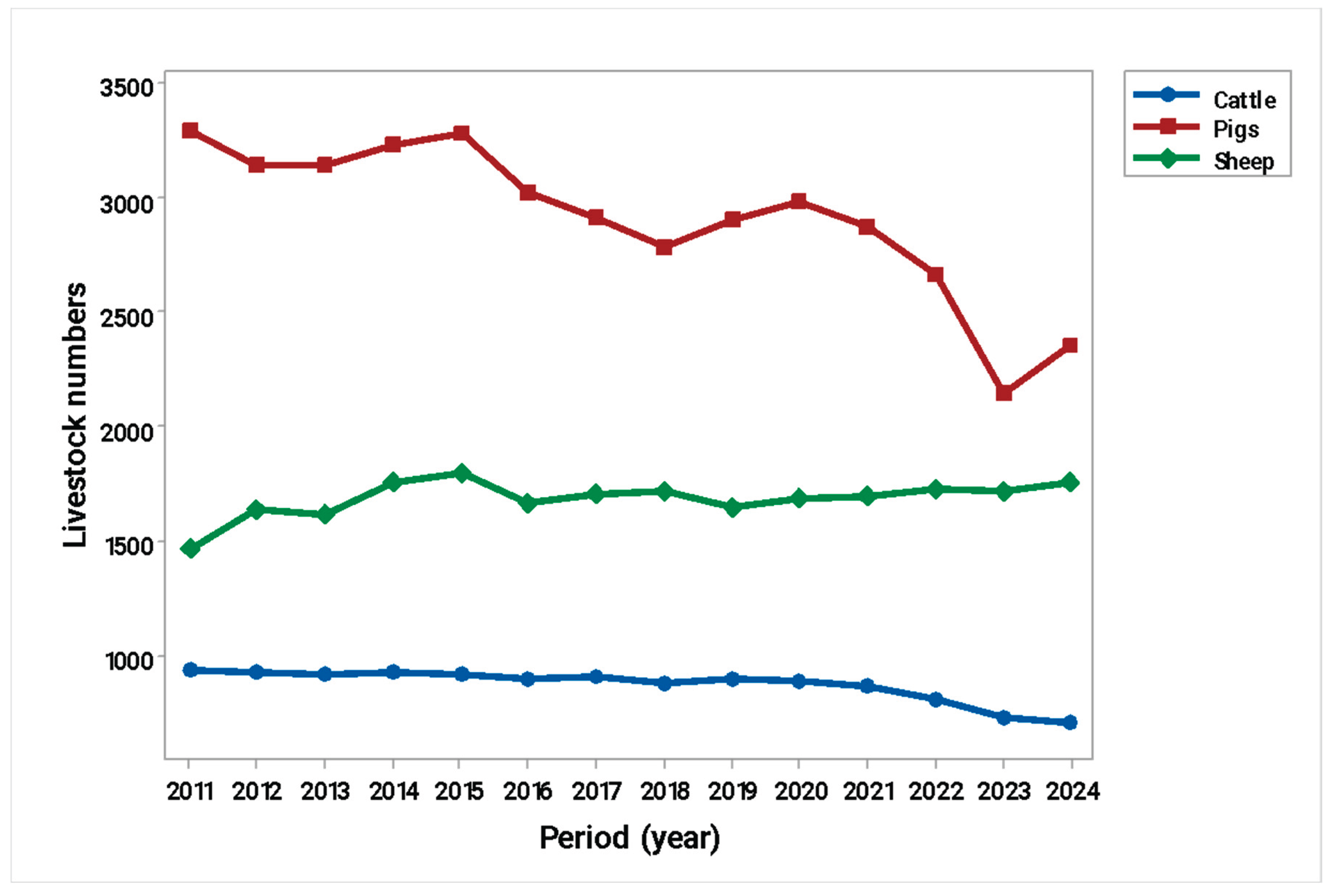
Figure 2.
Trend in poultry numbers in Serbia by year (in thousands).
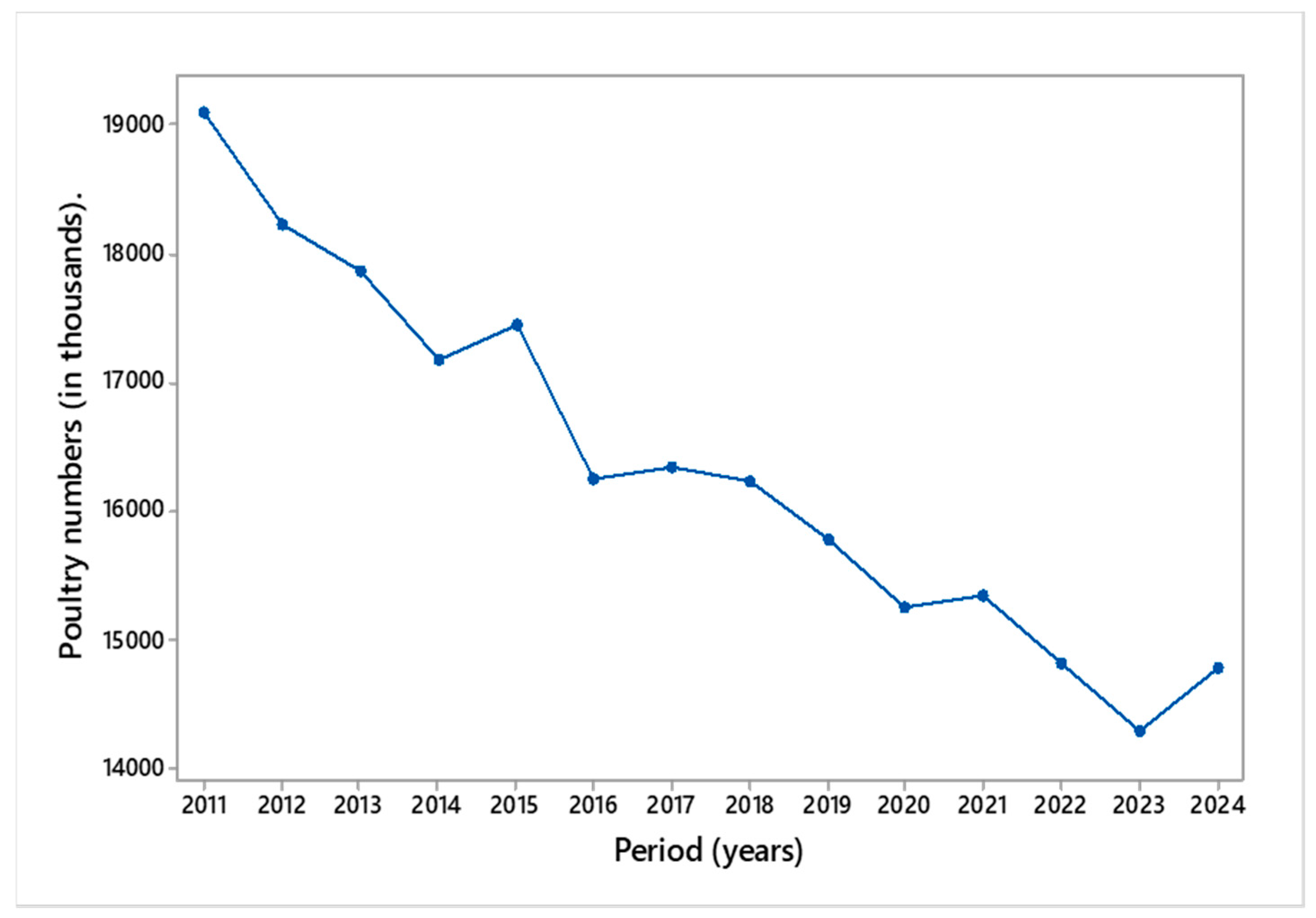

Table 1.
Production of meat, milk, and eggs in Serbia by year (tons).
| Period | Beef | Pork | Lamb | Chicken | Beef | Pork | Lamb | Chicken | N | Beef | Pork | Lamb | Chicken |
| Meat production in tons | Consumption per household in kg | Total consumption in tons | |||||||||||
| 2013 | 35574 | 131942 | 936 | 56678 | 10,9 | 47,8 | 2,0 | 46,9 | 2465799 | 26877 | 117865 | 4932 | 115646 |
| 2014 | 36844 | 150294 | 1296 | 62847 | 12,4 | 50,5 | 2,7 | 46,8 | 2466316 | 30582 | 124549 | 6659 | 115424 |
| 2015 | 40014 | 166350 | 1260 | 66876 | 13,9 | 46,4 | 2,5 | 47,2 | 2466316 | 34282 | 114437 | 6166 | 116410 |
| 2016 | 42160 | 163688 | 1404 | 70550 | 14,4 | 46,0 | 2,4 | 47,5 | 2466316 | 35515 | 113451 | 5919 | 117150 |
| 2017 | 45034 | 155925 | 1768 | 86139 | 13,9 | 45,4 | 2,3 | 50,0 | 2466316 | 34282 | 111971 | 5673 | 123316 |
| 2018 | 44461 | 170709 | 2006 | 93245 | 16,2 | 47,2 | 6,2 | 48,6 | 2466316 | 39954 | 116410 | 15291 | 119863 |
| 2019 | 46537 | 173082 | 2312 | 101662 | 16,8 | 49,6 | 6,5 | 50,2 | 2466316 | 41434 | 122239 | 16031 | 123809 |
| 2020 | 47300 | 169728 | 2465 | 100409 | |||||||||
| 2021 | 48327 | 168630 | 3723 | 100405 | 21,3 | 49,9 | 12,0 | 47,2 | 2466316 | 52533 | 123069 | 29596 | 116410 |
| 2022 | 43952 | 139524 | 3893 | 115328 | 20,0 | 46,0 | 9,6 | 47,3 | 2466316 | 49326 | 113451 | 23677 | 116657 |
| 2023 | 43040 | 136752 | 3468 | 124609 | 19,8 | 47,5 | 8,5 | 48,4 | 2466316 | 48833 | 117150 | 20964 | 119370 |
| 2024 | 45592 | 140067 | 3179 | 137228 | |||||||||
N- number of households.
Table 2.
Economic Accounts of Serbian Agriculture from 2013 to 2023.
| Period | 2013 | 2014 | 2015 | 2016 | 2017 | 2018 | 2019 | 2020 | 2021 | 2022 | 2023 |
| Current prices in millions of dinars | |||||||||||
| Output | 599,638 | 624425 | 584834 | 643686 | 590707 | 640862 | 653184 | 700488 | 785423 | 918689 | 842083 |
| IC | 349334 | 367327 | 344056 | 371854 | 336109 | 366069 | 377541 | 399919 | 437684 | 514034 | 490408 |
| GVA | 250304 | 257098 | 240778 | 271832 | 254598 | 274793 | 275642 | 300570 | 347739 | 404655 | 351675 |
| FI | 225787 | 236171 | 217348 | 243416 | 228284 | 246111 | 246158 | 267437 | 299920 | 357482 | 333868 |
| EEA (%) | 6,50 | 6,60 | 5,60 | 6,00 | 5,40 | 5,40 | 5,40 | 5,50 | 5,50 | 5,70 | 4,00 |
| Output | 389186 | 398499 | 367717 | 398347 | 354914 | 377498 | 377582 | 399731 | 415383 | 422123 | 359594 |
| IC | 226730 | 234423 | 216327 | 230123 | 201944 | 215632 | 218243 | 228212 | 231476 | 236190 | 209419 |
| GVA | 162456 | 164076 | 151391 | 168224 | 152970 | 161866 | 159339 | 171519 | 183907 | 185932 | 150175 |
| FI | 146544 | 150721 | 136681 | 150639 | 137160 | 144971 | 142295 | 152612 | 158617 | 164257 | 142572 |
Legend: Output- value of production in base prices; IC-intermediate consumption; GVA-gross value added; FI-factor income; EEA (%)-participation of BDV agriculture in GDP (%).
Table 3.
SWOT analysis of livestock production in Serbia.
| Strengths | Weaknesses |
| Existing capacities in the dairy and meat sectors with long-standing tradition and expertise. Favourable geographic and agro-climatic conditions for livestock production. Potential for integration into EU value chains. Presence of indigenous breeds suitable for Geographical Indications (GI) and traditional branding. |
Highly fragmented farm structure with economically non-viable smallholdings. Low productivity, e.g. average milk yield per cow of 3,500–4,500 L/year vs. >7,000 L in the EU. Outdated housing systems and insufficient technological modernisation. Limited adoption of Precision Livestock Farming technologies, AI, IoT, and robotics. Weak market organisation with few producer groups and clusters. Lack of a dedicated livestock development strategy aligned with EU CAP Strategic Plans and the Green Deal. Insufficient implementation of biosecurity and animal welfare standards. |
| Opportunities | Threats |
| Alignment with EU Farm to Fork Strategy, Green Deal, and CAP Strategic Plans. Potential for harmonization with EU CAP green architecture (eco-schemes, environmental conditionality) could facilitate access to future funding and enhance farm sustainability. Utilisation of IPARD and other EU funds for farm modernisation and digital transformation. Development of GI-certified and traditionally branded products for domestic and export markets. Implementation of AI, IoT, precision feeding, and robotics to increase productivity and sustainability. Growing demand for high-quality animal products within the EU and regional markets. |
Ongoing rural depopulation and an ageing farming population reducing available labour and innovation capacity. Climate change impacts, including droughts and heat stress, reducing forage yields and pasture productivity. Geopolitical and macroeconomic instabilities affecting feed costs, exchange rates, and market competitiveness. Increased risk of transboundary animal diseases (e.g. African Swine Fever, Avian Influenza) with insufficient biosecurity. Rising imports of cheaper animal products due to real appreciation of the dinar. Lack of adaptation to EU sustainability standards and delayed digital transformation may widen the competitiveness gap with EU livestock sectors. |
Disclaimer/Publisher’s Note: The statements, opinions and data contained in all publications are solely those of the individual author(s) and contributor(s) and not of MDPI and/or the editor(s). MDPI and/or the editor(s) disclaim responsibility for any injury to people or property resulting from any ideas, methods, instructions or products referred to in the content. |
© 2025 by the authors. Licensee MDPI, Basel, Switzerland. This article is an open access article distributed under the terms and conditions of the Creative Commons Attribution (CC BY) license (http://creativecommons.org/licenses/by/4.0/).
Copyright: This open access article is published under a Creative Commons CC BY 4.0 license, which permit the free download, distribution, and reuse, provided that the author and preprint are cited in any reuse.


