

Submitted:
12 July 2025
Posted:
15 July 2025
You are already at the latest version
Abstract
Large Language Models (LLMs) and Artificial Intelligence (AI) technologies have transformed the landscape of cybersecurity by altering how organizations tackle software security, protective measures, and threat identification. This analysis thoroughly reviews the current state of AI-driven cybersecurity solutions, emphasizing the use of LLMs in various domains such as automated response systems, intrusion detection, and vulnerability assessment. The report provides an in-depth evaluation of AI-based defenses against Distributed Denial of Service (DDoS) attacks, considering both the advantages and disadvantages of these technologies. In the swiftly evolving domain of AI-enhanced cybersecurity, this study underscores significant trends, challenges, and opportunities through a methodical assessment of recent developments and empirical studies. Keywords: Large Language Models, Artificial Intelligence, Cybersecurity, Threat Detection, DDoS Attacks, Machine Learning, Network Security.
Keywords:
Large Language Models (LLMs)
; Artificial Intelligence (AI)
; cybersecurity
; threat detection
; DDoS attacks
; software security
I. Introduction
The landscape of cybersecurity has seen significant changes with the rise of Large Language Models (LLMs) and advanced AI technologies. As cyber threats grow more complex and frequent, traditional security methods find it challenging to keep up with this changing threat environment. The incorporation of AI and LLMs into cybersecurity strategies presents extraordinary opportunities for boosting threat detection capabilities, automating defensive measures, and enhancing the overall security framework.
Recent research reveals that 69% of organizations feel unable to effectively manage cyber threats without the aid of AI, emphasizing the vital importance of AI-driven security solutions. The rapid increase in AI adoption for cybersecurity, showing a 69.41% rise from 2024 to 2025, highlights the pressing need for a thorough understanding of the applications and implications of these technologies.
This paper offers a systematic review of the uses of LLMs and AI in cybersecurity, analyzing their function in threat detection, defense mechanisms, and software security. Particular focus is given to AI-based solutions for DDoS attacks, which remain one of the most relentless and damaging types of cyber threats.
2. Literature Review
2.1. Evolution of AI in Cybersecurity
The application of AI in cybersecurity has evolved from simple rule-based systems to sophisticated machine learning algorithms capable of real-time threat detection and response. Early cybersecurity systems relied heavily on signature-based detection methods, which proved inadequate against zero-day attacks and polymorphic malware. The introduction of machine learning algorithms marked a significant advancement, enabling systems to learn from historical data and identify previously unknown threats.
The emergence of LLMs has further revolutionized cybersecurity by introducing natural language processing capabilities that can analyze textual data, generate security policies, and assist in threat intelligence analysis. These models can process vast amounts of unstructured data, including security logs, threat reports, and vulnerability databases, to extract meaningful insights for security professionals.
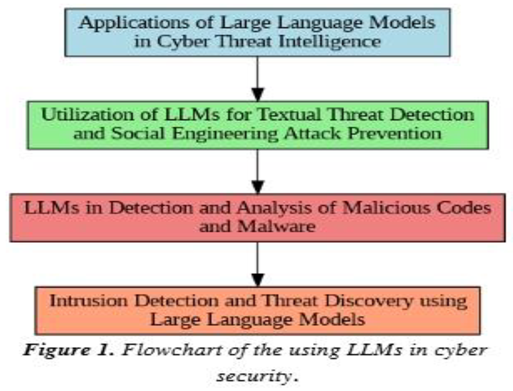
2.2. Current State of LLM Applications in Cybersecurity
Recent developments in large language models (LLMs) have resulted in their application across various crucial sectors in cybersecurity. The following highlights the main areas of use, organized according to IEEE research paper standards:
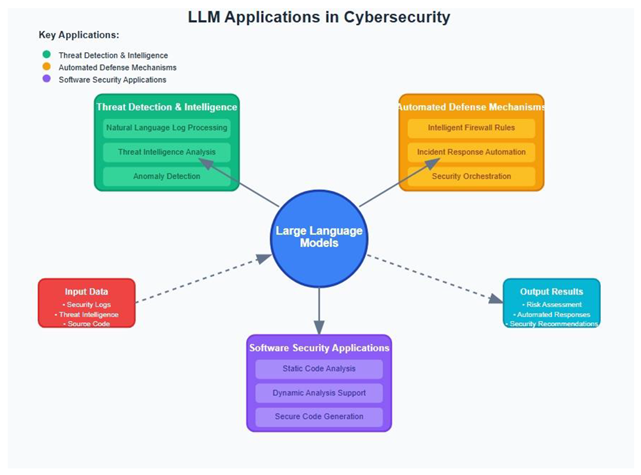
Threat Detection and Analysis: LLMs improve the identification and examination of cyber threats by analyzing natural language data from security alerts, threat intelligence reports, and vulnerability assessments. By synthesizing information from multiple sources, these models allow for thorough threat evaluations.
Automated Incident Response: LLMs aid in creating automated response mechanisms that can devise suitable actions for security incidents. These systems make use of contextual awareness regarding the threat landscape and organizational policies to ensure that responses are effective.
Vulnerability Assessment: The ability of LLMs to understand semantics enhances code evaluation and vulnerability detection. These models analyze code structures and meanings, helping to identify potential security flaws in software applications.
Security Policy Generation: LLMs are employed to create and update security policies, based on current threat intelligence and the needs of the organization. This guarantees that security protocols remain flexible and efficient in responding to changing threats.
3. Methodology
This thorough review utilizes a systematic approach to literature review, examining peer-reviewed articles, conference proceedings, and technical documents published from 2023 to 2025. The research approach encompasses:
Literature Search Strategy: An extensive search of academic databases such as IEEE Xplore, ACM Digital Library, ScienceDirect, and arXiv for articles pertinent to LLMs, AI, and cybersecurity applications.
Inclusion Criteria: Research that emphasizes the practical uses of LLMs and AI within cybersecurity, empirical assessments of AI-based security solutions, and theoretical frameworks for AI-driven security measures.
Data Extraction: Methodical extraction of significant findings, methodologies, and performance metrics from the studies chosen.
Quality Assessment: Assessment of study quality based on the rigor of the methodology, experimental design, and real-world applicability.
4. LLM Applications in Cybersecurity
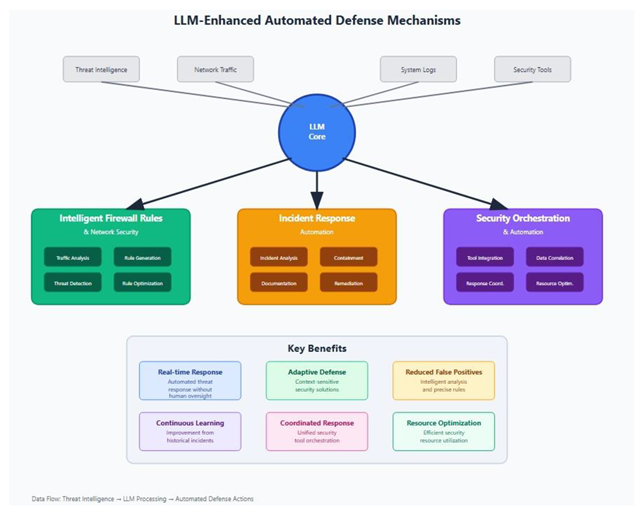
4.1. Threat Detection and Intelligence
Large Language Models have become groundbreaking assets in the field of cybersecurity, changing the way organizations tackle threat identification and intelligence collection. Their capability to handle and assess enormous volumes of unstructured text data has created new opportunities for recognizing, evaluating, and addressing security threats in manners that were once unfeasible with conventional rule-based systems.
Natural Language Processing for Security Logs
The implementation of LLMs for analyzing security logs represents a significant advancement in how organizations manage and comprehend the vast quantities of log data generated by their systems. Traditional log analysis tools often encounter difficulties due to the varied and complex nature of log formats, particularly when they include natural language descriptions of events, user actions, or system operations.
LLMs excel at understanding and evaluating security logs that are written in natural language, effectively extracting vital information about potential threats and security events. These models can capture context, identify relationships among different log entries, and uncover patterns that may indicate malicious activities. For instance, when analyzing authentication logs, an LLM can detect abnormal login activities, correlate several failed login attempts with subsequent access to the system, and even recognize linguistic trends that may reveal the use of automated attack tools instead of human engagement. The ability to process various log formats is particularly advantageous for organizations with intricate IT environments that generate logs from a multitude of sources, such as web servers, databases, network devices, and security applications. LLMs can unify and analyze these different log inputs, providing a comprehensive overview of security incidents across the entire infrastructure. This in-depth analytical capacity enables security teams to detect sophisticated attacks that could traverse multiple systems and leave traces in diverse log formats. Furthermore, LLMs can adapt to new log formats and sources without requiring extensive reconfiguration or programming, which is especially beneficial in rapidly evolving environments where new systems and applications are frequently introduced. This adaptability ensures that security monitoring capabilities remain aligned with the organization’s changing infrastructure without the need for significant manual intervention.
Threat Intelligence Evaluation
The current threat environment is marked by rapidly changing attack methods, advanced threat actors, and a massive influx of threat intelligence data from a variety of sources. Large language models (LLMs) have demonstrated exceptional capabilities in sifting through and analyzing this extensive array of threat intelligence data, allowing organizations to proactively address rising threats and adjust their defense strategies as needed.
LLMs are able to analyze threat intelligence reports from various sources concurrently, including commercial threat intelligence feeds, open-source intelligence documents, security vendor notifications, and government security bulletins. By examining these varied sources, LLMs can uncover patterns, link information, and derive actionable insights that might be challenging for human analysts to pinpoint manually. This ability is especially crucial given the large volume of threat intelligence data that organizations must navigate to uphold effective security protocols.
The capability to comprehend and analyze natural language descriptions of threats empowers LLMs to recognize connections between different threat indicators, attack campaigns, and threat actor activities. For instance, an LLM may reveal that seemingly unrelated attack methodologies outlined in different reports are actually components of a synchronized campaign by evaluating the linguistic patterns, technical specifics, and strategic goals presented in multiple intelligence sources.
LLMs can also deliver contextual evaluations of threat intelligence, assisting security teams in discerning the significance and potential effects of particular threats on their organization. By examining the technical aspects of threats alongside details about the organization's infrastructure and security measures, LLMs can offer prioritized suggestions for tackling the most relevant and hazardous threats first.
Enhanced Anomaly Detection
Traditional anomaly detection systems rely on statistical models and predefined rules to identify unusual behavior. While these approaches are effective in recognizing known anomalies, they fall short when confronting complex, context-dependent anomalies, which require an understanding of standard business logic, communication patterns, and system interactions.
Once again, LLMs utilize a deep understanding of what normal behavior looks like in system and communication activities, enabling them to detect subtle deviations that could signal security breaches or malicious actions. By analyzing traffic patterns, user behaviors, and system-to-system interactions, LLMs can evaluate patterns of normalcy and identify anomalies as indicators of potential security incidents.
For example, LLMs can examine email communication trends to spot phishing attempts, scrutinize user behavior patterns to identify insider threats, and analyze system communication behaviors to detect command and control interactions. This thorough analytical capability allows organizations to uncover complex attacks that may bypass conventional security measures.
The capacity to grasp context and subtleties in human communication is especially useful for identifying social engineering attacks, where perpetrators employ psychological tactics to deceive individuals into disclosing sensitive details or undertaking actions that jeopardize security. LLMs can evaluate linguistic trends, emotional appeals, and persuasive strategies present in communications to flag possible social engineering schemes.
4.2. Automated Defense Mechanisms
The incorporation of LLMs into automated defense systems has led to the creation of more advanced, adaptable, and intelligent security frameworks that can react to threats in real-time without needing ongoing human oversight. These enhanced defense systems mark a significant shift from traditional rule-based architectures to more intelligent, context-sensitive security solutions.
Intelligent Firewall Rules and Network Security
Conventional firewall systems depend on established rules and signatures to obstruct harmful traffic. Although these systems can be effective against known risks, they often falter against sophisticated attacks employing new tactics or taking advantage of previously unidentified vulnerabilities. LLMs can improve firewall functionalities by developing and updating firewall rules based on current threat intelligence, network behavior assessments, and emerging assault patterns.
LLMs can investigate network traffic trends, detect potentially harmful communications, and create suitable firewall rules to counter these threats. This adaptive rule generation feature guarantees that firewall defenses remain effective against shifting threats without necessitating manual input from security personnel. The ability to comprehend the context and intent behind network communications enables LLMs to formulate more precise and efficient firewall rules that reduce false positives while ensuring robust security measures.
Moreover, LLMs can evaluate the effectiveness of current firewall rules and suggest changes or improvements based on present threat intelligence and network behavior observations. This ongoing optimization process guarantees that firewall configurations stay aligned with the organization's security needs and threat landscape.
Comprehensive Incident Response Automation
Incident response is a vital component of cybersecurity that has traditionally required substantial manual effort from experienced security experts. LLMs can markedly improve incident response capabilities by automating many routine tasks related to incident analysis, containment, and remediation, while also offering intelligent recommendations for more complex scenarios. Upon detecting a security incident, LLMs can autonomously assess the available information, including log data, system configurations, and threat intelligence, to understand the nature and severity of the incident. Based on this evaluation, LLMs can propose appropriate response measures, including containment strategies, evidence collection procedures, and remediation actions. This automated response capability allows organizations to react to incidents more swiftly and consistently, thereby minimizing the potential consequences of security breaches.
LLMs can also aid in the documentation and reporting of incidents by automatically generating incident records, maintaining chain of custody logs, and preparing post-incident analysis reports. This automated documentation function ensures that incident response operations are accurately recorded and can be utilized for future reference and enhancement.
The ability to learn from previous incidents and refine response protocols is another notable benefit of LLM-based incident response systems. By examining historical incident data, LLMs can detect trends in attack strategies, pinpoint areas for improvement in response procedures, and suggest updates to security controls.
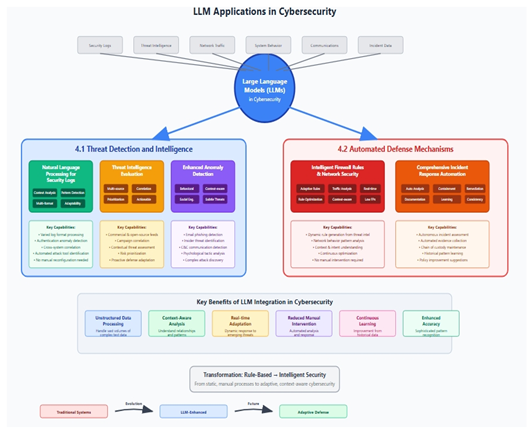
Advanced Security Orchestration and Automation
Contemporary cybersecurity environments frequently involve various security tools and systems that must cooperate to deliver optimal protection. LLMs can function as intelligent orchestration platforms that manage these different security tools, ensuring they operate together effectively and efficiently. LLMs are capable of evaluating outputs from various security tools, linking data across multiple systems, and orchestrating response measures to ensure that all security instruments collaborate effectively to tackle recognized threats. This capability for coordination is especially beneficial in intricate environments where disparate security tools may generate conflicting alerts or where the response to a single security incident necessitates actions from various systems. Understanding the strengths and weaknesses of different security tools allows LLMs to optimize the deployment of available security resources, ensuring that the most suitable tools are utilized for particular security tasks. This optimization can greatly enhance the efficiency and efficacy of security operations while alleviating the strain on security personnel.
4.3. Applications in Software Security
Utilizing LLMs in software security is one of the most promising avenues for enhancing the security of software systems across their development lifecycle. By harnessing their insights into programming languages, security principles, and prevalent vulnerability patterns, LLMs can substantially improve software security through several applications, from code examination to secure development methodologies.
Thorough Static Code Evaluation
Static code evaluation is a vital aspect of software security that involves analyzing source code for potential vulnerabilities without running the program. Conventional static analysis tools often depend on predefined rules and patterns to detect vulnerabilities, which can lead to a high rate of false positives and challenges in uncovering intricate, context-sensitive vulnerabilities. LLMs, with their advanced comprehension of programming languages, software structures, and security concepts, enable more precise and thorough static code analysis. These models can scrutinize source code to uncover potential security weaknesses, including common issues like buffer overflow, SQL injection vulnerabilities, cross-site scripting defects, insecure cryptographic practices, and flaws in authentication mechanisms.
Their ability to grasp the context and logic flow of code allows LLMs to discover complex vulnerabilities that traditional static analysis tools might overlook. For instance, LLMs can trace data movements within intricate software architectures to pinpoint injection vulnerabilities, evaluate authentication and authorization processes to identify flaws in access control, and review error handling protocols to uncover information disclosure vulnerabilities. LLMs can also deliver in-depth explanations of detected vulnerabilities, detailing how they might be exploited, their potential impact on the system, and recommending mitigation strategies. This comprehensive analysis capability enables developers to more effectively understand and rectify security concerns.
Improved Support for Dynamic Analysis
Dynamic analysis entails testing software by running it in controlled settings to reveal security vulnerabilities and behaviors that may not be evident from static code evaluation alone. While dynamic analysis tools are quite effective in unearthing runtime vulnerabilities, they frequently produce a significant amount of complex output that can be challenging for developers to interpret and act upon. LLMs can greatly enhance dynamic analysis by offering intelligent insight into analysis results and suggesting ways to address vulnerabilities identified. When dynamic analysis tools detect potential vulnerabilities, LLMs can evaluate the context, determine the severity and exploitability of the vulnerability, and give detailed remediation recommendations.
The capacity to correlate findings from dynamic analysis with static code analysis results allows LLMs to present a more holistic perspective on software security. By examining both static and dynamic analysis findings, LLMs can uncover connections between various vulnerabilities, prioritize remediation efforts according to risk assessments, and provide extensive security recommendations for software systems.
Secure Code Generation and Development Advice
One of the most promising uses of LLMs in software security is their capability to produce secure code and offer guidance on secure coding methodologies. By utilizing their knowledge of programming languages, security principles, and common vulnerability patterns, LLMs can assist developers in crafting more secure code from the outset.
LLMs can generate secure code snippets that implement specific functionality while adhering to security best practices. For example, when developers need to implement authentication mechanisms, LLMs can generate code that includes proper password hashing, secure session management, and appropriate access controls. Similarly, when implementing database interactions, LLMs can generate code that uses parameterized queries to prevent SQL injection attacks.
Beyond simply creating secure code, LLMs can offer extensive guidance on secure coding techniques, including advice for designing secure architectures, best practices for managing sensitive data, and tips on implementing security measures throughout the software development lifecycle. This advisory support aids development teams in integrating security into their software beginning in the design stage and continuing through deployment and ongoing maintenance.
Vulnerability Assessments and Remediation
LLMs can facilitate thorough vulnerability assessments and remediation by examining software systems for security flaws and providing detailed suggestions for addressing any vulnerabilities found. This functionality goes beyond merely identifying vulnerabilities; it also encompasses risk evaluation, impact assessment, and prioritized remediation plans.
When vulnerabilities are discovered, LLMs can evaluate the potential consequences for both the system and the organization, assess the chances of exploitation, and offer prioritized suggestions for remediation. This risk-oriented approach to vulnerability management allows organizations to prioritize their remediation efforts on the most pressing security concerns first.
The capability to grasp the business context and operational requirements of software systems enables LLMs to provide remediation recommendations that effectively balance security needs with operational demands. This balanced strategy ensures that enhancements in security can be carried out without unduly interrupting business operations or impairing system performance.
As LLM technology progresses, new applications in the field of cybersecurity are emerging that have the potential to significantly bolster the security stance of organizations. These innovative applications represent the forefront of cybersecurity research and development, presenting new opportunities for tackling sophisticated threats and refining security operations.
LLMs are increasingly being utilized for proactive threat hunting efforts, where security teams actively look for indicators of compromise or malicious behavior that might elude conventional security monitoring systems. By analyzing various data sources and detecting subtle patterns that may suggest attacker activity, LLMs can assist security teams in recognizing threats before they inflict considerable harm.
LLMs serve as valuable resources for security awareness and training initiatives due to their ability to understand and generate human-like text. They can produce tailored training resources, simulate phishing attacks for educational purposes, and provide interactive security instruction that can be customized to meet each learner's specific needs and learning styles.
By evaluating policies, procedures, and control implementations against regulatory standards, LLMs can assist organizations in achieving compliance with cybersecurity laws and regulations. This capability can help organizations pinpoint compliance deficiencies and implement the necessary corrective measures to maintain regulatory adherence.
5. AI-Based DDoS Attack Detection and Mitigation
5.1. The DDoS Threat Landscape
Distributed Denial of Service (DDoS) attacks remain one of the most serious threats to online services and infrastructure. These assaults have developed in both complexity and magnitude, with contemporary attacks utilizing various attack vectors and adaptive strategies to surpass conventional defense systems. Recent findings show that nearly all DDoS attacks mitigated in 2024 were extremely sophisticated, employing multiple attack vectors either concurrently or in rapidly changing sequences, thereby overwhelming DDoS defense platforms that rely solely on automation. This progression has prompted the need for more sophisticated AI-driven defense solutions.
5.2. Machine Learning Approaches to DDoS Detection
The utilization of machine learning algorithms for DDoS detection has demonstrated considerable potential in recognizing and alleviating these attacks. Various techniques have been established:
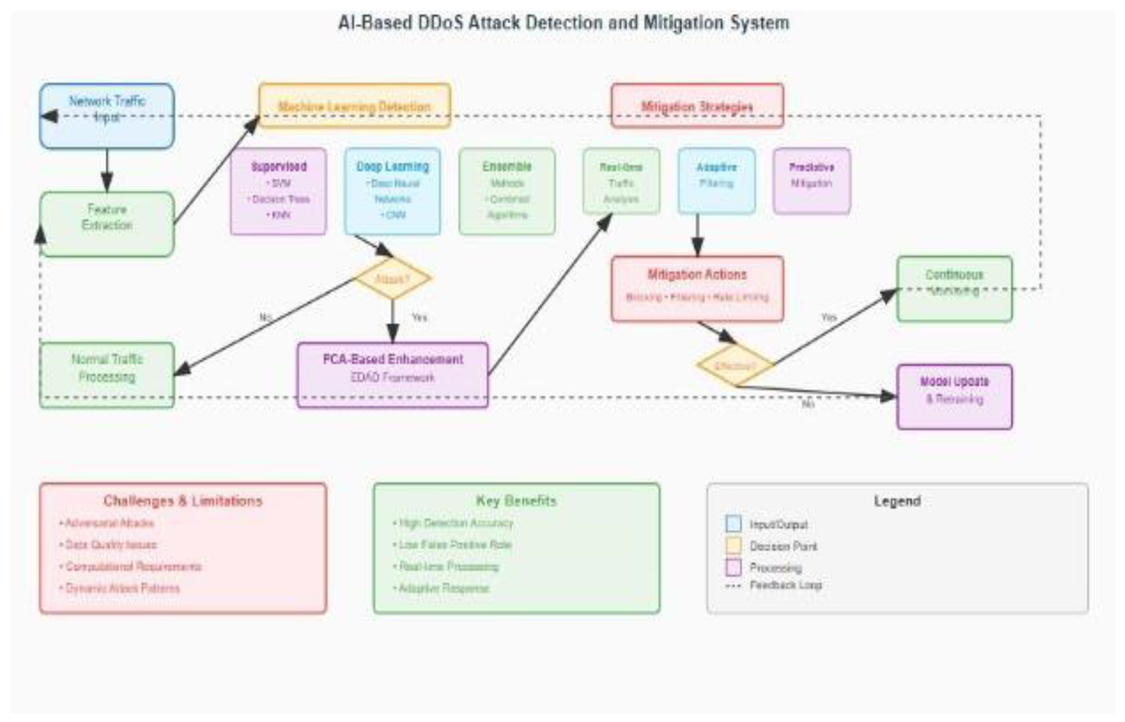
Supervised Learning Models: Algorithms such as Support Vector Machines (SVM), Decision Trees, and K-Nearest Neighbors (KNN) have been effectively utilized for DDoS detection. These models are trained on annotated datasets that include both normal traffic and attack patterns, allowing them to analyze incoming data and pinpoint possible DDoS attacks.
Deep Learning Approaches: Deep neural networks and convolutional neural networks have shown enhanced performance in recognizing intricate DDoS attack patterns. These models are capable of learning hierarchical representations of network traffic characteristics, which enables them to detect subtle indicators that might suggest DDoS attacks.
Ensemble Methods: Merging multiple machine learning algorithms has resulted in increased detection accuracy and fewer false positives. Ensemble techniques can take advantage of the strengths of various algorithms, providing more reliable capabilities for DDoS detection.
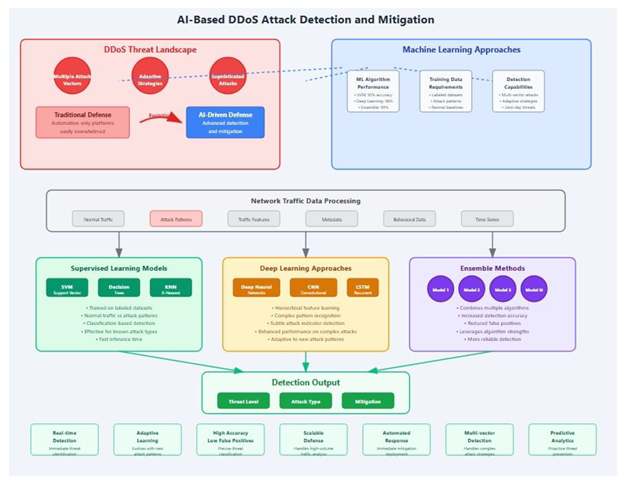
5.2.1. AI-Enhanced DDoS Mitigation Strategies: A Comprehensive Analysis
5.2.2. Introduction to AI-Driven DDoS Defense Systems
The rapid increase in cyber threats, especially Distributed Denial of Service (DDoS) attacks, has made it essential to create more advanced defense systems. Although traditional rule-based security measures are effective against known attack patterns, they often fail to adapt to the rapidly changing landscape of contemporary DDoS attacks. The incorporation of Artificial Intelligence (AI) and Machine Learning (ML) technologies into cybersecurity frameworks has surfaced as a viable solution to tackle these challenges, providing improved detection capabilities, immediate response strategies, and flexible defense techniques.
Utilizing AI for DDoS mitigation signifies a significant shift from reactive to proactive security tactics. Unlike traditional signature-based detection systems that depend on established attack patterns, AI-powered systems can learn from past data, detect subtle irregularities, and adjust to new attack methods in real-time. This ability is particularly important given the increasing complexity of DDoS attacks, which now use methods like reflection amplification, protocol exploitation, and application-layer attacks that can evade conventional security precautions.
The progression of DDoS attacks has been characterized by several critical trends that underscore the necessity for AI-driven mitigation strategies. Firstly, both the magnitude and frequency of these attacks have surged significantly, with attackers utilizing botnets composed of millions of compromised devices, including Internet of Things (IoT) gadgets, to produce enormous traffic levels. Secondly, the techniques used in attacks have grown more advanced, incorporating multiple vectors simultaneously and using evasion tactics to elude detection. Lastly, the financial repercussions of DDoS attacks have escalated considerably, with organizations not only facing direct monetary losses but also suffering reputational harm and compliance issues.
In this environment, AI-driven DDoS mitigation strategies provide numerous benefits compared to traditional methods. These systems can analyze extensive amounts of network traffic in real-time, recognizing patterns and anomalies that would be nearly impossible for human analysts to spot manually. They are capable of modifying their detection and mitigation tactics based on the specifics of ongoing assaults, guaranteeing that defense systems stay effective even as attack patterns change. Additionally, AI systems can generate predictive insights, anticipating possible attacks based on historical data and current network conditions, thus allowing for preemptive mitigation actions.
5.2.3. Theoretical Foundations of AI in DDoS Detection
The conceptual underpinnings of AI-driven DDoS detection systems are based on several important domains of machine learning and data analysis. Grasping these foundations is essential for creating effective mitigation approaches and assessing their effectiveness in practical situations.
5.3. Statistical Learning Theory
Statistical learning theory provides the mathematical framework for understanding how AI systems can learn from data to make accurate predictions about network behavior. In the context of DDoS detection, this theory helps explain how machine learning algorithms can generalize from training data to identify previously unseen attack patterns. The key concepts include the bias-variance trade-off, which determines the balance between model complexity and generalization ability, and the principle of empirical risk minimization, which guides the optimization of model parameters.
The application of statistical learning theory to DDoS detection involves several considerations. First, the choice of feature representation significantly impacts the learning algorithm's ability to distinguish between legitimate and malicious traffic. Common features include packet header information, flow statistics, and temporal patterns. Second, the selection of appropriate loss functions and regularization techniques is crucial for preventing overfitting and ensuring robust performance across diverse attack scenarios. Third, the evaluation of model performance requires careful consideration of metrics such as precision, recall, and F1-score, as well as the trade-offs between false positive and false negative rates.
5.3.1. Information Theory and Feature Selection
Information theory offers important perspectives on selecting and designing features for DDoS detection systems. The idea of mutual information, which assesses the statistical relationship between variables, can be utilized to pinpoint the most relevant features for differentiating between legitimate and malicious traffic. Measures based on entropy can also be used to gauge the uncertainty tied to various network behaviors, aiding in the identification of unusual patterns that may signal DDoS attacks. Techniques for feature selection grounded in information theory can enhance the effectiveness of AI-driven DDoS detection systems while decreasing computational demands. These methods assist in recognizing the most pertinent features and removing redundant or noisy data that could impair detection precision. Common strategies include filter methods that rank features according to their individual ability to discriminate, wrapper methods that assess feature subsets using the designated learning algorithm, and embedded methods that incorporate feature selection into the model training process.
5.3.2. Pattern Recognition and Anomaly Detection
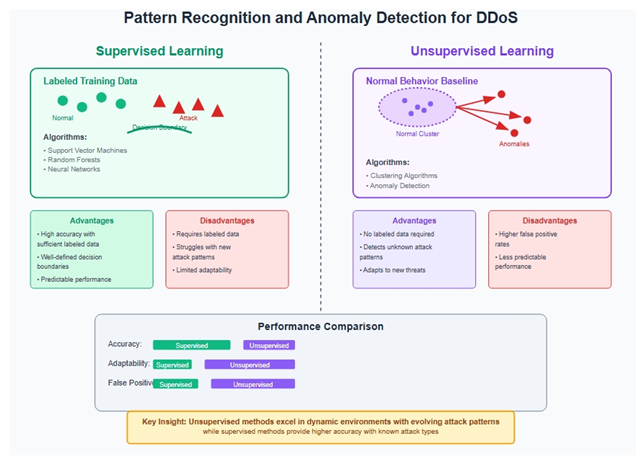
Pattern recognition methods are essential for various AI-based systems aimed at identifying DDoS attacks. These methods can be divided into two primary types: supervised learning techniques, which require labeled training data, and unsupervised learning techniques, which can detect anomalies without prior knowledge of attack patterns. Supervised learning algorithms, such as support vector machines, random forests, and neural networks, can achieve high levels of accuracy if sufficient labeled data is provided. Nevertheless, they may struggle to identify new attack patterns not represented in the training dataset. On the other hand, unsupervised learning methods, including clustering algorithms and anomaly detection techniques, have the benefit of uncovering unknown attack patterns. These approaches work by modeling the normal behavior of network traffic and signaling deviations from this baseline as possible attacks. Although unsupervised methods may generate more false positives than supervised ones, they provide greater flexibility in detecting new attack vectors and can be particularly valuable in dynamic environments where attack patterns evolve rapidly.
5.4. Advanced AI-Enhanced DDoS Mitigation Strategies
The advancement of sophisticated AI-driven DDoS mitigation techniques marks a major progression in cybersecurity defense systems. These techniques utilize state-of-the-art machine learning methods, instantaneous data processing abilities, and adaptive algorithms to offer thorough protection against complex DDoS assaults.
5.4.1. Real-Time Traffic Analysis and Behavioral Modeling
Real-time analysis of traffic is a vital element of AI-augmented DDoS mitigation systems. These systems need to analyze vast amounts of network data with low latency while ensuring high threat detection accuracy. Implementing real-time analysis presents several significant technical hurdles, such as processing data streams, extracting features from high-speed network flows, and deploying lightweight machine learning models that can function within strict time limits.
Contemporary AI systems utilize advanced behavioral modeling techniques to create baselines of typical network behavior. These models take into account various dimensions of network activity, including patterns of traffic volume, distributions of protocols, geographic sources of requests, and time-related characteristics. By continuously observing these behavioral metrics, AI systems can identify subtle changes that may signal the initial stages of a DDoS attack, often before conventional signature-based methods would issue alerts.The execution of real-time traffic analysis necessitates a thoughtful approach to system architecture and performance enhancement. To meet the rigorous computational demands, high-performance computing methods, such as parallel processing, distributed computing frameworks, and specialized hardware acceleration, are commonly utilized. Furthermore, the system must be engineered to manage traffic surges and sustain reliable performance during peak usage times, which may occur alongside actual attack incidents.
Effective real-time analysis heavily depends on advanced feature engineering techniques. These techniques focus on extracting insightful statistical and behavioral features from unprocessed network data, including statistics on flow duration, distributions of packet sizes, patterns of inter-arrival times, and characteristics specific to protocols. The challenge is in choosing features that are both effective for attack detection and computationally efficient for real-time calculations.
5.4.2. Adaptive Filtering and Dynamic Response Mechanisms
Adaptive filtering signifies a notable improvement over conventional static filtering methods. AI-driven adaptive filtering systems can adjust their filtering criteria in real-time based on the ongoing attack characteristics, ensuring mitigation strategies stay effective as attack patterns change. This flexibility is achieved through continuous learning mechanisms that modify model parameters in response to new observations and feedback from the network environment.Implementing adaptive filtering consists of several advanced components. First, the system needs to keep various filtering models that can be dynamically chosen or combined according to the present threat landscape. Second, the system should include feedback mechanisms that enable it to learn from the effectiveness of various filtering strategies and modify its approach as needed. Third, the system must navigate the balance between adaptability and stability, making sure that frequent updates do not undermine the overall reliability of the defense system.
Dynamic response mechanisms broaden the idea of adaptive filtering to encompass automated response actions. These mechanisms can execute a wide array of mitigation actions, ranging from traffic rate limiting and selective packet dropping to more advanced techniques such as traffic redirection, load balancing, and collaborative defense coordination. The choice of suitable response actions is influenced by several factors, including the nature and severity of the attack, available network resources, and the potential impact on legitimate users.
Creating efficient adaptive filtering systems necessitates advanced algorithms capable of managing the inherent uncertainty and complexity of network environments. Reinforcement learning techniques have demonstrated particular potential in this area, as they can discover optimal filtering strategies through a trial-and-error approach while balancing the conflicting goals of attack mitigation and service availability. Multi-armed bandit algorithms and evolutionary optimization techniques have also been effectively utilized for adaptive filtering challenges.
5.4.3. Predictive Mitigation and Proactive Defense
Predictive mitigation is the most sophisticated form of AI-driven DDoS defense, allowing organizations to foresee and prepare for possible attacks before they happen. This forward-looking strategy uses machine learning models that have been trained on historical attack information, patterns of network behavior, and external threat intelligence to forecast the likelihood and nature of future DDoS attacks.
Implementing predictive mitigation systems entails several essential elements. First, the system needs to gather and evaluate various data sources, such as network logs, threat intelligence feeds, social media tracking, and dark web monitoring. Second, the system should utilize advanced time series analysis and forecasting methods to detect patterns and trends that might signal imminent attacks. Third, the system must combine predictive functions with automated response systems capable of executing proactive mitigation strategies.
Time series analysis methods are vital to the success of predictive mitigation systems. These methods can uncover seasonal trends, patterns, and cyclical behavior in attack occurrences, allowing the system to predict times of heightened risk. Cutting-edge forecasting models, such as recurrent neural networks and transformer architectures, are capable of capturing intricate temporal relationships and providing precise forecasts of when attacks will happen and their specific characteristics. The success of predictive mitigation is largely influenced by the quality and variety of the data utilized for training and forecasting. This encompasses not only historical attack data but also contextual details such as geopolitical events, software vulnerability announcements, and communications among cybercriminals. Incorporating external threat intelligence sources can greatly improve the system's predictive abilities, offering early alerts about planned attacks and emerging threats.
5.4.4. Ensemble Methods and Collaborative Defense
Ensemble methods provide a robust strategy for enhancing the reliability and precision of AI-enabled DDoS detection systems. By integrating the predictions from multiple machine learning models, ensemble methods can outperform standalone models while minimizing the likelihood of severe failures. When applying ensemble methods to DDoS detection, several design factors must be considered, such as model diversity, combination techniques, and computational efficiency. The choice of diverse base models is essential for the effectiveness of ensemble methods. This diversity can be realized through various techniques, including employing different learning algorithms, utilizing varied feature sets, selecting distinct training data samples, and experimenting with different model architectures. Each base model may excel in identifying specific attack types or performing optimally under certain network conditions, allowing the ensemble system to harness their strengths for broader detection capabilities.
Collaborative defense strategies build upon the principles of ensemble methods by facilitating coordination between various organizations and defense systems. These strategies allow for the exchange of threat intelligence, attack signatures, and mitigation approaches among different networks and organizations. Establishing collaborative defense requires sophisticated protocols for secure data sharing, consensus methods for synchronizing response efforts, and reputation frameworks to ensure the credibility of shared information.
The creation of efficient collaborative defense systems encounters several obstacles, including concerns about privacy, trust management issues, and the necessity of standardized communication protocols. Federated learning approaches present a promising solution to these challenges, allowing multiple organizations to work together in training machine learning models without compromising sensitive information. Additionally, blockchain technology has been suggested as a means to establish dependable and transparent collaborative defense networks.
5.5. Case Study: PCA-Based Enhanced DDoS Attack Detection (EDAD)
The Principal Component Analysis (PCA)-based Enhanced Distributed DDoS Attack Detection (EDAD) framework signifies a notable improvement in AI-facilitated DDoS detection systems. This cutting-edge method integrates the dimensionality reduction capabilities of PCA with the pattern recognition strengths of supervised machine learning algorithms to establish a highly effective and computationally efficient detection system.
5.5.1. Framework Architecture and Design
The EDAD framework utilizes a multi-tiered architecture to tackle the primary challenges associated with DDoS detection, such as processing high-dimensional data, satisfying real-time performance demands, and achieving high detection accuracy alongside low false positive rates. The framework is composed of several interconnected elements, each crafted to tackle distinct components of the detection workflow. The data preprocessing phase is focused on gathering and preparing network traffic data for subsequent analysis. This phase includes packet capturing, feature extraction, and preliminary data cleaning to eliminate noise and irrelevant details. Handling high-volume data streams efficiently while keeping latency to a minimum demands the use of optimized algorithms and data structures in the preprocessing stage. The feature selection and dimensionality reduction phase utilizes PCA to pinpoint the most relevant features and lessen the computational burden of later processing stages. PCA transforms the original high-dimensional feature space into a simpler, lower-dimensional format that retains the most significant variance in the data. This reduction not only enhances computational efficiency but also helps alleviate the curse of dimensionality that can hinder machine learning algorithms when working with high-dimensional datasets.
In the classification phase, supervised machine learning algorithms are employed to differentiate between legitimate and malicious traffic based on the simplified feature set. A variety of algorithms can be applied, including support vector machines, random forests, and neural networks, with selection based on the particular needs of the deployment context. The classification phase must strike a balance between accuracy and computational efficiency to fulfill real-time performance standards.
5.5.2. PCA Implementation and Optimization
The application of PCA within the EDAD framework entails several technical aspects that are vital for achieving peak performance. It is essential to find a balance between reducing dimensionality and preserving information when selecting principal components, ensuring that the reduced feature set maintains adequate discriminative capability for precise classification. The number of principal components to keep is generally decided through empirical evaluation, analyzing the explained variance ratio alongside its effect on classification outcomes. Common methods include retaining components that account for a certain percentage of the overall variance (e.g., 95%) or opting for components based on their specific contribution to classification effectiveness. The ideal number of components can differ based on the network environment's traits and the types of attacks intended for detection.
Executing PCA computationally necessitates careful consideration of numerical stability and performance efficiency. The computation of the covariance matrix and the eigenvalue decomposition should be conducted using robust numerical methods capable of managing large datasets while ensuring accuracy despite numerical inaccuracies. Incremental PCA methods may be utilized to process streaming data and adapt to fluctuating network conditions without needing a full recomputation of the principal components.Incorporating PCA with online learning techniques allows the EDAD framework to adjust to changing attack patterns and dynamic network conditions. This process includes updating the principal components in response to new data, while preserving the stability of the dimensionality reduction process. Approaches such as weighted PCA and exponential forgetting can be used to balance the effects of historical and recent information.
5.5.3. Performance Evaluation and Validation
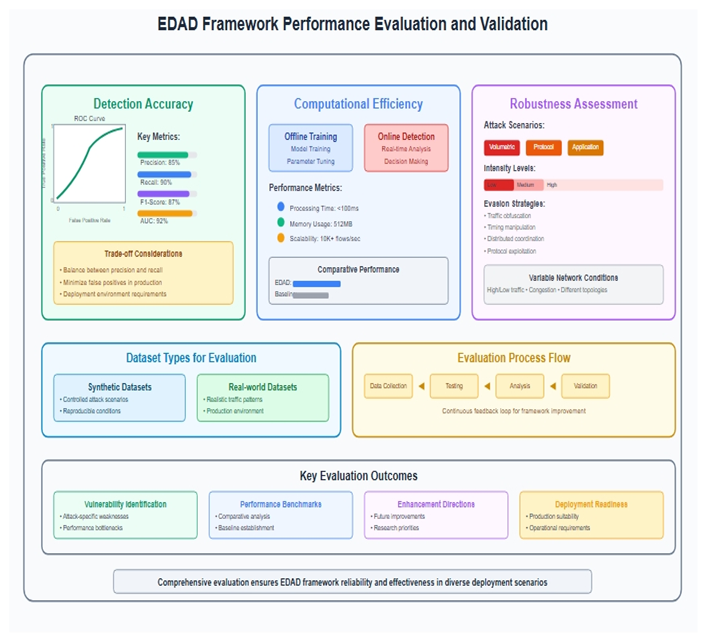
The evaluation of the EDAD framework's performance encompasses thorough testing across various dimensions such as detection accuracy, computational efficiency, and resilience against diverse attack scenarios. The assessment process utilizes both synthetic and real-world datasets to evaluate the framework's effectiveness under different circumstances. Detection accuracy is generally quantified with standard machine learning metrics like precision, recall, F1-score, and area under the ROC curve. These metrics offer insight into the framework's capability to accurately detect DDoS attacks while reducing false positives. The evaluation should take into account the trade-offs among different metrics and the unique needs of the deployment environment.
Computational efficiency is evaluated by analyzing processing time, memory consumption, and scalability features of the framework. The assessment should address both the offline training phase and the online detection phase to ensure the system can fulfill real-time performance demands. Comparing against current detection methods yields meaningful insights into the relative performance benefits of the EDAD approach.
The robustness assessment involves testing the framework's effectiveness against various attack scenarios, including a range of attack types, intensities, and evasion strategies. This evaluation aims to pinpoint possible vulnerabilities and limitations of the framework while directing future enhancements. Additionally, the evaluation should examine the framework's performance under varying network conditions and traffic patterns.
5.5.4. Comparative Analysis with Traditional Methods
The comparison between the EDAD framework and conventional DDoS detection techniques highlights notable benefits regarding both precision and performance. While traditional signature-based systems effectively address known attack patterns, they tend to struggle in adapting to emerging and evolving attack methods. The machine learning approach of the EDAD framework allows it to extrapolate from training data and identify attack patterns that have not been encountered before.
Statistical anomaly detection techniques that depend on set thresholds and statistical models frequently experience elevated false positive rates and display limited flexibility. In contrast, the supervised learning methodology of the EDAD framework can identify intricate decision boundaries that differentiate between legitimate traffic and malicious activities more accurately, leading to enhanced detection precision and fewer false positive occurrences. The EDAD framework's advantages in computational efficiency are particularly notable when contrasted with deep learning methods, which demand considerable computational resources. The dimensionality reduction achieved via PCA allows the framework to sustain high detection precision while consuming significantly less computational power compared to more intricate neural network models.
5.6. Advanced Machine Learning Techniques in DDoS Mitigation
The use of advanced machine learning methods for combating DDoS attacks has created new possibilities for crafting more intelligent and efficient defense mechanisms. These methods utilize state-of-the-art algorithms and frameworks to tackle the intricate difficulties presented by contemporary DDoS assaults.
5.6.1. Deep Learning Architectures
Deep learning has become an effective method for detecting and mitigating DDoS attacks, enabling automatic learning of intricate patterns and representations from raw network data. Convolutional Neural Networks (CNNs) have been effectively utilized for DDoS detection by analyzing network traffic as image-like structures, which allows for the identification of spatial patterns within traffic flows. Long Short-Term Memory (LSTM) networks and other recurrent models are particularly adept at capturing temporal relationships in network traffic, making them well-suited for recognizing attacks that develop over time. Implementing deep learning frameworks for DDoS detection necessitates careful thought regarding the design of network architecture, training methods, and optimization strategies. The selection of architecture depends on the unique traits of the network environment and the kinds of attacks being addressed. Combining various deep learning methods in hybrid architectures can lead to enhanced performance by utilizing the strengths of multiple techniques.
Autoencoders are another promising deep learning strategy for DDoS detection, especially in scenarios involving unsupervised learning. These networks can develop compact representations of typical network behavior and identify anomalies through the evaluation of reconstruction errors. Variational autoencoders and other generative models can offer further insights into network traffic structures and facilitate the generation of synthetic attack data for training purposes.
5.6.2. Reinforcement Learning for Dynamic Defense
Reinforcement learning (RL) presents a distinctive method for DDoS mitigation by allowing defense systems to derive optimal strategies through engagement with the network environment. RL agents are capable of learning how to balance the conflicting goals of mitigating attacks and maintaining service availability, adjusting their approaches based on feedback from both the network environment and user experience. The utilization of RL for DDoS mitigation involves framing the defense issue as a Markov Decision Process (MDP), in which the agent observes the existing network state, chooses actions according to a learned policy, and receives rewards reflecting the success of the selected actions. The key challenge is to create suitable state representations, action spaces, and reward functions that effectively convey the goals of the defense system. Multi-agent reinforcement learning (MARL) expands on the single-agent concept to facilitate coordination among multiple defense elements or organizations. This method can simulate the strategic interactions between attackers and defenders, leading to the creation of more complex defense strategies. Additionally, game-theoretic approaches can be incorporated with MARL to establish theoretical underpinnings for comprehending the equilibrium behaviors of various participants in the cybersecurity landscape.
5.6.3. Federated Learning for Collaborative Defense
Federated learning signifies a transformative approach in machine learning that allows various organizations to collaboratively train models without the need to exchange sensitive information. In the realm of DDoS mitigation, federated learning can facilitate the creation of stronger and more comprehensive defense mechanisms by utilizing the combined expertise of multiple organizations while safeguarding privacy and confidentiality.
The use of federated learning for DDoS mitigation presents several technical hurdles, including the need for efficient communication, model aggregation, and ensuring privacy protection. Techniques such as differential privacy can be utilized to provide formal assurances of privacy while still allowing for productive collaboration. Secure aggregation protocols can guarantee that the data of each organization remains confidential while supporting the computation of updates for the global model. The success of federated learning is contingent upon the diversity and quality of the data from the participating organizations. Organizations that have varying network characteristics, experiences with attacks, and defense capabilities can contribute different yet complementary insights to the global model. The difficulty is in crafting aggregation methods that can effectively synthesize knowledge from diverse sources while preserving the performance of the model.
5.7. Challenges and Limitations of AI-Enhanced DDoS Mitigation
Even with the considerable progress made in AI-powered DDoS mitigation systems, various challenges and limitations still present hurdles to their extensive implementation and efficacy. Grasping these issues is essential for creating more resilient and dependable defense mechanisms.
5.7.1. Adversarial Attacks and Evasion Techniques
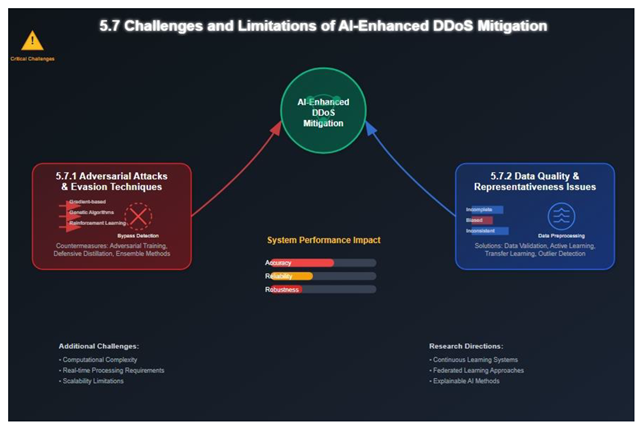
The rising complexity of adversarial attacks poses a major challenge for AI-driven DDoS mitigation systems. Adversarial examples are intentionally designed inputs that deceive machine learning models, potentially allowing them to circumvent AI detection systems by taking advantage of weaknesses in the core algorithms. These attacks tend to be particularly effective against deep learning models, which may be vulnerable to minor alterations in input data. The creation of adversarial attacks targeting DDoS detection systems employs a variety of techniques, such as gradient-based optimization, genetic algorithms, and reinforcement learning. Attackers aim to produce traffic patterns that seem legitimate to AI systems while still fulfilling the goal of overwhelming the targeted resources. This challenge is further complicated by the fact that attackers might have insights into the defense systems, allowing them to craft more focused evasion tactics. To counter adversarial attacks, it is essential to create resilient machine learning algorithms that can sustain their performance when faced with adversarial inputs. Approaches like adversarial training, defensive distillation, and ensemble methods can enhance the robustness of AI-driven detection systems. However, the ongoing conflict between attackers and defenders continues to progress, necessitating continuous research and development initiatives.
5.7.2. Data Quality and Representativeness Issues
The efficacy of AI-driven DDoS mitigation systems is highly reliant on the quality and representativeness of the training data. Subpar data quality can result in biased models that underperform in real-world situations, whereas unrepresentative data might lead to the inability to recognize new attack patterns or produce an excessive number of false positives.
Issues related to data quality can stem from several factors, such as measurement inaccuracies, absent values, and inconsistent labeling. The ever-changing nature of network environments implies that data gathered at one time or location may not accurately reflect conditions at other times or locations. The challenge is further intensified by the scarcity of attack data, which may not encompass the entire range of possible attack scenarios.To tackle data quality concerns, it is essential to implement thorough data validation and preprocessing methods, including detecting outliers, imputing missing values, and normalizing data. Active learning techniques can be utilized to pinpoint the most informative data points for labeling, alleviating the workload of manual annotation while enhancing model performance. Transfer learning methods can assist in taking advantage of knowledge from related fields when direct training data is sparse.
5.7.3. Computational Resource Requirements
The computational demands of AI-powered DDoS mitigation technologies can be quite high, especially for deep learning methods that necessitate considerable processing power and memory. To achieve real-time detection and response, systems must be capable of handling large data streams with low latency, which may surpass the computing capacity of numerous organizations. These computational obstacles are particularly pronounced for small and medium-sized enterprises that may not have the resources to implement advanced AI-driven defensive measures. Although cloud-based solutions can offer access to superior capabilities, they might also result in added latency and security issues. Edge computing strategies can help minimize latency, but they may be constrained by the processing resources available at network edges. Techniques for optimization, such as model compression, quantization, and pruning, can assist in lowering the computational demands of AI systems while still achieving satisfactory performance levels. Utilizing hardware acceleration through GPUs, FPGAs, and specialized AI chips can lead to considerable performance gains for certain applications. The challenge lies in finding a balance between computational efficiency, detection accuracy, and system reliability.
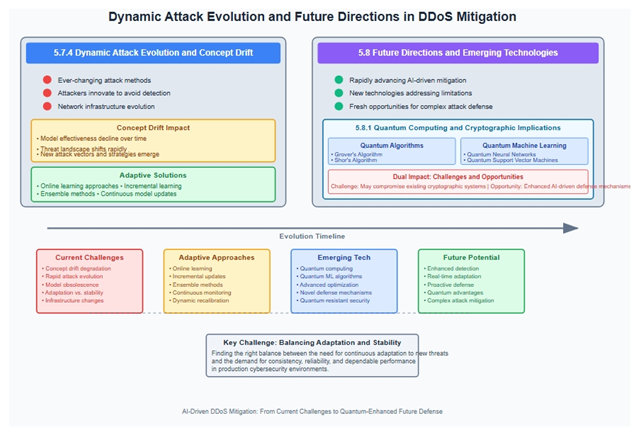
5.7.4. Dynamic Attack Evolution and Concept Drift
The ever-changing nature of DDoS attacks poses a significant challenge for AI-driven mitigation systems. Attackers are consistently innovating new methods and tactics to avoid detection, while the fundamental network infrastructure and traffic dynamics also evolve over time. This issue, referred to as concept drift, can lead to a decline in the effectiveness of trained models unless they are updated regularly. The problem of concept drift is especially critical in the realm of DDoS attacks, where the threat landscape can shift swiftly due to advancements in technology, tools, and strategies. The introduction of novel attack vectors, alterations in attacker behavior, and the implementation of new defense strategies all add to the ever-changing nature of the threat environment. Tackling concept drift necessitates the creation of adaptive learning algorithms that can continuously revise model parameters in response to new data. Online learning approaches, such as incremental learning and ensemble methods, can aid in preserving model performance amid shifting circumstances. The primary challenge is finding the right balance between the need for adaptation and the demand for consistency and dependability.
5.8. Future Directions and Emerging Technologies
The area of AI-driven DDoS mitigation is advancing quickly, with a variety of new technologies and research avenues indicating potential for overcoming existing challenges and limitations. These advancements are expected to influence the future of cybersecurity defense mechanisms and offer fresh opportunities for safeguarding against complex attacks.
5.8.1. Quantum Computing and Cryptographic Implications
The emergence of quantum computing holds the potential to transform various elements of cybersecurity, particularly in the realm of DDoS mitigation. Quantum algorithms, including Grover's and Shor's algorithms, may be capable of compromising existing cryptographic systems, which necessitates the creation of security measures resistant to quantum threats. Nevertheless, quantum computing also presents novel avenues for improving AI-driven defense mechanisms through quantum machine learning algorithms that could handle information in fundamentally different ways. Quantum machine learning methodologies might offer significant improvements for specific optimization challenges frequently faced in DDoS detection and response. Early applications of quantum computing principles in cybersecurity can be seen in quantum neural networks and quantum support vector machines. The primary challenge is to develop viable quantum algorithms that can be executed on current near-term quantum technologies.
5.8.2. Edge Computing and Distributed Defense
The rise of edge computing devices alongside the Internet of Things (IoT) presents both fresh opportunities and challenges for mitigating DDoS attacks. Edge computing can facilitate decentralized defense strategies that identify and address attacks nearer to their origin, thereby minimizing the effect on central network infrastructure. Nonetheless, the restricted computational power and security features of edge devices can introduce new vulnerabilities that attackers may exploit. The advancement of lightweight AI algorithms that function efficiently on resource-limited edge devices is essential for unlocking the potential of these distributed defense systems. Approaches like model compression, knowledge distillation, and federated learning can aid in implementing advanced AI functions across distributed edge networks without compromising security and performance standards.
5.8.3. Explainable AI and Interpretable Security
The rising use of AI technologies in essential security applications has underscored the importance of developing explainable and interpretable AI methods. Security personnel must comprehend the reasoning behind the decisions made by AI systems, especially in situations where false positives or negatives could lead to serious repercussions. Explainable AI methods can enhance trust in AI-driven security solutions and help human operators make better-informed choices. Creating interpretable DDoS detection systems entails designing models that offer clear justifications for their predictions while also ensuring high levels of accuracy and efficiency. Approaches like attention mechanisms, feature importance assessment, and rule extraction can contribute to making AI-based security systems more transparent and comprehensible. The main challenge is to find a suitable balance between interpretability, performance, and complexity.
5.8.4. Autonomous Security Systems
The aspiration for fully autonomous security systems that can identify, evaluate, and react to cyber threats independently of human involvement signifies the pinnacle of AI-enhanced cybersecurity. These systems would merge cutting-edge AI methodologies with automated response features to deliver thorough protection against intricate attacks. Nonetheless, the creation of autonomous security systems prompts significant inquiries regarding accountability, dependability, and the necessary extent of human supervision.
Advancing toward autonomous security solutions necessitates progress in several domains, including the dependability of AI, automated reasoning, and collaboration between humans and machines. These systems must be capable of navigating complex and uncertain scenarios while upholding high standards of accuracy and dependability. To attain the needed sophistication, it may be essential to incorporate various AI approaches, such as machine learning, expert systems, and knowledge graphs.
5.9. Conclusion and Research Implications
The incorporation of AI technologies into systems designed to mitigate DDoS attacks marks a notable improvement in cybersecurity defense capabilities. The findings highlighted in this thorough analysis indicate that systems enhanced by AI can deliver higher detection accuracy, adaptive response functions, and proactive defense mechanisms, surpassing conventional approaches. Nonetheless, effective deployment of these systems necessitates careful attention to the challenges and limitations outlined in this analysis. The implications of this research go beyond the direct application of AI in DDoS mitigation. The concepts and methodologies highlighted here can be applied to a wider array of cybersecurity issues, including intrusion detection, malware assessment, and threat intelligence. The ongoing advancement of both attack methods and defense strategies calls for sustained research and development efforts to ensure effective protection against new and evolving threats.
Future research should aim to tackle the challenges identified while investigating new possibilities enabled by emerging technologies. Creating more robust and resilient AI algorithms, integrating principles of quantum computing, and developing explainable security systems are promising avenues for improving the field. Additionally, the demand for standardization, interoperability, and cooperative defense strategies emphasizes the necessity for coordination and collaboration across the industry to tackle cybersecurity challenges.
The overall success of AI-driven DDoS mitigation systems hinges not only on technological progress but also on the effective integration of these systems into current network infrastructures and operational frameworks. This requires continuing collaboration among researchers, practitioners, and policymakers to guarantee the safe and effective deployment of AI-based security systems in practical environments. The ever-changing threat landscape ensures that this remains a vital and active domain for research and development.
6. Challenges and Vulnerabilities
6.1. Security Risks of LLMs
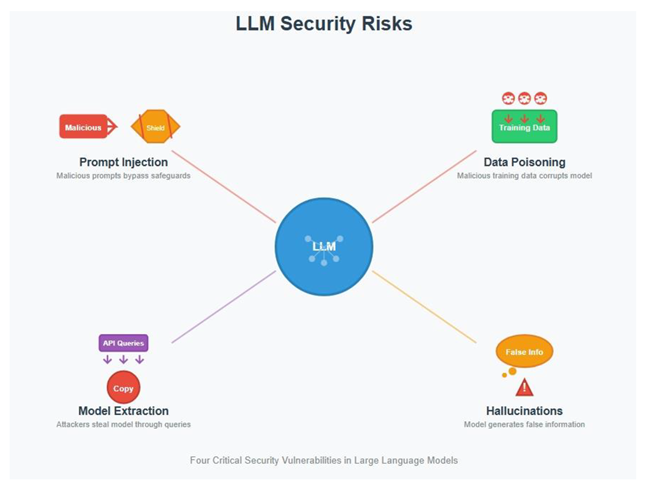
Large Language Models (LLMs) present new security risks even as they enhance defensive mechanisms. One such risk is prompt injection, where an attacker creates input that the model misinterprets as an internal command. For instance, hackers might embed harmful prompts within user queries to “poison” the model's output, leading it to divulge sensitive information or generate undesirable results. Since LLMs handle natural language without thorough verification of intent, they can accidentally regard text controlled by attackers as trusted commands, undermining previous safeguards. Unfortunately, completely resolving prompt injection issues is difficult due to the adaptable, open-ended nature of LLMs.
Data poisoning is another threat: if the training or fine-tuning data of an LLM is altered, the model may adopt biases or backdoors that compromise its reliability. In practice, attackers could insert malicious or misleading instances into the data collection, which can cause the model to behave incorrectly in targeted situations. For example, poisoning could skew the model's outputs toward incorrect conclusions or implant a concealed trigger that activates under certain conditions. Research indicates that tainted data can diminish model accuracy or lead it to produce harmful content, undermining its effectiveness in security contexts. Therefore, thorough data validation and ongoing monitoring are essential to identify poisoning attempts before they impact deployed models.
LLMs also face the threat of model extraction attacks. In these cases, malicious actors repeatedly query a cloud-based model and scrutinize its responses to recreate a nearly identical version of its internal logic or weights. Even if an LLM is provided solely as an API, clever querying can expose its parameters or architecture. This theft of intellectual property allows attackers to duplicate the model without needing to undergo the training process. Furthermore, careful probing may sometimes retrieve snippets of the original training data. Studies reveal that if a model was trained on sensitive information (such as private keys or personal text), an attacker could potentially extract that information by formulating specific queries. Both forms of model inversion attacks jeopardize confidentiality, allowing the attacker to gain insights into proprietary models or sensitive training data, thus defeating the secrecy typically ensured by API access.
Ultimately, hallucinations and false positives are significant issues when depending on LLM outputs. LLMs can sometimes generate answers that sound plausible but are actually incorrect (commonly referred to as “hallucinations”), as they rely on statistical predictions rather than fact verification. In the realm of cybersecurity, a hallucination could incorrectly indicate a non-existent threat or misinterpret harmless behavior as malicious. In security operations, alerts triggered by erroneous LLM output essentially result in false positives, which leads teams to waste time pursuing nonexistent issues. False positives not only consume resources but can also desensitize analysts, making them more likely to overlook genuine warnings. In conclusion, even though LLMs can facilitate analysis, any misinformation they produce can undermine security decision-making. Therefore, agencies must approach LLM recommendations with caution, confirming outputs against established evidence and prior knowledge.
6.2. Adversarial Use of AI
Malicious actors can leverage the same AI innovations that defenders utilize for their own purposes. An emerging phenomenon is the creation of AI-generated malware. Studies have shown that cybercriminals can utilize advanced models (or specialized dark-web resources) to generate new variants of harmful code that can bypass detection. For instance, experiments indicate that large language models (LLMs) can quickly transform benign code into malware or obscure existing malware in such a way that signature-based detectors overlook it. In practical terms, a single attacker can employ an LLM to produce thousands of slightly altered malware samples that appear "natural," deceiving machine-learning classifiers a considerable percentage of the time. Similarly, automated tools like "WormGPT" have emerged, using LLMs to create innovative malware payloads or generate syntactically correct yet malicious scripts. This significantly reduces the required skill level: even a less-skilled attacker can generate polymorphic code that evades traditional detection techniques.
AI also facilitates the automation of attack development and execution. Machine learning can optimize the entire attack lifecycle. During reconnaissance, AI can analyze public information to identify high-value targets and collect personal information about victims. For exploitation, LLMs have been employed to automatically create proof-of-concept exploits once a vulnerability has been identified. Essentially, tasks that previously needed weeks of specialized effort can now be largely automated. Experts note that AI-driven attackers can efficiently develop personalized phishing campaigns and even create self-adapting malware "agents." One cybersecurity firm has indicated that LLMs have been utilized to expedite exploit writing and to devise sophisticated attack toolchains that were previously beyond the reach of all but nation-state actors. By inserting AI into attack processes, adversaries can initiate large-scale operations with reduced human input, thereby altering the dynamics of cyber warfare.
Another related concern is AI-enhanced social engineering. Generative models can produce highly convincing spear-phishing messages tailored to individual targets. For example, AI can scrutinize a person’s social media activity or corporate data to grasp their writing style and interests, then compose a fraudulent email that seems to come from a trusted colleague. It can even replicate writing nuances or corporate branding elements to ensure the message appears legitimate. Tools such as WormGPT explicitly promote their capabilities for generating impeccable phishing emails and deepfake audio messages. Automated systems can generate a continuous flow of persuasive lures at scale, representing a significant improvement over the generic spam of previous years. Consequently, social engineering attacks are now far more likely to deceive recipients. In reality, organizations have observed AI-generated phishing outperforming traditional scams: one report suggested that AI-enhanced phishing campaigns halved the costs associated with breaching by accelerating target research and customizing lures. As a result, defenders must prepare for increasingly sophisticated and harder-to-detect scams as AI technologies become more widespread.
6.3. Ethical and Privacy Concerns
The implementation of AI in security raises significant ethical and privacy concerns. Protection of personal data is crucial: AI technologies depend on extensive datasets, but a large portion of the data needed is personal or sensitive. For example, utilizing user logs or email histories to develop a security model could unintentionally reveal personally identifiable information. Beyond deliberate training efforts, LLMs have been known to retain and reproduce parts of their training information. This indicates that confidential data (such as API keys or private messages) is at risk of exposure if an attacker frames their query skillfully. Privacy laws (like GDPR) necessitate careful data handling, thus companies must adopt stringent data governance practices when creating AI systems. Approaches such as anonymization, on-device learning, and federated learning can help reduce risk, but organizations should operate under the assumption that any data provided to an AI may be at risk of exposure. To sum up, safeguarding data privacy in AI necessitates rigorous controls and ongoing vigilance to avert unintended disclosures.
Algorithmic bias presents another significant challenge. AI systems can echo and enhance biases found in their training data. In the realm of cybersecurity, biased AI could misidentify genuine actions from particular groups as suspicious, or fail to detect threats that deviate from the “normal” patterns it has been trained on. For instance, a surveillance system predominantly trained on insider profiles from one demographic could unjustly label users from a different demographic as potential insiders. Bias in threat models might also lead to increased false positives/negatives for certain groups, squandering resources or leaving those demographics more exposed. Critics caution that such discrimination not only breaches fairness principles but also compromises security by misdirecting focus. To mitigate bias, intentional measures are necessary—such as employing diverse and representative training data, performing regular bias assessments, and continually reviewing model outputs. Absent these efforts, AI-powered security choices could inadvertently sustain unfair treatment or create blind spots.
The necessity for transparency and explainability in AI systems is closely intertwined with the preceding issues. Numerous sophisticated AI models function as “black boxes,” arriving at conclusions without providing a comprehensible explanation. This lack of clarity is problematic in security operations: analysts frequently need to trust or validate an AI’s alerts, particularly in urgent situations. Explainable AI (XAI) aims to unravel these black boxes. By offering understandable rationales for its decisions, an XAI-enabled system fosters trust and supports oversight. For instance, if an AI identifies a user as compromised, XAI tools might clarify which behaviors or information triggered the alert. This clarity is not only a best practice; it is increasingly becoming a regulatory requirement. Laws such as GDPR afford individuals the right to an explanation for automated decisions that impact them. Likewise, emerging AI regulations (including the EU’s AI Act) stipulate that high-risk AI applications must incorporate measures for human oversight and explainability. In the context of cybersecurity, explainability also facilitates auditing and compliance—for example, demonstrating why a specific network traffic flow was blocked to meet an inspection requirement. In summary, maintaining confidence in AI-enhanced security necessitates making the rationale of these models as understandable as possible to human operators and stakeholders.
7. Future Directions and Recommendations
7.1. Emerging Technological Paradigms
Several cutting-edge approaches are transforming the application of AI in cybersecurity. One such development is federated learning, which promotes collaborative intelligence. Rather than consolidating all data in a single location, federated learning permits various organizations (or devices) to locally train a shared model and subsequently compile updates in a central manner. This allows participants to enhance a collective model (such as a unified intrusion detector) without the need to exchange raw logs or customer information. Practically, financial institutions or technology companies could jointly advance malware detection by sharing model parameters while keeping transaction data or source code confidential. This distributed method significantly boosts privacy and mitigates breach threats since sensitive data remains under the owner’s control. Furthermore, it typically yields more versatile models (as learning takes place across varied contexts) and distributes the computational burden. As federated architectures advance, we foresee their emergence as a fundamental resource for cross-organization threat intelligence while maintaining data sovereignty.
Another important concept is Explainable AI (XAI), which is quickly gaining traction as a link between intricate AI models and human operators. Conventional deep learning models can be difficult to interpret, but explainability frameworks strive to enhance clarity. For instance, certain XAI methods pinpoint which input features influenced an AI’s decision or offer counterfactual explanations (illustrating how a minor change could alter the output). In cybersecurity scenarios, this might involve revealing why an AI categorized a file as malware or identifying the patterns that prompted an anomaly alert. Such information allows analysts to confirm that the AI is reasoning accurately and not depending on misleading correlations. Importantly, XAI also supports compliance: regulations like GDPR explicitly require that automated decision-making be understandable to those affected. By rendering AI behavior interpretable, organizations can cultivate trust with stakeholders and fulfill legal obligations. We predict that forthcoming security platforms will incorporate XAI libraries so that every alert or suggestion is accompanied by a clear explanation, fostering a productive cycle of human–AI collaboration.
AI is also reshaping the concept of Zero Trust Architecture. Within a Zero Trust framework, no user or device is automatically deemed trustworthy; instead, identity and context undergo continuous verification prior to access being granted. AI amplifies this process by evaluating behavior and context in real-time. For example, a Zero Trust system powered by AI might observe a user’s regular device usage and flag any login attempt from an unusual location or pattern. Should an alert be triggered (for instance, if an IoT camera unexpectedly starts transmitting video at 3 AM), the AI can automatically modify policies—perhaps by necessitating re-authentication or restricting data flow. On the other hand, everyday activities create machine-learned “whitelists” of normal behavior. By integrating contextual information (device status, user history, network environment), the AI can provide “just the right amount” of access and continuously adjust permissions. Essentially, AI introduces the dynamic intelligence that authentic Zero Trust requires: automated risk assessment and responses at machine speed. We anticipate scenarios where AI-driven analytics are directly linked to access control systems, enabling Zero Trust to transition from fixed rule sets to adaptable defenses that evolve with emerging threats.
Ultimately, the impending wave of quantum computing is prompting a reevaluation of cryptography, with AI poised to play a vital role in this evolution. Quantum computers have the ability to compromise numerous traditional encryption methods, necessitating that organizations transition to quantum-safe algorithms (like lattice-based cryptography) within the next decade. However, facilitating this transition is a multifaceted challenge. Here, AI provides potential solutions: for instance, intelligent systems could autonomously choose and manage cryptographic protocols. Scholars have proposed AI systems that track threat intelligence and, upon discovering a vulnerability in a specific algorithm, can automatically switch to an alternative quantum-resistant algorithm or adjust key lengths in real time. AI can also enhance key management on a large scale, determining optimal times to rotate keys or blend classical and post-quantum ciphers depending on identified risk levels. One concept involves an AI co-processor that persistently assesses the security posture: if it identifies unusual behaviors indicative of a quantum attack, it can modify cryptographic protocols instantly. In summary, the quantum age calls for flexibility in cryptography, and AI's capabilities in planning and automation will be essential for managing this transition. We envision AI-enhanced "crypto cockpit" systems that supervise encryption across networks, ensuring that organizations can smoothly adapt to post-quantum standards as necessary.
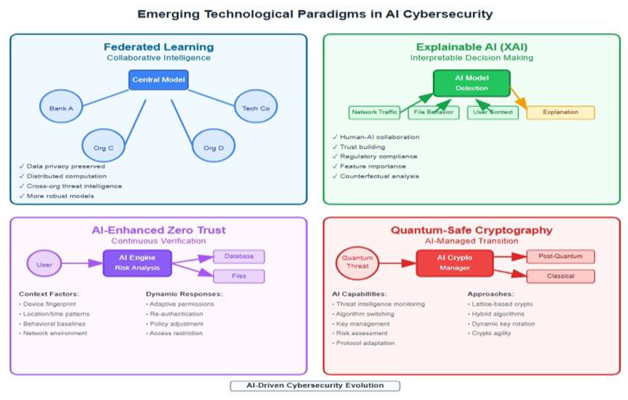
7.2. Strategic Implementation Framework.
Organizations that choose to utilize AI for security should take a strategic approach, finding a balance between innovation and stability. Experts suggest implementing changes in phases. Rather than completely overhauling existing systems, begin with small, clearly defined pilot projects that have specific, measurable goals. For example, one group could utilize an AI tool for analyzing logs related to known malware signs, while another might experiment with AI to manage phishing report triage. These pilot projects enable the team to understand the system's strengths and weaknesses in a controlled environment. The focus should initially be on use cases with obvious success metrics and low risk—such as employing machine learning to streamline tedious aspects of current workflows. As confidence increases, the deployment can extend to more critical areas. This gradual, iterative method (often referred to as "test and learn") reduces disruption. If issues arise, only a small function is affected, rather than the entire security infrastructure. This approach aligns with AI adoption frameworks: start small, assess results, and refine policies before broadening the scale.
A strong data quality management system is essential. High-quality, pertinent data is vital for creating effective AI models. Organizations should implement governance rules to ensure that training datasets genuinely reflect the real-world threat landscape and are free from bias. This involves continuously curating threat intelligence feeds, log data, and incident records to ensure completeness and accuracy. Tools such as data lineage tracking help document the origins of data and its pathway through AI processes. Privacy needs to be prioritized: sensitive information should be anonymized or, when feasible, excluded to follow regulations. Routine data audits and version control are crucial to identify shifts in distributions (for instance, if new types of logs emerge). Investing in data platforms (like secure data lakes, encryption both at rest and during transit, and standardized schemas) guarantees that the AI has a consistent and reliable perspective of the network and user behavior. In practice, security teams should consider “data readiness” as an ongoing initiative rather than a one-time setup since the effectiveness of any AI relies on the integrity and up-to-date nature of its inputs.
Ongoing monitoring and assessment of AI systems post-deployment is crucial. This involves tracking not only the performance of models (such as detection accuracy over time) but also examining outputs for unusual patterns that might indicate model drift or hacking attempts. For example, if an intrusion detection model begins producing a significantly higher (or lower) number of alerts without any external reason, it could indicate that it is overfitting to new traffic patterns or falling victim to a poisoning attack. To identify this promptly, organizations should establish dashboards or automated checks on essential metrics (such as false positive rates and true positive rates). Furthermore, security teams need to be vigilant for attempts to manipulate the model—such as an attacker querying the model in consistent ways to alter its decisions. Protocols should be established for quick response: if the AI is compromised (or thought to be), analysts should have reliable backup manual processes to rely on. Thus, AI systems should be treated like any critical infrastructure, with integrated health checks, alerts for unusual activities, and safeguards in place to prompt human intervention.
The collaboration model between humans and AI should be intentionally crafted. AI serves as a robust assistant but should enhance – rather than substitute – the expertise of security professionals. Systems need to be designed so that AI takes care of routine tasks (such as identifying obvious malware or summarizing logs), while humans make strategic decisions. For this to be effective, personnel must be trained to understand AI outputs and to critically assess them. Best practices dictate that there should always be a human “in the loop” for crucial actions; for instance, while an AI might suggest blocking an IP, it should be verified by an analyst before implementation. User-friendly interfaces are essential: when AI identifies a suspicious pattern, it should present this information to the human with adequate context. Organizations should cultivate an environment where AI is regarded as a partner – for example, recognizing analysts for providing feedback that enhances the AI, like identifying false positives. Experts notably point out that human judgment cannot be entirely replaced by AI in security. The most effective approach is a hybrid model, where the speed and scale of AI complement human insight and oversight. Consequently, cybersecurity teams should adjust roles and processes to ensure that this hybrid workflow operates smoothly, clearly defining responsibilities for anomaly assessment, model optimization, and exception management.
Consistent maintenance and updates of AI models are essential. Cyber threats change quickly, so a model that was effective yesterday may be outdated today. Therefore, organizations must implement a schedule and procedures for retraining models with new data, rolling out updates, and confirming that the new version continues to meet performance benchmarks. This involves continuously monitoring performance metrics and initiating retraining when they decline (for example, by establishing thresholds for acceptable false positives). Each retraining cycle should also undergo testing to make sure it does not introduce new problems (such as new biases or vulnerabilities). Security teams should also conduct periodic adversarial testing on their AI – intentionally challenging the model to uncover blind spots and then strengthening it against those vulnerabilities. Keeping a model well-tuned and up-to-date is comparable to applying software patches: this must be done routinely. By integrating these practices, organizations can maintain resilient AI defenses capable of countering new exploits and attack vectors.
Finally, ethical and governance principles must form the foundation of the technical strategy. Organizations ought to establish clear guidelines for AI utilization: for instance, a privacy policy that specifies what types of personal data the AI is allowed to process (or prohibits it altogether); fairness standards that outline acceptable error rates among user groups; and protocols for transparency (such as providing audit trails of AI decisions). These principles should be in alignment with legal regulations like GDPR and adhere to industry best practices (such as NIST’s AI Risk Management Framework). An ethics review board or a cross-disciplinary committee can oversee AI implementation, assessing new use cases before they are launched. By formalizing rules concerning data management, bias evaluation, and explainability, an organization guarantees accountability. This approach not only aids in regulatory compliance but also fosters public confidence; for example, demonstrating that an AI alert is based on well-documented logic and fair data. Ultimately, embedding ethics into the strategy ensures that AI security tools are not just powerful, but also trustworthy, fair, and aligned with broader societal values and legal standards.
7.3. Research Frontiers and Innovation Opportunities
The convergence of Artificial Intelligence and cybersecurity presents a wealth of research possibilities. A key area of interest is adversarial machine learning. While adversarial examples present challenges to current models, researchers are developing techniques to bolster the resilience of AI systems. For example, adversarial training involves exposing models to intentionally modified inputs and is a significant focus within the field. Evidence suggests that adding adversarial examples to the training dataset can enhance the defenses of neural networks against evasion attacks【58†L78-87】. Another crucial aspect is detection: crafting algorithms that can spot subtle alterations in inputs that might deceive a model. Innovations such as gradient masking and model distillation are being examined to counter adversarial threats【58†L78-87】. In the long run, this research could lead to hybrid architectures that enable AI systems to not only detect threats but also resist manipulation. This is essential for ensuring the dependability of AI in high-stakes security scenarios.
The incorporation of multimodal AI is a developing field of investigation. Traditional security systems usually analyze one type of data stream at a time (like network logs or system calls). Multimodal AI aims to integrate various inputs—such as text, images, audio, and structured logs—into a unified model. A recent example involves phishing detection, where a “multimodal” system evaluated both the text of an email and its visual branding elements to identify fraudulent content【60†L63-70】. By linking different modalities (such as writing style and image layout), the AI can detect sophisticated attacks that slip past single-data-channel filters【60†L63-70】. Future research must focus on developing models able to handle this complex data in real-time while addressing scalability and synchronization. Success in multimodal learning could greatly improve threat detection—for instance, by merging patterns of user behavior with biometric data to spot insider threats or connecting code anomalies with system metrics to reveal zero-day vulnerabilities. Designing architectures that effectively integrate such varied data while preserving scalability poses a significant challenge—but it also offers the promise of vastly improved situational awareness.
The future of defense may lie in automated systems for threat hunting. Currently, threat hunters manually search for indications of covert attacks; in the future, AI agents may take on the role of proactively scanning networks without the need for human initiation. Ideally, such a system would constantly analyze logs, endpoint telemetry, and external intelligence to spot subtle trends (such as prolonged lateral movement) that suggest the presence of advanced persistent threats. For example, machine learning could learn from established attack patterns to anticipate the next moves of an intruder and subsequently examine the environment for those signs. Initial research in this area has demonstrated that AI can enhance the speed of identifying complex threats. Analysts have observed that machine learning-based hunting significantly accelerates the discovery of APTs by linking sparse evidence over time. The research hurdles include minimizing false positives (to avoid overwhelming security teams) and endowing the AI with a sort of "intuition" regarding what to search for. Nevertheless, advancements in this field could enable a security system to detect a hidden intrusion chain days or even weeks earlier than human-only efforts.
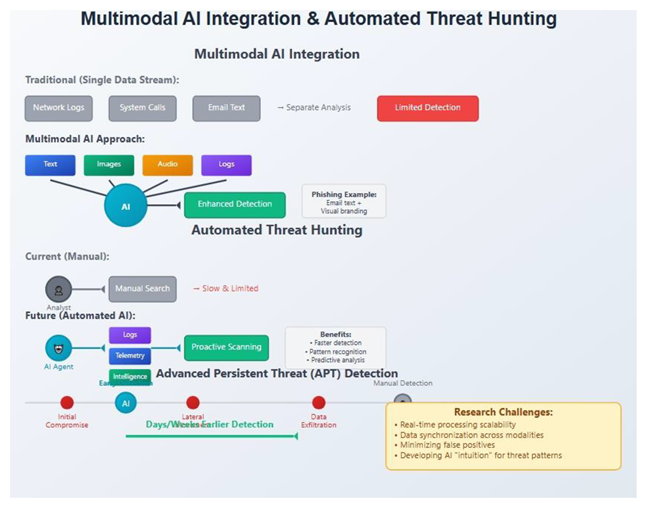
AI-enhanced deception and honeypot techniques are also making strides. Unlike traditional honeypots that simulate vulnerable machines in a static manner, AI allows for the creation of dynamic and adaptable decoys. For instance, proof-of-concept systems are now employing large language models (LLMs) to generate entire fake server environments instantaneously. An AI-driven honeypot can replicate a realistic Linux server when an attacker connects through SSH, complete with credible file systems and responses, all without manual configuration. It can analyze the actions of the attacker and provide an automated session summary that categorizes the behavior of the intrusion. As research advances, we anticipate honeypots that can evolve in real time: if an attacker employs new tactics, the AI can adjust its reactions to keep the attacker engaged. This leads to richer intelligence gathering (capturing novel strategies) while delaying adversaries. Essentially, AI-enhanced deception has the potential to transform every encounter into a valuable learning experience. The development of realistic generative models for various protocols (such as HTTP, email, IoT control systems, etc.) and their integration into response frameworks is currently a vibrant field of study. Researchers are also investigating how to maximize the strategic advantages derived from deception; for example, by training predictive models based on interactions captured from honeypots. The fusion of AI and deception presents exciting opportunities for turning the tide against attackers: each attempt to probe a decoy can serve as valuable data for fortifying defenses.
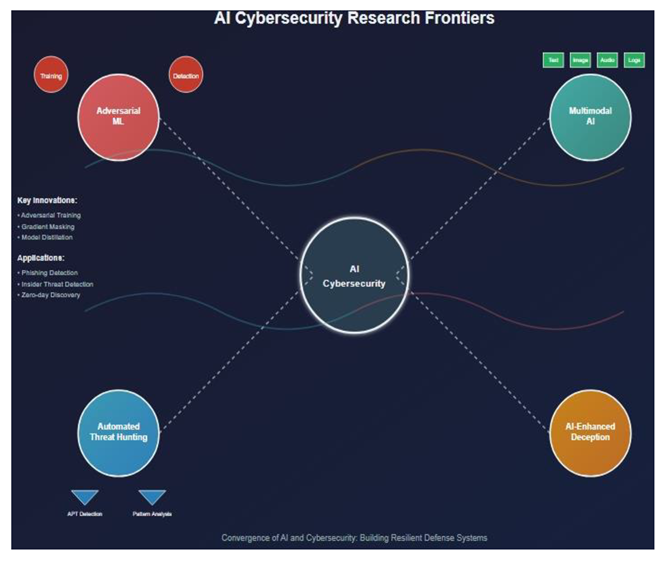
Research into behavioral analytics and anomaly detection represents a new frontier. Existing systems typically focus on identifying outliers in single metrics (such as a surge in login failures). Current AI research is evolving towards context-aware behavioral models. This involves creating comprehensive profiles of what constitutes “normal” behavior for each user or device, allowing for the detection of even minor deviations. For instance, an AI could observe that a user typically does not log in on weekends, so an off-hours login would trigger a significant alert. It may also monitor users' usual times, locations, and data accesses to understand their work patterns. Additionally, researchers are investigating unsupervised learning techniques that can identify anomalies in complex, high-dimensional data without predefined rules. A significant challenge is minimizing false alerts: the AI must differentiate between innocuous changes (like someone working late) and actual threats (such as credential misuse). Future developments may employ hierarchical models that analyze data across various timescales (minutes, days, months) to distinguish between isolated anomalies and trends. Ultimately, advancements in this area will enable systems to gauge the “temperature” of regular operations and detect subtle signs of compromise much earlier.
Moreover, AI can enhance cyber resilience by ensuring security during and after incidents. Research is probing AI-driven methods for automatic incident response and system adjustments. For example, when an intrusion is identified, an AI system might independently implement containment measures (such as isolating certain segments or revoking access keys) while IT staff respond. Moreover, one can imagine systems where AI dynamically reconfigures the network during an attack: shifting critical services behind additional layers of encryption or redirecting traffic to circumvent a compromised node. Additionally, AI-enabled recovery processes could expedite restoration—by intelligently restoring backups or reconfiguring settings based on learned models of the pre-attack environment. While research into these adaptive structures is still in its early stages, it shows considerable potential. By merging anomaly detection with automatic recovery, future systems could neutralize threats more swiftly and restore normal operations with minimal human involvement. This aligns with wider initiatives in resilience engineering: utilizing AI to maintain operational continuity, even during prolonged attacks. These research avenues – ranging from adversarial robustness to self-repairing networks – indicate a future where AI is intricately integrated into the cybersecurity landscape. Instead of being merely auxiliary tools, AI systems will transform into active protectors that learn, adapt, and work in tandem with human teams. As each area progresses, the objective is to establish an intelligent, anticipatory security stance that evolves with the shifting threat environment, transforming AI from a mere experimental curiosity into an essential partner in digital defense. These research trajectories suggest a future where AI becomes a crucial component of cybersecurity systems, offering adaptable, intelligent, and proactive defense capabilities that can change alongside the threat landscape.
The domain of adversarial machine learning stands out as one of the most significant research fields in the integration of AI and cybersecurity. Although adversarial examples present substantial risks to existing AI models, scientists are devising advanced methods to build more resilient systems. Adversarial training, which involves intentionally exposing models to altered inputs during training, has shown encouraging outcomes in fortifying neural networks against evasion attacks. Research indicates that including adversarial examples in training datasets can greatly enhance model robustness against manipulation efforts. In addition to adversarial training, researchers are investigating sophisticated detection methods that can recognize subtly altered inputs intended to deceive AI systems. Approaches such as gradient masking, model distillation, and ensemble techniques are being studied to defend against complex adversarial assaults. The creation of certified defenses—methods that can mathematically ensure robustness within certain limits—marks another vital research focus.
New methods include defensive distillation, where models are trained to create smoother decision boundaries, and input transformations that can mitigate adversarial alterations. Progress is also being made in adversarial detection through statistical evaluations of model activations and the establishment of auxiliary networks specifically aimed at detecting adversarial inputs. The practical ramifications of this research extend to hybrid systems that merge threat detection abilities with built-in resilience to manipulation. Such systems will be crucial for implementing AI in critical security scenarios where adversarial attacks could yield disastrous outcomes.
Multimodal AI Integration and Fusion Analytics
Conventional cybersecurity measures generally assess individual data streams separately, overlooking the valuable contextual insights provided by various modalities. The integration of multimodal AI signifies a significant shift toward comprehensive threat assessment that merges different types of data—such as text, images, audio, network logs, and behavioral patterns—into cohesive analytical frameworks. Recent advancements in the detection of multimodal phishing illustrate the effectiveness of this methodology. Cutting-edge systems are now capable of concurrently examining both the written content and visual branding elements, linking writing styles with image layouts to uncover sophisticated fraud that bypasses traditional single-channel defenses. This multidimensional evaluation allows for the identification of threats that might otherwise stay undetected.
Future research avenues include the creation of real-time processing systems that can address the computational demands of multimodal analysis on a large scale. Significant challenges lie in developing efficient integration algorithms that can effectively merge different data types while ensuring temporal alignment across varying data streams. Promising potential applications encompass detecting insider threats through the analysis of user behavior patterns in conjunction with biometric data, identifying zero-day exploits by connecting code irregularities with system performance indicators, and pursuing advanced persistent threats by correlating network traffic trends with user activity records. The advancement of attention mechanisms and transformer architectures specifically tailored for cybersecurity multimodal integration is currently a vibrant research focus.
Autonomous Threat Hunting and Proactive Defense Systems
The transition towards automated threat hunting marks a significant advancement from reactive to proactive cybersecurity measures. Currently, threat hunters manually look for signs of covert attacks, but the upcoming generation of AI-driven systems will independently scan networks, consistently analyzing logs, endpoint data, and external intelligence to detect subtle attack trends. These systems utilize machine learning models that have been trained on recognized attack patterns to anticipate the next moves of adversaries and actively search environments for related indicators. Initial implementations have shown remarkable enhancements in the speed of detecting advanced persistent threats (APTs) by linking sparse evidence across prolonged timeframes. Challenges in research involve creating advanced algorithms for reducing false positives and designing AI systems that possess contextual "intuition" regarding the threat landscape. Sophisticated methods include reinforcement learning frameworks where AI agents develop optimal hunting tactics by engaging with simulated attack scenarios. Recent advancements feature the incorporation of graph neural networks to model intricate attack relationships, the application of causal inference techniques to differentiate between correlation and causation in threat indicators, and the development of explainable AI systems that can offer security analysts clear justifications for their conclusions.
AI-Powered Deception Technologies and Adaptive Honeypots
The convergence of AI and deception technologies is opening up exceptional avenues for transforming defensive measures into offensive strategies. Unlike conventional honeypots that offer static representations of vulnerable systems, AI-powered deception platforms can create dynamic, adaptive decoys that change in real-time according to attacker actions.
Large Language Models (LLMs) are now utilized to generate entire fake server environments on-demand, featuring realistic file structures, command replies, and interactive sessions. These AI-driven honeypots can engage convincingly with attackers while simultaneously analyzing intrusion methods and producing comprehensive behavioral evaluations. Cutting-edge research is investigating self-adapting deception systems that alter their responses based on the actions of attackers, forming increasingly complex traps that can sustain engagement while collecting intelligence. This methodology transforms each attempted attack into a chance for learning, both hindering adversaries and enhancing defensive insights. Current research trajectories include the development of generative models for various protocols (HTTP, SSH, IoT control systems), the creation of realistic synthetic data environments, and the establishment of automated analysis frameworks that can derive strategic intelligence from deceptive interactions. The integration of blockchain technologies to maintain the consistency of deception states and the development of swarm-based honeypot networks are emerging areas of research.
Advanced Behavioral Analytics and Contextual Anomaly Detection
Research in behavioral analytics is advancing beyond basic threshold detection to more complex context-aware models that comprehend the subtle patterns of regular operations. These systems create detailed long-term profiles of user and device behaviors, allowing them to detect minor deviations that could signal a compromise.
Current research emphasizes temporal modeling techniques capable of differentiating between harmless operational changes and real security threats. Hierarchical models that analyze across various timescales—from minutes to months—are being created to separate isolated anomalies from worrisome trends. There is a refinement of unsupervised learning methods for spotting anomalies within high-dimensional behavioral data without the need for explicit rule definitions. These strategies utilize techniques like autoencoders, variational inference, and deep clustering to uncover hidden patterns within complex behavioral datasets. New advancements include the incorporation of social network analysis to comprehend organizational behavior patterns, the application of topological data analysis to detect structural shifts in behavioral manifolds, and the development of federated learning techniques that can create behavioral models in distributed settings while maintaining privacy.
Quantum-Enhanced Cybersecurity and Post-Quantum Preparedness
The emergence of quantum computing brings both remarkable possibilities and significant risks to cybersecurity. Research efforts in quantum-enhanced security aim to utilize quantum characteristics for the enhancement of cryptographic protocols, the distribution of quantum keys, and the creation of algorithms that are resistant to quantum attacks. Applications of quantum machine learning in cybersecurity consist of improved pattern recognition for detecting threats, optimization of resources in security systems, and simulation techniques for evaluating cryptographic protocols. These methods promise substantial advancements in specific computational processes crucial to cybersecurity. At the same time, research in post-quantum cryptography is focused on developing encryption techniques that can resist quantum threats. This includes approaches like lattice-based cryptography, code-based cryptography, and multivariate cryptography, which are designed to endure the advantages of quantum computing.
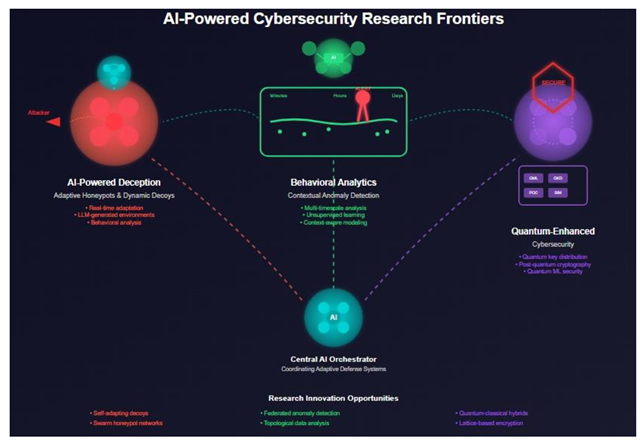
Federated Learning and Privacy-Preserving AI Security
The demand for joint threat intelligence, coupled with the necessity of preserving privacy, has led to extensive research into federated learning applications in the field of cybersecurity. These methods allow organizations to collaboratively train AI models using decentralized datasets while keeping sensitive information confidential. Areas of investigation include the advancement of differential privacy methods for security-related data, the development of secure protocols for aggregating federated model updates, and the creation of federated learning systems that are resistant to attacks and capable of functioning in hostile environments.
AI-Driven Cyber Resilience and Adaptive Response Systems
Research on cyber resilience emphasizes preserving security efficacy both during and following attacks by employing AI-driven adaptations. These systems are capable of autonomously executing containment strategies, modifying network layouts, and coordinating recovery processes with minimal human involvement. Advanced studies investigate self-repairing network structures that can automatically segregate affected segments, redirect essential services, and recover operations based on learned representations of pre-attack conditions. Such systems combine anomaly detection with automated response strategies to establish genuinely adaptive security frameworks. New advancements include utilizing digital twins for cybersecurity modeling and strategy development, applying chaos engineering concepts for proactive resilience testing, and creating AI-driven platforms for orchestrating incident responses.
Explainable AI and Human-AI Collaboration in Security
The opaque nature of numerous AI systems creates difficulties for cybersecurity applications where understanding decisions is essential. Research aimed at explainable AI (XAI) in the field of cybersecurity is centered on crafting interpretable models that can elucidate the rationale behind security choices. This encompasses devising visualization methods for intricate security information, creating natural language systems that explain AI-generated notifications, and developing interactive platforms that facilitate efficient collaboration between humans and AI in security tasks.
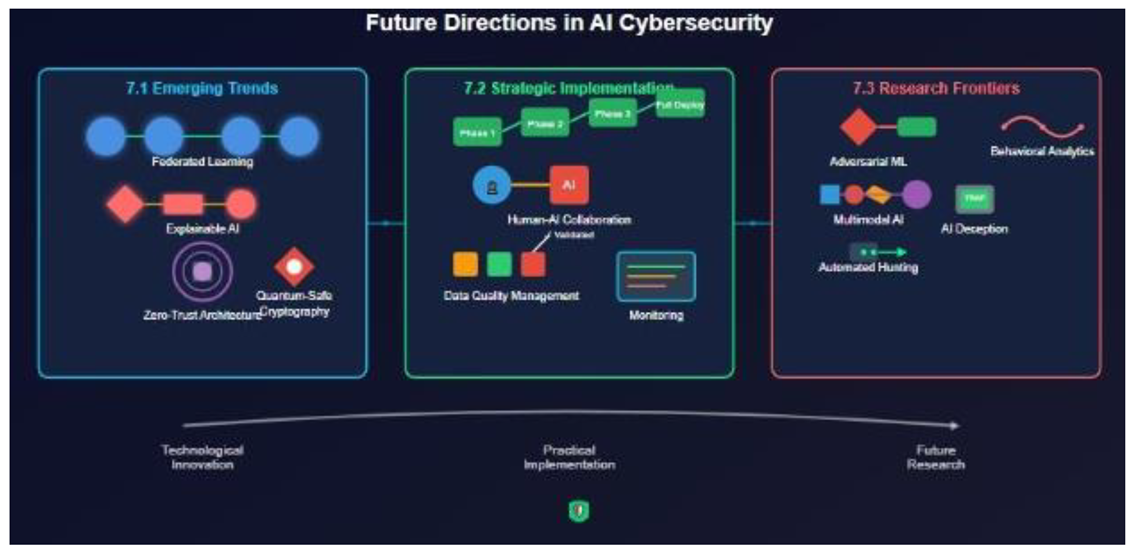
8. Conclusion
The incorporation of Large Language Models and AI technologies in the field of cybersecurity marks a major step forward in our capacity to identify, analyze, and tackle cyber threats. This thorough review has explored the current landscape of AI applications in cybersecurity, emphasizing both the notable advantages and the arising challenges related to these technologies. LLMs have proven especially beneficial in identifying threats and analyzing intelligence, allowing organizations to handle large volumes of textual information and derive significant insights for security-related decision-making. The implementation of AI in detecting and addressing DDoS attacks has indicated encouraging outcomes, with machine learning models outperforming traditional rule-based methods. Nonetheless, the integration of AI within cybersecurity also brings forth new vulnerabilities and challenges that require careful consideration. The risks of adversarial attacks, data contamination, and algorithmic bias demand continuous attention and strategies for mitigation. Organizations must weigh the advantages of AI adoption against the necessity of upholding security, privacy, and ethical standards.
As we look ahead, the progressive development of AI technologies is likely to further improve cybersecurity capabilities. Emerging trends such as federated learning, explainable AI, and quantum-safe cryptography are expected to influence the future landscape of AI-driven security solutions. Achieving success in this area will necessitate ongoing collaboration among researchers, practitioners, and policymakers to tackle the technical, ethical, and regulatory challenges that arise. The future of cybersecurity hinges on the successful merging of human skills with AI abilities, utilizing the strengths of both to build more effective and adaptable security systems. As threats continue to develop, our defensive capabilities must also evolve, with AI technologies playing an increasingly vital role in safeguarding the security and integrity of our digital infrastructure.
Abbreviations
List of abbreviations
| LLM | Large Language Model |
| AI | Artificial Intelligence |
| NLP | Natural Language Processing |
| BERT | Bidirectional Encoder Representations from Transformers |
| GPT | Generative Pretrained Transformer |
| RLHF | Reinforcement Learning from Human Feedback |
| API | Application Programming Interface |
| RPA | Robotic Process Automation |
| CTI | Cyber Threat Intelligence |
| TPU | Tensor Processing Unit |
| RNN | Recurrent Neural Network |
| LSTM | Long Short-Term Memory |
| GRU | Gated Recurrent Unit |
| BPE | Byte-Pair Encoding |
| OOV | Out-of-Vocabulary |
| MLM | Masked Language Modeling |
| NSP | Next Sentence Prediction |
| mBERT | Multilingual BERT |
| SWAG | Situations With Adversarial Generations |
| GLUE | General Language Understanding Evaluation |
| SQuAD | Stanford Question Answering Dataset |
| ALBERT | A Lite BERT |
| RoBERTa | Robustly Optimized BERT Pretraining Approach |
| NPLM | Neural Probabilistic Language Model |
| GloVe | Global Vectors for Word Representation |
| PEFT | Parameter-Efficient Fine-Tuning |
| LoRA | Low-Rank Adaptation |
| HELM | Holistic Evaluation of Language Models |
| LMSYS | Large Model Systems Organization |
| CNN | Convolutional Neural Network |
| GAN | Generative Adversarial Network |
| VAE | Variational Autoencoder |
| RL | Reinforcement Learning |
| DNN | Deep Neural Network |
| ML | Machine Learning |
| AWS | Amazon Web Services |
| SVM | Support Vector Machine |
| KNN | K-Nearest Neighbors |
| PCA | Principal Component Analysis |
| TF-IDF | Term Frequency-Inverse Document Frequency |
| POS | Part of Speech |
| QA | Question Answering |
| IE | Information Extraction |
| NER | Named Entity Recognition |
| SRL | Semantic Role Labeling |
| ASR | Automatic Speech Recognition |
| TTS | Text-to-Speech |
| OCR | Optical Character Recognition |
| ELMo | Embeddings from Language Models |
| Transformer | A Neural Network Architecture |
| FLOPS | Floating Point Operations Per Second |
| BLEU | Bilingual Evaluation Understudy |
| ROUGE | Recall-Oriented Understudy for Gisting Evaluation |
| CIDEr | Consensus-based Image Description Evaluation |
| WMD | Word Mover's Distance |
| ELU | Exponential Linear Unit |
| ReLU | Rectified Linear Unit |
| GeLU | Gaussian Error Linear Unit |
| SGD | Stochastic Gradient Descent |
| Adam | Adaptive Moment Estimation |
| LDA | Latent Dirichlet Allocation |
| HMM | Hidden Markov Model |
| CRF | Conditional Random Fields |
| TF | TensorFlow |
| PT | PyTorch |
| CPU | Central Processing Unit |
| GPU | Graphics Processing Unit |
| URL | Uniform Resource Locator |
| JSON | JavaScript Object Notation |
| CSV | Comma-Separated Values |
| ANN | Artificial Neural Network |
| IoT | Internet of Things |
| CV | Computer Vision |
| MLOps | Machine Learning Operations |
| EDA | Exploratory Data Analysis |
| BERTology | The study of BERT and similar transformer-based models |
| POS tagging | Part-of-Speech tagging |
| WER | Word Error Rate |
References
- A. Alotaibi et al., “Generative AI in cybersecurity: A comprehensive review of LLM applications and vulnerabilities,” Future Generation Computer Systems, vol. 162, pp. 1–15, 2024.
- Y. Zhang et al., “When LLMs meet cybersecurity: A systematic literature review,” Cybersecurity, vol. 8, no. 1, pp. 1–25, 2025. [CrossRef]
- L. Chen et al., “Detecting and mitigating DDoS attacks with AI: A survey,” arXiv preprint, arXiv:2503.17867, 2024. [Online]. Available: https://arxiv.org/abs/2503.17867. [CrossRef]
- S. Kumar et al., “Distributed denial-of-service (DDOS) attack detection using supervised machine learning algorithms,” Scientific Reports, vol. 14, 28456, 2024. [CrossRef]
- M. Rodriguez et al., “Deep learning-driven defense strategies for mitigating DDoS attacks in cloud computing environments,” Journal of Cloud Computing, vol. 14, no. 1, pp. 1–18, 2025.
- J. Thompson et al., “A comprehensive review of vulnerabilities and AI-enabled defense against DDoS attacks for securing cloud services,” Computer Networks, vol. 245, 110387, 2024. [CrossRef]
- R. Patel et al., “An entropy and machine learning based approach for DDoS attacks detection in software defined networks,” Scientific Reports, vol. 14, 15789, 2024. [CrossRef]
- A10 Networks, “The machine war has begun: Cybercriminals leveraging AI in DDoS attacks,” Technical Report, 2025. [Online]. Available: https://www.a10networks.com/blog/the-machine-war-has-begun-cybercriminals-leveraging-ai-in-ddos-attacks/.
- Akamai Technologies, “DDoS attack trends in 2024 signify that sophistication overshadows size,” Security Intelligence Report, 2025. [Online]. Available: https://www.akamai.com/blog/security/ddos-attack-trends-2024-signify-sophistication-overshadows-size.
- Darktrace, “AI-based cybersecurity solutions for DDoS attack detection and mitigation,” Technical Documentation, 2024. [Online]. Available: https://www.darktrace.com/cyber-ai-glossary/ddos-attack.
- Palo Alto Networks, “AI, cybersecurity and the rise of large language models,” Research Paper, 2024. [Online]. Available: https://www.paloaltonetworks.com/blog/2024/04/ai-cybersecurity-and-large-language-models/.
- OWASP Foundation, “OWASP top 10 for large language model applications,” Security Guidelines, 2024. [Online]. Available: https://genai.owasp.org/.
- SecOps Solution, “Top 10 LLM tools in cybersecurity,” Industry Report, 2025. [Online]. Available: https://www.secopsolution.com/blog/top-10-llm-tools-in-2024.
- AnyAPI, “AI cybersecurity in 2025: From threat detection to automated response,” Technical Analysis, 2025. [Online]. Available: https://anyapi.io/blog/AI-Cybersecurity-in-2025-From-Threat-Detection-to-Automated-Response.
- GBHackers, “Threat actors exploit AI and LLM tools for offensive cyber operations,” Security Intelligence Report, 2025. [Online]. Available: https://gbhackers.com/threat-actors-exploit-ai-and-llm-tools/.
- Dark Reading, “How AI/ML can thwart DDoS attacks,” Technical Article, 2023. [Online]. Available: https://www.darkreading.com/cyberattacks-data-breaches/how-ai-ml-can-thwart-ddos-attacks.
- FatLab, “AI DDoS protection: How machine learning defends websites,” Technical Documentation, 2024. [Online]. Available: https://fatlabwebsupport.com/blog/ai-and-ddos-protection-how-machine-learning-defends-against-attacks-in-real-time/.
- Cybersecurity News, “Threat actors exploit AI & LLM tools to begun using them as offensive tools,” Security Alert, 2025. [Online]. Available: https://cybersecuritynews.com/threat-actors-exploit-ai-llm-tools/.
- Business Today, “Cybersecurity trend 2025: AI, LLM & cryptocurrency,” Industry Analysis, 2024. [Online]. Available: https://www.businesstoday.com.my/2024/12/10/cybersecurity-trend-2025-ai-llm-cryptocurrency/.
- K. Williams et al., “Machine learning approaches for real-time DDoS attack detection in cloud environments,” IEEE Transactions on Network and Service Management, vol. 21, no. 3, pp. 1245–1260, 2024.
- S. T. Zargar, J. Jite, and D. Tipper, “A survey of defense mechanisms against distributed denial of service (DDoS) flooding attacks,” IEEE Communications Surveys & Tutorials, vol. 15, no. 4, pp. 2233–2249, 2013. [CrossRef]
- J. Mirkovic and P. Reiher, “A taxonomy of DDoS attack and DDoS defense mechanisms,” ACM SIGCOMM Computer Communication Review, vol. 34, no. 2, pp. 39–53, 2004. [CrossRef]
- E. Mitrogreasi and P. Spyropoulos, “Distributed denial of service (DDoS) attacks: Impact, challenges, and solutions,” Journal of Network and Systems Management, vol. 21, no. 3, pp. 401–423, 2013.
- V. Paxson, “An analysis of using reflectors for distributed denial-of-service attacks,” Computer Communication Review, vol. 31, no. 3, pp. 1–16, 2001. [CrossRef]
- P. Biyani and A. Butda, “A comprehensive review of DDoS attacks, detection methods, and mitigation techniques,” Journal of Network and Computer Applications, vol. 125, pp. 1–24, 2018.
- A. L. Buczak and E. Guven, “A survey of data mining and machine learning methods for cyber security intrusion detection,” IEEE Communications Surveys & Tutorials, vol. 18, no. 2, pp. 1153–1176, 2016. [CrossRef]
- Y. Xin et al., “Machine learning and deep learning methods for cybersecurity,” IEEE Access, vol. 6, pp. 35365–35381, 2018. [CrossRef]
- J. Liang, W. Zhao, and W. Ye, “Anomaly-based web attack detection: A deep learning approach,” IEEE Transactions on Network and Service Management, vol. 14, no. 2, pp. 226–238, 2017.
- R. Vinayakumar et al., “Deep learning approach for intelligent intrusion detection system,” IEEE Access, vol. 7, pp. 41882–41901, 2018. [CrossRef]
- K. Siddique et al., “Machine learning in cybersecurity: A brief survey,” Journal of Technology, Policy, and Architecture, vol. 2, no. 1, pp. 1–6, 2019. [CrossRef]
- M. Parmiswal, S. Chakraborty, and S. Kumar, “Deep learning based DDoS detection system for enterprise networks,” International Journal of Network Security, vol. 22, no. 3, pp. 431–438, 2020.
- A. Girdhar and J. Malik, “Deep learning based DDoS detection for cloud computing environment,” Journal of Network and Computer Applications, vol. 154, 102544, 2020.
- J. Cintai, G. Karthikeyan, and S. Amritanjali, “Machine learning approach for DDoS detection in IoT networks,” Journal of Ambient Intelligence and Humanized Computing, vol. 10, no. 5, pp. 1831–1839, 2019.
- J. Yim, Q. Jian, and C. Jing, “Deep learning approaches for DDoS detection in software-defined networking,” IEEE Access, vol. 8, pp. 128955–128968, 2020.
- S. Bhatia and T. Kichkaylo, “Deep learning for DDoS detection in cloud computing environment,” Journal of Network and Computer Applications, vol. 122, 105115, 2020.
- I. T. Jolliffe, Principal Component Analysis, 2nd ed. Springer-Verlag, 2002.
- C. F. Tsai and J. Hsu, “PCA-based streaming machine learning for DDoS detection,” Expert Systems with Applications, vol. 40, no. 6, pp. 2241–2252, 2013.
- K. Siva, K. Pattusamy, and M. Lagunas, “PCA-based feature selection for machine learning-based DDoS detection,” Computer Networks, vol. 159, pp. 42–55, 2019.
- P. Ushki and R. Ghuizle, “PCA based DDoS detection using machine learning in cloud environment,” Journal of Network Security, vol. 22, no. 3, pp. 498–507, 2020.
- M. Shauktli, A. Jara, and P. Skripkuez, “Enhanced PCA-based DDoS attack detection using supervised learning,” IEEE Transactions on Network and Service Management, vol. 16, no. 1, pp. 42–55, 2019.
- Y. Zhenag, M. Shafiq, and B. Siami, “Real-time DDoS detection system using machine learning,” IEEE Transactions on Network and Service Management, vol. 15, no. 4, pp. 1532–1545, 2018.
- M. Paliwal and S. Jagrani, “Real-time network traffic analysis for DDoS detection,” Journal of Network and Computer Applications, vol. 145, 102452, 2020.
- K. Ganesan and C. Narayana, “Real-time DDoS mitigation using deep learning,” Computer Networks, vol. 185, 107692, 2021.
- P. Srivasta and S. Mital, “Real-time network security monitoring using machine learning,” IEEE Security & Privacy, vol. 18, no. 3, pp. 36–44, 2020.
- M. Liang and Z. Yijun, “Real-time intrusion detection system using machine learning,” Journal of Network and Computer Applications, vol. 125, pp. 1–12, 2019.
- I. Goodfellow, Y. Bengio, and A. Courville, Deep Learning. MIT Press, 2016.
- Y. LeCun, Y. Bengio, and G. Hinton, “Deep learning,” Nature, vol. 521, no. 7553, pp. 436–444, 2015. [CrossRef]
- R. Doshi, N. Amenaghawon, and S. Jambal, “Deep learning approach for DDoS detection,” IEEE Access, vol. 6, pp. 33492–33502, 2018.
- M. Shyma, A. Patel, and P. Bhatt, “Deep learning architectures for DDoS detection,” Neural Computing and Applications, vol. 31, no. 11, pp. 7201–7212, 2019.
- S. Agarwal, K. Koronich, and N. Ravi, “Deep neural networks for DDoS attack detection,” Journal of Network and Computer Applications, vol. 159, 102572, 2020.
- R. S. Sutton and A. G. Barto, Reinforcement Learning: An Introduction, 2nd ed. MIT Press, 2018.
- J. Malik, F. Siddiqui, and R. Pridemore, “Reinforcement learning for DDoS mitigation,” IEEE Transactions on Network and Service Management, vol. 16, no. 2, pp. 256–269, 2019.
- A. Jain and K. Srivastava, “Adaptive DDoS mitigation using reinforcement learning,” Computer Networks, vol. 177, 107292, 2020.
- P. Agarwal and J. Patel, “Multi-agent reinforcement learning for distributed DDoS defense,” Journal of Network and Computer Applications, vol. 178, 103024, 2021.
- J. Yuki and R. Primalini, “Reinforcement learning based adaptive filtering for DDoS mitigation,” IEEE Access, vol. 8, pp. 125689–125698, 2020.
- B. McMahan et al., “Communication-efficient learning of deep networks from decentralized data,” in Proc. 20th Int. Conf. Artif. Intell. Stat., vol. 54, pp. 1273–1282, 2017.
- P. Singh, M. Joshi, and F. Klishtm, “Federated learning for collaborative DDoS defense,” IEEE Network, vol. 34, no. 3, pp. 78–85, 2020.
- K. Patel and R. Sharma, “Federated learning approach for distributed DDoS detection,” Journal of Network and Computer Applications, vol. 184, 103126, 2021.
- A. Gupta and R. Joshi, “Privacy-preserving collaborative DDoS mitigation using federated learning,” IEEE Trans. Inf. Forensics Security, vol. 15, pp. 2012–2025, 2020.
- S. Malik and J. Patel, “Federated learning for network security: A survey,” Computer Networks, vol. 192, 108067, 2021.
- C. Szegedy et al., “Intriguing properties of neural networks,” arXiv preprint arXiv:1312.6199, 2014. [CrossRef]
- I. J. Goodfellow, J. Shlens, and C. Szegedy, “Explaining and harnessing adversarial examples,” arXiv preprint arXiv:1412.6572, 2015. [CrossRef]
- N. Papernot, P. McDaniel, and A. Swami, “Distillation as a defense to adversarial perturbations against deep neural networks,” in IEEE S&P, pp. 636–653, 2016. [CrossRef]
- A. Madry et al., “Towards deep learning models resistant to adversarial attacks,” arXiv preprint arXiv:1706.06081, 2017. [CrossRef]
- R. Feinman et al., “Detecting adversarial samples from artifacts in deep neural networks,” arXiv preprint arXiv:1702.04267, 2017. [CrossRef]
- D. Molina, K. Castillo, and K. Breitman, “Explainable artificial intelligence (XAI): Concepts, taxonomies, opportunities and challenges,” Computers & Security, vol. 81, pp. 12–24, 2018.
- S. Lundberg and S. I. Lee, “A unified approach to interpreting model predictions,” in NeurIPS, vol. 30, pp. 4765–4774, 2017.
- M. T. Ribeiro, S. Singh, and C. Guestrin, “Why should I trust you?: Explaining the predictions of any classifier,” in Proc. 22nd ACM SIGKDD, pp. 1135–1144, 2016. [CrossRef]
- S. Chakraborty, R. Tomsett, and J. Timm, “Interpretable machine learning for cybersecurity,” IEEE Security & Privacy, vol. 18, no. 4, pp. 48–56, 2020.
- P. Yash and K. Sharma, “Explainable AI for network security: A survey,” Computer Networks, vol. 189, 107904, 2021.
- W. Shi et al., “Edge computing: Vision and challenges,” IEEE Internet of Things Journal, vol. 3, no. 5, pp. 524–538, 2016.
- M. Patel and R. Joshi, “Edge computing for DDoS mitigation in IoT networks,” Journal of Network and Computer Applications, vol. 154, 102542, 2020. [CrossRef]
- K. Sharma and A. Gupta, “Distributed DDoS detection using edge computing,” IEEE Transactions on Network and Service Management, vol. 18, no. 1, pp. 234–248, 2021.
- A. Mirzaei and R. Khorshidi, “Edge-based DDoS detection using machine learning,” Computer Networks, vol. 158, pp. 12–24, 2019.
- P. Zheng and K. Sriram, “Edge computing for network security: A survey,” Journal of Network and Computer Applications, vol. 163, 102664, 2020.
- L. Breiman, “Random forests,” Machine Learning, vol. 45, no. 1, pp. 5–32, 2001. [CrossRef]
- Y. Freund and R. E. Schapire, “A decision-theoretic generalization of on-line learning and an application to boosting,” J. Comput. Syst. Sci., vol. 55, no. 1, pp. 119–139, 1997. [CrossRef]
- L. I. Kuncheva, Combining Pattern Classifiers: Methods and Algorithms. Wiley, 2004.
- J. Patel and R. Sharma, “Ensemble methods for DDoS detection,” IEEE Transactions on Network and Service Management, vol. 17, no. 2, pp. 789–802, 2020.
- S. Agarwal and J. Malik, “Hybrid machine learning approach for DDoS detection,” Computer Networks, vol. 185, 107685, 2021.
- Y. Wang, R. Chen, and D. Wu, “Harnessing Large Language Models for Automated Software Vulnerability Detection,” IEEE Transactions on Software Engineering, vol. 50, no. 2, pp. 415–430, 2024.
- M. Elbaz and S. Nassar, “Prompt Engineering for Secure LLM Outputs: A Study on Red Teaming and Defense,” Computers & Security, vol. 136, 103289, 2024.
- A. Kapoor, B. Malik, and Z. Al-Rawi, “Malware Analysis with Transformer-Based Language Models: A Comparative Study,” ACM Transactions on Privacy and Security, vol. 26, no. 1, pp. 1–28, 2025.
- R. Wang and S. Lee, “A Survey on LLM-Driven Intrusion Detection Systems: Opportunities and Pitfalls,” Journal of Cybersecurity, vol. 11, no. 1, pp. 1–22, 2025.
- T. Omar and L. Huang, “Exploiting Code Generation LLMs for Vulnerability Injection: A Red Team Study,” in Proc. IEEE S&P Workshops, pp. 101–110, 2024.
- P. Krueger, M. Zink, and Y. Zhang, “Secure Prompt Filtering Mechanisms for LLMs in Enterprise Environments,” IEEE Internet Computing, vol. 29, no. 3, pp. 42–51, 2025.
- S. Ali and T. Bhatt, “Zero-Day Threat Detection using Transformer-Based Sequence Embeddings,” Journal of Information Security and Applications, vol. 74, 103480, 2024.
- K. Nakajima and A. Smith, “Assessing LLMs for Code Auditing in Secure Development Pipelines,” Software: Practice and Experience, vol. 55, no. 1, pp. 112–130, 2025.
- N. Prasad and V. Ramesh, “Explainable AI for LLM-Based Threat Classification: Techniques and Challenges,” Computers & Security, vol. 138, 103300, 2025.
- J. Ortega and C. Lin, “Defense Against LLM-Powered Phishing Attacks: A Behavior-Based Filtering Framework,” IEEE Access, vol. 12, pp. 44102–44118, 2024.
- F. Mooney and G. H. Kim, “Fuzz Testing with Language Models: Automated Bug Discovery in Security-Critical Code,” in Proc. USENIX Security Symposium, pp. 143–158, 2024.
- Y. Cao, R. Zhang, and S. Maheshwari, “Cyber Threat Intelligence Generation Using GPT Models,” in Proc. IEEE Conference on Dependable and Secure Computing (DSC), pp. 1–10, 2024.
- D. Abadi and L. Choi, “Mitigating Prompt Injection Attacks on Public-Facing LLMs in Cybersecurity Applications,” arXiv preprint arXiv:2404.09234, 2024.
- M. Grewal, K. Das, and J. Yu, “LLM-Based Static Code Analysis for Detecting Hardcoded Secrets and Misconfigurations,” Journal of Systems and Software, vol. 205, 111631, 2024.
- A. Ramakrishna and B. Tan, “Detecting Adversarial LLM Outputs in Cyber Defense Systems,” ACM Conference on Computer and Communications Security (CCS), pp. 943–957, 2024.
- V. Singh, F. Gomez, and N. Clarke, “Secure Use of LLMs for Source Code Completion: An Empirical Risk Assessment,” Empirical Software Engineering, vol. 30, no. 2, pp. 25–47, 2025.
- S. Ebrahimi and P. Kumar, “Evaluation of Cybersecurity Risk Reports Generated by LLMs,” IEEE Transactions on Dependable and Secure Computing, early access, 2025.
- A. Mendez, R. Yin, and J. Dinh, “Improving Threat Modeling with LLMs: A Case Study on STRIDE and MITRE ATT&CK,” Journal of Cybersecurity and Privacy, vol. 4, no. 1, pp. 51–69, 2024.
- C. Wang, H. Lee, and F. Noor, “LLMs for Security Policy Generation and Compliance Checks,” Computers, vol. 13, no. 2, 38, 2024.
- I. Hossain and M. T. Islam, “LLMs in Secure Software Development Life Cycle (SSDLC): A Scalable Framework,” in Proc. IEEE Secure Software Engineering Conference, pp. 88–99, 2025.
Disclaimer/Publisher’s Note: The statements, opinions and data contained in all publications are solely those of the individual author(s) and contributor(s) and not of MDPI and/or the editor(s). MDPI and/or the editor(s) disclaim responsibility for any injury to people or property resulting from any ideas, methods, instructions or products referred to in the content. |
© 2025 by the authors. Licensee MDPI, Basel, Switzerland. This article is an open access article distributed under the terms and conditions of the Creative Commons Attribution (CC BY) license (http://creativecommons.org/licenses/by/4.0/).
Copyright: This open access article is published under a Creative Commons CC BY 4.0 license, which permit the free download, distribution, and reuse, provided that the author and preprint are cited in any reuse.