

Submitted:
11 July 2025
Posted:
14 July 2025
You are already at the latest version
Abstract
Rivers State stands at a crossroads. Despite its immense oil wealth, too many of its young people are locked out of many of these opportunities, facing high unemployment, living amid environmental decline, and, for some, turning to dangerous informal economies like artisanal oil bunkering popularly known as “kpo-fire” just to survive. But all hope isn’t lost, there is a way forward.
This paper calls for the creation of Digital and Renewable Energy Innovation Hubs in every Local Government Area (LGA) of Rivers State, which will be very safe with inclusive spaces where young people can gain hands-on training in blockchain, digital entrepreneurship, and renewable energy systems.
This project will be for young indigenes of Rivers State aged 18 to 35, the initiative will provide fully funded training, free transportation, monthly stipends, and direct job placement opportunities for best trainees. Each hub will be managed by professionals that are very skilled, equipped with modern infrastructure and shuttle buses, and will use a community-based admissions process to ensure fairness, equity and local participation.
Graduates will not only gain cutting-edge skills, they’ll also be supported into real futures: whether in public service, global freelance markets, or starting up their own ventures.
With courageous leadership and real commitment, this isn’t just a plan to reduce unemployment, it’s a chance to restore pride, rekindle hope, and give Rivers State’s young people a future they can believe in. It’s a bold step toward making the state a shining example of digital and green innovation across Africa.
Keywords:
Rivers State Youth Empowerment
; Digital Skills Training Nigeria
; Blockchain Education in Africa
; Innovation Hubs in Nigeria
; Youth Unemployment in Niger Delta
; Green Energy Skills Nigeria
; Bunkering to Blockchain Transition
; Decentralized Finance (DeFi) Education
; Renewable Energy Vocational Training
; Coding Bootcamps for Nigerian Youth
; Tech Policy for Sub-Saharan Africa
; Smart Governance and Civil Service Reform
; Inclusive Economic Development Nigeria
; Silicon Delta Vision
; State-Level Tech Innovation Policy
Introduction: Oil Wealth, Wasted Youth
Rivers State, located in Nigeria’s oil-rich Niger Delta region, exemplifies what many scholars describe as the “resource curse” — the paradox where regions rich in natural resources suffer from underdevelopment, corruption, and social unrest (Auty, 1993). Even though the state is currently the home to the operational headquarters of major multinational oil companies, many young people struggle to find jobs. There is a very huge gap between rich and poor, and local communities often feel left out, marginalized and unheard.
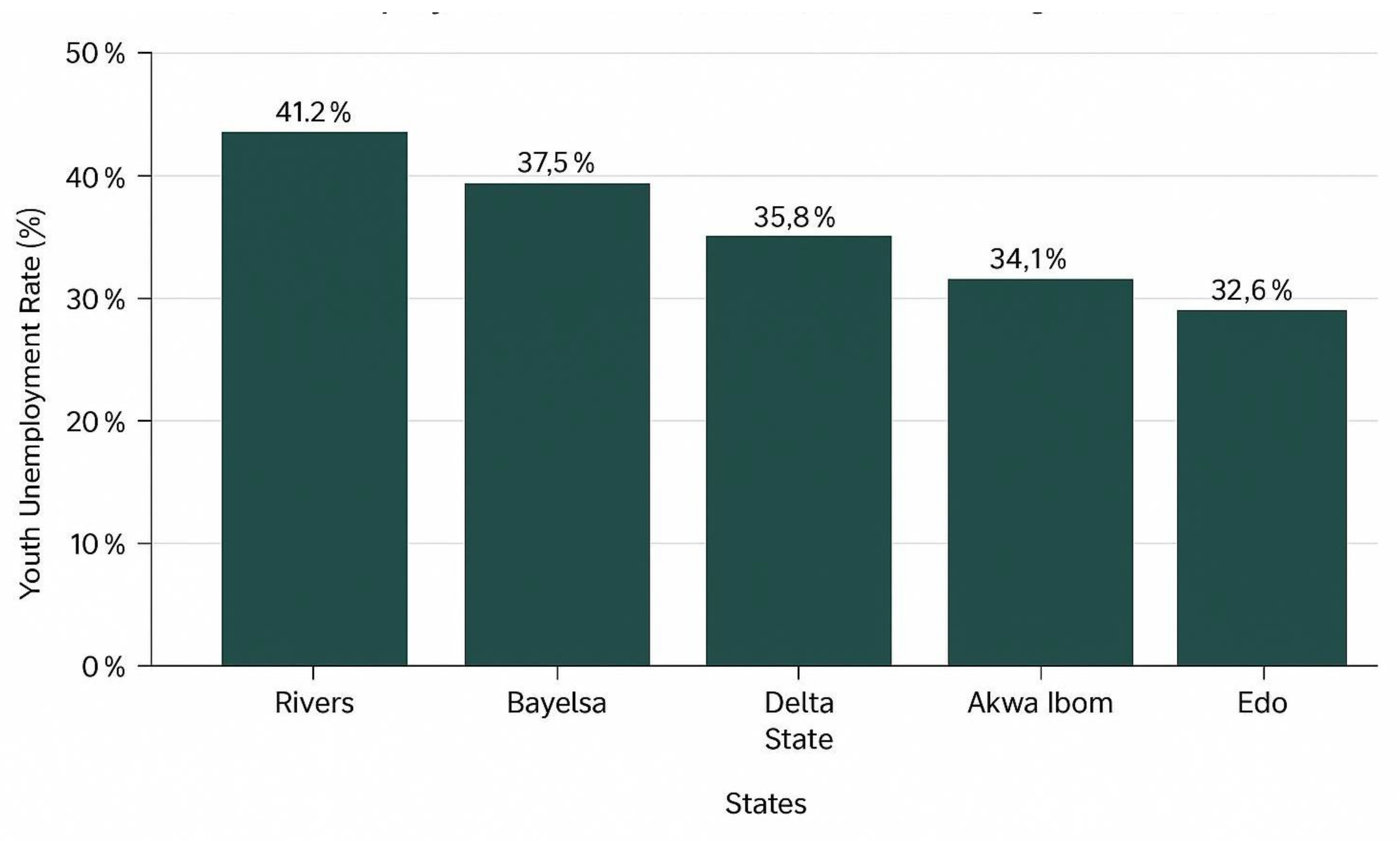
The youth, who constitute over 60% of the population, are increasingly left out of formal economic participation. For many, illegal oil bunkering, artisanal refining, political thuggery and militant recruitment become means of survival (Ibaba & Ikelegbe, 2010). This has resulted in a generation that is currently trapped in an environment of pollution, conflict, hopelessness, and economic deprivation, despite being surrounded by immense natural wealth. Formal basic education, which is often outdated and out of sync with the skills employers actually need, makes things even harder for young people trying to build a future. The bar chart below shows the fact that Rivers State has higher unemployment rate when compared to its peers.
This paper argues that Rivers State can no longer depend on fossil fuel-driven growth. Instead, it must transition its youth into sectors that are innovative, inclusive, and sustainable. The establishment of Digital and Renewable Energy Innovation Hubs presents a credible, scalable solution to this crisis — one that aligns with global trends in green jobs and digital transformation.
Figure 1.
Youth Unemployment Rate in Selected Oil-Producing States (2022).
Youth Crisis in Rivers State
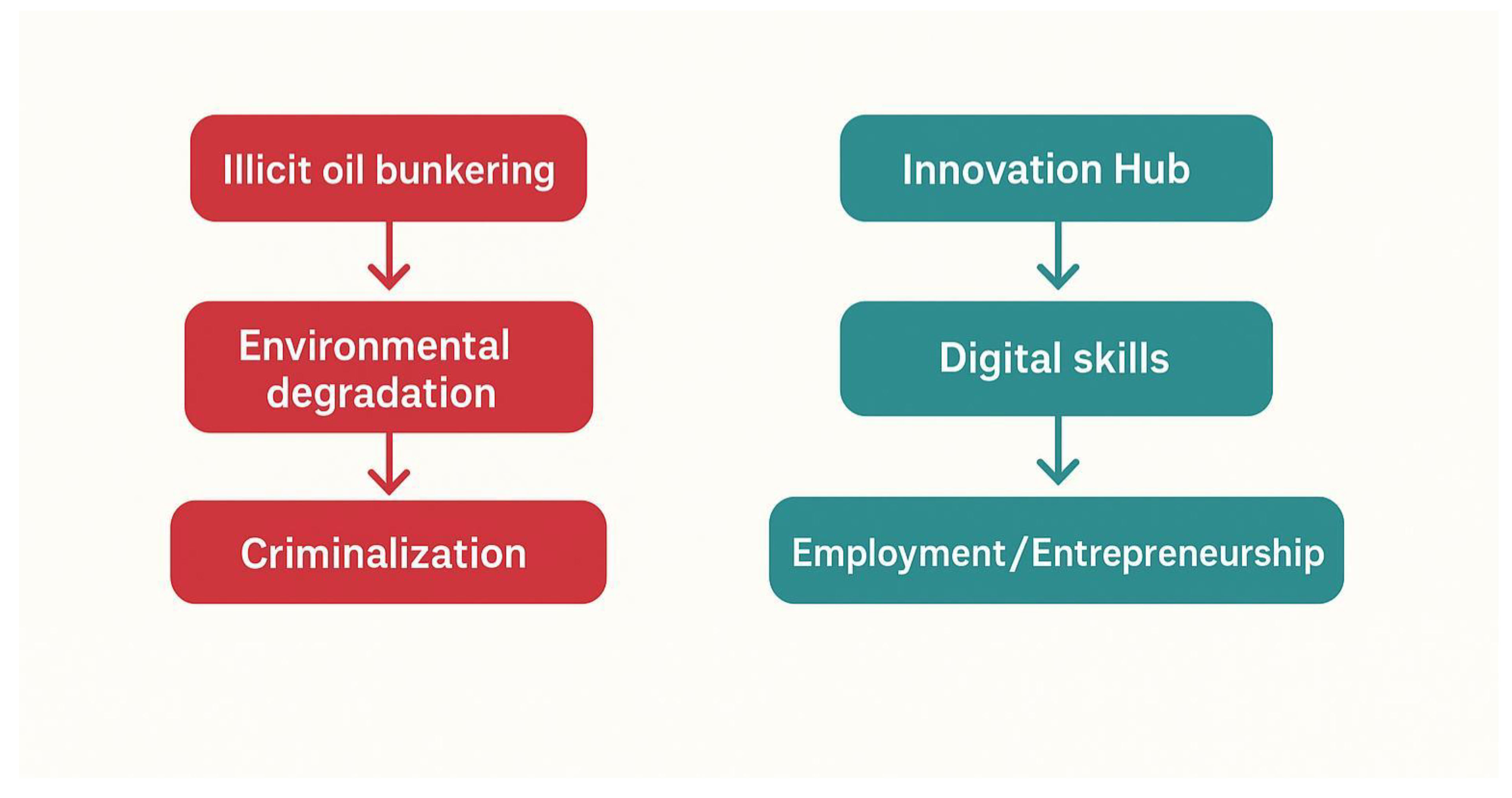
The youth unemployment crisis in Rivers State is more than just a lack of jobs, it’s a deep-rooted problem that shakes the foundations of society, politics, and progress. Over 40% of young people in Rivers are jobless, according to the National Bureau of Statistics (2022). This has been seen to stem from crumbling infrastructure, widespread corruption, ongoing insecurity, political instability and a shortage of quality education or practical training programs. With few options, many young people turn to desperate measures to survive—things like oil theft, piracy, cybercrime, or drug trafficking (Aghedo & Osumah, 2015). The flowchart below shows two paths: one, a destructive spiral of illegal oil activities, and the other, a hopeful road powered by innovation hubs that could change lives for the better.
Figure 2.
The Bunkering Economy Pathway vs the Innovation Hub Pathway.
In classrooms across the state, the curriculum used is outdated, and young people sit through lectures that often feel disconnected from the world unfolding around them. While global industries are racing ahead with technologies like artificial intelligence, blockchain, and renewable energy, these innovations barely make an appearance in the curriculum. Students graduate with certificates in hand, but without the skills the modern job market demands (Adewumi et al., 2023).
Review has shown that many of this youths are eager to contribute to the economy but are stranded and shut out of opportunities because of these gaps. Since these opportunities are not available, too many turn to informal or even illegal means to survive. The hunger to succeed is there; what’s missing are the pathways to get there.
What we’re witnessing is more than just a policy failure, it’s a quiet crisis. Many of these young people have very creative minds, are full of drive and craving change, but without proper training or opportunities, they’re stuck on the sidelines of their own future. If we don’t act fast to weave practical, skills-focused learning into our education and job policies, we’re not just wasting their talent—we’re crushing their hope.
Innovation Hubs: Vision and Structure
To address the deep-seated issues behind youth unemployment in Rivers State, this paper suggests creating Digital and Renewable Energy Innovation Hubs in all 23 Local Government Areas. Young people will have the opportunity to build their skills in these hubs, in the quest for a brighter future. With three hubs in each LGA, a total of 69 hubs would be established across the state, bringing opportunities for training, innovation, and job creation closer to young people in their own communities. These proposed hubs will function mainly as integrated centers for skills training, mentorship, innovation, and job facilitation focused on high-demand sectors such as software development, blockchain technology, decentralized finance (DeFi), and solar energy deployment. Modular training programs will be offered in each of these hubs in any of the following core areas:
- a)
- Full-stack web and mobile development
- b)
- Blockchain development and smart contracts (e.g., Ethereum, Solana)
- c)
- Cryptocurrency and DeFi literacy (wallets, staking, DAO governance, Airdrops)
- d)
- Solar photovoltaic (PV) installation and maintenance
- e)
- Digital freelancing, marketing, and entrepreneurship.
Young people won’t have to worry about the cost, this training will be completely free, thanks to government support and the backing of private tech companies, NGOs, and international partners who believe in their potential. Hubs will be fully equipped with digital infrastructure like computers, solar power backup, fast internet, smartboards, and each LGA will oversee implementation through a local advisory council consisting of community leaders, youth representatives, and civil society members.
This decentralized model is both scalable and inclusive. It is designed to ensure that all young people in the most remote corners of Rivers State get a fair chance at success, easing the pull and migration toward crowded cities and building stronger, more resilient communities (World Bank, 2021). Furthermore, similar models have shown success in Kenya, Rwanda, and Ghana, where digital job hubs have created thousands of employment pathways for youth in previously underserved communities (Ndemo & Weiss, 2017; ITU, 2022).
By bringing digital innovation and green skills training to local communities, Rivers State can shift from relying on natural resources to building a vibrant, knowledge-based economy where innovation thrives everywhere. Table 1 below shows details of the actual learning modules and timeline.
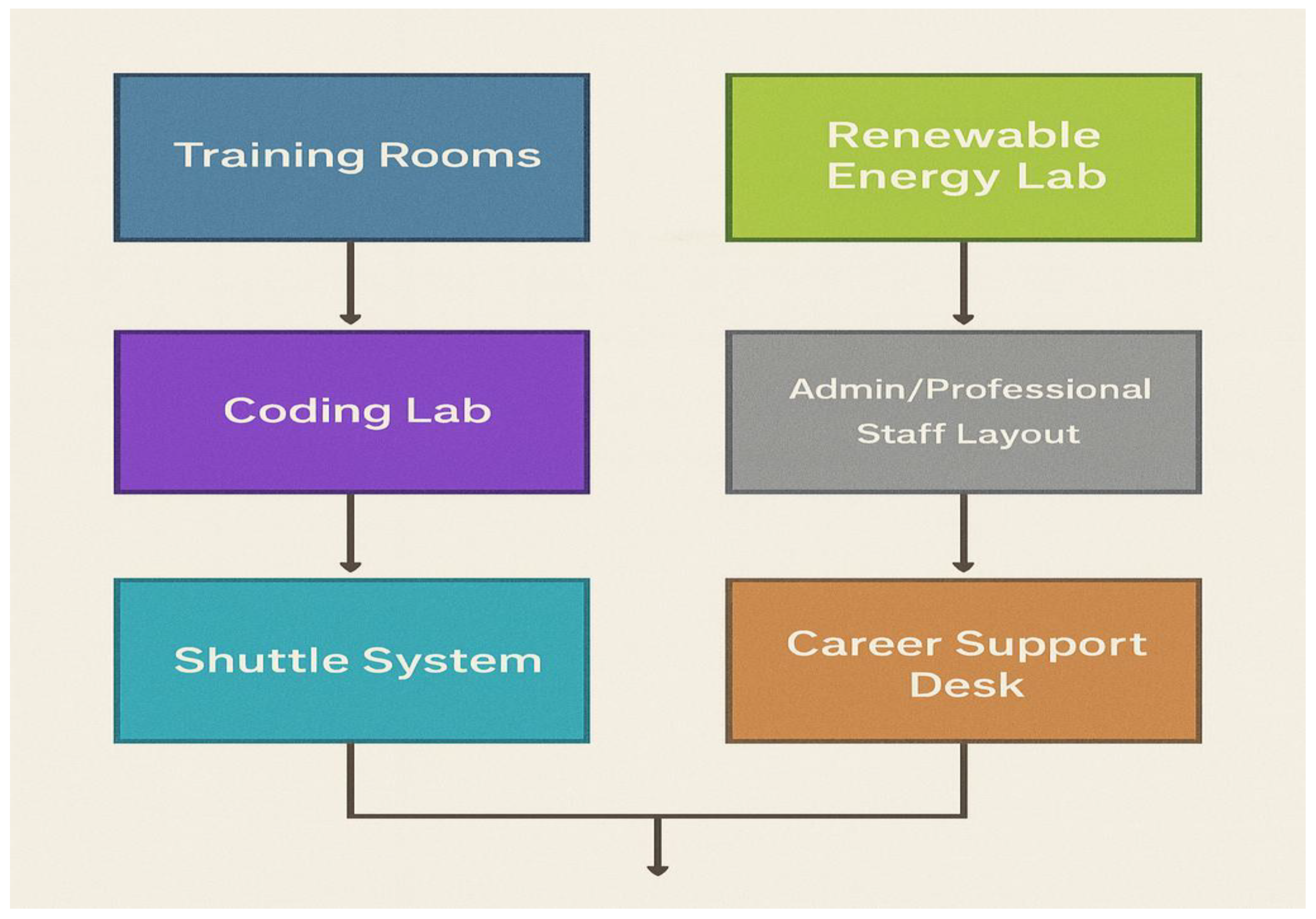
This schematic below shows a well-organized facility including training zones (Coding, Training, Renewable Energy), an admin center, a job desk, and a dedicated entrance with bus pickup space, visualizing how each hub will function as a full-service ecosystem.
Figure 3.
Structure of a Standard Innovation Hub in Rivers State.
Logistics, Access, and Incentives
These innovation hubs project can be a success, but that will depend heavily on their accessibility, inclusiveness, and ability to retain participants. Therefore, the program will be open exclusively to indigenes of Rivers State, aged 18 to 35, with proof of residency verified by community leaders and LGA records. To keep things fair and build trust, students will be chosen through a clear process that includes aptitude tests and support from their local community.
A shuttle bus will be assigned to each hub, scheduled to pick up and drop off students daily from designated bus stops near their homes. This resolves one of the major barriers to youth participation in rural and peri-urban areas: transportation costs (UNESCO, 2022). Students will also receive a monthly stipend, which will be tokenized and traceable through a blockchain-backed payment platform—to cover food, data, and personal expenses. This helps ease financial stress and makes it less likely that young people will drop out of the program to pursue quick, risky ways of making money (Oyeyemi & Okoro, 2020). Table 2 summarizes key motivators like stipends, free transport, and meals.
All services—training, transport, internet access, and meals, will be completely free. Partnerships with local food vendors, ISPs, and telecom companies will ensure cost efficiency and local economic stimulation (GSMA, 2021). These comprehensive support systems have worked well in keeping young people engaged in vocational programs across East and West Africa, giving them real pathways to success (ILO, 2020).
Staffing, Graduation, and Job Paths
Every Innovation Hub will have a diverse team of experts on board to provide top-notch training and guidance, helping young people thrive. Personnel will include certified blockchain developers, solar engineers, web developers, soft skills facilitators, and administrative officers. In addition to full-time instructors, the program will feature visiting experts from Nigerian universities, diaspora professionals, and partner organizations who will deliver monthly masterclasses and workshops (Aina & Salau, 2021).
Over six months, trainees will build their skills through a structured program, finishing with a final project that will be reviewed by both mentors from the program and outside experts. Graduation will be merit-based, and performance will be logged transparently on a state-level blockchain registry, creating a tamper-proof credentialing system (Tapscott & Tapscott, 2016).
To reward excellence and foster state development, the top 10% of each graduating class will be offered automatic placement into the Rivers State Civil Service, in departments related to e-governance, ICT, and energy. Remaining graduates will be connected to freelance platforms (e.g., Upwork, Toptal), green energy firms, and startup incubation programs. Microgrants and business development support will be available for those with viable entrepreneurial proposals (AfDB, 2021).
Policy Recommendations and Expected Impact
If we are to make sure that the Innovation Hubs can grow, stay transparent, reliable and last for the long haul, here are some key policy steps to take:
- Allocate 10% of the Rivers State Youth Empowerment Fund to the development and operation of the hubs annually (BudgIT, 2023).
- Legislate continuity, mandating future administrations to sustain the program through a dedicated Innovation and Digital Economy Act (YIAGA Africa, 2022).
- Deploy a blockchain dashboard for real-time monitoring of enrollment, stipend disbursement, and graduate employment outcomes (World Economic Forum, 2020).
- Partner with tech giants, NGOs, and development banks for co-funding, certification, and mentorship support (ITU, 2021).
Expected outcomes include:
- a)
- A projected 80% reduction in youth involvement in bunkering over 3 years
- b)
- Over 50,000 new job pathways created within 5 years
- c)
- Increased civil service efficiency with tech-literate employees
- d)
- Strengthened local economies through grassroots innovation
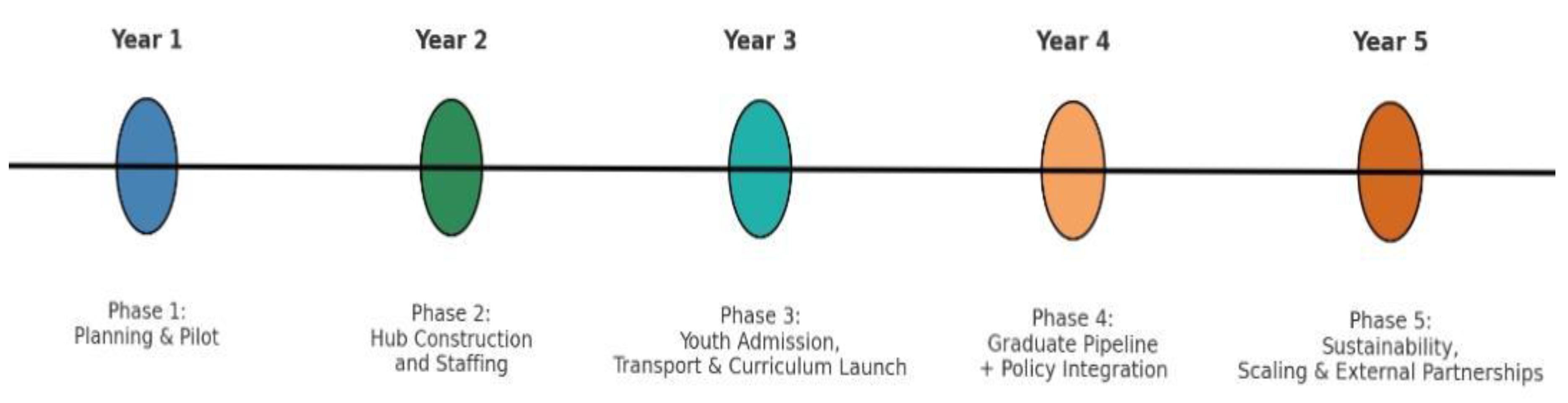
The figure below helps policymakers visualize rollout from Year 1 to Year 5.
Figure 5.
Five Year Timeline for Innovation Hub Rollout in Rivers State.
The demonstration of inclusivity, logistics coverage, and reach across Rivers State’s 23 LGAs is shown below.
If adopted, this model could serve as a national blueprint for tech-driven youth inclusion in oil-rich but economically excluded regions.

Table 4.
Proposed Innovation Hub Distribution Across Rivers State LGAs.
| LGA Name | No. of Hubs | Estimated Youth Served Per Year | Nearest Transport Nodes | Nearby Tertiary Institutions |
|---|---|---|---|---|
| Port Harcourt | 3 | 2,000 | Waterlines, Rumuola, Eleme Junction | Rivers State University, Uniport |
| Obio-Akpor | 3 | 2,000 | Rumuokoro, Choba, GRA | Uniport, Ignatius Ajuru University |
| Ikwerre | 3 | 1,200 | Elele Junction | Uniport Satellite Campus |
| Etche | 3 | 900 | Okehi, Igboh | Federal Polytechnic, Etche (planned) |
| Ahoada East | 3 | 1,000 | Ahoada Motor Park | Western Delta University (nearby) |
| Ahoada West | 3 | 900 | Joinkrama | - |
| Ogba/Egbema/Ndoni | 3 | 1,200 | Omoku Junction | - |
| Bonny | 3 | 1,000 | Bonny Jetty | - |
| Okrika | 3 | 800 | Okochiri, Navy Road | - |
| Opobo/Nkoro | 3 | 700 | Minima Waterfront | - |
| Gokana | 3 | 1,000 | Bori Junction | Ken Saro-Wiwa Polytechnic |
| Khana | 3 | 1,000 | Saakpenwa | Ken Saro-Wiwa Polytechnic (Bori Campus) |
| Tai | 3 | 700 | Kpite, Nonwa | - |
| Oyigbo | 3 | 900 | Kom-Kom, Afam | - |
| Eleme | 3 | 1,100 | Refinery Road | - |
| Andoni | 3 | 800 | Ngo Town | - |
| Ogu/Bolo | 3 | 600 | Bolo Town | - |
| Akuku-Toru | 3 | 750 | Abonnema Waterfront | - |
| Asari-Toru | 3 | 750 | Buguma Waterfront | - |
| Degema | 3 | 700 | Tombia | - |
| Abua/Odual | 3 | 800 | Abua Central | - |
| Emuoha | 3 | 1,000 | Emuoha Junction | - |
| Omuma | 3 | 600 | Eberi | - |
Total Number of Hubs: 23 LGAs × 3 = 69 hubs. Projected Youth Trained Annually: ≈ 24,000 to 28,000.
Conclusion: Silicon Delta Vision
In Rivers State, a lot of crisis has placed it at a pivotal moment. It can either persist in perpetuating youth disenfranchisement or courageously embrace a future driven by innovation, sustainability, and inclusive growth. The establishment of Digital and Renewable Energy Innovation Hubs provides a concrete path forward—one that equips the state’s youth with relevant skills, dignity, and economic power. This whole project will enable a move away from oil pipelines destructions for fiber optics, and turning away from illegal bunkering toward blockchain isn’t just something we have to do, it’s totally within our reach. This change can ignite a hopeful, creative future for Rivers State, where young people thrive and new possibilities shine (Oseni & Briggs, 2021; Chukwuemeka, 2020). The time to act is now, before another generation is lost to the paradox of wasted wealth.
References
- Adeola, G. N.; Olayemi, A. Unemployment and insecurity in Nigeria: A critical appraisal. Journal of Social Sciences 2019, 45(2), 134–148. [Google Scholar]
- Adewumi, O.; Okafor, U.; James, A. Nigeria’s digital skill gap and its impact on youth employability. African Journal of Science, Technology & Innovation 2023, 15(1), 45–59. [Google Scholar]
- AfDB. Jobs for Youth in Africa Strategy (2022–2025); African Development Bank Group, 2021. [Google Scholar]
- Aghedo, I.; Osumah, O. Insurgency in Nigeria: A comparative study of Niger Delta and Boko Haram uprisings. Journal of Asian and African Studies 2015, 50(2), 208–222. [Google Scholar] [CrossRef]
- Aina, L.; Salau, S. Digital workforce readiness in Nigerian higher education. Journal of African Educational Research 2021, 11(3), 98–112. [Google Scholar]
- Akinola, A. O. Youth engagement and political participation in Nigeria: Trends, challenges, and prospects. African Journal of Politics and Society 2020, 13(1), 22–41. [Google Scholar]
- Auty, R. M. Sustaining Development in Mineral Economies: The Resource Curse Thesis. Routledge, 1993. [Google Scholar]
- Bada, A.; Madon, S. The role of ICTs in community development in Africa: Lessons from SW Nigeria. Information Technology for Development 2006, 12(3), 201–216. [Google Scholar]
- British Council. Nigeria Creative Economy Report; British Council: London, 2020. [Google Scholar]
- BudgIT. State of States: Subnational Budget Transparency in Nigeria; BudgIT Foundation: Lagos, 2023. [Google Scholar]
- Chukwuemeka, E. Youth empowerment and sustainable development in the Niger Delta. African Journal of Development Studies 2020, 10(1), 24–36. [Google Scholar]
- Egbula, M.; Eronmhonsele, E. Renewable energy adoption in the Niger Delta: Barriers and opportunities. Energy Policy Journal 2021, 35(4), 142–158. [Google Scholar]
- Foundation, Ethereum. Ethereum Developer Documentation. 2022. https://ethereum.org/en/developers/docs/.
- GSMA. Mobile Internet Skills Training Toolkit: Lessons from Digital Skills Programs in Africa; GSMA: London, 2021. [Google Scholar]
- Ibaba, S. I.; Ikelegbe, A. The amnesty programme and the resolution of the Niger Delta crisis. Journal of Third World Studies 2010, 27(1), 83–105. [Google Scholar]
- ILO. Skills Development for Youth Employment in Africa; International Labour Organization: Geneva, 2020. [Google Scholar]
- International Telecommunication Union (ITU). Partnerships for Digital Skills Development in Africa; ITU: Geneva, 2021. [Google Scholar]
- International Telecommunication Union (ITU). Digital Skills in Sub-Saharan Africa: From Policy to Practice; ITU: Geneva, 2022. [Google Scholar]
- IRENA. Renewable Energy and Jobs–Annual Review 2021; International Renewable Energy Agency: Abu Dhabi, 2021. [Google Scholar]
- Kazeem, Y. Nigeria’s youth are leading a remote work revolution. Quartz Africa. 2020. https://qz.com/africa.
- National Bureau of Statistics. Labour Force Statistics: Unemployment and Underemployment Report; Abuja: NBS, 2022. [Google Scholar]
- Ndemo, B.; Weiss, T. Digital Kenya: An Entrepreneurial Revolution in the Making; Palgrave Macmillan, 2017. [Google Scholar]
- Nwachukwu, T.; Mordi, F. Digital infrastructure and employment creation in Nigeria. Nigerian Economic Review 2022, 34(2), 87–103. [Google Scholar]
- Obi, C. Nigeria's oil wealth and the crisis of development. Journal of Contemporary African Studies 2021, 39(2), 151–167. [Google Scholar]
- OECD. Blockchain for Inclusive Growth: The Case of Emerging Markets; OECD Publishing: Paris, 2018. [Google Scholar]
- Olanrewaju, F. Education and youth unemployment in Nigeria: The missing link. Journal of African Policy Research 2019, 11(3), 58–72. [Google Scholar]
- Oseni, T.; Briggs, J. Blockchain technology and the future of digital governance in Nigeria. Nigerian Journal of Public Policy and Administration 2021, 8(2), 75–88. [Google Scholar]
- Oyeyemi, T.; Okoro, U. Digital skills for youth empowerment in Nigeria: Barriers and opportunities. Nigerian Journal of Educational Technology 2020, 5(2), 44–56. [Google Scholar]
- Tapscott, D.; Tapscott, A. Blockchain Revolution: How the Technology Behind Bitcoin Is Changing Money, Business, and the World; Penguin, 2016. [Google Scholar]
- UNDP. Niger Delta Human Development Report; United Nations Development Programme, 2006. [Google Scholar]
- UNDP. Accelerating Digital Transformation in Africa: Policy Brief; United Nations Development Programme: New York, 2020. [Google Scholar]
- UNESCO. Youth and Skills: Putting Education to Work; UNESCO: Paris, 2022. [Google Scholar]
- Upwork. Freelancing in 2023: Global Skills Trends. 2023. https://www.upwork.com/research/.
- World Bank. Harnessing Digital Technologies for Inclusion in Africa; World Bank Group: Washington, DC, 2021. [Google Scholar]
- World Economic Forum. Blockchain Deployment Toolkit; WEF: Geneva, 2020. [Google Scholar]
- YIAGA Africa. Legislative Reforms and Youth Participation in Governance; YIAGA: Abuja, 2022. [Google Scholar]
Figure 4.
Civil Service Absorption Funnel.
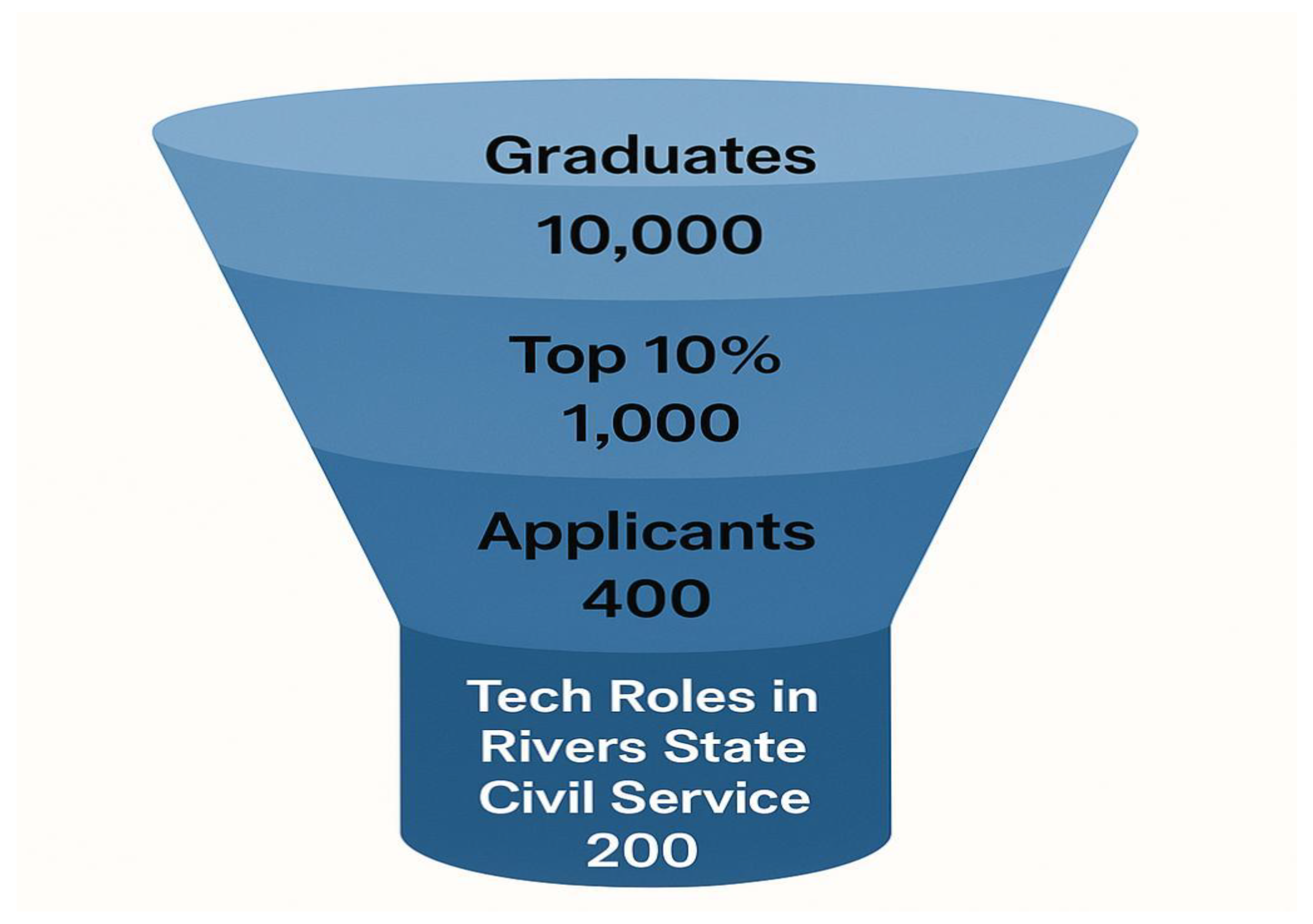
Table 1.
Core Training Modules and Duration.
| Skill Area | Duration | Certification | Partner Institution/Platform |
|---|---|---|---|
| Full-Stack Web Development | 8 weeks | Yes | ALX, Coursera, or Hub-specific |
| Blockchain & Smart Contracts | 6 weeks | Yes | Ethereum Foundation / Celo Labs |
| Renewable Energy Systems | 6 weeks | Yes | IRENA or Solar Sister Nigeria |
| DeFi Literacy & Wallet Skills | 4 weeks | Badge | Binance Academy / DeFi Africa |
| Freelancing & Digital Skills | 4 weeks | Yes | Upwork/LinkedIn Learning |
Table 2.
Incentives for Enrolled Youth.
| Incentive Type | Description | Delivery Mechanism |
|---|---|---|
| Monthly Stipend | ₦20,000 per student | Blockchain wallet |
| Free Transportation | Hub buses operating on set routes daily | Local driver cooperatives |
| Meal Subsidy | 1 daily meal from local vendors | Meal vouchers |
| Certification Grants | Paid exam fees for partner certification programs | Program-administered |
Table 3.
Civil Service Absorption.
| Stage | Percentage | Notes |
|---|---|---|
| Enrolled Youth | 100% | All admitted students |
| Completed Training | 85% | Accounts for dropout rate and attendance |
| Certified Graduates | 75% | Those who pass assessments |
| Top Performers | 20% | Highest scorers with leadership potential |
| Civil Service Placement | 10% | Absorbed into Rivers State tech departments |
Disclaimer/Publisher’s Note: The statements, opinions and data contained in all publications are solely those of the individual author(s) and contributor(s) and not of MDPI and/or the editor(s). MDPI and/or the editor(s) disclaim responsibility for any injury to people or property resulting from any ideas, methods, instructions or products referred to in the content. |
© 2025 by the authors. Licensee MDPI, Basel, Switzerland. This article is an open access article distributed under the terms and conditions of the Creative Commons Attribution (CC BY) license (http://creativecommons.org/licenses/by/4.0/).
Copyright: This open access article is published under a Creative Commons CC BY 4.0 license, which permit the free download, distribution, and reuse, provided that the author and preprint are cited in any reuse.


