

Submitted:
08 July 2025
Posted:
09 July 2025
You are already at the latest version
Abstract
Background/Objectives: Seaweeds have recently gained global attention as sustainable and health-promoting food sources. However, seaweed contains iodine, which, while a beneficial micronutrient, poses health risks if consumed excessively. Therefore, ensur-ing iodine safety has emerged as a critical priority. This study aimed to determine the total iodine content in five major edible seaweeds—laver (Porphyra spp.), sea mustard (Undaria pinnatifida), sea tangle (Saccharina japonica), green laver (Enteromorpha spp.), and hijiki (Hizikia fusiforme)—collected from 12 coastal regions of South Korea during 2020–2024. Methods: A total of 348 samples were analyzed using inductively coupled plasma mass spectrometry after microwave-assisted digestion. Results: The iodine content varied widely among the different species, with sea tangle showing the high-est levels (mean 2,432 mg/kg dry weight). A risk assessment was performed based on the estimated daily intake and hazard index (HI) using both the Korean Ministry of Food and Drug Safety (MFDS) and the Joint FAO/WHO Expert Committee on Food Additives (JECFA) reference values. The HI values were below 1.0 under the MFDS standards, indicating low risk. However, sea tangle showed values exceeding 1.0 under the JECFA standards. Conclusions: These findings highlight the need for species-specific iodine intake guidelines and safety regulations to ensure consumer protection and facilitate global seaweed trade. The study provides a scientific basis for balancing the nutritional benefits of seaweed with the potential risks of overconsumption, assist-ing in the development of national dietary guidelines and providing evidence-based data for navigating international regulatory landscapes.
Keywords:
inductively coupled plasma mass spectrometry
; iodine
; Korean diet
; Korean seaweed
; risk assessment
1. Introduction
Seaweeds are marine plants that grow naturally in the ocean and are rich in various functional components. Recently, these plants have gained global attention as sustainable and health-promoting food ingredients. In particular, species such as laver, sea tangle, sea mustard, hijiki, and green laver have long been consumed as staple food components in Asian countries, including Korea. Seaweeds also contain abundant minerals such as calcium, magnesium, iron, zinc, potassium, and iodine, as well as vitamins A, C, E, K, and B-complex (including B1, B2, and B12). These nutrients contribute to maintaining electrolyte balance, strengthening the immune system, providing antioxidant activity, regulating blood coagulation, and supporting energy metabolism [1,2]. Notably, vitamin B12 is rarely found in plant-based foods, making seaweeds a valuable source for vegetarians [3]. Furthermore, seaweeds contain both soluble and insoluble dietary fibers, which aid in improving gut health, inhibiting cholesterol absorption, and regulating blood sugar levels [4]. Alginate, abundant in brown seaweeds, is beneficial for inducing satiety and managing body weight. In addition, bioactive compounds found in seaweed, such as polyphenols, phlorotannins, and fucoidan, have been reported to exhibit antioxidant, anti-inflammatory, cytoprotective, anticancer, and immunomodulatory effects [5,6,7].
Owing to these advantages, seaweed consumption has expanded beyond Asia to regions such as North America, Europe, and Oceania. The European Union (EU) has recently designated seaweed as a “food of the future” and is actively promoting its use as a sustainable alternative to meat [8]. The import value of edible seaweeds among the 27 EU member states increased from USD 22.88 million in 2020 to USD 33.53 million in 2022. Concurrently, seaweed cultivation and processing industries have experienced rapid growth in countries such as France, the Netherlands, and the United Kingdom [2,9]. In 2022, South Korea ranked as the second-largest exporter of seaweed to the EU, accounting for 19.5% of the market share. Nevertheless, seaweed consumption remains limited in Western countries. This is primarily attributed to the lack of traditional dietary integration, sensory aversion to its unfamiliar taste and texture, insufficient public knowledge of its nutritional benefits, safety concerns, and regulatory ambiguity arising from its classification as a novel food [10,11,12]. Recently, however, increasing interest in health-promoting diets and Asian cuisine has led to increased seaweed consumption and importing, particularly in countries such as the Netherlands and Portugal, accompanied by a notable increase in dietary iodine intake. To address potential health risks associated with excessive iodine intake from seaweeds, various regulatory frameworks have been established across Western countries. The EU, for instance, has implemented labeling requirements to ensure transparency and support informed consumer choices. According to these regulations, food products containing ≥ 22.5 μg iodine per 100 g dry weight (dw) must be labeled as “iodine-containing,” while those with ≥ 45 μg/100 g dw must be labeled as “iodine-rich” [8]. Germany adopted more conservative limits, capping iodine content in food products at 20 mg/kg dw. This regulation applies to both general foods and dietary supplements, aiming to minimize the risk of thyroid dysfunction associated with excessive iodine intake [13]. In France, the French Agency for Food, Environmental, and Occupational Health & Safety (ANSES) set the upper limit of iodine in seaweed at 2,000 mg/kg but permits up to 6,000 mg/kg in brown seaweeds primarily used as seasoning. This approach reflects a differentiated regulatory stance that accounts for both the frequency and quantity of consumption [38] Australia also enforces strict regulatory standards for iodine content in imported seaweeds, particularly restricting or prohibiting the importation of brown seaweed if its iodine content exceeds 1,000 mg/kg dw. This preventive measure is intended to prevent circulating products that fail to meet domestic food safety standards and to protect public health [14]. Similarly, several Western countries have established import tolerance thresholds and consumer information systems, considering both the high iodine content naturally present in seaweed and the potential health risks associated with excessive intake [12,15]. These regulatory frameworks often function as non-tariff trade barriers for seaweed-exporting countries such as South Korea [14,16] (see also ANSES 2018). Consequently, seaweed products intended for international markets must not only control iodine concentrations but also implement rigorous analytical protocols and quality assurance systems to comply with the specific regulatory requirements of each importing country.
Seaweed contains iodine at concentrations hundreds to thousands of times higher than those found in terrestrial foods. This makes it a valuable dietary source in regions where iodine deficiency is prevalent. However, it also presents a dual risk, as excessive consumption may lead to adverse health outcomes. Iodine is an essential micronutrient required for synthesizing thyroid hormones and regulating metabolic processes. Inadequate intake can result in goiter, growth retardation, and cognitive impairment, whereas excessive intake has been associated with an increased risk of hyperthyroidism, autoimmune thyroiditis, and thyroid cancer [17]. Individuals with pre-existing thyroid conditions and the elderly are particularly susceptible to iodine sensitivity, thus making them more vulnerable to the risks of excessive iodine exposure. Although many countries have implemented their own regulatory standards for iodine intake, there is currently no harmonized international guideline established by the Codex Alimentarius Commission (CODEX). Germany has established a maximum permissible iodine content in food at 20 mg/kg dw, whereas Australia, New Zealand, and France permit higher limits, ranging 1,000–2,000 mg/kg dw. According to national dietary surveys, the median daily iodine intake among Korean adults is estimated at 352.1 µg/day, which remains below the tolerable upper intake level (UL) set by the Ministry of Food and Drug Safety (MFDS, 2,400 µg/day), yet exceeds the World Health Organization's (WHO) recommended daily intake (150 µg/day) by more than two-fold [18,19]. Notably, approximately 77.3% of total dietary iodine intake in Korea is derived from seaweeds, highlighting the critical need for precise exposure assessments and the development of evidence-based intake guidelines.
In South Korea, annual seaweed production is approximately 1.7 million tons, representing 45% of the total volume and 10% of the total economic value of domestic seafood production. In terms of production volume, sea mustard (36%), sea tangle (31%), and laver (30%) collectively account for 97% of total seaweed yield. Regarding production value, laver contributes the largest share (71%), followed by sea mustard (12%) and sea tangle (10%). Laver is predominantly processed and distributed in seasoned or dried forms. Regionally, Jeollanam-do is the leading production area, accounting for 74% of the national output, followed by Chungcheongnam-do (10%) and Jeollabuk-do (8%) [20].
This study analyzed the iodine content of 348 samples representing five major seaweed species—laver, sea tangle, sea mustard, hijiki, and green laver—widely produced and consumed in South Korea and assessed potential health risks based on estimated dietary exposure. Samples were collected to reflect key production regions and distribution channels, and the analysis accounted for species-specific and regional variations to provide more accurate baseline data for risk assessment. Given the EU's designation of seaweed as a “food of the future” in the context of climate change mitigation, global demand for seaweed is increasing. Accordingly, ensuring iodine safety has emerged as a critical priority, particularly in anticipation of expanding Korean seaweed exports. This study aims to offer a scientific basis for balancing the nutritional benefits of seaweed with the potential risks of excessive intake, thereby supporting the development of national dietary guidelines and supplying evidence-based data for navigating international regulatory landscapes.
2. Materials and Methods
2.1. Sample Collection and Preparation
To determine the iodine content of seaweed, 348 samples were analyzed, comprising 173 farmed samples obtained from verified production sites and 175 wild-harvested specimens collected directly from 12 coastal counties and cities across South Korea during the primary seaweed harvesting season (October 2020 to July 2024). All samples were immersed and rinsed in deionized water to remove surface impurities, then freeze-dried using a freeze-dryer (FDU-2100, EYELA, Tokyo, Japan) at temperatures below −60 °C and vacuum pressures below 10 Pa for a minimum of three days. All equipment and containers used in the experimental procedures were pre-cleaned with 1% (v/v) nitric acid (suprapure 65%, Merck, Darmstadt, Germany) to minimize potential contamination.
2.2. Iodine Analysis
The analytical procedure for determining iodine content was based on the Korean Food Code [21] and the Association of Official Analytical Chemists (AOAC) Official Method 2012 [39]. Freeze-dried seaweed of 0.25 g was placed into a 20 mL digestion vessel (Pyrex, New York, NY, USA), to which 10 mL of distilled water and 2 mL of 25% (v/v) tetramethylammonium hydroxide (TMAH; Sigma-Aldrich, St. Louis, MO, USA) were added. The mixture was digested using a microwave-assisted digestion system (UltraWAVE, Milestone, Sorisole, Italy) under the following conditions: 120 °C at 120 bar for 12 minutes, followed by 230 °C at 150 bar for 15 minutes, with a holding period of 10 minutes. After digestion, the sample volume was brought to 25 mL using 0.5% (v/v) TMAH. The solution was then filtered through a 0.45 μm polyvinylidene difluoride membrane filter (Merck, Darmstadt, Germany) to remove particulates. Each sample was analyzed in triplicate using an inductively coupled plasma mass spectrometer (ICP-MS; PerkinElmer, Waltham, MA, USA). Calibration was performed using iodine standard solutions (Agilent, Santa Clara, CA, USA) at concentrations of 0.5, 1, 5, 10, 25, and 50 μg/kg. All data were processed using Easy-DOC3 software, version 3.30 (Milestone, GitHub, San Francisco, CA, USA). Final iodine concentrations were expressed on both wet weight and dry weight bases following moisture correction.
2.3. Method Validation
To validate the analytical method, the limit of detection (LOD), limit of quantification (LOQ), and recovery rate were evaluated according to AOAC guidelines [39] The LOD and LOQ were determined from six replicate measurements of a low-concentration standard solution (1 μg/kg), while linearity was assessed using calibration curves generated from standard solutions spanning a range of concentrations, including levels relevant to the test samples. The recovery rate for iodine analysis in seaweed was calculated based on six replicate analyses of a certified reference material (CRM). The CRM employed in this study was Standard Reference Material 3232 (SRM 3232), provided by the National Institute of Standards and Technology (NIST)
2.4. Risk Assessment
To evaluate the safety of iodine intake from five types of seaweed, the estimated daily intake (EDI) of iodine was calculated using Equations 1 and 2 [22].
EDI 1 (µg/day/person) = ACDI (mg/kg) × SC (g/day)
EDI 2 (µg/kg bw/day) = {ACDI (mg/kg) × SC (g/day)} / 60.75 kg (person)
Where EDI refers to the estimated daily intake; ACDI (average concentration of detected iodine) represents the mean iodine content in seaweed (mg/kg dry weight); and SC (seaweed consumption) denotes the daily intake of seaweed (g/day) in South Korea, derived from both the average consumption by the general population and the actual intake among seaweed consumers, based on an average adult body weight of 60.75 kg. In Scenario 1, the hazard index (HI) was calculated by multiplying ACDI by SC (Equation 1) and dividing the result by the tolerable upper intake level (UL) for iodine, which is 2,400 μg/day, as established by the Korean MFDS. In Scenario 2, HI was calculated by first multiplying ACDI by SC (Equation 2), then dividing the result by 60.75 kg body weight, and finally comparing this value to the provisional maximum tolerable daily intake (PMTDI) of 17 μg/kg bw/day, as set by the Joint FAO/WHO Expert Committee on Food Additives (JECFA).
2.5. Statistical Analysis
All seaweed samples were analyzed in triplicate, and the resulting data were statistically evaluated at a 95% confidence level using R software (version 3.6.1; http://cran.r-project.org). To assess significant differences in iodine content among seaweed groups, a one-way analysis of variance (ANOVA) was conducted using the AGRICOLAE package (CC-BY 4.0 open access, 2015, https://crans.r-project.org/web/packages/agricolae/index.html). Post-hoc comparisons were performed using Duncan’s multiple range test to determine statistically significant groupings.
3. Results and Discussion
3.1. Sampling Information
According to data from the Ministry of Oceans and Fisheries (MoF, 2018), five representative seaweed species widely produced and consumed in South Korea were directly harvested or purchased from 12 major coastal counties and cities between October 2020 and July 2024. The geographical distribution of the sampling sites is presented in Figure 1. The southwestern coastal region, which accounts for over 74% of the national seaweed production, includes key areas in Jeollanam-do (Haenam, Jindo, Wando, Goseong, and Yeosu), along with parts of the southeastern coast (Gyeongnam and Busan). The western coastal sites, Hwaseong, Seocheon, Gunsan, Sinan, and Jangheung, are categorized as "others." A total of 348 seaweed samples were collected, and species and regional sample distribution are summarized in Table 1. Regionally, a total of 298 samples were collected from Jeollanam-do, including Goseong (n = 56), Yeosu (n = 11), Wando (n = 104), Jindo (n = 72), and Haenam (n = 55). Samples were also collected from Busan (n = 23), Gyeongsangnam-do (n = 5), and other regions (n = 22). In the “other regions” category, only laver (n = 19) and green laver (n = 3) were collected. By seaweed species, the total sample distribution was as follows: laver (n = 104), sea tangle (n = 20), sea mustard (n = 61), hijiki (n = 87), and green laver (n = 76). As of 2017, domestic seaweed production in South Korea was dominated by sea mustard (36%), sea tangle (31%), and laver (30%). In terms of production value, laver accounted for the highest proportion (71%), followed by sea mustard (12%) and sea tangle (10%). Laver is predominantly processed into dried or seasoned products, while sea mustard is commonly produced as salted products [20].
3.2. Total Iodine Content of Seaweed According to Various Classification Criteria
The average iodine content of the 348 seaweed samples, classified by cultivation method (cultivated vs. wild), collection year (2020–2024), and collection region, is summarized in Table 2. All results are expressed on a wet weight basis (mg/kg ww).
3.2.1. Variation in Iodine Content According to Cultivation Method (Wild and Farmed)
The overall average iodine content of seaweed, categorized by cultivation method, was 33.63 ± 60.60 mg/kg ww, corresponding to 351.17 ± 622.99 mg/kg dw. The detection range was 0.401–374.866 mg/kg ww (8.154–4,164.765 mg/kg dw). Mean iodine concentrations by species were 241.5, 61.2, 13.5, 5.3, and 6.3 mg/kg ww for sea tangle, hijiki, sea mustard, laver, and green laver, respectively. Laver and green laver exhibited the lowest iodine contents, whereas sea tangle showed significantly higher levels, which were approximately 46 and 38 times greater than those of laver and green laver, respectively. Of the 348 total samples analyzed, 175 were wild-harvested (20 laver, 12 sea tangle, 40 sea mustard, 53 hijiki, and 50 green laver), and 173 were farmed samples obtained from verified producers (84 laver, 8 sea tangle, 21 sea mustard, 34 hijiki, and 26 green laver). Laver was found to be the most extensively cultivated species among the analyzed samples. The iodine content of wild seaweed range was 0.590–355 mg/kg ww, averaging 41.3 mg/kg ww, whereas that of farmed seaweed ranged was 0.401–375 mg/kg ww, averaging 25.5 mg/kg ww. Overall, wild seaweed exhibited approximately 61% higher iodine content than farmed seaweed. When analyzed by species, wild and farmed iodine concentrations were 219 vs. 264, 58.1 vs. 64.2, 11.0 vs. 15.9, 5.54 vs. 7.04, and 3.92 vs. 6.67 mg/kg ww for sea tangle, hijiki, sea mustard, green laver, and laver, respectively. Farmed seaweed exhibited iodine concentrations that were 10–70% higher than those of their wild counterparts, with the smallest differences observed in sea tangle and hijiki (10–20%) and the largest in laver (approximately 70%). Among all species, sea tangle consistently showed the highest iodine levels, with more than 45 times the iodine content of laver. These findings indicate that the markedly elevated iodine levels in sea tangle are the primary factor influencing the overall results of this study. Numerous studies have reported significant differences in iodine content between wild and farmed seaweed. Wild seaweed is continuously subjected to environmental stress such as tidal fluctuations, intense solar radiation, and periodic dehydration. It has been suggested that seaweed accumulates high levels of iodine as part of its antioxidant defense mechanism, utilizing iodine to neutralize reactive oxygen species (ROS) generated under these stress conditions [23]. This mechanism is particularly prominent in brown algae, where iodine is believed to function through a vanadium-dependent haloperoxidase system, facilitating the scavenging of ROS. In contrast, farmed seaweed is typically cultivated under relatively stable environmental conditions with minimal external stress, thereby reducing the physiological demand for antioxidant activity and subsequent iodine accumulation. Moreover, commercial seaweed farming primarily prioritizes rapid biomass growth and high yield, with less emphasis on mineral content management. Consequently, farmed seaweed generally exhibits lower average iodine concentrations compared to wild-harvested counterparts, which may explain discrepancies observed in previous studies relative to the findings of this research. Furthermore, Kim et al. [24] reported that wild-harvested samples of Sargassum aquifolium and S. echinocarpum, both brown algae species collected in Hawaii, contained higher levels of inorganic arsenic compared to farmed counterparts. This finding suggests that wild seaweed has a tendency to accumulate certain inorganic elements relative to farmed seaweed. However, Schiener et al. [25] reported that in aquaculture settings for sea mustard, factors such as elevated nutrient inputs (particularly nitrogen and phosphorus) from surrounding waters, controlled water temperatures, and increased cultivation density can contribute to the accumulation of not only iodine but also other trace elements. Specifically, aquaculture environments characterized by shallow water depth and limited water circulation may promote continuous iodine availability, thereby facilitating its accumulation in seaweed tissues. Roleda et al. [26] investigated the iodine content of both brown and red algae widely produced in the North Atlantic, distinguishing between wild and farmed specimens. Their findings indicated that wild species exhibited lower iodine concentrations compared to farmed ones, aligning with the results of the present study.
The iodine content of seaweed is known to vary substantially depending on growth and harvest periods, which are strongly influenced by seasonal marine environmental factors such as water temperature, light intensity, nutrient concentration, and growth cycle dynamics [27]. In this study, monthly iodine concentrations were monitored from October 2021 to July 2024, with the following number of samples collected per month: October (n = 21), November (n = 38), December (n = 61), January (n = 66), February (n = 57), March (n = 52), April (n = 36), May (n = 7), June (n = 5), and July (n = 5). Major edible seaweed species consumed in Korea displayed distinct seasonal growth and harvesting patterns that correspond to marine environmental conditions such as seawater temperature, solar radiation, and tidal currents. Specifically, species like laver and green laver favor colder seasons, exhibiting rapid growth during the winter months. For these species, growth and harvest periods often overlap, typically occurring between November and April. Sea mustard, sea tangle, and hijiki are predominantly winter-growing species, with hijiki typically harvested in February and March, sea mustard from March to May, and sea tangle from March to June. According to the study results, sea tangle exhibited an average iodine concentration of 234.15 and 278.90 mg/kg in November and December, respectively, corresponding to the early growth phase, followed by a decrease to 183.98 mg/kg during the harvesting season, representing a reduction of over 30%. In contrast, hijiki showed lower iodine levels during the early growth period (45.16–42.99 mg/kg in December–January), with significantly higher concentrations during the harvest season (68.20–80.97 mg/kg in February–March), suggesting increased iodine accumulation toward the latter growth stages (data not shown). These findings imply that differences in iodine content between wild and farmed seaweed may be partially explained by the growth stage and harvest timing, highlighting seasonal and physiological factors influence on iodine accumulation.
Rehder [23] reported that seaweed, particularly brown algae, utilizes iodine as an antioxidant to scavenge ROS under environmental stress conditions such as low seawater temperatures and limited light availability, especially during winter and early spring. The activation of this antioxidant defense mechanism contributes to elevated iodine accumulation in algal tissues during these periods. However, as seawater temperature and light intensity increase with the onset of spring, seaweed growth rate accelerates. During this phase, metabolic activity shifts toward organic compound synthesis required for rapid cell division and tissue expansion, leading to a relative decrease in iodine accumulation [25]. In addition, the tissue dilution effect caused by rapid growth can reduce the iodine concentration per unit dry weight. In particular, high temperature and high light intensity environments increase seaweed metabolic rate, which promotes iodine consumption and further reduces iodine concentration in the tissue. Furthermore, iodine content tends to increase again in autumn. Due to these seasonal fluctuations, seaweed nutritional value can vary depending on harvest timing and environmental conditions. Therefore, when considering seaweed as a source of iodine, harvest timing is an important factor to consider
3.2.2. Temporal Variation in Iodine Content According to Collection Year (2021–2024)
The average iodine content of seaweed by harvest year was 65.6 mg/kg ww in 2021, 65.3 mg/kg ww in 2022, 47.0 mg/kg ww in 2023, and 67.2 mg/kg ww in 2024, with the lowest concentration observed in 2023. Excluding 2023, iodine levels remained relatively consistent across the other years. When analyzed by species, the average iodine content of sea tangle was 235, 254, 140, and 229 mg/kg ww in 2021, 2022, 2023, and 2024, respectively (mean: 214.5 mg/kg ww). For hijiki, the values were 72.2, 51.3, and 67.1 mg/kg ww in 2022, 2023, and 2024, respectively (mean: 63.5 mg/kg ww). Sea mustard showed concentrations of 10.27, 10.8, 16.2, and 12.4 mg/kg ww across 2021–2024, respectively (mean: 12.5 mg/kg ww). Green laver exhibited 5.41, 5.57, 6.5, and 19.5 mg/kg ww across 2021–2024, respectively, with a relatively high value observed in 2024 (mean: 9.3 mg/kg ww). Laver had values of 4.48, 4.85, 5.41, and 7.95 mg/kg ww during the same period (mean: 5.7 mg/kg ww). Notably, both green laver and laver, species with comparatively low baseline iodine concentrations, showed a substantial increase in 2024. However, Roleda et al. [26] previously reported that Saccharina spp. (sea tangle), a brown algae, generally contains higher iodine concentrations than red algae such as laver. While significant variation may exist depending on geographic harvest location, clear differences were not observed by season or year of collection.
3.2.3. Geographical Variation in Iodine Content According to Collection Area
Excluding Gyeongnam, where samples of laver or sea tangle were not collected, sea mustard, green laver, and hijiki exhibited the highest iodine concentrations in Busan, while sea tangle and laver showed the highest levels in Jindo, Jeollanam-do. For sea mustard, the iodine content in Busan was 17.8 mg/kg ww, compared to 10.6 mg/kg ww in Wando, Jeollanam-do, the region with the lowest concentration, indicating minimal regional variation. However, more pronounced differences were observed within Jeollanam-do itself. For example, the iodine content in hijiki collected from Haenam was approximately 1.5 times higher than that from other areas, and sea tangle from Jindo exhibited a value of 335 mg/kg ww, which was almost 25 times higher than the 83 mg/kg ww recorded in Goheung. Laver, one of the most widely consumed seaweeds in South Korea, also showed considerable regional variability, with iodine concentrations ranging 1.81–7.21 mg/kg ww (mean: 5.04 mg/kg ww). Notably, within Jeollanam-do, laver from Jindo contained 7.21 mg/kg ww, more than four times the concentration found in samples from Yeosu (1.81 mg/kg ww). According to a recent study on the average iodine content of laver produced or harvested in different countries, concentrations were 45.0–64.0 mg/kg dry weight (dw) in New Zealand, 56.0 mg/kg dw in Ireland, 12.02 mg/kg dw in Italy, and 35.0–102.0 mg/kg dw in Spain [28]. Additionally, a report by the Korean MFDS for 2006–2012 indicated the average iodine content of domestically produced laver as 51.6 mg/kg dw, with a broad range of 12.8–174 mg/kg dw depending on the production period and region. Iodine content is also influenced by cultivation depth. In the case of sugar kelp (Saccharina latissima) seaweed cultivated at a depth of 9 m was found to contain significantly higher iodine concentrations than that planted at 1 m, confirming that water depth plays a role in iodine accumulation [29].
Sea tangle, a representative species of brown algae, contains an average iodine concentration of 7.8 mg/g or higher on a dry weight basis, with some varieties reported to contain up to 12 mg/g [30]. This high accumulation capacity is attributed to sea tangle’s ability to efficiently absorb iodine from seawater and convert inorganic iodine into organic iodine compounds for storage, a process mediated by haloperoxidase enzymes located in the cell wall [31]. The iodine stored in the cell wall functions as an antioxidant, mitigating physiological stress caused by external environmental factors. Laver, a member of the red algae group, has a limited capacity for iodine uptake and accumulation [32]. This is primarily due to its weak or inactive haloperoxidase system and its typical habitat in shallow coastal waters, where iodine concentrations are relatively low. As a result, the average iodine content of laver ranges from 16 to 100 μg/g dw. In comparison, green laver, a representative species of green algae, has been reported to contain iodine levels ranging from 50 to 200 μg/g dw [10]. According to a study by Milinovic et al. [33], the iodine content of green algae, Ulva rigida, was reported to be only 33 μg/g dw, whereas the brown algae, Bifurcaria bifurcata and Fucus vesiculosus, contained significantly higher levels, at 391 μg/g dw and 352 μg/g dw, respectively. The study concluded that the elevated iodine content in brown algae is influenced by a combination of environmental factors, including species-specific characteristics, growth duration, seawater temperature, salinity, and harvesting location. Consistent with these findings, the present study also observed substantial variation in both average and maximum iodine content based on harvest location (e.g., Gochang, Wando, and Jindo in Jeollanam-do) and harvest period (January to April). Notably, sea tangle and hijiki exhibited fluctuations of more than ten-fold depending on the time of harvest. Given this high variability, accurate safety assessments and exposure estimations are essential when evaluating seaweed as a dietary source of iodine.
In conclusion, brown algae such as sea tangle exhibit optimized physiological mechanisms for iodine accumulation and inhabit ecological niches conducive to iodine uptake, resulting in markedly high iodine concentrations. In contrast, species such as sea mustard, laver, and green laver possess relatively low iodine levels, primarily due to differences in enzymatic systems and marine environmental conditions. These interspecies differences in iodine content reflect a complex interplay of evolutionary divergence, cell wall structure, biochemical traits, and ecological adaptation. Accordingly, developing species-specific consumption guidelines that account for these variations in iodine content is essential to ensure safe and nutritionally appropriate intake of seaweed.
3.3. Validation Method for Iodine Content of the Five Major Seaweeds
Validation results of the iodine content analysis method for the five major seaweed species are presented in Table 3. The LOQ was determined to be 2.75 μg/kg, and the LOD was confirmed at 0.92 μg/kg. Calibration curves constructed using standard solutions demonstrated excellent linearity, with correlation coefficients (R²) averaging ≥ 0.9996, thereby meeting the linearity criteria recommended by the Codex Alimentarius (R² > 0.98). According to Codex method validation guidelines, acceptable recovery ranges are defined as 40–120% for concentrations of 1 μg/kg, 60–115% for 10 μg/kg, and 80–110% for 100 μg/kg. The recovery rate obtained in this study was 87.44 ± 2.74%, falling within the acceptable range and confirming the validity of the analytical method. Therefore, the iodine analysis conducted in this study satisfies international validation criteria, and the results are considered analytically reliable and robust.
3.4. Risk Assessment
Table 4 presents the results of the dietary risk assessment for seaweed consumption. The average iodine content by species was 100.2, 2,432.1, 176.9, 526.6, and 86.1 mg/kg dw for laver, sea tangle, sea mustard, hijiki, and green laver, respectively. The average daily intake of each seaweed species by the general Korean population was 1.02, 0.67, 0.72, 0.09, and 0.38 g/day/person for laver, sea tangle, sea mustard, hijiki, and green laver, respectively. The average intake among actual consumers, those who reported consuming the corresponding seaweed, was significantly higher: 2.94, 15.79, 4.83, 18.3, and 24.39 g/day/person for laver, sea tangle, sea mustard, hijiki, and green laver, respectively. The EDI values (µg/kg body weight/day) for the general population and actual consumers were: laver, 1.69 (4.85); sea tangle, 26.88 (632.01); sea mustard, 2.09 (14.06); hijiki, 0.78 (158.63); and green laver, 0.54 (34.57), respectively.
In Scenario 1, HI values for individual seaweed species in the general population range were 0.01–0.68, with a cumulative HI of 0.81, remaining below the safety threshold. However, in the consumer group, HI values for individual items were 0.12–16.00, with a total cumulative HI of 21.37, significantly exceeding the recommended limit.
In Scenario 2, based on the total population, the HI for all seaweed species except sea tangle remained below 1. However, among the consumer group, the HI values for hijiki, green laver, and sea tangle exceeded 1. Notably, sea tangle exhibited the highest HI range, 0.68–37.18, which can be attributed to both its elevated iodine content and higher consumption levels. According to the World Health Organization (WHO), the recommended daily intake (RDI) of iodine for adults is 150 μg/day, and the UL is 1,100 μg/day. When evaluated against the standards set by the Korean MFDS, the HI for each individual seaweed and total intake remained below 1, suggesting a low risk of adverse effects due to excessive iodine intake. However, when applying the JECFA PMTDI, the HI for sea tangle solely was 1.58, and the cumulative HI for all seaweed species reached 1.88. These results indicate a potential health risk associated with excessive iodine intake, particularly from high-iodine species such as sea tangle and in cases of combined seaweed consumption (see Table 4).
Meanwhile, Aakre et al. [34] conducted a randomized crossover study involving 20 healthy Danish women (aged 24–30) and reported that the bioavailability of iodine (total dose: 231 μg) was approximately 75% following the consumption of sea mustard salad and sushi. Although this was lower than the 97% bioavailability observed with potassium iodide (KI) supplements containing the same iodine dose, it was still considered a substantial absorption rate. Furthermore, González et al. [35] evaluated iodine content and potential human exposure risks associated with the consumption of sea mustard and sea tangle, owing to increased dietary popularity. A total of 30 seaweed samples sourced from various regions, including Asia and Europe, were analyzed using the oxidation–reduction titration method. The results showed that European sea tangle had the highest iodine content among all samples, averaging 27.7 ± 5.4 mg/kg dw. European sea mustard also exhibited higher iodine concentrations compared to Asian counterparts. Notably, sea mustard showed statistically significant differences in iodine content depending on the origin (p < 0.05). In addition, daily consumption of 4 g of European sea tangle provides approximately 111 μg of iodine, which approaches the RDI for adults of 150 μg/day. The WHO has established an upper intake level of 1,100 μg/day for adults, highlighting that while seaweed can serve as a valuable dietary source of iodine, excessive intake may pose health risks, including hyperthyroidism and goiter. Accordingly, routine monitoring of iodine content in seaweed products is essential. Particular attention should be paid to the consumption of high-iodine species such as sea tangle, hijiki, and sea mustard, which should be consumed in moderation to avoid excessive iodine exposure.
In a large-scale cohort study involving 190,524 individuals in Korea, Park et al. [36] investigated the relationship between iodine intake and thyroid disease. The findings indicated that excessive iodine intake was not significantly associated with an increased risk of thyroid dysfunction, which may be attributed to the traditional dietary patterns and adaptive iodine metabolism in the Korean population. These results highlight the importance of developing population-specific dietary guidelines and implementing policy measures such as warning labels for seaweed products with high iodine content. Given that the average iodine intake in Korea is estimated at 400–500 μg/day, SC is believed to contribute over 20% of total dietary iodine intake. However, daily iodine intake varies substantially by country, region, and dietary habits. In Korea, the majority of iodine intake (77.3%) is derived from seaweed [19]. In contrast, in countries such as the United States, Canada, and several European nations, dairy products, including milk and cheese, are reported to be the primary contributors to dietary iodine. Nevertheless, approximately 44% of the European population has been reported to experience moderate to severe iodine deficiency, as evidenced by urinary iodine excretion levels below 100 μg/L [15]. Meanwhile, in addition to iodine, South Korea has set a standard of 0.3 mg/kg for cadmium, a harmful substance found in laver, while the EU and China have expanded the standard to include seaweed varieties.
Based on the results of this study, future research should investigate changes in bioavailability depending on cooking methods (boiling, blanching, etc.), as not all iodine in seaweed is absorbed. Re-evaluating seaweed consumption safety considering the iodine retention rate after cooking and human absorption rates and conducting a survey on actual consumption patterns for each type of seaweed are both necessary. Additionally, customized risk assessments targeting high-risk groups (such as individuals with thyroid disorders and pregnant women) are also necessary. Using research analyzing the association between seaweed consumption and thyroid function (changes in blood TSH, T3, and T4 levels), inconsistent international standards should also be addressed by conducting comparative studies on iodine standards between countries and providing policy recommendations for establishing seaweed consumption guidelines. This study quantitatively evaluated and analyzed the iodine content of major seaweed in Korea and the potential health risks associated with consumption. The risk was found to be low according to the Korean MFDS standards. However, according to JECFA standards, a risk of excessive consumption was identified, particularly associated with sea tangle. Furthermore, considering the expanding export markets, ensuring scientific safety is essential to build international trust.
4. Conclusions
Seaweed, a traditional Korean food ingredient, is increasingly recognized globally alongside other iconic Korean foods such as kimchi and fermented soybean paste. Brown seaweed species, such as sea mustard, sea tangle, and hijiki, have strong potential as functional food ingredients due to their rich iodine content and are gaining international attention as dietary iodine sources. However, given the high variability in iodine accumulation depending on growing conditions, a scientific understanding of the underlying environmental influences, including light intensity, nutrient availability, temperature, and water depth, is essential for ensuring product safety and consistency [10,25].
This study analyzed the iodine content of 348 samples representing five edible seaweed species (laver, sea tangle, sea mustard, hijiki, and green laver) collected from major coastal regions of South Korea over a four-year period (2021–2024) and conducted a health risk assessment based on the results. Among the species, sea tangle exhibited the highest average iodine concentration, followed by hijiki, sea mustard, laver, and green laver. Brown and red algae generally demonstrated more iodine accumulation than green algae, with notable variation attributed to environmental factors such as seawater temperature, salinity, and depth, cultivation method, and harvesting area and period. These interspecies and environmental differences are critical for accurate iodine exposure estimation and risk assessment related to seaweed consumption.
Risk assessment was conducted based on both the Korean MFDS and the JECFA standards. Under MFDS criteria, the HI for all individual seaweed species and cumulative intake remained below 1, indicating a low risk of adverse health effects. However, using JECFA’s more conservative PMTDI, the HI for sea tangle alone was 1.58, and the total HI across all seaweed types reached 1.88, suggesting a potential risk of iodine overconsumption in scenarios involving high-iodine species or combined intake. EDI by species increased from laver to sea mustard, hijiki, green laver, and eventually sea tangle with the highest value. All species except sea tangle fell within JECFA’s tolerable intake range. Sea tangle, however, was estimated at 1,632.61 μg/day, approximately 70% of the WHO’s upper intake limit (1,100 μg/day), warranting caution. These findings align with data from the Korea National Health and Nutrition Examination Survey (2016–2022), which reported a mean iodine intake of 559.16 ± 13.15 μg/day, exceeding the recommended intake (150 μg/day), though only 37.6% of the population reported consuming seaweed, indicating that average intake may be inflated by high-consuming subgroups. It is also important to note that sea tangle is commonly used in soups, and cooking processes such as boiling and blanching can reduce iodine content by 30–90% [37], suggesting that bioavailability-adjusted risk assessments are needed. Milinovic et al. [33] similarly emphasized the impact of processing methods on iodine variability, highlighting the importance of accounting for pre- and post-processing changes in exposure evaluations. Accordingly, future research should focus on refining dietary risk models by incorporating processing effects and bioavailability data, as well as aligning iodine measurements with actual consumption patterns.
The study findings provide a basis that can support the development of standardized cultivation protocols, iodine content prediction models, and international certification systems for quality control. These efforts are foundational for building a stable global supply chain for K-Food and promoting a safe, functional, and reliable image of Korean seaweed to consumers worldwide.
Author Contributions
Y.M.L.: Conceptualization, Data analysis, Writing-Original Draft; H.J.P.; Data analysis, Data Curation, Corporation. M.J., K.S.H. and J.S.M.; Data Curation. All authors have read and agreed to the published version of the manuscript.
Acknowledgments
This study was supported by the National Institute of Fisheries Science, Fisheries Science Research Project (R2025055).
Conflicts of Interest
The authors declare no conflicts of interest.
References
- MacArtain, P.; Gill, C.I.R.; Brooks, M.; Campbell, R.; Rowland, I.R. Nutritional value of edible seaweeds. Nutr. Rev. 2007, 65, 535–543. [Google Scholar] [CrossRef]
- Wells, M.L.; Potin, P.; Craigie, J.S.; Raven, J.A.; Merchant, S.S.; Helliwell, K.E.; Smith, A.G.; Camire, M.E.; Brawley, S.H. Algae as nutritional and functional food sources: revisiting our understanding. J. Appl. Phycol. 2017, 29, 949–982. [Google Scholar] [CrossRef]
- Watanabe, F.; Takenaka, S.; Katsura, H.; Masumder, S.A.; Abe, K.; Tamura, Y.; Nakano, Y. Dried green and purple lavers (nori) contain substantial amounts of biologically active vitamin B(12) but less of dietary iodine relative to other edible seaweeds. J. Agric. Food Chem. 1999, 47, 2341–2343. [Google Scholar] [CrossRef]
- Brown, E.S.; Allsopp, P.J.; Magee, P.J.; Gill, C.I.R.; Nitecki, S.; Strain, C.R.; McSorley, E.M. Seaweed and human health. Nutr. Rev. 2014, 72, 205–216. [Google Scholar] [CrossRef]
- Fernando, I.P.S.; Kim, M.S.; Son, K.T.; Jeong, Y.H.; Jeon, Y.J. Antioxidant activity of marine algal polyphenolic compounds: A mechanistic approach. J. Med. Food 2016, 19, 615–628. [Google Scholar] [CrossRef]
- Shannon, E.; Abu-Ghannam, N. Seaweeds as nutraceuticals for health and nutrition. Phycologia 2019, 58, 563–577. [Google Scholar] [CrossRef]
- Li, Y.X.; Wijesekara, I.; Li, Y.; Kim, S.K. Phlorotannins as bioactive agents from brown algae. Process Biochem. 2011, 46, 2219–2224. [Google Scholar] [CrossRef]
- European Commission. Food from the ocean (Scientific Opinion No. 3/2017 Publications Office of the European Union: Luxembourg), 2017. Available online: https://ec.europa.eu/research/sam/pdf/sam_food-from-oceans_report.pdf (accessed on 8 December 2022).
- McHugh, D.J. A guide to the seaweed industry. FAO Fish. Tech. Pap.; Food and Agriculture Organization: Rome, Italy 2003. Available online: http://www.fao.org/3/y4765e/y4765e00.htm (accessed on 10 May 2025), 441.
- Mouritsen, O.G.; Dawczynski, C.; Duelund, L.; Jahreis, G.; Vetter, W.; Schröder, M. On the human consumption of the red seaweed dulse (Palmaria palmata (L.) Webber & Mohr). J. Appl. Phycol. 2013, 25, 1777–1791. [Google Scholar] [CrossRef]
- Cherry, P.; O’Hara, C.; Magee, P.J.; McSorley, E.M.; Allsopp, P.J. Risks and benefits of consuming edible seaweeds. Nutr. Rev. 2019, 77, 307–329. [Google Scholar] [CrossRef]
- EFSA Panel on Dietetic Products, Nutrition and Allergies (NDA). Scientific opinion on the safety of seaweed and iodine content. EFSA J. 2014, 12, 3660–3716. [Google Scholar] [CrossRef]
- Smyth, P.P.A. Iodine, seaweed, and the thyroid. Eur. Thyroid J. 2021, 10, 101–108. [Google Scholar] [CrossRef]
- FSANZ (Food Standards Australia New Zealand). Imported food risk statement. Brown seaweed of the Phaeophyceae class and iodine, 2023. Available online: https://www.foodstandards.gov.au/sites/default/files/2023-11/Brown%20seaweed%20and%20Iodine.pdf (accessed on 10 May 2025).
- Zimmermann, M.B.; Andersson, M. Update on iodine status worldwide. Curr. Opin. Endocrinol. Diabetes Obes. 2012, 19, 382–387. [Google Scholar] [CrossRef]
- Bath, S.C.; Button, S.; Rayman, M.P. Iodine concentration of organic and conventional milk: implications for iodine intake. Br. J. Nutr. 2012, 107, 935–940. [Google Scholar] [CrossRef]
- Sorrenti, S.; Baldini, E.; Pironi, D.; Lauro, A.; D’Orazi, V.; Tartaglia, F.; Tripodi, D.; Lori, E.; Gagliardi, F.; Praticò, M.; et al. Iodine: its role in thyroid hormone biosynthesis and beyond. Nutrients 2021, 13, 4469. [Google Scholar] [CrossRef]
- Choi, Y.Y.; Lee, S.J.; Kim, H.S.; Eom, J.S.; Jo, S.U.; Guan, L.L.; Park, T.S.; Seo, J.K.; Lee, Y.K.; Bae, D.R.; et al. Red seaweed extracts reduce methane production by altering rumen fermentation and microbial composition in vitro. Front. Vet. Sci. 2022, 9, 985824. [Google Scholar] [CrossRef]
- Lee, J.Y.; Yeoh, Y.J.; Seo, M.J.; Lee, G.H.; Kim, C.I. Estimation of dietary iodine intake of Koreans through a total diet study (TDS). Korean J. Community Nutr. 2021, 26, 48–55. [Google Scholar] [CrossRef]
- MoF (Ministry of Oceans and Fisheries). South Korea, 2018. Available online: https://www.mof.go.kr/doc/ko/selectDoc.do?docSeq=20773&menuSeq=929&bbsSeq=27 (accessed on 10 May 2025).
- MFDS (Ministry of Food and Drug Safety). South Korea. Common Guidelines for Risk Assessment of Human Applications, 2019. Available online: https://www.mfds.go.kr (accessed on 10 May 2025).
- Kim, M.H.; Cho, M.H.; Kim, S.H.; Lee, Y.M.; Jo, M.R.; Moon, Y.S.; Im, M.H. Monitoring and risk assessment of pesticide residues in fishery products using GC-MS/MS in South Korea. Toxics 12, 299. [CrossRef]
- Rehder, D. Vanadate-dependent peroxidase in macroalgae: function, applications, and environmental impact. J. Oceanogr. Mar. Sci. 2014, 2, 2–7. [Google Scholar] [CrossRef]
- Kim, S.T.; Conklin, S.D.; Redan, B.W.; Ho, K.K.H.Y. Determination of the nutrient and toxic element content of wild-collected and cultivated seaweeds from Hawaii. ACS Food Sci. Technol. 4, 595–605. [CrossRef]
- Schiener, P.; Black, K.D.; Stanley, M.S.; Green, D.H. The seasonal variation in the chemical composition of the kelp species Laminaria digitata, Laminaria hyperborea, Saccharina latissimi and Alaria esculenta. J. Appl. Phycol. 2015, 27, 363–373. [Google Scholar] [CrossRef]
- Roleda, M.Y.; Skjermo, J.; Marfaing, H.; Jónsdóttir, R.; Rebours, C.; Gietl, A.; Stengel, D.B.; Nitschke, U. Iodine content in bulk biomass of wild-harvested and cultivated edible seaweeds: inherent variations determine species-specific daily allowable consumption. Food Chem. 2018, 254, 333–339. [Google Scholar] [CrossRef]
- Lüning, K. Seaweeds: Their Environment, Biogeography, and Ecophysiology; John Wiley & Sons: New York, NY, USA, 1991.
- Gunnarsdóttir, I.; Brantsæter, A.L. Iodine: a scoping review for Nordic Nutrition Recommendations 2023. Food Nutr. Res. 2023, 67, 10369. [Google Scholar] [CrossRef] [PubMed]
- Sæther, M.; Diehl, N.; Monteiro, C.; Li, H.; Niedzwiedz, S.; Burgunter-Delamare, B.; Scheschonk, L.; Bischof, K.; Forbord, S. The sugar kelp Saccharina latissima II: Recent advances in farming and applications. J. Appl. Phycol. 2024, 36, 1953–1985. [Google Scholar] [CrossRef]
- Aakre, I.; Solli, D.D.; Markhus, M.W.; Mæhre, H.K.; Dahl, L.; Henjum, S.; Alexander, J.; Korneliussen, P.-A.; Madsen, L.; Kjellevold, M. Commercially available kelp and seaweed products—valuable iodine source or risk of excess intake? Food Nutr. Res. 2021, 65, 7584–7600. [Google Scholar] [CrossRef] [PubMed]
- Küpper, F.C.; Carpenter, L.J.; McFiggans, G.B.; Palmer, C.J.; Waite, T.J.; Boneberg, E.M.; Woitsch, S.; Weiller, M.; Abela, R.; Grolimund, D.; et al. Iodine accumulation provides kelp with an inorganic antioxidant impacting atmospheric chemistry. Proc. Natl Acad. Sci. U. S. A. 2008, 105, 6954–6958. [Google Scholar] [CrossRef]
- Teas, J.; Pino, S.; Critchley, A.; Braverman, L.E. Variability of iodine content in common commercially available edible seaweeds. Thyroid 2004, 14, 836–841. [Google Scholar] [CrossRef]
- Milinovic, J.; Rodrigues, C.; Diniz, M.; Noronha, J.P. Determination of total iodine content in edible seaweeds: application of inductively coupled plasma-atomic emission spectroscopy. Algal Res. 2021, 53, 102149. [Google Scholar] [CrossRef]
- Aakre, I.; Tveit, I.B.; Myrmel, L.S.; Fjære, E.; Ballance, S.; Rosendal-Riise, H. Bioavailability of iodine from a meal consisting of sushi and a wakame seaweed salad—A Randomized Crossover Trial. Food Sci. Nutr. 2023, 11, 7707–7717. [Google Scholar] [CrossRef]
- González, A.; Paz, S.; Rubio, C.; Gutiérrez, Á.J.; Hardisson, A. Human exposure to iodine from the consumption of edible seaweeds. Biol. Trace Elem. Res. 2020, 197, 361–366. [Google Scholar] [CrossRef]
- Park, S.J.; Chen, L.; Wallace, T.; Lee, H.J. The association between iodine intake and thyroid disease in iodine-replete regions: the Korean genome and epidemiology study. Nutr. Res. Pract. 2025, 19, 24–35. [Google Scholar] [CrossRef]
- Kwon, S.O.; Kwon, K.I.; Lee, M.Y.; Lee, H.Y.; Kim, C.I. Iodine intake from brown seaweed and the related nutritional risk assessment in Koreans. Nutr. Res. Pract. 2024, 18, 412–424. [Google Scholar] [CrossRef] [PubMed]
- ANSES (French agency for food, environmental and occupational health and safety). Annu. Rep. 2018.
- Method. AOAC Intl. 20th ed.; Association of Official Analytical Communities Official Method of Analysis (OMA) 2016, 2012. Rockville, MD, USA.
Figure 1.
Geographic illustration of the major edible seaweed production areas in South Korea. A total of 348 seaweed samples were collected from 12 major areas.
Figure 1.
Geographic illustration of the major edible seaweed production areas in South Korea. A total of 348 seaweed samples were collected from 12 major areas.
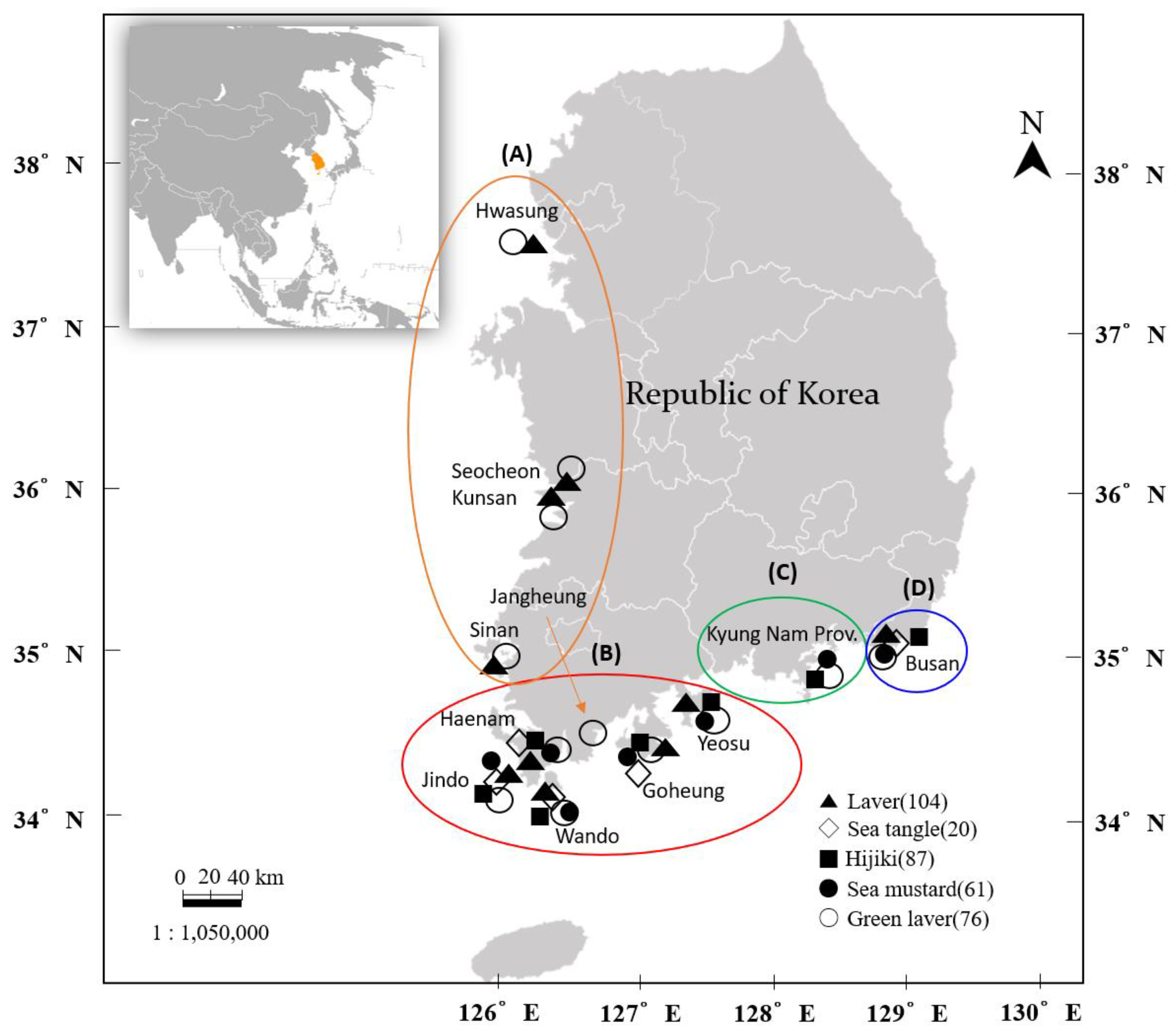

Table 1.
Five major seaweeds collection based on the regions in South Korea.
| KN | BS | JN | Others | Total | |||||
| GH | YS | WD | JD | HN | |||||
| Laver | 0 | 4 | 9 | 1 | 10 | 35 | 26 | 19 | 104 |
| Sea tangle | 0 | 5 | 3 | 0 | 7 | 2 | 3 | 0 | 20 |
| Sea mustard | 2 | 8 | 15 | 2 | 22 | 4 | 8 | 0 | 61 |
| Hijiki | 1 | 3 | 21 | 6 | 35 | 18 | 3 | 0 | 87 |
| Green laver | 2 | 3 | 8 | 2 | 30 | 13 | 15 | 3 | 76 |
| Total | 5 | 23 | 56 | 11 | 104 | 72 | 55 | 22 | 348 |
KN; Kyungnam Province, BS; Busan, JN; Jeonnam Province (GH; Goheung, YS; Yeosu, WD; Wando, JD; Jindo, HN; Haenam), Others (HS; Hwasung, SC; Seocheon, KS; Kunsan, SA; Sinan, JH; Jangheung). 298 samples from JN, 23 samples from BS, 5 from KN, and 22 from others (4 from HS, 9 from SC, 5 from KS, 2 from SA, 2 from JH).
Table 2.
This is a table. Tables should be placed in the main text near to the first time they are cited.
Table 2.
This is a table. Tables should be placed in the main text near to the first time they are cited.
| Species | Growth method | Harvest year | Sampling region | |||||||||||
| Wild | Farmed | 2020-21 | 2022 | 2023 | 2024 | KN | BS | JN | Others | |||||
| GH | YS | WD | JD | HN | ||||||||||
| Laver | 3.92 | 6.67 | 4.48 | 4.85 | 5.41 | 7.95 | a- | 3.96 | 5.88 | 1.81 | 4.87 | 7.21 | 6.70 | 4.85 |
|
Sea tangle |
219 | 264 | 235 | 254 | 140 | 229 | a - | 268 | 83 | a - | 241 | 335 | 215 | a - |
| Sea mustard | 11.0 | 15.9 | 10.72 | 10.8 | 16.2 | 12.4 | 16.7 | 17.8 | 12.1 | 12.9 | 10.6 | 14.5 | 13.5 | a - |
| Hijiki | 58.1 | 64.2 | 72.2 | 51.3 | 67.1 | a - | 77.3 | 98.4 | 52.5 | 50.5 | 67.2 | 49.5 | 80.0 | a - |
| Green laver | 5.54 | 7.04 | 5.41 | 5.57 | 6.50 | 19.5 | 6.23 | 9.84 | 5.75 | 9.43 | 6.58 | 4.98 | 5.06 | 3.92 |
a -; No sampling from these regions.
Table 3.
Quality parameters of analytical methods for iodine determination.
|
CRM (SRM 3232) |
LODa | LOQb | Linearity | Recovery |
| (µg/kg) | (µg/kg) | (R2) | (%) | |
| 0.92 | 2.75 | 0.9996 | 87.44±2.74 |
CRM; Certified reference materials (Standard Reference Material (SRM) 3232). a LOD; limit of detection =3.143×σ. b LOQ; limit of quantification =10×σ. (σ standard deviation in the seven-replicate determination of standard solution).
Table 4.
Risk assessment of iodine intake for the five major seaweeds. Hazard index evaluation of two scenarios using MFDS and JECFA reference values.
Table 4.
Risk assessment of iodine intake for the five major seaweeds. Hazard index evaluation of two scenarios using MFDS and JECFA reference values.
| Species |
ACDI (mg/kg dw) |
SC (g/day)a |
EDI 1 (µg/day/person)d |
EDI 2 (µg/kg bw/day)e |
Scenario 1f | Scenario 2g | |||||||||
| HI | HI | ||||||||||||||
| Avg.b | Act.c | Avg. | Act. | Avg. | Act. | Avg. | Act. | Avg. | Act. | ||||||
| Laver | 100.2 | 1.02 | 2.94 | 102.44 | 294.69 | 1.69 | 4.85 | 0.04 | 0.12 | 0.10 | 0.29 | ||||
| Sea tangle | 2432.1 | 0.67 | 15.79 | 1632.61 | 38393.31 | 26.88 | 632.01 | 0.68 | 16.00 | 1.58 | 37.18 | ||||
| Sea mustard | 176.9 | 0.72 | 4.83 | 127.12 | 854.19 | 2.09 | 14.06 | 0.05 | 0.36 | 0.12 | 0.83 | ||||
| Hijiki | 526.6 | 0.09 | 18.30 | 47.50 | 9636.62 | 0.78 | 158.63 | 0.02 | 4.02 | 0.05 | 9.33 | ||||
| Green laver | 86.1 | 0.38 | 24.39 | 32.86 | 2100.32 | 0.54 | 34.57 | 0.01 | 0.88 | 0.03 | 2.03 | ||||
| Total | 0.81 | 21.37 | 1.88 | 49.31 | |||||||||||
a Seaweed consumption was based on the ‘Korea National Health and Nutrition Examination Survey (KNHANES) 2023.’ b Avg.; Average daily intake of seaweed by the Korean population. c Act.; Actual seaweed intake of seaweed consumers. d EDI 1 was calculated by {ACDI X SC of Avg. or Act}. e EDI 2 was calculated by {ACDI X SC of Avg. or Act.} / average Korean adult body weight (60.75 kg). f Scenario 1 is the result of HI=EDI 1 / tolerable upper intake level of iodine (UL) from MFDS (2,400 µg/day/person). g Scenario 2 is the result of HI=EDI 2 / provisional maximum tolerable daily intake of iodine (PMTDI) from JECFA (17 µg/kg bw/day). Hi; Hazard Index: MFDS; Korean Ministry of Food and Drug Safety: JECFA; Joint FAO/WHO Expert Committee on Food Additives: ACDI; average concentration of detected iodine: SC; seaweed consumption: EDI; estimated daily intake.
Disclaimer/Publisher’s Note: The statements, opinions and data contained in all publications are solely those of the individual author(s) and contributor(s) and not of MDPI and/or the editor(s). MDPI and/or the editor(s) disclaim responsibility for any injury to people or property resulting from any ideas, methods, instructions or products referred to in the content. |
© 2025 by the authors. Licensee MDPI, Basel, Switzerland. This article is an open access article distributed under the terms and conditions of the Creative Commons Attribution (CC BY) license (http://creativecommons.org/licenses/by/4.0/).
Copyright: This open access article is published under a Creative Commons CC BY 4.0 license, which permit the free download, distribution, and reuse, provided that the author and preprint are cited in any reuse.