

Submitted:
07 July 2025
Posted:
11 July 2025
You are already at the latest version
Abstract
Materials that store a significant amount of heat in a narrow temperature range by a solid-liquid or solid-solid phase change are called Phase Change Materials (PCMs). The most well-known is water, widely used for centuries in commonly called “ice storge”. Today, there are probably hundreds of commercial PCMs, many of them pure substances, mainly from the material classes of the alkanes, alkanols, and fatty acids, as well as mixtures, mainly of water and salts. As the phase change temperature of a PCM determines the temperature range where it can be used, mixtures can extend the choice. In this review, published literature on binary mixtures is analyzed. It is subdivided into binary mixtures of the same material class, e.g., alkane – alkane mixtures, and of different material classes, e.g., water – salt mixtures. The focus is on the questions what can be mixed, what has been mixed, and what was the outcome, thus covers the composition, information on how the components interact (e.g. salt hydrate), phase change temperature and enthalpy. The review shows the amount of work done in the past decades, reveals promising as well as not promising combinations, and highlights where more R&D should be performed.
Keywords:
phase change material
; PCM
; compound
; mixture
; eutectic
; alkane
; alkanol
; sugar alcohol
; fatty acid
; salt hydrate
1. Introduction
1.1. Background on PCMs
Thermal energy storage (TES), often also called heat and cold storage depending on the application, already has a vital role in the energy system, and even more in the future. Different effects can be used for TES. Among them are phase change between solid and liquid or different solid phases, which typically occur in a narrow temperature range. If phase change is at a single temperature the heat is also called latent heat as it cannot be sensed without a temperature change. Materials that store a significant amount of heat in a narrow temperature range by phase change solid-liquid or solid-solid are called Phase Change Materials (PCMs), often also latent heat storage materials (even if some temperature change is involved). Precisely, the materials should also be technically useful, e.g., not gold. Due to the ability of PCM to store a significant amount of heat in a narrow temperature range, they are preferably used for thermal energy storage (heat or cold storage) with high storage density (per mass or volume) in a small temperature range, and for passive temperature stabilization (temperature control). Today, PCMs are used commercially in many applications (Mehling et al. [1]), and there are many other potential applications where intense R&D is going on (Mehling [2], Garcia et al. [3], Krüger et al. [4], Dumont et al. [5], Novotny et al. [6]).
The most common PCM is water, with a phase change temperature Tpc between solid and liquid at 0 °C, and an enthalpy change on phase change ∆pch of 333 kJ/kg or 306 kJ/L (at lowest density of 0.92 kg/L). For other application temperatures other materials with suitable Tpc have to be used. Well known are paraffins, fatty acids, alcohols, and salts, as well as mixtures of two or more materials, e.g., eutectic mixtures of water with salts, salt hydrates, or mixtures of salts. And many more are investigated and developed today to keep up with the growing demand for PCMs and the increasing range of applications.
1.2. Classification of PCMs
PCMs can and should be classified in different ways, depending on the goal and focus of classification. In a review of classification of PCMs (Mehling [7]) a consistent classification scheme was developed to give an overview of options for the search for new PCM candidates, including also established PCM. It focusses on the chemical composition, using the approach and terms already established in chemistry (e.g., Brown et al. [8]). The top level shows Figure 1. Its basis is crucial to understand mixtures.
Pure substances are elements, or chemical compounds which are composed of two or more elements in integer proportions, e.g., in H2O being H:O as 2:1. Origin of the integer proportions are primary bonds, built by electron sharing respectively transfer: molecules have covalent bonds, salts have ionic bonds. Due to their fixed composition, pure substances have fixed physical and chemical properties, e.g., Tpc. In contrast, non-pure substances are mixtures that have variable composition, thus variable properties. Substances combined in a mixture are called component (Atkins [9]); the ratio states the composition. Origin of possible variable composition, instead fixed, is a bonding that is neither covalent nor ionic; e.g., present in metal - metal mixtures (called alloys, metallic bond), water - salt mixtures (permanent dipole - ion), water - alcohol mixtures (permanent dipole - permanent dipole), water - O2 mixtures (permanent dipole - induced dipole), and alkane - alkane mixtures (induced dipole - induced dipole). Despite having overall variable composition, there is still the possibility of specific proportions, e.g., in clathrates due to the arrangement of the host molecules. Mixtures can be split up into those with both components being from the same subclass of materials and those where they are from different subclasses (Mehling [7]). For binary mixtures this shows Figure 2.
1.3. Advantages and Possible Drawbacks of Mixtures
With regard to the search for new, suitable PCM candidates, two main options exist: investigation of pure substances, and investigation of mixtures. For both the requirements are the same, as they originate from the demand for applying PCMs in different applications. Always, storage of a significant amount of heat in a narrow temperature range is required, and typically it is required for many cycles.
Mixtures have a distinct advantage regarding the choice of phase change temperatures. Figure 3 shows the melting temperatures of 15 pure fatty acids, and additionally 97 of their binary eutectic mixtures (predicted, as described by Kahwaji and White [10]), thus mixtures of the same subclass (Figure 3).
Figure 4 shows a phase diagram of H2O - CaCl2 mixtures, thus mixtures from two different subclasses, namely water and simple salts. There are three salt hydrates, in addition to water and the pure salt CaCl2, namely CaCl2∙2H2O, CaCl2∙4H2O, and CaCl2∙6H2O, and at a composition of about 30 wt.% CaCl2 also a eutectic mixture of water and the salt hydrate CaCl2∙6H2O.
However, Tpc is not the only important criterion. Addition of salt to water can actually lead to higher enthalpy change on phase change ∆pch. For example, Voigt and Zeng [12] list 475 kJ/L for KF∙4H2O and 358 to 419 kJ/L for NaOAc∙3H2O, both values significantly higher than the value of pure water which is 306 kJ/L (at lowest density of 0.92 kg/L). Another advantage of mixtures is the option to use, as a significant component, materials optimized for cost, availability (incl. bio-, waste-based etc.), or disposal; all are relevant criteria for large scale use of a PCM. For example, an advantage of salt hydrates is that a large fraction is water, which is cheap and abundant. These advantages make mixtures very interesting when searching for new options for PCM.
Mixtures also have distinct, potential drawbacks, specifically with regard to their phase change behavior. As non-pure substances they have variable composition, thus variable physical and chemical properties. Thus, mixtures can undergo a local change of composition and phases. Having different density, if at least one of the phases is liquid to allow motion, phases can separate macroscopically. This is denoted by the terms congruent, incongruent, or semicongruent melting. A change of composition, then different than intended, causes a change of the phase change temperature (or temperature range) and typically a reduction of the overall phase change enthalpy. This is related to the type of phase transition of a mixture, which can be peritectic, eutectic, etc. Mixtures with a eutectic transition usually change phase at a single temperature without separation, thus congruent, while mixtures with a peritectic transition by their very nature have a phase change temperature range and probably show phase separation, thus are semi- or incongruent. Options to reduce phase separation are gelling, thickening, and stirring. However, these options are not useful in many situations, and even if they are, require additional effort. Thus, a simple, congruent phase change behavior is preferred. The potential drawbacks must be considered, and should be tested, for any specific mixture before judging its potential to be used as PCM.
1.4. Goal, Method, and Scope of This Review
Having a classification scheme for the material options for the search for new, suitable PCM candidates, including already established PCM (Mehling [7]), next is to use it to review results of past R&D. Goal of this review is to get an overview on binary mixtures, specifically regarding what can be mixed, what has been mixed until today, and what was the outcome. This starts with the composition (chemical and physical), comprising the components being mixed (material class, e.g., alkane, and specific components, e.g., hexadecane, if applicable molecular structure, e.g., linear), maybe information on how the components interact (e.g., salt hydrate). Next are the thermal properties phase change temperature Tpc and enthalpy change on phase change ∆pch, and the phase change properties, comprising the type of phase change (e.g., solid-liquid), type of phase transition (e.g., peritectic), and information on the formation of phases with different composition (e.g., congruent melting). Also of interest is information about production and life cycle, specifically if a significant component is available at low cost, abundant, waste-based etc.
The method for the review is to collect and evaluate the available literature on binary mixtures for PCM.
For binary mixtures the options can be organized in a matrix (Figure 5) with the vertical and horizontal direction covering the options for the two components. The vertical axis also shows the classification details. The options for the individual components are, in the most basic form, selected from the pure substances. Pure substances are subdivided into elements and chemical compounds (Figure 1). Elements are split up into metals, non-metals, and semi-metals. Chemical compounds are formed by electron sharing or transfer, so must be molecules or salts. These can be subdivided further by their complexity, into small to large molecules and macromolecules (polymers), as well as simple and more complex salts (like ionic liquids). Small to large molecules are further subdivided, because of their importance in PCM development, into water, alkanes, alkanols, sugar alcohols, fatty acids, esters, amines, and amides (Mehling [7]). Altogether, 14 subclasses were selected, and as one of them is water, there are 13 options for binary mixtures of the same subclass. For binary mixtures of different subclasses there are in total 13 + 12 + … + 2 + 1 = 91 options.
It must be stressed that impurities in small concentration, additives that act as nucleators, additives to prevent or reduce phase separation (by gelling or thickening), or additives to enhance heat transfer are not counted as component in mixtures in this review. They typically have no significant effect in the phase diagram, thus are out of the focus.
2. Review of Binary Mixtures
2.1. Binary Mixtures of the Same Subclass
For binary mixtures of the same subclass, e.g., alkane – alkane binary mixtures, generally a positive outcome can be expected for mixing, at least in part. The reason is that both components have the same bond type. Binary mixtures of the same subclass are found on the diagonal in the overview in Figure 5.
2.1.1. Alkane - Alkane Binary Mixtures
For alkane - alkane binary mixtures, substantial literature exists. Specifically, linear alkanes, called n-alkanes, are in the focus, as non-linear alkanes have lower melting enthalpy. Linear alkanes have melting temperatures far below zero for small n (n = number of C atoms), rising above zero at n = 14, and approaching temperatures around 100 °C at large n. Bo et al. [13] looked at binary mixtures of tetra-, penta-, and hexadecane (n = 14, 15, 16), specifically studied the phase diagram and behavior of tetra- and hexadecane mixtures. Many n-alkanes show not only a phase change solid-liquid but also phase change solid-solid of different types, which also affects the behavior of their mixtures. Phase diagrams of alkane – alkane binary mixtures, specifically n-alkanes, were studied by Mondieig et al. [14], including crystal structure. They covered n = 8 to 28, and mixtures with a difference in n of the components being 1 or 2. The phase diagrams of the mixtures investigated show a complex behavior, often having more than one solid-solid transition. Gunasekara [15] focused on crucial PCM properties, from literature and own experiments. For binary mixtures, reported are eutectics, peritectics, and isomorphous congruent minimum melting solid solutions, and phase change temperatures between -60 °C and 82 °C, and enthalpies between 130 J/g and 227 J/g. Mentioned is also that in some cases a risk for phase separation exists, but that it was negligible in thermal cycling. This is not surprising. Macroscopic separation of phases requires (Mehling [16]) besides the existence of different phases also that at least one is liquid (for mobility) and that a density difference exists (for a driving force). For mixtures of n-alkanes the density difference is however small, and the viscosity is also high, thus that phase separation of their mixtures is not very probable.
2.1.2. Alkanol - Alkanol Binary Mixtures
For alkanol - alkanol binary mixtures, available literature is rather scarce. Generally, similar to alkanes, focus is on linear alkanols, and specifically on alkanols with a single OH-group at one end. They have melting temperatures far below zero for small n, rising above zero at n = 10, and approaching 80 °C at n = 26. Ventola et al. [17] determined phase diagrams of binary mixtures, with n in the range of 15 to 20 and a difference in n of 1, 2, and 4, and identified mixtures having total miscibility as well as ones without. Focusing on the crucial properties of PCM, Li et al. [18] investigated binary mixtures of 1-dodecanol with 1-hexadecanol, and also 1-dodecanol with 1-octadecanol, and identified eutectics at 82:18 wt.%, melting at 16.4 °C with 194 J/g, and respectively at 82:18 wt.%, 18.1 °C, and 206 J/g. Bidiyasar et al. [19] collected values, and list for mixtures of cetyl and lauryl alcohol a eutectic at 20:80 wt.%, melting at 20.0 °C with 192 J/g, and for lauric and myristyl alcohol a eutectic at 40:60 wt.%, with 21.3 °C and 152 J/g.
2.1.3. Sugar Alcohol - Sugar Alcohol Binary Mixtures
Generally, alcohols with more than one OH-group, called polyols, are promising for use as PCM. Thus, regarding pure substances, besides alkanols with one OH-group at one end also diols having one OH-group at each end are investigated. Most R&D on polyols for PCM is however on sugar alcohols, which are alcohols having one OH-group at each C-atom, being derived from sugars. Some show outstanding phase change enthalpies, including solid-solid transitions, and are thus treated separately.
For sugar alcohol - sugar alcohol binary mixtures, Palomo Del Barrio et al. [20] tried to find eutectic mixtures with melting points lower than the individual sugar alcohols but still high melting enthalpy. They investigated 16 binary systems of sugar alcohols, derived the phase diagrams, and experimentally verified four eutectic mixtures with melting point around 80 °C and enthalpy above 225 J/g. Diarce et al. [21] tried to find binary eutectic mixtures of erythritol, xylitol, and sorbitol, determined the phase diagrams, and found eutectic mixtures with suitable melting temperature and enthalpy. They also determined the crystallization rates and found them to be low, thus limiting the use as PCM. A literature study and some experimental investigations were performed by Gunasekara [15].
2.1.4. Fatty Acid - Fatty Acid Binary Mixtures
For fatty acid - fatty acid binary mixtures, literature is quite abundant. Similar to alkanes and alkanols, focus is on saturated, linear fatty acids, and specifically on those with a single COOH-group at one end. They have melting temperatures well below zero for small n, rising above zero at n = 8, and approaching 85 °C at n = 26. Gunasekara [15] reviewed available literature and found data for binary mixtures, specifically eutectics having phase change temperature between 4 °C and 53 °C and enthalpy between 130 J/g and 220 J/g, and peritectics between 8 °C and 57 °C and enthalpies between 84 J/g and 106 J/g. Kahwaji and White [10] reviewed available literature on fatty acid mixtures, specifically investigated models to predict the composition and the thermal properties of eutectic binary mixtures, and then systematically investigated binary mixtures of 15 pure fatty acids. These were 14 saturated, from n = 7 (heptanoic acid) to n = 20 (eicosanoic acid), and one unsaturated with n = 18 (oleic acid). The outcome of calculating (predicting) melting temperatures and enthalpies was the identification of 97 eutectics (Kahwaji and White [11]). Figure 3 shows the melting temperatures, which reach as low as -20 °C. This shows how mixtures extend the options compared to the components. Zhou et al. [22] investigated binary eutectic mixtures of capric acid, lauric acid, myristic acid, palmitic acid, and stearic acid, and experimentally verified melting temperatures and enthalpies of 10 eutectics. Saher et al. [23] investigated binary mixtures of boric and succinic acid, and identified a eutectic at around 150 °C with an outstanding enthalpy of 394 J/g. Their findings are additionally important as they proved that during phase change reversible dehydration of the boric to metaboric acid occurs, which is a chemical reaction.
2.1.5. Ester - Ester Binary Mixtures
For ester - ester binary mixtures, the focus of R&D is on fatty acid ester - fatty acid ester binary mixtures. Here numerous literature studies are available. Fatty acid esters are promising for use as PCM due to their physical and chemical properties, and also the possibility to extract them from vegetable or animal oils. The latter makes them also interesting in biodiesel. Rubio-Pérez et al. [24] collected and analyzed published literature on fatty acid ester mixtures, covering fatty acid ester - fatty acid ester, fatty acid ester - alkane, and fatty acid ester - fatty acid mixtures, and concluded that “having a better understanding of the behavior of biodiesel is the main goal of most of the literature reported”. For example, Boros et al. [25] studied the solid-liquid temperature of binary mixtures of fatty acid ethyl esters, however not the phase change enthalpy. Nikolić et al. [26] however list three eutectic mixtures with phase change temperatures of about 24 °C, 28 °C, and 22 °C, and also the phase change enthalpy being 220 J/g, 189 J/g, and 180 J/g. The systematic study of binary mixtures is thus a logic next step, specifically because esters as pure substance, thus the component, have been studied as PCM already extensively in the past with good results. Ravotti et al. [27] measured melting points from 15 °C to 48 °C and enthalpies in the range of 190 J/g to 204 J/g.
2.1.6. Amine – Amine Binary Mixtures
For amine – amine binary mixtures, no literature on experimental data regarding use as PCM was found. However, for amines as pure substance, thus the component in mixtures, very promising values exist. Soodoo et al. [28] list melting temperatures of amines from below 0 °C to above 50 °C, and some melting enthalpies around 260 J/g to 280 J/g. For symmetric diamines they report melting temperatures between about 40 °C and 80 °C and enthalpies between 240 J/g and 260 J/g.
2.1.7. Amide – Amide Binary Mixtures
For amide – amide binary mixtures also no literature on experimental data regarding use as PCM was found. But again, for amides as pure substance, thus the components, very promising values exist. Soodoo et al. [28] collected data for monoamides, with melting temperatures from below 0 °C to close to 100 °C, and enthalpies in the range of about 160 J/g to 190 J/g. For symmetric diamides, melting temperatures between about 140 °C and 160 °C and enthalpies between 150 J/g and 220 J/g are stated. Schranzhofer et al. [29] measured for sebacamide 210 °C and 375 J/g, for dodecanediamide 191 °C and 338 J/g,
2.1.8. Polymer - Polymer Binary Mixtures
Many materials can be classified in different ways, e.g., polyethylene glycol (PEG) is not only a polymer, but also a polyether, and due to the OH-groups at its ends an alcohol. And polyvinyl alcohol (PVA) is a polymer, and a polyol. Because polymers, being macromolecules, have distinct properties compared to substances with small to large molecules, here the classification as polymers is chosen. Macromolecules are, e.g., able to form crystals from parts of a single molecule (with amorphous parts between) or can be crosslinked. The simplest example is polyethylene (PE), the macromolecular version of the alkanes.
For polymer - polymer binary mixtures little information was found. Only Stewart et al. [30] investigated high density polyethylene (HDPE) - polypropylene (PP) mixtures, in fixed 25 wt.% steps. According their results both can be mixed, but still show their unaltered phase change temperatures and phase change enthalpies, and crystallinities are only slightly lower than calculated by their fractions. This indicates that both exist as separate crystals with their molecules having no energetic interaction.
2.1.9. Simple Salt - Simple Salt Binary Mixtures
As for molecular substances, which are split up by size due to the specific properties, ionic substances, thus salts, are also split up that way having simple or more complex ions.
For simple salt - simple salt binary mixtures literature is abundant. Simple salts, like NaCl or Na2CO3, melt at high temperature, often with high melting enthalpy (per volume) and also good thermal stability. By mixing them, PCM with lower, often more useful melting temperatures can be found. First investigations, e.g., for solar thermal powerplants, date back decades. Fricke and Borst [31] collected melting temperature and enthalpy data of simple salts, and for some mixtures the phase diagrams. More recently, Gomez [32] lists binary mixtures of salts, comprising chlorides (e.g. LiCl, NaCl, KCl, CaCl2, FeCl2), bromides (e.g. LiBr, KBr), hydroxides (LiOH), carbonates (e.g. Li2CO3, Na2CO3, K2CO3), and nitrates (KNO3), among others, with melting temperatures between 308 °C and 503 °C. According collected data, addition of KCl to KNO3 lowers the melting temperature from 335 °C to 308 °C while the melting enthalpy even rises 100 J/g to 105 J/g. A detailed investigation of mixtures in the 210 °C to 270 °C range was published by Maldonado et al. [33]. Reis [34] studied a range of mixtures for PCM in detail, calculating phase diagrams and comparing them with literature data. Gage et al. [35] investigated formate salts as PCM, precisely sodium formate and its eutectic mixtures with potassium and calcium formate. According their measurements, sodium formate has a melting temperature of 256 °C and enthalpy of 252 J/g, the eutectics have 134 °C and 155 J/g, respectively 171 °C and 229 J/g. The latter however degraded on cycling.
2.1.10. Complex Salt – Complex Salt Binary Mixtures
The example of formate salts, where the cation, e.g., Na+, is simple, but the anion COOH- is a bit more complex than the previously discussed, shows something important: there is, of course, no clear boundary between simple and complex salts. Still, it is advantageous to make a difference here. The term ionic liquid, IL, is often used for salts that are liquid below 100 °C, even at room temperature. They are a material class that came up in the early 2000s, however investigation as PCM is more recent. ILs usually comprise an organic cation, sometimes also an organic anion, thus are complex. Piper et al. [36] shows the chemical structures of some of the main cations and anions used in ILs that have been studied for use as PCMs or are discussed in the publication. Most of the ions have a more complex chemical structure than those in simple salts, and cover a wide variety. Listed melting temperatures are from 31 °C to 209 °C and enthalpies from 6 J/g to 190 J/g, however in general melting temperatures range from -100 °C to +300 °C. Regarding mixtures of ILs there is no R&D yet. This could be because ILs as PCM are a new material class. However, the inherent variety of ILs might also make mixtures of them less interesting.
2.1.11. Metal - Metal Binary Mixtures
For metal - metal binary mixtures literature exists and covers several decades of R&D. In the discussion here the term “alloy” for metal – metal mixtures is avoided as it is defined differently in different sources and also does not add any crucial information here. Also, the type of phase transition is not given despite that many references specify “eutectic”; the reason is that the term is often used in a wrong way, and as for metal – metal mixtures it is specifically hard to say if it is correct without a phase diagram. Liu et al. [37] collected data of some metals (Pb, Al, Cu), and a number of binary, ternary, even quaternary mixtures. Costa and Kenisarin [38] also collected data on a large number of pure metals and metal – metal mixtures, including melting temperature and enthalpy. In contrast to these collections, Kageyama and Morita [39] performed detailed studies on a few selected metal – metal mixtures, however ternary or higher, so out of the scope here, and just list again some binary metal – metal mixtures.
2.1.12. Semi-Metal – Semi-Metal Binary Mixtures
Semi-metals form the transition between metals and non-metals. However, which elements are classified as semi-metals differs in literature. The reason is that different criteria are used to distinguish between metals, semi-metals, and non-metals, but also different states (e.g., ambient, at melting). Looking at the melting behavior and the composition on the atomic and molecular level (Mehling [40]), it is appropriate to classify as follows. Metals are, as common, defined by having a metallic bond, so are electrically conducting. B, C, Si, Ge, As, Sb, Bi, Se, and Te are semi-metals, substances with atoms bound by covalent bonds in a 3-D arrangement, or layers or chains of atoms that interact by weak bonds; they are electrically semi-conducting (C if it is graphite, however not if it is as diamond). N, P, O, S, the halogens, and the noble gases, being molecular substances, from the class of non-metals and are due to their structure electrically non-conductors.
For semi-metal – semi-metal binary mixtures there is no example of a potential PCM in literature. Mixtures with phase change solid-liquid in an interesting temperature range for application, at reasonable cost, are also not expected. Among the semi-metals only C and Si are abundant, and combining them results in SiC, which is a compound and solid until about 2300 °C.
2.1.13. Non-Metal – Non-Metal Binary Mixtures
For non-metal – non-metal binary mixtures, no example of a potential PCM was found in literature. Looking at the options it is also not expected. Halogens and noble gases mix as gas, they do not mix with N, P, O, and S, and mixtures between the latter also are not expected to have any relevance.
2.2. Binary Mixtures of Different Subclasses
Binary mixtures of different subclasses, e.g., water – alkanol binary mixtures, are located in Figure 5 off diagonal. Due to the large number, and some issues that become clear in the analysis process, it is useful to discuss them in groups.
2.2.1. Mixtures Containing the Elements: Metals, Semi-Metals, and Non-Metals (Group 1)
The elements comprise metals, semi-metals, and non-metals. Their discussion is split up into mixtures among them (except previously discussed), and mixtures with others, which are discussed afterwards.
Binary mixtures between metals and semi-metals (B, C, Si, Ge, As, Sb, Bi, Se, and Te) exist, according literature. SERI [41] looked at PCM-TES for concentrating solar power plants and mentioned AlSi as a candidate. The phase diagram of Al – Si is given, showing a eutectic at 12 wt.% Si, and also a density of 2.34 kg/L and melting enthalpy of 516 kJ/kg. Kageyama and Morita [39] did a study, measured a melting temperature of 578 °C, a melting enthalpy of 440 J/g, and a volume specific value of about 1150 kJ/L. Liu et al. [37] collected data of more metal – semimetal mixtures as PCM candidate, also with Si and Sb. Costa and Kenisarin [38] also collected interesting materials and thermal data, including Cu – Si, Ca – Si, Mg – Si, and Mg – Bi mixtures. For steels, Wilthan et al. [42] determined properties of five industrial steels, and found melting enthalpies that look very promising. However, the melting temperature of the steels is between 1450 °C and 1550 °C, too high for common applications. With regard to binary mixtures between metals and non-metals (N, P, O, S, halogens, and noble gases), no mixtures seem to exist. Instead, they seem to prefer formation of compounds, like Fe2O3. The same seems to be the case for binary mixtures between semi-metals and non-metals.
Binary mixtures of metals and semi-metals with any other subclass are not expected from the bond types, and consistently also none were found in literature. Binary mixtures of the non-metals (N, P, O, S, the halogens, and the noble gases) with any of the other subclasses are also not expected. N and O are gases, and like the noble gases probably only dissolve. Halogens can interact well, but form new compounds. For P and S also no mixtures are expected. This is in accordance with the literature on PCM candidates.
2.2.2. Mixtures Containing Salts, Except Mixtures of Salts with Water (Group 2)
Next, binary mixtures of salts (simple or complex), are discussed, except mixtures with water. For salts, being composed of ions, the potential for mixing with other substances is good as long as they are also ionic, so other salts, or are polar, e.g., have an induced or a permanent dipole moment like water.
For salt – alkane binary mixtures, no literature on such mixtures was found. This is expected, because alkanes are non-polar and thus should not mix with salts that are ionic.
For salt – alkanol or salt – sugar alcohol binary mixtures mixing should be possible as alkanols and sugar alcohols are polar. Silva et al. [43] investigated mixtures of choline chloride and some polyalcohols. Choline chloride, ChCl, is an ammonium salt consisting of choline cations (CH3)3NCH2CH2OH+ and chloride anions Cl−. The polyalcohols used were ethylene glycol, glycerol, 1,3-propanediol, meso-erythritol, sorbitol, and xylitol. The phase diagrams were determined in the full composition range and some new eutectics discovered, but no melting enthalpies are reported. Królikowski et al. [44] investigated binary mixtures of alcohols, specifically the diols 1,6-hexanediol, 1,8-octanediol, 1,10-decanediol, and 1,12-dodecanediol, with one of two ILs. The phase diagrams show a eutectic in each case, with eutectic temperatures in the range of 41 °C to 80 °C, and enthalpies between 200 J/g and 244 J/g.
For salt – fatty acid binary mixtures, salt – ester binary mixtures, and also salt – amine binary mixtures, no information on research regarding the potential as PCM was found. However, in all cases the polarity of the functional group should at least make partial miscibility in some cases possible. For small esters it is known that they are partly soluble in water, thus should also mix with salts.
For salt – amide binary mixtures the situation is somewhat better, having an example. Urea, CO(NH2)2, actually a diamide, is soluble in water, so expected to mix with salts. Diarce et al. [45] investigated binary mixtures of sodium nitrate, NaNO3, and urea, for use as PCM. They determined the phase diagram, and identified a eutectic with melting temperature 85 °C, enthalpy 172 J/g, and liquid density 1.42 kg/L. Lizana et al. [46] researched materials suggested as PCM for building applications, and list eutectics of ammonium nitrate NH4NO3 and urea, and of ammonium bromide NH4Br and urea. For the complex salt Choline chloride, ChCl, with [(CH3)3NCH2CH2OH]+ and Cl−, Meng et al. [47] determined the solid–liquid phase diagram of the urea – ChCl system, with a eutectic at about 25 °C and a phase change enthalpy of 93 J/g.
Finally, salt – polymer binary mixtures should also be possible as polymers with a wide variety of functional groups exist. However, no literature was found that indicated a thermal effect thus that the mixture would qualify as a new PCM, different from just adding its components.
Binary mixtures between simple and complex salts can be expected, but were not found in literature. Reasons might be that R&D on complex salts, e.g. ILs, is still focused on their own properties, their vast number to be studied, and last, but not least, also that complex salts already have low melting temperatures thus that lowering it further by mixing is less attractive.
2.2.3. Mixtures of Water with Remaining Options (Group 3)
Mixtures of water with remaining options is the next, larger group of mixtures, vertically in Figure 5. They are discussed together because mixtures with water play a crucial role among established PCMs. Generally, a substance containing water is called a hydrate. Origin and result of hydrate formation vary with the bond type and geometric situation. Several characteristic cases are distinguished. First, water can be bound by covalent bonds forming a new compound (often said to be chemically bound). For example, hydration of ethene gives ethanol, or carbohydrates release bound water on decomposition. Second, water molecules, being dipoles, can bind by an electric interaction to ions and to dipoles. In the solid, the water molecules can be arranged in a crystal lattice, e.g., in salt hydrates. Third, water molecules can have little energetic interaction with a substance, while mutually interacting by their hydrogen bonds. In a clathrate, guest molecules are incorporated in a cage that is formed by host molecules (if water then called clathrate hydrate), or by a lattice of host molecules, e.g., zeolites. In clathrate hydrates, when solid, the cage of water molecules has a different crystal structure than ice. While the hydrate shell in common salt hydrates typically has no more than a dozen water molecules, a water cage in clathrate hydrates typically has far more than a dozen water molecules per guest molecule. Common guest molecules are small, non-polar (typically gases, then called gas hydrate, e.g., methane), or they are polar but have a large non-polar part. A somewhat mixed case is a semiclathrate hydrate. It can be formed by a salt with a larger organic cation and a small anion, the cation giving rise to a clathrate hydrate structure, the anion just interacting with the water molecules.
For water - alkane binary mixtures, the lack of polarity of alkanes leads to practically zero miscibility, precisely at typical conditions for PCM. Methane hydrate forms at ambient pressure below some -80 °C, and for higher temperatures formation requires significantly higher pressure, so it is no promising PCM candidate.
For water - alkanol binary mixtures, the polar OH-group in alkanols allows mixing. If miscibility is full or to a lesser degree depends on the length of the nonpolar part of the alkanol, and if present other functional groups. Sugar alcohols are discussed together with them, due to the similar structure. For water – methanol, Dougherty et al. [48] present a phase diagram with a mono-hydrate CH3OH∙H2O at 69 wt.% with a peritectic transition at -102 °C, and at about 88 wt.% a eutectic composed of solid methanol and solid hydrate at -123 °C. For water – ethanol, Anderson et al. [49] present a phase diagram that shows several hydrates: a eutectic at -120 °C, and various peritectics that all melt around -75 °C. Regarding polyols, Martinez [50] collected phase diagrams of mixtures of water with ethylene glycol (ethane-1,2-diol), propylene glycol (propane-1,2-diol), and glycerol (propane-1,2,3-triol); each shows only a eutectic, of water and alcohol, at -55 °C, -60 °C, and -47 °C. The first and last have an OH-group at each C-atom. For water – maltitol, a sugar alcohol, Gunasekara [15] reports a eutectic that is melting at -19 °C, however again no enthalpy. Next are branched alcohols. Rathgeber et al. [51] show the phase diagram of water and pinacol (2,3-dimethylbutane-2,3-diol), with a hexahydrate melting around 45 °C with a melting enthalpy of about 300 J/g, a monohydrate at 41 °C with 134 J/g, and two eutectics at 40 °C with 180 J/g (mono- and hexahydrate) and at 30 °C with 126 J/g (monohydrate and pinacol). Another example is trimethylolethane (TME), 2-(hydroxymethyl)-2-methylpropane-1,3-diol; Koyama et al. [52] report a 60 wt.% mixture with water, melting at 29 °C with 190 J/g.
For water – fatty acid binary mixtures, mixing can be expected, similar as for alcohols; the solubility decreases with increasing length of the non-polar chain. Investigations with regard to binary mixtures with water as PCM seem to be limited to oxalic acid, (COOH)2, which is the simplest dicarboxylic acid. Han et al. [53] investigated oxalic acid dihydrate for use as PCM, and report measured values of about 100 °C for the melting temperature and 372 J/g for the melting enthalpy.
For water – ester binary mixtures only a single investigation was found, on mixtures with corn-oil ester. Corn-oil ester is in fact a mixture of many esters, but lacking other data it is nevertheless included. Suamir et al. [54] tested mixtures of water with corn-oil ester, containing 5 %, 7.5 %, 10 %, 12.5 %, 15 %, 20 %, 25 %, 30 % and 35 vol.% corn-oil ester. They observed in all a phase transition below 0 °C while that of water disappeared in the DSC curves, proving that the mixture is not just an emulsion. For the 5 vol.% mixture a phase change enthalpy of 228 J/g and onset temperature of -3 °C were measured, and with increasing vol. fraction both decreased further.
With regard to water – amine binary mixtures, Kiyokawa et al. [55] investigated mixtures of water and piperazine (1,4-Diazacyclohexane), a diamine, of different composition. At 0.443 wt.%, which corresponds to piperazine hexahydrate, their DSC measurements showed a transition temperature of 43 °C and enthalpy of 250 J/g.
For water – amide binary mixtures mixing is also possible. Durickovic et al. [56] report for water – urea mixtures a eutectic at about -18 °C, however, no phase change enthalpy was determined.
For water – polymer binary mixtures, it is important to remember that in the context here they refer only to such cases that result in a different phase change temperature and enthalpy than the two components. In contrast, polymers are also combined with PCM to avoid phase separation by gelling, or to make PCM shape-stable, where phase change temperature and enthalpy of the PCM should remain unchanged. Polyethylene (PE) consists of C2H4 monomers (polymer version of an n-alkane), thus is not polar, and therefore does not dissolve in water. Polyvinylaclchol (PVA) consists of CH2CH(OH) monomers, thus is polar, and therefore dissolves in water; in fact, it is a common basis for hydrogels. Regarding calorimetric data, however, no information was found. PolyEthyleneGlycol (PEG) consists of monomers of C2H4O and has an OH-group at both of its ends. Precisely, the name is used for molecular masses where the ends have an effect (200 to 20,000 g/mol). Jablonski [57] investigated water – PEG mixtures, covering the full composition range, and testing different molecular weights of PEG, namely PEG 300, 400, 600, 900, and 1500. Their DSC results showed a eutectic for PEG 600, 900, and 1500, with melting temperature of about -40 °C, -30 °C, and -20 °C, melting enthalpy of about 60 J/g, 90 J/g, and 120 J/g, at PEG concentrations of about 62 wt.%, 55 wt.%, and 52wt.%. Thus, with increasing molecular weight the eutectic temperature and enthalpy systematically increase, while the eutectic composition shifts to lower PEG concentration. These general observations are in accordance with investigations by Huang and Nishinari [58], who investigated PEG 400, 1540, and 70000, found the eutectic temperature to be below -40 °C, about -17 °C, and about -12 °C, the enthalpies to be about 60 J/g, 105 J/g, and 125 J/g, at concentrations of about 40 wt.%, 30 wt.%, and 20 wt.%. Kuttich et al. [59] studied the structure of the mixtures by X-ray scattering, found that below the eutectic temperature both components de-mix microscopically, and are present as hexagonal ice and as crystalline PEG.
For water – simple salt binary mixtures, R&D is going on for decades, since the start of PCM technology. The key features of such mixtures are shown in the phase diagram of H2O – CaCl2 mixtures (Figure 4). Salts dissolve in water up to some concentration by water molecules building hydrate shells around the ions. Specific compositions, typically with integer molecular ratio, are called hydrates, e.g., with increasing water content CaCl2∙2H2O, CaCl2∙4H2O, and CaCl2∙6H2O. The transition can be eutectic, peritectic etc., and the melting temperature is between that of water and the pure salt, for CaCl2 772 °C. Closer to pure water is typically a eutectic, formed by crystals of water and crystals of the hydrate with the highest number of water molecules, in Figure 4 crystals of CaCl2∙6H2O. The melting temperature of these eutectics can be far below -40 °C. At such low temperatures crystallization can become a problem as water tends to form a glass if supercooled to -40 °C or below. Simple salts are often at low cost, and the additional fraction of water then makes water – simple salt mixtures economically attractive. For the hydrates however the transition is often not congruent, which can potentially cause problems regarding stability upon their repeated melting and solidification. Yang et al. [60] list eutectics with melting temperatures below 0 °C. Salt hydrates are discussed by Kenisarin and Mahkamov [61]. Common salt hydrates have melting temperatures below 100 °C and enthalpies up to 300 kJ/kg. Salt hydrates with higher melting temperature exist, but they have not been in the focus of R&D so far. Common ions involved are from the main group metals Li+, Na+, K+, Mg2+, Ca2+, Sr2+, Ba2+, Al3+, not from the main groups Cu2+, Mn2+, Zn2+, Fe3+, further on NH4+, and for the anions Cl-, Br-, OH-, NO3-, CO32-, SO42-, PO43-, HPO42-, H2PO4-, S2O32-, CH3COO-, P2O74-. Most of them have a quite simple structure.
For water – complex salt binary mixtures, more complex ions should be considered. As discussed before, complex ions are found in ILs, but no literature on investigations on mixtures with water as PCM exist. A reason could be that ILs are a rather new class such that mixtures have not received much attention so far. However, there has been significant R&D in a different area: on clathrate hydrates. Specifically clathrate hydrates formed by Tetrabutylammonium (TBA) and Tetrabutylphosphonium (TBP) salts. These salts have [(CH3CH2CH2CH2)4N]+ and [(CH3CH2CH2CH2)4P]+ cations, thus with a complex structure. Yin et al. [62] reviewed hydrates for cold TES, and list 13 semiclathrate hydrates formed by TBA salts, having hydration numbers between 26 and 38. This shows the difference between salt hydrates from simple salts and clathrate hydrates. The phase transition temperatures are between 9.1 °C and 27.4 °C and the enthalpies between 161 J/g and 203 J/g. Probably the most well-known is Tetrabutylammonium bromide (TBAB), [(C4H9)4N]+ Br-, forming two semiclathrate hydrates. Miyamoto et al. [63] list clathrate hydrates formed by TBP salts, with phase transition temperatures between 9.2 °C and 15.6 °C, and enthalpies between 186 J/g and 214 J/g.
2.2.4. Mixtures of Alkanes with Remaining Options (Group 4)
Mixtures of alkanes with the remaining options is the next, larger group of mixtures, vertically in Figure 5. While the previous group, mixtures of water with other subclasses, was about mixtures with polar, hydrophilic materials, mixtures of alkanes with other subclasses are preferably with non-polar, hydrophobic ones.
For alkane – alkanol binary mixtures, any OH-group adds a polar site in an alkanol molecule. Thus, mixtures of alkanes with alkanols exist preferably with long chain alkanols having only one OH-group. Rathgeber et al. [64] performed measurements on pentadecane (C15H32) – undecanol (C11H23OH) and icosane (C20H42) – myristil alcohol (C14H29OH), and identified a 55:45 wt.% mixture with melting temperature of 7 °C and enthalpy 178 J/g, respectively at 30:70 wt.% melting at 32 °C with 230 J/g. About polyols, Więckowski et al. [65] investigated binary mixtures of n-alkanes and α,ω-diols. Specifically, they determined the phase diagrams of n-tetradecane (C14H30) – 1,6-hexanediol (C6H14O2) and n-tetradecane (C14H30) – 1,12-dodecanediol (C12H26O2), and as expected, found a miscibility gap in the liquid phase over a wide range of compositions. Therefore, not surprising, no literature was found on alkane - sugar alcohol binary mixtures at all. The situation changes if not all C-atoms have an OH-group but instead some have a methyl CH3-group. Serrano et al. [66] investigated mixtures of some commercial paraffins, namely RT28, P55, and RT100, with neopentylglycol NPG (2,2-dimethyl-1,3-propanediol), pentaglycerine PG (1,1,1-tris(hydroxymethyl)ethane), and pentaerythritol PE (2,2-bis(hydroxymethyl)-1,3-propanediol). According their DSC results, a binary mixture of RT28 – NPG behaves different than the simple combination of components added by the fraction. This was also observed in the ternary mixtures P55 – NPG – PG and RT100 – PE – PG. Yet, for polyols, including sugar alcohols, no promising heat storage data were found.
For alkane – fatty acid binary mixtures, a behavior similar to alcohols can be expected as their functional group COOH is also polar. The earliest work found in literature is by Dimaano and Watanabe [67], who investigated mixtures of pentadecane with an earlier developed mixture of capric and lauric acid, so actually a ternary mixture. A decade later, Mazman et al. [68] prepared PCM-graphite compounds for use in a domestic hot water system, using as paraffin commercial RT54 from Rubitherm, which was then mixed with 20 wt.% stearic acid, and the same for palmitic acid. Rathgeber et al. [64] investigated mixtures of hexadecane (C16H34) – caprylic acid (C7H15COOH), and nonadecane (C19H40) – capric acid (C9H19COOH), and identified two mixtures, one of 35:65 wt.% melting at 9 °C with 179 J/g, the other of 40:60 wt.% melting at 23 °C with 181 J/g. Dixit et al. [69] mixed commercial OM 18 from Pluss Advanced Technologies, a mixture of fatty acids that melts at 16 °C with melting enthalpy of 140 J/g, and hexadecane (melting at 18 °C with 206 J/g) in steps of 10 wt.%. They identified a mixture with a single peak, melting from about 7 °C with a melting enthalpy of 170 J/g.
For alkane – ester binary mixtures, some literature is available. As pointed out when discussing ester - ester binary mixtures, fatty acid esters can be extracted from vegetable or animal oils, and are, e.g., used in biodiesel. When sourcing them, as well as using them, they are often present in mixtures, thus that knowledge of their physical and chemical properties, pure and in mixtures, is widely needed. Rubio-Pérez et al. [24] collected and analyzed published literature on fatty acid ester mixtures, including mixtures with alkanes. For example, for an octadecane – ethyl palmitate mixture they list a melting temperature of 21 °C and enthalpy of 180 J/g, for an eicosane – methyl palmitate mixture they list 22 °C and 225 J/g, and for an octacosane – methyl stearate mixture 36 °C and 210 J/g. Branco et al. [70] studied binary mixtures of the three alkanes eicosane (C20H42), octadecane (C18H38), and hexadecane (C16H34), with the two fatty acid methyl esters methyl stearate (C19H38O2), and methyl palmitate (C17H34O2). They determined the phase diagrams and found a somewhat complex behavior.
For alkane – amine as well as for alkane – amide binary mixtures, mixtures should be possible, but no literature was found.
For alkane – polymer binary mixtures, a well-known example are alkane – polyethylene PE mixtures. Both components have the same structure, differ only in length; thus, they easily mix, but also have no new interaction. Their mixing is however known for a long time to get alkanes shape stabilized by the solid PE matrix. Further on, as alkanes have no functional group, no other specific interaction is possible. Consequently, even if mixing is possible, an advantage with regard to phase change and heat storage is unlikely.
2.2.5. Mixtures of Alkanols, Sugar Alcohols, and Fatty Acids with Remaining Options (Group 5)
Mixtures of alkanols, sugar alcohols, and fatty acids with the remaining options is the next group of mixtures in Figure 5. In contrast to water, which is polar, and alkanes, which are non-polar, alkanols, sugar alcohols, and fatty acids have a polar OH-group and non-polar molecule parts, with size and accessibility depending on the number, location, and orientation.
For alkanol – sugar alcohol binary mixtures, the existence of mixtures can be expected due to the common OH-groups. Nevertheless, no literature on such mixtures was found. However, for completeness, indicating that the current classification must be improved, there is literature on a mixture with an alcohol that is no alkanol: trimethylolethane (TME), 2-(hydroxymethyl)-2-methylpropane-1,3-diol. Shockner et al. [71] found in erythritol – TME mixtures two phase transitions at 82 °C and 97 °C, with a total phase change enthalpy of 198 J/g.
For alkanol – fatty acid binary mixtures, a number of publications with promising results can be found. Gunasekara [15] reports literature values for a lauric acid – 1-tetradecanol eutectic mixture, with melting temperature between 24 °C and 28 °C and enthalpy of 161 J/g to 163 J/g. Liu et al. [72] investigated lauric acid – octadecanol mixtures and identified a eutectic with melting temperature of 40 °C and enthalpy of 187 J/g. For diols, Rathgeber et al. [64] report, from DSC measurements, for lauric acid – hexane-1,6-diol of 20:80 wt.% a melting temperature of 35 °C and enthalpy of 199 J/g, and for stearic acid – decane-1,10-diol of 45:55 wt.% a melting temperature of 64 °C and enthalpy of 236 J/g. For sugar alcohol - fatty acid binary mixtures no information was found at all.
For alkanol – ester binary mixtures, no information regarding PCM was found at all, and the same holds for sugar alcohol – ester binary mixtures.
For alkanol – amine binary mixtures, as well as for sugar alcohol – amines binary mixtures, also no information regarding PCM was found.
For alkanol – amide binary mixtures, Duraipandi et al. [73] report a eutectic mixture of stearyl alcohol and benzamide at 70:30 mol%, with a melting temperature of 54 °C and melting enthalpy of 157 J/g. For sugar alcohol – amide binary mixtures, Göhl et al. [74] attempted to affect the phase transition temperature and supercooling of sugar alcohols by mixing with urea. They investigated erythritol – urea and mannitol – urea binary mixtures, determined the phase diagrams, found that even small amounts of urea have a significant effect including reduction of supercooling, and identified for both combinations eutectic mixtures. However, they do not report their phase change enthalpies. For the first, erythritol-urea, Diarce et al. [75] identified a eutectic at 55:45 wt.%, with melting temperature 81°C and enthalpy 248 J/g. Shockner et al. [71] found 82 °C with 227 J/g.
For alkanol – polymer binary mixtures, as well as for sugar alcohol – polymer binary mixtures, no information regarding PCM was found at all. However, the existence of such mixtures must be expected because polymers with OH-groups or other polar groups should show at least some miscibility.
For fatty acid – ester binary mixtures some literature is available. Alipour et al. [76] report on a novel bio-based PCM, a methyl palmitate – decanoic acid eutectic mixture at 30:70 wt.%, with melting temperature of 20 °C and enthalpy of 201 J/g. Without details, Rubio-Pérez et al. [24] list a eutectic mixture of methyl palmitate and lauric acid.
For fatty acid – amine binary mixtures, no information regarding PCM was found at all.
For fatty acid – amides binary mixtures, some literature is available. Toifane et al. [77] report on a propionamide – palmitic acid eutectic at 25:75 wt.%, with melting temperature around 125 °C and enthalpy of about 185 J/g. Lizana et al. [46] report on an acetamide – stearic acid mixture of 50:50 wt.% with melting temperature 65 °C and enthalpy of 218 J/g.
For fatty acid – polymer binary mixtures, no information regarding PCM was found. However, as in several cases before, the variability of functional groups in polymers should make mixtures possible.
2.2.6. Mixtures of Esters, Amines, and Amides, with Remaining Options (Group 6)
Mixtures of esters, amines, and amides, with remaining options, is the last group in Figure 5. Explicitly, these are ester – amine, ester – amide, and ester – polymer binary mixtures, amine – amide and amine – polymer binary mixtures, and finally amide – polymer binary mixtures. They are grouped for two reasons. While, alkanols, sugar alcohols, and fatty acids, all have one or several OH-groups which have a strong dipole moment, esters, amines, and amides in contrast have polar groups that are less strong. This should affect miscibility, and also thermal behavior in a different way. However, and this is the second reason to put them in a group, for none of them any literature was found.
3. Discussion
At first sight, already the large number of options is impressive, and shows the sheer size of the R&D topic. Altogether, 14 subclasses were selected, and as one of them is water, this results in 13 options for binary mixtures of the same subclass and 91 options for binary mixtures of different subclasses. Thus, a total of 104 options of mixtures were reviewed. The review shows that for many of these options already promising specific mixtures have been identified. Even more, some options have already been investigated intensively, e.g., alkane – alkane binary mixtures. But so far, none has been investigated comprehensive, in a systematic way, not even just regarding the phase change temperature and enthalpy. The most comprehensive review that was found is the one by Rubio-Pérez et al. [24], who collected and analyzed literature on mixtures with fatty acid esters. For that case, many mixtures have been tested, however not as PCM, thus without determining phase change temperature and enthalpy.
That not a single option has been investigated systematically, not even just with regard to phase change temperature and enthalpy, is however only the tip of the ice berg. Major gaps already exist in characterizing specific mixtures. Information on the phase change properties, comprising the type of phase change (e.g., solid-liquid), the type of phase transition (e.g., eutectic), and information on the formation of phases with different composition (e.g., congruent melting), is available for many but by far not all of the investigated mixtures. However, almost never hysteresis, incl. supercooling, is investigated. Regarding the formation of phases with different composition and possible consequences, in fact even the necessary understanding is still missing, as discussed by Mehling [16]. The identification of the potential for phase separation from phase diagrams is well-known, and testing its consequences upon repeated phase change, called cycling, under more or less justified conditions too. However, what happens if the conditions change is still not understood. Therefore, many researchers reject mixtures that do or might show phase separation, without knowing if it is a problem; instead, they focus on safe solutions: pure substances and eutectic mixtures. This significantly reduces the choice of candidates. Even worse, the accuracy of the information is often unclear. Regarding measurements, several critical issues exist. First, it is common to simply assume a phase change temperature and not even test if it is really a phase change range. Also, solid-solid transitions often occur close to solid-liquid transitions; thus, enthalpies might refer to both together. Besides measured data, often the term eutectic seems to be used for all mixtures, or there is no sufficiently detailed phase diagram as a proof.
While characterizing is an important part of PCM R&D, understanding must follow. The questions why components mix, and why a specific outcome results, are vital in R&D. Without such knowledge R&D is limited to simply mixing substances and characterizing the resulting mixtures. Currently, however, not even for pure substances a comprehensive understanding of what happens on the atomic and molecular level on phase change exists. This can be studied experimentally, e.g., determining the crystal structure, or by molecular dynamic simulations. How components interact is presently only known for few types of mixtures, and on a very basic level, e.g., for salt hydrates and for clathrate hydrates.
Last, but not least, while what can be mixed, what has been mixed, and what was the outcome is crucial to understand the basic potential of mixtures, information on production and life cycle (e.g., if components are at low cost, abundant, waste-based) is crucial regarding any possible real application. This information, relevant at least for the most promising mixtures, is hard to get and thus, not surprising, rarely available.
4. Implications and Future R&D Directions
Following the discussion, a main topic of future R&D is the systematic investigation of the different options, starting with the determination of the phase diagram for varying composition, and then for promising mixtures the type of phase transition (e.g., eutectic), the phase change temperature or range and enthalpy, hysteresis including supercooling, to some degree also the stability on repeated phase change, maybe also crystallization. They justify, or not, any further characterization of a specific mixture (e.g., regarding compatibility), or any work to develop an optimized mixture with an improved performance. Regarding future R&D, it is necessary to stress that thermal characterization is still often not done appropriately; results are then unclear, questionable, or in the worst case useless. Most important, calorimetric measurements require a suitably low heating and cooling rate to give good temperature resolution. Generally known long before, for PCM the effect was studied the first time almost 20 years ago by Mehling et al. [78]. This led to the development of a measurement standard for DSC that reliably reduces related inaccuracies (Gschwander et al. [79]). The use of well-founded and established experimental standards in future R&D is essential for the use of the results.
Systematic investigations of options for binary mixtures are the basis for application, but not sufficient. Due to the vastness of the R&D topic, reviews that focus on individual options are required. An excellent example is “Evolution of the Study of Phase Diagram of Binary and Ternary Mixtures Involving Fatty Acid Esters” by Rubio-Pérez et al. [24], who collected and analyzed literature with the same systematics as in this general review, as mixtures of fatty acid esters and mixtures of fatty acid esters with other compounds. The fatty acid esters were split up into fatty acid ethyl esters and fatty acid methyl esters. This is a point of classification, thus refers to the classification scheme that was used here. It is a significant improvement compared to commonly used schemes (Mehling [7]), but it is not perfect. For example, alcohols, defined by having an OH-group, were split up into alkanols and sugar alcohols, both being the focus of R&D on pure substances. However, this does not include pinacol, nor TME, which show up in mixtures. Also, PEG and PVA, both alcohols, were classified otherwise, as polymer. The reason was that being a polymer is another, crucial issue for the use as PCM. PEG is however not only an alcohol and a polymer but also a polyether, thus an example with two different functional groups. Thus, for future reviews that focus on individual mixture options it is recommended to check, and if necessary adjust and refine the classification scheme for the individual option.
Understanding how mixtures work is next. As a simple, but helpful contribution, review papers on a mixture option could include also a brief review on the components used as background information. Deeper goes understanding the physics and chemistry behind mixtures and their phase transition. Here a new, specific R&D topic is coming up. Commonly, the simple model of phase change solid-liquid, with the same particles and the same interaction in both phases, is assumed. However, evidence accumulates that it does not cover all cases, and that the cases not covered show exciting thermal properties. This also affects classification, as a new material class, deep eutectic solvents, DES, shows. The key to the complication is the difference between mixtures that contain only ions and mixtures that contain not only ions but also neutral molecules of the mixed components. Ils, by definition, belong to the first. DES belong to the latter, so cannot be classified easily. For example, protic ILs form by proton transfer from an acid to a base, e.g., after mixing. Depending on the acid and the base, proton transfer might not be complete, thus that the mixture contains not only ions but also still neutral molecules of the mixed components. It is called deep eutectic solvent as long as the mixture is eutectic, having exceptionally deep melting temperature. An example of a DES is the eutectic mixture (molar ratio of 1:2) of choline chloride, a salt, and urea, an amine. Matuszek et al. [80] collected thermal data of different IL and DES, and plotted their melting enthalpy versus temperature. The melting temperature is from below room temperature to above 220 °C, with enthalpies reaching as high as 250 J/g. DES are also reported for mixtures of choline chloride with polyols (Silva et al. [43]), or with CaCl2∙6H2O (Shahbaz et al. [81]). The latter is, counting chemical compounds, a ternary mixture of the two salts choline chloride and CaCl2 with H2O. These examples, which fit regarding their mixed components (e.g., salt – amine mixture) into the classification scheme used here, however do not fit into it from the result of mixing because they contain ions as well as neutral molecules. Consequently, they have not been listed in the results section. The issue is however not limited to DES, or to mixtures. Mehling [40] investigated data of 1120 different materials, elements and many chemical compounds, and collected information on the structure in the liquid and the solid phase. In the liquid phase, C, Si, Ge, behave metallic, As, Sb, and Bi, are small molecules, and AlCl3 exists in as dimers; however, in the solid phase all of them form 1-, 2-, or 3-dimensional infinite structures. They solidify by a polymerization, meaning a chemical reaction. It is however not completely clear if the changes occur directly and completely at the phase change, or if they occur in some cases later; in sulphur S the change in the molecular structure occurs after melting. A breakthrough is thus a mixture mentioned in the results on fatty acid - fatty acid binary mixtures. Saher et al. [23] investigated binary mixtures of boric and succinic acid, identified a eutectic at about 150 °C with an enthalpy of 394 J/g, and proved that during phase change reversible dehydration of the boric to metaboric acid occurs, thus a reversible chemical reaction. It is the first proof of a chemical reaction for a PCM candidate. And the phase change enthalpy is outstanding, much better than for similar mixtures. Thus, the physics and chemistry behind mixtures that are PCM candidates should be investigated deeper with regard to the particles and interactions involved.
Finally, R&D is needed also needed on the issues advantages and possible drawbacks of mixtures. Based on the phase diagram, the potential for phase separation can be seen. How much phase separation occurs under repeated phase change, and the degree of degradation on the heat storage capacity caused, depends however on the temperature profile used for phase change (heating rate etc.), on the mixture investigated (e.g., density difference of phases) and on the height of the container used (Mehling [16]). These can vary in an application and between applications, thus a good general understanding is crucial. And while doing the review, it became clear that not all potential advantages and possible drawbacks have been identified in published literature. In addition to those already named in section 1.3, specifically lowering the phase change temperature in a mixture compared to the components can be an advantage or a potential drawback. For example, if one component in a eutectic mixture is water, its tendency to form a glass instead a crystal below -40 °C can become a problem in case the eutectic temperature is in that range. In reverse, if a component thermally decomposes close to its phase change temperature, e.g., choline chloride, it might be more stable in a mixture with a much lower phase change temperature than its own phase change temperature.
Future R&D on mixtures thus covers a wide range of areas: thermal characterization of specific mixtures and systematic for the different mixture options (alkane – alkane etc.), investigation of the physical and chemical processes on the atomic and molecular level, and last but not least understanding how these affect the usefulness of a specific mixture for application as PCM in heat or cold storage.
Funding
This research received no external funding.
Institutional Review Board Statement
Not applicable.
Informed Consent Statement
Not applicable.
Data Availability Statement
No new data were created or analyzed in this study. Data sharing is not applicable to this article.
Conflicts of Interest
The author declares no conflicts of interest.
Abbreviations
The following abbreviations are used in this manuscript:
| PCM | Phase Change Material |
| TES | Thermal Energy Storage |
| PE | PolyEthylene |
| HDPE | High Density PolyEthylene |
| PEG | PolyEthyleneGlycol |
| PP | PolyPropylene |
| PVA | PolyVinylAclchol |
| ChCl | Choline chloride |
| TME | Trimethylolethane |
| TBA | Tetrabutylammonium |
| TBP | Tetrabutylphosphonium |
| TBAB | Tetrabutylammonium bromide |
| NPG | Neopentylglycol |
| PG | Pentaglycerine |
| PE | pentaerythritol |
| DES | Deep Eutectic Solvents |
| IL | Ionic Liquid |
| DSC | Differential Scanning Calorimetry |
References
- Mehling, H.; Brütting, M.; Haussmann, T. PCM products and their fields of application - An overview of the state in 2020/2021. Journal of Energy Storage 2022, 51. [Google Scholar] [CrossRef]
- Mehling, H. Use of Phase Change Materials for Food Applications - State of the Art in 2022. Appl. Sci. 2023, 13. [Google Scholar] [CrossRef]
- Garcia, P.; Olcese, M.; Rougé, S. Experimental and numerical investigation of a pilot scale latent thermal energy storage for CSP power plant. Energy Procedia 2015, 69, 842–849. [Google Scholar] [CrossRef]
- Krüger, M.; Muslubas, S.; Loeper, T.; Klasing, F.; Knödler, P.; Mielke, C. Potentials of Thermal Energy Storage Integrated into Steam Power Plants. Energies 2020, 13, 2226. [Google Scholar] [CrossRef]
- Dumont, O.; Frate, G.F.; Pillai, A.; Lecompte, S.; De paepe, M.; Lemort, V. Carnot battery technology: A state-of-the-art review. J. Energy Storage 2020, 32, 101756. [Google Scholar] [CrossRef]
- Novotny, V.; Basta, V.; Smola, P.; Spale, J. Review of Carnot Battery Technology Commercial Development. Energies 2022, 15, 647. [Google Scholar] [CrossRef]
- Mehling, H. Review of Classification of PCMs, with a Focus on the Search for New, Suitable PCM Candidates. Energies 2024, 17, 4455. [Google Scholar] [CrossRef]
- Brown, T.L.; LeMay, H.E.; Bursten, B.E.; Murphy, C.J.; Woodward, P.M.; Stoltzfus, M.W. Chemistry: The Central Science. Global Edition, 13th ed. 2015. [Google Scholar]
- Atkins, P.W. Physical Chemistry, 4th ed. 1990. [Google Scholar]
- Kahwaji, S.; White, M.A. Prediction of the properties of eutectic fatty acid phase change materials. Thermochimica Acta 2018, 660, 94–100. [Google Scholar] [CrossRef]
- Kahwaji, S.; White, M.A. Data supporting the prediction of the properties of eutectic organic phase change materials. Data in Brief 2018, 17, 724–730. [Google Scholar] [CrossRef] [PubMed]
- Voigt, W.; Zeng, D. Solid–liquid equilibria in mixtures of molten salt hydrates for the design of heat storage materials. Pure Appl. Chem. 2002, 74, 1909–1920. [Google Scholar] [CrossRef]
- Bo, H.; Gustafsson, M.; Setterwall, F. Paraffin Waxes and Their Binary Mixture as Phase Change Materials (PCMs) for Cool Storage in District Cooling System. Workshop paper, IEA Annex 10, Phase Change Materials and Chemical Reactions for Thermal Energy Storage. 17 April.
- Mondieig, D.; Rajabalee, F.; Metivaud, V.; Oonk, H.A.J.; Cuevas-Diarte, M.A. n-Alkane Binary Molecular Alloys. Chem. Mater. 2004, 16, 786–798. [Google Scholar] [CrossRef]
- Gunasekara, S.N. Phase Equilibrium-aided Design of Phase Change Materials from Blends. Doctoral Thesis, 2017, KTH Royal Institute of Technology, Sweden. ISBN 978-91-7729-484-9. https://www.diva-portal.org/smash/get/diva2:1135830/FULLTEXT01.pdf.
- Mehling, H. Analysis of Existing Approaches to Investigate Property Degradation of Phase Change Materials and Development of a New Systematic Approach. Appl. Sci. 2023, 13, 8682. [Google Scholar] [CrossRef]
- Ventola, L.; Calvet, T.; Cuevas-Diarte, M. A.; Ramírez, M.; Oonk, H. A. J.; Mondieig, D.; Negrier, P. Melting behaviour in the n-alkanol family. Enthalpy–entropy compensation. Phys. Chem. Chem. Phys. 2004, 6, 1786–1791. [Google Scholar] [CrossRef]
- Li, D.; Lenfant, T.; Landry, V.; Rodrigue, D.; Kaboorani, A.; Wang, X. Development and investigation of biobased binary eutectic phase change materials for low-temperature building applications: 1-Hexadecanol/1-Dodecanol and 1-Octadecanol/1-Dodecanol. Journal of Energy Storage 2024, 103, 114345. [Google Scholar] [CrossRef]
- Bidiyasar, R.; Kumar, R.; Jakhar, N. State-of-the-Art Review of Organic Phase Change Materials for Low-Temperature Thermal Energy Storage Technology. Preprint 2022. [Google Scholar] [CrossRef]
- Palomo Del Barrio, E.; Cadoret, R.; Daranlot, J.; Achchaq, F. New sugar alcohols mixtures for long term thermal energy storage applications at temperatures between 70 °C and 100 °C. Solar Energy Materials & Solar Cells 2016, 155, 454–468. [Google Scholar] [CrossRef]
- Diarce, G.; Gandarias, I.; Campos-Celador, Á.; García-Romero, A.; Griesser, U.J. Eutectic mixtures of sugar alcohols for thermal energy storage in the 50–90°C temperature range. Solar Energy Materials & Solar Cells 2015, 134, 215–226. [Google Scholar] [CrossRef]
- Zhou, D.; Xiao, S.; Xiao, X.; Liu, Y. Preparation, Phase Diagrams and Characterization of Fatty Acids Binary Eutectic Mixtures for Latent Heat Thermal Energy Storage. Separations 2023, 10, 49. [Google Scholar] [CrossRef]
- Saher, S.; Johnston, S.; Esther-Kelvin, R.; Pringle, J.M.; MacFarlane, D.R.; Matuszek, K. Trimodal thermal energy storage material for renewable energy applications. Nature 2024, 636. [Google Scholar] [CrossRef] [PubMed]
- Rubio-Pérez, G.; Muñoz-Rujas, N.; Aguilar, F.; Ravotti, R.; Müller, L.; Montero, E. Evolution of the Study of Phase Diagram of Binary and Ternary Mixtures Involving Fatty Acid Esters. Materials 2021, 14, 369. [Google Scholar] [CrossRef] [PubMed]
- Boros, L.; Batista, M.; Coutinho, J.; Krähenbühl, M.A.; Meirelles, A.; Costa, M.C. Binary mixtures of fatty acid ethyl esters: Solid-liquid equilibrium. Fluid Phase Equilibria 2016, 427, pp–1. [Google Scholar] [CrossRef]
- Nikolić, R.; Marinović-Cincović, M.; Gadžurić, S.; Zsigrai, I.J. New materials for solar thermal storage - solid/liquid transitions in fatty acid esters. Solar Energy Materials & Solar Cells 2003, 79, 285–292. [Google Scholar] [CrossRef]
- Ravotti, R.; Fellmann, O.; Lardon, N.; Fischer, L.J.; Stamatiou, A.; Worlitschek, J. Synthesis and Investigation of Thermal Properties of Highly Pure Carboxylic Fatty Esters to Be Used as PCM. Appl. Sci. 2018, 8, 1069. [Google Scholar] [CrossRef]
- Soodoo, N.; Poopalam, K.D.; Bouzidi, L.; Narine, S.S. Fundamental structure-function relationships in vegetable oil based phase change materials: A critical review. Journal of Energy Storage 2022, 51, 104355. [Google Scholar] [CrossRef]
- Schranzhofer, H.; Zettl, B.; Steinmaurer, G.; Werner, A.; Schnürch, M.; Zauner, C. Tes4seT - Thermal Energy Storages for Sustainable Energy Technologies. 8: Projektnummer, 8450; 20. [Google Scholar]
- Stewart, K.; Stonecipher, E.; Ning, H.; Pillay, S.B. Mixing rules for high density polyethylene-polypropylene blends. Can J Chem Eng. 2023, 101, 5395–5407. [Google Scholar] [CrossRef]
- Fricke, J.; Borst, W.L. Energie: Ein Lehrbuch der physikalischen Grundlagen. Energiequellen - Energiespeicherung - Energietransport - Energiekonservierung, 2nd ed.; Oldenbourg Wissenschaftsverlag, 1984. ISBN-13: 978-3486249729.
- Gomez, J.C. High-Temperature Phase Change Materials (PCM) Candidates for Thermal Energy Storage (TES) Applications. 20 September 5500. [Google Scholar]
- Maldonado, J.M.; Fullana-Puig, M.; Martín, M.; Solé, A.; Fernández, Á.G.; de Gracia, A.; Cabeza, L.F. Phase Change Material Selection for Thermal Energy Storage at High Temperature Range between 210 °C and 270 °C. Energies 2018, 11, 861. [Google Scholar] [CrossRef]
- Reis, B.H. Development of a novel thermodynamic database for salt systems with potential as phase change materials. 2021. [Google Scholar]
- Gage, S.; Sharan, P.; Turchi, C.; Netter, J. Evaluation of Formate Salt PCM’s for Latent Heat Thermal Energy Storage. Energies 2021, 14, 765. [Google Scholar] [CrossRef]
- Piper, S.L.; Kar, M.; MacFarlane, D.R.; Matuszek, K.; Pringle, J.M. Ionic liquids for renewable thermal energy storage – a perspective. Green Chem. 2022, 24, 102–117. [Google Scholar] [CrossRef]
- Liu, M.; Saman, W.; Bruno, F. Review on storage materials and thermal performance enhancement techniques for high temperature phase change thermal storage systems. Renewable and Sustainable Energy Reviews 2012, 16, 2118–2132. [Google Scholar] [CrossRef]
- Costa, S.C.; Kenisarin, M. A review of metallic materials for latent heat thermal energy storage: Thermophysical properties, applications, and challenges. Renewable and Sustainable Energy Reviews 2022, 154, 111812. [Google Scholar] [CrossRef]
- Kageyama, Y.; Morita, K. Compositional and thermophysical study of Al–Si- and Zn–Al-Mg based eutectic alloys for latent heat storage. High Temperature Materials and Processes 2023, 42, 20220269. [Google Scholar] [CrossRef]
- Mehling, H. Enthalpy and temperature of the phase change solid–liquid – An analysis of data of compounds employing entropy. Solar Energy 2013, 95, 290–299. [Google Scholar] [CrossRef]
- SERI Solar Energy Research lnstitute: Phase-Change Thermal Energy Storage. 19 October 1988; -20.
- Wilthan, B.; Schützenhöfer, W.; Pottlacher, G. Thermophysical Properties of Five Industrial Steels in the Solid and Liquid Phase. Int J Thermophys 2017, 38, 83. [Google Scholar] [CrossRef]
- Silva, L.P.; Martins, M.; Conceição, J.; Pinho, S.; Coutinho, J. Eutectic Mixtures Based on Polyalcohols as Sustainable Solvents: Screening and Characterization. ACS Sustainable Chem. Eng. 2020, 8, 40–15317. [Google Scholar] [CrossRef]
- Królikowski, M.; Więckowski, M.; Żółtańska, K.; Królikowska, M. Eutectic Phase Change Materials Based on Novel Dicationic Isoquinoliunium Ionic Liquids: Synthesis and Characterization. J. Chem. Eng. Data 2024, 69, 958–972. [Google Scholar] [CrossRef]
- Diarce, G.; Corro-Martínez, E.; Quant, L.; Campos–Celador, Á.; García–Romero, A. The sodium nitrate–urea binary mixture as a phase change material for medium temperature thermal energy storage. Part I: Determination of the phase diagram and main thermal properties. Solar Energy Materials and Solar Cells 2016, 157, 1065–1075. [Google Scholar] [CrossRef]
- Lizana, J.; Chacartegui, R.; Barrios-Padura, A.; Valverde, J.M.; Ortiz, C. Identification of best available thermal energy storage compounds for low-to-moderate temperature storage applications in buildings. Materiales de Construcción 2018, 68, 331–0465. [Google Scholar] [CrossRef]
- Meng, X.; Ballerat-Busserolles, K.; Husson, P.; Andanson, J.-M. Impact of water on the melting temperature of urea + choline chloride deep eutectic solvent. NewJ.Chem. 2016, 40, 4492. [Google Scholar] [CrossRef]
- Dougherty, A.; Chumsky, R.; Morris, D. Freezing of methanol-water mixtures at high pressure with applications to Titan. 47th Lunar and Planetary Science Conference (2016). https://www.hou.usra.edu/meetings/lpsc2016/pdf/2167.pdf, downloaded 11 June 2025.
- Anderson, R.; Chapoy, A.; Tanchawanich, J.; Haghighi, H.; Lachwa-Langa, J. Binary ethanol-methane chlathrate hydrate formation in the system CH4-C2H5OH-H2O: experimental data and thermodynamic modelling. Proceedings of the 6th International Conference on Gas Hydrates (ICGH 2008), Vancouver, British Columbia, CANADA, July 6-10, 2008.
- Martinez, I. Properties of some particular solutions. http://imartinez.etsiae.upm.es/bk3/c07sol/Solution%20properties.pdf, downloaded 8 Jan. 2024.
- Rathgeber, C.; Schmit, H.; Hennemann, P.; Hiebler, S. Investigation of pinacone hexahydrate as phase change material for thermal energy storage around 45 °C. Applied Energy 2014, 136, 7–13. [Google Scholar] [CrossRef]
- Koyama, R.; Arai, Y.; Yamauchi, Y.; Takeya, S.; Endo, F.; Hotta, A.; Ohmura, R. Thermophysical properties of trimethylolethane (TME) hydrate as phase change material for cooling lithium-ion battery in electric vehicle. Journal of Power Sources 2019, 427, 70–76. [Google Scholar] [CrossRef]
- Han, L.; Xie, S.; Sun, J.; Jia, Y. Preparation and thermal characterization of oxalic acid dihydrate/bentonite composite as shape-stabilized phase change materials for thermal energy storage. Materials Science and Engineering 2017, 182, 012010. [Google Scholar] [CrossRef]
- Suamir, I.N.; Rasta, I.M.; Sudirman; Tsamos, K. M. Development of corn-oil ester and water mixture phase change materials for food refrigeration applications. Energy Procedia 2019, 161, 198–206. [Google Scholar] [CrossRef]
- Kiyokawa, H.; Miyamoto, T.; Takeya, S.; Ota, I.; Iwai, T.; Hotta, A.; Ohmura, R. Investigation of the thermodynamic properties of hydrates as cooling phase change materials for their implementation in electric vehicles. New J. Chem. 2022, 46, 9214. [Google Scholar] [CrossRef]
- Durickovic, I.; Thiebaud, L.; Bourson, P.; Kauffmann, T.H.; Marchetti, M. Spectroscopic characterization of urea aqueous solutions: Experimental phase diagram of the urea-water binary system. Applied Spectroscopy 2013, 67. [Google Scholar] [CrossRef] [PubMed]
- Jablonski, P. Kalorimetrische Untersuchungen des Systems Polyethylenglykol/Wasser. PhD Thesis, Fakultät für Naturwissenschaften der Gerhard-Mercator-Universität – Gesamthochschule Duisburg, 2002.
- Huang, L.; Nishinari, K. Interaction Between Poly(ethylene glycol) and Water as Studied by Differential Scanning Calorimetry. Journal of Polymer Science: Part B: Polymer Physics 2001, 39, 496–506. [Google Scholar] [CrossRef]
- Kuttich, B.; Matt, A.; Appel, C.; Stühn, B. X-ray scattering study on the crystalline and semi-crystalline structure of water/PEG mixtures in their eutectic phase diagram. Soft Matter 2020, 16, 10260–10267. [Google Scholar] [CrossRef] [PubMed]
- Yang, L.; Villalobos, U.; Akhmetov, B.; Gil, A.; Khor, J.O.; Palacios, A.; Li, Y.; Ding, Y.; Cabeza, L.F.; Tan, W.L.; Romagnoli, A. A comprehensive review on sub-zero temperature cold thermal energy storage materials, technologies, and applications: State of the art and recent developments. Applied Energy 2021, 288, 116555. [Google Scholar] [CrossRef]
- Kenisarin, M.; Mahkamov, K. Salt hydrates as latent heat storage materials: Thermophysical properties and costs. Solar Energy Materials & Solar Cells 2016, 145, 255–286. [Google Scholar] [CrossRef]
- Yin, Z.; Zheng, J.; Kim, H.; Seo, Y.; Linga, P. Hydrates for cold energy storage and transport: A review. Advances in Applied Energy 2021, 2, 100022. [Google Scholar] [CrossRef]
- Miyamoto, T.; Koyama, R.; Kurokawa, N.; Hotta, A.; Alavi, S.; Ohmura, R. Thermophysical property measurements of Tetrabutylphosphonium Oxalate (TBPOx) ionic semiclathrate hydrate as a media for the thermal energy storage system. Front. Chem. 2020, 8, 547. [Google Scholar] [CrossRef] [PubMed]
- Rathgeber, C.; Schmit, H.; Hiebler, S. Mixtures of alkanes, fatty acids and alcohols as novel phase change materials: preparation and characterization with DSC and T-history. 19 June 2013; -21. [Google Scholar]
- Więckowski, M.; Krolikowski, M.; Scheller, Ł. Dzida, M. Alkane-based eutectic phase change materials doped with carbon nanomaterials. Phys. Chem. Chem. Phys. 2023, 25, 16979. [Google Scholar] [CrossRef] [PubMed]
- Serrano, A.; Duran, M.; Dauvergne, J.-L.; Doppiu, S.; Del Barrio, E.P. Tailored transition temperature plastic crystals with enhanced thermal energy storage capacity. Solar Energy Materials & Solar Cells 2021, 220, 110848. [Google Scholar] [CrossRef]
- Dimaano, M.; Watanabe, T. The capric-lauric acid and pentadecane combination as phase change material for low-temperature thermal energy storage. Proceedings of Regional Symposium on Chemical Engineering, Hat Yai, Thailand, Nov. 1999.
- Mazman, M.; Cabeza, L.F.; Mehling, H.; Nogues, M.; Evliya, H.; Paksoy, H.Ö. Utilization of phase change materials in solar domestic hot water systems. Renewable Energy 2009, 34, 1639–1643. [Google Scholar] [CrossRef]
- Dixit, P.; Balwani, A.; Ambardar, T. A novel shape-stabilized phase change material with tunable thermal conductivity for cold chain applications. RSC Sustainability 2023, 1, 2305. [Google Scholar] [CrossRef]
- Branco, N.; Lobo Ferreira, A.; Ribeiro, J.; Santosa, L.; Coutinho, J. Understanding the thermal behaviour of blends of biodiesel and diesel: Phase behaviour of binary mixtures of alkanes and FAMEs. Fuel 2020, 262, 116488. [Google Scholar] [CrossRef]
- Shockner, T.; Zada, O.; Goldenshluger, S.; Ziskind, G. Investigation of high-enthalpy organic phase-change materials for heat storage and thermal management. J. Phys. Energy 2023, 5, 024015. [Google Scholar] [CrossRef]
- Liu, J.; Jiang, D.; Fei, H.; Xu, Y.; Zeng, Z.; Ye, W. Preparation and Energy Storage Properties of a Lauric acid/Octadecanol Eutectic Mixture. ACS Omega 2021, 6, 23542–23550. [Google Scholar] [CrossRef] [PubMed]
- Duraipandi, S.; Somkunwar, S.; Appukuttan, S. Comprehensive analysis of thermophysical properties of a binary stearyl alcohol and benzamide eutectic phase change material and determination of thermal performance of a solar dryer integrated with phase change material. Energy Storage 2023, 5. [Google Scholar] [CrossRef]
- Göhl, J.; Paberit, R.; Rilby, E.; Swenson, J.; Johansson, P.; Jansson, H. Manipulation of phase transition temperatures and supercooling of sugar alcohol based Phase Change Materials (PCMs) by urea. Proceedings of INNOSTORAGE, Ben-Gurion University of the Negev, Israel, 2016.
- Diarce, G.; Quant, L.; Campos-Celador, Á.; Sala, J.M.; García-Romero, A. Determination of the phase diagram and main thermophysical properties of the erythritol–urea eutectic mixture for its use as a phase change material. Solar Energy Materials & Solar Cells 2016, 157, 894–906. [Google Scholar] [CrossRef]
- Alipour, A.; Eslami, F.; Sadrameli, S.M. A novel bio-based phase change material of methyl palmitate and decanoic acid eutectic mixture: Thermodynamic modeling and thermal performance. Chemical Thermodynamics and Thermal Analysis 2023, 10, 100111. [Google Scholar] [CrossRef]
- Toifane, H.; Tittelein, P.; Cherif, Y.; Zalewski, L.; Leuck, H. Thermophysical Characterization of a Thermoregulating Interior Coating Containing a Bio-Sourced Phase Change Material. Appl. Sci. 2022, 12, 3827. [Google Scholar] [CrossRef]
- Mehling, H.; Ebert, H.-P.; Schossig, P. Development of standards for materials testing and quality control of PCM. 7th IIR Conference on Phase Change Materials and Slurries for Refrigeration and Air Conditioning, France, 2006.
- Gschwander, S.; Haussmann, T.; Hagelstein, G.; Sole, A. ; Cabeza, L-F.; Diarce, G.; Hohenauer, W.; Lager, D.; Ristic, A.; Rathgeber, C.; Hennemann, P.; Mehling, H.; Peñalosa, C.; Lazaro, A. Standardization of PCM Characterization via DSC. Proc. of the 13th International Conference on Energy Storage GREENSTOCK, Bejing, 2015.
- Matuszek, K.; Piper, S.; Brzeczek-Szafran, A.; Roy, B.; Saher, S.; Pringle, J.; MacFarlane, D. Unexpected Energy Applications of Ionic Liquids. Adv. Mater. 2024, 36, 2313023. [Google Scholar] [CrossRef] [PubMed]
- Shahbaz, K.; AlNashef, I.M.; Lin, R.J.T.; Hashim, M.A.; Mjalli, F.S.; Farid, M.M. A novel calcium chloride hexahydrate-based deep eutectic solvent as a phase change materials. Solar Energy Materials and Solar Cells 2016, 155, 147–154. [Google Scholar] [CrossRef]
Figure 1.
Top level of classification optimized for development of new PCMs (Mehling [7]).
Figure 1.
Top level of classification optimized for development of new PCMs (Mehling [7]).
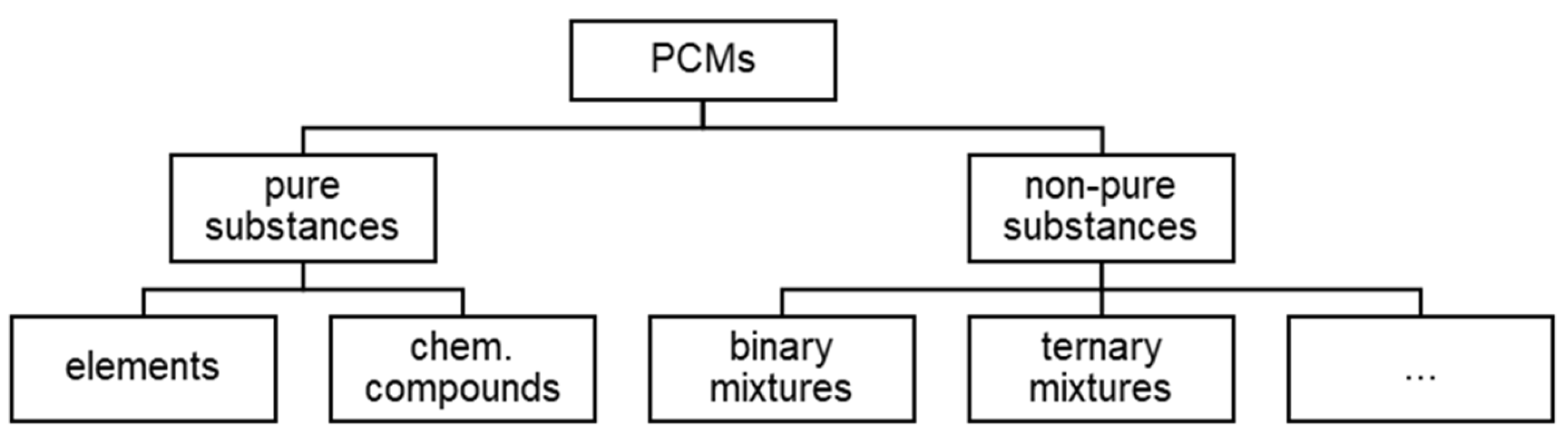
Figure 2.
Classification of binary mixtures as PCM (Mehling [7]).
Figure 2.
Classification of binary mixtures as PCM (Mehling [7]).
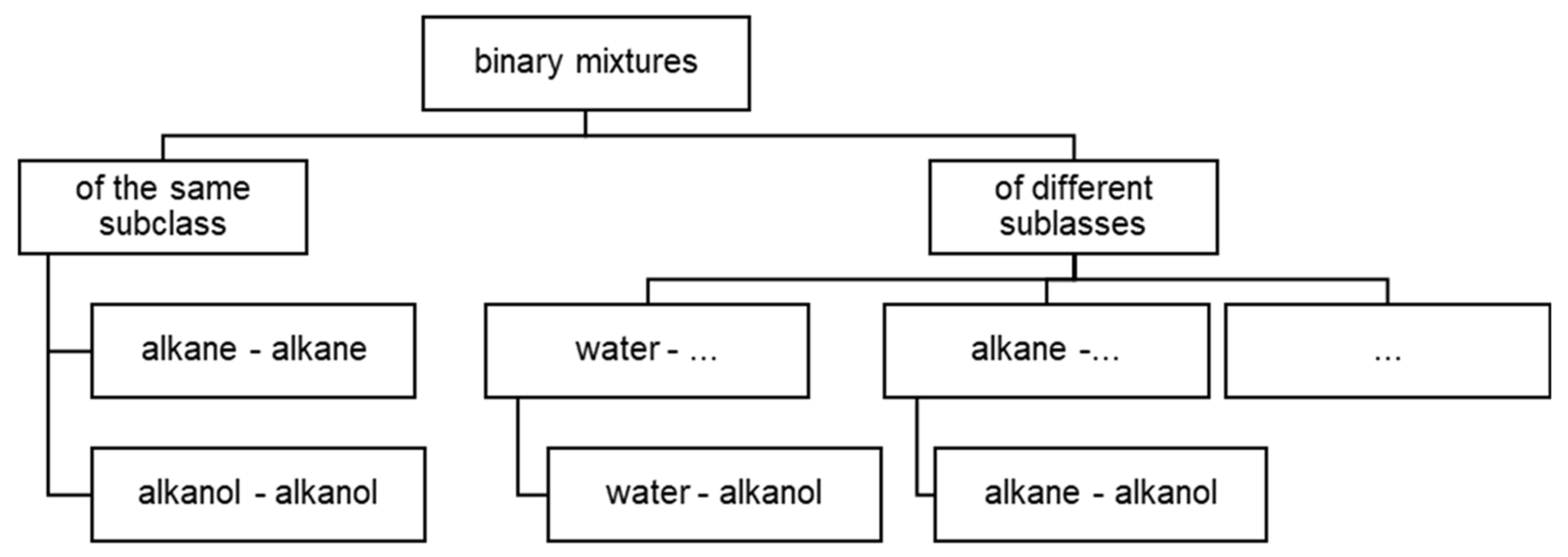
Figure 3.
Melting temperatures of 15 pure fatty acids and calculated ones for their binary eutectic mixtures (data source: Kahwaji and White [11]).
Figure 3.
Melting temperatures of 15 pure fatty acids and calculated ones for their binary eutectic mixtures (data source: Kahwaji and White [11]).
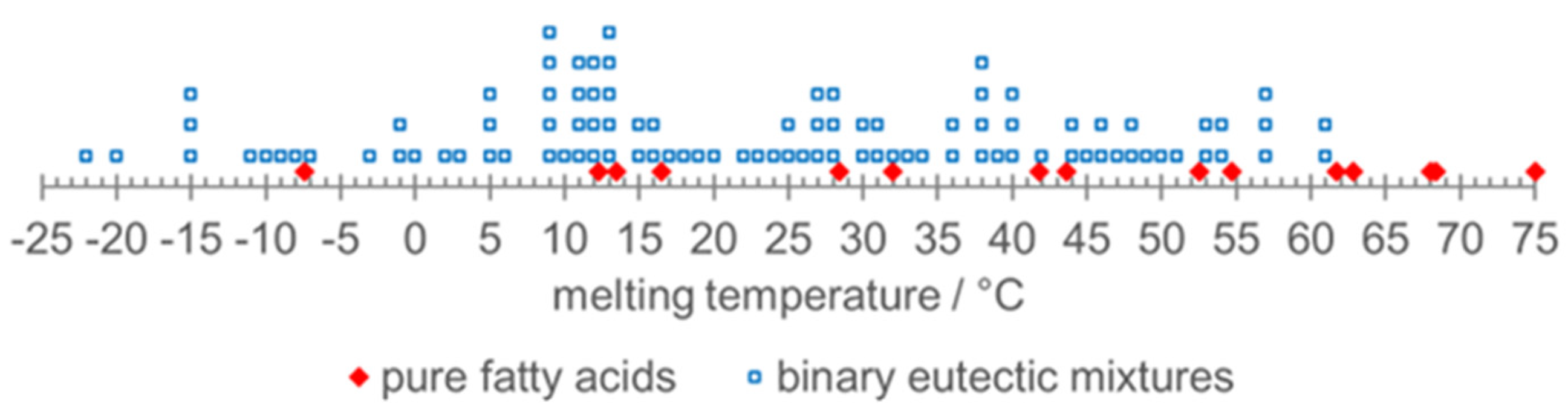
Figure 4.
Phase diagram (schematic) of H2O - CaCl2 mixtures in a wide composition range.
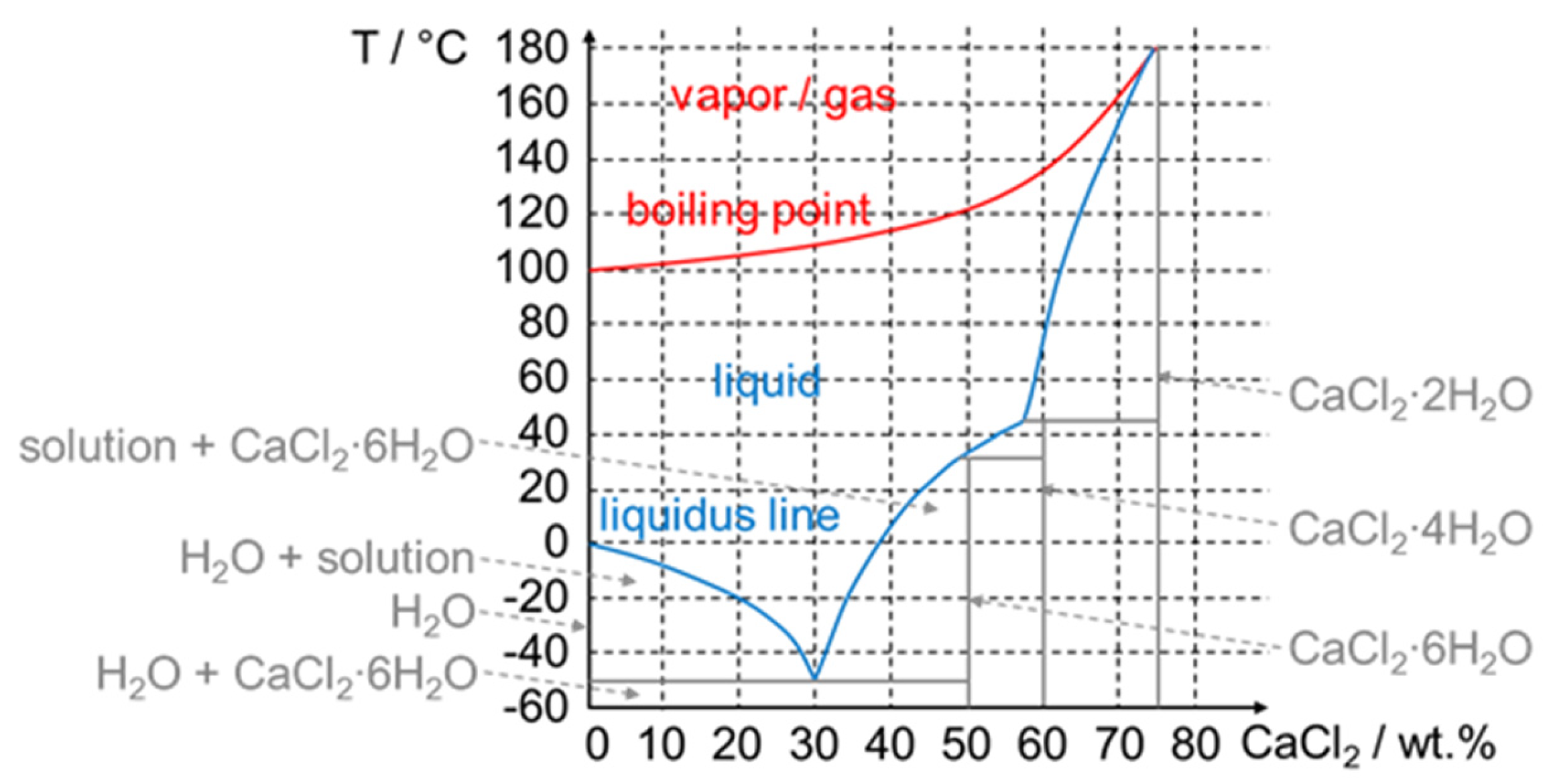
Figure 5.
Overview on options for binary mixtures.
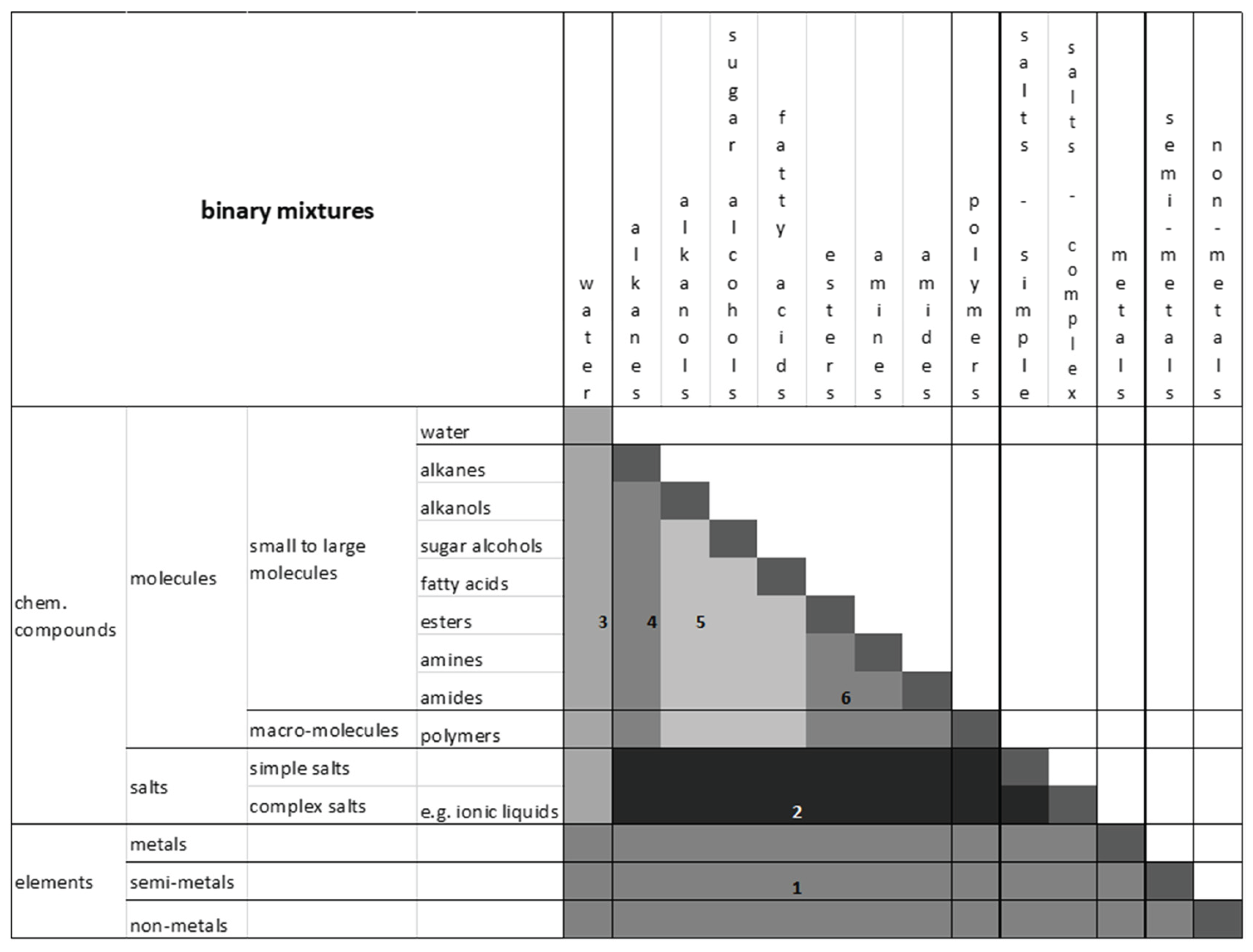
Disclaimer/Publisher’s Note: The statements, opinions and data contained in all publications are solely those of the individual author(s) and contributor(s) and not of MDPI and/or the editor(s). MDPI and/or the editor(s) disclaim responsibility for any injury to people or property resulting from any ideas, methods, instructions or products referred to in the content. |
© 2025 by the authors. Licensee MDPI, Basel, Switzerland. This article is an open access article distributed under the terms and conditions of the Creative Commons Attribution (CC BY) license (http://creativecommons.org/licenses/by/4.0/).
Copyright: This open access article is published under a Creative Commons CC BY 4.0 license, which permit the free download, distribution, and reuse, provided that the author and preprint are cited in any reuse.


