

Submitted:
05 July 2025
Posted:
08 July 2025
You are already at the latest version
Abstract
What began as a spiritual practice in India, yoga has transformed into a powerful global economic industry. This paper explores the economics of yoga through a comparison of the size, growth, and structure of the yoga market in India versus the rest of the world. The analysis draws on peer-reviewed articles, governmental publications, and industry reports to show how, through a systematic literature review, the transformation of yoga into a multi-billion dollar industry of wellness, fitness, technology, and tourism. As of 2023, the global yoga market is valued at approximately USD 107.1 billion and is projected to grow at a CAGR of 9.4%, while the yoga market in India is valued at USD 5.7 billion and is projected to grow at a CAGR of almost 12%. India, despite its historical roots, still has a minor percentage of the international market, which is ascribed to low commercialization, the cultural framing of yoga and price deviations. It also highlights the impact of state policy, particularly via the Ministry of AYUSH, in the promotion of yoga as a tool for public health and soft power. The industry is evolving with new trends like digital yoga platforms, wellness tourism, and green practices, and there are significant research gaps such as lack of standardized data and metrics of impact. Rather, the paper argues that an interdisciplinary and policy-driven approach necessarily needs to be taken in order to realize the economic benefits of yoga while maintaining its cultural and philosophical integrity.
Keywords:
yoga economy
; global wellness industry
; Indian yoga market
; yoga tourism
; digital yoga platforms
2 MKSSS’s Cummins College of Engineering for Women, Pune
3 Kasegao Education Society’s Rajarambapu Institute of Technology, Affiliated to Shivaji University Kolhapur
I. Introduction
Yoga, an ancient discipline originating in India, has become globally recognized for its benefits to physical, mental, and spiritual well-being [8,36,52]. With roots in Indian culture for over three millennia, it fosters a balance between body, mind, and spirit. Key milestones include UNESCO designating yoga as an Intangible Cultural Heritage in 2016 and the UN proclaiming June 21 as the International Day of Yoga in 2015, following India’s proposal supported by 177 member states [53]. By 2015, celebrations occurred in 192 countries, with over 400 million participants by 2022 [49]. The rising popularity of yoga is largely due to its well-documented health benefits, including stress reduction, improved mental health, and better cardiovascular function. It increasingly serves as a complementary approach in managing chronic illnesses where traditional medicine can be limited [36,38,51]. Consequently, it's being integrated into healthcare frameworks globally, especially in the U.S., where it enhances healthcare provider resilience [35,38]. In India, yoga acts as both cultural heritage and public health strategy, crucial for addressing lifestyle-related diseases amid high physical inactivity rates. The Ministry of AYUSH, established in 2014, promotes yoga within national health policies and advocates for its inclusion in physical activity guidelines [33]. As yoga becomes more commercialized, examining its economic dimensions is vital. This review will analyze global and Indian yoga market sizes, structural trends, growth rates, and key drivers of economic growth, focusing on cultural promotion, health trends, and government policy [33].
II. Yoga as an Economic Activity
Yoga has transformed from its ancient roots in India to a global economic powerhouse, merging with wellness, fitness, tourism, and digital technology. This shift has turned it into a multibillion-dollar industry, altering how it is perceived and practiced worldwide [34,42,51]. The economic impact of yoga is significant for individuals, organizations, and economies. In workplaces, yoga programs help reduce stress, improve productivity, and lower healthcare costs, offering measurable financial benefits, especially for small and medium-sized enterprises [16,77]. On a personal level, yoga promotes preventative health and decreases medical expenses, underscoring its value in overall well-being [16,72].
The yoga economy comprises various sectors, including studios that generate income through memberships and workshops, and teacher training programs that cultivate certified instructors. Yoga tourism, particularly retreats in places like Rishikesh, boosts local economies, with the global market valued at USD 154.11 billion in 2021 and projected to reach USD 256.90 billion by 2030 [34,88]. Additionally, the yoga apparel market is expected to reach USD 31.03 billion by 2024, driven by lifestyle branding and fitness trends [34]. Digital platforms have made yoga more accessible, particularly during the pandemic, significantly contributing to revenue in the wellness sector. However, access disparities persist, as high costs often exclude low-income populations, highlighting the need for inclusive initiatives [42,64]. The commercialization of yoga also raises important socio-cultural questions, including issues of authenticity and cultural appropriation as traditional practices intersect with market forces . Therefore, while yoga offers significant economic opportunities, it is crucial to govern it wisely to maintain its philosophical integrity and promote inclusivity in the wellness economy [18,42,45,50,61,75,86].
III. Methodology
This systematic literature review aims to analyze the economic aspects of yoga, focusing on market size, industry growth, and commercialization trends in India and globally. A comprehensive search was conducted using various academic and industry databases, including PubMed, Scopus, Web of Science, Google Scholar, Grand View Research, and Allied Market Research [4,5,10]. An extensive range of keywords was utilized, such as “yoga,” “economic impact,” “yoga industry,” “yoga tourism,” “global yoga industry,” and “yoga teacher training,” in different combinations with Boolean operators to ensure a diverse and representative sample [4,5,29,70,87]. Additionally, grey literature, including government reports and policy documents, was incorporated to enhance the review's depth [5,6,52]. The inclusion criteria focused on studies published between January 2019 and December 2024 while permitting key historical works for context. Eligible sources consisted of peer-reviewed articles, economic and policy reports, and industry analyses specifically addressing the economic dimensions of yoga in India or worldwide [4,5]. Studies were selected based on their empirical data related to market size, revenue, employment generation, and growth rates. In contrast, research emphasizing solely health benefits, editorial pieces, and non-English publications without reliable translations were excluded to maintain quality [4].
Data synthesis employed qualitative and quantitative methods. Thematic analysis identified major trends in commercialization, the globalization of yoga, employment, and tourism, while quantitative data on market values and growth rates were compared across Indian and global settings [5,84]. This systematic approach fosters a comprehensive understanding of the evolving yoga economy, offering valuable insights for policymakers, industry stakeholders, and academic researchers [5,6,52,84] .
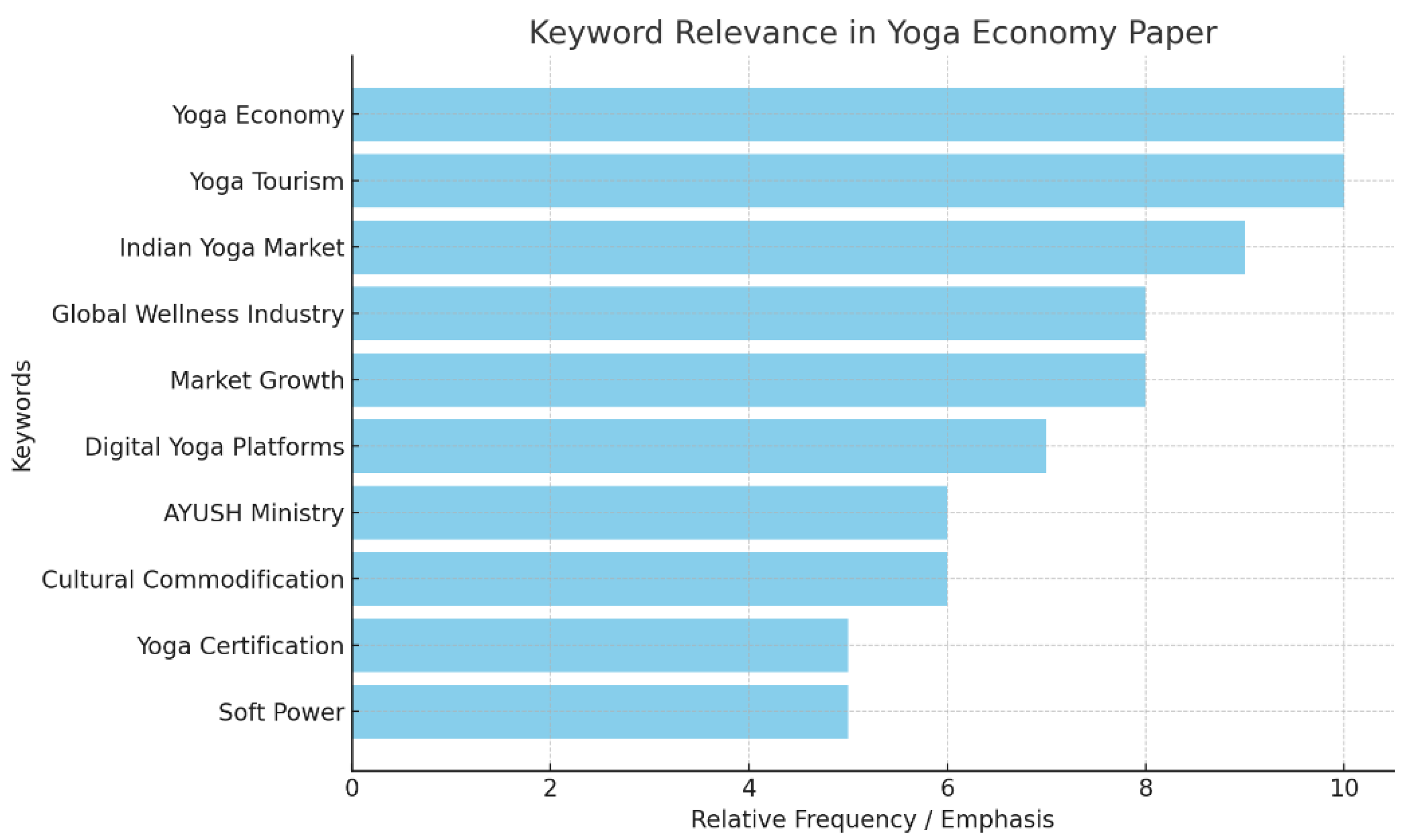
Figure 1.
Relative emphasis of key themes and keywords in the literature analyzed for this study.
IV. Global Market Size and Growth Trends of Yoga
Yoga has evolved significantly from its origins as a traditional Indian spiritual practice to a prominent global wellness trend. This shift has created a vibrant economic sector intersecting fitness, lifestyle, and tourism, reflecting yoga's cultural and commercial influence worldwide [32,52].
Figure 2.
Comparative analysis of yoga market size in India and globally from 2021 to 2030 (projected). India shows strong growth potential but remains a small fraction of the global market.
Figure 2.
Comparative analysis of yoga market size in India and globally from 2021 to 2030 (projected). India shows strong growth potential but remains a small fraction of the global market.
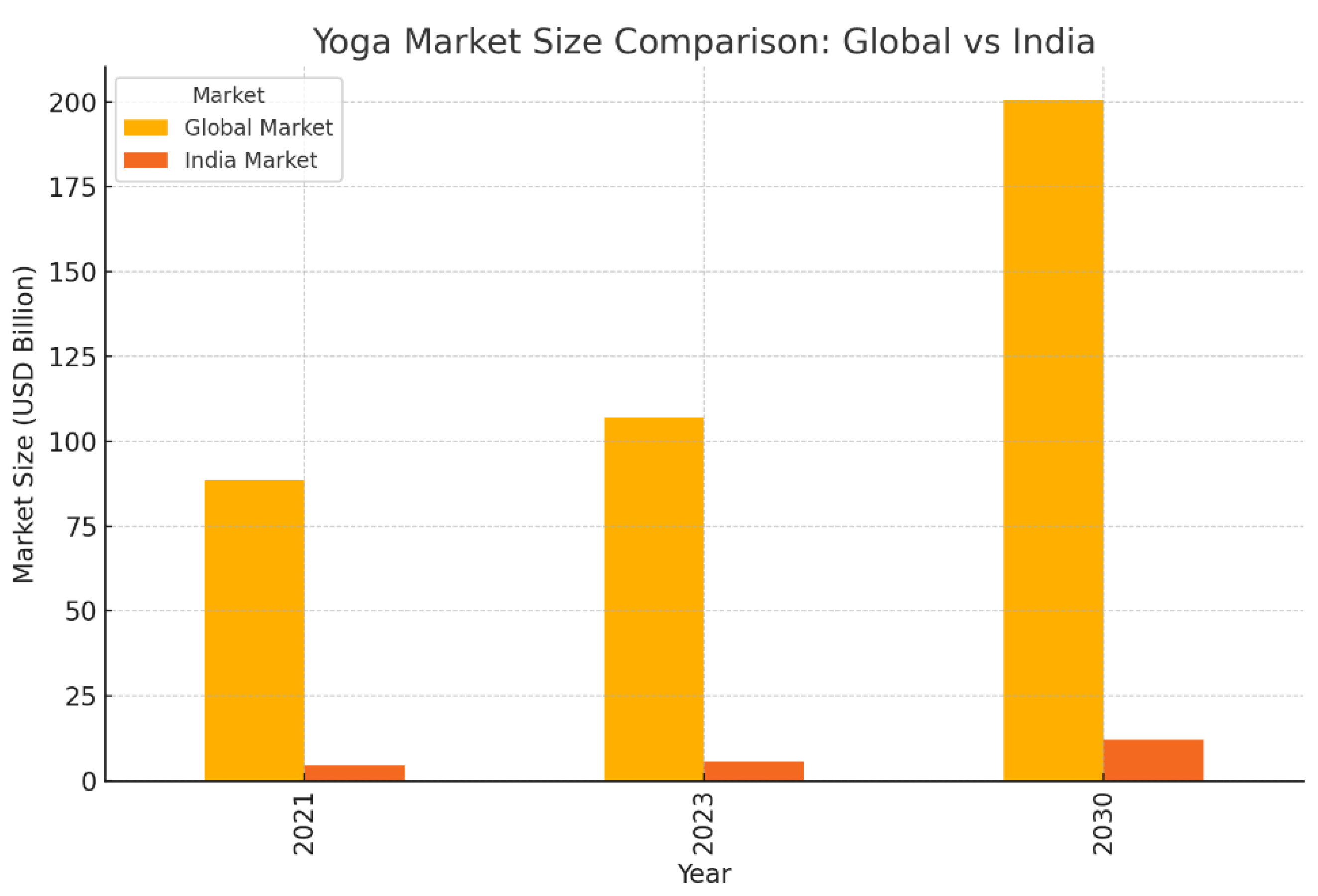
In 2023, the global yoga market was valued at approximately USD 107.1 billion, with a projected compound annual growth rate (CAGR) of 9.4%, expected to reach USD 200.35 billion by 2030 [32]. This growth is fueled by increasing participation, a rise in yoga studios, and greater integration into mainstream fitness and health sectors. The Asia-Pacific region, particularly China and Japan, held the largest market share at 37.2%, driven by heightened health awareness and supportive policies [32]. In North America, around 38.4 million Americans practice yoga regularly, highlighting its established role in the wellness economy [32]. The industry exhibits diverse segments, with yoga classes accounting for a 74.3% market share in 2023, showcasing a strong demand for community-based sessions [32]. The shift to digital has also spurred online classes, projected to grow at a CAGR of 10.5% as more people seek convenient options [32]. The burgeoning yoga tourism and retreats sector, valued at USD 154.1 billion in 2021 and expected to reach USD 256.9 billion by 2030 with a CAGR of 5.8%, highlights destinations like India and Thailand that attract wellness travelers [32,52]. Key players like CorePower Yoga and Pure Yoga are shaping the landscape, expanding both in-person and virtual offerings [52]. As yoga continues to integrate into the global wellness economy, its segmented growth in classes, products, and tourism reinforces its commercial significance for years to come .
V. Indian Yoga Market Size and Growth Trends
The Indian yoga sector has become a significant part of the country’s wellness economy, demonstrating remarkable growth. In 2023, the industry was valued at around USD 5.7 billion (₹4.7 lakh crore) and is projected to exceed USD 12 billion by 2030, reflecting a compound annual growth rate (CAGR) close to 12% [27]. This surge corresponds with the broader health and wellness market, estimated at USD 156 billion in 2024 [39]. Yoga tourism, a rapidly expanding segment, plays a crucial role in both domestic and international travel. International yoga tourists can spend up to USD 3,000 per visit, substantially benefiting local economies in areas like Rishikesh, Kerala, and Bihar [27]. In Bihar, yoga-related tourism contributes 30–35% to economic activities, underscoring its importance for local development [27]. Additionally, academic studies show that yoga tourism bolsters sectors such as hospitality and wellness services [13,52,82]. Employment in yoga-related fields—comprising instructors and wellness professionals—has surged by nearly 35% over the past decade [7]. India’s tourism sector, where yoga is central, supports over 76 million jobs and, by FY2023, had regained its pre-pandemic economic share [57]. The Indian government has supported this growth through the Ministry of AYUSH, promoting yoga on national and international stages, exemplified by initiatives like the International Day of Yoga [13,40,41]. The sector is diversifying, integrating traditional and modern approaches, with online yoga gaining traction alongside traditional offerings [27]. The convergence of yoga with Ayurveda enhances market segmentation, appealing to tourists seeking comprehensive wellness experiences [13,21,52].
VI. Comparative Analysis: India vs. Global Yoga Economy
The global yoga industry has seen remarkable growth, with its 2023 valuation estimated at approximately USD 107.1 billion and over 300 million practitioners around the world, emphasizing its role in the broader wellness economy [30,78].
Figure 3.
Yoga tourism revenue comparison between global and Indian markets (2021 and projected 2030). While India is a leading spiritual destination, it captures a small share of the global yoga tourism economy.
Figure 3.
Yoga tourism revenue comparison between global and Indian markets (2021 and projected 2030). While India is a leading spiritual destination, it captures a small share of the global yoga tourism economy.
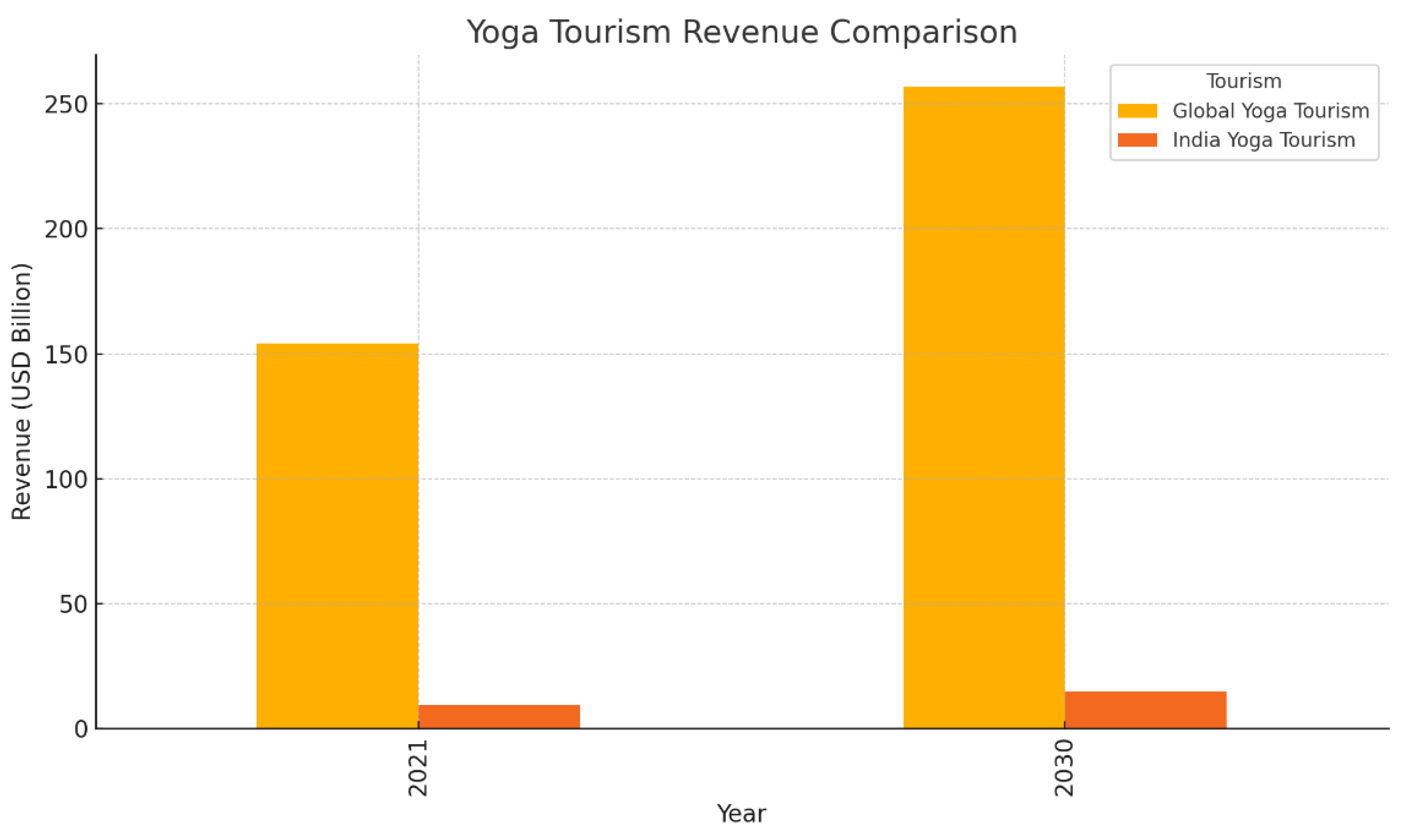
Although India is the birthplace of yoga and a key destination for yoga tourism, it only captures a small segment of this market. In 2021, while global yoga tourism was valued at USD 154.1 billion, India contributed merely USD 9.35 billion, accounting for just 6.1% of the total [28]. Although accurate data on India’s entire yoga market is scarce, it is clear that its economic impact is minimal compared to the global scale [28,30]. This disparity is influenced by various structural and cultural factors. In India, yoga is deeply intertwined with spirituality, cultural heritage, and public health initiatives often offered by community centers and ashrams, under programs from institutions like the Ministry of AYUSH and events like International Yoga Day [55,83]. Conversely, in Western nations, yoga has become a commodified wellness experience characterized by premium pricing, franchised studios, and branded merchandise [17,78]. As a result, the economic models differ significantly: Western yoga classes typically range from USD 15 to 30, with monthly memberships surpassing USD 100, while Indian classes are often donation-based or very low-cost. Consequently, Indian yoga instructors earn significantly less, with annual salaries between USD 2,500 and 4,000, compared to USD 30,000 to 50,000 in the U.S. [30]. Despite these challenges, India possesses distinct competitive advantages in the global yoga arena. It acts as a training hub for certified yoga professionals, attracting thousands of international trainees to renowned centers like Rishikesh and Mysore. India has also established the Yoga Certification Board (YCB) to promote standards and issue certifications through its diplomatic networks [15]. Furthermore, India’s emphasis on the authenticity of yoga as a culturally rich discipline differentiates it from Western interpretations, which often present it as merely a physical activity [17,55]. States like Uttarakhand and Kerala leverage this authenticity, drawing numerous wellness tourists and benefiting from integrated wellness practices like Ayurveda [12]. The digital transformation of yoga, accelerated by the COVID-19 pandemic, offers opportunities for India’s market expansion, allowing platforms like YogaVidya to extend their reach globally [56]. India’s promotion of yoga as a cultural export is bolstered by initiatives like International Yoga Day, which, initiated by Prime Minister Narendra Modi, enhances India’s soft power and economic engagement [79]. Despite its potential, India's yoga economy grapples with challenges such as informal practices, fragmented regulations, and growing competition, which complicate its growth path and risk cultural dilution through commodification.
VII. Emerging Trends and Future Prospects in the Yoga Industry
The yoga industry is experiencing a significant transformation driven by digital innovation, wellness tourism, international collaborations, and sustainability efforts. The COVID-19 pandemic accelerated the adoption of online yoga, with 47% of instructors teaching exclusively online and 46% using hybrid models, and over 84% of virtual class providers plan to continue this format post-pandemic, recognizing its accessibility and quality benefits [43,62]. Simultaneously, wellness tourism is boosting yoga tourism, projected to reach $651 billion in 2024, with yoga-specific tourism anticipated to grow to around $256.9 billion by 2030 at an annual rate of 5.8% [23]. India expects its yoga tourism revenue to jump from $9.3 billion in 2021 to $14.6 billion by 2030, driven by demand for experiences that integrate yoga with Ayurveda and cultural immersion in places like Rishikesh and Kerala [4]. Other regions, including Nepal and Indonesia, are also emerging as popular destinations [12]. International collaborations are enhancing the sector, with the UN declaring June 21 as International Day of Yoga and UNESCO recognizing yoga as an Intangible Cultural Heritage [47,54]. India's Ministry of AYUSH has partnered with over 50 countries to promote Yoga and Ayurveda, thereby bolstering India's standing in global yoga education . Establishing standards through bodies like the Yoga Certification Board (YCB) promotes trust in yoga instruction [47]. Sustainability is increasingly important, as concerns about environmental and cultural impacts grow. Yoga retreat centers are adopting eco-friendly practices like renewable energy and local sourcing, aligned with the United Nations Sustainable Development Goals [31]. Overall, the yoga economy is set for robust growth, with a global market estimated at around $107 billion in 2023 and expected to grow by 9–10% annually [23,62]. India's wellness tourism sector is projected to nearly double by 2030, emphasizing yoga's economic and health benefits , particularly as inclusivity efforts target underserved demographics. The future of the yoga industry appears bright, shaped by innovation, global wellness trends, partnerships, and sustainability [23]
VIII. Research Gaps and Future Directions
Despite the growing global interest in the yoga industry, significant research gaps remain that impede our understanding of its economic impact. A primary issue is the absence of consolidated, industry-wide economic data. Current studies often rely on fragmented sources—ranging from regional case studies to limited market analyses—which overlook the full extent of yoga's contributions in terms of revenue, employment, and socioeconomic effects [48,60,68]. This lack of cohesion is highlighted by varying market size estimates; for instance, Allied Market Research valued the global yoga market at about US$37.5 billion in 2019, while projections by Expert Market Research and Grand View Research suggest figures could reach up to US$256.9 billion by 2030 [5]. This signals an urgent need for standardized datasets and comparative meta-analyses to facilitate cross-country and longitudinal evaluations [2,48]. The yoga sector lacks widely accepted economic indicators, making it difficult to track its growth and diverse offerings that include in-person classes, digital platforms, and wellness retreats [22,48,68]. Future research should focus on developing sector-specific metrics capable of disaggregating the industry by service type and delivery channel. Moreover, there is limited exploration of yoga's broader socioeconomic impacts, including public health outcomes and gender equity [37,48,60,68]. Addressing these gaps will require innovative methodologies that integrate diverse data sources to provide a comprehensive understanding of yoga’s societal contributions [37,48,63].
Conclusion
Yoga’s transition from an esoteric and spiritual endeavor grounded in Indian philosophy to a global economic phenomenon is of a very particular order of transformative processes.
The previous chapter demonstrated the development of an internationally multi-billion dollar yoga industry, while the Indian market itself, although expanding rapidly, is relatively small.
India, despite being the home of yoga, remains a small player in the global yoga economy due to little commercialization, cultural and pricing disparities, and regulatory fragmentation. India’s authenticity, holistic wellness offerings, and government initiatives such as the Ministry of AYUSH and International Yoga Day, have positioned India to be not only the cultural leader but also the economic leader within the global wellness economy. New developments like virtual yoga platforms, blended teaching formats, and wellness tourism are beginning to redefine the yoga economy. But these challenges have also presented unique opportunities to define what an ideal ecosystem might look like, including standardized economic metrics, access models that are more equitable, and protections against cultural dilution. The way forward must be to have an interdisciplinary, policy focused and ethics centered approach that can help and support sustainable growth while respecting the spiritual core of yoga. As long as yoga remains progressive and innovative while respecting its roots, it can remain a strong cultural export and a valuable source of economic development and world good will.
References
- Ali-Knight, J., & Ensor, J. Salute to the sun: an exploration of UK Yoga tourist profiles. Tourism Recreation Research. 2017; 42. [CrossRef]
- Allied Market Research. (2020, September). Yoga market size, share, competitive landscape and trend analysis report, by type: Global opportunity analysis and industry forecast, 2021–2027 (Report Code: A06967). https://www.alliedmarketresearch.com/yoga-market-A06967.
- Bali, P., Kaur, N., Tiwari, A., Bammidi, S., Podder, V., Devi, C., Kumar, S., Sivapuram, M., Ghani, A., Modgil, S., Malik, N., & Anand, A. Effectiveness of Yoga as the Public Health Intervention Module in the Management of Diabetes and Diabetes Associated Dementia in South East Asia: A Narrative Review. Neuroepidemiology. 2020; 54. [CrossRef]
- Bhawra, J., & Katapally, T. P03-05 State of the Evidence of Active Living among Children and Youth in India: A Scoping Review Informing the Global Matrix 4.0. The European Journal of Public Health. 2022; 32. [CrossRef]
- Bowers, H., & Cheer, J. Yoga tourism: Commodification and western embracement of eastern spiritual practice. Tourism Management Perspectives. 2017; 24. [CrossRef]
- Cagas, J., Biddle, S., & Vergeer, I. When an activity is more than just exercise: a scoping review of facilitators and barriers for yoga participation. International Review of Sport and Exercise Psychology. 2020; 16. [CrossRef]
- Clarke, M. Yoga and the Gig Economy. Religions of South Asia. 2024. [CrossRef]
- Correa, D. (2024b, December 5). Yoga Market Size Forecasted to Grow at 9.6% CAGR, Reaching USD 66.2 billion by 2027. EIN Presswire. https://www.einpresswire.com/article/766493198/yoga-market-size-forecasted-to-grow-at-9-6-cagr-reaching-usd-66-2-billion-by-2027.
- Dayananda Swamy, H. R., & Agoramoorthy, G. (2021). The coronavirus pandemic impact on India’s Yoga tourism business. Yoga Mimamsa, 53(2), 145–148. https://doi.org/10.4103/ym.ym_116_21:contentReference[oaicite:7]{index=7}. [CrossRef]
- Dayananda Swamy, H. R.1; Agoramoorthy, Govindasamy2,. The coronavirus pandemic impact on India's Yoga tourism business. Yoga Mimamsa 53(2):p 145-148, Jul–Dec 2021. [CrossRef]
- Deka, B. The Soft Power Synergy: Ayurveda and Yoga in Contemporary Diplomacy. Electronic Journal of Social and Strategic Studies. 2024. [CrossRef]
- Dutta, A., Aruchunan, M., Mukherjee, A., Metri, K., Ghosh, K., & Basu-Ray, I. A Comprehensive Review of Yoga Research in 2020.. Journal of integrative and complementary medicine. 2022. [CrossRef]
- Embassy of India, Lisbon, Portugal : Press releases. (n.d.). https://www.eoilisbon.gov.in/news_letter_detail/?id=127#:~:text=To%20further%20the%20promotion%20of,under%20the%20following%20four%20categories.
- Falleiro, S. Economics of Yoga: Multi-Level Healthy Gains. Asian Journal of Research in Social Sciences and Humanities. 2016; 6. [CrossRef]
- Fish A. The Commodification and Exchange of Knowledge in the Case of Transnational Commercial Yoga. International Journal of Cultural Property. 2006;13(2):189-206. [CrossRef]
- Fish, A. The Commodification and Exchange of Knowledge in the Case of Transnational Commercial Yoga. International Journal of Cultural Property. 2006; 13. [CrossRef]
- Fish, A. The Commodification and Exchange of Knowledge in the Case of Transnational Commercial Yoga. International Journal of Cultural Property. 2006. [CrossRef]
- Future Market Insights. (2024, March). Yoga market analysis – trends & forecast 2024–2034. https://www.futuremarketinsights.com/reports/yoga-market.
- G. Role of Yoga in Viksit Bharat Vision 2047. International Journal of Multidisciplinary Research Configuration. 2024. [CrossRef]
- Global Wellness Institute. (2023). Global Wellness Economy Monitor 2023. Retrieved from https://globalwellnessinstitute.org/industry-research/llnessinstitute.
- Global Wellness Institute. (2024, December 10). Wellness Tourism Initiative trends for 2024. https://globalwellnessinstitute.org/global-wellness-institute-blog/2024/04/30/wellness-tourism-initiative-trends-for-2024/#:~:text=Wellness%20Tourism%20globally%20is%20now,wellness%20travel%20offering%20or%20business.
- Grand View Research. (2022, August). Yoga tourism market growth & trends. Retrieved 2024, from https://www.grandviewresearch.com/press-release/global-yoga-tourism-market (Yoga Tourism Market Worth USD 256.90 Billion By 2030).
- Grand View Research. (2024). Yoga Market Size, Share & Trends Analysis Report by Delivery Mode (Online Yoga Course, Offline Yoga Course), by End-use (Male, Female), by Age Group, by Region, and segment forecasts, 2024–2030. Retrieved from [https://www.grandviewresearch.com/industry-analysis/yoga-market-report](https://www.grandviewresearch.com/industry-analysis/yoga-market-report).
- Grand View Research. (2024). India yoga tourism market size & outlook, 2021-2030. Retrieved from https://www.grandviewresearch.com/horizon/outlook/yoga-tourism-market/india (India Yoga Tourism Market Size & Outlook, 2030).
- Grand View Research. (n.d.). India yoga market size & outlook, 2023–2030. https://www.grandviewresearch.com/horizon/outlook/yoga-market/india.
- Grand View Research. (n.d.). Outlook, 2021–2030: Global yoga tourism market highlights. https://www.grandviewresearch.com/horizon/outlook/yoga-tourism-market-size/global#:~:text=Global%20yoga%20tourism%20market%20highlights.
- Grand View Research. (n.d.). Yoga market size, share & trends analysis report by delivery mode (online yoga course, offline yoga course), by end-use (male, female), by age group (below 18 years, 18–29 years), by region, and segment forecasts, 2024–2030 (Report ID: GVR-4-68040-180-8). https://www.grandviewresearch.com/industry-analysis/yoga-market-report.
- Grand View Research. (n.d.). Yoga market size, share & trends analysis report by delivery mode (online yoga course, offline yoga course), by end-use (male, female), by age group (below 18 years, 18–29 years), by region, and segment forecasts, 2024–2030. https://www.grandviewresearch.com/industry-analysis/yoga-market-report#:~:text=The%20global%20yoga%20market%20size%C2%A0was,4%20million%20people%20in%20the.
- Grand View Research. (n.d.). Yoga market size, share & trends analysis report by delivery mode (online yoga course, offline yoga course), by end-use (male, female), by age group (below 18 years, 18–29 years), by region, and segment forecasts, 2024–2030 (Report ID: GVR-4-68040-180- 8). https://www.grandviewresearch.com/industry-analysis/yoga-market-report#:~:text=The%20global%20yoga%20market%20size%C2%A0was,4%20million%20people%20in%20the.
- Grand View Research. (n.d.). Yoga market size, share & trends analysis report by delivery mode (online yoga course, offline yoga course), by end-use (male, female), by age group (below 18 years, 18–29 years), by region, and segment forecasts, 2024–2030 (Report ID:GVR-4-68040-180-8). https://www.grandviewresearch.com/industry-analysis/yoga-market-report.
- Grand View Research. India Yoga Tourism Market Size & Outlook, 2030 (2022). (India Yoga Tourism Market Size & Outlook, 2030).
- Grand View Research. Yoga Market Size, Share, Growth & Trends Report 2030. https://www.grandviewresearch.com/industry-analysis/yoga-market-report (Yoga Market Size, Share, Growth & Trends Report 2030).
- Grand View Research. Yoga Tourism Market Size Worth USD 256.90 Billion By 2030. https://www.grandviewresearch.com/press-release/global-yoga-tourism-market (Yoga Tourism Market Worth USD 256.90 Billion By 2030).
- Grand View Research. Yoga Tourism Market Size, Share & Growth Report, 2022-2030. https://www.grandviewresearch.com/industry-analysis/yoga-tourism-market-report (Yoga Tourism Market Size, Share & Growth Report, 2022-2030).
- Guddeti, R., Dang, G., Williams, M., & Alla, V. Role of Yoga in Cardiac Disease and Rehabilitation.. Journal of Cardiopulmonary Rehabilitation and Prevention. 2019. [CrossRef]
- Gururaja, C., Rangaprakash, D., & Deshpande, G. Research Trends in the Application of Yoga to Human Health: A Data Science Approach. International journal of public mental health and neurosciences. 2020; 7.
- Harvard Health Publishing. (2015, November 18). Yoga and meditation offer health care savings—and you can do them at home. Retrieved from https://www.health.harvard.edu/blog/yoga-and-meditation-offer-health-care-savings-and-you-can-do-them-at-home-201511188616:contentReference[oaicite:8]{index=8}.
- Horiuchi, S., Flusberg, Y., Peterson, C., Mills, P., Chopra, D., & Kogan, M. Current Approaches to Yoga in U.S. Medical Schools: Scoping Review of the Literature.. Journal of integrative and complementary medicine. 2022. [CrossRef]
- IMARC Group. (n.d.). India health and wellness market report by product type (functional foods and beverages, beauty and personal care products, preventive and personalized medicinal products, and others), functionality (nutrition & weight management, heart & gut health, immunity, bone health, skin health, and others), and region 2025–2033 (Report ID: SR112025A5488). https://www.imarcgroup.com/india-health-wellness-market.
- Invest India. (2021, August 23). Wellness tourism: Relaxation for your mind, body, and soul. https://www.investindia.gov.in/team-india-blogs/wellness-tourism-relaxation-your-mind-body-and-soul#:~:text=government%20has%20taken%20various%20initiatives%3B,Wellness%20centres%20are%20also%20being.
- Invest India. (2023, June 14). Yoga Day 2023. https://www.investindia.gov.in/team-india-blogs/yoga-day-2023#:~:text=Since%20June%2021st%2C%202015%2C%20this,transforming%20it%20into%20a%20global.
- K. The Twisting Path: Yoga and its Commercialization Worldwide. International Journal For Multidisciplinary Research. 2025. [CrossRef]
- Kim, S. J., Solow, J., Lein, D. H., & Singh, H. (2024). Understanding the impact of COVID-19 on yoga instruction: Examining teaching methodology, class components, and injury patterns in the Northeastern US. Explore, 20(6), Article 103079. [CrossRef]
- Koch, A. Yoga as a Production Site of Social and Human Capital: Transcultural Flows from a Cultural Economic Perspective. 2013. [CrossRef]
- omati, M., Kamaly, P., Velvizhi, R., & Dr. Gujjeti Thirupathi. (2024). Yoga Tourism: A Journey towards Holistic Wellness. In International Journal of Advanced Multidisciplinary Research and Studies (Vols. 4–5, pp. 514–518) [Journal-article]. https://www.multiresearchjournal.com/admin/uploads/archives/archive-1727679997.pdf#:~:text=Economic%20and%20Cultural%20Impact%20Yoga,There%20are%20concerns%20about%20the.
- Kotecha, Vaidya Rajesh. Initiatives and achievements of the Ministry of Ayush towards its global propagation. International Journal of Ayurveda Research 3(1):p 4-8, Jan–Jun 2022. [CrossRef]
- Kumar, V. (2023). Yoga: a tonic for economy’s health. In K.T.Govt. College, IOSR Journal of Humanities and Social Science (pp. 68–70). [CrossRef]
- Kumari S. Yoga: An Ancient Practice in India’s Modern Diplomacy. Vivekananda Int. Found. (July 24, 2024). (Yoga: An Ancient Practice in India’s Modern Diplomacy | Vivekananda International Foundation) (Yoga: An Ancient Practice in India’s Modern Diplomacy | Vivekananda International Foundation).
- Li, J. Between Wellness and Elegance: Yoga Consumption in China. Journal of Consumer Culture. 2022; 23. [CrossRef]
- M., K., & P., C. THE IMPACT OF YOGA ON STRESS REDUCTION: EXPLORING ITS ROLE IN ACHIEVING SATTVIC STATES- A REVIEW ARTICLE. International journal of Indian medicine. 2024. [CrossRef]
- Manjula, K., P, K., R, V., & Thirupathi, G. Yoga Tourism: A Journey towards Holistic Wellness. International Journal of Advanced Multidisciplinary Research and Studies. 2024. [CrossRef]
- Manjula, K., P, K., R, V., & Thirupathi, G. Yoga Tourism: A Journey towards Holistic Wellness. International Journal of Advanced Multidisciplinary Research and Studies. 2024. [CrossRef]
- Manjunath NK. The Transformative Impact of the International Day of Yoga. Int J Yoga. 2023;16(1):1–4. ( The Transformative Impact of the International Day of Yoga - PMC ) ( The Transformative Impact of the International Day of Yoga - PMC ).
- Manjunath, N. K. (2022). Need for global standards in Yoga training. International Journal of Yoga, 15(2), 87–88. https://doi.org/10.4103/ijoy.ijoy_147_22 ( Need for Global Standards in Yoga Training - PMC ) ( Need for Global Standards in Yoga Training - PMC ). [CrossRef]
- Manjunath, N. K. (2023). The transformative impact of the International Day of Yoga. International Journal of Yoga, 16(1), 1–4. [CrossRef]
- Meryl. (2021, June 21). Yoga: Revolutionising the global fitness industry - IndBiz | Economic Diplomacy Division. IndBiz | Economic Diplomacy Division. https://indbiz.gov.in/yoga-is-transforming-the-global-fitness-industry/#:~:text=The%20demand%20for%20yoga%20exercises,though%20yoga%20studios%20were%20closed.
- Ministry of Tourism. (2025, February 4). Tourism as a key driver for employment and growth: Budget 2025–26 focuses on infrastructure, medical tourism, and heritage conservation. Press Information Bureau. https://pib.gov.in/PressReleasePage.aspx?PRID=2099519.
- Mohanty, S., Epari, V., & Yasobant, S. Can Yoga Meet the Requirement of the Physical Activity Guideline of India? A Descriptive Review. International Journal of Yoga. 2020; 13. [CrossRef]
- Mora, J., Berry, J., & Salen, P. The Yoga Industry: A Conscious Luxury Experience in the Transformation Economy. Luxury. 2018; 5. [CrossRef]
- Mordor Intelligence. (2024). India wellness tourism market – size, report & growth. Retrieved 2024, from https://www.mordorintelligence.com/industry-reports/india-wellness-tourism-.
- Nagaswami, M., Saper, R., Streeter, C., Uebelacker, L., Ding, G., Dalvie, A., Norton, R., Mischoulon, D., & Nyer, M. Yoga-Based Interventions in Low-Income Populations: A Scoping Review.. Journal of integrative and complementary medicine. 2024. [CrossRef]
- Oznalbant, E., & Alvarez, M. A Socio-cultural Perspective on Yoga Tourism. Tourism Planning & Development. 2020; 17. [CrossRef]
- Panjwani, U., Dudani, S., & Wadhwa, M. Sleep, Cognition, and Yoga. International Journal of Yoga. 2021; 14. [CrossRef]
- Patwardhan, A. Yoga Research and Public Health. Journal of Primary Care & Community Health. 2017; 8. [CrossRef]
- Pawar, J. HARMONY OF MIND AND BODY: STUDY OF IMPORTANCE OF YOGA IN HUMAN LIFE. International Education and Research Journal. 2024. [CrossRef]
- Poornima, A., & Surulinathi, M. (2019). Yoga research output in India: A scientometric study. Indian Journal of Information Sources and Services, 9(2), 85–90. [CrossRef]
- Prajapati, N. Impact of Fee Based Yoga Practice as a Cultural Services Product on prospects for Yoga Market in Mumbai. . 2019.
- Prakash, O. Yoga: Individual Prosperity and Indian Trade Opportunities. Political Economy - Development: Domestic Development Strategies eJournal. 2015.
- Press Information Bureau. (2022, November 12). India’s Ayush sector to increase its market share to USD 23 billion globally by 2023: Sarbananda Sonowal. Government of India. https://pib.gov.in/Pressreleaseshare.aspx?PRID=1875479.
- Puustinen, L., & Rautaniemi, M. Wellbeing for sale: Representations of yoga in commercial media. Temenos. 2015; 51. [CrossRef]
- Sahoo, U., Sharma, S. K., Chari, H., Nayak, S. R., Ali, W., & Muhammad, T. (2023). Examining the rural–urban differentials in yoga and mindfulness practices among middle-aged and older adults in India: Secondary analysis of a national representative survey. Scientific Reports, 13, 22095. [CrossRef]
- Satpathy, I., Patnaik, B., & Das, C. Yoga as an Innovative Solution for Financial Growth of Companies. Purushartha - A Journal of Management , Ethics and Spirituality. 2018. [CrossRef]
- Shaw, A., & Kaytaz, E. Yoga bodies, yoga minds: contextualising the health discourses and practices of modern postural yoga. Anthropology & Medicine. 2021; 28. [CrossRef]
- Swamy, D., & Agoramoorthy, G. (2021). The coronavirus pandemic impact on India’s yoga tourism business. Yoga Mimamsa, 53(2), 145–148. [https://doi.org/10.4103/ym.ym\_116\_21](https://doi.org/10.4103/ym.ym_116_21). [CrossRef]
- Swamy, D., & Agoramoorthy, G. The coronavirus pandemic impact on India's Yoga tourism business. Yoga Mimamsa. 2021; 53. [CrossRef]
- Telej, E., & Gamble, J. Yoga wellness tourism: a study of marketing strategies in India. Journal of Consumer Marketing. 2019. [CrossRef]
- Verified Market Research. (2025, February). Wellness tourism in India market size by type (Ayurvedic tourism, yoga & meditation retreats, spa tourism, medical wellness, natural healing), by location (domestic wellness tourism, international wellness tourism), by travelers type (primary wellness travel, secondary wellness travel), by service type (transport, lodging, food & beverage, shopping, activities & excursions), and region for 2024–2031 (Report ID: 477662). https://www.verifiedmarketresearch.com/product/wellness-tourism-in-india-market/.
- Webb, J., Vinoski, E., Warren-Findlow, J., Padro, M., Burris, E., & Suddreth, E. Is the "Yoga Bod" the new skinny?: A comparative content analysis of mainstream yoga lifestyle magazine covers.. Body image. 2017; 20. [CrossRef]
- Wieland, L. S., Cramer, H., Lauche, R., Verstappen, A., Parker, E. A., & Pilkington, K. (2021). Evidence on yoga for health: A bibliometric analysis of systematic reviews. Complementary Therapies in Medicine, 60, 102746. [CrossRef]
- Wikipedia. Rishikesh. https://en.wikipedia.org/wiki/Rishikesh (Rishikesh).
- market (Wellness Tourism Market in India - Size, Report & Growth).".
Disclaimer/Publisher’s Note: The statements, opinions and data contained in all publications are solely those of the individual author(s) and contributor(s) and not of MDPI and/or the editor(s). MDPI and/or the editor(s) disclaim responsibility for any injury to people or property resulting from any ideas, methods, instructions or products referred to in the content. |
© 2025 by the authors. Licensee MDPI, Basel, Switzerland. This article is an open access article distributed under the terms and conditions of the Creative Commons Attribution (CC BY) license (http://creativecommons.org/licenses/by/4.0/).
Copyright: This open access article is published under a Creative Commons CC BY 4.0 license, which permit the free download, distribution, and reuse, provided that the author and preprint are cited in any reuse.