

Submitted:
04 July 2025
Posted:
08 July 2025
You are already at the latest version
Abstract
Dysbiosis is the strategy to control insect pests through disrupting essential for their life cycle symbiotic bacteria. The olive fly Bactrocera oleae has been considered a suitable system for dysbiosis, as the insect is strictly dependent on its unique symbiont Candidatus Erwinia dacicola. Here, we review older and recent results from studies of the interaction of the symbiont and its host fly. We then discuss possible methods for disrupting the symbiosis as a means to control the fly. Specifically, we summarize studies using microscopy methods which have investigated in great detail the organs where the bacterium resides, and that they are always extracellular. Furthermore, we discuss how genome sequences of both host and bacterium can provide valuable resources for understanding the interaction, and transcriptomic analyses that have revealed important insights that can be exploited for dysbiosis strategies. We also assess the experiments where compounds have been tested against the symbiont. There hitherto limited efficacy in decreasing bacterial abundance suggest that novel molecules and/or new ways for delivery of agents will be important for successful dysbiosis strategies. Finally, we discuss how gene drive methods could be implemented in olive fly control, though a number of hurdles would need to be overcome.
Keywords:
Bactrocera oleae
; Candidatus Erwinia dacicola
; symbiosis
; fly-bacteria interaction
; dysbiosis
1. Introduction
The olive fly, Bactrocera oleae (Diptera: Tephritidae), is the most serious pest in olive production [1]. It is present in most areas where olives are grown, in countries around the Mediterranean Sea as well as in the Middle East and in South and East Africa, India, and Pakistan. It has also been reported in California, Mexico and Hawaii [2,3]. Damage by the insect incurs a huge economic cost in regions where olive cultivation is an important agricultural crop. In these areas damage can reach 80% of the value of olive oil and 100% of some table cultivars, with 5% of total olive production in the world affected [4]; for example, the cost has been estimated at 100 million Euros in Spain annually [1]. Control of the pest in the Mediterranean basin has been largely based on the use of chemical neurotoxic insecticides, and this has resulted in the development of resistance against many of the compounds used [5]. Furthermore, the ecological effects of insecticides encourage the development of new control methods based on environmentally friendly biotechnological approaches.
The fly is strictly dependent on the fruit of the cultivated olive tree (Olea europaea) and a few other closely related species for larval development. The female lays its fertilized eggs in the olive mesocarp, where the larvae develop through three instars concomitantly destroying the quality of the fruit. After completion of the third larval instar the larvae either leave the olive and falls into the ground or stay in the olive where they undergo pupation, and from the pupae adult flies emerge, with each adult female producing hundreds of eggs during several weeks [6]. For completion of the life cycle in the unripe olives the larvae are dependent on the presence of a symbiotic bacterium, named Candidatus Erwinia dacicola [7]. Figure 1 shows the life cycle of B. oleae, emphasizing the specific host tissues inhabited by symbiotic bacteria throughout its development. In all B. oleae populations the bacterium constitutes the vast majority of the gut microbial community, although a range of other bacteria have also been reported to be present in the fly [8,9]. The fact that the fly is dependent on the symbiont has raised the prospect that one possible tool to control the olive fly population would be through targeting the bacteria. In this review we summarize what is known about the symbiont and its interaction with the fly and its role in the life cycle of the host. We then describe possible methods for targeting the bacteria and the steps necessary to develop such intervention strategies for efficient control of B. oleae.
I) In adult flies, the symbiont is localized in the esophageal bulb (EB); GUT and ovipositor [OVI; present only in female adults (FA)]. Bacterial abundance is high in EB, which is entirely filled with bacteria, and in the midgut but drastically decreases after the malpighian tubule junction, indicating lysis during transit. During oviposition, the egg is smeared with Ca. E. dacicola; the specific interactions enabling the adhesion to the egg surface are unknown. ΙΙ) The female deposits the EGG into the olive mesocarp. III) The mechanism by which the emerging first instar larva acquires the symbiont remains unresolved. During the three larval instars (L), when the larvae feed and tunnel through the olive fruit, bacterial abundance increase from first to second instar and they are primarily localized in the gastric caeca and midgut. How the bacteria reach and colonize the gastric caeca remains unknown. As third instar larva prepare for pupation bacteria are discharged from the gastric caeca into the midgut where they are lysed. IV): In the PUPA bacterial abundance is very low to increase substantially shortly before emergence of the adult. The bacteria establish themselves and proliferate in the EB; the reason for this preference is not known. FG, foregut; MG, midgut; HG, hindgut. Figure created with BioRender.com
2. Biology of Bactrocera oleae – Ca. Erwinia dacicola Interaction
2.1. The symbiont Ca. Erwinia dacicola
In 1909 Petri published a microscopic study investigating the bacteria in the fly [10]. He observed high numbers of a rod-shaped bacterium in various fly organs, and described their morphology but was not able to cultivate them; this has been confirmed in later studies [7,11,12]. The major species of the bacteria was identified from DNA sequencing [7] which revealed that it is a Gram-negative bacterium belonging to the family Enterobacteriaceae. It is most similar to two plant pathogens belonging to the subgroup of Erwinia amylovora and to another Erwinia sp. identified from the congeneric B. biguttula which infests wild species of olives in Africa [13,14]. It was given the name Candidatus Erwinia dacicola and is considered an obligate symbiont, since the larvae cannot develop in unripe olives when lacking the bacterium. Since 2005 at least three haplotypes of the bacterium have been identified based on variations in their 16s rRNA sequences and these are associated with the fly according to its geographic distribution [3,14,15,16]. The few haplotypes of the bacterium are in contrast to the high genetic diversity of its host and is suggestive of a long-term association of host and symbiont. B. oleae diverged from other species about 25 million years ago, and from its sister species B. bigittula about 10 million years ago. The ancestor of Ca. E. dacicola may have been obtained at the earlier time point, possibly acquired from a free-living bacterium residing on the plant [14]. Its low genetic diversity can be explained by strong selective pressure [3]. Genome sequences have been obtained [17,18,19]; this will be discussed further in section 2.5.
Various other bacteria, as well as fungi co-occur with Ca. E. dacicola in the gut of larvae and adult olive flies (reviewed by [20,21]). Most of these are probably acquired randomly during feeding and represent transient additions to the core microbiome associated with the fly. Several species of the genera Pseudomonas, Acetobacter, Tatumella and Enterobacter have been highlighted for their apparent prevalence in the microbiome (see [21,22]). For the latter two genome sequences exist allowing detailed comparisons with the obligate symbiont [17,23]. The co-occurrence of these and other bacteria with Ca. Erwinia dacicola suggests that the microbiome is dynamic, and may deviate spatially and temporally in species composition. The functional significance of this apparent variance is still not clear. Possibly, alterations to microbial composition in the gut align functionally with the varying diet and nutritional gaps accompanying the life cycle of the fly, eventually contributing to overall fitness. Nevertheless, despite these variations the microbiome of olive flies remains conserved and dominated by Ca. Erwinia dacicola, and highly differentiated in terms of species composition, when compared to that of other fruit infesting Tephritids [17,23,24].
2.2. Abundance of Bacteria During the Life Cycle
The fluctuations of the bacteria during the fly’s life cycle have been reported [25,26,27]. The most detailed analysis compared samples from unripe and ripe olives [26]. In larvae derived both from unripe and ripe olives, the second instar larvae had the maximum number of bacteria, which decreased in the third instar samples. The lowest number overall was from the pupal samples. In adults derived from unripe olives the bacteria increased over time and the females contained more bacteria compared to the males. In young adults from the ripe olive samples the numbers increased compared to the pupae but were still very low. In this comparison there were much higher numbers of bacteria in the samples from ripe olives, but it is possible that this difference is due to ecological factors and not to the phenology of the fruit. This is supported by the report of seasonal variability of the bacterial load [28]. In this study unripe olives were collected monthly over four years and the numbers of symbionts was determined from dissected esophageal bulbs of the adult flies using qPCR. A consistent pattern emerged suggesting that changes in temperature and humidity correlate with bacterial load. Smallest numbers were recorded during September and December, due to low humidity and temperature, respectively.
Remarkable is the variation among individual samples in the study of Siden-Kiamos et al. [26], although each sample was pooled from five individuals. The reason for this variation is not clear, although ecological parameters could play a role. This raises cautions interpreting results from treatments intended to decrease bacterial load and necessitates careful choices of experimental conditions to minimize variation as well as inclusion of primary data in publications.
2.3. The Role of Ca. E. dacicola in the Adult and Larval Stages of the Olive Fly
The contribution of the bacterium to nutrition of adult flies has been investigated by reducing the abundance of the bacteria in the gut through continuous feeding with the antibiotic piperacillin; this did not achieve complete elimination of the bacteria but reduced the number of bacteria more than two orders of magnitude-fold in diets lacking protein, while less reduction was seen when feeding a complete diet [29]. In this and a further study adult wild females treated with the antibiotic (“aposymbiotic”) were compared to untreated females; both groups were fed on different diets and the fecundity was measured [30]. This revealed that fecundity was affected when the flies were fed on a diet missing essential amino acids or when urea was the only nitrogen source provided. Furthermore, when the flies were fed bird droppings the aposymbiotic females egg production was halved compared to the flies containing the symbiont. Taken together, these data suggest that the symbiont play a crucial role in providing the fly with essential amino acids and the utilization of nitrogen from urea to boost egg production. In the field bacteria may allow flies to meet their need for protein by sequestering otherwise unavailable nitrogen from bird droppings (e.g. urea and other compounds) and possibly also from honeydew – an unbalanced dietary source of amino acids. Analyses of draft genomes of the symbiont has shed further light on this issue and will be discussed in detail in section 2.6.2 [17,23]. Briefly, these results support the notion that Ca. E. dacicola is able to utilize urea as a source of nitrogen, but cannot recycle uric acid from waste products of the insect [23]. Furthermore, operons encoding pathways for the synthesis of some amino acid are present [17]. Taken together, these data support the notion that the symbiont is involved in the provision of nitrogen and possibly some amino acids for the needs of the adult fly, being especially necessary for the fecundity of the female fly.
The importance of the bacteria during the larval stage was first pointed out in 1966 [31,32], and further examined by use of antibiotics [33,34,35]. Later these findings were confirmed and this dependency was characterized in relation to the phenology of the olive fruit [8]. Female flies derived from the wild were treated with antibiotics and allowed to lay eggs in unripe or ripe olives, and compared to untreated controls. The ripe olives supported viability of both groups of larvae, but the aposymbiotic larvae did not develop in the unripe olives. Bacterial abundance was correlated with the length of the larvae and the authors suggested that bacteria are essential for overcoming the anti-nutritive effects of oleuropein - the olive's main defense compound. Oleuropein is a phenolic secoiridoid glycoside compound found in unripe olives. It is degraded in the fruit by plant enzymes producing highly reactive toxic molecules after mechanical damage by the olive fly ovipositor during egg laying, and act as defense molecules against the insect [36]. According to the findings of Ben-Yosef et al. [8], due to the effects of oleuropein larvae feeding in unripe fruit must contend with indigestible, cross-linked protein aggregates containing little lysine, an essential amino acid for the insect. Under such restrictions bacteria may be essential for obtaining sufficient protein. In ripe olives, where oleuropein is degraded, larvae are able to meet their protein requirements through their diet and independently of bacteria [8].
2.4. Association of the Symbiont with the Host
2.4.1. Larval Stage
The detailed description of the symbiont -fly interaction by Petri in 1909 [10] was based on microscopy to identify the organs of the fly where the bacterium resides. His observations are very detailed and still valid. Importantly, he observed the fluctuations in the abundance of the bacteria over the life cycle and how they colonize different compartments. In the larvae, the bacteria were found in the four lobes of gastric caeca (GCs), blind sacs that are found anterior to the midgut and just below the proventriculus. The bacteria are constantly dividing and are pushed out from the GCs. Just before pupation the bacteria are expelled from the GCs through a “squeezing” of the muscles surrounding the GCs and the bacteria are pushed into the midgut where they are possibly rapidly lysed. A recent study revisited these observations using modern microscopy techniques [26]. This study confirmed the findings of Petri, and carried out a more detailed analysis of the GCs. Importantly it showed that the bacteria were present in the lumen of the GCs, and not residing intracellularly as suggested previously [12], and that the epithelial cells were separated from the bacteria by a caeca membrane (similar to the peritrophic membrane). Furthermore, it revealed that the epithelial cells of the GCs with microvilli extending into the lumen had the hallmarks of metabolically active cells, which was more pronounced in the second instar samples compared to those of the third instar. The numerous bacteria in the GC lumen were observed as dividing cells but also in various stages of lysis in the second instar larvae while the GCs of the third instar larvae were devoid of bacteria.
2.4.2. Pupal and Adult Stages
Petri [10] also followed the bacteria during the pupal and adult stages. He reported that at pupation a few bacteria were detected in the proventriculus (PV) and in the posterior region of the esophagus. During pupation the midgut and the gastric caeca disappeared, and the bacteria remained in the PV and the beginning of the esophagus. In adult olive flies the bacteria were found to associate with the host in dedicated sections of their foregut and midgut [10]. A primary organ facilitating this symbiosis was the bulb-shaped diverticulum of the esophagus, located in the head of the adult fly (i.e. the esophageal bulb, EB). The bulb was formed de novo in the emerging adult and colonized with a small number of bacteria. In the adult the bacteria continued to multiply in the EB and were continuously expulsed into the esophagus as bacterial masses discharged through a narrow opening. When passing through the midgut the bacteria were held together in oval or polyhedral shapes, but after the joint with the malpighian tubules very few bacteria remain, suggesting that they eventually undergo lysis as they transit to the hind section of the midgut [10]. Similar observations were reported using modern microscopy [37]. These observations suggest that the bacteria are digested in the gut and consequently contribute nutritionally to the fly.
2.5. Vertical Transmission of the Bacteria
In many insects, vertical transmission of extracellular symbionts has been described (review [38]). Vertical transmission can be achieved by several routes. Some insects deposit a jelly or capsule on the eggs, while another route is through trophallaxis, that is exchange of bacteria via mouth-to-mouth or anus-to-mouth feeding, or the bacteria can be smeared onto the egg, and then taken up by the larvae through feeding. The first option is not sustained by experimental data for Ca. E. dacicola. Trophallaxis has been reported in two studies. Ca. E. dacicola [39,40]. However, in neither of these were the offspring tested for the symbiont and it is possible that the bacteria were only transiently associated with the flies. Another study tested the offspring similar experiments but this did not reveal any transmission of the bacterium from one generation to the next [41]. Thus, stable association of insect and bacterium is dependent upon transmission via the egg at least in the laboratory setting, although it cannot be ruled out that in nature other routes of transmission are sometimes used.
The transmission of the bacteria from the female to the egg was analyzed in detail by Petri [10]. He described the anatomy of the ovipositor where the vagina and rectum were joined in a common duct (cloaca). Blind diverticula (also called anal glands) lined the duct with a narrow opening towards the rectum. The symbiont was residing in the diverticula, which was further investigated by microscopy analysis [37] and later confirmed by transmission EM analysis [12]. Petri (ibid) suggested that the egg is smeared with the bacteria when passing through the common duct and in the deposited egg he detected the bacteria surrounding the micropylar region [10]. These observations were later confirmed in EM analyses showing bacteria inside the micropylar area [37,42] and also on the outside of the ovipositor [42]. The bacteria in the micropylar region were identified as Ca. E. dacicola using molecular tools [43]. Furthermore, washing the eggs with disinfectants removed the bacteria, confirming that they are present on the surface and not internalized in the egg.
2.6. Genomic and Transcriptomic Analysis of Host-Symbiont Interaction
2.6.1. Genomic and Transcriptomic Analyses of B. oleae
An assembled and annotated genome of B. oleae with a total sequence length of 468,8 Mb is available, although many gaps still remain in the sequence [44]. The DNA sequence was complemented with RNA sequences obtained from different life stages and organs of the insect. Combined these sequences are estimated to cover most genes (>90%). The genome, even if not complete, constitutes a valuable resource for studies of the fly, and makes it possible to carry out meaningful transcriptomic and proteomic analyses.
Until now to the best of our knowledge no proteomics studies have been reported, but two analyses exist of differential gene expression. A comparison of wild larvae developing in unripe and ripe olives was carried out using a microarray platform [45]. This revealed that the larvae developing in unripe olives overexpressed genes involved in protein digestion as well as detoxification, reflecting the insect’s response to the harsh environment in the unripe olives. In the ripe olives lipid metabolic process were more pronounced reflecting the high oil content in these olives [45]. The transcriptomic profiles of gastric caeca of second instar larvae collected from the wild compared with those of a laboratory strain shed light on processes taking place in this organ [26]. The wild sample contained the symbiont, while the latter did not, and therefore changes in gene expression may reflect the response of the fly to the bacterium. Specifically, expression of genes encoding proteolytic enzymes and peptidases were upregulated in the field sample, that are putatively important for digestion of proteins derived from the bacteria. Genes coding for proteins with a role in the immune response were also upregulated in the second instar wild larvae suggesting a direct role in the interaction with the bacteria [26].
2.6.2. Genomic and Transcriptomic analyses of Ca. E. dacicola
2.6.2.1. Genome Sequencing of Ca. E. Dacicola Reveals Metabolic Function Complementing Host Needs
Six assembled genomes are available in the NCBI database (https://www.ncbi.nlm.nih.gov/datasets/genome/?taxon=252393), none of which is yet complete. The genome size is estimated to be roughly 3 Mb and the number of genes annotated vary between approximately 3-4 000. Two analyses of the symbiont genome have been published. Estes et al. [17] combined data of multiple datasets [18,19,45] that indicated that >98.5% of the genome was covered [17]. In this study, identification of gene products contributed to the understanding of the functions of the bacterium in relation to the host. Analysis of metabolic pathways revealed that proteins involved in the biosynthesis of a limited set of amino acids are present. Olives are rich in aspartate and arginine, and the bacterium has multiple pathways to degrade these amino acids although there is overall a limited set of amino acid degradation pathways. The genome encodes complete sets of genes for glycolysis and TCA cycle but lacks glyoxylate cycle and fermentation; a limited number of genes of enzymes for carbohydrate degradation were identified. The olive is rich in lipids, but no genes encoding proteins for lipid degradation were identified [17].
As discussed in section 2.3 the adult flies consume diets which may contain inaccessible nitrogen (e.g. in form of urea) but lack genes to utilize these nitrogen sources. At the same time the gut microbiome was recorded to benefit fecundity under these conditions, probably due to Ca. E. dacicola [30]. The bacterium encodes proteins for nitrogen assimilation which is tightly regulated in bacteria via nitrogen control involving several proteins and three genes of this category were identified [17]. Furthermore, an operon, located in a putative gene island, contains genes encoding the structural proteins of the enzyme urease, accessory proteins and the transcriptional regulator. This operon is lacking in other bacteria of the Erwinia genus and was possibly acquired from a free-living microorganism via horizontal gene transfer [23].
Evidence for genetic exchange of Ca. E. dacicola has been documented in two cases. A putative example of lateral transfer of a genetic region with genes encoding metabolic pathways was identified. A roughly 7 kb region, possibly flanked on both sides by a transposase, contained genes for metabolic pathways (genes for amino acid transport/metabolism, lipid metabolism and a partial gene for energy metabolism). A phylogenetic analysis suggested that it may have been obtained from Pseudomonas savastanoi pv. savastanoi, a bacterium causing olive knot disease. Another example of genetic exchange is the pTA1 plasmid from the co-symbiont Tatumella, which is present in certain populations of B. oleae. It was identified in the Ca. E. dacicola genome from a sample which does not contain Tatumella, and was putatively acquired via conjugative transfer as the plasmid may be self-transmissible [23]. Ca. E. dacicola is missing several genes encoding flagellar proteins, an organelle responsible for motility [17]. The genome was analyzed for the presence of mobile genetic elements (MGE) which were present at an unusually high fraction, a hallmark of recent establishment of symbionts [23]. The analysis further revealed that the genome size and GC/AT content of Ca. E. dacicola was similar to free-living relatives, in contrast to other symbionts that have a reduced genome size and a skewed nucleotide composition of their genomes. The lack of certain genes encoding proteins involved in carbohydrate and amino acid transport, metabolism and cell motility indicate that some functions have been lost during co-evolution of host and symbiont [17].
Taken together, the genome analysis reveals that Ca. E. dacicola is unable to fully complement the dietary limitations of the olive fly. However, as the genome is not yet complete and a number of genes encoding proteins of unknown function may fulfill roles in these processes this may be an underestimate of its metabolic capacity. Furthermore, other bacteria are also present in the fly and these may satisfy some of the requirements of the insect during development. As an example, a comparison of Ca. E. dacicola to an Enterobacter sp. also derived from B. oleae found this to be the case for certain processes important for the survival of the fly [17]. Furthermore, in some B. oleae populations a co-symbiotic bacterium named Tatumella sp has been identified which encodes enzymes lacking from the host and Ca. E. dacicola [23].
2.6.2.2. Transcriptomic Comparison of Ca. E. dacicola Developing in Unripe and Ripe Olives
A transcriptomic comparison of the symbiont isolated from gastric caeca of larvae developing in unripe and ripe olives was carried out before the availability of the genome sequence; for this analysis the genome was reconstructed from pooled transcriptomic sequences [45]. The size of this reconstructed genome and the number of genes was somewhat lower compared to the genome sequence described above [17,18]. The comparison revealed overexpression in the unripe olive sample of genes involved in genetic exchange and the metabolism of aromatic, nitrogen and nucleobase-containing compounds as well as of several genes encoding proteins with a putative role in detoxification of oleuropein; in the sample from ripe fruit a different set of processes were noted though with marginal statistical support.
3. Targeting the Symbiont for Olive Fly Control
3.1. Antisymbiotic Approaches—Laboratory Experiments
In B. oleae only a limited number of reports have been published on experiments targeting the bacteria with antibacterial agents (Table 1). In two studies [8,29] the antibiotic piperacillin was used for laboratory experiments to explore the role of the bacteria in the adult and larval stages of the fly. In both cases adult flies originating from the field were continuously treated for approximately three weeks, and, in the case of the larvae, they were derived from eggs laid by the treated females. This resulted in a reduction of the bacteria in the adult and larvae of roughly three to four orders of magnitude, but did not achieve their complete elimination. Another study tested the antibiotic streptomycin and analyzed its effect on the total gut microbiome using DNA sequencing, but no effect on the microbiome composition was detected [9]. As Ca. E. dacicola cannot be cultured it is difficult to differentiate between genetic resistance to antibiotics and the difficulty of the agent to reach the bacteria for efficient killing. Resistance to antibiotics occurs at a high frequency during treatment, and it is possible that in the case of the prolonged treatment with piperacillin resistance occurred and thus elimination was not achieved [46]. Arguing against this hypothesis is that bacterial abundance was considerably reduced, which would not be expected if genetic resistance had occurred.
Studies have also tested the effect of antimicrobial compounds on the transmission of the bacteria via the egg (Table 1) [43,47]. Both direct application to the egg and indirectly to the infested olive have been tested. The results suggest that a ten-fold reduction in bacterial load can be accomplished by the treatment of olives with dodine.
Copper compounds as antibacterial agents have attracted interest and four published studies are available; in all of these the compounds were provided orally to adults (Table 1). Copper salts did not result in any significant reduction in the abundance of Ca. E. dacicola in the resulting eggs [48]. Copper Oxychloride treatment resulted in a reduction of endosymbiotic load in adult esophageal bulb and midgut which reached more than 50% at the higher concentrations tested compared to the control. Offspring was not tested [46]. However, in another study with the same compound there was no significant decrease in bacterial load comparing esophageal bulbs from the treated and control samples [47]. In a fourth study bulk and nanosized copper compounds were provided to the flies. A significant decrease in bacterial load in the treated adults was found, with a more pronounced effect on the bacteria in the esophageal bulb [49]. Taken together, the results of these studies are largely discouraging as the effects on the symbiont of copper compounds are limited.
In conclusion, it might be possible to target the bacteria with different antibacterial agents at various stages in the life cycle. The antibiotic piperacillin has shown most promise but it didn’t eliminate the bacteria even during prolonged application. Piperacillin is only one of many antibiotics and it is possible that agents with different modes of action could be more efficient. Field application of antibiotics that are used in humans and animals is however problematic. On the other hand, antibiotics may constitute important tools for studying the role of the symbiont in the laboratory, as has already been shown by the studies reported above. Copper compounds have advantages as they are already used in agriculture being cheap to produce and considered safe for food production, but their low efficacy is a major impediment for use to target the symbiont. However, the fact that so far, no agent has shown the ability to radically affect viability of the bacterial symbiont shows that new approaches should be investigated.
3.2. Disruption of Symbiosis in Other Insects
Bacterial symbionts are found in many insects where they contribute to the host fitness [50]. In the agricultural pest insects of the family Pentatomidae the symbionts are considered possible targets for control; in this case the bacteria are smeared onto the egg which are oviposited on crop surfaces [51]. Treatments of egg masses of Halyomorpha halys with antibacterial formulations have resulted in disruption of the acquisition of the symbiont [51]. These results suggest that extracellular symbionts that are exposed to the environment could be targeted directly.
For intracellular symbionts the situation is more complicated as the bacteria are not exposed to the environment. In many insect pests feeding on plant sap the bacteria reside in specialized cells called bacteriocytes. One example is Aphids that depend on the endosymbiont Buchnera aphidicola here the symbionts reside in a dedicated organ called the bacteriome [52]. In this system RNAi has been suggested as a technique for control of the host via interfering with its interaction with the symbiont. In one study two putative immune modulators were down regulated using RNAi which resulted in reduction of the abundance of the symbiont [53]. Another approach used synthetic single-stranded peptide nucleic acids (PNAs) to decrease expression of the bacterial chaperone groEL which led to significantly reduced titer of Buchnera [54]. These latter two studies indicate that it may be possible to target the symbiont with specific effectors that could be genetically encoded in the host insect or in the plants the insect feeds on.
3.3. Biotechnology Approaches for Targeting the Symbiont
Strategies to genetically modify insects to reduce their ability to transmit microbes is a subject that is intensely worked on, especially as a tool for eliminating or eradicating malaria (for recent review see [55]). This entails the release of gene modified organisms that express factors that interferes with the viability of the microbe. Furthermore, the spread of the genes encoding these factors into the existing population is achieved by the use of genetic mechanisms such as the CRISPR/Cas9 system; this is called gene drive. While the subject is complex and beyond the scope of this review it is of interest to mention the major components that would be required for such a strategy to target the symbiont in the olive fruit fly and achieve population decline of the insect. The effector should target Ca. E. dacicola with high specificity and efficacy. In mosquitoes, antibacterial peptides and single-chain antibodies have been used to target the malaria parasite [56,57]. These effectors should be expressed under the control of a stage specific promoter active in the organs where the microbe resides for maximal effect [56,57]. The gene drive system to be used should aim for spread of the modified locus in the population, and CRISPR/Cas9 system is ideal for this purpose. This short description makes it clear that the development of such a system requires detailed research both of the bacterium and the host. Furthermore, the population to be released carrying the gene drive needs to be compatible with the wild population and be competitive for mating. Other aspects that need to be taken into consideration for such a strategy is the spread of the gene drive in the population and the possibility of mutations disrupting the intended spread. Finally, the release of gene modified insects has environmental and social implications that need to be carefully weighed into the possible gain. We consider that for the olive fruit fly such a strategy should be looked into, and certain aspects could be part of the research agenda already (effectorss, promoters, modelling of gene drive). However, the limited resources in this field, compared to that of the mosquito, impedes the rational design and implementation of gene drive but the experience from other systems may in the future make this an attractive option for olive fruit fly control.
4. Discussion
Importantly, Tephritidae have been suggested as ideal candidates for targeting symbiosis as a means to control the insects [51]. However, the difficulties in the developments of such strategies necessitate deeper knowledge of the interaction of the host with the symbiont. In the following we highlight some research questions that we consider to be critical for understanding symbiosis in the olive fruit fly.
1. What is the critical function of the symbiont in larval stage? The essential role of Ca. E. dacicola in the larvae developing in unripe olives is not yet clarified. One possibility is the synthesis of amino acids by the bacteria which are made available to the host by digestion of the bacteria, thus overcoming the nutritional restriction by oleuropein. This notion is supported by reports that lysis of the bacteria take place in the gastric caeca and that genes encoding digestive proteases are differentially expressed in larvae harboring the bacterium compared to aposymbiotic samples [26]. Alternatively, the bacterium may directly contribute to the detoxification of oleuropein in larvae thus increasing the availability of the fruit’s protein. Other possibilities include providing precursors for molecules secreted by the larvae which ultimately deactivate oleuropein. Symbiotic bacteria of many insects play a direct role in the defense against plant toxins utilizing a multitude of pathways (for a review see [58]) and this aspect could be investigated for Ca. E. dacicola using as starting point the genome sequences. Metabolites in the caeca could also be directly identified by metabolomic analyses.
2. What is the role of the symbiont in the adult? The current evidence points to the function of the symbiont in supplementing the poor nutrition of the fly, especially the lack of a nitrogen source [29,30]. This is supported by the fact that the bacteria eventually undergo lysis as they transit to the hind section of the midgut [10]. Other Tephritids share similar gut morphologies with B. oleae and also cultivate a large and metabolically active mass of bacteria which are digested [59]. Adult olive flies and other Tephritids may be regarded as specialized to gain nutrition by digesting bacteria propagating internally and thus, they do not rely on external microbes for gaining nutrition. Similar mechanisms can be seen in the bacteria-directed digestive physiology of dipterans, for example cyclorhaphus Dipterans such as Drosophila and other flies which are evolutionary specialized for obtaining nutrition by digesting microbes, although in this case the microbes are obtained from the environment. [60,61].
The specific function of the esophageal bulb, which is found also in other Tephritids, is unknown. At least in Ceratititis capitata and Rhagoletis pomonella this organ harbors bacteria [62,63]. In the olive fly it maintains the association with the symbiont by enclosing the symbiont and in addition it may keep harmful microbes outnumbered. Crucial knowledge that is lacking are the specific characteristics of the esophageal bulb that allow bacterial reproduction. Proteomic or transcriptomic analyses of this organ may suggest specific proteins that are crucial for the symbiont and that may constitute targets for interventions.
3. What is mechanism for vertical transmission of the symbiont? In the laboratory transmission to the next generation in strictly dependent upon maternal transfer of the symbiont [41] although trophallaxis may take place [39,40]. This should be investigated under simulated field conditions, and establish whether the symbiont is stably transmitted for several generations if acquired by trophallaxis. The detailed mechanism for vertical transmission of the symbiont, for example whether special interactions are necessary for the bacterium to adhere to the egg during oviposition, remains to be clarified. Vertical transmission has been suggested as a target for intervention [51], although complicating this issue is that the process largely takes place inside the ovipositor as it penetrates the olive mesocarp. However, promising results have been reported from treatment of the olive fruit and new formulations may lead to improvement of penetration of the fruit [47].
The exact mechanism of the uptake of the bacteria in the young larva is not completely resolved, as well as how they reach the gastric caeca. Imaging carefully staged eggs could provide more information. Fluorescently labeled bacteria would be ideal for identifying their position and proliferation, and this method was successfully used for the establishment of synthetic insect-bacteria mutualism between the grain weevil and a free-living relative of the symbiont Sodalis pierantonius [64]. However, this would require the generation of transgenic bacteria which would be challenging, given that the symbiont cannot be cultivated. Alternatively, an antibody recognizing the bacterial surface could be useful for this purpose.
4. How can Ca. E. dacicola be cultivated? It will be clear from this review that one important hinder in studying symbiosis in B. oleae is the fact that the symbiont cannot be cultivated using standard media as well as more specialized media for bacterial culture [7,12]. To be able to test growth in a systematic fashion analysis of the genome may provide clues for critical requirements of the bacterium. Comparisons with genomes with relatives, for which complete genome exist, within the genus could be one starting point. One drawback is that as the genome is not yet complete of Ca. E. dacicola the lack of specific genes may be because the specific genome sequence is missing. Thus, completion of the sequence would be worthwhile. Alternatively, if a limited list of candidate genes is put together, based on the present genome sequences, the presence of the specific genes could be determined directly via PCR.
5. Is dysbiosis based control of B. oleae possible in the field? Ca. E. dacicola is present all through the life cycle of the host, and possibly any of the stages could be targeted to eliminate or reduce the symbiont. The egg is deposited inside the olive mesocarp where larval development takes place. As mentioned above the application of antibacterial compounds on the olive has shown a minor reduction in bacterial abundance. Thus such a strategy is theoretically feasible although it is currently not a realistic option due the difficulty in implementing this in the field. The pupae reside in the earth and the olive groves could possibly be sprayed with agents that have the ability to penetrate the pupal case. A possible approach could be a combination of entomopathogenic fungi targeting the host with copper compounds to kill the bacteria. This would have the advantage that the bacterial number in this stage is very low, and it may be easier to achieve complete elimination, but the method would need careful considerations for its practical implementation. The adult stage is perhaps the easiest to target with baits containing sugar to which antimicrobials could be added. After the uptake by the fly the agents should reach the EB and gut where the bacteria reside. This is a theoretically simple method but there are several unknown factors that may confound such a solution. First, one would need to verify that indeed antimicrobials will reach the organs of interest and that their activity is not diminished by the environment in the digestive system. It would also be preferrable for the agents to remain in the esophagus, bulb and midgut and not be transferred throughout the fly. Detoxification mechanisms should also be taken into considerations. For all approaches the choice of agent would also be critical, and at present it is limited to conventional antibiotics used in humans and animals. While, as discussed above, copper has been suggested it has not yet been shown to be able to eliminate the bacterial symbiont. However, it is possible that improved formulations could circumvent this obstacle and combination with other agents could improve efficacy. Although challenging, the development of new and safe agents targeting Ca. E. dacicola should be a priority for research on dysbiosis.
5. Conclusions
Dysbiosis is a fairly recent concept for insect control and yet to be established in practice (for review see [65]). Thus, there is little experience that could be of use for the development of such methods in olive fly control. Initially, the knowledge of the fly- symbiont interaction raised the prospect of dysbiosis as an attractive strategy for the control of B. oleae. The initial hope that it would be straightforward to eliminate Ca. E. dacicola [29] has been moderated by the published reports of such attempts (section 4.1, Table 1). It is now clear that many issues remain to be resolved until these ideas will reach maturity. However, there are reasons to be optimistic that this approach could be realized in the future but we would like to stress that this will be dependent on research focusing on the basic biology of the fly-bacterium interaction as well as innovative methods for anti-bacterial control in insects. The rapid developments in the fields of high throughput analysis (genomics, transcriptomics, metabolomics), bioimaging, AI and material sciences are factors that should positively contribute to the critical knowledge necessary for the ambitious endeavor to control B. oleae through its symbiont.
Author Contributions
Conceptualization, ISK and JV; Writing – Original Draft Preparation, ISK and JV.; Writing – Review & Editing, ISK, GP, JV.; Visualization, GP.
Funding
This research received no external funding.
Acknowledgements
The authors thank Dr. Michael Ben-Yosef for fruitful discussions and helpful comments. Mr Ioannis Livadaras is acknowledged for generously sharing his knowledge of the fly and advice in preparing the Figure.
Conflicts of Interest
The authors declare no conflict of interest.
References
- Roots, S. The Olive Fruit Fly: A Persistent Pest in a Changing Climate. Olive Oil Times [Online News Association] 2023; Available from: https://www.oliveoiltimes.com/basics/the-olive-fruit-fly-a-persistent-pest-in-a-changing-climate/125055.
- European and Mediterranean Plant Protection Organization (EPPO). .
- Martinez-Sañudo, I., et al., The biogeographic patterns of the olive fly and its primary symbiont Erwinia dacicola across the distribution area of the olive tree. Scientific Reports, 2024. 14(1). [CrossRef]
- Daane, K.M. and M.W. Johnson, Olive Fruit Fly: Managing an Ancient Pest in Modern Times. Annu Rev Entomol, 2010. 55: p. 151-169. [CrossRef]
- Kampouraki, A., et al., Recent evolution and operational impact of insecticide resistance in olive fruit fly Bactrocera oleae populations from Greece. J Pest Sci., 2018. 91(4): p. 1429-1439. [CrossRef]
- Genç, H. and J.L. Nation, Maintaining (Gmelin.) (Diptera: Tephritidae) colony on its natural host in the laboratory. Journal of Pest Science, 2008. 81(3): p. 167-174. [CrossRef]
- Capuzzo, C., et al., 'Candidatus Erwinia dacicola', a coevolved symbiotic bacterium of the olive fly Bactrocera oleae (Gmelin). Int J Syst Evol Microbiol, 2005. 55(Pt 4): p. 1641-7. [CrossRef]
- Ben-Yosef, M., et al., Symbiotic bacteria enable olive fly larvae to overcome host defences. R Soc Open Sci, 2015. 2(7): p. 150170. [CrossRef]
- Koskinioti, P., et al., The effects of geographic origin and antibiotic treatment on the gut symbiotic communities of Bactrocera oleae populations. Entomologia Experimentalis Et Applicata, 2019. 167(3): p. 197-208. [CrossRef]
- Petri, L., Ricerche Sopra i Batteri Intestinali della Mosca Olearia., in Memorie della Regia Stazione di Patologia Vegetale di Roma 1909: Rome. p. 1-129.
- Girolami, V. and R. Cavalloro, Aspects of Bacterial Symbiosis of Dacus-Oleae-Gmelin in Nature and Rearing of Laboratory. Annales De La Societe Entomologique De France, 1972. 8(3): p. 561-+.
- Estes, A.M., et al., The olive fly endosymbiont, "Candidatus Erwinia dacicola," switches from an intracellular existence to an extracellular existence during host insect development. Appl Environ Microbiol, 2009. 75(22): p. 7097-106. [CrossRef]
- da Costa, L.T., et al., The complete mitochondrial genome of (Bezzi) (Diptera: Tephritidae) and phylogenetic relationships with other Dacini. International Journal of Biological Macromolecules, 2019. 126: p. 130-140.
- Mazzon, L., et al., Conziderazione filogenetiche e biogeografiche su "Candidatus Erwinia dacidol" e pospettive per l'allevamento di Bactrocera oleae (Rossi). ATTI DELLA ACCADEMIA NAZIONALE ITALIANA DI ENTOMOLOGIA RENDICONTI 2016. Anno LXIV: p. 85-91.
- Savio, C., et al., Evidence of two lineages of the symbiont 'Candidatus Erwinia dacicola' in Italian populations of Bactrocera oleae (Rossi) based on 16S rRNA gene sequences. Int J Syst Evol Microbiol, 2012. 62(Pt 1): p. 179-87. [CrossRef]
- Nobre, T., Olive fruit fly and its obligate symbiont Erwinia dacicola: Two new symbiont haplotypes in the Mediterranean basin. Plos One, 2021. 16(9). [CrossRef]
- Estes, A.M., et al., Comparative genomics of the Erwinia and Enterobacter olive fly endosymbionts. Sci Rep, 2018. 8(1): p. 15936. [CrossRef]
- Estes, A.M., et al., Draft Genome Sequence of Erwinia dacicola, a Dominant Endosymbiont of Olive Flies. Microbiol Resour Announc, 2018. 7(10).
- Blow, F., et al., Draft Genome Sequence of the Bactrocera oleae Symbiont "Candidatus Erwinia dacicola". Genome Announc, 2016. 4(5).
- Estes, A.M., et al., A basis for the renewal of sterile insect technique for the olive fly, Bactrocera oleae (Rossi). Journal of Applied Entomology, 2012. 136(1-2): p. 1-16. [CrossRef]
- Bigiotti, G., et al., Bacterial symbiosis in Bactrocera oleae, an Achilles' heel for its pest control. Insect Science, 2021. 28(4): p. 874-884.
- Nobre, T., Symbiosis in Sustainable Agriculture: Can Olive Fruit Fly Bacterial Microbiome Be Useful in Pest Management? Microorganisms, 2019. 7(8). [CrossRef]
- Blow, F., et al., Functional Genomics of a Symbiotic Community: Shared Traits in the Olive Fruit Fly Gut Microbiota. Genome Biol Evol, 2020. 12(2): p. 3778-3791. [CrossRef]
- De Cock, M., et al., Comparative Microbiomics of Tephritid Frugivorous Pests (Diptera: Tephritidae) From the Field: A Tale of High Variability Across and Within Species. Frontiers in Microbiology, 2020. 11.
- Campos, C., et al., Olive Fruit Fly Symbiont Population: Impact of Metamorphosis. Front Microbiol, 2022. 13: p. 868458. [CrossRef]
- Siden-Kiamos, I., et al., Dynamic interactions between the symbiont Candidatus Erwinia dacicola and its olive fruit fly host Bactrocera oleae. Insect Biochem Mol Biol, 2022. 146: p. 103793. [CrossRef]
- Estes, A.M., et al., Prevalence of Candidatus Erwinia dacicola in wild and laboratory olive fruit fly populations and across developmental stages. Environ Entomol, 2012. 41(2): p. 265-74. [CrossRef]
- Jesu, G., et al., Trichoderma metabolites 6-pentyl-α-pyrone and harzianic acid affect the reproduction and microbiome of. Journal of Pest Science, 2024.
- Ben-Yosef, M., et al., Give us the tools and we will do the job: symbiotic bacteria affect olive fly fitness in a diet-dependent fashion. Proc Biol Sci, 2010. 277(1687): p. 1545-52. [CrossRef]
- Ben-Yosef, M., et al., Symbiotic bacteria enable olive flies (Bactrocera oleae) to exploit intractable sources of nitrogen. J Evol Biol, 2014. 27(12): p. 2695-705. [CrossRef]
- Hagen, K.S., Dependence of Olive Fly Dacus Oleae Larvae on Symbiosis with Pseudomonas Savastanoi for Utilization of Olive. Nature, 1966. 209(5021): p. 423-+. [CrossRef]
- Fytizas, E. and M.E. Tzanakakis, Some Effects of Streptomycin, When Added to the Adult Food, on the Adults of Dacus oleae (Diptera: Tephritidae) and Their Progeny. Annals of the Entomological Society of America, 1966. 59(2): p. 269–273. [CrossRef]
- Lambrou, P.D. and M.E. Tzanakakis, Inhibition of Larval Growth of Dacus-Oleae (Diptera-Tephritidae) by Streptomycin .2. Effect of Treating Parents. Entomologia Experimentalis Et Applicata, 1978. 23(2): p. 163-170.
- Tzanakakis, M.E. and A.S. Stavrinides, Inhibition of Development of Larvae of Olive Fruit-Fly, Dacus-Oleae (Diptera - Tephritidae), in Olives Treated with Streptomycin. Entomologia Experimentalis Et Applicata, 1973. 16(1): p. 39-47.
- Tzanakakis, Μ.Ε., et al., Inhibition of larval growth of Dαcus oleαe by topical application of streptomycin to olives. ENTOMOLOGIA HELLENICA, 1983. 1(0): p. 65-70. [CrossRef]
- Spadafora, A., et al., Oleuropein-Specific-β-Glucosidase Activity Marks the Early Response of Olive Fruits (Olea europaea) to Mimed Insect Attack. Agricultural Sciences in China, 2008. 7(6): p. 703-712. [CrossRef]
- Mazzini, M. and G. Vita, Identificazione submicroscopica del meccanismo di trasmissione del batterio simbionte in Dacus oleae (Gmelin) (Diptera, Trypetidae) Submicroscopic identification of the mechanism of transmission of the symbiotic bacterium in Dacus oleae (Gmelin) (Diptera, Trypetidae). Redia, 1981. 64: p. 277–301.
- Salem, H., et al., An out-of-body experience: the extracellular dimension for the transmission of mutualistic bacteria in insects. Proceedings of the Royal Society B-Biological Sciences, 2015. 282(1804). [CrossRef]
- Estes, A.M., et al., Effect of the symbiont Candidatus Erwinia dacicola on mating success of the olive fly Bactrocera oleae (Diptera: Tephritidae). International Journal of Tropical Insect Science, 2014. 34: p. S123-S131. [CrossRef]
- Bigiotti, G., et al., Horizontal transfer and finalization of a reliable detection method for the olive fruit fly endosymbiont, Candidatus Erwinia dacicola. BMC Biotechnol, 2019. 19(Suppl 2): p. 93. [CrossRef]
- Livadaras, I., et al., Stably inherited transfer of the bacterial symbiont Candidatus Erwinia dacicola from wild olive fruit flies Bactrocera oleae to a laboratory strain. Bull Entomol Res, 2021. 111(3): p. 379-384. [CrossRef]
- Sacchetti, P., et al., Relationships between the olive fly and bacteria. Journal of Applied Entomology, 2008. 132(9-10): p. 682-689. [CrossRef]
- Sacchetti, P., et al., Olive fruit fly rearing procedures affect the vertical transmission of the bacterial symbiont Candidatus Erwinia dacicola. BMC Biotechnol, 2019. 19(Suppl 2): p. 91. [CrossRef]
- Bayega, A., et al., De novo assembly of the olive fruit fly (Bactrocera oleae) genome with linked-reads and long-read technologies minimizes gaps and provides exceptional Y chromosome assembly. BMC Genomics, 2020. 21(1): p. 259. [CrossRef]
- Pavlidi, N., et al., Transcriptomic responses of the olive fruit fly Bactrocera oleae and its symbiont Candidatus Erwinia dacicola to olive feeding. Sci Rep, 2017. 7: p. 42633. [CrossRef]
- Sinno, M., et al., Symbiosis disruption in the olive fruit fly, Bactrocera oleae (Rossi), as a potential tool for sustainable control. Pest Management Science, 2020. 76(9): p. 3199-3207. [CrossRef]
- Perin, C., et al., Impairing the development of an olive fly pest by targeting its symbiotic bacteria in egg-infested fruits. Entomologia Generalis, 2023. 43(4): p. 831-838. [CrossRef]
- Bigiotti, G., et al., Symbiosis interruption in the olive fly: Effect of copper and propolis on Erwinia dacicola. Journal of Applied Entomology, 2019. 143(4): p. 357-364. [CrossRef]
- Malandrakis, A.A., et al., Copper nanoparticles interfere with insecticide sensitivity, fecundity and endosymbiont abundance in olive fruit fly (Diptera: Tephritidae). Pest Management Science, 2024. 80(7): p. 3640-3649.
- Kaltenpoth, M., et al., Origin and function of beneficial bacterial symbioses in insects. Nature Reviews Microbiology, 2025. [CrossRef]
- Gonella, E. and A. Alma, The Role of Symbiont-Targeted Strategies in the Management of Pentatomidae and Tephritidae Pests under an Integrated Vision. Agronomy-Basel, 2023. 13(3). [CrossRef]
- Shigenobu, S. and A.C.C. Wilson, Genomic revelations of a mutualism: the pea aphid and its obligate bacterial symbiont. Cellular and Molecular Life Sciences, 2011. 68(8): p. 1297-1309. [CrossRef]
- Chung, S.H., et al., Targeting symbiosis-related insect genes by RNAi in the pea aphid-symbiosis. Insect Biochemistry and Molecular Biology, 2018. 95: p. 55-63. [CrossRef]
- Tan, K.X.Y. and S. Shigenobu, In vivo interference of pea aphid endosymbiont gene by synthetic peptide nucleic acids. Scientific Reports, 2024. 14(1). [CrossRef]
- Naidoo, K. and S.V. Oliver, Gene drives: an alternative approach to malaria control? Gene Therapy, 2025. 32(1): p. 25-37.
- Carballar-Lejarazú, R., et al., Dual effector population modification gene-drive strains of the African malaria mosquitoes, Anopheles gambiae and Anopheles coluzzii. Proceedings of the National Academy of Sciences, 2023. 120(29): p. e2221118120. [CrossRef]
- Hoermann, A., et al., Gene drive mosquitoes can aid malaria elimination by retarding Plasmodium sporogonic development. Science Advances, 2022. 8(38): p. eabo1733.
- Itoh, H., et al., Detoxifying symbiosis: microbe-mediated detoxification of phytotoxins and pesticides in insects. Natural Product Reports, 2018. 35(5): p. 434-454. [CrossRef]
- Girolami, V. Mediterranean Fruit Fly Associated Bacteria: Transmission and Larval Survival. 1986. Berlin, Heidelberg: Springer Berlin Heidelberg.
- Lemos, F.J.A. and W.R. Terra, Digestion of Bacteria and the Role of Midgut Lysozyme in Some Insect Larvae. Comparative Biochemistry and Physiology B-Biochemistry & Molecular Biology, 1991. 100(2): p. 265-268. [CrossRef]
- Terra, W. and C. Ferreira, Biochemistry and Molecular Biology of Digestion, in Insect Molecular Biology and Biochemistry. 2012. p. 365-418.
- Marchini, D., et al., Bacteria associated with the oesophageal bulb of the medfly (Diptera:Tephritidae). Current Microbiology, 2002. 44(2): p. 120-124.
- Ratner, S.S., Structure and function of the esophageal bulb of the apple maggot fly, Rhagoletis pomonella Walsh. 1981, University of Massachusetts Amherst: Amherst.
- Su, Y.H., et al., Rational engineering of a synthetic insect-bacterial mutualism. Current Biology, 2022. 32(18): p. 3925-+. [CrossRef]
- Rupawate, P.S., et al., Role of gut symbionts of insect pests: A novel target for insect-pest control. Frontiers in Microbiology, 2023. 14. [CrossRef]
Figure 1.
Ca. E. dacicola Colonization and Abundance During the Life Cycle of Bactrocera oleae.
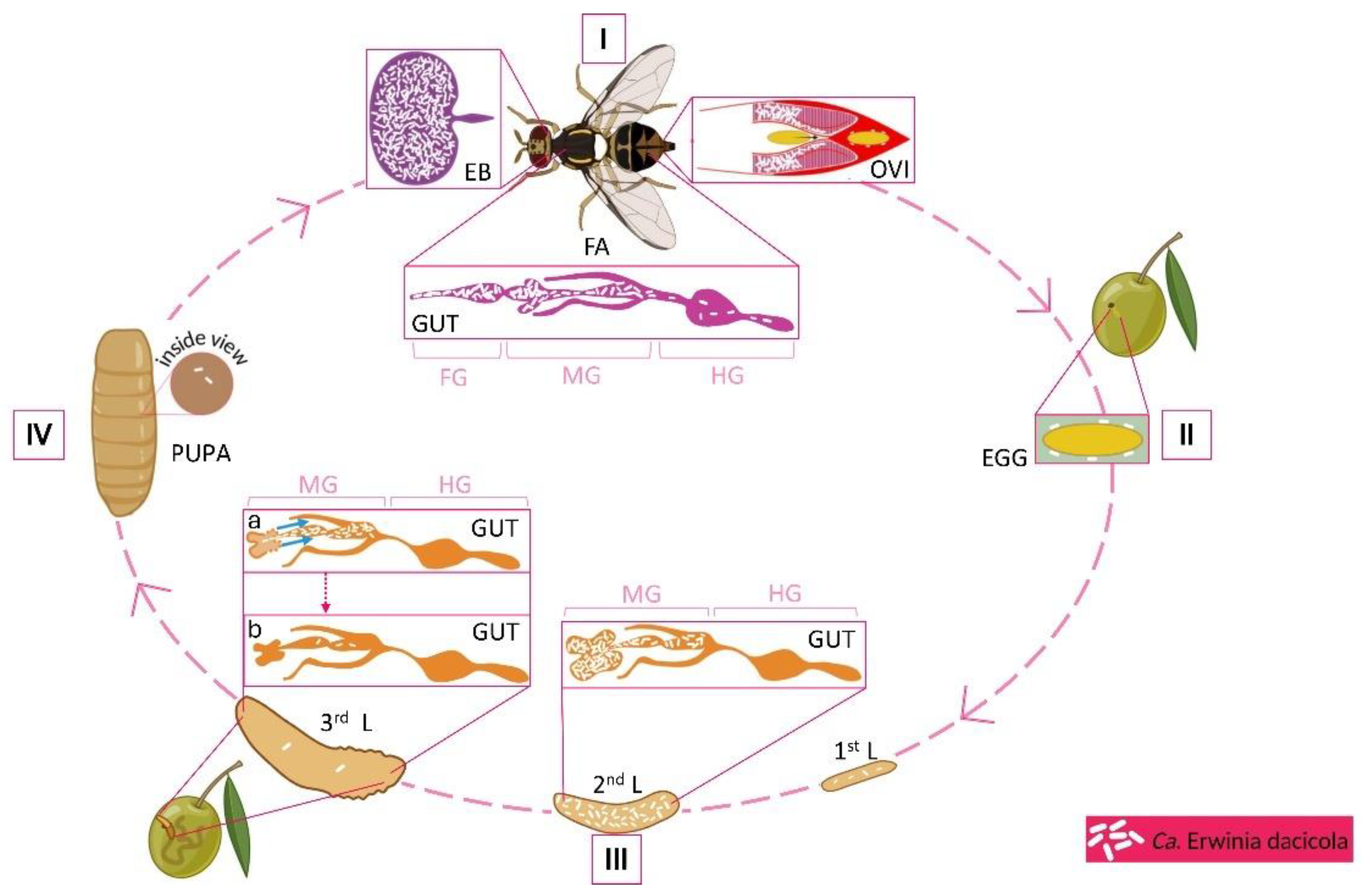

Table 1.
Results from studies testing anti-microbial compounds on Bactrocera oleae determining their effect on the symbiont Ca. E. dacicola.
Table 1.
Results from studies testing anti-microbial compounds on Bactrocera oleae determining their effect on the symbiont Ca. E. dacicola.
| Compounds & Treatment | Stage & Tissue Treated | Stage & Tissue Tested | Method for Determining Bacterial Abundance | Results | Comments | References |
| Antibiotic (100-200 ug ml-1 Piperacillin) Addition to food |
♀ Adults | Adult: dissected esophageal bulbs | Epifluorescence microscope Statistical analysis |
LD | [29] | |
| Antibiotic (200 ug ml-1 Piperacillin) Addition to food |
♀ Adults | 3rd instar larvae: gut | HTS Bacterial counts under microscope |
LD | Total bacterial community in the gut counted | [8] |
| Propolis 20% Copper 5% Copper Addition to food |
Adults Eggs |
Adult: dissected esophageal bulbs Eggs |
DNA extraction PCR & DGGE analyses RT-q-PCR Bioinformatics & statistical analysis |
Bulbs: SD (copper compounds) SI (propolis) Eggs: NC |
[48] | |
| Propionic acid solution (0.3 %PA) Mixture of sodium hypochlorite & Triton X (1:1 SHTX) Soaking |
Eggs |
Eggs: surface and rinse solution | DNA extraction & DGGE Stereomicroscope RT-q-PCR Scanning electron microscopy |
SD (All treatments) | Bacteria are lost even when eggs are washed with water | [43] |
| Antibiotic (0.08% Streptomycin) Addition to food |
Adults | Adult: dissected guts | DNA extraction and 16S rRNA gene amplicon library Sequencing Bioinformatics & statistical analysis |
NC | [9] | |
| Copper Oxychloride (0.5%, 0.1%, and 0.02% w/w) Fungal metabolite Viridiol (0.5% and 0.1% w/w) Negative control: antibiotic (Piperacillin) Addition to food |
Adults | Adult: head & abdomen | DNA extraction & qPCR Statistical analysis |
Heads: All treatments (≠ CO 0.02%): SD CO 0.02%: NC Abdomens: All treatments (≠ CO 0.02% & Vi 0.1%): SD CO 0.02% & Vi 0.1%: NC |
All treatments (≠ antibiotic and CO 0.02%): LD (total bacterial community) |
[46] |
| Copper oxychloride (3.75%) Dodine (52.9%) Tannins (0.13%) Flavonoids (2% propolis) Micronutrient EC fertilizer [Cu (2%) + Zn (4%) + citric acid (23.8%)] Sodium hypochlorite (NaClO 1%) Soaking |
Eggs Infested olives |
Larvae | DNA extraction & qPCR Statistical analysis | Egg treatment: LD: NaClO SD: All other treatments Olive treatment: SD/NC: All treatments |
Eggs exposed directly & indirectly | [47] |
| Copper nanoparticles (Cu-NPs) Copper oxide nanoparticles (CuO-NPs) Ethylenedia-minetetraacetic acid (EDTA) Copper hydroxide (Cu (OH)2) Deltamethrin (Decis 2.5 EC) Addition to food |
Adults | Adult: thorax – head & abdomen | Scanning electron microscopy DNA extraction & qPCR Statistical analysis |
SD/NC: All treatments | [49] | |
| 6-pentyl-α- pyrone 0.5%, 0.1% and 0.02% p/p (6PP) Harzianic acid 0.5%, 0.1% and 0.02% p/p (HA) Positive controls: A) Piperacillin (100 ug ml-1) B) Copper oxychloride (0.5%, 0.1% and 0.02% p/p) Addition to food |
Adults | Adult: dissected esophageal bulbs | Cloning (E.Coli vectors) qPCR Statistical analysis |
LD: Piperacillin, SD:0.5% HA & 0.5% Cu SI: 0.1% Cu NC: 0.02% HA & 0.02% 6PP |
[28] |
LD= Large Decrease, > 10-fold decrease, SD= Small Decrease, <10-fold decrease, NC= No Change, SI= Small Increase, ≠ different to.
Disclaimer/Publisher’s Note: The statements, opinions and data contained in all publications are solely those of the individual author(s) and contributor(s) and not of MDPI and/or the editor(s). MDPI and/or the editor(s) disclaim responsibility for any injury to people or property resulting from any ideas, methods, instructions or products referred to in the content. |
© 2025 by the authors. Licensee MDPI, Basel, Switzerland. This article is an open access article distributed under the terms and conditions of the Creative Commons Attribution (CC BY) license (http://creativecommons.org/licenses/by/4.0/).
Copyright: This open access article is published under a Creative Commons CC BY 4.0 license, which permit the free download, distribution, and reuse, provided that the author and preprint are cited in any reuse.